History lesson on foot

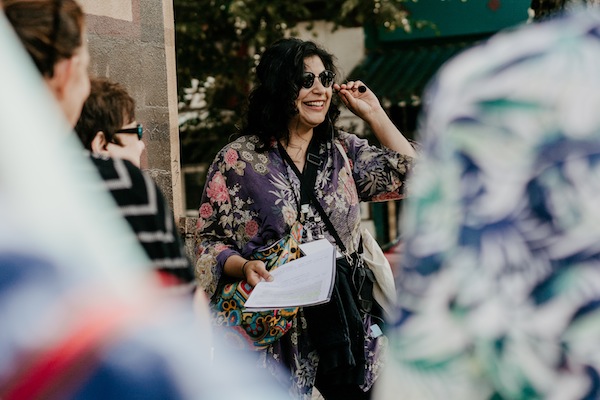
Tour organizer Carmel Tanaka at one of the tours last stops. (photo by Kayla Isomura)

The first Jewish neighbourhood in Vancouver was in Strathcona, which also served as the first home for many, if not most, cultural communities that make up the diverse fabric of the city. The neighbourhood welcomed wave after wave of immigrants of different backgrounds and continues to do so today. The rich multicultural history of this area – too often overlooked amid the social challenges of the larger Downtown Eastside – was given its due in a series of walking tours this spring.

Carmel Tanaka organized the tours, bringing together almost two dozen community organizations. Tanaka is chair of the human rights committee of the Greater Vancouver Japanese Canadian Citizens’ Association and an active member of the Jewish community, but the tour is an ad hoc, grassroots project with no umbrella organizing agency. Partnering agencies include Heritage Vancouver, the Dr. Sun Yat-Sen Classical Chinese Garden, the Nikkei National Museum and Cultural Centre, Vancouver Asian Heritage Month Society, the Jewish Museum and Archives of British Columbia and the Jewish Independent. The Cross Cultural Strathcona Walking Tour took place each Sunday in May, with two tours each day. Tanaka said she hopes to make the tour an annual event.

Tanaka came up with the idea after participating in a walk of Hogan’s Alley, Vancouver’s historic black neighbourhood, as part of Jane’s Walks, a global festival of citizen-led walking tours inspired by the late visionary urbanist Jane Jacobs. A week after her exploration of the neighbourhood’s black history, Tanaka took the Jewish Museum’s walking tour of Strathcona.

“We were walking similar streets and even talking about places that are right across the road from each other and I started to think, well, there must have been interaction between our communities,” she told the Independent. “Why not bring the guides, the experts, the archivists and the know-alls into one room and see if we can do something together. What started as a small group of four to five guides, who do existing tours, blossomed into 20-plus participating organizations, including community organizations, heritage organizations, the Vancouver School Board and more. We’ve been told there have been attempts to do something like this before, but not to this degree. It’s very exciting that we’re all working together.”

The tour, which took in Hogan’s Alley, Jewish Strathcona, former Japantown and Chinatown, was intended to build awareness of the contributions of immigrant communities then and now. It took place in May as part of the celebration of Vancouver Asian Heritage Month and Canada’s Jewish Heritage Month.

The theme of the walking tour this year was education and the starting point of the two-and-a-half-hour adventure was Lord Strathcona Elementary School, the city’s oldest. Referred to as the “League of Nations” for its diversity, the school remains one of the most multicultural in the country.

One former Strathcona student, Elder Larry Grant of the Musqueam Nation and Chinese-Canadian communities, recalled the experience of growing up in the area and the impact the cultural mosaic had on him and others.

Opened in March 1891 as East School, it was renamed in 1909 in honour of Donald Smith, Lord Strathcona, who drove the last spike in Canada’s first transcontinental railway. To get a sense of the extraordinary range of ethnicities, a survey in 1940 indicated that the students included 650 of Japanese descent, 300 Chinese, 150 Italian, about 150 Yugoslavian, Ukrainian and Polish students, about 100 of British descent, several from India and a scattering from other European countries. After the regular school day, many of the students would have proceeded to after-school programs in their heritage language at, for example, the Vancouver Japanese Language School and Japanese Hall, a 1906 building on Alexander Street where the tour finished.
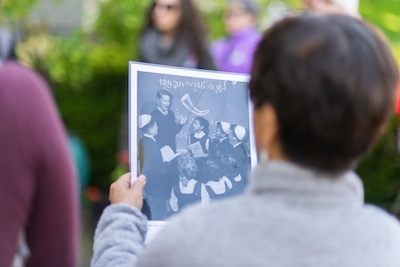
photo - A tour participant holds up a picture from the Talmud Torah Grade 4 class, circa 1965; Gita Kron, teacher
A tour participant holds up a picture from the Talmud Torah Grade 4 class, circa 1965; Gita Kron, teacher. (photo from Jewish Museum and Archives of British Columbia)

Jewish kids would have made their way down the block from Strathcona elementary to the B’nei Yehuda synagogue, since converted to condos but, at the time, the spiritual and figurative centre of Jewish life in the city. The synagogue opened in November 1911, with an after-school program in Jewish tradition. A full-time day school, Talmud Torah, opened there in 1921 and moved to its current location on Oak Street in 1948.

In 1942, when the Canadian government instituted a wartime policy against Japanese and Japanese-Canadians, about half of Strathcona school’s population disappeared, forcibly relocated to camps in the British Columbia interior and elsewhere east.

The tour featured different community guides at each destination along the route, bringing together a patchwork of knowledge about different communities to help participants form an impression about how different communities maintained their distinctiveness while interacting with the variety of cultures and languages around them.

Not far from the industrial waterfront, Strathcona grew, in part, from the maritime trade, especially the 1858 discovery of gold in the Fraser Canyon. But, as guides noted, the area has probably been a gathering place for thousands of years, initially as a summer campsite for the Musqueam, Squamish and Tsleil-Waututh First Nations. The 1858 gold rush, and successive ones further north, brought merchants from China and Jewish provisioners from San Francisco. Indentured labourers from China, who worked on the Canadian Pacific Railway, helped launch the beginnings of Chinatown in the area around Pender Street. Japanese, Portuguese and Italian immigrants followed, with many working in the Hastings Sawmill and other resource-related industries.

The tour passed the National Council of Jewish Women Neighbourhood House on Jackson Street, a locus of Jewish social activity that is seen as a precursor to the Jewish Community Centre. The Vancouver chapter of NCJW was founded in 1924 and helped new immigrants settle, learn English and find jobs. One of their landmark programs was the Well Baby Clinic, which immunized kids and helped new parents care for their families. National Council remains active today, providing services especially for families and youth, educational and advocacy programs around human trafficking and spreading awareness about Jewish genetic diseases.

Later, the tour passed Oppenheimer Park, named for the city’s first – and so far only – Jewish mayor, David Oppenheimer.

An important part of the tour was Hogan’s Alley. The creation of the Georgia Viaduct destroyed a large part of the historic black neighbourhood but Fountain Chapel, a branch of the African Methodist Episcopal church, still exists, though it is now a private residence.
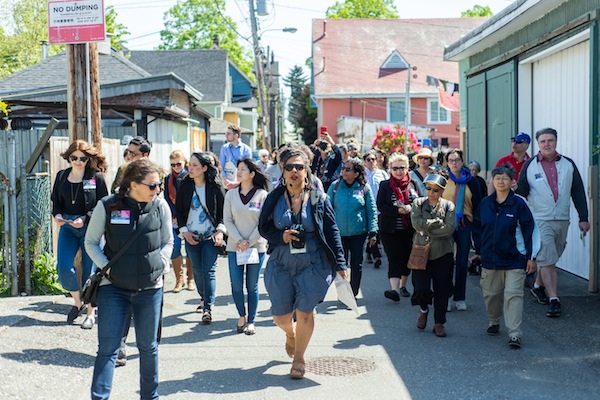
photo - Vanessa Richards of the Hogan’s Alley Society leads guests down Hogan’s Alley
Vanessa Richards of the Hogan’s Alley Society leads guests down Hogan’s Alley. (photo by Matt Hanns Schroeter)

From Hogan’s Alley, the old Canadian National Railway station looms large to the south, and it was the profession of Pullman porter, made up almost exclusively of African-American and black Canadians, that was a launchpad to the middle class for many black families. The development of the black neighbourhood in this location owed its origins to the proximity to the train station.

From there, the tour proceeded into Chinatown and the Dr. Sun Yat-Sen Classical Chinese Garden. A sawmill at the foot of Carrall Street, constructed in 1886, provided employment for many Chinese men and set in motion the establishment of Vancouver’s Chinatown on this block.

In 1947, the Chinese Immigration Act was repealed, rescinding a racist law and opening the door to more Asian newcomers and establishing equal rights, including the right to vote, for Chinese-Canadians. The tour also recalled how, in 1907, a group calling itself the Asiatic Exclusion League incited a mob of about 9,000 rioters who rampaged through Chinatown and Powell Street, smashing windows and destroying properties. This led to the federal government reducing immigration from East Asia.
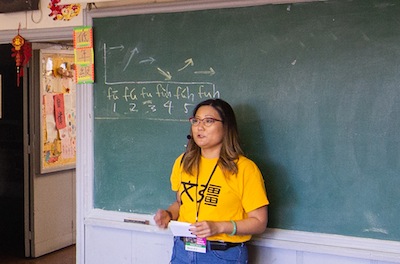
photo - Aynsley Wong Meldrum welcomes guests to the Mon Keang School in the Wongs’ Benevolent Association building
Aynsley Wong Meldrum welcomes guests to the Mon Keang School in the Wongs’ Benevolent Association building. (photo by Matt Hanns Schroeter)

The tour continued to the Mon Keang School in the Wongs’ Benevolent Association building, an example of a Chinatown clan society. These societies supported extended family members as they migrated, serving as housing agency, employment office, post office and bank for new arrivals. Chinese men could borrow money here to pay Canada’s discriminatory head tax and to send money home to their families in China.

Mon Keang School provided a classical Cantonese education to the first generation of local-born children and, in the 1930s, was just one of 10 such Chinese schools in the area. By the 1970s, Chinese families were living throughout the city and Chinese-Canadian kids were choosing sports and other extracurricular activities over Chinese school. Mon Keang School closed in 2011 but reopened in 2016 with a grassroots community program taking a different approach to Chinese language learning.

The history of Christian social action in the neighbourhood is demonstrated powerfully at the corner of Hastings and Gore, where the Salvation Army citadel, now boarded up, stands across from First United Church, a hub of social programs in the Downtown Eastside, and nearby Saint James Anglican, which also has a long activist history. While plenty of good work has emanated from these institutions, during the era of Indian residential schools in Canada, from 1883 to 1996, churches were complicit with the federal government in the genocide of indigenous Canadians through the deliberate and brutal attempts to exterminate indigenous cultures and languages.

The walking tour tries to highlight the main aspects of the area’s history, without romanticizing it.

“This is a grassroots initiative led by myself and a bunch of amazing, dedicated team members,” Tanaka said. “We’re really hoping that this will become an annual event and will be able to include even more communities next year. We’ll see what this turns into.”
A word chosen with care

Words matter. In a period when traditional media compete with social media, where everyone on the planet can pretty much find a place to say whatever they want, the weight of words can seem lost in the deluge of opinions, aspersions and insults. So, it is encouraging, in some ways, to see a pitched battle over the use of a single word. It assures us that many people still understand the power that language can have.

After the Truth and Reconciliation Commission’s 2015 final report, the federal government set up the National Inquiry into Murdered and Missing Indigenous Women and Girls. The MMIWG report, released last week, concluded that there are “serious reasons to believe that Canada’s past and current policies, omissions and actions towards first Nations peoples, Inuit and Métis amount to genocide….”

The use of the term genocide has sparked a debate. Top federal officials at first avoided using the word. At the ceremony marking the release of the report, Prime Minister Justin Trudeau was interrupted by an audience member who yelled, “Genocide! Say it!” Trudeau opted against it on that day, but he would use the term later in the week. Justice Minister David Lametti deflected discussion, saying he would leave the determination around the use of the term genocide “to academics and experts.”

The 1948 Genocide Convention defines it as “intent to destroy, in whole or in part, a national, ethnical, racial or religious group.” Raphael Lemkin, the Polish Jew who coined the term, described genocide as an effort to destroy the foundations of a national group with the objective of annihilation. While genocide certainly includes state-led mass murder, the term can also incorporate a range of less aggressively lethal acts, such as Canada’s residential schools system, the core goal of which was to eradicate indigenous cultures and languages among native peoples in the country.

The report identifies “colonial structures,” including the Indian Act, the Sixties Scoop, residential schools and offences against human rights, as antecedents to current rates of traumatic violence, suicide and deaths among indigenous populations.

The MMIWG report makes a series of recommendations, including, for example, that police services investigate officers for discrimination and mistreatment against indigenous peoples and failures to investigate crimes, government funding to improve recruitment of indigenous peoples into policing, a national task force to review and potentially reinvestigate every unresolved case and a standardizing of protocols around treatment of the thousands of missing and murdered women.

The chief commissioner, Marion Buller, chose the term genocide determinedly and used it throughout the report.

“This report is about deliberate race, identity and gender-based genocide,” she wrote in the opening paragraph of the final report.

However, the report also acknowledged that there are “outstanding disagreements” over the definition of the term. Alongside the final report came a 43-page legal analysis of the term genocide and how it applies to the Canadian situation.

The lead author of the legal assessment, Fanny Lafontaine, a specialist on international criminal justice and human rights at Université Laval, said, “I think it has to be understood as a very distinct type of genocide from the Holocaust…. Genocide is composed of lethal and nonlethal acts. All of that together leads to the physical destruction of indigenous people, but also as a social unit. It’s the genocide taken as numerous acts spanning decades, basically, that is the root cause of the violence against [indigenous] women,” she told the National Post.

RCMP statistics indicate that 16% of female homicides in Canada between 1980 and 2012 were perpetrated against indigenous women, who make up just 4% of the population. This is triple the rate of nonindigenous women and double those of indigenous men. Testimony from individuals and families that were incorporated into the final report tell a harrowing story of violence and dehumanization.

Some might say that the debate over the term genocide detracts from the urgent, less theoretical components of the report and its recommendations. Maybe. But the considered choice by those who best understand the social impacts of systemic discrimination against indigenous Canadians, especially indigenous women, to use the term genocide should give us pause. Among Jewish observers, there may be an understandable sensitivity to anything that seems to shift the weight of the word, which was created specifically to articulate the Jewish experience in the Shoah. Yet, we should also take this opportunity to learn and understand why and how a community in our midst would articulate their own experiences as amounting to genocide.

Knee-jerk responses are not helpful on this front (or any, probably) and, while the arguments over the meaning and intent of the term reassure us that people still appreciate the power of words, we might also caution not to get stalled over this debate. What non-indigenous Canadians should do at this point – especially if we have an issue with the use of the term genocide – is to dive deeply into the tragic legacies of colonialism that have led to this moment and try to understand why this term was carefully chosen. Perhaps, we can each start with a commitment to read the report.

Reflections on parenting

So, I’m thinking about the times of our growing up, and who did what in the story of our lives. We never think much about it while it’s happening, during the years when we are coming to our senses. During those times, we are too busy trying to figure out what’s going on.

This process has always fascinated me, wondering what I was thinking. I can’t remember any details about how it was for me. Do you ever wonder how we ended up in the particular places we were, with the people with whom we were packaged? Do you ever wonder how it was that these particular people came to inhabit your life?

Didn’t we just take for granted what was happening all around us as we were growing up, and just went on from there? But, let’s face it, the operation of our lives didn’t just happen. Somebody was out there doing the heavy lifting for us while we just floated along with the tide. It may take us a lifetime to figure that out and to begin to appreciate how generous other people have been, with what may have been meagre resources, in the making of our lives. I remember I resented, for the longest time, never having had any choice about the particular place in which I found myself. I couldn’t wait to get out of that place into one of my own making. Are all of us that arrogant as to our imagined rights at that young age? Did you ever have similar disloyal thoughts?

I think about the roles I had in bringing up my own children. I get the feeling that I sleepwalked through that job, concentrated as I was on making the best of my career opportunities. How much of that was ego and how much of that was an inbred drive, an absorbed imperative to provide for my dependents? I always told myself that they were the ultimate beneficiaries of my misguided priorities. My dependents may have a different view.

How much time did I spend preparing them to cope with the demands of a sometimes hostile world? Did I spend enough time counseling them as to how they might overcome the challenges they were sure to face? Did I do enough beyond providing food, clothing and housing? Was it enough? Did I do a better job than my parents did, as I was convinced I could? Didn’t I have a greater capacity to do that, so that so much more was expected?

I’ve never talked to my kids much about these concerns. Now I am a little hesitant about broaching the subject. I fear the memories they might have would have them judging my behaviour as bordering on neglect. Horrors! Did I do enough of the heavy lifting that was required? Do you people out there ever think about this stuff? Don’t we all console ourselves with the thought that we always did our best under the circumstances? Do we dare ask our kids about that?

If we look at nature, at the way creatures go about raising their young, it is clear that, in most cases, mammals and birds will, like humans, protect and nourish their young during their vulnerable periods, even to the point of surrendering their lives if need be. For wild creatures, the pains they go to, making nests and burrows, hunting and gathering food, seem without limit, commandeered by instinct. And the young learn by following their parents’ example. For humans, that period of vulnerability is so much longer. And what our young have to learn is so much more complex.

I always thought I would do better when my turn came, only to realize on maturity how the many gifts I had been given by my parents would challenge my own capacities to match them with my own brood. We know what a difference parental attendance can make in an offspring’s future.

How many parents stick with a job they hate to put bread on the table? How many parents stay in a relationship they loath to keep a roof over the heads of their young? Most just keep on doing what they have to do, day after day, year after year. That’s heavy lifting!

How many parents abandon places where they know all the rules for the unknown, in the hope of ensuring their children will have a better chance at life? How many jump off into danger in the hope of finding a better life? We are hearing a lot about that these days at the Unites States’ southern border. And at many European borders for the last several years. Didn’t most of us have it a lot easier?

How do we define what we owe ourselves and what we owe to those we are responsible for bringing into this world? How many of those rules come from outside ourselves, absorbed from our parents, from our communities? (What a hierarchy of social imperatives I inherited just by being born Jewish! What was in your birth box?) Or, like other creatures, do we mostly act out of instinct? We see all kinds of behaviours. And we can’t help judging what we see, whatever our own performance has been, with whatever tatters of standards remain to us.

Now, no longer under the gun, and seeing things with a broader perspective, what do we do now? Do we think we have the right to butt in on our offspring with our own views about how things should go? How do you think we would feel if we were in their place? Isn’t it obvious? Do we have the wisdom to wait to be invited to comment? Will that invitation ever come?

For many of us, the heavy lifting is now in other hands.

Max Roytenberg is a Vancouver-based poet, writer and blogger. His book Hero in My Own Eyes: Tripping a Life Fantastic is available from Amazon and other online booksellers.

Dali artwork on display

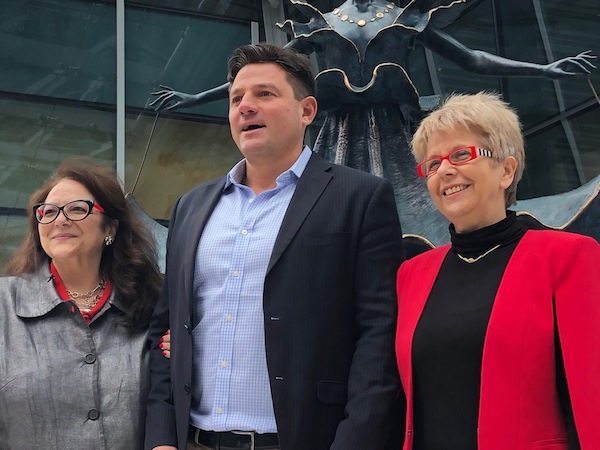
Left to right: Oree Gianacopoulos, Chali-Rosso Gallery director; James Sanders from Dali Universe (Switzerland); and Susanna Strem, president of Chali-Rosso Gallery. (photo by Shula Klinger)

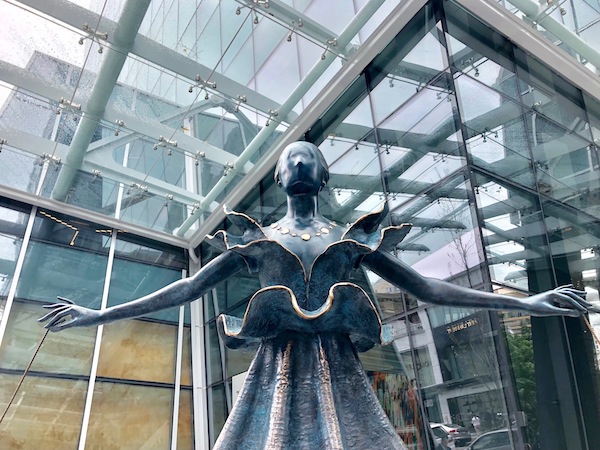
May 17 and 18 saw the unveiling of two sculptures by Spanish surrealist Salvador Dali, which will be on display until September. The sculptures were brought to Vancouver by the Chali-Rosso Gallery on Howe Street, the site of the annual Definitely Dali exhibition. More than 100 Dali originals are on display at the gallery, along with 20 smaller versions of Dali’s bronzes.

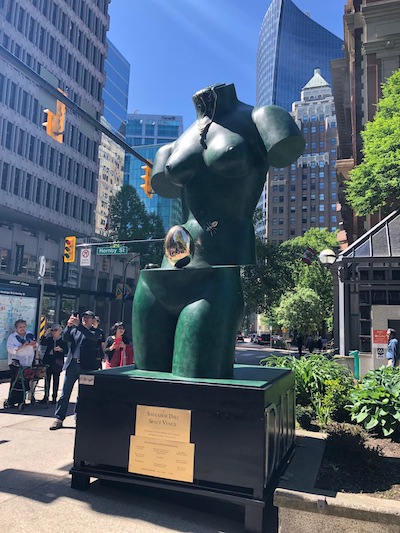
On May 17, “Dalinian Dancer” was revealed at the corner of Thurlow and Alberni. “Space Venus” was unveiled on the next day at Lot 19, on West Hastings at Hornby. The unveilings were accompanied by flamenco music, which Dali loved.

Oree Gianacopoulous, Chali-Rosso’s director, spoke before the unveiling of “Space Venus.” Describing it as one of Dali’s “iconic” pieces, she expressed her gratitude to Beniamino Levi, director of Dali Universe, the foundation that lends out the artwork. Levi worked with Dali himself to develop the collection of 29 sculptures.

This is the third year that Dali sculptures have traveled to Vancouver, under the leadership of Chali-Rosso president Susanna Strem, a member of the Jewish community. Working in close collaboration with Dali Universe in Europe, which loaned the sculptures to Chali-Rosso, Strem’s initiative has helped establish a new cultural tradition for the downtown core.

This year, the gallery also worked with Virtro Games to develop a smartphone application to enhance viewers’ experience of the sculpture. Definitely Dali is an augmented reality app – when a phone camera is focused on the image of Dali’s face, the dancer begins to move her arms and spin.

Alex Lazimir, who developed the app, talked about the privilege of spending many hours looking at Dali’s dancer. “I really like this piece because it was like going into Salvador Dali’s mind. The first thing I thought was that she has to be spinning.”

photo - Salvador Dali’s “Dalinian Dancer” can be found at the corner of Thurlow and Alberni
Salvador Dali’s “Dalinian Dancer” can be found at the corner of Thurlow and Alberni. (photo by Shula Klinger)

After the unveilings, Chali-Rosso hosted a champagne reception and a talk by James Sanders of Dali Universe (Switzerland). With reference to the sculptures at the gallery, Sanders spoke about Dali’s life and the tremendous influence of his surreal imagination on the world of art. Sanders is responsible for sourcing locations, sponsors and partners for exhibitions all over the world.

Originally from Europe, Strem came to Canada 25 years ago, via a spell in Israel. Formerly an information technology professional, Strem spoke about the challenge of bringing world-class art to public spaces in Vancouver.

“These sculptures are traveling all over the world. They’re exhibited in many major cities. Vancouver has to compete with cities like New York, London and Paris. These are major art hubs, so we are very happy that we managed to get two sculptures.”

Last year, Definitely Dali featured “Woman in Flame” and “Surrealist Piano.” More than three million visitors saw the sculptures.

Bringing monumental works of art here is a labour of love, however. “It takes almost a year to organize something like this,” said Strem. “Last year, when we had two other sculptures here, we were already talking about this year’s exhibition. It all depends on what is available and circumstances in other cities.”

The logistics of moving bronzes like “Space Venus” – which is 3.5 metres high – can be tough. “These sculptures were transported by ocean freight from Italy, then traveled through the Atlantic to the Panama Canal, up the Pacific Ocean past Mexico and California to Vancouver,” she said. “It’s a long journey. We experienced a delay. There was a traffic jam in the Panama Canal.”

photo - “Space Venus” by Salvador Dali has been placed in Lot 19, on West Hastings at Hornby
“Space Venus” by Salvador Dali has been placed in Lot 19, on West Hastings at Hornby. (photo by Shula Klinger)

These exhibits are both the impetus for, and a sign of, urban growth – “for a real city,” said Strem, “public art is a natural part of its evolution.” She spoke of the collaboration with the Downtown Business Improvement Association. “They were full-force behind it from day one, which helped motivate us. They were really enthusiastic,” she said.

Part of Chali-Rosso’s community involvement includes supporting Recovery Through Art, a charitable organization in Vancouver that gives individuals struggling with mental illness and addiction a chance to heal through the creation and appreciation of art.

Strem is already seeing the impact of the Dali pieces on public display. “If somebody is looking at their phone and they walk by 10 times but, this time, they look up and their face changes, even for a fleeting moment, that’s important. Or they might stop for 30 minutes. There are many ways to enjoy art,” she said.

Strem explained that, to truly become part of life, art should not just be locked away in special locations.

“It’s not about having a destination for art, where you allocate time and energy to it,” she said. “When we don’t engage with art like this, in public, people are missing out.”

Shula Klinger is an author and journalist living in North Vancouver. Find out more at shulaklinger.com.


Not long ago, not far away

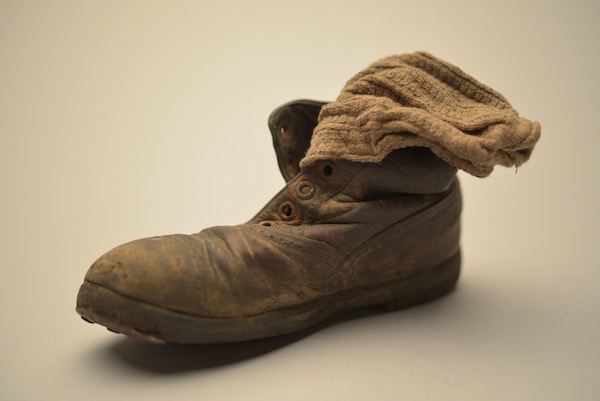
This child’s shoe and sock were found in January 1945 among thousands of others at Auschwitz-Birkenau, abandoned by the Nazis as the Red Army approached. (photo from Collection of the Auschwitz-Birkenau State Museum, Oswiecim, Poland. ©Musealia)

On display now at the Museum of Jewish Heritage in New York City, the exhibit Auschwitz: Not Long Ago. Not Far Away is the most comprehensive Holocaust exhibition ever mounted in North America about Auschwitz. Dedicated to the victims of the death camp, the goal of this exhibit is to make sure no one ever forgets.

A study conducted by the Conference on Jewish Material Claims Against Germany reported that 41% of Americans and 66% of millennials say they don’t know about the Auschwitz death camp, where more than a million Jews and others, including Poles, Sinti and Roma, Soviet prisoners of war, homosexuals, Jehovah’s Witnesses and others, were executed. And 22% of millennials say they haven’t even heard of the Holocaust.

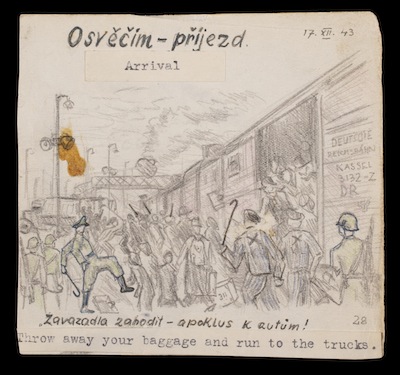
image - Artist Alfred Kantor’s depiction of arrival in Auschwitz: “Throw away your baggage and run to the trucks”
Artist Alfred Kantor’s depiction of arrival in Auschwitz: “Throw away your baggage and run to the trucks.” (photo from Gift of Alfred Kantor, Museum of Jewish Heritage, N.Y.)

“Seventy-three years ago, after the world saw the haunting pictures from Auschwitz, no one in their right mind wanted to be associated with the Nazis,” Ron Lauder, founder and chair of the Auschwitz-Birkenau Foundation Committee and president of World Jewish Congress, said. “This exhibit reminds them, in the starkest ways, where antisemitism can ultimately lead and the world should never go there again. The title of this exhibit is so appropriate because this was not so long ago, and not so far away.”

The exhibition consists of 20 galleries spanning three floors, and features more than 700 original objects and 400 photographs. They are on loan from more than 20 institutions and private collections around the world, as well as the Auschwitz-Birkenau State Museum in Poland.

An audio guide given to each visitor upon entry details the items on display. Visitors will see hundreds of personal possessions, such as suitcases, eyeglasses, photos, shoes, socks and clothes that belonged to survivors and those murdered at the concentration camp. In one glass case, a child’s shoe is on display with a sock neatly tucked inside. We are left to wonder, who put that sock in the shoe and were they expecting the child to shower and then retrieve it?

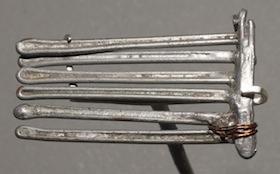
photo - Determined to survive, and to have a head of hair again one day, Ruth Grunberger made this comb for herself in Auschwitz, using stolen scrap metal and wire
Determined to survive, and to have a head of hair again one day, Ruth Grunberger made this comb for herself in Auschwitz, using stolen scrap metal and wire. (photo from Collection of the Museum of Jewish Heritage. Gift of Ruth Mermelstein, Yaffa Eliach Collection donated by the Centre for Holocaust Studies.)

Auschwitz was located 31 miles west of Krakow in the small southern Polish town Oswiecim, which dates back to the Middle Ages. Jews were a part of its society for centuries. Auschwitz-Birkenau was conceived and initially constructed to house 100,000 Soviet prisoners of war and slave labour, before it became a factory of death. The architect who designed the camp was Fritz Ertl, a native of Austria. Ultimately, some 1.1 million Jews and thousands of others were killed there. Many who arrived at Auschwitz were sent directly from the overcrowded, sealed, windowless boxcars to the gas chambers and crematoriums.

There are videos throughout the exhibit, including one of Hitler and a large adoring crowd. There’s a concrete post that was a part of the fence at the Auschwitz camp, and a part of the original barrack for prisoners at the killing centre.

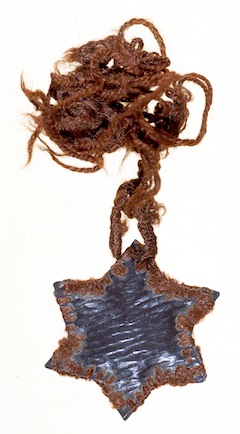
photo - Margit (Manci) Rubenstein made this Star of David necklace from material taken from the lining of her shoes and shoelaces while imprisoned in Auschwitz (1944)
Margit (Manci) Rubenstein made this Star of David necklace from material taken from the lining of her shoes and shoelaces while imprisoned in Auschwitz (1944). (photo from Collection of the Museum of Jewish Heritage. Gift of Sugar siblings in memory of Rosenfeld and Schwartz families.)

A German-made Model-2 boxcar, like those used to transport people to Auschwitz, sits outside the museum. In a video, survivors talk of the horrible conditions and stench inside those boxcars.

Viewers can see the operating table, test tubes and instruments used in medical experiments. There’s a gas mask used by the SS and a model of a gas chamber door used in crematoria 2, 3, 4 and 5 – and testimonies from survivors of the camp. To show the striking contrast between the victims and the perpetrators, there are photos of Rudolf Hess at his nearby residence with his family enjoying the outdoors.

Nazi ideology and the roots of antisemitism are traced from the beginning, to understand what happened before the gas chambers were created. Discrimination and bigotry against Jews existed long before Hitler came into power, of course. In one room, there’s an anti-Jewish proclamation issued in 1551 by Ferdinand I that was given to Hermann Göring for his birthday by German security chief Reinhard Heydrich. The proclamation required Jews to identify themselves with a yellow ring on their clothes. Heydrich noted that, 400 years later, the Nazis were completing Ferdinand’s work.

In a video seen near the end of the exhibition, Holocaust survivors urge people to refrain from hate and to work for peace.

This exhibition was in Madrid before coming to New York. This important and moving must-see exhibition is both a reminder and a warning.

Alice Burdick Schweiger is a New York City-based freelance writer who has written for many national magazines, including Good Housekeeping, Family Circle, Woman’s Day and The Grand Magazine. She specializes in writing about Broadway, entertainment, travel and health, and covers Broadway for the Jewish News. She is co-author of the 2004 book Secrets of the Sexually Satisfied Woman, with Jennifer Berman and Laura Berman.

***

Located in the Museum of Jewish Heritage, at 36 Battery Place, entry to the exhibit Auschwitz: Not Long Ago is by timed tickets available at mjhnyc.org. An audio guide is included with admission, and tickets range from $10 to $25. Hours are Sunday to Thursday, 10 a.m.-9 p.m. (last entry at 7 p.m.), and Friday, 10 a.m.-5 p.m. (last entry at 3 p.m.). The exhibit will be in New York until January 2020.

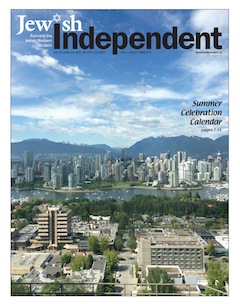
The 2019 Summer Celebration cover photo

photo - Baila Lazarus, z"l
Baila Lazarus, z”l

image - 2019 Summer Celebration cover

(photo by Cynthia Ramsay)

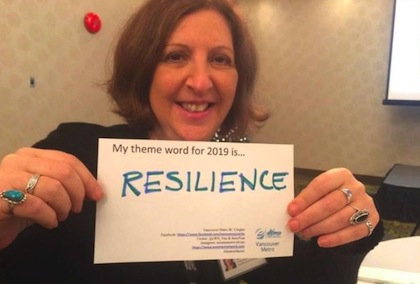
This year’s Summer Celebration cover photo was taken from the Vancouver General Hospital palliative care unit’s outdoor garden, on the 16th floor of the Jim Pattison Pavilion. It is dedicated to our dear friend and colleague Baila Lazarus who, at the age of 57, died at the hospital on May 31, due to complications of multiple myeloma. She was resilient to the end. May her memory be for a blessing.

Chocolate babka debacle

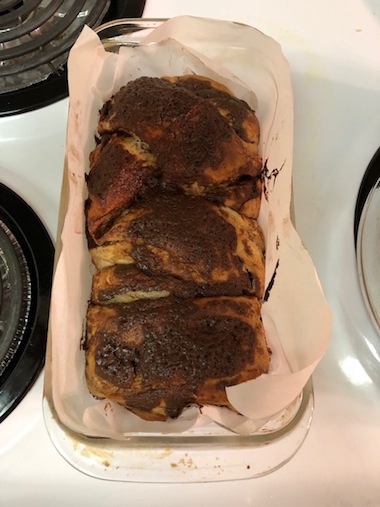
Babka gone bad: The Accidental Balabusta’s first attempt at this Jewish treat was less than a stellar success. (photo by Shelley Civkin)

After I conquered challah and cholent, I felt it was time to tiptoe into the forbidden realm of babka. I say the word with a great deal of reverence, because, well, if you’ve ever eaten a spectacular babka, you know it’s something awe-inspiring. There are limitless variations of babka: chocolate, Nutella, boozy, apricot and cinnamon, pumpkin, butterscotch and more. I even found a recipe for babka ice cream sandwiches and babka bread pudding. This is not diet food. Never was. Never will be.

Babka is comprised of a basic challah dough or a butter challah dough. Every recipe is different and, sometimes, to achieve the perfect babka (which I am far from accomplishing) you need to do a bit of mixing and matching of recipes.

My first attempt at making chocolate babka was an unmitigated disaster. Not only was my dough so velvety soft that I couldn’t even roll it, but the filling was so thin that it smooshed out all over the place. Part of the problem was math. I have always been math challenged. In fact, I have a pair of socks that say: “The three things I hate most are math.” My brain shuts down when faced with mathematical conversions (yes, I know there are apps for that). Long story short, I mistakenly used a half-pound of butter instead of a half-cup of butter for my babka dough. Hence, the flaccid, unresponsive dough. Nobody likes flaccid dough. Most people don’t even like the word flaccid. Except sex therapists. Anyway….

My other challenge was not realizing that you have to refrigerate the dough for a bit before rolling it out and filling it. There are tons of YouTubes on how to make babka – I recommend viewing several of them before attempting this at home. Also, check out lots of Jewish cookbooks, too. I stress “Jewish” because we Jews know how to accentuate the caloric value of our food so that it tastes impossibly rich and irresistible. Jewish baking is famous for a reason. If a recipe calls for eight ounces of dark chocolate, what the hell, 12 ounces must be better. Half a cup of butter – why not half a pound? Don’t bother pointing it out. I see the error of my ways.

If my first attempt at babka was less than a stellar success, it’s not just because of the aforementioned infractions. My main excuse is my miniscule galley kitchen. I lay the blame squarely where it belongs: on the almost-nonexistent counter. Things are so squished in my kitchen that there’s very little room for food. Or utensils. Take, for example, my long, articulated spatula. It’s the perfect implement for shmearing the chocolate onto the dough before rolling it up. I digress.

Back to the babka. I started shmearing the chocolate and, part way though, I had to sneeze. So, I put the long spatula into the bowl with the melted chocolate sitting on my teeny, tiny counter. The sheer force of my sternutation – it was probably a 7.8 on the Richter scale – caused the chocolate-covered spatula to fly out of the bowl and splatter chocolate everywhere, and I mean everywhere. It ended up on the walls, the floor, me, the counter, the carpet and Harvey, who looked on in mute husbandly horror. It was like something out of a slasher movie. Except the splatter was 85% bittersweet cacao chocolate instead of blood. I could have been arrested for assault with a confectionery weapon. All that was missing was the yellow police tape.

As if that wasn’t enough, the excitement of it all caused me to knock the recipe into the sink, which was filled with dirty bowls and brown water. At that point, I almost cried. But I didn’t. Instead, I casually looked at my chocolate-covered hubby and said: “OK, no one died. I’m going to try again.” I was determined not to let this babka get the better of me. I was going to show it who was the boss.

After wiping chocolate off my face, the walls and the counter (I may have licked the counter), I rolled up the flaccid babka, shoved it into the fridge and poured myself a teeny, tiny single malt Scotch. Just to shore up my nerves. Once I’d consumed the liquid fortification, I took out the babka, sliced it down the middle lengthwise, which is kind of difficult when it’s not really a shape, and proceeded to twist it so that that the layers of dough and chocolate showed on the outside. Then, I carefully laid it to rest in a parchment-lined coffin. I mean loaf pan. Said Kaddish.

photo - Babka gone better: Subsequent babka attempts were more successful
Babka gone better: Subsequent babka attempts were more successful. (photo by Shelley Civkin)

Since I’d made enough dough for about 15 babkas (by mistake, of course … remember my math impairment?), I now had to figure out what to do with the rest of it. I was tempted to sell it on Craigslist, but how would I even describe it? “Blob of velvety soft dough for sale. Nearly house-trained. Enough to make several loaves of bread or a small border wall. If frozen. Pick-up only. $10 obo.” In all honesty, I would have paid someone to take it off my hands at that point.

Stuck with all that dough, I shmeared and shaped the rest of it into circles, rectangles and free-form sculptures, jammed them into every available pan I had, and shoved them into the oven to bake. The entire procedure took about 11 hours. My bone graft and tooth implant took less time. I think I started the whole process at around 9 a.m. and didn’t remove the final “babka” (I use that word loosely) until around 8 p.m. Of course, I’m also factoring in the time it took the restoration team to steam clean our entire apartment. Should have just moved.

By that time, there was no way I was making dinner. So, we ate three-quarters of one chocolate babka for dinner. Slathered in even more butter. I think I may have sent both of us into a slight sugar coma. Not sure. No paramedics were called, so it couldn’t have been that traumatic.

I put the rest of the evidence into the freezer, for when I want to scare some unsuspecting dinner guests. I promise, here and now, that my next foray into babka-making will start with single malt Scotch.

If I’m lucky, it may end there, too.

Shelley Civkin, aka the Accidental Balabusta, is a happily retired librarian and communications officer. For 17 years, she wrote a weekly book review column for the Richmond Review, and currently writes a bi-weekly column about retirement for the Richmond News.

Wonders of asparagus

(photo from pixnio.com)

In Israel, asparagus is not widely seen in the outdoor markets but, when it is, I am always happy to buy it. There are at least 10 reasons why we should eat more asparagus.

  1. It contains lots of fibre, making it a good choice if you’re trying to lose weight, because your body digests fibre slowly, which keeps you feeling full in between meals. (It is also low in fat and calories: one cup is a mere 32 calories.)
  2. It contains high levels of the amino acid asparagine, making it a natural diuretic. In other words, eating more of the spears can help flush excess fluid and salt from your body, which may help prevent urinary tract infections.
  3. It is full of antioxidants that could help your body fight free radicals.
  4. It contains vitamin E, another important antioxidant, which helps strengthen your immune system and protects cells from the harmful effects of free radicals.
  5. It is a natural aphrodisiac, thanks to vitamin B6 and folate.
  6. The minerals and amino acids in asparagus extract may help ease hangovers and protect liver cells from the toxins in alcohol.
  7. It beats bloating by promoting overall digestive health – another benefit of all that fibre. And, thanks to prebiotics, which encourage a healthy balance of good bacteria, or probiotics, in your digestive tract, it can also reduce gas. Relatedly, since asparagus is a diuretic, it helps flush excess liquid, combating belly bulge.
  8. It’s a rich source of folic acid, providing 22% of the recommended daily allowance of folic acid.
  9. It’s filled with vitamin K, crucial for coagulation, which helps your body stop bleeding after a cut, as well as bone health.
  10. It boosts your mood because it is full of folate, a B vitamin that could lift your spirits and help ward off irritability. Asparagus also contains high levels of tryptophan, an amino acid that has been similarly linked to improved mood.

Need I say more? Buy asparagus with straight stalks, closed compact tips and good green colour. Keep refrigerated and use within one or two days. Bend the stalk near the bottom to snap off the part that is too tough to eat. Cook in one inch of boiling salt water. Let the water boil again and cover. Cook whole stalks about five minutes and cut-up pieces about three minutes. Here are some ways to use asparagus.

VINAIGRETTE

1/4 cup olive oil or canola oil
1 tbsp red wine vinegar
1 tbsp Dijon mustard
1/2 tsp sugar
salt and pepper to taste

Combine all ingredients in a blender and mix for one minute. Pour over cooked asparagus.

MICROWAVED IN LEMON BUTTER DIJON SAUCE
(3-4 servings)

2 1/2 tbsp canola or olive oil
1 tbsp lemon juice
2 tsp Dijon mustard
1/2 tsp low-sodium soy sauce
1/2 tsp minced garlic
2 tbsp minced white onion
salt and pepper to taste
1/2 pound asparagus
chives or green onions for garnish

Arrange asparagus in a microwave steaming bag. Add oil, lemon juice, mustard, soy sauce, garlic, onion, salt and pepper. Microwave four to five minutes; let stand one minute. Place in serving bowl and garnish with chives or green onion.

FLAMANDE SAUCE
6 servings

4 mashed hard-boiled egg yolks
1/4 cup + 2 tbsp olive or canola oil or 1/2 cup melted margarine or butter
1/4 cup minced fresh parsley

Whisk oil or butter or margarine into egg yolks in a saucepan. Add parsley and heat sauce. Pour over cooked asparagus.

STEAMED WITH TARRAGON SAUCE
(6 servings)

1 1/2 pounds trimmed asparagus
2 tsp olive oil
6 thinly sliced scallions
1 1/2 tbsp chopped fresh tarragon or 3/4 tsp dry tarragon
3 tbsp lemon juice or cider vinegar
dash sea salt
3 tbsp water

Steam asparagus two to five minutes, rinse, drain and place in serving bowl. Heat oil in a pan and sauté scallions one to two minutes. Add tarragon, lemon juice or vinegar, salt and water; cook one to two minutes. Pour over asparagus.

Sybil Kaplan is a journalist, lecturer, book reviewer and food writer in Jerusalem. She created and leads the weekly English-language Shuk Walks in Machane Yehuda, she has compiled and edited nine kosher cookbooks, and is the author of Witness to History: Ten Years as a Woman Journalist in Israel.

ללכת עם ישראל

קהילת היהודים בטורונטו מפגינה עמדת כוח של תמיכה בישראל

למעלה משלושים אלף איש צעדו בדאון טאון טורונטו לאחרונה בפרוייקט השנתי: “ללכת עם ישראל”. זאת הפגנת עמדת כוח לתמיכה במדינת ישראל. מדובר באחד מאירועי התמיכה בישראל מהבולטים ביותר עולם, כמובן אחרי קהילת היהודים של ניו יורק.

לפי הערכה למעלה מארבע מאות אלף יהודים חיים כיום בקנדה. מדובר בעצם באחת מקהילות היהודים הגדולות בעולם מחוץ לישראל. במקום השני ארה”ב, אחרי כן עדיין צרפת ואולי גם רוסיה ולאחר מכן במקום המכובד קנדה.

קהילת היהודים בקנדה נחשבת לתומכת בישראל לפי מחקרים של אוניברסיטאות טורונטו ויורק, ואפילו אולי יותר מיהדות ארה”ב? לא בטוח שהנתונים נכונים, אך בוודאי בכל קהילה של יהודים בעולם רוצים לחשוב ולקוות שהם התומכים הגדולים ביותר של ישראל.

הקהילה היהודית בקנדה היא קהילה חזקה ומבוססת ובעלת השפעה בקנדה, בתחומים הפוליטיים, הכלכליים ועוד. זאת בעיקר ערים הגדולות של קנדה בהם מרוכזים מרבית היהודים: טורונטו ומונטריאול. בערים מרכזיות אחרות בקנדה מספר היהודים נחשב לקטן ויש להם פחות משמעות. מדובר בערים כמו: ונקובר, אוטווה, קלגרי, אדמונטון וויניפג.

שגריר ישראל בקנדה, נמרוד ברקן, מסר לעיתון ידיעות אחרונות כי אם גורמים בישראל ימשיכו לדחוק את היהודים הקונסרבטיבים והרפורמים, ישראל תשלם מחיר על כך בקנדה. ליהודי קנדה הפלורליזם היהודי מאוד חשוב יש לזכור.

לפי נתוני שגרירות ישראל בקנדה: כארבעים אחוז מהיהודים במדינה הם אורתודוכסים, כארבעים אחוז מהיהודים הם קונסרבטיבים וכעשרים אחוז מיהודים הם רפורמים. למעלה ממחצית היהודים בקנדה (כחמישים וחמישה אחוז) שולחים את ילדיהם למערכת החינוך היהודית. על סדר יומה של הקהילה היהודית בקנדה, בדומה לקהילות יהודיות אחרות בעולם: אנטישמיות הגואה, ביטחון, הדור המזדקן, הגברת המעורבות של דור העתיד, הקמת הנהגה חדשה והקשר עם ישראל.

בממשלה הפדרלית הקנדית של המפלגה הליברלית בראשות ג’סטין טרודו, מכהנים כיום שני שרים יהודים: השר לגיוון סחר חוץ, ג’ים קאר והשרה למוסדות הדמוקרטים, קרינה גולד. בבית הפרלמט הקנדי יש שישה חברי פרלמנט יהודים (בהם יו”ר ועדת החוץ ויו”ר האגודה הפרלמנטרית קנדה-ישראל, מייקל לוויט). בבית המשפט העליון שמכיל תשעה שופטים מכהנים שני שופטים יהודים.

ראש הממשלה, ג’סטין טרודו, נחשב לידיד הקהילה אם כי הוא רחוק מאוד מראש הממשלה הקודם, סטיבן הרפר, שנחשב בשעתו למנהיג התומך ביותר בישראל מקרב כל מנהיגי העולם. הרפר בנסיעתו לישראל העמיס על מטוס הממשלה משלחת גדולה של כמאתיים איש ומרביתם יהודים. טרודו השתתף לאחרונה באירוע ההצדעה לישראל שנערך בטורונטו, במלאת שבעים שנה לקשרי קנדה וישראל. באירוע טרודו נאם ויצא בחריפות נגד האנטישמיות וכן גינה את תופעת הבי.די.אס הגואה בקנדה בשנים האחרונות. במהלך ביקורו בקנדה של נשיא המדינה, ראובן ריבלין, נפגש עמו טרודו לא פחות מארבע פעמים. לפי הערכות טרודו מחפש את הקול היהודי לקראת הבחירות הפדרליות שיערכו בעשרים ואחד באוקטובר.

 לפי הערכת שגרירות ישראל בקנדה מספר הישראלים בקנדה עומד כיום על יותר משבעים אלף. מטבע הדברים מרביתם חיים בטורונטו. בנוסף אליהם בשנים האחרונות הגיעו לקנדה קרוב לכארבעים אלף יהודים מארצות חבר העמים. מרביתם כנראה גרו קודם לכן בישראל.

הקונסוליה הישראלית בטורונטו אגב נחשבת לאחת מהעמוסות בעולם וזאת לאור הגידול המתמיד במספר הישראלים המהגרים לקנדה, בין אם בגלל עבודה או רצון לשפר את איכות החיים.

יצויין כי המגבית היהודית של טורונטו מגייסת מדי שנה כשישים מיליון דולר, ומהם כעשרים מיליון מועברים לסיוע בפרוייקטים שונים בישראל, בעיקר בפריפרייה.

King David set for expansion

Architects Acton Ostry, who designed the original building of King David High School, are back for the expansion. (image from KDHS)

Bucking a trend that is seeing Jewish day schools across North America struggling to maintain enrolment, Vancouver’s King David High School is about to launch an expansion that will grow the space by 40% to accommodate increasing demand from students.

The Diamond Foundation, which purchased the land on which the school sits and funded construction of the school, which opened in 2005, has committed $6.5 million for the expansion project. Building is expected to begin in spring 2020, with completion in time for the opening of school in September 2021.

The school was built for 10 classes – two cohorts in each of grades 8 to 12.

“The challenge is, unfortunately, they don’t come in even numbers,” said Russ Klein, King David’s head of school. “You have some years where you have huge groups and then you have years where you have lesser groups. The challenge of dealing with a third cohort in a grade is really, really challenging. It was really built for two classes per grade and, as soon as you add a third class in a grade, it changes the whole structure.

“For the last three years, we’ve been squeezing in,” he continued. The expansion will permit 13 or 14 classes, with the flexibility to accommodate bulges, like the large cohorts in the current Grade 8 and Grade 11 classes.

Originally envisioned for about 200 students, the school’s enrolment is now 236.

“Thankfully, when we talked to the Diamonds, they were totally on board with helping us get to where we want to be, to be the best school we can be for our community,” he said.

The project will add an additional 13,000 square feet to the school’s current 33,000 square feet. Architects Acton Ostry, who designed the original building, are back for the expansion.

The two-storey existing building is the maximum height allowed by the city, so the increased space will be accommodated by digging down. There is already an underground level featuring a parkade. That will be extended and an additional sub-basement dug beneath it. The land around the school will be excavated to allow natural light into the new sub-level spaces, with stairs and an accessible ramp leading to the outdoor activity area.

The lowest sub-basement level will include changing rooms for students, additional gender-neutral bathrooms, a computer technology room and storage, which is lacking in the existing school.

The basement level will feature a state-of-the-art music room with three rehearsal areas and a control room so that students can record music. Also on that level will be an office for the physical education staff.

Added to the existing main floor will be a drama space and film studio with a green screen, where students can work on movie-making, film-editing and drama programs. Also in the works is an “innovation lab,” still in the planning stage, which could include 3-D printers and other hands-on learning tools where students can co-create a range of projects and explore individual interests. The existing drama and music spaces will be converted into general classrooms, Klein said, “so we get the extra bang there as well.”

The top floor will accommodate more new classrooms and a teachers’ workroom. A number of small offices will also be integrated into the new design.

When completed, the school’s existing space and new areas will merge seamlessly, Klein said, as if part of the original structure.

Notably, despite the expansion to the east of the existing building, useable outdoor space will increase with the removal of a hill at the edge of the property and a reorganization of the playing courts.

The entire project will involve minimal disruption to students because most of the work will take place outside of the existing school. One area that will be affected is the loss of outdoor space for a school year. Aside from that, the most disruptive impacts should be some construction noise, said Klein.

The $6.5 million commitment from the Diamond Foundation covers all the brick-and-mortar components. As part of the commitment, the King David community is to raise an additional $765,000 for furnishings, technology and other “soft costs,” Klein said. Also part of the agreement is that the school increase its existing endowment, which stands at about $1 million, to $5 million over the next five years. The revenue from the endowment is intended to create a fund that ensures tuition affordability and accessibility regardless of family capacity.

Klein lauded the Diamonds’ visionary commitment to continuity.

“They are the greatest supporters of Jewish education in the city,” said the principal. “We are so in awe of what they’re doing and their willingness to do it and just step up and support the growth of the school, to demonstrate how proud they are of what the school has done and not just with their talk but with their actions and their leadership.”

The co-presidents of the King David board of directors, Jackie Cristall Morris and Neville Israel, noted that school enrolment has increased 70% in 10 years.

“The expansion will allow us to grow and to keep striving towards meeting our school vision of being a dynamic leader in empowering Jewish minds and engaging Jewish hearts for the modern world,” they wrote in a statement to the Independent. “We are incredibly grateful for the Diamond family’s support of King David since the school’s early days. Simply put, King David would not have existed without the support of the Diamonds both in building the school, providing us free use of the building and in supporting our Judaic studies program, which is now well regarded under the leadership of Rabbi Stephen Berger.”

The Diamond Foundation has been run by Gordon and Leslie Diamond and their daughters Jill Diamond and Lauri Glotman. Recently, Leslie Diamond said, the next generation of family – Glotman’s children Bram Glotman, Sadye Dixon and Carly Glotman – has joined the foundation.

Leslie Diamond acknowledges that she has been King David’s most avid proponent within the family foundation. “To me, it was very important there be a high school to carry on those traditions and to instil the purpose of keeping those traditions,” she said. “I think that kids going to King David will have a better chance of feeling their roots and not leaving them.”

The need for more space is a sign of the excellent health and strength of the community, she said.

“Even though we think that we’re small compared to Toronto and the east, we really are a strong community,” Diamond said. “The success of the school proves that. The fact that they’re growing by leaps and bounds means there is a need for a Jewish high school, which goes back to my thoughts in the very beginning.”

In addition to excellence in Judaic and general education and the range of additional curricular and extracurricular options, there is something that Diamond said King David offers that she sees as vitally important for young people. “There is this need of belonging, which you don’t get in a public school,” she said.