Get lost in the sound

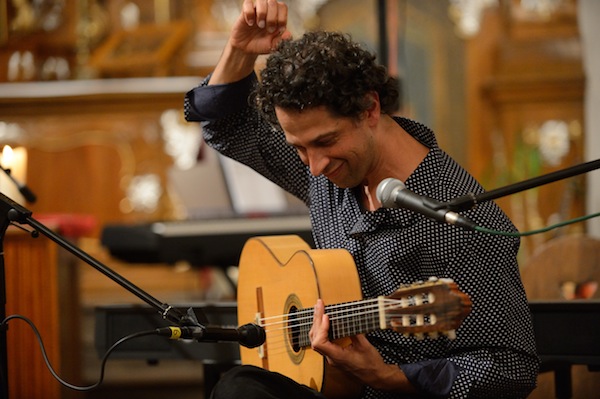
Itamar Erez’s new CD, Mi Alegria, is being launched with a concert at the Annex. (photo by Wolfgang Vogt)

Composer, performer and teacher Itamar Erez releases his new CD in a concert June 20 at the Annex. The title, Mi Alegria, or My Happiness, is a play on words: his daughter’s name is Mia.

Originally from Tel Aviv, Erez teaches guitar at Vancouver Symphony Orchestra School of Music and collaborates with renowned musicians from numerous cultures and musical traditions. His music is infused with the melodies, instruments and rhythms from across the Middle East and beyond.

Erez traces his love of music to his childhood home. His father was a pilot who brought many stories and gifts home from overseas trips – food, clothes, shoes and the music.

“You couldn’t get a lot of records. My father would always bring music with him,” said Erez in an interview with the Independent. “Really interesting music: Bartok, Stravinsky, Coltrane and Bach. I absorbed a lot of it.”

There was also live music in his home, he said. He tells these stories with ease, which is reflected in his style of composition, with its shifting, fluid themes and nuanced moods.

“At 6, I asked to play the piano, so we got one and my older sister and both parents took lessons. We’re all musical,” he said.

Added to all the different traditions in Israel, Erez got a well-rounded education in music, which shows in his eclectic repertoire.

“I remember the first piece I wrote that was performed in a theatre: a piano and upright bass duo. I was 16 or 17,” he said. “It was a magical experience to come out with my own music.”

The relationship between father and son, through music, is mirrored in his relationship with his own son, Yahli. The new album features a song written for his son, “Yahli’s Lullaby.”

“It came about when I was improvising in my room and my son was playing,” said Erez. “He was really listening and asked me what it was.”

Erez derives inspiration from a wealth of other sources: literature, history and myriad musical traditions. “My muse is constantly changing,” he said. “It alternates between world music and jazz, with a lot of classical music.” About Mi Alegria, he said, “this release is definitely going towards jazz.”

“I focused on classical composition at one time, and I felt limited,” he explained. “At some point, I just decided to let go of figuring it out. Something wants to come out, influenced by different traditions, meeting musicians from all over the world, like the Turkish musician I met.”

These influences can be heard on his new album.

“‘Samai’ is based on a Middle Eastern melody that I’m ‘quoting’ – a very traditional piece. The original is a folk tune based on a metre of 10/8; classical Arabic or Turkish tradition,” he said by way of example.

“In my daily practice, I play Bach. It’s really important to me, but not in concert because it’s not my tradition.”

Instead, he prefers to perform his own compositions. “I love the freedom of playing my own music because it doesn’t have to fit a standard of performance,” he said.

Erez writes down his compositions, but only when he needs to share them. When he is composing in the moment, improvising on the piano, “I rarely play a piece the same twice,” he said. “When you’re learning to compose and improvise, it’s important to try things out for hours, transcribing, figuring out what other musicians are doing … just getting lost in the sound.”

Of his new release, Erez said, “I’m super-excited. It’s been awhile since my last release and this is a really fresh new sound.”

For Mi Alegria, Erez worked with percussionist Hamin Honari, with whom he has been collaborating for several years, as well as musicians François Houle, Dani Benedikt, Celsa Machado, James Meger, Kevin Romain and Ilan Salem.

The piece “Tides” evokes the ocean so clearly, with eddies of rapid notes below the slower, tidal shifts in the music, with the cymbal taking the role of the surf, crashing on the shore. “Requinto” is a mischievous piece that moves quickly, with many rapid changes, including the sudden arrival of a sweeping clarinet solo – it calls to mind the swift footsteps of children chasing butterflies. “Shesh” is syncopated, laden with whirling rhythms and pregnant pauses. The intense, mesmerizing repetitions and rising tensions evoke the intelligence of Dave Brubeck or Moe Koffmann, while the wind section takes the listener to the Middle East and China.

The new album is fueled by Flamenco-sized passion but also the playfulness of Bach. The result is a work of both tremendous discipline and unbridled freedom. All in all, the mood of the album suggests so much of human experience and emotion, from joyous to the pensive, from comical to introspective and brooding, and beyond.

In addition to the concert June 20 at the Annex, with opening band the Giving Shapes, Erez also performs on July 11 at Hermann’s in Victoria and July 28 at Frankie’s in Vancouver, with his quartet.

Shula Klinger is an author and journalist living in North Vancouver. Find out more at shulaklinger.com.

Historic next election

For the first time in its history, Israel will go to the polls because the Knesset Israelis elected in April could not form a government.

Prime Minister Binyamin Netanyahu crowed after the election results came in that his Likud had defied critics and won a comparatively easy reelection. The number of small right-wing parties in the Knesset made it impossible for the opposition Blue and White bloc to assemble the 61 seats needed for a bare minimum majority coalition, leaving Netanyahu a free hand to form another government. Or so it seemed to everyone.

But there’s right-wing and then there’s right-wing. As in any country, a range of issues and interests combine to make up political parties and movements. While they may be in sync on a whole range of economic, social, internal and foreign policy issues, the one thing that unified Likud and its ostensible allies among the smaller right-wing parties was animosity toward the left, which Netanyahu demonized during the campaign – even accusing the veteran military figures who lead Blue and White of being too far left. The leftist bogeyman Netanyahu was conjuring is, at this point in Israeli history, largely fictitious. The Labour party, once the dominant force in the country, suffered its worst showing ever, finishing with less than 5% of the vote.

What divides the right-wing parties are a few issues of core principle. The ultra-Orthodox parties are right-wing and prefer Netanyahu as prime minister. But they want special considerations for religious institutions maintained and strengthened. Nationalist parties, like Avigdor Lieberman’s Yisrael Beiteinu party, are right-wing, but secular, and Lieberman would not budge on his assertion that there should be no compromise on a new law – promulgated under his watch as Netanyahu’s minister of defence – that yeshivah men not be automatically excused from conscription. The five seats Lieberman’s party won in April were the lynchpin for a fifth Netanyahu government – and the notoriously combustible Lieberman ultimately kiboshed the government and the 21st Knesset.

Some commentators suggest principle was less a factor in Lieberman’s choice than personal pique. The two men were once the closest of allies – and nothing is more bitter than a family fight. A number of policy issues have frayed the relationship. For example, as defence minister, Lieberman publicly excoriated his boss for what he characterized as letting Hamas off the hook too easily in the most recent flare-up of cross-border violence from Gaza. Lieberman, it appears, would have preferred a far more punishing response, though he has a history of making dire threats on which he does not follow up. He once brazenly gave Hamas leader Ismail Haniyeh 48 hours to live if he did not return an Israeli hostage and the bodies of dead Israeli soldiers. The gambit failed. The millionaire Haniyah remains very much alive, luxuriating in a waterfront palace he built with a 20% tax on all goods traveling through the tunnels between Egypt and Gaza. Lieberman meanwhile continues with similar bellicosity to stoke his base, primarily older Israelis with roots in the Soviet Union.

Whether Lieberman’s dashing of Netanyahu’s plans was an ego issue or a strategy to improve his party’s weak showing in April, or whether it was, in fact, a matter of principle, doesn’t matter much now that new elections have been slated for September.

Most of Israel’s 2019 will have been eaten up by election campaigns and, unless the electorate has a swift change of heart – or the criminal charges hanging over Netanyahu’s head shift the discourse – the results in September may be very similar to those of April. Then what?

Ehud Barak, a former prime minister who has been both ally and opponent to Netanyahu, posited last week that, whatever the outcome in September, Netanyahu is finished. While there are anonymous sources inside Likud suggesting the leader may be ousted after the next election, the fact is that Netanyahu’s career has been declared dead several times before, but he has defied prognosticators and triumphed. Not for nothing is his nickname “the Magician.”

See the light inside everyone

Lately, I’ve been thinking about Elijah the Prophet, or Eliyahu Hanavi. He’s that guy who somehow travels worldwide, to drink all the wine at every Passover seder every year. (What a hangover he must have!) Elijah is also supposed to attend every Jewish boy’s circumcision (brit milah or bris). We sing about him during Havdalah, the short service that separates the Sabbath from the rest of the week. This guy’s all over the place!

Well, he’s both all over the place in Jewish tradition and shrouded in mystery. This is the quirky prophet that never actually died, but instead ascended to heaven. He’s got three separate roles in Jewish tradition.

1) He’s a zealous prophet, reminding people how to behave properly and to remember G-d.

2) He’s known to appear and help those in distress.

3) He’s supposed to announce the coming of the Messiah or the Messianic Age.

(There’s more to Elijah’s roles, depending on what text you study.)

I hadn’t thought much about Elijah as an adult. I’m not big into worrying over the coming of a man on a white donkey (from Babylonian Talmud, Sanhedrin 98a) or the Messianic Age. However, he makes an appearance in ways that capture my kids’ interest. There’s that mysterious cup on the seder plate, and the song that we sing hoping that this week will be the one where Eliyahu Hanavi shows up to bring about the Messiah’s coming. Even if a kid doesn’t attend a bris too often, he might ask questions about Elijah.

There are a lot of stories that retell rabbinic traditions about Elijah. The most powerful are ones I never forgot from childhood, and which may still be helpful today. The stories seem to align directly with those points above, that adults are already supposed to know.

From the Prophets, we know that Elijah reprimanded others, threatened them with scary stories and told them to shape up. It’s essentially “putting the fear of G-d” into them. Apparently, he was good at this role, as he was sent to do it multiple times. In Jewish folklore, Elijah is the stranger who appears and helps the poor and reminds the wealthy of their failings. It’s this combination of the stranger who appears when you least expect it and the coming of the Messianic Age that I think about most often. Why?

I was taught to try to treat everybody with respect and empathy – because that person might be Elijah. That Elijah could appear at any time, looking like an old lady or a child, a homeless person or an older person with dementia. How we treat people indicates how we’re doing on bringing about a better age, or a Messianic one. When this idea was introduced to me, I remember thinking it sounded weird.

As an adult, it makes more sense because, well, life is weird. Life offers us many opportunities to practise conscious kindness, to do mitzvot (commandments) that help make the world a better place. If we keep doing this “fixing the world” (tikkun olam), well, we might just hear from Elijah.

There was that time when we had a stranger knock at our door. My husband answered it and then told me what happened. It was an indigenous man who didn’t look well. He looked like he had been doing some traveling through back lanes, but he came to the door with our dog’s collar in his hand.

I was immediately anxious. Our dogs are never without their collars and ID tags. However, this man came along, saw the collar in the back lane, clearly beyond the fenced yard. He was worried for the dog. The good news? We called her, and our dog was happy and safe inside. She’d somehow managed to shed her collar and leave it in the back lane without anyone noticing. This kind act made me wonder: Was this Elijah, known for his affinity with dogs? In the Sefer HaAggadah, it’s said that, when dogs are happy for no reason, it’s because Elijah is in the neighbourhood.

Sometimes, one of my kids carefully saves the seat beside him at services for what appears to be an imaginary friend. We joke that he knows Elijah is coming. Instead, it ends up being the friend on her own who needs just one spot or maybe even a stranger, who we then get to welcome to synagogue.

It’s the extra granola bar in my “mom bag,” when I thought someone might need a snack – and, indeed, a hungry person turns up. He needs it to continue onwards. Who knows what that person’s potential will be? That stranger gets a granola bar because, well, he might be Elijah.

This is all mystery and whimsy, if you take a purely Western and scientific view of the world. Yet, most of us acknowledge that we can’t explain why we’re lucky or when misfortune befalls us. Is it because of our behaviour or our efforts to do good in the world? Is it because some people “deserve” misfortune? I think not.

There are amazing people, all around us, who have struggled. Some were homeless, were put in foster care as children, or had addictions. Perhaps they suffered through wars or trauma. This childhood lesson about Elijah has stood me in very good stead because, if you remember that every person has value, every soul is important, it doesn’t matter how the person’s body presents itself. Whatever their clothes or hair look like, that person could be Elijah. Better yet, every person is someone important. It’s up to us to see that light inside, the potential waiting there, and to acknowledge the “other,” as Martin Buber would say. Be ready to offer something, with love and hope, when needed. It could be welcoming someone and offering a seat, a kind word, a thank you for returning a lost item, or a granola bar. Anybody can do this. Remember, that person across from you may be Elijah. The rest? It’s up to you.

Joanne Seiff has written regularly for CBC Manitoba and various Jewish publications. She is the author of three books, including From the Outside In: Jewish Post Columns 2015-2016, a collection of essays available for digital download or as a paperback from Amazon. See more about her at joanneseiff.blogspot.com.


Jerusalem’s Henderson

Adam Henderson stars in Jerusalem, at the Jericho Arts Centre June 7-30. (photo from United Players)

The play Jerusalem by Jez Butterworth sees its debut in Vancouver this month at the Jericho Arts Centre and its lead actor, Adam Henderson, is a member of the Vancouver Jewish community.

Henderson grew up in New York City, moved to Winnipeg as a teenager and, after studying and working as an actor in England for 20 years, relocated to Vancouver in 2000. “I wanted to have a more balanced life than was possible in England, with more time to raise a family,” said Henderson, who is married with two children at home ages 5 and 12.

Asked about his Jewish identity, he said he describes himself as “a New York Jew from a mixed upbringing, but Jewish by birth and culturally interested.”

Henderson’s acting career began at the Manitoba Theatre Centre when he was 17 and has taken him all over the world, including to Israel, where he starred in War Shepherds in the 1980s. Today, in addition to doing live theatre, he teaches accents and dialects at the Vancouver Film School, and voice acting at the University of British Columbia. As a dialect coach, he specializes in helping other actors with their accents and dialogues, and he records audiobooks, too. “Vancouver doesn’t easily support actors, so we have to do other things to make our acting happen,” he explained.

As he rehearsed for Jerusalem – a play that references a poem by William Blake and not the holy city of Jerusalem – he was also working on Altered Carbon, a television show for which he’s coaching an actor from Berlin to sound more American. “It’s exciting for me because my family is originally from Berlin and I have a strong connection with the city,” he told the Independent.

Jerusalem, presented by United Players, is about a squatter called Johnny “Rooster” Byron and his retinue, and has a cast of about 16, Henderson said. “It’s quite a remarkable play and was made famous by Mark Rylance, one of my heroes, who played the role of Rooster. It’s a great adventure taking on a role that he’s put his stamp on, and it’s both intimidating and inspiring, because he sets the bar quite high!”

Henderson said anyone who enjoys classical theatre will enjoy Jerusalem, a play rich in language and “quite epic.” As for his lifestyle move to Vancouver almost two decades ago, that’s worked out well, he added.

“I have a successful family and I can organize my schedule to be there to raise my kids. In London, I was constantly busy with my career and, though it’s an exciting place to work, it’s harder in that environment to have a stable life. In Vancouver, I don’t travel much and there’s more contact with nature, which I find calming.”

Jerusalem runs June 7-30 at the Jericho Arts Centre. Tickets, which range from $22-$28, are available at the door or online at unitedplayers.com.

Lauren Kramer, an award-winning writer and editor, lives in Richmond. To read her work online, visit laurenkramer.net.

First edition Frank diary

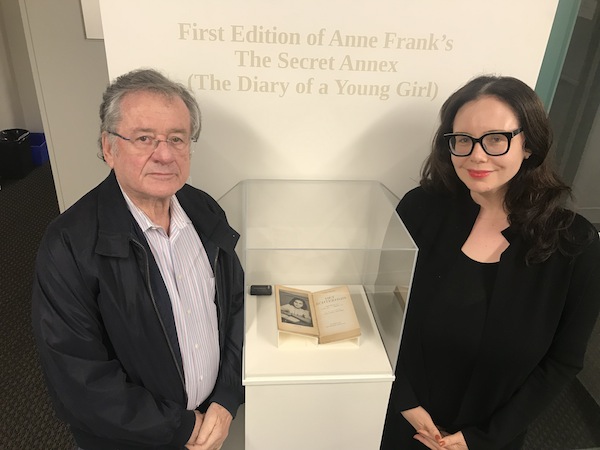
Dr. Robert Krell and VHEC executive director Nina Krieger at the display case for Het Achterhuis, a first edition of Anne Frank’s Diary of a Young Girl. (photo by Shula Klinger)

In November 2017, the Jewish Independent published the story of a first edition of Anne Frank’s Diary of a Young Girl, that had come to light in North Vancouver (jewishindependent.ca/retribution-and-restoration).

The edition had been purchased by bookbinder Richard Smart from an estate sale in Holland. The book was badly damaged. The front cover had come apart and the spine had broken away from the bound pages. Inside the binding, pieces of another book had been used to pad the spine. It was common practice at a time when paper was scarce, but, in this case, the paper fragments came with a message. Taken from a German volume, the original bookbinder had positioned the title of the book, Die Vergeltung, where it could easily be seen. Its meaning: retribution.

Smart planned to sell the book but not to a private collector. He wanted it to remain in the public eye and be kept within the Jewish community.

A few weeks after the article was published, I received an email from Dr. Robert Krell in Vancouver. A survivor himself, he is a founder of the Vancouver Holocaust Education Centre. He wanted to know if the book was still for sale and could be purchased for the VHEC.

I passed Krell’s message to Smart at the Old English Bindery, and a conversation began about its possible sale. Two weeks later, I drove Smart and Emilie Crewe, the bindery’s administrator, to a meeting at Krell’s home. Krell and his assistant, Joy Fai, welcomed us, and we talked over coffee.

Krell explained his position on the sale, talking about the book’s precious legacy and his own feeling for history. It was deeply moving when he held the book for the first time and opened the cover to see the printed words in the spine.

For any lover of history, a volume like this can take a pretty firm hold on one’s imagination. When the volume is a treasure of this kind, in the hands of a Dutch Holocaust survivor, and – just possibly – with its own, private message of solidarity for those who perished, the power of this moment is immeasurable.

It took a few minutes to finalize the administrative aspects of the sale. Krell gave me a moment alone with the book, then I put it back in the decorative box Smart had crafted, wished Anne goodnight and closed the lid.

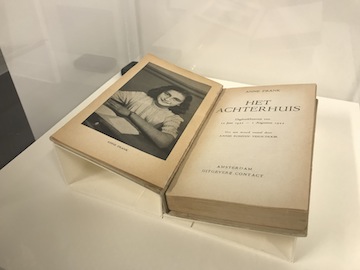
Het Achterhuis is now on display at the Vancouver Holocaust Education Centre. The case is situated next to the classroom where all school students begin their tours. It is, said Krell, “a high-traffic area,” so the children cannot fail to pass the book. And, while the centre’s artifact-driven exhibits include many extraordinary items, he said, “the symbolism of Anne reaches far more children than we can.”

photo - Housed at the VHEC, Het Achterhuis will be a teaching tool
Housed at the VHEC, the book will be a teaching tool. (photo by Shula Klinger)

Having said that, Krell added, “It’s symbolic for all the wrong reasons. It’s a lovely story of a bright girl who saw so much more than anyone else could, from that tiny room. The Dutch use this photo of a smiling adolescent girl as an example of Dutch resistance, but they have not yet apologized for what they did, the 100,000 Dutch Nazis.”

Krell spoke of the many ties between Holland and Canada, describing liberation day on May 5, 1945, by Canadian troops. Even now, Holland celebrates this day with a gift of tulip bulbs to Ottawa.

Asked why the first edition should be housed here, at the VHEC, Krell said, “Why not? We have been teaching students since 1976. We have earned the right to have a precious book to show our students and loyal teachers.”

Krell emphasized the educational role of the book – artifacts make history real for children, he said. And, “to continue our teaching, we have to use artifacts that survivors have left us. They are evidence of what happened and we have to show what they represent. A skipping rope, a toy, a tin cup, a utensil – that is the difference between life and death.”

Even more importantly, he said, “we’re in a phase of succession to the next generation, to carry the legacy of survivors. These include memories and warnings because we’re facing incredible racism and antisemitism in the world today.”

Contemplating the importance of remembering and teaching about the Holocaust, Krell offered a sombre analogy. At Auschwitz, he said, when prisoners were robbed of their last possessions, they were stockpiled in a spot they named “Canada,” the land of plenty. “Canada was in Auschwitz,” said Krell. “We must be careful not to bring Auschwitz back to Canada.”

Shula Klinger is an author and journalist living in North Vancouver. Find out more at shulaklinger.com.
Dayson successful in business, love

Dayson Here portrays Ben Dayson’s innate business acumen and his economic success, as well as his unwavering devotion to his wife, Esther.

Following the publication of the Nemetz family biography Don’t Break the Chain: The Nemetz Family Journey from Svatatroiske to Vancouver, in 2017, comes a new book called Dayson Here: The Story Behind the Voice, compiled and written by Shirley Barnett and Philip Dayson.

Anyone who met Ben Dayson knows he was larger than life. Standing at five feet, six inches (or thereabouts), he was a giant among men. People knew him for many things, but primarily his business success, his deep and abiding love for his “beautiful wife” Esther, and his close family. What’s missing from that picture are his modest beginnings in Ukraine, the journey that brought him to Vancouver, and the man behind the voice. The new book, comprised mainly of direct quotes from Dayson – thanks to the Dayson/Barnett families and the Jewish Museum and Archives of British Columbia – and black-and-white photos, tells a more intimate story of his life. My favourite quote of his is: “I know nothing and you know even less!” Pure Ben Dayson.

The book portrays not only Dayson’s innate business acumen and the extent of his economic success, but also his unwavering devotion to his wife, Esther. She was the epicentre of his life, the voice of reason and the sole calming influence in his life.

It’s no secret that Dayson was an extraordinary character. He made his presence known, and loved to “work a room.” Within the space of a few hours, he could be loud, moody and assertive in his office, then morph into a charming, polite man in a social setting.

Dayson was very interested in real estate development, first residential and, later on, commercial. He had a natural business sense, despite having little to no formal education. There’s no question that his obsession with building and developing fed the fire in his belly. He’d often drive friends around to visit his buildings.

Starting life in Canada wasn’t easy, but, with determination and sheer energy, he parlayed his first business ventures into greater and greater things. Ironically, his difficult start in life (his father died when Dayson was 15) primed him for later success. Having witnessed pogroms and antisemitism, Dayson was determined to have a better life for himself and his family. When a cousin in Kamsack, Sask., sent papers to help him come to Canada, that gave Dayson the impetus to build that good life. Traveling from Ukraine to Moscow, then Riga, Berlin and Rotterdam, Dayson’s world opened up. In Rotterdam, “he became acquainted with new things in life – chocolate, coffee, white bread and girls.”

But Dayson became impatient to get to Canada. In anticipation of his future, he bought a few essentials: a new suit, a pair of shoes and a hat, which left him with only $7. His arrival in Canada took him from Halifax to Montreal to Winnipeg and then to Kamsack, where he settled in 1927. Beyond most everything else, gaining Canadian citizenship was one of his proudest accomplishments. A more patriotic man you could not find.

Friends from his hometown sent word that Esther Nemetz, who grew up just blocks from Dayson in Ukraine, was living in Vancouver – and she was a beauty. Despite never having met her, Dayson began a correspondence with her in 1931. He courted her by mail, despite that she was engaged to a doctor from London, Ont. Dayson’s trademark perseverance won the day and their romance grew. As some people know, Dayson began life as Boruch Deezik, but, at the urging of his wife-to-be, he Americanized his name and became Ben Dayson.

Nemetz’s six brothers had done well since their arrival in Canada and she benefited from their generosity, having the “wedding of her dreams,” after which, the couple moved to Viscount, Sask., where Ben Dayson had already purchased a general store. The book recounts that “Esther sold her furs and diamond rings to help buy inventory.” Their business grew, they made more money, and became community leaders.

Working together as partners, Ben and Esther Dayson grew their family and built a good life. They moved to Saskatoon and bought a meat market, which also did well. In 1949, Esther suggested they move to Vancouver, since her six brothers and two sisters lived there. Living in the big city, the Daysons involved themselves in the Jewish community, surrounded themselves with extended family and expanded their social circle.

In 1951, Dayson discovered real estate and became consumed by it; he built numerous apartment buildings in Vancouver, Richmond, Burnaby, New Westminster and West Vancouver. He had a remarkable sense of what would work and what wouldn’t in the real estate world. He was a pragmatist and a savvy, self-taught businessman. In the 1970s and 1980s, he discovered industrial property, and the book paints a picture of a tenacious but principled man who always got what he wanted. Unless his wife vetoed it.

Throughout their life, Ben and Esther Dayson were great philanthropists and ardent supporters of Israel. Among the many causes they supported was the Richmond Public Library, where I was first introduced to Ben. Having built the first high-rise apartments in Richmond and benefited from them, Dayson felt he owed a debt of gratitude to Richmond. So, in 2004, the couple gave $50,000 to the Richmond Public Library Endowment Fund, one of the library’s largest single donations.

An avid reader and lover of books, Ben Dayson also gave most of his personal Judaica book collection to the library, and established the Ben and Esther Dayson Judaica Collection at the Brighouse (Main) Branch. Thanks to the Daysons, the library is now home to one of the Lower Mainland’s largest Judaica collections, and includes Jewish books, DVD movies and newspapers. In 2004, Ben Dayson was awarded the British Columbia Library Association Keith Sacré Library Champion Award for his support of libraries, literacy and public access to information.

As a senior librarian at the Richmond Library, I had the honour and pleasure of working closely with Ben Dayson to develop this collection. He maintained a hands-on approach to the collection, and would regularly buy and donate Jewish-themed books to the library. Always insisting on an accurate (and usually immediate) accounting of the books he donated, I would often get calls from him, asking (telling?) me to come to his home with the library’s laptop, so I could type out an author/title list of the books he donated.

This was a regular occurrence. But I remember one particular time when there was a bad snowstorm. It was a Friday night and my home phone rang at around 8 p.m. It was Dayson. He said, “I have books for you. Come and get them.” I recall asking him, “You mean right now?” To which, naturally, he replied, “Yes.” It was around 2006 and I didn’t yet own a personal laptop. Knowing that few people ever say no to Ben Dayson (and live to tell the tale), I drove through the snowstorm to his home, bearing a pad of paper and a pen. The rest is history.

Dayson Here: The Story Behind the Voice is filled with fascinating information about the Dayson family business. But there are also plenty of surprising and humorous anecdotes demonstrating how passionate Ben Dayson was about issues that offended him personally. He pursued causes until he got a satisfactory resolution, or was forced to give up the fight, like when the government revoked his driver’s licence at age 95.

As Shirley Barnett said so eloquently in her father’s eulogy, Ben Dayson “lived his life loud and clear.” It’s nearly impossible to encapsulate the enormity of his personality, but this book does just that, with humour, honesty and love. His headstone says it all: “Once met, never forgotten.”

Copies of Dayson Here are available at the RPL Brighouse branch, the Isaac Waldman Jewish Public Library at the Jewish Community Centre of Greater Vancouver or by contacting the authors directly.

Shelley Civkin is a happily retired librarian and communications officer. For 17 years, she wrote a weekly book review column for the Richmond Review, and currently writes a bi-weekly column about retirement for the Richmond News.

Reinventing ourselves

Keynote speaker Irene Dodek and Bill Gruenthal, from the Temple Sholom 60+ group, at the latest JSA Snider Foundation Empowerment Series event, which took place May 15. (photo by Marcy Babins)

Jewish Seniors Alliance of Greater Vancouver and the seniors group Temple Sholom 60+ co-sponsored the fourth in the 2018-19 JSA Snider Foundation Empowerment Series, which has the theme “Renewing and Reinventing Ourselves.” About 60 attendees met at Temple Sholom on May 15 for lunch, followed by a talk by Irene Dodek on Writing Our Own Stories.

Bill Gruenthal of the 60+ group welcomed the audience and announced the names of everyone who was having a birthday in April and May. He then introduced Ken Levitt, president of Jewish Seniors Alliance, who thanked Temple Sholom for the opportunity to co-sponsor the event with them and briefly outlined JSA’s programs, with particular emphasis on the Peer Support Program. He also explained that JSA’s motto is “Seniors Stronger Together.”

Gruenthal introduced Dodek, one of two charter members of the Jewish Museum and Archives of British Columbia (JMABC).

Dodek is a graduate of the University of British Columbia in anthropology and museum studies. She said she first became interested in stories while growing up in Wapella, Sask., where she heard many family tales from her grandfather and her uncles, who were homesteaders there.

Dodek has been conducting interviews for the JMABC for many years. She outlined a few of her early interviews and pointed out some of the mistakes made by beginners. She offered the following tips, stressing that the most important thing is for the interviewees to be heard. Questions must be open-ended, she said, to give the person a chance to talk and explain. Confidentiality must be maintained, as well as respect for the person, and patience in waiting for answers. Interviewers must give people a chance to think before they answer, she said.

Dodek – who said that history is her passion – was also involved in a Steven Spielberg Shoah Foundation project that required 30 hours of training in three days on how to interview Holocaust survivors. She commented that this was very different from interviewing community pioneers.

The title of her family history, which she wrote, is You’ll Always be My Darling. Dodek took the name from a note her mother once wrote in her autograph book. She did a lot of genealogical research and the book contains many maps and family photographs. The book is in the national archives in Ottawa.

After a number of questions about interviewing and also about writing, Gruenthal thanked Dodek for her stimulating presentation.

The fifth in the “Renewing and Reinventing Ourselves” series will take place on June 24, sponsored by JSA and the Kehila Society of Richmond. Called Dueling Pianists, Lester Soo and Marilyn Glazer will entertain. Lunch is at noon and the program starts at 1 p.m. at Congregation Beth Tikvah. For more information and to register, contact Toby Rubin at 604-241-9270 or the JSA office at 604-732-1555.

Shanie Levin is an executive board member of Jewish Seniors Alliance and on the editorial board of Senior Line magazine.

Teen wins for speech

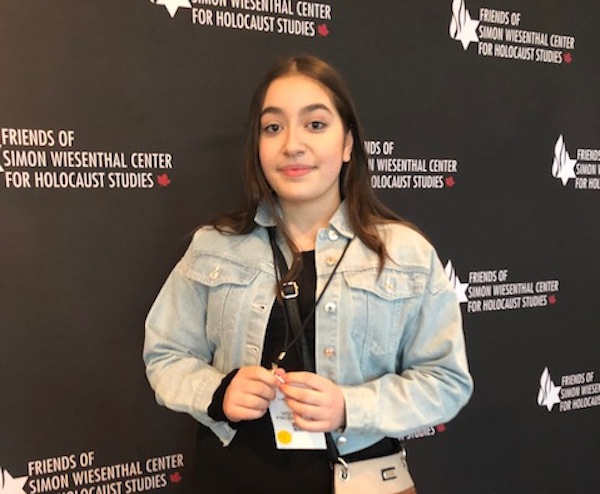
Deema Abdel Hafeez placed third in the Friends of Simon Wiesenthal Centre for Holocaust Studies’ annual speech contest. (photo from Janet Lee Elementary School)

Every year, the Friends of Simon Wiesenthal Centre for Holocaust Studies puts out a call to Ontario students in grades 6 to 8 to submit a speech reflecting on a quote of Holocaust survivor Simon Wiesenthal, z”l. This year, the quote selected was, “I believe in the good in people,” and students were encouraged to think about how to make the world a better place.

Deema Abdel Hafeez, a Grade 8 student at Janet Lee Elementary School in Hamilton, Ont., entered the contest, the first round of which was in February. Hafeez comes from a Palestinian family who moved to Canada 20 years ago.

“When I heard the quote, I didn’t want to just base it on the good in people … unicorns, rainbows,” Hafeez told the Independent. “I, more so, attacked the quote. I was like, you cannot believe in the automatic good in people, because it takes time to find the good in people.

“I wrote about my Islamophobic experiences. I was saying that you have to define the word ‘good’ to believe in the good in people. And, you have to become the good yourself before you can assume the good in other people.”

Hafeez shared that, while her school is pluralistic, with students of many different faiths, racism still very much exists.

“All the racist slurs and things like that, that’s how I attacked the quote,” said Hafeez. “I talked about how my family can’t go out without [experiencing it] … how my mom is being told to go back to her own country, or how anyone wearing religious clothing … is attacked in social standing … and how things are at a disadvantage for people like us. Obviously, it’s not as bad as it used to be, but, as a world, we need to try to change more.”

Hafeez said one of her Muslim neighbours had been badly beaten, to the point that he had almost died, just because he is a Muslim.

In the classroom, Hafeez has witnessed hate. “People mention jokes on social media and like things like that, and they talk about different colours of skin as if following a stereotype… and it’s, like, you’re funny, but you’re not … it’s just rude.”

When asked about how her parents felt about her entering the competition, Hafeez said she had entered without their knowledge. “It wasn’t because they wouldn’t have allowed me to,” she said. “But, I kind of just entered without telling anyone. At home, we talk about the Palestine-Israel conflict a lot, because we have a lot of family in Palestine. We can’t hate a whole group of people, because that’s hypocritical and we’re nice people … so, we don’t hate Israeli people. I have a lot of Israeli friends and I’m Palestinian. It’s cool, because, I feel like, with the Palestinian-Israeli conflict, there’s a way we can live in harmony, both nations living in the same land.”

Hafeez is a member of the school group Making a Difference.

“We do a lot of fundraisers and things like that,” she said. “I volunteer my time while making projects for my school and having the whole school getting involved in these projects. That’s how … I think I’ve become ‘the good,’ in my opinion. I find good as not seeing other people as objects and not labeling them and things like that … becoming the good is more mental to me. You can’t judge anyone. You can’t say, this person is good or bad. You can define yourself and, if you believe you’re doing the best you can at being good … if everyone did that in the world, then we’d live in a better place.”

Hafeez said she watches the news a lot and feels there is far too much violence that results from people judging others.

“I’m not talking about politics,” she said. “If everyone just stopped judging other people based on their religion, colour, sexual orientation … if everyone just focused on themselves, then our world wouldn’t be as hateful a place as it is right now.”

Hafeez practised her speech with her eight siblings.

“I feel like the hardest part for me was just managing my time and how I was supposed to practise my speech, and do all the things for my speech while I also have school, sports, classes … that was the hardest part,” said Hafeez. “The speech itself came easy for me. It is my own thoughts and is everything I’d thought about before. I stayed up late at night thinking these thoughts. I already knew what I wanted to say, so, on the stage, I wouldn’t be reading off a paper. I’d be talking about what I’ve been thinking about.”

The practise paid off. Hafeez was among 10 students chosen to attend a workshop and have their speeches taped as part of the semifinals on March 3 at the Friends of Simon Wiesenthal Centre in North York, a suburb of Toronto. A panel of judges then selected five students for the finals on March 28 at the Toronto Centre for the Arts. Hafeez placed third, winning an iPad.

Hafeez and her school have sent the Simon Wiesenthal Centre a grant application in the hope of organizing a peace summit, incorporating some anti-Islamophobic and anti-discrimination workshops for area schools.

Hafeez is already thinking about what types of activities she would like to undertake in high school, next year, such as starting up a group for change.

“I feel like, when I do that, I’ll be introduced to everything else I can do at my high school,” she said. “I have a lot of siblings, know a lot of teachers. I feel like it won’t be hard, to use my voice to reach people in high school.”

Meanwhile, Hafeez will find good use for her new iPad.

Rebeca Kuropatwa is a Winnipeg freelance writer.

Learning to lead prayer

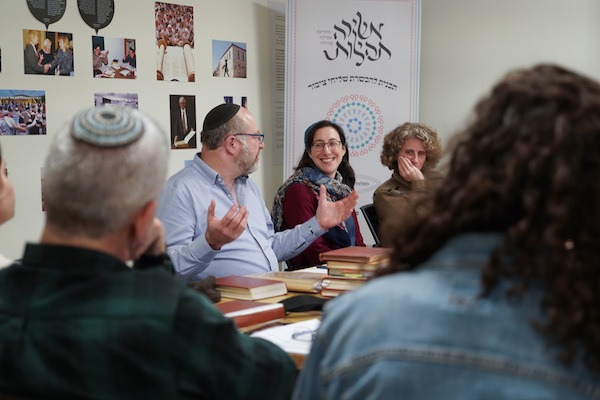
Rabbi Uri Kroizer from the Ashkenazi track with his students. (photo by Itai Nadav)

Some 50 prayer leaders recently completed the first session of the inaugural Ashira program. The program’s goal is to train prayer leaders (schlichei tzibur) from across Israel to direct creative prayers in one of the following three tracks: Ashkenazi, Sephardi and contemporary liturgy.

This unique program, which is held at the Schechter Rabbinical Seminary in Jerusalem, is a joint initiative of Rabbi Avi Novis Deutsch, dean of the Schechter Rabbinical Seminary, and Yair Kochav, one of the founders of the Tahrir cultural platform. Both are graduates of the New York Federation’s social leadership Cohesion Lab.

At one of the meetings at the Schechter campus in Jerusalem, Novis Deutsch explained, “Musical prayer is at the crux of the soul – it is clear that enabling people to study prayer touches their souls. We can discern true happiness in the classes. As the director of many programs at the Schechter Rabbinical Seminary, I can sincerely say that when you teach Torah you sometimes see happiness, but when you teach prayer you constantly see happiness on the students’ faces.”

The Ashira program is comprised of 15 weekly five-hour meetings, where students study both theoretical and practical aspects of prayers and it is sponsored by donors from Vancouver and various parts of Israel.

From December 2018 to just after Passover 2019, when you walked down the hallways of the building, you would hear different styles of music from the classrooms.

“The students represent a broad variety of Israeli communities – some are studying in rabbinical programs, some are prayer leaders, and all have a love for Jewish liturgical music,” said Novis Deutsch. “The Ashira program furthers social cohesion; it is a collaborative project with the leaders of prayer renewal in Israel. Many of those who participate in the program never thought that they could be prayer leaders. Ashira allows them to imagine this possibility – it reduces their anxiety about leading prayers and gives them a voice.

The program’s premise is that, to find your voice as a prayer leader, you must acquire an in-depth knowledge of the tools, styles and procedures in this field.

“Before we embarked on the program, we assembled 12 leaders in the field of Israeli music and started a process, which gave birth to Ashira,” explained Yair Kochav. Of the three tracks, he said the Ashkenazi and Sephardi work with the existing liturgy, teaching it to the new prayer leaders, while the “contemporary liturgy track fuses the first two tracks with modern Israeli reality.”

photo - Sephardi track director Hacham David Menachem (holding the oud)
Sephardi track director Hacham David Menachem (holding the oud). (photo by Itai Nadav)

According to Kochav, each track is divided into three sections: theoretical, musical and practical.

“This gives students a multifaceted experience of the essence of prayer and what motivates people to pray,” said Kochav. “Each identity and motivation must receive its own space. There is a certain apprehension that the traditional liturgy will disappear due to the growth of a popular modern Israeli liturgy. Therefore, students in all three tracks meet to discuss the similarities and differences of each liturgy.”

Rabbi Rani Yager, from the Shalom Hartman Institute, who heads the contemporary liturgy track together with Yair Harel, said, “The most important lesson that I learned in this program is that prayer is a need felt by people in all communities: it is not connected to one’s religious or ethnic background, nor to one’s gender. People are willing to discuss this need, to learn and to share their feelings. Singing together requires courage, and the enormous need for prayer engendered this courage.”

Rabbi Uri Kroizer and Dr. Naomi Cohn Zentner direct the Ashkenazi track and Hacham David Menachem and Drori Yehoshua direct the Sephardi track.

Students study the musical scales of each liturgical style; each student plays an instrument and/or sings during the classes. During the breaks, students meet in the hallway and eat dinner together (organized by different students each week) and discuss current events.

“Those of us in the Ashkenazic track, who come from different backgrounds, meet weekly and make space for the voices that we bring from our homes,” said Shira Levine, who received her master’s from the Schechter Institute of Jewish Studies and is now a rabbinical student of the Hartman/Oranim program. “I have learned much from Rabbi Kroizer, who is an expert in Ashkenazic liturgy and a real mensch. I hope to study Sephardic liturgy in the next session.”

Osnat Ben Shoshan Pruz, a participant in the Sephardi track, said, “The program opened a door to a significant and immense world in which I have participated for many years. Ashira provided me with an opportunity to study, in depth, areas that I had not previously had a chance to examine. I have acquired numerous tools and knowledge in liturgy, Talmud and Jewish philosophy.”

“The program changed the manner in which I sing prayers, which goes beyond the pages of the siddur,” said David Arias, a Schechter Rabbinical Seminary student who participates in the contemporary liturgy track.

The next program starts in the fall. For more information, visit schechter.edu/schechter-rabbinical-seminary/about-the-rabbinical-seminary.

Nechama Rivlin dies at 73

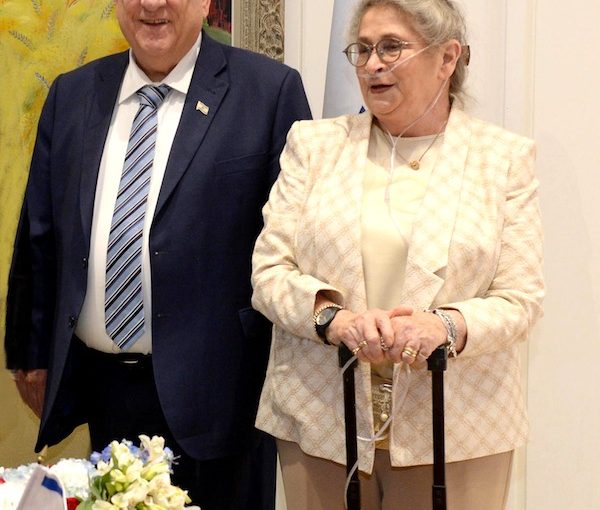
Israeli President Reuven Rivlin and his wife, Nechama, in Jerusalem in May 2018. (photo from Ashernet)

Nechama Rivlin died June 4 at Beilinson Hospital in Petah Tikva, at the age of 73. She had undergone a lung transplant operation three months ago because of pulmonary fibrosis. She received a lung from Yair Yehezkel Halabli, 19, of Ramat Gan, who drowned in Eilat. President Rivlin extended his family’s thanks to the Halabli family, “who donated their late son Yair’s lung, for their inspiring nobility and wonderful deed.”

Nechama Rivlin was born in 1945 in Moshav Herut in the Sharon region. She completed high school at the Emek Hefer Ruppin Regional School. In 1964, she began studying natural sciences at the Hebrew University of Jerusalem. After graduating, she worked at the Hebrew University of Jerusalem as a researcher in the department of zoology, and other departments. In addition, she studied modern, classical and ancient art. In 1971, she married Reuven (Rubi) Rivlin and settled in Jerusalem. They have three children and many grandchildren; she was sister to Varda.

Rivlin’s fondness for Hebrew literature and art led her to write from time to time about writers and artists, who particularly appreciated the posts she published on the official Facebook page of the president. She generally began her posts with the words, “Hello everyone, Nechama here,” and signed them “Yours, Nechama.” In 2018, she established the President’s Award for Hebrew Poetry.