Skip to content
  • Home
  • Subscribe / donate
  • Events calendar
  • Business Directory
  • FAQ
  • News
    • Local
    • National
    • Israel
    • World
    • עניין בחדשות
      A roundup of news in Canada and further afield, in Hebrew.
  • Opinion
    • From the JI
    • Op-Ed
  • Arts & Culture
    • Performing Arts
    • Music
    • Books
    • Visual Arts
    • TV & Film
  • Life
    • Celebrating the Holidays
    • Travel
    • The Daily Snooze
      Cartoons by Jacob Samuel
    • Mystery Photo
      Help the JI and JMABC fill in the gaps in our archives.
  • Community Links
    • Organizations, Etc.
    • Other News Sources & Blogs
  • JI Chai Celebration
  • JI@88! video

Recent Posts

  • Legal help for students
  • Revisiting myth of Lilith
  • Wrong person rebuked
  • Canada’s mixed messages
  • Questions for museum
  • Symposium on antizionism
  • Making soccer political
  • CJPAC lauds Pulver’s impact
  • City recognizes Vrba’s legacy  
  • Organ donation saves lives
  • Theodore’s March premiere
  • A healing Shabbaton
  • Supplying healthy food
  • A chime of metal tags
  • Yellowknife seder a first
  • Ishai energizes, unifies
  • A Lag b’Omer to remember
  • Expanding the healing
  • Hannah Senesh – a unique hero
  • Community milestones … May 2026
  • Sharing her testimony
  • Fall fight takes leap forward
  • The balancing of rights
  • Multiple Tony n’ Tina roles
  • Stories of trauma, resilience
  • Celebrate our culture
  • A responsibility to help
  • What wellness means at JCC
  • Together in mourning
  • Downhill after Trump?
  • Birth control even easier now
  • Eco-Sisters mentorship
  • Unexpected discoveries
  • Study’s results hopeful
  • Bad behaviour affects us all
  • Thankful for the police

Archives

Follow @JewishIndie
image - The CJN - Visit Us Banner - 300x600 - 101625

Month: February 2019

Climate crisis a top priority

Climate crisis a top priority

Teen activists talk with Vancouver Mayor Kennedy Stewart at a climate-strike action on Dec. 7. (photo from Rebecca Hamilton)

“It’s going to be our future, so it’s up to us to take it into our own hands and show that, even if we can’t vote, we can still make a difference in our communities and the world,” Malka Martz-Oberlander told the Jewish Independent when she and fellow activist and friend Rebecca Hamilton met with the paper to discuss recent – and future – efforts to draw awareness to the climate crisis.

The two high school students are part of the group Sustainabiliteens, which was inspired by Swedish climate activist Greta Thunberg. Last year, Thunberg started monthly school strikes, stating that preparing for a future that won’t have a livable climate was pointless. The strikes, called “Fridays for Future,” have spread to at least 270 countries, including Canada.

Inspired by Thunberg, strike action took place at Vancouver City Hall on Jan. 16, the day that Vancouver city council unanimously passed a motion put forward by Councilor Christine Boyle (OneCity) to declare a climate emergency. Similar motions have been adopted in other cities, including London, Los Angeles and Oakland, but Vancouver is the first in Canada to do so.

“Climate change is already impacting the people of Vancouver and will continue to. We need to respond to this crisis urgently and compassionately with a path towards a more equitable society,” said Boyle in a release. “Adequately addressing the climate emergency won’t be easy, but we are a smart city, capable of doing difficult things.”

Hamilton was an organizer of the strike at City Hall, and the groups Force of Nature and Extinction Rebellion Vancouver also supported the action. There was a previous school walkout and strike for the climate on Dec. 7, said Martz-Oberlander. She and Hamilton are among a growing number of Metro Vancouver teens coming together in what Martz-Oberlander describes as a “shared passion for climate justice.”

“With some of my friends, it’s just doom and gloom,” said Martz-Oberlander. “There’s this sense of this is all going to happen and no one can do anything, so why do anything? It’s out of our hands, we’re just kids…. But there’s also a lot of people that I know who are hopeful and see the bigger picture.”

“When I ask kids about the climate crisis,” said Hamilton, “they say that they think it’s a real problem and they’re scared. But the world around us doesn’t recognize what’s happening with the same sense of urgency that we feel. We are living in a confusing and weird time. On the one hand, we understand the science, we’re being told the scientific facts that we’re in a crisis. We’re being told these very conflicting messages, and there’s this dissonance. So what am I supposed to believe? The world is just going as normal, but why are you telling me then that we’re in this crisis and everything needs to change? I think that’s really frustrating. Me, personally, every day I’m frustrated by that.”

Both Martz-Oberlander and Hamilton grew up in the Vancouver Jewish community and say their Jewish values inform their activism. Martz-Oberlander’s family has been involved with Congregation Or Shalom since before she was born, and Hamilton grew up going to Temple Sholom.

“In the Torah, it talks about needing to pass down this world better than we got it,” said Martz-Oberlander. “That’s the concept of l’dor v’dor, ‘from generation to generation.’ The Jewish teaching that really influenced me is the sense of responsibility towards future generations.”

“Camp Miriam was most important to me in cultivating my Jewish identity,” said Hamilton. “I think it played a huge role in what I’m doing and why I care about it. The focus on youth agency, being told we could create change. It’s tikkun olam – environmentalism and climate justice is the most important way to try and help other people and create a more just world.”

photo - On Jan. 16, students walked out of school to be at Vancouver City Hall to raise awareness of the climate crisis and support Councillor Christine Boyle’s motion to declare a climate emergency
On Jan. 16, students walked out of school to be at Vancouver City Hall to raise awareness of the climate crisis and support Councillor Christine Boyle’s motion to declare a climate emergency. (photo from Rebecca Hamilton)

Both teens avoid the word “climate change,” preferring instead to talk of the “climate crisis” or “climate emergency” and the need for “climate justice.”

“Climate change doesn’t sound urgent enough,” said Martz-Oberlander. “It’s an emergency.”

“I prefer climate emergency or climate crisis,” said Hamilton, who cites Jewish writer and activist Naomi Klein as an important influence on her thinking. “It’s not about preventing this catastrophe but about healing the foundation of our world. The climate crisis is a manifestation of these unjust worldly systems which exploit nature, animals and people, so fixing that manifestation will also mean fixing those systems.”

Hamilton and Martz-Oberlander were inspired to join the climate-strike movement after it came to Canada with a strike in Sudbury, Ont., led by 11-year-old Sofia Mather.

“I feel like I have been concerned about climate change my whole life,” said Hamilton, “but I began to want to do something when I realized that nothing else really matters if we live on a dead planet.”

Hamilton and Martz-Oberlander are currently preparing for a Canada-wide school strike on May 3, and have a local action planned for Feb. 15.

Matthew Gindin is a freelance journalist, writer and lecturer. He is Pacific correspondent for the CJN, writes regularly for the Forward, Tricycle and the Wisdom Daily, and has been published in Sojourners, Religion Dispatches and elsewhere. He can be found on Medium and Twitter.

Format ImagePosted on February 8, 2019February 7, 2019Author Matthew GindinCategories LocalTags climate change, climate crisis, education, environment, Malka Martz-Oberlander, politics, Rebecca Hamilton, Sustainabiliteens, youth

Two bads don’t make good

The United States Senate was expected to vote this week on a bill that would make it easier for state and local governments, as well as government agencies and perhaps other bodies, to refuse to do business with groups that endorse a boycott against Israel.

The bill comes after several state governments have taken steps against BDS, the movement to boycott, divest from and sanction Israel. Florida’s legislators, for example, directed officials in 2016 to create a list of companies that engage in boycotts of Israel and instructed all government entities to divest from those companies. Two years later, the state passed a bill preventing companies that engage in boycotts of Israel from bidding on local or state government contracts. In all, about half of the 50 states have some form of statute on the subject, some simply making their opposition to BDS known, without adding punitive economic conditions.

Boycotting Israel is a dumb and self-defeating position, but so is the idea of governments boycotting the boycotters.

Opponents of the federal anti-BDS effort – and even some people with no horse in the race – are asking whether boycotts are covered by free speech legislation. Nobody is saying BDS should be illegal. But, when a company or individual applies to government for, say, a contract to build a road, there are numerous conditions. Non-unionized companies may be excluded, for example, or businesses may have to prove they adhere to government guidelines around equal employment. People are free to boycott Israel, and governments are free to prevent those people from obtaining contracts with them. On free speech grounds, we don’t really have a problem with the idea – and we’re pretty defensive about free speech.

To us, the discussion is less a legal one, or even a moral one, than it is a strategic one.

Despite their thuggish, bullying tactics, members of the anti-Israel movement love to position themselves as victims. While harassing Jewish students on campuses, shouting down speakers, making Jewish women unwelcome at women’s marches and disrupting venues where Israel and Palestine would seem to have little relevance, such as at a major LGBTQ conference in Detroit recently, they nevertheless depict themselves as tiny Davids fighting Goliath. With that in mind, legislation that punishes those who support BDS will give its advocates their first rightful justification for claiming victimhood. But there is a more important and obvious reason why we should not be legislating against BDS.

We shouldn’t need to tie the hands of BDS supporters behind their backs to win this fight. Our strength must be our ability to refute the lies, exaggerations, hypocrisies and prejudices of the BDS movement. There are a million arguments against BDS.

Ireland recently passed a wide-ranging Israel-boycott law and promptly realized that its high-tech sector, which is mostly propped up by American investment, could be imperiled if Ireland forces giants like Apple, Google and Facebook to choose between Dublin and Tel Aviv. While BDS is intended to be economically injurious to Israel, it can harm the very people who are advancing it. And it is more than economic damage BDS can self-inflict. Given the plethora of life-saving and life-enhancing innovations emerging constantly from Israel, boycotting that country could be detrimental to one’s health.

There are countless ways to counter BDS … like pointing out that BDS hurts Arabs. Not just Israeli Arabs or Palestinians, like those who famously lost their jobs when BDS forced the closure of a SodaStream plant in the West Bank, but impoverished residents of countries adjoining Israel, too. Seventy years of its Arab neighbours boycotting and isolating Israel has done nothing to harm the massive economic and social successes enjoyed by citizens of Israel. It has only ensured that the people of Jordan, Lebanon and other countries that snub Israel suffer from being deprived of these economic, technological and scientific achievements. Since the Arab boycott of Israel went global, the discrepancies have only grown. Israel’s GDP has doubled since 2005, when BDS started to take off.

The preoccupation of the BDS movement with academic boycotts is especially easy to confront: it’s the ideological descendent of book-burning.

We should also be conscious that even people who take positions we support may be using us to advance their own agendas. While the Republican party has been steadfastly pro-Israel – as have most Democratic party lawmakers – this anti-BDS measure is a bald attempt to sow division among Democrats by shining a light on some of the new elected officials who diverge from the traditional bipartisan consensus on the American-Israeli special relationship. Confronting those dissenters on the issues is justified – and is being taken up by a new group of Zionist Dems, called the Democratic Majority for Israel. But allowing one party to monopolize Israel for political advantage spells disaster for American Zionists and for Israel (despite the overt collaboration of Israel’s prime minister in the Republicans’ partisanship on this issue).

BDS is a bad idea. But, banning – or, more accurately, boycotting – BDS gives the appearance that Israel is indefensible on merit. That makes legislation to punish BDS supporters another bad idea.

At a time when there are plenty of bad ideas to go around, this is absolutely a case where two wrongs do not make a right. Defeating BDS should be done intellectually, not legislatively.

Posted on February 8, 2019February 7, 2019Author The Editorial BoardCategories From the JITags anti-Israel, antisemitism, BDS, boycott, Israel, politics, United States
Matchmaker embraces farce

Matchmaker embraces farce

Ric Reid and Nicola Lipman co-star in The Matchmaker, which is at the Stanley until Feb. 24. (photo by David Cooper)

If you are an aficionado of the absurd, an enthusiast of the exaggerated, a supporter of slapstick and an overall buffoonery buff, then set a date to see The Matchmaker.

Thornton Wilder’s work has taken over the Stanley Theatre with all the intensity and madness a play can muster and keeps farce fans delighted from opening curtain to final applause.

Matchmaker, which was first staged in 1955, is the retelling of Wilder’s original farce The Merchant of Yonkers and was a precursor to Hello Dolly!, one of the most popular Broadway plays of all time. It was made into a movie in 1969 starring Barbra Streisand in the title role of Dolly Levi.

Levi – played by Nicola Lipman in the Arts Club production – is the thread in the play that winds its way through four relationships of star-crossed lovers and would-be elopers. She’s a woman who “arranges things,” but is generally bored with life. The forceful matchmaker goes to Yonkers under the pretence of finding a wife for the crotchety Scrooge-like storeowner Horace Vandergelder (Ric Reid). Her real motive, however, is to snatch Vandergelder for herself.

Along the way, Levi tries to cement the relationships of Vandergelder’s niece, Ermengarde, and struggling artist Ambrose Kemper; milliner Irene Molloy and Vandergelder’s chief clerk, Cornelius Hackl; and Molloy’s assistant Minnie Fay and store clerk Barnaby Tucker. Quite a bit of work for one day, but Levi is ready to put in the effort if it will get her what she wants. She even goes so far as to make up an extensive story that she tells Vandergelder about a fictional 19-year-old potential spouse, just to keep him from marrying anyone else. And she tells Molloy that Hackl is a millionaire known in the best levels of society in order to ensure Molloy loses interest in Vandergelder. And that’s all just in the first act!

The second act brings all the characters together at the home of Flora Van Huysen, a friend of Ermengarde’s late mother, who Vandergelder hopes will keep Ermengarde and Kemper apart. But, it turns out the over-the-top opera-singing spinster is a romantic at heart and, despite a series of confused identities, manages to bring all the relevant couples together.

Now, it’s understood that a farce is comprised of ludicrous situations, improbable plot lines, absurd characters, exaggerated fashion and just about anything that falls under the categories of irony, satire and bad wit. Even so, I expect there to be some consistency within a person’s character, some personality traits that remain the same despite the nonsense of any given situation. I found that missing (or misdirected) in Molloy, one of the key characters, and an original love interest of Vandergelder.

Molloy is a hat-maker who admits to never having adventure in her life, and being very limited in her socializing. Yet, when she finally goes out to a restaurant, she acts like she goes out on the town every night, ordering the best food, telling people what to do, convincing the two clerks to sing in order to get a date.

Also, Molloy and Hackl supposedly fall in love at first sight. The feelings are clearly evident from Hackl’s actions, but it’s hard to get any sense of interest from Molloy.

It makes sense that Hackl, whose experience with women is so minimal, basically falls in love with the first one he meets and laments the fact that he has so little knowledge about the opposite sex.

“I’ll bet you could know a woman 100 years and never really know if she likes you or not,” he says, presenting an observation that many would say holds true.

Now, just in case you were wondering if this level of farce is your cup of tea, here are a couple of examples of the humour you’ll see. When Minnie Fay kisses store clerk Barnaby Tucker, he goes all “aw, shucks” and falls down. There’s a knee-slapper!

In another scene, they need some help from a cabbie, so they ask him, “Do you want to earn $5?” The cabman replies, “I don’t know; I’ve never tried.” (Cue the ba-dum-tshh post-groaner sound effect.)

If you enjoy these types of laughs, then Matchmaker should be right up your alley.

In a final note, kudos go out to set and costume designer Drew Facey for absolutely gorgeous visuals, and composer and sound designer (Jewish community member) Mishelle Cuttler for a score that complements the frenetic action on stage.

The Matchmaker runs at the Stanley Industrial Alliance Stage until Feb. 24. For tickets, visit artsclub.com.

Baila Lazarus is a Vancouver-based writer and principal media strategist at bailalazarus.com.

Format ImagePosted on February 8, 2019February 7, 2019Author Baila LazarusCategories Performing ArtsTags Arts Club, slapstick, theatre
Meet new or favourite writers

Meet new or favourite writers

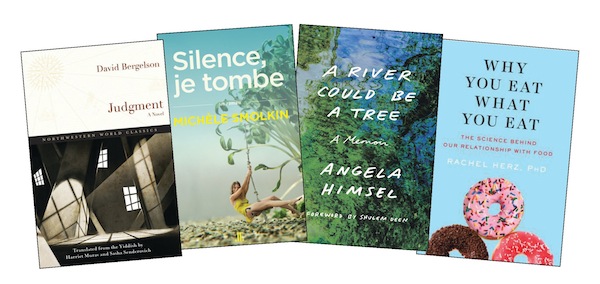
The Cherie Smith JCC Jewish Book Festival starts this Saturday night (Feb. 9) with Joshua Cohen, author of Moving Kings and ATTENTION: Dispatches from a Land of Distraction. It continues for five literary-filled days at the Jewish Community Centre of Greater Vancouver, and here’s a sampling of books you might want to add to your reading list, and authors you might like to meet.

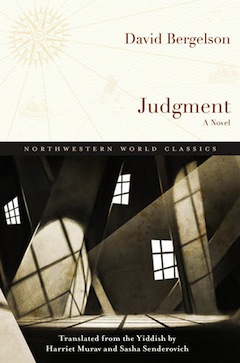
book cover - JudgmentSet in 1920, in the fictional shtetl of Golikhovke during the Russian civil war, Judgment, by David Bergelson (1884-1952), is a melancholic novel about humanity in a time of uncertainty, where different political factions are warring, each under their own ultimately meaningless banner; neighbours cannot trust one another, let alone strangers; and justice is meted out randomly by a cruel, indifferent force.

Stationed in an also fictitious abandoned monastery called Kamino-Balke, near Golikhovke, the sickly Bolshevik Filipov is in control of the area along the Ukraine-Poland border. There are smugglers who travel across the border for commercial reasons and Socialist Revolutionaries who travel across it in preparation for an uprising against the Bolsheviks. Jews and non-Jews live together in relative tolerance but political loyalties, ethnic ties and differing ideas of morality ensure a constant tension. All live in fear of being captured by one of Filipov’s agents, as guilt of a crime does not need to be proven for a person to be beaten, imprisoned and/or shot.

What makes this novel beautiful is Bergelson’s prose. Imaginative metaphors: “Large, invisible hands merrily picked up whole heaps of snow and just as merrily released them.” Animated objects: “… the coat lay there bent over, dejected, as if it had made a long, pointless, idiotic journey” and “The cannons’ muzzles – black, fat and eyeless – stared longingly in the direction of the forests around Moshne….” Humour: “Stone fences suited the inhabitants of Yanovo, for all of them were as stubborn as their stone fences: stone upon stone.” And empathy, in this case, for the undercover agent Yokhelzon, whose “eyes (which inspected everything, people said) had already taken in the horror of death – they winked joyfully, so that the horror would not show afterward.”

As should be obvious, Harriet Murav and Sasha Senderovich have done a masterful job of translating Judgment from Yiddish to English. They also provide a fascinating introduction to the novel, its historical context, the author and his other works (Bergelson was executed in 1952, on Stalin’s orders), the book’s title, form, themes and use of language.

Senderovich will be at the book festival on Feb. 10, 3:30 p.m.

***

book cover - Silence, je tombeMichèle Smolkin’s novel Silence, je tombe is a witty, philosophical novel that explores how people can become isolated from one another, including themselves. Told from the perspectives of a few protagonists, readers will likely relate to many of the feelings expressed.

The novel starts with a pregnant Tania, as she, her husband Paul and their toddler Margot are making the drive to their new home in “Manhattan, Kansas, The Little Apple,” from Vancouver. Tania’s disenchantment is obvious and she expresses her anger towards her husband – who, as a professor of philosophy, couldn’t find a job elsewhere – with vicious (and very funny) sarcasm, mostly in her thoughts, but aloud, as well. She had imagined a different life for herself – living in New York, the Big Apple, for one thing; and certainly not in the Bible Belt. As a Francophone Jew, she anticipates that fitting in might be a problem.

As the book progresses, we get to know Tania, Paul and a disturbed man named Kevin, plus a couple of other minor but important characters. Through them, we contemplate love, what attracts people to one another and what forces them apart, what happiness is, what actions might be unforgivable, how our childhoods influence our adulthoods, and, of course, the inadequacy of words for certain situations, and understanding why, sometimes, silence is the only possible response.

Smolkin’s talk – the book festival’s first-ever French-language event – will take place Feb. 10, 5 p.m. (Note: Festival program shows incorrect time.)

***

book cover - A River Could Be a TreeA River Could Be a Tree is, thankfully, not the memoir of a person who goes from believing fanatically in one religion to being swept away as unquestioningly into another, though it might seem like it would be, given some aspects of the press material. “How does a woman who grew up in rural Indiana in a fundamentalist Christian cult end up a practising Jew in New York?” asks part of the blurb on the book flap. Well, for starters, Angela Himsel seems to always have been an inquisitive person, and never an avid follower of Herbert Armstrong’s Worldwide Church of God. She was an obedient child, but is still struggling with understanding how her parents believed so much in the church doctrine that they didn’t give her sister the care that might have prevented her death at a young age.

A River Could Be a Tree is a measured, often humourous, always intelligent memoir. Himsel starts with a prologue that gives readers a very large hint as to what led her to ultimately convert to Judaism: she and her boyfriend Selig were, “just once … careless about birth control.”

But the journey to that point is long and more complicated, and Himsel takes readers through it with the benefit of hindsight, hard-won insights and a writing style that is serious, honest but unsentimental, and filled with initially unexpected levity. As but one example, a mere three paragraphs into Chapter 1, in which Himsel talks about her parents’ religious heritage, Roman Catholicism and Lutheranism, she writes about Martin Luther, that, at age 41, he “married a nun, a woman he had helped smuggle out of a convent in a herring barrel. While irrelevant to Luther’s religious beliefs, a nun in a herring barrel is always worth mentioning.”

And A River Could Be a Tree is well worth reading. Himsel will speak at the book festival on Feb. 11, 7:30 p.m.

***

book cover - Why You Eat What You EatThere is so much information in Why You Eat What You Eat: The Science Behind Our Relationship With Food by Rachel Herz. And a refreshing aspect of the book is that it’s not written from a dogmatic, all-knowing viewpoint. Herz acknowledges that sometimes studies come to different conclusions, sometimes scientific progress means that what was once thought true is disproven, and that different people will experience food, exercise and other things differently. Readers looking for certainty might be disappointed, but those wanting to learn will learn a lot. Who doesn’t want to know, for example, why tomato juice is one of the most popular drink orders on planes? Does sugar really help the medicine go down, so to speak, i.e. reduce the effects of pain? And why can buying ethically branded or organic products make us less charitable?

But Why You Eat What You Eat is more than an amalgamation of trivia. Herz has compiled a very readable and relatively comprehensive resource that will, as the title promises, help explain why we eat what we eat; how all of our senses – taste, smell, sight, touch and hearing – affect how we experience food. And knowing these things just might make us feel better about ourselves, and make choices that would serve us better.

Herz will be at the book festival on Feb. 13, 6 p.m.

Format ImagePosted on February 8, 2019February 7, 2019Author Cynthia RamsayCategories BooksTags Angela Himsel, Cherie Smith JCC Jewish Book Festival, David Bergelson, fiction, food, French, memoir, Michèle Smolkin, non-fiction, Rachel Herz, science, translation, Yiddish
World’s craze for sand

World’s craze for sand

The World in a Grain: The Story of Sand and How It Transformed Civilization by Vince Beiser is a finalist for the 2019 PEN/E.O. Wilson Prize for Literary Science Writing. The award is given to a “book that exemplifies literary excellence on the subject of the physical or biological sciences and communicates complex scientific concepts to a lay audience.”

At the core of PEN America is the ideal of freedom of speech, “recognizing the power of the word to transform the world.” For his entire career, Beiser has been trying to change the world with his writing and, with The World in a Grain, he educates readers about the phenomenal importance of sand in making thousands of things, from concrete to glass to fibre-optic cables, and how dependent on it we are. So valuable is sand that people steal it and even kill for it, and our unbridled use of it, in concrete in particular, might just kill the planet.

To bring these harsh realities to light, Beiser adeptly and engagingly – sometimes with humour – mixes empirical evidence, scientific explanations, interviews with people directly connected to or affected by sand mining, profiles of relevant historical figures and his own commentary, as well as some factoids, which he calls “Interludes.” He comes to the not-surprising-but-disheartening conclusion that there’s only one solution: “human beings have to start using less sand. For that matter, we have to start using less of everything.”

Beiser dedicates the book to his wife, Kaile, and their children, Adara and Isaiah. While they live in Los Angeles, he grew up here. The Jewish Independent interviewed him about his upbringing, his career and, of course, his book.

JI: Could you tell me where you were born, how you ended up in Vancouver, and how your parents’ involvement in social causes influenced your choice of profession?

VB: I’m from a venerable Vancouver family, though I wasn’t born there. My grandfather’s family – the Landos – came over from England around the turn of the 20th century, first to Prince Rupert and then to Vancouver, where they worked in the fur business, of all things. My mother [Roberta] and her siblings were all born and raised in Vancouver – mostly in the same house where she still lives! My brothers and I were all born in the U.S. (myself in New York City), where my father [Morton] was working. We moved to Vancouver when I was 10, and I grew up there until I took off to college in California. I come back just about every summer.

My parents were always very engaged with the world, and the idea of trying to make it a better place – my father as a mental health researcher, and my mother mainly through her work with all kinds of arts and cultural organizations. We did a lot of traveling as well, which really opened my eyes to just how lucky we were and how much less so are so many other people. Meanwhile, I also had an uncle, Vancouver native Barry Lando, who was a highly decorated producer at 60 Minutes, so I grew up watching his shows and hearing about his adventures all over the world. I never consciously thought that I wanted to have a job like that, but it certainly made an impression.

JI: What role does Jewish culture and/or Judaism play in your life and work?

VB: I’m proud to be a Jew, and that heritage has definitely had an impact on my professional life. Knowing our long and brutal history of oppression helped sharpen my desire to work for social justice, to do what I can to help right, or at least bring attention to, wrongs wherever I find them. I started my career in Jerusalem, covering the First Intifada as a freelancer for both Israeli and Palestinian publications. Later, I wound up working for an Israeli magazine, The Jerusalem Report, first in Eastern Europe covering the wars in the former Yugoslavia, and later as their New York correspondent. I’ve probably written more about Jews and Jewish issues than anything else except sand!

JI: What took you from Vancouver and how did you establish yourself in Los Angeles?

VB: I went to college at the University of California at Berkeley – I really wanted to get to the States, which I thought was a much more exciting place than then-sleepy little Vancouver. From there, I spent years traveling and working all over the world, first as a hitchhiking backpacker, and later as a freelance journalist (there’s often not a lot of difference between the two lifestyles). I spent several years in the Middle East and then Eastern Europe, then came back to the U.S., where I bounced around from New York to San Francisco to Las Vegas (that’s right, I lived in Las Vegas). I was living in San Francisco when I met a delightful young woman living in L.A. I was doing a lot of work in L.A. at the time, writing for the L.A. Times Magazine and other places, so had an excuse to visit her often and, well, 17 years later we’re married, with two kids and a mortgage and the whole package.

JI: In an interview you did with David Simon, you talk about journalism, fiction and film, and Simon comments that no one reads anymore. What are your thoughts on that, on the state of journalism and your decision to write a book?

VB: These are dark days for the business of journalism, of course, with local newspapers dying off en masse and money drying up for those that are left, thanks to the internet. Most of my career has been spent writing for magazines, and a terrifying number of the ones that I’ve written for over the years have disappeared or been reduced to emaciated shadows of their former selves – The Village Voice, Spin, Rolling Stone, US News & World Report, and on and depressingly on.

book cover - The World in a Grain
The World in a Grain can be purchased on Amazon and at other bookstores.

But, contrary to what everyone expected with the advent of the internet and the Twitterization of discourse, people do still read, at length and in numbers. There are plenty of long, deep articles published online that attract hordes of eyeballs – the trick no one has cracked yet is figuring out how to make money off of them. Oddly, the book industry is still doing relatively well; most people still seem to prefer physical, paper books to reading something of that length on a screen. So, moving from magazines into book writing is not only something I’ve always wanted to do – it’s also a tactical move aimed at keeping me solvent. I’m branching into movies and TV for the same reason. If you’re going to survive as a freelance journalist in the 21st century, you’ve got to tell your stories and get paid every which way you can.

JI: Can you describe how the topic of sand first came to you, why it piqued your interest and about the path to the book’s publication?

VB: I’m a full-time freelancer, so I’m always hustling for stories, which involves trawling through a lot of obscure publications. One day in early 2015, I stumbled across a story on a little environmental website from which I learned two things. One, sand is the most-consumed natural resource on earth after air and water; that alone made me sit up and take notice. Two, that there is so much demand for the stuff that we are inflicting tremendous environmental damage all over the world to get it, stripping bare riverbeds and beaches and, in some places, people are even being murdered over sand. Like most people, I had never even thought about sand as a commodity, let alone one so important people might be killed over it.

I thought this all sounded crazy but, with a little research, I found it was true. The violence, I discovered, is by far the worst in India. So, I convinced Wired magazine to send me to India, where I reported a feature on the murderous ‘sand mafias’ that bedevil that country. The piece came out in spring of 2015 and got a great response from readers. I knew by then there was much, much more to the story – a book’s worth, I figured. That summer, I spent a few days alone on a tiny property we own on Gabriola Island pounding out a book proposal. My agent in New York sold it almost right away to the folks at Penguin Random House, and I was off to the races.

JI: How would you describe your level of optimism about the future?

VB: Really depends on the day, or hour. But I’ve got kids growing up in this world, so I don’t have much choice but to hope for the best!

Format ImagePosted on February 8, 2019February 7, 2019Author Cynthia RamsayCategories BooksTags environment, journalism, politics, sand, tikkun olam, Vince Beiser
Girls funny, open and smart

Girls funny, open and smart

Girls Gotta Eat co-hosts Rayna Greenberg, left, and Ashley Hesseltine have created careers they love. (photo from JFL NorthWest)

To say it’s a podcast about dating and relationships doesn’t begin to describe Girls Gotta Eat. Co-creators and co-hosts Rayna Greenberg and Ashley Hesseltine invite their guests to talk about pretty much anything, and pretty much as explicitly as they’d like. Recent topics include creating successful online businesses, avoiding toxic partners, managing depression, the health benefits of masturbation, and having sex with famous people – and that was on just one show.

Girls Gotta Eat celebrates its first anniversary this month, and Greenberg and Hesseltine will be in Vancouver for that milestone. The pair has two soldout performances at JFL NorthWest, which runs Feb. 14-23 (jflnorthwest.com). They were scheduled to do just one show initially, and the demand would have sold out a third, no doubt, and probably even a fourth. On Instagram, Girls Gotta Eat has garnered more than 69,900 followers in less than a year. (By the time you’re reading this article, that number will likely be more than 71,000, as the account gained 300-plus new followers in the space of two days last week.)

In addition to Girls Gotta Eat, Greenberg and Hesseltine each have other ventures on various platforms, including websites, Twitter and Facebook, but Instagram is where their celebrity status is most remarkable. At press time, Greenberg’s One Hungry Jew had more than 350,000 followers on Instagram; Hesseltine’s Bros Being Basic, more than 915,000, and her Fashion Dads, another 186,000. It is no wonder that a good chunk of time on the Girls Gotta Eat podcast is spent promoting advertisers’ products, mainly cosmetics and fashion. These women have worked hard to secure an enviable target market – their 30-something peers who have money to spend.

While Girls Gotta Eat generally focuses on one topic or guest, Greenberg and Hesseltine try to cover a range of topics and have different guests for the live version, as well as make the show an interactive experience for the audience.

“We typically try to have a guest that has already been on the podcast,” Greenberg told the Independent in a recent phone interview from Los Angeles, where she and Hesseltine were performing.

“It’s rare,” she said, “that we go to a new city and invite somebody we’ve never had on the show. Just because our audience is so invested in the show and they love it, it’s so exciting for them to be able to also see another person that was on the show.”

The weekly podcast now averages well over an hour. In its first several months, it was about 45 minutes, the approximate length of a commute to work, said Greenberg.

“As we had more and more guests, the show just became really fun. We want guests to feel like they can cover a range of topics and we don’t want to truncate the show, something that’s great,” she explained. “We don’t want to hold ourselves to 45 minutes if it’s great content, so it’s just gotten a little longer. There was no day where we woke up and said, let’s do an hour-and-a-half. So, it just depends on the guests; some episodes are going to be 45, some are going to be an hour-and-a-half, we’ll see when the guests come in.”

For Greenberg, the podcast was a huge departure from what she had been doing before.

“I’ve worked in restaurants, I went to culinary school and then I really worked in tech startups for a long time,” she said.

The Girls Gotta Eat podcast was Hesseltine’s idea initially.

“She is a comedian herself and she really wanted to do a show about dating and relationships, and wanted to find somebody that would be open and honest about their own lives and also could be funny,” said Greenberg. “She and I met on a press trip because we both have very large Instagram influencer accounts, and we just really hit it off. We had a great time with each other, we became friends over the course of a few months, and then she asked me if I’d be interested in doing this.”

As soon as the idea came up, said Greenberg, “I decided, and she decided with me, that it wasn’t going to be a hobby or a side project, this could be what we do. So, we focused on it as a business: we built a website, we had professional photos taken, we devised a way to market this. From Day 1, there was definitely a strategy of let’s make this a business, let’s expand it.”

Greenberg had already monetized her food blog, One Hungry Jew, by doing ads for brands. “For example, a company like American Express will come to me if they’re looking to attract a younger audience that has money and they’ll say, OK, we want to create a campaign that is designed to encourage people to use our AmEx Travel and they’ll give me an idea of what they’re looking for and, obviously, a budget, a price, and it can be something like, hey, we want to encourage people to sign locally, so go to a restaurant, take a photo of yourself at the restaurant, write a caption, and they pay me for something like that. It’s clearly an ad, it says ad. That’s how, personally, I make money through social media.”

One Hungry Jew started “as a silly hobby,” said Greenberg. “I would never purposely have named a business One Hungry Jew…. I’ve always enjoyed food, I’d always worked in food, and I was in the tech startup world and I didn’t have much of a creative outlet, so I started taking photos of food with my cellphone. It’s something I always spent money on anyways, it’s what I enjoyed, and I just put them on Instagram because I wanted somewhere to put the photos. It’s just as simple as that.

“There weren’t a lot of food blogs back then…. I was one of the earlier people that started posting continuously. I had really good content, and it was really ‘right place, right time.’ It was certainly a time in the world where marketing and PR were shifting heavily to social media…. And I started getting invited to all these places for free, for a free meal in exchange for a photo.”

Working at Amazon at the time, Greenberg said she was splitting her focus between her job and the social media account. “I was obviously doing a bad job of both of them and I had to make a decision, so I chose. I left my job two-and-a-half years ago to pursue this full time and I worked really hard. I reached out to every single PR and advertising agency in the United States. I introduced myself, I said this is what I do, this is what makes me unique, I’d love to find time to meet. So, just like the podcast, I tried to make it into a business as opposed to a silly hobby.”

While not religious, Greenberg said, “I am exactly who I am because I was brought up in a Jewish family, I was brought up in a big Jewish community. A lot of my social activities as a child revolved around that, so I had a really nice upbringing because I was brought up in this Jewish community.”

Though her parents divorced when she was 4 years old, she said, “I have an incredibly supportive family from both sides.”

She could always talk about sex with her parents, and said her mom is a psychologist, so “we’ve always explored my feelings.”

“My mom bought me a book about puberty when I was like 11,” said Greenberg. “She wanted me to understand my body and what was happening.”

Nonetheless, she admitted to being a little nervous when she and Hesseltine started the podcast, as the pair does talk openly about their sex lives.

“It was a real struggle and a real choice that I wrestled with, how much do I talk about myself and how open am I going to be? And we both, Ashley and I, made the decision that, if we’re going to put ourselves in a public light, then we have to be honest and open about things in our life, and we both really are. And I think that’s what makes our show really good, is that people really feel like they know us, they really feel like they understand our pitfalls and our successes.”

Over the course of the year, Greenberg and Hesseltine have interviewed a wide variety of people. “We’ve had the founder of Hinge, which is a dating app, on the show; we’ve had a sex therapist; we’ve had a psychotherapist; we’ve had matchmakers; we’ve had comedians, actors and artists and all these different people. And everybody brings such a different, unique view of their own life and other people’s lives, and I feel so lucky to have amassed this huge knowledge of dating and what other people go through,” said Greenberg.

The podcast, she said, has “helped me be more calm and not so emotional, not take everything personally all the time. It’s helped me to realize that people are people and they make mistakes…. And I think that lots of people are looking for love and, just because you’re not the person they fall in love with, it’s not insulting, it’s not personal.

“It’s helped me to relax a little bit and be happy with my own life and realize that I should do other things besides focus on dating, which is funny because I do a show about dating. But, the advice I always give girls is focus on your job, focus on hobbies and friends and family and all these other things that bring so much joy your life, and that can be really fulfilling. And love will come and dating will come. And, if you’re a more whole person, it allows you to let in love in a really beautiful way.”

Format ImagePosted on February 8, 2019February 7, 2019Author Cynthia RamsayCategories Performing ArtsTags comedy, dating, JFL NorthWest, lifestyle, podcasts, relationships
Many types of defiance

Many types of defiance

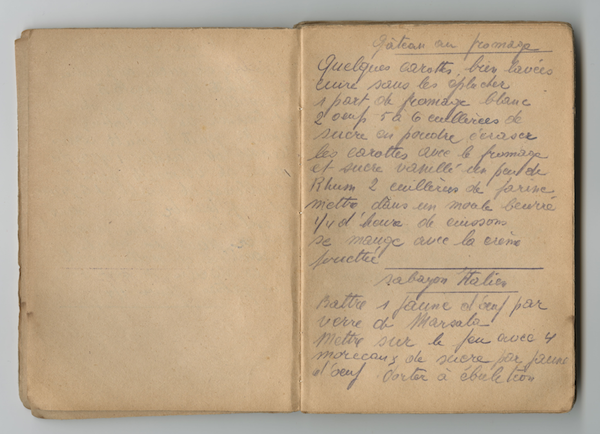
Rebecca Teitelbaum’s recipe book was compiled in Ravensbrück concentration camp, Germany, circa 1940s. It is from the Teitelbaum, Buckman family fonds, VHEC Collections.

This article is based on remarks delivered at the screening of the film Who Will Write Our History on International Holocaust Remembrance Day.

The Vancouver Holocaust Education Centre (VHEC) was honoured to partner with the Vancouver Jewish Film Centre and the Peretz Centre for Secular Jewish Culture for the screening of Who Will Write Our History (2018, directed by Roberta Grossman) that took place on Jan. 27 at the Peretz Centre.

Jan. 27 marked the 74th anniversary of the liberation of the death camp at Auschwitz-Birkenau. This date was first commemorated in 2005 by the United Nations General Assembly as International Holocaust Remembrance Day.

Around the world, thousands of individuals observe International Holocaust Remembrance Day to honour the six million Jewish victims of the Shoah and millions of other victims who were brutally murdered by the Nazis and their collaborators. Many organizations worldwide take this day as an opportunity to raise awareness of the Holocaust and to offer educational programs to help prevent future genocides.

The VHEC also gathered with local survivors of the Holocaust a few days prior to the film screening to commemorate the victims of the Shoah. The survivors remembered their beloved mothers, fathers, brothers, sisters and other family members who perished during the Shoah, as they lit candles and said prayers.

When students from all over the Lower Mainland visit the VHEC, they frequently ask about resistance against the Nazis during the Holocaust. We all know too well what the consequences of resistance were in the Nazi-occupied countries. But what exactly did resistance in the context of the Holocaust mean or look like? When people hear the word resistance, often, they think of physical, armed resistance, as it occurred, for instance, during the Warsaw Ghetto Uprising in 1943, or by brave partisan fighters, who fought the Nazis and their collaborators and blew up Nazi train tracks and other infrastructure. However, there were forms of defiance that were more subtle.

Let me give you two examples of defiance that one may call cultural or spiritual resistance during the Holocaust.

Rebecca Teitelbaum (born 1909), from Belgium, was kept in Ravensbrück, a concentration camp for women. In secret and at great risk, she stole small pieces of paper and a pencil from the Nazi office of the camp. She also traded food for a needle and thread. At night, together with other women from her barrack, she wrote down her favourite recipes and filled 110 pages with what reminded her of better times with her family. She then sewed together the pieces of paper into a book. Upon its completion, the women took comfort reading the recipes out loud.

Sarah Rozenberg-Warm (born 1923), from Poland, was a slave labourer at a Nazi munitions factory in Skarzysko-Kamienna, Poland. Living conditions in the camp were terrible. One day, a fellow inmate stole pieces of metal and, instead of creating munitions for the Nazis, he created a mirror, a ring and a comb for Sarah, risking his life to do so. Perhaps, he wanted to make Sarah feel like a human being again as she looked in the mirror, in times when she was treated in the most inhumane way imaginable. Perhaps, through the seemingly small gesture of creating these gifts for Sarah, the inmate succeeded in giving Sarah hope for better times, and strength to carry on.

Both Rebecca Teitelbaum’s recipe book and Sarah Rozenberg-Warm’s mirror are currently on display at the Vancouver Holocaust Education Centre as part of the exhibition In Focus: The Holocaust Through the VHEC Collection and serve as examples to students and the general public about cultural and spiritual defiance.

Jewish defiance was also expressed through efforts to perpetuate Jewish culture and maintain humanity in the face of attempted annihilation. Spiritual resistance in ghettos and camps included clandestine prayers and the creation of artistic works and books. In some ghettos, underground schools were formed, and secret archives were established to document the Holocaust.

The film Who Will Write Our History gives us the opportunity to learn more about an extraordinary example of Jewish defiance during the Holocaust through the attempt of preserving diaries, documents and papers in the secret Oyneg Shabes Archive created by Dr. Emanuel Ringelblum and his fellow inmates. It is a film worthwhile seeing.

Dr. Ilona Shulman Spaar is the education director at the Vancouver Holocaust Education Centre and the curator of the exhibition In Focus: The Holocaust Through the VHEC Collection, on display at the VHEC until June 2019. Find out more at vhec.org.

Format ImagePosted on February 8, 2019February 7, 2019Author Dr. Ilona Shulman SpaarCategories LocalTags defiance, Holocaust, Rebecca Teitelbaum, remembrance, Sarah Rozenberg-Warm, VHEC
From Hitler’s library

From Hitler’s library

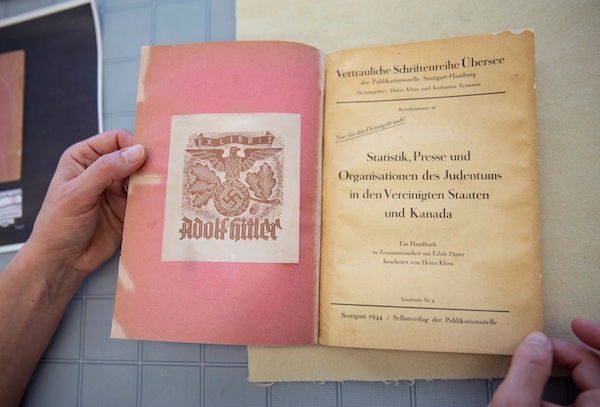
Library and Archives Canada recently acquired this 1944 book previously owned by Adolf Hitler. (photo from Library and Archives Canada)

Library and Archives Canada recently acquired a rare 1944 book previously owned by Adolf Hitler. The 137-page German-language report Statistik, Presse und Organisationen des Judentums in den Vereinigten Staaten und Kanada (Statistics, Media and Organizations of Jewry in the United States and Canada) was compiled by Heinz Kloss. The data contained within it provides details on population statistics in certain cities, as well as key organizations and presses of Canadian and American Jewish communities. The bookplate bears a stylized eagle, swastika, and the words “Ex Libris Adolf Hitler,” indicating it came from Hitler’s personal library.

Kloss, who visited the United States in 1936-1937, was a noted German linguist whose specializations included German speakers living in the United States. He was the head of the Publikationsstelle Stuttgart-Hamburg, which dealt with research on nationality issues, particularly in the United States, and this book was part of a confidential series and for official use only.

The work hints at the story of what might have happened in Canada had the Allies lost the Second World War. It also demonstrates that the Holocaust was not a purely European event, but rather an operation that was stopped before it reached North America. The book adds many insights worthy of reflection for Canada about the Second World War, and is an important tool to fight Holocaust denial.

“It is fundamental for a national institution like Library and Archives Canada – and other memory institutions around the world – to acquire, preserve and make available documents no matter how controversial or contentious they could be,” said Guy Berthiaume, librarian and archivist of Canada. “It allows us to educate and to advocate for the most complete historical record possible. The truth of history is woven from many sources, and it is only when history is presented in its entirety that it can support the free exchange of ideas that lies at the heart of a democratic society.”

This book by Kloss was likely brought to the United States as a war souvenir, as thousands were taken by American soldiers from the Nazi leader’s alpine retreat outside Berchtesgaden in the spring of 1945. The library acquired it from a reputable Judaica dealer who had obtained it as part of a collection owned by a Holocaust survivor, and it will be preserved in the Jacob M. Lowy Collection, where other important items related to Holocaust remembrance reside.

The acquisition of this book highlights the library’s mandate to acquire material that reflects the published record of Canada, as well as to preserve the memory of the Holocaust. It is also a way to let us reflect on what would have happened in Canada had the Second World War ended differently.

“This invaluable report offers a documented confirmation of the fears felt so acutely and expressed by so many Canadian Jews during the Second World War: that the Nazis would land on our shores and, with them, the annihilation of Jewish life here,” said Prof. Rebecca Margolis, department of modern languages and literatures and Vered Jewish Canadian Studies Program, University of Ottawa, and president, Association for Canadian Jewish Studies. “While these fears may seem unfounded given the geographic distance of Nazi Europe to Canada, this handbook offering detailed statistics of Jewish populations across North America underlines their nightmarish potential.”

Format ImagePosted on February 8, 2019February 7, 2019Author Library and Archives CanadaCategories BooksTags education, Hitler, Holocaust, library, remembrance
Teaching entrepreneurship

Teaching entrepreneurship

Students at the Bachar school in Even Yehuda, which educates for leadership and entrepreneurship, prepare to welcome a delegation of educators from developing countries, who came to learn how Israeli schools educate for entrepreneurship. (photo from Galit Zamler)

For Galit Zamler, a course that began as a volunteer position at one school has become a full-time job, with more and more schools picking up her program.

In 2009, when Zamler’s third child was in Grade 6, his school principal wanted to have an after-school activity. She brought representatives of a company that was not only expensive to hire, but would only present to outstanding students, and required at least 20 of them.

Seeing the value of educating kids about entrepreneurship, Zamler – who has an MBA and has co-founded two businesses – told the principal that she would do such a presentation at no charge, as long as her son could be one of the participants. A month later, Zamler was teaching her first group of 12 children. She knew she was onto something great after she had sent the students’ parents notes about what was being taught, and the parents responded with thank you letters.

Word spread and, after volunteering for six years, Zamler turned her volunteer work into a full-time career. Now, 10 years into it, she said, “At the beginning of the course, I’d count each one of them, but now there are a lot of schools and there’s awareness of the need to teach entrepreneurship. I don’t need to go and try to convince anyone. They are going out looking for it.”

One of the first things Zamler teaches is that there are different kinds of entrepreneurs. It is not strictly about entrepreneurs of technology or inventions, and it is not just about opening a business. Students are taught that, to succeed, one must stand out from others – be creative and make their initiative unique.

“Then, they raise ideas and learn that there are no bad ideas,” said Zamler. “Each idea can be good and that’s how we do it. Being critical will prevent others from raising ideas. It’s very important that the class be open-minded and let everyone, whatever their idea, say it aloud and learn to explain it. Sometimes, what they have in their head is not clear to the others. They learn to stand in front of the class and explain their ideas.

“It’s not that every idea is great,” she clarified. “It’s just that we won’t criticize ideas. We ask questions to understand, and we discuss what difficulties we see in ideas – things like, how much it will cost, who will need it, to take a good look at it.

“Sometimes, this makes the student drop an idea, because they understand it can’t be implemented…. For example, there was a student who said she wanted every student to have a cupboard in the class to put their books into. The kids asked where she would put them, with very little space. And, she realized it couldn’t be done.”

photo - Sixth graders at the Hayovel school in Ashdod present their social project: A Birthday to Everyone
Sixth graders at the Hayovel school in Ashdod present their social project: A Birthday to Everyone. (photo from Galit Zamler)

Once all the ideas are shared with the class, students start to determine which ones they like the most and come up with business plans – tackling the process like a cake recipe, considering which ingredients they will need to bring their concepts to life. This includes the physical elements, as well as how to make their business unique, part of which involves seeking advice from experts in various fields to see if any changes might be needed.

Only then do the students try to implement their project, which can sometimes be as simple as composing a letter to the municipality.

“I have a school that wanted to have a gym,” said Zamler. “But, the school is small and there’s no place. So, they wrote a letter. The municipality sent an expert to explain why it can’t be done, but gave them money to buy equipment for activities they can move from place to place; using it outside and bringing it back inside as needed. And, they were satisfied with this.”

The curriculum is offered to grades 2 through 9 in Israel and it is funded in part by the government, as principals are allowed some leeway to allocate funds as they see fit within a list of external programs pre-approved by the Ministry of Education.

“Sometimes, they teach it as a science class,” said Zamler. “Other times, it is categorized as a life skills lesson in the curriculum … and, when the school principal thinks it’s important, he or she finds a way.”

Zamler – and other parents – consider the entrepreneurship course a great addition to what is being taught in school, as it will help in practically every aspect of life.

“I think, sometimes, it’s the parents that bring the program to the schools, because they know that children learn something useful for life … not just the ordinary curriculum,” which includes things that may not “help them when they grow up, as things change so quickly,” said Zamler.

Even armed with this entrepreneurial knowledge, Zamler acknowledged that the overwhelming majority of students – 90% to 95% – will end up as employees. But, she is hoping they will be leader employees.

“I was an employee with entrepreneur skills, and that’s what helped me go from the bottom up to management,” she said. “Being an entrepreneur in an organization means that you think big, you do more than you are told. Those are the kinds of workers we need in the workforce.”

While Zamler has not yet conducted follow-up studies on the students who have taken the program, other countries are taking note and looking for ways to implement the program in their own schools.

“The foreign office brings delegations to Israel twice a year and takes them to a school that educates for entrepreneurship,” said Zamler. “And what we see is that, instead of students who don’t like to go to school, we see students who are really enjoying their time in school, because they have choices.

“The army is also looking for these kinds of students…. If they don’t have these kinds of skills – persistence, creativity, and working on team goals – the army doesn’t want them. We know it helps them in the future, in the army and, I think, the workforce.”

The Hebrew Academy in Miami Beach was the first school outside of Israel to implement the program. Also, a company from Hong Kong has purchased the licence to bring the program there.

“They do amazing things there and they’re opening more and more classes,” Zamler said of Hong Kong. “But, there, it is an after-school activity, because it’s hard to bring it into the public school curriculum.”

Zamler has created an online training program for both students and teachers wanting to bring entrepreneurship into their school. For more information, visit tomorrowsuccess.com.

Rebeca Kuropatwa is a Winnipeg freelance writer.

Format ImagePosted on February 8, 2019February 7, 2019Author Rebeca KuropatwaCategories IsraelTags children, education, entrepreneurship, Galit Zamler, Israel
Museum of Babylonian Jewry

Museum of Babylonian Jewry

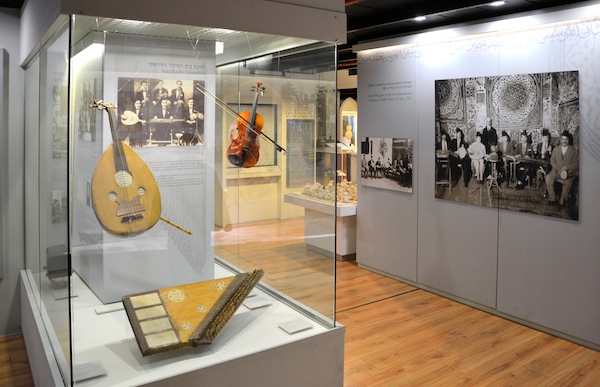
Between 1948 and 1951, more than 121,000 Jews were smuggled out of Iraq in operations Ezra and Nehemia. Many of those who came to Israel settled in the town of Or Yehuda, some 10 kilometres southeast of Tel Aviv. In 1988, Or Yehuda’s mayor, Mordechai Ben-Porat, who was himself born in Iraq, was instrumental in creating in the town the Museum of Babylonian Jewry. Together with six other founding members, the museum was built to tell the story of the Jews in Iraq, up until the aliyah following the establishment of the state of Israel. The museum has become the largest centre in the world for documenting, researching, collecting and preserving the spiritual treasures of Babylonian Jewry. (photo by Ashernet)

Format ImagePosted on February 8, 2019February 7, 2019Author Edgar AsherCategories IsraelTags history, museums, Or Yehuda

Posts pagination

Previous page Page 1 … Page 3 Page 4 Page 5 Next page
Proudly powered by WordPress