Skip to content
  • Home
  • Subscribe / donate
  • Events calendar
  • News
    • Local
    • National
    • Israel
    • World
    • עניין בחדשות
      A roundup of news in Canada and further afield, in Hebrew.
  • Opinion
    • From the JI
    • Op-Ed
  • Arts & Culture
    • Performing Arts
    • Music
    • Books
    • Visual Arts
    • TV & Film
  • Life
    • Celebrating the Holidays
    • Travel
    • The Daily Snooze
      Cartoons by Jacob Samuel
    • Mystery Photo
      Help the JI and JMABC fill in the gaps in our archives.
  • Community Links
    • Organizations, Etc.
    • Other News Sources & Blogs
    • Business Directory
  • FAQ
  • JI Chai Celebration
  • JI@88! video

Recent Posts

  • Sharing her testimony
  • Fall fight takes leap forward
  • The balancing of rights
  • Multiple Tony n’ Tina roles
  • Stories of trauma, resilience
  • Celebrate our culture
  • A responsibility to help
  • What wellness means at JCC
  • Together in mourning
  • Downhill after Trump?
  • Birth control even easier now
  • Eco-Sisters mentorship
  • Unexpected discoveries
  • Study’s results hopeful
  • Bad behaviour affects us all
  • Thankful for the police
  • UBC needs a wake-up call
  • Recalling a shining star
  • Sleep well …
  • BGU fosters startup culture
  • Photography and glass
  • Is it the end of an era?
  • Taking life a step at a time
  • Nakba exhibit biased
  • Film festival starts next week
  • Musical with heart and soul
  • Rabbi marks 13 years
  • Keeper of VTT’s history
  • Gala fêtes Infeld’s 20th
  • Building JWest together
  • Challah Mom comes to Vancouver
  • What to do about media bias
  • Education offers hope
  • Remembrance – a moral act
  • What makes us human
  • המלחמות של נתניהו וטראמפ

Archives

Follow @JewishIndie
image - The CJN - Visit Us Banner - 300x600 - 101625

Tag: terrorism

Holding faith at rallies

Holding faith at rallies

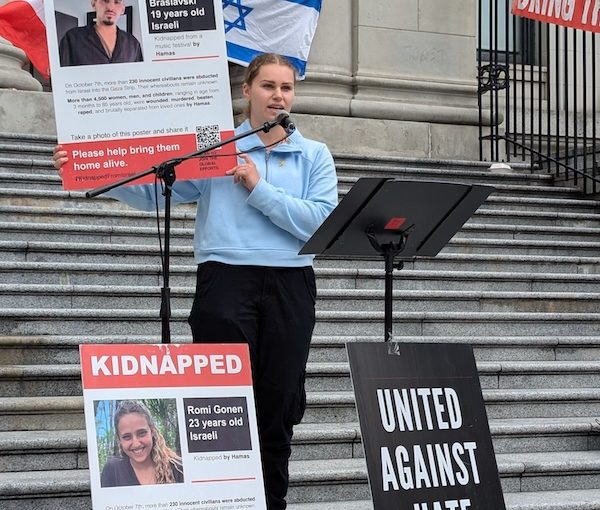
UBC student Zara Nybo, a non-Jewish ally, holds a poster of Rom Braslavski, as she speaks of his heroism before he was taken hostage to Gaza on Oct. 7. (photo by Pat Johnson)

As negotiations continued in Doha, Qatar, for the release of Israeli hostages, the weekly rallies in support of those held, their families and all Israelis continued Sunday, Aug. 18, at the Vancouver Art Gallery.

“As a university professor and as a Jew, I have been forced to witness the frontlines of a propaganda war to dehumanize and demonize Jews and to delegitimize the nation of Israel,” said Prof. Steven Plotkin, a University of British Columbia physicist.

The Hamas strategy is one of “asymmetric warfare,” he said, in which they bait Israel Defence Forces with attacks and hostage-takings, then use their own Palestinian civilians as human shields, knowing that the casualty numbers and horrible images will evoke sympathy in the West.

“And we’ve seen it,” he said. “The encampment and the protests at UBC quickly turned from advocating for the human rights of Palestinians to a call for the end of Israel.”

On campus, the messages he saw included the now familiar “From the river to the sea, Palestine will be free,” but others on the same theme, including “We don’t want your two states! Take us back to ’48” and “Resistance is justified when you are occupied.” Another common refrain, he said, is “‘Globalize the intifada.’ That means bring terrorism everywhere, including here in Canada.”

“Long live Oct. 7” was yet another slogan the professor saw on his campus. 

“Let that sink in,” he said. 

When reports of extensive sexual abuse by Hamas and other Palestinians who broke through the border on Oct. 7 became known, he said, “I saw posters at UBC that announced a discussion group for ‘the lies that Zionists spread about the sexual abuse that didn’t occur on Oct. 7.’”

Plotkin reflected back to the days after the 9/11 terror attacks in New York City, when people put up posters of their lost loved ones.

“Could you imagine what kind of person would think to tear one of those down? No one would have dreamed of it,” he said. “And now we’re seeing a world whose moral compass has completely lost its direction.”

Posters of Israeli hostages are routinely torn down at UBC, elsewhere in Vancouver and around the world. Plotkin shared a psychological hypothesis for why this desecration is so rampant.

In the identity-centred worldview of many activists, Plotkin said, morality is determined by one’s position in the hierarchy of oppression.

“The less powerful are pardoned, the more powerful must be guilty,” he said. Because Hamas is less powerful than Israel, Israel must be guilty, despite the evidence of Hamas murdering, raping and abducting Israeli civilians. 

“A hostage poster, however, throws a wrench into that framework because it forces them to cope with the idea that the people that they thought were oppressed could actually be in the wrong,” Plotkin said. “Their whole simplistic worldview of the blameless oppressed and the evil oppressor is undermined by the ugly facts contained in the posters. A hostage poster induces a cognitive dissonance and, rather than question their own worldview, it’s easier for them to see it as pro-Israel propaganda designed to elicit their sympathy for the Jews in Israel, the bad guys, and so they feel compelled to tear the poster down.”

Eyal Daniel, a Burnaby high school teacher who specializes in Holocaust and genocide studies and who is president of the Holocaust and Antisemitism Educators’ Association, spoke about how his group was denied recognition by the BC Teachers’ Federation. 

Representing close to 150 educators, the group applied to become one of the BCTF’s provincial specialist associations.

“Our application was rejected without any given reason,” he said. “Currently, there are no educational resources about the Holocaust and antisemitism for teachers in the province.”

Conversely, Daniel said, the province’s 50,000 teachers are bombarded by their union with materials promoting the elimination of the state of Israel.

The provincial government has mandated that Grade 10 students must receive Holocaust education beginning in 2025 and it is said to be working on curriculum materials. 

Despite the lack of recognition from the BCTF, Daniel’s group will continue to work “as if we had been approved,” he said.

“Therefore, these days, we are in the process of constructing a new website, developing useful, meaningful professional development opportunities for teachers, assessing and developing appropriate educational materials and working with the minister of education on the upcoming Grade 10 Holocaust education curriculum framework,” he said.

Daniel spoke of his family’s recent visit to Israel, where they visited the site of the Nova music festival.

“Stepping out of the car into the desert heat, we were immediately surrounded by the haunting silence,” he said, “but, yet, 364 voices called out from the ground: Where is the humanity? The Nova memorial site is a barren killing field where humanity ceased to exist.”

Rabbi Susan Tendler of Congregation Beth Tikvah, in Richmond, spoke of the need for dialogue.

“In civic discourse … we’re yelling more than we’re listening,” she said. “So many of us will talk about the need to listen to one another but instead we’re just angry and have an inability to actually talk to one another.”

She asked people to see the humanity of others as a starting point to dialogue.

“To be a Jew means to respect and understand that every single human being was created in the image of God,” she said. “Let us continue to work for peace in the region that so, so sorely needs healing.”

Zara Nybo, a fourth-year student at UBC, is an ally to the Jewish community, president of the Israel on Campus club, and an Emerson Fellow with the international advocacy group StandWithUs. She shared recollections of a training conference in Los Angeles from which she and scores of other campus activists recently returned. At an LA rally for the hostages, she heard profoundly moving testimonies from family members of those still held in Gaza.

“Most people around me, men, women, had tears streaming down their face,” said Nybo. “We were all holding each other in collective grief.”

The mother of Rom Braslavski spoke of how her son had been a security guard at the Nova music festival and took it upon himself to hide the bodies of murdered women, both so they would not be taken to Gaza and so that they would not be posthumously raped or mutilated, as he had seen other female bodies desecrated. Braslavski was taken hostage in Gaza.

As Nybo and her fellow students prepare for the new academic year, she emphasized the training they have undergone and the determination with which they will return to campus.

“I will tell you we are committed to this fight,” she said. 

Richard Lowy, who has provided vocal and guitar inspiration at almost every rally for months, spoke of the hope that a resolution will come through negotiation.

Event organizer Daphna Kedem recounted the rally in Tel Aviv the evening before and expressed hope that the hostages will be released soon and that the weekly rallies she has organized for 10 months will cease to be necessary.

Format ImagePosted on August 23, 2024August 22, 2024Author Pat JohnsonCategories LocalTags antisemitism, BCTF, Bring Them Home, Daphna Kedem, Eyal Daniel, Hamas terror attacks, Holocaust education, hostages, Oct. 7, rally, Richard Lowy, Steven Plotkin, Susan Tendler, terrorism, Zara Nybo

Who are the cynical ones?

The Islamic Revolutionary Guard Corps is the world’s foremost state sponsor of terror. The IRGC’s Quds Force (“Quds” meaning “Jerusalem,” to note the ultimate priority of the corps’ aims), is effectively the international terrorism arm of the Iranian government and military.

Ottawa finally got the message. Last week, the Government of Canada designated the IRGC a terrorist entity under Canadian law. 

“The Canadian Jewish community has persistently called for this decisive action against the IRGC, recognizing its role in promoting violence and instability globally, including through its support for terrorist groups targeting Jews and others,” said a statement from Shimon Koffler Fogel, president and chief executive officer of the Centre for Israel and Jewish Affairs. “While we applaud this step, it is disappointing that it took so long for the government to act on its commitment.” 

Iran has destabilized (the word seems profoundly modest) Lebanon, by backing Hezbollah, the terror group that has wreaked havoc by upending that country and turning it into a staging ground for attacks on Israel, and Syria, by supporting Bashar al-Assad, the strongman who has waged war on his own people for more than a decade. Terrorism by the Iranian regime has prevented Iraq from becoming a functioning state. Tehran’s long arm has also terrorized individuals and organizations in the large Iranian diaspora. In 2020, the IRGC shot down Ukrainian International Airlines Flight 752, killing all 176 passengers and crew, including 55 Canadian citizens and 30 Canadian permanent residents.

And still Canada’s government did not take the seemingly simple step of calling the IRGC what is so clearly is.

In 2020, the US State Department estimated that Iran was supplying Hamas and other Palestinian terror groups with $100 million per year in training and military and financial support. An Israeli source put that number, by 2023, at $350 million.

Part of the intelligence catastrophe of Oct. 7 was an apparent assumption by Israeli intelligence that Hamas did not have the capacity to organize as complex an attack as it did against Israel that day. This was a tragic intelligence failure on many fronts, but it was certainly a failure in Israel’s massive underestimation of the extent and complexity of what Hamas was capable of, thanks directly to the IRGC. 

Canada is grappling with the fact that foreign actors have meddled in our politics, with China and Russia the prime suspects in this still-shrouded issue, but Iran has certainly had its fingers in our pie. The Iranian regime is also suspected of laundering money through Canada.

Iranian-Canadian human rights activist Nazanin Afshin-Jam addressed a parliamentary committee this month, putting a fine point of who we’re dealing with, not only internationally but domestically in Iran as well.

“Any time you have seen video footage of women in Iran being beaten and dragged screaming into police vans because of not properly wearing a hijab or of Christians arrested for worshipping in underground churches or Kurds being gassed or children being executed or peaceful protesters being intentionally shot at, blinded, raped or tortured, these are all the acts of the IRGC and its paramilitary subgroup, the Basij,” she said.

So why did Canada act now?

The announcement came less than a week before a pivotal byelection in Toronto. Voters in the riding of St. Paul’s, a Liberals stronghold since 1993 and considered one of the party’s safest seats in the country, went to the polls Monday.

The riding has one of the largest concentrations of Jewish voters – about 15%, which may not seem a lot but is 15 times the national Jewish population average and enough to swing a tight race, certainly. Another 1,500 of so residents list Farsi as a mother tongue and those, presumably Iranian-Canadians, know as well as anyone what the IRGC is capable of.

The very suggestion that a Canadian government would make a crucial, long-delayed decision like this based on crass political motivations is almost beyond the imagination.

Asked point blank by a reporter whether the decision was linked to the byelection – which many suggested could have existential implications for Prime Minister Justin Trudeau’s political career – Trudeau seemed to glass over and deliver a robotic reply.

Canada, he said, has already been “extremely preoccupied with the activities of the murderous regime in Tehran.” His government, he said, has “been working very, very hard on this for years.” He suggested that the delay was based on concerns for Iranian-Canadians and their families back home.

We are glad our government has taken this step. We are also revolted at the very suggestion that the decision could have been motivated by political expediency. It is unfathomably cynical – but who are the cynics? Is it reporters and commentators who accused the government of politicizing this move? Or is it a cadre of political advisors and elected officials who calculated that a few Jewish voters in midtown Toronto could save the prime minister’s hide if they were just thrown a bone?

We may never know exactly. But, if that was Liberals’ calculation, it failed. Conservative candidate Don Church upended tradition and won the riding. Liberals and others are still poking through the entrails to divine the wider implications for Canadian politics. 

Posted on June 28, 2024June 27, 2024Author The Editorial BoardCategories From the JITags Canada, Election, IRGC, Islamic Revolutionary Guard Corps, politics, St. Paul’s, terrorism
Past echoes in present

Past echoes in present

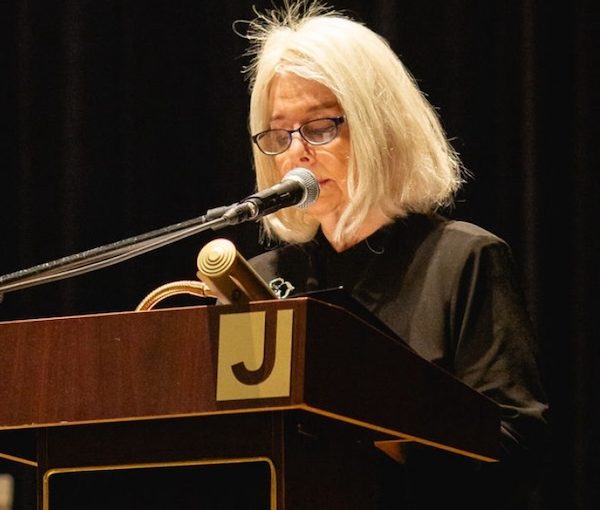
Child survivor Lillian Boraks-Nemetz speaks at the community’s Yom Hashoah Commemoration May 5. (Rhonda Dent Photography)

The pogrom of Oct. 7 and the hurricane of antisemitism that has swirled since then added resonance to commemorations of Yom Hashoah this week.

Around the world, Jewish communities united in different ways to mark the annual Holocaust remembrance day. Sunday night, May 5, the local commemoration at the Jewish Community Centre of Greater Vancouver featured child survivor Lillian Boraks-Nemetz, who reflected on the unmistakable parallels across time, of “Broken families, broken bodies and minds and the poor frightened children and much more.”

Recently, said Boraks-Nemetz, she heard the words of Israel’s ambassador to the United Nations, Gilan Erdan, who reflected on how a sunny Shabbat morning in Israel turned, in a matter of seconds, into hell.

“On just such a sunny morning, in Warsaw, I lost my childhood,” said Boraks-Nemetz, who was introduced Sunday night in a touching tribute by her son, Stephen. “The day Nazis invaded Poland, I remember German bombers flying low over my head against an innocent blue sky and as World War Two began on Sept. 1, 1939, I had to become an adult at the age of 6.”

In the war that began that day, she said, 1.5 million Jewish children were murdered. She suffers guilt and questions around her survival when so many, including her little sister, did not live.

“Some of us were younger than others. Some older,” she said. “Nevertheless, we were all traumatized – as our brothers and sisters are today, in Israel, and in a world that won’t learn history and its lessons. We don’t feel safe anymore around our world. Thousands protest against us as they have always done, just looking for a reason to express their hate for Jews.”

Boraks-Nemetz shared parts of her Holocaust history, from the earliest time, when her mother took her to a favourite café only to find a sign declaring Jews were forbidden from entering – signs that then proliferated in parks, recreation areas, theatres, streetcars and elsewhere.

“We were beginning to lose our humanity,” she recalled. “Thousands protested against us with words such as ‘Death to Jews,’ ‘Final Solution’ and more.”

Today, she said, similar words are directed at Jews.

“This is being allowed to flourish unpunished, using our freedom of speech for their purposes,” she said. “But surely there are red lines where free speech ends and hate speech begins that must be punishable by law.”

She recalled seeing the wall around the Warsaw Ghetto being constructed, higher and higher, as she watched.

“I asked my father what this wall means,” said Boraks-Nemetz. “I asked many questions. I was almost 7 years old. This wall, he replied, will eventually enclose a part of Warsaw where we will be forced to live.”

That day came when, through a window, she saw a long car with officers and a bullhorn ordering Jews to enter the ghetto or suffer severe consequences.

“From the day I and my family entered our one room within these close, shabby quarters, I felt as if I had stepped out of sunlight into darkness,” she said. “I felt as if I was being stifled and the feeling of being stifled stayed with me as a memory and a trigger all of my life. The wall meant confinement, exclusion, isolation, fear, hunger and quarantine of a disease called typhus.”

Boraks-Nemetz shared the story of how she was to be smuggled out of the ghetto by her father, who had bribed a non-Jew but, when the day came, she was ill and instead her sister was sent out, never to be seen again. 

“The streets were treacherous, with children dying of hunger and disease, poor and starved people peddling what little they had for a few potatoes and stealing what they couldn’t buy,” she said. 

While smuggling a child out of the ghetto was a life-threatening act for all involved, so was remaining in the ghetto, she said. Eventually, thanks to an enormous bribe, young Lillian was passed through the gate of the ghetto, where she survived on the outside in the care of her grandmother, who had secured a false identity.

“That day, I felt as if I had lost my family, my home and any degree of safety I had felt,” she recounted. “I became numb and frozen. As a child, I didn’t understand why was I being sent away, alone, into a hostile world. I felt I wasn’t wanted by family or society. That day, I lost my identity as a Jew and a human being, a daughter.”

A forged piece of paper gave her a new, false name, false parents, a false age.

With a small blue suitcase in hand, she walked the short distance from her father, past the bribed guards, who looked the other way, into the care of a waiting stranger who would whisk her to a new, still very hazardous, life outside the ghetto.

“Although it was a very short distance, today I think of it as the longest walk, from impending death to the possibility of life,” she said.

Eventually, she started a new life in Canada, married at 19 and took on the role of a typical Canadian housewife, she said. At 40, she had a crisis, during which she was forced to confront the realities of what she had experienced, a struggle she has addressed ever since, through poetry, sharing her story with students and other means. For her, and for so many others, she said, Oct. 7 brought back from the mists of time the collective consciousness and memory of the past.

“We are still persecuted, blamed, hated,” she said. 

Rabbi Carey Brown, associate rabbi at Temple Sholom, spoke earlier in the evening, expressing the need to be careful in drawing parallels between historical events, but acknowledging that the traumas of the past inform reactions to the present. 

“It is difficult to distinguish between remembering the past and living in the present,” she said. “It feels inseparable.”

The current generation, said Brown, owes it to the memory of those who perished in the Shoah, as well as to the generations yet to come, “to take seriously and be steadfast in our commitment to ‘Never again.’”

photo - Singers Erin Aberle-Palm, left, and Cantor Shani Cohen and cellist Eric Wilson were part of the music program produced by Wendy Bross Stuart
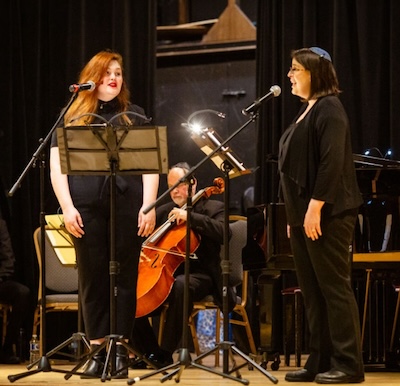
Singers Erin Aberle-Palm, left, and Cantor Shani Cohen and cellist Eric Wilson were part of the music program produced by Wendy Bross Stuart. (Rhonda Dent Photography)

The solemn ceremony began with Holocaust survivors in a procession escorted by King David High School students who are descendants of survivors.

Shoshana Krell-Lewis, a member of the board of directors of the Vancouver Holocaust Education Centre and a daughter of the centre’s founding president, Dr. Robert Krell, welcomed the audience and acknowledged elected officials and survivors. In recognition of survivors from the former Soviet Union, Irena Gurevich translated into Russian.

Sarah Kirby-Yung, deputy mayor of Vancouver, represented the city. 

Cantor Yaacov Orzech recited El Moleh Rachamim.

A moving musical program by artistic producer Wendy Bross Stuart featured Eric Wilson on cello and singers Erin Aberle-Palm, Cantor Shani Cohen, Lisa Osipov Milton, Matthew Mintsis, Kat Palmer and Lorenzo Tesler-Mabe.

The program was presented by the Vancouver Holocaust Education Centre, funded through the Jewish Federation annual campaign and by the Province of British Columbia, and supported by the Gail Feldman-Heller & Sarah Rozenberg-Warm Memorial Endowment Fund, Temple Sholom Synagogue and the Jewish Community Centre of Greater Vancouver. 

Format ImagePosted on May 10, 2024May 8, 2024Author Pat JohnsonCategories LocalTags antisemitism, Carey Brown, history, Holocaust, Lillian Boraks-Nemetz, memorial, Oct. 7, remembrance, Second World War, terrorism, Yom Hashoah
Reflections on April mission

Reflections on April mission

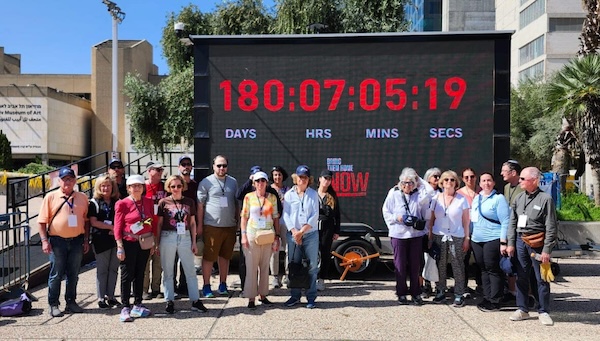
JNF Canada, Har El and Beth Israel mission participants in Hostages Square in Tel Aviv. (photo from Lorraine Katzin)

About 20 volunteers – from Vancouver, Edmonton and Toronto – went on the JNF Canada Bearing Witness Mission to Israel April 1-8. Organized by Jewish National Fund Canada, Congregation Har El and Congregation Beth Israel, the trip was led by BI’s Rabbi David Bluman and JNF Edmonton executive director Jay Cairns. On his Facebook page, Cairns thanks JNF Pacific executive director Michael Sachs, BI Senior Rabbi Jonathan Infeld and Bluman “for spearheading this important mission.” Among the volunteers were Har El members Lorraine Katzin and Karen Shalansky, who shared some of what they experienced with the Jewish Independent.

Some first impressions
(Lorraine Katzin)

Stepping onto the El Al plane from Los Angeles to Tel Aviv reminded me of the olden days of flying – a blanket, pillow, headphones and a bag with a toothbrush, toothpaste and eye mask. Two meals were served and, during the flight, you could help yourself to snacks, sandwiches and drinks.

Walking through Ben Gurion International Airport, you see photos of the hostages still in captivity. When we went through the foreign passport area, it was chilling – we were literally the only people passing through passport control. There were no tourists. Our hotel was quiet as well.

Walking on the promenade in Tel Aviv to Jaffa on our arrival, it felt as if there were no war – people were out on the beach, swimming, playing beach bats, foot volleyball, and jogging.

Tuesday, April 2, was our first full day of touring. We started at Kibbutz Kissufim in the south. We heard stories of the murders and saw the devastation made by the Hamas terrorists. One of the stories that haunts me is that of the chief fireman whose only child, his daughter, and her husband were shot to death in their safe house, then their home was burnt down. Searchers only knew by finding a nose ring and bracelet in the ashes that the bodies had been burnt. 

We were very close to Gaza and could hear artillery every now and again, which was scary. At the site of the Nova music festival, there was a memorial of photographs: 364 people were killed there by Hamas, 44 hostages were taken.

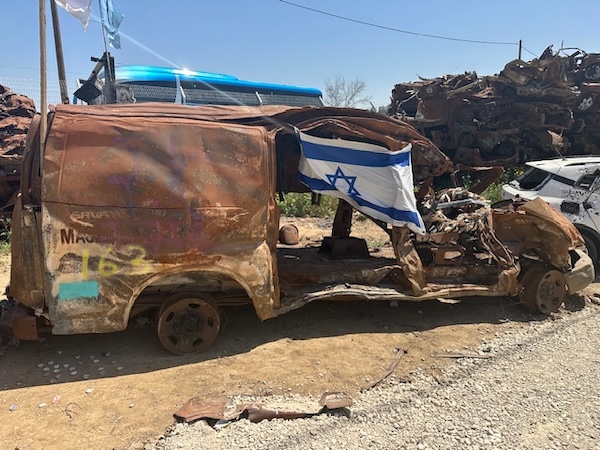
On Wednesday, we toured Adi Negev-Nahalat Eran, which is a village for children with disabilities, which JNF supports. Karen and I volunteered at the therapeutic farm, cleaning the goat pen and washing the tortoises. That day we were also taken to the car cemetery, where you see two burnt ambulances, as well as burnt and bullet-holed cars numbering more than 1,000. In Sderot, we saw where the police station used to be – the building was taken over by Hamas terrorists and then an Israeli tank destroyed the building, killing the terrorists inside.

photo - A burnt-out Magen David Adom ambulance in the car cemetery near the Gazan border, where burnt and bullet-holed vehicles numbering more than 1,000 are being kept for further investigation
A burnt-out Magen David Adom ambulance in the car cemetery near the Gazan border, where burnt and bullet-holed vehicles numbering more than 1,000 are being kept for further investigation. (photo from Lorraine Katzin)

The first few days of the mission, I found it difficult to sleep, the images and stories kept going through my head.

On Thursday, we picked lemons and went to Rachashei Lev Israel Children Cancer Centre, another JNF project. We also visited Hostages Square.

Friday included a visit to Western Canada House, a No2Violence shelter for women and children fleeing domestic violence, the building of which was funded by JNF Canada supporters in Vancouver and Winnipeg. [For more on Western Canada House, see jewishindependent.ca/a-new-refuge-from-violence.] We also went to the ANU Museum of the Jewish People, which had on display models of different shuls in Europe and the United States, a replica of the Codex Sassoon and an Oct. 7 exhibit. After stopping at the Carmel Market, we went back to Hostages Square for Kabbalat Shabbat, which was very moving.

Saturday, we went to the beach in the morning and walked around Tel Aviv in the afternoon. That night, we had a survivor come speak to us and it happened to be Shalev Biton, who had come to speak at Har El and elsewhere in Vancouver a few weeks prior. Amazingly, he remembered me!

On another night, we heard from Jacqui and Yaron Vital, parents of Adi Vital-Kaploun, who was murdered on Oct. 7. Jacqui, who is a Canadian, was in Ottawa visiting family when the Oct. 7 Hamas terror attacks happened. Adi, her husband and two children lived on Kibbutz Holit in the south and Yaron had come to visit; he was put up in a room in a vacant house opposite his daughter’s. Adi texted her husband, who had gone on a hike, warning him not to return home. Adi was killed, and her two children and a neighbour were kidnapped but let go at the Gaza border, by some miracle. Yaron survived, as the terrorists had determined which homes had how many people and who had dogs, which were shot first, but the room Yaron was in was usually vacant, so went unchecked by the terrorists.

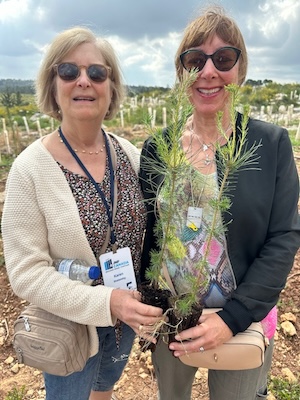
photo - Karen Shalansky, left, and Lorraine Katzin tree planting
Karen Shalansky, left, and Lorraine Katzin tree planting. (photo from Lorraine Katzin)

On Sunday, April 7, we went JNF tree planting. We visited the Black Arrow Memorial, where, from the lookout, you can see Gaza. There, we were given a briefing by retired colonel Kobi Marom, whose opinion was that the Palestinian Authority should be enlisted to run Gaza. We then traveled to the Israel Defence Forces base at Nahal Oz for lunch with the soldiers – these 19-, 20- and 21-year-olds going into Gaza are truly amazing! The soldier I sat with, his name was Daniel and he was from Eritrea. We were so close to Gaza that we could see convoys of food trucks going through the Rafah Border Crossing.

Monday, our last day, we went to Jerusalem to two places that JNF supports: the Jerusalem Hills Therapeutic Centres, which provides services for at-risk children, and the Glassman PTSD and health centre at Herzog Hospital. We then visited the market and went for a walk down Ben Yehuda Street, the Kotel and the tunnels, and had dinner at Piccolino restaurant before heading to the airport. We were joined by Jewish Federation of Greater Vancouver executive director Ezra Shanken and Rabbi Jonathan Infeld from Congregation Beth Israel.

Israel trip highlights
(Karen Shalansky)

I went to Israel to show my support in its time of need, as well as to hear the views of Israelis and their feelings toward the war. Through our many experiences, I felt I accomplished my mission.

Listening to the diverse perspectives of our guide, the young soldiers and guards on our bus, my 31-year-old cousin who made aliyah right after high school and is now fighting in the reserves, Lorraine’s Israeli friends, a retired colonel and others, I heard varying opinions on many topics. For example, should Israel invade Rafah, should there be a ceasefire, should the release of the Israeli hostages be the No. 1 priority, should there be an election, who should oversee Gaza after the war? While there was always more than one answer to every question, there were consistent feelings among everyone we met of resilience, strength and perseverance – that this war is another of many, and that Israel will carry on. As well, everyone we met was both amazed that we came during war and so happy that we had made the effort. That happiness alone made Lorraine and I feel that this trip was worthwhile. 

Some highlights of the trip for me were:

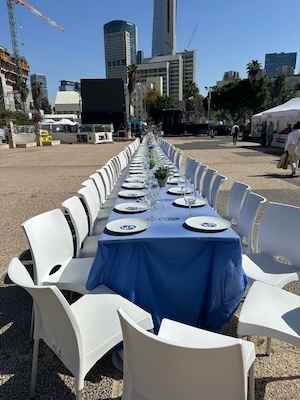
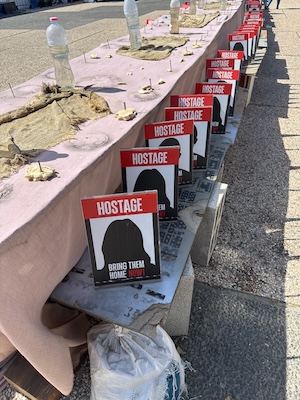
1) Visiting Hostages Square in Tel Aviv for Kabbalat Shabbat. This is a square that has Shabbat tables set up for both the released hostages (with blue tablecloth and wine glasses) and for the hostages still being held (with dirty water and stale pita). There was a wonderful band playing, with a singer, and, at one point, there was a chance for people to stand up and say something. Lorraine was our spokesperson and announced that we were on a trip from Canada to support Israel. Several Israelis came up to us afterwards to shake our hands and welcome us. When the band sang Lecha Dodi, a few people got up to dance the hora, including Lorraine and me. 

photo - In Hostages Square, there are two tables set up: one for the hostages who have been released (left) and one for those still being held in Gaza (right)
photos - In Hostages Square, there are two tables set up: one for the hostages who have been released (left) and one for those still being held in Gaza (right)
In Hostages Square, there are two tables set up: one for the hostages who have been released (left) and one for those still being held in Gaza (right). (photos from Lorraine Katzin)

2) Visit to Shlomit settlement in the southern Negev. This was a religious settlement that JNF helped build. As an aside, JNF has been very active in rebuilding bomb shelters and kibbutzim that were destroyed on Oct 7. At Shlomit, we heard from Dana, a mother of six children, about how her husband and four other men went to a neighbouring kibbutz to fight the terrorists. While the men were successful in killing all five terrorists, her husband, unfortunately, was shot dead. Dana said she wanted her children to remember her husband as a hero, and to foster a sense of hope, not hate. In this inspirational talk, she kept emphasizing that we can’t live with hate, only with love and hope. 

3) A talk from a trauma psychologist at the Glassman centre. While post-traumatic stress has risen substantially in Israel, this psychologist told us a story of an army unit that recently returned from a three-month stint in Gaza. Prior to going home, the unit visited one of the soldier’s grandmothers, who was a Holocaust survivor. The attacks by Hamas on southern Israel have been equated to a second holocaust, but, upon asking the grandmother’s views, she said “no,” the attacks were nothing like the Holocaust. We have a country and a people that will fight for us now, whereas in 1940 we had nobody, she said. She concluded: we are never alone again, as long as there is an Israel. 

Format ImagePosted on May 10, 2024May 8, 2024Author Lorraine Katzin and Karen ShalanskyCategories IsraelTags Beth Israel, Har El, Israel, JNF Canada, JNF Pacific, kibbutzim, mission, Oct. 7, terrorism
Heroic survival at kibbutz

Heroic survival at kibbutz

A photo Dekel Agami took Oct. 7, 2023, of Kibbutz Nir Oz in flames. (phot by Dekel Agami)

On Oct. 7, Kibbutz Magen, from which residents can see the Gazan city of Khan Yunis, was infiltrated by dozens of terrorists from Gaza. While two of the approximately 400 kibbutzniks were murdered and two seriously injured, a more horrific outcome was avoided, thanks to the heroic acts of a small squad of kibbutz civilian defenders, who held off the terrorists during a seven-hour gun battle.

A member of that response team was in Vancouver last week, sharing his story.

Kibbutz Magen is a kilometre away from Kibbutz Nir Oz, a village with a similar population, but which suffered exponentially more tragic outcomes that day – 46 Nir Oz residents were murdered and 71 taken hostage.

One reason for the less catastrophic death toll in Magen is that the terrorist infiltrators blew apart the perimeter fence a good distance from the kibbutz’s residential area. But the heroism and tireless response of Magen’s civilian emergency squad played a big role.

photo - Dekel Agami, left, and his partner Nufar Gal-Yam, share their Oct. 7 experiences with Vancouver audiences April 14. Itai Bavli, right, a University of British Columbia academic, grew up with Agami on Kibbutz Magen, near the Gaza border
Dekel Agami, left, and his partner Nufar Gal-Yam, share their Oct. 7 experiences with Vancouver audiences April 14. Itai Bavli, right, a University of British Columbia academic, grew up with Agami on Kibbutz Magen, near the Gaza border. (photo by Daphna Kedem)

Dekel Agami, who grew up on the kibbutz, and his partner, Nufar Gal-Yam, who grew up in Sde Boker, the kibbutz most noted as the home of David Ben-Gurion, had moved in together on Kibbutz Magen on Oct. 4.

Since both had grown up in southern Israel, close to Gaza, the red alerts on Oct. 7 did not disturb them unduly. Around 7 a.m., Agami, an Israel Defence Forces veteran who served in the special forces, headed out with his weapon to meet other members of the security squad, a group of civilians and off-duty soldiers ranging in age from 20 to 70. He quickly realized this was not a routine day.

As he walked to meet his colleagues, Agami saw figures near the kibbutz border. The first one he encountered was wearing an Israel Defence Forces uniform – as numerous terrorists were that day – and so he did not shoot.

He came across the head of his security team, Baruch Cohen, who had been shot in the leg. As Agami was delivering first aid, an anti-tank missile hit the vehicle they were next to. Agami does not know how they survived.

In the event of an emergency, civilian and off-duty military personnel on kibbutzim are expected to manage on their own for 20 to 30 minutes until the arrival of the IDF. On Oct. 7, the dozen emergency squad members in Kibbutz Magen battled 30 to 40 terrorists on their own from 7 in the morning until 2 in the afternoon.

The terrorists breached the fence at a location relatively remote from the residential area of the kibbutz, giving the defenders a small tactical advantage. Fighting soon moved to the terrorists’ targets, the kibbutz’s homes, and, after providing first aid to Cohen, Agami fought the terrorists from one of the houses. The kibbutzniks successfully flushed the infiltrators back to the fence, where some of them fled – maybe back to Gaza, possibly off to murder easier prey.

During the fighting, Agami took a photo of nearby Nir Oz, where multiple plumes of smoke were rising in an ominous foreshadowing of their potential fate. The photo went viral in Israel.

“When I took this picture, I thought we were next,” Agami said to an audience at Temple Sholom on the evening of April 14. He and Gal-Yam also spoke at the weekly rally earlier that day, outside the Vancouver Art Gallery.

When the IDF finally made it to Kibbutz Magen, about 2 p.m., they killed the remaining terrorists. Then the larger trauma began to dawn on Agami and his fellow kibbutzniks.

Agami’s two daughters from a previous relationship were with their mother at a moshav a few kilometres away. During the battle, he didn’t worry about them – partly because, he said, he “couldn’t go there” but more because it never crossed his mind that the battle he was engaged in was part of a much larger crisis. When he finally did get in touch, he found out the three were safe.

The Magen fighters were too occupied keeping the terrorists at bay – Agami alone expended 15 magazines, about 450 bullets – to check their phones to see what was going on elsewhere. They did, though, have cellular connectivity, which was not the case in many kibbutzim. The terrorists were strategic, first targeting army bases and bringing down communications systems.

As the smoke cleared midafternoon on Oct. 7, several stunning realities came to light.

Three wounded residents – Cohen, Nadav Rot and Avi Fleisher – had been transported by the kibbutz doctor to a nearby community, from which they were helicoptered to hospital. Fleisher did not survive. Cohen would eventually have his leg amputated. No one – including those who made the journey – understand how they made it to safety. The terrorists had taken control of all the roads in the region, killing every Israeli they encountered. Even the military had not breached the area by the time the medical transport got through.

The exhausted kibbutz defenders soon discovered that what they had experienced was a comparatively small part of the worst terror attack in Israel’s history. In just a hint of the depths of preparation that went into the attacks, the fleeing terrorists left behind not only weapons, flashlights and food for an extended siege, but even supplies of blood for infusions.

Agami and Gal-Yam were brought to Vancouver by Itai Bavli, a postdoctoral fellow and lecturer in public health at the University of British Columbia. He and Dekel grew up together in Magen.

The friends estimate that 60 alumni of their regional high school died on Oct. 7. Including those killed in the subsequent war, they estimate 100 of their circle of friends are dead, including Bavli’s stepbrother, Tamir Adar, who lived in Nir Oz.

Agami downplays his heroism, but Bavli is emphatic.

“He saved my family,” Bavli said.

Gal-Yam, who is expecting a baby in July, just completed a five-month call-up as a major in the IDF. She and Agami are now in temporary accommodations on her home kibbutz of Sde Boker. Agami spent five months relocated in Eilat.

“It’s like some area after a hurricane,” Gal-Yam said of the chaos at Kibbutz Magen, which was founded in 1949 and is one of the oldest communities adjacent to the Gaza Strip.

She has since returned to her day job, but everything has changed, she said.

“It seems unimportant to do again whatever it was I was doing before Oct. 7,” she said, noting that creating a normal routine is impossible. “Nothing is normal now. I’m not normal. I’m a completely different person. We are living completely different lives than before. Nothing is the same. Nothing at all.”

The Israeli visitors demurred from making predictions about the political or military ramifications of events.

“Some people are going to have to give answers after all this will be over,” Gal-Yam said.

The length of time the hostages have been in captivity – more than six months – is something that was unimaginable on that first, terrible day, she said. “Not a person in Israel thought it would take more than six months to bring them home,” she said. “This is a reality none of us expected.”

An audience member asked how they view residents of Gaza now.

Bavli reflected on how, before Hamas took over the Gaza Strip, workers from Gaza came to their kibbutz, even staying overnight.

“People from Gaza worked on our kibbutz and were treated as family,” he said. “We wanted to have them as neighbours, to find political solutions, to find a way to live together.

“We don’t have anything against people from Gaza,” he said. “What broke our hearts was, at Kibbutz Nir Oz, the first wave [of infiltrators on Oct. 7] was Hamas, but the second wave was just people who came to steal. But they also killed people. That’s what broke our hearts, confused us.”

For the future, Bavli sees the willingness of Gazans to live in peace as key.

“Hopefully,” he said, “there are enough good people there to find a way to live together.”

Format ImagePosted on April 26, 2024April 26, 2024Author Pat JohnsonCategories IsraelTags Dekel Agami, Israel, Itai Bavli, Kibbutz Magen, Nufar Gal-Yam, Oct. 7, survivors, Temple Sholom, terrorism
Freedom and friendship

Freedom and friendship

Achiya Klein and Joy at Trout Lake Park in Vancouver April 4. Klein and Joy were brought together by the Israel Guide Dog Centre for the Blind. (photo by Cynthia Ramsay)

“The Israel Guide Dog Centre is not just a centre,” said Achiya Klein. “It’s like a family.”

Klein and his assistance dog, Joy, came to Vancouver from Toronto earlier this month with Atarah Derrick, executive director of Canadian Friends of the Israel Guide Dog Centre for the Blind. The Independent met with them at Trout Lake Park April 4.

It was an educational experience to see Klein and Joy interact, like a unit. Even when Joy was off leash, clearly enjoying the freedom of running around on her own, meeting other dogs, she would respond to Klein’s occasional check-in whistles or calls. Being a Hebrew-speaking dog, one wonders what she had to say to her Canadian compatriots. Only once, enticed by the lake, did Joy hesitate to return to Klein, but she did – and before taking the plunge she so obviously wanted to take. On our walk, Derrick explained that all the 

Israeli guide dogs have English names so that the animals will know it’s them being called – imagine, she said, if a client called out a name like Yossi in an Israeli market, for example.

Klein has had Joy since the end of last October, since his first guide dog, Night, passed away at the age of 8.

“Having a guide dog is my way to get my independence again,” said the Israel Defence Forces veteran, who was injured in 2013. “I can do whatever with a guide dog because I can walk alone, with no fear, and being comfortable.”

Klein has serious visual impairment. “I have some sight,” he said, “but it’s minimal.”

A team commander in Yahalom, a special unit of the IDF that deals with the handling of dangerous ammunition and weapons, Klein was injured in a Gazan tunnel. “I was on a mission to demolish the terror tunnel that crossed into Israel,” he explained, “and, when we were walking in the tunnel … there was a booby-trap, and I got injured from that when it exploded.”

Klein moved to Canada with his wife, who is Canadian, in 2023. Noach Braun, the founder of the Israel Guide Dog Centre, personally brought Joy to Klein, where he worked with the pair for 10 days. The training period was shorter than usual because Klein had already had a guide dog. Normally, after matching a client with a dog, the pair train together for a few weeks at the centre, which then provides more training in the client’s home environment.

“It’s not like they just give you a dog and say, ‘OK, good luck,’” said Klein. “It’s more than that, and I think that one of the best examples is, after Night passed away, even though I was in Canada and I was supposed to go to Israel to receive a new dog, because of Oct. 7, I couldn’t make it to Israel, so Noach … came here during the war. He came here with Joy and I think that’s a beautiful story, to show what it means to be a part of the family.”

According to Derrick, who has been leading the Canadian Friends of the Israel Guide Dog Centre for the Blind since 2021, the centre has placed 796 guide dogs, 39 post-traumatic stress disorder (PTSD) dogs and 442 emotional support dogs, for a total of 1,277 since its founding in 1991. In 2023, there were 176 puppies being raised by centre volunteers, she said.

“The IGDCB (as it is known in Israel) serves Israel’s blind community by providing them with mobility, independence, self-confidence and companionship through the faithful assistance of guide dogs specially trained in Hebrew to meet Israel’s rigorous and challenging environment,” Derrick explained in an email. “We also breed and train service dogs for IDF veterans who have service-related PTSD and provide emotional support dogs for children on the autism spectrum.”

Canadian Friends of the Israel Guide Dog Centre for the Blind was established almost 20 years ago and Canada accounts for 6.6% of donations, according to its 2022 annual report. It is one of Derrick’s goals to increase that amount.

“I have always been passionate about community service and working in the charity sector, raising funds for vulnerable communities,” she said. “I’m a real dog person and, when the opportunity opened at Canadian Friends of the Israel Guide Dog Centre, it was the perfect match for my skills, interests and passions – helping people, Israel and dogs!”

Last year, Derrick and Braun visited Vancouver to visit donors and meet others interested in the centre’s work. “Everyone asked us to come back soon, preferably with a client and their dog, so they could see our work in action,” said Derrick, which was why she came this spring with Klein – who has become, she said, since being injured, “a Paralympic rower, a dedicated skier, a father and an asset to the IDF” – and Joy.

“We visited Vancouver Island first, with a meeting in Ladysmith to meet new friends there,” said Derrick. “We then headed south to Victoria, specifically Chabad of Vancouver Island. Then we moved east to Vancouver, where we met with Schara Tzedeck, the Kollel, and held a parlour meeting at the home of new friends. It was such a lovely visit, and we got to meet terrific people with whom our work really resonated.”

Initially, former Jewish National Fund shaliach (emissary) to Vancouver Mickey Goldwein, his wife Lili and her dog, Zita, were to accompany Derrick on the BC visit. Unfortunately, they couldn’t make the journey from Israel.

Lili Goldwein was partnered with Zita in 2018, explained Derrick, “because Lili’s vision had significantly deteriorated. Mickey joined the Israel Guide Dog Centre for the Blind’s board in 2022.”

The need for the centre and its services has increased since Oct. 7.

“Due to this war, we altered the criteria for receiving an emotional support dog to provide an immediate response to those injured or suffering due to the war,” said Derrick. “Since then, we have provided our emotional support dogs to children and adults with special needs whom the war has immensely impacted. Some of these people fought on Oct. 7 and were discharged immediately because of the trauma they endured. Some are widows of fallen soldiers. Some have been afraid to leave the house for months. 

“We are aware of some soldiers who have lost their vision in this conflict, and we need to be ready for them when they need us. This is in addition to the current clients on the waitlist,” she said.

The war also has disrupted the centre’s training, which may impact the number of guide dogs it can provide this year. “But we are doing our best to meet the challenge,” said Derrick.

photo - Atarah Derrick, executive director of Canadian Friends of the Israel Guide Dog Centre for the Blind, with Cookie
Atarah Derrick, executive director of Canadian Friends of the Israel Guide Dog Centre for the Blind, with Cookie. (photo from Atarah Derrick)

And they are meeting the challenge while still feeling the effects of the pandemic.

“COVID had two major impacts on our training,” said Derrick. “The first was in the socialization of our puppies. In their first year, it’s crucial to expose them to as many environments as possible. The office or university, the mall and the train station are all places where our pups get to experience lots of people, noises and smells and become more comfortable navigating those environments. Because of the lockdowns, most were cut off from those experiences, and many were not ready to take on service work. So, our success rate through COVID dropped, and our clients had to wait longer periods for their dogs. This was the case worldwide. 

“The second was that we were not able to open our residences to clients in guide dog courses. When a person is partnered with a guide dog, they live in residence with us for two weeks while they train together with our professionals. This was impossible during COVID, so our trainers went to the clients and worked with them at home, one-on-one, to complete the course. We put a lot of mileage on our vans during those years.”

Now, it is hospital visits that account for some of the mileage being put on the centre’s vans, with puppies and guide-dogs-in-training traveling to offer comfort to injured soldiers and civilians across Israel. 

“As the war rages on, we’re committed to continuing this mission of love and compassion,” reads the centre’s latest blog. “Because no matter the circumstances, a little bit of puppy love can go a long way in healing hearts and bringing people together.”

Seeing Klein and Joy together at Trout Lake Park and getting a glimpse of what having a guide dog has meant to Klein, the importance of the IGDCB’s work seems clear.

“They provide you with one of the most basic tools that you use every day,” Klein said. “But it’s not just a tool, it’s also a friend.”

To learn more about the Israel Guide Dog Centre for the Blind, visit israelguidedog.ca. 

Format ImagePosted on April 26, 2024April 26, 2024Author Cynthia RamsayCategories Israel, LocalTags Achiya Klein, Atarah Derrick, COVID, dogs, health care, IDF, Israel Defence Forces, Israel Guide Dog Centre for the Blind, Israel-Hamas war, mental health, pandemic, terrorism, veterans

Don’t give up on the UN

A review released Monday about the United Nations Relief and Works Agency, the sprawling bureaucracy that for decades has played a central role in the lives of Palestinians, said Israel has not provided adequate evidence to demonstrate that UNRWA workers engaged in terrorism.

The review, headed by a former French foreign minister, dismissed Israel’s claims that UNRWA workers in Gaza were engaged in terrorist activities, including the Oct. 7 pogroms. It did, however, recommend several steps to ensure neutrality, transparency and third-party monitoring of UNRWA activities. 

Regardless of the specifics in this particular accusation, UNRWA is deeply problematic. Critics contend that its mission is to perpetuate Palestinian statelessness and discontent, rather than ameliorate these problems.

Many Jewish and pro-Israel voices have long pointed to UNRWA, as well as the annual procession of anti-Israel votes at the United Nations General Assembly, among other examples, as “proof” that the United Nations is hopelessly anti-Israel, if not antisemitic.

This may or may not be true. In any event, the answer is to fix the United Nations, not bury it.

Hyperbolic, disproportionate, often ludicrous attacks on Israel at the General Assembly and from countless UN bodies undeniably demonstrate a peculiar obsession with this one (Jewish) country to the detriment of other serious issues. However, this inappropriate and biased approach must not blind us to the irreplaceable value of the organization that was envisioned as a world parliament.

Coincidentally, a new poll of Canadians and Americans indicates massive dissatisfaction with the organization – and rightly so.

The Association for Canadian Studies and the Metropolis Institute engaged the pollster Leger to survey North Americans on their opinions toward the United Nations. The poll was conducted about four months after the Oct. 7 attacks, and indicates that just over one-third of Canadians and just under one-third of Americans trust the UN.

Jack Jedwab, president and chief executive officer of both of the survey’s sponsoring organizations, noted a particular incongruity in the results. While only around one-third of respondents “trust” the United Nations, much higher numbers of people hold a “net positive opinion” of the body. In both countries, a majority – 58% of Canadians and 54% of Americans – view the organization as more positive than negative.

This is encouraging, because it suggests that, while people have issues with the UN in practical terms, we are not ready to give up on the potential of the UN or the ideals upon which it was founded.

There are many reasons to criticize the United Nations, but the clearly biased anti-Israel resolutions and reports that grab headlines obscure a panoply of crucial, often lifesaving programs and services delivered by UN organizations like the World Health Organization, the World Food Program, UNICEF and UNESCO.

To put this in a context that perhaps makes sense on a more localized level, giving up on the UN would be like eliminating the sewer systems, traffic lights and schools in your hometown because you can’t stand the mayor. 

If we cannot muster idealism, let’s just be practical. Don’t take it from us, take it from Danny Danon, Israel’s former ambassador to the United Nations. Danon has a long history as a right-wing Israeli politician. In his 2022 book, In the Lion’s Den: Israel and the World, he reflects on his five years as ambassador, from 2015 to 2020.

He arrived, he admits, as a hawk and a hardliner, not expecting to fit into the world of diplomacy. Over his time there, he came to see the value of the UN, despite all the disappointments and wasted resources.

Even in the lion’s den at the head of the sprawling body, the General Assembly, Danon said it is possible for a seemingly unwelcome individual like Israel’s ambassador to “build bridges, forge friendships and create a space for understanding.”

The idea, expressed by some pro-Israel people, that Israel should simply walk away from the world body, would be to cut off our nose to spite our face. Why would we abandon the one small voice we have in that forum, surrendering it to the haranguing of Israel’s enemies without contest?

Likewise, if Canadians feel our government is not representing our values and ideals at the United Nations, we need to take that up with our elected representatives here and ensure that they do so. Throwing up our hands in surrender helps no one.

Is there a problem with UNRWA? Undeniably. Fix it. Is there a problem with the International Court of Justice? Many observers would say so. Fix it. Do numerous United Nations agencies obsess over Israel while millions around the world suffer in obscurity? Undoubtedly. Fix that too.

Is the United Nations perfect? It’s a ridiculous question. Nothing in human activity is perfect. But what is the role of Jews in the world, an obligation we reminded ourselves during our seders this week? Our obligation as Jews and as humans is to strive to make the world better – and, in that context, fixing the UN is central to that objective.

Is there a long way to go in this work? Yes. Are we free to abandon it? No. 

Posted on April 26, 2024April 26, 2024Author The Editorial BoardCategories From the JITags governance, Oct. 7, Passover, terrorism, tikkun olam, United Nations inquiry, UNWRA
A long day in multiple ways

A long day in multiple ways

The car graveyard at Moshav Tekuma. The vehicles – recovered from along Highway 232 and the site of the Nova music festival – are being kept for at least a year, for investigators to scour them for further evidence. (photo by Adina Horwich)

At the beginning of April, I had a very long day, which is rare for me. I rose at 5:45 a.m. to visit the Gaza Envelope with 30 others. At 7:35, the bus left Jerusalem. Our guide boarded at Latrun. We proceeded toward the Re’im Junction, also known as Masmia, then headed south to Sderot.

At Sderot, we went to the site of the destroyed police station, where many police and staffers were killed on Oct. 7. The town is slowly returning to normal function, as many evacuees have returned and schools have reopened. A new police station has been built.

Despite being the closest community to Gaza, under nearly constant fire from Hamas for nearly 20 years, Sderot has become an attractive place for young families, joining the stalwart old-timers. I was there several times a dozen years ago, when my son was a student at Sapir College, and have always enjoyed spending time there. New neighbourhoods, including high rises, have sprung up.

From a lookout on the outskirts of the city, atop Kobi’s Hill, we could see the entire length of the Gaza Strip. The lookout was consecrated in memory of four soldiers who died in Operation Protective Edge in 2014. It was impressive, if that is the word, to see Gaza  from so close. Mere kilometres.

We visited the up-and-coming city of Netivot, which is nearby. There, too, we saw much real estate, which has attracted a mostly, though not exclusively, religious sector, with Baba Sali’s gravesite and shrine a major calling card. He was a beloved rabbi and sage, particularly dear to Jews of Moroccan background. We went inside a well-tended sanctuary, to have a look and offer prayers. The place was hopping. As it was Monday, a Torah reading day, it was a suitable time to celebrate bar mitzvahs, and we caught a festive first haircutting of twin 3-year-old boys.

Afterwards, we headed to Moshav Tekuma. We did not expect to be allowed in, as there was heavy security and restricted access, but we were granted permission. Within the guarded gates, we saw what looked like a huge car junkyard – except that it is a graveyard. All the cars were recovered from along Highway 232 and the site of the Nova music festival at Re’im. They are being kept for at least a year, for investigators and forensic experts to scour them for further evidence. Many cars are smashed up, as if they had been in bad accidents, others are pockmarked, having been sprayed with bullets. Surrounding these is a huge pile of rusty scrap and charred rescue vehicles, as well as pickup trucks and motorcycles used by the terrorists to infiltrate the area.

photo - Memorial to those who were murdered at the Nova music festival by Hamas terrorists on Oct. 7.
Memorial to those who were murdered at the Nova music festival by Hamas terrorists on Oct. 7. (photo by Adina Horwich)

We drove further along the road, past Kibbutz Sa’ad and Alumim, along Route 232, and stopped just outside Kibbut Be’eri (the public is not allowed in). We looked inside one of the roadside shelters, next to a bus stop, which normally accommodates roughly eight people. On Oct. 7, some 40 people stuffed themselves inside. It was into such structures that many fled from the Re’im festival, seeking refuge, but the terrorists hurled grenades inside. At one migunit, Aner Shapira managed to throw the grenades back at the terrorists, though, in the end, he was killed, along with other young people. Inside are memorial candles, stickers with the pictures and names of victims, letters and comforting wishes are written on the walls.

photo - Site of the Nova music festival
Site of the Nova music festival. (photo by Adina Horwich)

We traveled some more, reaching the city of Ofakim. That is where a very brave woman, Rachel Edri, appeased the five terrorists who barged into her home by offering them refreshments, including her now-famous cookies. She and her husband, David, both in their 60s, were able to manage the terrorists, engaging them in conversation, plying them with more food and singing songs, over 19 hours. Whenever she could, Rachel would go to the bathroom and signal from the window to the police outside, who had surrounded the house, gauging attempts to enter. The Edris’s son is in the police force and was instrumental in finally seizing back their home. Unfortunately, during the siege, the house suffered great damage and is a total wreck; only a shell remains. And, sadly, David Edri passed away about a month ago. Rachel has gone to live with her sister-in-law.

As we were looking around, another hero appeared in the small parking lot opposite. Shuki Yosef lives across the street with his wife. He invited us to come into their building’s shelter, where he recounted how he and some of the neighbours hid for several hours, all the while hearing gunshots and shouting outside. He secured a metal bicycle frame to keep the shelter’s door closed, holding it with his own hands for hours. Later, after the ordeal had ended, he designed and fashioned a wooden plank to better fit the door hinges, in the event of future need.

The bravery of these residents is remarkable. It is worth noting that their homes are not the closest ones to the highway – which one might think would have been attacked first – but the houses and people who took the brunt of the terrorist attack are tucked well within the city. The sheer gall and number of terrorists that infiltrated, going from house to house on a murderous rampage in Sderot, in Ofakim, in the kibbutzim, on the roadsides, gunning down so many, are mind-boggling. These communities all lie within minutes of each other in a pretty small area.

It was an unusually hot day for April 1, over 30 degrees Celsius. And it was an intense excursion. Visiting made the reality a lot more tangible, but still impossible to fully comprehend. It was moving to witness and I learned much. We left the Otef (Envelope/Wrapping), as it is called, and I arrived home just before 7 p.m.

More than six months have passed since Oct. 7 and we remain in the thick of things. It is taxing and draining, even on those of us who, fortunately, are not too closely involved. Everyone is touched by the terror attacks and the war. 

Adina Horwich was born in Israel to Canadian parents. In 1960, the family returned to Canada, first living in Halifax, then in a Montreal suburb. In 1975, at age 17, Horwich made aliyah, and has lived mostly in the Jerusalem area. She won a Rockower Award for journalistic excellence in covering Zionism, aliyah and Israel for her article “Immigration challenges” (jewishindependent.ca/immigration-challenges-2).

Format ImagePosted on April 26, 2024April 26, 2024Author Adina HorwichCategories IsraelTags Gaza Envelope, Israel, kibbutzim, Netivot, Oct. 7, Re’im, Sderot, terrorism
Songs released since Oct. 7 

Songs released since Oct. 7 

At Beth Tikvah Synagogue on April 2, Israeli music expert and radio personality Josh Shron will present A Musical Hug from Israel. (photo from Josh Shron)

Beth Tikvah Synagogue in Richmond welcomes Israeli music expert and radio personality Josh Shron on April 2. Shron, longtime host of the radio show and podcast Israel Hour Radio, will be in Calgary and Vancouver as part of a North American tour. He will present A Musical Hug from Israel, which explores songs that have been released in Israel since Oct. 7.

For Shron, Israeli music has always meant more than just nice tunes in Hebrew. It’s been a window into Israeli society, providing a meaningful glimpse into the heart and soul of the Jewish state. “I’ve long believed that Israeli music has the power to connect us to our homeland unlike anything else,” Shron said. “The songs are great, but the stories behind them often teach us a great deal about the amazing spirit of Israel.”

It’s that amazing spirit that has enabled Israelis to cope with the horrific events of Oct.7.  Music has been a large part of the healing process.

“The music that’s emerged from this tragedy has been nothing short of inspirational,” said Shron. “It makes us cry, makes us sigh and makes us proud to be supporters of Israel – sometimes all in the same song.”

The presentation will feature a selection of Israeli songs, seen on video with English subtitles. The music will highlight the unity, optimism and determination that have characterized the Israeli people throughout this challenging period, showcasing the resilience and strength that unite them in the face of adversity. The repertoire will include songs that touch on themes of sadness and death. Other songs will shed light on the plight of Israeli hostages in Gaza, serving as a reminder of the desperation felt around the world to bring them all home.

Several Vancouverites have previewed Shron’s presentation and agree that it is a powerful and unique way for the local community to understand the rollercoaster of emotions that Israelis and other Jews around the world have been experiencing.

A former resident of New Jersey, Shron recently fulfilled a lifelong dream by making aliyah with his wife and four of his five children, moving to Modi’in in August 2023.

“I’ve immersed myself in Israeli music for more than 25 years,” he said, “and the more I listened, the more I felt like I belonged there. We put it off for years, but, with our kids getting older, we realized it’s now or never – and we weren’t prepared to say never. Obviously, we wish the circumstances were different, but, during this challenging time, it just feels right to be there. It’s only been a few months, but we can’t imagine living anywhere else.”

Thanks to sponsor support from the Kehila Society, Richmond Jewish Day School and the Vancouver Israeli Folkdance Society, tickets to A Musical Hug at Beth Tikvah April 2, 7 p.m., are only $10 each. As part of the event, Hadas Klinger will lead an Israeli dance session immediately following Shron’s presentation.

The event is for adults 19+ and registration is recommended, as space is limited. Visit tinyurl.com/28anpjab. 

– Courtesy Beth Tikvah

Format ImagePosted on March 22, 2024March 20, 2024Author Beth Tikvah CongregationCategories MusicTags Beth Tikvah, Israel Hour Radio, Josh Shron, music, Oct. 7, social commentary, terrorism

Making meaning in diaspora

“We’re planning a family event in June.” That’s how I start nearly every contact with vendors while trying to arrange it. Sometimes, I say a “party with family and friends.” I avoid saying b’nai mitzvah. It’s just easier and safer.

One of my twins has a locker at junior high near a student who uses her body as a sign of protest. “Free Palestine” is written on her cheek. Other days, messages are emblazoned on a sweatshirt. My kid says she seems to stare at him, but I recommended he just stay away, don’t stare back, and don’t cause any kind of confrontation. “Do you know this person?” I ask him. “No,” he says, “she doesn’t know us.” What he meant is perhaps more obvious to us now – he doesn’t think she knows we are Jewish.

The transition from a bilingual Hebrew/English public elementary school to a junior high where Jewish kids are few and far between has been a big one. To my surprise, it went smoothly, but, over time, the ramifications have become clear. We knew our kids would figure out that we were, in fact, a small minority in Canadian culture. In elementary school, they would choose surprising moments to discuss Jewish things or use words in Hebrew with people at the dentist’s office or on public transportation. At first, our explanations about how people were different, with various religions and backgrounds were confusing. In their minds, they still believed everyone was Jewish.

On one hand, I loved that they didn’t have to learn to code-switch as early as I did. Code-switching is a way to describe how we switch between dialects, languages or personae in different settings. That is, a person might speak one language at home and another at work. In Jewish settings, one might use what linguists call “Jewish English,” English interspersed with Yiddish or Hebrew or other Jewish languages. At home, we might be encouraging someone to “daven at shul” with friends. We might shout “Dai, maspik!” (“Stop, enough!”) when someone misbehaves. In public, we might say “go to services” or “Behave yourself!”

Some people say that learning this kind of nuance takes maturity, but that doesn’t always ring true. I knew, by age 5 or 6 when my ethno-religious identity needed to be kept to myself. During times of extreme antisemitism, children were forced to keep this hidden, or even not told they were Jewish until old enough to manage the information. Giving my kids this extended time of safety felt like offering them a special oasis, a honeymoon that I missed.

Years ago, I worked with an editor and writer who shared with me that she had a Jewish background, although she was adamantly secular. I often felt the need to code-switch with her, as something made me feel like I was “too Jewish” for her comfort level. Since Oct.7, things have changed. She has become public in her Jewish identity, speaking out against antisemitism. Recently, she has been reading history and research for a book-length project. Today, she said, reflecting on an historic “golden age” for Jews in Polish history: “There is no safety in America now just because it’s been a golden age for my lifetime.” Yeah, I responded. I know.

Everyone copes differently. On social media and among friends, some dig into their Jewish identities. They’re consistently posting about their Jewish pride or activities and asking others to do so as well. One local friend who regularly attends synagogue told me that, if anything, this war has made her want to “do Jewish” even more, so she’s physically attending more services and gatherings than she had previously. Others decide to keep their kids home from school on days where there might be safety issues or have stopped attending anything at all connected with the Jewish community. They keep a low profile. Being loud and proud isn’t their way.

I have seen all these approaches (and many variations) from the Jewish people I know. And there are the minority Jewish viewpoints, too, on the political right and left. Those who claim more of an affinity with their progressive causes than with Jewish ones are often vocal on social media and at pro-Palestinian protests, either finding ways to disown their background or use their Judaism to explain their activism. Some particularly outspoken ones demonstrate, at least to me, that they don’t have a solid grounding in Jewish history and tradition, particularly as it relates to Israel, but instead embrace narratives around colonialism and apartheid instead.

Lately, I have been longing to ask where these “land back” Canadian Jewish activists live, if not in homes on occupied land taken from Indigenous communities. If homes here are on occupied ground, where do they believe it would be acceptable for Jews to live? I wonder how they mesh these theories with their everyday lives, or the archeological, historical and literary references to the Jewish past.

Living in grey areas of nuance is exhausting. There are so many references in Jewish texts to back this up. We have, after all, been struggling with these identity issues for millennia. We’re the ethnic group for whom the Greek word of “diaspora” was invented. Yet, this is one time where more evidence seems pointless. For those of us who feel this discord and disconnect, it’s not news. For others, who either manage to live wholly in the Jewish world or outside of it, these retellings of history aren’t useful. So many people have made their place, and it’s not in the margins of subtlety.

There’s no one response that suits. For me, I understand the value of having a rich interior and family life. The moment I’m absorbed in braiding challah and reciting the blessing blocks out some of this noise. Although I’m alone, it’s meaningful spending that small moment to send love and prayers for the hostages, the Jewish community and my family. I knit sweaters for ever-growing twins, anticipating their big birthday ahead this spring. I fall deep into intellectual arguments online, or into gazing at a pileated woodpecker whose rat-a-tat vibrates throughout the neighbourhood.

Finding one’s authentic self, the comfort zone where all the discord falls away, offers a brief respite. As we meet this complex moment in time, finding small outlets of escape can enable us to keep on going. Perhaps this is about good mental health or, as generations before us have explained, it’s nothing new. It’s about making a meaningful life in a diaspora, amid struggle. 

Joanne Seiff has written regularly for the Winnipeg Free Press and various Jewish publications. She is the author of three books, including From the Outside In: Jewish Post Columns 2015-2016, a collection of essays available for digital download or as a paperback from Amazon. Check her out on Instagram @yrnspinner or at joanneseiff.blogspot.com.

Posted on March 22, 2024March 21, 2024Author Joanne SeiffCategories Op-EdTags antisemitism, code-switching, education, Israel-Hamas war, mental health, Oct. 7, terrorism

Posts pagination

Previous page Page 1 … Page 3 Page 4 Page 5 … Page 17 Next page
Proudly powered by WordPress