Skip to content

  • Home
  • Subscribe / donate
  • Events calendar
  • News
    • Local
    • National
    • Israel
    • World
    • עניין בחדשות
      A roundup of news in Canada and further afield, in Hebrew.
  • Opinion
    • From the JI
    • Op-Ed
  • Arts & Culture
    • Performing Arts
    • Music
    • Books
    • Visual Arts
    • TV & Film
  • Life
    • Celebrating the Holidays
    • Travel
    • The Daily Snooze
      Cartoons by Jacob Samuel
    • Mystery Photo
      Help the JI and JMABC fill in the gaps in our archives.
  • Community Links
    • Organizations, Etc.
    • Other News Sources & Blogs
    • Business Directory
  • FAQ
  • JI Chai Celebration
  • JI@88! video
image - Weizmann Canada Physics Tournament 2025
image - The CJN - Visit Us Banner - 300x600 - 101625

Recent Posts

  • היהירות היא אחד האויבים הגדולים ביותר של ישראל
  • Vrba monument is unveiled
  • Music to build bridges
  • A better future possible
  • Anne Frank exhibit on now
  • Human rights in sport
  • Telling the story of an icon
  • Crawl bigger than ever
  • JCC Maccabi in Toronto
  • A way to meet fellow Jews
  • Time to include
  • Add Jewish joy to the mix
  • Reminder of humanity’s light
  • From the archives … editorials
  • Year-round holiday recipes
  • מדוע עזבתי את ישראל ואינני חושב לחזור ארצה
  • OJC hosts Oct. 7 memorial
  • A journey beyond self
  • Antisemitism a problem
  • Young man is missed
  • Orr action sparks complaint
  • Prison sentence for hate
  • Etgar Keret comes to Vancouver
  • New fall lecture series
  • Series explores music
  • Doc on Zapiro screens Nov. 6
  • Joy of shared existence
  • Community milestones … October 2025
  • MAID vs Jewish values
  • Cheshvan a great month, too
  • Bull, bear or bubble?
  • From the archives … a coin, etc.
  • מדוע האנטישמיות הולכת וגואה בעולם
  • New bio gives Vrba his due
  • Joy brighter than ever
  • When approaches differ

Archives

Follow @JewishIndie

Tag: Jewish community

A lesson learned anew

In the late 1990s, the collective Jewish community organizations in North America acknowledged a crisis. What had been increasingly evident anecdotally was being confirmed by statistics, research, published works and commentary. Affiliation with Jewish communities and agencies was declining precipitously – to the extent that the very future of the Jewish community, by some estimates, was in doubt.

Assimilation, intermarriage and declining religious observance were seen as factors in this decline. Counterintuitively, the almost complete disappearance of systemic antisemitism and the sidelining of social antisemitism meant that this opposition force no longer had the pull it once did to enforce cohesion among North American Jews.

This realization, and the debate it launched, were among the reasons that Jewish federations, synagogues, Hillels and other agencies engaged in a redoubling of efforts to reach Jews where they are. For example, to destigmatize intermarriage and welcome mixed families, and to entice largely assimilated Jews into Jewish community centres and synagogues and Jewish spaces on campuses, through the development of innovative programs. 

But the core “problem” facing Jews in this narrative – a decline in the defensive, if unifying, force of antisemitism in Western societies – took care of itself just three years later.

Conflict in the Middle East always results in a conflict over the conflict around the world. The launch of the Second Intifada, in September 2000, saw an upsurge in anti-Israel and antisemitic (not exactly the same; not unrelated) activities on campuses and elsewhere around the world.

By various measures, the first two decades of the 21st century saw some successes in terms of sustained engagement and growth in aspects of the community. This was a result of a confluence of events – the debate that began in earnest in the 1990s; the investment in outreach undertaken across the Jewish community; and, not at all incidentally, the rise in global antisemitism that coincided with the growing conflict in the Middle East.

Then came Oct. 7, 2023.

In response, early indications suggest, some Jews have prudently covered up Magen David necklaces, put caps over their kippot and otherwise reduced their visibility in public. This is a superficial response, but it is based on reasonable principles of safety.

Here is what Jews overwhelmingly have not done: abandoned Judaism and the broader Jewish identity that draws the hostility of haters.

On the contrary. Synagogues, Jewish advocacy organizations, Hillels and other Jewish groups are seeing spikes in engagement unknown in recent memory.

Many Jews whose lives have been comfortably lived with only tangential connections to the broader Jewish peoplehood found themselves suddenly and profoundly isolated in their various communities after Oct. 7. Some Jews who had concluded that they did not need the benefits of collective engagement found, perhaps to their dismay, that they do.

This fact (or its observation) should not be seen as an “I told you so.” It is merely a recognition that antisemitism exists and, throughout history, it has been a cyclical phenomenon that rises and falls in waves.

Let us not pretend that there are silver linings in the horrors we have experienced collectively in the past year. No one would choose this trade-off. What we are suggesting is that, in the face of this new reality, Jews are doing what Jews have always done: returned to the teachings, core values and simple togetherness that have sustained our people and traditions for millennia, realizing, as generations before have done, that these ancient assets are no less valuable today than in eras past.

We cannot foresee the future. Things may get worse before they get better. But when this cycle finally recedes, we hope we will be a stronger people. Those who had dismissed their own parents’ warnings around cyclical bigotry are conveying to their own kids the lessons they had disdained. There are reports of record synagogue attendance at High Holiday services this year, established and new ad hoc advocacy programs and organizations have been enriched by an influx of people and talent. Innovative organizations have popped up to support many non-affiliated or disaffected Jews in spiritual exploration, with racialized identities, or those who want to advocate for peace and dialogue outside of established communal structures. On campuses, Jewish students are learning advocacy and skills that will empower our community for decades to come.

This is not, to be clear, an instance of Jewishness being defined by negatives, driven by its opposites. It is a constructive, positive, heartening phenomenon in which people who did not even know that they needed community reach out, find one and, in the process, empower both themselves and the larger people.

Again, this is not a silver lining in a terrible time. This is simply an ancient lesson learned anew. 
Posted on October 11, 2024October 9, 2024Author The Editorial BoardCategories From the JITags antisemitism, Jewish community, Judaism, Oct. 7, organized community, terrorism
Exploring Jamaica’s Jewish history

Exploring Jamaica’s Jewish history

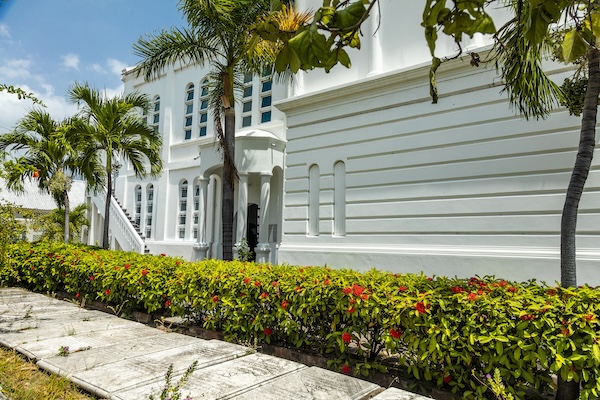
Congregation Sha’are Shalom in Kingston, Jamaica. (photo from Jamaica Tourist Board)

It was a muggy Friday afternoon just hours after my family and I had touched down in Jamaica for a two-week vacation, and the plan was to attend evening services at Kingston’s only synagogue, Congregation Sha’are Shalom. Too tired to argue, my kids and spouse changed clothes, we squashed six into the rental car and ventured into the city.

Though we knew the stately synagogue on Kingston’s Duke Street had been there since 1912, it still felt surprising to go inside and find eight members of the tribe leading a Shabbat service. The two-level synagogue is a magnificent piece of architecture, with a majestic, mahogany aron hakodesh filled with Torah scrolls from other Jamaican synagogues that closed or merged over the years. The ground floor is composed of sand, making this one of just five sand-floored synagogues worldwide. One story says the sand hearkens back to when Jews were worshipping in basements in Spain and Portugal, during the Inquisition, and sandy floors silenced their footsteps. Another legend says the sand is there as a reminder that we should multiply like sand on the seashore. 

Sha’are Shalom has space for at least 300 congregants, but when we arrived, there were just the eight locals and the six of us. The deep, sonorous baritone of one member, who led the service from the mahogany bimah, filled the air with a spiritual melody and, above us, ceiling fans whirred, adding a reprieve to the humid evening. From the bimah, Stephen Henriques, the spiritual leader, spoke of the dispersal of Kingston’s Jewish community over the past four decades, adding that many of today’s members are interfaith. “Still, we are here, celebrating and living our Jewishness, as we have done for centuries,” he said.

We were warmly welcomed to the service, and happily joined in a kiddush of grape juice, challah and sweet Jamaican coco bread. I tried to imagine a time when the synagogue was brimming with Jews, its walls resonating with children’s laughter, congregants’ prayers and Jewish possibilities. There were times like this, but they happened many, many years ago.

Jamaica was occupied by the Spanish from 1494 until 1655. During that time, Jews from Spain and Portugal began trickling onto the island. With the Spanish Inquisition underway, those Jews became Marranos, practising their faith in secret. In 1655, when the British occupied Jamaica, Jews were able to practise their faith without secrecy, but they weren’t completely free from discrimination. Between 1690 and 1740, a “Jew Tax” was levied and only in 1831, the year of the largest slave rebellion in the country, were Jews allowed to vote and participate fully in public life. 

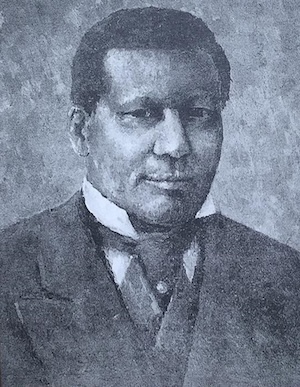
photo - Jewish businessman George Stiebel (1821-1896) was Jamaica’s first Black millionaire, in 1881
Jewish businessman George Stiebel (1821-1896) was Jamaica’s first Black millionaire, in 1881. (photo by CoCoLumps / wikimedia)

Jews had been quietly involved for years before that, but they embraced this opportunity with gusto. By 1849, eight of the members of Jamaica’s House of Assembly were Jewish. George Stiebel, a Jewish businessman who made his fortune in gold mining in Venezuela, was the country’s first Black millionaire, in 1881. He built Devon House, one of the country’s flagship mansions and a national monument today. 

We continued to nibble on coco bread in the Jewish Heritage Centre adjacent to the synagogue, wishing we had more time to peruse the walls, where there is lots of historical data on Jewish contributions to the island. It was dark by the time we left, so we didn’t have time to see the memorial garden, where tombstones dating back to the 18th century have been relocated.  

A few days into our stay, we left Kingston for Ocho Rios and Montego Bay on the north coast. When the sun shone, we explored Jamaica’s beaches, relishing the feel of the warm water on our skin. When the rain came pouring down, we drove to neighbouring parishes to explore small towns.

One such drive took us to Falmouth, a small town whose poverty and neglect is loudly revealed in its deeply potholed roads and dilapidated homes and buildings. Coming, as we did, from an all-inclusive resort just 20 minutes away, the disparity between the two environments was glaring. 

But it wasn’t always this way. The Jewish cemetery in Falmouth is filled with the graves of Jewish merchants who dominated the once-flourishing trade here in the 19th century. When I announced we were making a stop at the cemetery, there was a collective groan from the back of the car. “We went to synagogue – now we have to visit dead Jews?” my son asked. As my husband valiantly navigated through potholes the size of small swimming pools, I tried to explain how a cemetery could be a fascinating place to explore history. 

Though we were probably only a stone’s throw away from the cemetery, we never made it. After one particularly large pothole, and another ahead that threatened to drown the rental car, a decision was made. “I love you, sweetheart, but I just don’t want to get stuck out here,” my husband declared.

I couldn’t blame him.

Drive around Jamaica and safety is not a feeling that comes easily. For one, the drivers overtake with such reckless disregard for life that road accidents always feel imminent. For another, the looks you get from some locals leave your Spidey sense tingling with fear. Leave the resorts and there are few warm welcomes from the community at large it seems, with the exception of those who have something to sell. Jamaica is known for its violence, with a rate of 52.9 homicides per 100,000 people, as compared to Canada’s, at 2.5.

We turned around and headed back to the resort, where staff sweep trash off the beach daily, and food and booze are readily available day and night. Moving between the pool and the ocean, it didn’t take long to relax. As the mojitos flowed, though, my mind kept returning to those tenacious Jews who arrived in Jamaica hundreds of years ago. They came with sand in their shoes and buckets of determination to pursue their religion and build success in a new land. I wondered what they’d say if they could see Jamaica today. 

Lauren Kramer, an award-winning writer and editor, lives in Richmond. 

Format ImagePosted on March 8, 2024March 7, 2024Author Lauren KramerCategories TravelTags Congregation Sha’are Shalom, history, Jamaica, Jewish community, Judaism
Proudly powered by WordPress