
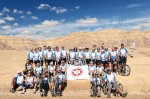
Fifty-four cyclists from Toronto, Vancouver, New Jersey and New York City participated in Beit Halochem Canada, Aid to Disabled Veterans of Israel’s annual Courage in Motion bike ride in Israel recently. The organization is devoted to helping the more than 50,000 Israeli disabled veterans and victims of terrorism rehabilitate. For five days, the group cycled from Jerusalem to Eilat, raising funds to support ongoing cycling programs and purchase equipment for rehabilitative sports and cultural centres in Tel Aviv, Haifa, Jerusalem, Nahariya and Beersheva. More than 50 members of the Israeli centres joined them, riding hand bikes and tandems, inspiring participants with their strength, determination and positive outlook.
Tag: terrorism
Misdirecting attention
U.S. President Barack Obama has sent a letter to the Ayatollah Ali Khamenei requesting Iran’s support in the battle against ISIS. At a time when Israel’s relationship with the American administration is strained, the letter (which was apparently sent back in October and whose existence was recently reported by the Wall Street Journal) has sparked a great deal of reaction.
Stopping the Islamic State is and should be a global priority, but the softening of attitudes toward Iran’s regime is a concern. While there appears to be some progress in talks on Iran’s nuclear program – negotiations that are rapidly approaching a Nov. 24 deadline for an agreement – the hatred directed at Israel is as vibrant as ever. Just days ago, Khamenei tweeted an infographic titled “9 Key Questions About Elimination of Israel.”
The graphic design is better than the English grammar, but the message is unmistakable. No less than ever – and regardless of what we may read suggesting schisms in the highest reaches of the regime – the top leader is as committed as he ever was to the annihilation of Israel.
While insisting that, “of course, the elimination of Israel does not mean the massacre of Jewish people in the region,” the emphatic message is, put mildly, unwelcoming. Still, the world seems convinced that it’s a bluff. To see events at the United Nations, one would think it was Israel that was threatening to obliterate another member-state. Commentators dismiss destructive rhetoric like Khamenei’s as propaganda for domestic consumption, but most Jews, and anyone with a sense of history, take seriously threats like this at any time, but particularly in the week that we commemorate both the 76th anniversary of Kristallnacht and Remembrance Day.
Meanwhile, U.S. Secretary of State John Kerry insists any Iran overture is unrelated to the broader issues of the Middle East, as if the interconnected web of intrigues, hatreds and alliances could be unraveled from one another. And then, as if there are not enough issues in the world with which to be concerned, European states are lining up to recognize the “state of Palestine.” These legally meaningless but symbolic votes by Britain and Sweden, with more legislatures intending to follow suit, are meant to force negotiations toward a two-state solution, with an underlying assumption that Israel is to blame for the lack of progress. All the incitement to violence by Palestinian leaders and the recent upsurge in vehicular murders and stabbings of Israelis are blamed on the Israelis themselves, who must somehow deserve what they get.
Often, commentators, including Kerry recently, state that resolving the Israeli-Palestinian conflict is the lynchpin to resolving the broader conflict in the region. By obsessing about Israel, the UN, European powers and others are wasting their energies on a sideshow while the feature presentations get short shrift.

שירות חדש באינטרנט
[vsw id=”vQBqQLXGtIA” source=”youtube” width=”425″ height=”344″ autoplay=”no”]
Horribly wrong advice
Glenn Greenwald, the journalist who came to our attention as the conduit for Edward Snowden’s Wikileaks cache, has a theory on why members of the Canadian military have been killed in terror attacks like the one last week in Ottawa. They died for the sins of Canada’s foreign policy.
Greenwald wrote a piece after the incident in Quebec on Oct. 20, in which two soldiers were run over – Warrant Officer Patrice Vincent fatally – in a deliberate attack. Greenwald’s article was rerun at rabble.ca on Oct. 22, apparently posted to the site about the time another attack was taking place on and around Parliament Hill in Ottawa.
“It is always stunning,” Greenwald wrote, “when a country that has brought violence and military force to numerous countries acts shocked and bewildered when someone brings a tiny fraction of that violence back to that country.”
Greenwald shifts blame for the soldiers’ deaths from their murderers to Canadian involvement in Afghanistan, Canada’s newly announced air support for the Western battle against ISIS, and on Canada’s being “an enthusiastic partner in some of the most extremist War on Terror abuses perpetrated by the U.S.”
The article has been shared around social media and similar assertions have been made by other commentators.
It needs to be said that both of these incidents, in which the perpetrators themselves were also killed, were apparently “lone-wolf” attacks. Also popping up in social media are demands for greater attention to mental illness in Canada, the implication being that mental instability may have trumped ideology for one or both of these perpetrators. This is an important issue to consider.
Greenwald anticipates the inevitable comeback to his argument – that Islamists are not driven by reaction to our foreign policy but by hatred of our values. That is, they hate us not for what we do, but for who we are.
“They even invent fairy tales to feed to the population to explain why it happens: they hate us for our freedoms,” wrote Greenwald. “Those fairy tales are pure deceit. Except in the rarest of cases, the violence has clearly identifiable and easy-to-understand causes: namely, anger over the violence that the country’s government has spent years directing at others.”
It’s not a stupid idea, but it’s simplistic in the extreme. It suggests not only a self-deception about the ideology driving worldwide terror, but an almost understandable, desperate hope for safety: if we just stop provoking the terrorists, they will leave us alone.
What his position ignores – though it is shared by many – is that the perpetrators are fundamentalists, seeking the destruction of the existing order not only in Syria and Iraq, but worldwide. The deceitful fairy tales are those told and believed by those who refuse to acknowledge evil when they see it beheading people on the internet.
Greenwald’s position, in fact, is a version of the Western colonialist mentality. The actions and worldview of ISIS and other extremists are not born of ideology or theology. No, they are solely a reaction to our actions. It’s all about us. It’s a weirdly imperialist view in its own way.
But even if he is correct, even if the attacks we saw last week and those endured by other democracies including Israel in recent years, were motivated by government actions and policies, his solution is suicide.
Even if there were proof positive that terrorists were motivated by our policies, rather than the fact that we like freedom, equality, an after-dinner drink and mixed-gender dancing, the solution would still not be to change our policy.
For a country to base its foreign policy on whether or not it will be liked or hated by ideologues who scythe off the heads of innocents is a map to self-destruction. The idea that terrorists will target our soldiers and civilians because our government is engaged in far-off conflicts is not completely outlandish, but its corollary – that we should change our foreign policy to one more agreeable for the worst elements in the world – is horribly wrong. That is, to use a hackneyed and ridiculed phrase that is nonetheless spot on, how the terrorists win.

קנדה מגנה את הפיגוע בירושלים
Reasons to protest Klinghoffer
One of the most controversial operas in recent memory, The Death of Klinghoffer, debuted Oct. 20 at New York’s Metropolitan Opera. The Met has scheduled seven more performances through November. The first staging did not occur without protest, as about 400 demonstrators – including Jewish communal and nationally recognized leaders – came to Lincoln Centre to denounce the anti-Jewish and anti-Israel opera.
Klinghoffer, the creation of composer John Adams and librettist Alice Goodman, premièred in 1991, with few additional stagings. The opera is based on the 1985 murder of a 69-year-old American Jew, Leon Klinghoffer, on an Italian cruise ship. Klinghoffer, confined to a wheelchair, was shot in the head by Palestinian Arab terrorists who had hijacked the ship. They dumped his body into the Mediterranean Sea.
The opera repeatedly defames Jews and Israelis as representatives of religious/ethnic or national groups. Nowhere does it similarly criticize Arabs/Muslims as a group. The Met’s intransigent insistence that Klinghoffer must be staged has become an organizational calamity.
Adams and Goodman make up an aptly matched pair. Their Jewish problem seems to include an obsession with what they imagine to be Jewish guilt. This should not be surprising on the part of Goodman, perhaps, since, during the writing of Klinghoffer, she rejected her American Jewish heritage and joined the Anglican Church. The church’s leadership has been known in recent years for its hostility toward Israel. Goodman is now a parish priest in England.
But is Klinghoffer the only Adams/Goodman opera that contains elements of antiemitism, including the stereotypical notion of Jewish guilt?
Consider the Adams/Goodman opera Nixon in China (world première 1987, Met première 2011). It offered relatively humane depictions of President Richard M. Nixon and Chinese leader Mao Zedong – a mass murderer on the scale of a Hitler or Stalin – but not a similarly sympathetic picture of U.S. Secretary of State Henry Kissinger, a Jew. In a 1988 review of the opera, Pulitzer Prize-winning critic Tim Page wrote that Kissinger is depicted as “a venal, jabbering, opportunistic buffoon.” Others remarked that Kissinger is portrayed as cruel and cunning.
A bizarre, memorable scene involving Kissinger occurs in the second act. In a propagandistic ballet staged by Madame Mao for the Nixon entourage, First Lady Pat Nixon thinks she sees Kissinger playing an evil landlord savagely whipping a poor village girl. Not seeing Kissinger in the audience or at the Nixon family table, Mrs. Nixon points to the landlord while whispering to her husband, “Doesn’t that look like you-know-who?” Indeed, the singer who plays the role of Kissinger also plays the role of the evil landlord.
Then there is the Adams opera Doctor Atomic (world première 2005, Met première 2008). Its storyline centres on Jewish American scientist J. Robert Oppenheimer, often called the “father of the atomic bomb” for leading the Manhattan Project during the Second World War. The project developed the nuclear weapons that incinerated Hiroshima and Nagasaki, killing more than 100,000 people and causing Japan to surrender to the United States, thus ending the war earlier than would have otherwise been the case. The earlier end potentially saved hundreds of thousands, if not millions, of other lives on both sides.
Adams and librettists Goodman and Peter Sellars depict Oppenheimer as consumed with guilt and torn with remorse. Did they exaggerate here? According to a 1967 New York Times report, Oppenheimer was “beset by the moral consequences of the bomb, which, he told fellow physicists, had ‘dramatized so mercilessly the inhumanity and evil of modern war’ … [but] in later years, he seemed to indicate that the ‘sin’ was not to be taken personally. ‘I carry no weight on my conscience,’ he said in 1961 in reference to the atomic bombing of Hiroshima and Nagasaki.”
Defenders of The Death of Klinghoffer seem either unaware or unconcerned about any of the several instances of the opera’s anti-Jewish and inflammatory lyrics. Some of these were cited by the Committee for Accuracy in Middle East Reporting in America in an open letter to Met general manager Peter Gelb on May 29, 2014. The letter helped spark initial protests against staging Klinghoffer and resulted in the cancellation of a Nov. 15 large-screen simulcast of the opera that would have been viewed live by hundreds of thousands of people in theaters in 70 countries.
Klinghoffer defenders treat the libretto – the text sung and spoken in the opera – as proving nothing. Instead, they seem to either misunderstand, or misuse as camouflage, the concept of “artistic freedom.” It is possible to defend Klinghoffer on artistic grounds, but the art involved is the low variety of the propagandist, not the high art of worthwhile opera. The defenders act as if neither the libretto nor the music matters much. In fact, while the lyrics recycle some of the worst antisemitic canards, the music is mediocre and unremarkable except for the propagandistic way it is used by Adams to underscore words of the Palestinian hijackers. This was pointed out by eminent American musicologist Richard Taruskin in a December 2001 New York Times article strongly condemning the Adams opera, headlined “Music’s dangers and the case for control.”
The Death of Klinghoffer is a vehicle for tendentious reiteration of antisemitic and anti-Zionist slurs. But this opera, when considered together with the other two Adams/Goodman opera collaborations mentioned here, represents something more – a prejudicial obsession with Jews.
Myron Kaplan is a senior research analyst for the Boston-based, 65,000-member Committee for Accuracy in Middle East Reporting in America. This article was originally published by jns.org.

Hundreds attend Met protest of Klinghoffer opera
Demonstrators protest the New York Metropolitan Opera’s production of The Death of Klinghoffer on Monday. (photo by Amelia Katzen via jns.org)
Several hundred protesters gathered at New York’s Lincoln Centre on Monday to protest the opening night of the New York Metropolitan Opera’s production of The Death of Klinghoffer.
The opera depicts a 1985 cruise ship hijacking by members of the Palestine Liberation Front (PLF) and the killing of disabled Jewish-American passenger Leon Klinghoffer. Critics of the 1991 John Adams opera say that it promotes antisemitism and glorifies terrorism.
At the rally, protesters held signs reading “Klinghoffer Opera: Propaganda Masquerading as Art” and “The Met Opera Glorifies Terrorism.”
High-ranking New York politicians – including former New York governor George Pataki, former U.S. attorney general Michael Mukasey, U.S. Rep. Eliot Engel (D-NY) and New York State Assemblyman Dov Hikind – joined the protesters.
Additionally, several Jewish and Christian organizations, such as the Zionist Organization of America, the Simon Wiesenthal Centre, the Catholic League and the Christians’ Israel Public Action Campaign, co-sponsored and attended the rally.
The protesters read a letter that was written by Judea Pearl, the father of Daniel Pearl, the Wall Street Journal journalist who was executed by terrorists in 2002. “We do not stage operas for rapists and we do not compose symphonies for penetrating the minds of ISIS (Islamic State) executioners,” the letter reads.
“This antisemitic opera viciously falsifies history to malign and incite hatred against Israel and the Jewish people. The opera is a disgrace and should be canceled immediately,” said Morton Klein, national president of the ZOA, in a statement.
Learning from tragedy
It was Aug. 9, 2001. I was in Jerusalem after 19 years absence, to attend a convention and do research on a memoir, Witness to History: Ten Years as a Woman Foreign Correspondent in Israel (still unpublished). I was staying at the Sheraton (now the Leonardo). I left the hotel to meet my good friend and personal guide, Pat (z”l). She and I were going to the Bible Lands Museum for a reunion with a mutual acquaintance. All the traffic from the hotel down King George into town was blocked. We heard there had been a terrorist attack, but decided to go on with our plans.
Later, when we returned to the hotel, national board members were waiting for us and told us to go and call our families and tell them we were OK. One by one, Hadassah women came in with stories of having been on Ben Yehudah … of hearing an explosion and ambulances. It was the Sbarro restaurant terrorist attack.
***
Dr. Zieva Dauber Konvisser is a fellow of the Institute for Social Innovation at Fielding Graduate University in California. In 2003, she was at the Israel Centre for the Treatment of Psychotrauma in Jerusalem, beginning research on the “possibility of post-traumatic growth coexisting with post-traumatic stress.” Earlier this year, her book Living Beyond Terrorism (Gefen Publishing, 2014) was published.
 Founding director of the centre, Prof. Danny Brom, writes in the book’s foreword that Konvisser contributes to “the study of politically motivated violence by documenting many of the challenges that confront people who experience such violence and by elucidating the many ways people find to overcome the horrors of their encounter with deadly violence. Equally, this book contributes to the development of the concept of post-traumatic growth.”
Konvisser herself explains in the preface that the focus of this book is on “resilience or recovery and post-traumatic growth.”
Konvisser is a second-generation Holocaust survivor, having lost more than 30 relatives in Vilna. During a trip to Israel in 2002, she reflected how survivors of terrorist bombings moved beyond their traumas. Subsequently, she visited Israel eight times between 2004 and 2010 to speak with such survivors.
She spoke with 24 survivors in 2004, who made up the research study sample for her doctoral dissertation, then revisited them in 2007, interviewed seven more plus 15 Arab Israelis. In 2013, she again asked them to reflect upon and describe changes in “their family, work, health and/or outlook in life since the previous interviews. The result is 36 stories as told by 48 survivors and family members with 33 incidents described.
The book is a tribute “to those who survived attacks with or without disability or loss, as well as family members of those who perished…. By telling and retelling their stories, we celebrate their lives as people – as human beings.”
Among the most amazing aspects of the book is one of the three appendices, which lists 58 organizations supporting terror survivors and families. There is also a glossary and a selected bibliography.
This is a very difficult book to read. Every story is upsetting and painful, whether one has personally experienced a terrorist attack, is related to someone or is acquainted with a victim. However, Konvisser notes 12 qualities common to these survivors, which could be “cultivate[d] to master any crisis.” These include:
• They struggle, confront and ultimately integrate painful thoughts and emotions.
• They adjust their future expectations to fit their new reality.
• They call on their inner strength, core beliefs and values.
• They are helped to move forward by strength gained from their past experiences and prior adversity.
• They are helped by spirituality or grappling with fundamental existential questions.
• They stay healthy and focus on their fitness level.
• They are creative, find the silver lining and give back, moving forward with action.
• They stay connected and seek outside resources to help them through rough times.
• They tell their stories and try to make sense of their lives.
• They are hopeful, optimistic and celebrate life.
May we all learn from their experiences.
Sybil Kaplan is a foreign correspondent, lecturer, book reviewer and food writer in Jerusalem. She has compiled nine kosher cookbooks. She leads weekly walks in English in the Jewish produce market, Machaneh Yehudah, and writes the restaurant features for Janglo, the oldest, largest website in Israel for English-speakers.
Tunnels pose serious threat
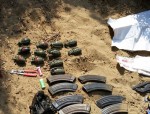
Weapons recovered from a Hamas tunnel. (photo from IDF/FLICKR)
“One hundred Israeli schoolchildren killed in Hamas attack.” Israelis say this would have been just one of many similar headlines announcing untold loss of civilian life had Operation Protective Edge not been launched last month. The goal of the operation was to silence the seemingly endless barrages of Gaza rockets aimed at Israeli cities and towns, and to detect and destroy the vast network of underground tunnels dug beneath Gaza and into Israel by the Islamist Hamas terror organization.
As details of the tunnel system became public, Israelis were at once fascinated and infuriated to learn specifics of the intricate Trojan-horse-like network lurking beneath their communities; an engineering feat so potentially lethal that the national discussion is rife with unsubstantiated worries about terrorist plans for the execution of “an Israeli 9/11.”
Frequently heard were comments like, “Surely the high-tech nation should have the ability to detect tunnels!” while others ask how such an elaborate feat of engineering and construction could have proceeded right under the noses of the military in a security-savvy country with vast counter-terrorism experience.
In October 2013, Israeli army intelligence located entrances to one such tunnel just a couple of hundred metres from the entrance to Kibbutz Ein Hashlosha, a collective community in southern Israel near the border with Gaza.
On a tour of that network, standing at ground level, one can see the tunnel split in the middle, its branches extending deep into the earth, with one entrance/exit nearly a mile away – through Israeli territory and into the Gaza Strip – and the other a mere 600 metres (almost 2,000 feet) to the right: exiting into Israeli territory.
Moving closer required man- oeuvring through a steep downward 46-foot trek, assisted by the steadying hand of an IDF officer to navigate the distance from the surface to the underground passageway itself. Crawling through the deceptively small opening and out of the desert’s summer heat into the coolness of the subterranean concrete-encased structure, it was surprising to find myself standing upright, able to see far enough to sense the vast distance it covers. Though visibility was limited by the dearth of ambient light, helped only slightly by the lighting unit attached to our camera, the immense dimension of the tunnel was perceptible, the elaborate nature of the structure striking. From the sophisticated construction to the array of cables, conduits, finished ceilings, communication lines and pulley systems, it made sense that each tunnel was estimated to have required several years and millions of dollars to build – mostly by hand, with jackhammers and shovels.
Also discovered in many of the recently destroyed tunnels was a variety of weapons, army uniforms, motorcycles, chloroform and handcuffs: macabre “kidnapping kits.”
Read more at themedialine.org.