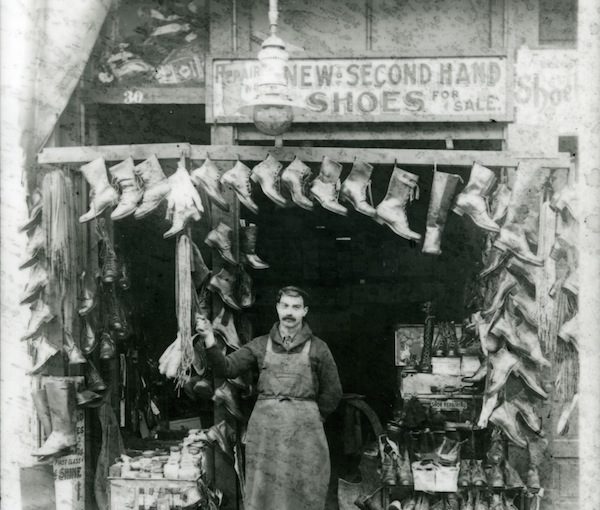
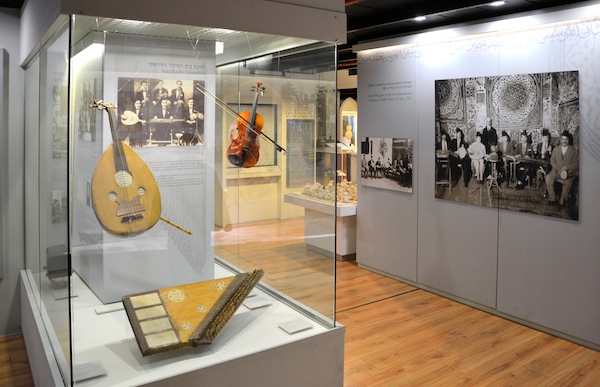
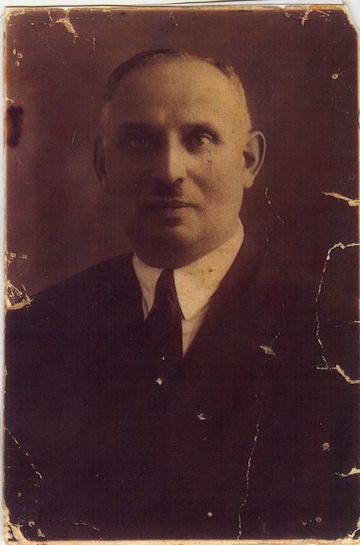
Nessim Menashe, born on the Isle of Rhodes in 1887, came to Portland in 1909. By 1914, he had established a shoe repair shop in northwest Portland, which he operated until 1921. (photo from Oregon Jewish Museum and Centre for Holocaust Education, OJM 03274)
Reading the history of the Oregon Jewish community can feel like reading B.C. Jewish history in a carnival mirror. Everything is familiar but just a little out of place.
Since the sister communities of Vancouver and Portland share both common history and common concerns about the future, there is much we can learn from each other. This is one reason why the Jewish Museum and Archives of British Columbia is excited to be hosting a trip to Portland in late May.
The three-day, two-night trip will take participants to historic sites and Jewish restaurants, and introduce them to engaging locals. Travelers will eat at Aviv, Lefty’s Café, Katchka, and Kenny & Zuke’s Deli. They will visit the Oregon Holocaust Memorial, Oregon Jewish Museum, Powell’s Bookstore, Beth Israel Historic Synagogue, Portland Art Museum, Oregon Historical Society Museum, Portland Rose Garden and Portland’s South End Jewish neighbourhood. They will also enjoy a curator-guided tour of the Oregon Jewish Museum.
As in British Columbia, it was the gold rush that attracted the first Jews to Oregon. German-born Jacob Goldsmith and Lewis May opened a general store in Portland in 1849 and helped found the Masonic Temple the following year. The community’s growth kept pace with the rapidly growing city and, in 1858, the Reform congregation Beth Israel was established. Jews had a disproportionate presence among the merchant class, with one-third of the 146 merchants on record in 1860 being Jewish. They worked in the industries of clothing, tobacco, furniture and wholesale.
Just 328 kilometres north, the Jewish population of Victoria followed a similar trajectory. The earliest arrivals stepped off boats arriving from San Francisco in 1858. They, too, established careers primarily as merchants and, in 1863, opened Congregation Emanu-El, which continues to operate today. In the 1870s, Jewish merchants began placing their bets on the future of a small encampment on the Fraser River, going by the name of Granville. These bets paid off when Granville became Vancouver in 1886, the terminus of the intercontinental railway.
The Jewish populations of Portland and Vancouver have grown dramatically over the decades since, with new arrivals from all corners of the world making their contributions. In both locations, community organizations blossomed early on, providing essential social and cultural services. Today, the Jewish population of Portland, at 50,000, is roughly double that of Metro Vancouver, thanks largely to a wave of young American Jews who were drawn to Portland in the wake of the 2008 market crash.
To learn more about the Oregon Jewish community and to experience it firsthand, join the JMABC-led trip, which departs by chartered bus on Monday, May 27, and returns Wednesday, May 29. For more information and registration, visit jewishmuseum.ca/program/portland-jewish-history-tour. The deadline to register is March 31.
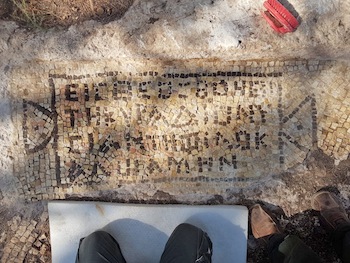
An inscription (top of above photo and below), written in Greek, was translated by Prof. Leah Di Segni of the Hebrew University of Jerusalem. Dated to the early fifth century CE, it says, “Only God helps the beautiful property of Master Adios, amen.” (photos from IAA courtesy Ashernet)
Close-up of the inscription found. (photo from IAA courtesy Ashernet)
New neighbourhood construction in the southern part of the Sharon Plain of central Israel has revealed an estate, some 1,600 years old, which was determined by Israel Antiquities Authority (IAA) archaeologists to have been the property of a wealthy Samaritan. The discovery reinforced evidence that, at one time, the area was extensively populated by the Samaritans, who claim they are Israelite descendants of the northern Israelite tribes of Ephraim and Manasseh. An inscription, written in Greek, was translated by Prof. Leah Di Segni of the Hebrew University of Jerusalem. Dated to the early fifth century CE, it says, “Only God helps the beautiful property of Master Adios, amen.” According to Dr. Hagit Torge, director of the excavation on behalf of the IAA, “The inscription was discovered in an impressive winepress [near the top of Tel Zur Natan, where remains of a Samaritan synagogue were found] that was apparently part of the agricultural estate of a wealthy individual named Adios. This is only the second such winepress discovered in Israel with a blessing inscription associated with the Samaritans. The first winepress was discovered a few years ago in Apollonia near Herzliya.” The Samaritans were originally brought to the region as part of Assyrian policy, and first settled on and around Mount Gerizim.
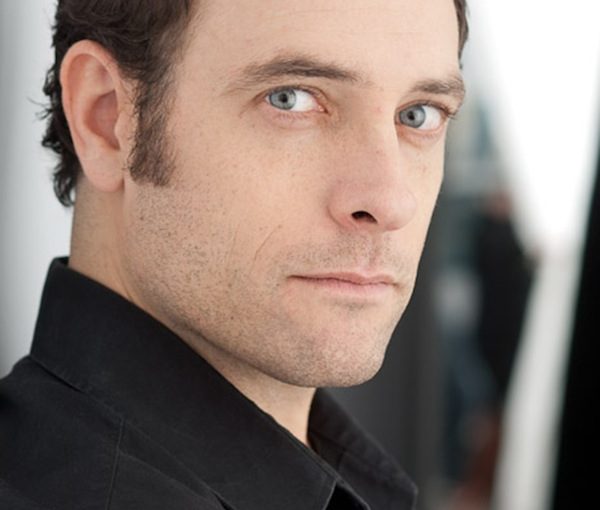
Ryan Gladstone is co-writer of Jesus Christ: The Lost Years, which opens at Havana Theatre March 13, 8 p.m. (photo from Monster Theatre)
Scholars have pondered the question of the unknown, or missing, years of Jesus. In the Christian Bible, he disappears from the narrative in his teens, only reappearing at age 30. What happened in that time? What was Jesus doing? Even if you haven’t wondered about this before, you should consider checking out the award-winning theatrical romp Jesus Christ: The Lost Years, which offers some unconventional theories that academics and theologians have possibly overlooked.
Written by Ryan Gladstone, Bruce Horak and Katherine Sanders, with an original score by Drew Jurecka, Jesus Christ: The Lost Years was first created in 2006. It toured until 2008, then also had its “lost years,” returning to the Fringe circuit only last summer; this time, with two women playing the male leads. Directed by Gladstone, the irreverent physical comedy opens at the Havana Theatre March 13.
“The script is pretty much the same, so the biggest change is what the two new performers bring to the table,” said Gladstone about how the current iteration of the play differs from the original. “Carly Pokoradi and Alex Gullason really have made the play their own, and that’s been a pleasure to watch. It’s also fun watching two talented and funny women being funny and talented on stage.”
Both actors take on multiple characters. In the play, notes the promotional material, “we see teenaged Jesus, wondering why he doesn’t fit in. Mary and Joseph finally come clean and tell him that Joseph isn’t his real father. Hurt and confused, Jesus heads off on the most epic father quest of all time. Along the way he meets Judas, Mary Magdalene, the Three Wise Men, lepers, Romans, he even has a battle with the spirit of Elvis!”
The idea for Jesus Christ: The Lost Years came up long before it was first produced in 2006.
“Katherine Sanders and I were roommates in Calgary in the late ’90s, and we came up with the idea of doing a play about a teenaged Jesus. But Monster Theatre was just on the cusp of being founded and it wasn’t the right time,” said Gladstone. “I remember calling her in 2005, saying, ‘It’s time.’ So, we started researching, and we got Bruce Horak on board, who we both greatly respected, and got to work. The writing process was pretty smooth for having three writers, though maybe some of us were more forceful with our ideas than others! (I’m talking about me, if it’s not clear.)”
As wild as the play gets, it is based on research, as are all Monster Theatre productions. Part of the company’s mission is to reimagine history or adapt “universal stories to make them relevant for our specific time.”
“I took a couple history classes in university but, funnily enough, my thirst for history came out of doing plays for Monster,” Gladstone told the Independent. “In 2001, we created our longest-running, most successful show, The Canada Show: The Complete History of Canada in One Hour, and the research portion of the project really fired my imagination. I loved the idea of taking amazing events that people have never heard of and exposing them to these great moments in our past, or events that people think they know and showing it from another angle. In 2003, Bruce Horak (and later my brother Jeff) and myself spent about seven months researching and writing the follow-up show, The Big Rock Show: The Complete History of the World. It was really this that gave me my love for history. Having that broad overview of everything has given me context for every other event I learn about.”
Perhaps also “funnily enough,” given his love of history, Gladstone only recently found out about his Jewish heritage. “A couple years ago,” he said, “my brothers and I got one of those DNA tests done for both our parents, and discovered that our dad has about 30% Jewish blood. We have some very close Jewish friends here in Vancouver that took us under their wings and guided us through everything they thought we needed to know.”
Born and raised in Calgary, Gladstone went to theatre school at the University of Calgary. “I had been caught up in the exciting whirlwind that was the Loose Moose Theatre Company, run by improv guru Keith Johnstone, who was also teaching in the theatre department at U of C,” explained Gladstone. “After I graduated, I moved to Toronto, because that’s where all my friends were, and I loved it. That was around the time that I founded Monster Theatre. In 2006, I moved to Vancouver. My (now) wife had come to Toronto from Vancouver and tried it out for a few years and we decided we would give Vancouver a shot for year or two. Well, that’s been 13 years now.”
Gladstone followed up his bachelor of fine arts in acting from U of C with a master of fine arts in directing from the University of British Columbia. He has written or co-written, produced, directed or acted in every Monster production.
“It’s a tough thing to tally, but I think it’s around 40 original plays, written or co-written,” Gladstone said of his literary output. “I occasionally write for other mediums; I’ve been co-writing a kids’ book for many years, and we have tried adapting our plays for film and web series.”
Gladstone founded Monster Theatre almost 20 years ago. “In 2000,” he said, “I wanted to tour the Fringe Festival circuit. I had some friends with a comedy troupe called the 3 Canadians who were very successful and were touring Australia and beyond every year, and I basically wanted to be like them. So, I filled out an application form for the Edmonton Fringe and, when it came down to ‘Company Name,’ I just wrote down Monster Theatre for the first time.
“The name is based on something Keith Johnstone said one day when I was in university. We were working on a scene from Othello and Keith was discussing Iago and the difference between demons and monsters. He said, ‘Demons are evil and twisted on the inside, but they are usually quite attractive on the outside, while monsters are strange, twisted and bizarre on the outside, but they always have a good heart.’ And I thought, that’s the kind of theatre I want to make! So, we try to create original plays that are odd, unique, unlike what everyone else is doing, but we are always focused on the heart of the play, making sure that it is rooted in something meaningful or profound. We often talk about our style as being at the intersection where high brow and low brow meet.”
Gladstone was still living in Calgary when he started Monster Theatre. “But, when I moved to Toronto, the company, such as it was, moved with me and, when I moved here in 2006, it moved again,” he said. “Since arriving in Vancouver, we have laid down roots and I don’t think there will be another relocation for Monster in the future. With that said, Monster is a very cross-national company – we have a fan base in a number of cities across the country. In fact, for a long time, Vancouverites witnessed fewer productions of ours than Toronto, Winnipeg, Calgary or Edmonton.”
Over the years, the societal norm of what is acceptable and offensive in word or deed has changed, but Gladstone said there aren’t really any “red lines” he won’t cross in his writing.
“I mean, in the old days, my writing was way more provocative,” he acknowledged. “We were trying to offend people. We often talked about trying to piss off everyone, then no one gets left out. But, these days, it’s a different atmosphere. I’m not afraid of offending people, but I think there needs to be a worthwhile reason, not just for the shock of it.”
Jesus Christ: The Lost Years is at Havana Theatre March 13-16 and 20-23, 8 p.m. For tickets ($20/$15), visit showpass.com/ticket-buyers.
I’ve never seen my sister-in-law’s house look cluttered. Every piece of curated furniture and even the magazines are placed just so. I just couldn’t understand it, even though my mother told me that she was raised this way because her mother was an interior designer. My brother joked that, if he bought something new for their small townhouse, he had to give something up. Even as they moved and their family and lives grew complex, I always left their house feeling like mine had about three times as much stuff in it as theirs did.
During family emergencies where I helped out, I saw that this approach to home decorating wasn’t designed to make me feel badly about myself. So why was the house so carefully manicured? It was a chance to control something and make order where there isn’t any. When one is a methodical soul and life feels chaotic, it’s only natural to want to control something and make it do what you want. We can’t control politics or natural disasters. Even our family members are all independent. We struggle with their health and they do what they want whether or not it’s a problem for us.
This isn’t a Marie Kondo “spark joy” by cleaning article, although it may seem that way. No, it’s about Exodus, at the beginning of Chapter 38, where Bezalel comes on the scene. Bezalel helps create the Tabernacle of the Tent of Meeting, and the instructions, which were “drawn up by Moses’ bidding” (Exodus 28:21), spell out exactly how it’s to look.
I’ve heard sermons and discussions about this portion of the text where people say, “Why does the Torah spend so much time on these tiny details of design and style?” Yes, design and artistry are pleasing, and perhaps a chiddur mitzvah, beautifying the way we fulfil a commandment, but, for many, this seems to be extraneous and unnecessary.
Ever since getting to know my sister-in-law, who I love very much, by the way, I see this differently. Although I love aspects of design, I lack the gene that would enable me to keep my living space so tidy. It isn’t in me – and it’s certainly not in my spouse, who is more disorderly than I am. (He insists that every pile of paper is deeply meaningful and I shouldn’t touch his filing system.)
When we read about how the Tabernacle is created, it’s filled with precision and detail. It’s something that the Israelites contribute to, own and control, while in the midst of a wilderness, while wandering around and wondering when they will actually get to their new home. Perhaps it gives them a sense of security and purpose to create this during a time of nomadism and uncertainty. Unlike the golden calf episode, it’s a scene that’s calm and controlled.
Even while reading the specifics, there are surprises. Historically, women and children did nearly all hand-spinning of yarn. There were no factories for it. Every single yarn and thread for any garment was spun by hand, on a spindle. We might assume that all of the carefully hand-dyed linen yarn was provided by the Israelite women, yet it’s Oholiab, mentioned in Exodus 38:23, who is the man named as the carver, designer and embroiderer of “blue, purple and crimson yarns and in fine linen.”
There it is again. We think we are certain about all sorts of things in our environment and culture, like which gender does embroidery. We’re wrong. Many of the assumptions we make about gender roles, for instance, come from other times. For example, Victorian notions of a woman’s “higher spiritual nature” have seeped into Judaism. Our assumptions about what we wear or who does what kind of handiwork changes according to time period and culture.
So why be specific and detailed about the building of the Tabernacle or, for that matter, keeping your living room impeccably organized?
Some say that, since the Shechinah (G-d’s divine spirit) dwells in the Tabernacle, it must be perfect and beautiful. Others argue that our homes should also resemble the Tabernacle, because we each have bits of the holy spark, the divine, within. These are all wonderful aspirational and elevated ideas.
I’d argue something different. Our surprising world is busy and chaotic. Every time we shovel snow, the plow comes by and moves it, or it snows all over again. Maybe that flowerbed we planted last year didn’t bloom the way we’d expected it to. Our daily lives are out of our control in many ways, and this doesn’t account for disease, disaster, death or violence.
So, we manipulate what we can. My sister-in-law’s house is always going to be tidier than mine. It’s a way she can bring order to things despite the entropy around her. My house may be untidy, but I’m cooking, designing and knitting textiles in an endless attempt to keep people fed, warm and help them feel loved.
While writing this, my computer blinked. I lost a whole document. This week, a friend’s child is struggling and self-harming. Another far-away friend concludes radiation and chemo treatments, and I don’t know how she’s doing. My car might not start, my kids get sick at school – unpredictability and difficulties abound. However, there’s comfort in routine and minutiae. When we read the Torah portion or do the same Jewish prayers or rituals, we can offer ourselves that order and precision. We can’t control much, but we can control something. Goldsmithing, embroidery, carving, metal work or clothing, each of us can choose to create something precise and beautiful, in acknowledgement of a higher order.
Joanne Seiffhas written regularly for CBC Manitoba and various Jewish publications. She is the author of three books, including From the Outside In: Jewish Post Columns 2015-2016, a collection of essays available for digital download or as a paperback from Amazon. See more about her at joanneseiff.blogspot.com.
Historical ignorance has been in the news recently, with polls indicating widespread lack of awareness of the Holocaust, especially among young people in North America and Europe. (See jewishindependent.ca/much-work-left-to-do.) Some media reports got the story wrong, however, claiming that many people “don’t believe” six million Jews died in the Holocaust. The reality is that many people “don’t know” this fact, and there is a big difference between not knowing and not believing. Then there is a different phenomenon altogether: denial.
Plenty of well-informed but ill-intentioned people know the truth of the Holocaust but, for various reasons, take a position that the facts are falsified. The notorious Holocaust denier David Irving is reportedly again making the rounds in Britain, promoting his ahistorical ideology. In a nice contrast, Irving’s nemesis, Prof. Deborah Lipstadt, is back in the news promoting her new book, Antisemitism: Here and Now.
Lipstadt went from respected Emory University professor to a sort of global superstar when Irving sued her for libel in a British court in 1996 for correctly characterizing him as a Holocaust denier. Although Lipstadt is an American, she and the book’s U.K. publisher were targeted because Irving apparently thought that country’s libel laws might serve his cause. In the United Kingdom, libel law places the burden of proof on the defendant instead of the plaintiff. As a result, the trial played out as a public history lesson, with Lipstadt’s legal team forced to prove the historical truths of the Holocaust. They did, of course, and won the case. Nonetheless, Irving’s career as a provocateur and historical revisionist continues.
More serious than a nasty British gadfly is the Holocaust denial taking place in Poland right now, a phenomenon that has led to a collapse in Israeli-Polish relations.
Until recently, Poland was one of Israel’s closest allies on the world stage. While Polish society has never undergone the self-reflection that Germany did after the Holocaust, Polish governments developed excellent relations with the Jewish state. After the fall of the communist regime, relations between the two countries grew quite warm. Trade and diplomatic relations at the highest levels flourished.
With the election of the right-wing nationalist Law and Justice party, in 2015, things began to change. Last year, the Polish government passed a law criminalizing speech that references Polish collaboration with the Nazis during the Holocaust.
Canadian Prof. Jan Grabowski, who spoke in Vancouver last fall, heads a team of researchers, most of them in Poland, who are scouring archives throughout that country amassing what is probably the most comprehensive assessment ever compiled on the subject of Poles’ complicity in the Holocaust. Without Polish collaboration – frequently offered willingly and without compulsion, the research indicates – the Nazis could not have succeeded nearly so completely at their murderous destruction of Polish Jewry, Grabowski insists.
Politicizing this history – that is, criminalizing the truth – has put the Polish government on a trajectory of institutionalized denial. Unlike masses of young North Americans and Europeans, the Polish leaders know very well what transpired in their country during the war. As Grabowski notes, it is not the collaborators and their descendants who are today ostracized in small communities across Poland but rather those families whose members helped their Jewish neighbours.
It was inevitable that Poland’s approach would have repercussions in the Polish-Israeli relationship. It happened dramatically in recent days. The Visegrád Group, which is a cultural and political alliance of the Czech Republic, Hungary, Poland and Slovakia, was slated to meet with Israeli leaders at an extraordinary summit in Israel this week.
A week ago Friday, Prime Minister Binyamin Netanyahu was visiting the Museum of Polish Jews, in Warsaw, when he stated, in a meeting with Israeli reporters where recording devices were not permitted, that Poles had aided the Nazis. A flurry of confusion followed as the prime minister’s office clarified that he had said “Poles,” and not, as some media had reported, “the Poles” or “the Polish nation.”
Polish Prime Minister Mateusz Morawiecki decided to snub Netanyahu by withdrawing from the summit and sending his foreign minister instead.
Yisrael Katz, on his second day on the job as Israel’s foreign minister, dumped fuel on the simmering conflict in a TV interview. Ostensibly sent to smooth over the matter, Katz used the opportunity to quote the late Israeli prime minister Yitzhak Shamir to the effect that “the Poles imbibe antisemitism from their mothers’ milk.”
Suffice to say the summit is off. The leaders of the three other countries are still slated to travel to Israel for bilateral meetings but Polish-Israeli relations are on the rocks.
The conflict illuminates a strange dichotomy. The government of one of the countries most affected by the Holocaust tries to blot out what they certainly know to be the truth. Meanwhile, a generation of young people look on, unaware of even the barest details of what is at the root of the uproar.
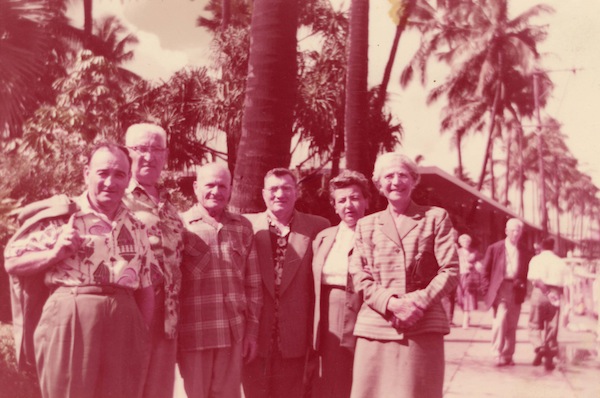
Dave and Rose Nemetz with an unidentified group, undated. (photo from JWB fonds, JMABC L.16225)
If you know someone in this photo, please help the JI fill the gaps of its predecessor’s (the Jewish Western Bulletin’s) collection at the Jewish Museum and Archives of B.C. by contacting archives@jewishmuseum.ca or 604-257-5199. To find out who has been identified in the photos, visit jewishmuseum.ca/blog.
Between 1948 and 1951, more than 121,000 Jews were smuggled out of Iraq in operations Ezra and Nehemia. Many of those who came to Israel settled in the town of Or Yehuda, some 10 kilometres southeast of Tel Aviv. In 1988, Or Yehuda’s mayor, Mordechai Ben-Porat, who was himself born in Iraq, was instrumental in creating in the town the Museum of Babylonian Jewry. Together with six other founding members, the museum was built to tell the story of the Jews in Iraq, up until the aliyah following the establishment of the state of Israel. The museum has become the largest centre in the world for documenting, researching, collecting and preserving the spiritual treasures of Babylonian Jewry. (photo by Ashernet)
Janet Wees at a book signing for her
novel When We Were Shadows, which
she’ll be bringing to the Cherie Smith JCC Jewish Book Festival on Feb. 10. (photo
by Jack Cohen)
Ze’ev Bar was 5 years old in 1937, when his
family fled Germany to the Netherlands, where they lived in safety for a few
years. But, in 1940, as the Nazis extended their hold on Europe, the family had
to go into hiding, managing to survive the Holocaust with the help of members
of the Dutch Resistance.
Calgary-based educator and writer Janet Wees
tells Bar’s story of survival in the book When We Were Shadows. She will
present the novel for younger readers (ages 9-13) on Feb. 10, 10 a.m., at the
Jewish Community Centre of Greater Vancouver as part of the Cherie Smith JCC
Jewish Book Festival, which runs Feb. 9-14. Wees and five other authors – Leo
Burstyn, Miriam Clavir, Arnold Grossman, David Kirkpatrick and Helen Wilkes –
will briefly introduce their works at the event A Literary Quickie.
“My reasons for writing this book were
twofold,” Wees told the Independent. “One, to help relieve Ze’ev from
having to repeat his story over and over to schoolchildren because it was so
upsetting for him, yet he felt it needed to be told so they would know what
happened during the Second World War in their country. Hopefully, having had
the book translated into Dutch in Holland, that might be happening. I have had
letters from mothers of children who are reading the book in Dutch for book
reports.
“My other reason was to expose North American
children to the plight of children during war, to the bravery of the people who
helped save lives at risks to their own.”
Among the real-life members of the resistance featured in the novel are Opa Bakker, Tante Cor, and Edouard and Jacoba von Baumhauer, all of whom have been recognized as Righteous Among the Nations by Yad Vashem. Wees said, “I made a promise to von Baumhauer’s son that I would honour the people who risked their lives helping to build the Hidden Village [near Vierhouten] and hide, assist and feed the people who were fleeing the Nazis.”
Wees visited the memorial site of the Hidden
Village in 2005, and again in 2007. She interviewed Bar in Amsterdam in 2008.
“We spent three to four days in his dining
room, talking, crying, laughing; I taped and wrote,” she said. “Once home, I
poured it all out on computer and began to sort and edit and change, and
watched it take shape. Of course, life interfered, and sometimes it was so
intense, hearing his wavering voice on tape, that I would have to take a break.
By 2011, it felt ready for an editor. After that, I submitted it, naively
giving myself 12 rejections – apparently J.K. Rowling had 12 rejections before
Harry Potter was accepted – before I reconsidered my direction.”
A change in direction did occur. In 2014, Wees
was accepted into a mentorship program and, with that guidance, realized that
the novel “needed a boy’s voice and an empathetic setting, where children could
identify with the protagonist.”
Over some four months, Wees said, “I
essentially rewrote the book using a different format and incorporating a boy’s
voice. At the end, there was a reading and the book was so enthusiastically
received that I knew I was on the right track.
“It felt like I had kind of lost perspective,
as I was so close to the story and, even though I would have times of ‘Wow! Did
I write that?’ seeing it through others’ eyes really gave me a boost. I began
submitting again and, this time, the 11th publisher contacted was the one!”
The book was accepted by Second Story Press in
2017.
“I always wanted Second Story Press to be my
publisher because of their Holocaust Remembrance Series for Young Readers. I
read other books in that series and felt this was a good fit,” said Wees.
While When We Were Shadows is Wees’
first book, she has published articles in educational journals and in news
magazines. In addition to other literary projects, she has written drafts for
two children’s books, she said, “based on something I did growing up in
Saskatchewan, and one based on my pen pal’s granddaughter’s activity with her
Oma in Holland.”
The 60-something Wees first started writing her
pen pal when she was 12 years old.
“My pen pal Henk had to find a pen pal in an
English-speaking country for his English class in school. He put an ad for a
pen pal in the Regina Leader-Post and I saw it and responded,” she
explained. “He told me, on my first visit, as we were looking over all my
letters he’d saved, that my letter was the funniest so he chose me as his pen
pal.
“We wrote constantly but lost contact for a few
years during which we both got married and started families. I reconnected, in
1972 or thereabouts, and, knowing how families in Europe usually stay in their
family homes, I wrote to the old address. Lo and behold! There they were! After
that, it was letters with Henk’s wife because she was better at that point with
written English, but we telephoned and, upon the onset of computers, we emailed
and then FaceTimed.
“I went to visit them for the first time in
1991, and have been back 10 times since…. On one of the trips where I stayed
one month on the island (Terschelling), Hennie (Henk’s nickname) and Loes took
me to see the memorial site of the Hidden Village and the urge to learn more
about this site was palpable.
“Two years later,” said Wees, “we went again,
and I sat for longer in the replica huts and tried to imagine what went on. It
smelled like our dirt basement in Togo, Sask., and just thinking about living
in that basement for 18 months gave me a bit of an idea of the sense of being
confined; the smells, the dark, the cold. And I decided that I had to write a
book, if not for my former students who were now in university, for their
children. Sadly, Hennie passed away this past April without seeing the
published book, but I used his name (with his permission) for one of my
characters, so he lives on through the book. If not for him, this book may
never have existed.”
In their first discussions about the novel,
Wees said she and Bar had “talked about making it an ‘adventure’ of a boy
during wartime.” The original title was Boy of the Forest. “But,” she
said, “as I was writing, I realized this was not an ‘adventure’ as we perceive
adventure, and he concurred, so I changed my title to Whatever It Takes.
My publisher chose the final title, When We Were Shadows, and I love
it because it personifies the whole concept of living in the shadows – unseen,
and unable to see.”
In revising the original manuscript to be from
a young boy’s perspective, she said her focus was on “the emotional being of
Walter [Ze’ev changed his name as an adult] and how he perceived what was
happening, being sheltered and wanting desperately to know and to do something,
and about the selflessness of others. I wanted it to be about the people in his
world, what was happening inside his head and heart, more than what was
happening outside.”
Wees said the character of Walter took over
“and his voice flowed through so eloquently and so quickly that there were many
days I never budged from my computer for hours, missing lunch and working until
dark. I ‘heard’ him in my head. I could ‘see’ what was happening. Until I
actually was writing, I always thought that was bunk when I heard other authors
say that their characters take them on their own journey. But now I know it
happens.
“I also discovered that what I’d taught my
students about editing, I had to follow as well, so I did most of my editing by
reading the book aloud. I found errors that way in facts, such as tents not
having zippers in the 1940s but pegs instead. I was able to find correct
weather for dates in the letters by searching online.”
This diligence no doubt contributed to When
We Were Shadows being nominated for the Forest of Reading Red Maple
non-fiction award of the Ontario Library Association, which describes the award
program’s aim as getting young readers (ages 12 to 13) to engage “in
conversation around the books and … to use critical thinking while reading.”
The awards will be presented in May.
In the writing of When We Were Shadows,
Wees said, “I have become friends with von Baumhauer’s grandson and wife. While
writing this book, I also found out that my grandmother lost sisters-in-law to
the death camps and her brother was killed on the Russian front. Until then, I
had no idea how our family was affected by the Holocaust, as I was unaware of
family still living overseas. I am now in touch with the great-granddaughter of
one of those women.”
The Princess Dolls by Ellen Schwartz,
with illustrations by Mariko Ando, takes place in Vancouver in 1942. Esther and
Michiko are best friends. They dream that one day they will be princesses
together; in games, Esther is Princess Elizabeth and Michi is Princess
Margaret. When they spy dolls fashioned after the real-life princesses in the
toy store window, the girls dare to hope that they’ll each get their favourite for
their birthday, something else they shared, both having been born on the same
day.
However, when Esther gets her royal doll as a
gift, but Michi doesn’t, the girls’ friendship is strained. Before they have a
chance to patch it up, Michi and her family – ultimately along with more than
21,000 other Japanese-Canadians – are forced to leave the West Coast, losing
their home, business and possessions. Michi ends up in Kaslo, B.C.
A story thread throughout The Princess Dolls
is Esther’s family’s worry over family members in Europe, as the Nazis round up
Jews and send them to transit camps, about which Esther’s parents and
grandmother know little.
The Princess Dolls is kind of a companion novel to Schwartz’s Heart of a Champion, in which 10-year-old Kenny Sakamoto dreams of being as good at baseball as his older brother, who is the Asahi team’s star player. Also set in Vancouver in 1942, the Sakamoto family’s neighbours and good friends, the Bernsteins, are Jewish. As she told the Independent when that book was released, “I wanted to point out that the treatment of Japanese-Canadians, although obviously not nearly as lethal or horrific, was comparable to that of Jews in Europe,” said Schwartz. “In both cases, a minority was being persecuted simply because of their religion or nationality. Giving Kenny a Jewish best friend would make both characters sympathetic about this issue.” (See jewishindependent.ca/uniquely-b-c-baseball-story.)
Schwartz will talk about The Princess Dolls on Feb. 10, 11 a.m., at Richmond Public Library, as well as at Vancouver Talmud Torah later that week as part of the Cherie Smith JCC Jewish Book Festival. For the festival schedule and tickets, visit jewishbookfestival.ca.
The author’s maternal aunt, Sara Basson (at age 23). (photo from Libby Simon)
It was the long, cold winter nights in Winnipeg
that made me do it. With my husband working late and a preschooler asleep in
her room keeping me housebound, what else could I do? I finally tackled the
onerous task of sorting seemingly hundreds of musty, dusty family photos that
lay scattered inside battered cardboard boxes saved by my parents, their lives
obviously too busy living the moments.
Who were these people in these tattered and
torn brown photos? Some, I had been told, were Aunt Lorna or Cousin Sylvia.
Others were total strangers. The clothing and hairstyles against an unfamiliar
backdrop told of another time and place in history. Places I had never seen nor
been, yet vague memories from childhood floated in my mind. Some pictures had
writing on the back in a foreign language I could not read or understand.
Nonetheless, I carted these decaying remnants along with all the important
household belongings wherever we moved. Why had I not discarded them?
I now painstakingly placed these memories of
bits and bytes under protective sheets in photo albums, one by one. Organizing
them in some fashion was just too daunting a task. For the moment, preserving
them was the goal – for whom I did not know. That question wouldn’t be answered
until many years later, when I received a letter that launched an unexpected
personal journey.
Bold, black type on unfamiliar letterhead
demanded my attention – Lois Feinberg, Financial Consultant, Hollywood,
Florida. I was about to toss out what I thought was spam sent by snail mail
when one short sentence leaped out at me: “I’m your second cousin on your
mother’s side,” it read. “My grandmother and your grandfather were siblings.”
Maybe it was more scam than spam but I had to
pay attention. What did she want? Credit card numbers? Bank account numbers?
Transfer a million dollars out of some remote African country? I read further
with guarded skepticism.
“In the process of my genealogical research,”
she wrote, “I found our mutual cousin, Sylvia, who gave me your contact
information. I would like the names and birth dates of your family in order to
register this information with the Yad Vashem in Israel.”
Yad Vashem. I knew it as the memorial centre
for the murdered six million Jews and a symbol of the ongoing confrontation
with the rupture of families engendered by the Holocaust. My doubts began to
dissipate as the letter took on a flavour of authenticity. After confirming its
legitimacy with Sylvia, I provided Lois with the information she requested. I
did not pursue further personal contact, however, because, frankly, I have not
been blessed, or cursed, with the need to search out relatives who could be
more of a blemish than a blossom on my family tree.
But things were about to change.
Circumstances arose the next winter that would
take my husband and me to Florida. I contacted Lois and invited her for lunch.
When I greeted this pretty, dark-eyed, dark-haired lady, we hugged each other
warmly. She appeared similar in age, slim, well-dressed and refined in manner.
Lois had been a teacher turned financial consultant, divorced from her doctor
husband, with two grown children.
“I discovered two other cousins who live in
Florida whose grandparents are also siblings of our grandparents,” she said. I
was stunned. Two more family members – right here!
The author’s maternal grandfather, Abraham Basson (at age 60). (photo from Libby Simon)
“I’ll arrange a brunch at my home so you can
meet them,” she promised with a smile. And, true to her word, the cousins all
gathered at her home the following week.
A strange mix of emotions coursed through me as
the past and present began to meld. Until recently, we were totally unaware of
one another’s existence. Suddenly, we had a common thread tying us together –
our grandparents.
Lois told me that the grandparent siblings,
including my maternal grandfather, had all come to the United States in the
1930s to escape Hitler’s rise to power, but he was the only one sent back,
because of a leg deformity. Not from disease, mind you, but the result of an
accident. In the course of operating his paper company business, a heavy object
had fallen on his leg yet he continued to run a successful business. I was told
he and several other relatives were among the six million Jews murdered in the
Holocaust.
Like a seismic jolt of lightning, the brown
pictures flashed across my mind. For the first time, my grandfather became more
than a lifeless face on a faded old photo. Sadness and anger pulsed through me.
He was my mother’s father – a living, breathing person whose life had been cut
short. Not by a natural disaster like a tsunami, a flood or earthquake, but by
a human-made catastrophe, the Holocaust. Nature’s cataclysmic events kill
randomly but humans ravaged and murdered with deliberation and purpose. While
we had been spared the agony of their deaths, history had changed the lives of
those who lived, splintering family shards across the globe, many of which will
never be repaired.
Yet it was heart-warming to meet Marty, the
supervisor IRS lawyer in south Florida; Arnie, a retired businessman; and their
wives. After a four-hour brunch came to a pleasant end, plans were discussed
for “The Brunch” next winter, ensuring a future for this fractured family.
These images gradually transcended time and
geography and were now transplanted into my world in the 21st century. They
were channeled from a dismal and distant past to live again in the present. In
fact, in April 2012, I learned the names of six of my maternal relatives who
were murdered in the Holocaust. My Israeli family had listed their names at Yad
Vashem in Israel. I have now added them to Winnipeg’s Holocaust memorial on the
grounds of the Manitoba Legislature to further ensure they will never be
forgotten.
The exciting promise of a journey of discovery
still lies ahead, as traces of life continue to sprout new branches on this
family tree – blemish or blossom. I knew now for whom these pictures were
preserved. I preserved them for me and for future generations of Jewish
history. L’dor v’dor.
Libby Simon, MSW, worked in child welfare services prior
to joining the Child Guidance Clinic in Winnipeg as a school social worker and
parent educator for 20 years. Also a freelance writer, her writing has appeared
in Canada, the United States, and internationally, in such outlets as Canadian Living,
CBC, Winnipeg Free Press, PsychCentral and Cardus, a
Canadian research and educational public policy think tank. She wrote this
piece with International Holocaust Remembrance Day (Jan. 27) in mind.
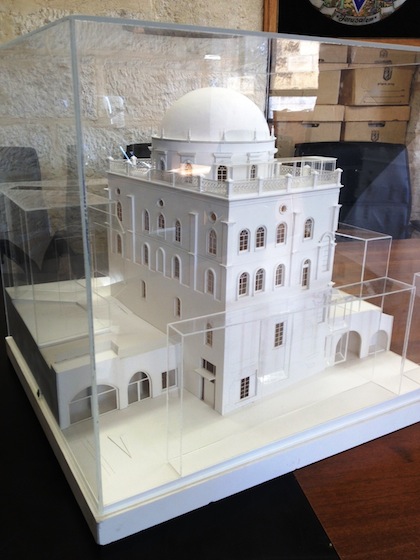
The landmark synagogue before being
dynamited by Jordan’s Arab Legion in 1948. (photo from Wikipedia)
A cornerstone laying ceremony was held May 29,
2014, for the rebuilding of the Old City of Jerusalem’s Tiferet Yisrael
Synagogue, which was dedicated in 1872 and dynamited by Jordan’s Arab Legion in
1948.
Speaking nearly five years ago, then-Jerusalem
mayor Nir Barkat declared, “Today we lay the cornerstone of one of the
important symbols of the Jewish community in Jerusalem. The municipality
attaches great importance to the preservation and restoration of heritage sites
in Jerusalem, and we will continue to maintain the heritage of Israel in this
city.”
Citing Lamentations 5:21, Uri Ariel, housing
minister at the time, added, “We have triumphed in the laying of yet another
building block in the development of Jerusalem, a symbolic point in the vision
that continues to come true before our eyes: ‘Renew our days as of old.’”
The two politicians symbolically placed a stone
salvaged from the ruined building, and construction was supposed to take three
years, according to the Company for the Reconstruction and Development of the
Jewish Quarter in the Old City of Jerusalem Ltd. (JQDC), a public company under
the auspices of the Ministry of Construction and Housing.
Fast forward to Dec. 31, 2018, and the exercise
was repeated, this time with the participation of Jerusalem minister Zeev
Elkin, construction minister Yoav Galant, deputy health minister Yaakov Litzman
and Jerusalem Mayor Moshe Leon. But, this time, according to the JQDC, much of
the project’s NIS 50 million (approximately $18 million Cdn) budget has been
secured, in part thanks to anonymous overseas donors. With the Israel
Antiquities Authority’s salvage dig of the Second Temple period site headed by
Oren Gutfeld completed, work can now begin in earnest.
Fundraising to purchase the land for the
Tiferet Yisrael, also known as the Nisan Bak shul, was initiated in 1839 by
Rabbi Israel Friedman of Ruzhyn, Ukraine, (1797-1850) and his disciple Rabbi
Nisan Bak, also spelled Beck (1815-1889). While der Heiliger Ruzhiner
(Holy Ruzhyner), as his Chassidim called him, purchased the hilltop in 1843,
the mystic didn’t live to see construction begin.
A model of Tiferet Yisrael. (photo from Jerusalem Municipality)
His ambitious plans in Jerusalem reflected his
grandiose lifestyle in Sadhora, Bukovina, in Galicia’s Carpathian Mountains,
pronounced Sadagóra in Yiddish. There, he lived in a palace with splendid
furnishings, rode in a silver-handled carriage drawn by four white horses and,
with an entourage, dressed like a nobleman, wore a golden skullcap and clothing
with solid gold buttons, and was attended by servants in livery. This unusual
manner was accepted and even praised by many of his contemporaries, who
believed the Ruzhiner was elevating God’s glory through himself, the tzadik
(righteous one), and that the splendour was intended to express the derekh
hamalkhut (way of kingship) in the worship of God.
In one incident, described in David Assaf’s The
Regal Way: The Life and Times of Rabbi Israel of Ruzhin (Stanford
University Press, 2002), the Ruzhiner’s Chassidim noticed that, notwithstanding
that their rebbe was wearing golden boots, he was leaving bloody footprints in
the snow. Only then did they realize that the gold was only a show and his
shoes had no soles. Indeed, he was walking barefoot in the snow.
Rabbis Friedman and Bak were motivated by a
desire to foil Czar Nicholas I’s ambitions to build a Russian Orthodox
monastery on the strategic site overlooking Jerusalem’s Temple Mount. Bak
consulted with architect Martin Ivanovich Eppinger. (Eppinger also planned the
Russian Compound, the 68,000-square-metre fortress-like complex erected by the
Imperial Russian Orthodox Palestine Society west of the Jaffa Gate and outside
the Old City, after the czar was outmanoeuvred by the Chassidim.)
Bak, who both designed the massive synagogue
and served as its contractor, spent more than a decade fundraising and six
years building it. Inaugurated on Aug. 19, 1872, he named the three-storey
landmark in honour of his deceased rebbe.
According to a perhaps apocryphal story, the
quick-witted Bak was able to complete the ornate synagogue thanks to a donation
from Kaiser Franz Joseph of Austria-Hungary. In 1869, while visiting Jerusalem
en route to dedicate the Suez Canal, the emperor asked his subjects who came
from Sadhora in the remote Austrian province of Bukovina why their synagogue
had no roof. (In 1842, having spent two years in Russian prisons on charges of
complicity in the murder of two Jewish informers, Rabbi Friedman fled to
Sadhora and reestablished his resplendent court.)
Seizing the moment, Bak replied, “Your majesty,
the synagogue has doffed its hat in your honour.” The kaiser, understanding the
royal fundraising pitch, responded, “How much will it cost me to have the
synagogue replace its hat?” and donated 1,000 francs to complete Tiferet
Yisrael’s dome, which was thereafter referred to by locals as “Franz Joseph’s
cap.”
Tamar Hayardeni, in “The Kaiser’s Cap”
(published in Segula magazine last year), wrote that, while the kaiser
made a donation, the dome was in fact completed with funds provided by Rabbi
Israel of Ruzhyn’s son, Rabbi Avrohom Yaakov of Sadhora (1820-1883).
In the winter and spring of 1948, the dome
served as a key Haganah military position and lookout point for the Jewish
Quarter’s outgunned defenders.
Children were recruited for the battle for
Tiferet Yisrael. Some as young as 9 built defence positions. The “older” ones –
12 or so – carried messages, food, weapons and ammunition. Some were killed,
including Grazia (Yaffa) Haroush, 16, and Nissim Gini, 9, who was the youngest
fallen fighter in the War of Independence. Like the others who fell in the
defence of the Jewish Quarter and were buried there, his remains were exhumed
after 1967 and reinterred on the Mount of Olives.
Badly damaged by heavy shelling, the synagogue
was blown up by Jordanian sappers on May 21, 1948. A few days later, following
the neighbourhood’s surrender on May 25, the nearby Hurva Synagogue – the main
sanctuary of Jerusalem’s mitnagdim (anti-Chassidic Ashkenazi followers
of the Vilna Gaon) – met the same fate.
With the rebuilding of the Hurva completed by
the JQDC in 2010, Tiferet Yisrael became the last major Old City synagogue
destroyed in 1948 not rebuilt.
Hurva is a stone-clad, concrete and steel
facsimile of its original structure, updated to today’s building code and
equipped with an elevator. The same is planned for Tiferet Yisrael.
The reconstruction of faux historic synagogues
has not been without critics. Writing in the Forward in 2007 as the
Hurva was rising, historian Gavriel Rosenfeld, co-editor of Beyond Berlin:
Twelve German Cities Confront the Nazi Past (University of Michigan Press,
2008), noted the manifold links between architecture, politics and memory.
“The reconstruction of the Hurva seems to
reflect an emotional longing to undo the past. It has long been recognized that
efforts to restore ruins reflect a desire to forget the painful memories that
they elicit. Calls to rebuild the World Trade Centre towers as they were before
the Sept. 11, 2001, attacks represent a clear (if unrealized) instance of this
yearning. And the recently completed reconstruction of Dresden’s famous
Frauenkirche – long a heap of rubble after being flattened by Allied bombers in
February 1945 – represents a notable example of translating this impulse into reality.
“And yet, the reconstruction project is
problematic, for in seeking to undo the verdict of the past, the project will
end up denying it. Denial is inherent in the restoration of ruins, as is
frequently shown by the arguments used to justify such projects. In Dresden,
for example, many supporters of the Frauenkirche’s restoration portrayed
themselves as the innocent inhabitants of a city that was unjustly bombed in
1945, thereby obscuring the city’s longtime support for the Nazi regime and its
war of aggression during the years of the Third Reich. Similarly, the physical
appearance of the restored Frauenkirche – despite its incorporation of some of
the original church’s visibly scorched stones – has effectively eliminated the
signs of the war that its ruin once vividly evoked.
“In the case of the Hurva,” writes Rosenfeld,
“the situation is somewhat different. If many Germans in Dresden emphasized
their status as victims to justify rebuilding their ruined church, the Israeli
campaign to reconstruct the Hurva will do precisely the opposite – namely,
obscure traces of their victimization. As long as the Hurva stood as a hulking
ruin, after all, it served as a reminder of Israeli suffering at the hands of
the Jordanians. [Mayor Teddy] Kollek said as much in 1991, when he noted: ‘It
is difficult to impress upon the world the degree of destruction the Jordanian
authorities visited upon synagogues in the Old City…. The Hurva remnants are
the clearest evidence we have today of that.’ Indeed, as a ruin, the Hurva served
the same kind of function as sites such as Masada and Yad Vashem – which, by
highlighting the tragedies of the Jewish past, helped to confirm the Israeli
state as the chief guarantor of the Jewish people’s future.
“At the same time, however, it seems the
Hurva’s existence as a ruin conflicted with the state of Israel’s Zionist
master narrative: the idea that, ultimately, heroic achievement triumphs over
helplessness. In fact, in the end, it may be the project’s ability to confirm
the national desire to control its own destiny that best explains its appeal.
Israel faces many intractable problems that make present-day life uncertain.
But, in the realm of architecture, Israelis can indulge in the illusion that
they can at least control and manipulate the past. In this sense, the Hurva’s
reconstruction may express deeper escapist fantasies in an unpredictable
present.”
Rosenfeld’s theorizing about architectural
authenticity made little impression on the JQDC chair, Moti Rinkov. Indeed the
JQDC, together with the Ben-Zvi Institute, recently published High Upon High,
in which 12 historians trace Tiferet Yisrael’s history. Rinkov noted at the
second cornerstone ceremony: “The renovation and restoration of the Tiferet
Yisrael Synagogue in the Jewish Quarter is one of the most important and
exciting projects I’ve taken part in. Rebuilding the synagogue is, in fact,
raising the Israeli flag in the Jewish Quarter. It’s truly a work where they’re
restoring the crown to its former glory and restoring glory to the Jewish
people.”
The rebuilt Tiferet Yisrael, together with the
Hurva, will engage Jerusalem’s skyline not as authentic landmarks but, as
Rosenfeld noted, “postmodern simulacrum.”
The other Tiferes Yisroel
In 1953, Rabbi Mordechai Shlomo Friedman, the
Boyaner Rebbe of New York, laid foundations for a new Ruzhiner Torah centre in
west Jerusalem to replace the destroyed Tiferet Yisrael. Located on the western
end of Malkhei Yisrael Street between the current Central Bus Station and
Geula, the downtown of the Charedi city, the Ruzhiner yeshivah, Mesivta Tiferes
Yisroel, was inaugurated in 1957 with the support of all of the Chassidic
rebbes descended from Friedman, who was the first and only Ruzhiner Rebbe.
However, his six sons and grandsons founded their own dynasties, collectively
known as the “House of Ruzhin.” These dynasties, which follow many of the
traditions of the Ruzhiner Rebbe, are Bohush, Boyan, Chortkov, Husiatyn,
Sadigura and Shtefanest. The founders of the Vizhnitz, Skver and Vasloi
Chassidic dynasties were related to the Ruzhiner Rebbe through his daughters.
A grand synagogue built adjacent to the new
Ruzhiner yeshivah also bears the name Tiferes Yisroel. The current Boyaner
Rebbe, Nachum Dov Brayer, leads his disciples from there. The design of the
synagogue includes a large white dome, reminiscent of the original Tiferet
Yisrael destroyed in 1948 and now being rebuilt.