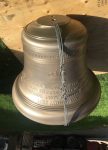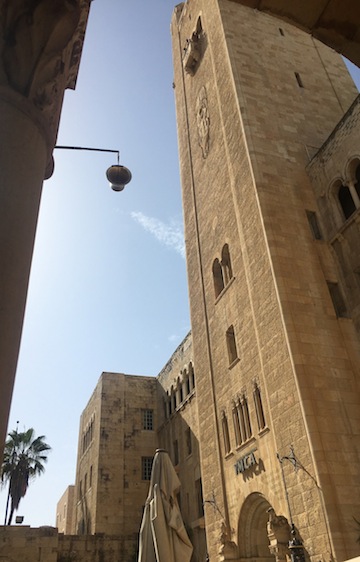
The displays at the Steinhardt Museum of Natural History educate visitors on natural history, as well as current-day environmental issues. (photos by Ashernet)
Just over a year ago, the Steinhardt Museum of Natural History opened the doors of its purpose-built structure on the campus of Tel Aviv University. The 100,000-square-foot building contains more than five-and-a-half million specimens from every corner of the world, educating visitors in every aspect of natural history.
At the same time as the museum serves to educate visitors about specific specimens, the various exhibits and presentations are a reminder of the frailty of the planet and the responsibilities of all humankind to act responsibly to preserve all the species above and below the waves. It also calls on us to try and decrease the pollution that is degrading natural life and depleting the world’s oceans and natural habitats, such as its rain forests and rivers. Israel is not free from such degradation.
It is not just the quantity of exhibits and specimens at the museum that makes it special, it is also the presentation of the material. (photo by Ashernet)
It is not just the quantity of exhibits and specimens at the museum that makes it special, it is also the presentation of the material. As well, there are dozens of friendly, informed museum staff who are only too happy to talk with visitors.
In one sense, the museum has depressing overtones. Many of the species of wildlife that once were found in the region can no longer be seen in their natural surroundings. Visitors are also reminded that fish stocks in the Mediterranean have been depleted over the past 20 years by some 50% due to pollution. In addition, the opening of the Suez Canal has meant that many species of marine life from the Red Sea have ventured into the Mediterranean, via the canal, and wreaked havoc on the Mediterranean’s natural balance.
The museum also shows the harm being caused to the environment by other human actions. For example, it highlights in various ways, including specially prepared film presentations, the danger posed by plastic waste.
The museum presents the history of a world that is unquestionably millions of years old. There are no huge prehistoric animal models exhibited, but there are clear references to the age of dinosaurs. Also, life-size models show the development of humans through the ages. Presumably not wanting to offend anyone’s religious sensibilities, the museum would nevertheless be remiss not to give some scientific explanation for the skeletal remains of both the people and animals that lived on these shores many millennia ago. It is also a sad fact that many animal species of more recent times have been eliminated – because of over-hunting or, in some cases, like the Golan vultures, being almost completely eliminated by farmers poisoning them to protect their flocks.
Throughout the museum there are many opportunities to interact with exhibits that demonstrate or define a particular aspect of nature; for example, comparing a monkey’s hand and its mobility with that of a human. All of the exhibits are clearly explained in Hebrew, Arabic and English.
the museum has a definitive collection of live insects, which are featured in 17 terrariums, as well as almost three million insect samples. (photo by Ashernet)
In addition to the models of creatures and the animals that have been prepared by taxidermists, the museum has a definitive collection of live insects, which are featured in 17 terrariums, as well as almost three million insect samples. This is the largest collection in the museum and includes several types of insects new to science. This provides an interesting opportunity to learn about worlds to which most of us don’t have access.
Among the myriad items in the museum’s collection are those of a 19th-century German zoologist and Catholic priest, Ernst Johann Schmitz, who lived in what is now Israel. Included in the Schmitz collection is the last known bear in the region, from 1916; an Asiatic cheetah from 1911; and the last crocodile from the Taninim River in central Israel. All the species have become extinct in the country.
Nowadays, there is no active hunting of local mammals or birds – the local animals on display are animals that died in nature and have been collected by the Israel Nature and Parks Authority.
Dioramas and interactive displays are located across five floors that are connected by sloped ramps. The curators hope that the museum will increase understanding and knowledge of the natural world. Just as Israel displays its unique archeological treasures, the curators in this museum want to draw attention to Israel’s unique natural history. Despite its small area, Israel has both forests and deserts. The Dead Sea – the lowest point on earth – is within an hour-and-a-half’s drive from the Hula Valley and its collection of migrating birds.
The building of the Steinhardt Museum of Natural History, the National Centre for Biodiversity Studies at Tel Aviv University – to use its full name – was possible mainly because of a donation of some $40 million by American philanthropists Judy and Michael Steinhardt.
Kristallnacht, which took place 80 years ago this month, saw hundreds of synagogues burned, Jewish-owned businesses destroyed, 100 Jews murdered and 30,000 incarcerated. (photo from commons.wikimedia.org)
Kristallnacht, which took place 80 years ago this month, was the “Night of Broken Glass” that saw hundreds of synagogues burned, Jewish-owned businesses destroyed, 100 Jews murdered and 30,000 incarcerated. The state-sanctioned pogrom was staged to look like a spontaneous uprising against the Jews of Germany, annexed Austria and occupied Sudetenland. It is frequently seen as the beginning in earnest of the Holocaust. According to Prof. Chris Friedrichs, who delivered the keynote address at the annual Kristallnacht commemorative evening Nov. 8, global reaction to the attack, which took place on the night of Nov. 9-10, 1938, sent messages to both Nazis and Jews.
“The world was shocked,” said Friedrichs, professor emeritus of history at the University of British Columbia. “Newspapers in the free countries of Europe and all over the Americas reported on these events in detail. Editorials thundered against the Nazi thugs. Protests took place. Demonstrations were held. Opinion was mobilized – for a few days. But soon, Kristallnacht was no longer front-page news. What had happened was now the new normal in Germany, and the world’s attention moved elsewhere. And this is what the Nazis learned: we can do this, and more, and get away with it. Nothing will happen.
“And the Jews of Germany learned something too,” said Friedrichs, himself a son of parents who fled the Nazi regime. “By 1938, many Jews had emigrated from Germany – if they could find a country that would take them. But many others remained. Much had been taken away from them, but two things remained untouched: their houses of worship and their homes. Here, at least, one could be safe, sustained by the fellowship of other Jews and the comforts and consolations of religious faith and family life. But now, in one brutal night, these things, too, had been taken from them. Their synagogues were reduced to rubble, their shops vandalized, their homes desecrated. Nothing was safe or secure. The last lingering hopes of the Jews still living in Germany that, despite all they had suffered at the hands of the Nazis, they might at least be allowed to live quiet private lives of work and worship with family and friends, collapsed in the misery of fire, smashed glass, home invasions, mass arrests and psychological terror on Nov. 9, 1938.”
Friedrichs’ lecture followed a solemn procession of survivors of the Holocaust, who carried candles onto the bimah of Congregation Beth Israel. The evening, presented by the Vancouver Holocaust Education Centre (VHEC) and Beth Israel, was funded by the Jewish Federation of Greater Vancouver annual campaign, with support from the Robert and Marilyn Krell Endowment Fund of the VHEC and the Azrieli Foundation, which provided every attendee with a copy of Dangerous Measures, the memoir of Canadian Joseph Schwartzberg, who witnessed Kristallnacht and fled Germany with his family soon after.
“We are gathered tonight in the sanctuary of a synagogue,” said Friedrichs, who retired in June, after 45 years of teaching and researching at UBC. “A synagogue should indeed be a sanctuary, a quiet place where Jews can gather, chiefly but not only on the Sabbath, for prayer, worship and contemplation. Recent events have reminded us only too bitterly that this is not always the case.
“Our minds are full of mental images of what happened in Pittsburgh less than two weeks ago, but I invite you to call up a different mental image,” he said, taking the audience back to the time of Kristallnacht. “Think of a synagogue. Just a few days earlier, on the Sabbath, Jews had gathered there, as they have gathered in synagogues for 2,000 years, for prayer, worship and fellowship with other Jews. But now, suddenly, in the middle of the night, a firebomb is thrust through a window of the synagogue. As the window glass shatters to the floor, the firebomb ignites a piece of furniture. Within minutes the fire spreads. Soon the entire synagogue is engulfed in flames. It is an inferno. The next morning, the walls of the synagogue are still standing, but the interior is completely gutted. No worship will ever take place there again.”
Friedrichs paused to note that some in the audience would recall a similar attack that destroyed Vancouver’s Reform synagogue, Temple Sholom, on Jan. 25, 1985. He recounted the reaction of police and firefighters, civic leaders and the general public, who rallied around the Vancouver congregation at the time, and compared that with the reactions of non-Jews in Germany and the territories it controlled at the time of Kristallnacht.
“Police and firefighters are on the scene,” Friedrichs said of the situation during Kristallnacht. “But the firefighters are not there to put out the blaze. They are there only to make sure the fire does not spread to any nearby non-Jewish buildings. The police are there only to make sure no members of the congregation try to rescue anything from the building.
“The next morning, crowds of onlookers gape at the burnt-out shell of the synagogue. Some of the furnishings and ritual objects have survived the blaze, so they are dragged out to the street and a bonfire is prepared. But first, the local school principal must arrive with his pupils. Deprived of the opportunity to see the synagogue itself in flames during the night, when they were asleep, the children should at least have the satisfaction of seeing the furnishings and Jewish ritual objects go up in smoke. Most of those objects are added to the bonfire, but not all. Not the Torah scrolls – the Five Books of Moses, every single word of which, in translation, is identical to the words found in the first five books of every Christian Bible. No, the Torah scrolls are not added to the bonfire. They are dragged out to the street to be trampled on by the children, egged on by adult onlookers, while other adults rip apart the Torah covers to be taken home as souvenirs.
“And now consider this: events like this did not happen in just one town,” Friedrichs said. “The same things took place in hundreds upon hundreds of cities and towns throughout Germany and Austria, all on the very same evening and into the next morning. There were minor variations from town to town, but the basic events were exactly the same, for it was a nationwide pogrom, carefully planned in advance.”
Prof. Chris Friedrichs (photo from VHEC)
Friedrichs, who devoted 25 years to serving on the organizing committee of the Kristallnacht commemorative committee, including eight as president, reflected on the history of Holocaust remembrance in Vancouver, including the decision to single out this date as one of the primary commemorative events of the calendar.
“Why should we commemorate the Shoah at this particular time in November?” he asked. “Consider this: 91 Jewish men died on Nov. 9th and 10th, 1938. Yet, on a single day in the busy summer of 1944, up to 5,000 Jewish men, women and children might be murdered in the gas chambers of Auschwitz on one day. Why not select some random date in August 1944 and make that the occasion to recall the victims of the Shoah? Why choose Kristallnacht?”
The earliest Holocaust commemorations in the city, he said, citing the work of local scholar Barbara Schober, was an event in 1948 marking the Warsaw Ghetto Uprising.
People who had founded the Peretz School in Vancouver, in 1945, hoped to preserve the memories and values of the East European Jewish culture, which had been almost totally wiped from the map, he said. “Yet, rather than focus on the six million deaths, their intention was to honour those Jews who had actually risen up to fight the Nazi menace – the hopeless but inspiring efforts exemplified above all by the heroic resistance of the Warsaw Ghetto fighters who used the pathetically meagre supply of weapons they could find to resist the final liquidation of the ghetto by the Nazis in the spring of 1943,” said Friedrichs. “That effort failed, but it was not forgotten.”
This event continued, with the support of Canadian Jewish Congress, into the 1970s, he explained.
“There was an emerging concern that Jews should not just recall and pay tribute to the victims of the Shoah,” said Friedrichs. “The increasing visibility of the Holocaust denial movement made it apparent that Jews should also make their contribution to educating society as a whole – and especially young people – about the true history of what had happened. Prof. Robert Krell and Dr. Graham Forst undertook to establish an annual symposium at UBC at which hundreds of high school students would learn about the Holocaust from experts and, even more importantly, from hearing the first-person accounts of survivors themselves. It was in those years, too, that the Vancouver Holocaust Education Society was established to coordinate these efforts. The survivor outreach program, through which dozens of survivors of the Shoah in our community spoke and continue to speak to students about what they experienced, became the cornerstone of these educational efforts. Their talks are always different, for no two survivors ever experienced the Shoah the same way, but the ultimate object is always the same – not just to teach students what happened to the Jews of Europe between 1939 and 1945, but to reflect on the danger that racist thinking of any kind can all too easily lead to.”
But this was education, he noted, not commemoration.
“With the decline of the Warsaw Ghetto event in Vancouver, the need to commemorate the Shoah came to be filled in other ways. One of those ways was the emergence of the Vancouver Kristallnacht commemoration. The origins of this form of commemoration lie right here in the Beth Israel congregation. In the late 1970s, members of the Gottfried family who had emigrated from Austria in the Nazi era, now members of Beth Israel, proposed that their synagogue host a commemoration of Kristallnacht.”
Friedrichs spoke of the burden carried by each of the survivors who carried candles onto the bimah moments earlier.
“You might think that a candle is not very hard to carry, but, for each one of these men and women, the flame of the candle has reignited painful memories stretching back 70 or 80 years, to a dimly remembered way of life before their world collapsed,” he said. “These men and women survived, and sometimes a few of their relatives did as well, but all of them, without exception, you’ve heard this before, had family members – whether parents, grandparents, uncles, aunts, siblings, or cousins – who were murdered. One could not reproach these men and women if they had chosen to stay home on a night like this. But, instead, they are here.
“Many of these men and women have done more, even more, as well,” he continued. “For many of them have done something for years and continue to do so even now: to speak of their experiences to students in the schools of our province. To stand in front of two or three or four or five hundred students of every race and every heritage and describe life in the ghetto or the camp or on the death march or the anxiety of living in hiding and being pushed into a basement or a closet every time some unwanted visitor arrived – this is not easy. But there is a purpose. The young people of our province are barraged with images and messages and texts telling them that people of certain religions or races or heritages are inferior and unwanted members of our society. They must be told just what that kind of thinking can lead to. No textbook, no video, no lecture can do the job as powerfully as hearing a survivor describe exactly what he or she experienced during the Shoah.”
Corinne Zimmerman, vice-president of the VHEC, welcomed guests and introduced the candlelighting procession. Cantor Yaacov Orzech chanted El Moleh Rachamim, the memorial prayer for the martyrs. UBC Prof. Richard Menkis delivered opening remarks and Helen Pinsky, president of Beth Israel, introduced Sarah Kirby-Yung, a Vancouver city councilor who read a proclamation from the mayor. Nina Krieger, executive director of the VHEC, introduced Friedrichs. Beth Israel’s Rabbi Jonathan Infeld provided closing remarks, and Jody Wilson-Raybould, minister of justice and member of Parliament for Vancouver Granville, sent greetings on behalf of the Government of Canada.
Today, Nov. 9, is the 80th anniversary of Kristallnacht. Seen by some historians as the moment when the Nazis’ legalized discrimination against Jews turned irreversibly toward genocide, the date has been marked by the Vancouver Jewish community for several decades.
Jews view the present and the future through a lens of the past. This has its advantages and disadvantages. Unable to see the future clearly, a keen awareness of the past can lead us to reasonably project expectations. But the memory of Kristallnacht and what came after it instils a rightful and necessary caution in interpreting current events. History tells us that vigilance is crucial and that complacency can be fatal.
Of course, no two moments in history are identical. Are we overreacting by drawing too instructive an historical parallel when we experience traumas like the mass murder at the Tree of Life synagogue on Oct. 27? We can’t be certain. It is probably wise to err on the side of caution and respond with vigilance.
The reaction from so many faith groups and other allies, including at a “solidarity Shabbat” last weekend that filled synagogue seats throughout Metro Vancouver and across North America, is not only a reassuring phenomenon. These demonstrations of intercommunal friendship are underpinned by the awareness that, while some might dismiss the events in Pittsburgh as the deranged act of a single madman, historical consciousness places the terrible act within a larger context.
History is important, too, because we live busy lives and a lot of things are slammed into our consciousness every day. Stepping back and placing contemporary events in a larger context helps us assimilate our place in society, individually and collectively. This is being demonstrated particularly well this week, as Remembrance Day (Nov. 11) approaches.
The Government of Canada’s apology for the 1939 refusal to accept the imperiled Jewish refugees aboard the MS St. Louis comes as part of a long line of apologies for historic wrongs. A cynic could look at the litany of regret and see political expediency. We prefer to look at it as a progressive, healthy way of not only addressing the past but of improving the future.
The journey of the MS St. Louis saw just 29 of the 937 passengers allowed to disembark in Cuba, the intended destination and presumed final refuge for the passengers fleeing the imminent Holocaust. The ship then sailed to the United States and on to Canada, where, in both places, xenophobic and antisemitic attitudes among the general public and the governing elites prevented the asylum-seekers from disembarking. Forced to return to Europe, 254 of the passengers would be murdered in the ensuing genocide.
At a time when many Jews are looking at the news with trepidation, the prime minister’s statement represents the voice of a country facing the antisemitism of its past and, more importantly, committing to face and combat similar sentiments today and in future.
Presaging the prime minister’s formal apology this week, Canada’s ambassador to Israel, Deborah Lyons, speaking at the General Assembly of the Jewish Federations of North America last month (see “Interdependent communities” and “GA pitches softballs at Bibi”) spoke movingly about the importance of applying historical knowledge to the present. She quoted a 17-year-old from Hamilton, Ont., who, after completing the March of the Living, observed that, “as our hearts were breaking, our hearts were also growing.”
Said Lyons: “We need to acknowledge these difficulties, we need to acknowledge these injustices. It may break our hearts, but it will teach our hearts to love again and to grow.”
The writer’s father listening to the radio, circa 1940. (photo from Libby Simon)
This black-and-white picture, lined with age, was taken of Papa in about 1940. His attire reflects a time when a vest was commonly worn under a man’s suit jacket. It is rarely seen today, nor is the armband on his shirtsleeve. His white shirt makes the ensemble too formal to be worn at home, especially with his often-repaired dress shoes. But Papa was a Hebrew teacher and, perhaps uniquely to him, he always dressed as if he were going out. The bare, worn floor reveals a modest home, not uncommon in the 1930s, considering the widespread impacts of the Great Depression.
He sits in rapt attention, hunched on a stool, his expression tense, his eyes fixed on an old, brown, wooden floor radio. We grew up with that radio the way people grow up today with television. It connected our family with the outside world, but each for different reasons. As immigrants, Yiddish was our first language and, for him, radio undoubtedly served as an opportunity to hone his English, as well as to receive its messages. Although I was still a preschooler, I remember what he was listening to because the scene in this photo was repeated several times every day from 1939 to 1945, the years of the Second World War. Papa was listening to the news. But the true catastrophic human saga unfolding beyond the photo, even as he listened, would not emerge until after the war ended.
Fortunately, we here in Canada escaped the devastating fate of our relatives. As a child, I was only aware that certain foods were rationed, like tea, coffee, sugar and butter. My four brothers and I would fight over the krychik (Yiddish for the end piece of a rye bread). It was not the bread itself, but the limited availability of butter on the krychik that made this a special treat worthy enough to be fought over. If Papa were home, he would assign it to me as the youngest and as the only girl, much to the dismay of my brothers. But the rations coupon books provided by the Canadian government gradually extended to include many other staples, such as meat, cheese and evaporated milk. These were needed for the soldiers and the war effort.
I also remember short musical promotions appealing to Canadians to buy Victory Bonds. As a second-grader, I stood up in class one day and patriotically sang one such little ditty, which still reverberates in my memory. My substitution of the word “bun” for “bond” exposes my childhood ignorance that I only came to realize in retrospect as an adult. The lyrics go as follows:
“Buy a ‘bun’ V for Victory / Show you’re fond of your liberty / Keep on buying to keep them flying, / And don’t ever stop till they’re over the top.
“Every dollar makes Hitler holler / And every ‘bun’ you buy will make him groan / So help flood our Chest, / Do your best and invest / In Canada’s Victory Loan.
“Oh, Canada, we stand on guard for thee.”
The radio became such a central focus and source of news that, when the war ended in 1945, I wondered what would happen to it. “Papa,” I asked, “now that the war is over, will they close the radio?”
“Why do you think they will close the radio?”
“Because,” I answered, “what else would they have to talk about?”
It was then I learned that radio not only delivered news about war. It also provided entertainment. For example, I discovered Hockey Night in Canada. My brothers and I would huddle around the radio every Saturday night and listen to Foster Hewitt, in his inimitable high-pitched excitement shout, “He shoots! He scores!” The contagion caused a clutch of five kids to holler in unison along with the sound of the roaring crowd – but only for the Toronto Maple Leafs. In time, I became a hockey aficionado, and could spout names like Syl Apps, Turk Broda or even Conn Smythe, their manager. Establishment of the Hot Stove League began during those early years and continues to this day.
We used to listen to shows like John & Judy, a serial about life in a small Canadian city, and Share the Wealth, with Bert Pearl. And Second World War songs filled the airwaves, like the “White Cliffs of Dover,” referring to the Battle of Britain. “We’ll Meet Again,” a song that resonated especially with soldiers off to battle and their families and sweethearts who had the heartbreak of waiting and not knowing if they would ever return.
Papa’s faded photo tells not only a personal story, but the story of many in Canada. It also highlights the role of radio in our lives. It served to bring the world into our homes between two catastrophic events – the Great Depression and the Second World War. We cannot overlook its importance as a medium of communication that brought the world into millions of living rooms across the country.
Of course, time brings change. My parents are long gone and my siblings and I have dispersed across North America. Radio was eventually muscled out by television but, today, you can “turn your radio on” in a resurgence of popularity. As a segment of mass media, the power of radio has infiltrated our lives again, even on the internet. And, online, you can go back to your childhood with “retro music” and shows like Roy Rogers and The Lone Ranger. It still connects us, though without taking up nearly as much floor space.
Libby Simon, MSW, worked in child welfare services prior to joining the Child Guidance Clinic in Winnipeg as a school social worker and parent educator for 20 years. Also a freelance writer, her writing has appeared in Canada, the United States, and internationally, in such outlets as Canadian Living, CBC, Winnipeg Free Press, PsychCentral and Cardus, a Canadian research and educational public policy think tank.
Filmmaker Michelle Paymar. (photo from D-Facto Filmstudio)
In the 19th century, the hunt for ancient manuscripts was in vogue, and a tip from two Scottish Presbyterian identical twin sisters – Agnes Smith Lewis and Margaret Dunlop Gibson – led talmudic scholar Solomon Schechter of Cambridge University to one of the most incredible discoveries. In 1896, he headed to Egypt, to Ben Ezra Synagogue in Cairo, where he climbed through an opening high in a wall of the synagogue and found himself standing on countless documents that have “revolutionized our understanding of Jewish history.”
The documentary From Cairo to the Cloud, produced, directed and filmed by Vancouver-based filmmaker Michelle Paymar, chronicles the history of the search for the Cairo geniza, or storeroom, which contained more than 900 years’ worth of material – more than half a million fragments. There were religious texts, personal letters, bills, bureaucratic
reports, a child’s practise of the alphabet, artwork, prescriptions, what someone had for lunch and even handwritten drafts penned by 12th-century rabbi and physician Moses Maimonides. The geniza contained a written record of almost every aspect of Jewish life, in multiple languages: Hebrew, Arabic, Aramaic, Judeo-Greek, Judeo-Spanish, Judeo-Persian and Yiddish.
From Cairo to the Cloud sees its North American première at the Vancouver Jewish Film Festival on Nov. 12, 3:30 p.m., at Fifth Avenue Cinemas. It had its world première at the Cambridge Film Festival earlier this week.
“Many years ago, I learned about the existence of an archive that was essentially a time capsule of Jewish life in medieval Egypt,” Paymar told the Independent. “Then, in 2011, two books about the Cairo geniza appeared – one by Adina Hoffman and Peter Cole called Sacred Trash and one by Mark Glickman entitled Sacred Treasure.
“I was captivated by the immediacy of the voices from the geniza, the richness of Judeo-Arabic culture, and the sophistication of their milieu. When I learned that Cambridge was in the process of digitizing its final geniza documents for the Friedberg Genizah Project, I called Ben Outhwaite, the head of the geniza collection at the Cambridge University Library, to find out if any film crews would be documenting this momentous event. No one was planning to film the digitization of the last documents, so I grabbed my camera and my gear and went to Cambridge to film it myself.”
Solomon Schechter at work in the old Cambridge University Library, with the crates of material from the Cairo geniza around him. (photo from Cambridge University Library via D-Facto Filmstudio)
Using narrations of various texts (translated into English), archival images, animation, visual effects and lots and lots of interviews, From Cairo to the Cloud does indeed take viewers from Cairo to the Cloud, or the internet. Thanks to the Friedberg Genizah Project, all the geniza fragments are now accessible by researchers around the world. With the physical manuscript pieces stored in different institutions, it used to be that, to study one document, a researcher might have to go to several cities just to puzzle together part of a page. Not only is that travel no longer necessary but, because every scribe writes in a unique way, computer programs have been able to match texts using a technology like that which is used in facial recognition, making it possible to join hundreds of pieces of a document within a couple of months.
Wherever you have a Jewish community, you must have a geniza, explains Prof. Hassan Khalilieh (University of Haifa) in the film. Rabbi and author Mark Glickman then explains that a geniza is a place to store damaged Jewish religious texts and documents. Geniza is a Hebrew word for hide, adds Prof. Yaacov Choueka (Friedberg Genizah Project). In Jewish law, he explains, you are not allowed to destroy or deal disrespectfully with written material with God’s name on it.
So, continues Prof. Janet Soskice (University of Cambridge), that document has to be treated with the reverence you would accord to a human body. Once a home’s or synagogue’s geniza is full, the stored material gets taken to the cemetery and buried. But, what author Dara Horn notes is that the Jews of medieval Cairo had a different method – they not only saved documents with God’s name in it but any document written in Hebrew letters, and they didn’t empty their geniza for more than 900 years.
Quick snippets of information from academics, librarians, writers and other experts keep From Cairo to the Cloud moving at a good pace, while not losing its educational aspect.
“I started with a few names and those names begat more names,” said Paymar. “I soon discovered that these ‘geniziologists’ were wonderful storytellers and passionate about the geniza. I ended up interviewing about 40 people representing a wide range of interests and three generations of geniza scholarship. The oldest – Mordechai Friedman, Avraham Udovitch and Mark Cohen – studied with [ethnographer] S.D. Goitein himself. Then there are the students of Goitein’s students, like Marina Rustow, and her student, Arnold Franklin.
“I have about 60 hours of interview material. Once I started piecing together the story, it became more or less clear which selections to use from each of the interviews.”
And what a story it is, between how the geniza was found – meeting people like the sisters Smith Lewis and Dunlop Gibson, who were academics in all but name, knowing 14 languages between them and taking multi-continent excursions, often in search of ancient manuscripts – and the documents from the geniza itself. The material in the storeroom roughly covers the period 1000 to 1250 in Fustat, which started as a separate city than Cairo, and was a major hub for trade.
“Gaining permission to film in the Ben Ezra Synagogue in Cairo,” explains Paymar in her director’s notes, “required nearly seven years, three Egyptian governments, gaining the support of representatives from the Jewish community of Cairo, the assistance of the Canadian consulate in Cairo, approval by the Egyptian ministries of the interior and antiquities, the Egyptian state police, the Egyptian tourist police, the Egyptian Press Office and the Jewish community of Cairo. I was the first filmmaker in decades to be allowed to film inside the synagogue.”
Because of Paymar’s efforts, the rest of us can see inside the Cairo geniza’s treasures much more easily. We should take the opportunity to do so. It is a fascinating journey.
For the full Vancouver Jewish Film Festival lineup, visit vjff.org.
Still from If You’re Hungry, Sing. If You Ache, Laugh.
When Vancouver freelance director and writer Michèle Smolkin interviewed her uncle, Sam Rechtman, he was 103 years old. Born on July 7, 1914, he has experienced two world wars, pogroms, poverty, hard manual labour, military service, loss, love and so much more, and yet he still approaches life with energy and cheer. Si tu as faim, chante. Si tu as mal, ris (If You’re Hungry, Sing. If You Ache, Laugh) is the perfect name for the documentary Smolkin has made on him.
The adage is an old saying from Chelm, explains the film, which happens to be the village in which Rechtman was born. At the time of his birth, Chelm was part of the Russian Empire. He was the second of four siblings.
We are merely introduced to Rechtman in this documentary, which runs just under an hour. With delightful, simply drawn animated sequences, along with music, archival film footage, old family photos and, of course, the interview with her uncle, Smolkin has created an inspiring reminder of just how much our attitude affects our lives.
In a brief interview for the DOXA Documentary Film Festival this past May, Smolkin explains that the film is “more than just a portrait of a man’s life and time, it’s also the portrait of a century in Europe. My uncle went through so much ordeal and such a dramatic life and is still this happy, simple, fun person who enjoys life and is not bitter or complaining. We are so privileged, that we should sometimes think, oh yeah, we could also enjoy life. That’s a life lesson.”
If You’re Hungry, Sing. If You Ache, Laugh screens on Nov. 11, 1 p.m., at Fifth Avenue Cinemas, as part of the Vancouver Jewish Film Festival, vjff.org.
B’nai B’rith event, 1969. (photo from JWB fonds, JMABC L.09488)
If you know someone in this photo, please help the JI fill the gaps of its predecessor’s (the Jewish Western Bulletin’s) collection at the Jewish Museum and Archives of B.C. by contacting [email protected] or 604-257-5199. To find out who has been identified in the photos, visit jewishmuseum.ca/blog.
A scene from Who Will Write Our History, about the secret Warsaw Ghetto archives that were hidden from the Nazis. The film screens Nov. 1 at the Rothstein Theatre. (photo by Anna Wloch / Katahdin Productions)
One of the better known documents of the Oyneg Shabes Archive is written by David Graber, who was 19 at the time. In his will, he wrote: “What we were unable to cry and shriek out to the world, we buried in the ground…. I would love to see the moment in which the great treasure will be dug up and scream the truth at the world…. May history attest for us.” While Graber did not survive Holocaust, his words did. As did the words and tens of thousands of pages of material collected by historian Emanuel Ringelblum and the 60 Oyneg Shabes members in Warsaw from 1940 to 1943.
The documentary Who Will Write Our History, written, produced and directed by Roberta Grossman, highlights the story of the archive and some of the Oyneg Shabes members, only three of whom survived. It will be screened by the Vancouver Jewish Film Centre on Nov. 1, 7 p.m., at the Rothstein Theatre and Grossman, along with executive producer Nancy Spielberg, will be in attendance.
The film is based on the book of the same name by Samuel D. Kassow.
“When I read Sam’s book, I was just absolutely shocked that I didn’t know the story because I’ve done a lot of work and been very engaged in learning about this period of time my entire life and, to me, it seemed like a travesty that it was so little known outside of academic circles and it seemed that it really should be known,” Grossman told the Independent. “To my mind, it is the most important unknown story of the Holocaust.”
Being a filmmaker, Grossman said, “I felt that the best way to help Ringelblum and the other members of the Oyneg Shabes achieve what they wanted, which was to tell the story of the war from the Jewish point of view and to be remembered as individuals,” was through film, that the “medium is the best way to tell stories that will reach a lot of people and not just scholarly circles.”
Grossman optioned Kassow’s book in 2012.
Roberta Grossman, writer, producer and director of Who Will Write Our History. (photo from Katahdin Productions)
From that time to the finished film, she said, “The goal and the vision for the film stayed the same, it just took a long time to figure out how to achieve that because you need to set the story of the Oyneg Shabes Archive in the historical context. You need to know what’s going on between the wars [and] during the war; you need to know the story of the Warsaw Ghetto; you need to know the story of the Oyneg Shabes and how they operated; and then you need to know the individual story arcs of the people that we chose to highlight…. It’s a lot to pack in, so the challenge was in figuring out the pieces of that puzzle.”
Of the three caches of material hidden by the Oyneg Shabes, two have been found, in 1946 and 1950. They contained more than 35,000 pages of material, including letters, artwork, photographs, circulars, posters and so many other documents, which are housed at the Jewish Historical Institute in Warsaw. In 2008, the Vancouver Holocaust Education Centre mounted the exhibit Scream the Truth at the World: Emanuel Ringelblum and the Hidden Archive of the Warsaw Ghetto, which presented parts of that extensive collection to Vancouver. But the exhibit must have been a relative rarity because Spielberg also hadn’t heard of Ringelblum – who was among those murdered by the Nazis (in 1944) – and the archive.
“We worked together on Above and Beyond,” Spielberg told the Independent about how she came to work with Grossman on the documentary. “I came to Vancouver with that film and showed it in the [2014 Jewish] film festival there…. She had just bought the rights to Who Will Write Our History? and she left the project to come on board to direct Above and Beyond. We were spending time together, we were in the car, we were driving to locations, [and] I’m listening to her on the phone talking about this other project, and then she started telling me the story, and I knew nothing about this.”
Grossman eventually asked Spielberg if she’d be interested in joining the project and, having worked with Grossman before, Spielberg said, “We’re a wonderful balance and I loved this story. And we did [the film] with the idea that someone could come out of their immediate misery and sit down and do something with eyes to the future when it looks like there’s no tomorrow for you.”
“We know about people who, against all odds, rose up to the best of their ability militarily against the Nazis,” said Grossman, “but we haven’t spent a lot of time necessarily paying attention to and giving honours to people who resisted in other ways and, to me, this is an incredible example of spiritual resistance. They saw themselves as being literally engaged in a battle of humanity versus barbarism and I think that, especially now, the idea of or the question, who writes our history, and what is true and what is false, and what is propaganda and what is truth, and who controls the narrative is as important today as it’s ever been.
“In an era,” she continued, “where truth is not particularly valued in some of the most powerful corners of our world and a lot of lies and hateful propaganda is being propagated, especially vilifying the other, whether they be immigrants or Muslims or whoever ‘the other’ of the moment is, we know from history, if we pay attention, that’s an extremely dangerous – very powerful and, therefore, dangerous – way to operate. It’s important for people who are victimized or marginalized to tell their own story.”
The upcoming screening here of Who Will Write Our History is part of a tour of the film. Both Grossman and Spielberg have been attending various screenings, sometimes together, sometimes not.
“I think that the most common reaction is twofold,” said Spielberg. “One is of gratitude that the story was told. That may come in many ways, first of all, from people who are hungry for more knowledge and didn’t know anything about this … and also, of course, from survivors and their children; keeping these stories alive and honouring these people so that their lives would not have been in vain.
“And the other response is ‘I didn’t know that, how come I didn’t know that?’… Then you know you’ve unearthed a gem, that you were able to teach somebody another aspect of the Holocaust, just when we thought we’ve heard it all. Getting this out to the general populace will be really, really important, Jewish and non-Jewish.”
“I feel very proud to have fulfilled in some small way the wishes of the members of the Oyneg Shabes to tell the story from the Jewish point of view and to be remembered as individuals,” said Grossman. “I get the feeling, when I watch the film with audiences, that there is a way in which people sitting in the audience feel as if they’re honouring those people just by watching the film, and that’s really exciting.”
Tickets to the Vancouver screening of Who Will Write Our History are $72 and can be purchased via vjff.org.
The University of British Columbia’s Prof. Richard Menkis has received two honours recently: the 2018 Louis Rosenberg Canadian Jewish Studies Distinguished Service Award and the 2018 Switzer-Cooperstock Prize for the best essay in Western Canadian Jewish history.
The Association for Canadian Jewish Studies established the Rosenberg Award in 2001 to recognize the significant contribution by an individual, institution or group to Canadian Jewish studies. In announcing Menkis as this year’s honouree, the association noted his “long and very distinguished career as a strong advocate for and practitioner of the scholarship and teaching of Canadian Jewish studies.”
Menkis won this year’s Switzer-Cooperstock Prize for the essay “Two Travelers and Two Canadian Jewish Wests,” which emphasizes the multiple expressions of interwar Jewish life in the Canadian west, and studies how two rabbis – Chief Rabbi J.H. Hertz and Rabbi Y. Horowitz – traveled through the region to promote their different visions. Hertz offered a modern acculturated Anglo-orthodoxy, while Horowitz promoted a traditionalist orientation shaped by Chassidism.
The Switzer-Cooperstock Prize, donated by members of the Switzer family to honour their parents and grandparents, is awarded biennially by the Jewish Heritage Centre of Western Canada. Past winners of the prize are Theodore Friedgut (Hebrew University), Lynne Marks (University of Victoria), Chana Thau (Winnipeg independent scholar), David Koffman (York University) and Esyllt Jones (University of Manitoba).
Menkis received his PhD from Brandeis University in 1988 and for many years held a position in the department of classical, Near Eastern and religious studies with a cross appointment to the department of history at UBC. He is currently associate professor of medieval and modern Jewish history in the history department at UBC. In addition to the surveys of medieval and modern Jewish history, he has taught advanced undergraduate courses on the Holocaust; Canadian Jewish history; fascism and antifascism; the historiography of genocide; and Jewish identity and the graphic novel. He continues to supervise both MA and PhD student theses at UBC and has served on PhD committees at other institutions.
Menkis has published widely on the cultural and religious history of Canadian Jewry. His articles have appeared in American Jewish History, American Jewish Archives, Canadian Ethnic Studies, Canadian Jewish Studies and in a number of edited volumes. Menkis was co-author, with Harold Troper, of More Than Just Games: Canada and the 1936 Olympics (University of Toronto Press, 2015), a seminal work in the field that presents an investigation of the responses and reactions of both Jewish and non-Jewish Canadian athletes and their communities to participation in the games. He is continuing the research for a publication, begun with Gerald Tulchinsky (z”l), on an aspect of the Canadian Jewish garment industry.
Appointments
Tikva Housing has hired Alice Sundberg as director of operations and housing development. Sundberg has more than 30 years of nonprofit housing experience, including housing development, organizational and project management, and sector leadership. Most recently, she was involved with the development of the Co:Here Housing Community and the creation of Home Front, a collaborative initiative to make homelessness in Metro Vancouver rare, brief and one-time. Her knowledge of and contacts with both provincial and federal levels of government will assist Tikva Housing greatly as the organization moves forward with current and new project developments.
Sundberg is excited to be joining Tikva Housing and is already busy with the upcoming opening of the Ben and Esther Dayson Residences in Vancouver’s Fraser district. For information about Tikva’s upcoming projects, you can reach her at [email protected], or housing administrator Anat Gogo, at [email protected].
Congregation Beth Israel, circa 1955. (photo from JWB fonds, JMABC L.09737)
If you know someone in this photo, please help the JI fill the gaps of its predecessor’s (the Jewish Western Bulletin’s) collection at the Jewish Museum and Archives of B.C. by contacting [email protected] or 604-257-5199. To find out who has been identified in the photos, visit jewishmuseum.ca/blog.