Skip to content
  • Home
  • Subscribe / donate
  • Events calendar
  • News
    • Local
    • National
    • Israel
    • World
    • עניין בחדשות
      A roundup of news in Canada and further afield, in Hebrew.
  • Opinion
    • From the JI
    • Op-Ed
  • Arts & Culture
    • Performing Arts
    • Music
    • Books
    • Visual Arts
    • TV & Film
  • Life
    • Celebrating the Holidays
    • Travel
    • The Daily Snooze
      Cartoons by Jacob Samuel
    • Mystery Photo
      Help the JI and JMABC fill in the gaps in our archives.
  • Community Links
    • Organizations, Etc.
    • Other News Sources & Blogs
    • Business Directory
  • FAQ
  • JI Chai Celebration
  • JI@88! video

Recent Posts

  • Sharing her testimony
  • Fall fight takes leap forward
  • The balancing of rights
  • Multiple Tony n’ Tina roles
  • Stories of trauma, resilience
  • Celebrate our culture
  • A responsibility to help
  • What wellness means at JCC
  • Together in mourning
  • Downhill after Trump?
  • Birth control even easier now
  • Eco-Sisters mentorship
  • Unexpected discoveries
  • Study’s results hopeful
  • Bad behaviour affects us all
  • Thankful for the police
  • UBC needs a wake-up call
  • Recalling a shining star
  • Sleep well …
  • BGU fosters startup culture
  • Photography and glass
  • Is it the end of an era?
  • Taking life a step at a time
  • Nakba exhibit biased
  • Film festival starts next week
  • Musical with heart and soul
  • Rabbi marks 13 years
  • Keeper of VTT’s history
  • Gala fêtes Infeld’s 20th
  • Building JWest together
  • Challah Mom comes to Vancouver
  • What to do about media bias
  • Education offers hope
  • Remembrance – a moral act
  • What makes us human
  • המלחמות של נתניהו וטראמפ

Archives

Follow @JewishIndie
image - The CJN - Visit Us Banner - 300x600 - 101625

Tag: history

Anne Frank exhibit on now

Anne Frank exhibit on now

Created in 1995, the traveling exhibit Anne Frank: A History for Today is on display roughly 300 times a year. Mainly for school groups, people can visit the exhibit at Seaforth Armoury Nov. 11. (photo from Anne Frank House)

The traveling exhibit Anne Frank: A History for Today, hosted by the Consulate General of the Netherlands, is at Seaforth Armoury until Nov. 21. An opportunity for school groups to learn about Anne’s story and the legacy of her diary, the exhibit tours have already sold out, but the public is welcome to visit on Remembrance Day, Nov. 11.

While this is not the first time the exhibit has been in Vancouver, its presence at the armoury and museum is poignant. Started in 1920 by Scottish Canadians, infantry from the Seaforth Highlanders were on the ground in Amsterdam on May 8, 1945. They entered the city as part of the Allies’ liberating force.

Following months of battles and Germany’s surrender, the Seaforth Highlanders offered humanitarian aid to the city’s population. The close ties between the regiment and the people of the Netherlands are commemorated every year. 

The school tours at Seaforth Armoury are led by volunteers trained by Phyllis Lewis, a staff member of Anne Frank House, said the house’s director of Canadian activities, John Kastner.

Arriving on Nov. 5, the exhibit required about six people half a day to set up, then there was peer training. The response to the call for volunteers was excellent, said Kastner, as has been the level of interest from local schools.

“I think the premise is from Anne Frank House in Amsterdam – there’s real value for people to become ambassadors of the message. People that are close to the same age as Anne are particularly effective when it comes to relaying the message of the diary,” he said.

Not all the exhibit’s stops are in metropolitan areas. Kastner described its journey to Anne Frank Public School in Vaughan, part of the Greater Toronto Area, then it went to Marathon, a mining community on the shore of Lake Superior, then to All Saints High School in Toronto, before being displayed at Ottawa’s Beechwood Cemetery (Canada’s national military cemetery) and the Dutch consulate in Vancouver, which sponsored it. 

And the exhibition will keep moving, said Kastner. “It’s been very busy in 2025 – demand has been very steady and it has hardly been in storage at all.”

Created in 1995, the Canadian exhibitions are just some of the many around the world, in languages including Albanian, Arabic, Bengali, Bosnian, Korean, Macedonian and two forms of Portuguese. In total, the exhibit is on display roughly 300 times a year.

Paired with a 30-minute film, Who was Anne Frank?, the tour takes about 90 minutes. It comprises 11 panels of information that are the same worldwide and the 12th panel is curated specifically for the region. The version that arrived in Vancouver this week references the liberation of Amsterdam and all the panels are in both English and French, which is the case for all the Canadian showings, though the exhibit for northern Ontario is also in Inuktitut.

The docents bear a responsibility as ambassadors for Anne’s legacy and message, said Kastner. “You want people who are in classrooms, at dinner tables, in peer groups at schools, who are aware of the story, that become advocates of fairness, opponents of racism, opponents of prejudice, and we really see it in real life – that those docents become docents of the message of Anne Frank House.

“Every generation that comes through, you create a new generation that becomes familiar with the story and the messaging of Anne Frank – not only what she went through, but her optimism in a world surrounded by hate, prejudice and violence…. As people go through the exhibit, they become aware of what an important story it is,” said Kastner. “They come to realize that it is, by definition, a history for today – that it has relevance in today’s society.”

photo - Anne Frank, in 1941. The traveling exhibit Anne Frank: A History for Today is at Seaforth Armoury until Nov. 21
Anne Frank, in 1941. The traveling exhibit Anne Frank: A History for Today is at Seaforth Armoury until Nov. 21. (photo from Anne Frank House)

Kastner spoke about his personal connection to Anne’s remarkable outlook and values, referencing her often-quoted diary entry of July 15, 1944: “In spite of everything, I still believe that people are really good at heart.”

“I wish we could all be as optimistic as Anne was,” he said. “It was remarkable.

“There have been many periods since the Second World War when we’ve had many reasons to be pessimistic, and that’s why it’s a history for today. It’s a recurring message that continues. After 75 years, it still has relevance.”

Kastner praised the design of the exhibit, calling it “fantastic.”

“There’s a timeline ribbon that goes down the centre … the date and the year. Above the ribbon is what is happening in the world politically at the time. Below the ribbon is how it’s impacting people – Anne, her family and everybody else,” he explained. “The idea is that [some people think] what you see on the news doesn’t really matter…. This says, it should matter, it does make a difference. And that creates an awareness of current events, of being involved … of speaking out. Even in minor cases of prejudice, it’s problematic and [can lead] to a greater problem.”

When talking about this idea in Marathon, Kastner gave the example of name-calling. “Calling someone a name, a slur, we can see it as problematic but not the end of the world,” he said. Or, “graffiti on a kid’s locker, that’s not very nice, but it’s not the end of the world – but it leads to a huge problem when [such actions] become the norm.”

Kastner spoke highly of the 3D model of the house, which is “one of the great learning tools that goes with the exhibit.” There is power in asking teenagers, “Who can tell us where Anne slept?”

“When I went to Anne Frank House to work there, where my workspace was, I’d be looking at the courtyard and at the Annex, looking at the tree, and it’s absolutely surreal,” he said. “Being in the presence of that kind of history. There’s no replacement for that.”

It’s the same tree Anne would have seen. 

“I’d be in her father’s office at the warehouse and there are all sorts of people traipsing through the house,” he said, and he’d think about “how you [would have] had to be deathly quiet, completely stationary, because people were using that office.”

Certain questions come up time and again. Students want to know how the Holocaust started, for example.

“The Holocaust didn’t start with people getting loaded on trains,” Kastner explains to the kids. “The Holocaust started with all sorts of things that Anne talks about – her bike being taken away, not being allowed to swim in the public pool, not being allowed to take public transit, then extended to larger things. Her dad not being allowed to have a job or own property.… It starts by slow increments.”

At Anne Frank Public School in Vaughan, the kids asked Kastner how Anne’s diary got published. He described the return of Anne’s father, Otto Frank, to the Annex, which had not changed since the day their hiding place was discovered. He told the students that Miep Gies, who had helped hide Anne and her family, “had taken the diary after the Nazis had left and kept it, gave it to Otto and he read through it and then said, I should publish this.”

Kastner said the kids marvel at the serendipity, the turn of events that led to “one of the most important books written by somebody under the age of 16.” He added, “The kids say that it’s amazing that [Otto] survived, that he got the book, that somebody wanted to publish it and then the idea that it’s become standard reading for millions of kids 70 years later.”

During the exhibition’s stop at Beechwood Cemetery, Kastner recalled two students asking him, “What is it about Jewish people? Why do they pick on Jewish people?” And, “Why didn’t somebody do something?

Kastner explained the scapegoat theory to these students. “It’s in Shakespearian plays, it’s throughout history: the idea of a common enemy often solidifies a group,” he said.

Each exhibition site brings different opportunities for learning, said Kastner. Getting it to remote locations can be tough but it’s worthwhile. Shipping the panels to Marathon, for example, was challenging, but Kastner applauded the motivation of the school there as “very noble and progressive.”

“Every place it goes, it has a different impact and it’s going there for a different reason,” said Kastner of the exhibition. 

“The message,” he said, “is in Anne’s experience, Anne’s death – that has relevance in today’s society.” 

Shula Klinger is an author and journalist living in North Vancouver.

Format ImagePosted on November 7, 2025November 6, 2025Author Shula KlingerCategories LocalTags Amsterdam, Anne Frank, Anne Frank House, education, exhibits, history, Holocaust, John Kastner, Seaforth Armoury, Second World War
Telling the story of an icon

Telling the story of an icon

Ronnie Marmo brings his one-man show I’m Not a Comedian … I’m Lenny Bruce to the Chutzpah! Festival Nov. 18. (photo from dorensorellphotography.com via Chutzpah!)

In 2017, with the expectation of a six-week run, creator and performer Ronnie Marmo and director Joe Mantegna brought I’m Not a Comedian … I’m Lenny Bruce to the stage. Now, celebrating eight years and 468 performances, Marmo told the Independent, “we can not wait to bring it up to Vancouver for 469!”

I’m Not a Comedian … I’m Lenny Bruce is part of this year’s Chutzpah! Festival, which runs Nov. 12-23. It’s being presented on Nov. 18, 7:30 p.m., at the Rothstein Theatre.

Bruce, a groundbreaking standup comedian and satirist, was born Leonard Alfred Schneider in Mineola, on Long Island, NY, in 1925. He consistently pushed social and legal boundaries, being arrested more than once for what was considered obscenity in his day, including a conviction in 1964 for a performance he gave at Café Au Go Go in New York City. Bruce died two years later, at age 40, from an accidental overdose. He was bankrupt, basically not having been employable after the conviction. It would be 37 years before he was posthumously pardoned, by then-governor George E. Pataki.

In I’m Not a Comedian … I’m Lenny Bruce, Marmo told the Independent, “We bookend the show with the final moments of his life and take you on a journey through his first performance all the way to his demise. We learn about his family, we see his charm and success, his struggle with addiction, his long-standing fight with the judicial system. We don’t hold back. You really get a full theatrical experience of his entire life.”

Bruce is one of Marmo’s heroes.

“What inspires me about Lenny is how ahead of his time he was and how passionate he was about his pursuit of the truth. I have so much respect for someone who is willing to sacrifice everything and put it all on the line just to make sure he didn’t fall into suit with everyone else. I’m proud to be entrusted by the family to be the one to tell his story to the next generation.”

Marmo landed on the title for the show after hearing Bruce say, in an audio clip, “I’m sorry I wasn’t funny tonight … I’m not a comedian, I’m Lenny Bruce.” For Marmo, that comment resonated. “He wasn’t a comedian – he was so much more than that,” said Marmo of Bruce. “He was a satirist, a social commentator and a true advocate for the freedom of expression.”

The show has evolved a lot since its creation.

“As the writer, I am always tinkering with the script,” said Marmo. “For example, I removed the famous ‘N-word’ bit when we came back after the pandemic. I felt as though, even though the bit itself was in support of removing power from words so we don’t give them the chance to harm us, I knew that people might have a hard time hearing what Lenny was actually trying to say. Plus, even though I loved the impact it had on an audience, it kept me up at night thinking about it even before events like what happened to George Floyd. I have a responsibility as an artist to tell the absolute truth but also to not be tone deaf to the world around me. I don’t believe Lenny would have done that bit today. 

“I also had long discussions with Kitty [Bruce, Lenny’s daughter] and my director, Joe Mantegna, who both agreed that it was best to remove it. So, I replaced it with ‘The Meaning of Obscenity,’ which, in my opinion, supports the show even more. So, I’m happy to make the switch, knowing it is not only the best fit culturally in this climate but also the strongest choice for the show overall. As a performer, my portrayal of Lenny evolves as I explore my own life and how I tell his story resonates differently depending on where I am in my life. I think it takes passion, dedication and an openness to watch it grow and evolve along with me.”

While I’m Not a Comedian … I’m Lenny Bruce premiered in 2017, Marmo said, “I’ve actually been with Lenny since 2005, when I did another show about him, called Lenny’s Back and Boy is He Pissed. On stage, I don’t separate us – it is my job as an actor to find where we meet in the middle. I try to focus on all the similarities that I identify with for Lenny. It is easy to keep it fresh because it is such an emotional ride and massive performance. I don’t feel like I ‘have it’ yet, which is refreshing, because it always feels just slightly out of reach.”

When Marmo did Lenny’s Back, which was brought to him by comedian Charlie Brill, he became “intimately involved with Lenny Bruce and his life.

“In getting to know him, I realized that there was so much of his story we weren’t telling. I wanted to get into the nitty gritty, I wanted to do his bits,” said Marmo. “So, I set out to write my own show. 

“We initially started the show anticipating a six-week run,” he said. “This thing has caught fire in the most incredible way. It is a testament to just how relevant Lenny is today – perhaps even more than he was over 60 years ago! It truly has been a perfect storm: free speech, first amendment, cancel culture and not to mention the success of the Amazon series The Marvelous Mrs. Maisel. They really helped catapult Lenny’s name back into pop culture and have sold thousands of tickets for us. We have, in some ways, come very far and, in others, not far at all.”

Marmo described Bruce as “a very proud Jewish man,” who often incorporated Judaism and his Jewish heritage into his material. “He openly incorporated his Yiddish vocabulary into his bits and there is quite a bit of familiar references sprinkled throughout the show,” said Marmo. “His relationship with religion overall was complex but, rather than hiding his heritage, he celebrated it.”

As for what he thought gave Bruce the courage to run up against the country’s obscenity laws, Marmo said, “The truth. He held a mirror up to society and asked questions that everyone wondered about but never found any resolution to. He also fervently believed in our judicial system and always believed that it would prevail and he would be redeemed – something that he, unfortunately, didn’t see in his lifetime, but did come to fruition with his posthumous pardon in 2003 – the first in New York history, in fact. He spoke out loud what everyone whispered to themselves and his popularity was proof of how profound he was.”

Even though Bruce wasn’t alive to receive the pardon, Marmo still believes it was an important action.

“It was a landmark symbolic victory for free speech,” he said. “I think it was redemption. It was validation that Lenny had something to say to this society and that we are free-thinking creatives entitled to our artistic expression.”

For tickets to I’m Not a Comedian … I’m Lenny Bruce or any other Chutzpah! show, go to chutzpahfestival.com or call 604-257-5145. 

Format ImagePosted on November 7, 2025November 6, 2025Author Cynthia RamsayCategories Performing ArtsTags Chutzpah!, comedy, free speech, history, Lenny Bruce, Ronnie Marmo, satire

Reminder of humanity’s light

The passage across the Øresund, the body of water that separates the Danish peninsula from Sweden, is, at its narrowest, about the same distance as Horseshoe Bay to Bowen Island. But the waters can be treacherous – especially when it’s 1943 and the waters are swarming with Gestapo Kriegsmarine boats. Yet, for two weeks at the beginning of October 1943, 7,000 Danish Jews – about 95% of Danish Jewry (including the wonderful Victor Borge) – were safely transported across the Øresund in small fishing boats to the “sacred soil” of neutral Sweden.

In his new book, A Light in the Northern Sea: Denmark’s Incredible Rescue of Their Jewish Citizens During WWII, Tim Brady, author of the popular story of the Dutch Resistance Three Ordinary Girls, uses his excellent narrative skills to outline in detail how Danish Jews were warned about Nazi deportation plans, how they escaped and how they were treated when they arrived in Sweden. 

image - A Light in the Northern Sea book coverBrady has described himself as a storyteller, rather than as a professional historian, but he has done his research and he tells this story in great detail. As he did with Three Ordinary Girls, Brady brings history alive with the telling of stories through the eyes of participants, rather than simply cold facts. The eyes here are, for the most part, those of the remarkable Dutch resistance fighter Jurgen Kieler, whose recently published memoirs (encouraged by Elie Wiesel) would not have been available to earlier rescue historians.

Readers might be surprised that the “light in the northern sea” of the title refers to welcoming Sweden, not, as you might expect, given the book’s subtitle, Denmark. But, as Brady is quick to point out, the Swedish “light” was not always bright – before, and early in the war, Sweden had demanded that Germany mark the passports of Jewish emigrés with a “J” so they could be more easily refused, and Sweden refused potential Jewish immigrants who were not financially independent. 

However, as Brady notes, largely due to the enormously influential intercession of the great Danish Nobelist Niels Bohr (a dedicated Nazi-hater) with the Swedish government, Sweden’s position regarding the Jewish immigrants changed radically by October 1943, when it decided to admit all 7,200 Jews fleeing the recently occupying Nazis in Denmark. 

Swedes almost universally opened their homes to the Danish Jews. The refugees were also made to feel comfortable in churches, community centres, hotels and schools, as welfare agencies constructed camps, provided clothing and household items, and helped them find employment. Also, as Brady notes, during the post-rescue months of the Danish resistance, Sweden provided a 25 million kroner (about $70 million in today’s dollars) credit to help Denmark train and organize the Danish Brigade revolutionary group. 

Interestingly, the “rescue of Denmark’s Jewish citizens” referred to in the book’s subtitle has a double reference for Brady. On the one hand, there is the escape across the Øresund. But there is a second “rescue” described in the ending chapters of the book. These chapters deal with the 1943-45 undertakings of the Danish resistance, including detailed accounts of both their successful and non-successful sabotage activities. However, most of these Danish fighters were ultimately captured, and Brady carefully narrates their terrible experiences in German concentration camps. But, once again, the Danish Jews were “rescued.” Thanks to a coordinated effort of the Swedish Red Cross and the Danish government, most of the Danish concentration camp prisoners were returned to Denmark in the remarkable “White Bus Rescue” that was made possible in March 1945 by negotiations instigated between the Swedish diplomat Folke Bernadotte and Heinrich Himmler, which Brady describes at the end of his book. 

When put into historical perspective, as Brady is careful to do, the rescue of 95% of Danish Jewry, while utterly unique in Europe, was not completely surprising. At no time had Danish Jews been required to wear a yellow star. Moreover, King Christian X, while greeting his Danish subjects, would never salute the occupying Nazis, and would habitually visit Denmark’s Great Synagogue on Rosh Hashanah. (King Christian, in contradiction to popular myth, never wore the yellow star – but he would later be placed under house arrest.) As well, Jews lived comfortably in Copenhagen; for 100 years, they had enjoyed full human rights and become very active in arts, politics and philanthropy. For these reasons, as Brady explains, and also because the Danish population was, in his words, “peculiarly democratic,” Germany hesitated to “twist the arms of Denmark regarding its Jewish problem” (no less was Denmark anxious to “poke the Third Reich bear,” as Brady puts it).

But how did the Danish Jews know about the Nazis’ plans to deport them? To answer this question, Brady emphasizes the courageous actions of Nazi diplomat Georg Duckwitz, whom history should celebrate as a kind of Raoul Wallenberg- or Oskar Schindler-type figure. With his life on the line, Duckwitz tipped off Danish authorities when, in September 1943, the Nazis decided to solve the Danish “Jewish problem” in the way history shows they “solved” other problems. Duckwitz also, after tipping off Danish authorities, courageously traveled to Stockholm to tell Sweden’s prime minister about the impending roundup of Danish Jews.

As a result of Duckwitz’s actions, Danes were warned in time of the impending roundup and, when the Gestapo came calling, there was no one home. Almost all (except the very ill and disabled who did end up deported) were in neighbours’ homes or schools, churches, hospitals or safe houses, preparing for their trip to Sweden. 

Once the fishing boats were assembled, the flight to Sweden began in earnest. The boats were usually crammed; children and babies were usually sedated; and the passage was often rough, as high winds would often raise waves four to six metres high. 

As an aside, in 1989, the annual Holocaust Symposium at the University of British Columbia arranged by the Vancouver Holocaust Education Centre focused on the Danish rescue. The speakers were a Danish Jewish woman who was rescued and a Danish fisherman who was among the rescuers. In the Q&A portion of their presentation, the fisherman admitted that he and the other rescuers charged as much as 1,000 kroner ($5,000 in today’s Canadian money) per “Jewish ticket.” Brady notes this, but finds it “understandable,” since the fishermen’s livelihood was at stake in crossing the Gestapo-infested Øresund.

All in all, the Danish rescue, as Brady presents it, is truly a remarkable story – and a welcome reminder that, even in the roughest seas and at the darkest times, the basic light of humanity can shine brightly. 

Graham Forst, PhD, taught literature and philosophy at Capilano University until his retirement and now teaches in the continuing education department at Simon Fraser University. From 1975 to 2010, he co-chaired the symposium committee of the Vancouver Holocaust Education Centre.

Posted on November 7, 2025November 6, 2025Author Graham ForstCategories BooksTags A Light in the Northern Sea, Denmark, Georg Duckwitz, history, Holocaust, Sweden, Tim Brady

From the archives … editorials

Almost every year that the Jewish Independent has entered the American Jewish Press Association’s Simon Rockower Awards for Excellence in Jewish Journalism competition, the paper has been recognized for its editorials. We have won for other articles, too, in several different categories, but have taken away the most honours for our editorials. This year, for instance, we took first and second place! (See jewishindependent.ca/ji-editorials-win-twice.)

The JI’s editorial board, Pat Johnson, Basya Laye and I, don’t always agree initially on what the editorial’s stance will be. Our back-and-forths, exchanging our different views and coming to a consensus, is one of my favourite parts of running the paper. It’s a key reason, I believe, that the editorials have been so award-winning.

Another reason is that the three of us have read and worked on the Jewish Independent for so many years, and we’ve been part of this community for so many years. We are grateful for those on whose shoulders we stand. The wisdom of previous generations, and that of our own generation, inspires how we look at what’s happening here and elsewhere in the world.

As I looked through the JI archives, I came across the first editorial I wrote for the paper, when it was still called the Jewish Western Bulletin, and before Pat, Basya and I became a team. I also clipped out just some of the thousands of editorials that have been written over the years. There are so many recurring themes, including communal and democratic responsibilities and the importance of free speech. The editorials variously try to calm, cajole, educate or empower readers. 

image - April 13, 1945, editorial in JWB
April 13, 1945: The paper’s editorials were brought under community review. Associate editor Goodman Florence describes the meeting that took place and comes to the conclusion that, “He who aspires to express himself must expect to receive both ‘bouquets and brick-bats’ – and if he is intelligent he will use them both.”
image - Oct. 26, 1973, editorial in JWB
Oct. 26, 1973: Jewish Western Bulletin editor Sam Kaplan calls out community members who’ve not contributed funds to Israel in the wake of the Yom Kippur War. The editorial floats the idea of publishing a list of these “Missing Jews of Silence.”
Feb. 6, 1998, editorial in the JWB
Feb. 6, 1998: My first editorial for the paper argued for limited  regulation of the internet, concluding that state censorship is more dangerous than free speech, including hate speech.
image - The JI editorial board’s first place Rockower Award winners from 2024
The JI editorial board’s first place Rockower Award winners from 2024 – and our many other missives – can be read at jewishindependent.ca.
Posted on November 7, 2025November 6, 2025Author Cynthia RamsayCategories From the JITags AJPA, American Jewish Press Association, editorials, history, Jewish Independent, Jewish Western Bulletin, journalism, Rockower Awards
New fall lecture series

New fall lecture series

White Rock South Surrey Jewish Community Centre’s first-ever Fall Speaker Series, starts Oct. 29, with a talk on Jewish immigration to Canada. (image designed by Chloe Heuchert)

On Oct. 29, I will help launch White Rock South Surrey Jewish Community Centre’s first-ever Fall Speaker Series, which will also feature presenters from the Jewish Genealogical Society of British Columbia and the Jewish Museum and Arch-ives of British Columbia over the coming months.

For my presentation, I will give an introduction to the history of the Jews in Canada and some of the adversities they have had to face. I start off with the first known Jewish settlers, who came here in the 1760s, following Britain’s conquest of New France. So, Jews first came to Canada when it was under the British colonial rule. While there were no legal restrictions on them, the opportunities for integration into public life and to hold public office were limited. 

One of the earliest Jewish settlers was Aaron Hart, a fur trader who lived in Trois-Rivières, Que. The Hart family was influential over generations and laid the groundwork for Canada’s first Jewish community, in Montreal, in the late 1760s. 

Most formal Jewish communities – which grew into the ones we inhabit now – were established in major Canadian cities during the 19th century. Most of these Jewish Canadians would have been small business owners, farmers and traders. While small in number, they established the first synagogues and communal organizations.

During the latter half of the 19th and early 20th centuries, a significant surge of Jewish migration from Eastern Europe occurred. Between 1880 and 1920, Canada’s Jewish population grew from a few hundred to tens of thousands. These individuals found jobs as garment workers, shopkeepers and tailors, among other things, contributing to the industrial economy. They formed organizations, published English and Yiddish newspapers, held social gatherings, etc. In the larger community, Jewish immigrants were regularly at the forefront of labour, social justice and human rights movements, in part because of their own experiences with marginalization. 

While Jewish immigrants had thriving communities, they also faced adversity. Antisemitism dates back millennia, before there was even a word for it. In the context of the first Jewish settlers in Canada, Jews were often treated with suspicion and faced social exclusion. Certain professions, institutions and clubs were closed to them. Different publications and political figures depicted Jews as a threat to Canadian morality and economic stability. Restrictive measures were put in place in the 1910s and 1920s, as Jews were seen as “undesirable.” The 1923 Immigration Act severely restricted Jewish and other immigration. (Most notably, it effectively banned Chinese immigration.)

Antisemitism continued to be prevalent during the interwar years, becoming more organized and explicit. Hotels, social clubs and resorts often displayed signs barring Jews and there were several groups advocating for even more restrictive policies. The government of William Lyon Mackenzie King was antisemitic and, during the Second World War, only permitted a small percentage of Jews into Canada – the attitude of “none is too many,” in reference to Jewish immigrants, applied. Many Jewish boys and men were put into internment camps and the government imposed strict financial responsibility requirements on those wanting to sponsor others to enter the country or be freed from internment. While immigration policies began to loosen after the Holocaust, antisemitism is an ongoing challenge in Canada. 

White Rock South Surrey Jewish Community Centre’s new speaker series was created to highlight and celebrate Jewish heritage and identity in Canada. Its goal is to engage the community in exploring Jewish genealogy, culture and history, while encouraging intergenerational dialogue and a personal connection to the past. Ideally, it will serve as a platform for education, reflection and preservation of Jewish life in Canada, inspiring attendees to delve into their own histories and contribute to the broader communal narrative.

To register for any of the series talks, go to wrssjcc.org. 

Chloe Heuchert is an historian specializing in Canadian Jewish history. During her master’s program at Trinity Western University, she focused on Jewish internment in Quebec during the Second World War.

Format ImagePosted on October 24, 2025October 23, 2025Author Chloe HeuchertCategories LocalTags Canadian Jewish history, education, history, immigration, speakers, White Rock South Surrey Jewish Community Centre, WRSSJCC

Doc on Zapiro screens Nov. 6

The South African Film Festival, which takes place Nov. 6-17, is primarily a streaming festival, but there are a few in-person cinematic experiences, including a screening of The Showerhead on Nov. 6, 6:30 p.m., at SFU Goldcorp Centre for the Arts.

image - The Showerhead film posterThe Showerhead is a feature-length documentary that examines the work of political cartoonist Jonathan Shapiro, aka Zapiro, tracing his journey from anti-apartheid activist and struggle artist to “conscience of the nation” and champion of freedom of expression in democratic South Africa.

The documentary delves into the origins, relevance and impact of an iconic feature in Zapiro’s work that gives the film its title: the plumbing hardware fixed to the head of Jacob Zuma, the former president of South Africa. Through Zapiro’s cartoons, the film explores Zuma’s scandal-ridden rise to power, his turbulent presidency and eventual downfall.

Zapiro’s cartoons also capture a range of critical issues that have plagued South Africa in the post-Mandela era: failures of leadership during the AIDS pandemic, corruption, chauvinism, cronyism, self-enrichment, subversion of the constitution and the rule of law, and escalating threats to freedom of expression.

For tickets to The Showerhead, go to southafricanfilmfest.com.

– Courtesy South African Film Festival

Posted on October 24, 2025October 23, 2025Author South African Film FestivalCategories TV & FilmTags cartoons, documentaries, history, politics, South Africa, South African Film Festival, The Showerhead
From the archives … a coin, etc.

From the archives … a coin, etc.

My latest trip down a rabbit hole was inspired by this issue’s theme of Finance & Law. One of the first news items that caught my eye was “Model for U.S. Coin Revealed as a Jewess at Marriage.” The two-paragraph story appeared in the July 24, 1930, copy of one of the Jewish Independent’s predecessors, the Jewish Centre News.

“Through her marriage it was revealed that Miss Doris Doscher, whose face adorns the new twenty-five cent pieces issued by the National Treasury, is a Jewess. She was married yesterday to Dr. H. William Baum at the Jewish Institute of Religion,” reads the article.

“Miss Doscher was selected several years ago by the government representatives as the model for the new twenty-five cent pieces because she characterized ‘the highest type of American Womanhood.’”

Doscher, who lived from 1882 to 1970, was an actress (in silent films!) and model. Her main claim to fame movie-wise seems to have been the role of Eve in 1918’s The Birth of a Race. Her most famous modeling ventures were for the Standing Liberty Quarter (in circulation 1916-1930), designed by Hermon Atkins MacNeil, and for the Pulitzer Fountain of Abundance by Karl Bitter (and Thomas Hastings, according to nycgovparks.org), which was dedicated in 2016, having been completed by Isidore Konti and Karl Gruppe after Bitter died in 1915. The fountain is located at Grand Army Plaza in Manhattan.

From the late 1920s, Doscher worked as a newspaper columnist and radio broadcaster, even having her own health and beauty column for a time; she also lectured on the topic. But, back to the Standing Liberty Quarter, which was controversial for a couple of reasons.

image - A 1918 print of Doris Doscher, horizontally flipped for comparison to the Standing Liberty Quarter, for which she may have been the model
A 1918 print of Doris Doscher, horizontally flipped for comparison to the Standing Liberty Quarter, for which she may have been the model. (photo from mediastorehouse.com)
image - Standing Liberty Quarter, 1930
The Standing Liberty Quarter, 1930.

The first iteration of Liberty was quite risqué, with her right breast exposed, which apparently appalled the women’s movement of the day, as well as clergy and others. According to edmontoncoinclub.com, “The initial production run of 52,000 pieces had made their way through the Treasury system by January 1917; by then, the production of the ‘Type 1’ 1917 issue was already in full-swing … but by early 1917 clearly something had to be done. Hermon MacNeil was obliged to modify his design, which he strenuously objected to [an article on uscoinnews.com asserts that MacNeil never authorized the design change], and the reasons that were given to him by the mint were everything from poor striking characteristics, relief problems, die wear, coin wear, anything else but that exposed breast. The dies were modified in time for the 1918 strike (known as ‘Type 2’), and it featured a now ‘clad-to-the-neck’ in chain-mail Liberty.” Other changes were made for that casting and there were later revisions. 

“The last run of the Standing Liberty Quarter took place in 1930, with only Philadelphia and San Francisco minting them. None were made in 1931 or 1932, possibly reflecting an oversupply because of the Great Depression, which had decimated the world economy in 1929,” notes the article on edmontoncoinclub.com.

The second controversy – which is still unresolved – arose after Doscher died. In 1972, another actress and model, Irene MacDowell, claimed to have been MacNeil’s model. According to various reports, her husband was friends with MacNeil and would not have approved of her modeling for the sculptor, hence, the secrecy. Another rumour is that MacNeil’s wife considered MacDowell a threat to her marriage, and so the sculptor kept her identity hidden.

It may never be known whether MacDowell or Doscher was the real model for the Standing Liberty Quarter, but Doscher was publicly credited, becoming known as known as “the girl on the Quarter.” And the moniker stuck. As noted on a memorial site for MacNeil (hermonatkinsmacneil.com), “100 years after the birth of Hermon MacNeil and fifty years after the Standing Liberty Quarter was minted, Doris Doscher Baum appeared on the TV quiz show I’ve Got a Secret on April 4, 1966.” The video is on YouTube.

There’s even more on this whole topic – including the reason the Standing Liberty coin was made. According to a blog on greatamericancoincompany.com, “When Robert W. Woolley took office as Mint director in April 1915, he asked [Philadelphia Mint superintendent Adam] Joyce to have [Mint chief engraver Charles] Barber submit some new designs for the dime, quarter and half dollar. It seems Woolley misinterpreted a memo from the assistant treasury secretary stating that coin designs could be changed after 25 years. Woolley took it to mean they must be changed and set the redesign wheels in motion.”

Barber’s suggested designs did not impress, and so a few sculptors were asked to make a submission, and MacNeil’s won. In the end, the blog notes, more than 214 million MacNeil quarters were made.

I could have spent as many hours exploring the other clippings I picked for this issue’s theme. I settled on a group that, to me, shows the paper’s diversity, as well as how technology and societal attitudes change over the years. 

image - April 4, 1947: In an article by Winnipeg Jewish community member David Orlikow, Saskatchewan’s then-premier Tommy Douglas talks about the Bill of Rights his province was introducing  – the first such bill in Canada. Orlikow would have a 43-year political career, including 26 years as an MP (1962-1988)
April 4, 1947: In an article by Winnipeg Jewish community member David Orlikow, Saskatchewan’s then-premier Tommy Douglas talks about the Bill of Rights his province was introducing  – the first such bill in Canada. Orlikow would have a 43-year political career, including 26 years as an MP (1962-1988).
imaeg - Oct. 17, 1969: An organization called the National Committee for Furtherance of Jewish Education was appalled, to say the least, by the goings-on at the Woodstock Music and Arts Festival, which, it contended, created “a national hallucination which has distorted the minds of 200,000,000 Americans as to what is wrong morally"
Oct. 17, 1969: An organization called the National Committee for Furtherance of Jewish Education was appalled, to say the least, by the goings-on at the Woodstock Music and Arts Festival, which, it contended, created “a national hallucination which has distorted the minds of 200,000,000 Americans as to what is wrong morally.”

image 1 - Community organizations need to fundraise, of course. A couple of the longest-running initiatives were the Hadassah Bazaar, which may have started in 1933 as a small affair at the JCC that graduated to Seaforth Armories in 1952, though the 1952 bazaar is generally counted as the first one and the 2007 event at the Hellenic Community Centre as the last; and the community phone directory, a fundraiser for Vancouver Talmud Torah that ran from 1959 to 2013-14.

image 2 - Community organizations need to fundraise, of course. A couple of the longest-running initiatives were the Hadassah Bazaar, which may have started in 1933 as a small affair at the JCC that graduated to Seaforth Armories in 1952, though the 1952 bazaar is generally counted as the first one and the 2007 event at the Hellenic Community Centre as the last; and the community phone directory, a fundraiser for Vancouver Talmud Torah that ran from 1959 to 2013-14.
Community organizations need to fundraise, of course. A couple of the longest-running initiatives were the Hadassah Bazaar, which may have started in 1933 as a small affair at the JCC that graduated to Seaforth Armories in 1952, though the 1952 bazaar is generally counted as the first one and the 2007 event at the Hellenic Community Centre as the last; and the community phone directory, a fundraiser for Vancouver Talmud Torah that ran from 1959 to 2013-14.


image - Nov. 17, 1995: Antisemitic graffiti on Beth Israel Synagogue concerned a passerby, but it was a “false alarm.” BI had agreed for its exterior to be used for “an episode of the locally-produced cop show The Commish.”
Nov. 17, 1995: Antisemitic graffiti on Beth Israel Synagogue concerned a passerby, but it was a “false alarm.” BI had agreed for its exterior to be used for “an episode of the locally-produced cop show The Commish.”
Format ImagePosted on October 24, 2025October 23, 2025Author Cynthia RamsayCategories From the JITags coins, finance, history, Jewish Centre News, Jewish Western Bulletin, law, ytttttttttt
New bio gives Vrba his due

New bio gives Vrba his due

Rudolf Vrba, left, and author Alan Twigg at the University of British Columbia in 2001. Twigg’s new book on Vrba, Holocaust Hero: The Life & Times of Rudolf Vrba, breaks much new ground. (photo by Beverly Cramp)

Celebrated German factory owner Oskar Schindler is estimated to have saved the lives of about 1,200 Jews during the Holocaust. Carl Lutz, a Swiss vice-consul in Budapest, is credited with organizing protective documents and “safe houses” that helped between 50,000 and 62,000 Jews survive. Raoul Wallenberg, a Swedish envoy in Budapest issued passports and sheltered people in buildings, saving somewhere between 20,000 and more than 30,000 Jews. Chiune Sugihara, a Japanese consul in Kaunas, Lithuania, wrote thousands of transit visas, enabling about 6,000 Jews to escape via the Soviet Union and Japan, some of whom came to Canada and settled in Vancouver.

But few outside certain circles know of Rudolf Vrba. The late University of British Columbia professor of pharmacology escaped from Auschwitz and alerted the world to what was happening there. Estimates of the number of Jews saved by Vrba’s report vary, but a consensus among historians worldwide suggests he helped halt the mass deportation of more than 200,000 of Hungary’s Jews to Auschwitz. The late eminent historian Sir Martin Gilbert said of Vrba: “No other single act in the Second World War saved so many Jews from the fate that Hitler and the SS had determined for them.”

And yet, Vrba’s name remains largely unknown. This is not a coincidence. After the war, especially in Israel, there was a deliberate effort to downplay Vrba’s perspective of events. 

image - Holocaust Hero book coverA new book – the first of a meticulous two-volume assessment of Vrba’s life – has just been released by Vancouver author Alan Twigg. It goes great lengths to broadening awareness of Vrba’s heroism and correcting the many misconceptions around his legacy. In the process, Holocaust Hero: The Life & Times of Rudolf Vrba breaks much new ground. 

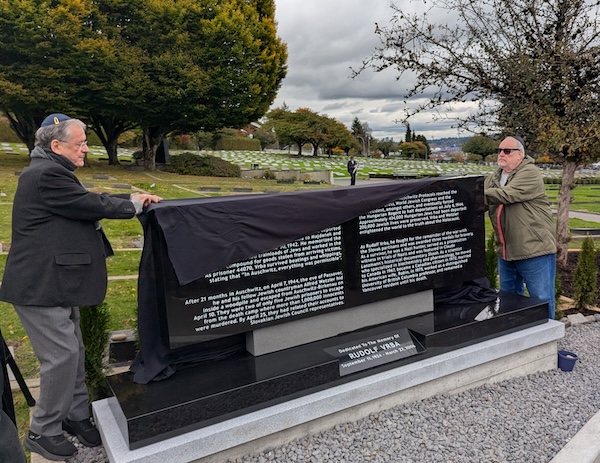
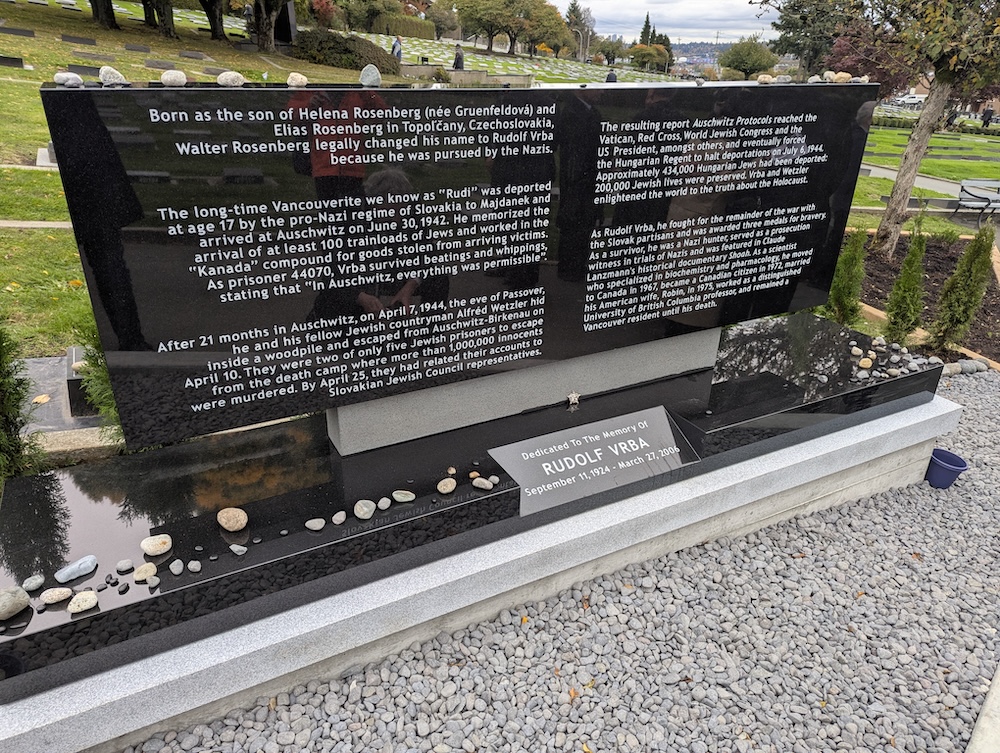
Coincidental to the release of this publication, a monument to Vrba’s memory is to be unveiled later this month at Schara Tzedeck Cemetery, righting what many locals see as an unjust historic oversight. 

While Vrba wrote his own memoirs, somewhat incredibly, Twigg’s book is the first real Vrba biography. 

“There’s never been an in-depth biography of Rudolf Vrba,” said Twigg, who deliberately did not replicate the contents of Vrba’s own 1963 book, written with Alan Bestic, titled I Cannot Forgive and re-released in the 1980s as Escape from Auschwitz. “I tried to concentrate on information that was not available anywhere.”

While this first volume is an eye-opener for those who know nothing of Vrba, it contains bombshells and fascinating depth even for those who have read Vrba’s book or who otherwise know something about his story. And Twigg promises more to come in the next volume.

“The really revealing material is going to be in Volume Two,” Twigg told the Independent. “That volume will be almost entirely original material and it will show the evolution of Rudi’s character.”

Those who know of Vrba are aware of his daring escape. But that was, in many ways, the beginning of his historic story. He joined the Partisans and was a decorated war hero. He was an extraordinary intellectual, a difficult personality, had a dark humour many people didn’t understand, and carried anger throughout his life.

“I think it’s so important if you’re writing a biography to get across his character, not just the events of his life,” said Twigg. The participation of Vrba’s widow, Robin, was invaluable and the book includes extended transcriptions of Twigg’s engaging conversations with her.

Rudolf Vrba was originally a false name that came on the forged papers given to Walter Rosenberg soon after he filed his report and then joined the Czechoslovakian resistance after his escape from Auschwitz.

Born in Slovakia, Rosenberg/Vrba was transported to Auschwitz in June 1942. He steadfastly viewed the plunder of Jewish assets – not antisemitism as its own accelerant – as the motive for the Holocaust.

Vrba is said to have had a near-photographic memory, which allowed him to store away data that would change the course of history. It is believed that he greeted almost every train arriving at Auschwitz for 10 months, mentally noting estimated numbers and places of origin.

Eventually, he gained the coveted job of registrar of Birkenau’s quarantine camp, allowing him unusual access to additional information and limited freedom of movement. He learned that plans were afoot to liquidate the last remaining large population of European Jews – the 800,000 in Hungary – whose destruction would be streamlined by the construction of a new rail line to expedite transportation to the crematoria.

Vrba connected with Alfréd Wetzler, another Slovakian Jew who was registrar of the morgue.

On April 7, 1944, Vrba and Wetzler hid in a woodpile, still on the Birkenau site but outside the barbed wire prisoner encampment. Gasoline-soaked tobacco threw search dogs off their scent. They hid there for three days and nights as search parties worked 24/7 to find the escapees. After the intensive search was called off, they made their move.

The pair made an 11-day trek by foot through Poland to the border with Slovakia, where they connected with the Jewish community. 

“Their feet were bloodied and misshapen,” Twigg reports. “A doctor was summoned. The malnourished pair recovered and soon cooperated with Jewish Council officials to produce an anonymous report that would be so detailed and emotionless that it could not not be believed.”

The Vrba-Wetzler Report, as it became known, was the first to have any significant reverberations, apparently because of the mathematical tallies and objective, scientific-like writing. 

With the report, pressure came down on Admiral Miklós Horthy, the Hungarian leader viewed by most as a Nazi collaborationist, to halt the deportations of Hungarian Jews to Auschwitz. By 1944, the tide had begun to turn against the Nazis and so it was not moral considerations, Twigg suggests, that turned Horthy against the deportations, but the fear of war crimes charges after the war. Regardless of Horthy’s motivations, it was this impact of the Vrba-Wetzler Report that is believed to have saved at least 100,000 and as many as 200,000 lives.

The deportations did not end permanently, though. And here Vrba’s history is inescapably tied up with that of another Rudolf – Rudolf (Rezső) Kasztner, one of the most polarizing figures in Holocaust history.

“A controversy persists to this day as to the extent prominent Jewish and Zionist leaders should be held accountable for a myriad of failures to adequately inform Jews about the lethal dangers of boarding the trains,” Twigg writes. “For the rest of his days, Vrba would chiefly lay the blame for the failure to adequately inform approximately 800,000 Jews in Hungary about the Holocaust on Kasztner, the Zionist leader from northern Transylvania.”

Kasztner was the first non-Slovakian official to see the Vrba-Wetzler Report and a harsh dispute rages still around what happened next.

In meetings among the leadership of Hungarian Jewry, it was apparently Kasztner who pressed for an approach in which, rather than alerting the Jewish population, the leadership would keep the information to themselves and negotiate directly with Adolf Eichmann for favourable terms that made it possible for Kasztner and other senior Jewish figures to save themselves and a number of others.

Kasztner (and those sympathetic to his narrative) would have seen some logic in the fact that the Nazi war effort was foundering and the Germans desperately needed goods and money, something Kasztner and his associates believed they could access through Jewish channels internationally. With the Soviets approaching from the east, they may have thought they could buy time and save more than their limited numbers.

Eventually, Kasztner negotiated with Eichmann that a trainload of about 1,684 Jews, many or most of Kasztner’s own choosing, would set off for Switzerland. It is estimated that the passage for each passenger had been “bought” from Eichmann for about $1,000. 

The passengers did not go directly to Switzerland, though, but were rerouted to Bergen-Belsen. Unlike the other Hungarian Jews arriving at the concentration camps, however, these 1,600 or so were kept separate and eventually did make it to Switzerland, in two transports, later in the year.

In the meantime, 400,000 Hungarian Jews were sent to Auschwitz, where almost all of them were murdered. 

The title of Vrba’s book, I Cannot Forgive, is assumed to refer to the Nazis. Twigg, among others, believes it is simultaneously a reference to Kasztner and his coterie of Jewish leaders.

Vrba was openly critical of the Jewish leadership, particularly those in Hungary and especially Kasztner, who by this time had risen to a moderately senior post in the Israeli government, along with other Hungarian Jewish leaders who were senior or mid-level figures in the governing party, Mapai. To some extent, put simply, the Hungarian Jews who had negotiated with Eichmann and who Vrba blamed for preventing his report from saving exponentially more Jewish lives, became integrated into the nascent elite of the new Jewish state. It was decidedly not in their interests to have the provocative professor, now halfway around the world in Vancouver, obtain any wider audience for his book.

Ruth Linn, an Israeli scholar of moral psychology and Holocaust memory at the University of Haifa, has Vancouver connections and stumbled onto Vrba’s story a couple of decades ago. She could not understand why his name was almost completely unknown in Israel. She spearheaded the first publication of the Vrba-Wetzler Report in Hebrew, in 1998, and, in 2004, wrote Escaping Auschwitz: A Culture of Forgetting, which examined why Vrba’s account had been marginalized in Israel and how politics and memory shaped Holocaust historiography.

Capturing the dichotomy of the debate around Kasztner’s role in the Hungarian Holocaust, Twigg juxtaposes two quotes. An Israeli judge, Benjamin Halevi, said of Kasztner, “He didn’t sell his soul to the devil; he was the devil.” Canadian author and publisher Anna Porter, who has written about the subject, said, “If you’re in hell, who do you negotiate with but the devil?”

A 1955 libel trial instigated by Kasztner proved his undoing. Ostensibly a case against Malkiel Gruenwald, who publicized the wartime actions of Kasztner, the trial turned into an examination of the facts of the case. Halevi, the judge who deemed Kasztner the devil himself, ruled that, by saving a chosen few, Kasztner had sacrificed the majority of Hungarian Jews. More than two years later, Israel’s Supreme Court overturned the judgment, but Kasztner did not live to see his legal redemption. He was assassinated outside his home in March 1957.

Twigg came to the Vrba story more by happenstance than design. Twigg edited BC Bookworld, a newspaper about books and authors, for more than three decades. 

“I used to keep track of all the books of British Columbia and I had categories,” he said. He could cross-reference, for example, all books on Japanese-Canadians or forestry. 

Based on this knowledge, in 2022, Twigg wrote Out of Hiding: Holocaust Literature of British Columbia. (See jewishindependent.ca/a-roadmap-to-remembering.) Its largest, though still necessarily brief, section is on Vrba. However, this was inadequate for Twigg, who decided to expand the project – first as a comprehensive website (rudolfvrba.com) – now as this book.

Not directly related to Holocaust Hero but timely, if profoundly overdue, an ad hoc group of friends and admirers of Vrba will erect the world’s only monument to him on Sunday, Oct. 26, beginning with a ceremony in the chapel at Schara Tzedeck Cemetery at 2 p.m. The program will feature reflections on Vrba’s life, legacy and enduring impact from Dr. Robert Krell, Dr. Joseph Ragaz and Prof. Chris Friedrichs, and will conclude with the dedication of the memorial monument. 

Format ImagePosted on October 10, 2025October 8, 2025Author Pat JohnsonCategories BooksTags Alan Twigg, history, Holocaust, Rudolf Vrba, Vrba-Wetzler Report
From the archives … social life

From the archives … social life

Oct. 10, 1935: This week, 90 years ago, community members were coming and going from the city. There was a Folk Song and Dance Festival and Arts and Crafts Exhibition coming up. Beth Israel, Young Judaea, AZA, BB Junior Auxiliary, Junior Council and Sub-Junior Council all had meetings and other events. China Seas and Page Miss Glory were screening at the Capitol Orpheum and Heart’s Desire was playing at the Strand.

The Jewish Western Bulletin / Jewish Independent has always covered the arts and culture scene. Amid the harder-hitting news, there have been society and social notes columns, social and club news sections, synagogue calendars, event listings, notices and advertisements, as well as articles promoting, reviewing or otherwise profiling various creatives (including community organizers) or their creations/events.

One of the longest-lasting social columns is Between Ourselves (Tsvishn Unz Alein) by Lazar, which started on April 14, 1949, when the JWB was run by the Vancouver Jewish Administrative Organization (akin to our Jewish Federation of Greater Vancouver) and Abraham Arnold was managing editor. When Sam and Mona Kaplan took over the paper in 1960, Mona Kaplan penned her first Between Ourselves (Tsvishn Unz Alein) by Lazar columns, in the Aug. 5 issue of that year, and she continued to be “Lazar” until the paper again sort of changed hands in mid-1995. While the Kaplans still owned the JWB, it came under new management, as they were beginning their retirement journey. At first, the new publisher, Andrew Buerger, kept the Lazar column – minus its Yiddish flavour – but editor Ariela Friedmann bid “Farewell to Lazar” (then written by Cara Loebl) a couple of months’ later, on Aug. 18, 1995.

Its replacement was Menschenings, which, Friedmann noted, would “give voice to all ages and aspects of the community, from social news, to what’s new, who’s new, some schmoozing, a bit of this and that.” 

Initially, the column was alternately written by two different writers, Jacqui Roitman and Alex Kliner, both of whom had experience in theatre and film. As many readers will know, Alex became the sole face of Menschenings, continuing through the Kaplans’ sale of the paper in mid-1999 to Kyle Berger, Pat Johnson and me. From his first column to his last, in 2016, when he retired, Alex’s writing was infused with Yiddish, having a heimishe (homey and familiar) quality like Lazar’s, meaning that Between Ourselves/Menschenings lasted some 67 years. 

image - Between Ourselves/Menschenings history in newspaper clippings

Format ImagePosted on October 10, 2025October 8, 2025Author Cynthia RamsayCategories From the JITags Abraham Arnold, Alex Kliner, Cara Loebl, history, Jacqui Roitman, Lazar, lifestyle, Mona Kaplan
Impacts of oppression

Impacts of oppression

Franz was shot in Prague, including near Franz Kafka’s birthplace. (still from film)

Troubled father-son relationships, both literally and metaphorically, are themes of Franz and Orphan, the former a biopic with some quirks and the latter a more old-school period piece. The two movies are part of this year’s Vancouver International Film Festival, which runs Oct. 2-12.

Director Agnieszka Holland’s Franz is an imaginative film that flits between the “present,” Franz Kafka’s adult years, until his death, at age 40, in 1924, and some formative childhood moments (mostly highlighting his domineering and dismissive father), while also jumping into the future, where tour guides at various institutions and parks tell modern-day tourists all about the influential writer. 

In one of these future moments, we learn that the ratio of words written by Kafka and those written by others about him is approximately one to 10 million. Some of these millions of words were written by Kafka’s friend and literary executor, novelist Max Brod, who rescued much of Kafka’s work. Brod’s Franz Kafka: A Biography is apparently a primary source of what we know about Kafka’s life, and he is featured in Holland’s film.

While Idan Weiss, who plays the tortured writer (and insurance lawyer) has gotten kudos from other reviewers for his performance, Peter Kurth, who plays Hermann Kafka, Franz’s father, stands out even more. Kurth plays stubborn and unlikeable well, but also shows Hermann’s vulnerability and how he uses meanness to cover it up.

Franz Kafka was born in Prague, in 1883, and he is witness to world-changing events, including the First World War and the subsequent collapse of the Austro-Hungarian Empire. Kafka was drafted, but his employers successfully argued that he was an indispensable worker – according to the movie, they did so at Hermann’s behest. The creation of Czechoslovakia and several other independent states after the war is not an explicit aspect of Franz, but the oppressiveness of the empire (the fatherland, in the metaphor) comes out in Kafka’s depictions of bureaucracy, alienation, anxiety, etc. While Franz doesn’t add any new knowledge to what’s known about Kafka, his upbringing (harsh on many levels), writing (most of it published after his death), love life (engaged for a period, then involved with a married woman), religion (not an observant or believing Jew) and illness (tuberculosis), but it might bring a new generation to his ideas, which remain important.

As Holland told Variety: “the dehumanization of society, the despisal of [certain groups of people] and alienation are once again becoming the main communicative tools,” but, not wanting to “give an interpretation like that,” she said, “Kafka has been interpreted in so many ways, as is shown in the film, but when you compare what he wrote with what was written about him they are poles apart. So, we didn’t want to reinterpret Kafka; we wanted to make him alive.”

And Franz is a success in those terms. It is entertaining and thought-provoking, though sometimes the thoughts are about odd creative choices. There is a lot of male nudity and it’s not always clear why. For example, in one scene at a sanitorium, naked men, some wearing animal head masks, engage in a game of tug-o-war.

László Nemes’s Orphan, which takes place in Hungary, is a more linear and literal form of storytelling, also focusing on a time of upheaval and oppression. While most of the film takes place in 1957 – a year after the Soviet Union crushed the people’s revolt against the country’s communist government – the young Jewish protagonist, Andor (played by a brooding Bojtorján Barábas), was put into an orphanage during the Second World War. We witness his mother and a reluctant Andor reunited after the Holocaust. Her “saviour” was a non-Jew, Berend (played by Grégory Gadebois with nuance), who Andor absolutely hates. 

photo - Bojtorján Barábas and Grégory Gadebois in Orphan
Bojtorján Barábas and Grégory Gadebois in Orphan. (photo © Mostra internazionale d’arte cinematografica­)

Andor cannot forgive his mother for giving up on the possibility of his father’s survival, even years after the war, and, when Berend claims that Andor is actually his biological son (and Andor’s mother never clarifies), Andor’s anger is barely containable and the tension mounts to a climatic Ferris wheel ride. While Berend is an abusive brute, he also seems to genuinely want Andor’s filial affection. Andor and Berend not only represent son and (possible) father, but Hungary’s desire for freedom from its Soviet oppression. 

Orphan is slow-paced, capturing the heaviness of the period, the incapacitating fear and oppression of 1957 Hungary. Twelve-year-old Andor doesn’t go to school, roams the streets, amuses himself at home, seems bored silly at times, and has nowhere positive to channel his frustrations and his feelings of abandonment.

While Franz and Orphan are two very different movies, they cover overlapping themes that are sadly all too relevant. Franz screens Oct. 7 and 11, and Orphan plays Oct. 2 and 4.

For tickets to either film and the entire festival line-up, go to viff.org. 

Format ImagePosted on September 26, 2025September 24, 2025Author Cynthia RamsayCategories TV & FilmTags Agnieszka Holland, Franz, history, László Nemes, movies, Orphan, Vancouver International Film Festival, VIFF

Posts pagination

Previous page Page 1 … Page 3 Page 4 Page 5 … Page 57 Next page
Proudly powered by WordPress