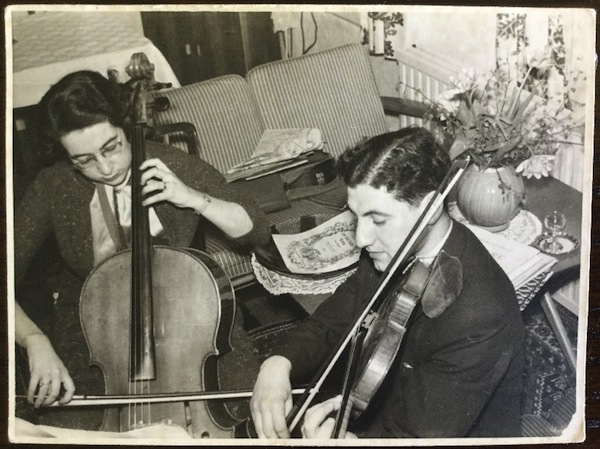
Susi and Mænni Ruben, Copenhagen, 1960s. Mænni Ruben’s autograph book, compiled in Theresienstadt, is the focus of a new online exhibit launched by the Victoria Shoah Project. (photo from Victoria Shoah Project)
The Victoria Shoah Project has launched a virtual exhibit of an autograph book compiled by Mænni Ruben, a Danish violinist and graphic artist held prisoner at Terezin (Theresienstadt) concentration camp outside of Prague.
The 1945 Theresienstadt Autograph Book Exhibit features panels and the 40-page book itself, which is replete with signatures, sketches and aphorisms from Ruben’s friends and acquaintances who were also incarcerated at Terezin.
The book records the closing period of the war as survivors were being liberated. It is a story not only of the horrors of Nazism, but of long-lasting friends, and the music and art that united them during dreadful times.
Ruben died in 1976 in Copenhagen. Though he never lived in or visited Canada, the book remained with his widow, Susi, who remarried after his death and settled in Victoria. Upon her passing, in 2018, the book came into the hands of Rabbi Harry Brechner of Victoria’s Congregation Emanu-El. He subsequently showed it to member Janna Ginsberg Bleviss, who became the coordinator of the exhibit project.
“When the rabbi showed the book to me last year, I could see right away that it was special and should go to a museum. It is in remarkable condition for being 75 years old and is a tremendous addition to Holocaust studies,” Ginsberg Bleviss said.
“I was fascinated by the book – who were these people and what happened to them? Reading the pages filled with optimistic greetings, illustrations and pieces of music was like finding a hidden treasure, waiting to be opened. I wanted to discover who these people were and hear their stories,” she added.
“This virtual launch [which took place Aug. 20] is meant to honour both Mænni and Susi, and the memory of those whose lives intersected in space and time in the Theresienstadt camp. None of the artists, musicians, composers or rabbis who wrote in the book are alive, but we can sense their lives through their traces here,” said Dr. Richard Kool, a member of the Victoria Shoah Project.
A number of panels show the powerful drawings of artist Hilda Zadikow, whose husband, sculptor Arnold Zadikow, died at Theresienstadt. One depicts the coat of arms of Terezin under a Magen David made of barbed wire. Another features three sad, grey sketches of the camp itself. In a third, there is a happier scene of colourful opera figures.
Her inscription in the autograph book reads, “Your old friend Hilda Zadikow wishes you all the best and delight in beauty.”
A poignant message comes from Rabbi Leo Baeck, an intellectual and leader of the German Jewish community and the international Reform movement, who wrote: “What you forget and what you don’t forget, that is what decides the course of your life will take.”
Pianist Alice Sommer Herz, the subject of the 2007 book A Garden of Eden in Hell and the 2013 Oscar-winning documentary The Lady in Number 6, was another prisoner at the camp. Sommer Herz, who died at age 110 in 2014, wrote in Ruben’s book: “In memory of music at Theresienstadt and in strong hopes of a better future.”
And a touching note comes from Miriam Pardies, someone Ruben seems to have known only in passing: “We know each other only from having greeted each other in a friendly way, but that too is a good memory,” she writes in the book.
“There is a huge educational value to these pieces for students learning about the Holocaust, or for researchers who want to continue exploring the stories of these most interesting people during an important time at the end of the Second World War,” remarked Brechner.
Ruben and his family were sent to Theresienstadt in 1943. A place where the Nazis kept prominent Jews, the camp housed musicians, intellectuals, artists, religious leaders and hundreds of children. In 1944, the inmates performed a concert for German visitors and the visiting International Red Cross – the performers were forced to act as though life at the camp was normal.
Losing his father at the camp, Ruben returned home after the war. A few years later, he met his wife. They married and both played in the Copenhagen Youth Orchestra – she on cello and he on violin. Mænni Ruben also worked as a graphic designer and Susi Ruben as a fashion designer; they were together for 24 years.
After her husband died, Susi Ruben’s company sent her to Israel, where she met Dr. Avi Deston. They married in 1978 and went to South Africa for 13 years, where Deston taught physics at the University of Transkei. On his retirement, they came to Victoria, in 1992.
The autograph book will be donated to the Canadian Museum for Human Rights in Winnipeg for their Holocaust gallery. To view the virtual exhibit, go to terezinautographbook1945.ca.
Sam Margolishas written for the Globe and Mail, the National Post, UPI and MSNBC.
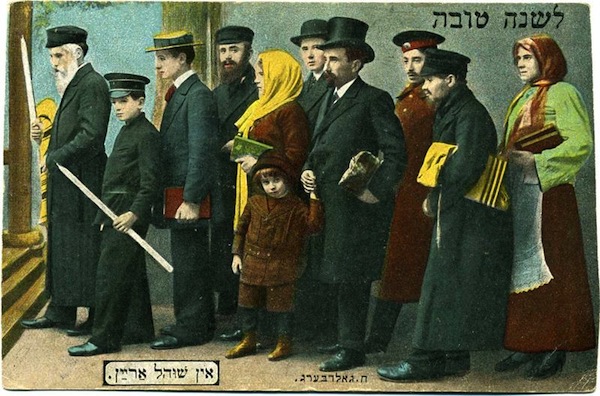
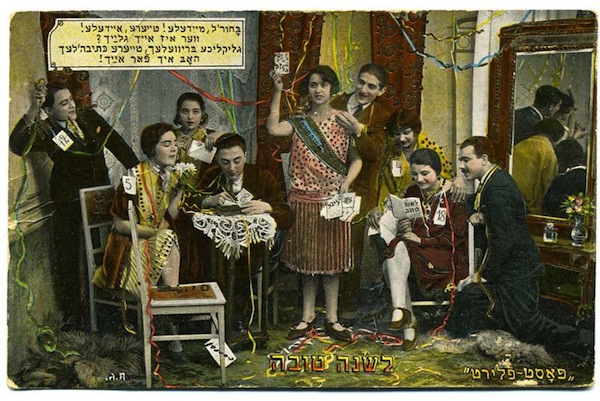
Rosh Hashanah greeting cards (above and below) from the author’s family’s collection. The cards are almost 100 years old. The translation of the one in which people are walking is “Into the synagogue.” It is signed by Chaim Goldberg, a well-known artist who also illustrated many children’s books. The party postcard, also done by Goldberg, is a printed rhyme, which translates as, “Boy, girl! Dear, refined! Who is like you? Happy letters, dear writings, I have for you!”
The Jewish calendar is an amazing conceptualization of time that has evolved (what else?) over time.
In his blog on the Museum of the Jewish People at Beit Hatfutsot website, Ushi Derman relates that, originally, the Jewish calendar was a solar calendar. But it was not just a solar calendar, it was a holy solar calendar, delivered by angels to Enoch. (See the Book of Enoch, the section dealing with astronomy, called “The Book of Heavenly Luminaries.”) Temple priests had to follow a rigorous schedule – time itself was judged to be sacred. Thus, the Temple in Jerusalem was regarded as both the house of G-d and the dwelling of time.
With the destruction of Jerusalem’s Second Temple, the priests lost their power. They were no longer the mediators between G-d and the people. Authority switched to the scholars (our sages) of the Mishnah (edited record of the Oral Torah), Talmud and Tosefta (similar to the Mishnah, but providing more details about the reasons for or application of the laws).
In a bold move, the scholars declared that G-d had handed religious authority to humans. “Each month, envoys were sent to watch the new moon and to determine the beginning of the month. Thus, the ownership of time was expropriated from G-d and delivered to man – and that is why the Hebrew calendar has survived for so many centuries,” writes Derman in the 2018 blog “Rosh Hashanah: The Politics and Theology Behind Jewish Time.”
Here is a lovely story from The Book of Legends, edited by Hayim Nahman Bialik and Yehoshua Hana Ravnitzky, illustrating the above change. A king had a clock. “When his son reached puberty, he said to him: My son, until now, the clock has been in my keeping. From now on, I turn it over to you. So, too, the Holy One used to hallow new moons and intercalate years. But, when Israel rose, He said to them, until now, the reckoning of new moons and of New Year’s Day has been in My keeping. From now on, they are turned over to you.”
Perhaps oddly, the Mishnah mentions more than one new year. In fact, it points out four such dates on the Jewish calendar:
The first of Nissan is the new year for kings and for festivals;
The first of Elul is the new year for tithing of animals (some say the first of Tishrei);
The first of Tishrei is the new year for years, sabbaticals and Jubilee, for planting and vegetables;
The first of Shevat is the new year for trees, according to the House of Shammai, while the House of Hillel (which we adhere to today) says the 15th of Shevat, or Tu b’Shevat.
With its thrice daily prayers, the synagogue came to replace the Temple. Excluding Yom Kippur, synagogue attendance is higher on Rosh Hashanah than any other time of year. Rosh Hashanah prayers are compiled in a special prayer book, or Machzor.
Amid COVID-19, the following words about Rosh Hashanah have heightened meaning: “The celebration of the New Year involves a mixture of emotions. On the one hand, there is a sense of gratitude at having lived to this time. On the other hand, the beginning of a new year raises anxiety. What will my fate be this year? Will I live out the year? Will I be healthy? Will I spend my time wisely, or will it be filled in a way that does not truly bring happiness?” (See the Rabbinical Assembly’s Machzor Lev Shalem for Rosh Hashanah and Yom Kippur, published almost a decade ago.)
Sounding the shofar is one of the special additions to Rosh Hashanah services. According to Norman Bloom – in a 1978 article on Rosh Hashanah prayers in Tradition: A Journal of Orthodox Jewish Thought – the timing of the shofar blowing weighed in the physical safety and comfort of the congregation. Hard as it may be to comprehend today, scholars considered potential attacks from both local enemies of the Jews and from Satan himself. They also considered the comfort of the infirm, who might not be able to stay through a long service.
Rosh Hashanah has other curious customs. For example, there is a tradition of having either a fish head or, among some Sephardim, a lamb’s head as part of the Rosh Hashanah meal. This is meant to symbolize that, in the year to come, we should be at the rosh or head (on top), rather than at the tail (at the bottom). Vegetarians and vegans substitute a head of lettuce.
Both Sephardi and Ashkenazi Jews have Rosh Hashanah seder traditions. The symbolic foods include beets, leeks, pomegranates, pumpkins and beans. As Rahel Musleah has pointed out, each food suggests a good wish for the coming year. Thus, before eating each one, people recite a special blessing. Humour is at play, too, as some of the blessings are puns on the food’s Hebrew or Aramaic name. (Read Musleah’s article “A Sephardic Rosh Hashanah Seder” at myjewishlearning.com/article/a-sephardic-rosh-hashanah-seder.) Of course, we cannot neglect to mention that the festive table also includes apples dipped in honey, for a sweet new year, and a round challah, symbolizing both the cycle of life and G-d’s kingship.
Another Rosh Hashanah custom is Tashlich. This ceremony involves going to a body of water to symbolically cast off one’s sins. Breadcrumbs are often used, as are leaves, but, seeing that COVID-19 will be a part of this year’s holiday, here is another suggestion. Originally, this activity was used with youth groups of the Reform movement – participants wrote out their sins and then the papers on which they were written were put through a paper shredder. A dramatic gesture, suited to our current need for social distancing.
My city, Jerusalem, is a land-bound city without a sea or lake in its immediate vicinity. So, what do residents of the capital do? Those who wish to practise Tashlich go to one of the following four sites. Two of the four places are near the Supreme Court: the Jerusalem Rose Garden and the Jerusalem Bird Observatory. Also in the same general area is the Botanic Garden in the Nayot neighbourhood and, in the Old City, one can go to the Shiloah Springs in City of David.
Wishing all readers a year of blessings and not of curses.
Deborah Rubin Fields is an Israel-based features writer. She is also the author of Take a Peek Inside: A Child’s Guide to Radiology Exams, published in English, Hebrew and Arabic.
* * *
Additional observations
• Hebrew has a number of expressions using the word rosh. Here are just a handful of examples: rosh hamemshala (prime minister); rosh kroov, literally cabbage head, or a negative reference to someone who is not very bright; rosh katan, someone who is small-minded; l’kabel barosh, to be defeated; and rosh tov, or good vibes.
• Anyone interested in learning more about the solar calendar should read Prof. Rachel Elior’s article, “Enoch Son of Jared and the Solar Calendar of the Priesthood in Qumran,” which can be found in a Google search.
Although beekeeping as an occupation is not mentioned in the Bible, bees are mentioned four times, honeycombs are referred to eight times and honey is referred to 26 times. Archeologists actually have discovered proof that there was beekeeping and honey 3,000 years ago in a site in northern Israel.
Among Ashkenazim, sweet desserts for Rosh Hashanah are customary, particularly lekach, or honey cake, and teiglach, a hard, doughy, honey and nut cookie. Some say the origin of the sweets comes from a passage in the book of Hosea mentioning “love cakes of raisins.” There is also a passage in II Samuel, which talks about the multitude of Israel, “to everyone a cake of bread and a cake made in a pan and a sweet cake.”
It was Ezra, the fifth-century BCE religious leader who was commissioned by the Persian king to direct Jewish affairs in Judea, and Nehemiah, a political leader and cup bearer of the king in the fifth century BCE, who told the returning exiles to eat and drink sweet things.
Honey cakes traditionally include honey, spices, coffee and brown sugar as major ingredients, but some contain cognac, brandy, orange or lemon peel and nuts. In Curaçao, for example, cinnamon, ginger, nutmeg, raisins, nuts or currants, lemon or orange peel is added. In Zimbabwe, Jews include allspice, cinnamon, cloves, raisins, chopped nuts, brandy and chopped candied fruit in their honey cake.
In That Hungarian’s in My Kitchen, Linda Radke includes a Hungarian recipe from her family, which includes the basic ingredients and orange juice. A cookbook of Russian recipes includes a Ukrainian honey cake, medivik, with the basic ingredients as well as cardamom, orange peel, raisins, walnuts and apricots.
In The Jewish Book of Food, Claudia Roden writes that honey cake was a favourite in Germany as far back as the Middle Ages, and that lebkuchen, honey gingerbread, was also mentioned as early as the 12th century.
According to John Cooper in Eat and Be Satisfied: A Social History of Jewish Food, references to honey cake were made in the 12th century by a French sage, Simcha of Vitry, author of the Machzor Vitry, and by German rabbi Eleazar Judah ben Kalonymos. Cooper writes that, on the new moon in the month of Nissan, boys at Jewish school were given honig lekach, honey cake: “Originally, the names of angels were inscribed on the honey cake and amulets were attached to them, but later this practice was discarded.” According to Cooper, the words lebkuchen and lekach probably came to be related to the German word for lick, lecke.
By the 16th century, lekach was known as a Rosh Hashanah sweet. It also became popular for other lifecycle celebrations, such as betrothals and weddings. Malvina W. Liebman writes in Jewish Cooking from Boston to Baghdad that Crypto-Jews in 16th-century Latin America ate honey cake at weddings, in memory of the honeycomb that an angel gave to Asenath when she married Joseph.
In The Complete International Jewish Cookbook, Evelyn Rose (z”l), a maven of Jewish cooking from England, wrote that the first cakes made with artificial raising agents were honey cake, and honey was the chosen sweetener because sugar was not widely available until the end of the 19th century. As an aside, she also recommends keeping a honey cake in a closed container for a week before serving it, so it will “mature.”
Among the Chassidim, it was customary for the rebbe to distribute lekach to his followers, and others would request a piece of honey cake from one another on Erev Yom Kippur. This transaction symbolized a substitute for any charity the person might choose to receive.
Gil Marks (z”l), in The World of Jewish Desserts, says fluuden, a layered yeast cake, was traditional for Rosh Hashanah among Franco-German Jews. Made with a cheese filling, it could be eaten after a meat meal, since they only waited one hour between meat and dairy. Strudel, from the German word for whirlpool, was also common for Rosh Hashanah among European Jews.
The most traditional cookie for Rosh Hashanah is teiglach, the dough pieces dropped into a hot honey syrup and simmered until brown then left to cool. It has been suggested that this Eastern European sweet was probably invented by some housewife who had dough left over and dropped the pieces into a boiling honey syrup.
Many Jews of Sephardi background make tishpishti for Rosh Hashanah. This cake with walnuts, almonds, hazelnuts or pecans, has a hot syrup poured over it. The syrup can be made with sugar, water and liqueur, according to Rabbi Robert Sternberg in The Sephardic Kitchen. Sternberg also points to rodanchas as a popular Sephardi Rosh Hashanah sweet. These spiral-shaped pastries of phyllo dough contain a pumpkin or squash filling because these vegetables and their shape symbolize the cycle of life and the ascent of the soul into heaven.
Here are some honey cakes to try this year.
TISHPISHTI Jews who lived in Turkey after being expelled from Spain in 1492 adopted this dish, whose name means “quick and done.” Some say it was always served on Rosh Hashanah, but it was also popular for Passover because it has no flour.
2 cups ground almonds, hazelnuts, pistachios or walnuts 1 cup cake meal 1 tsp ground cinnamon 1/2 tsp ground cloves or allspice 6 separated eggs 1 cup sugar 2 tbsp orange juice 1/2 cup vegetable oil 1 tbsp grated lemon or orange peel * * * 3/4 cup honey 1/2 cup sugar 2/3 cup water 1/4 cup lemon juice
Preheat oven to 350°F. Grease a rectangular baking pan.
In a mixing bowl, combine nuts, cake meal, cinnamon and cloves or allspice.
In another bowl, beat egg yolks with sugar. Add to nut mixture along with orange juice, oil and lemon or orange peel.
Beat egg whites in another bowl until stiff. Fold into batter. Pour into cake pan and bake 45 minutes.
Place honey, sugar, water and lemon juice in a saucepan. Stir until sugar dissolves. Increase heat, bring to a boil and cook for one minute. Let cool.
Cut cake into squares or diamonds. Drizzle syrup over cake. Serve warm or at room temperature.
MOM’S HONEY LOAF CAKE I don’t recall my mom baking this, but it was in my collection of recipes as being hers.
3 1/2 cups flour 1/4 tsp salt 1 1/2 tsp baking powder 1 tsp baking soda 1/2 tsp ground cinnamon 1/8 tsp ground cloves 1/2 tsp ground ginger 1/4 tsp ground nutmeg 4 eggs 3/4 cup sugar 1/4 cup vegetable oil * * * 2 cups honey 1/2 cup strong coffee 1/2 cup raisins 1/2 cup chopped nuts
Preheat oven to 325°F. Grease two loaf pans or a rectangular baking pan.
Combine in a bowl flour, salt, baking powder, baking soda, cinnamon, cloves, ginger and nutmeg.
Beat eggs and sugar in another bowl until fluffy. Add oil, honey and coffee.
Stir in flour mixture. Add raisins and nuts. Pour into pans. Bake for 1.5 hours.
Sybil Kaplanis a journalist, lecturer, book reviewer and food writer in Jerusalem. She created and leads the weekly English-language Shuk Walks in Machane Yehuda, she has compiled and edited nine kosher cookbooks, and is the author of Witness to History: Ten Years as a Woman Journalist in Israel.
An aerial photo of the remains of a 3,200-year-old Canaanite fortress built near today’s town of Kiryat Gat. (photo by Emil Aladjem/IAA via Ashernet)
The Kiryat Gat fortress site, which was opened to visitors this week, was prepared by the Israel Antiquities Authority (IAA) and Jewish National Fund (KKL).
According to archeologists Saar Ganor and Itamar Weissbein of the IAA, “The fortress we found provides a glimpse into the geopolitical reality described in the Book of Judges, in which the Canaanites, Israelites and Philistines are fighting each other. In this period, the land of Canaan was ruled by the Egyptians and its inhabitants were under their control. During the 12th century BCE, two new players entered the game: the Israelites and the Philistines. This led to a series of violent territorial disputes. The Israelites settled in non-fortified settlements at the Benjamin and Judean mountains. Meanwhile, the Philistines accumulated power in the Southern Coastal Plain and established cities such as Ashkelon, Ashdod and Gat in an attempt to conquer more areas. The Philistines confronted the Egyptians and the Canaanites on the borderline, which probably passed at the Guvrin River, between the Philistine kingdom of Gat and the Canaanite kingdom of Lachish. It seems that the Galon fortress was built as a Canaanite/Egyptian attempt to cope with the new geopolitical situation. However, in the middle of the 12th century BCE, the Egyptians left the land of Canaan and returned to Egypt. Their departure led to the destruction of the now-unprotected Canaanite cities – a destruction that was probably led by the Philistines.”
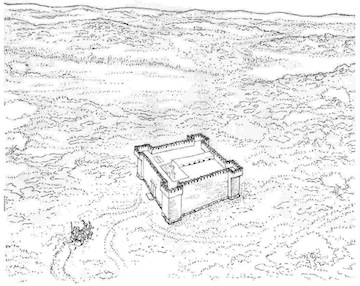
A drawing of what the fortress probably looked like. (drawing by Itamar Viskin/IAA via Ashernet)
The dimension of the fortress is 18 metres square and watchtowers were built in the four corners. A threshold, carved from one rock weighing around three tons, was preserved at the entrance of the building. Inside the fortress was a courtyard paved with stone slabs and featuring columns in the middle. Rooms were constructed on both sides of the courtyard. Hundreds of pottery vessels, some still whole, were found in the rooms.
The remains of the fortress were uncovered with the help of students from the Israel studies department at Be’er Sheva’s Multidisciplinary School, students from the Nachshon pre-military preparatory program and other volunteers. This was done as part of the IAA’s policy to bring the general public, and especially the younger generation, closer to archeology.
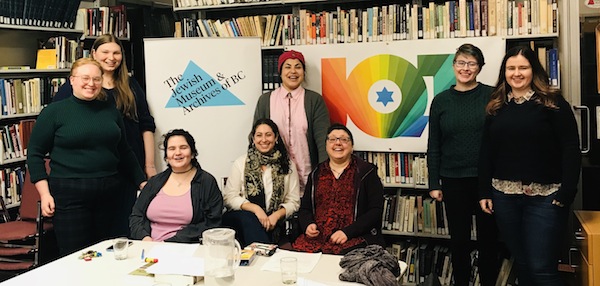
Embarking on a new archival project: left to right, Ye’ela Eilon-Heiber, Lily Hoenig, Mickey Morgan, Madison Slobin, Carmel Tanaka, Holly Steele, Avi Grundner and Alysa Routtenberg. (photo from JQT and JMABC)
The Jewish Museum and Archives of British Columbia (JMABC) and JQT Vancouver are seeking to document the history of local LGBTQ+ Jews through a joint initiative called On the Record: The BC Jewish Queer and Trans Oral History Project.
While the JMABC has an extensive – closing in on 1,000 – and diverse collection of oral histories, the experiences and stories of LGBTQ+ Jewish community members are not prominently featured. This is something the museum would like to change.
“We do a lot of oral histories and we typically target people in their 70s and 80s, for a number of reasons,” explained JMABC archivist Alysa Routtenberg of the process. “Generally, it’s a good age because people begin to feel reflective. They may have grandchildren with whom they would like to share their stories, they have wound their professional lives down and they are not yet suffering from memory or health issues.”
In addition, she said, given that a whole life history requires a significant story to tell, the interviews tend to feature older people.
And this might be one of the reasons why many of the oral histories of LGBTQ+ Jews have not yet been shared, according to Carmel Tanaka, JQT project coordinator.
“I have a friend who takes oral histories of LGBTQ seniors through UBC,” Tanaka told the Independent. “She says it’s hard to get people to stop talking about their lives once they get started. That is not the Jewish experience. We have a close-knit community and many older members fear being out in the Jewish community. They may be out in other aspects of their lives but not in the Jewish context, so many of them have remained silent.”
JQT (pronounced J-cutie) is a relatively new Jewish queer and trans group. Established in 2018, it aims to promote diversity and inclusion by “queering Jewish space and Jewifying queer space,” said Tanaka. The group approached the JMABC about the oral history project last year and interviewer training for the project was completed in January.
“We had six JQT members who trained as interviewers. They were ready to go and then COVID hit,” said Tanaka. “We had hoped to get 30 interviews done in three months. It’s been hard to get interviews done because the technology is difficult for some of our interviewees.”
Routtenberg agreed that people tend to prefer an in-person interview than one over the phone or via Zoom. “The interviews take between one and two hours,” she explained. “It’s a long time to be on the phone or in front of a computer.”
That said, a number of interviews have been completed, so the first phase of the project is underway, with the goal of 30 interviews conducted and transcribed. “Our objective is to reach a cross-section of LGBTQ Jews from across the province,” said Tanaka.
Both Routtenberg and Tanaka stressed that anonymity is provided for those who would prefer to keep their identities private.
The next phase of the project is to translate the interviews into a public program.
“What the interviews tell us will inform us as to the most appropriate form the material will take,” said Routtenberg. “Among our options are an online exhibition, a podcast, a physical exhibition…. There are so many possibilities. Hopefully, there will be many phases over many years.”
Routtenberg explained that the JMABC is always looking to build relationships with individuals and organizations both within and outside of the Jewish community. She said she was thrilled when Tanaka approached her to do this project together, and Jewish Family Services Vancouver is also helping, supporting the interview experience as needed.
Having the oral history of LGBTQ+ Jews as part of the JMABC records is helping accomplish the mission of JQT. “LGBTQ people have always been in our community,” said Tanaka. “This is an opportunity to make them feel included.”
For more information on how to participate in this project, or to nominate someone to be interviewed, contact Routtenberg at info@jewishmuseum.ca or 604-257-5199.
Michelle Dodekis a freelance writer living in Vancouver.
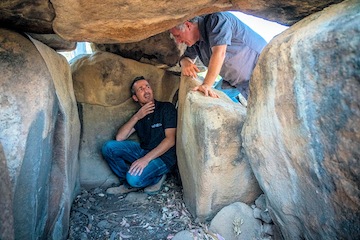
Uri Berger of the Israel Antiquities Authority, left, and Prof. Gonen Sharon of Tel Hai Academic College inside a dolmen where a wall engraving was unexpectedly discovered. (photo by Yaniv Berman/IAA via Ashernet)
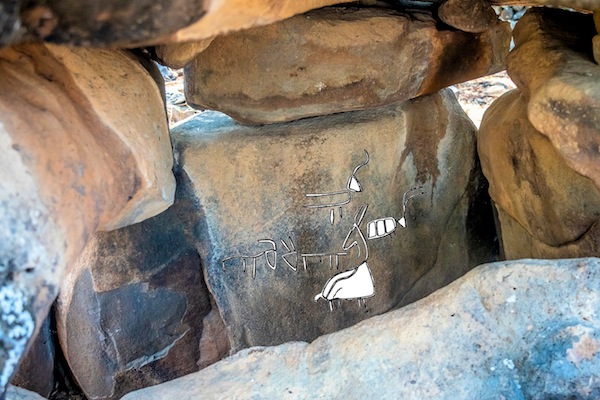
The interior of a dolmen (ancient burial chamber built of rocks) with symbols overlaid on the image for clarity. (photo by Yaniv Berman/IAA via Ashernet)
There are many such dolmens in the Galilee and the Golan, all of which date back more than 4,000 years. An inspector of the Israel Nature and Parks Authority has identified engravings of horned animals, leaves, fertilizers and wild cows in one dolmen; a human face in another; and a panel with geometric shapes in yet another.
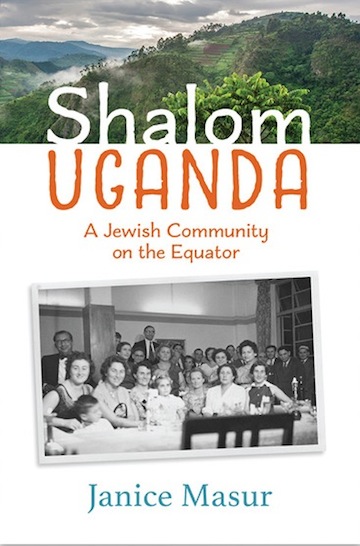
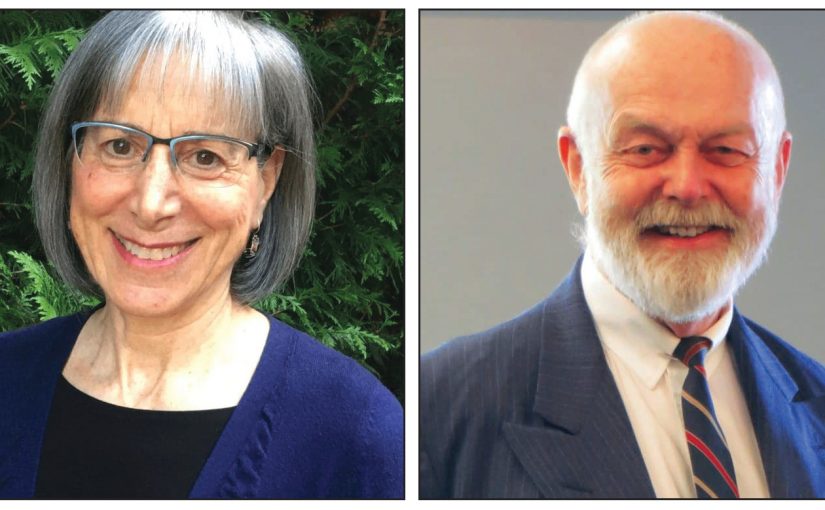
In her recently published book, Shalom Uganda: A Jewish Community on the Equator, Vancouverite Janice Masur writes about her life in Kampala, Uganda, where she moved as a child of 5 and stayed until the age of 17 in 1961, leaving just before Uganda achieved independence in 1962. The small Jewish community of Kampala has been all but forgotten, its history mostly undocumented and lost to time.
JI: How did the idea for this book come about, and when did you begin researching and writing it?
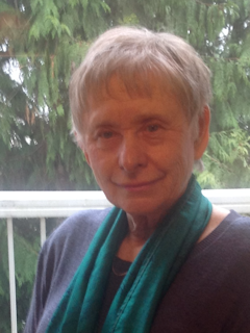
Janice Masur (photo courtesy)
JM: The idea originated in a modern East African history class I attended at Simon Fraser University. I began writing in 2005, traveling to interview octogenarians and nonagenarians, who [earlier in their lives] had arrived in Kampala. They included Holocaust survivors, individuals who might otherwise have gone to Kenya but could not afford to pay the required head tax, and those who arrived on work contracts of two to four years.
JI: Why was it important for you to try to capture the history of Jewish life in Kampala?
JM: I wanted to both document and honour my small Jewish community on the equator, an imploded star vanished in the diasporic galaxy. While many people are familiar with the Abayudayah who, in 1921, converted to Judaism in passive rebellion against British rule, my community is almost completely forgotten. There’s not even a cemetery to mark the existence of 23 secular families who, without a rabbi, Torah or synagogue managed to create a small, cohesive, but unreligious community. There is a great paucity of research literature on this topic and I have been told that, presently, Shalom Uganda is likely the only scholarship devoted to the Jewish community in Kampala.
JI: How did spending some of your formative years in Kampala leave a lasting imprint on your life?
JM: To this day I love mangos, and growing up in Kampala has made me feel comfortable in the company of all ethnic groups. This long-forgotten colonial world included boarding school attendance and, though much-hated, this education provided me with some excellent life lessons.
JI: Do you have any inclination to return to Uganda to visit or live?
JM: I have not had the courage to return yet, and think that perhaps memories are best left to glitter in the distance. I know that the town is much more densely populated and built up now than it was when I left, and that the red murram country roads are in ill repair.
JI: Who do you believe will benefit most from reading this book?
JM: My intent is to place this book in all major libraries worldwide. It seems that all who have read Shalom Uganda so far seem to have learnt a new fact, enjoyed the memoir or want to tell me how their life was or wasn’t similar to mine. So, I believe that the book will be well read among a Jewish following or among scholars thirsting for information about Jewish history and life in far-flung places last century. I hope others enjoy reading my writing effort. It is a relief to have the story out in the open.
Lauren Kramer, an award-winning writer and editor, lives in Richmond. To read her work online, visit laurenkramer.net.
Dr. Paige Axelrood and Ivan Sayers were among the 25 British Columbians honoured with a 2020 BC Achievement Community Award. (photos from BC Achievement Foundation)
On April 27, Premier John Horgan and Anne Giardini, chair of the BC Achievement Foundation, named this year’s recipients of the BC Achievement Community Award. Among those honoured were Jewish community members Dr. Paige Axelrood and Ivan Sayers. “These days more than ever, our communities are made stronger by British Columbians who go above and beyond,” said Horgan. “Thanks go to all of the BC Achievement 2020 Community Award recipients for helping build a better province for everyone.”
“It is an honour to celebrate the excellence and dedication of these 25 outstanding British Columbians,” added Giardini. “On behalf of all of us at the BC Achievement Foundation, I thank each of them for strengthening their communities and inspiring others to community action.”
As the founder of the Scientist in Residence Program, Axelrood developed and built an educational program to support teachers and help students discover their inner scientist. Elementary students across the Vancouver School District have experienced real science and discovered the natural world through the Scientist in Residence Program. Axelrood’s vision to partner teachers with scientists to facilitate hands-on, inquiry-based lessons has helped change the delivery of science education.
Sayers is the honorary curator of the BC Society for Museum of Original Costume and curator emeritus, Museum of Vancouver. Specializing in the study of women’s, men’s and children’s fashions from 1700 to the present, Sayers has produced historical fashion shows and museum exhibitions all over western North America. A lecturer and mentor, his fashion shows have supported countless nonprofits over the years.
The BC Achievement Foundation is an independent foundation established in 2003, whose mission is to honour excellence and inspire achievement. This year’s selection committee members were Mayor Lee Brain of Prince Rupert, Mayor Michelle Staples of Duncan, and past recipients Lolly Bennett, Aart Schuurman Hess and Andy Yu.
The recipients of the 2020 Community Award will be recognized in a formal presentation ceremony in Victoria, in the presence of Janet Austin, lieutenant governor of British Columbia. Each recipient receives a certificate and a medallion designed by BC artist Robert Davidson. For more information on the award and its recipients, past and present, visit bcachievement.com.
A human jawbone found in the Misliya Cave on Mount Carmel near Haifa. (photo by Israel Hershkowitz, Tel Aviv University via Ashernet)
A human jawbone and other fossils found in the Misliya Cave on Mount Carmel near Haifa indicate that human migration from Africa occurred during the Ice Age, approximately 200,000 years ago, which is contrary to the popular theory that the freezing conditions and dryness of the Ice Age periods deterred human migration between continents.
These recent findings were published in the Journal of Human Evolution by Dr. Lior Weissbrod of the Israel Antiquities Authority and Prof. Mina Weinstein-Evron of the Zinman Institute of Archeology at the University of Haifa, and they build on work previously published by Weinstein-Evron and Prof. Israel Hershkowitz of Tel Aviv University in Science.
In addition to the jawbone, Weissbrod said, “The fossils now being investigated were identified as belonging to 13 different species of rodents and small insect eaters, some of which now live in high and cold regions, in the Zagros Mountains of northwestern Iran and in the Caucasus Mountains.”
This means that, “in Israel, cold conditions prevailed that allowed such animals to survive. Finding the human jawbone in the same layer where the rodent lived, suggests that these early humans survived under these conditions,” changing existing perceptions on human evolution.
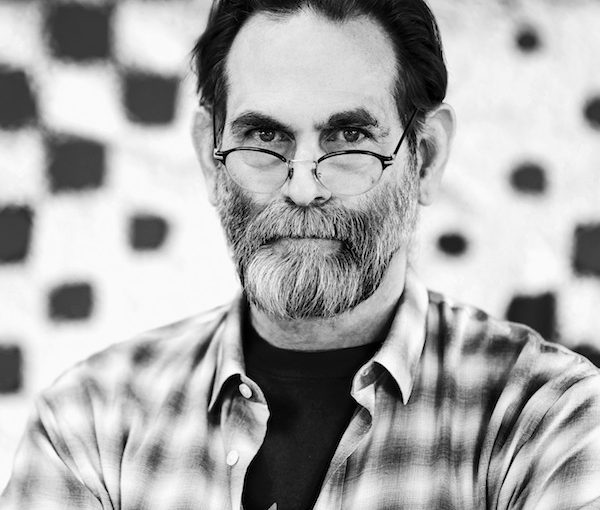
Avram Finkelstein will be participating in the Queer Arts Festival, which takes place July 16-26. (photo by Alina Oswald)
A lot of it feels familiar, said New York-based artist and activist Avram Finkelstein about the current situation in the United States. The same American institutions that failed during the HIV-AIDS crisis are failing to effectively deal with the pandemic. And, when he was a teenager in the 1960s, cities were also being burned in America.
“It’s sad to think that we will be having the same struggles,” he told the Jewish Independent in a phone interview last week. “But, also, as you get older, you realize that progress is not a pendulum swing from left to right, it’s actually a spiral going forward and things do move to the right and they move to the left, but [there is] incremental change. So, part of me feels like we’re seeing the dying gasp of a world that I hope we’re leaving behind, and I see a world in the future that I want to live in. So that’s kind of helping me through this.”
Finkelstein was scheduled to come to Vancouver next month to participate in the Queer Arts Festival.
A founding member of the Silence=Death and Gran Fury collectives, as well as the political group ACT UP, he is the author of After Silence: A History of AIDS Through its Images (University of California Press, 2017). His artwork is part of the permanent collections of MoMA, the Smithsonian, and the Victoria and Albert Museum, to name but a few places, and his work has been shown around the world. He was set to unveil one of his new works in Vancouver. As it is, with the restrictions required to minimize the spread of COVID-19, he will be helping open the festival remotely, as part of a panel discussion chaired by curator Jonny Sopotiuk, which will also provide viewers with a tour of the festival’s art exhibition.
“I have a large mural that was going to be in the exhibition and now it’s going to be in a virtual space,” said Finkelstein. “I’m very excited about this piece and the fact that Jonny chose it – it’s the first time I’ve shown it…. I had a commission to do a work for the Shed, which is a new art space in New York, and, while I was waiting for the weaving tests of the final pieces – it’s a very large jacquard weaving – I decided to start drawing from the same source material as the cartoon for the weaving. I hadn’t drawn since recovering from a stroke; I had a stroke about two years ago…. I then realized that my hand isn’t my own, my body is no longer my own.”
The source material, he explained, “is a portrait of a gender-non-conforming friend who later transitioned. The work was all about corporeality as an abstraction and the ways in which we’re allowed to look at certain things, and what is public and what is private about gender and sexuality. And then, all of sudden, I realized, I’m actually talking about my own body in these drawings because my own body is not my own body anymore. I realized that I had made this sharp pivot from an abstract, theoretical idea of corporeality to this kind of war or dance, or I don’t know how to describe the physical process of having to use your entire body to hold a pencil.”
Despite the health, political and other challenges Finkelstein has faced, he remains hopeful.
“We’re trained to think that, if we don’t have hope, then the only thing that’s left is despair, but the truth is, hope isn’t so much the point – it’s the horizon that hope is sitting on and, so long as you can see a horizon, I think that, to me, is the same thing,” he said.
“I’m Jewish, as you know, and I think that Jews have a very different relationship to memory and to witnessing. If your people have been chased all over the globe for centuries, you take a long view. You sleep with one eye open, but you take a long view, and I think, therein, I’m eternally hopeful.”
In an interview in 2018, Finkelstein predicted that the situation in the United States would worsen before it improved.
“Which is another thing about being Jewish – you learn that there is no such thing as paranoia because it’s all real,” he said. “So, one could have seen, as plain as the nose on one’s face, where America was heading. And, in actual fact, what happened with Trump’s election was, we’ve joined the international march of global totalitarianism…. And, it’s not about to get really bad, it’s really, really bad. It’s really bad and I think that, here again, you can’t be Jewish and not think – not think your entire life, actually – in some way being prepared for, OK, what are the risks I’m willing to take if this happens? How far would I be willing to fight for other people if that happens. The shadow of Nazi Germany never escaped your consciousness.”
So how does Finkelstein conquer the fear?
“I guess I’ve replaced it with anxiety,” he said, laughing. But, he added, “I don’t know why I’m not fearful. I think that I was just raised – a day doesn’t go by that I’m not reminded of another lesson or another incident or another part of Jewish-American social history in the 20th century that my family was directly there for. I almost feel like I’m the Zelig of the left. All the stories you would tell my mother or my father, they’d be like, ‘Oh, yeah, we were there. We were there at the Robeson riots. Oh, yeah, we were there when they closed The Cradle Will Rock and everyone walked down the street’ – exactly the way it was in the last scene in Tim Robbins’ movie. When I saw it, it seemed too preposterous, I called my mother, said, ‘Could that have happened?’ And she started singing the song that Emily Watson sings in the film.
“So, I think I have such a sense of self that one could interpret it as fearlessness, but I think that it would be more accurate to say I was not given an alternative role model. I was raised to feel the suffering of others and, if other people are suffering, there’s no night’s sleep for me. So, there’s really no option – you’re either closing your eyes to something terrible or you’re doing everything you can to try and make it less terrible. And I think that that’s the Jewish condition.”
He described Jews as being like queer people. “We are everywhere,” he said. “We’re in every culture, we’re in every race, we’re in every gender, we’re in every country. We have every type of ethnic community that we surround ourselves with. An Ethiopian Jew is different from an Ashkenazi Jew, but we’re still all Jews.”
Though raised by atheists, he said, “I don’t think you’ll find anyone more Jewish than I am or than my family, but Jews are prismatic. We are many things. Consequently, I feel like I can’t speak on behalf of other Jews, I can only speak on behalf of myself.
“Likewise, I’ve always had people of colour in my family; I just always have. And, I learned very early on back in the ’60s, when the civil rights movement was fragmented between King and Stokely Carmichael and the Panthers, and everyone was choosing sides, I think that’s another example of what I’m talking about – there are many ways in which to be black. And so, I don’t feel like what I have to say about this current moment is anywhere near as important, essential, vital, critical … [as] a person of colour – what a person of colour has to say about this moment is much more important.”
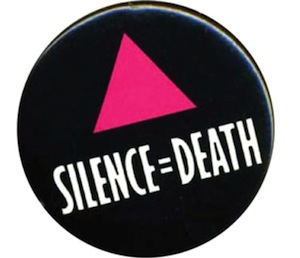
The original Silence=Death poster has been adapted over the years by many people, including for use as a pin.
Finkelstein was one of the minds behind the now-iconic Silence=Death poster, which has been adapted over the years by many people. A variation of it could be seen in at least one of the recent protests. The original iteration encourages viewers to use their power and, for example, vote. In general, working towards solutions is an important part of Finkelstein’s activism.
“I think critiques are easier,” he said. “I think also we mistake public spaces, we mistake the commons, as a declarative space. I tend to think of it as an interrogative space. I think that, even in late-stage capitalism, when someone is trying to get you to put your money in a bank or go buy a soft drink, there’s something Socratic about the gesture of trying to get you to do something … you’re responding to it, you’re engaged in it, and that’s the interrogative part that I think is easy to overlook. And I think that’s where the answers are.
“I think that the way that the Silence=Death poster is structured is it’s really like a bear trap. We worked on it for nine months – the colour has certain codes and signifiers, and the triangle has another set of codes and we changed the colour of the triangle from the [concentration] camps and inverted it to obfuscate some of the questions about victimhood. And the subtext has two lines of text, one that’s declarative and one that’s interrogative, and the point size forces you into a performative interaction.”
This poster and other work with which Finkelstein has been involved include aspects that “people are very afraid to experience,” he said, “which is fallibility, mess-making and tension. And I find all of those things as generative, as kindness, support, community. They’re differently generative and … hearing so many people who are trying to figure out how to find their way in, as white people, into the conversations that are happening in America right now, is the same struggle as a young queer person trying to find their way into the AIDS crisis. I mentor a lot of young queer artists and activists and the first thing they say, their immediate impulse is, I have no right to this story, I wasn’t here, I didn’t live through it. To which my response is, immediately, you have every right to the story – it’s your story, it’s the story of the world…. Race is a white person’s problem. People of colour are paying the price for it, but the problem, the genesis of the problem, is whiteness. And we have to figure out how to talk about it…. But I think now is the time for listening.”
He said, “We have to know what our responsibilities are and this goes back to Judaism – our responsibilities as witnesses. You can’t let your discomfort change the importance of this moment or overshadow the importance of this moment.”
One of the things Finkelstein does is teach social engagement via flash collectives. “I think we’re never put into a position where people mentor our personhood,” he said. “We have people mentor us as computer programmers or healthcare providers or tax accountants or artists or writers, but … there’s something primeval which is missing in the way we’re acculturated, and the flash collective is almost shamanistic in that regard; it taps into this primal thing that is quite astonishing when you let it out.”
Understanding that he will not live forever, he said “the Silence=Death poster casts a very mighty shadow and it makes it very difficult for people to figure out how to make new work, if that’s what they think it has to be…. It became obvious to me that I could be talking about Silence=Death until the day I drop, but, one day, I am going to drop and I want other people to start making those new works and I thought this would be a way to get people to make new work.”
He described the collectives, which teach political agency, as being “like a stew of the top 10 hits of grassroots organizing in a condensed workshop that’s tailored to the individuals in the room.”
He said, “I believe that I don’t necessarily have to change the world because I know that there could be a teenager in 2050 who sees something that someone I worked with did that made them think of something else that I never would have thought of. That is the point of the work, not the how do I fix it before I’m gone, which is the dilemma of Larry Kramer [who passed away last month]. He really thought, and I think it’s really male, but it’s very men of a certain generation also – he really thought that he could fix the AIDS crisis, and it didn’t happen.”
Unfortunately, space doesn’t allow for most of what Finkelstein shared with the Independent about Kramer, who he described as “a complicated person.”
Kramer was a rhetorician, said Finkelstein. “And I’m a propagandist. We’re both rhetoricians in a way, but what was the dividing line that made Larry incapable of understanding the work that I did?… I felt like I understood his process better than he understood mine. And I started to think, well, here’s the difference between a person who articulates their rage with words and a person who articulates their rage with every tool in the toolbox…. Not to make myself sound superior, but I realized that I think of rage as sculptural; he thought of rage as rhetorical. I think of rhetoric as sculptural, I think of it as casting a shadow and activating social spaces. And I think that he was a Jewish gay man of a different generation and a lot of his rage was tied into his personal struggles. And I did not have those. I had other personal struggles, but I did not have them.”
As part of the Queer Arts Festival, Finkelstein will lead a flash collective on the question, “What does queer public space mean in a 21st-century pandemic?” He hopes the resulting work will be shown in a public space.
For more information about the festival, visit queerartsfestival.com. The next issue of the JI will feature an interview with QAF artistic director and Jewish community member SD Holman.