Memories of Balkans

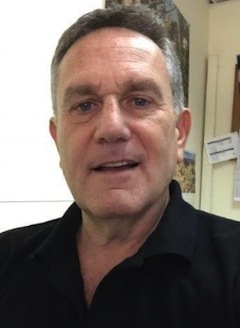
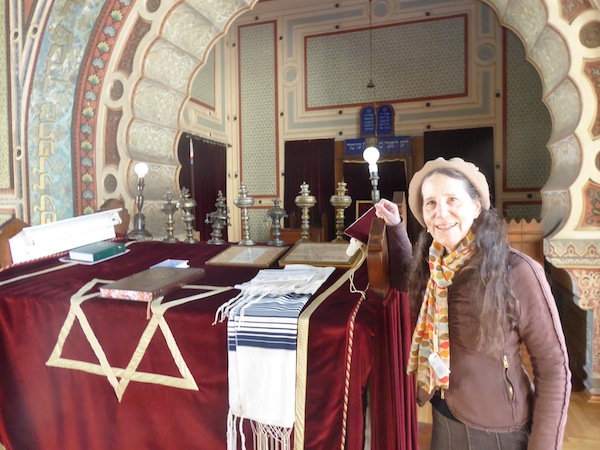
The author in the synagogue in Sarajevo, Bosnia-Herzegovina. (photo from Miri Garaway)

When I first started planning and researching our October 2017 trip to Slovenia, Croatia and Bosnia-Herzegovina, the foremost thing on my mind was learning about the Jewish history of the region. It was uncharted travel territory for me and I was curious to uncover the areas that were once vibrant Jewish communities.

Rather than being herded around by bus on a large organized tour and staying in North American-type hotels, which are far away from the pedestrian-only “Old Town” neighbourhoods of the cities, I wanted the challenge of researching centrally located, charming and historical bed and breakfasts and/or apartments and then finding private or small group Jewish heritage tours within each place. This proved to be an interesting process, whereby I delved into several possibilities. I left no stone unturned in designing this journey and it was such a feeling of exhilaration to put it all together and enjoy it.

Once I decided on accommodations in each city, I then had the task of transportation. To save time and energy, I hired a series of private drivers. This proved to be a wise decision, as 17 days does not allow for a slow pace. An added bonus was having our driver appear at the hotel, take our luggage and drop us off at our next destination, stopping to tour along the way, if we desired.

By pure chance, I had come across a U.K.-based company called mydaytrip.com – they responded promptly, were professional and easy to deal with and I had full confidence that I made the right choice. In addition to hiring a private driver, I also discovered a private tour company (based in Vancouver) called toursbylocals.com – their in-depth walking tours were excellent and I would highly recommend them.

Another option I used was Viator, a subsidiary of Tripadvisor. They offer a variety of small group (maximum eight people) tours all over the world and they liaise with local travel agencies, which provide the service. It is a great way to have various tour options at a reasonable cost.

Our first stop was Ljubljana, Slovenia, a charming university town of friendly people, exquisite Baroque architecture, a delightful cobblestoned Old Town and a vibrant café culture. Most notable is the Kaverna Zvezda, the best pastry café in town, featuring the traditional kremna rezina, also known as cremeschnitz, cream and custard between layers of puff pastry, which I had also tried in Israel. In short – divine. The gibanica (pronounced gabanitza), a delicious cake with poppy seeds, curd cheese, walnuts and apples, is another legendary cake in Slovenia and reminded me of a cake my Eastern European grandmother made. She was from Czernowitz, Austria-Hungary.

Pumpkin seed oil is “king” here and is used with the same frequency as olive oil is in Italy. Vegetarian pumpkin soup is on every menu, much to my delight. Were there any remnants of a Jewish community here? This seemed like Jewish comfort food to me.

Documents show that Jews settled in Ljubljana from the 13th century onward and worked as merchants, bankers, artisans and some as farmers. They had a synagogue, a school and a rabbinical court. In 1515, the Roman emperor Maximillian expelled the Jews and Ljubljana’s Jewish Quarter disappeared.

As I walked down the two narrow streets in the Old Town, that once housed a small Jewish community – Zidovska ulica and Zidovska steza, Jewish Street and Jewish Lane – the only sign of a Jewish presence was a vacant stone indentation on a building where a mezuzah had once stood.

Maribor, the second largest city in Slovenia, has a synagogue, but, unfortunately, it sits empty. Jews were also expelled from here, in 1496, though, eventually, both Ljubljana and Maribor regained their Jewish communities – until the Second World War. Then the Holocaust took its toll.

On a positive note, a synagogue did open in Ljubljana in 2003, but it is now part of the Jewish Cultural Centre. Ljubljana was previously the only European capital lacking a Jewish house of worship. The city does not have a rabbi, but the chief rabbi for Slovenia, Rabbi Ariel Haddad, resides in nearby Trieste, Italy.

* * *

Split, Croatia, once had a vibrant Jewish community, so, after visiting the Dalmatian coastal town of Zadar, we headed a little further south to Split, stopping first at the World UNESCO Heritage Site of Trogir.

In Split, I had arranged for a private guide, Lea Altarac, to meet us and give us a Jewish history tour as well as a general city walking tour. In 3.5 hours, we covered a lot. Lea is a teacher; extremely knowledgeable and proud of her city. Her mother is Bosnian and her father is Jewish; she has a Jewish soul, albeit one that does not practise Judaism. Nevertheless, she was eager to enlighten us with some of the Jewish history of the city.

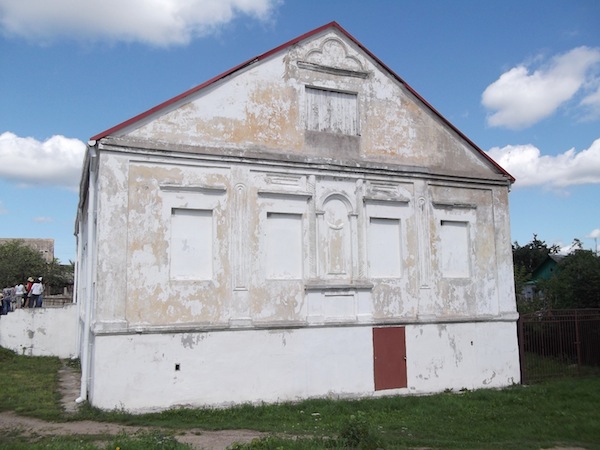
We first toured Diocletian’s Palace in the Old Town and Lea pointed out the many Magen Davids etched into the stone. Once we had finished touring the extensive palace, we walked to the edge of the Old Town. There, we came across the small synagogue of Split, no exterior decoration to distinguish it, which is maintained as a museum by Lea’s father. As we climbed the stairs to the second floor of the old stone building, I tried to visualize it teeming with congregants, sadly no more.

One of the oldest European synagogues, it was created in the 16th century. The interior dates back to 1728. That was the first restoration of several, and when the mechitzah (partition between men and women in an Orthodox shul) was added. It is interesting to note that the ark was built into the western wall of the palace.

The synagogue was plundered by fascist fanatics in 1942 and, unfortunately, many valuable ritual books, archives and silver objects were burned or stolen.

In 1996, during another restoration, a commemoration plaque of local victims of the Holocaust was given to the synagogue as a gift from the Israeli ambassador.

There is no official rabbi for the synagogue in Split, but the rabbi from Zagreb, Croatia, comes about twice a year.
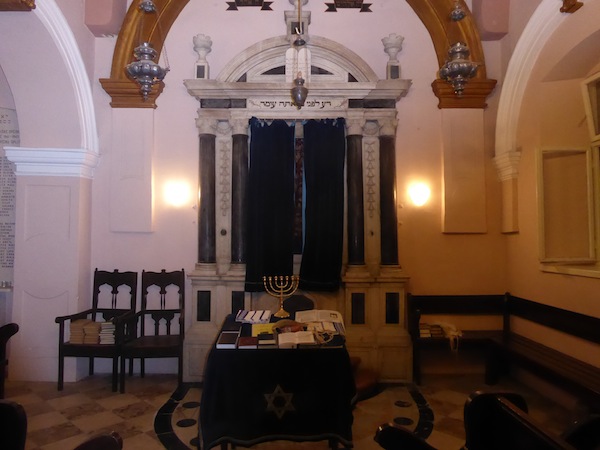
photo - The synagogue in Split, Croatia
The synagogue in Split, Croatia. (photo from Miri Garaway)

During archeological excavations carried out in the area of the Roman city of Salona, the capital of the Roman province of Dalmatia and the parent city of Split, traces of an established Jewish community were found. When Salona was destroyed, in the early seventh century, the surviving Jewish members took refuge within the walls of Diocletian’s Palace. This settlement was the early beginning of the city of Split.

The term Zueca is used to describe the localities where Jewish tanners and dyers lived. This was a common trade for centuries. Other Jewish occupations included weaving, tailoring, the sale of cloth, the running of a bank, as well as the food business, which was not permitted to Jews elsewhere.

Via 16th-century documents, we learned that there were Spanish and Portuguese immigrants who settled in Split, which was a port for trade between the Republic of Venice, to which Split belonged to at that time, and the Ottoman Empire. Most notably, a Spanish Jew named Daniel Rodriga, short for Rodriguez, was responsible for promoting the development of trade between Europe and the countries in the east. Caravans were also used for the exchange of goods to Turkey and Asia, which Rodriga felt was safer. He conceived the idea of building a large quarantine area, a lazaretto, in the port of Split to house men and goods from the eastern countries, before ships took them to Venice and the rest of Europe.

There was no Jewish ghetto in Split, as the members of the Jewish community enjoyed civil liberty. It was not until the late 18th century, toward the end of Venetian rule, that a ghetto was formed, due to the influence of the clergy and the decline of the Venetian economy.

Our walking tour led us up a steep hill, Marjan Hill, where we were afforded a spectacular view of Split. Overlooking the city, in a forest-like setting, is the Jewish cemetery, one of the oldest Jewish cemeteries known. It was founded in 1573 and was used until 1946.

After the collapse of fascism in 1943 and before the occupation of Split by the German army, many of the younger Jews left Split and joined the resistance movement in partisan units. Jews who did not leave were rounded up by the Nazis and sent to forced labour and concentration camps. Only one-third of the community survived and returned to Split after the liberation; others emigrated to Israel.

* * *

Sarajevo was our next stop, with a visit to Mostar on the way. Mostar, in Bosnia-Herzegovina, is a picturesque city situated on the Neretva River, only a two-hour drive from Split. I arranged a walking tour for the morning and asked the tour guide if we could visit the proposed site of a new synagogue. The small patch of land was donated by Zoran Mandlbaum, head of Mostar’s 45-member Jewish community, in the hopes that a synagogue would be built there. His vision was a building made of glass, symbolizing trust between Jews, Muslims, Orthodox Christian Serbs and Roman-Catholic Croats, and bridging ethnic gaps. For now, the only distinguishing feature of this barren piece of land is a wrought-iron Magen David carved into the gate.

Mostar originally did have a synagogue, but it was damaged during the Second World War and the communists turned it into a puppet theatre in 1952. We visited that colourful building. Today, there are only a handful of Jews living in Mostar.

Walking through the charming Old Bazaar (Kujundziluk), we reached the famous Old Bridge, a curved structure, originally built of square stones and completed by a Turkish architect in 1556. Its arch spanned nearly 29 metres and stood 20 metres above the river. Although the famous bridge was destroyed during the war in 1993, it was rebuilt in 2004. The tradition of diving contests off the bridge has been maintained.

Of notable interest is the elegant Turkish-designed Muslibegovic House and courtyard/garden, now a hotel, which we were fortunate enough to tour.

In another couple of hours, we arrived in Sarajevo, a beautiful city, surrounded by mountains. The first Jews, Sephardim, arrived in Sarajevo as early as 1541. They were mainly artisans, merchants, pharmacists and doctors. Ashkenazi Jews began arriving in the 17th century, fleeing persecution in Europe. When the Austrians occupied Sarajevo in 1697, they burned and destroyed the Jewish Quarter, including the synagogue.

When the Ottomans regained control of Sarajevo, the lot of Jews improved. Sarajevo became known as “Little Jerusalem,” having the unique feature of a synagogue, a Roman Catholic church and a mosque all within 500 metres of one another.

Jewish life changed dramatically with the rise of Nazi Germany and the Holocaust – 85% of the Jewish population perished and those who survived emigrated to Israel in the late 1940s. Before 1941, there were 12,000 Jews living in Sarajevo and 15 synagogues. In 2017, 700 Jews lived there, out of a population of 400,000. There was no official rabbi, but a rabbi, originally from Sarajevo, came in from Israel to officiate for the High Holidays.

Our Jewish heritage tour was given by a young Muslim man, the owner of Meet Bosnia travel agency. He was very proud of the fact that he was licensed to give this tour. We began at the Old Synagogue, which was originally built in 1581, but burned down and was rebuilt a couple of times. The synagogue was converted into a museum in 1965. There are historical exhibits, ritual objects, Ladino books, photographs, religious traditions and depictions of life before the Holocaust. There is a replica of the famous 14th-century Sarajevo Haggadah; the original being in the National Museum. Unfortunately, that museum was closed for renovations.

Next to the synagogue is the building called Novi Hram, or New Synagogue, now an art gallery owned by the Jewish community of Sarajevo. There was also a large, ornate Sephardi synagogue, built in 1932, but the interior was destroyed by the Nazis in 1941.

Most impressive was the grand Ashkenazi synagogue, built in Moorish style and located across the Miljacka River that runs through Sarajevo. It also serves as the Jewish community centre. We were fortunate enough to be there during Sukkot, and went to their sukkah. The synagogue also holds Friday night services.

We visited the large hillside Jewish cemetery, among the oldest in Europe. It was founded by Sephardi Jews in 1630 and contains more than 3,500 uniquely shaped tombstones; some with inscriptions in Ladino. There are two Holocaust memorials: one Sephardi, one Ashkenazi. After 1959, it became a mixed cemetery and, in 1966, it closed. The cemetery was used as an artillery position by the Bosnian Serbs during the siege of Sarajevo and many of the tombstones were toppled.
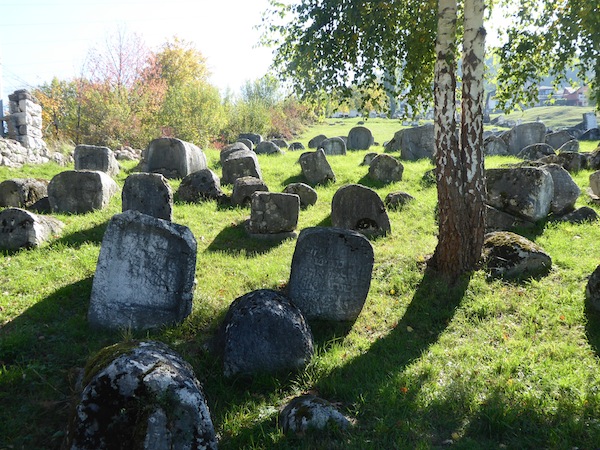
photo - The cemetery in Sarajevo, Bosnia-Herzegovina
The cemetery in Sarajevo, Bosnia-Herzegovina. (photo from Miri Garaway)

One thing I noticed during our stay in Sarajevo was that everyone we met was proud of the multicultural aspect of their city. One woman, in a Judaica shop we were taken to, next to a cinema that once housed a Sephardi synagogue, proudly told us that her Muslim neighbour helped her and her family build their sukkah.

It was hard to leave this fascinating, exotic city that had weathered so much, but we drove on to Dubrovnik, via the country roads. In the Serbian parts of that countryside, we saw signs in Cyrillic and I felt like I was in Russia.

What a contrast to arrive in Dubrovnik, a city inundated with tourists, even in October. Our Jewish heritage tour, which also included a walking tour of the city, was led by a Catholic woman studying for her master’s degree in archeology. In the late 1400s, early 1500s, there was a Sephardi community in Dubrovnik, with about 300 members. In the 1800s, Ashkenazi Jews arrived. Before the Second World War, Jewish property was confiscated and Jews had to wear the yellow armband. Some community members were involved in the anti-fascist movement. After the war, Jews were still registered in Dubrovnik, but most of them had immigrated to New York City.

We visited the Sephardi synagogue, located in the Old Town in a three-storey stone Baroque building; it is one of the oldest in Europe. The synagogue and museum received a direct hit from a missile during the war in the 1990s, but the Museum Foundation, the Croatian Ministry of Cultural Heritage and UNESCO, as well as private donations, helped restore it. There are fascinating displays of ritual objects in the museum and a Judaica shop next door. Sadly, there are only about 50 Jews left in Dubrovnik, all residing outside the Old City walls.

Miri Garaway is a freelance travel writer.
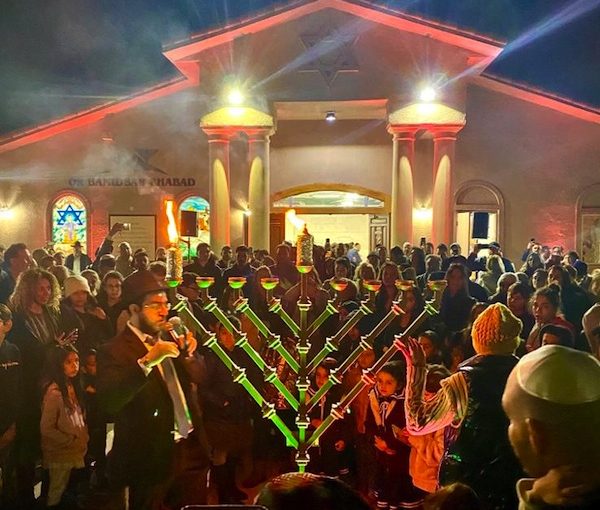
Going to shul in Las Vegas

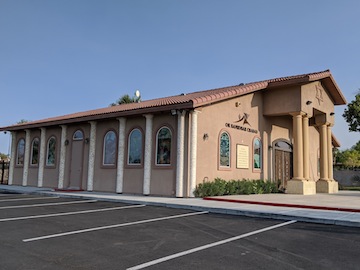
Las Vegas’s Or Bamidbar Chabad Sephardi synagogue at Chanukah. (photo from Rabbi Yossi Shuchat)

The Las Vegas Strip is where all of the action is, an endless sea of attractions and hotels with casinos, exhibits and more. These hotels cater to a tourist’s every whim. However, during my last trip to Vegas, several years ago, I spent a majority of my time off the strip, away from the bright lights and glitz.

I met up with a group of friends who I had spent a year with in Arad, Israel, in 1990-91, on a World Union of Jewish Students (WUJS) program that was for young Jewish professionals thinking of making aliyah. This was our second excursion to Las Vegas and members of our group hailed from Paris, New York, Boston, Toronto and Seattle. On our first trip, we stayed in the Egyptian-themed Luxor Hotel; this time, we stayed at Bally’s Hotel, in the heart of the strip.

We spent our first night wandering around the area near our hotel. The next day, on Friday afternoon, we ventured further afield to eat a fabulous lunch at an Israeli kosher restaurant called the Jerusalem Grill, which also offers pre-Shabbat delivery to hotels. As we dined on authentic Israeli dishes that could have come straight from the Holy Land, we reminisced about the good times we had had on our program and the many trips we took to explore Israel together.

We then explored the Palms Casino Resort and the Rio Hotel and Casino, which were near the restaurant. The Rio, where we would be going to see magicians Penn and Teller perform on Saturday night, after Shabbat, was also hosting the World Series of Poker.

On the Friday night, a few of my WUJS friends and I went to Or Bamidbar Chabad – East Las Vegas, a unique Sephardi synagogue, whose Chassidic spiritual leader, Rabbi Yosef Yitzchok (Yossi) Shuchat, is from Venezuela. I had made arrangements with the rabbi prior to Shabbat to attend services and he graciously invited my friends and I to dinner at his house afterwards.

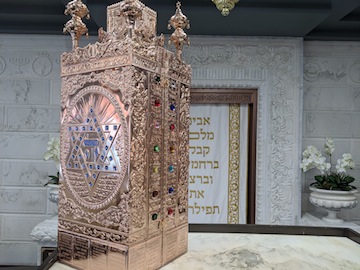
photo - A Sephardi Torah case at Or Bamidbar Chabad
A Sephardi Torah case at Or Bamidbar Chabad. (photo from Rabbi Yossi Shuchat)

The synagogue features a picture of the Rebbe (Rabbi Menachem Mendel Schneerson) but, other than that, it is a typical Sephardi house of worship, with the bimah in the middle, and Sephardi prayer books and a Sephardi Torah case. I felt right at home, as I have prayed at Sephardi and Chassidic congregations all over the world and have an affinity for the customs and traditions of both streams of Judaism.

After some spirited davening and a great drash by the rabbi, we and a few members of the congregation followed the rabbi to his home, where we were treated to a scrumptious Shabbat meal by his wife, Miriam Bryna Shuchat, who is co-director of Or Bamidbar.

Most of the guests were Sephardi and from Las Vegas, but there was also Baruch, a visitor from New York who was in town to play at the poker tournament. There was also Walter, a Jew who had moved to Las Vegas from Boston and, at one time, was a boxer and a blackjack dealer. After great conversation and food, I retired to a recently renovated mobile home right across from the synagogue, which was reserved for guests – and I had the honour of being the first one!

photo - Or Bamidbar Chabad – East Las Vegas
Or Bamidbar Chabad – East Las Vegas. (photo from Rabbi Yossi Shuchat)

The next morning, I participated in the services and got to chant Birkat HaKohanim, the ancient priestly blessing that Sephardi shuls – including Beth Hamidrash in Vancouver – do every day, but Ashkenazi ones do not. At lunch, I had a lively discussion with a former Vancouverite who was encouraging me to leave Canada and move to Las Vegas’s thriving Jewish community, with its approximately 80,000 Jews, 20 synagogues, many Jewish schools and several kosher restaurants. When they had lived in Vancouver, both he and his mom had attended services at the Kollel and are fans of Rabbi Shmulik Yeshayahu. Interestingly, since my Vegas visit, the Pacific Torah Institute, which was located in Vancouver, has relocated to Las Vegas and merged with a local yeshivah.

After services, I was contemplating walking back to the hotel in the sweltering 32°C heat, but Walter, the former blackjack dealer, invited me to spend the afternoon at his house. It was a relaxing, enlightening and cool afternoon. Walter regaled me with stories about what Vegas was like when he arrived there in 1956. At that time in the city, which was founded by notorious Jewish gangster Bugsy Siegel, most of the hotels were owned by Jews and, so, as a blackjack dealer – at a variety of casinos, including the Flamingo and Desert Inn – Walter got to know many of them. He also got to know Frank Sinatra, Dean Martin, Sammy Davis Jr., and other members of the Rat Pack, as well as boxer Rocky Marciano. (When Walter was a boxer himself, he also met Muhammad Ali.)

After my stay at Walter’s – where I even got a Shabbat nap in – he gave me a lift to the Rio, where I met my friends to see the Penn and Teller show. The poker tournament was also in full swing, of course, but I don’t know how Baruch fared.

I spent my last night in Vegas before returning home to Vancouver with my friends at a glitzy hotel watching a magic show. However, while I enjoyed all that I did, the highlight of my trip – in addition to hanging out with friends – was the gracious hospitality of the folks in the Jewish community. I will always remember my wonderful Shabbat in Las Vegas at Or Bamidbar Chabad.

David J. Litvak is a prairie refugee from the North End of Winnipeg who is a freelance writer, former Voice of Peace and Co-op Radio broadcaster and an “accidental publicist.” His articles have been published in the Forward, Globe and Mail and Seattle Post-Intelligencer. His website is cascadiapublicity.com.

Rebuilding Volozhin Yeshivah

Volozhin Yeshivah in Belarus, 2017. In learning about the institution, Mark Weintraub was moved to sponsor a lecture on it, in honour of his mother, and to champion restoration efforts. (photo by Da voli)

“How did I not know about this?” That was the question echoing through the mind of Vancouver lawyer Mark Weintraub, a longtime student of Jewish intellectual history, when he first learned about Volozhin Yeshivah, a once-illustrious place of study that he describes as “the Harvard, MIT and Yale of the Jewish people rolled into one.”

Once Weintraub understood the influence Volozhin – which was open from 1806 to 1892 in what was then Russia – had on the Jewish world, he was stunned that it was so little known. His passion about this treasure of Jewish history led to his participation in organizing a recent online class, From Volozhin to Vancouver, taught by Rabbi Yitzchak Breitowitz, the rav and a teacher of Ohr Samayach Yeshivah in Israel, whose resumé includes having been a professor of law at the University of Maryland. It led, as well, to Weintraub’s championing of an effort to restore the still-standing building of the yeshivah, which is in Belarus.

To spread knowledge of Volozhin and to honour his late mother, Rita Weintraub, z”l, a lifelong devotee of Jewish learning, Weintraub helped organize and sponsor the online class with Congregation Beth Hamidrash, Congregation Schara Tzedeck, Vancouver Hebrew Academy and Shalhevet Girls High School. On Oct. 18, more than 60 people gathered to learn from Breitowitz on Zoom. Weintraub introduced the lecture, dedicating it to his mother, and Rabbi Ari Federgrun of Schara Tzedeck moderated the discussion. Breitowitz had risen at 5:30 a.m. in Israel to give the lecture about the legend and history of Volozhin, whose very name, he said, “carries an aura of mystery and delight.”

Volozhin is sometimes called “the mother of yeshivot,” since it was the first modern, institutionalized yeshivah, explained Breitowitz. It was established by Rav Chaim Volozhiner (1749-1821), a famed kabbalist and Torah scholar. Rav Chaim was a student of the Vilna Gaon (1720-1797), a towering figure at the time and the leader of non-Chassidic Jewry in Eastern Europe. The Vilna Gaon had led the Orthodox opposition to Chassidism, concerned about its radical theological ideas and the possibility that Chassidim might transgress Jewish law and lead to extremist mystical movements that would disrupt or damage the Jewish community. Followers of the Vilna Gaon came to be known as Misnagdim (Opponents), as the Chassidic movement grew to become the dominant force in Eastern European Jewish life.

Rav Chaim, who did not sign the Gaon’s writ of excommunication against the Chassidim, took a gentler stance towards the movement than his teacher. He focused his efforts on teaching an intellectually intense absorption in Torah study for its own sake and a fierce devotion to the observance of halachah (Jewish law) as a form of devotion to God.

Rav Chaim formed the Volozhin yeshivah to create a new kind of environment for study. Instead of the local learning that took place in small houses of study in the shtetls, Volozhin was a large institution that provided both housing and food to its students, and taught young Jewish men from near and far. “The Volozhiner wanted yeshivahs to be non-local institutions which all of Israel had a stake in,” explained Breitowitz. “He didn’t like a few large donors but many small donors.”

The yeshivah had 24-hour learning that was intended to sustain the world with the power of Torah and de-emphasize practical legal rulings for the sake of pure disinterested study. Volozhin – and its immediate offspring in the form of other similar yeshivot started by its graduates – created both a new model of Jewish learning and a generation of non-Chassidic luminaries with a far-ranging and decisive influence on orthodoxy and beyond. A short list of the graduates it produced, or who taught there, included Rav Chaim Soloveitchik (the Brisker Rav, 1853-1918), Rav Nafatli Yehuda Berlin (the Netziv, 1816-1891), Rav Abraham Isaac Kook (1865-1935) and many others, including both Zionists and anti-Zionists, mystics, ethicists and legalists.

The yeshivah environment encouraged creative ferment and demanded intellectual rigour, and Volozhin was not only famed for the Orthodox leaders it produced. Some of the students became leaders in the Haskalah, or Jewish Enlightenment, and it was rumoured that secret books were passed among students and housed in a hidden library full of philosophy, science and secular language texts. Among its luminaries in this regard was Chaim Nachman Bialik (1873-1934), the renowned Israeli poet and writer.

In 1892, the Russian government closed Volozhin when the heads of the yeshivah refused to change the daily schedule to curtail Torah study and include hours of government-approved secular studies. While it reopened in 1899 on a smaller scale, its glory days had passed.

Volozhin functioned until 1939, when the Second World War broke out. During the war, German soldiers used the building as a stable; later, it was a canteen and deli. The site was returned to the Jewish community of Belarus in 1989. In 1998, it was registered on the State List of Historical and Cultural Monuments of the Republic of Belarus.

It was the discovery of this history that so excited Weintraub. His mother had been a devotee of learning, libraries and study. “I wanted to have lectures to honour her, since it was difficult to communally mourn her during COVID,” said Weintraub. “I approached Rabbi [Don] Pacht at Vancouver Hebrew Academy about bringing in Rabbi Breitowitz.”

Wondering if the topic was too Orthodox for his mother, Weintraub, who has been involved in the Conservative movement for years, decided, “Nothing was ever too Jewish for her. She saw the goodness in everyone’s Judaism, no matter what it was, so I went ahead to tell this fascinating story of Jewish learning in her honour.”

For his part, Breitowitz has taken on a project to raise awareness and money for the reconstruction of Volozhin. He has begun organizing a group to work on it and is beginning “to raise momentum and find a way.”

“Five hundred years from now, Harvard, Yale and MIT are in ruins and everyone just walks by it?” he challenged. Volozhin, he said, “is a place that needs special attention from the Jewish community.”

Matthew Gindin is a freelance journalist, writer and lecturer. He has been published in Philosophy Now, Tricycle, the Forward and elsewhere. He blogs on Medium and is master teacher at Or Shalom Synagogue in Vancouver.

Reckoning with family’s past

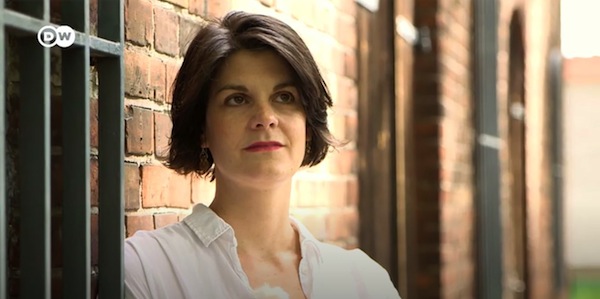
Writer and illustrator Nora Krug spoke with the Globe and Mail’s Marsha Lederman at a virtual event Oct. 27. (photo by DW Deutsche Welle)

The first time Nora Krug heard the word “Jew” was in elementary school during religion class, which was taught by the local priest. He told students that Jews killed Jesus.

Born in the German city of Karlsruhe, Krug is now associate professor of illustration at the Parsons School of Design in New York City, and author of the book Belonging: A German Reckons with History and Home. She spoke with Marsha Lederman at a virtual event Oct. 27 presented by the German Consulate General in Vancouver, the Vancouver Holocaust Education Centre, the University of British Columbia and the University of Victoria. Lederman is the Western arts correspondent for the Globe and Mail and her own book, Kiss the Red Stairs: Intergenerational Trauma, the Holocaust, and Me, is to be published in 2022.

“I came home from school that day and confronted my mother about it,” Krug recalled. “I said, ‘Are Jews evil?’ She got really angry because [it was] so obvious to her that this was something that nobody in Germany should ever think or say.”

A few years later, in her early teens, when she began learning about the Holocaust, she made a yellow star and intended to wear it as an act of solidarity with the Jewish people. Her mother, again, set her on a more appropriate path.

Krug explores her own struggles with her family’s past, as well as that of her country, in the book, a visual memoir that incorporates prose, graphics and photography. (See jewishindependent.ca/creative-engaging-memoir.)

The book was challenging on many fronts, Krug said, including her intention to tell one family’s story about the war era without downplaying German atrocities or doing anything that would appear to paint Germans as victims. While Germans did suffer during the war, it was ultimately a result of their own government’s actions.

“I’m not saying that Germans did not suffer during the war. I think they did,” she said. “But it was a self-imposed suffering.”

Like many aspects of researching a family’s or a country’s past, some things are unknowable and, at times, evidence can raise more questions than it answers. For instance, Krug had been told that her grandfather was a lifelong social democrat. But, when she dug through archives and found the military questionnaire that Germans in the American sector of occupied Germany were required to fill out to explain their war-era activities, he had acknowledged being a Nazi party member. Holding the document in her hands – not a facsimile, but the very document on which her grandfather had responded to more than 300 questions – was chilling, she said. The knowledge of her grandfather’s relationship with the Nazi party could only lead to speculation when she pieced two other facts together.

Krug had always known the location where her grandfather’s office had been in Karlsruhe. But only when she was researching the book did she discover that the Jewish centre and a synagogue were right across the street. Where was her grandfather when the synagogue was attacked on Kristallnacht and Jews were beaten in the streets? In the book, she posits four possibilities, from watching out his office window to laying home in bed sick to the most alarming possibility: that maybe he was among the mobs perpetrating the attacks.

Having lived for the past two decades in the United States – and being married to a Jewish man and having a 5-year-old daughter who is beginning to ask questions about history – all impacted her decision to write the book.

“I don’t think I would have done that had I not left Germany because I think, when I lived in Germany, I felt like I learned everything there is to learn about the war, what else is there to investigate?” she said. “That was my thinking. But, since I’ve been living in New York, I’m an individual and I am a German representing my country.”

Being away from her homeland also made her consider history more from an individual perspective.

“I think when you live as a German among Germans you accept the collective understanding of how we grew up learning about the war,” she said, crediting Germany with doing a good job addressing the topic as a nation. “But I think where we have to really still catch up is to do it on an individual basis, to really go back into our families, into the archives, into the cities where we grew up, what happened in our streets, in our houses, and investigate more deeply on an individual level.”

These are complex challenges and Krug sees a problem with the way Germans struggle with their national identity because of the terrible history of the 20th century.

“I think Germans really need to learn to love their culture,” she said. “I have a problem with it, too. I’m not saying I know how to do that. But I do think it’s a dangerous thing to only highlight our guilt. I think we need to learn, as Germans, to replace the word guilt or shame with the term responsibility.”

By struggling to express national pride, she said, Germans tend to abandon that to a fringe element.

“The problem is a lot of Germans who are willing and open to looking back at the past from a critical angle cannot express this love for their culture,” she said. “I think Germans should try to learn to do that because, otherwise, we leave it to the extreme right to do it for us and that’s a big problem.”

After Krug’s conversation with Lederman, a high school teacher submitted a question noting that some Canadian students are expressing fatigue at learning about Canada’s history of residential schools and asked whether German kids are getting tired of learning about the Holocaust. Krug acknowledged this might be the case and suggested ways of teaching that make the lessons more directly relevant for the present.

“If we had learned in Germany, for instance, more about the German resistance movement, we could have applied that knowledge to the present as well and asked ourselves, how can I help minorities that are harassed today or how can I make sure that we defend our democracy?” she said. “I think the more important question to ask is not what would I have done back then but what am I doing today on a daily basis to reflect on the issues that we have in our countries, no matter what country that is.”

Nature in Israel talk

On Nov. 19, the Jewish Community Centre of Victoria will host a webinar dedicated to Nature Israel (Society for the Protection of Nature in Israel, SPNI) and the organization’s role in addressing Israel’s environmental challenges.

For more than 60 years, SPNI has been dedicated to protecting and preserving Israel’s natural resources, environment, natural assets and landscape. The work carried out by SPNI now will determine what the land of Israel will look like for generations to come.

photo - Jay Shofet
Jay Shofet

The Canadian Society for the Protection of Nature in Israel (CSPNI) is a registered charity with the mission to raise awareness of, and funds for, the work of SPNI to protect and preserve Israel. CSPNI is, therefore, lending support to this program, which will be led by Jay Shofet, director of partnerships and development at SPNI.

A Brief History of Israel’s Environmental Movement: A Snapshot of Today’s Sustainability Challenges and Successes will highlight the programs run by SPNI. As well, Shofet will trace the growth of Israel’s environmental movement, from its early-decades focus on a romantic notion of conservation, through its growth and professionalization stage in the 1990s, to its grassroots focus on sustainability in the last decade. Then, he will give a snapshot of where things stand today: how a new ethos of dense, sustainable cities is slowly developing; how land-use planning affects everything; how the push for renewable energy is fighting against entrenched economic interests and old infrastructure; and how Israel’s world-class biodiversity is threatened by habitat loss and fragmentation – and what SPNI is doing about it.

The webinar begins at 10 a.m. To register, go to jccvictoria.ca/webinars-3.

Must teach about Holocaust

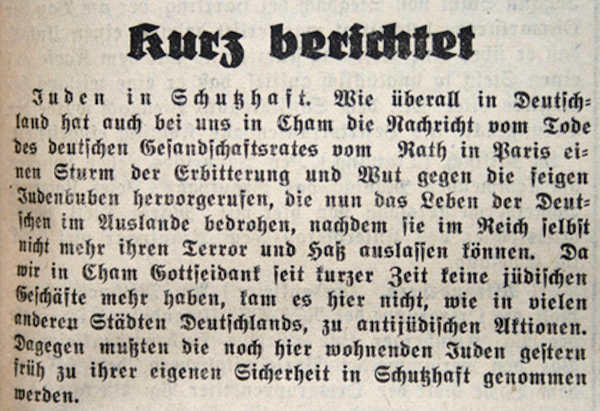
An item from the Nov. 10, 1938, newspaper in Helen Waldstein Wilkes’ mother’s hometown, Cham, Bavaria. It reads: “In Brief. Jews Taken into Protective Custody. As was the case everywhere in Germany, news of the death of the German Councilor von Rath in Paris unleashed a storm of bitterness and fury against the cowardly Jewboys who are now threatening the lives of Germans abroad because they can no longer unleash their terror and hatred within the Reich. Since, by the Grace of God, we no longer have any Jewish shops in Cham, anti-Jewish action did not take place as it did in so many other German cities. However, for their own safety, those Jews still living here had to be taken into custody yesterday morning.” (Translation by Waldstein Wilkes.)

As we have sat waiting to hear who will be president of the land that was once the beacon of hope for so many, we have asked ourselves, “What can I do? Are there meaningful avenues for action?”

Election day Nov. 3, Kristallnacht Nov. 9 and Remembrance Day Nov. 11 form a cluster. For Jews who became refugees or who lost family in the Holocaust and for all their descendants, Nov. 9 has particular resonance. Peter Gay was there. Here’s how he describes it:

“Synagogues were severely damaged or totally burnt out, sacred scrolls desecrated with the peculiar elation and ingenuity that the plunderers brought to their work. Businesses were destroyed, private houses and apartments were reduced to piles of rubble, with furniture, pictures, clothing and kitchen equipment thrown around so that they were barely recognizable. There was some looting…. But for the majority, the thrill lay in destruction for its own sake.

“The world watched, disapproved, and did almost nothing. In the United States, the public’s attention was still focusing on the midterm congressional elections of November 8, and the press was busy assessing the results.” (From Gay’s My German Question: Growing Up in Nazi Berlin, Yale University Press, 1998.)

For me, the parallels to today send shivers down my spine. The world must not be allowed to forget the depths to which humans can sink.

Awareness of the Holocaust is shrinking. In the United States, a 2018 survey showed that 66% of millennials could not identify what Auschwitz was. A recent survey revealed that about a third of 7,000 European respondents across seven countries knew “just a little or nothing at all” about the Holocaust.

Knowing about the Holocaust can provide a necessary understanding of how an entire population was bullied and manipulated by demagogues before succumbing to hate and fear-mongering. It can also serve as a blueprint for recognizing the dangers of demonization and incitement and help guard human rights and strengthen core democratic values.

Instead of endlessly fretting about social isolation and the threat of COVID-19, I’ve been seeking ways to make the gift of my days here on earth matter. I, a woman who calls herself “accidentally alive,” a woman who left her first home by horse and buggy, now count technology as among the miracles of my life. Recently, from out of the blue, the wife of a second cousin in New York, whom I’d met only once many years ago, decided to gather the extended family (all that’s left, thanks to Hitler and his efficient helpers) via Zoom. Welcoming me to this gathering of the mishpocha was a man in Israel claiming that his great-great-grandparent and mine had been siblings, and that he had read my book Letters from the Lost in connection with his volunteer work at a museum there. The museum used to be a kibbutz, founded by survivors from Theresienstadt, the concentration camp where both of my grandmothers perished and where most of my family suffered before being sent to their final destination, Auschwitz. Perhaps to distance itself from the German and to place upon it the stamp of renewal that Israel became for these lost souls, the kibbutz was named Beit Terezin.

Together with David, this fourth cousin in Israel, I am building a pathway for keeping alive that which we forget at our peril. Please, if you can, go to jgive.com and search for “Letters from Arnold.”

Using artwork and graphics contributed by those early survivors in Beit Terezin, alongside the words of my beloved Uncle Arnold, who spent 17 months in Theresienstadt before enduring the hellfires of Auschwitz, we hope to create a book that will find a home in every Holocaust museum in the world. If finances permit, we will use technology to bring the contents to life in new ways so that those who cannot visit a Holocaust museum in person nonetheless can receive our reminder that it must not happen again. Never Again.

I urge you to visit our website. And if you’d like to do an additional mitzvah, please forward the link to contacts near and far whose family members may once have lived through the hell of Theresienstadt – or worse.

Born in a country that no longer exists at a time hopefully never to be repeated, Helen Waldstein Wilkes describes herself as “accidentally alive” because she, too, was marked for eradication. Now an energized octogenarian with a richly rewarding life, she is author of two award-winning books, The Aging of Aquarius, an uplifting book that encourages people to live their passion by striving to effect change for the better, and Letters from the Lost (also available in German and Spanish translation), a moving memoir of how a box of letters from prewar and postwar Europe changed everything.

Golden coins found

(photo by Shai Halevi/IAA via Ashernet)

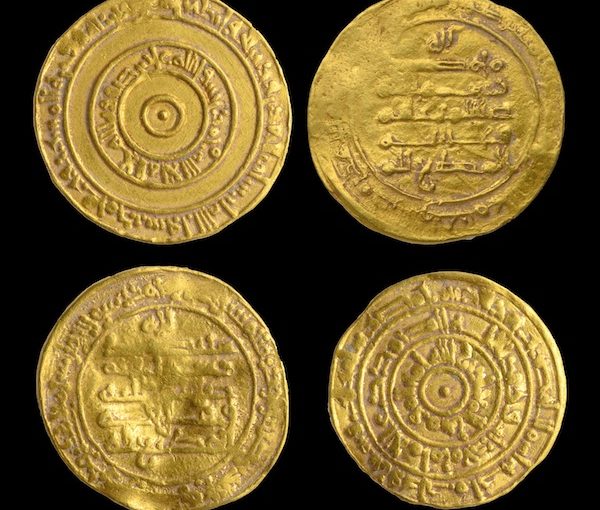
A small pottery jar containing four pure gold coins dating from the Early Islamic period was unearthed during archeological excavations conducted by the Israel Antiquities Authority (IAA), as part of the Jewish Quarter Development Corporation’s plan to build an elevator and make the Western Wall Plaza more accessible. The jar was found by IAA inspector Yevgenia Kapil and, some weeks later, excavation director David Gellman found the coins inside it. “To my great surprise, along with the soil, four shiny gold coins fell into my hand,” said Gellman. “This is the first time in my archeological career that I have discovered gold, and it is tremendously exciting.”

According to IAA coin expert Dr. Robert Kool, “The coins date from a relatively brief period, from the late 940s to the 970s CE. This was a time of radical political change, when control over Eretz Israel passed from the Sunni Abbasid caliphate, whose capital was Baghdad, Iraq, into the hands of its Shiite rivals, the Fatimid dynasty of North Africa, who conquered Egypt, Syria and Eretz Israel in those years.”

According to Kool, “Four dinars was a considerable sum of money for most of the population, who lived under difficult conditions at the time. It was equal to the monthly salary of a minor official, or four months’ salary for a common labourer. Compared with these people, the small handful of wealthy officials and merchants in the city earned huge salaries and amassed vast wealth. A senior treasury official could earn 7,000 gold dinars a month and receive additional incomes from his rural estates amounting to hundreds of thousands of gold dinars a year.”

Learning his family’s history

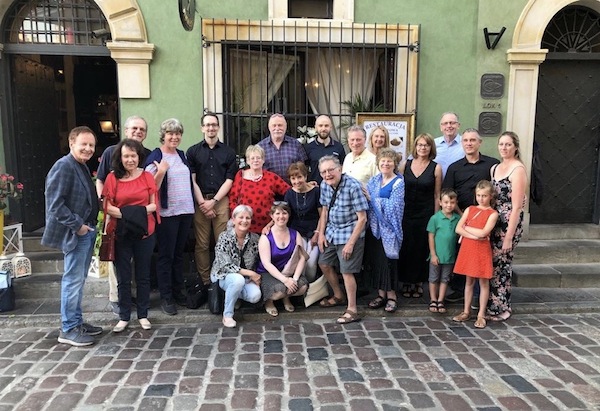
George Heyman, ninth from the right, with family members in Poland last year. (photo from George Heyman)

Like scores of other British Columbians, George Heyman owes his life to Chiune Sugihara.

Heyman, who was reelected Saturday as MLA for Vancouver-Fairview, was born after the Second World War. But his parents escaped Poland via Japan thanks to the assistance of Sugihara, who was the vice-consul for the Japanese Empire in Kaunas, Lithuania. At risk to his career and probably his life, Sugihara betrayed orders of the Imperial Japanese government and issued transit visas that are credited with saving the lives of at least 6,000 European Jews.

Heyman, who was minister of environment and climate change strategy in the last government, was sketchy on some of this family history. So, at the urging of a distant cousin who is “a ferocious researcher,” Heyman, his sister and other family members from around the world convened in Poland last year.

“[The cousin] found others as well and he started communicating with us and sending us snapshots of things that he’d found in archives and going back a couple of hundred years,” Heyman said of the cousin, who is a retired professor in Denmark. “He found information about the village that our ancestors had once lived before they migrated to Warsaw.”

The diverse group of family members spent about 10 days together in the summer of 2019.

“We met in Warsaw, we had an initial family dinner of 20 people, three generations,” he recalled. “Everybody said a little bit about what it meant to them to be back, as well as where their lives had taken them.”

The cousin had prepared a family tree and presented each guest with a scroll outlining their genealogy. They then traveled as a group to Praszka, the village where the family had originated but left for Warsaw, probably in the late 1700s or early 1800s.

Both of his parents, Stefan Heyman and Marta Eliasberg Heyman, were born in Warsaw and they were family friends with the noted pedagogue and child advocate Dr. Janusz Korczak.

“My grandmother had been a volunteer working with him and my grandfather, who was a doctor, had also worked with him,” said Heyman. “We visited the site of the orphanage, which is now a commemorative museum. We went to the Jewish cemetery in Warsaw.… I was so pleased to see that so much had been done to rehabilitate much of the cemetery. People had been working on it since the end of the Second World War, but work continues. We wandered, we found gravestones of relatives and people we thought might be relatives. We talked to people we met there.”

They also visited the remnants of the Warsaw Ghetto, where Heyman’s maternal grandmother had been confined but from which she was rescued before the ghetto was liquidated, in 1943.

His maternal grandfather had died before the war and his grandmother, Stella Bernstein Eliasberg, had remained behind when Heyman’s parents fled. She was incarcerated in the ghetto, but was rescued in a scenario of which Heyman knows only the barest details. The ghetto wall abutted the side of a church and someone – friends of his grandparents, he thinks – brought clothing as a disguise and smuggled her out through the church and into hiding for the rest of the war. Heyman does not know whether there was any communication during this time between his mother and his grandmother. But, shortly after the war, Heyman’s parents were able to bring his grandmother to Vancouver, where she lived with them and played an important role in his life, until she passed away just before Heyman’s bar mitzvah.

Nothing is known of the fate of Heyman’s paternal grandparents.

“I often wonder what it must have been like for my father,” he said. “It’s hard enough when we remember a loved one who has died and we know the circumstances of their death. It’s horrific, as it has been for so many, many, many people … they are left only to imagine what their loved ones went through in their final days and hours. That was my father.”

The trip refashioned Heyman’s conception of his family.

“I always thought of my family as being very small,” he said. “In fairness, I didn’t know that some of these people even existed…. It gives me a sense of continuity and history.”

The trip also helped emphasize for him the lessons of the past for the politics of the present.

“We see right-wing violence, we see the beginnings of fascism appearing in many countries,” he said. “We don’t have to look far to see what happens if we take things for granted.”

He brings that experience back into his current work.

“That’s one of the reasons that our government, after 16 years of its elimination, reinstated the B.C. Human Rights Commission,” he said, “because it’s not enough to just deal with racist behaviour, hate behaviour, after it happens, we need a commission that will be responsible for educating people and recommending programs to raise people in an atmosphere of tolerance and love, not suspicion and hate. So that is also a very significant and often unnoticed achievement of our government, and we did it very early.”

He reflected: “The trip was meeting a family that I never knew I had and having more of a sense of being grounded in my family history, as well as the terrible recent history of what happened to our and so many other families, just dispersed, another diaspora all over the world.”

Tower of David conservation project underway

(photo from Tower of David Museum)

The Tower of David Museum has started one of the largest conservation projects in Israel, with work underway for a $40 million renewal plan led by the Clore Israel Foundation together with the support of the City of Jerusalem, the Ministry of Jerusalem and Heritage, and the Israel Ministry of Tourism. The Israel Antiquities Authority is supervising the archeological excavations and conservation of the project, which will double the current area of the museum to 20,000 square metres (more than 215,000 square feet). There will be a new sunken-entrance visitor centre, café, additional public bathrooms, as well as seven new galleries, additional exhibition spaces and two elevators, making the ancient citadel accessible to all. An educational complex of offices, classrooms and an auditorium will be constructed and a promenade added, which will be lined with archeological findings from the site.

Throughout the next two years, the museum will remain open (within the guidelines of the Ministry of Health), with temporary exhibitions, guided tours and cultural activities. A capital campaign has been initiated to complete the renewal project. At the same time, the museum continues to raise working capital to ensure that, even during the project and through the pandemic, the story of Jerusalem continues to be told. Last year, more than 500,000 people visited the museum, generating income for 80% of its budget, but the pandemic shutdown cut its income to zero, forcing the furlough of 85% of the working staff. Despite this, a small team is still creating live and virtual programming. In addition to fundraising, the museum has petitioned the government of Israel, including the Ministry of Culture, for support.


Lubeck shul sees restoration

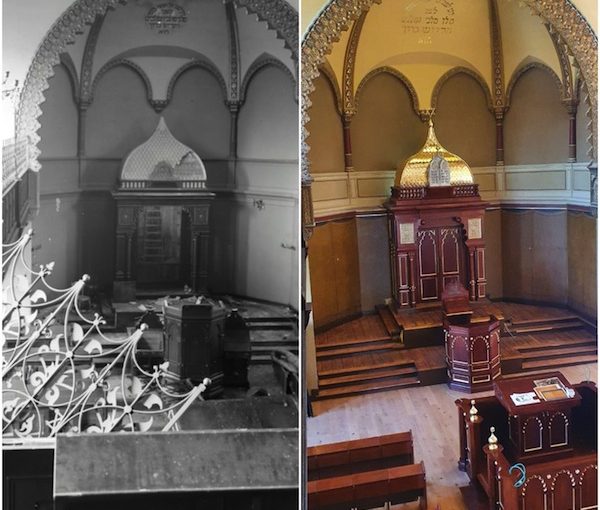
Israel’s Lavi furniture factory recreated Carlebach Synagogue’s original ark from three prewar black-and-white photos. (photo from IMP)

Viewing the restored Carlebach Synagogue in Lubeck, Germany, brings to mind the biblical prophecies of consolation, where the Jewish people are reassured that the day will come when not only will they be restored to their land, but their houses of worship will likewise be restored. Sadly, neither the shul’s rabbi nor any other of the original community members are alive today to revel in the synagogue’s reinstated glory; however, in an interesting twist, several of the rabbi’s grandchildren are the children of founding members of Kibbutz Lavi, whose furniture factory designed and built the synagogue’s ark and other holy articles.

Rabbi David Alexander Winter, rabbi of the Carlebach Synagogue, fled Lubeck in 1938, together with most of his community. Several months later, on Kristallnacht, when many of Germany’s synagogues were torched and burned to the ground, the Lubeck shul was damaged and looted, but not destroyed – the building had been sold to the municipality and the contract, signed by the rabbi, was inside the synagogue, in plain view.

For Winter’s grandchildren, seeing the restoration of their grandfather’s synagogue is especially moving. “It’s a feeling of coming full circle,” said Yehudit Menachem, who visited Lubeck last year, seeking to learn more about her family history. Dr. Ariel Romem, a pediatrician and one of the grandsons, remarked that the restoration is symbolic of the re-blossoming of the Winter family and of the Jewish people as a whole. “They may have ruined the shul, but they never succeeded in breaking us,” he said.

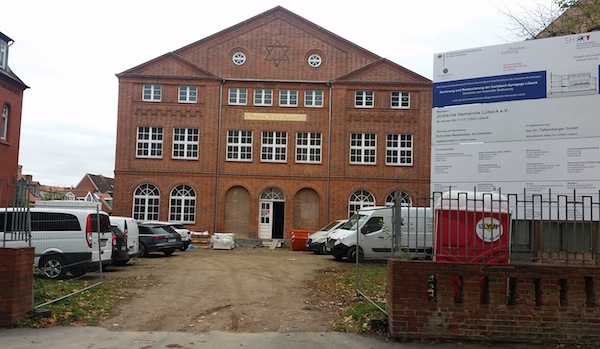
In the seven decades since the Holocaust, the once-stately synagogue, established in 1880, has suffered looting, a firebombing, squatters and general neglect. German architect Thomas Schröder-Berkentien began working on its restoration in 2010, but the project was stuck due to a lack of funding. In 2016, the federal government dedicated a sizable sum, with other funding arriving from the Schleswig-Holstein state, the Lubeck-based Possehl Foundation and UNESCO, which had declared the Old City of Lubeck a World Heritage Site. The total cost of the project amounted to almost $10 million.

Schröder-Berkentien was intent on finding the best craftspeople for the synagogue furniture, and also felt that it was only right that the furniture should come from Israel. He found the Lavi furniture factory online and, after several inquiries and a visit to the carpentry workshop along with his team, was assured that they had the necessary experience and expertise to perform the research and produce items of quality and beauty. Indeed, in its 60 years of operation, Lavi has designed and produced interiors for synagogues in more than 6,000 Jewish communities around the world, including for new and restored synagogues in Germany.

Motti Namdar, the factory’s chief planner, described the challenge, and ultimate satisfaction, of creating replicas of the original items. “We only had three prewar black-and-white photos to go by,” he explained. “The photos showed only one angle and even that was not very clear. It was difficult to make out a lot of the detailing or which metals were used, especially for the ark, which you can see from the photos is very unusual.”

Ultimately, much of Namdar’s work had to be done by deduction and a knowledge of the history of the period. “I traveled to Lubeck to see the synagogue and examine the parts that had not been damaged. Part of the ladies’ gallery was intact. The architect had hired restoration experts who carefully removed the layers of paint from the walls, exposing the original murals. The synagogue as a whole had been built in the Moorish style, and I proceeded in that direction.”

In one of the photos, it’s possible to make out the pointed roof-like structure at the top of the ark, which Namdar designed to include 1,500 “scales,” all coated in pure gold. Under Namdar’s direction, the Lavi factory completed all the articles by the deadline. “The hardest part wasn’t the tight schedule, but, rather, building everything such that it could be taken apart, packed and shipped, and then reassembled so that everything fit perfectly.”

photo - Since its restoration, Carlebach Synagogue in Lubeck, Germany, has been serving as a spiritual hub for Lubeck’s 700-strong Jewish community
Since its restoration, Carlebach Synagogue in Lubeck, Germany, has been serving as a spiritual hub for Lubeck’s 700-strong Jewish community. (photo from IMP)

But while it was clear to the craftspeople at Lavi that they wanted to produce replicas that were as authentic as possible, the project’s architect, Schröder-Berkentien, was intent that the structure itself, which was restored to be a national monument, should serve as a testament and, in his words, “like a wound,” as a painful reminder of the events of 1938. This was the reasoning behind his decision not to redo the synagogue’s original ornate façade, which, together with the cupola and other elements, had been destroyed on Kristallnacht. “The plain red brick tells the story of what happened,” he said. “A rebuilt façade would ignore that part of history, failing to show the suffering of the era. This is what makes it such a unique monument among other German synagogues.”

When news of the coronavirus pandemic first broke in January, the factory began working overtime so that everything would be ready for the gala re-inauguration, which was to have been attended by high-ranking German officials, including Chancellor Angela Merkel, members of the restoration committee and local community figures, as well as Winter’s grandchildren from Kibbutz Lavi. However, when it was finally time for the assembly and installation of the furniture, the world was already in COVID-19 lockdown. As soon as it was possible, Lavi sent their own experts from England to complete the work. Now, the synagogue stands in all its resplendent glory, but the ceremony has been postponed indefinitely.

The important thing is that the synagogue is open and operating, serving as a spiritual hub for Lubeck’s 700-strong Jewish community. “This synagogue is not only a place of prayer, but a symbol of the revival of Jewish life in Lubeck, throughout Germany and around the world,” said the current spiritual leader of Lubeck, Rabbi Nathan Grinberg.

– Courtesy International Marketing and Promotion (IMP)