
Skip to content

  • Home
  • Subscribe / donate
  • Events calendar
  • News
    • Local
    • National
    • Israel
    • World
    • עניין בחדשות
      A roundup of news in Canada and further afield, in Hebrew.
  • Opinion
    • From the JI
    • Op-Ed
  • Arts & Culture
    • Performing Arts
    • Music
    • Books
    • Visual Arts
    • TV & Film
  • Life
    • Celebrating the Holidays
    • Travel
    • The Daily Snooze
      Cartoons by Jacob Samuel
    • Mystery Photo
      Help the JI and JMABC fill in the gaps in our archives.
  • Community Links
    • Organizations, Etc.
    • Other News Sources & Blogs
    • Business Directory
  • FAQ
  • JI Chai Celebration
  • JI@88! video
image - Weizmann Canada Physics Tournament 2025
image - The CJN - Visit Us Banner - 300x600 - 101625

Recent Posts

  • היהירות היא אחד האויבים הגדולים ביותר של ישראל
  • Vrba monument is unveiled
  • Music to build bridges
  • A better future possible
  • Anne Frank exhibit on now
  • Human rights in sport
  • Telling the story of an icon
  • Crawl bigger than ever
  • JCC Maccabi in Toronto
  • A way to meet fellow Jews
  • Time to include
  • Add Jewish joy to the mix
  • Reminder of humanity’s light
  • From the archives … editorials
  • Year-round holiday recipes
  • מדוע עזבתי את ישראל ואינני חושב לחזור ארצה
  • OJC hosts Oct. 7 memorial
  • A journey beyond self
  • Antisemitism a problem
  • Young man is missed
  • Orr action sparks complaint
  • Prison sentence for hate
  • Etgar Keret comes to Vancouver
  • New fall lecture series
  • Series explores music
  • Doc on Zapiro screens Nov. 6
  • Joy of shared existence
  • Community milestones … October 2025
  • MAID vs Jewish values
  • Cheshvan a great month, too
  • Bull, bear or bubble?
  • From the archives … a coin, etc.
  • מדוע האנטישמיות הולכת וגואה בעולם
  • New bio gives Vrba his due
  • Joy brighter than ever
  • When approaches differ

Archives

Follow @JewishIndie

Tag: honey cake

Year-round holiday recipes

Year-round holiday recipes

Tori Avey’s Honey Apple Bundt Cake before being dusted with sugar powder or decorated with icing. (photo by Shelley Civkin)

Rosh Hashanah may well be in the rearview mirror, but Tori Avey’s Honey Apple Bundt Cake (toriavey.com/honey-apple-cake) is guaranteed to be a staple on your dinner table, no matter the time of year. It’s definitely not your typical yontif honey cake that doubles as a brick. Filled with shredded apples, it not only satisfies your sweet tooth but is off-the-charts moist.

Except for the apple-shredding part, which I do by hand, this recipe is fast and easy. I used to have a food processor with a shredder attachment but I never used it, so I gave it to my niece. I also used to have a Bundt pan, but I rarely used it, so I gave it to my niece. She now has an extensive collection of high-end small kitchen appliances. And I borrow from her. My point is that this cake was a colossal hit at my Rosh Hashanah dinner table, and is one recipe I’ll be making on the regular. You’re welcome.

HONEY APPLE BUNDT CAKE

3 large eggs
3/4 cup honey
1/2 cup white sugar
1/4 cup light brown sugar
1 1/4 cups canola oil
1 1/2 tsp vanilla
3 cups all-purpose flour
1 tsp baking powder
1 tsp baking soda
1 1/2 tsp cinnamon
3/4 tsp salt
1/4 tsp allspice (optional)
dash ground cloves (optional)
4 apples (peeled, cored, shredded)
3 tbsp powdered sugar

Preheat oven to 325˚F. Peel, core and shred your apples. 

In a large mixing bowl, beat the eggs until they’re frothy. Whisk in the honey, white sugar, brown sugar, oil and vanilla. In a separate medium-sized bowl, mix the flour, baking powder, baking soda, cinnamon, salt and spices (optional) together. Incorporate the flour mixture into the liquid, and stir to blend. Fold in the shredded apples (I used Ambrosia or Fuji but you can use any kind you like) and their juice.

Spray your nine-inch Bundt pan with cooking spray, making sure to evenly coat the entire inner surface. Pour the batter into the pan. Since Bundt pan sizes vary (I use a 10-to-15-cup pan), make sure the batter fills the pan three-quarters full or less – don’t fill beyond that or your cake might overflow during baking. Use a spatula to gently smooth the batter on the top so it’s flat and even all the way around the pan.

Bake the cake for 75 to 90 minutes. If you’re using a dark-coloured Bundt pan, it may bake faster, so start checking at 50 minutes. When the edges darken and pull away from the sides of the pan, and the cake is brown all the way across the top, insert a toothpick (or wooden shish kabob skewer) into the thickest part of the cake. If it comes out clean, it’s done. It’s a very moist cake, so it’s easy to undercook it. Bake it a little longer if you’re unsure, but not too long or it’ll dry out.

Let the cake cool for 10 minutes, then invert it onto a flat plate. Tap the Bundt pan gently to release the cake, then let the cake cool completely before you dust it with powdered sugar. Since the cake is moist, it tends to soak up the powdered sugar, so only add it right before serving. I put three tablespoons of powdered sugar into a small handheld mesh sieve and sprinkled it on top of the cake by tapping the sieve. If there’s any cake left over, keep it in the fridge, covered.

If you happen to be a fan of drizzled icing, this next part is for you. To make an icing, sift one cup of powdered sugar into a mixing bowl. Add a quarter teaspoon of vanilla extract and half a tablespoon of water or non-dairy creamer. Whisk the sugar and liquid to blend, adding the liquid very slowly, until it just comes together. Add additional liquid by half teaspoonfuls, mixing constantly, until the mixture has the texture of very thick honey. When you pull a spatula through the icing and it takes a few seconds for the gap to close again, the texture is right.

Pour the icing into a sealable plastic bag. Close the bag, leaving a small bit open to vent, and push the icing towards one lower corner of the bag. Cut the very tip of that corner off the bag. Squeeze gently to drizzle the icing over the cake. Let the icing dry completely before serving – this takes 30-60 minutes. Slice and enjoy!

Another new Rosh Hashanah recipe I tried convinced me that not all tzimmes are created equal. Ksenia Prints’ Russian Jewish Carrot Tzimmes (immigrantstable.com/my-grandmas-russian-jewish-carrot-tzimmes) is definitely a cut above and checks all the boxes for rich depth of flavour. Some of my Rosh Hashanah guests actually asked if they could take some home! 

RUSSIAN JEWISH CARROT TZIMMES

2 lbs carrots peeled & cut into 2-inch pieces
7 oz pitted prunes
7 oz dried apricots
zest of 2 oranges, in strips
juice of 2 oranges
4 tbsp honey
1/4 cup brown sugar
3 tbsp butter
1 tsp ground cinnamon
1/2 tsp ground ginger
1/4 tsp ground cardamom (optional)
salt to taste
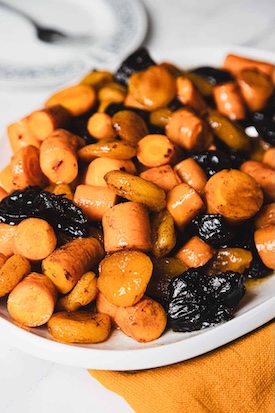
photo - Ksenia Prints’ Russian Jewish Carrot Tzimmes
Ksenia Prints’ Russian Jewish Carrot Tzimmes. (photo from immigrantstable.com/my-grandmas-russian-jewish-carrot-tzimmes)

Preheat oven to 350°F.

Blanch carrots in boiling salted water for 5 minutes, then drain.

In a large ovenproof dish, combine carrots, prunes, apricots and orange zest.

Combine orange juice, honey, brown sugar, melted butter, cinnamon, ginger and cardamom (optional), and pour this over the carrot mixture. Toss to coat. 

Cover the dish with foil and bake for 30 minutes. Remove foil, stir, and continue baking uncovered for 30 to 40 minutes, until carrots are tender and the sauce has thickened and reduced to a glaze. Season with salt to taste and let rest for 10 minutes before serving.

The orange zest strips become almost candied and the glaze is sweet and slightly spicy. This dish freezes perfectly and offers a deep, rich flavour that only gets better with time. Seriously. You can make it in advance, like I did, then defrost and reheat it in the microwave. No one was the wiser. And everyone was happy.

The $64,000 question is this: Why do we save these delicious recipes only for holidays? Get thee to the oven now!

Shelley Civkin, aka the Accidental Balabusta, is a happily retired librarian and communications officer. For 17 years, she wrote a weekly book review column for the Richmond Review. She’s currently a freelance writer and volunteer.
Format ImagePosted on November 7, 2025November 6, 2025Author Shelley CivkinCategories LifeTags Accidental Balabusta, baking, cooking, honey cake, recipes, Tzimmes
A history of sweetness

A history of sweetness

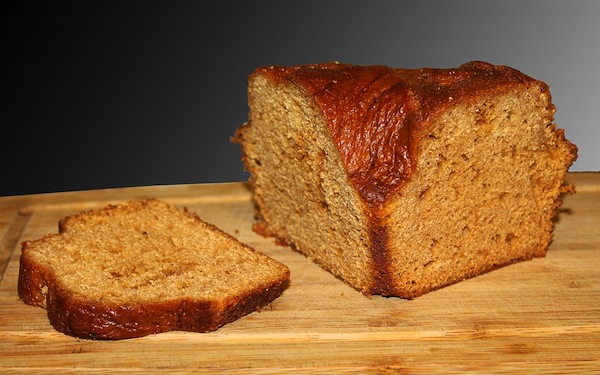
(photo from pixabay.com)

Although beekeeping as an occupation is not mentioned in the Bible, bees are mentioned four times, honeycombs are referred to eight times and honey is referred to 26 times. Archeologists actually have discovered proof that there was beekeeping and honey 3,000 years ago in a site in northern Israel.

Among Ashkenazim, sweet desserts for Rosh Hashanah are customary, particularly lekach, or honey cake, and teiglach, a hard, doughy, honey and nut cookie. Some say the origin of the sweets comes from a passage in the book of Hosea mentioning “love cakes of raisins.” There is also a passage in II Samuel, which talks about the multitude of Israel, “to everyone a cake of bread and a cake made in a pan and a sweet cake.”

It was Ezra, the fifth-century BCE religious leader who was commissioned by the Persian king to direct Jewish affairs in Judea, and Nehemiah, a political leader and cup bearer of the king in the fifth century BCE, who told the returning exiles to eat and drink sweet things.

Honey cakes traditionally include honey, spices, coffee and brown sugar as major ingredients, but some contain cognac, brandy, orange or lemon peel and nuts. In Curaçao, for example, cinnamon, ginger, nutmeg, raisins, nuts or currants, lemon or orange peel is added. In Zimbabwe, Jews include allspice, cinnamon, cloves, raisins, chopped nuts, brandy and chopped candied fruit in their honey cake.

In That Hungarian’s in My Kitchen, Linda Radke includes a Hungarian recipe from her family, which includes the basic ingredients and orange juice. A cookbook of Russian recipes includes a Ukrainian honey cake, medivik, with the basic ingredients as well as cardamom, orange peel, raisins, walnuts and apricots.

In The Jewish Book of Food, Claudia Roden writes that honey cake was a favourite in Germany as far back as the Middle Ages, and that lebkuchen, honey gingerbread, was also mentioned as early as the 12th century.

According to John Cooper in Eat and Be Satisfied: A Social History of Jewish Food, references to honey cake were made in the 12th century by a French sage, Simcha of Vitry, author of the Machzor Vitry, and by German rabbi Eleazar Judah ben Kalonymos. Cooper writes that, on the new moon in the month of Nissan, boys at Jewish school were given honig lekach, honey cake: “Originally, the names of angels were inscribed on the honey cake and amulets were attached to them, but later this practice was discarded.” According to Cooper, the words lebkuchen and lekach probably came to be related to the German word for lick, lecke.

By the 16th century, lekach was known as a Rosh Hashanah sweet. It also became popular for other lifecycle celebrations, such as betrothals and weddings. Malvina W. Liebman writes in Jewish Cooking from Boston to Baghdad that Crypto-Jews in 16th-century Latin America ate honey cake at weddings, in memory of the honeycomb that an angel gave to Asenath when she married Joseph.

In The Complete International Jewish Cookbook, Evelyn Rose (z”l), a maven of Jewish cooking from England, wrote that the first cakes made with artificial raising agents were honey cake, and honey was the chosen sweetener because sugar was not widely available until the end of the 19th century. As an aside, she also recommends keeping a honey cake in a closed container for a week before serving it, so it will “mature.”

Among the Chassidim, it was customary for the rebbe to distribute lekach to his followers, and others would request a piece of honey cake from one another on Erev Yom Kippur. This transaction symbolized a substitute for any charity the person might choose to receive.

Gil Marks (z”l), in The World of Jewish Desserts, says fluuden, a layered yeast cake, was traditional for Rosh Hashanah among Franco-German Jews. Made with a cheese filling, it could be eaten after a meat meal, since they only waited one hour between meat and dairy. Strudel, from the German word for whirlpool, was also common for Rosh Hashanah among European Jews.

The most traditional cookie for Rosh Hashanah is teiglach, the dough pieces dropped into a hot honey syrup and simmered until brown then left to cool. It has been suggested that this Eastern European sweet was probably invented by some housewife who had dough left over and dropped the pieces into a boiling honey syrup.

Many Jews of Sephardi background make tishpishti for Rosh Hashanah. This cake with walnuts, almonds, hazelnuts or pecans, has a hot syrup poured over it. The syrup can be made with sugar, water and liqueur, according to Rabbi Robert Sternberg in The Sephardic Kitchen. Sternberg also points to rodanchas as a popular Sephardi Rosh Hashanah sweet. These spiral-shaped pastries of phyllo dough contain a pumpkin or squash filling because these vegetables and their shape symbolize the cycle of life and the ascent of the soul into heaven.

Here are some honey cakes to try this year.

TISHPISHTI
Jews who lived in Turkey after being expelled from Spain in 1492 adopted this dish, whose name means “quick and done.” Some say it was always served on Rosh Hashanah, but it was also popular for Passover because it has no flour.

2 cups ground almonds, hazelnuts, pistachios or walnuts
1 cup cake meal
1 tsp ground cinnamon
1/2 tsp ground cloves or allspice
6 separated eggs
1 cup sugar
2 tbsp orange juice
1/2 cup vegetable oil
1 tbsp grated lemon or orange peel
* * *
3/4 cup honey
1/2 cup sugar
2/3 cup water
1/4 cup lemon juice

  1. Preheat oven to 350°F. Grease a rectangular baking pan.
  2. In a mixing bowl, combine nuts, cake meal, cinnamon and cloves or allspice.
  3. In another bowl, beat egg yolks with sugar. Add to nut mixture along with orange juice, oil and lemon or orange peel.
  4. Beat egg whites in another bowl until stiff. Fold into batter. Pour into cake pan and bake 45 minutes.
  5. Place honey, sugar, water and lemon juice in a saucepan. Stir until sugar dissolves. Increase heat, bring to a boil and cook for one minute. Let cool.
  6. Cut cake into squares or diamonds. Drizzle syrup over cake. Serve warm or at room temperature.

MOM’S HONEY LOAF CAKE
I don’t recall my mom baking this, but it was in my collection of recipes as being hers.

3 1/2 cups flour
1/4 tsp salt
1 1/2 tsp baking powder
1 tsp baking soda
1/2 tsp ground cinnamon
1/8 tsp ground cloves
1/2 tsp ground ginger
1/4 tsp ground nutmeg
4 eggs
3/4 cup sugar
1/4 cup vegetable oil
* * *
2 cups honey
1/2 cup strong coffee
1/2 cup raisins
1/2 cup chopped nuts

  1. Preheat oven to 325°F. Grease two loaf pans or a rectangular baking pan.
  2. Combine in a bowl flour, salt, baking powder, baking soda, cinnamon, cloves, ginger and nutmeg.
  3. Beat eggs and sugar in another bowl until fluffy. Add oil, honey and coffee.
  4. Stir in flour mixture. Add raisins and nuts. Pour into pans. Bake for 1.5 hours.

Sybil Kaplan is a journalist, lecturer, book reviewer and food writer in Jerusalem. She created and leads the weekly English-language Shuk Walks in Machane Yehuda, she has compiled and edited nine kosher cookbooks, and is the author of Witness to History: Ten Years as a Woman Journalist in Israel.

Format GalleryPosted on September 11, 2020September 10, 2020Author Sybil KaplanCategories Celebrating the HolidaysTags food, history, honey cake, recipes, Rosh Hashanah, tradition
Proudly powered by WordPress