
Skip to content
  • Home
  • Subscribe / donate
  • Events calendar
  • Business Directory
  • FAQ
  • News
    • Local
    • National
    • Israel
    • World
    • עניין בחדשות
      A roundup of news in Canada and further afield, in Hebrew.
  • Opinion
    • From the JI
    • Op-Ed
  • Arts & Culture
    • Performing Arts
    • Music
    • Books
    • Visual Arts
    • TV & Film
  • Life
    • Celebrating the Holidays
    • Travel
    • The Daily Snooze
      Cartoons by Jacob Samuel
    • Mystery Photo
      Help the JI and JMABC fill in the gaps in our archives.
  • Community Links
    • Organizations, Etc.
    • Other News Sources & Blogs
  • JI Chai Celebration
  • JI@88! video

Recent Posts

  • Legal help for students
  • Revisiting myth of Lilith
  • Wrong person rebuked
  • Canada’s mixed messages
  • Questions for museum
  • Symposium on antizionism
  • Making soccer political
  • CJPAC lauds Pulver’s impact
  • City recognizes Vrba’s legacy  
  • Organ donation saves lives
  • Theodore’s March premiere
  • A healing Shabbaton
  • Supplying healthy food
  • A chime of metal tags
  • Yellowknife seder a first
  • Ishai energizes, unifies
  • A Lag b’Omer to remember
  • Expanding the healing
  • Hannah Senesh – a unique hero
  • Community milestones … May 2026
  • Sharing her testimony
  • Fall fight takes leap forward
  • The balancing of rights
  • Multiple Tony n’ Tina roles
  • Stories of trauma, resilience
  • Celebrate our culture
  • A responsibility to help
  • What wellness means at JCC
  • Together in mourning
  • Downhill after Trump?
  • Birth control even easier now
  • Eco-Sisters mentorship
  • Unexpected discoveries
  • Study’s results hopeful
  • Bad behaviour affects us all
  • Thankful for the police

Archives

Follow @JewishIndie
image - The CJN - Visit Us Banner - 300x600 - 101625
photo - An aerial photo of the remains of a 3,200-year-old Canaanite fortress built near today’s town of Kiryat Gat

3,200-year-old fortress now open to public

0 Flares 0 Flares ×

An aerial photo of the remains of a 3,200-year-old Canaanite fortress built near today’s town of Kiryat Gat. (photo by Emil Aladjem/IAA via Ashernet)

The Kiryat Gat fortress site, which was opened to visitors this week, was prepared by the Israel Antiquities Authority (IAA) and Jewish National Fund (KKL).

According to archeologists Saar Ganor and Itamar Weissbein of the IAA, “The fortress we found provides a glimpse into the geopolitical reality described in the Book of Judges, in which the Canaanites, Israelites and Philistines are fighting each other. In this period, the land of Canaan was ruled by the Egyptians and its inhabitants were under their control. During the 12th century BCE, two new players entered the game: the Israelites and the Philistines. This led to a series of violent territorial disputes. The Israelites settled in non-fortified settlements at the Benjamin and Judean mountains. Meanwhile, the Philistines accumulated power in the Southern Coastal Plain and established cities such as Ashkelon, Ashdod and Gat in an attempt to conquer more areas. The Philistines confronted the Egyptians and the Canaanites on the borderline, which probably passed at the Guvrin River, between the Philistine kingdom of Gat and the Canaanite kingdom of Lachish. It seems that the Galon fortress was built as a Canaanite/Egyptian attempt to cope with the new geopolitical situation. However, in the middle of the 12th century BCE, the Egyptians left the land of Canaan and returned to Egypt. Their departure led to the destruction of the now-unprotected Canaanite cities – a destruction that was probably led by the Philistines.”
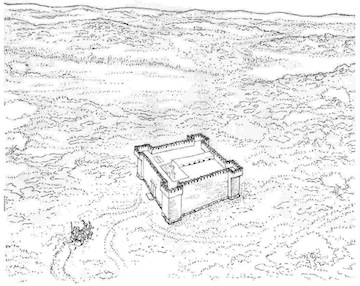
image - A drawing of what the fortress probably looked like
A drawing of what the fortress probably looked like. (drawing by Itamar Viskin/IAA via Ashernet)

The dimension of the fortress is 18 metres square and watchtowers were built in the four corners. A threshold, carved from one rock weighing around three tons, was preserved at the entrance of the building. Inside the fortress was a courtyard paved with stone slabs and featuring columns in the middle. Rooms were constructed on both sides of the courtyard. Hundreds of pottery vessels, some still whole, were found in the rooms.

The remains of the fortress were uncovered with the help of students from the Israel studies department at Be’er Sheva’s Multidisciplinary School, students from the Nachshon pre-military preparatory program and other volunteers. This was done as part of the IAA’s policy to bring the general public, and especially the younger generation, closer to archeology.

Print/Email
0 Flares Twitter 0 Facebook 0 Google+ 0 0 Flares ×
Format ImagePosted on August 28, 2020August 27, 2020Author Edgar AsherCategories IsraelTags archeology, education, history, IAA, Israel, Israel Antiquities Authority, Jewish National Fund, JNF, Kiryat Gat, tourism

Post navigation

Previous Previous post: Thank you to all who contributed to the Aug. 28/20 issue!!!
Next Next post: Community milestones … JFS chosen for challenge, Krajden appointed OBC, Micner ordained
Proudly powered by WordPress