On International Holocaust Remembrance Day, Jan. 27, the Vancouver Holocaust Education Centre (VHEC) and the Walrus Lab launched The Hidden Holocaust Papers: Survival. Exile. Return.The six-part documentary podcast, hosted by best-selling Canadian author Timothy Taylor, offers a personal exploration of his family’s hidden Holocaust history.
Through the series, VHEC furthers its mission of Holocaust education and remembrance by supporting stories that bring the realities of the Holocaust to new audiences. Taylor’s journey of discovery is not only an act of personal reconciliation but also a vital contribution to preserving the memory of Holocaust victims and survivors for future generations.
As Taylor unpacks long-forgotten family archives, the series takes listeners on an emotional journey from his home in Vancouver to Germany, revealing a tapestry of stories about survival, resilience and loss. Alongside his search for answers, Taylor reflects on the universal lessons of justice, remembrance and identity in the face of historical atrocities.
“The Holocaust isn’t just a chapter in history – it’s a call to action to remember, educate and prevent future acts of hatred and genocide,” said Hannah Marazzi, acting executive director of VHEC. “We are honoured to work with Timothy Taylor to amplify his family’s story and underscore the importance of safeguarding these narratives.”
In conjunction with the podcast, Taylor’s accompanying feature article, “Paper Trail,” will be published in The Walrus in May; it was made available online on Jan. 27. The article is an account of Taylor’s journey to instal Stolpersteine memorial stones for his family members who suffered under Nazi persecution.
The new historical novel by Vancouver writer David Spaner, Keefer Street, is as much about the idea of Keefer Street as it about the real East Vancouver avenue. This is appropriate, because the book is a reflection on the Spanish Civil War and its Canadian, especially its Jewish, volunteers. For the dead and the survivors, the war was a living hell. But for the survivors and anyone else with a direct or inherited memory of the 1936-39 conflagration, it is an idea. It has been called the Last Great Cause – and that is the underpinning of Spaner’s story.
Spaner takes part in the Feb. 26 JCC Jewish Book Festival event Jewish Fiction from Western Canada, in which Saskatchewan writer Dave Margoshes (A Simple Carpenter) is also featured.
Keefer Street toggles back and forth between the Spanish Civil War and a 1986 reunion of fighters and hangers-on (with occasional detours to family vignettes in other eras and areas). The storyline follows veterans of the Mackenzie-Papineau Battalion, the ragtag Canadian volunteers who made their way to Spain in direct defiance of their own government, joining American volunteers of the Abraham Lincoln Battalion, as well as French, Poles and others signing on in a pre-Second World War proxy against Hitler and Mussolini and their Spanish incarnation, Francisco Franco.
The narrator, Jake Feldman (later Jack Fields), is a Mac-Pap from the neighbourhood – that is, the Strathcona area of East Vancouver, specifically Keefer Street, where waves of immigrants have planted their first roots in Canada. By the time we join Feldman’s spirited (if predictably stereotypical) Jewish family, Strathcona’s Jews have already begun moving to the Oak Street corridor and its environs, but the Jewish element remains prominent among the multicultural milieu of the area.
Spaner, who has written extensively about Vancouver’s left-wing (see Solidarity: Canada’s Unknown Revolution of 1983, jewishindependent.ca/history-of-left-coast), list-ticks a raft of momentous and minor Vancouver signposts and events, including Stanley Park’s hollow tree, the Sylvia Hotel’s Jewish roots, the lost, lamented Woodward’s flagship department store, Theatre Under the Stars (still going), Eastside firebrand Rose Barrett and her boy Dave, the Carnegie Library turned Downtown Eastside community centre, and the blacklisted singer Paul Robeson singing at the Peace Arch for binational audiences.
Obscure local trivia is also tucked into the pages. The Industrial Workers of the World got their nickname Wobblies here in Vancouver. David Oppenheimer, Bavarian Jew, became the city’s second mayor and has an eponymous park in the Downtown Eastside where the fictional Feldman family frolics. Local gal Sadya Marcowitz became Mary Livingstone and married Jack Benny, going on to become a major radio star.
More momentous local events are introduced, including the On-to-Ottawa Trek, the 1935 Ballantyne Pier riots and the upheaval around the visit of the Nazi warship Karlsbad earlier that year.
The life of Jake/Jack takes on a bit of a Forrest Gump feel with his uncanny ability to be in the right place at the right time, such as when he just happens to be watching an amateur baseball game in Toronto when Nazis descend in what we know now as the infamous antisemitic (and anti-antisemitic counteroffensive) Christie Pits riots.
Keefer Street is sometimes a didactic (perhaps necessarily, given the times) 101 on antisemitism in Canada, including Toronto’s Swastika Club and Quebec’s philo-fascist Adrien Arcand.
The flashbacks feature the parents’ hardscrabble migrant experience and their engagement in the shmata and fur trades, as well as the moderately idyllic life of Vancouver kids and teens in the 1930s. Apparently before the advent of Netflix, something called “shooting pool” was a popular pastime.
Hindsight allows Jake to reflect on the legal proscriptions against enlisting with a foreign militia, then the socialostracism on their return due to the associations of Spanish partisans with communism, then McCarthyism, then the apathy and ignorance of the Me Generation and its aftermaths, in which successive generations don’t know the role the Spanish Civil War or its belligerents played in 20th-century history.
The 1986 reunion allows for the exploration of the emotions of former fighters, wondering what their impacts were and what their lives have become.
Jews played a major role in the Spanish Civil War, as Keefer Street’s central protagonists demonstrate. This was understandable as a first military salvo against fascism, but Spaner illuminates another massive historical consonance that may be overlooked.
“Along with everything else the Civil War stood for, it meant a Jewish return to Spain after centuries in exile,” says one of the characters at the reunion. “During the Spanish Inquisition of the 15th century, the country’s considerable Jewish population, though it had lived there for eons, was given the choice of conversion or expulsion. Many were expelled. In the 1930s, Jews returned to Spain, volunteering in disproportionately large numbers – over half of the American nurses, for instance, from a country three-point-something percent Jewish. One personal note. In 1937, I crossed the same ocean going to Europe that my parents had fled across, coming from Europe just a generation earlier. My parents fled the barbarism of pogroms, inquisitions. I came back to fight it.”
Says Spaner through his character Jake: “Funny how a short time can define a lifetime. For a lot of the volunteers, the Spanish Civil War years are the big memory but, when you think about it, the war lasted less than three years. I was there about a year-and-a-half and so much of it’s a blur.”
A photograph of Gen. Lewis Cass taken by Mathew Brady, circa 1860-65. In 1837, Cass dropped the anchor of the USS Constitution off Jaffa. (photo from US National Archives and Records Administration)
President Donald Trump’s unconventional proposal on Feb. 5 to annex the Gaza Strip isn’t the first time the United States has expressed territorial ambitions in the Middle East.
In 1837, Gen. Lewis Cass (1782-1866) dropped the anchor of the USS Constitution, “Old Ironsides,” off Jaffa. (Until British dynamite cleared the rock-strewn harbour in the 1920s, rowboats connected the port with the ships anchored offshore.) Together with several US Navy officers, Cass proceeded inland, planning to survey the uncharted Dead Sea – the lowest point on earth – but the poorly equipped mission was a failure. Ill from sunstroke and dehydration, the sailors barely managed to return to their vessel alive.
A decade later, Lieut. William Francis Lynch (1801-1865) of the US Navy led a better-provisioned 17-man expedition to explore the Jordan River and Dead Sea. Camels hauled the prefabricated boats specially manufactured of copper and galvanized iron overland from the Mediterranean Sea to Lake Kinneret (Sea of Galilee). Lynch then ventured down the Jordan River, which is a creek by most standards. In tandem, a party proceeded on land. The mission mapped the Jordan’s hitherto unknown 27 rapids and cascades. Though it is only 100 kilometres from the freshwater Lake Kinneret to the Dead Sea, the Jordan River’s winding course was 322 kilometres long. Lynch described the Jordan as unsuitable for navigation, calling it “more sinuous even than the Mississippi.”
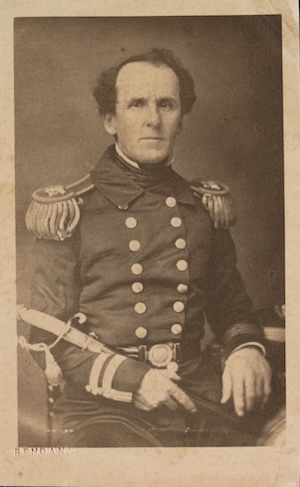
Lieut. William F. Lynch, circa 1861-62. In the mid 1800s, Lynch led a 17-man expedition to explore the Jordan River and Dead Sea. (photo from Naval History and Heritage Command Photograph Collection, NH 367)
While advancing “the cause of science,” Lynch was also at “the service of American commerce with the region.” He reported “an extensive plain, luxuriant in vegetation and presenting … a richness of alluvial soil, the produce of which, with proper agriculture, might nourish a vast population.”
While Congress shelved Lynch’s report recommending colonization, it helped spark the United States’s fascination with the Holy Land – and led to the establishment of American colonization projects in Jaffa and Jerusalem.
At Tel Aviv’s south end is a cluster of wooden clapboard buildings straight out of New England known as the American Colony. The story begins shortly after the American Civil War: on Aug. 11, 1866, 157 members of the Palestine Emigration Colony – including 48 children under the age of 12 – set sail from Jonesport, Me., for Jaffa on the newly built, three-masted vessel USS Nellie Chapin.
George Jones Adams (1811-1880), leader of the 35 New England families, hoped to develop the Land of Israel in preparation for the biblically prophesized return of the Jews. This would hasten the second coming of the Christian messiah. Adams had been a follower of the Mormon Church, but quit the religion following the assassination of Mormon founder Joseph Smith in 1844. Most of the congregants of the Church of the Messiah that Adams founded lived in Maine.
Departing the United States, Adams stated: “We believe the time has come for Israel to gather home from their long dispersion to the land of their fathers. We are going [to Jaffa] to become practical benefactors of the land and people, to take the lead in developing its great resources.”
Proto-Zionists, their purpose was not to missionize but to assist the Jewish people in returning to their ancestral land. However, though equipped with the latest agricultural tools, 22 pre-fab houses and religious fervour, the colonists’ mission was doomed. Arriving in Jaffa, they learned that Adams had not yet purchased the land on which they planned to settle. Instead, they pitched their tents on the beach near a cemetery where the victims of a recent cholera epidemic were buried. Within six months, 22 of the 157 settlers, including nine children, were dead.
Disease was not the settlers’ only problem. After finally buying the property for their neighbourhood, the first outside of Jaffa’s Ottoman ramparts – Tel Aviv would only be founded 43 years later, in 1909 – the pioneers quickly learned that farming in the arid Middle East was nothing like agriculture in rainy New England.
Facing starvation and soaring mortality, Adams sought solace in alcohol. Within two years after their arrival, all but two dozen or so members of the American Colony had returned to the New World. Their buildings were sold to newly arrived German evangelical Christians. Known as Templars, the Germans developed seven colonies across Palestine until being arrested by the British in 1939 as Nazi sympathizers. They were deportedto Australia or sent back to the Third Reich in prisoner exchanges.
Among the Americans who remained was Rolla Floyd (1832-1911), a pioneer of Israel’s tourism business. In 1869, he opened the stagecoach service from Jaffa to Jerusalem on the newly paved road. The journey from the coast to the mountains took 14 hours: today’s high-speed train covers the same distance in 29 minutes, with a stop at Ben-Gurion Airport.
The Maine settlers were not forgotten, thanks to Reed Holmes: in 1942, the historian met an elderly woman who had been 13 when the Nellie Chapin dropped anchor. After four decades of research, Holmes published The ForeRunners. Around the same time, he organized a tour of Israel. Among the participants was Jean Carter, a licensed contractor from Massachusetts. Touring the former American Colony, she was aghast to learn that the decrepit, historic wooden houses were about to be torn down.
Raised in a Protestant church, Carter had a master’s degree in Jewish studies and was fluent in Hebrew. She persuaded the Israeli government to declare the former colony a heritage site, received a promise that any structure that could be preserved would be spared demolition, and got the Tel Aviv municipality to erect a plaque on the beach where the Maine colonists had landed.
Holmes and Carter fell in love and eventually married. In 2002, they purchased Wentworth House – one of the remaining American Colony buildings. With the help of specialists in 19th-century building preservation techniques from Maine, the couple spent two years restoring the ruin and removing later additions. Today restored as the Maine Friendship House, it houses a museum about Jaffa’s American Colony.
The Holmes, who live in Peace Valley, Me., were honoured in 2004 by the Maine Preservation Society – the first time the group recognized a project outside of New England.
Unrelated to Jaffa’s American Colony is a Jerusalem settlement of the same name. The eponymous luxury hotel where foreign journalists like to belly up to the bar was founded in 1881 as a commune – Israel’s first kibbutz – by members of a Protestant utopian society led by Horatio Spafford of Chicago (1828-1888), who penned the Evangelical hymn “It Is Well With My Soul.”
Spafford and his wife Anna (1842-1923), together with a group of 14 adults and five children, expected Jesus’s second coming imminently. While waiting, the members of the pietistic settlement of Yankees and Scandinavians served the Holy City’s many destitute by opening soup kitchens, hospitals, orphanages and other charitable ventures.
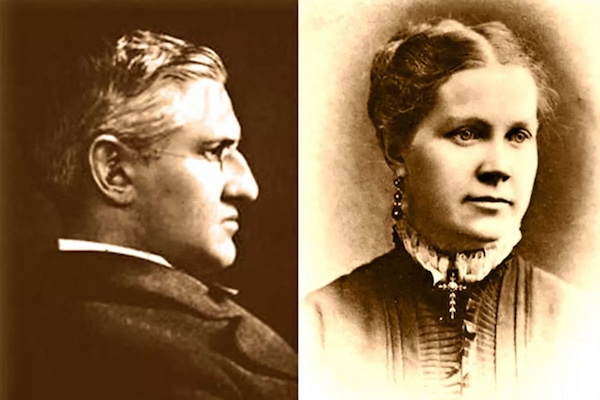
Horatio Gates Spafford and Anna Spafford, circa 1873. In 1881, a Protestant utopian society led by Horatio Spafford founded the American Colony in Jerusalem. (photos from Manuscript Division, Library of Congress)
Much of that charity was funded by the American Colony Photo Department, which became the community’s primary income. Many of those early images fall into the category of Orientalism, for which the West had a seemingly insatiable appetite. But part of that artistic achievement was due to fortuitous timing – the colony’s photographers began operating at a time when tourism to the Holy Land, especially from America and Europe, was beginning en masse.
Moreover, “with the advent of halftone printing in the 1880s, images were now becoming more accessible to the public via printed matter – books, magazines and newspapers – where they were now reproduced alongside text,” notes Tom Powers in his 2009 work Jerusalem’s American Colony and Its Photographic Legacy. (Before that, photographs could only be pasted into books by hand, as individual prints.)
A third factor was getting off to a good start, thanks to plain luck. The first sizeable project of the American Colony documentarians was the1898 state visit of Imperial Germany’s Kaiser Wilhelm II and Empress Augusta Victoria to the Holy Land.
Interested in seeing the American Colony Photo Department’s 22,000 historic photographs archived at the Library of Congress in Washington, DC? Visit loc.gov/pictures/collection/matpc/colony.html.
History is fickle. Who becomes known as great in their field, whose work is displayed in museums or taught in schoolbooks? When there is a tangible product – a building, a painting, a book, whatever – the chances seem higher that you’ll be remembered. But what if you were mainly a muse to others, what if you could enthrall audiences with your voice but never recorded an album, if you created works of art that people liked and even bought, but you didn’t create in the popular style of the day, or you were a woman in a man’s world?
Most readers will not have heard of Kiki de Montparnasse, born Alice Prin in 1901, in Châtillon-sur-Seine, about 240 kilometres southeast of Paris, to an unwed mother who wasn’t much into mothering. But most would likely recognize her – she modeled for many an artist (Alexander Calder, Tsuguharu Foujita, Amedeo Modigliani, to name a few, as well as Maurice Mendjizky, with whom she fell in love for awhile). And, during her seven-year relationship with surrealist photographer Man Ray (who thought himself more of a painter), she posed for him many a time. In 2022, one of Ray’s most famous images of her, called “Le Violon d’Ingres,” sold for $12.4 million, the most expensive photograph ever sold at auction.
Yet, what of her own work, her talents, her accomplishments?
Cultural historian Mark Braude gives Kiki her overdue due with his latest book, Kiki Man Ray: Art, Love and Rivalry in 1920s Paris, which Braude will discuss with University of British Columbia professor emeritus of history Chris Friedrichs at the JCC Jewish Book Festival on Feb. 24, in an event called Art & History: Paris, Jews and Surrealism.
While Kiki wasn’t Jewish, so many of the artists she hung out with were, including, of course, Ray, who was born Emmanuel “Manny” Radnitzky. If she hadn’t lived among the who’s who of Dada and Surrealist art, perhaps she wouldn’t have been overshadowed, mostly forgotten. She was a commanding performer, she sold at least a few dozen paintings, wrote a memoir, appeared in films. By all accounts, a success. But, as “Queen of Montparnasse,” the early-1900s bohemian paradise in Paris, Kiki lived on the more wild side. Addiction would speed along her end – she died in 1953, only 51 years old. Another reason, perhaps, that her legacy was not as lasting.
As much as Braude’s account is about Kiki, it is about the time in which she lived and the people among whom she lived. Because, “as she experienced her era and channeled that experience into her art, Kiki shared drinks and cigarettes and ideas with many of the people who would shape how their century saw and thought and spoke: Modigliani, Stein, Picasso, Barnes, Matisse, Guggenheim, Calder, Duchamp, Breton, Cocteau, Flanner, Hemingway,” writes Braude. “And Man Ray, whose emergence as a modern artist must be understood as intimately linked to her own.”
While Kiki may not have left much physical evidence behind of her influence, it doesn’t mean she wasn’t influential. Living as she did, with whom she did, Braude writes: “Evolving in concert with them, watching them become who they were, challenging them and joking with them, working with them and through them, Kiki, too, played her role in shaping the cultural history of the past hundred years.”
Braude’s book is not only a fascinating read, but a reminder that none of us is insignificant. Even if our names are lost to history, we matter, we impact others and the world around us.
Anthony Santiago, at front, plays Fagin in Gateway Theatre’s production of Oliver!, which runs until Jan. 4. (photo by David Cooper)
Charles Dickens wrote Oliver Twist in 1837. His eponymous main character, an 11-year-old orphan, has the audacity to ask for more when the workhouse daily gruel is handed out, leading to a series of events that change his life forever. And local audiences will be asking for more, more, more of Gateway Theatre’s offering of Oliver!, the musical “freely adapted” from Dickens’ novel by Lionel Bart, which plays until Jan. 4.
A beloved classic, the 1968 screen adaptation of Oliver! won the Academy Award for best picture of the year. A revival of Bart’s work is currently playing in London’s West End to widespread acclaim. I predict the same for this production.
The story revolves around Oliver’s journey through the gritty underworld streets of Victorian London, from being an impoverished orphan sold to apprentice a cruel undertaker, to his secondment to a gang of street urchins under the tutelage of Fagin “the Jew” and, finally, a reunion with his well-to-do family.
Community member Josh Epstein ably directs his 24-person cast, a superb mix of professional and amateur actors (including 11 children), as they enthusiastically sing, dance and cavort their way across Ryan Cormack’s handsome set.
On the dark side of the original story is Dickens’ portrayal of Fagin as a venal, sinister, petty criminal who runs a den of adolescent thieves, teaching them to pick the pockets of London’s elite. Dickens refers to Fagin as a Jew more than 250 times, mostly in a negative way. He defended his choice by stating that he was just reflecting the reality of the time – that London underworld criminals were almost invariably Jewish. Some say he based the character on Ikey Solomon, a notorious Jewish fence. Over the years, consistently called out by Jewish community members for antisemitism, Dickens eventually apologized and edited out the negative references. Bart, who is Jewish, downplayed any stereotypes of Fagin in his rewrite.
In Gateway’s production, you would not even know that Fagin, played by Anthony Santiago, is Jewish, although, in his one solo, “Reviewing the Situation,” the klezmer-inspired clarinet accompaniment hints at a connection. Even as Fagin salivates over his cache of jewels, overall, he comes across as a lovable rogue, not the sleaze Dickens originally described. On opening night, I asked Epstein about this characterization. “I did not want to make a Jewish caricature of him,” said Epstein. “I wanted the show to be something entertaining and deep without that aspect.”
While this is truly an ensemble production, a number of actors stand out. Many of the veterans take on multiple roles, gliding effortlessly from one to the other.
Miranda MacDougall, who can really belt out a song, does double duty as Nancy, one of Fagin’s accomplices, a kind-hearted strumpet, and Mrs. Sowerberry, the undertaker’s wife. She also carries off a pretty good Cockney accent.
Tanner Zerr plays Nancy’s churlish beau Bill Sykes, whose cruelty leads to murder and his ultimate demise. One wonders what Nancy sees in this violent partner and why she stays with him. The answer comes in her poignant rendition of “As Long As He Needs Me,” which brought tears to my eyes. Zerr also doubles as Mr. Sowerberry in a very funny funeral scene and chorus line dance, including a spry corpse – Kate Malcic.
Santiago is simply fantastic as Fagin. Lucas Gregory as the Artful Dodger, the leader of Fagin’s gang, has a very physical role, as he slides down poles and climbs up and down ladders. I hope he can make it through the three-week run without an injury.
Then, of course, there is Rickie Wang as Oliver. Wang gives a sublime performance and showed his singing talent with “Where is Love?”
More minor characters, Victor Hunter, as Mr. Bumble, the beadle, and Cecilly Day, as Widow Corney, delight in a raunchy two-hander that had the audience in stitches. Daniel Curalli plays Mr. Brownlow, who turns out to be Oliver’s uncle, with the appropriate gravitas, and Suani Rincon does a nice job as Bet,
Nancy’s friend. All the gang kids, from the tallest to the smallest, are great and perform with gusto.
A musical of this scope is nothing without the behind-the-scenes work of the creative team. In this production, they really deliver.
Cormack’s industrial two-storey wrought-iron set constantly revolves, morphing from a workhouse to Fagin’s hideout to a posh London salon to London Bridge. Frenetic activity accompanies each revolution with various cast members running to and fro.
Lighting designer Sophie Tang’s rich colours infuse the various sets, providing the mood for each scene.
The costumes of Donnie Tejani authentically reflect the Victorian era – the rustling petticoats of the ladies, the tattered frocks and knickers of the children’s gang, Fagin’s patchwork overcoat, and fancy waistcoats and trousers for the gentlemen.
Against the backdrop of all of these designs, choreographer Nicol Spinola gets her young charges hoofing away to musical director Sean Bayntun’s impressive six-piece orchestra. With iconic songs like “Food, Glorious Food,” “Consider Yourself One of the Family” and “Oom Pa Pa,” what’s not to like?
My only complaint is that the hidden orchestra often overpowers the actors (although they are all wearing microphones) so that many of the lyrics are lost. Hopefully, over the course of the run, this will be corrected.
In program notes Epstein remarks: “Directing Oliver! has been an incredible opportunity to reimagine a story that has resonated for generations. While it’s a tale of resilience and hope, it also confronts the harsh realities of poverty, abandonment, and the search for belonging. For this production, we’ve worked to see the story through Oliver’s eyes, capturing the vivid and fantastical way children remember moments.
“This isn’t a softened version of Oliver!, it’s raw, unflinching, and a true dark fairy tale. It’s a story about finding light in the darkest places and holding onto hope when it feels out of reach.”
I highly recommend this delightful musical, suitable for ages 10 and up. Tickets can be purchased at boxoffice@gatewaytheatre.com or by calling 604-270-1812. Special performances include VocalEye audio description for guests withvisual impairments (Dec. 28) and a relaxed performance (Dec. 21).
Tova Kornfeldis a Vancouver freelance writer and lawyer.
Kelley Korbin, left, and Trilby Smith honour Bernie Simpson, who has been a longtime staunch supporter of Camp Miriam, which he attended, starting in the mid-1950s. (photo by Adi Keidar)
Hundreds gathered Dec. 7 to mark 75 years of Camp Miriam. Generations of campers convened at the Jewish Community Centre of Greater Vancouver for an emotion-packed reunion of alumni and friends, in which the Habonim Dror-affiliated Labour Zionist camp was fêted for having an outsized impact on building British Columbia’s Jewish community.
The celebration actually marked 76 years since the beginning of the camp, but the event, originally scheduled for last year, was postponed as a result of the Oct. 7, 2023, terror attacks.
Some of those who have strengthened Camp Miriam in recent years were honoured at the celebration.
Sam Bernofsky paid tribute to Leah Levi, who retired after 17 years as camp registrar, in 2023, but continues her involvement as bookkeeper and keeper of institutional memory. She received an ovation and video-recorded greetings from alumni and friends.
Trilby Smith and Kelley Korbin honoured Bernie Simpson who, among other contributions, has ensured that camperships are available for all who need them, guaranteeing that finances are never a barrier to participation. Simpson also nurtured relationships with non-Jewish supporters of the camp, including former BC Supreme Court Justice Angelo Branca, and former Speaker of the House of Commons John Fraser, both now deceased. Through fundraising and personal contributions, Simpson is credited with playing a core role in every capital project the camp has completed in recent decades. He is also Camp Miriam’s unofficial historian and archivist.
Speaking to the Independent, Simpson credited Camp Miriam (along with his wife, Lee) for every success in his life, including his time as a member of the BC legislature.
“It means everything to me,” Simpson said of the camp, which he began attending in the mid-1950s. “It probably shaped my whole life. The Habonim leadership at that time, which was the camp leadership, took me under their wing. I came from quite a disturbed home and they had lots of patience for me and they ended up being my life.
“They had time for a shmuck like me,” he said. “That was remarkable. But I’m not the only person.”
Alan Tuffs was being physically abused in his home, Simpson said. The head of the Jewish welfare agency, Jessie Allman, called Simpson up and asked if Camp Miriam would “take this boy.”
Tuffs went on to study Judaism in Israel and recently retired as a rabbi in Hollywood, Fla., after 45 years.
Shalom Preker was another Miriam success story, according to Simpson, having overcome challenges to become a PhD and a global expert in health financing. Preker has served in senior roles at the World Bank and the International Finance Corporation, focused on the health sector in developing countries.
Pioneers of the movement – often kids themselves at the time – were remembered throughout the evening. Michael Livni, né Langer, spearheaded the purchase of the camp on Gabriola Island. As a teenager, Langer/Livnicajoled philanthropists to front the money to purchase the camp’s site from the Cooperative Commonwealth Federation, precursor to the New Democratic Party, in 1956.
Until then, Habonim had rented camps for summer programming, and ran youth programs in Vancouver throughout the year. Livni, who made aliyah and went on to be a leading figure in both Reform Zionism and the kibbutz movement in Israel, died this year at age 89.
Simpson credited the late Army & Navy department store founder Sam Cohen, as well as the late Ben and Esther Dayson and the late Norman Rothstein as benefactors who set the foundation for Camp Miriam’s long-term sustainability.
The anniversary event featured a display of the camp over the decades and pioneers, living and departed, were celebrated. Camp “matriarch” Gloria Levi was on hand, and the movement’s leaders of the past and present shared memories.
Miriam alumni Michael Schwartz emceed the evening, provided a moving reflection on the impacts of Oct. 7 on the Habonim community, and recalled his own memories of camp.
“I got to experience moments I will never forget,” Schwartz said, including the staging of a “show trial” of the Little Mermaid. “Through all these experiences – some absurd, yes – Miriam taught me some of life’s most important lessons. It taught me about the so-called big, important things, like history and justice, political philosophy, but it also taught me about the truly important things, like teamwork, leadership, friendship and girls.”
Jay Eidelman, the camp’s new director of fundraising and strategic planning, said that next summer’s enrolment will be a record 360, with a waiting list of others who want to come.
“That’s 5% more than last year, which was also a record enrolment,” he said. “Our retention rate is an astounding 90%.”
Especially in this time of rising antisemitism, Eidelman said, Jewish kids need safe spaces.
“Miriam is that space and for many of our campers,” he said. “Miriam is the only place where they can explore their Jewish identities, their relationship to Israel and their relationship to our community.”
He noted that 85% of Miriam campers attend public schools and more than half come from outside the city of Vancouver.
“We are growing and we need to grow sustainably,” he said. “That’s why, in 2022, with the help of the Ronald S. Roadburg Foundation, we started a site master planning process to help us grow sustainably.”
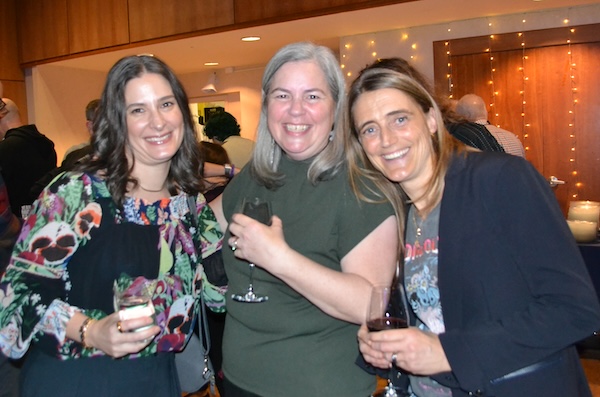
Left to right at Camp Miriam’s 75th anniversary celebration are Sue Siklos (parent), Trilby Smith (past camp committee chair) and Gretchen DuMoulin. (photo by Adi Keidar)
Brian Tucker, chair of the camp’s board, and Ariella Smith-Eidelman, who is going into her second year as rosh machenah (head of camp), spoke from their respective positions. Video greetings were shared from alumni Selina Robinson, former provincial cabinet minister, and Seth Rogen, comedian and actor.
The anniversary celebration was emotional, said Leya Robinson, who took over as Camp Miriam’s community director last year, succeeding Levi. Before returning to her hometown of Vancouver, Robinson (a second-generation Habonimnik, thanks to her mother Selina) worked for the North American Habonim movement in New York as director of education and then spent five years in Israel, where she directed programs in Israel for Habonim Dror campers and university students worldwide.
“It was very heartwarming, almost in an overwhelming way,” Robinson said of the event. “Just to have that deep a sense of belonging and to look around and see how many other people felt that same sense of community and belonging to Camp Miriam. I just feel so lucky to be a part of the community and to have the experience at Camp Miriam.”
In these challenging times, she said, that connection is vital.
“It’s really easy to fall into despair seeing what’s happening, and having community helps to build up that sense of hope or to maintain that sense of hope and to see that we are not isolated and we have friends and partners and people to talk with,” she said.
David Bogdanov told the Independent that his camping experiences in the late 1970s and early ’80s were “very transformative and almost lifesaving.”
“It gave me a strong love of Israel,” he said. “It really enhanced my relationship with the Jewish community and really informed my whole life to a very large degree.”
Michelle Plotkin, a member of the committee that put the anniversary event together, wasn’t a camper herself but has seen the camp’s effects on her daughter.
“It just offers so many opportunities for the kids to be independent and learn how to be comfortable outside their comfort zone and stretch their minds and imaginations,” Plotkin said. “My daughter does things I never would have expected her to be comfortable doing.”
It was Plotkin’s idea to put together a one-time band for the event. The six-member group was made up of three professional and three amateur musicians, all of them Miriam alumni. The musicians, who dubbed themselves the Final Messiba, were Yonni Silberman (drums), Sunny Zatzick (guitar), Daniel Pimentel (bass guitar), Ira Cooper (vocals), Roy Vizer (percussion) and Jessica Stuart (lead guitar and vocals, and music director).
Gretchen DuMoulin, who chaired the evening’s organizing committee, has experienced almost all aspects of camp, from being a camper herself, a madricha (counsellor), a parent to campers and madrichim, and an organizer of family camps and then the 75th anniversary celebration.
She said Camp Miriam “is a whole Jewish and cultural experience. Every aspect of camp is thoughtfully planned with aspects of Jewish values, equality, social justice and leadership woven throughout. Every camper has an opportunity to become a leader at some level and for their voice to be heard and counted. It is 100% a youth leadership-run camp.”
DuMoulin cites lasting friendships as an enduring legacy of camp.
“There is something about spending weeks at a time, day and night, independently but together,” she said, “that just allows you to form friendships in a different way than when you are at home and in school.”
Sefaria’s Sara Tillinger Wolkenfeld speaks Dec. 15 and Jan. 12, as part of Our Story, Our Heritage: A Speaker Series with Wexner Scholars. (photo from facebook.com/thejewishnetwork)
Our Story, Our Heritage: A Speaker Series with Wexner Scholars launched here in September. It features top Jewish educators from across North America who teach in the two-year Wexner Heritage Program, which focuses on Jewish learning and leadership training. While in Vancouver, the scholars give a talk that is open to the public, and also hold learning sessions with the local Wexner cohort, a diverse group of young local community members set to steer the community.
The speaker series began Sept. 22 with Yonatan Cohen, the rabbi of Congregation Beth Israel in Berkeley, Calif., and a senior fellow at the Shalom Hartman Institute. His talk, titled Our Texts in Tense Times, offered insights into Jewish texts that help frame recent experiences, particularly as the first anniversary of Oct. 7 approached.
Cohen spoke again on Nov. 17, giving a lecture called Agree to Disagree: The Seeds of Jewish Pluralism Revealed in Talmudic Debate. In it, using classic cases from the Talmud that elucidate the rabbinic approach to makhloket (debate or dispute), he considered how the rabbinic tradition distinguishes between “ultimate truth” and “public policy,” and how ancient texts might help guide the way one operates in a contemporary pluralistic Jewish community.
Next up on the Wexner speaker circuit is Sara Tillinger Wolkenfeld, chief learning officer at Sefaria, the free online library of Jewish texts, on Dec. 15. Her topic will investigate how ancient wisdom might offer insights into navigating the realities of social media. Wolkenfeld will return on Jan. 12 to examine tikkun olam, repair of the world, what it means and why it is important.
An alumna of the David Hartman Centre at the Hartman Institute of North America, Wolkenfeld also serves as scholar-in-residence at Ohev Sholom Congregation in Washington, DC. Her current research and writing focus is on the intersection between Jewish ethics and technological advancements.
Dr. David Shyovitz, a professor of history and Jewish studies at Northwestern University, gives online talks Feb. 9 and March 2. (photo from from davidshyovitz.com)
Dr. David Shyovitz, a professor of history and Jewish studies at Northwestern University, will talk on Feb. 9 and March 2. His first lecture will look at Jews and Muslims from an historical perspective. His second asks, “Has there ever been a ‘Judeo-Christian’ tradition?” and digs into what the registration page for the talk describes as “an uneasy alliance.”
“Obviously, these are both very big and complex topics, so there is no way we will do either of them justice fully,” Shyovitz told the Independent. “But they are also topics about which many people have limited knowledge or dramatically oversimplified assumptions, so the goal will be to share some interesting ideas and sources and give participants a glimpse of the rich and nuanced history of inter-religious relations.”
Rabbi Dr. Tali Zelkowicz, director of curriculum and research at the Wexner Foundation, is slated to speak on March 16. She will revisit a debate in Jewish education.
The Wexner Foundation’s Rabbi Dr. Tali Zelkowicz, speaks on Jewish education on March 16. (photo from Wexner Foundation)
“It has become a widely accepted fact that, across every age and stage, the field of Jewish education has split between the sub-fields of so-called ‘formal’ versus ‘informal’ (also known as ‘experiential’ education) or, alternatively, between ‘education’ versus ‘engagement,’” Zelkowicz said. “But how did we get to this default assumption, and is it helping us?”
By taking a closer look at assumptions about how learning works in Jewish life, Zelkowicz hopes to show how we are mired in what she sees as a “nonsensical debate” around which kind of learning setting is most needed or effective in Jewish life while avoiding the much more important question, what counts as great learning?
Devin E. Naar, a professor of history and Jewish studies at the University of Washington, winds up the series with lectures on March 30 and June 2. His first will study the formation of Sephardi Jewish communities in the Ottoman Empire.
“This lecture traces the trans-Mediterranean journey of the exiled Spanish Jews to the sultan’s realm and the cultural and political dynamics that shaped the communities they created and developed over the subsequent centuries. In short, it explores how the descendants of Spanish Jews eventually became Ottoman Jews, and the implications of those transformations today,” Naar told the Independent.
Devin E. Naar of the University of Washington winds up the Wexner series with lectures on March 30 and June 2. (photo from University of Washington)
Naar’s second session will probe how the history of Middle East Jews might change the perception of Israel.
“This talk moves beyond polemics to delve into the history of the long-standing Jewish presence in the geography that now forms the state of Israel,” he said.
“The talk situates Jewish experiences within the broader framework of the Ottoman Empire (which ruled from 1517-1917) during which Ladino – not Hebrew, Arabic or Yiddish – largely remained the primary Jewish language of Jerusalem,” Naar continued. “The talk also introduces some of the key challenges that Sephardic and Mizrahi Jews confronted with the establishment of the state of Israel. What are the lingering effects of those transformations today?”
The Wexner Heritage Program has returned to Vancouver after a 24-year absence thanks to the support of the Diamond Foundation, the Jewish Federation of Greater Vancouver and alumni of the first local cohort.
“It was a transformative experience for me. Because of Wexner, I became a better Jewish leader,” said Jonathan Berkowitz, a member of the original cohort, and a former Vancouver Federation president and chair of Federation’s annual campaign. He was an instrumental figure in rebooting the program in Vancouver.
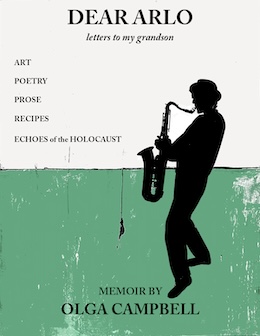
With her latest book, Olga Campbell sets out to leave a legacy, one that encompasses the trauma of the past but also the richness of the present and hope for the future.
Dear Arlo: Letters to My Grandson is Campbell’s third book. Her first, Graffiti Alphabet, comprised photographs of graffiti she found around the Greater Vancouver area. Her second, A Whisper Across Time, was her family’s Holocaust story.
The first essay in Dear Arlo is about Campbell’s parents, Tania and Klimek. They lived in Warsaw. “They were surrounded by family and friends and had much to look forward to,” writes Campbell. “Then, in 1939, everything changed. The Nazis invaded Poland from the west, the Soviets from the east. Life as they had known it stopped.”
Klimek would be arrested by the Soviets first, a pregnant Tania two weeks later. They were sent to different Russian prison camps. They survived, but the baby didn’t, nor did any of Tania’s family, most notably, her twin sister and parents, Campbell’s maternal grandparents.
“Several months after their release from the prison camps, my parents found themselves in Baghdad, Iraq,” writes Campbell. “By that time, my mother was pregnant with me and could go no further. I was born in Baghdad on February 14, 1943.”
Eventually, after living in both Palestine and the United Kingdom, the family came to Canada. It wasn’t an easy life, learning a new language and new culture, or a long one for Campbell’s mother, who died at 52 of cancer.
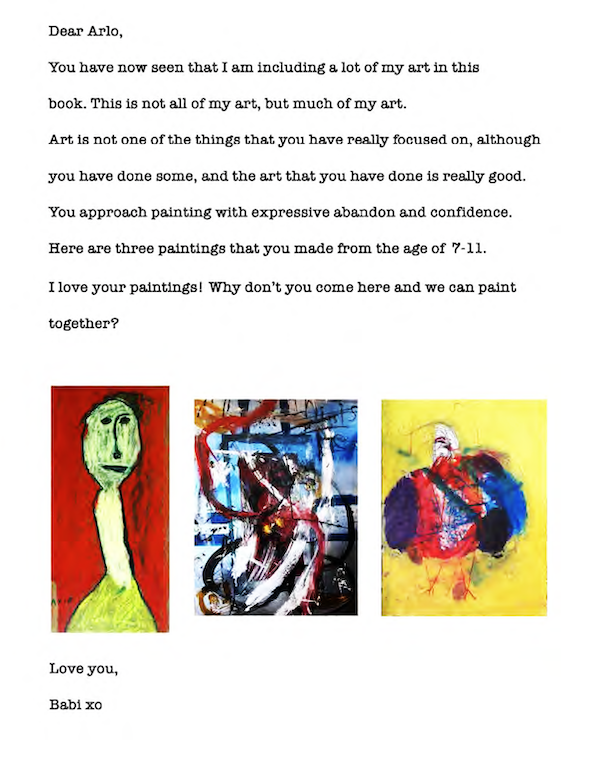
A page from Olga Campbell’s memoir Dear Arlo: Letters to My Grandson, which features letters, art, poems, essays and recipes.
Campbell shares her stories and wisdom with readers as a grandmother speaking to her only grandson, Arlo, with whom she obviously has a special relationship.
“I am writing this book as a legacy for you,” she writes in the first letter to Arlo. “A multidimensional memoir. A compilation of my writing, my art and a few family recipes. These writings and art are my responses to events in my life. The losses, trauma, grief … and the joy, happiness and love. It’s about the angst and awe of life, which is ever-changing, full of challenges but also magical.”
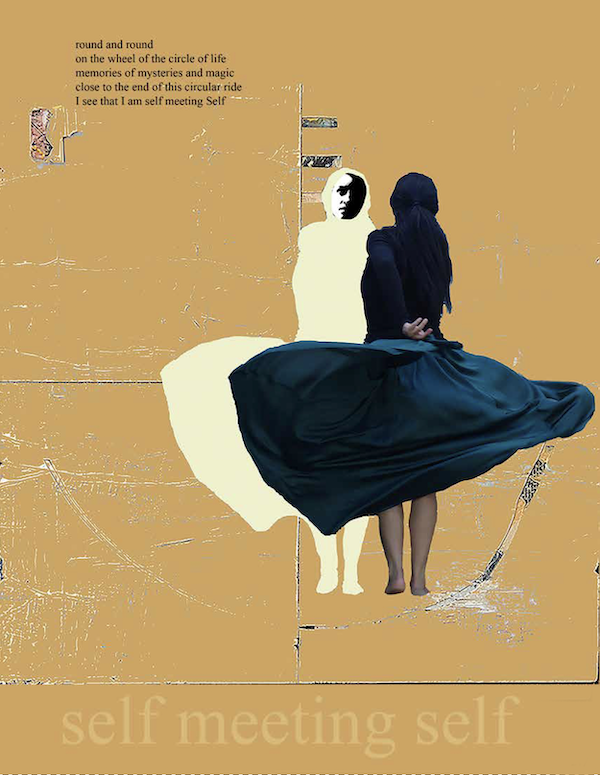
Brief letters to Arlo are spread throughout the memoir, which is gloriously full of Campbell’s artwork – painting, mixed media, sculpture and more, all of it in colour. A graduate of Emily Carr University of Art + Design, she has had many exhibitions since deciding to become an artist in her 40s, having started her professional life as a social worker. She has participated in the Eastside Culture Crawl since its inception almost 30 years ago, and has been a consistent part of the West of Main Art Walk (Artists in Our Midst) as well.
In addition to the art and letters in Dear Arlo, Campbell includes some of her poetry and essays. She shares how she came to write her second book, her experiences dealing with intergenerational trauma, her path to spirituality, how she found courage, and more.
She writes about losing her husband, in 1994. “Along with him, my plans and dreams for the future also died,” she writes. He died of a stroke at 49 years old – the pair had been together for 32 years, married for 26 of those years.
She shares the story of how she came to have her current dog, Nisha. “I was very sick in September 2019 with what my doctor now believes was COVID, before anyone had heard of COVID,” writes Campbell. Struggling many months with breathing difficulties, she turned, in desperation, to Ganesha, a Hindu god. “My wish to him was to remove all obstacles to my physical, emotional and mental well-being.”
A couple of days later, there came a knock at her door. Two work acquaintances were there, asking if she could adopt a rescue dog. Campbell did, and Nisha “was extremely timid, jumping, trembling and shaking at every sound, every movement. I held her all day every day for the first week to calm her down and get her used to me. She is still a little timid but every day she becomes more brave. She is playful, full of fun and great company,” writes Campbell. “She did remove all obstacles to my physical, emotional and mental health.”
Another uplifting essay is the one on how Campbell has “never come of age.” When she paints and creates with friends, she feels like she is 5 years old, she says. When with her teenage grandson, she also feels like a teen, and sees “the wonder of the world.”
A page from Olga Campbell’s memoir Dear Arlo: Letters to My Grandson.
Campbell has role models, older friends and neighbours who still have bucket lists and exercise regimes. Having traveled much herself–Myanmar, Morocco, Vietnam, India, Cambodia, Laos, Turkey and other places – she now wants “to do inward travel. To get to know myself and others around me. To find the mystery inside. To nourish relationships with the people I know and with new people that I meet.” She wants to have different adventures: “Creative adventures, people adventures, spiritual adventures.”
There are more than a dozen recipes in Dear Arlo – from an apple torte that a 5-year-old Arlo bet Campbell she wouldn’t make (which she did but he never ate); to cabbage pie and Russian salad, recalling when Arlo was teaching himself Russian; to broccoli and cheese soup, vegetarian meatloaf and ginger apple tea, in response to Arlo’s request for some recipes.
Campbell is grateful for many things.
“I have had a good marriage and a wonderful family – my lovely daughter, her loving partner and my wonderful grandson Arlo,” she writes.
“I have dealt with losses and tragedies in my life, including the premature death of my husband, but I survived, and now I am happy. Those intense feelings of sadness that I grew up with no longer plague me. I can be triggered, but on the whole, I am fine.”
The memoir ends as it begins, with a letter to Arlo, who, says Campbell, has been “the best grandson I could ever have imagined.”
She writes, “The past provides us with valuable lessons that we can use to inform our present and future. A sense of connection and continuity with the people who came before us. This adds a depth and richness to our lives. I look forward to having many more adventures with you.”
We get to see Arlo grow up, in photos throughout the book. And the photo placed squarely in the centre of this last letter is perfect: Arlo in the driver’s seat of his new red convertible, toque on, giving a thumbs up, smiling, with Campbell beside him, also bundled up for a cold drive, but also with a big smile.
To purchase Dear Arlo or Campbell’s previous books, visit olgacampbell.com.
Campbell’s artwork is on display at the Zack Gallery Jan. 8-27, with an artist reception Jan. 9, 6-8 p.m. Campbell speaks as part of the JCC Jewish Book Festival on Jan. 23, 7 p.m., in the gallery.
A photo of Reuven Rashkovsky from the book An Improbable Life: My Father’s Escape from Soviet Russia, by his daughter, Dr. Karine Rashkovsky. Here, Reuven is pictured with a MIG 19 Soviet fighter plane. At 18, he was drafted into the military, conscripted for three years.
Perusing the pages of the Independent’s predecessor, the Jewish Western Bulletin from the 1960s and ’70s, demonstrates the centrality of the movement for Soviet refuseniks in Jewish life of that time. Jewish communities in North America and elsewhere in the West were deeply devoted to the Jews behind the Iron Curtain who sought to emigrate to Israel and other places of freedom.
That movement, ultimately, was a largely Western phenomenon. In a new book, Vancouver’s Dr. Karine Rashkovsky shares her family’s story. An Improbable Life: My Father’s Escape from Soviet Russia, and others of its still-emerging genre, open the narrative to the stories from the other side of the Iron Curtain, those of the refuseniks who Western activists were trying to free.
The Soviet Union, Rashkovsky writes, was a country based on an ideology intended to eliminate ethnic and religious lines, but which counterintuitively insisted that every citizen’s internal passport indicate their nationality – and for Jews, regardless of their geographic origins, their nationality was “Jewish.” And that “nationality” meant slammed doors in the face of opportunity for those carrying that mark.
The book is a personal testimony – written by the daughter in the first person from the perspective of her father, Reuven – but it is also part of a larger story of the struggle of refuseniks and the lives they eventually made for themselves.
After his escape from the Soviet Union, Reuven fought in the Yom Kippur War, attained a PhD in Israel and France, and both he and his wife narrowly avoided being on the hijacked Air France flight that was the centre of the famous raid on Entebbe, Uganda.
In the preface, Reuven calls his life, “a kaleidoscope of hardships and failures.” But there are plenty of successes also.
Reuven’s parents were born in Bessarabia, in what is now Moldova. It was a highly multicultural area and they spoke German, Romanian, Yiddish, Hungarian, Ukrainian and Russian. When the Romanian fascists took over their town, the family fled, but went east to Odesa, rather than to Palestine or America.
When Germany invaded the USSR, Reuven’s father was drafted into the Red Army. His facility with languages put him in the intelligence unit and he assisted in interrogating prisoners of war. He was severely injured during a Luftwaffe bombing raid and, because he was an officer, the family was evacuated to a military hospital in Uzbekistan. There, he learned to walk again and returned to service, participating in the capture of Berlin, in March 1945. Reuven was born in Uzbekistan, in November 1945.
After the war, the family relocated to Belgorod-Dnestrovsky (now in Ukraine but under shifting sovereignty for centuries and known by at least 13 different names and transliterations over time). His father was a police officer and his mother worked 25 years in a fish cannery, which was relatively good fortune for the family in terms of providing protein, thanks to fish she smuggled out of the factory in her bra.
Eventually, they would be a family of seven, with five surviving children. At age 6, Reuven was responsible for taking care of his younger siblings all day while the parents were at work.
In response to antisemitic bullying, Reuven became a scrapper, taking his malnourished body to the gymnastics coach at school and forcing the coach, through the power of determination, to take on the unpromising-looking young Jew. As his biceps grew, the bullying receded. But the discrimination became more insidious and systemic.
In the home of a more well-off classmate, Reuven discovered books. Together, they devoured foreign works in translation, “free from Communist Party propaganda and boring Soviet patriotism.” This set Reuven on a trajectory of skepticism and dissidence that could have ended badly (and, along the way, did have bad moments – but ultimately resulted in freedom and a very successful life in the West).
Reuven’s teachers ascertained that he wasn’t a fan of the Communist Party and so he did not get a favourable reference for university. After 10th grade, he got a job at a slaughterhouse, then became an apprentice electrician. He began night school, where his facility with numbers shone and where his politics were not known and he might get a recommendation for university.
At 18, he was drafted into the military, conscripted for three years.
Eventually, the American allies of the refuseniks forced the American government to put conditions on the sale of American wheat, upon which the Soviet economy depended. The 1974 Jackson-Vanik Amendment tied trade in this necessary commodity to visas for Soviet Jews. Until then, of the several million Jews in the USSR at the time, just a few hundred had been permitted to leave.
Reuven was part of a group of about 25 Jewish youths who decided to hold a hunger strike to demand emigration. They took a petition to city hall and police soon blocked the exit. They were taken before authorities and subjected to “a long lecture on how inappropriate it was to think about leaving our Soviet paradise for Israel, that aggressor capitalist country, a puppet of America.”
When an interrogator threatened the group with imprisonment, one of the dissidents explained to the KGB officers why that was not a good idea.
“She calmly explained to him that we’d communicated with Western journalists and passed them our names and plans for the hunger strike. We’d also alerted these journalists to expect a phone call before midnight to tell them what had happened today. If we didn’t call them, they would tell the Western media about us. Katya went on to tell the colonels what would happen if we were arrested: America wouldn’t sign the contract for selling wheat to the Soviet Union, which would harm the whole country. And Moscow would come down hard on Odesa’s KGB for causing such a disaster.”
The next morning, Reuven and his family went to the government offices first thing. The entire family was granted the right to emigrate except for Reuven’s brother Fima, because he was serving in the army. But the authorities finally agreed that everyone would be allowed to emigrate after Fima’s military service. Reuven’s parents refused to abandon their son and decided that Reuven and his sister Hanna should go on ahead to Israel and the rest would follow later, which they eventually did.
Traveling through Moscow, at New Year’s 1971-’72, Reuven was put up at the apartment of a friend’s mother. There, he met Fania, who was visiting from Kyrgyzstan. She didn’t know anything about Israel and it had never crossed her mind to emigrate. A few shots of vodka in, Reuven told her he would be waiting to marry her if she ever decided to come to Israel.
“It was crazy of me to say such words – to offer marriage to the most innocent girl I ever met and one I had only known for hours – on my last evening in the Soviet Union,” he says. “Of course, I was both very stressed and excited that I was leaving the country, and I had been drinking quite a lot of vodka to relax a bit.”
That was the beginning of a happy 50-something-year marriage that continues today.
Freed of the Soviet Union’s antisemitic shackles, Reuven’s career took off. Hebrew University was looking for a Russian-speaking mathematician to teach first-year students, then he developed a curriculum for high schoolers with advanced math skills. An opportunity landed in his lap to teach at an elite Israeli school in Paris. Friends who had migrated to New York extended an invitation, which led to a side journey to Toronto, where Reuven’s career took another turn and the family became Canadian.
While they were living in Paris, Reuven was unable to attend his brother’s wedding in Israel, in June 1976, but Fania went. On his way to the airport to pick her up on her return, Reuven heard that terrorists had hijacked an Air France plane to Uganda. Reuven was beside himself. It turned out, Fania had missed the plane and was rebooked on a later El Al flight – but jammed phone lines prevented her from notifying Reuven for several days.
Jews of a certain age remember the fight for Soviet Jewry. The Rashkovskys’ book, An Improbable Life, is a story of what they were fighting for.
Rashkovsky is part of the JCC Jewish Book Festival on Feb. 24, 6 p.m., at the Jewish Community Centre of Greater Vancouver, along with Sasha Vasilyuk, author of Your Presence Is Mandatory, a debut novel, based on real events, about a Ukrainian World War II veteran with a secret that could land him in the Gulag, and his family who are forced to live in the shadow of all he has not told them. Visit jccgv.com/jewish-book-festival.
King Manuel I of Portugal (1495-1521) had a problem. To marry Princess Isabella of Spain, he consented to the request of her parents – Ferdinand and Isabella – to rid Portugal of its Jews. But Manuel wanted to keep the Jewish citizens close by, for their economic benefits (money and skills). His solution? In 1496-7, he forced Jews to convert. (He also expelled the country’s Muslims.)
Manuel believed that New Christians – this population is likewise referred to as conversos, anusim or Crypto-Jews; marranos is a derogatory term that should not be used – would continue to boost the country’s economy. It should be noted that Jews in Portugal already paid a special poll tax and a special property tax.
Even after they were forcibly converted, Portuguese Jews could not live wherever they wanted. They lived in separate quarters referred to as judiarias, what we might call ghettos. They worked as artisans and rural labourers, weavers, tailors, cobblers, carpenters, leather tanners, jewelers, and every branch of the metal industry, ranging from ordinary blacksmiths to armourers and goldsmiths.
Several Jews nonetheless reached prominence in medieval Portugal. Among them was Abraham Zacuto, originally from Spain. Portuguese King John II invited Zacuto to be the royal astronomer. The king wanted Zacuto to chart a sea route to India. Unlike most of his fellow religionists, Zacuto managed to flee Portugal after King Manuel imposed conversion on the country’s Jews.
There was also Isaac Abarbanel, who was King Afonso V’s treasurer. Yehuda Even Maneer was the richest Jew in the kingdom and, for that reason, was appointed Portugal’s finance minister. Master Nacim, a Jewish eye doctor, was accorded certain privileges because of his professional skills.
Before King Manuel decreed the forced conversion, the Jewish community of Tomar built a synagogue, in spite of attacks orchestrated against them and other Jews in the country. Unfortunately, the building was used for its original purpose for only a short period, after which – for years and years after the forced conversion – it was used by the Church. The town itself became one of the sites of the Inquisition tribunal. Today, the synagogue has been renovated and is considered a national monument.
Crypto-Jews continued to covertly practise Judaism. In the town of Porto, for example, the Crypto-Jews secretly operated a synagogue, hiding it from the Inquisition.
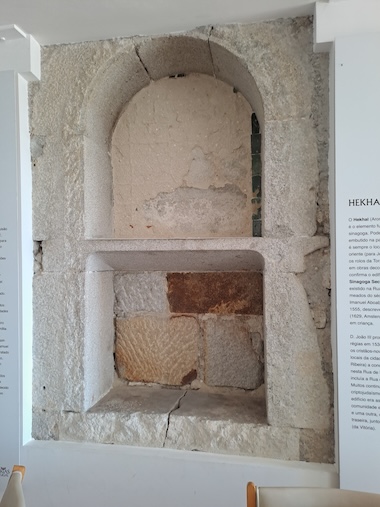
In 2013, a renovation project at a facility for Portuguese senior citizens turned up a Torah ark, carved directly into the stonework separating the building from its neighbour. (photo by Deborah Rubin Fields)
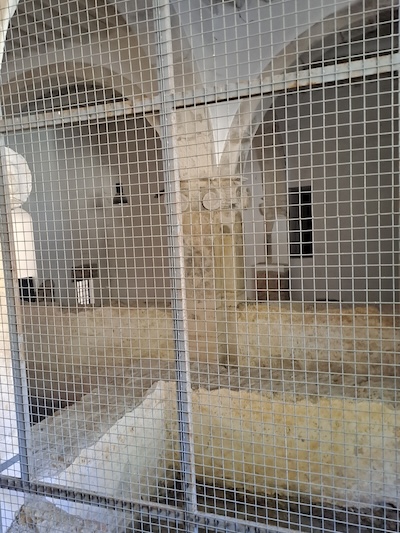
In 2013, a renovation project at a facility for Portuguese senior citizens turned up an amazing find. Hidden behind the eastern wall of the dining room was a Torah ark, or aron kodesh, carved directly into the stonework separating the building from its neighbour. There were two compartments, a square space topped by a slightly larger arched tablet-shaped opening, with space for approximately six small Torah scrolls. Besides this relatively recent discovery, we have the 16th-century testimony of Immanuel Aboab, a native of Porto. (The late Yom Tov Assis, who was a professor at Hebrew University, had likewise been trying to locate where such an aron kodesh was located in the area.)
It was common among Crypto-Jews to light one Shabbat candle in a secret cabinet. There was also an emergency tool for snuffing out Shabbat lights if it was suspected that a Christian neighbour was spying. To make Shabbat different from other days, these secret Jews ate no meat. Purim was marked by three days of fasting beforehand. Passover was celebrated two days late, so as to throw Christians off the track. Other secret Jews took the risk of undergoing circumcision.
Within limits, these Crypto-Jews read psalms and recited the Shema, didn’t work on Shabbat, didn’t eat pork and fasted on Yom Kippur. Manuel (Abraham) de Morales passed out manuscripts of what he thought were important points to know about Judaism. But most of the Jewish customs were orally transmitted from mother to children.
Not surprisingly, the period before the forced conversion was not totally free of tension between Jews and Christians: Franciscan and Dominican clergy walked through judiarias, ready to convert Jews. Moreover, Portugal’s new merchant class was apprehensive about the influence of the Jewish citizens and their capital. Under the reign of João I (1385-1443), new laws obliged Jews to wear an identifying sign on their clothes and imposed curfews on the judiarias. There were scattered outbreaks of violence, like the attack on the Lisbon judiaria in 1445, in which many died.
Jew Street in Lisbon, Portugal. (photo by Deborah Rubin Fields)
After the forced conversion, New Christians would be charged with being infidels, not heretics. These New Christians generally adopted Christian given names and Old Christian surnames. They probably did this to deflect attention. But harder times still followed for Portuguese Jews, with the massacre of 2,000 conversos in Lisbon in 1506 and the Portuguese Inquisition, which began in 1536. Inquisitors would come to a town and tell the gentile population that they were looking for secret Jews. They would present a list of suspicious behaviour to look for.
In medieval Portugal, turning in New Christians became a profitable venture. Arrested conversos had their assets seized by members of the Inquisition. Occasionally, Church officials would accept bribes for temporary pardons.
Apparently, if a New Christian approached an inquisitor, he had a chance of redeeming himself by admitting that his family lit Shabbat candles or washed sheets for Shabbat. On the other hand, if an Old Christian accused a New Christian of still practising Jewish rituals and the latter denied the observances, he would face a worse outcome from his trial.
The number of Inquisition victims between 1540 and 1765 is estimated at 40,000. Punishment included being raised by a pulley with one’s hands behind one’s back. Convicted infidels were then burned at the stake.
Cells where Crypto-Jews were held before their Portuguese Inquisition trials. (photo by Deborah Rubin Fields)
The cruel punishments passed down by the Portuguese Inquisition drew large crowds of spectators. The crowds were akin to those who would come to watch bullfights.
Trials ceased after about 250 years, although Portugal’s Inquisition was not officially abolished until 1821.
Jewish informers should also be mentioned. These people, as can be imagined, found an open ear among Portugal’s prejudiced secular and religious leaders. If these traitors were discovered by the Jewish community, they might have had their eyes gouged out, their tongue removed or been put to death for putting the community at tremendous risk. So serious a crime was acting against one’s own people that even Maimonides condoned Jewish informers.
The impact of the forced conversion and the Inquisition continue to be felt. Take, for example, Belmonte, located in the northern part of Portugal. It has a small Jewish community that has retained the rituals of Judaism despite all the hardships and persecution. In the 1990s, when the idea of building a synagogue was raised, some Jewish communitymembers were against it. Why? Because being a member of the anusim community was their cherished identity. Almost 200 years after the Portuguese Inquisition had been abolished, they couldn’t imagine living openly as Jews.
Estimates are that at least 20% of Portugal’s current population has anusim roots.
Deborah Rubin Fields is an Israel-based features writer. She is also the author of Take a Peek Inside: A Child’s Guide to Radiology Exams, published in English, Hebrew and Arabic.