In a story that is positive and uplifting, Rabbi Adam Stein, associate rabbi of Vancouver’s Congregation Beth Israel, wrote a piece in Canada’s Anglican Journal, which describes itself as the largest faith-based publication in North America. In the article, Stein describes his engagement with national leaders of the Anglican movement as the church has reviewed its liturgy around Judaism and Jewish people. Stein was representing the Canadian Rabbinical Council, a cross-denominational group under the auspices of the Centre for Israel and Jewish Affairs. (Click here for article.)
While the slow machination of the church’s processes means it won’t be official until at least 2022, the recent General Synod of the church approved the replacement of a prayer for the conversion of the Jews with a prayer for reconciliation with the Jews. The move is monumental in the context of Jewish-Christian relations. The idea that Christianity is a replacement theology to Judaism – and that Jews should convert or disappear, with all that implies – prevailed for nearly 2,000 years. At heart, it is a negation of the Jewish people’s right to exist and, indeed, at times in history, conversion or death were the two choices Jews were offered.
The two-millennia history of conflict, supercessionism and religious-based antisemitism went almost unchallenged until the 1960s, when the Roman Catholic church underwent a revolutionary reconsideration of many aspects of its theology, including its relations with Jews. Since then, other branches of Christianity have taken leads of varying sorts in addressing their own histories of oppression directed at Jews, as well as at women, indigenous people and communities, LGBTQ+ people and others.
The generosity of spirit evidenced by Canadian Anglicans – and the obviously heartfelt expression of gratitude in Rabbi Stein’s written reflections on the issue – are a welcome ray of light and warmth in a world that too often seems lacking in these elements.
At the recent General Synod [of the Anglican Church of Canada in July], I had the pleasure of speaking from what we in Judaism call the bimah; literally, the “stage.” I sat next to extremely kind and welcoming incoming and outgoing primates, Archbishop Linda Nicholls and Archbishop Fred Hiltz, and the Rev. Gordon Maitland, national chairman of the Prayer Book Society of Canada. As Bishop Bruce Myers stood at the podium explaining the prayer he was proposing to change, I looked out at the rapt audience at the synod and smiled.
I had spent several weeks working with Bishop Myers to plan our presentation, and I was aware that it was a truly amazing moment. A bishop inviting a rabbi to share his thoughts on a prayer “for the conversion of the Jews” – offensive content for Jews throughout our historical relationship with Christianity – and the proposed replacement: a “prayer for reconciliation with the Jews.” Wow. When I took the podium and shared some words, a few meaningful images and even a laugh or two, I felt truly welcomed by the dedicated Anglicans gathered in Vancouver.
I was there on behalf of the Canadian Rabbinic Caucus, representing my fellow rabbis from around Canada. The Canadian Rabbinic Caucus (CRC) is the only national organization that unites rabbis from across the spectrum of Jewish practice in Canada. As an affiliate of the Centre for Israel and Jewish Affairs (CIJA), the CRC plays a key role on behalf of the organized Jewish community of Canada in fostering interfaith relations – including with our Anglican friends.
During the process of seeking to replace this prayer, the CRC was approached by the national leadership of the Anglican Church of Canada to provide guidance and constructive feedback on the details of the church’s revised prayer, which we were very pleased to offer. We are humbled to have played a role in this historic development, which is a natural and logical culmination of decades of growing Jewish-Anglican ties.
The Anglican church has made a significant effort, particularly since the 1980s, to acknowledge and tackle the issue of Christian antisemitism. Examples include the removal of a supercessionist Good Friday collect from the Book of Common Prayer in 1992 and the powerful document “From Darkness to Dawn” (Christian post-Holocaust reflections on antisemitism), published in 1989 and reprinted and disseminated again in 2015 through the active leadership of Bishop Myers. The decision to transform the prayer for the conversion of Jews into a prayer for reconciliation with the Jews, which repents for historical antisemitism among Christians, is a testament to this wonderful trend.
The church has spoken out strongly about the rise of antisemitism, including the neo-Nazi rally at Charlottesville (when the Anglican church partnered with the Jewish community on an interfaith statement of solidarity against hate), as well as the horrific attack at Pittsburgh’s Tree of Life Synagogue, following which the church spoke out and stood with us to mourn the victims. That attack hit home for so many of us in the Jewish community; my synagogue’s senior rabbinic colleague is from Pittsburgh, and I have friends and colleagues who live shockingly close to where the attack took place. Interfaith support was thus all the more significant.
We were very grateful that the church’s leadership brought the upsetting prayer’s removal to a vote at the 2016 General Synod. Unfortunately, while it received majority support, it was one vote short of reaching the critical mass needed to pass that year. However, we understand the complexities involved in that vote and, in a way, it was a blessing in disguise. While the original proposal was simply to remove the older prayer, the new proposal, after a deep and fruitful process, led us to the beautiful and powerful new prayer.
The church leadership’s steadfast work in advancing this issue just goes to show how important it is to them – past and current primates, Bishop Myers, Fr. Maitland – and, for that, we are exceptionally grateful. It is incredibly heartening to see that the 2019 General Synod offered near-unanimous support for the new prayer. While this work will not be complete until the 2022 General Synod votes on a second reading of the proposed change, we are confident the new prayer “for reconciliation with the Jews” will be ratified at that time.
The timing of this decision is poignant. A recent Tel Aviv University study found that last year saw the highest number of Jews murdered in antisemitic attacks in decades. The Jewish community is experiencing a sense of vulnerability that, at least here in North America, is perhaps unprecedented – due in no small part to the two fatal shooting attacks on synagogues in the United States in the past 10 months. By replacing the prayer for conversion with one of reconciliation and acknowledgement of the history of Christian antisemitism, the Anglican church has sent a compelling message to the Jewish community that you stand with us at this worrisome time. As both a rabbi and a Jewish parent who is concerned for the kind of society in which my children will live, this is deeply appreciated.
The Anglican Church of Canada’s decision to revise this prayer in such a significant way is just one piece of evidence among many that this is a warm and growing relationship, one which will only enable our communities to further engage on other issues of common cause in a fruitful manner.
Rabbi Adam Steinis associate rabbi of Congregation Beth Israel. This article was originally published in the Anglican Journal, the national newspaper of the Anglican Church of Canada.
On Monday, Facebook eliminated many extremist pages from its platform, including several Canadian pages, such as those of extremist groups Soldiers of Odin, the Canadian Nationalist Front and Aryan Strikeforce, as well as individuals like white supremacists Faith Goldy and Kevin Goudreau.
Some anti-racist activists say it’s a good start, but only the tip of the iceberg. They also assert that occasional purges of hate content will not address the larger issue in the absence of clear, enforceable standards by social media giants like Twitter and Facebook, which also owns Instagram.
Relatedly, the Centre for Israel and Jewish Affairs has launched a campaign, #notonmyfeed, which is intended, according to the accompanying website, “to stop online hate from becoming real-world violence.” (See jewishindependent.ca/cija-fights-online-hate.) CIJA cited social media posts by the murderers in the Pittsburgh synagogue and the Christchurch mosque killings as cause for governments to move on the issue.
“In both cases, the perpetrator used social media to spread their heinous, hateful agenda,” according to the website notonmyfeed.ca. “From white supremacists to ISIS, it is increasingly clear that online hate and radicalization can fuel and foreshadow offline violence.”
The House of Commons justice committee – as if they are not busy enough with the SNC-Lavalin affair – is launching a study on the issue. The intent, according to CIJA, is to develop a national strategy around online hate.
A national strategy confronting hatred, whether online or offline, seems like a positive development if it helps track problematic people and ideas in order to prevent future violence.
The benefits of a crackdown on online hatred are obvious: by making it more difficult for hateful ideas to reach large, mainstream audiences, moves like those by Facebook are a positive step. Groups that use social media to recruit individuals into hate movements may be hobbled by such policies. Although there are plenty of forums online where they can continue their efforts, hate groups may not have as easy and accessible a reach if policies are put in place to monitor and censor such groups and their messages.
Of course, some of the extremists are crowing about being banned.
“Our enemies are weak and terrified,” Goldy tweeted (because she is not banned from that platform). “They forget most revolutions were waged before social media!”
True enough. But if we make Goldy’s job harder, it’s a good thing.
However, while there are potential positive outcomes, we should not be blind to the potential unintended consequences of such a move.
If the murderers of Pittsburgh and Christchurch had given hints on social media of their intent, isn’t the larger issue here that those threats went unchecked and, therefore, the perpetrators were allowed to complete their mission of mass murder without intervention? Do we really want to eliminate forums in which we can track and identify potential terrorists? If we ban them from these platforms, are we forcing them underground into places where we cannot police them?
Presumably, police and intelligence agencies know where to find the online warrens of hatemongers and can monitor those venues almost as easily as they could Facebook or Twitter, while ensuring that members of the public who are innocently surfing the web do not stumble upon violent hate messaging in seemingly innocuous places. Even so, given that, as CIJA points out, the Pittsburgh and Christchurch killers left a trail on social media and still managed to execute their terrible plans, it suggests we’re not doing a stellar job on this front even when the warning signs are on the world’s largest sharing platforms. So, how much better are we to expect things to be when we force them into the darker crevasses of the online world?
This issue is confounding in part because the internet is, by definition, anarchic and largely beyond the control of all but the most authoritarian governments. As a result, governments and even social media behemoths like Facebook can do only so much to control what is shared through the web writ large.
Leaving aside issues of free expression (which differ across jurisdictions in ways that social media do not), there are practical considerations that we hope elected officials, law enforcement and social media corporations themselves consider when addressing online hate.
As governments do begin to take the issue seriously and consider interventions in the interest of public safety (including, especially, the safety of the most commonly targeted identifiable groups), we trust that a balance will be struck between eradicating violently hateful messaging, on the one hand, and, on the other, not harming law enforcement’s ability to do their job by pushing these ideas into clandestine sectors where they can neither be monitored nor challenged. Finding that balance should be the key to formulating public policy on this urgent issue.
“We were saddened, horrified and deeply angered by the murderous terrorist attack in Christchurch, which was clearly motivated by hatred of Muslims that was at least in part fomented online,” Martin Sampson of the Centre for Israel and Jewish Affairs (CIJA) told the Independent. “This is another disturbing example of how terrorists and mass murderers make use of social media – both before and after attacks – to spread their heinous message.”
On Friday, March 15, 50 Muslims were murdered by a white nationalist terrorist at two mosques in Christchurch, New Zealand. On Oct. 27, 2018, 11 Jews were murdered at Tree of Life Synagogue in Pittsburgh, Penn. Both perpetrators had been active in spreading hatred online. In the case of Tree of Life Synagogue, the shooter had written a post announcing his intentions hours before the attack.
“This issue has been of interest to us for some time,” said Sampson. “We included it as a core federal priority in our Federal Issues Guide, which was released in September of 2018. The horrific shooting at the Tree of Life Synagogue in late October, and the fact that the assailant had been highly active in promoting antisemitism on social media – it is reported that he posted more than 700 antisemitic messages online in the nine months or so prior to the attack – underscored the urgency of the issue and the need to increase awareness about the connection between online hate and offline violence. This is why we launched notonmyfeed.ca.”
The goal of CIJA’s #notonmyfeed campaign is to reduce the spread of online hate speech. “In any democratic society that values freedom and individual rights, no right is absolute,” said Sampson. “Striking a reasonable balance between preserving free speech and protecting Canadians from those who systematically demonize and slander entire communities is a challenging, complex task, but not an impossible one.”
CIJA is calling for a comprehensive response that addresses hate in a variety of forms, not just antisemitism, he said. “We can preserve free speech while protecting Canadians from those who deliberately promote hostility – and even glorify violence – against entire communities.”
Sampson said there is a direct link between online hate speech and violence. “In countless cases – such as in the case of individuals who have been radicalized to participate in terrorism or hate crimes – online propaganda has been a significant factor,” he said. “This is a complex issue. Understanding it and developing tools to counter it is why we are calling on the government of Canada to take the lead by launching a national strategy to tackle online hate, working in partnership with social media platforms and internet service providers.”
Some people contend that, if online hate speech foreshadows offline violence, there may be some value in monitoring it, rather than forcing it underground. As well, if kicked off one social platform, those inciting hatred can just move to another one.
“In cases of ignorance, inappropriate statements or offhand comments that are bigoted, counter-speech is clearly the best response, and these types of online behaviours are not the focus of our calls for a national strategy to tackle online hate. In cases of propaganda being systematically produced by extremists – particularly when it includes the glorification of violence – allowing it to continue can in some cases pose significant risks to public safety,” said Sampson about these concerns. “Moreover, allowing such behaviour to take place on social media platforms often violates the basic terms and conditions of those sites. Social media platforms should enforce their own existing policies.”
The movement to boycott, divest from and sanction Israel over its treatment of Palestinians is controversial, with some seeing it as a legitimate tactic opposing human rights abuses and others seeing it as a form of discrimination rooted in antisemitism. “It is neither the focus of our policy position on online hate, nor can I perceive any scenario in which BDS would be implicated or affected by a national strategy to tackle online hate,” said Sampson, when asked whether BDS was one of the intended targets of CIJA’s campaign. “To be clear – we strongly oppose BDS and work to expose and counter the real agenda of the BDS movement, but that is a very separate challenge and completely distinct from our call for a national strategy to combat online hate.”
Asked if CIJA has any plans for addressing hate speech in the Jewish community itself, Sampson said, “Our position on online hate is that a national strategy should address hate in a variety of forms, not just antisemitism. This is why we have mobilized a coalition of communities, including the Muslim community, to join us in this effort. We believe every online account should be held to the same standard, regardless of the identity of the person who runs the account. When it comes to the Jewish community, we strive to set an example in how we manage our social media accounts, allowing debate and diverse opinions in the comments section of our posts, while having a zero tolerance policy toward bigotry and hateful comments.”
Matthew Gindinis a freelance journalist, writer and lecturer. He is Pacific correspondent for the CJN, writes regularly for the Forward, Tricycle and the Wisdom Daily, and has been published in Sojourners, Religion Dispatches and elsewhere. He can be found on Medium and Twitter.
The birth of a baby is a milestone and the
Jewish Community Centre of Greater Vancouver acknowledges that this
life-changing event requires validation and support for new parents. Judaism
offers profound teachings about becoming a parent and raising a family.
The JCCGV’s new Shalom Baby group is a free
program for parents and infants 0-18 months. The group provides a place to
learn and grow, connect with other parents, share experiences and hear
professional speakers address relevant subjects, such as feeding, sleeping,
play, development, transition to motherhood and more. Becoming a parent can be
overwhelming, and this program provides respite in a warm environment in which
parents are nurtured, so they can nurture their babies, and help build strong
and healthy family units in our community.
All of the meetings feature guest speakers.
Speakers are community professionals, such as nurses, researchers, doulas,
psychologists and speech and language specialists. And the group is always
looking for accredited experts to contribute.
Shalom Baby meets twice a month on Mondays at
11:30 a.m. at the community centre in Room 102. The group is led and organized
by a Shirly Berelowitz, JCCGV director of children, youth and camps, who
welcomes the participants, books the speakers and sends weekly emails on
upcoming programs.
The goals of the program are to strengthen
emotional bonds between parents and children; inspire a shared learning
experience to support growth and development during the early childhood years;
provide support services and activities for families to raise healthy and happy
children; and connect unaffiliated Jewish families with young children to the
Jewish community through different programs.
The Centre for Israel and Jewish Affairs (CIJA)
has appointed new members to its board of directors, including board co-chairs
Joel Reitman and Jeffrey Rosenthal, succeeding David J. Cape.
Nominations to the CIJA board are guided by an
independent nominating process, which examines the background, skills,
experience and other relevant qualifications of prospective directors. A list
of candidates is produced through consultations with federations and other
stakeholders across the country. The independent nominations committee –
comprised of federation representatives and ad personam members – consider all
of the candidates and recommend a slate of directors to the CIJA membership
(the “shareholders” of the organization). Special attention is given to
achieving balance with respect to regional, gender and demographic attributes,
as well as the qualities that candidates can leverage to advance the mission of
the organization.
Reitman is the founder and president of Jillcy
Capital ULC, a global investment firm, and is an active volunteer in the Jewish
community and beyond, serving various organizations over the years in different
capacities. Rosenthal is a managing partner of Imperial Capital Group, which he
co-founded in 1989, and has a long history of volunteering and experience on
boards of other organizations.
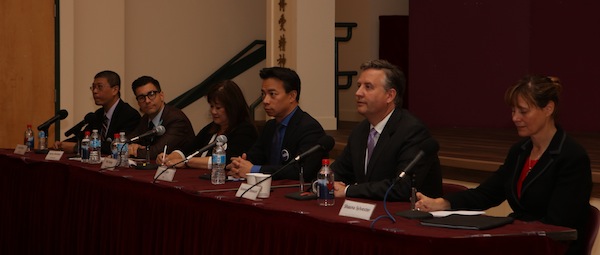
A full house came out to the CIJA-SUCCESS townhall Sept. 23, which featured six Vancouver mayoral candidates. (photo from CIJA)
The refracted nature of Vancouver’s civic politics was on full display at a candidates meeting featuring six of the perceived front-running candidates for mayor. The near-implosion of the governing Vision Vancouver party, combined with divisions among erstwhile Non-Partisan Association members, has led to a race with both the left and right sides of the political spectrum divided and struggling to gain traction in a campaign with 21 contenders.
The afternoon event Sept. 23 was co-sponsored by the Centre for Israel and Jewish Affairs and the multicultural organization SUCCESS, which is rooted in the Chinese-Canadian community. Veteran Vancouver broadcaster Jody Vance handily moderated the occasionally raucous meeting.
Housing affordability topped the list of issues, with Kennedy Stewart, a former NDP member of Parliament for Burnaby-South who resigned that seat to run for Vancouver mayor as an independent, said his plan to attack unaffordability calls for building 85,000 new homes over the next 10 years, including affordable and market rentals.
Ken Sim, an entrepreneur who founded Nurse Next Door and Rosemary Rocksalt Bagels and who is the candidate for the centre-right Non-Partisan Association (NPA), responded by claiming that the construction industry does not have the capacity to meet Stewart’s construction schedule.
Wai Young, a former Conservative member of Parliament for Vancouver South, is running with a new party, called Coalition Vancouver, which was originated by a group of former NPA members who felt betrayed by what they call a lack of democracy in that party.
“Vancouver does not have a supply issue,” Young said about the housing situation. “There are no millionaires wandering around Vancouver that are unable to buy a house or a luxury condo. The issue is that we are not able to keep our young people, our young families, here because they can’t afford to buy a house. We have an affordability issue in Vancouver.”
“If I am mayor, we will have a three percent vacancy rate,” said Shawna Sylvester, who is running as an independent but has roots in Vision Vancouver. The rate today is about zero. She supports more co-ops, cohousing and what she called “gentle densification,” as well as addressing how the housing situation has particular impacts for women, who experience poverty in greater proportions than men.
Left to right are David Chen, Hector Bremner, Wai Young, Ken Sim, Kennedy Stewart and Shauna Sylvester. (photo from CIJA)
Partly related to the affordability issue is the topic of Vancouver’s reputation as a place that is welcoming of people from diverse backgrounds.
David Chen, who is running with another new party, ProVancouver, noted that racism is alive and well in the city.
“My parents were first-generation Taiwanese [Canadian],” said Chen. “I was born in St. Paul’s [Hospital] because, at that time, it was the only hospital they were allowed to go to. During this campaign, I heard somebody say to me, ‘Go home.’ Well, I am home.” He added: “We haven’t progressed as much as we should or could.”
The NPA’s Sim echoed the experience and extrapolated it to the Jewish community.
“I’m 47 right now,” said Sim, “and I still remember the hurtful comments that I faced when I was 5 years old. It was tough. I think of what’s going on to our Jewish community right now. We still have a lot of issues. I’m acutely aware of what our Jewish community goes through because, when something happens halfway around the world, our friends in the Jewish community have to worry about their physical safety. That’s terrible. We will have zero tolerance for that, as mayor of Vancouver. We’re going to work with community groups, work with the Jewish community, work with all communities identifying threats to our communities and working on solutions to protect us, to protect our communities, and we will monitor our results.”
Hector Bremner, another former NPA member now leading another new party, YES Vancouver, is the only candidate for mayor currently sitting on Vancouver city council.
“Racism is a symptom, it’s not the disease,” Bremner said. “When do racial tensions flare up, when do they happen? They happen in a time when the people feel that resources are scarce and they feel pressure economically. It’s really a function of tribalism and nativism that occurs when people feel that it’s hard for them to make it. We look for scapegoats.”
Sylvester, who among many other roles is director of the Morris J. Wosk Centre for Dialogue at Simon Fraser University, said people need to stand up to extremist voices and actions.
“There are forces in our communities, whether we want to acknowledge them or not, that are trying to divide us,” she said. “What we need to do [is] not be tolerant of any kind of hate crime, not be tolerant of antisemitism.”
Stewart said those who don’t subscribe to Canadian ideas of tolerance should be helped to change their minds.
“Immigration is really one of the best things about being Canadian,” he said. “We travel around the world and we brag about it. Multiculturalism is a Canadian word and it’s something we’ve exported. It’s something we should embrace, and most of us do. Those that don’t, we have to help them understand, change their opinions.”
Accusations of intolerance and implications of racism emerged in the debate.
Young, who had originally sought the NPA mayoral nomination, implied that her supporters, many of whom were from the Chinese community, weren’t welcome in the NPA. This brought a sharp rebuke from Sim.
“Guess what, I’m Chinese,” he said. “Here’s the real issue. When you [say] inflammatory statements like that to win a political agenda, you create divisions in our communities. People don’t like that. You put a wedge. That is a problem and you’ve got to knock it off.”
Sim went on to accuse politicians of stoking already existing embers of intolerance around foreign purchasers of Vancouver real estate.
“For political expediency, what politicians are doing is pointing at groups and blaming groups for problems,” he said. “We have a lot of issues with affordability and there are a lot of things that affect affordability and housing. I’m not saying foreign purchases do not affect housing. But, when we point to it and we blame a group, that starts a slippery slope. That’s what’s dividing our city, our province and our country. I call on everyone here to knock it off, because there are a lot of things that affect affordability – permitting delays, interest rates, the economy – but to point to something for political expediency because it wins votes is dividing people and it’s hurtful.”
The meeting took place in a SUCCESS building in Chinatown, close to the Downtown Eastside. Candidates agreed that more needs to be done to confront the seemingly intractable challenges facing that area of the city.
Young said she had visited a seniors home in Chinatown earlier in the day and was told residents are afraid to go outside.
“They can no longer walk outside of their building,” she said. “That should not happen in our beautiful city. There was a time I remember coming down here to Chinatown when it was vibrant, when it was safe, when you didn’t feel like you couldn’t be on the wrong side of the street here.… This city has gotten dirtier and grittier…. There are needles everywhere, there is defecation everywhere. We are one of the top 10 cities in the world and yet, currently, it’s embarrassing to have your friends come visit.”
She promised to be “John Horgan’s worst enemy,” referring to the B.C. premier, in demanding provincial help to address the issues in the area.
Stewart touted his connections with former NDP member of Parliament Libby Davies, who previously represented the area in Ottawa.
“Last week, I was very proud to stand with Libby Davies in the Downtown Eastside and announce that, as mayor, I would immediately strike an emergency task force to deal with the opioid epidemic and homelessness,” Stewart said. “We cannot have the number of deaths that are happening and the number of overdoses. We can’t have the impacts on the people that are suffering through illness and addiction problems.”
Another perennial issue candidates addressed was transportation and congestion.
“Vancouverites spend 88 hours of your life every year sitting in congestion,” said Young. “That’s like a two-week holiday.”
Sim promised an independent review of congestion in the city.
“The number of cars has not increased in the city in the last 20 years but congestion has,” he said. He blamed a range of factors, including bike lanes, left-hand turns, people running yellow lights and getting stopped by police, pedestrians crossing after the indicator says “don’t walk,” and roads that are closed for construction longer than necessary.
Chen said getting people to switch from cars to transit requires improving the system.
“If you use negative reinforcement, you’re not going to get people to switch,” he said. “It’s not reliable, it’s not convenient, it’s not cheaper, it’s not faster. You [improve] those four items and suddenly people may just switch.”
The would-be mayors mooted the availability of culturally appropriate services, such as seniors care, community security for institutions like synagogues and the Jewish Community Centre of Greater Vancouver, and unisex washrooms.
During the debate, Stewart repeatedly emphasized that he, Bremner and Young were the only ones with elective experience, a tack that may be motivated by the few polls on the race, which have indicated that Stewart’s toughest opponent is Sim.
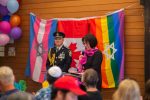
B.C. Lt.-Gov. Janet Austin addresses the July 27 Shabbat Dinner with Pride Colours event. (photo by Matt Hanns Schroeter)
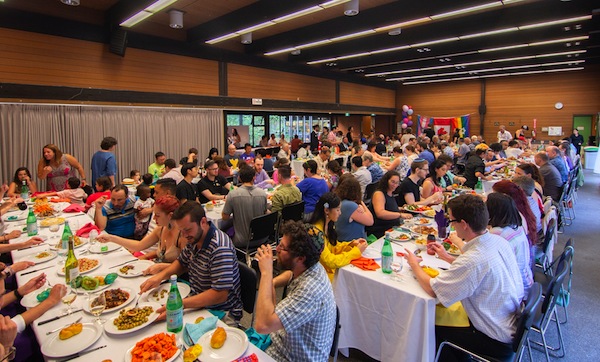
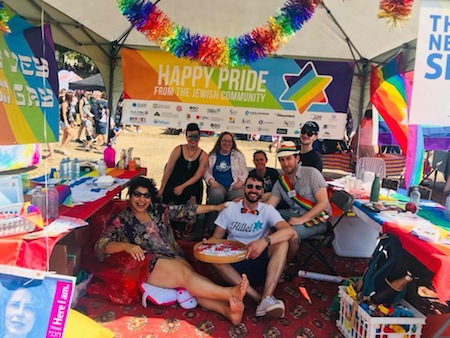
On July 27, the Metro Vancouver Jewish community celebrated Jewish Pride with guests ranging from B.C. Lt.-Gov. Janet Austin, to government officials and representatives of faith-based and nonprofit organizations, as well as Jewish community leaders, LGBTQ+ Jews and friends in a sold-out, community-wide, family-friendly, gender-inclusive Shabbat dinner at VanDusen Botanical Garden. The festivities continued on Aug. 5, when the Jewish community hosted its annual booth on Sunset Beach during the Pride Parade and Festival.
These events were organized by the Jewish Pride planning committee and made possible by the support of a record 31 Jewish participating organizations, led by the Centre for Israel and Jewish Affairs, Pacific Region, and the work of numerous volunteers and community members. Funds raised at the Shabbat dinner will go towards supporting future Jewish LGBTQ+ events over the coming year.
The July 27 Shabbat Dinner with Pride Colours was a sold-out event. (photo by Matt Hanns Schroeter)
While B.C. Premier John Horgan could not attend the July 27 Shabbat Dinner with Pride Colours, he sent his “warmest greetings,” noting, “For some, tonight may be their first introduction to observing Shabbat, and it is through sharing our lives and traditions with others that understanding and acceptance grows. Events like this are essential in ensuring that B.C. is a vibrant, diverse and welcoming place to live.”
Selina Robinson, minister of municipal affairs and housing, commented in a post on Facebook, “While I was proud to be there to bring greetings on behalf of our government … I was most proud to be there as a member of the Jewish community. I am grateful to see just how much has changed over the past number of years to create and facilitate space in our community … space for everyone regardless of gender identity or gender expression.”
“This was a really powerful moment for me last week,” said attendee Aaron Robinson, also on Facebook. “My mom spoke about being the Jewish parent of a gay Jewish man and how wonderful it was to see that there was space being made in the Jewish community for queer Jews. She spoke of the struggle and fear about making sure that your children have the space to be who they are in all of the ways they identify, and this Friday gave both of us so much hope. I’m so very grateful to the people that put on this Shabbat Pride dinner and all the organizations that were represented there for taking a huge step forward in creating a space for Jewish LGBTQ+ folks.”
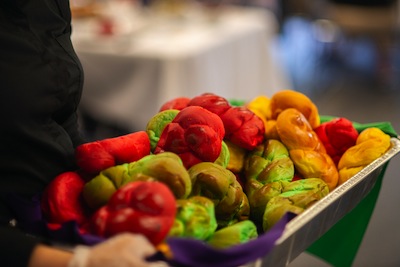
Twenty-five rainbow round challahs by Chef Menajem will be for sale ($10) at the JCC on Sept. 6, 10 a.m.-2 p.m., until supplies last. Monies raised will go to LGBTQ+ programming. (photo by Matt Hanns Schroeter)
Attendee Jill Beamish especially enjoyed talking with other women there “about parenting, queering and Judaism.”
“I loved the gathering, and send heartfelt thanks to the organizers,” said Beamish. “In 30 years of being out – and only four of being Jewish – I never thought I’d feel this welcomed and celebrated.”
Dr. Aaron Devor was another invitee who could not attend the Shabbat dinner, but who sent his remarks to be read at the event. Devor is, among other things, founder and inaugural chair in transgender studies at the University of Victoria, as well as a past president of the Jewish Federation of Victoria and Vancouver Island and a former board member of Hillel BC.
“I’d like to express my sincere appreciation to all who participated in making this fine event happen,” said Devor in his speech, “and especially to [CIJA’s] Carmel Tanaka, who I know from her years of dedicated service to the Jewish communities of Vancouver and Vancouver Island. Yasher koach to all of you!
The festivities continued on Aug. 5, when the Jewish community hosted its annual booth on Sunset Beach during the Pride Parade and Festival. (photo by Matt Hanns Schroeter)
“I, personally, have been attending Pride celebrations since 1971, when I was there for the second-ever Pride march, which took place down New York City’s Fifth Avenue. It was a breathtaking and exhilarating experience to see 10,000 lesbian, gay, bisexual and trans people marching together in the bright sunlight…. To be out and proud was something new and bold back then. And, I want to remind you that many of the people who took the risks to fight back against shame and oppression in those early days – and in all the days since – were gender diverse people: trans people, non-binary people, two-spirit people, genderqueer people, transsexuals, transvestites, drag queens and drag kings, and queers, many of whom were also Jews.
“We’ve seen huge progress since then,” said Devor. “It would be easy to get comfortable and enjoy the benefits of all that LGBTQ2+ people have accomplished in the decades since the birth of Pride. The fact that all of you are here tonight is a beautiful testament to the progressive thread that runs through much of Jewish life and culture…. I thank you for all that you have already done to bring us to this moment, and I look forward to continuing the work. There is much still to be done to make the world truly inclusive of gender and sexual diversity in all its glory.”
Gabor Maté reads the names of Palestinians killed by the Israel Defence Forces during the Great March of Return protests in Gaza. (photo by Matthew Gindin)
“Each one of them was a full human being, with a full life,” said Rabbi David Mivasair, addressing a dozen or so people, most of whom were Jews, outside of the Jewish Community Centre of Greater Vancouver on May 21, the second day of Shavuot, for Yizkor, the traditional memorial service for the dead.
Organized by Independent Jewish Voices, the group gathered to commemorate the Palestinian protesters who had been killed by the Israel Defence Forces during the Great March of Return protests in Gaza, which began on March 31 and ended May 15 (which Palestinians observe as Nakba Day). They gathered, according to the event’s Facebook page, for another reason, as well: “We will also publicly denounce the Centre for Israel and Jewish Affairs for its continual dishonest manipulation of Canadian political leaders and media sources to silence and minimize Israel’s brutality toward Palestinians and, in this case, shift the blame for the killings to the very people who were killed.”
Those present included Gabor Maté, a physician, author and member of the Jewish community. He and others took turns reading the names of Palestinians who had been killed. Afterwards, he told a story from an article that Uri Avnery, an Israeli peace activist, had written days before. In the article, Avnery described how he, as a teenage member of the Irgun, had done similar things to those of the Palestinian protesters when demonstrating against the then-occupying British forces for Israel’s independence, but the British shot over their heads, not at them. Maté also criticized the JCC for not being inclusive enough of all Jewish voices, saying that, in practice, it was more like “the Zionist community centre.”
“The confusion between Zionism and Judaism is a tragedy,” said Maté. “I’m just glad to be here to bear witness along with the rest of you.”
Shawkat Hasan, a member of the Palestinian community and the B.C. Muslim Association, whose family lost their home in the war of 1948, also spoke, emphasizing that the conflict was not between Jews and Muslims but between Zionism and its “victims,” and calling for widespread resistance to violence against Palestinians.
The group carried out their service peacefully. The idea for it came about only days before, and the organizing of it was rushed to coincide with Shavuot. One sign read, “Murdering innocents is not a Jewish value.” Some passersby stopped to join or listen, as members of the group chanted the names and recited Kaddish, and some to express their opposition.
Mivasair told those assembled that the location had been chosen to protest CIJA, who have their offices inside the JCC. CIJA had launched a campaign calling for Prime Minister Justin Trudeau to apologize for remarks Trudeau had made that the “reported use of excessive force and live ammunition is inexcusable” and his call for “an immediate independent investigation” after a Canadian doctor was shot by the IDF while treating protesters.
“Hamas has left Israel no choice but to use force to protect the tens of thousands of Israelis who live close to Gaza,” said Shimon Koffler Fogel, CIJA’s chief executive officer, in a statement May 16. “We are outraged and saddened that Hamas is again using civilian human shields. For Israelis and the Jewish community, Palestinian casualties are painful tragedies. For Hamas, Palestinian casualties are sickening public relations achievements.”
“Everything that CIJA says is contestable,” Mivasair told the Jewish Independent following the service. “The situation in Gaza is desperate enough, due to the policies of the Israeli government, to explain the actions of the Palestinian protesters without imagining that they were primarily orchestrated by Hamas, which they were not. Why are organizations that purport to speak for the Jewish community suppressing discussion in Canada about what is really going on?”
The Yizkor service at the JCC followed weeks of protests by Palestinian solidarity groups outside of federal Justice Minister Jody Wilson-Raybould’s Vancouver constituency office.
In the conflict at Israel’s border with Gaza, the IDF faced some 50,000 protesters. More than 100 Palestinians were killed and between 8,700 and 13,000 wounded, depending on the source of the data. The IDF’s actions, in particular the use of live ammunition, has been condemned by organizations including B’Tselem, Human Rights Watch and Amnesty International. According to Israel, most of those killed were members of the terrorist group Hamas, which, the Israeli government says, organized the protests.
Matthew Gindin is a freelance journalist, writer and lecturer. He is Pacific correspondent for the CJN, writes regularly for the Forward, Tricycle and the Wisdom Daily, and has been published in Sojourners, Religion Dispatches and elsewhere. He can be found on Medium and Twitter.
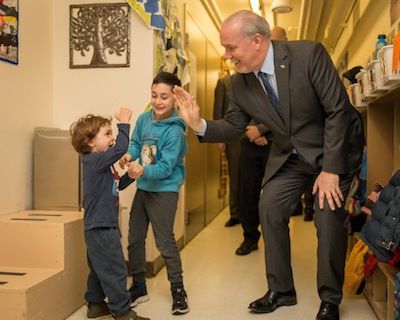
B.C. Premier John Horgan toured the Jewish Community Centre of Greater Vancouver on March 29, speaking with community members of all ages. (photo from Office of the Premier)
B.C. Premier John Horgan visited the Jewish Community Centre of Greater Vancouver just before erev Pesach, March 29.
The premier had visited the JCCGV before, but only to attend meetings in the boardroom, and this was his first visit as the province’s head of government.
Horgan toured the building, visited the Vancouver Holocaust Education Centre, the sports facilities and spent time with children and parents at the daycare. (photo from Office of the Premier)
Horgan toured the building, visited the Vancouver Holocaust Education Centre, the sports facilities and spent time with children and parents at the daycare.
In a statement to the Independent after the meeting, the premier said: “People drive community. Touring the centre really hit that message home.… I was glad to meet with and hear from community leaders, see the range of services being provided and visit with kids, parents and educators at the childcare centre in advance of Passover.”
On April 12, the premier also participated in a Yom Hashoah ceremony at the B.C. Legislature, which included numerous survivors of the Holocaust. In next week’s Independent, there will be more about the Yom Hashoah commemorations that took place in Victoria and Vancouver.
“Our goal was for him to get to know us and get to see our centre, get to understand the level and breadth of activities we offer,” said Eldad Goldfarb, executive director of the JCCGV. “His focus was primarily on childcare and I think he had a few more visits during that day to other [childcare] facilities.… We wanted him to see what we are doing and we wanted him to hear about our plans for the future.”
While there was no formal agenda for the meeting, after the tour, Horgan met with representatives of agencies that are located in the building. He was introduced and thanked by Alvin Wasserman, vice-president of the JCCGV.
While affordable housing was not on the agenda officially, Goldfarb said he discussed with the premier the opportunity for including such accommodations within the planned redevelopment of the JCCGV site. The new provincial government made a substantial commitment to affordable housing in its first budget, Feb. 27.
Nico Slobinsky, director of the Pacific Region for the Centre for Israel and Jewish Affairs, said Horgan was at the centre more to listen than to talk.
“He was there to learn a little bit about what the centre does and the opportunity to connect with the community since becoming premier,” said Slobinsky, who helped arrange the visit. “He hasn’t had a chance yet to do that. He did that before but not since becoming premier.
“As a community,” he said, “we have long enjoyed a great relationship with the provincial government and we are very happy to see that continue.”
Ariella Kimmel, left, and Sophie Hershfield at last summer’s Winnipeg Pride Parade. Hershfield has been on CIJA’s LGBTQ+ Advisory Council since its inception. In that capacity, she is trying to break down barriers and clear up misconceptions about Israel within the LGBTQ community. (photo from Sophie Hershfield)
As part of the Limmud festival that took place in Winnipeg March 18-19, LGBTQ activist Sophie Hershfield gave a presentation.
A student at the University of Winnipeg, studying English and philosophy, Hershfield became active in the LGBTQ community when she was at Gray Academy of Jewish Education. She has been on the Centre for Israel and Jewish Affairs’ LGBTQ+ national advisory council since its inception last year.
“The talk I gave at Limmud was largely on advocacy within LGBTQ communities, because a lot of them are hostile towards Israel,” Hershfield told the Independent. “Last year, for example, at the Chicago Dyke March and the fallout from that … it was apparent that the LGBTQ community was hostile toward Israel and often to Jewish Zionists within their organizations. At the Chicago Dyke March, people who were on the Pride side were actually told to put their flags away, because of their connection to Israel.”
Hershfield is trying to break down barriers and clear up misconceptions about Israel within the LGBTQ community.
“One of the most successful things I think we did last year was we had an Israel-themed float in the Pride Parade,” said Hershfield. “And we had Jewish people and Israeli people on this float. We actually won best float in the entire parade. People were associating Israel with fun and happiness and being inclusive, those positive connections. There were definitely some positive responses. There were people saying, it was so cool, that Israel is so fun. I didn’t see any negative pushback, just positivity.”
Hershfield is already working with a planning committee on next year’s parade in Winnipeg.
Through CIJA, Hershfield plans to continue her efforts to improve inclusiveness within Jewish communities across Canada and to do Israel advocacy in LGBTQ communities.
“Halifax’s Pride board was incredibly hostile toward Jewish people and toward pro-Israel people – to the point where there were death threats to people who were involved,” said Hershfield. “I wanted to be more preventative, by building positive connections instead of negative ones.”
Jonathan Lerner favours a similar approach. He is assistant director of the Vancouver Holocaust Education Centre, and is also on CIJA’s LGBTQ+ Advisory Council.
Vancouver’s Jonathan Lerner, a member of CIJA’s LGBTQ+ Advisory Council, finds that many LGBTQ Jews “choose one or the other – either they’re involved in the Jewish community or the LGBTQ community, but not necessarily both.” (photo from Jonathan Lerner)
“Vancouver is a very welcoming place for LGBTQ people, with a society that is very diverse and welcoming,” he said. “The annual Pride Parade draws 600,000 people or more, and there is a month-long celebration. The municipal government is very supportive of these events and, while discrimination still exists, Vancouver as a whole is very welcoming.
“I’ve had great experiences with Vancouver synagogues, including the Reform and Reconstructionist movements,” he added. “I can say that even the Conservative synagogue in Vancouver has sponsored our booth at the Pride festival.”
Still, Lerner feels there remains a disconnect between the Jewish and LGBTQ communities.
“There are plenty of LGBTQ Jews and they’re often involved in Jewish or LGBTQ communities,” he said. “However, I find that most choose one or the other – either they’re involved in the Jewish community or the LGBTQ community, but not necessarily both. Sometimes, one may feel a necessity to choose an identity. For example, if one is associated with LGBTQ organizations, they may be anti-Israel … and so, one may choose to hide one’s Zionism or even Judaism.”
Lerner said that, while CIJA and the Jewish Federation of Greater Vancouver have worked hard at increasing collaboration and sharing between the communities – with recent workshops, training and outreach – more is always welcome.
“It has been challenging at times for LGBTQ people to be out in the Jewish community, and also for Jews to be open about their religion and Zionism in the LGBTQ community,” he said. “I’d like to see that change.”
Meanwhile, in Winnipeg, there have been other initiatives to increase awareness and inclusivity. On Feb. 21, Shaarey Zedek Synagogue hosted at the Jewish deli Desserts Plus an event called LGBTQ Jews: Sexuality, Gender Identity and Judaism, with some 20 attendees. It was led by the synagogue’s Rabbi Anibal Mass.
“Our vision is an inclusive space, a nonjudgmental environment, where you can express your Judaism pretty much your way,” Mass told the Independent.
Spiritual leaders of Winnipeg’s Shaarey Zedek Synagogue, Rabbi Alan Green, left, and Rabbi Anibal Mass. The synagogue is working to become more inclusive. (photo from Shaarey Zedek Synagogue)
An LGBTQ group had approached the synagogue, said Mass. Some people from the group attend Shaarey Zedek and were concerned about the level of acceptance at the shul.
“I don’t blame them,” said Mass. “We’ve been changing … the last few years, and some people are unaware of all the changes we went through. We thought that it would be a good time to share with this specific group of people our vision and our values, for them to have it clear. If they have any doubts or questions, they can ask a member of our clergy – what we stand for, what we’re willing to do or not do, etc.”
Mass sees rabbis of the Talmud as examples to follow in regards to being nonjudgmental and inclusive. “They speak about compassion, about loving your fellow human beings,” said the rabbi. “We feel empowered by the works of the rabbis to embrace all these people in our synagogue and make Shaarey Zedek their home.
“I was expecting to have lots of questions [at the event]. I didn’t have too many. I guess maybe they weren’t expecting me to say how open we are. Maybe people thought I would come there and preach … and to say, ‘Yeah, we accept you, but….’ But there was never a ‘but.’ We do accept you, period. So it was a great event.”
At that information event, a gay male couple from the synagogue shared their story with the group, about how they were turned down for a wedding from pretty much every synagogue in town – until they arrived at Shaarey Zedek. The couple said they could not believe how welcoming the congregation was.
“We ended up celebrating their wedding,” said Mass. “Many times, people complain that synagogues don’t offer the answers. The problem is, sometimes we don’t have the questions. We want to know what people in the LGBTQ group actually want, and to make that part of our vision.
“We also detect there will be some challenges for the future that we don’t know how to handle,” he admitted. “For example, how do you serve people who define themselves as non-binary? Do they have a bar or bat mitzvah? Both terms are appropriate.”
To keep things moving forward, Mass plans to start by hosting a group at his house. He understands that it might take awhile for some people to feel comfortable coming to a synagogue. “But, that’s OK,” he said. “If they don’t come to the synagogue, the synagogue will come to them. That’s my philosophy.”