Skip to content
  • Home
  • Subscribe / donate
  • Events calendar
  • Business Directory
  • FAQ
  • News
    • Local
    • National
    • Israel
    • World
    • עניין בחדשות
      A roundup of news in Canada and further afield, in Hebrew.
  • Opinion
    • From the JI
    • Op-Ed
  • Arts & Culture
    • Performing Arts
    • Music
    • Books
    • Visual Arts
    • TV & Film
  • Life
    • Celebrating the Holidays
    • Travel
    • The Daily Snooze
      Cartoons by Jacob Samuel
    • Mystery Photo
      Help the JI and JMABC fill in the gaps in our archives.
  • Community Links
    • Organizations, Etc.
    • Other News Sources & Blogs
  • JI Chai Celebration
  • JI@88! video

Recent Posts

  • Federation now across BC
  • Israel fighting for its existence
  • Deal strengthens Iran
  • Patriotic belonging diminishes
  • A campaign to engage
  • Upstanders’ first live event
  • Responding to Carney
  • Having your own home
  • Music a family tradition
  • Musical to warm heart
  • Community milestones … June 2026
  • Sharing her passion for Israel
  • Or Shalom reopens its doors
  • JFS from past to future
  • Need holistic approach
  • Sharing stories, advice
  • Journalist shares fears
  • Skills to live together
  • Road to independence
  • Cutting grass with scissors
  • Zionism as a solution
  • Deceit, desire & the divine
  • Reclaiming sacredness
  • Creative project ideas
  • Summer squares and cobbler
  • Thou shalt … summer commandments
  • Legal help for students
  • Revisiting myth of Lilith
  • Wrong person rebuked
  • Canada’s mixed messages
  • Questions for museum
  • Symposium on antizionism
  • Making soccer political
  • CJPAC lauds Pulver’s impact
  • City recognizes Vrba’s legacy  
  • Organ donation saves lives

Archives

Follow @JewishIndie
image - The CJN - Visit Us Banner - 300x600 - 101625

Tag: CIJA

On access to palliative care

The way a society treats its most vulnerable speaks volumes about its principles. There are few more vulnerable than those reaching the end of life. The physical, emotional, interpersonal and spiritual challenges confronted at life’s end are immense. Just as we expect our healthcare system to be there for us throughout our lives, so too must it support each of us – and our families – as we enter life’s final chapter.

Palliative care is a policy issue that has the potential to touch every family across the country. According to the Canadian Hospice Palliative Care Association, only 15% to 30% of patients approaching the end of life have access to palliative care. With Canada’s population continuing to age, existing shortfalls in the system will only grow in the coming years.

While the federal government has taken the vital step of announcing additional federal funds for home care and palliative care, more can be done to ensure that no patient seeking palliative care is denied. This is why the Centre for Israel and Jewish Affairs (CIJA) has taken a lead role in mobilizing an interfaith coalition to urge Ottawa to take action on this issue.

Working with Catholic, Evangelical and Muslim allies, CIJA’s efforts achieved a key milestone in late 2017, when Parliament passed Bill C-277. This bill, which received strong support from MPs across party lines, called for the establishment of a national palliative care strategy. Our next step is to ensure that the national strategy that flows from Bill C-277 strengthens end-of-life care for all Canadians.

For this reason, in partnership with others, CIJA is organizing an expert working group to provide us with advice regarding Canada’s national palliative care strategy. An essential portion of these suggestions will be based on the patient and family experience, which is why I invite every reader to consider whether they have personal insights they can share with us.

Can you attest to the importance of high-quality palliative care, perhaps having had a loved one who received excellent end-of-life care? Or, do you have a family member who, despite seeking it, was unable to access appropriate hospice or palliative care? We want to hear your stories – and government policymakers need to hear how these policies affect real lives. Email [email protected] to share your experiences with palliative care.

It is an extraordinary act of chesed to care for a person in their final days of life. Our healthcare system, in which Canadians rightly take pride as evidence of our nation’s innate sense of kindness, must do better to ensure that those who need palliative care are never denied this essential service.

Steve McDonald is director, policy and strategic communications, at the Centre for Israel and Jewish Affairs (CIJA).

Posted on February 9, 2018February 7, 2018Author Steve McDonaldCategories Op-EdTags Centre for Israel and Jewish Affairs, CIJA, healthcare, palliative care, policy

Balfour is but one milestone

This year marks the 100th anniversary of the Balfour Declaration, a cause for commemoration and even celebration on the part of Jewish activists worldwide.

The Balfour Declaration refers to a short letter from Lord (Arthur) Balfour, former U.K. prime minister and then-foreign secretary, to Lord (Lionel Walter) Rothschild. In it, Balfour declared that the British cabinet had approved a statement that the government favoured the establishment of a Jewish national home in what was soon to become the British Mandate of Palestine.

The implications of the declaration have been debated by pro- and anti-Israel activists for, well, an entire century. For many in the pro-Israel community, the declaration is akin to a Magna Carta for the Zionist movement: an affirmation – from the very authority that would oversee the territory – that Zionism was indeed a worthy enterprise.

Without diminishing this sentiment, I offer my interpretation of the Balfour Declaration and what it teaches us about pro-Israel advocacy today.

The Balfour Declaration was a strategically vital recognition of the right of the Jewish people to self-determination – and one that clearly affected the course of history. But Balfour did not establish our national rights, which pre-existed the declaration. These rights have always been rooted in the natural right of every nation to shape its own identity and achieve self-determination in its ancestral land.

This is not a minor distinction. We dare not confuse the validation of our rights with the source of our rights. Indeed, our detractors falsely do so. In their minds, if the Balfour Declaration can be dismissed as a “colonial” statement, the rights of the Jewish people to which it speaks can be similarly undermined.

It’s this sort of nonsense that suggests Jewish history in the land began in 1917. To believe it, one would have to ignore the mountains – and caverns – of archeological and historical evidence that confirm a Jewish presence in the land for millennia. In addition to various non-biblical documents confirming Jewish indigenous roots in Israel, the Bible itself is widely recognized – even by ardent atheists – as a historical chronicle of a particular people in a particular land.

As Shimon Koffler Fogel, chief executive office of the Centre for Israel and Jewish Affairs (CIJA), recently observed, the Balfour Declaration was “one milestone among many that confirm the moral, historic and legal right of the Jewish people to self-determination in our ancestral land. Just as many states endorsed the Balfour Declaration at the time, the international community’s support for the national liberation of the Jewish people after centuries of exile has been expressed time and again.”

Fogel further noted that, in a similar vein, November also marks “the 70th anniversary of the UN partition resolution of 1947, which expressly called for the creation of a Jewish state.”

The Balfour Declaration matters today precisely because it is more important than ever that we show how our fundamental rights as a people are backed by international consensus. The declaration is not the linchpin of this recognition but rather a signpost on the road to achieving widespread affirmation of our rights.

Every year, CIJA brings approximately 200 Canadian leaders and future leaders (almost all of whom are non-Jewish) on fact-finding missions to Israel. As someone who heads an annual trip of post-grad students, I can tell you that most Canadians – including those sympathetic to Israel – are not particularly interested in what a British lord had to say about the region a century ago.

But what they do care about, and what makes them more receptive to understanding the strong legal and moral foundation for Israel’s existence, is that many global figures and organizations (including the United Nations) have echoed these rights. In this regard, Balfour is an important thread of the historic fabric.

The importance of non-Jewish validators applies to many pro-Israel advocacy issues, such as Israel’s right to define itself as a Jewish homeland, the dangers of BDS (the movement to boycott, divestment from and sanction Israel) or the threat posed by Israel’s neighbours. On these and other topics, our target audience is generally more receptive to our perspective when we can demonstrate that it is one shared by others, including governments and leaders around the world.

Balfour matters, but we should remember why. The declaration serves not as the basis for modern Israel’s existence but as a key witness to the abundant evidence – irrefutable, millennia-old proof – of the right of the Jewish people to self-determination.

Steve McDonald is deputy director, communications and public affairs, at the Centre for Israel and Jewish Affairs. Follow him on Twitter at twitter.com/koshermcdonald.

Posted on November 24, 2017November 23, 2017Author Steve McDonaldCategories Op-EdTags Balfour Declaration, CIJA, Israel, Shimon Koffler Fogel
Canadian Jewish history

Canadian Jewish history

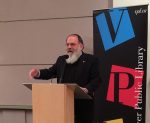
Rabbi Dr. Yosef Wosk was the keynote speaker at the Vancouver exhibit. (photo by Cynthia Ramsay)

The Canadian Jewish Experience traveling exhibit opened at the central branch of Vancouver Public Library on Nov. 16. The display is presented by the Jewish Museum and Archives of British Columbia, the Centre for Israel and Jewish Affairs, Jewish Federation of Greater Vancouver and VPL.

The opening event was hosted by Michael Schwartz, JMABC director of community engagement. Kayla Epstein, VPL board chair, and Karen James, Jewish Federation board chair, said a few words, as did Tova Lynch, who led the committee that created the exhibit, which opened in April in Ottawa. The multi-panel display celebrates the history of Jews in Canada and was made for the occasion of the 150th anniversary of Confederation. The set that is on display at VPL has an additional panel dedicated to the B.C. Jewish community.

“To date, we have created 15 various sets [of the exhibit] that are traveling around the country,” said Lynch. To date, it has been to 35 places, and is scheduled for more, including a push to have it on university campuses. Among the major supporters of the exhibit, she said, are Fred Belzberg and Sam Belzberg. She thanked the Belzbergs, who couldn’t attend the event, as well as Rabbi Dr. Yosef Wosk, whose contributions, she said, made the event possible.

Wosk was also the keynote speaker. He spoke of the importance of books, of stories, of the relative youth of Canada as a nation and about the Jewish community’s participation in national life. He expressed gratitude for living in a country that is safe for Jews and other minorities, but also recalled that it wasn’t always so and that immigrants today still face problems.

The Hon. Dr. Hedy Fry, member of Parliament for Vancouver Centre, offered greetings from Prime Minister Justin Trudeau, as well as her own comments on the contributions of Jewish and other immigrants to Canadian society.

The Canadian Jewish Experience is on view at VPL until Nov. 30.

Format ImagePosted on November 24, 2017November 23, 2017Author Cynthia RamsayCategories LocalTags CIJA, Jewish Federation, Jewish history, JMABC, Vancouver Public Library, VPL
ביקור חשוב

ביקור חשוב

נציגי הפדרציה היהודית של ונקובר ביקרו בישראל, ברשות הפלסטינית ובירדן. (צילום: twitter.com/JewishVancouver)

משלחת של הפדרציה היהודית של אזור מטרו ונקובר בשיתוף פעולה עם המרכז לעניני ישראל והיהודים בקנדה, חזרה מביקור חשוב בישראל, ברשות הפלסטינית ובירדן. בראש המשלחת עמדה יו”ר מועצת המנהלים של הפדרציה היהודית, קרן ג’יימס. כן השתתפו בה המנכ”ל, עזרא שנקן, היו”ר לשעבר סטיבן גרבר והיו”ר של המרכז, דיוויד קייפ.

המשלחת מסרה בדיונים שניהלה עם נציגים שונים מישראל את תמיכתה בישראל ואת הרצון להגיע לשלום באזור. הפגישות התנהלו בין היתר עם בכירים במערכת הפולטית בישראל. ובהם: שר התשתיות הלאומיות, האנרגיה ומקורות מים, יובל שטייניץ (ממפלגת הליכוד), שרת המשפטים, איילת שקד (ממפלגת הבית היהודי), סגנית שר במשרד החוץ, ציפי חוטובלי (ממפלגת הליכוד) וסגן השר לעניינים דיפלומטיים במשרד ראש הממשלה, מיכאל אורן (ממפלגת כולנו). כן התקיימה פגישה עם נציג האופוזיציה יו”ר מפלגת יש עתיד, יאיר לפיד. בנוסף התקיימו פגישות עם שגרירת קנדה בישראל, דבורה ליונס והקוסטוס (שומר המקומות הקדושים) של הכס הקדוש בישראל הפורש, האב פיירבטיסטה פיצאבלה.

נציגי הפדרציה היהודית לקחו חלק בישיבת חבר הנאמנים של הסוכנות היהודית לארץ ישראל, שדנה במשמעות החוק של ממשלת ישראל בנושא הגיור (המאפשר לרבנות הראשית בישראל סמכות בלעדית בהליכי הגיור), וכן בהשעיית ההסכם לגבי סידורי התפילה בכותל המערבי (“מתווה הכותל”), על ידי ראש הממשלה, בנימין נתניהו, עקב לחצן של הפלגות החרדיות יהדות התורה וש”ס. כידוע יו”ר הסוכנות היהודית, נתן שרנסקי מתנגד להשעיית סידורי התפילה החדשים וחוק הגיור. יצויין עוד כי שני נושאים אלה מטבע הדברים מעסיקים רבות יהודים הגרים בישראל ומחוצה לה, שלא נמנים על הזרם האורתודוכסי (בהם רפורמים וקונסרבטיבים).

המשלחת התשתפה גם באירוע הרשמי בכנסת לזכרו של ראש הממשלה לשעבר, יצחק רבין ז”ל.

נציגי הפדרציה היהודית והמרכז לענייני ישראל והיהודים יצאו לרמאללה ושם נפגשו עם ראש הממשלה של הרשות הפלסטינית, פרופסור ראמי חמדאללה. הנציגים מסרו לחמדאללה את תמיכתם בהסכם השלום בין הצדדים, וכי על הרשות הפלסטינית לקבל את הצעתה של ממשלת ישראל לחדש את המשא ומתן בנושא השלום. הם ביקשו מראש ממשלת הרשות הפלסטינית לעשות יותר כדי להילחם בהסתה ובטרור. בפדרציה היהודית מציינים בהקשר זה כי החשוב היה להם להסביר ישירות לראש הממשלה הפלסטינית מהיא העמדה של היהודים בתפוצות בנושאי השלום וישראל.

כן נפגשו נציגי המשלחת בעמאן עם ראש הלשכה המלכותית של ירדן ולשעבר ראש ממשלת ירדן (בשתי קדנציות), ד”ר פיאז א-טראונה. המשלחת הציגה לפניו מסרים דומים לאלה שהועברו לראש הממשלה הפלסטינית, תוך הדגשה שעל המנהיגים הערבים להפעיל לחץ על הרשות הפלסתינית לעשות יותר כדי להילחם בהסתה ובטרור. וכן להניע את הרשות לקבל את עמדת ישראל ולחדש את המשא ומתן לשלום. בישיבה עם ד”ר א-טראונה נכח גם שגרירה של קנדה בירדן, פיטר מקדוגל.

בפדרציה היהודית מבקשים לציין כי מידע בדבר שתי הפגישות עם ראש הממשלה הפלסתיני, ועם ראש הלשכה המלכותית של ירדן, נמסר לממשלות קנדה וישראל, שאף הביעו תמיכה בהן.

קדמו לפגישות בישראל, ברשות הפלסטינית ובירדן, ביקור בלונדון שכלל פגישות של נציגי המשלחת המשותפת עם נציגים של ראשי הקהילה היהודית. הדיונים כללו בעיקר את נושאי הגברת הביטחון והמלחמה באנטישמיות. המשלחת השתתפה גם באירועי מאה שנה להצהרת בלפור עם שר החוץ הבריטי, בוריס ג’ונסון, שנערכו בלשכת יושב ראש בית הנבחרים הבריטי, ג’ון ברקו. המשלחת ביקרה עוד בבית קנדה בלונדון ונפגשה עם נציגו מטעם ממשלת קנדה.

Format ImagePosted on November 8, 2017Author Roni RachmaniCategories עניין בחדשותTags Balfour Declaration, CIJA, Israel, Jewish Federation, Jordan, London, Palestinian Authority, הפדרציה היהודית, הצהרת בלפור, ירדן, ישראל, לונדון, מרכז לעניני ישראל והיהודים, רשות הפלסטינית
Jewish groups’ M-103 advice

Jewish groups’ M-103 advice

Left to right, MP David Sweet, MP Michael Levitt, CIJA chief executive officer Shimon Koffler Fogel, MP Scott Reid and MP David Anderson pose for a photo during the House of Commons Standing Committee on Canadian Heritage hearings on M-103 on Oct. 18. (photo from CIJA)

Jewish groups were in Ottawa on Oct. 18 to testify in front of the House of Commons Standing Committee on Canadian Heritage, which will make policy recommendations on M-103, a motion that condemns “Islamophobia and all forms of systemic racism and religious discrimination.”

Leaders of the Centre for Israel and Jewish Affairs (CIJA) and B’nai Brith Canada drew on the Jewish community’s experience with fighting antisemitism in their recommendations on how to maximize the motion’s efficacy.

In his testimony, CIJA chief executive officer Shimon Koffler Fogel pointed to statistics that showed Jews are the most targeted religious minority in the country.

“Nationally, there were 54 hate crimes targeting Jews per 100,000 individuals in 2015. While this number is relatively consistent with previous years, there was an increase in hate incidents targeting other minority communities, including the Muslim community. In fact, Muslims were the next most targeted group, with 15 incidents per 100,000 individuals,” Fogel said. “I mention these numbers not to showcase Jewish victimhood, but rather to demonstrate the very real experience our community has in grappling with the issues this committee is studying.”

B’nai Brith Canada chief executive officer Michael Mostyn recommended that the motion be constructed so that it will be “embraced broadly by all Canadians” and by “communities that are the targets of racism and discrimination, including Canadian Jews, who continue to be the target of antisemitism.”

Mostyn said the bill must not diminish “the threat to Canadians of all faith communities who face racism and religious discrimination and it must not suggest that one form of racism or religious discrimination is more threatening, or of greater priority, than another.”

Among Fogel’s recommendations was that the committee work to improve on the collection and publication of hate crime data, as it currently varies widely by police department.

He said statistics from the Greater Toronto Area – including Peel Region, Toronto and York Region – are readily available, “but even with these three neighbouring jurisdictions, each report provides different information, making direct comparisons sometimes difficult.”

He added that there are cities, such as Montreal, that don’t release data about which identifiable groups are being targeted, leaving policymakers with incomplete information.

Fogel said it’s important to properly define hate, as we “can’t effectively fight bigotry and hatred without precisely defining it. The term ‘Islamophobia’ has been defined in multiple ways, some effective and some problematic. Unfortunately, it has become a lightning rod for controversy, distracting from other important issues at hand.”

Fogel used the Islamic Heritage Month Guidebook, which was issued by the Toronto District School Board earlier this month and contains a definition of Islamophobia that includes “dislike toward Islamic politics or culture,” as an example.

“Muslims can be protected from hate without restricting critique of Islamist political ideologies,” Fogel said.

Mostyn agreed that the committee should “exercise great care in any definition of Islamophobia” because, if the definition is vague or imprecise, it can be “hijacked and only inflame tensions between and among faith communities in Canada.”

Mostyn said an imbalance can create “the impression that Canadian Muslims are the only victims of hate crimes. We are just as concerned with the source of hate crimes targeting Canadian Jews from within radical elements of the Muslim community.”

Fogel also recommended that greater and more consistent enforcement of existing laws is needed. “Recently, the attorney general of Quebec decided not to lay charges in a case of an imam in Montreal who had called for the murder of Jews. Quebec’s attorney general also declined to pursue a second charge of genocide promotion. This decision sent a message that someone can call for the death of an entire group of people without consequence,” he said, adding that the federal government should train police and prosecutors to better enforce the existing Criminal Code hate speech provisions and provide resources for the development of more local hate crime units.

In his testimony, David Matas, B’nai Brith Canada’s senior legal counsel, argued that some fear of radical Islam is rational.

“Adherents to some components of Islam preach hatred and terrorism, incite to hatred and terrorism and engage in hate-motivated acts and terrorist crimes,” Matas said. “What the committee, we suggest, can usefully do is propose criteria, with illustrative examples, which can guide those directly involved in the combat against the threat and acts of hatred and terror coming from Islamic radicals.”

Matas called on the committee to “focus both on those victimized by Islamophobia and on the incitement and acts of hatred and terrorism, which come from within elements of the Islamic community.”

In his remarks, Fogel also referred to the passing of Bill C-305 – a private member’s bill that would expand penalties for hate crimes against schools and community centres associated with identifiable groups – which had its third reading on Oct. 18.

“CIJA has long advocated for the changes contained in Bill C-305,” Fogel said. “C-305 is a clear example of how elected officials can work together, in a non-partisan spirit, to make a practical difference in protecting vulnerable minorities.”

CIJA chair David Cape said, “CIJA remains grateful for the tireless efforts of MP Chandra Arya, who has committed his time and energy to strengthening hate crime protections. As we celebrate Canada’s 150th anniversary, we’re reminded that the safety of at-risk communities is essential for a healthy, vibrant country. Criminals who target Jews or other minorities don’t distinguish between houses of worship, community centres and schools – neither should the law.”

– For more national Jewish news, visit cjnews.com

Format ImagePosted on October 27, 2017October 25, 2017Author Sheri Shefa CJNCategories NationalTags antisemitism, B'nai B'rith, CIJA, David Matas, Islamophobia, M-103, Michael Mostyn, politics, racism, Shimon Koffler Fogel

Giving back 150

Reflecting on Canada 150, Shimon Koffler Fogel, chief executive officer of the Centre for Israel and Jewish Affairs (CIJA), recently wrote in the Globe and Mail, “Surely marking 150 years as a united confederation means more than just an extravagant party and a day off work?… Canada 150 is an opportunity to appreciate the privileges and benefits we enjoy in our great country. But these reflections risk becoming mere platitudes if they are not animated with positive action. With privilege comes responsibility. Canada 150 is a moment for each of us to consider how we can pay the great gift of being Canadian forward through tangible contributions that enhance the experience for all who call Canada home.”

As someone whose family has been in Canada since the late 1700s, these words resonated with me. Indeed, my own ancestors were among Canada’s first refugees: Loyalists who had supported and fought for the British in the American Revolution.

In my case, the Lyon family (my father’s mother’s family) were Connecticut Loyalists who lost everything because of their active service to the Crown. Passionate supporters of the British way of life and system of government, they fled to New Brunswick bereft of their possessions. In their new home, unfamiliar but welcoming, they turned their efforts to building the extraordinary country that would become Canada.

The legacy the Loyalists left – combined with the work of generations of Canadians from innumerable backgrounds – was poignantly felt on the 150th anniversary of Confederation. Today, Canada is the envy of much of the world. While Canada is not perfect (what nation is?), we enjoy greater freedom, security, social harmony and prosperity than perhaps any other country on the planet.

More than anything, our forebears taught us that, as with most good things in life, a remarkable country doesn’t just happen; it is the product of vision, values and hard work. This no less true today than it was in 1867. The country my children inherit will be made better or worse by the actions (or inaction) of my own generation.

It was in that vein that Shimon continued, in his Globe and Mail column, to present a Pledge 150 challenge to all faith communities:

“The challenge is straightforward. We ask every church, temple, mosque and synagogue to commit to undertaking 150 positive deeds that make Canada better tomorrow than it is today: 150 volunteer hours visiting the elderly, 150 new donations to community food banks, 150 new Canadian Blood Services donations, 150 hands extended to indigenous communities. The list of concrete opportunities is as limitless as the need for them.”

What better way to teach our children what it means to be Canadian than to do something tangible to make our country a better place?

At the same time, the Pledge 150 approach requires us to be thoughtful, organized and sustained in our contribution. Based on the premise that we are changed through repetition, the great Jewish philosopher-rabbi Maimonides noted that it is better to undertake many individual acts than one large act of giving. The process of giving not only benefits the recipient but, when adopted as a conscious habit, it also creates a mindset of generosity in the donor.

If you, your family or your synagogue are interested in taking part, I invite you to visit pledge150.ca for more details – and to connect with us to share your pledge ideas with others. As for me and my family, we have pledged to collect 150 items of clothing over the year to donate to those in need. By encouraging our young children to be part of the effort, we share with them the importance of helping those less fortunate – a value at the heart of Jewish tradition and Canadian civic values.

Steve McDonald is deputy director, communications and public affairs, at the Centre for Israel and Jewish Affairs, the advocacy agent of Canada’s Jewish federations.

Posted on July 21, 2017July 19, 2017Author Steve McDonaldCategories Op-EdTags Canada 150, CIJA, Shimon Koffler Fogel, tikkun olam

Express your opinion

The good news is we’re again debating “who is a Jew.” This is good news, of course, only because it’s a topic that divides Jews mostly when external threats abate enough to allow the luxury of pilpul around denominational rights and definitions.

We can only assume that the state of the world – the Iranian threat, the unhinged American administration, Syria in collapse – looks fine enough from the Israeli prime minister’s office that we have the freedom to indulge in family squabbles.

A year-and-a-half ago, the Israeli government finally agreed to create an egalitarian prayer space at the Western Wall. The Charedim who legally control Israel’s Jewish religious character, including practices at the Wall, have imposed a strict gender division on prayer and ritual at the holy site. This has sent the message to Conservative, Reform and other non-Orthodox Jews that the holy site is not wholly theirs and, by extension, that their forms of Judaism are not authentic or proper. The creation of an egalitarian section was hailed as putting an end to a painful and divisive aspect of Israeli-Diaspora relations.

An egalitarian space would permit families to visit the Kotel together, allow girls to read from the Torah during their bat mitzvahs and give women the right to pray out loud, rather than following the existing rules by which women must pray quietly so that their voices may not be heard by men on the other side of the divided plaza. The agreement for a new egalitarian space would not alter the existing men’s and women’s areas, but rather add a new, third space, south of the traditional prayer areas.

At the time the agreement was reached, Anat Hoffman, chair of the board of Women of the Wall, a group that has been at the fore in advancing the goal of an egalitarian space and whose members are routinely arrested for praying at the Kotel with prayer shawls, said the decision by Israel’s cabinet was an acknowledgment “that there is more than one way to be Jewish.”

Last week, the Netanyahu government changed its mind and decided there is not.

Bending to pressure from the ultra-Orthodox members of his coalition, the proverbial tail that so often wags the dog in Israel’s political system, Netanyahu called a snap vote on whether the decision taken in January 2016 to create the egalitarian space should indeed proceed. Ministers who last year voted in favour last week voted against.

In for a penny, in for a pound, the government at the same time advanced a bill that would reinstate the Orthodox monopoly on conversions and lifecycle events, including marriage and burials. Among the implications is that Jews not converted under the auspices of the Chief Rabbinate – in other words, by Conservative, Reform or other non-Orthodox rabbis – would not be recognized as Jews.

On most issues, Israel should take Diaspora concerns into consideration only secondarily to what is right for Israel. We have said in this space before, for instance, that Israeli defence policies should be determined with the security of Israelis as the priority, not the comfort of Diaspora Jews who have to live with the political consequences, but not the life-and-death consequences facing Israelis.

This is different. Rules regarding prayer at the Western Wall – who, where and how – should be made with the interests of the Jewish people – not just Israelis – foremost in mind. Of course, if the rules were made with the majority of Israelis in mind, they would reflect the diversity of religious observance both in Israel and in the Diaspora. Instead, what we have is a narrow reflection of ultra-Orthodox priorities that is more a result of political realities in the Knesset than religious reality anywhere outside that chamber.

Ultimately, these decisions are a result of political, not religious, considerations. The political needs of the Netanyahu government’s coalition appear to be superseding the Jewish state’s respect for diversity and pluralism within the global Jewish peoplehood.

“We believe in Jewish unity, not uniformity,” states a letter to Netanyahu signed by scores of Canadian rabbis. “The spectrum of Jewish practice is diverse, but it need not lead to divisiveness. Our differences are eclipsed by all that unites us: millennia of shared history and a shared future. What happens to Jews today – no matter where they live or where they attend synagogue – invariably affects us all.… We are an indivisible people, which is why we are deeply concerned by these and any other actions that unnecessarily foment division within amcha.”

Most of us do not have a vote in Israel, but each of us has a voice. The Centre for Israel and Jewish Affairs is urging each of us to contact the Israeli embassy to express our views on this vital matter. Please do.

Posted on July 7, 2017July 5, 2017Author The Editorial BoardCategories From the JITags Centre for Israel and Jewish Affairs, CIJA, Conservative, Diaspora, discrimination, equality, identity, Israel, Kotel, Netanyahu, non-Orthodox, Reform, religion, ultra-Orthodox, women
A pre-election townhall

A pre-election townhall

Queenie Choo, chief executive officer of SUCCESS (photo from SUCCESS), and Jacob Switzer, member of CIJA’s Local Partners Council (photo from CIJA Pacific Region), spoke with the Independent about the upcoming townhall April 2.

Immigration, security, inclusivity and affordability are among the subjects to be addressed at the April 2 Provincial Pre-election Townhall.

The townhall is being presented by SUCCESS and the Centre for Israel and Jewish Affairs (CIJA). SUCCESS chief executive officer Queenie Choo told the Independent, “The topics were determined based on … dialogue between the two organizations.”

“We wanted to find topics that were of relevance and concern for both sets of constituents, as well as current,” said Jacob Switzer, a lay leader involved in planning the event, as a member of CIJA’s Local Partners Council. Culturally sensitive care for seniors, and accessibility and transportation will also be covered.

Scheduled to participate in the discussion as of press time were Michael Lee, B.C. Liberals candidate, Vancouver-Langara; George Chow, B.C. NDP candidate, Vancouver-Fraserview; and Michael Markwick, Green Party candidate, West Vancouver-Capilano. The townhall will take place at Choi Hall, SUCCESS Social Service Centre, 28 West Pender St.

“The event will allow our community to hear from its potential political leaders and learn about their views, as well as engage politically,” said Switzer. “It also lets us tailor questions to issues that are of specific importance to our respective communities, which often overlap and which may not be as central a concern in other forums.”

About SUCCESS, he added, “we have very much enjoyed cooperating with them, both on this event and in the past.”

“It has always been our mandate to support integration of newcomers to our Canadian communities, as well as helping them to understand the rights and responsibilities of being a Canadian citizen, particularly in the civic responsibility,” said Choo. “As such, SUCCESS and CIJA have taken a leadership role to host this pre-election townhall to ensure we have an opportunity for the community to understand the positions each political party holds on the key areas of our interest. This will help voters in making an informed decision on May 9.”

“One of the key discussion points for the event will be community security and the apparent rise in bigotry and hate crimes, which is a highly current issue,” said Switzer. “We expect that both of our communities will want to hear about what policies are being considered to improve these issues and we anticipate questions from the floor around security (particularly in light of the recent bomb threats to the Vancouver Jewish Community Centre).”

With respect to the seeming rise in expressions of bigotry and hatred, Choo said, “Through the townhall, I am sure this issue will surface. It is important for the community to hear what are the directions or policies in addressing discrimination and racism from each political party. We would also like to hear how our future government will uphold our shared values of inclusion and diversity.”

The format of the event will be that of “a non-debate-style townhall,” said Switzer. “Each participant will be given a brief period for initial remarks (order is set by draw) and then will have the opportunity to answer the questions that we are already receiving via email or phone call. All will be given time to answer the same question so they can present their party’s perspectives. They will have another period to share any final comments with the audience.

“We have found that this format works well with the candidates and allows for a respectful and organized interaction among themselves and the public.”

The pre-submitted questions will be facilitated by a moderator at the townhall, noted Choo.

“This event is open to the public and free of charge,” she added. And the hope, she said, is “to engage as many people as possible, as it is important to understand what are the directions the next government will hold, especially on our important topics.”

“We are co-hosting this event with our friends at SUCCESS because we believe that joining forces with partners in other communities can only strengthen us,” said Switzer. “We are looking forward to a well-attended and meaningful event.”

The townhall will run 2:30-4:30 p.m. on April 2. To submit questions on the aforementioned topics for any party candidate, email [email protected] with the subject line “Provincial Pre-election Townhall Question.”

Format ImagePosted on March 24, 2017March 23, 2017Author Cynthia RamsayCategories LocalTags CIJA, Election, Jacob Switzer, politics, Queenie Choo, SUCCESS

Bill S-201 passes 220 to 60

The Centre for Israel and Jewish Affairs (CIJA) lauded the House of Commons’ March 8 passage of a private member’s bill to prevent genetic discrimination, which survived a last-minute push by Prime Minister Justin Trudeau to oppose it on jurisdictional grounds.

Bill S-201, which was put to a free vote, passed 220-60, with dozens of Liberals joining the Conservatives, NDP and Green Party in support of the legislation. It now goes to the Senate for technical amendments and is expected to become law by the spring.

The bill was introduced by former senator James Cowan and spearheaded through the House by Liberal MP Rob Oliphant. It is designed to prevent insurance companies and employers from denying coverage and employment to people who have a genetic predisposition to various illnesses. It also prohibits any person from requiring an individual to undergo a genetic test or to disclose the results of a genetic test as a condition of providing goods or services or entering into or continuing a contract. The enactment amends the Canada Labour Code and the Canadian Human Rights Act.

The Canadian Coalition for Genetic Fairness (CCGF), which had been lobbying for a change to the law for six years, applauded its passage. “It’s a good day because of the vote. It’s been a long time coming,” said Bev Heim-Myers, chair of the 18-member CCGF and chief executive officer of the Huntington Society of Canada.

People have been denied rental accommodations, insurance coverage and have been let go from jobs because of concerns they might one day contract serious diseases. “Many people are refusing to get a genetic test for fear of discrimination,” but the benefits of testing can be substantial, leading to early diagnosis, prevention in some cases and early, targeted treatment, she said.

CIJA, a member of CCGF, also applauded the vote. The bill’s passage is “a milestone in protecting the health and well-being of all Canadians,” said CIJA chair David Cape. “Everyone should feel comfortable to take potentially lifesaving genetic tests without fear of punitive consequences.

“As this is an issue of overlapping federal-provincial responsibility, we encourage the provinces to bring forward complementary legislation to provide full protection against genetic discrimination for all Canadians,” he added.

Trudeau opposed the bill on constitutional grounds, arguing that, by regulating insurance companies, the bill was intruding into areas that come under provincial jurisdiction.

Liberal MP Randy Boissonnault introduced motions to remove several of the bill’s sections that arguably were areas of interest to the provinces, but those amendments were rejected. Prior to the vote, he told the House that the federal government had received letters from the governments of Quebec, Manitoba and British Columbia voicing concern that the bill infringed on provincial jurisdiction on regulating contracts and on the provision of goods and services. However, a House committee that studied the bill heard from constitutional lawyers who said it did not intrude on provincial jurisdiction.

Noah Shack, CIJA’s director of policy, said the Jewish community in particular should benefit from the new law. Once enacted, “It’s something that will save lives,” he said.

Ashkenazi Jewish women have a greater chance of carrying a mutated BRCA gene than women in the general population, giving them an increased risk of developing breast cancer or cervical cancer; men carrying the gene have an increased risk of developing prostate cancer. Because of concerns they might be turned down for insurance, people refrain from getting tested for the mutation, increasing the chances they won’t take preventive measures to address the disease, Shack said. “It creates a disincentive for getting tested in the first place.”

Heim-Myers said that, after the bill passes, CCGF’s efforts will turn to the provinces, which will be urged to amend their human rights laws to prevent genetic discrimination.

– For more national Jewish news, visit cjnews.com
Posted on March 17, 2017March 14, 2017Author Paul Lungen CJNCategories NationalTags Bill S-201, CIJA, discrimination, genetic testing

These times call for solidarity

When a multicultural country like Canada faces a stark rise in hatred targeting one ethnic group, its social and ethical solidarity is put to the test. The question for Canada’s Jewish establishment is, how will it respond to the shocking spike in hatred targeting the Muslim community?

On the heels of the Quebec City mosque shooting, which left six worshippers dead, and then a hate-filled protest outside of a Toronto mosque, a private member’s motion to condemn Islamophobia was introduced in Parliament. Regrettably, the Centre for Israel and Jewish Affairs (CIJA) is opposing the motion, at least in its current form.

Liberal MP Iqra Khalid introduced the non-binding motion (M-103) urging the government to “better reflect” the Canadian Charter of Rights and Freedoms by “quell[ing] the increasing public climate of hate and fear,” while “condemn[ing] Islamophobia and all forms of systemic racism and religious discrimination.” Her motion also asks Parliament to convene a study to address these issues and “to conduct needs assessments for impacted communities.”

As the motion – intended to express the will of Parliament but falling short of having any legal force – acknowledges, there are already Charter provisions for opposing racism and discrimination. And Section 319 of the Criminal Code already outlaws “communicating statements in any public place, incit[ing] hatred against any identifiable group where such incitement is likely to lead to a breach of the peace.” But, sometimes, the law is not enough to signal collective revulsion.

The demonstrators outside the downtown Toronto mosque held signs such as “Ban Islam” and “Muslims are terrorists.” Interviewed on camera, one of the protesters makes the following chilling observation: “They [she presumably means Muslims] start out friendly and, before you know it, they grow so much in population that they take over.” The interviewer challenges her: “This is sounding a lot like what people said about Jews at one time,” to which the protester replies: “There’s no comparison. Jews were not evil.”

For its part, CIJA calls M-103 “flawed.” As CIJA head Shimon Koffler Fogel writes, the motion “requires us to silence legitimate concerns or suppress a public conversation about those strains of Islam that pose a real and imminent threat to Jews around the world,” adding that the motion “denies space and opportunity within the Muslim community to confront those strains of Islam that do indeed exist and do indeed cause harm to the majority of Muslims who do not subscribe to an extremist ideology.” For these reasons, CIJA is urging lawmakers to oppose it.

It’s not the first time a private member’s motion has been introduced to focus Canada’s attention on a specific form of hatred. In 2015, Conservative MP James Bezan asked “all members [of Parliament] and all Canadians [to] join me in denouncing antisemitism.” In 2015, Liberal MP Irwin Cotler asked the “House [to] condemn the alarming development of a new antisemitism….” And then, of course, there’s the 2010 Ottawa Protocol on Combating Antisemitism, which convened parliamentary representatives from an array of countries to call out antisemitism.

CIJA director of communications Martin Sampson shared with me the amended text of the motion CIJA proposed to Khaled, including trying to add a clause that would “recognize that criticism and condemnation of any and all forms of extremism is not only acceptable but necessary in a free and democratic society; and tasking the proposed study to define ‘Islamophobia in Canada.’”

Bernie Farber, former head of Canadian Jewish Congress and now head of the Toronto-based Mosaic Institute, a diversity, peace and justice organization, said he is “baffled and stunned” by CIJA’s opposition to the motion.

Is the lack of explicit acknowledgment of the legitimacy of criticizing religion a problem, as CIJA is suggesting? No. Parliamentary motions have no legislative force. The existing Criminal Code – including laws governing freedom of expression – will remain unaffected. Fogel’s claim that the motion will silence criticism by force of law is simply wrong. It may serve to dampen enthusiasm for the kind of hateful anti-Muslim demonstrations we saw in Toronto, but that is the point.

Or perhaps the vagueness of the term Islamophobia is a problem. Sampson calls the word “politically charged and imprecise.” Cotler, for instance, is suggesting that M-103 be amended to say “anti-Muslim bigotry.”

But, like homophobia, Islamophobia is simply the term that exists to denote this form of bigotry. When I asked historian of language Liora Halperin why the term got saddled with the more clinical “phobia” suffix instead of acquiring the more straightforward “anti” prefix, she acknowledges that phobias are psychiatric diagnoses, not ideologies. But, she adds, “in practice, fear is indeed part of racism.”

The term antisemitism – which, ironically, was coined by a German antisemite – captures the unique phenomenon of Jew hatred. Similarly, Farber argues, “hatred of Muslims needs its own specific word to get people to understand the importance of what this kind of hatred of Muslims can do. And we’ve seen it, sadly, right here in Canada.”

These times call for solidarity in the face of rising tides of antisemitism, Islamophobia and all other forms of racism. In the wake of the mosque massacre and the hateful protests on Toronto’s usually peaceful streets, coupled with the shadow of U.S. President Donald Trump’s xenophobic policies, the time is now for Canadians to stand together against Islamophobia. That’s the word we have, that’s the member’s motion being proposed, and that’s the wave of hatred – one prominent wave among many, sadly – that we urgently need to address.

Mira Sucharov is an associate professor of political science at Carleton University. She is a columnist for Canadian Jewish News and contributes to Haaretz and the Jewish Daily Forward, among other publications. A version of this article was originally published on haartez.com.

Posted on March 3, 2017February 28, 2017Author Mira SucharovCategories Op-EdTags antisemitism, bigotry, Canada, CIJA, Iqra Khalid, Islamophobia, M-103, racism, Trump

Posts pagination

Previous page Page 1 … Page 6 Page 7 Page 8 … Page 10 Next page
Proudly powered by WordPress