Skip to content
  • Home
  • Subscribe / donate
  • Events calendar
  • Business Directory
  • FAQ
  • News
    • Local
    • National
    • Israel
    • World
    • עניין בחדשות
      A roundup of news in Canada and further afield, in Hebrew.
  • Opinion
    • From the JI
    • Op-Ed
  • Arts & Culture
    • Performing Arts
    • Music
    • Books
    • Visual Arts
    • TV & Film
  • Life
    • Celebrating the Holidays
    • Travel
    • The Daily Snooze
      Cartoons by Jacob Samuel
    • Mystery Photo
      Help the JI and JMABC fill in the gaps in our archives.
  • Community Links
    • Organizations, Etc.
    • Other News Sources & Blogs
  • JI Chai Celebration
  • JI@88! video

Recent Posts

  • SFU honours Gloria Gutman
  • Lifting people’s spirits
  • Wedding a ray of light
  • Indigeneity and Zionism
  • Rule of law broken: councilor
  • Football and its roles
  • The burden of defence
  • Fish Café returns after fire
  • All right in what goes wrong
  • Nuns & mermaids at TUTS
  • Camp offers holiday retreat
  • Students and mentors inspire
  • Once-in-a-lifetime trip
  • 100 dancers, one heart
  • Money for the sciences
  • What “Jewish food” means
  • Have a cookie, schnitzel too
  • Federation now across BC
  • Israel fighting for its existence
  • Deal strengthens Iran
  • Patriotic belonging diminishes
  • A campaign to engage
  • Upstanders’ first live event
  • Responding to Carney
  • Having your own home
  • Music a family tradition
  • Musical to warm heart
  • Community milestones … June 2026
  • Sharing her passion for Israel
  • Or Shalom reopens its doors
  • JFS from past to future
  • Need holistic approach
  • Sharing stories, advice
  • Journalist shares fears
  • Skills to live together
  • Road to independence

Archives

Follow @JewishIndie
image - CJN box ad Rockowers 2026

Tag: antisemitism

Post-tumble, lights still shine

I recently celebrated Shabbat morning in a way I don’t recommend. I stepped out of my house for the dog walk, thought, “Oh, slippery!” The next thing I knew, I lost my footing. I fell down several stone steps. I ended up on the sidewalk. I’d let go of the leash. My large dog stood patiently, looking concerned, as I lay on the front walk, assessing the situation.

We’ve had a long and temperate fall here in Winnipeg. The light glaze of ice that covered everything was an unfortunate surprise. I’m very lucky. I was able to get up. I went back up the front stairs with the dog and got help. While I’m bruised and my hands were bloodied, nothing broke. While I would have preferred to go right back to bed, I stayed active enough to manage the rest of the weekend. My kids volunteer at services, so I still had to go there, too. Sometimes, what we want isn’t possible, so we make the best of the situation.

I think about Hanukkah, and the adversity that Jews face, in this way. In the best possible situation, we wouldn’t have to fight physically or verbally to maintain our traditions. We would be able to celebrate in a full-throated way, without hesitation. Yet, that option doesn’t always feel possible, even if we might think that embracing Jewish joy is the best way forward.

The issue arose for me recently when I participated in an accessible “make along.” This event, called Fasten Off, has a period each fall where knitting and crochet designers offer a big discount on their downloadable patterns. It is intended to be as accessible as possible to people with disabilities, as well as those with other challenges. There are multiple categories of challenges: non-gendered, low-vision, sizing for those who are taller or larger than average. For the first time, this year, there was a category on the form that one could tick off that said, “marginalized religious group.” I really didn’t know what to do. 

It’s true that my designs include kippot and a hamantashen baby rattle stuffie. I have never hidden my identity. Now, in Canada, Jews are a marginalized group, with documented hate crime numbers and antisemitism rising. However, I wondered what would happen if I checked off this box. Would it mean fewer people would buy my work? More? What benefit would it have? I both ticked off the box and contacted the organizer to mention my concern. I got no response at all, which made me feel even more worried.

My sales stats show what a huge shift the last two years have been. Previously, one of my kippah patterns, as an example, had been a dependable seller. I looked up this design’s sales and found I’d sold only about 16 kippah patterns (all styles) on three sales platforms during two years of the Gaza war. In the previous year, 2022/23, I sold 14 copies of this pattern on only one sales platform. As a result of this drastic sales drop (I have more than 80 designs online), I ended up taking a break from designing. It no longer became cost-effective to sink money into creating new designs when knitters no longer make even these small purchases. It doesn’t mean my business interests changed. The situation has. I’m still marketing my work, offering discounts and trying to attract interest – even while being part of a “marginalized group.”

Our tradition teaches us to pivot when things are challenging. In the Torah parsha (portion) Toldot, Isaac grows successful as a shepherd. (Genesis 26:13 and onwards) However, when he increases his household and flocks, he needs more water. When he digs new wells, he runs into trouble. First, the Philistines fill up his old wells and, then, as he moves onward, digging new ones, other herdsmen object. He pivots, digging new wells in new places until he finds one that works out. Meanwhile, in time, those who objected to him previously seek a reconciliation, seeing Isaac’s divine fortune, and they make peace. (Genesis 26:31)

After hearing this portion chanted in synagogue, a friend reminded me that sometimes being resilient means pivoting or waiting with patience when faced with adversity. Things don’t turn around right away. We both have engaged in a lot of Jewish advocacy and antisemitism education work over the past year together. She is a professional, public figure, while I tend to write and reach out behind the scenes as a volunteer. Sometimes, my efforts net quick responses, and I know what I said mattered. Other times, I have no idea if anyone received my email or if they read it. I keep trying, as I’m invested in this effort to make life better for Canadian Jews for the long haul.

I believe that bringing up issues concerning antisemitism education, equity reviews in schools and school curriculum matters makes a difference. Sometimes my message reaches the right reporter or school official. Sometimes, it doesn’t or it fails. Yet, in every situation, it’s important to pick myself up, dust myself off – and start all over again, even if the setbacks can hurt.

During Hanukkah, we celebrate the triumph of regaining religious freedom and peace. We use candles to illustrate the metaphor of bringing light to dark times. Sometimes that light is sweeter because of the struggle beforehand. 

I’m still very sore from tumbling down our icy front steps, but I’m also incredibly grateful. This morning, the dog barked, asking for her walk and, while I may still be hobbling and bruised for a bit, I was able to get outside again. 

That opportunity, to keep digging wells, reaching out to others and continuing to try? It matters. Some might see Jews as marginalized, but it’s also possible to take another read. Rather, we’re lucky and resilient, too, a people offering religious freedom and Hanukkah light to other nations. 

Joanne Seiff has written regularly for the Winnipeg Free Press and various Jewish publications. She is the author of three books, including From the Outside In: Jewish Post Columns 2015-2016, a collection of essays available for digital download or as a paperback from Amazon. Check her out on Instagram @yrnspinner or at joanneseiff.blogspot.com.

Posted on December 5, 2025December 3, 2025Author Joanne SeiffCategories Op-EdTags antisemitism, education, Hanukkah, history, Jewish life, knitting, Torah
Visit to cradle of Ashkenaz

Visit to cradle of Ashkenaz

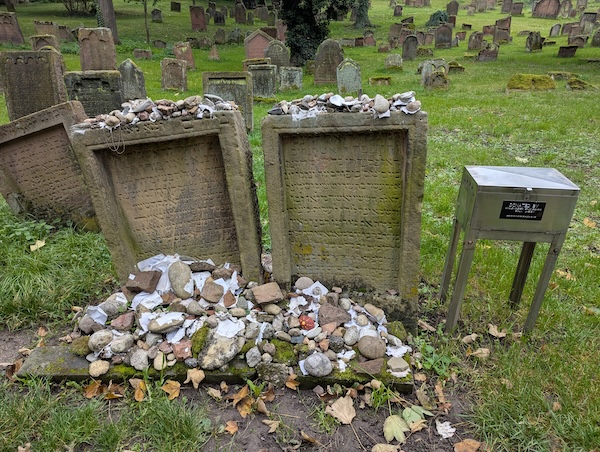
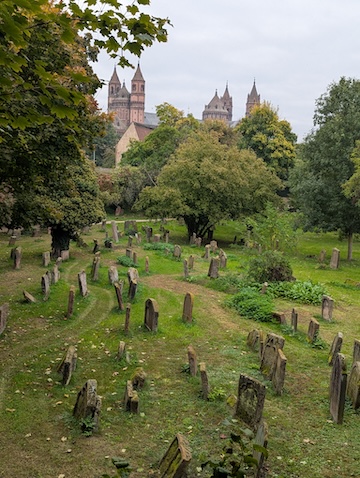
Buried next to Maharam of Rothenburg’s grave is Alexander ben Salomon of Wimpfen (known in some sources as Alexander Süsskind Wimpfen) – the man who paid for the release of the rabbi’s remains. (photo by Pat Johnson)

They say that history repeats itself and, if this is true at all, it is perhaps more true for Jewish history. The recent exchange of almost 2,000 imprisoned Palestinian terrorists for the remaining Jewish hostages held in Gaza was an act of moral compromise that has a long lineage. 

Throughout Israeli history, the centrality in Jewish values of the sanctity of life and the respectful burial of the dead have been exploited by the country’s enemies. Yahya Sinwar, the mastermind of the 10/7 pogrom, was himself freed in a 2011 prisoner release that saw more than 1,000 Palestinian terrorists set free in exchange for the freedom of Gilad Shalit, an Israeli held in Gaza for more than five years.

The ransoming of Jews goes back much, much further, however – at least to the very beginning of Ashkenaz.

In a recent brief visit to the German city of Worms, southwest of Frankfurt, I learned of Rabbi Meir of Rothenburg, who was the leading Ashkenazi halakhic authority of the 13th century. Also known as the Maharam of Rothenburg (an acronym of “Moreinu ha-rav Rabbi Meir,” meaning “Our teacher, the rabbi, Rabbi Meir”), he was imprisoned after attempting to leave the Holy Roman Empire around 1286. Jews were legally considered imperial property and valued for their tax revenue. His attempted departure was due to rising oppression, repressive taxes and broader political instability.

His arrest was intended both to prevent Jewish emigration and to extract a massive ransom by holding the most prominent rabbi of the era hostage. Although the Jewish communities were prepared to pay for his release, the Maharam refused to permit an excessive ransom, invoking the talmudic principle that captives should not be redeemed at exorbitant cost lest it encourage future kidnappings. He remained imprisoned until his death in 1293. After death, his body was held for 14 years, until a private individual paid for the release. He was ultimately buried in the Jewish cemetery at Worms.

The cemetery is known as Heiliger Sand, or Holy Sand, and the Maharam’s grave is adorned in mountains of memorial stones. Buried next to him, and also remembered with countless stones, is Alexander ben Salomon of Wimpfen (known in some sources as Alexander Süsskind Wimpfen) – the man who paid for the release of the rabbi’s remains. The parallel graves symbolize the duality of moral sacrifice and restorative compassion.

The Maharam aside, the cemetery is one of the most significant burial sites in the Jewish world. It is the oldest remaining Jewish cemetery in Europe, the earliest grave estimated to date from 1058.  

Worms was one of the central pillars of medieval Jewish civilization because it stood at the heart of Ashkenazi religious, legal and cultural development during the Middle Ages. Together with Mainz and Speyer, Worms was one of the “ShUM cities,” the most important Jewish centres north of the Alps between roughly the 10th and 13th centuries. The ShUM communities created the foundations of Ashkenazi Judaism as it is still practised today. It was one of the earliest Jewish settlements in Central Europe after Jewish migration from the Mediterranean world. It was a cradle of Ashkenazi civilization and the Maharam its most venerated scholar.

Jewish life in Worms became a template for Ashkenazi Jewish communal life, developing the legal customs (minhagim) around marriage, mourning, tzedakah and education that spread throughout Central and Eastern Europe. Even after the devastation of the Crusades and later expulsions, Worms endured in Jewish consciousness and culture. The last burial in the cemetery was in 1942. Miraculously, unlike many other Jewish cemeteries across Europe, this one survived the Shoah relatively intact. 

The symbiosis – if that is the correct word – of Jewish and Christian life in Worms is embodied in the larger dichotomy of European Jewish life. From the cemetery, the main edifice visible outside the grounds is the imposing Worms Cathedral. Worms may be central in Ashkenazi tradition, but it also holds a profound place in Christian history. 

photo - From the cemetery, the main edifice visible outside the grounds is the imposing Worms Cathedral
From the cemetery, the main edifice visible outside the grounds is the imposing Worms Cathedral. (photo by Pat Johnson)

Martin Luther, the 15th-century monk who sparked the Protestant Reformation and drove the most significant schism in Christianity, nailed his 95 theses to the cathedral door in Wittenburg, about 400 kilometres from Worms. Luther’s history intersected with Worms when he was tried at the unappetizingly titled Diet of Worms, in 1521, and found guilty by imperial authorities. Refusing to recant, he became one of history’s most consequential heretics – or spiritual pioneer and reformer, depending on one’s perspective. 

To Jews, Luther is a despotic figure. After effectively inventing Protestant Christianity, Luther was solicitous to the Jews, hoping that the stiff-necked people who had rejected the doctrine of Jesus as purveyed by the Vatican would jump on board the rebranded Lutheran variety. When they overwhelmingly did not, Luther transformed into a ferocious antisemite, putting quill to papyrus in some of history’s most vile racist tirades. 

From the perspective of this history, the cathedral dominating the sightlines of the Holy Sand can be viewed as a place where one of history’s greatest Jew-haters got his comeuppance. Of course, the Catholicism that the building still represents has its own problematic history, to frame it kindly. And, for that matter, Luther landed on his feet, historically speaking.

Visiting the cemetery is a moving experience – with a bizarre and almost laughable twist. 

Unsurprisingly, there were two security personnel seated at a table outside the gate. I attempted to gather some information, but our lack of shared language prevented much conversation. They did motion toward a box of what I thought were face masks, but which turned out to be makeshift kippot. In fact, they were peaked paper caps, the sort that short order cooks at Denny’s might wear. It was an odd experience to be walking around an ancient cemetery looking like I just stepped out of Mel’s Diner. 

We should use caution in making sweeping parallels across history, but it is striking how the enemies of the Jews across the centuries have recognized and exploited the importance of pidyon shvuyim, the redeeming of captives. How many other traditions, I wonder, have prayers in the liturgy for specifically this eventuality? A visit to the Holy Sand reminds us how deep that tradition of exploitation goes. 

Format ImagePosted on December 5, 2025December 3, 2025Author Pat JohnsonCategories TravelTags Alexander Süsskind Wimpfen, antisemitism, cemetery, Germany, history, hostages, Maharam, Martin Luther, Worms

Words hold much power

At an event hosted by the National Council of Canadian Muslims on Nov. 1, Toronto’s Mayor Olivia Chow said, “the genocide in Gaza impacts us all.” 

Four days later, protesters attacked a group of Jewish students from Toronto Metropolitan University at an event featuring a speaker who served in the Israel Defence Forces during the recent Gaza war.

Is this cause and effect? Did Chow’s words give a kind of permission for anti-Israel activists to act out violently?

Human nature doesn’t work so neatly. Suggesting one directly led to the other is both unprovable and probably specious.

Both of these incidents, however, are part of a larger zeitgeist.

For (at least) two years, Israel has been accused of monstrous barbarities. Accusations against the Jewish state include deliberate starvation, ethnic cleansing, intentional mass killings, wanton destruction of infrastructure and other assorted war crimes.

There are legitimate debates around the definitions of terms and whether or how they apply to recent events in Gaza. However, public discussions, as Chow demonstrated, rarely reflect these nuances.

As a society, we now widely accept that incendiary language can lead to incendiary actions. In discussions around immigration levels, for example, responsible public figures generally engage in discourse that does not demonize migrants or new Canadians. Concerns have been raised in recent years around the tenor of discussion around transgender issues, with advocates warning that some of the language can exacerbate emotional isolation, especially in transgender youth, and can lead to suicide ideation. Words, it is widely accepted, can have tangible, indelible impacts.

This thoughtfulness seems nowhere to be found when Jews and allies warn that the provocative language against the Jewish state is having serious impacts on Jews in Canada.

While cause and effect are rarely provable, correlations can be clearer. Over the past two years, combustible rhetoric against Israel has coincided with an unprecedented spike in antisemitic acts against Jewish institutions and people. One would think, under the circumstances, that reasonable people might see the potential that one is at least somewhat related to the other.

Raise this possibility, though, and you can expect to be met with assertions that “Zionists” are trying to silence criticism of Israel or that there is a “chill” on discussion of urgent and legitimate international matters.

This is an admirable defence of free speech. It is interesting, though, that concepts of almost unfettered free expression seem to be the redoubt of Israel critics who accept limitations on civil discourse in a vast range of other topic areas.

Is it a coincidence, also, that the very concept of “Zionists” controlling what other people are permitted to think and say about Israel dovetails with traditional antisemitic concepts of Jewish power and control?

What everyone should be able to accept – because the evidence is plain – is that there is a parallel between the intensity of rhetoric against Israel and increasing attacks on Jews in Canada (and elsewhere).

Toronto’s mayor is just one of many Canadian leaders who should know better than to nonchalantly toss around accusations, understanding that the pitch of condemnation against Israel is having concrete impacts on Jews in Canada.

Anyone with a public platform should behave in ways that recognize the intended and potentially unintended consequences of their words. A mayor of a Canadian city, for example, should know that her words will have limited effect on the lives of Palestinians, but plenty of impacts here at home.

In a diverse country like Canada, where inclusivity is considered a core value, people in positions of respect and power have a duty to act responsibly, to promote unity and avoid phrases that might inflame community tensions. 

Did Chow’s words directly lead to the violent attack on Jewish students this month? Almost certainly not. 

But they contributed to an environment already aggravated with tension and peril.

Format ImagePosted on November 21, 2025November 20, 2025Author The Editorial BoardCategories From the JITags antisemitism, language, Olivia Chow
Plenty of hopefulness

Plenty of hopefulness

Avi Benlolo of the Abraham Global Peace Initiative was in Vancouver Nov. 5 to screen the AGPI’s new film, Heart of Courage, about Jewish resilience in the wake of the Oct. 7, 2023, terror attacks. (photo by Pat Johnson)

Against a “tsunami” of anti-Israel and antisemitic content online and in the broader society, Jews and pro-Israel voices need to do a better job getting their message out, according to Avi Benlolo.

Benlolo is founding chair and chief executive officer of the Abraham Global Peace Initiative (AGPI), whose mandate is to study and research international human rights, fundamental freedoms, democracy, global peace and civil society in Canada, Israel and around the world. He was previously founding president and CEO of Friends of Simon Wiesenthal Centre and writes weekly in the 

National Post. He was in Vancouver screening AGPI’s new 40-minute film, Heart of Courage and spoke with Rabbi Jonathan Infeld at Congregation Beth Israel Nov. 5. He was introduced by Diane Friedman, the congregation’s adult program director. 

The film features a soldier playing John Lennon’s “Imagine” on a piano in Tel Aviv’s Hostages Square.

“His music becomes his voice, a testament to the resilience of his spirit and the strength of his people,” the narrator intones. “His teary eyes remain wide open, reflecting the weight of his generation’s struggle. He plays for a world he longs to see, a world of peace. In that moment, his dreams reach beyond the darkness, yet his resolve remains unshaken. This soldier is part of a chain, a line of defenders stretching back through history, each bound by an unyielding commitment to Israel’s survival.”

Produced prior to the ceasefire, the film includes Benlolo interviewing people at the weekly rallies that drew hundreds of thousands of people in Tel Aviv, many of them family members of hostages. Some have risen to prominence as voices for those held in Gaza and their relatives.

Benlolo visits an art installation that serves as a memorial monument adjacent to the Ministry of Foreign Affairs’ building in Jerusalem. The work, titled “Memory Pomegranate 7.10.2023,” is a sculpture of a pomegranate with multi-coloured glass and ceramics, visual shards and fragments that metaphorically reference broken lives, trauma and loss, but together form a hopeful whole, emphasizing life, resilience and collective memory. The artwork integrates electronic tags that allow a smartphone or other device to access digital content to learn more about the events of 10/7 and the people and communities affected.

Sharing stories of non-Jews who saved lives on 10/7, the film declares, “In Israel, heroism knows no bounds of religion, ethnicity or background. On Oct. 7, amid the chaos, countless stories emerged of Muslims, Druze, Christians and Bedouins risking everything to protect their fellow citizens.” 

After the screening, Benlolo and Infeld spoke of the hurdles to getting the message out.

Benlolo, who has worked extensively in multicultural and interfaith sectors, plans to screen Heart of Courage for diverse audiences, as his organization has done with previous films.

The biggest challenge, Benlolo said, may be reaching younger audiences, for whom anti-Israel activism has become “cool.”

“We have to go to them and get to them through the technology that exists today,” he said. “Social media in particular.”

This presents its own challenges, he noted, as there is a “tsunami” of anti-Israel and antisemitic content.

The silver lining of this era, according to Benlolo, is a new generation of engaged Jewish young people.

“What we all saw as a result of Oct. 7 was Jewish youth for the first time ever walking proudly with Magen Davids around their necks, fighting back, distancing themselves from people who have rejected them and reject the state of Israel,” he said.

While the film paints a picture of a unified Israeli society, Benlolo acknowledged divisions, rifts that will likely be exacerbated in next year’s national elections. 

One of the most visible points of discord is the debate over Haredi conscription. Benlolo is unequivocal on this topic. Asked by Infeld what he would say to the Haredi community, Benlolo said, “What’s wrong with you? I mean, honestly.… To not participate in defending the country and to insist that others do it for you, I think, is wrong.”

Benlolo also pulled no punches on issues closer to home. He said Canada’s government is “pretty much siding with Hamas” and other leaders, such as Toronto’s mayor, are “emboldening the other side.” This inspires violent people to act out, he said, citing a vicious attack on Jewish students near Toronto Metropolitan University earlier that day.

“What gives them permission to do that?” Benlolo asked. “It’s the environment that feeds it. It’s the political leadership that allows it. That is the central problem.” 

Responding to a question from Infeld on the future of Jewish life in Canada, Benlolo noted that Jewish schools and other institutions in parts of Europe are protected by armed guards and he warned that North American Jews may find themselves “in a much more defensive posture.”

“I can’t promise you that there’s going to be a good future here in Canada,” he said. “But, in Israel, at least, we have an ability to wear the uniform and protect ourselves, and that’s an important distinction. It doesn’t mean Israel is 100% safe, as we all know, it doesn’t mean that’s an easy life, but at least it’s a place where we can stand up for ourselves.”

He has plenty of hopefulness for Israel.

“I think that the next chapter for Israel is an optimistic one,” he said, suggesting that more countries will normalize relations with Israel and join the Abraham Accords. He suggests also that Israel’s economy will skyrocket, in part because of all the technology developed as a result of the war. He also predicts continued increasing levels of aliyah. 

Format ImagePosted on November 21, 2025November 20, 2025Author Pat JohnsonCategories NationalTags Abraham Global Peace Initiative, AGPI, antisemitism, Avi Benlolo, Beth Israel, Heart of Courage, Israel, Jonathan Infeld, Oct. 7
Lessons from past for today

Lessons from past for today

At the Kristallnacht commemoration in Victoria on Nov. 6, Congregation Emanu-El’s Rabbi Elisha Herb led a community pledge of mutual respect and support, joined by local politicians, faith leaders and law enforcement. (photo by Penny Tennenhouse)

“Hate has no boundaries and needs to be resisted wherever and against whomever it is found. This is necessary to protect our whole society. The history of the Shoah teaches us the dangers of complacency,” said Micha Menczer in his opening remarks at the Nov. 6 commemoration in Victoria of Kristallnacht, the Night of Broken Glass.

Menczer is a founding member of the Victoria Shoah Project, which held the community’s commemoration at Congregation Emanu-El. The project is a group of Holocaust survivors and their descendants, as well as educators and other individuals, dedicated to Holocaust remembrance and education.

photo - Micha Menczer
Micha Menczer, a founding member of the Victoria Shoah Project, gave the opening remarks at the Nov. 6 commemoration in Victoria of Kristallnacht. (photo by Penny Tennenhouse)

After Menczer spoke about the increase in hate crimes in Canada – of which Jews are often the target – Kristin Semmens, a history professor at the University of Victoria, spoke about Kristallnacht, the organized anti-Jewish riots in Germany and Austria on Nov. 9-10, 1938. The violence sent a clear message to Jews that they were not welcome in Germany, said Semmens, noting that, although Jews had already faced extreme persecution, no one foresaw what would come. 

“Even after November 1938, even after the destruction and horror and humiliation and fear, even after the shattered storefronts, the burning synagogues, the mass arrests, the physical assaults and murders, few could have imagined how much worse things could get,” she said.

Semmens stressed that, while people came on Nov. 6 to commemorate what happened in the past, it is also fundamentally important to act in the present, to differentiate among people when it comes to basic human rights today.

“We cannot turn a deaf ear or a blind eye to defamation and demonization,” she said. “We must find the courage to challenge the wrongs we see in our society. And, as the events leading to Kristallnacht reveal, we must beware of the beginnings.”

Nina Krieger, British Columbia’s solicitor general and minister for public safety, was the keynote speaker. Due to inclement weather that evening, she spoke from the Lower Mainland via Zoom.

“How can we, today, fathom six million lives cut short solely because they were Jewish?” asked Krieger, who, before entering politics, was the executive director of the Vancouver Holocaust Education Centre (VHEC).

“Sadly, as we gather to remember events of 87 years ago, our historical imagination, I think, is less challenged than we thought. With the recent Manchester synagogue attack and the graffiti scrawled on this congregation, the echoes of the past are particularly and painfully resonant.”

In August, antisemitic graffiti was painted at the entrance of Congregation Emanu-El. According to a September post by the synagogue, Victoria police have since found the suspected perpetrator, who “has been charged on two counts: mischief relating to religious property and wilful promotion of hatred.”

Krieger noted that, during the pandemic in Canada, contingents within the anti-vaccination movement borrowed symbols from the Holocaust, such as yellow stars and photos of Anne Frank, to portray their feelings of being marginalized and victimized for the requirement to carry proof of vaccination. She said a commitment to history and memory is the necessary antidote to such Holocaust distortion and trivialization, “which we are seeing with increasing frequency as the Holocaust transitions from lived to mediated memory.” 

She pointed to the VHEC’s use of primary sources when engaging with the 25,000 young people the centre educates each year. “Fragments of the Shoah – artifacts, photographs, documents – provide tangible entry points into the past and to individual human experiences during an event that might otherwise be an abstraction of numbers,” said Krieger, who reminded the audience that, in a time of rising antisemitism, the Holocaust may not simply be a lesson but a warning, “an inescapable fact that speaks to what is possible.”

Remembrance of the Shoah, she said, “provides an opportunity to wrestle with fundamental questions about the fragility of democracy and our responsibility as citizens today.”

Music performed by Kvell’s Angels, a local klezmer group, and the Capriccio Vocal Ensemble of Victoria, conducted by Adam Jonathan Con, was interspersed between speakers at the commemoration.

Politicians, leaders from other faith groups and members of the Victoria Police Department rose at the end of the ceremony to recite a pledge of mutual respect and support.

In the program notes to the commemoration, the organizers drew attention to the events that transpired in Germany 87 years ago, when at least 91 Jews were killed and 30,000 Jewish men were forced into concentration camps, Jewish homes and institutions were ransacked, businesses destroyed and synagogues burned. It was, the notes read, “a reflection of the inability of ‘polite society’ – of Jews and non-Jews – to comprehend that the institutions at the very heart of civil society (the police, uniformed people, political representatives) would be at the very core of this violence inflicted on the Jews of Germany and Austria, or contribute … to its devastating effect.”

The commemoration was sponsored by Congregation Emanu-El and the Jewish Federation of Victoria and Vancouver Island.

Sam Margolis has written for the Globe and Mail, the National Post, UPI and MSNBC.

Format ImagePosted on November 21, 2025November 20, 2025Author Sam MargolisCategories LocalTags antisemitism, Emanu-El, history, Holocaust, Jewish Federation of Victoria and Vancouver Island, Kristallnacht, Kristin Semmens, Micha Menczer, Nina Krieger, remembrance, Shoah, Victoria Shoah Project

Add Jewish joy to the mix

In Grade 9, the English teacher rotates table placements monthly because sitting with different students helps expose everyone to new worldviews. In general, this makes sense; discussions about literature require us to hear lots of opinions. This was also where, last week, my kid got exposed to a view that our household could have done without.

I didn’t know about the rotating seating until one night at dinner, when my kid asked if I knew of a short video that I could recommend. He needed to explain to a classmate that “all Jews are rich” was an antisemitic stereotype. Both parents stalled for a moment as we sought more information.

It turns out that other tablemates shut down this classmate immediately. They told her to be quiet and do her schoolwork. Let’s call the student Anna. These other female classmates’ backgrounds were Filipina and African Muslim. While grateful, my kid can’t wait until the seat assignments will be changed. He believed that Anna got her information about the Gaza war and Jews from TikTok and that maybe fighting this misinformation with facts, using shortform videos, would help.

When pressed, we learned my kid didn’t have a social media connection with Anna for forwarding information, nor did we think she would watch the video. After all, Anna’s grandmother was Palestinian and liked Jews, saying we were cousins. We parents concluded that someone in Anna’s life or online introduced hateful stereotypes to her. That’s what she believed – not her grandmother.

My husband retold the story of when his family was forced to couch surf. They were homeless for a year. My father-in-law, a young architect without financial backing, sold their family home to fund future work, including their new, half-built house. When the bank lost the deposited cheque from the house sale, they had nowhere to go. My husband, a kindergartener, his toddler brother and his mother spent the year at his grandparents’ New York Lower East Side apartment. My father-in-law had to stay with his parents in New Jersey. When the awful lost cheque episode resolved, they finally moved into their half-built house. They washed their dishes at the only faucet – in the bathtub. My husband could have gone on: his grandfather, raised in Mezrich, Poland, lived in a home that they shared with their cow for winter warmth and financial security. His great-grandmother had 13 children. This included three sets of twins, but none of the twins survived.

Our son said he didn’t want to share any family information. Our truths didn’t matter to Anna, he thought. He didn’t want this kid spouting hate to think he cared or even discussed this with his family. He wanted her to think her prejudice hadn’t affected him. He felt, aside from showing a video to counteract it, he’d get nowhere in explaining how she’d upset him.

This reaction correlates to a JTA article by Ilana Horwitz, a Tulane University professor. Noting that her Jewish studies students didn’t choose topics concerning antisemitism or Israel, she asked why. Her students are constantly facing antisemitism outside her classroom online and in person. Their anxiety about “saying the wrong thing” when it comes to Israel means that they don’t want any more discussions or pressure than they already face. Exhausted, they come to her class to find ways to deepen and strengthen their Jewish knowledge and history and find “Jewish joy.” They want “to remember what we’re fighting for.”

My child’s experiences echo some of the code-switching I did as a teenager in Virginia more than 35 years ago. As an adult, I realized that my Jewish identity, practice and ideals were carefully separated and toned down when we were a small minority amid Christian Southerners who were perhaps ignorant at best when it came to treating Jews as equals. Not much has changed, although, in Winnipeg, the majority culture is coded as secular Christian rather than religious, and there are many more Muslims, Hindus, Sikhs and other religious traditions around.

I recently attended a Jewish-Christian interfaith event on the 60th anniversary of Nostra Aetate, when the Pope decreed that the Catholic Church should guard against antisemitism and that Jews hadn’t killed Jesus. The event’s planners had great intentions. The speakers were good. Rabbi Lisa Grushcow (PhD) and Dr. Murray Watson, a Catholic theologian, brought thoughtful, intellectual views on the subject. They didn’t shy away from much-needed dialogue as a bulwark against rising hate. Unfortunately, the event moderation left something to be desired. The well-intentioned Catholic senior citizens, who rose during the Q&A to speak, didn’t have critical questions. Instead, they wanted to “testify” about the “great Jewish boss” they’d had or seek reassurance that it was OK to disagree with the nice “quite Orthodox Jewish couple” in their senior living facility when it came to the West Bank/Judea and Samaria. I couldn’t help myself. Leaning over to a Jewish friend, I whispered that it’s good there are these amazing Jewish examples mentioned, because of what it suggested about the rest of us “no-goodniks”!

After several awkward moments, I felt relieved when the event ended. As a small minority in Canada, we need allies and connections. We cannot afford to give up on building bridges with others. First, we might make deep friendships and gain positive community, but also, with rising hate, it’s important to have allies (like those school tablemates) who stand up and tell haters to stop when they spout prejudice.

That said, this work to counter antisemitism isn’t solely our problem. Perhaps my teen and those students at Tulane are right. We should devote more energy to our Jewish joy, culture and history. Let’s embrace all the good, rich parts of our identities and re-invest in our learning and celebration. My kid, and most of his tablemates, didn’t want to give hateful stereotypes any airtime. In this instance, he was probably right. Lots has changed since I dealt with this in high school. I was often forced to give all the explanations and information about Jews, since I was the only Jew there. Then, afterwards, there was Jew-hate spewed towards me anyway.

What’s changed is our understanding of what causes criminal behaviour. We now recognize that a short skirt doesn’t cause sexual assault. Nothing we do specifically, as Jewish individuals, brings on this hate. Nothing the modern state of Israel or individual Jews do created this ancient hatred. It’s not our behaviour or fault. We don’t have to own this or fight this alone. Antisemitism is an old symptom of a much more invasive disease of ignorance and hate.

The solutions are complicated. Meanwhile, let’s consider shutting down these biases when they pop up, just as they did in my kid’s Grade 9 class. Let’s offer some Jewish joy to the mix – and let’s also remind one another that it’s not all on us. What causes antisemitism? Antisemites. 

Joanne Seiff has written regularly for the Winnipeg Free Press and various Jewish publications. She is the author of three books, including From the Outside In: Jewish Post Columns 2015-2016, a collection of essays available for digital download or as a paperback from Amazon. Check her out on Instagram @yrnspinner or at joanneseiff.blogspot.com.  

Posted on November 7, 2025November 6, 2025Author Joanne SeiffCategories Op-EdTags antisemitism, family, Jewish joy, Judaism, school

Antisemitism a problem

The overwhelming joy of seeing the remaining hostages reunited with their loved ones, and Israelis and Jews heaving a sigh of relief after two excruciating years, is tempered with the sadness of all that was lost on and since Oct. 7, 2023. The entirely reasonable fear, also, is that this eight-decade conflict is not over. With the days-old ceasefire already fraying, it is not clear that even the immediate conflict is decisively ended.

For Jews in the diaspora, the past two years have seen two related but distinct conflicts. The war in the Middle East, with the fate of the hostages as well as the loss of Palestinian and Israeli lives, has been a constant source of pain. The paroxysm of antisemitism worldwide has been a parallel phenomenon.

We are careful to note that the phenomenon of antisemitism is parallel to the war in Gaza, not caused by it. The blame for antisemitism must always be placed where it belongs – on antisemites. To justify it as being a consequence of international affairs is to excuse the perpetrators and avoid the problem. Even so, it is naïve to ignore the parallel – for decades, every time violence flares between Israelis and Palestinians, trouble increases for Jews worldwide.

Assuming that the war is over, we will see whether the antisemitism we have witnessed and experienced – the violence against Jews, the attacks on Jewish institutions, the loss of jobs, the end of friendships, the graffiti, vandalism, and tsunami of online and verbal hatred and conspiratorial speculation (and even unintended offence) – abate. Even if it does subside, the underlying issue remains. Antisemitism in Canada is a Canadian problem. To accept that it ebbs and flows with international news is not an acceptable approach for people who claim to oppose racism and advance inclusion.

Two interesting approaches – and doubtlessly scores more that have received less publicity – take aim at the issue. They come from organizations with significantly different views and propose significantly different responses. This diversity is understandable, in part because antisemitism manifests in diverse ways and so requires diverse responses. This also points to a larger problem: antisemitism is so diffuse and varied, and so historically enduring, that we can disagree on its very nature, its manifestations and causes, let alone how to confront and overcome it. If anyone had the magic solution, we wouldn’t be having this discussion three millennia on.

The latest intervention is a report by the Nexus Project, a US-based nonprofit focused on combating antisemitism while protecting democratic norms like free speech and civil rights. The Shofar Report: A Call to Defend Democracy and Confront Antisemitism contends the best way to combat antisemitism is to strengthen the values of American society (and other Western societies). It argues that Jewish safety and security and American (or, we might extrapolate, Western democratic) institutions are inseparable. Put succinctly, their approach rests on the conventional wisdom that the very societies where antisemitism flourishes are endangered in existential ways. As such, antisemitism is a kind of canary in the coal mine of societal erosion.

The report has several calls to action, including expanding education around the Holocaust, media literacy and diverse Jewish contributions to society; strengthening civil rights enforcement; countering disinformation and conspiracy theories; preserving academic freedom; building cross-community coalitions; and so forth. It critiques antisemitism on the left and right of the political spectrum. While these are not fresh ideas, they are compiled and contextualized here within the apparent erosion of American democracy. If these approaches have not seemed to work, a response might be that we have not been doing them forcefully enough or with enough resolve. With a rapidly changing landscape, might focused attention and some new tactics yield better results?

The Heritage Foundation has a rather more assertive approach. The foundation is perhaps best known in this era as the authors of Project 2025, which serves as a policy map for the current American administration.

Project Esther: A National Strategy to Combat Antisemitism, which was released a year ago, rests on the assumption that antisemitism in the United States (and, again, to extrapolate, in the West) is not an incidental, populist phenomenon, but a deliberately fomented strategy of a coordinated “Hamas Support Network.” The strategy of this report is to put pressure across academic, social, legal, financial and religious spheres to identify and isolate forces they see as perpetrators, supporters or fence-sitters. Their aim is to dismantle the “pro-Palestinian” movement as it is currently constituted, including associated liberal and progressive organizations. To that end, they focus exclusively on left-wing antisemitism. They recommend a combative strategy based on existing and new counter-terrorism and hate-crime laws, investigations and litigation.

We may agree with aspects of one approach more than the other, or take nuggets from each and a thousand other tactics. The solution to antisemitism’s rise, if there is one, will probably come from some synthesis of strategies: building bridges, fighting for democracy, and holding individuals and institutions accountable for their failures and fomentation. The most important thing is to be engaged in the struggle and not to assume that, if an overseas conflict is resolved, the domestic problem will be solved. That would be a form of denial and, while we can disagree over the potential resolutions, we must be unanimous in recognizing the painful realities of the problem. 

Posted on October 24, 2025October 23, 2025Author The Editorial BoardCategories From the JITags antisemitism, foreign affairs, Gaza, Heritage Foundation, Israel, Israel-Hamas war, Nexus Project, policy, Project Esther, The Shofar Report

Prison sentence for hate

An Ontario court has handed down a 12-month prison sentence to a man who incited hate against Jews in public during a vigil last year at Nathan Phillips Square in Toronto.

“We commend the Court for making clear that there is a difference between free speech and hate speech, and for demonstrating that those who target our community, or any Canadian community, will be held accountable under our country’s laws,” said Richard Robertson, B’nai Brith Canada’s director of research and advocacy.

Razaali Bahadur, 45, was convicted this past June of inciting hatred at the April 7, 2024, event. His outbursts included blood libel, such as that Jews enjoy killing children and are, as a collective, responsible for killing Jesus.

During Bahadur’s sentencing, B’nai Brith Canada delivered an impact statement reflecting the fear and anguish many Jewish Canadians have felt as antisemitism has increased in this country.

As part of its advocacy at the federal level, B’nai Brith Canada penned a formal submission to the House of Commons Standing Committee on Finance, which is preparing an official report to inform the federal government’s fall budget.

In addition, B’nai Brith Canada is calling on the federal government to use the Budget Implementation Act to eliminate a loophole that temporarily allowed Samidoun, which was listed as a terrorist entity in this country in 2024, to continue operating as a nonprofit corporation.

“It is astonishing that, in Canada, an organization does not automatically lose its corporate status when it is declared a terrorist entity,” said Robertson. 

In its fall budget submission, B’nai Brith recommended that the government:

• Make new investments to strengthen Canada’s resilience against violent extremism;

• Ensure that recipients of federal grants are in compliance with Canada’s anti-racism strategy: Changing Systems, Transforming Lives, 2024-2028;

• Develop a five-year plan to enhance Canadian youths’ understanding of contemporary antisemitism, as outlined in the IHRA working definition of antisemitism, which Canada adopted in 2019; and

• Make mandatory the existing antisemitism training approved for federal public servants.

– Courtesy B’nai Brith Canada

Posted on October 24, 2025October 23, 2025Author B’nai Brith CanadaCategories NationalTags antisemitism, federal budget, hate crimes, Razaali Bahadur

מדוע האנטישמיות הולכת וגואה בעולם

 אנו עדים לעליה משמעותית באנטישמיות ברחבי העולם אחרי השבעה באוקטובר. על כך אין מחלוקת

אך נשאלת השאלה מה הביא לעלייה הכל כך משמעותית באנטישמיות כולל פגיעה פיזית ביהודים וישראלים בעולם? למרבה הצער בישראל מעדיפים שלא להתעסק בסיבות אלה רק בתוצאות שכידוע הן קשות מאוד ולא מוצדקות בשום מקרה

קודם כל: הגל האנטישמי הנוכחי לא החל מהשבעה באוקטובר אלא לאחריו. זאת, לאחר שבעולם החלו לראות את התמונות הקשות מרצועת עזה. גם הפעולות המזויעות של החמאס ושותפיו בשבעה באוקטובר שכללו רצח, אונס ועוד מעשים בלתי אנושיים – לא יכולים לשמש כתירוץ לפגיעה והריגת אלפי ילדים, נשים ואחרים שגרו ברצועת עזה. אי אפשר לטעון שכל תושבי הרצועה הם אנשי חמאס ושאר הארגונים, למרות שקל לעשות זאת. המראות הקשים האלה מהרצועה הם שהדליקו את מדורת השנאה הנוכחית כנגד הישראלים והיהודים בעולם. בישראל לא רוצים להבין זאת וממשיכים להתעלם מהמציאות הקשה של תושבי רצועת עזה, שחלקם הגדול אף מורעבים. לא פלא שישראל הפכה כיום לאחת המדינות השנואות בעולם. כצפוי ראש הממשלה, בנימין נתניהו, הוא אחד האנשים השנואים ביותר בישראל וכן ברחבי העולם כולו

הדיבורים של שרי הממשלה בדבר החלת הריבונות הישראלית על השטחים הכבושים, תוך כדי עיבוי ההתנחליות שהן דבר ביומו, וכן הגליית כל תושבי הרצועה בהתאם למשנתו הגרועה של נשיא ארה”ב המטורף, דונלד טראמפ, רק מגבירה את השנאה כלפי הישראלים והיהודים בעולם. החלת הריבונות והגליית הפלסטינים מהרצועה עשויות גם להרחיק מדינות ערביות מהסכמי השלום עם ישראל

ולאור זאת ולמרות הכל, ממשלת נתניהו מאלצת את צה”ל להמשיך ולהילחם בעזה כאשר מחיר הדמים הוא גבוה ביותר. כשש מאות חיילים נהרגו מאז כניסת צה”ל לעזה לאחר השבעה באוקטובר

מרבית החטופים שחזרו לישראל שוחררו באמצעות משא ומתן וצה”ל הצליח לשחרר בעצמו מספר בודד של חטופים. ומהצד השני נהרגו אלפי אזרחים מקומיים ברצועת עזה כתוצאה מפעילות צה”ל

לאור זאת אני שואל בקול גדול: כמה עוד חפים מפשע משני הצדדים צריכים להיהרג בעזה כדי שממשלת הדמים של נתניהו תואיל להוציא את הצבא משם? האם המספרים הגבוהים האלה שהשאירו אלפי משפחות יתומות מתאבלות על אובדן יקיריהם – לא מספיקים לכם? האם אתם רוצים וצריכים בעוד נהרות של דם באזור

בישראל בדרך כלל לא חושבים על רק על היום ולא על מחר ובוודאי ובוודאי שזה לא מטריד את ממשלת נתניהו: לא העליה הקשה באנטישמיות ברחבי העולם, לא העמקת הפילוג בתוך ישראל ולא המשך אבדן חיים משני הצדדים. בישראל בעידן של נתניהו שכחו כנראה שהאירועים הקשים האלה ברצועת עזה ישליכו גם על עתידה של ישראל ושכנותיה

יש לזכור שרבים בקרב הטרוריסטים הפלסטינים שאחראים על פעולות טרור רצחניות בישראל לאורך השנים, שייכים למשפחות שאיבדו את יקיריהן בפעולות שונות של צה”ל. ולכן לא מן הנמנע שתמונה זו תחזור על עצמה בעתיד הנראה לעין, וחלק מהטרוריסטים העתידים לפגוע בישראלים ימנו על משפחות פלסטיניות שאיבדו את יקיריהן ברצועת עזה. אני חושש שהתוצאה של הנזק העצום בעזה תעלה לישראל במחיר כבד בעתיד. וכמו שציינתי היינו כבר בסרט הזה בעבר

ארה”ב השאירה נזק רב במקומות בהן צבאה פעל בהם אפגניסטן, עיראק ווייטנאם. אך מדינות אלו רחוקות מאוד מארה”ב, לעומת רצועת עזה הסמוכה לישראל. מוטב היה אם ממשלת נתניהו הייתה חושבת גם על המחר, ועל כך שישראל מוקפת בשכנות שצריך להמשיך לחיות עימן גם בעתיד

Posted on October 16, 2025October 8, 2025Author Roni RachmaniCategories עניין בחדשותTags 7 באוקטובר, antisemitism, Gaza, Israel, Netanyahu, Oct. 7, politics, war, אנטישמיות, ישראל, מלחמה, נתניהו, עזה, פוליטיקה
CHW expands helping efforts

CHW expands helping efforts

Israeli journalist Rolene Marks, chair of WIZO’s Hasbara Division, was the keynote speaker at CHW Vancouver Centre’s Opening Lunch and Fashion Show on Sept. 14. (photo by Cynthia Ramsay)

“I know that, as a community, you are feeling vulnerable and you are feeling that you have to be the mouthpiece or, as I call it, the litmus test, for however Israel is prosecuting a war so many miles, so far away, from you,” Israeli journalist and advocate Rolene Marks told those gathered at CHW Vancouver Centre’s Opening Lunch and Fashion Show on Sept. 14. “And I want to tell you that, although Israel’s not perfect – even though we are the only country in the world expected to prosecute a perfect war – you can be proud of the state of Israel.”

photo - Left to right: Claudia Goldman, Rolene Marks and Toby Rubin at the Sept. 14 event
Left to right: Claudia Goldman, Rolene Marks and Toby Rubin at the Sept. 14 event. (photo from CHW)

Marks, who, among other things, chairs WIZO’s Hasbara Division, was the event’s keynote speaker. Toby Rubin, president of CHW Vancouver Centre, welcomed the 150-plus guests at the Richmond Country Club Sept. 14, acknowledging the presence of Judy Mandleman, Rochelle Levinson and Claudia Goldman – three local Jewish community members who have been presidents of national CHW. She noted that the current national president, Tova Train, would be speaking, as would Lisa Colt-Kotler, chief executive officer of CHW, and Marks.

“This luncheon today is raising funds for two very important projects that we have here locally,” said Rubin. “One is JOLT, and the other is Franny’s Fund [which supports six youth advocacy centres across Canada, including the Treehouse Vancouver Child and Youth Advocacy Centre]. JOLT is the Jewish Outreach Leadership Training program at Canadian Young Judaea, and provides camperships to seven camps across Canada, including our very own Camp Hatikvah. Today, we are honoured to have with us the president of Camp Hatikvah, Joanna Wasel, who, along with the camp director and staff has worked with CHW these past two summers with the campers.”

Last year, Wasel and staff spearheaded making keychains and bracelets for Israeli soldiers, which Colt-Kotler and Train hand-delivered on a visit last January to patients at the Gandel Rehabilitation Centre at Hadassah Hospital, said Tobin.

This year, campers in Hatikvah’s first session created their own version of the Maccabi Games, as a fundraiser for HaGal Sheli (My Wave), “a surfing program that is used to help people combat stress, anxiety and PTSD,” said Rubin. “And you can only imagine, since Oct. 7, how important that program is.”

The initiative raised more than $7,000 for HaGal Sheli, said Rubin, who also noted that the brunch’s table decorations of books, toy cars and pens would be given to Treehouse Vancouver. Many of the books were donated by Vancouver Talmud Torah, she said.

Train, who came to the event from Toronto, spoke about being from Edmonton, calling herself “a Westerner at heart.”

“I never imagined myself taking on the role of national president,” she said, “but I’ve always believed with my whole heart that, if I cannot serve Israel by wearing a uniform, then my obligation is to serve in every other way I can. That’s why CHW speaks so deeply to me. For more than a century, this organization has invested in education, health care and social services. And, today, especially after Oct. 7, those needs have never been greater – Rolene shared with me a statistic this morning that more than 10,000 IDF soldiers have been treated for mental health issues across the country since Oct. 7.”

After a video about CHW’s various impacts, Colt-Kotler presented a plaque to Bernard Pinsky, in his role as chair of the Ronald S. Roadburg Foundation.

“CHW, at our core, is philanthropy, and we were founded, as you know, in 1917, by a very dedicated, special woman named Lillian Freiman,” said Colt-Kotler, describing Freiman as “an example of philanthropy” and “of dedication to the Jewish community,” and as “the essence of what a CHW woman is … an empowered woman.”

photo - Lisa Colt-Kotler, chief executive officer of CHW, presents a plaque to Bernard Pinsky, chair of the Ronald S. Roadburg Foundation
Lisa Colt-Kotler, chief executive officer of CHW, presents a plaque to Bernard Pinsky, chair of the Ronald S. Roadburg Foundation. (photo from CHW)

She continued, “We created the Lillian Freiman Society to recognize individual donors for their generous philanthropy, starting at $100,000, and the Ronald S. Roadburg Foundation generously donated to Michal Sela Forum …  to combat domestic violence, to provide innovative solutions for the protection from and prevention of intimate partner violence,” said Colt-Kotler. 

Pinsky said he pushed the foundation to have women’s empowerment as one of its focuses because, from the time he was a teenager, he has been influenced by his sister, Helen Pinsky, who attended the brunch.

“She’s a real feminist,” he said. “And somebody who taught me that women’s empowerment and women’s protection is very, very important in life, and I think it’s no less important today than it was over 50 years ago, when she talked to me about it.”

When Marks took to the podium, she acknowledged the Israel Defence Forces soldiers, who are “fighting 24/7 to protect the state of Israel.”

“I also want to take a moment to acknowledge the over 900 soldiers who have fallen in defence of the state of Israel and the many who are wounded, both physically and who carry those invisible wounds,” said Marks. 

“It is an absolute imperative that I mention that we still have 48 hostages languishing in the hell of Gaza,” she added. “Every second counts…. We want them home now.”

Marks specializes in media, public relations and training on Jewish- and Israel-related issues. She hosts a radio program called Modiin and Beyond and is a contributor on Johannesburg’s Chai FM. She co-founded Lay of the Land, hosts The Israel Brief on YouTube and serves as a national spokesperson for the South African Zionist Federation. She is currently doing a doctorate at Middlesex University London, in media, politics and antisemitism.

“I’m the W in the CHW [Canadian Hadassah-WIZO] – I represent World WIZO, Israel’s foremost women’s organization in terms of working for empowerment,” said Marks. “And we have seen, certainly in the last two years, the voices of Jewish women and the experience of Israeli women on the 7th of October completely erased from the feminist landscape.”

Israel is fighting a war on multiple fronts, she said, acknowledging how vulnerable the diaspora community feels because of what is put out in the media, which filters onto the streets and makes it into government policy.

“I know that every day you hear the accusations: genocide, mass starvation, bombing of civilian infrastructure, like hospitals. And I can tell you that, as somebody who is living through the war and covering the war, the situation is not what you are being painted out to answer for.”

Marks was in Gaza a few weeks before the CHW brunch.

“I saw mountains – mountains and mountains – of humanitarian aid marked United Nations, UNICEF, World Food Program, and more. Things like medical kits, baby formula, flour, oil, pasta, hygiene kits, all languishing in the sun. Now, accompanying the few of us that went in, apart from our incredible soldiers, were two journalists from Australia’s ABC [network]…. The IDF said to us, we’re here to answer questions, but, guys, go off, find your stories; there was no interference. And these two journalists stood in front of a big mountain of aid marked United Nations and, in his piece to camera, the correspondent said, ‘This is the image that Israel wants you to see with regards to humanitarian aid.’ And you could hear the collective jaw drop from the rest of us, including colleagues from the Arab media, because we know what we saw. But my point is this: the bias and the narrative-building start in the field.

“I’ve had several instances where I’ve gone into the field with the foreign media,” she said. “And, despite what they have seen, they have turned it into an agenda that they can push to put the pressure on Israel, and to put the pressure on you as a community.”

Marks stressed that “we can hold our heads up high as a community and as a people. There is nothing dirty about the Z word.”

Zionist, she said, “just means a belief in the existence of the nation-state of the Jewish people in our ancient homeland.”

In the fight against antisemitism, everyone must play a role, said Marks, whether “sharing on your social media or writing letters to the press or getting involved in your community organizations. We are a people that have survived millennia of blood libels, persecution, and attempts to erase our history and our narrative.”

This can include something like wearing a Magen David, she said: “When you show your pride and you show your strength, you stand up to the hate, you stand up to the misinformation.”

She added, “The truth always comes, but we need your help to make that happen. When people accuse us of genocide, I can tell you, as somebody who has been working on the ground, the complete opposite is true.… Our army inoculates children against polio in the Gaza Strip, and drops leaflets, and moves civilians out of harm’s way.”

She recommended people follow Israel’s COGAT (Coordinator of Government Activities in the Territories) website, where you can track the humanitarian aid going to the Gaza Strip and related news.

Referring to the murder of American activist Charlie Kirk, she said “it was symptomatic of something very, very frightening that is spreading around the world, and that is a move to disengage in discourse, a move to shut down conversation. And it is so important that we have these conversations. It is so important that we interrogate the truth and the facts.”

In the question-and-answer period, Marks suggested the lack of support from allies like Canada, France, the United Kingdom, Australia and others, is “a big campaign to deflect from problems that are domestic.”

“It’s very, very distressing for us in Israel to see our allies taking the side of Hamas, and also treating us like the naughty child of the world,” she said. “And part of that is, we believe, that many countries have forgotten or don’t know what it’s like to live under constant threat. We live under constant threat … wars within wars.”

Marks recalled what Israeli President Isaac Herzog told British Prime Minister Keir Starmer in a recent meeting: “Friends can sometimes disagree – but don’t reward terror.”

While in Vancouver, Marks also spoke at a CHW-Community Kollel event on Sept. 12.

photo - The fashion show part of CHW Vancouver Centre’s opening event featured local community members sporting clothes from Maison Labelle Boutique and After Five
The fashion show part of CHW Vancouver Centre’s opening event featured local community members sporting clothes from Maison Labelle Boutique and After Five. (photo from CHW)

The Sept. 14 speeches and brunch were followed by an intergenerational fashion show, with models sporting clothes from Maison Labelle Boutique and After Five. Walking down the runway were grandmothers, mothers, daughters, granddaughters and friends. 

Format ImagePosted on September 26, 2025September 24, 2025Author Cynthia RamsayCategories LocalTags After Five, antisemitism, Bernard Pinsky, bias, Canadian Hadassah-WIZO, CHW, fashion show, genocide, health care, Israel-Hamas war, journalism, Lisa Colt-Kotler, Maison Labelle Boutique, media, Oct. 7, philanthropy, Rolene Marks, Ronald S. Roadburg Foundation, tikkun olam, Toby Rubin, Tova Train, United Nations, women, World WIZO

Posts pagination

Previous page Page 1 … Page 5 Page 6 Page 7 … Page 45 Next page
Proudly powered by WordPress