Last week, a cluster of protesters, including at least two medical doctors, demonstrated on the lawn of the B.C. Legislature, reciting the now-boring litany of justifications for putting others at risk by refusing to be vaccinated against the coronavirus.
Griping from anti-vaxxers has become routine online and, for the most unfortunate among us, in family discussions and among friends. Invoking high ideals of freedom and dredging up quotes from great people in history to reinforce their narrative, many anti-vaxxers claim victimhood, driven either by ignorance of science or obstinacy.
What happened at the legislature last week was more galling than other such incidents, however. On a spectrum from the fairly innocuous act of an individual making ignorant remarks on social media to the atrocious behaviour of impeding emergency vehicles and making a ruckus outside hospitals, this one fell somewhere in the middle.
The demonstration was organized by Common Ground, a free distribution magazine originally focused on natural health and wellness but which has lately gone down conspiracy rabbit holes. The most recent issue warns: “Parents – Protect your children.” The sage advice on how to protect your kids includes rejecting the advice of every legitimate medical professional in North America.
There is also a rambling, full-page open letter to B.C. Attorney-General David Eby from anti-gay activist Kari Simpson, who runs a group called Culture Guard, which seems determined to guard a culture that most of us would prefer to see vanish. A centrefold of the Canadian Charter of Rights and Freedoms, along with multiple calls for the preservation of free speech, position conspiracy theorists as downtrodden voices of reason and goodness pluckily standing up to tyranny.
And here is where the Common Ground crowd goes particularly off course. The demonstration was specifically linked to the 75th anniversary of the Nuremberg trials. The unsubtle messages at the protest were that modern medical experts and those who follow their advice are ideological descendants of the Nazis and those who refuse the vaccines are defenceless voices of righteousness and reason, equivalent to the victims of the Holocaust.
The demonstrators hanged in effigy Health Minister Adrian Dix, Solicitor General and Public Safety Minister Mike Farnworth and Premier John Horgan. The effigies were a nod to the fact that, as a result of the Nuremberg trials, nine Nazi doctors were hanged for their participation in medical experimentation and other atrocities. Common Ground is, and the protest was, rife with assertions that the vaccines are a form of human medical experimentation. As one doctor who addressed the crowd said, the anti-coronavirus vaccines are “the most dangerous injection in the history of vaccination.” Uh-huh.
The invocation of the Holocaust and Nazism has been a pandemic within a pandemic. People have donned yellow stars to portray their perceived victimization and have shamelessly exploited the language and imagery of that epoch.
In an era when cultural appropriation is a cancelable offence, it seems Jewish history remains the ethical equivalent of public domain. Note that the grievous historical experiences of other peoples with traumatic histories are rarely, if ever, trotted out in quite this way.
If privileged, sanctimonious North Americans wanted to find a reason for justifiable indignation, they wouldn’t have to pick at the scabs of Jewish trauma. They could look at the real tragedy and injustice in the world today: global inequality in vaccination status. While many Canadians now expect a third dose, there are 1.4 billion people in Africa and only 7.8% are double-vaxxed.
But why focus on genuine, contemporary atrocities when one can play a victim in the crudest historical reenactment of the Holocaust and, somehow, incredibly, face the mirror and see a freedom fighter?
An ongoing controversy in Canada’s largest school district took a more bizarre turn this week.
Last spring, the student equity advisor of the Toronto District School Board compiled and released a compendious assemblage he called “resources to educators.” The materials, issued via email by Javier Davila, were a hodgepodge of anti-Israel propaganda, and included outright antisemitic content and the glorification of suicide bombings.
The “resources,” for example, claim that Palestinians “have been legitimately resisting racism, colonization, and genocide since the 1920s to the present day by any means necessary: general strikes, demonstrations, armed struggle, and martyrdom operations (called ‘suicide bombing’ by Zionists).” Davila’s materials also included a link to the website of the Popular Front for the Liberation of Palestine, a group that is banned in Canada. Bibliographical recommendations include children’s books that characterize Israelis as thieves and murderers.
The materials Davila distributed are intended to guide teachers in educating students about the Arab-Israeli conflict. They were not vetted by senior officials in the school board and, when controversy ensued, Davila was put on leave but then reinstated. Despite the absence of even a slap on the wrist, he moderated a panel in June with the tagline “How can we educate about Palestine if we can’t even say it?”
Not only is Davila free to “say” Palestine, he is also, evidently, free to distribute whatever material he chooses to Toronto teachers. Which brings us to this week.
Alexandra Lulka is a Toronto school trustee who is Jewish and represents a heavily Jewish district of the city.
“I was outraged to discover that some of this material justifies suicide bombings and other forms of terrorism,” she wrote on social media during the conflict in the spring between Israel and Hamas in Gaza. “This is reprehensible. These materials were provided by an employee from the TDSB equity department, the very department that should be countering antisemitism and violence, not fanning the flames.”
The school board’s integrity commissioner investigated Davila’s materials and found they did indeed contain antisemitic content and promote terrorism – and then called for Lulka to be censured because, the commissioner’s investigation declares, it was the purview of the school board, not Lulka, to determine whether the content was unacceptable. The commissioner went further, condemning Lulka for not pointing out positive aspects of Davila’s “resources.”
The Centre for Israel and Jewish Affairs criticized this part of the situation in particular.
“It is astonishingly unreasonable to compel a Jewish trustee calling out Jew-hatred to also highlight positive elements in the resources. The recommendation to censure her for not doing so is misguided and must be rejected,” said CIJA’s vice-president Noah Shack in a statement. “Punishing Trustee Lulka is contrary to the values of an educational institution purporting to engender learning and mutual respect.”
Friends of the Simon Wiesenthal Centre also drew a contrast between what should have happened and what did happen.
“This outrageous process against TDSB Trustee Alexandra Lulka is just the latest manifestation of the institutional antisemitism afflicting the TDSB,” said Jaime Kirzner-Roberts, the centre’s director of policy. “Not only is the investigation and its findings unjust, but it’s ridiculous that the person who calls out a transgression is being punished but the person responsible for the transgression was not.”
We are familiar, by now, with antisemitism being downgraded by the very people who are appointed (or self-appointed) to monitor and combat racism and bigotry. The Toronto case, which presumably will have been decided Wednesday (after the Independent goes to press), is a step beyond. It threatens to condemn the very people who stand up against antisemitism, even as a perpetrator of what the integrity commissioner acknowledges was anti-Jewish racism gets off scot-free.
This outcome is problematic, not only for the potential danger it presents to Jewish students in Canada’s largest school district. It encourages teachers to miseducate students on a sensitive and complex international issue with very real consequences for intercultural harmony here at home.
Editorial Note: After the Jewish Independent went to press, the TDSB voted to not censure Lulka. For the full story, see thecjn.ca/news/alexandra-lulka-tdsb.
During Chanukah, we celebrate the victory of light over darkness, of the triumph of our values over the hegemonizing ideals and practices of the oppressor.
A crucial part of Jewish tradition is applying the wisdom of the past to the challenges of today. And the world is full of challenges today. One of those closest to home for some of us is the culture and climate at universities. Over the past two decades, we have witnessed growing anti-Israel activity and antisemitism on campus.
Concurrently, a new orthodoxy has emerged, which is viewed by many as an overdue reckoning and by some as ideological overreach. This shift is typified by an intolerance or rejection of ideas that are deemed intolerant or worse. Racism, sexism, homophobia, transphobia and ideological extremism have been targeted by growing numbers of students and faculty, which, on its face, is progress. Even so, issues with this evolution include who is doing the judging, as well as where intolerance of intolerance intrudes on academic growth and ideological diversity, which is the lifeblood of the institutions.
A confounding aspect of campus culture today is that, in an ideal world, anti-Jewish sentiments would be included in the panoply of censured ideas. Instead, too often, the people who are denouncing racism are carving out exceptions in this one instance, as many voices have observed. (David Baddiel’s book Jews Don’t Count was reviewed in these pages recently.)
In a curious development, it has recently been announced that a group of academics, activists and entrepreneurs are set to open a whole new university. The University of Austin, to be soft-launched in Texas next year, intends to be a petri dish for unfettered “academic freedom.”
The historian Niall Ferguson, who is one of the proponents of the new school, has written of the problem they intend to address, using some of the reductive shorthand now deployed in this larger “culture war”: “Trigger warnings. Safe spaces. Preferred pronouns. Checked privileges. Microaggressions. Antiracism. All these terms are routinely deployed on campuses throughout the English-speaking world as part of a sustained campaign to impose ideological conformity in the name of diversity. As a result, it often feels as if there is less free speech and free thought in the American university today than in almost any other institution in the U.S.”
The University of Austin appears to be a product of frustration. The state of campus discourse today is problematic in many ways. But there is a larger principle at stake. If there is a problem in the academy at large, is the solution to pack up one’s books and ghettoize into a whole new school? Around the globe, liberal values are under threat by totalitarianism on both extremes of the political spectrum from left to right. The campus environment reflects and is a contributor to the trends in society, how we relate to one another and ourselves, as well as organize our politics and affiliations. We do not have the ability (yet) to decamp to another planet because of rampant illiberalism on this one. Similarly, while we do have the capacity to segregate ourselves into alternative institutions, is that in any way going to improve the broader issue?
Ironically, the purpose of the University of Austin appears to be to create a space for uncomfortable ideas. But isn’t that precisely what they are running away from? As in so many things in life, we have a choice: flee or stay and fight.
Academia is one of the places where we address, however awkwardly and inconclusively, concerns like power, class, race, gender, legacies of colonialism and many, many more. If the voices of intellectual homogeneity on campus are determined to shelter students from disturbing topics, or to instil in them a uniform, facile response, is it the proper reaction to give them what they want?
It is understandable and tempting to abandon the institutions that betray our values or challenge our identities. It is also understandable and tempting to want to have a whole institution that reflects back our values and reinforces our identities. Neither scenario sits well within Judaism’s long tradition of debate and critical thinking. And neither scenario makes for a healthy society.
Our only reasonable response in life – and especially at supposed institutions of higher learning – is to continue engaging in the battle of ideas, however daunting and hopeless the fight might appear.
Chanukah is but one of the Jewish holidays that teach us miracles can happen – but that they don’t happen on their own. We have an active role to play in this world, and should always be looking for ways to bring light into it.
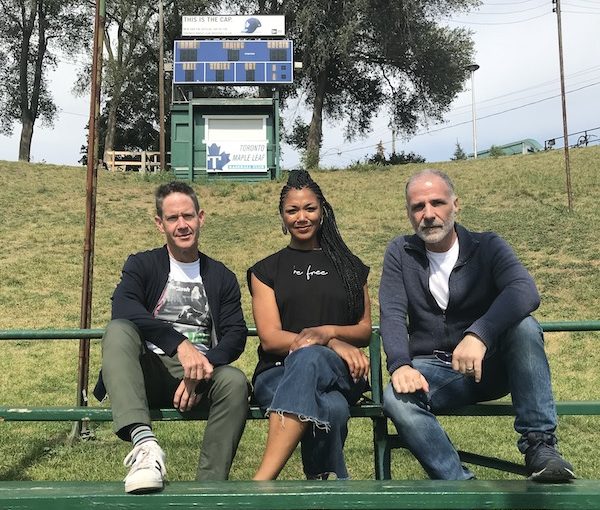
Left to right: Drew Carnwath, Measha Brueggergosman and Sam Rosenthal are the main creatives behind the podcast The Christie Pits Riot. (photo by John Ebata)
On Aug. 16, 1933, Toronto experienced what is viewed as one of the worst race riots in Canadian history. Earlier this fall, the Hogtown Collective, an immersive theatre company, released a four-part podcast that recreates the events of that summer evening 88 years ago.
The eponymously named podcast, The Christie Pits Riot, is seen through the eyes of its 12-year-old protagonist, Joey Rosenbaum. Created by Sam Rosenthal and Drew Cranwath of Hogtown Collective and set amid the circumstances of the Great Depression, Hitler’s rise to power in Germany and escalating ethnic unrest within Toronto, the series also contains an interactive walking tour through the neighbourhood where the riot took place.
The centre of the conflict is a baseball diamond in Christie Pits Park. Tensions began festering during a playoff between two local teams, the Harbord Playground, consisting mostly of Jewish and Italian players, and St. Peter’s, a club sponsored by a local church. Fights erupted and a full-on riot ensued. There were many injuries, but no fatalities.
The mass brawl, which lasted six hours, started after the final out of the second game of a quarterfinal pitting Harbord against St. Peter’s. Two nights earlier, at the first game, a swastika had been displayed by some fans. In the weeks before these games, troubles in Toronto had been brewing more broadly between some Jewish residents and antisemitic groups, primarily those calling themselves the Swastika Club.
A number of Jewish boys and young men who had heard about the swastika incident at the first game rushed to destroy the swastika unfurled at the end of the second. Supporters of both sides, including the Italians, who supported the Jews, joined in the melee.
In the podcast, narrated by Rosenthal, the listener gets a snapshot of life in the city at the time and follows Joey through his day – running errands for his father’s drugstore – along Bloor Street, near the ballpark.
“We wanted the audience to be able to access this story through an emotional, not just historical, perspective,” Rosenthal told the Independent. “Making our hero a young boy allowed us to show the world from his perspective.
“Exploring the deeper issue of systemic racism and antisemitic behaviour can be challenging,” he added. “Our young hero doesn’t understand hatred the way an adult might, so his character provides a means of asking questions about antisemitic racism. We also wanted a way to keep things rooted in the present simultaneously, so as to be able to draw clear parallels to the same problems and issues” that still exist.
The first three instalments take the audience through Depression-era Toronto, with the final episode coming to a head at the fateful game. When the riot breaks out in the story, we find Joey trying to get his friend Rachel home. They are helped along the way by Nala – voiced by Juno Award-winning soprano Measha Brueggergosman – who encourages Joey to stand up for what he believes.
In addition to providing her vocal talent, Brueggergosman was the podcast’s musical supervisor.
In releasing a theatrical production during the pandemic, the creators spotted a chance to provide audiences with a safe and tangible way to experience where the riot happened via the walking tour.
“To look out at Christie Pits Park and imagine what it would be like being in the middle of 1,000-plus people fighting is a terrifying thought, and so it makes the story land in a more visceral way if one can actually be there while listening in,” Rosenthal said. “Since my grandfather owned a store at the corner of Bloor and Manning, the walking tour is a perfect addition to share some of my family history within the broader scope of this chapter from Toronto’s history.”
Several scenes in the story are situated in the drugstore operated by Rosenthal’s grandfather from the early 1920s until the late 1950s. Rosenthal’s father, Joseph, grew up in the neighbourhood and worked there. Joseph was born after the riot, and knew about it from his own father.
“My dad shared many stories of being a young boy in a deeply divided antisemitic Toronto,” said Rosenthal. “When he told me there were once signs posted at the Balmy Beach Club that said, ‘No Jews or Dogs,’ and that there were Swastika Clubs in the 1930s, I felt compelled to tell this story. My father and his friends were often brutalized or threatened whilst walking home from school. I wonder how many Toronto residents know this about our city’s past, and why it seems still entrenched in our present.”
Rosenthal’s hope for the production is that younger listeners not only learn that the riot was a dark chapter in Canadian history, but see it as a way to honour previous generations who paved the way for the diverse culture that Toronto is celebrated for today.
The Christie Pits Riot is available online from multiple providers. The Anchor app can be used by anyone interested in taking the guided walking tour through the Toronto neighbourhood where the riot transpired – the app can be found at hogtownexperience.com.
Sam Margolishas written for the Globe and Mail, the National Post, UPI and MSNBC.
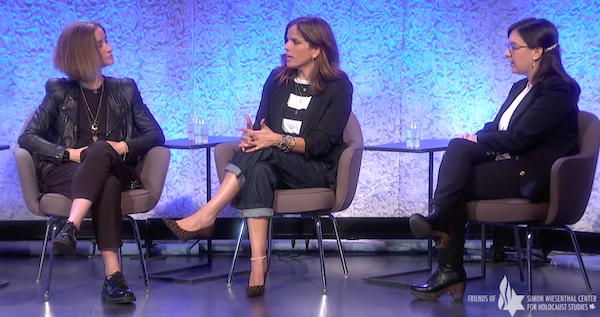
Left to right: Eve Barlow, Noa Tishby and Bari Weiss participate in a Nov. 3 panel hosted by the Friends of the Simon Wiesenthal Centre for Holocaust Studies. (screenshot)
In a time of burgeoning antisemitism and anti-Zionism, Jews need to lean into their identities, says a leading voice in the fight against anti-Jewish racism.
“In other instances in Jewish history, we believed, wrongly, that the way to get acceptance, the way to get along, was to self-abnegate and erase who we are,” said Bari Weiss. “If there has been one lesson in thousands of years of Jewish history, it’s that that is a terrible strategy.”
Weiss is a former writer at the New York Times. She resigned her position there, citing a hostile work environment, and is the author of the book How to Fight Antisemitism. She was speaking as part of a panel convened Nov. 3 by the Friends of the Simon Wiesenthal Centre for Holocaust Studies (FSWC). She was joined by Eve Barlow, a pop-culture writer who grew up in the United Kingdom and has worked in music journalism as deputy editor for NME New Musical Express but who, most recently, is using her voice to stand up against antisemitism. Also on the panel was Noa Tishby, an Israeli-American actor, producer and author of the book Israel: A Simple Guide to the Most Misunderstood Country on Earth.
The three women have become prominent voices, online and off, in the fight against the latest upsurge of antisemitism and anti-Zionism. The Nov. 3 discussion took place in Los Angeles, where all three women are now based. They were joined by Michael Levitt, president and chief executive officer of FCSW, and the panel was moderated by journalist Jamie Gutfreund, both of whom traveled from Toronto for the event, titled State of the Union: Fighting Back Against Hate.
Weiss said the first step in confronting the problem must be vocal and unequivocal pride in Judaism and Zionism.
“The mere act of doing that is radical and contagious and changes the whole conversation,” she said. Doing grassroots work building alliances is another overlooked key to confronting the issue, she added.
“Let’s take a page from the book of our political opponents,” she said. “How have they done what they have done? Deep work inside communities on a grassroots level.”
The Black Lives Matter organization – not the wider movement, Weiss stressed, but the leadership of the organization – has exhibited problematic approaches to Jews and Israel. But no one should concede that there are not plenty of African-Americans (and Canadians) who are allies, she said.
“There are huge parts of the Black community that the Jewish community in America can still be allied with; there are other parts of it that we would be extremely foolish to try and ally ourselves with,” Weiss said. “There are other communities though. I’m thinking about Hispanics, I’m thinking about Hindus, I’m thinking about all kinds of other groups that I don’t see our community actively and affirmatively reaching out to and trying to build relationships with based on our mutual interests.”
Weiss warned that the polarization of politics in the United States and across the West does not bode well for Jews.
“That puts Jews in a deeply uncomfortable position because, I believe, where the political centre thrives, Jews thrive because, if the political centre is thriving, it means that there is room for nuance, that there is room for disagreement, that it’s not a kind of Manichaean, black-and-white, pure-impure, red-blue thinking. Right now, that is the world we are living in and – guess what? – we Jews don’t easily slot into either of those categories. We are both hyper-successful and also we are the victims of more hate crimes than any other group in this country. We are white-passing and yet white supremacists hate us because we are the greatest trick the devil has ever played. We predate the newfangled notions of ethnicity, of race, of religion. We are before all of that. I think that there is a dovetailing between fighting antisemitism and fighting Jew-hate, and standing up for liberalism, broadly defined, because, where liberalism thrives … Jews thrive too.”
Much of the panel’s discussion was about flourishing anti-Jewish hatred online, but Barlow warned that no one should assume there is a substantive difference between what happens online and what happens offline.
“We have seen how [online hatred] has contributed vastly to the amount of physical violence that happens offline and you would have to be extremely ignorant to … say right now that what happens online does not have offline ramifications,” said Barlow.
Tishby agreed, but suggested that offline violence may not be inspired by online hate but rather is part of a broader battle.
“Social media is just the tip of the iceberg of a well-funded political campaign that has been waged against Israel in the past 20 years,” Tishby said. “This is not by accident. This happened by design. The language, everything that we are seeing right now, originated in the Durban conference against racism in Durban in 2001 that was so antisemitic that the U.S. and Israel pulled out of it…. They have been putting a lot of money, a lot of effort and a lot of groundwork in going into these social justice causes, going to Black Lives Matter, going to the Women’s March, going to gay and lesbian marches in San Francisco, going to unions and actually slowly changing their minds and poisoning them basically with lies to make them shift against Israel. These are nefarious powers and nefarious countries that want to dismantle the Jewish state, period, end of story.”
At a panel discussion hosted by the Friends of the Simon Wiesenthal Centre, journalist Bari Weiss warned of the potential dangers in pressuring social media giants like Facebook to censor certain messages. (screenshot)
Acknowledging that some of the most prominent anti-Zionists are themselves Jews, Barlow called the phenomenon “koshering antisemitism.” However, she advocates a compassionate response.
“I believe that how we deal with them has to be different than how we deal with non-Jewish antisemites because they are part of our people, we love them regardless and they are part of our tribe and I think we have to really understand the nuances of why people become anti-Zionist,” Barlow said. “I think a lot of what I see is trauma from the Jewish community and a rejection of the Jewish community that presents itself in this anti-Israel fashion.”
She offered up what she acknowledged as a controversial joke: “Don’t blame Israel for your daddy issues.”
Tishby laid much of the blame for anti-Zionist Jews on the Jewish education system.
“We need to take a good look at ourselves and what we did in order to allow for this,” she said. “We took our kids, put them through … this beautiful Jewish education, we give them all the values and we tell them Israel is the most amazing people and place in the world and we send them off to college without ever acknowledging the concepts of ‘ethnic cleansing,’ ‘apartheid.’ We let college talk to them about this for the first time.… Nobody ever [said], let’s talk about why people call Israel an apartheid state. Let’s have a conversation about this, not when they get to college, [but] when the kid is 12, 13, 14, bring it up. Say, here’s the argument, here is where it’s completely false, here are the facts. Let’s talk about what’s happening in the West Bank.”
Weiss, who has spent her career in mainstream media, said those media outlets are “the most intellectually homogenous environment I’ve ever been in in my entire life.” But she warned against swallowing conspiracy theories.
“I think sometimes people in the Jewish community who are frustrated by this bias imagine some kind of secret conspiratorial meetings where they’re cooking up how to screw the Jews and the Jewish state,” Weiss said. “It’s just a reflection of the consistent bias among all the people that work there.”
The power of social media giants like Facebook and their haphazard responses to hate speech are a problem, Weiss said, but Jews and Zionists may be hastening their own defeat by pressuring them to censor certain messages.
“I think it is a genuinely knotty and complicated question whether or not the Jewish community should be going to these big tech companies and saying, in the same way that you’re censoring x, y and z, also censor the people who hate us,” she said. “My fear is that, in asking these companies [to] do more censorship on our behalf, then, in a way, we are actually feeding the fuel that will come to burn all of us. The ideology that is currently dictating the choices at many of these companies is an ideology that says Zionism is racism. That is part of that broader worldview.… What happens six months from now when … they want to go and censor Zionists because now they have decided that Zionism, to follow the Soviet lie, is a form of racism? Would we be happy with that? I don’t think so.”
Canada recently made several important commitments to the Jewish community, with plans to target hate and fund initiatives to educate and fight antisemitism. While good news, for some of us, these also feel like vague promises. Many of us have felt vulnerable because of our Jewish identities. It has gotten worse recently, with a sharp rise in both physical violence and hate online.
This fall, I signed up for a virtual program run by the Jewish Federation of Winnipeg, featuring Rabbi Matt Liebl in conversation with Centre for Israel and Jewish Affairs (CIJA) chief executive officer Shimon Koffler Fogel. The event was called Antisemitism in Canada: Pushing Back against Hate. The conversation was intellectual and insightful but, when it ended, I was unsatisfied. The overall message was that perhaps 80% of the antisemitic events in Canada were due to ignorance. To fix this, we must educate people. So, I asked a question during the Q&A period. It was something like, “What resources are available to us, as we go forth to educate, both online and in the Canadian context?”
The answer didn’t meet my needs, although it wasn’t wrong, either. Koffler Fogel responded by first saying that the internet (Facebook, etc.) had no borders, so we needed better Canadian policy and international law around hate online. Second, he suggested that “we” older folks had no real power to stop this antisemitic stuff on social media, but that, if it was possible to enlist some 17-year-old influencers, they could help.
Right, I’m just a middle-aged nobody. I’m no big name social media influencer. However, as a Gen Xer, I’ve lived with email since its infancy. I’ve been on the web for more than half my life. I’ve also been the target of hate online, as well as through the (far more retro) postal service and telephone. Some might say this is because I write on Jewish topics, but I’m just not that famous. Right after I moved to Canada, my Winnipeg house was egged on Chanukah when somebody saw the menorah in the window. I wasn’t even writing Jewish articles here yet, and I doubt the people who egged my house had read any of the ones published in the United States.
I could produce a list of bad experiences that occurred before moving to Canada, and these had nothing to do with being “public” about my Jewish identity. Yet, too much has happened since moving here in 2009. Recent attacks on social media this spring and summer, including being harassed and banned by a Canadian knitwear designer who strongly supported Palestinian issues, weren’t my first Canadian antisemitic experiences. I’ve mostly kept this to myself, even though the harassment was scary and painful. These attacks were directed towards me because I’m Jewish and spoke up for Israel’s right to exist. I was harassed even though I don’t vote in Israel and don’t always agree with Israel’s policies. Being Jewish and speaking out was enough.
The October anniversary of the Pittsburgh Tree of Life shootings reminded me of what greeted my family that awful Sunday morning in 2018. My kids and I went to a playground near where a lot of Jewish families live. It was easy to see an enormous swastika and other hate graffiti on the side of the nearby swimming pool building. The senior citizens, many of them Jewish, living across the street in apartment buildings, could see those hate symbols, too.
When my twins were done playing, I walked them, one holding each hand, indoors to the pool front desk to report the swastika graffiti. I then drove home and spent way too long trying to report what was obviously a hate crime to the police, the B’nai Brith and one of my editors at the time. The worst part was hearing, “Well, did you take photos?” The answer was no. I didn’t have a third hand to let go of my kids and take photos, which would have signaled to them how very distressed I was. It was another chance to feel isolated, vulnerable and angry. Not only did I experience the hate but, apparently, I should have documented it (to prove it existed) and take on the task of reporting it multiple times. The graffiti was cleaned up but, for me, the hateful message lingered.
After the virtual CIJA/Jewish Federation event, there was a follow-up note with a couple of links. One offered an entire page of antisemitism resources to read. Another link was “Report an antisemitic incident.” While I deeply appreciated the form online as being easier than what I’ve gone through previously when trying to report hate, the form didn’t say where the submitted information went. It didn’t suggest what supports were available. It didn’t say who would read submissions or when. I contacted the Winnipeg Jewish Federation to ask that this be added to the site but haven’t received a reply.
For me, the worst part of dealing with hateful messages, graffiti, assault or social media attacks is feeling alone and unsafe. Maybe most antisemitism comes from ignorance. That doesn’t make it any less hurtful or intimidating.
So, what are solutions? Yes, we need to educate others and invest in better laws and in security for Jewish institutions. We also need to invest in ourselves. Advocacy organizations and community institutions should be part of the solution. Give everybody useful tools and information for how to combat hate – because we never know who will need it next.
Also, let’s follow up and support those in our community who have faced hateful incidents. We may never erase all the hate in our midst, but our communities can offer better security, kindness, counseling or, heck, a (COVID-safe!) hug to those who experience antisemitism.
We need non-Jewish allies, too. Intellectually, I know that these incidents – graffiti, the egg on my window and even reporting a threatening email to the police – were not a big deal. These incidents can shake us up anyway. If those affected by hate crimes feel afraid, isolated and vulnerable, we can help by showing up for one another more consistently. There’s safety in numbers. Next time somebody submits one of these antisemitic incident forms, here’s hoping a friend in the community follows up, too. We can deal with the after-effects when we’re not alone. We can do that for one another. It’s time to try.
Joanne Seiffhas written regularly for CBC Manitoba and various Jewish publications. She is the author of three books, including From the Outside In: Jewish Post Columns 2015-2016, a collection of essays available for digital download or as a paperback from Amazon. Check her out on Instagram @yrnspinner or at joanneseiff.blogspot.com.
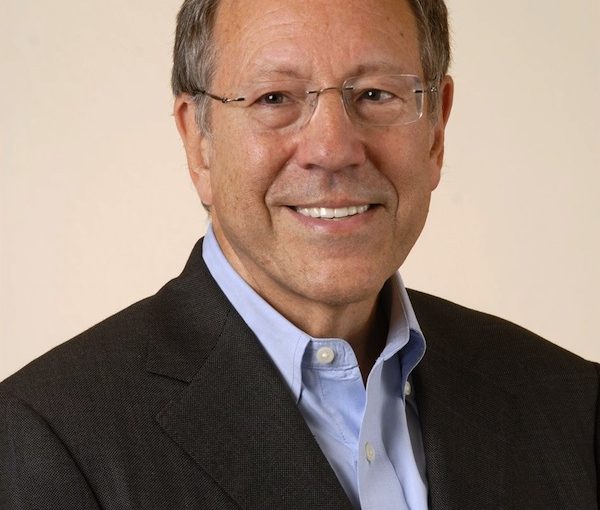
Irwin Cotler spoke Sunday at a virtual event convened by National Council of Jewish Women of Canada. (photo from raoulwallenbergcentre.org)
Canada is set to make a number of significant commitments to combat antisemitism, as are other countries that participated in a summit on the issue last week in the Swedish city of Malmö.
Irwin Cotler, Canada’s special envoy on preserving Holocaust remembrance and fighting antisemitism, spoke Oct. 17 at a virtual event convened by National Council of Jewish Women of Canada. The human rights lawyer and former federal justice minister, who is also international chair of the Raoul Wallenberg Centre for Human Rights, said that, in the aftermath of the conference, the Canadian government would announce a number of pledges.
These will include enhanced teaching and learning about the Holocaust across generational lines, combating the increasing Holocaust denial and distortion, and battling hatred on social media. Reducing an alarming rise in hate crimes will also be among the pledges Prime Minister Justin Trudeau is set to make, according to Cotler.
“Twenty-twenty was the year for the highest rise in hate crimes targeting Jews ever,” he said. “But, by May 2021, we had reached the level then of all the hate crimes in all of 2020.”
The government will recommit itself to protecting the security of Jewish institutions, he said.
“Here, the government recently made commitments in financial terms for this purpose,” said Cotler.
Zero tolerance for antisemitism in the political discourse is also an objective, he added.
“That means not just calling out antisemitism in the other’s political party but calling out antisemitism in our own,” Cotler said. “In other words, not weaponizing antisemitism or politicizing it, but holding each of us, respectively, our own political parties, accountable.”
In addition to Trudeau, Israeli President Isaac Herzog, French President Emmanuel Macron and U.S. Secretary of State Antony Blinken were among the leaders who addressed the conference. The Malmö International Forum on Holocaust Remembrance and Combating Antisemitism was hosted by Sweden’s Prime Minister Stefan Löfven. Trudeau announced at the conference that Cotler’s role of special envoy would be made permanent.
Cotler contextualized the Malmö forum in a two-decade era of what he calls “demonological antisemitism,” which began at the 2001 Durban conference against racism that devolved into an antisemitic carnival.
“What happened at Durban was truly Orwellian,” said Cotler. “A world conference against racism and hate turned into a conference of racism and hate against Israel and the Jewish people. A conference that was to commemorate the dismantling of apartheid in South Africa turned into a conference calling for the dismantling of the ‘apartheid state’ Israel.
“Those of us who personally witnessed this Durban festival of hate have been forever transformed by the pamphlets and posters of hatred and antisemitism, by the cartoons and the leaflets portraying not only the Jews as Nazis, but the classical antisemitic tropes of Jews with hooked noses, with fangs, with fingers dipped in blood from the killing of children. Where we were accosted with pamphlets of the Protocols of the Elders of Zion. Where we witnessed demonstrators with signs – incredibly for a human rights conference or for any conference – signs which said, ‘Too bad Hitler didn’t finish the job.’ Where we witnessed Jewish students – and I witnessed this personally – being physically assaulted and being told, ‘You don’t belong to the human race,’” said Cotler.
Durban was the first tipping point and the global surge of antisemitism during last spring’s conflict between Hamas and Israel was a second, he said.
“Jews were targeted and threatened in their own neighbourhoods and on their own streets,” said Cotler. During and after that conflict, Cotler said, Jewish memorials were defaced, synagogues were torched, cemeteries were vandalized, Jewish institutions found themselves under assault and incendiary hate speech – such as 17,000 tweets that “Hitler was right” – exploded.
The COVID-19 pandemic has exacerbated antisemitism, or at least has been exploited by antisemites, who have “instrumentalized one of the more ancient tropes of the Jews as the poisoners of wells,” said Cotler. The health crisis has also seen conspiracies of Jews profiting from vaccines and anti-vaxxers posing “as if they were victims of Nazi persecution,” he added.
Cotler lamented what he calls “the mainstreaming, the normalization – in effect, the legitimization of antisemitism in the political culture.” During the conflict last spring, convoys of vehicles in London, U.K., drove through Jewish neighbourhoods screaming, “F–k the Jews, rape their daughters!” This was a convoy and a message that was replicated in Toronto days later and which resulted in, Cotler said, an “utter absence of outrage.”
The legalist also spoke of the International Holocaust Remembrance Alliance Working Definition of Antisemitism.
“If you can’t define it, you can’t combat it,” he said. The IHRA definition was adopted after 15 years of discussion and debate by intergovernmental bodies, governments, parliaments, scholars and civil society leaders, he said.
The task of fighting antisemitism must not fall only to Jews, Cotler stressed.
“As we’ve learned only too painfully, and have repeated too often, that, while it begins with Jews, it doesn’t end with Jews,” he said. “Therefore, we need this collective global constituency of conscience to combat it.”
The U.S. Congressional committee investigating the Jan. 6 insurrection is limping along in the face of a near-total absence of cooperation from the Republicans who make up almost half of Congress and of the American voting public. Despite reams of video evidence, there is legitimate worry that justice will not be served in the case of an attempted coup at the heart of American government.
Those who tried to overthrow the will of the people and who even called for the murder of the vice-president of their own party are venerated by their supporters as patriots, while those who seek justice for those events are vilified as traitors.
The very people who tried to subvert the democratic decision of the American people last November – those who are trying to steal the election from President Joe Biden – chant “Stop the steal!” apparently without a hint of irony or self-awareness.
But the fight over Jan. 6 is a small puzzle piece in a larger social disorder. We are seeing verifiable truths dismissed as lies and what should be summarily debunked as lies revered as gospel. Listening to some of these voices, it is difficult to tell whether they are trying to create a reality based on what they wish were true – Trump won, Democrats eat babies, whatever – or whether they truly believe these falsehoods. It’s probably some of both.
Are we approaching a tipping point where a healthy society that has at least a modicum of shared consensus on what is true and what is false slides into a moral terrain that has no agreed-upon truth or lies, right or wrong, good or evil?
The pandemic has brought this problem into clear relief. Doctors say that they are treating people who, on their deathbed, continue to insist there is no such thing as COVID. There is a spectrum, from outright denial of the existence of the virus to conspiracies that it was invented for nefarious purposes to the idea that the virus itself is legitimate but is being exploited by governments (or other disreputable entities) to take away some amorphous “freedoms.”
Recently, parents opposed to mask mandates chased fellow parents (and their kids) at a school in California, screaming that the kids could not breathe through the masks. When some parents responded with what, by any fair measure, is common sense, one protester screamed back: “You were propagandized.… You are not being told the truth!”
To put a fine point on it, people who have been propagandized and who are convinced of a lie are shouting at others that they have been propagandized and do not know the truth.
Recently, South Carolina Senator Lindsey Graham, speaking to a Republican crowd that should have been in his back pocket, said, “If you haven’t had the vaccine, you ought to think about getting it because if you’re my age –” At this point, he was drowned out by screaming and booing. When he was able to speak again, he told the Republican crowd, “Ninety-two percent of the people in the hospitals in South Carolina are unvaccinated.” To this, some audience members began screaming “Lies!”
The New York Times Magazine’s ethics columnist, Kwame Anthony Appiah, wrote recently of the “strange mirror game” being played by conspiracy theorists and hucksters. “They peddle hoaxes that warn of hoaxes, scams that warn of scams. They dupe their victims by cautioning them not to be duped.”
Lies have been around forever. But it seems we are in another realm now. When Kellyanne Conway, a counselor to Trump, defended then-White House press secretary Sean Spicer’s false claims that attendance numbers at Trump’s 2016 presidential inauguration were the largest in history, Conway asserted that there were facts and then there were
“alternative facts.” This was not the genesis of a culture of gaslighting, but it did represent, along with Spicer’s lies, a turning point. The Trump administration operated in a world that rational observers would view as existing in an alternative universe of alternative facts.
Jews and supporters of Israel who forgive Trump’s many affronts because they deem him to be on “our side” on one issue suffer from something that might be equated to the difference between the weather and the climate.
Trump may indeed have taken steps that people view as being to Israel’s advantage. But, in nearly everything else Trump and his supporters have done, they have assaulted truth, facts and rationality. They call black white and up down. Legitimate media are “fake news” and darkweb rantings are trustworthy sources.
In a story in the last issue of the Independent, the commentator Bret Stephens said: “We now have come to a place where, increasingly, we are a nation that can bring ourselves to believe anything and a nation that can bring itself to believe anything … sooner or later, is going to have no problem believing the worst about Jews.”
Trump, Spicer, Conway and their crowd did not invent the situation where lies are gospel and truth is rejected, but they did their best to perfect it.
It should not need saying that such people should not be trusted, since their loyalty and sincerity are worthless. Republicans who, on a dime, turn into an angry mob screaming “Hang Mike Pence!” should not be trusted when it comes to something as sacred as the security and the fate of Israel and its people.
More gravely still, there is a reason why Jews are often referred to (as dehumanizing as the term is) as “canaries in a coalmine.” When antisemitism emerges, it is a sign of broader societal disorder. It is no surprise that the spike in antisemitism we are witnessing coincides with a phenomenon where verifiable facts are regarded as debatable assertions and the most ludicrous assertions are not only accepted as truth but defended with fanaticism and violence.
In the late 20th century, Canadian Jewish Congress and other groups adopted an approach premised on the idea that the best way to ensure the safety of Jewish people was to advance an ideal that protects allminorities. There might always be people with antisemitic motivations, but, if we can inculcate in society a transcendent commitment to equality for all, we may create a firewall against the worst antisemitism.
As CJC and others did several decades ago, it may be time for Jewish people and others who care about fighting antisemitism to rededicate ourselves to strengthening the most fundamental principles of our democratic societies, the very foundations that we too often have taken for granted, even after Jan. 6. This includes not only ensuring basic things like civil and voting rights and protecting the institutions of democratic government, but it calls on us to contest outright lies and to defend basic truth. If, in the process, we manage to yank our democratic societies back from the abyss of lies and the frightening places they lead, we will have made things better not only for the Jewish future, but for everyone’s.
It’s no secret that antisemitism around the world has been increasing for years. As recently as Sept. 30, MLA Spencer Chandra Herbert saw his office window hit with a spray-painted red swastika. Make no mistake: there is no place for antisemitism in our world. That’s why Chabad Richmond is offering the four-week Rohr Jewish Learning Institute program called Outsmarting Antisemitism on Wednesdays Nov. 3, 10, 17 and 24 from 7:30-9 p.m.
“Join me each week as we explore the ethical impacts of history repeating itself, both within the Jewish community and beyond, by those who believe that antisemitism and hatred are accepted and encouraged practices and attitudes,” said Rabbi Yechiel Baitelman, director of Chabad Richmond.
Outsmarting Antisemitism takes on this subject directly and unapologetically, with a sense of optimism, faith and a distinctly Jewish approach.
“Through insightful source texts and fascinating case studies, this course examines the sources of this ancient scourge, along with the appropriate strategies for overcoming it. It’s time to find the confidence to fight hate with hope, and to stand tall against antisemitism,” said Baitelman.
“Upon concluding our series Outsmarting Antisemitism, you will be better equipped to campaign publicly against those who oppose both Israel and the Jewish people, and ensure we do everything possible to condition society to bring out the best in humans, rather than their more sinister elements,” he added.
Outsmarting Antisemitism will be offered both in-person and online via Zoom. Sign-in information will be provided at the time of registration. The cost to attend is $75 per person or $130 per couple, and includes the textbook.
This course will also be offered to lawyers for B.C. Law Society accreditation on Nov. 25, Dec. 2, 9 and 16 from 7:30-9:30 p.m. and will take place in person, at Chabad Richmond, 4775 Blundell Rd. The cost is $540 including textbook and the course is applicable for eight CLE approved credits.
To register for either Richmond course, call 604-277-6427 or visit chabadrichmond.com/jli.
The JLI course is also being offered at Lubavitch Centre (604-266-1313), starting Oct. 26, and Chabad of Nanaimo (250-797-7877), starting Nov. 9.
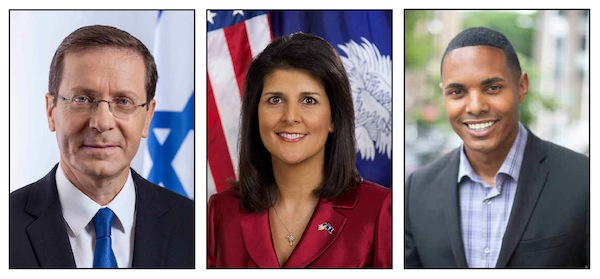
Israeli President Isaac Herzog, left, former U.S. ambassador to the United Nations Nikki Haley and U.S. Congressman Ritchie Torres all spoke on Sunday at the General Assembly of the Jewish Federations of North America. (PR photos)
Antisemitism, community security, caring for the most vulnerable and relations between Jews in Israel and in the Diaspora were among the topics highlighted at the 2021 General Assembly of the Jewish Federations of North America. Normally a multi-day gathering, this year’s conference was a virtual event condensed into 90 minutes on Oct. 3.
Jewish Federations of North America (JFNA) is the umbrella agency representing 146 independent federations and 300 smaller communities across the continent.
Eric Fingerhut, president and chief executive officer of JFNA, credited federations and their supporters for turning a matching grant of $18 million into $62 million to fund frontline Jewish social services organizations during the pandemic.
While the challenges of the pandemic absorbed resources during the past year and a half, Fingerhut addressed a range of issues, noting that it is not easy being an optimist right now.
“We face enormous challenges, which can make it difficult to maintain a positive outlook,” he said. On top of the pandemic and urgent issues of racial justice, Jewish communities across the continent have been confronted by the most sustained and virulent antisemitism in recent memory.
He also addressed the challenges of being an inclusive Jewish community.
“I’m not naïve,” said Fingerhut. “I know that our communities are not now, nor have they ever been, perfect. We have let too many people slip through the cracks unnoticed or unserved. We have not always been there when people needed us the most. We have sometimes struggled to keep up with the ever-changing character of the Jewish community.”
Fingerhut was not the only president to address the truncated assembly. Israel’s President Isaac Herzog emphasized the need to continue building bridges between Israel and the Diaspora, working together to reignite a passion for Zionism among North American youth and instil in Israeli young people awareness of and connections to Diaspora Jews.
“Too many American Jewish youth are disinterested in what being Jewish means and in a complex understanding of the realities and challenges facing Israel,” Herzog said. “Some of them, a very small minority, are too willing to accept distorted labels and libels against the Jewish state. At the same time, on the other side of the ocean, far too many Israelis show too little interest in Jewish life outside of Israel and lack a nuanced understanding of their sisters and brothers in the Diaspora.”
He stressed that, as president of the state of Israel, he makes it his personal mission to strengthen the lines of communication and reinforce the underlying bond and mutual responsibility.
The theme of mutual responsibility was echoed by Mark Wilf, chair of JFNA’s board of directors. When thousands of rockets rained down on Israel last May, he said, federations in North America mobilized to repair and rebuild damaged infrastructure in Israel.
Confronting security issues closer to home was another theme running through the event. Wilf noted that 45 federations have adopted and enhanced community security initiatives and the goal is for every federation and Jewish community on the continent to meet best practices in community safety protocols.
The annual General Assembly events generally attract a raft of Israeli, American and Canadian politicians and elected officials. Due to the unique circumstances, American politicians were limited to one Republican and one Democrat.
Nikki Haley, former governor of South Carolina and President Donald Trump’s appointee as United States ambassador to the United Nations from 2017 to 2019, said the “ancient evil of antisemitism is on the rise.”
“I encountered the sad reality at the United Nations,” she said. “Hateful governments, like Iran, didn’t even bother to hide their hostility toward Jews. I heard it in their words, I saw it in their deeds. Other countries were more subtle. They didn’t go after the Jewish people. Instead, they went after the Jewish state. No other country faces so many insults, no other country is singled out for such attack. Of course, they say, it’s just about opposing Zionism. Well, you and I know the truth. Anti-Zionism is antisemitism.”
She took a swipe at the BDS movement, which seeks to boycott, divest from and sanction Israel.
“While BDS claims to be about justice, it’s a blatant attempt to starve Israel of funding, friends and a future,” she said, noting that she was the first U.S. governor to prohibit public entities in her state from doing business with companies engaged in “discriminatory” boycotts.
She lauded the Abraham Accords, which have led to normalized relations between Israel and the United Arab Emirates, Sudan, Morocco, Oman and Bahrain.
“There were those who said it couldn’t be done,” said the former ambassador and potential Republican presidential candidate. “Now it’s happening before our eyes. Israel is bravely leading the Middle East into a brighter future.”
Also addressing the virtual assembly was Democratic Congressman Ritchie Torres. While a first-term representative elected less than a year ago, the 33-year-old from the south Bronx in New York City has gained attention as a gay, Afro-Caribbean American. Representing the economically poorest district in the country, Torres, a former New York city councilor, is a strong progressive voice on social issues including public housing, predatory loans and gang violence. He has gained notice in the Jewish community and among pro-Israel voters for distancing himself from other progressive Democrats by being an articulate and unapologetic supporter of Israel.
“I feel like all of us in public life have an obligation to speak out forcefully against extremism, no matter what form it takes,” he said. “The rise of a demagogue like [former British Labour Party leader] Jeremy Corbyn is cautionary tale of what could happen when antisemitism infects the bloodstream of a nation’s politics. All of us have an obligation to ensure that extremism is fought at every turn and in every form.”
The idea that it is incompatible to be progressive and pro-Israel is, he said, “a vicious lie.”
He condemned anti-Israel organizations in the United States for co-opting important issues like police violence and immigration and turning them into battering rams against Israel.
Like Haley, he slammed the BDS movement. The contributions of Jewish activists working in partnership with other social justice movements are threatened by litmus tests that seek to prevent pro-Israel Jews from participating in those movements, said Torres.
The antisemitic violence and vandalism that spiked in the spring of this year is “a wake-up call that the Jewish community cannot afford to be complacent about,” he said.