Green party reckonings

During the election campaign, Green leader Annamie Paul was surprisingly candid about her precarious position at the helm of her party. She acknowledged that she spent almost all the campaign in her home riding of Toronto Centre because she might not be welcomed by Green candidates across the country. She suffered a near-defenestration just before the election and the simmering internal strife the Greens barely managed to conceal through the campaign will inevitably boil over now, especially after her own poor results in Toronto Centre.

Paul faced horrific online racism and antisemitism during and after her campaign for the party leadership. We trust that she will share more of her experiences without reservation now that her tenure is almost certainly at an end. Rarely has so talented and qualified an individual offered themselves for public office – and even more infrequently has any political figure been so ill-treated by their own party.

Canadians, but especially Green party regulars, must examine what happened. Paul and other members of the party owe it to Canadians to examine the entrails of this affair and determine what roles racism, misogyny and antisemitism played in the matter. If there are Green activists who have legitimate grievances against Paul, they should be transparent and demonstrate that their extraordinary treatment of their leader was based on policy or strategic differences and not on her innate identities.

Controversy over instructor

A proposed fall semester course at the University of Victoria has raised concerns that it will become what B’nai Brith Canada described as “a forum for antisemitism.” The concerns were sparked by inflammatory comments the course’s instructor, Dr. Shamma Boyarin, wrote on social media earlier in the year.

In a May 26 Twitter post, for example, Boyarin used an obscene verb before labeling Abraham Foxman, former president of the Anti-Defamation League, a “Zionist pig.” On June 3, he ridiculed an individual who had been the recipient of a torrent of antisemitic abuse online. This was followed the next day by a post in which Boyarin remarked, “[It’s] hard for North American Jews to admit the truth: What is happening in Israel is ethnic cleansing and slow genocide.”

An online description of the UVic course, entitled Introduction to Antisemitism, has been modified since it was first posted. At an earlier stage, the description began, “What is antisemitism? As soon as one attempts definitions, it becomes clear that even the most fundamental aspects of antisemitism are controversial.” The course’s current title is also different from the original, which was Towards an Understanding of Antisemitism. Gone, too, is a study of present-day antisemitism.

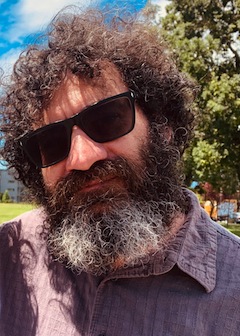
photo - Prof. Shamma Boyarin
Prof. Shamma Boyarin (photo from uvic.ca)

The changes occurred in early August after B’nai Brith, among others, raised objections to UVic about Boyarin teaching a class on modern antisemitism. The course’s subtitle on the UVic website now reads, “A Historical Survey of Key Texts and Moments from Augustine to Luther.” Its description: “What is antisemitism? The term itself was coined in the late 19th century, but when does the phenomenon begin? Is it the same or different from ‘anti-Judaism’? Should we spell it ‘anti-Semitism’ or ‘antisemitism’? Beginning with these basic questions, we will focus on the particular role Christianity has played in developing and sustaining antisemitism in Europe.”

“Moving this course away from modern antisemitism is an important first step,” said Michael Mostyn, chief executive officer of B’nai Brith Canada. “However, we are still concerned that, instead of educating students on the scourge of Jew-hatred, there is a risk, albeit a reduced one, that hostility toward Jews will instead be promoted.

“UVic must provide assurances to the Jewish community that academic freedom will not be used as cover to falsely accuse Jews, as a whole, of contributing to genocide, among other antisemitic canards,” he added.

When contacted by the Independent, UVic expressed the position that it “does not condone antisemitism” and “that it is highly committed to equity, diversity and inclusion and to social justice in its many forms.”

“We are aware that a faculty member has expressed personal views in public communications which are disturbing to people. Those views are personal. They have not been made on behalf of the university or in the context of their work,” said Karen Johnston, a spokesperson for the university.

“Canadians have a constitutional right to free speech, subject to limits under the law,” she said. “And so it cannot be the role of the university to judge or censor its employees’ exercise of free speech in their private lives. While all faculty enjoy the privilege of academic freedom, there are also limitations to this right. In this specific instance, there is no evidence at this time that the faculty member has or will exceed those limitations in teaching this course.”

The university also said it “will act on any allegation that there has been a violation of university policies against discrimination or harassment, which apply to all members of our community.”

Rob Philipp, executive director at Hillel BC, has been monitoring the situation and has spoken with Dr. Kevin Hall, the president of UVic. Philipp said, “If the course does run, we will check to see what the reading material is and what is being taught.” However, he added, while the organization is keeping on top of things, there is not much that can be done to stop the course from going ahead.

Jeff Kushner, president of the Jewish Federation of Victoria and Vancouver Island (JFVVI), said they, too, will be following the UVic course and will remain in contact with senior administration staff.

“The JFVVI does not have any serious concerns about the course material, such as we know it,” said Kushner. “Our concerns are more about the academic and emotional safety of the students enrolled in the course. In this particular case, a professor at UVic made some very objectionable comments on his private Twitter feed. We wish that he had not made such incorrect and inflammatory statements, both in his role as an academic and as a Jew.

“He has not made these comments in any official capacity, and the university has been very clear that these objectionable views are not the views of the university. Our concern is that an individual having these views, and expressing them as he has, may find it difficult to leave them at the classroom door and, through explicit statements or implicit actions, may create an unsafe learning environment for Jewish students holding views contrary to his own.”

In a letter to the university, B’nai Brith urged UVic to publish the syllabus of the revised course online, to cancel the course if it is used to attack the Jewish community in any way and to follow other universities, such as Oxford and Cambridge, in adopting the International Holocaust Remembrance Alliance Working Definition of Antisemitism to “avoid future confusion.”

Boyarin has taught at the University of Victoria since 2008 in religious studies and medieval studies, and in the English department since 2009. According to his profile at UVic, his current research and teaching interests include medieval literature (particularly the literature of Spain and the Near East), comparative literature (particularly Hebrew and Arabic), literature and religion, Jewish studies, and the religious roots of antisemitism. He has additional expertise, his profile continues, in the connections between medieval and contemporary culture, especially as they manifest in heavy metal music and white supremacist ideologies.

The Independent tried to reach Boyarin for comment, but had not heard back from him at the time of publication.

Sam Margolis has written for the Globe and Mail, the National Post, UPI and MSNBC.

To do or not to do (the Bard)

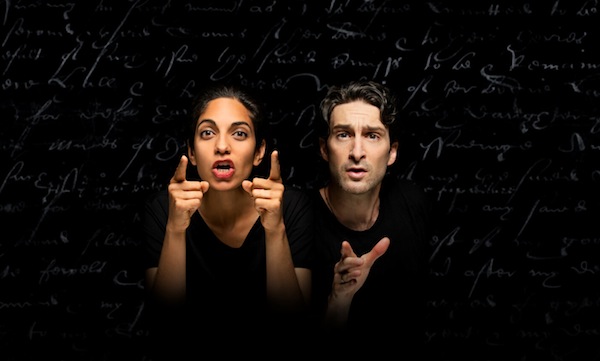
Bard on the Beach’s Done/Undone, written by Kate Besworth, co-stars Harveen Sandhu and Charlie Gallant. (photo from bardonthebeach.org)

Throughout COVID, Vancouver’s Bard on the Beach has been unable to mount its popular summer festival at Vanier Park. However, it is easing its way back into the hearts and minds of Shakespeare fans with its innovative film production Done/Undone, written by Kate Besworth and starring Bard veterans Charlie Gallant and Harveen Sandhu, who take on multiple and diverse roles. The creative team includes community member Mishelle Cuttler as sound designer.

The film raises many probing questions. Is time up for Shakespeare’s works in the #metoo, woke, cancel culture era? Is there room today for plays written 400 years ago that can be interpreted as misogynist (The Taming of the Shrew), racist (Othello) or antisemitic (The Merchant of Venice)? Are the Bard’s works not just the reflections of a white, privileged male, written for colonial audiences to glorify British mores and culture? Or was English writer Ben Johnson, who died in 1637, right when he said Shakespeare was “not a man of his age, but a man for all times?” Should any form of Bardolatry continue or should Shakespeare and his folios be laid to rest as we move forward with contemporary artists telling contemporary stories?

To answer these questions, the film, set against the backdrop of a working theatre, uses snappy vignettes to showcase the pros and cons of the debate with interesting and perhaps unexpected results.

It opens as the two actors arrive at the theatre to prepare for a production of Hamlet, and the question first arises. Sandhu appears as Shakespeare to state that the purpose of writing is to “hold a mirror to humanity,” as she lists off the myriad subjects that the Bard explored – the sea, star-crossed lovers, a donkey in the arms of a fairy queen, an exiled warrior, an emperor of Rome, a triumphant king, how choices matter, and how governments fail us.

We then are spectators to a battle of wits between dueling professors, explaining and emoting from their respective lecterns. Gallant emphatically argues that Shakespeare is a product of a white, patriarchal society, using words as a tool of cultural imperialism written, originally, for white men to perform (women were not allowed to act in Shakespeare’s times, so male actors would take on the female roles) and that there is no place today for his work. Sandhu counters that Shakespeare’s texts still evoke emotions that resonate within the contemporary world – his topics of love, hate, greed and lust are timeless and embedded in the human character, she argues. She sees Shakespeare as remarkably progressive, with many of his characters in gender-fluid roles and with his portrayals of strong women – Rosalind, Cleopatra and Lady Macbeth, to name a few. His works can provide teaching moments, says Sandhu, giving the examples of Taming of the Shrew to show the harm that misogyny causes, King Lear, the scourge of elder abuse, and Othello and Merchant as vehicles to elicit tolerance and empathy in society.

Other vignettes in the film include a Bard board member – a neurosurgeon – who, during an opening night audience address, poignantly recounts the solace he found in the dark spaces of the theatre during a production of King Lear after the loss of a patient. He says that darkness was the escape from the reality of his grief.

Another scenario depicted is a couple taking in a performance of Romeo and Juliet, where the woman is clearly more into it than her male partner, who finds the Shakespearean language highbrow and difficult to understand.

Then there are the gothic, spectre-like creatures who denounce the Bard’s portrayal of women and Blacks in a macabre pas de deux; a talkback session after a Measure for Measure performance, where the female actor embarks on a scathing indictment of colour-blind casting; and the finale, in French, as the two actors attend an inventive Shakespeare festival in Montreal.

Shakespeare’s influence is global. At any given time, somewhere on the planet, one of his plays is being produced, either in its original form or as an adaptation. Do we judge him with our contemporary lens or should we remember the times in which he wrote and appreciate his genius? Done/Undone is a thoughtful and intelligent production that seamlessly blends the worlds of cinema and theatre, and considers some difficult questions. It leaves you to draw your own conclusions.

Done/Undone, with a run time of 76 minutes, is available for streaming online until Sept. 30. Tickets can be purchased at bardonthebeach.org or from the box office at 604-739-0559.

Tova Kornfeld is a Vancouver freelance writer and lawyer.

Tackling the hatred head on

When white supremacists converged on Charlottesville, Va., four years ago chanting “Jews will not replace us,” it was the first encounter most of us had had with the conspiracy theory known as “the Great Replacement.”

In the pretzel logic of racists, immigration and multiculturalism are products of the Jewish imagination, with Jews perpetrating, through behind-the-curtains jiggery-pokery, what the tiny number of actual Jews in the world cannot do demographically: replace Aryan culture with alien races and cultures. The absurdity of the “theory” makes a lot more sense as one delves deeper into the trends and characteristics of antisemitism. Three wildly different but related books show that the projection of all that is wrong in society onto an empty vessel that happens to be Jewish recurs repeatedly. As ludicrous as the Great Replacement is, it dovetails magnificently with thousands of years of anti-Jewish prejudice and propaganda.

In Jews Don’t Count: How Identity Politics Failed One Particular Identity (TLS Books, 2021), author David Baddiel explores how the treatment of Jews is the exception to effectively everything today’s progressives espouse.

“It is a progressive article of faith – much heightened during the Black Lives Matter protests following the murder of George Floyd in 2020 – that those who do not experience racism need to listen, to learn, to accept and not challenge when others speak about their experiences,” he writes. “Except, it seems, when Jews do. Non-Jews, including progressive non-Jews, are still very happy to tell Jews whether or not the utterance about them was in fact racist.”
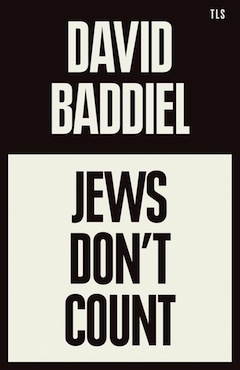
image - Jews Don’t Count book coverBaddiel discusses how racism and antisemitism are disentwined to disadvantage Jews, placing antisemitism lower on a “hierarchy of racisms” than other forms.

“Jews are stereotyped, by the racists, in all the same ways as the other minorities are – as lying, thieving, dirty, vile, stinking – but also as moneyed, privileged, powerful and secretly in control of the world,” he says. “And, if you believe, even a little bit, that Jews are moneyed, privileged, powerful and secretly in control of the world … well, you can’t put them into the sacred circle of the oppressed. Some might even say they belong in the damned circle of the oppressors.”

Baddiel confronts the canard that Jews can’t be victims of racism because they represent a religion, not a race – an audacious defining of an entire people by others who do not belong to the group, itself an example of something progressives would deign to do with no group other than Jews. By pushing antisemitism down the victimization scale, perpetrators can then accuse people who call out antisemitism as diminishing the experiences of minorities with legitimate claims to oppression.

When Baddiel called out one prominent antisemite, saying he had rarely heard so blatant a statement from someone with so large an audience, the perpetrator replied: “’Cos everyone was scared, that’s why.”

By alleging that a cabal of powerful Jews is policing the language of critics, the perpetrator, Baddiel writes, “isn’t a racist, he’s a hero, finally standing up and saying the things that need to be said even though it will bring down the wrath of this all-powerful Jewstablishment on his head.”

Similarly, when an article in the New York Times seemed like an attempt to rehabilitate the notorious antisemite Louis Farrakhan, the author replied to a critic who mooted the negative impact this could have on Jews: “Somehow, among the million concerns, you believe that yours are supposed to rise to the top.… That is called privilege.”

A recurring theme is that, unlike other minorities, Jews are not “innocent victims.” Baddiel (and the other authors mentioned here) do not explicitly say it, but it is understood that, for antisemites, Jews are not victims because, whatever the calamity, they bring it on themselves.

Another recent book, Israel: A Simple Guide to the Most Misunderstood Country on Earth by Noa Tishby (Free Press, 2021), picks up on some of Baddiel’s themes.

Tishby is an Israeli-American actor with a strong Zionist lineage. Her grandmother was a founder of the first kibbutz in Israel. Her grandfather was Israel’s first ambassador to West African countries and served on the Israeli delegation to the United Nations. Her great-grandfather was the founder of Israel’s ministry of industry and trade. Tishby served in the Israel Defence Forces entertainment troops, which she describes as, basically, “a nightly USO [United Service Organizations] tour.” She starred in an Israeli prime time soap opera – Ramat Aviv Gimmel, a sort of Israeli Melrose Place – then made the move to Hollywood.
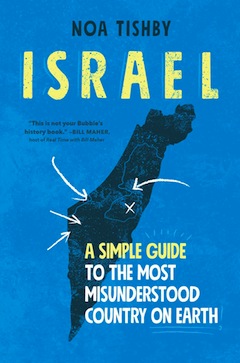
image - Israel book coverHer book is aimed at people of her demographic – young, hip, leftist (though presumably non-Jewish) readers – and she presents, through biography and history, a tidy Zionist narrative that hits the bases. She does what pro-Israel writers rarely do: she uses emotion and personal stories, rather than dogged reliance on facts, chronology and empiricism. This is not to diminish the fact-based foundation of the book, but her first-person narrative connects the reader to the land and people of Israel in a way that cold facts do not.

Tishby provides a simple but thorough overview of regional history and the development of Israel, as well as the parallel history of the Palestinian and Arab peoples in the area. She dissects the claims of the BDS movement one by one, debunking the prevailing leftist narrative in the West. She pillories the obsession of the United Nations with anything Israeli and rebuts allegations of colonialism, apartheid, ethnic cleansing, unequal warfare and occupation quite effectively.

She recounts how, in the years after the Second World War, there were roughly 11 million refugees worldwide, 700,000 of whom were Palestinian.

“The 10,300,000 non-Palestinian refugees were funneled into UNHCR (United Nations High Commissioner for refugees, created in 1951), the UN agency dedicated to resettling and integrating refugees and/or stateless peoples,” she writes. The Palestinians got their own unique refugee agency: the UN Relief and Works Agency for Palestine Refugees in the Near East (UNRWA).

“While UNHCR is constantly working on getting the global number of refugees down, with UNRWA the numbers go up, up, up,” Tishby writes. “After the 1948 war, there were approximately 700,000 displaced people. Now UNRWA has 5.6 million ‘refugees’ registered in their books. How is that possible?”

Even Palestinians living in Gaza and the West Bank are counted as refugees by UNRWA, she notes, asking: “Can you be a refugee from Palestine when you currently live in … Palestine?”

Near the end of the book, Tishby throws some questions at the reader: “How would you handle a wannabe Sharia state 30 miles from your house? How should Israel retaliate when Hamas fires thousands of rockets into southern Israeli towns? Why haven’t the Palestinians agreed to make a final peace deal? Will the PA unite with Hamas and, if so, will Hamas denounce violence, like, ever? Why is Israel singled out? What about other countries that actually do systematically abuse human rights? Why aren’t activists focused on their freedoms of religion, speech, and assembly, which Israel grants all her citizens? Where are the boycott movements of neighbouring countries that literally kill people for their beliefs, desire for freedoms and democracy, or sexual orientation?”

Tishby’s Israel is an engaging, entertaining read and an ideal primer for newbies to the subject. For those more immersed academically or through lived experience with this topic, there is little new information, but it is largely an enjoyable read although, in an effort to be hip and approachable, she routinely employs gratuitous profanities, which might grate on some readers.

Far from these two volumes on the scale of page-turning readability is the monumental tome Anti-Judaism: The Western Tradition by David Nirenberg (W.W. Norton & Co., 2013). Published eight years ago, it had somehow escaped my eye and, when I did get my hands on it, it sat for some time on my pile. Cracking the spine was daunting because the thesis is dark and unnerving.

Nirenberg undermines the received wisdom that antisemitism is characteristic of ideological extremes in Western civilization. Instead, he depicts “anti-Judaism” as absolutely central and foundational to the very identity of Western civilization. (He differentiates “antisemitism,” which is discrimination against Jews, and “anti-Judaism,” which is perhaps a more pernicious, guileful thing, attributing “Judaism” and “Jewishness” to anything undesirable, whether the object is Jewish or not.) Applying Nirenberg’s thesis to Charlottesville is a simple way of understanding it. In the eye of the racists, immigration and multiculturalism are bad, ergo, by definition, they are “Jewish,” whether actual Jews have any hand in them or not.
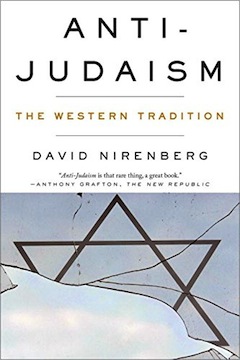
image - Anti-Judaism book coverNirenberg provides a sadly compendious recital of civilizations for whom “Jews,” “Jewishness” and “Judaism” were used as a prism through (and against) which non-Jews defined their own identities.

“Why did so many diverse cultures – even many cultures with no Jews living among them – think so much about Judaism? What work did thinking about Judaism do for them in their efforts to make sense of their world?” he asks.

In Christianity, Jews are viewed as “materialist” and earthly, which is juxtaposed with Christians’ self-image as being concerned with the spiritual and the divine. In a theology where things terrestrial are equated with all things evil, the corollary is predictable.

Nirenberg quotes Jean-Paul Sartre, who said: “if the Jew did not exist, the antisemite would invent him.” The subtext of Nirenberg’s book, one could say, is that both things are true: the Jew does exist and the antisemite invented him. There are, in effect, two different “Jews”: real Jews and the image antisemites have created and refined for millennia.

It is this latter imaginary “Jew” that has been used not only to torment generations of actual Jews, but also to contrive the self-identities of civilizations. Nirenberg includes both Christianity and Islam under the rubric of Western civilization when he writes: “anti-Judaism should not be understood as some archaic or irrational closet in the vast edifices of Western thought. It was rather one of the basic tools with which that edifice was constructed.”

Since Christianity and Islam were both founded as supercessionary religions to Judaism, juxtaposing that theological parentage with an antipathy to the descendants of the parent religion creates a cognitive dissonance that Nirenberg describes as the “truth of Jewish scripture and the falsity of the Jews.”

Somehow, adherents of both religions have intrepidly managed to accommodate the dissonance.

“The simultaneous inclusion and exclusion of Judaism became for Islam – as it had been for Christianity – a structuring principle of the world, one through which Islamic truth was explored, discovered and articulated,” he writes. Jews were “both necessary and noxious, prophetic and pernicious.”

The religious bigotry permeates Western civilization, not just its religion, he argues. Nirenberg discusses how Marx employed typical Christian perceptions of Jews as materialistic to fit his atheistic ideology. He also analyzes how it influenced the Enlightenment and the French Revolution. For example, while the Declaration of the Rights of Man and of the Citizen, the great document of the French Revolution, does not mention Jews or Judaism, “it was famously presented and represented to the people – in a painting and in print – as two new tablets of law, replacing those handed Moses on Mount Sinai.” Never mind Christianity and Islam, when it came time for what was probably the most progressive, liberal society yet in modern history to define itself, the revolutionaries took Jewish imagery and firmly demarcated themselves as “not that.”

What is striking when immersing oneself in volumes about antisemitism is the stark certainty of today’s “critics of Israel” that they are untainted with antisemitic bias. They apparently have given little, if any, thought or effort to learn the history of antisemitism and its myriad permutations.

While Nirenberg speaks very little about Israel, he packs a powerful punch when, after hundreds of dense pages excruciatingly dissecting how civilizations for thousands of years have understood their identities and their most significant beliefs in direct opposition to Judaism, he declares: “We live in an age in which millions of people are exposed daily to some variant of the argument that the challenges of the world they live in are best explained in terms of ‘Israel.’”

Coincidence? It doesn’t seem so to those have studied the history and malleability of anti-Jewish ideas.

Hate not acceptable at SFU

“Antisemitism is hate, and it is not acceptable at SFU,” said Simon Fraser University president and vice-chancellor Joy Johnson. (photo by Jeff Hitchcock / flickr)

The president of Simon Fraser University met with Jewish students recently and issued a statement condemning antisemitism on campus and directing those who experience anti-Jewish racism to appropriate resources.

After meeting with Jewish students, Joy Johnson, Simon Fraser’s president and vice-chancellor, tweeted on July 12: “Their experiences were deeply upsetting.”

“Antisemitism is hate, and it is not acceptable at SFU,” she added. “If you are experiencing discrimination or hate, help is available. Please reach out.”

The university, in consultation with the SFU Multifaith Centre and Hillel BC, created a resource for those who have experienced antisemitism. This includes links to campus chaplains, confidential counseling and critical incident support for significant events.

Like many university campuses, SFU has a history of anti-Israel activism that can often veer into antisemitic imagery and tropes. The latest eruption occurred at the first council meeting of a newly elected Simon Fraser Students Society. Occurring around the time of the most recent conflict between Hamas and Israel, the council meeting passed a resolution endorsing the boycott, divestment and sanction movement against Israel (BDS) in what Jewish students view as a biased and unfair meeting.

The student society’s resolution – titled “SFSS Response to the Israeli Colonization of Palestine” – accused Israel of “disproportionate violence,” claiming “worshippers at the Al-Aqsa Mosque were indiscriminately targeted by Israeli police forces” and condemning “the ongoing persecution of the Palestinian people by the government of Israel.” The resolution endorsed the BDS movement and expressed no parallel concerns about Palestinian terrorism, violence, incitement or human rights abuses. It also accused the United States and Canada of complicity in perceived Israeli misdeeds. The resolution passed unanimously.

The student society brought in Dalya Masri, a Palestinian activist, to provide “expert” testimony before the vote, said Katia Fermon, outreach coordinator for Hillel BC, the Jewish student organization.

“She gave a presentation, which was beyond hurtful for Jewish students,” said Fermon. Masri, she said, compared the First Intifada to the sort of peaceful rallies that happen on the streets of Vancouver.

“My students have family that died in the First and the Second Intifada,” Fermon said. “This is not a strange thing for us, and she just mentioned it like it was a rally.”

The presenter accused Israel of taking over territory in 1967, while eliding the larger facts around the Six Day War and other realities, she said.

Fermon said that, in preparation for the vote, the SFSS consulted with Independent Jewish Voices, but did not consult with Hillel.

“That fact is very hurtful,” she said. “Independent Jewish Voices is not a club on campus, however Hillel Jewish Students Association is. They pay their dues.… We are a part of that union. Those voices were not asked for or heard.”

Hillel BC issued a statement condemning the student society’s approach.

“Instead of supporting an open and extensive dialogue amongst students, the SFSS has chosen to perpetuate the agenda of a movement whose use of harmful terminology fails to address the root causes of the conflict, ignoring centuries of complex history in which power dynamics constantly shifted,” it reads. “This rhetoric further sows hate and division instead of helping work towards a peaceful two-state solution. The SFSS has decided to single out the state of Israel instead of opening a space for adequate dialogue between Jewish, Israeli and Palestinian students on campus wherein we may critique the policies of the state while being mindful of the hate that may result in endorsing certain statements, activists or movements.”

It added that BDS “openly traffics in antisemitic conspiracies and dog whistles” and noted that nearly two decades of BDS activism has not “freed Palestine from violence or oppression. Instead, it has been to stoke aggression and polarization online, in the streets and on campuses.”

In a statement to the Independent, Nico Slobinsky, director of the Centre for Israel and Jewish Affairs, Pacific region, said: “The statement by SFU’s president is an important step in denouncing the rising tide of anti-Jewish hate on campus. CIJA thanks president Dr. Joy Johnson for recognizing that SFU is not immune from antisemitism. Combating anti-Jewish hatred is not only about protecting Jews but also about protecting the very fabric of our society, on and off campus.

“CIJA appreciates the strong friendship and commitment shown by Dr. Johnson to creating a campus that is inclusive, diverse, safe and open to all students,” Slobinsky added. “CIJA looks forward to working with SFU alongside our campus partner, Hillel BC, towards ensuring a healthy campus environment.”

Students have been studying remotely for more than a year and so most of the discussion, which has included a litany of offensive comments, has taken place on official and unofficial online platforms, including the primary undergraduate forum.

One Israeli student, who asked to remain anonymous, said she was one of a few who spoke up in opposition to the prevailing bias in the dialogue.

“I didn’t expect it to go smoothly,” she said. “There was a lot of backlash in the moment and it is still going on.… A lot of comments are being deleted and monitored but there are a lot of hateful comments.”

The statements frequently included slogans such as “From the river to the sea, Palestine will be free” and other comments promising the annihilation of Israel. Israel was compared with Nazi Germany, Rhodesia, apartheid-era South Africa and plantation-owning slaveholders. Concerns about the safety of Jewish people were dismissed as efforts to “stifle” legitimate criticism of Israel.

“As an Israeli, I don’t want to believe they said them personally to me,” the student said. “I try my best not to take all those comments personally, but sometimes it gets there.”

As she and other students prepare to return to campus this fall for the first time in more than a year, she said she is not concerned for her personal safety, but she is worried about some of her friends.

“I was born in Israel and I have a little bit of Israeli inside of me so, for myself, I’m not that worried,” she said. “Obviously, it’s not a nice experience.” Whether the online threats and vitriol turn into real-time incidents remains to be seen, she said, but some of her Jewish friends are already taking cover.

“They are not wearing their Star of David,” she said. “They never say out publicly that they are Jewish: to not get into a conflict, to avoid any debate on the matter, they just decided not to. I think it’s a shame…. It is a shame that we live in Canada in the 21st century and people are choosing to hide part of their identity. For myself, it’s a big chunk of my identity, so I’m not going to hide it, but I can’t blame people who choose to. I empathize with them.”

Stepping up to confront hate

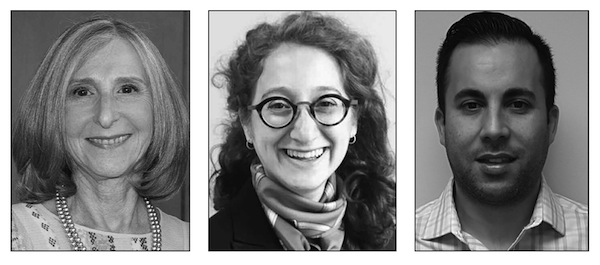
Left to right: Jewish Federation’s Shelley Rivkin, CJPAC’s Kara Mintzberg and CIJA’s Nico Slobinsky spoke at an online event June 17 on topics including how individuals can help fight antisemitism in Canada. (PR photos)

Representatives from three Jewish communal agencies spoke at an online event June 17 on topics including online hate, adoption of the Working Definition of Antisemitism, strengthening supports for the investigation and prosecution of hate crimes, and how individuals can help fight antisemitism in Canada.

Shelley Rivkin, vice-president of local and global engagement at the Jewish Federation of Greater Vancouver, Kara Mintzberg, B.C. regional director for the Canadian Jewish Political Affairs Committee (CJPAC), and Nico Slobinsky, director of the Pacific region of the Centre for Israel and Jewish Affairs (CIJA), spoke about how their agencies are confronting the surge in antisemitism, as well as a range of other topics.

Dafna Silberstein, associate director of the Jewish Federation’s Israel and global engagement department, opened the evening.

“We are here tonight to understand the Canadian political process and learn how you can become more involved, how we can become engaged with a range of issues that matters to you and to our community, and to learn what our community organizations are doing to combat antisemitism,” she said.

Rivkin described Federation’s role as “our community’s primary convener.”

“We are an umbrella organization that represents over 25 organizations locally and an additional number of organizations, approximately 10, in our partnership region [in Israel’s Galil Panhandle] and globally,” said Rivkin.

Federation is the central fundraising arm of the community and runs programs and partners with other agencies to care for the most vulnerable. About one in six Jewish British Columbians lives in poverty, she said, including 13.4% of Jewish children. Federation is also critically involved in supporting Jewish day schools and ensuring continued provincial support for those institutions, she added.

Antisemitic incidents and threats have spiked in recent weeks, coincident with the conflict between Hamas and Israel. Rivkin said the relationships Federation has built with other ethnocultural agencies and communities have proven valuable.

“We have a long history of working side-by-side with other ethnocultural communities,” she said. “These relationships and the supports that we provide are very important so that, when we stand up and speak out on behalf of other ethnocultural organizations, we’re building the bridges and relationships so that they will stand up and speak out on our behalf. Especially this past month, we’ve been very proactive in reaching out to the Indigenous community and the Muslim communities, both of whom faced significant losses over this past month.”

Rivkin also noted Federation’s substantial investment – about $1 million annually – in community security.

“Hate crimes against our community remain one of the highest reported crimes in Canada,” she said. “That was why, in 2016, we made the decision to invest in a director of security that is available and responsive to all of our community organizations, in particular those organizations that have stand-alone facilities.”

Slobinsky explained that CIJA represents hundreds of thousands of voices affiliated with Jewish federations across the country.

“Combating antisemitism, educating Canadians about the central role that Israel plays in Jewish life, strengthening the ties between Canada and Israel and ensuring that Jewish voices are represented in the discussion on a range of issues is some of the long-term work that CIJA does,” he said.

Because of CIJA’s lobbying, he said, the federal government has announced an emergency summit on combating antisemitism, to be led by former justice minister Irwin Cotler.

CIJA also promotes the adoption by governments of the International Holocaust Remembrance Alliance Working Definition on Antisemitism, which Slobinsky calls “the gold standard definition for antisemitism” and a vital tool in fighting antisemitism in Canada and around the world.

“For the first time in our history, we have a definition [of antisemitism] that we as a community champion, that the Canadian government has adopted and now Ontario, New Brunswick and Quebec have adopted,” Slobinsky said. “It’s a very useful tool to work with our elected officials, law enforcement, our partners in other communities, when they ask us what is antisemitism, how do you experience antisemitism, how it manifests.… We are defining what our own discrimination, our own oppression, looks like.”

CIJA is also calling on federal and provincial governments to increase supports for existing hate crime teams in British Columbia and to initiate teams to investigate and prosecute hate crimes in jurisdictions where investigation teams do not yet exist.

Of CJPAC, Mintzberg said: “We are all about political engagement.”

“Our focus is on getting our community interested and involved in politics through volunteering and building relationships with elected officials,” she said. CJPAC, she emphasized, is not involved in lobbying or advocacy; that’s CIJA’s job. “We create programs that reflect the mandate of engagement and highlight the importance of getting involved in Canada’s political process.”

Jewish voters have a significant presence in only about 10 of the country’s 338 ridings. Especially during elections, Mintzberg said, CJPAC acts as a “political concierge,” connecting volunteers with candidates. As Canada is currently governed by a minority government, an election could come at any time. She calls on community members to step up now and be prepared when that call comes.

Mintzberg asked that people pledge to volunteer in the next election and participate in a free, one-hour online training course, which can be accessed via cjpac.ca. Slobinsky invited participants to visit cija.ca/takeaction to find ways to mobilize against antisemitism and support other topics on CIJA’s agenda.

Pride trumps bigotry

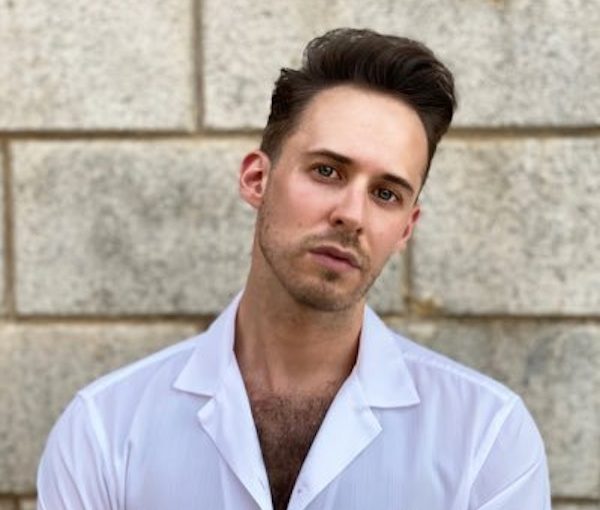
Writer Ben M. Freeman (PR photo)

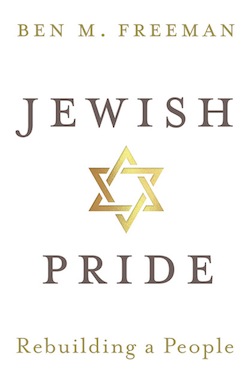
Antisemitism is not a Jewish problem, writes Ben M. Freeman in his new book Jewish Pride. “It is a non-Jewish problem that has an impact upon Jews.”

Freeman is a young Scottish Jew whose book projects some of the lessons of his coming out as a gay man onto the experiences of Jews dealing with the internalizing of others’ expectations and prejudices. He speaks of “passing,” of how a member of some minority groups can identify as a member of the majority.

“There are those who describe the ability of some LGBTQ+ people and some Jews to pass as a ‘privilege,’” he writes. “However, from my experience, this is a specific form of oppression itself.”

Freeman insists that the book is not about antisemitism, but rather its opposite: Jewish pride. But, perhaps by necessity, antisemitism plays a big role.

“Our journey is not about fighting antisemitism. That is the non-Jewish world’s journey,” he writes. “The Jewish journey is one of self-discovery, self-acceptance and self-love – in the name of collective pride.”

In the same way that antisemites have gone some distance to characterize who and what Jews are, anti-Zionists have stolen the word Zionism and redefined it to their perverse definitions, he suggests.

Above all, the fact that so many of the perpetrators of antisemitism are unfamiliar with its history is precisely the reason people can exhibit antisemitism while claiming – often haughtily – to be free of it.

“Due to a lack of education about both the conflict and Jewish history, most people are not armed with the knowledge to understand the connection between anti-Zionist rhetoric and historical antisemitism,” he argues. For example, the recurring libel that Israelis harvest organs from unsuspecting victims is a modern variation on the ancient blood libel – but people ignorant of that catastrophic history do not see their complicity as they perpetuate outlandish allegations. Likewise, the depiction of Israel as a unique embodiment of evil in the world mirrors the ancient projection on Jewish people of society’s fears and false narratives of evildoing.

He discusses how the International Holocaust Remembrance Alliance’s Working Definition of Antisemitism has led to a whole new wave of arguments around what is and is not anti-Jewish bigotry.

The British sociologist David Hirsh created the “Livingstone Formulation,” named after the former mayor of London, Ken Livingstone. It encapsulates the pretzel logic in which expressions of concern about antisemitism are met with a refusal to engage and a counter-accusation that the charge of antisemitism is made up as a conspiracy to silence legitimate criticism of Israel, as a “weaponization of antisemitism for political ends.”

This was in clear view during the spate of overt antisemitism that engulfed the Labour Party in the U.K. under the leadership of Jeremy Corbyn. Concerns about rampant Jew-baiting and unconcealed antisemitism were, Freeman writes, routinely dismissed as a “smear campaign against Jeremy.” It was, in short, bullies crying that they are being bullied.

image - Jewish Pride book coverFreeman points out the core problem for Jews in the evolving interpretations of hierarchical discrimination.

“There is a view of racism that suggests it is prejudice plus power, which implies that only those in positions of power over others can be racist,” he writes. “This definition leads to the notion that most forms of racism and prejudice are ‘punching down’ and that only marginalized groups with less or no power are being oppressed. While this experience is true for certain communities, this specific definition of racism, combined with exaggerated antisemitic perceptions of Jewish power and privilege, can be particularly dangerous for Jews. It thus lends to the erasure of the Jewish experience and of antisemitism as a legitimate form of prejudice. It can also allow those on the left – and some marginalized groups – to actively target us as representatives of elite power structures.”

Freeman’s core message is that Jews, like LGBTQ+ people, need to overcome the negative programming with which they are bombarded by the larger world.

“Jewish people have been in a dysfunctional relationship with the non-Jewish world for over 2,000 years,” he writes. “To be accepted, we have tried, over and over again, to change who we are.… In our thousands of years of history, has this sacrifice ever worked? No…. This cycle has to stop. The way to stop this abusive, destructive and exhausting cycle is to turn to ourselves for that acceptance and love.”

One might have hoped that a book on this subject would glance at the remarkable reversal of homophobia in most parts of the Western world in recent years, how that progress was achieved and how the lessons from that experience might be repurposed to fight antisemitism. But that, perhaps, is a future tome for Freeman or someone else to undertake.

Push back against antisemitism

The last three weeks or so have been a trying time for the Jewish community both in and out of Israel.

An 11-day onslaught of terrorist missiles sent thousands to bomb shelters or to their building stairways while the Iron Dome took down 90% of the missiles from the sky. Some got past, however, and 11 Israelis, Jewish and not, died. The loss of innocent life – both Palestinian and Israeli – is heartbreaking.

In the Diaspora, we hoped that a tense political situation would not turn into something worse. When it did, we watched the videos of missiles launched, of buildings hit, of funerals held – and of a country protecting itself and its people.

We then braced for the public opinion backlash. While Israel defended itself from more than 4,000 missiles fired from civilian neighbourhoods into civilian neighbourhoods, we were told by news outlets and celebrities on talk shows and social media that Israel’s actions – in which it went to extreme lengths to target only terrorist assets – were unjust.

I believe that Israel has a right to defend itself. I believe that Israel has a place in the Middle East, and I see it increasingly accepted by its neighbours. I believe Israel has much to offer the world.

Zionist is not a dirty word. I am an unapologetic Zionist. I stand with Israel. I believe in our people’s history, collectivity, peoplehood and right to self-determination.

Grievances with government policy do not give licence to question Israel’s right to exist. I do not believe that anti-Israel equals pro-Palestinian; if it did, then those burning Israeli flags in the streets would be calling for peace, or for a two-state solution, not to “globalize the intifada.”

In Gaza, Hamas – a listed terrorist entity in Canada, the United Kingdom, the United States and the European Union – remains a barrier to peace. I believe Palestinians deserve better. I believe that Palestinians are entitled to equal rights and to self-determination. This is not at odds with my Zionism.

I believe that anti-Zionism, as defined by the International Legal Forum as “the prejudice against the Jewish movement for self-determination and the right of the Jewish people to a homeland in the state of Israel,” can itself be antisemitic and create a climate that allows antisemitism to fester.

Across the world, we are witnessing a horrific surge in antisemitism in connection with the conflict. In the United States, Jews have been chased down and beaten. In the United Kingdom, there were chants to “rape their [Jewish] daughters” and antisemitic incidents have risen almost 500%.

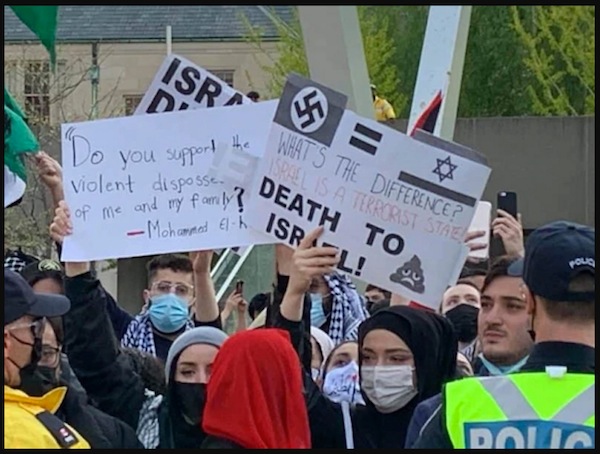
Canada is not immune. Recently, in Montreal, peaceful pro-Israel demonstrators were pelted with rocks. In May, Toronto experienced a 500% spike in antisemitic incidents compared to last year. Nazi symbols were spotted at anti-Israel demonstrations across the country, including in

aOttawa and London. In Vancouver, we saw a Jewish business owner being harassed and threatened, and an increase in hateful posters and graffiti. The recent spate of antisemitism has also spread online. There are numerous incidents of Jewish students bullied, businesses targeted, and many others harassed.

While my phone explodes with messages from family and friends asking how to respond to hateful social media posts and vicious videos and memes, it is easy to feel cornered. It is easy to assume that public opinion equals the right opinion, but a simple understanding of history reminds us that it does not.

We must speak out and push back against this rising tide of antisemitism.

We know that what starts with the Jews never ends with Jews. Combating antisemitism is not only about protecting Jews but also about protecting the very fabric of Canadian society. Thousands across Canada are joining the Centre for Israel and Jewish Affairs (CIJA) in calling for the federal government to convene an emergency summit on antisemitism – a forum to discuss enhancements to community security, education for youth about Jewish history, suffering and triumphs, and a Canada-wide campaign for social media literacy. Join our call to action at fightit.ca.

Neither Israel nor its supporters are perfect. Nobody is. The disproportionate criticism toward the Jewish state is unwarranted. Israel must, and will, stand by its principles, which are – not coincidentally – those same principles that gave rise to Western societies. As long as it does, I will stand with Israel, and you should, too.

Judy Zelikovitz is vice-president, university and local partner services, Centre for Israel and Jewish Affairs (CIJA).

Antisemitism unleashed

As Israel announced a ceasefire in its latest conflagration with Hamas in Gaza, the world sifted through the entrails to declare victors. In reality, neither “side” has won. Both “sides” have lost a great deal. There are, of course, implications for domestic politics on both sides, with Israeli Prime Minister Binyamin Netanyahu apparently benefitting politically from the conflict and Hamas achieving their goal of seizing the Palestinian narrative from the Palestinian Authority. These factors aside, this conflict was avoidable and, when civilians die, it is morally dubious to discuss “winners.” We are deeply distressed by this latest round of hostilities and the loss of life and security experienced by all the people of Israel and Palestine.

We also note, once again, that the conflict between Israel and its neighbours seems to attract global interest that eclipses any other issue on earth – demonstrated, among other things, by the litany of United Nations General Assembly resolutions that single out the Jewish state while ignoring or giving short shrift to victimized populations everywhere else on the planet. Indeed, the overseas reactions to the events in Israel and Palestine over recent weeks are illuminating, as “pro-Palestinian” activists have taken to the streets in cities around the world, in large numbers.

Not unrelated, in recent days, there has been a horrific spike in antisemitic incidents around the world, including in Canada. Identifiably Jewish people, businesses and institutions have been attacked. Pro-Israeli demonstrators in Toronto have been physically assaulted, and rocks have been thrown at them in Montreal; there have been reports of people seeking out Jews to harass in cities across our country. Jews walking in New York City and dining in Los Angeles have been assaulted, synagogues have been defaced in Chicago, Skokie and Tucson.

Then there are those like the BBC journalist who posted “Hitler was right” or the CNN contributor who posted “the world today needs a Hitler.” Members of groups who invaded a pro-Israel rally in Chicago a few days ago chanted, “Kill the Jews.” The Anti-Defamation League said there were more than 17,000 tweets using variations of the phrase “Hitler was right.”

There is a phrase that Israel’s critics repeat like a mantra: anti-Zionism is not antisemitism. This supposed tautology, uttered as though the speakers can make something true simply through repetition, has always been problematic. Some anti-Zionism is absolutely and undeniably antisemitic, such as when it veers into blood libels, Holocaust analogies and stereotypical representations of Jews and power. Part of the reason that a large number of people are able to spout such words is that they lack knowledge or understanding of the expressions and permutations of antisemitism in previous eras and don’t have the self-awareness to see the bigotry they are obliviously replicating. That’s to say nothing of their complete lack of any awareness or knowledge of Jewish history, cultural and religious traditions, scholarship, heritage or epistemology.

Are these people anti-Zionists? Who knows. Are they “pro-Palestinian”? Well, if scaring Jews is pro-Palestinian, then sure. But there is no doubt about the other part. This is antisemitism, in its most recognizable form.

In the past days, we have seen more overt Jew-hatred and incitement to harm and kill Jews, from more sources, than most of us have seen in our lifetimes. Not criticism of Israel, mind you. Outright, murderous Jew-hatred. A number of Canadian Jewish leaders have said this time feels different.

Here is the bigger problem: while far too many people are screaming, tweeting or otherwise expressing explicitly antisemitic hatred, far more appear to be sitting on the sidelines, somehow convinced that there are complexities around the subject.

There are deep complexities in Israel-Palestine, yes. But, when Jewish people and institutions are targeted around the world because of a conflagration in Israel and Gaza, that conflict is not a cause; it’s an excuse.

Good people of the world should be coming to the aid of Jewish people. In a conflict with a genocidal terrorist entity that launches thousands of rockets at civilians, the world should stand with Israel, too, but let’s leave that aside for today. Some political leaders, religious figures and others have expressed disgust with the antisemitism and expressed solidarity with Jewish people. But we should be seeing a global grassroots uprising in defence of Jews – and we’re not.

We hope that the ceasefire between Israel and Hamas holds. We hope for a return to negotiations that will result in a just two-state solution with Israelis and Palestinians in their own respective homelands. We hope, as always, for lasting peace. And we should all commit to doing our part to end the occupation and secure a democratic Jewish homeland. But, in the aftermath of this latest “round” in the conflict, we have learned another lesson. There are many people in the world who look at explicit calls for the murder of Jews, the annihilation of Israel, assaults on individuals and institutions and conclude there are better things to devote their energies to fighting.

Of course, there are well-informed critics of Israel who are not motivated by anti-Jewish animus. But these people – whatever their numbers are – seem untroubled to be part of a larger movement that is absolutely fueled by the worst impulses. They have, almost to a person, chosen to welcome support for their cause whatever hateful strings are attached.

Recent events have shown how easy it is still – despite all our advances in the area of human rights – for so many people to slide right into antisemitism, whether from anti-Zionism or other perhaps not even conscious feelings about Jews.

CIJA calls on feds to act now

Signs shown at a recent rally in support of Palestine. (screenshot from cija.ca)

The Centre for Israel and Jewish Affairs is calling on the federal government to expand supports for Jewish communal security after a surge of antisemitic violence and vandalism in Canada, and to launch an emergency summit on antisemitism.

Shimon Koffler Fogel, CIJA’s chief executive officer, made the request in a meeting with senior staff from the prime minister’s office and Liberal cabinet ministers and members of Parliament May 20. Later that day, he spoke at a virtual event billed as a national Canadian Jewish community briefing, called Learn, Mobilize, Act: Keep the Conflict Out of Canada.

“We are calling on the prime minister to convene an emergency summit on antisemitism that will include the political leadership at both the provincial and municipal levels, a true all-of-government effort, and establish a comprehensive program to combat Jew-hatred, the oldest and most enduring hate the world has ever experienced,” he said.

CIJA also wants a complementary program to the Security Infrastructure Program, “that enhances the capacity of our community to take ownership of our own security.”

He spoke just hours after Israel announced a ceasefire in its most recent battle with Hamas.

“As we express hope for a durable ceasefire to take hold and an end to the conflict there, we are painfully aware that the battle has moved to our country, to our communities from coast to coast,” Fogel said. “It’s been frightening but we dare not cower and hide. It’s been disturbing, but we dare not be intimidated from asserting our identity, who we are and what we are, and in doing so with pride…. Our adversaries seek not only to erase our ties to the land and history of Israel, they seek to erase the presence of Jews altogether.”

He lauded the additional attention to racial justice that has emerged in recent years. “But, along with the good of that movement has come a contaminated strain that reduces everything to a simple equation of the oppressed and the oppressor, and Jews have been declared the poster child of the oppressors, so they must be rejected and vilified,” said Fogel.

Joel Reitman, co-chair of CIJA, opened the event.

“Over the past two weeks, we have watched with shock as our fellow Jews in Israel have been subjected to attack at the hands of Hamas, a terrorist organization bent on the destruction and the obliteration of the Jewish state of Israel and the murder of Israelis,” said Reitman. “Our sorrow and compassion is extended also to Hamas victims in Gaza, where Hamas has embedded its terrorist infrastructure within densely populated areas, deliberately putting the people of Gaza in harm’s way and where one-third of Hamas missiles have fallen, taking many innocent lives.

“Our outrage has deepened as the violence on our television screens has spilled over into violence and threats of violence directed against the Jews in our streets, in our communities, online and in our places of business, our schools and our houses of worship,” continued Reitman. “Never has it been more clear that Jewish people, whether we live in Canada or in Israel, must stand as one. Never has it been more clear that the ancient hatred of antisemitism does not distinguish between a Jew in Tel Aviv at or a Jew in Toronto. We are all targets…. We will not be intimidated. We will not be discouraged. We will call out the perpetrators of violence and we will call on our many friends to stand with us and we will act together. Together with our fellow Canadians right across this country, we say, enough. We know where antisemitism leads if left unchecked. We know what must be done to stop it. And, together, stop it we will.”

Naomi Rosenfeld, executive director of the Atlantic Jewish Council, said it has been a scary few weeks to be a Jew.

“With all this hatred and fear,” she said, “I hope that we all remember three things. One, it has never been more apparent why we need Israel and why we need a strong Jewish state. Two, if any of you have been going through any of the things that I’ve mentioned, please know that you are not alone. We stand together, a community here to support one another through each of these events. And, finally, as a national Canadian Jewish community, we must remain strong and resilient. We will not cower to fear and we will not hide our true identities and who we are.”

Dr. Gil Troy, professor of history at McGill University and an author of several books on Zionism, spoke of being a parent of two members of the Israel Defence Forces and the betrayal he felt to read a letter signed by 180 rabbinical students comparing the racial reckoning in the United States in recent years directly to the Israeli-Palestinian conflict.

“We’re told again and again, especially by my friends in the United States, too many of my Jewish friends in the United States, that this is a racial issue between the white Israelis, the white privileged Israelis, and the brown Palestinians,” said Troy. “And we are told that the cause of this latest conflict is Israeli provocations.… We all know that the underlying cause of this is the refusal of Hamas, the refusal of Islamic Jihad, the refusal of the so-called moderate Palestinian Authority to accept the fact, 73 years after the establishment of the state of Israel, that the state of Israel exists.”

Jeff Rosenthal, the other co-chair of CIJA, asserted that “Jews and only Jews have the right to define what constitutes antisemitism.” He said, “We’ve always known that there is no distinction between anti-Zionism and antisemitism. Our lived experiences and the experiences of our forefathers and ancestors confer a unique alertness to this threat.”

He called on viewers to mobilize and directed people to the Action Centre on the website cija.ca.