Tragedy and cruelty

Reports from eyewitnesses to the catastrophe at Mount Meron last week, on Lag b’Omer, recount a horrifying crush of humanity propelled as if by an external force. The tragedy of 45 lives lost and scores of seriously injured will be investigated by authorities after allegations that the potential for such a disaster had been foretold.

The investigation into Israel’s worst civilian disaster will likely look at structural factors that led to the stampede and the inability of attendees to escape as the throng converged into a choke point at the site.

A small silver lining in the horrific incident was the mobilization of Arab Israelis in villages near the mountain, who set up help stations to provide water and food to attendees as they gathered in the aftermath.

But the tragedy itself was exacerbated when some among the survivors turned on female Israel Defence Forces soldiers arriving to help. The event was attended almost exclusively by religious men and boys. When female soldiers arrived to deliver first aid and evacuation assistance, some were spit on, kicked and punched as they attempted to help the wounded and remove the bodies of the deceased.

Such misogynistic extremism will probably not be within the parameters of a government inquiry. And perhaps that is fine, because this is a symptom of a much larger societal problem and one that should be confronted thoroughly by the entire country. Interfering in the life-saving work of first responders is not only reprehensible, it is an abrogation of a foremost tenet of Judaism, pikuach nefesh, the saving of life. Most of the victims and survivors are shomer negiah, adhering to a religious principle that restricts or forbids contact between members of the opposite sex. In a deeply distorted interpretation, a number of men in the situation chose to elevate shomer negiah above pikuach nefesh. By spitting on rescue workers, the perpetrators were spitting on the very sacredness they imagined themselves to be defending. That is something that deserves serious consideration by religious people and by secular authorities as the country – and Jews worldwide – grapple with the aftermath of the entire incident.

Another tragic byproduct of the disaster has been reactions to the news among people who gravely lack humanity. Within hours of being posted, a story on Al Jazeera’s website about the tragedy was met with more than 10,000 comments celebrating the deaths. Among the representative comments: “Drinks on me, y’all,” “about time we got some good news on our media,” “I feel so happy, actually” and “May God ensure the bodies pile high.”

It is difficult to fathom that we live in a world where people would respond to a mass casualty event in this manner. It is also nearly impossible to imagine such a response if the tragedy had happened to anyone other than Jews.

For years, a robust discussion has occurred around whether, if or when anti-Zionism crosses a line into antisemitism. Did the callous, sadistic comments reflect a political statement about the right of Israel to exist? Were they even more base, a celebration of dead Jews just because they were Jews? Was it anti-Zionism that drove these depraved commenters, or was it antisemitism?

These questions throw a spotlight on the fundamental foolishness of the dichotomy. A semantic discussion about the motivations of people who would behave in this way gives far too much credence to their actions, as if there could, in some convoluted moral universe, be a justification for their cruelty.

Was it anti-Zionism? Was it antisemitism? At this point, does it really matter what we call it?

Summit on online hate

Martin Luther King III and Arndrea Waters King delivered the keynote address at the Action Summit to Combat Online Hate, April 14 and 15. The son and daughter-in-law of the late civil rights leader Martin Luther King Jr. have both been deeply involved for many years in fighting racism, antisemitism and all forms of discrimination.

The summit was organized by the Canadian Coalition to Combat Antisemitism, an initiative of the Centre for Israel and Jewish Affairs, and funded by the Government of Canada.

King reflected on the legacy of Black-Jewish alliances in the civil rights movement and quoted his late father’s words: “Rabbis of Jewish congregations took their places on the frontlines as the Old and New Testament ethic of social justice flamed with a fire that had once transformed the world.”

King has worked in Israel and Palestine, educating young people to advance nonviolent resolutions to conflict.

“It was a wonderful experience and everywhere I went I experienced great hospitality and kindness from the people of Israel,” he said. “My father and mother, Coretta Scott King, were very concerned about the spread of antisemitism, racism and all forms of hatred, prejudice and bigotry, particularly among young people. Both of my parents made a commitment to doing everything that they could to help educate people about their shared vision for greater interracial understanding, cooperation and goodwill. Long after my father was assassinated, my mother continued to speak out against antisemitism and remain active in building the Black-Jewish coalition of social justice and human rights in Atlanta and throughout the world.”

Waters King worked for years at the Centre for Democratic Renewal, an organization that monitors and reports on hate groups, also delivering a broad range of educational programs to combat hate groups in the spirit of nonviolence that empowered the American civil rights movement.

“I have learned that the proponents of hate never sleep and our struggle against racism, antisemitism and all forms of bigotry and prejudice must remain ever-vigilant. What we can and must do is declare war on the ignorance that fuels hatred and the only known and proven cure for ignorance is education.”

King spoke about the advent of technologies over the past decades that hate groups have used to disseminate their messages. “But let’s remember that this communications revolution we have all lived through also gives us powerful tools to combat online hate,” he said.

The summit also featured keynote presentations by Katharina von Schnurbein, European Commission coordinator on combatting antisemitism, and Steven Guilbeault, federal minister of Canadian Heritage. More than three dozen others participated in two days of sessions, lectures, workshops and panel discussions. The Kings’ presentation is available online at actionsummit.ca.

B.C. observes Yom Hashoah

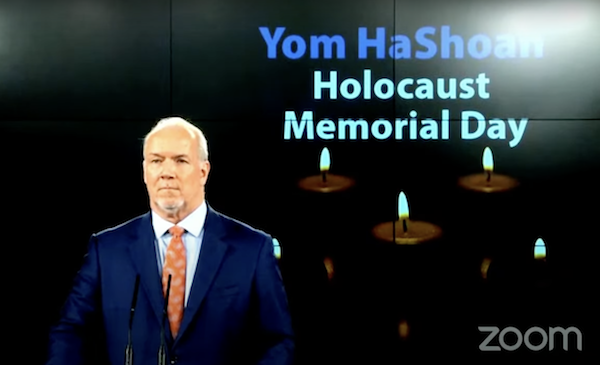
B.C. Premier John Horgan opened the commemorative event. (screenshot)

A uniquely British Columbian virtual commemoration of Yom Hashoah, Holocaust Remembrance Day, took place April 8, convened by the Government of British Columbia in partnership with the Vancouver Holocaust Education Centre (VHEC) and the Centre for Israel and Jewish Affairs, Pacific Region.

Premier John Horgan opened the event.

“On Yom Hashoah, we remember the six million Jewish lives that were lost during the Holocaust. We also remember and honour the millions who lost their lives or were murdered because of their ethnicity, sexual identity or disability,” said the premier. “Today, we also pay tribute to Holocaust survivors and, as that community grows smaller, it’s all the more important that we work together to carry that message forward – that we will never forget and it will never happen again, especially in light of the ongoing threats of violence and discrimination Jewish people are facing worldwide today.”

Horgan noted an incident in Victoria where a Chabad centre was defaced with antisemitic graffiti a day earlier.

“These are the types of acts we must stand together and fight against with a united voice, regardless of where we come from, regardless of our orientations or ethnicities or our faith. We must stand against antisemitism and racism whenever we see it,” said Horgan. “As we light the candles at Yom Hashoah in remembrance, we must remain vigilant and, as we take action today and honour those who lost their lives and those who have struggled since the Holocaust, we must again remember that we cannot repeat our past.”

Michael Lee, MLA for Vancouver-Langara, also spoke.

“As the living memory of the Holocaust fades, the important act of remembering and coming together each year grows in importance,” he said. “It is our collective responsibility to ensure that we never forget and such a thing never happens again, because, sadly, this is not just about remembering history, but about standing together today against the racism, bigotry and antisemitism that still exists in our world.… As a community, now and every day, we must stand against these acts of hate and bigotry.

“Today, on Holocaust Remembrance Day, we are reminded of why it is so important to come together, to reflect and to ensure that the past is not forgotten. We must remember both the parts of this dark, dark history that we must not let be repeated and the acts of heroism that took place amid such tragedy. Even during a period of humanity’s darkest chapters, there was still good in the world, people who risked their lives to hide and save others from the Shoah. Amidst the horrors and atrocities, there were tales of love, hope and bravery, including with the many righteous among nations, people who demonstrated that light can triumph over darkness. Today, we reaffirm our commitment to never forget; remember the victims, the survivors and the heroes; and we pledge to build a better world in their memory.”

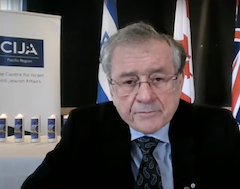
Dr. Robert Krell, founding president of the VHEC, lit six memorial candles. The premier lit a seventh candle “to honour the millions of Roma, Slavic, LGBTQ2+ and people with disabilities who lost their lives.”

Krell, speaking on behalf of Holocaust survivors, noted that 1.5 million of the six million Jews murdered in the Holocaust were children. An estimated 93% of Jewish children in Europe were murdered, which makes his survival extremely remarkable. The fact that both his parents survived, when more than 80% of Dutch Jews were killed, is additionally miraculous.

screenshot - Dr. Robert Krell spoke on behalf of Holocaust survivors
Dr. Robert Krell spoke on behalf of Holocaust survivors. (screenshot)

“I had lost all grandparents, uncles and aunts,” Krell said. “One first cousin remained. The war left its mark and I bear a special responsibility to remember what happened and try to derive lessons from that unfathomable tragedy. The tragedy was unique in its objectives, its focus and its ferocity. Jews were extracted wherever they resided, whether Paris, Prague or Vienna, whether city or countryside or the isles of Rhodes or Corfu. The enemy pursued us and tortured and murdered without mercy, without exception.”

While Dutch citizens remember the Canadian military’s role in liberating that country, Krell also noted Canada’s failure to save European Jews before the war.

Krell also addressed the issue of the International Holocaust Remembrance Alliance’s Working Definition of Antisemitism. Around the world, he said, 34 countries have adopted the definition, as has the province of Ontario.

“As a survivor who has been deeply involved in Holocaust remembrance and education, it strikes me as unconscionable not to accept the IHRA definition to assist us all in recognizing the signs and symptoms of the scourge of Jew hatred,” he said.

Yom Hashoah fell the day before the federal New Democratic Party convention that was to consider a resolution rejecting the IHRA definition. The matter never made it to the floor, but another resolution condemning Israel passed by an overwhelming margin.

“It is my hope that we will soon see the provincial government’s adoption of the IHRA definition of antisemitism,” said Krell.

Rabbi Dan Moskovitz of Temple Sholom also took up the issue of the antisemitism definition.

“The International Holocaust Remembrance Alliance’s definition of antisemitism is, I think, the tool that guides us in our work to combat anti-Jewish sentiments,” he said. “I want to urge our provincial government to join other jurisdictions in embracing the action that is required to combat both historical and contemporary hatred of the Jewish people.”

He added: “When we think of the death of a human being, we mourn the loss of the body and the soul, but, in my work, standing with too many grieving families at graveside, it is not the body that we miss most, that is merely the vessel for the soul, the part of that person that is unique in all the world,” he said. “That’s the part that we fall in love with and are forever changed by. The soul of another leaves an imprint on our heart. So, today, we remember six million murdered Jewish souls, their lives that have been extinguished, their dreams unrealized, their loves and relationships gone forever. We pray that those dear souls are comforted and embraced under the wings of God’s presence and that now, remembered so publicly, will never be forgotten.”

Moskovitz then chanted El Moleh Rachamim and a version of the Mourner’s Kaddish that includes the names of the Nazi death camps.

In addition to the B.C. event, the Vancouver Holocaust Education Centre also partnered on April 8 with the Neuberger Holocaust Education Centre in Toronto, the Azrieli Foundation, Canadian Society for Yad Vashem, Facing History and Ourselves, Friends of Simon Wiesenthal Centre, March of the Living Canada and UIA in a Canada-wide Yom Hashoah online program that included survivor testimony from individuals across the country and a candlelighting ceremony.

A day earlier, the VHEC partnered with the Montreal Holocaust Museum for a virtual program focusing on the importance of remembrance in the intergenerational transmission of memory. Survivors and members of the second and third generations spoke about their experiences. Video recordings of all three events are available at vhec.org.

Complex issues up for debate – IHRA definition

I met my husband long ago at Cornell University Hillel events. One event celebrated what looked like the success of the Israel-Palestinian peace process. It was part of the Oslo Accords and, in October 1994, the Nobel Peace Prize was awarded to Yasser Arafat, Yitzhak Rabin and Shimon Peres. It was a sunny, warm day, but things have shifted often since then. These are thorny political issues, but one can hope.

I recently completed studying the talmudic tractate of Pesachim. When finishing a tractate, one says a prayer called Hadran. It ends with Kaddish, much like what’s said at any Jewish service. It ends with praying for peace. We have lots of prayers for peace.

Meanwhile, my husband, now a biology professor, asked me to look at a motion from his faculty union. It claimed a deep concern with academic freedom. The motion proposed rejecting the IHRA’s definition of antisemitism. (The IHRA stands for International Holocaust Remembrance Alliance.) This motion theoretically responded to a student union motion that supported the IHRA’s definition. Many countries, including Canada, have adopted the IHRA’s working definition.

The politics behind this are tangled. Many on the political left suggest that to truly support truth and reconciliation and BIPOC (Black and Indigenous People of Colour), one must support all Indigenous movements worldwide. According to this argument, Palestinians must be supported as the sole true Indigenous people – against the colonial-settler narrative of Israel. There are issues with this position. One is that Britain is the colonial power whose actions helped lead to the creation of Israel. Also, Jews have been indigenous to, or lived in what is now, Israel for thousands of years.

There are practical consequences when universities debate these topics. North American Jews are a minority. This vote, which affects us, is one where we have no majority voting power. We rely on non-Jews to advocate for us and support anti-discrimination guidelines. We often must confront those who feel these definitions threaten them intellectually – while we’re feeling threatened in reality.

Jewish students on campus feel attacked. Jewish academics are forced to step up and speak out. In some cases, Jewish professors and students face discrimination as a result of this advocacy.

Just before Passover this year, at a special meeting, the faculty union put forth its agenda. The meeting agenda was to consider this motion that opposes the IHRA’s working definition of antisemitism. Those attending the meeting wouldn’t approve the agenda. (Note that approving the agenda is usually not a big deal.) Without an agenda, the motion couldn’t go forward. There was no vote.

Some attendees suggested that the entire union membership should vote. First though, they said, this motion should be considered by the cultural diversity and academic freedom committees. In the end? This meeting’s outcome just puts off the problem for the Jewish community.

Multiple professors in relevant fields spoke out against this motion, which opposed using a working definition of antisemitism. Behind the scenes, the local Jewish federation got involved. The motion was problematic – and it’s still out there. It could be voted on at another meeting, potentially one with even less notice or publicity.

It’s particularly troublesome that those voting on whether one can use the IHRA definition at this university in teaching or research aren’t all relevant experts. Most aren’t professors in religious studies, Jewish studies, Holocaust studies, Near Eastern studies. Most of the voting representatives won’t be Jewish. In their argument to maintain “academic freedom,” they’re proposing to limit the freedoms of colleagues. This limits others’ right to use whatever definitions they prefer when they speak about anti-Jewish discrimination.

There’s a bigger argument here. If Canadian universities want to show ally-ship with Indigenous communities and to be partners in truth and reconciliation, the way is clear. It starts much closer to home. Stand with Canada’s Indigenous peoples on the issues that matter to them. For instance, pressure the government to provide all Canadians with clean drinking water. Support Indigenous students at universities. Hire and appoint Indigenous peoples (First Nations, Inuit and Métis) to academic positions. The list is long. To start, read the Truth and Reconciliation Commission of Canada’s 94 calls to action.

None of these feuds are new. My husband and several other Jewish professor friends spent a lot of time on how to address this motion. This is “their” problem because they’re Jewish, but not because this is in their fields of research.

This gut-wrenching position is familiar. Does supporting academic freedom mean that antisemitism is up for discussion? It shouldn’t mean this, but antisemitic incidents are on the rise. Freedom of speech shouldn’t mean danger to minority students and professors.

Complexity isn’t resolved easily. Delving into these issues without lots of prior knowledge reflects badly on this faculty union and, by extension, the university. Smart people know there aren’t easy answers to entrenched political problems. Motions such as this one show a lack of rigour.

Canadian university professors should be sophisticated enough to know that complex issues aren’t resolved by simply opposing a working definition. It’s useless virtue signaling. Just as it shouldn’t be up to Black people or Indigenous people to fight every battle without allies, we, as Jewish people, shouldn’t have to keep fighting these battles alone over how to define antisemitism.

My husband and I met with a hope for peace. We care about human rights, but this union issue just seems to be wasting time during a pandemic. Opposing this working definition that protects a minority population, because it could possibly affect free speech? This really isn’t what a biology professor wants to be doing at work – even if he’s Jewish.

If Canadians care about peace, truth and reconciliation, and about the well-being of all people, we shouldn’t be attacking one group to elevate others. We shouldn’t have to keep fighting over definitions about discrimination against minorities.

Perhaps, we can leave the global political issues and their definitions up to the relevant experts. For us, it might be simple: we should show up to care for one another with respect instead. Advocate for better conditions close to home: safety without discrimination, fresh food, clean water, housing security, and economic and social supports. Even at their preschool, my children learned about key Jewish concepts like “Shalom Ba-bayit.” In other words, peace and tolerance start at home.

Joanne Seiff has written regularly for CBC Manitoba and various Jewish publications. She is the author of three books, including From the Outside In: Jewish Post Columns 2015-2016, a collection of essays available for digital download or as a paperback from Amazon. Check her out on Instagram @yrnspinner or at joanneseiff.blogspot.com.

IHRA definition stifles speech

On June 25, 2019, the Liberal government of Justin Trudeau adopted the International Holocaust Remembrance Alliance (IHRA) definition of antisemitism, as part of Canada’s anti-racism strategy. Widely proposed around the world, the definition has evoked fierce debate.

In Canada, the NDP will consider a resolution against the definition at its national convention this month, one penned by B.C. former MPs Libby Davies and Svend Robinson. Meanwhile, a coalition of 100 Canadian Jewish organizations has objected to the NDP resolution.

Wherein lies the controversy with the IHRA definition?

The definition, though vague, is not, in itself, controversial: “Antisemitism is a certain perception of Jews, which may be expressed as hatred toward Jews. Rhetorical and physical manifestations of antisemitism are directed toward Jewish or non-Jewish individuals and/or their property, toward Jewish community institutions and religious facilities.” IHRA has promoted it as a “non-legally binding working definition.”

As is so often the case, the devil is in the details, and the details here are found in the 11 examples of what the definition considers actionable antisemitism: seven of them concern the state of Israel.

Those who defend the definition argue that Israel is treated unfairly in the media and in international political discourse and see antisemitism as the root of this discriminatory treatment. Yet Israel is a country whose founding wars and subsequent military occupation of the West Bank and Gaza have meant displacement of millions of Palestinians followed by the occupation and policing of that same population. The circumstances of the displacement and occupation are such that even the most generous interpretation of Israeli actions should recognize that an ongoing critical scrutiny of the Israeli state is a moral duty. Voices within and without Israel – and especially the voices of Palestinians and their allies – must be free to speak their experience and, yes, their accusations.

This is exactly the freedom that the IHRA definition would curtail. The burden should not be on those who criticize the Israeli state to prove that their statements are not antisemitic. Rather, the Israeli state, like any other, should bear the burden of demonstrating that criticisms of it are discriminatory, made in bad faith and nonfactual.

The definition’s history

The International Holocaust Remembrance Alliance was initiated in 1998. In 2016, it adopted a definition drafted by Kenneth Stern, director of the Bard Centre for the Study of Hate, to aid in the collection and sorting of possible instances of antisemitism. Stern has acknowledged that the definition has been misappropriated and is being “weaponized” against critics of Israel and has warned against the definition “being employed in an attempt to restrict academic freedom and punish political speech.”

In Canada, the adoption of the definition has been opposed by the B.C. Civil Liberties Association and the Ontario Civil Liberties Association. More than 450 Canadian academics have signed on to an open letter opposing its adoption by governing bodies. In 2021, the New Israel Fund Canada, which had previously urged Ontario to adopt the definition, reversed its position, citing concerns over free speech and academic freedom.

There have already been unjust consequences. Lives, livelihoods and reputations have been damaged, particularly in universities where academics have been harassed, censured and dismissed for teaching about the Israeli-Palestinian conflict or scheduling speakers on that topic – instances where the definition is acknowledged to be in play. The definition also has created what some argue is a limiting of speech critical of the Israeli state on social media platforms like Zoom or Facebook.

In one example, law professor Faisal Bhabha was accused of antisemitism by B’nai Brith Canada for his remarks in a debate that was sponsored by the Centre for Free Expression at Ryerson University. A petition was launched using the IHRA definition, calling for Bhabha to no longer teach human rights classes. The professor’s allegedly antisemitic act was to argue that Zionism as practised today in Israel amounts to “Jewish supremacy,” an opinion shared not only by many human rights organizations and Palestinian activists, but also by many Jews. Yet for those wielders of the definition the question cannot even be debated.

Similar incidents have been reported in the United States. To get a sense of the extreme rhetoric involved, consider that, in 2020, the U.S. State Department announced its intentions to declare the advocacy groups Oxfam, Amnesty International and Human Rights Watch antisemitic and to withdraw U.S. support for these groups. If only advocacy groups in Canada and the United States could find a way to declare criticism of the genocidal actions of the Burmese state to be merely anti-Asian prejudice, what a coup for Myanmar’s military junta that would be.

Not only is the speech of Jews not immune to these accusations, but even Jewish Holocaust survivors are not immune. When survivor Marika Sherwood attempted to give a talk at Manchester University called You’re Doing to the Palestinians What the Nazis Did to Me, Mark Regev, Israeli ambassador to the United Kingdom, intervened. The embassy claimed the title breached the definition and accused the Holocaust survivor of hate speech towards Jews.

Incredibly, the Simon Wiesenthal Centre listed the European Union’s insistence that products made in Israeli settlements must be so labeled as the third most serious antisemitic incident in 2015.

These examples, which are only a sample of many more, should be enough to convince anyone that there are few limits to the measures that Israel’s absolute defenders will take to use the IHRA definition to silence criticism of the Israeli state.

Opinions in Canada

Can the centuries-old hatred of Jews be redefined as criticism of the state of Israel or is this an unacceptable slippage of meaning? A recent (2020) poll indicated that a strong majority of Canadians believe that criticism of Israel is not antisemitic. Considering the importance of holding the state of Israel up to criticism, it must be demonstrated that said criticism is rooted in antisemitism, not assumed.

One of the examples in the IHRA definition states that referring to Israel as a “racist endeavour” is antisemitic, because it denies the Jewish people their right to self-determination. But surely there are methods of national self-determination that can be judged to be racist.

The definition claims that holding Israel to a higher moral standard than other countries is antisemitic. Considering the fact that every government on the planet receives vitriolic criticism, together with the previous claim that calling Israel a “racist endeavour” is antisemitic, one gets the sense that what is sought for Israel is a higher level of exemption from criticism than any other nation receives. We are perfectly free to call Canada a “racist endeavour,” after all. This happens frequently, often by the main victims of Canada’s very real history of racism, Indigenous peoples. Would we want to criminalize such speech in Canada as somehow a form of racism against Anglo-Saxons, or the French? Obviously not, yet our prime minister is willing to penalize the speech of Palestinians calling out Israel’s structural racism.

Most Jews live outside of Israel. Some are not Zionists or do not identify with the Israeli state as part of their Jewish identity. Yet, since Israel was founded as a reclamation of the ancient Jewish homeland and seeks to identify itself as “the Jewish state,” obviously those who hate Jews may hate the Israeli state and attempt to attack it. Yet states are prone, by their very nature, to all kinds of ethical challenges and must be held open to free and vociferous criticism. Again, the burden should be on the Israeli state to demonstrate that criticism of its actions is unfair and rooted in antisemitism. The claim that criticism of Israel is antisemitic should not be the first assumption but rather the last, after the criticisms – or, in the case of the recent investigation of Israel launched by the International Criminal Court, the legal allegations – have been fairly assessed.

Matthew Gindin is an independent journalist, writer and teacher of Jewish studies. You can follow his writing at matthewgindin.substack.com. Marty Roth is a retired professor of American literature and film studies, a freelance writer and member of Independent Jewish Voices.

IHRA definition a vital tool

Synagogues damaged. Community centres defaced. Children bullied. Threats of violence online. Hate targeting Jewish Canadians is growing. When it comes to hate crime, the Jewish community is the most frequently targeted group. According to Statistics Canada, an anti-Jewish hate crime occurs, on average, once every 24 hours.

We in British Columbia are not immune. The Vancouver Police Department reports that, in 2018, there were 141 hate crimes, of which Jews were the most targeted.

This rising threat is either unseen or misunderstood by most Canadians, which is why the International Holocaust Remembrance Alliance (IHRA) definition of antisemitism is so important. It can empower our political leaders, judges, educators, and others to recognize and address rising antisemitism. After all, if you cannot identify the problem, you will not solve it.

Grounded in decades of research by experts in Holocaust remembrance, antisemitism and Holocaust denial, IHRA, an international group comprising 34 member countries, including Canada, adopted – by consensus – a working definition of antisemitism.

The definition includes 11 illustrative examples that help Canadians understand the evolving nature of antisemitism. In all, the IHRA definition is a vital, non-legally binding instrument to combat antisemitism, one that provides flexibility, consistency and understanding of its many manifestations.

Since its publication in 2016, the IHRA definition has become the most widely supported definition of antisemitism for organizations and governments at home and abroad. It is an important instrument in the coordinated, consistent response to a grave international threat.

In Canada, support for the IHRA definition is widespread – backed by almost every Canadian Jewish organization, including the Canadian Rabbinic Caucus and rabbis and lay leaders of the Canadian Reform movement. The definition is a foundational part of the federal government’s national anti-racism strategy and is supported by the Canadian Human Rights Commission, the Canadian Race Relations Foundation, the Province of Ontario, and many municipalities.

Internationally, the definition has received extensive backing. From the European Union, to the United Nations Secretary General, to the Special Rapporteur on Freedom of Religion or Belief, to governments throughout the world, the IHRA definition of antisemitism is supported by leaders of every political stripe.

Notwithstanding the IHRA definition’s widespread recognition, there is a small but vocal cadre of detractors, unrepresentative of the Canadian Jewish community, who reject the IHRA definition, claiming it is a conspiracy to stifle criticism of the state of Israel. This contention is false.

The IHRA definition states explicitly that, “criticism of Israel similar to that leveled against any other country cannot be regarded as antisemitic.”

Here, the IHRA definition distinguishes between political expression on Israeli policies and hate targeting Israel as a Jewish collectivity. The IHRA definition describes manifestations of antisemitism, such as denying Jewish self-determination and characterizing Israel or Israelis with classic antisemitic images or symbols.

For nearly all Jewish Canadians, a connection with Israel is central to their Jewish identity. For 86% of Jewish Canadians, caring about Israel is an essential or important part of being Jewish, according to the 2018 Study of Jews in Canada. This link cannot be ignored or denied, nor can the link between anti-Zionism and antisemitism. Those denying the Jewish right to self-determination are, in essence, rejecting the heart of Jewish identity: peoplehood – a right to control our own destiny.

This tiny group of detractors also criticizes the IHRA definition as too vague. The IHRA definition is not a checklist. Context is critical. The real world is rarely black and white. When read together with the 11 examples, the IHRA definition provides a nuanced understanding that allows the specifics of a situation to be duly considered.

This unrepresentative faction goes on to assert that “real” antisemitism is rooted exclusively in white supremacy. This one-sided, dangerously narrow view erases Jewish experience, history and identity. While antisemitism is undoubtedly a prominent feature of white supremacy, antisemitism is not confined to any single position on the political spectrum. There is as much antisemitism on the extreme left as on the extreme right.

Antisemitism is not limited to a place, a time, or a specific political ideology. That is precisely one of the reasons that the IHRA definition is important. It is a tool to identify antisemitism wherever it may root, breaking through the subterfuge and identifying antisemitism in a thoughtful and context-specific manner, so that we can stand together as a society against antisemitism, building a better tomorrow.

Visit cija.ca/ihra to learn more about the IHRA definition of antisemitism and how you can get involved.

Geoffrey Druker chairs the Centre for Israel and Jewish Affairs (CIJA) Pacific Region Local Partnership Council. CIJA is the advocacy agent of the Jewish Federations of Canada, including the Jewish Federation of Greater Vancouver. CIJA is a national, non-partisan, nonprofit organization dedicated to protecting Jewish life in Canada through advocacy. It represents hundreds of thousands of Jewish Canadians affiliated with Jewish federations across Canada.

Mufti house to be shul

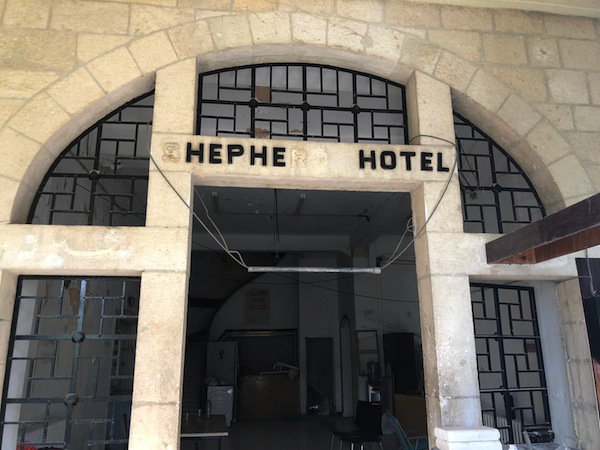
Hajj Amin al-Husseini’s mansion turned into the Shepherd Hotel for a period of time. (photo from Daniel Luria)

Hajj Amin al-Husseini, the mufti of Jerusalem in the 1920s and 1930s, who spent much of the Second World War in Berlin as a Nazi collaborator and war criminal, must be spinning in his grave in Beirut. The landmark mansion he built 88 years ago in affluent Sheikh Jarrah, between the Old City and Mount Scopus, is slated to become a synagogue in a future 56-apartment Jewish neighbourhood in east Jerusalem.

The 500-square-metre manor house, called Qasr al-Mufti (the Mufti’s Palace) in Arabic, today stands derelict at the centre of a largely completed 28-apartment complex which itself lacks an occupancy permit. The reason the new neighbourhood is not being finished – and indeed has not been marketed in the 10 years since demolition and construction began – is that the developers have applied to rezone the 5.2-dunam site to double the number of units to 56, according to Daniel Luria, a spokesman for Ateret Cohanim, which backs the housing project.

Luria was unclear when the rezoning application would be approved. The historic house at the core of the site will be preserved and repurposed for communal needs, including a synagogue and perhaps a daycare centre, he said.

“There is a beautiful poetic justice when you see the house of Hajj Amin al-Husseini crumbling down,” said Luria.

Though al-Husseini built the mansion, he never lived in it. Following the outbreak in 1936 of the Arab Revolt against the British Mandate government, the mufti became a fugitive, hiding in the Old City’s Haram ash-Sharif. When the British attempted to arrest him in 1937, he fled Palestine and the British made do with confiscating his property. The al-Husseini clan owned numerous properties in Jerusalem, among them the Palace Hotel (today the Waldorf Astoria), the Orient House and the villa subsequently turned into the Shepherd Hotel in Sheikh Jarrah on a plot of land known as Karam al-Mufti (the Mufti’s Vineyard), named for al-Husseini.

Among those who did occupy the mansion was his secretary George Antonius (1891-1942), who wrote The Arab Awakening while living there, in 1938. Antonius’s widow, Katy, continued living in the building, which functioned as a salon where wealthy Palestinian Arabs and British officials socialized. (The city’s British sports club had a “No Natives” policy.)

At one of her elegant soirées in 1946, she met Sir Evelyn Barker. The much-decorated general was commanding officer of the British forces in Palestine and Trans-Jordan from 1946 to 1947. The two carried on an affair and exchanged Judeophobic love letters. In April 1947, he wrote her about Jews: “Yes, I loathe the lot – whether they be Zionists or not. Why should we be afraid of saying we hate them. It’s time this damned race knew what we think of them – loathsome people.”

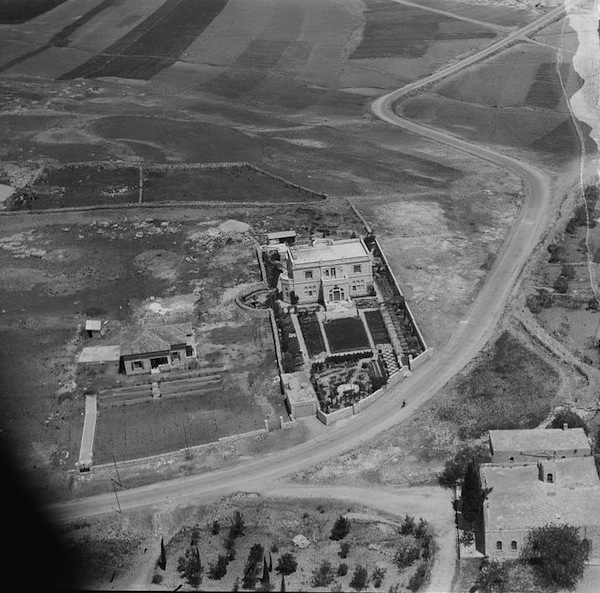
photo - Hajj Amin al-Husseini’s mansion in the Sheikh Jarrah neighbourhood circa 1938
Hajj Amin al-Husseini’s mansion in the Sheikh Jarrah neighbourhood circa 1938. (photo from Daniel Luria)

On April 13, 1948, both Scottish Highlanders garrisoned at the mansion and other British troops stationed at the nearby Police Academy failed to intervene for eight hours when a convoy of doctors and nurses headed to Hadassah Hospital came under fire from Arab guerillas. Seventy-eight Jews, many doctors and nurses, died in the massacre.

Following the War of Independence, the al-Husseini mansion became the Shepherd Hotel in the now-divided and impoverished city. It was eclipsed by the Hotel Jerusalem Intercontinental, today called the Seven Arches, which opened on the Mount of Olives in 1964. After the Six Day War in 1967, when Israel conquered and annexed east Jerusalem, the hotel was taken over by the custodian of absentee property.

In 1985, it was sold to C and M Properties Ltd., owned by Florida bingo hall billionaire Irving Moskowitz (1928-2016), the benefactor of right-wing Israeli settler groups intent on housing Jews in the eastern side of the now united city. Following the zoning of Plan 2591, a request was made on Nov. 6, 2008, to permit the company to build two new residential blocks, including 28 apartments on top of an underground parking lot. In January 2011, the four-storey Shepherd Hotel annex – added on to the mufti’s original mansion – was demolished to make way for the future housing.

Rather than attempt to rezone the site – which adjoins the British consulate – for a higher density at the beginning of the redevelopment process, it was decided to build what was legally permitted and later apply to amend the zoning, Luria explained.

“Ateret Cohanim is not involved in the building project but we have an interest in strengthening Jewish roots in and around the Old City,” he said.

Gil Zohar is a writer and tour guide in Jerusalem.

Combat online hate

Since the beginning of the pandemic, we have been confronted by two viruses: COVID-19 and, in its wake, the rampant spread of online hate.

As much of the world has been forced indoors, our time on the internet using social media has increased, which has advantages. We have found new ways to engage, stay in touch with our loved ones, and maintain and transform our connections to our workplaces and the world.

But the same technologies that have allowed us to keep connected have also served as springboards for the spread of online hate and conspiracy theories, which form the perfect Venn diagram of antisemitism. Since the pandemic broke, we have witnessed the emergence of ludicrous conspiracy theories accusing Jews of being responsible for the spread of COVID-19 or of profiting from the havoc. As a community that has consistently encouraged compliance with public health measures, we may be tempted to dismiss these outlandish conspiracy theories as nonsense. It is a type of nonsense, however, that spreads quickly and remains a cause for great concern.

Recent history has taught us that what begins online as the absurd mutterings of a few haters can, and too often does, turn into real-world violence. What we witnessed in Pittsburgh, Christchurch and Halle can certainly happen again. The threat is even greater today because people are spending more time online while also under considerable financial and emotional stress, a combination that makes people even more susceptible to messages hate-mongers are peddling.

Curbing online hate has been a priority for the Jewish community – and, therefore, for the Centre for Israel and Jewish Affairs – for nearly a decade. Since the beginning of the pandemic, we have remained on high alert, monitoring the emergence of antisemitic and hateful activity and bringing it to the attention of law enforcement and social media platforms.

Recently, we launched Stop the Transmission! (cija.ca/stop-the-transmission), a campaign powered by CIJA and funded by Canadian Heritage through the Anti-Racism Action Program. The campaign has provided practical tools and tips to hundreds of thousands of Canadians to identify and slow the spread of conspiracy theories, misinformation and deliberate disinformation.

We have also engaged directly with social media giants and are proud to have collaborated with our colleagues at the World Jewish Congress to urge Facebook to ban Holocaust denial, one of the most pernicious forms of Jew-hatred, from their platform, an action they took earlier this year.

We continue to call on social media companies to adopt the International Holocaust Remembrance Alliance definition of antisemitism, the most widely accepted definition in use today, including by the Government of Canada, who adopted it as formal policy in its 2019 Anti-Racism Strategy. In response to the global collective effort of our community, Facebook’s chief operating officer, Sheryl Sandberg, said “the IHRA’s working definition of antisemitism has been invaluable – both in informing our own approach,” and that Facebook would “continue to refine” its “policy lines as speech and society evolve.”

A continuing aspect of our work is advocating for governments to advance policies to address online hate directly. Federally, we continue our call for a national strategy on online hate that includes clear, harmonized and uniform regulations that apply to platforms and providers operating in Canada, as well as an independent regulator to enforce them. You can help by visiting notonmyfeed.ca and taking action.

CIJA is also working with Canadian Heritage to host the Action Summit to Combat Online Hate, scheduled for April 14-15. You can pre-register at cija.ca/action-summit. The summit will feature discussions with experts, law enforcement, industry leaders and community groups like ours. The goals are to create greater understanding of the issue and develop concrete actions to address it.

Even once the pandemic is over, our migration to the digital world will endure. We, therefore, must stay committed and united in our efforts to combat antisemitism and other forms of hatred online.

Judy Zelikovitz is vice-president, university and local partner services, at the Centre for Israel and Jewish Affairs.

Court verdict on Grabowski

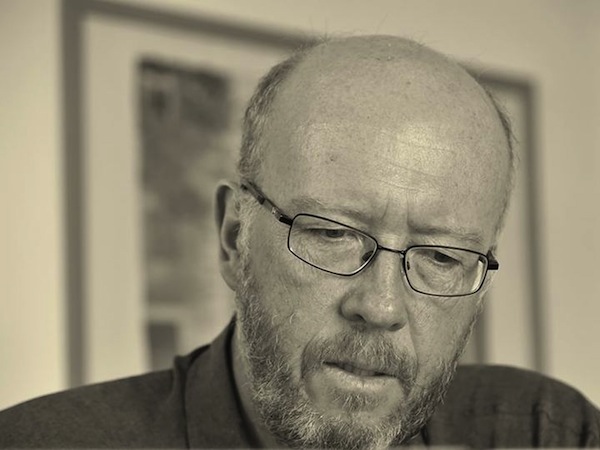
Jan Grabowski (photo from facebook.com/TheCJN)

A Polish court’s ruling that a Canadian Holocaust scholar must apologize for tarnishing the memory of a wartime mayor in Poland continues to reverberate around the world.

The case is being condemned by Jewish organizations and historians as an attack on free academic inquiry. Scholars warn the ruling could further chill an already touchy area of research: the role played by Poles in the murder of Jews in Nazi-occupied Poland.

In a long-awaited ruling on Feb. 9, a civil court in Warsaw ordered two prominent Holocaust scholars to apologize to an elderly woman who claimed they had defamed her late uncle over his wartime actions.

Prof. Jan Grabowski, an historian at the University of Ottawa, and Prof. Barbara Engelking, a sociologist and founder of the Polish Centre for Holocaust Research, were accused of defaming Edward Malinowski, the wartime mayor of Malinowo, a village in northeast Poland, by suggesting in a book that he delivered several dozen Jews to Nazi occupiers.

The professors were ordered to apologize for a passage in Night Without End: The Fate of Jews in Selected Counties of Occupied Poland, a two-volume work they co-edited, which the court said “violated Malinowski’s honour” by “providing inaccurate information.”

The court declined a demand for monetary damages of 100,000 Polish zlotys (about $34,000 Cdn) but ordered the scholars to apologize to Malinowski’s niece, 81-year-old Filomena Leszczynska, who brought the case; publish a statement on the website of the Centre for Holocaust Research; and correct the passage in any future edition.

Leszczynska had argued that her uncle had actually aided Jews and was acquitted of collaboration in 1950.

Grabowski, whose father survived the Holocaust, called the outcome “a sad day for the history of the Holocaust in Poland and beyond Poland. I have no idea what will be the consequences as well as the implications of this trial. But I can say for certain this thing will be studied for a long time by historians,” he told the Globe and Mail.

Prior to the verdict, he warned that, if the lawsuit were successful, “then basically it will mean the end to the independent writing of the history of the Holocaust in Poland.”

The professors were sued under a Polish law allowing for civil action against anyone claiming that the Polish nation or state was responsible for Nazi atrocities. The law was amended in 2018 to drop plans to criminalize the offence.

In her ruling, the judge said the decision “must not have a cooling effect on academic research,” but that is how it is being perceived.

As a senior tenured professor, the verdict, Grabowski conceded in a Postmedia interview from Poland, is “unpleasant. But, imagine you are a 25-year-old graduate student of history. Do you think you’re going to embark upon discovery of difficult history? I don’t think so.”

Grabowski and Engelking said they will appeal the ruling.

Mina Cohn, director of the Centre for Holocaust Education and Scholarship at Carleton University in Ottawa, called the campaign against Grabowski and Engelking “ugly.”

“The Polish government’s attempt to discredit them, and to silence and distort the historical facts of the Holocaust in Poland is appalling,” Cohn told The CJN. “It endangers the basic right of the future freedom of historical research of the Holocaust in that country.”

She said that, as daughter and granddaughter of Holocaust survivors with roots in Poland, “I find this blatant attempt by the Polish government to reject the reality of inherent antisemitism within Polish society before and during the Holocaust, and to discredit survivors’ testimonies, very offensive.”

For Prof. Piotr Wrobel, a specialist in Polish history at the University of Toronto’s Munk School of Global Affairs, the case is an example of the current Polish government’s attempt to control the historical record.

“They try to shape the ‘official’ version and persecute people who do not share [it],” he told The CJN. “This is very sad.”

It was “very clearly” the intention of those behind the lawsuit “to freeze scholarly research into the Holocaust. This was supposed to be a warning. Young people should remember this. If your opinions [and] historical interpretations are different than the official ones, then do not touch the Holocaust,” Wrobel said. “There is a choice between comfort and truth.”

In a statement on Feb. 10, the University of Ottawa offered its “unwavering support” to Grabowski and his “widely respected” Holocaust research. The university called the verdict “unjust.”

“Prof. Grabowski’s critical examination of the fate of Polish Jews during World War II shows how knowledge of the past remains vitally relevant today,” said university president Jacques Frémont. “The impact his work has had in Poland, and the censorious reaction it has generated, demonstrates this truth.”

The university “emphatically supports” Grabowski’s “right to pursue historical inquiry unencumbered by state pressure, free from legal sanction and without fear of extrajudicial attack.”

In Israel, the Yad Vashem Holocaust memorial and museum decried the ruling as “an attack on the effort to achieve a full and balanced picture of the history of the Holocaust.”

Even before the verdict, David Silberklang, a senior Holocaust historian in Israel, said the libel case intended for the two scholars to be “sued into submission.”

The decision “damages an open and honest coming to terms with the past,” said Gideon Taylor, president of the Conference on Jewish Material Claims Against Germany, which sponsors historical research on the Holocaust.

Taylor said Poland “must encourage open inquiry into its history, both the positive and the negative aspects.”

Canadian historian Frank Bialystok, who has written extensively about the Holocaust, sees the verdict against Grabowski and Engelking as a flipping of political extremes in Poland.

The murder of Jews in Poland, even after the war, was documented at the time. “This research was acceptable during the communist era as a weapon against nationalism,” said Bialystok. Now, the two professors are being “vilified” by the nationalist camp.

Friends of Simon Wiesenthal Centre said the ruling could have “a devastating impact on Holocaust research and education.” The organization said it is reaching out to senior government leaders, urging them to speak out against “Holocaust distortion in Poland.”

The American Historical Association went so far as to write Polish President Andrzej Duda, saying “a legal procedure is not the place to mediate historical debates” and urged Polish leaders to “uphold the rights of historians to investigate the past without legal harassment and with no fear of reprisals for making public their historical- and evidence-based findings.”

In 2018, Grabowski announced he was suing the government-funded group that backed Leszczynska’s libel case for allegedly libeling him. He claimed that the ultranationalist Polish League Against Defamation had itself defamed him by questioning his findings about the complicity of Poles in the wartime murder of Jews.


This article originally was published on facebook.com/TheCJN. For more on Prof. Jan Grabowski, see jewishindependent.ca/revealing-truth-elicits-threats.

What’s in a definition?

The International Holocaust Remembrance Alliance, in 2016, adopted a so-called Working Definition of Antisemitism. Given the complexity and pervasiveness of this ancient bigotry, the statement itself is remarkably succinct at a mere 38 words.

It reads: “Antisemitism is a certain perception of Jews, which may be expressed as hatred toward Jews. Rhetorical and physical manifestations of antisemitism are directed toward Jewish or non-Jewish individuals and/or their property, toward Jewish community institutions and religious facilities.”

It is innocuous and hardly debatable. Where controversy has arisen is in the accompanying 11 examples, seven of which make reference to Israel. Examples provided of antisemitic manifestations include: accusing Jews as a people, or Israel as a state, of inventing or exaggerating the Holocaust; accusing Jewish citizens of being more loyal to Israel, or to the alleged priorities of Jews worldwide, than to the interests of their own nations; applying double standards by requiring of Israel a behaviour not expected or demanded of any other democratic nation; drawing comparisons of contemporary Israeli policy to that of the Nazis; and holding Jews collectively responsible for actions of the state of Israel.

Opponents of the definition, including a majority of Vancouver’s city council, which voted against adopting the definition in 2019, claim it could stifle free expression in the form of criticism of Israel – this despite the fact that the definition self-defines as “non-legally binding.” In a world where any individual with access to a computer has more power than even the most powerful figures in history to disseminate their views to a global audience, it is notable that “Zionists” are imagined to have the power to control what others think, do and say. The criticism is perhaps, ironically, a manifestation of the problem itself.

To their credit, the new U.S. administration has said it “embraces and champions” the definition. The previous administration also endorsed the definition. (Canada and 28 other countries, as well as scores of cities and other jurisdictions and organizations have similarly endorsed it.) But the Trump administration’s support was a component of a broader politicization of ostensible support for the Jewish community. By allowing Israel’s right to exist in peace to become a partisan tool, we risk polarizing politicians and the public, driving supporters to their corners on a topic where less polarization should be encouraged.

If there are problems inherent in the terminology, it is perhaps in the chutzpah of attempting to define it at all. It is almost universally acknowledged that antisemitism is uniquely capable of metastasizing as required by the perpetrator. It is, above all, a pathology of the antisemite, with more to do with the eye of the beholder than with Jewish people themselves. Antisemitism is very often (if not always) a projection of someone’s (or some society’s) own problems directed toward an empty vessel in the form of “Jews.” Note that antisemitism is most rampant in the places where Jews are fewest – or nonexistent.

Antisemitism differs from other prejudices and bigotries as well in the typical responses it engenders. We have unlearned a tendency to deflect blame for misogyny back onto its victims; we do not accept that violence against women is in anyway justified by, say, what a victim was wearing. We recognize racism as a flaw of it perpetrators and we do not accept that racism against people of colour is based on the behaviour or innate characteristics of the victims. Homophobia is a pathology of the homophobe; it is not nurtured or provoked by LGBTQ+ people. Yet how many times do we see people respond to antisemitic violence or words with a variation on the question: What did the Jews do to deserve it?

Last week, that formulation was hinted at by a Democratic member of the U.S. Congress, Rep. Andy Levin, of Michigan. “Injustice anywhere is an injustice everywhere,” Levin said during a webinar. “Unless Palestinian human rights are respected, we cannot fight antisemitism.”

This false equivalency and conflation – coming from a Jewish elected official, no less – is a picture-perfect illustration of why the IHRA was created.

As the new administration in Washington begins repairing the unprecedented social and economic damage done to the country over the past four years, it is encouraging to see one of its first acts being an explicit and enthusiastic commitment to the battle against antisemitism.