Back to school is a time of excitement and anxiety for parents and kids. It is a time of new beginnings. For Jewish people, it generally coincides, as it roughly does this year, with the new year and the High Holidays. This confluence creates a somewhat chaotic frenzy in many households.
Jewish tradition is deeply tied to cycles of time, weaving renewal and return into every layer of life. The turning of the calendar is reflected not only in Shabbat, the progression of holy days and the annual cycle of Torah reading, but also in agricultural rhythms, the monthly sanctification of the new moon and daily prayers mapping sunrise, midday and nightfall.
This year, as we move from the beginning of the school year through the procession of holidays, we approach the anniversary of Oct. 7, and the terrible realization that the surviving hostages in Gaza have been held for nearly two years – as well as the continued reality facing Israelis, Palestinians, Jews worldwide and everyone who cares about human life.
As the new school year begins, Jewish families have additional anxieties, knowing as we do that the public school system – not least some teachers’ unions in Canada, including the one in British Columbia – in many cases have not only failed to address the unique challenges faced by Jewish students but exacerbated existing problems while creating new ones. Almost everyone has heard anecdotally of insults and distress faced by Jewish students in public schools, and the situation on post-secondary campuses locally and internationally has been in the news for all the wrong reasons for most of the past two years.
Additionally, this school year marks the first in which British Columbia’s education system officially mandates the teaching of the Holocaust. Most students did learn about the Holocaust before, but it had been left up to the discretion of individual teachers. Now, the Social Studies 10 curriculum requires that the topic be included. (See jewishindependent.ca/teaching-about-shoah.) This is something that the Jewish community and others have long promoted.
It does, however, create new openings for challenges. Given the allegations of genocide in Gaza, and overheated rhetoric against Israel in the public discourse – often invoking the memory of the Holocaust, the mantra “never again” and the appropriation of Jewish historical experiences for political advantage – there is a real possibility that individual teachers in the comparative privacy of their classrooms will attempt to inculcate anti-Israel narratives in the guise of genocide education. We expect there will be reports of inappropriate comparisons made between the Jewish experience in the Shoah and current tragedies in the Middle East – and we know that most such incidents will never be reported.
It should never have come to this with regard to antisemitism, but powerful new generations of Jewish leaders have been forged on university campuses and, yes, in high schools and even elementary schools, rising to occasions they should never have had to meet, but doing so in ways that often have surprised even themselves. As tough as the past two years have been, all evidence so far points to young Jews continuing to rise to every challenge.
When all is said and done, we hope that the next generation of our community grows up stronger, smarter and more determined, individually and collectively. To students and parents: May you go from strength to strength this year and always.
Recently, I was in the car with one of my twins and we were discussing how easy it is to accumulate too much stuff. We’d just had a conversation with a neighbour who mentioned that his sibling had moved into their parents’ house as an adult. It was a large, old home, now sadly so full of stacks of papers and other belongings that one had to turn sideways to navigate some of it.
I commiserated with my neighbour, misunderstanding the level of hoarding. I imagined how hard it must be to move, as an adult with a household, into a home already full of one’s parents’ belongings. Alas, our neighbour said, it was a mental health issue. It’s sometimes referred to as a hoarding disorder or Diogenes syndrome. It was serious.
In the car with my kid, we found ourselves understanding how people get to this point. He said, quite astutely, that our society pushes “more, more, more.” We both agreed that it is hard to resist the siren song of acquisition that we’re constantly hearing. Choosing to stop, clean, tidy and cull things and acknowledge what we don’t need is even harder than resisting new acquisitions.
I was faced with my own “hoarding” scenario. My personal, free email account is more than 20 years old. Suddenly, I got a warning about a month ago that the storage on these accounts would be slashed dramatically. I could choose to pay a fee every month or delete a lot of messages. My husband got a similar warning, but his account was not as old or big as mine. Even so, we commiserated, because deleting some of these saved emails felt painful. Save the baby photo elsewhere and then delete the message? One by one, it didn’t seem to make a dent. Eventually, I figured out how to move older messages to a folder on my computer and I didn’t have to delete messages from people I’d loved who have now died; I didn’t have to cull every family photo.
Still, this exercise made us look around. My kids, about to start high school, decided that they didn’t need about 75 books on their shelves, acquired over the years from Scholastic book fairs, PJ Library and elsewhere. They are making plans to sell or donate the books.
Each kid, getting ready for a new school year, worked to empty out enormous middle school binders. They recycled tons of paper. They acknowledged that we no longer needed a Grade 5 workbook leftover from those pandemic days of learning at home. Both kids realized we needed to make space in their backpacks: for new intellectual growth and a new school year.
As my kids grow physically this summer, I’m knitting as fast as I can to make them new sweaters for winter but I’m knitting a sweater now out of “stash” yarns that I acquired when they were infants. Both kids are now bigger than me. The sweaters I make from now on will likely be too big for me when they outgrow them.
This is a balancing act, of course. It’s normal in our household to get some new things for a new school year, even if we reuse the old stuff, too. This celebration of something new even has a word for it in Modern Hebrew. We might say “Tithadash!” or “May it renew you!” when you see someone with new belongings.
At the same time, I’ve been studying the Babylonian tractate of Avodah Zarah. It explores how Jews are to interact with non-Jews or those who might worship idols. One of the concepts it covers is whether one can reuse anything that might have been used by someone who engaged in idol worship. This is a complicated topic. It involves both “decommissioned” idols and whatever was used to sacrifice to the idol. One also must consider whether any of these items might be ever “reused” in Jewish worship or sacrifice, in the days when the Temple still stood in Jerusalem. It goes even farther, examining what one does about an idol created by Jews in the first place, like the Golden Calf. The tractate is sometimes confusing because it’s in so much detail.
That said, I returned to something else the text seemed to be telling us. In some cases, these items can be reused. The underlying message explores what we waste or throw away, versus how we can give things “new lives” even if their first use wasn’t ideal.
Nobody is worshipping idols at our house, but we’re discussing reuse, as well as the acquisition of new things for the upcoming school year. I see 14-year-olds evaluating their lunch bags and considering making themselves new ones. There was a pile of shirts in the give-away pile after we cleaned up today. I even saw a completely tidy sock drawer. This may never happen again!
I’m not sure how to always resist or even push back against our consumerist culture. However, the talmudic debate over physical leftovers from idol worship and what might be used again and/or refurbished made me realize that this struggle isn’t new. Just as we hope our kids are off to learn more with each school year, we also hope they’ll hold onto the good, sweet things that they embodied at younger ages, too. New, shiny ideas and things are tempting, but there’s something powerful and potentially meaningful about reuse, too.
Joanne Seiff has written regularly for the Winnipeg Free Press and various Jewish publications. She is the author of three books, including From the Outside In: Jewish Post Columns 2015-2016, a collection of essays available for digital download or as a paperback from Amazon. Check her out on Instagram @yrnspinner or at joanneseiff.blogspot.com.
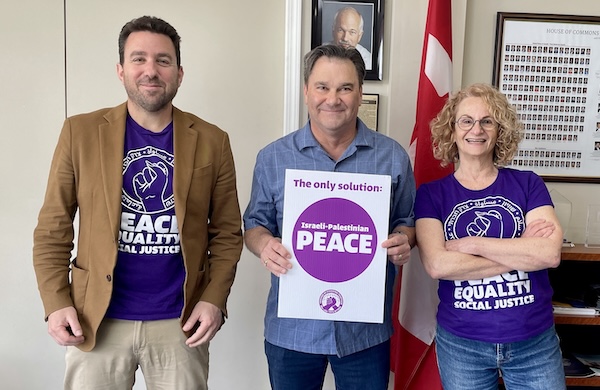
Interim leader of the New Democratic Party of Canada Don Davies, centre, with Itai Bavli and Avril Orloff of Vancouver Friends of Standing Together. (photo from Vancouver FOST)
This summer, Vancouver Friends of Standing Together has been holding weekly vigils in front of City Hall to continue the call for the return of the hostages, an end to the war in Gaza and an end to settler violence against Palestinians in the West Bank.
“We organize rallies, vigils and information sessions to raise awareness of the situation in Israel/Palestine and promote ‘another way’ that is not exclusively pro-Israel or pro-Palestine but pro-humanity,” Avril Orloff, who started the Vancouver Friends of Standing Together (FOST) chapter, told the Independent.
Adi Keidar, one of the chapter’s co-administrators, said, “If you are willing to accept that both Israelis and Palestinians deserve to live freely and safely on this land, I will be standing with and supporting you. Someone told me, ‘if you need to choose between pro-Israel or pro-Palestine, it is obvious for me, as a Jew/Israeli where I stand. However, if I knew and trusted that there is another way, I would choose both.’ Standing Together, for me, brings that other voice.”
“I joined the FOST group in June 2024 because it reflects my values and my belief that finding a just solution to the conflict is the only way forward,” Itai Bavli, also a Vancouver FOST co-administrator, said. “I care about all people living between the river and the sea and believe that both peoples can thrive if given the chance. I support Israelis and Palestinians alike and believe they both have the right to live freely and safely. Which means ending the occupation and supporting a Palestinian state. For me, it’s a responsibility I carry.”
Currently, there are nine local co-administrators, who play active roles as their other work and responsibilities permit, Orloff explained. “We try to divide up responsibilities, so no one is overburdened,” she said, noting that everyone involved is a volunteer. “We meet on an ad hoc basis as needed to brainstorm ways to increase awareness, bring out the voice of Standing Together and address issues that come up.”
Standing Together is an Israeli grassroots social movement made up of Jewish and Palestinian citizens that, according to its website, “envision[s] a society that serves all of us and treats every person with dignity. A society that chooses peace, justice and independence for Israelis and Palestinians, Jews and Arabs. A society in which we all enjoy real security, adequate housing, quality education, good healthcare, a liveable climate, a decent salary and the ability to age with dignity.”
Since the Hamas terror attacks on Oct. 7, 2023, and the ensuing war, Standing Together in Israel has been organizing demonstrations – attended by tens of thousands – calling for a hostage deal and a ceasefire agreement. They also have been engaging in public campaigns “aimed at re-humanizing the discourse, retaining humanity, mourning all lives lost and rejecting violence on social media in Hebrew, Arabic, and English.” Last May, they launched the Humanitarian Guard initiative at Tarqumiyah checkpoint to protect “aid trucks headed to Gaza from attacks by extremist settlers that come out to attack the trucks.” This month, they started a campaign to collect food and humanitarian aid for residents of Gaza.
In addition to the eight chapters of Standing Together that operate in Israel, there are Friends of Standing Together chapters worldwide that have formed since Oct. 7. The chapters in the diaspora raise awareness of and funds for Standing Together, as well as offer a local communal space for people who share the movement’s values and goals. Orloff is an ambassador for ST’s global crowdfunding campaign and recently surpassed her personal goal of raising $6,000 for the movement.
“I started the Vancouver FOST group in February 2024, when I first learned about Standing Together and discovered they had support groups around the world,” said Orloff. “I was drawn to ST because I felt that a lot of groups advocating for either Israel or Palestine focused on only one side or the other, which seemed short-sighted to me. Standing Together’s stance, by contrast, is that, with seven million Jews and seven million Palestinians living ‘between the river and the sea,’ none of whom are going anywhere, the only sustainable future is a shared one grounded in equality, security, peace and justice for all.”
Orloff, Keidar and Bavli said they appreciate that ST is about more than ending the war and that it’s “a broad-based social movement that goes beyond the specifics of Jewish/Palestinian issues to encompass social change at all levels of society, from the bottom up.”
“One of the biggest concerns and confusions I had on Oct. 7 and the events that followed was the rise of hate and polarization on both sides,” said Keidar. “It was rare that I could agree with much that was said, and I was constantly trying to hold two thoughts at the same time. I felt alone and was not seeing the benefit of supporting one side – it felt wrong and unjust and it didn’t fit my values.
Adi Keidar at one of Vancouver Friends of Standing Together’s vigils. (photo from Vancouver FOST)
“When I learned about Standing Together, it was the closest group that I felt spoke to my values and beliefs, as their focus is not one side or the other but humanity, which was the voice I felt was drowning in the hate that was brewing. I wasn’t willing to accept just one side. I believe that the only way to get out of this cycle is by compassionately seeing both sides, taking responsibility, finding the people that speak these values and bringing their voices out.”
Keidar participates in the weekly Bring Them Home rallies. Both she and Bavli spoke at a BTH rally this summer to raise the voice of Standing Together, to show “that it’s possible (indeed, necessary) to support both Israel and Palestine, and remind people that the immediate end of this war is only the beginning of the work to build a shared society in which all peoples live in peace and security.”
Vancouver FOST does local community-building through their WhatsApp group, social events (for example, film evenings, picnics, in-home gatherings), rallies and other activities. They raise awareness on social media via Instagram and work to build their membership, liaising with Standing Together and FOST groups globally. They meet monthly on Zoom with other Canadian FOSTs and build relationships with groups that share ST’s values and principles, like Women Wage Peace and various faith organizations. They have started doing outreach to Canadian politicians.
“We have endorsed Canada FOST’s Call to Action to the Canadian government and politicians to advance key priorities,” said Orloff, “including taking urgent diplomatic action to permanently end the war in Gaza; providing long-term support for peace and equality, not war; and supporting solidarity and partnership in our own society.”
The group organized and hosted an event in June last year, which brought Raja Khouri and Jeffrey Wilkinson to Vancouver to talk about their book, The Wall Between: What Jews and Palestinians Don’t Want to Know About Each Other. (See jewishindependent.ca/not-such-a-great-divide.) They have plans to host an information table at the University of British Columbia in the fall.
In an email, Orloff, Keidar and Bavli described Vancouver FOST as being “for more than we’re against. We don’t argue about terminology or labels or traffic in simplistic black-and-white ‘solutions,’ but are comfortable living with complexity and difference. We love to have juicy discussions, but, more than talk, we’re about supporting action that will bring about real, practical, sustainable change. We aren’t pro-Israel or pro-Palestine but pro-humanity,” they reiterated, “and we don’t see this as a left-right divide or an Israel-Palestine divide, but a divide between those who want peace and life for everyone and those who traffic in death and destruction. We’re here to offer a different way of thinking about the conflict and a different path forward, not to convince people that we’re right.”
Orloff said group members aren’t “settling for simplistic, one-sided solutions that make heroes of one side and villains of the other, but recognize that geopolitical issues have history and context that create layers of complexity, compounded by historical and intergenerational trauma on both sides. What I tell people is that, in this ongoing conflict, there is no win/lose: it’s either win/win or lose/lose. If we don’t find a way to justice, equality, peace and security for all, there won’t be justice, equality, peace or security for anyone.”
“We are involved with Standing Together,” the three co-administrators stressed, “because of deep feeling for Israel and the people living in the land. Many of our FOST members are Israelis who are heartsick at what Israel is doing in Gaza, the West Bank, and to its own Palestinian Israeli citizens. We believe in Israel’s promise and want to hold Israel to its highest ideals. There is no other way. It’s our responsibility to bring about the change.”
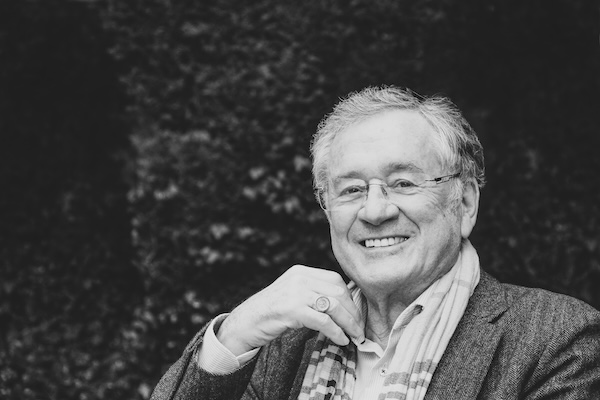
Dr. Robert Krell will be honoured at the Sept. 7 gala of the Canadian Shaare Zedek Hospital Foundation’s Western region. (photo from CSZHF, Western region)
Ilan Pilo had recently arrived in Canada from Israel in 2013 when he attended a Jewish National Fund gala in Toronto honouring Stephen Harper, Canada’s then-prime minister. Pilo thinks it may have been the largest kosher dinner ever on Canadian soil – but what struck him most was the rapturous enthusiasm among attendees for the country’s head of government.
“Harper was, and has been, one of the most genuine and strong allies and voices on behalf of Canadian Jewry and Israel,” said Pilo, now Western Canada executive for the Canadian Shaare Zedek Hospital Foundation.
Pilo will dine again with Harper, when the former prime minister is the keynote speaker at the first-ever gala of the Canadian Shaare Zedek Hospital Foundation’s Western region, which takes place Sept. 7.
“In these challenging times, we all deserve to get some hope and strength by having a strong ally like him speaking in front of us,” said Pilo. “We all were astonished and so proud to hear his great support, his genuine support for Israel, and just now we need it more than ever.”
The gala, which also marks the 50th anniversary of the Canadian Shaare Zedek Hospital Foundation, will see the Kurt and Edith Rothschild Humanitarian Award bestowed upon Dr. Robert Krell.
The founding president of the Vancouver Holocaust Education Centre, Krell is a child survivor of the Shoah and a renowned Vancouver-based psychiatrist, academic, author and educator, who has devoted his life to supporting survivors, educating on genocide and combating intolerance. In 2020, he was inducted into the Order of Canada.
The Kurt and Edith Rothschild Humanitarian Award is named in memory of the late Kurt Rothschild, a Canadian philanthropist, Jewish community leader and co-founder of the Canadian Shaare Zedek Hospital Foundation. Along with his wife Edith, Rothschild devoted his life to strengthening the Jewish people, the state of Israel and institutions like Shaare Zedek Medical Centre in Jerusalem; he also served as president of the World Mizrachi movement. The award recognizes exceptional individuals whose integrity, leadership and service have left a meaningful impact both locally and globally.
Krell told the Independent that he has felt a special connection with Shaare Zedek Medical Centre in Jerusalem since he read Dr. Gisella Perl’s 1948 memoir, I Was a Doctor in Auschwitz.
Imprisoned in the death camp, Perl, a gynecologist, was forced to work under the notorious Dr. Josef Mengele in the camp’s women’s infirmary. She performed countless life-saving – but excruciating – procedures without anesthesia, including secretly conducting abortions to save pregnant women from certain execution. Later, while serving in the maternity ward at Shaare Zedek Medical Centre, she would say a silent prayer before every delivery, “God, you owe me a life.”
“So, Shaare Zedek has been on my mind for a long time and, therefore, to be asked to be an honouree of that particular hospital talked to me,” Krell said.
The hospital’s maternity ward delivers 20,000 babies annually – by comparison, that’s three times as many as Vancouver’s BC Women’s Hospital & Health Centre. About 1,000 of those newborns are premature and the Sept. 7 gala is the culmination of a campaign to generate revenue to purchase five new $50,000 incubators for the Jerusalem hospital.
Krell is especially honoured, he said, to receive the award in the presence of Harper.
“It’s a great honour to be with someone who is truly admired for their statesmanship,” he said. “It’s been a long time since we’ve seen a statesman in Canada.”
Pilo noted that Krell’s selection for the award was unanimously supported by the award committee, which was chaired by Rabbi Andrew Rosenblatt, and included Dr. Arthur Dodek, Marie Doduck, Shannon Gorski-Averbach and Dr. Jonathon Leipsic, as well as Pilo.
“We were aiming to find the right person to be awarded for the first time ever with the Kurt and Edith Rothschild Humanitarian Award in the Western region,” Pilo said. “The committee agreed, without any hesitation, that our award recipient should be Rob Krell, since he is renowned for support of Canadian Jewry and Israel. His lifelong efforts at preserving the memory of the Holocaust and his dedication for children, which aligns with our incubator drive, [made it] so natural that he is the right person to receive this award.”
Pilo credited the foundation’s national executive director, Rafi Yablonsky, for securing the former prime minister’s presence at the celebration, which will be emceed by Dr. Marla Gordon. Dinner co-chairs are Yael Segal and Carol Segal. Community partners for the event are the Jewish Federation of Greater Vancouver, the Canadian Jewish Political Affairs Committee, Congregation Schara Tzedeck, the Jewish Medical Association of British Columbia and the Jewish Independent. Tickets are at hospitalwithaheart.ca.
Why do international media outlets seem intent on repeating the Hamas narrative? According to British military expert Maj. (ret.) Andrew Fox, there are a few key factors – including antisemitism.
“The first [factor] is a human desire not to admit when they are wrong and we don’t understand how powerful this is because it means that they have to admit that they have been wrong for the last 18 months,” he told JNS during a visit to Israel earlier this year.
Fox continued: “The second reason is the power of the narrative. Once you have achieved the dominance of your narrative, it is very, very difficult to present another narrative. The third one is antisemitism. While everything is not antisemitism – and I am really wary of saying that it is – certainly there are biases.”
Fox was a panelist at the International Conference on Combating Antisemitism hosted by the Ministry of Diaspora Affairs in Jerusalem on March 27. As a research fellow at the Henry Jackson Society who served as a top officer in the British army from 2005 to 2021, he is an authoritative voice supporting Israel, explaining how the Israel Defence Forces operates, and fighting disinformation about the Israeli military and its terrorist enemies.
In December 2024, Fox released a report under the auspices of the Henry Jackson Society titled “Questionable Counting: Analyzing the Death Toll from the Hamas-Run Ministry of Health in Gaza.” The report presented clear indications that Hamas was padding casualty numbers. Despite this, he said, many in the media repeated, without question, whatever Hamas put out.
Fox is not the only publisher of a report that backs Israeli data with empirical evidence. On March 18, he pointed out, British historian Lord Andrew Roberts presented the All-Party Parliamentary Group report on the atrocities of Oct. 7, 2023. The 318-page report lays bare the depravity of the Hamas attack in detail.
“The immediate reaction online is that it’s biased,” Fox said. “Lord Roberts is not Israeli, Israel is not his area of focus and everything is meticulously referenced. Yet, it has been utterly dismissed out of hand, and that is absolutely astonishing.”
He added: “Of course, there will be a strong counter campaign with Qatari money. I had the same thing with my report. The final aspect is that the Palestinian campaign has 10 times the supporters that Israel does. It’s a numbers game, ultimately.”
Is antisemitism in the form of anti-Zionism, or what some call “Israelophobia,” ingrained in some media institutions?
According to Fox, the answer is yes. “It is institutional with the BBC. Twice this year [as of March] they have had to put out major apologies breaching their own impartiality guidelines – when they platform Hamas royalty in a documentary about kids in Gaza or when they email the Israeli embassy asking for a speaker who is specifically anti-Netanyahu,” he said.
“There are three parts to an apology: ‘I am sorry, it’s my fault and I will do better.’ They haven’t really done that third part at all. It is endemic and institutionalized.”
While the IDF has faced criticism from journalists who are not being allowed into Gaza, with some saying this strategy has impaired Israel’s ability to present the facts on the ground, Fox backed the Israeli military’s position.
“If you give a journalist free rein in Gaza, they will either do what Hamas tells them or they will be killed – and that will be blamed on the IDF anyway. From a military perspective, you don’t want anyone filming an airstrike because they don’t have all the supporting data to report fairly without knowing what went into the targeting process.”
To illustrate his point, Fox said he had flown to Israel with Sir John McColl, a former British army four-star general who had been “very anti-IDF.”
“All week he was pushing the IDF like a hawk – and then came home and wrote an op-ed saying he was convinced Israel is doing everything it can to protect civilians, and that’s what the IDF should be showing journalists,” Fox said.
He added: “You can’t send journalists in with fighting troops; that is too dangerous. Fighting in Gaza is a 360-degree war. You have high-rise buildings, ground level, underground. As a soldier, I would probably refuse to take a journalist into that battle.”
Fox expressed concern that we are in a very dangerous information environment when many people turn to social media for information because of the 24-hour news cycle, and very often what is posted is not factual and has not been verified. In the rush to make the news cycle, journalists are also not fact-checking properly, he said.
“The fight against antisemitism is the most important thing to me,” he said. “The stories I hear from my friends are just shocking.”
When asked what communities around the world could be doing better, he said: “We are not going to stop 2,000 years of antisemitism; it is not something we can defeat. It is not easy, but I would work to bring the silent majority on to our side.”
He added: “From a British perspective, we need to make it about a community that is part of the country. The ‘Palestine’ marches are horrendous and very un-British. It’s about how we frame it.”
Rolene Marksis a journalist and commentator specializing in Israeli advocacy, global Jewish affairs and Middle Eastern politics for JNS.org. She is a member of Media Team Israel and Truth be Told, both dedicated to promoting accurate reporting on Israel. Additionally, she serves as the chair of WIZO’s hasbara division, where she leads efforts in public diplomacy and advocacy. This article was originally published on jns.org.
* * *
Marks’s two stops here
Rolene Marks (photo from CHW)
Israeli journalist, advocate, and chair of WIZO’s hasbara (communications) division Rolene Marks is touring Canada this September with Just the Facts, about the current situation in Israel, the realities of the war between Israel and Hamas (and other hostile groups), and the resilience of the Israeli people. Marks stops in Vancouver on Sept. 12 for an event hosted by CHW and the Ohel Ya’akov Community Kollel, and also helps open CHW Vancouver Centre’s new year, on Sept. 14.
At the Kollel young professionals event, Marks will talk about the United Nations, Gaza and Israel-related topics, and the Canadian government’s agenda, as it affects Israel and the Jewish diaspora. She will dispel lies, misinformation and blood libels, sharing links for where people can find accurate information and sources, stressing the need for Jews in Canada to share accurate information on social media. As well, she will discuss WIZO’s work in Israel and the importance of belonging to CHW (Canadian Hadassah-WIZO).
To join the CHW-Kollel Young Adults Shabbat experience on Sept. 12, 7:30 p.m., go to chw.ca/just-the-facts. Registration is by donation.
The CHW Vancouver Centre’s opening luncheon and fashion show on Sept. 14, 10:30 a.m., will feature fashions from After Five and Maison Labelle,lunch and door prizes, as well as an exclusive pre-event meet-and-greet for sponsors with Marks, CHW national president Tova Train and CHW chief executive officer Lisa Colt-Kotler. Tickets ($96) are available at chw.ca/region/western-region.
On Aug. 5, B’nai Brith Canada hosted an online discussion on the crises affecting Druze communities in Syria and the Iranian people, with a focus on the impact on these diasporas in Canada and potential actions by the Canadian government.
The speakers were Kiumars Rezvanifar, president of the Canadian Ethnic Media Association and founder of the Iranian Canadian Cultural Fellowship, and Jamal Sehnawi, an advisor to the Supreme Druze Council and a member of the Canadian Druze Society.
Rezvanifar said the recent violence in Syria’s Suwayda (Sweida) governorate could have resulted in “hundreds of thousands” of Druze deaths if the Israel Defence Forces had not intervened. He said the attacks included the killing of civilians and kidnappings, highlighting the case of a 5-year-old girl who was kidnapped, assaulted, and her family killed, allegedly by members of Hayat Tahrir al-Sham (HTS). He lamented that major Arab media outlets like Al Jazeera and Al Arabiya have downplayed the crisis, a silence he called “a moral issue.”
Independent casualty figures vary. The Washington Institute reported more than 800 dead and 900 injured. Reuters-verified footage and the Syrian Network for Human Rights cited more than 1,000 deaths, mostly Druze, including women and children. The Syrian Observatory for Human Rights documented 182 executions by government-affiliated forces as of July 19. Le Monde reported 1,311 deaths, while Anadolu Agency cited at least 321 killed, including six children and nine women.
These attacks have deeply shaken Canada’s Druze community, said Rezvanifar, who estimated the Druze population in Canada at about 50,000, mainly in Montreal, Toronto and Edmonton.
Sehnawi described the violence in Suwayda as “ethnic cleansing,” attributing it to the Syrian Ministry of Defence and Interior and to foreign fighters. He said the Druze community’s requests were for peace and recognition similar to that afforded to other communities worldwide.
Throughout the discussion, Sehnawi spoke about historical and cultural ties between Jewish and Druze communities, referring to Druze as “direct descendants to the sons of Jacob (Israel)” and noting traditions of service and community support.
The online conversation also addressed the situation in Iran. Rezvanifar spoke about decades of repression by the Iranian government, citing executions, censorship and the suppression of protests. He criticized European countries for “prioritizing economic interests over human rights,” noting that international attention often came “too late to effectively help the Iranian people facing brutal repression.”
In the face of internet blackouts and censorship, Rezvanifar praised citizen journalists, saying, “The Iranian population is tech-savvy and educated, constantly finding ways to circumvent restrictions.”
Rezvanifar alleged that Iranian regime operatives live openly in Canadian cities such as Vancouver and Richmond Hill (part of the Greater Toronto Area), claiming “thousands of visas may have been issued to regime members” and “fewer than 10 deportations have occurred in the past five to eight years.” These figures have not been independently confirmed.
He commented on the fact that it took repeated calls before Canada designated the Iranian Revolutionary Guard Corps a terrorist organization in 2024. The measure had been sought by various groups since the January 2020 downing of Ukraine International Airlines Flight PS752, which killed 176 people, most of them Canadian citizens or residents. Both speakers called for Canada and the international community to take action in support of affected communities.
“In real estate, it’s all about location, location, location,” Sehnawi concluded. “In this situation, it’s all about information, information, information.”
Uriel Presman Chikiaris a student at Queen’s University and serves as executive vice-president of external relations at Hillel Queen’s.
Left to right: Emily Bonnell-Marcus (Friends of Simon Wiesenthal Centre), Zelda Dean (Emanu-El), Johanna Herman (FSWC), April Nowell (Jewish Federation of Victoria and Vancouver Island), Frances Grunberg (JFVVI) and Jaime Stein (FSWC, Western Canada). (photo fromFSWC)
On Aug. 12, more than 80 people from diverse faith backgrounds gathered at Victoria’s Congregation Emanu-El for Friends of Simon Wiesenthal Centre’s flagship antisemitism education workshop – Antisemitism: Then and Now.
Geared for professionals, community members and volunteers who are interested in combating hatred, the workshop is presented by Jewish Federation of Victoria and Vancouver Island in partnership with FSWC. It is designed to build historical understanding of antisemitism and the Holocaust, examine how antisemitism shows up today, offer practical strategies to recognize and respond to antisemitic rhetoric and behaviour, and strengthen an organization’s capacity for allyship and inclusivity.
While in British Columbia, FSWC advocacy team members also attended the Canadian Association of Chiefs of Police Annual Conference. During the event, they strengthened their partnership with the Canadian Police Knowledge Network to advance the development of a national antisemitism training module, which will be made available to police services across the country. They also established new connections to support their law enforcement training initiatives, and promoted the upcoming Building a Case Against Hate Conference in Vancouver, scheduled for February.
Understanding the past, including the darkest eras, can help people recognize the symptoms of a society going off the rails.
A forthcoming book for young readers, titled Can Posters Kill? Antisemitic Propaganda and World War II, by Torontonians Jerry Faivish and Kathryn Cole, explores how propaganda and racist imagery desensitized a society to atrocities.
Faivish, a retired lawyer, has collected Jewish posters since young adulthood, building one of the world’s largest private collections. The son of Holocaust survivors, he created this book with Cole, an illustrator, art director, editor, designer and publisher, to educate young people about the dangers of hatred and the powers of persuasion used for evil ends.
The richly illustrated publication spotlights how vivid imagery and repetition intended to evoke fear, distrust, loyalty or revulsion served to influence populations to accept (even collaborate in) barbarism.
“By understanding the visual language of propaganda from the past, we can learn to recognize and resist messages of hate – an essential skill in a digital world where information is spread in seconds,” according to the publisher, Second Story Press.
Aimed at readers 13 and up, this book about the past has its purpose firmly planted in the present and future.
“Like social media today,” write the authors, “visual communication in the ’30s and ’40s – from movies to newspapers to paper posters – was clever and interesting, engaging and effective. But, under Nazi manipulation, it became deadly.”
The focus of the book is visual, befitting a volume of this topic, with just enough copy to contextualize the imagery and point out salient aspects that the reader might not have noticed. It is also perhaps a perfect mix of text and graphics for the generation it aims to reach.
The authors provide a brief overview of the post-First World War economic conditions in Germany, the impacts of the Treaty of Versailles, and Hitler’s rise to power. This history tilled the soil for the hate-messaging showcased.
“A false message, when repeated often enough, can become the truth in the minds of people who are frightened, oppressed and searching for someone to blame for their misfortune during hard times,” the book warns.
Can Posters Kill? also delves into how graphic design played into the success of the brainwashing – “clever use of different typefaces grabs the attention of passersby,” among other innovations.
Joseph Goebbels, the Nazis’ minister of propaganda, who more than any other individual is associated with this sort of material, did not overestimate his audience.
“The rank and file are usually much more primitive than we imagine,” he is quoted in the book. “Propaganda must, therefore, always be essentially simple and repetitious. In the long run, only he will achieve basic results in influencing public opinion who is able to reduce problems to the simplest terms and who has the courage to keep forever repeating them in the simplified form, despite the objections of intellectuals.”
The messages his department imparted were subtle as sledgehammers.
In one poster, a doctor or scientist is looking through a microscope at a vicious “Jewish” disease devouring healthy tissue. Jews are characterized as sexual deviants and blamed for spreading tuberculosis, syphilis and cancer.
“It’s a chilling message because it can quickly turn into ‘kill or be killed,’” the book says.
In another poster, a Jew hovers menacingly over the globe, spinning a web from his index finger.
“This reinforces the Nazi-supported notion that Jews are power-hungry and backed by secret cabals or conspirators,” the authors write.
Jews are depicted as the mortal enemy of Christianity and the Star of David is equated alongside the communist red star, implying a dual-pronged threat to German society.
Faivish shares his family’s story: his mother’s experiences in various ghettos, work and concentration camps, and at extermination sites such as Auschwitz, and his father’s defiant escape from a cattle car headed for the gas chambers. Faivish’s father lost his parents and his eight siblings in the Holocaust. His mother had just one surviving brother and one remaining sister out of a family of 10.
Faivish goes into some detail about the experiences of his mother in the constellation of Nazi ghettos and camps, and his father’s unlikely survival in hiding, thanks to a gentile Polish family. He places significant emphasis on the heroism of non-Jews.
“After the war, my parents met in Bergen-Belsen, the DP camp where they married and started a family,” he writes. “My older sister was born there in 1949.… In 1952, my parents immigrated to Canada. In 1953, I was born in Montreal. For my parents, the question of how to deal with recurring hate, and what could be done about it, was more than philosophical. It became a guideline for how to live their lives and what to pass on to their children. The lessons they taught us are still applicable and valuable today.”
He includes nine values his parents instilled in him and that he hopes the book will pass on to others, including: be proud of who you are and embrace your faith and culture [because the] aim of the “Final Solution” was to annihilate Jews and to destroy Judaism; respect your fellow human beings and treat them well; and recognize and eliminate hate and evil as much as possible.
A timeline of historical events and an excellent glossary of relevant terms are included at the end of the book.
As British Columbia and other provinces institute mandatory Holocaust education in school curricula, books like Can Posters Kill? Antisemitic Propaganda and World War II provide powerful resources for educators to convey the lessons of history in ways that are impactful but age-appropriate, with undeniable and clear lessons around critical media consumption for contemporary generations.
While not formally related, the book is also a valuable complement to the Vancouver Holocaust Education Centre’s current exhibition, Age of Influence: Youth & Nazi Propaganda, which is being reconfigured into a traveling exhibit.
On Sept. 16, Stephen Schecter will retell three stories from the Hebrew Bible at the 40th anniversary celebration of L’Chaim Adult Day Centre. He promises the stories will bring laughter and tears.(photo from Stephen Schecter)
“I love the Hebrew Bible,” Stephen Schecter told the Independent. “It is, after all, the template of Western literature and the DNA of the Jewish people. Its stories are all told twice, inviting the reader to ask what is going on here. And the stories invariably end badly, teaching us the importance of getting a handle on our passions if we want to have a halfway decent life together.”
On Sept. 16, in celebration of L’Chaim Adult Day Centre’s 40th anniversary, Schecter will share a few of his favourite biblical tales.
“Retelling these stories,” he said, “is my way of giving the Jews back their pride and their backbone, steeling them to be proud Zionists, once again going back to ‘In the beginning,’ which is the title of my show on Sept. 16. The stories – and I will be retelling three of them – when you examine them closely are rather funny, but this is no laughing matter. Some of them bring you even to tears.”
Schecter, who was a sociology professor at Université du Québec à Montréal, has always been interested in literature, but not necessarily the Hebrew Bible.
“When my kids had their bat and bar mitzvahs, I started going to Shabbat services again, which meant I read the weekly Torah portion and, lo and behold, I was swept away,” he said. “When a friend put me on to a contemporary rewrite of some of the books of The Iliad, I thought I could do that too but within my tradition. The upshot turned out to be a 170-page poem called ‘David and Jonathan,’ published in 1996.
“From there, I went on to lecturing about the Hebrew Bible to multiple audiences in Montreal and ended up doing a one-man show on the first half of the book of Genesis in 2003 at the Saidye Bronfman Centre theatre [now the Segal Centre for Performing Arts]. In 2005, I moved to Vancouver and gave a number of series of talks on the Hebrew Bible to seniors at the JCC.”
Schecter continued to write about sociology and, in 2012, published a book called Grasshoppers in Zion about Israel’s situation in the Middle East. In that book, he said, “I explained how a reading of the Hebrew Bible could help Jews immeasurably in dealing with the Palestinians. No one listened, but I continued to write and now do so on Substack at schecter.substack.com.”
He also noted how people don’t listen to – or even know about – the lessons of the Hebrew Bible. Hence, he quipped, “the constant rewrites. Steinbeck’s East of Eden retells Cain and Abel. Shakespeare’s Romeo and Juliet turns the Dinah story into a five-act play. The end of the Book of Judges replays Sodom and Gomorrah, which now finds its rehash on our TV screens in Gaza. Not for nothing is the Hebrew Bible laced with irony, engendering that particular form of Jewish humour Sholem Aleichem and S.Y. Agnon each captured.”
The English-speaking world once used the Hebrew Bible to learn to read, but people have stopped reading it altogether, said Schecter.
“Many Jewish day schools do not teach it, especially at the high school level, which is where Jewish youngsters could begin to immerse themselves in their tradition,” he said. “When I attend shul, I often hear more about food banks than the wild poetry of the parashah [weekly Torah portion]. The answer to antisemitism lies not in refuting the arguments of those who slander us; it is in asserting the timeless truths of this sacred text, which lay out the indissoluble link between the Hebrew Bible and the land of Israel and our identity as Jews.
“I am blown away every time I reread these stories,” he said.
“So, I hope Jews come to see the show,” said Schecter. “I hope especially community leaders, activists, rabbis, principals and teachers come and hear these magnificent tales and see how they still speak to a modern audience. It is a show to celebrate the 40th anniversary of L’Chaim, the only adult Jewish day centre in the Lower Mainland, whose exceptional level of care would have well served even our founding patriarchs, all of whom could have used its services. Come and see why.”
“We are on our way to becoming the gold standard of adult day programs in Vancouver,” said L’Chaim executive director Leah Deslauriers of but one of the many reasons to celebrate the organization’s 40th year.
“L’Chaim is fortunate to have community support, from foundations to private donors, which allows us to offer an enriched program to our clients and their families. All of us at L’Chaim are forever grateful for this support,” she said, adding that “L’Chaim continues to grow, and shows no signs of slowing down.”
In the coming years, said Deslauriers, “L’Chaim will prepare to move into the new JWest building upon its completion. In the next 10 years, our hope is to increase our funded spaces from 16 to 22 each day. And, if demand increases, maybe even add an additional day and be open on Sundays.”
Tickets ($18) for In the Beginning, which takes place Sept. 16, 7 p.m., at the Rothstein Theatre, can be purchased at eventbrite.ca.
Director Francis G. Matheu, right, with actors Nolan Fidyk and Dan Landry rehearsing Alan Segal’s Shade Apparel. (photo by Sarah Nicole Faucher)
This year’s Victoria Fringe Festival, billed as “12 days of madcap fun this summer,” started on Aug. 20 and runs to Aug. 31. Included in the lineup are pieces by two local Jewish community members, Alan Segal and David Heyman.
Segal describes his play, Shade Apparel, as “comedy, drama and absurdity.” It features Danver, a playwright rooted in daily routine, who tries to find answers to questions he never knew he had. And, Segal told the Independent, “He is not prepared for the answers. Shade Apparel is a play about wanting to know more and not knowing where to find anything.”
In Segal’s words, our society is “heavily psychologized,” in that everything is given a psychological or emotional origin story, he said.“But, if we breathe, we absorb culture, ideas, ideals and assumptions.
“Most of the time, we have a slight awareness of the precise origin of these. Their origin tale, however, is found in the social cauldron of daily life. This, too, is our apparel. We are clothed in more than material fabric,” he said.
From an early age, Segal has had an interest in how people become, well, anything; for example, how are allegiance, assurance, belonging, anger, dissent, happiness, or its opposite, created?
Segal’s first Victoria Fringe experience was not as a playwright but as a supporter of the arts who was captivated by the aura and array of creativity he observed. Last year, he founded Imbroglio Theatre, which will put on Shade Apparel.
“Beyond headlines and supposed fame, people venture into many realms of expression. I loved it from the start, and I expect many will be enlivened by what is approaching in Victoria at the end of August,” he said.
The creative team for the Fringe show comprises Dan Landry, Nolan Fidyk and Kendra Bidwell (cast), Alan Segal (writer), Francis G. Matheu (director), Elaine Montgomery (stage manager), Luke Weston and Andrea Gregg (lighting design), Phil Letourneau (music and sound design), Sarah Nicole Faucher (costume design) and Doug Wills (poster and program).
“Shade Apparel is the second play I have written – a project I never intended to write and had no inkling of, until it leaped into my mind as a single scene,” said Segal.
His first play, Frey’s Anguish, premiered in March 2024 at Paul Phillips Hall in Victoria.
David Heyman’s Ducks co-stars, right to left, Gloria Snider, Lorene Cammiade, Ryan Kniel and Danielle Greschner. (photo from David Heyman)
Heyman’s play, Ducks, takes place in the aftermath of an incident in which 1,600 ducks flew into an oilsands tailings pond in northern Alberta and died – a true event that caused international criticism of the provincial government. Years later, the oil company that owned and operated the pond was fined and the government promised tighter restrictions; however, the damage toAlberta’s reputation was significant.
The fictionalized theatrical story centres on a government communications director who has 20 minutes to retrieve an embarrassing, career-ending invitation erroneously sent out in his name before the media or public find out about it.
“I was communications manager for the premier of Alberta at the time [of the real-life incident] and, although I was not involved in managing the issue …I was able to observe the crisis-management efforts from up close,” Heyman said.
“The characters and events in the play are entirely made up but are informed by my inside knowledge of how communications offices work, and how the media deal with such situations,” he said. “Before joining the Alberta Premier’s Office, I was a political reporter at the Calgary Herald for many years. Many people who work in governments in Alberta and BC have told me that the play feels authentic, which was my goal.”
When Ducks premiered at the Victoria One-Act Play Festival in 2023, it won the prize for outstanding original script. When it was performed at the 2024 Edmonton Fringe Festival, five of eight shows sold out and the play received stellar reviews. The play has also been performed at the Nanaimo Fringe Festival and in Tofino.
Heading into the Victoria Fringe, Heyman said, “We’ve got a top-notch cast, a great director and a great stage manager this year. The rehearsals are going very well and I’m confident it will be a hit.”
Heyman is the show’s producer and, joining him in mounting the Fringe show are Ryan Kniel, Lorene Cammiade, Gloria Snider and Danielle Greschner (cast), Francis G. Matheu (director), Andrea Gregg (stage manager) and Sarah Heyman (associate producer).
David Heyman has written an as-yet-unperformed sequel, Rhymes with Ducks, that he hopes to put on at next year’s festival. “The sequel is designed also to be a second (and final) act, and perhaps one day both will be performed as a single show,” he said.
For the Fringe, Shade Apparel is at Victoria Conservatory of Music’s Wood Hall, while Ducks is at James Bay United Church. Both plays are 45 minutes long. For tickets and more information, visit victoriafringe.com.
Sam Margolis has written for the Globe and Mail, the National Post, UPI and MSNBC.