Annual civil courage tribute

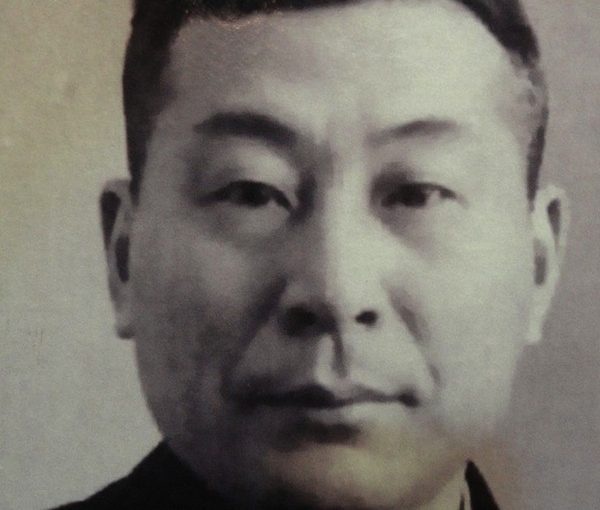
Chiune Sugihara, 1941. This year’s Raoul Wallenberg Day event includes the screening of Persona Non Grata: The Story of Chiune Sugihara. (photo from Vilnius-Green House exhibit)

On Sunday, Jan. 19, the 15th annual Raoul Wallenberg Day event pays tribute to courageous actions by diplomats Raoul Wallenberg of Sweden and Chiune Sugihara of Japan. During the Second World War, they engaged in selfless acts of civil courage, at grave risk to themselves and their families, to rescue many tens of thousands of Jews during the Holocaust.

This year, the Vancouver-based Wallenberg-Sugihara Civil Courage Society focuses on the story of Sugihara. The event features a showing of the biographical film drama Persona Non Grata: The Story of Chiune Sugihara. As a consular official for Japan in eastern Europe during the Second World War, Sugihara saved thousands of refugees by issuing transit visas that allowed people to escape Nazi German forces. Once reviled in Japan, today Sugihara is considered a hero, with museums and a memorial site.

The keynote speaker on Jan. 19 is George Bluman, a local descendent of Sugihara visa recipients and an international expert on Sugihara’s life. Some of those saved by his visas ended up in Vancouver and other parts of Canada.

When possible, the Civil Courage Society also presents an award to an individual associated with British Columbia who, at significant personal risk, helped improve the lives of others while defying unjust laws or norms, past or present. Past recipients include Hon. Ujjal Dosanjh, Chief Robert Joseph and Mary Kitagawa. Their stories inspire Canadians to act with courage and live by their moral values.

This year’s event – sponsored by the estate of Frank and Rosie Nelson, and supported by several organizations and volunteers – is being held at the H.R. MacMillan Space Centre, and it begins at 1 p.m. Admission is free; donations are appreciated. A reception follows. For more information, visit wsccs.ca. New volunteers and nominations for the Civil Courage Award are always welcomed.

Inspired through story, song

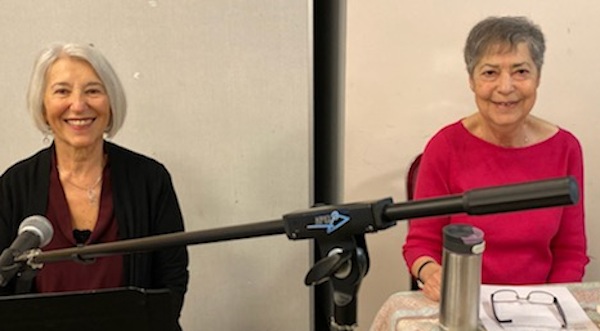
Musician Myrna Rabinowitz, left, and Jewish Senior Alliance’s Shanie Levin. (photo from JSA)

The theme of this year’s Jewish Seniors Alliance-Snider Foundation Empowerment Series is “Be inspired!” and the first of four sessions was called Be Inspired through Story and Song.

Held at the Peretz Centre for Secular Jewish Culture on Nov. 29, Gyda Chud, co-president of the JSA, introduced the two presenters, referring to each as “a gift to our community”: storyteller Shanie Levin, who is a member of JSA’s executive board and on the editorial board of JSA’s Senior Line magazine, and singer-songwriter and guitarist Myrna Rabinowitz.

Rabinowitz opened with the Yiddish song “Abi Gezunt” (“As Long as You’re Well”) and the audience echoed enthusiastically the refrain, “As long as you’re well, you can be happy.”

Levin followed with a story by Kadya Molodowsky, the first lady of Yiddish poetry. A House with Seven Windows is about a proud, strong heroine in the mid-19th century who embraced the dream of “normalizing” Jewish life through a return and settlement in the land of Israel.

Other songs by Rabinowitz included the Yiddish translation of Leonard Cohen’s “Hallelujah,” as well as “Sleep Little Boy,” a Yiddish song that she wrote eight years ago for her first grandson. She ended with the Yiddish rendition of “Sunrise Sunset” from Fiddler on the Roof (Tog Ayn Tog Oys).

Tall Tamara by Abraham Karpinowitz, both sympathetically comic and painfully tragic, was another inspiring story of Vilna’s poor and the unexpected dignity available to one woman through a chance contact with Yiddish literary culture.

Levin also shared Ted Allan’s Lies My Father Told Me, about the relationship between a 6-year-old child and his grandfather that transcends the differences in ages with deep connection. This story was made into a Golden Globe-winning film of the same name.

The last story Levin read – If Not Higher by I.L. Peretz – was about a rabbi who demonstrates that doing good deeds on earth may be a more exalted activity than doing God’s will in heaven.

Chud thanked the performers and urged the audience to attend upcoming JSA events, the next one being the screening of the movie Music of the Heart, starring Meryl Streep, at the Jewish Community Centre of Greater Vancouver on Jan. 15.

Marilyn Berger, who initiated the Light One Candle project and designed a card to help JSA celebrate Chanukah, encouraged the audience to spread the light and make a special donation to help JSA continue its peer support program, as well as its advocacy work.

For more information about JSA, visit jsalliance.org.

Tamara Frankel is a member of the board of Jewish Seniors Alliance.

Many milestones for Wosk in 2019

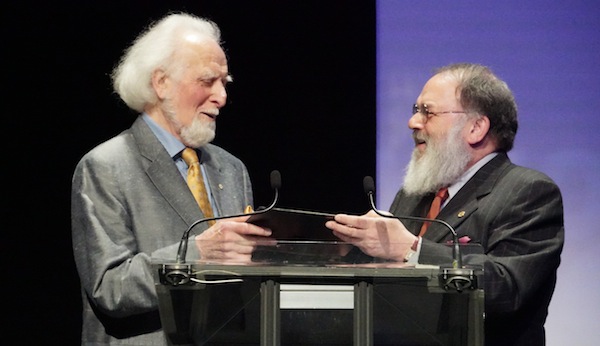
Dr. Yosef Wosk, right, with Max Wyman, 2017. (photo by Fred Cawsey)

The Yosef Wosk Poetry Initiative at the Jewish Community Centre of Greater Vancouver, which began in 2009, marked its 10th year with a celebratory gathering of artists and poets and with the publication of a commemorative book earlier this year. In addition, the Yosef Wosk Poets’ Corner, along with the adjacent Poet Laureates Garden, was inaugurated on the newly renovated top floor of the downtown central Vancouver Public Library – it was named in recognition of Dr. Yosef Wosk’s decades-long support of the VPL.

Wosk was an early major donor to the redevelopment of the eighth and ninth floors and the roof of the central branch of VPL and was asked to serve as honourary chair of the VPL campaign in 2018/19. The architect for the renovations, as for the library itself, was Moshe Safdie, while Cornelia Hahn Oberlander designed an extensive garden to complement her roof garden that crowns the award-winning structure.

In the library world, Wosk – who has established more than 400 libraries on all seven continents over the past 20 years – was able to fund more than 50 new initiatives in 2018/19, including 20 libraries in remote Himalayan villages and 37 in Jewish communities throughout the world.

As a writer and publisher, Wosk’s work has appeared in a number of publications. Most recently, these include having curated and written the preface for Memories of Jewish Poland: The 1932 Photographs of Nachum Tim Gidal, featuring photographs by Gidal from Wosk’s and the Israel Museum’s collections (Gefen Publishing, Jerusalem and New York, 2019). He also initiated and funded a biography, written by Christopher Best, of Faye Leung, the effervescent pioneer in the Chinese and real estate communities, affectionately known as the Hat Lady (Warfleet Press, 2020).

Wosk’s essay “On the Wings of Forever” was published in the online Ormsby Review this year in collaboration with the Canadian Academy of Independent Scholars. The editor’s preface notes that: “With prose as profound and learned as it is clear and accessible, here Wosk examines and appreciates the role of museums and museum workers in the digitizing modern world. It’s not gloom ’n’ doom. Instead, he outlines what he calls ‘a stirring vision, one of innovative technology on a human scale, heart-centred and soul-sized.’”

In collaboration with the Canadian Museums Association, Wosk helped transform the President’s Award into the President’s Medal; he also commissioned the medal and wrote the introduction in the booklet that accompanies the honorific, which was first awarded in 2019.

The province-wide Max Wyman Award for Critical Writing in the Arts, which was inaugurated by Wosk in 2017, formed an alliance this year with the VIVA Awards (the Shadbolt Foundation), which will begin in 2020.

In academia, Wosk was reappointed this year as an adjunct professor in humanities at Simon Fraser University and completed four years as a Shadbolt Fellow at SFU, where he was recently named a Simons Fellow.

During the year, Wosk served on 11 boards in the Jewish and general communities in areas such as education, medical research, museums, libraries, literature, business and the arts. These boards have included the Vancouver Holocaust Education Centre, Schara Tzedeck Cemetery Board, CHILD Foundation, Museums Foundation of Canada and Pacific Torah Institute. He was also an ambassador for the Vancouver Sculpture Biennale and is completing a second term with the B.C. Arts Council.

Green Thumb milestone

Breanne Harmon at the 41st Annual Business / Arts Awards. (photo from Business / Arts)

On Nov. 7, Vancouver-based Green Thumb Theatre, in partnership with TELUS, was awarded the Community Impact Award sponsored by KPMG at the 41st Annual Business / Arts Awards Gala, held at Meridian Hall in Toronto. The Business / Arts Awards recognizes and celebrates partnerships between business and the arts, and profiles exceptional volunteers and leaders in the business and arts community who have made a significant impact on the arts in Canada.

Breanne Harmon (née Jackson) is general manager of Green Thumb. She was born and raised in Richmond, and was an avid and active member of both Beth Israel USY and Vancouver Hillel at the University of British Columbia, where she graduated with her bachelor of fine arts in theatre production and design.

Since 1975, Green Thumb Theatre has been a staple in many schools across Canada. Each year, they tour to hundreds of schools and communities, and bring professional productions to students who may otherwise have no exposure to theatre in their communities. For the past 13 years, TELUS has been a committed partner, supporting Green Thumb in creating and executing relatable, educational, artistically excellent and relevant theatre for young audiences. Throughout this partnership, TELUS has supported the development of plays that address important social issues, including bullying, homophobia, drug addiction, respectful relationships and consent.

“By bringing live professional theatre that addresses social issues youth face on a daily basis directly into their schools, we can continue to reach thousands of youth with our programming each year, making a lasting impact on those who see our plays,” said Harmon.

Green Thumb Theatre is the third theatre company – and first theatre for young audiences and touring company – to be awarded the Community Impact Award. This is the first time Green Thumb Theatre has been recognized by Business / Arts.

Providing care and support

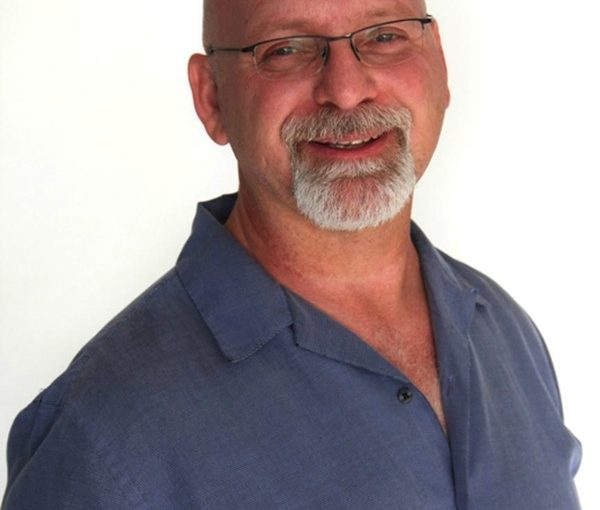
Jamie Kinaschuk helps caregivers in various ways. (photo from Jamie Kinaschuk)

“When somebody faces a situation of becoming a caregiver, they can embrace it and see it as a sense of purpose for the person they’re caring for, or they can resent having to do it,” Jamie Kinaschuk, a social worker with A & O (Age and Opportunity) Inc. in Winnipeg, told the Independent.

“When you embrace it, you can feel that the tables have turned – from the time my parents looked after me to, now, me looking after them – and you can see this as something you want to do, are proud to do. That makes it easier.

“On the other hand, you can have a child or a spouse who’s just not ready and doesn’t want that responsibility. They may have been designated by other family members.”

In some situations, said Kinaschuk, the ultimate caregiver is the closest in physical proximity to the family member needing care and, as such, other family members expect them to carry the load of caring, not taking into account that the caregiver has their own life, family, job and/or other commitments.

Being a caregiver takes a toll in many ways, including that their life has to be put on hold to a certain extent.

“Somebody might become a caregiver with some resentment … or, maybe, the relationship between the caregiver and the recipient hasn’t been the greatest and it just happens that they live together,” said Kinaschuk. Regardless of the circumstances, “there is an impact on you physically, mentally, emotionally and financially.”

The care given varies by recipient. For some people, minimal help is needed – things like cooking, house cleaning or doing laundry and shopping. For others, assistance could be needed in bathing or grooming, getting dressed or using the toilet. Often, needs change over time and a caregiver is left to find ways to fill the new requirements of the person for whom they are caring. As a caregiver, one must learn to adapt.

“Maybe they have to locate a different doctor for a different health issue that has arisen,” said Kinaschuk. “Maybe they have to apply for home care, to locate medical supplies or transportation. Maybe it’s come to a point where they can no longer transport them, so they need something like Handy Transit.

“Sometimes what adds to the difficulty of being a caregiver is, if you’re a male caregiver, having to do the personal care if you’re caring for your mom. That could be a struggle – dressing, bathing and toileting.”

Ideally, caregivers will have their own support system, people who can provide some relief. Staying healthy is the most important thing a caregiver can do, not just for themselves but also to not become a further burden on the family.

Kinaschuk, who started his career with Winnipeg’s Jewish Child and Family Service in 2000, runs a caregivers support group.

“In my group,” he said, “we see a lot of caregivers struggling to access resources or, because they don’t have any other supports, they’re really struggling with the situation. There are times where, I’ll give you an example, a caregiver is struggling because their sibling doesn’t understand what they’re going through; they don’t know how difficult it is. That other sibling may say, ‘You can deal with it’ and ‘That’s not a problem.’”

Kinaschuk recommends having a heart-to-heart conversation with the other siblings or relatives to inform them about what’s going on. If a conversation is not an option, a letter can work wonders in getting the message across. “This way, they can read it and hopefully not rip it up, and then read it again,” said Kinaschuk. “And maybe they’ll realize that, ‘Yeah, my brother or sister is going through a lot. I better start supporting them.’”

One of the concerns is that a caregiver may take their frustrations out on the care recipient. Good communication with other family members and their support diminishes this risk, as does attending a caregiver support group. When possible, a talk about boundaries could be beneficial for all involved.

“Both the caregiver and the recipient need to realize that there are boundaries,” said Kinaschuk. “They both have boundaries.” Caregivers, he said, have to be honest with themselves and the recipient – be up front about the fact that they can only do so much.

“The recipient needs to realize that the caregiver needs time. They can’t be demanding 24/7 care,” he said. “They have to be respectful, to respect each other. If the recipient is too over-demanding, it drains the caregiver.”

If all involved can embrace the situation and find the positives, such as having an increased sense of purpose, then, being a caregiver can be an uplifting, life-changing experience.

“From the support group perspective, it’s all about empowering,” said Kinaschuk. “When people attend the support group, first of all, that’s where you see that you’re not alone – you see that other people are experiencing similar emotional, physical and mental situations.”

In his sessions, Kinaschuk asks that people not give advice, but rather share their experiences, in the hope that others can take what information they need to find a solution that fits them. At some meetings, he invites professionals – from the regional health authority and groups specializing in Alzheimer’s and palliative care, among others – to teach the group about different aspects of providing care.

Rebeca Kuropatwa is a Winnipeg freelance writer.

Constructing age-tech maps

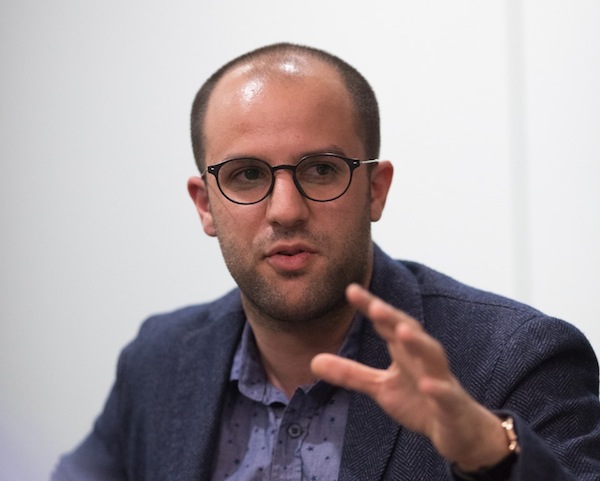
Keren Etkin (photo by Pazit Oz)

Keren Etkin, a 32-year-old Israeli master’s student, has been working on what she calls the Age Tech Market Map. This small but full link library is a place for older adults to find the latest news about technology.

“I am a gerontologist by training and tech enthusiast by nature,” said Etkin, who was born and raised in Israel and currently lives in Tel Aviv. “Gerontology is the study of various aspects of aging and gerontologists are either scientists researching the various aspects of aging or professionals working in the aging business.”

While working on her undergraduate degree in the sciences, Etkin began volunteering with Holocaust survivors, which she found a stark contrast to working in the lab. After graduating, she continued further along this path, finding work in the nonprofit sector. But she soon realized that, without a relevant degree, it would be challenging for her to advance her career, which is why she is currently studying for a master’s in gerontology.

“I work at the intersection of tech and aging, which is a very interesting place to be right now, professionally,” said Etkin. “I also run The Gerontechnologist [thegerontechnologist.com], which allows me to explore different aspects of the age-tech ecosystem and talk to many interesting people who do interesting and impactful work.”

Etkin’s first job in the industry was with Intuition Robotics, where she helped develop and build ElliQ, a friendly sidekick for older adults.

“ElliQ was the first big project I was involved with,” said Etkin. “I was recruited to Intuition Robotics in 2016 as the company’s first employee and only gerontologist. That was a very hands-on project that I feel fortunate to have had the opportunity to work on for several years.

“I know there are other gerontologists out there working in or with start-ups or investing in start-ups, and I think that’s a good thing – to have professionals from the aging industry come work inside the tech industry and help build tech solutions for the aging population.”

ElliQ makes it easier to connect to family, friends and the digital world, and helps users stay active and engaged. With it, people can read and respond to messages, share pictures, get reminders about medications, respond to questions and even receive surprise suggestions throughout the day.

“I think incorporating technology into any field of work is beneficial, specifically when it comes to the aging industry,” said Etkin. “There’s a lot to gain, since it’s very labour intensive. Some of the work currently being done by humans could be done by machines – like paperwork and some physical tasks – hence, freeing up humans to perform tasks that require uniquely human skills, such as empathy, critical thinking and creative problem-solving.”

The biggest hurdle Etkin sees in the industry is that most tech companies do not view older adults as potential users. In her opinion, they are missing out on a huge sector.

“Studies show that older adults are adopting technology more and more,” she said. “Internet use is rising steadily and many older adults own smartphones. From my experience, older adults are willing to use technology as long as they find that it’s useful and brings value to their lives.”

According to Etkin’s website, “The global spending power of people 60+ years old is expected to reach $20 trillion by 2020. Americans over 50 are expected to spend $84 billion annually on tech products by 2030.

“Contrary to common belief, most older adults hold a positive perception of technology. Many are eager to learn new tech skills as long as they find them useful. However, most of them admit they require some assistance in setting up and learning to use new devices.

“A report by the Pew Research Center found that 42% of older adults in the U.S. own smartphones and that 67% use the internet. Baby boomers spend an average of 27 hours a week online.”

Etkin began working on The Gerontechnologist in 2017. At the time, she was just looking for was a snapshot of the ecosystem and she was curious to learn what other people in the field were working on.

“After spending many, many hours doing online research, I came to the conclusion that there was no age-tech market map out there and so I decided to create it myself,” said Etkin. “After publishing it online, I got a lot of feedback and realized that other people were also interested in this. I also realized that I enjoyed creating content about age tech, and it sort of took off from there. The blog today serves anyone who’s interested in tech for older adults.”

This past summer, Etkin started posting podcasts and video series on thegerontechnologist.com, and she plans to keep working on projects that she is passionate about and that she thinks bring value to the world.

Etkin is working on the 2020 Age Tech Market Map. In the process, she will evaluate more than 2,000 service providers and choose the top 200 for the map.

“I would love to hear about Canadian start-ups developing tech for older adults,” said Etkin. “You can reach me through the contact page on my website or message me on LinkedIn and Twitter.”

Rebeca Kuropatwa is a Winnipeg freelance writer.

Choose to seek hope

Chanukah is about, among other things, sparking light amid the darkness. It is a message of hope that we should uplift all year round, not only in December. As discussed in this space last week, social media, and media generally, advances divisive and unsettling messages. So, while it takes perhaps more effort to light a candle than to curse the darkness, we should invest the little extra effort to find those stories that soothe our souls, calm our anxieties, and give us frameworks on which to build. Just as we have at our fingertips access to a million indignities and frustrations, so, too, can we choose to search for inspiring stories of kindness and coexistence.

As we share news in these pages throughout the year, we necessarily approach some unpleasant topics. But we also make a point to bring you uplifting news, including medical and other advances from Israel and our own community here in Canada. From Winnipeg, we recently reported on Operation Ezra, an ongoing program through which the Jewish community in that city assists newcomer Yazidis who are survivors of genocide, as well as the interfaith Meditation for Peace program at that city’s St. Boniface Cathedral. Closer to home, the Jewish and Muslim communities of Kelowna and area are celebrating their similarities with neighbourly get-togethers.

Just recently, community action led a Vancouver-area auction house to cancel the sale of Nazi paraphernalia. Taking a similar situation a step further, a Lebanese businessman, Abdallah Chatila, recently paid 50,000 euros for a hat owned by Hitler, and other Nazi memorabilia, in order to keep it out of the hands of neo-Nazis. He donated the items to Yad Vashem.

Israel’s President Reuven Rivlin met with Chatila and pinpointed the significance of the act. “What you did was seemingly so simple, but this act of grace shows the whole world how to fight the glorification of hatred and incitement against other people,” said Rivlin. “It was a truly human act. I know you have been thanked many times, but it was important for me to say it loud and clear here at the President’s Residence in Jerusalem – we appreciate it and thank you for it very much.”

About the same time, a group of civil society leaders and intellectuals from across the Arab world met in London for the inaugural meeting of what is being called the Arab Council for Regional Integration. These individuals, admittedly not-quite-mainstream in their respective bodies politic, reject the boycott and isolation of Israel, recognizing the harm it has caused to Palestinians and the greater Arab world to quarantine the most innovative economy in the region. This comes amid what appears to be a major reconfiguration of Middle East politics, which bodes well for Israel. The Gulf States are making overtures to Israel and other longtime belligerents are softening their tones. It is, of course, part of an internal Sunni-Shiite political struggle within the area, but that in no way takes away from the historic nature of the opening.

This year, we reported on the response to Tag Mechir (“price tag” attacks by radical West Bank settlers) with Tag Meir (“Light Tagging,” in which volunteers perform surprising acts of kindness across divides). We also ran a story on T’ruah: The Rabbinic Call for Human Rights, which works in Jewish social justice circles in Israel and North America. And we published an article on the efforts of the Jerusalem Foundation, a font of coexistence projects in the holy city, from Hebrew-Arabic bilingual education and colour-blind poverty alleviation efforts to a dance troupe for ultra-Orthodox women and kids music programs that transcend cultural differences.

Elsewhere in Israel, dance is the medium of another intercultural project, in a workshop created earlier this year called Steps from Sana’a to Hebron, in which Yemenite Jews pair their traditional dance with the Palestinian dabke danced by a group of Palestinians from outside Hebron.

Especially at this time of year, despite the inter- and intra-cultural divisions in Israel, there are countless small points of light. In Haifa, long considered a model of inter-religious coexistence, December is a time of celebrating Chanukah and Christmas in a diverse community including Muslims, Baha’is, Druze and others.

As simple as such small interactions might seem, they can have the most profound impact on participants. Once you begin searching for such stories, the results are bountiful.

Here in Canada, in Israel and around the world, similar stories of goodwill and overcoming differences abound. They are not likely to crawl across the bottom of your cable news screen. So, we must seek them out. We must.

An advocate for two states

Eli Kowaz is communications director at the Israel Policy Forum. (photo from Eli Kowaz)

This article is one in an occasional series about people with British Columbian roots having positive impacts in Israel and elsewhere.

For Vancouver-born Israeli Eli Kowaz, there is only one path to ensuring Israel remains both a Jewish state and a democracy: a two-state solution. The road to that ideal may be long and the slogging hard, but this is the core mandate of the Israel Policy Forum, where he serves as communications director.

Though focused on Israel and its situation, IPF’s mission is to “shape the discourse and mobilize support among American Jewish leaders and U.S. policymakers for the realization of a viable two-state solution.”

Israel currently has military control over the entire land from the Mediterranean Sea to the Jordan River but, to continue being a Jewish state as well as a democracy, Kowaz said, Israel faces a decision.

“It can decide to annex the West Bank, keep the entire land and, if it wants to be a Jewish state, it will have to give up on the democracy aspect because, if it was to grant all the citizens living between the Jordan and the Mediterranean equal rights, then already today, Jews would be about 50-50, a small majority,” he said.

The answer is not cut and dry, he acknowledged. The Jordan Valley is a vital Israeli security interest and, come what may, Israel is likely to maintain military control there for the foreseeable medium-term. But both Israeli Prime Minister Binyamin Netanyahu and U.S. President Donald Trump have recently obfuscated their countries’ erstwhile support for a two-state solution. In Netanyahu’s case, it’s at least partly political, said Kowaz.

“He is dependent on his right-wing coalition partners, he’s willing to say things and even do things to secure his position as prime minister, even though he’s already surpassed [David] Ben-Gurion as Israel’s longest-serving one,” Kowaz said. “A lot of it is right-wing pandering to those people. Another part of it is a genuine security concern. The research done by the top security experts in Israel and others show that there is a way to keep that area secure while advancing a gradual separation of Palestinians and an eventual two states. Obviously, it’s not something that’s happening tomorrow.”

Kowaz, now 29, grew up in Vancouver’s Oakridge neighbourhood with an Israeli father, Joseph Kowaz, who moved to Vancouver in his 20s, and a mother, Andrea (Rogow) Kowaz, who moved here from New York at a young age. His late maternal grandparents were community leaders and academics Dr. Sally and Dr. Robert Rogow.

He attended Vancouver Talmud Torah and Hebrew Academy for elementary school and Magee and King David high schools, “so I kind of got a taste of Orthodox Jewish education, more of a secular traditional and also public school, so it was nice to have,” he said.

Kowaz did a gap year in Israel after high school, studying at Hebrew University and Ben-Gurion University. Returning to Canada, he graduated from McGill University in Montreal and then completed a graduate degree in digital media at Ryerson University in Toronto. His final project for his degree addressed ways to remember and educate about the Holocaust in the 21st century.

“From the beginning, I wanted to do something that was Israel-related,” said Kowaz. “So, it was either move straight to Israel or look for something Israel-connected that was outside of Israel.” He moved to New York City and soon got work at IPF. He moved to Tel Aviv last year and, in July 2018, married Tal Dor, a former graphic designer for the Israel Defence Forces newspaper BaMahane. She occasionally gives Kowaz advice and support from her experience.

Part of a generation that gained political awareness during the Second Intifada, Kowaz said he has been affected by the violent imagery of those days.

“I obviously want the best for everyone, but Israel is most important to me and I want Israel to be a Jewish state,” he said. “I want Israel to be a state that’s also accepted in the world to the best that it can be. Obviously, there will still be people that hate us but I don’t want Israel’s best allies to be Hungary, Poland, these right-wing [governments] with elements of fascism. We don’t want those to be our best friends, so, at the end of the day, I don’t think we have a perfect partner and the Palestinians, they’re never going to be a perfect partner, but we should do what’s best for Israel, which is at least preserve conditions for a two-state solution, a form of separation to secure Israel as a Jewish and democratic state as a goal for the next five, 10, 15 years. Keep that a possibility. And, right now … I think it’s definitely still an option. It’s still on the table. We haven’t killed it. But it’s treading in the wrong direction.”

The Israel Policy Forum began in 1993, said Kowaz, on the very day the day of the famous handshake on the White House lawn with Yitzhak Rabin, Bill Clinton and Yasser Arafat.

“At that time, Yitzhak Rabin was looking for American Jewish support for his vision of peace,” he said. “Even back then, AIPAC were already becoming close with Binyamin Netanyahu, who [had been] Israel’s ambassador to the UN and, at that time, he was already opposition leader.”

IPF does a lot of work in Washington, D.C., with policymakers, convening roundtable discussions and panels with congresspeople, congressional staffers and opinion leaders, as well as organizing events in synagogues around the United States, all focused on preserving conditions for two states.

Their positions are credibly backed up, said Kowaz, by security experts in Israel, called Commanders for Israel’s Security, which was begun by former major-general Amnon Reshef, a hero of the Yom Kippur War, and includes a cadre of 290 former IDF generals, Mossad and Shin Bet division heads and others.

“They work in Israel, so we work closely with them to relay their policy proposals and their messaging to an American audience,” he said. “It represents about 80% of the retired security establishment. It doesn’t get more legitimate than that. These are people that, I think, between all of them have 6,000 years of experience at the highest positions, making decisions constantly with people’s lives.”

While AIPAC has an upstart challenger on the left, J Street, Kowaz sees IPF as a more fact-based alternative to the politically oriented advocacy groups.

“People are looking for a voice that is different, that’s more policy-based, less trying to rally the troops and more looking at the facts,” he said. “I think we provide that kind of home and, in a way, everything’s very fact-based.”

Kowaz looks forward to continuing to work toward the perpetuation of Israel as a Jewish democratic state.

“It really doesn’t matter to me what the role is, I think that’s where I’d like to see myself,” he said, adding: “I’ve given up on the professional soccer career.”

Young learners, big mission

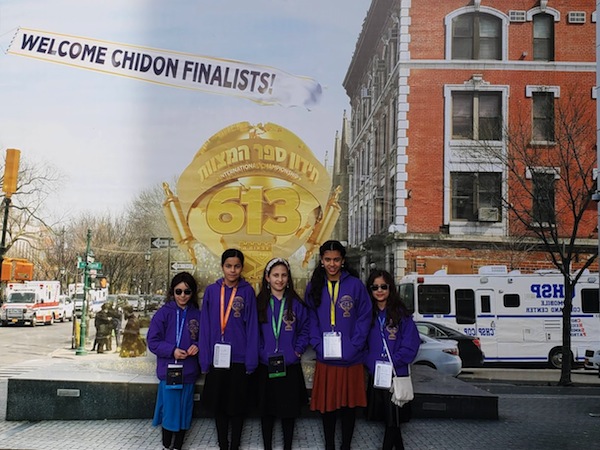
Left to right: Chana Rivka Bitton, Miriam Feigelstock, Baila Shapiro, Shira Oirechman and Ora Yeshayahu. The biggest event of the Tzivos Hashem year is a Shabbaton in New York, the highlight of which is an international competition called Chidon Sefer Hamitzvos, where kids from around the world compete in their knowledge and understanding of the 613 mitzvot of the Torah, as codified by Maimonides. (photo from Tzivos Hashem)

Walking into the Lubavitch Centre at 41st and Oak Street a couple of months ago, I witnessed a hub of activity so vibrant with excitement it was practically humming. Every available space was brimming with excited children, from little ones to newly minted teenagers. Engaged in drawing, listening intently, and engrossed in a whole variety of activities, I knew these kids had to be connected to Chayolei Tzivos Hashem.

Make no mistake – Chayolei Tzivos Hashem (CTH or Tzivos Hashem, for short) is serious business. According to Tzivos Hashem Vancouver coordinator Riki Oirechman, it’s an educational program for Jewish children ages 3-13, founded in 1980 in New York by the Lubavitcher Rebbe, Menachem Mendel Schneerson. Tzivos Hashem focuses on teaching about kindness, good deeds and refining our character to become better people and more effective influencers in our community. The program aims to increase Jewish identity and provide children with Chassidic Jewish learning through informal activities and songs.

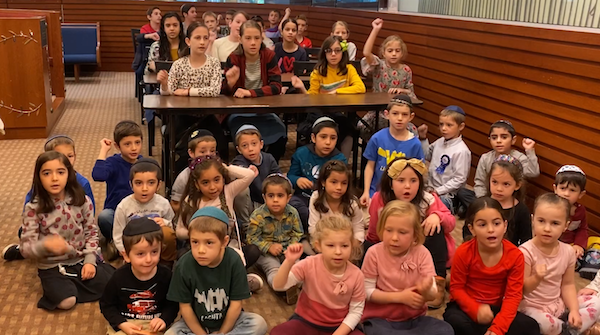
Tzivos Hashem Vancouver was established several years ago by Rabbi Shmulik Yeshayahu, Rabbi Dovid Rosenfeld and Rabbi Schneur Wineberg and, since then, it has grown in size. Today, they count 50 children registered in the local program, and have plans to expand its hours. Currently, it is being held every Sunday at the Lubavitch Centre, from 10:30 a.m. to noon, in groups divided by age.

“It’s incredible to see how much the kids learn every week, and how much they enjoy coming,” said Oirechman. Parents even relate that their kids consider it the “highlight of their week.”

The Vancouver chapter of Tzivos Hashem was able to run the first two years thanks to a grant from the Phyliss and Irving Snider Foundation. This helped lay the foundation for the program. Since then, it is partially self-funded and relies on tuition fees for each student.

“The program is designed to give young children a sense of pride and belonging, a feeling of connectedness to other Jews,” said the Lubavitch Centre’s Rosenfeld. “It’s meant to instil in them an appreciation for what they do and inspire them to do even more.”

When asked what they learn, Rosenfeld said the curriculum includes things like a deeper insight into the Jewish holidays and following examples of role models from our ancient and recent history. The older kids learn Mishnah and Talmud. All of the learning is illustrated according to Chassidic theory, as taught by the Lubavitcher Rebbe.

“We encourage the children to advance their knowledge, not just maintain it,” said Rosenfeld. “Constant review and reinforcement of the different concepts allows the kids to build on the knowledge they gain each week. Moreover, we try to channel the kids’ studies into the practical realm, having them translate their knowledge into action. Whether through class activities, such as visiting the Louis Brier Home with cards and hamantashen before Purim, or with doughnuts before Chanukah, the kids can keep track of their mitzvot (good deeds) through an online logging system.”

“The Sunday program,” added Oirechman, “teaches kids in a fun, highly interactive and hands-on way. Our lessons incorporate creative team challenges, unique arts and crafts, educational games, Tanya (the foundational work of the Chabad movement) and mishnayot (the oldest authoritative post-biblical collection and codification of Jewish oral laws), memorization, weekly missions, songs and much more. In the short time we have each Sunday, we instil and teach the kids important values.”

photo - A group of Tzivos Hashem learners
A group of Tzivos Hashem learners. (photo from Tzivos Hashem)

Tzivos Hashem is based on the Rebbe’s style of teaching, and offers children badges for missions based on things they accomplish in their daily Jewish lives – for instance, saying Modei Ani every morning, washing their hands before meals, giving tzedakah, saying Tehillim (Psalms), etc. Using the army and its ranks as a metaphor for how Tzivos Hashem is structured, the program enables children to learn at their own pace and get rewarded for it. Each student starts out as a private, but, as they do more good deeds and complete missions, they earn mitzvah badges. After collecting enough badges, they are awarded medals. When they get enough medals, they are promoted in rank. Think of it like a Chassidic Airmiles loyalty program; when the children complete missions every week and behave during the Sunday programs, they’re rewarded with mileage points.

A few times throughout the year, there is a prize store, where the students can use the points they earned to buy prizes online. The global headquarters of Chayolei Tzivos Hashem hosts monthly raffles, where children who have completed missions can have a chance to earn more prizes. There are monthly international webcast rallies, where recognition and honour are given to students who have gone up in rank. The physical prizes act as incentives to learn and do more but, in reality, the incentives are inherent, or self-generated: love of Hashem and commitment to Torah values and Yiddishkeit.

The biggest event of the year is a Shabbaton in New York, the highlight of which is an international competition called Chidon Sefer Hamitzvos, where kids from around the world compete, on stage, in their knowledge and understanding of the 613 mitzvot of the Torah, as codified by Maimonides. The competition motivates the children to review the mitzvot and commit them to memory.

Oirechman said the Tzivos Hashem program is adding to both to the quality and quantity of learning opportunities and resources available in Vancouver for Jewish children. For more information about the Vancouver Tzivos Hashem program, email tzivoshashemvancouver@gmail.com or visit their website, thvancouver.ca.

With the goal of living Torah-observant lives, kids in the program are steered to become “lamplighters” – igniting and spreading light wherever they go, through good deeds, acts of kindness and Torah study. Light is something that can be shared infinitely and it only takes a bit of light to extinguish darkness. And while, from my outsider’s point of view, the army metaphor sounds rather harsh, it actually reflects a message that couldn’t be gentler and more caring: to love and help your fellow Jew.

Shelley Civkin is a happily retired librarian and communications officer. For 17 years, she wrote a weekly book review column for the Richmond Review. She’s currently a freelance writer and volunteer, including with Chabad Richmond.

Teaching in new ways

Prof. Ira Robinson of Concordia University’s Institute for Canadian Jewish Studies teaches a wide range of students about the Holocaust and antisemitism. (photo from Ira Robinson)

Ira Robinson is the director of Concordia University’s Institute for Canadian Jewish Studies and a professor of Judaic studies in the department of religions and cultures. A strong believer that an educator shouldn’t teach the same course in the same way year after year, he is always looking for new ways to reach students of all ages.

Born in Boston, Mass., Robinson moved to Montreal with his wife, Sandra, 40 years ago.

“I came to Canada because Concordia offered me a job, and I landed in the right place at the right time,” he told the Independent. “Academics don’t always have a complete choice of where they are going to settle. I came to Montreal and Montreal has a large and interesting Jewish community and a tremendously interesting bilingual culture.”

Though Robinson had never envisioned writing a book about antisemitism or the Holocaust, he did so, publishing A History of Antisemitism in Canada in 2015.

Robinson was trained by students of the late Salo Baron, a Polish-American historian, who once said, “If you want to understand the totality of Jewish history, you have to take into consideration that the pogroms and the massacres take only an infinitesimal amount of time, even though they wreak great havoc.”

According to Robinson, “Ninety-nine percent of the time, we’re dealing with normal life…. Baron and his students decided to look at the Jews as they had lived and not as they had died. That was the lesson that I took.”

For Robinson, this meant he would have to determine his own take on the history of antisemitism in Canada and, hence, “I came out with the book.”

Robinson starts many of his courses by telling students that there is nothing he is going to teach them that is not completely denied by somebody, somewhere. With this message, he is stressing that what he is about to teach is his perspective on what took place.

In looking at the history of antisemitism in Canada, for example, Robinson tried to contextualize the reasons Jews were looked at as guests in the 1920 and 1930s in Canada.

“What I did in this book is create a continuous narrative on antisemitism in Canada from the 18th century through to the present,” he explained. “There have been many very good studies on various aspects of antisemitism in Canada, the most famous of which is [Irving] Abella’s and [Harold] Troper’s None is Too Many. This academic book uniquely made a difference in the political discourse of Canada. Now, whenever anyone debates a refugee issue in Canada, the phrase, ‘None is too many,’ is sure to come into the discourse or debate at some point. That was a great success, but the book only concentrates on the 1920s to the 1940s, and mainly focuses on the Canadian federal government.”

Since the research for Robinson’s book was completed in 2014, antisemitism has increased, he said. For that reason, he decided to find ways to teach about the problem to younger children, kids in grades 4 to 6.

“It presents a challenge, because I have to begin with who they [antisemites] are and where they are,” said Robinson. “And so, I started by talking with them [the kids] about bullying, because bullying, as you understand, is something that kids know about and people talk to them about it.

“If you see somebody bullying somebody else, what are you supposed to do? If you can intervene, you should intervene. If you need to call somebody in a position of authority, you call somebody…. So, I said, ‘imagine that there are kids and you can bully them and nobody is going to stop you. And imagine that, if somebody goes to a person of authority, they will just say, ‘Good for you!’”

Robinson took it a step further, creating a PowerPoint presentation focusing on the wearing of the yellow Jewish star that was imposed upon Jews.

“I showed first a picture of a girl’s dress with the yellow star shown on it – just the dress, nobody in it,” he said. “Then, the next thing I showed was a little girl in a dress with the yellow star. When I changed the slide from just the girl’s dress with the yellow star to the little girl in the dress with a yellow star, I could hear a slight gasp among the students. So, there are ways – you have to talk to the people you have in front of you.”

Robinson gave this presentation in a public school and, as far he knows, there were no Jewish students in the classroom. “I am used to talking to a wide range of people,” he said. “And, in my university classes, for instance, I do expect Jews to enrol, and they do. But, I also expect Muslims and Christians to enrol, and they do, and everybody else, too.”

In Robinson’s view, the challenge of finding ways to disseminate the information effectively is always a worthwhile exercise.

“There are lots of people involved in Holocaust education and I think a lot of them are spending a lot of effort introducing and assisting in educating about the Holocaust in public school systems. The problem, as always, is not lack of good will,” he said, “but that the schools are under great pressure from a whole bunch of different directions. What should our children study? And the mega trend, not merely in public schools, but also in universities, is moving away from the social sciences and humanities, and focusing on other subjects.”

As far as teaching methods regarding the Holocaust and antisemitism, Robinson said, “I think I am able to speak with more depth, because you can’t teach the same course in the same way for decades. You have to develop a scholarly understanding as the field develops and, so, my teaching is informed by my reading and my reading continues to inform me.

“And my power is that I am able to direct students to certain books, certain articles and certain films that I think will help them develop their sense of things. But, before I can even do that, before I can guide anybody, I have to find the things myself, first and foremost.”

Rebeca Kuropatwa is a Winnipeg freelance writer.