Get ready to rock at TUTS

School ofRock cast members, left to right: Crosby Mark, Casey Trotter, Colin Sheen, Mya Forrest, Fumi Okochi and Thailey Roberge. Matthew Rossoff is choreographer of the production. (photo by Emily Cooper)

Matthew Rossoff has returned to Theatre Under the Stars – to choreograph his first production for TUTS, School of Rock. The musical, which alternates with Cats at the Malkin Bowl in Stanley Park, previews July 7-8 and opens July 11.

“Over a year ago, I responded to a posting seeking new creative team members to join the upcoming season and thought it would be a great way to reconnect with the TUTS community,” said Rossoff, who grew up in Richmond and performed in TUTS shows in his younger days. “I was actually on my honeymoon when I received the initial call and am thrilled it all worked out!”

Rossoff, who is a member of the Jewish community, has performed in two TUTS productions: South Pacific in 2000 and Joseph and the Amazing Technicolour Dreamcoat in 2002.

“For several reasons, both of these productions and experiences were huge influences in my career as an emerging artist,” Rossoff told the Independent. “After a long performing hiatus, South Pacific was my first musical after I graduated high school and it was a dream to perform at the Malkin Bowl. Joseph was directed and choreographed by my childhood idol, Jeff Hyslop, and this production catapulted me into my professional career as a dancer and actor, making my CAEA [Canadian Actors’ Equity Association] debut in Fiddler on the Roof at the Vancouver Playhouse later that fall.”

While earning his bachelor of arts at the University of British Columbia, majoring in theatre and minoring in English literature, Rossoff was also doing work in film and traveling across Canada performing in theatrical productions. In 2006, he followed through on his dream to move to New York. There, he performed in several shows, and made his Stratford Shakespeare Festival debut in Camelot and Jesus Christ Superstar.

Jesus Christ Superstar gained critical acclaim and, eventually, the entire Canadian cast transferred to Broadway in March 2012,” Rossoff said. “I was fortunate to make my Broadway debut, as the dance captain and swing. Our production became a Tony Award nominee for best revival, which offered me a once-in-a-lifetime opportunity to perform on the Tony Awards!”

And to think, Rossoff’s career began in elementary school, when he saw one of his sister’s dance classes. “I was amazed,” he said, knowing it “was something I needed to do. Very much in line with the character Mike from A Chorus Line, I told my parents, ‘I can do that!’

“Tap dancing evoked a passion and spark in my soul so bright that I continued on with it all throughout elementary school,” Rossoff said. “During high school, I decided to put up my dancing shoes for a bit and tried other sports and school activities, but it was after my first show at TUTS, South Pacific in 2000, when I bought a new pair of shoes and reignited my passion for tap dancing. Luckily I did because my career took off and I’ve been so fulfilled and blessed with such amazing dance and performance opportunities.”

He got his first theatre work about the time he started tap dancing, in Grade 3. He played an orphan and one of Fagin’s boys, Mouse, in Oliver!

“My sister was in the production with me and I remember getting bit by the theatre bug,” said Rossoff. “There was a sense of community being created with the cast that I loved being a part of and, of course, the excitement of performing and dancing under the lights.”

photo - Matthew Rossoff choreographs his first production for TUTS this summer – School of Rock
Matthew Rossoff choreographs his first production for TUTS this summer – School of Rock. (photo from Matthew Rossoff)

After 10 years living and working in New York City, Rossoff decided to follow another impulse – “to go back to school and deepen my training as a performer, artist and educator.”

He moved to Toronto to attend York University, earning a master’s of fine arts in the school’s performance (acting) program, with a specialization in teaching.

“Those two years changed me at the core of my artistry and revealed a new sense of how I wanted to move forward in my artistic journey,” he told the Independent. “Along with my long-time dance background, my focus became voice, speech and mindfulness work. I quickly became a faculty member at several post-secondary schools and universities in Toronto – teaching voice, speech and movement at York University, Randolph College, Sheridan College, Brock University and, most recently, Toronto Metropolitan University.

“Knowing that choreography and dance were at the base of my creative foundation, I stepped onto the creative team side of the table and began my director/choreographer journey. Shortly after my time at TUTS this summer, I will be returning to Toronto and stepping into the world of Disney as a resident creative team/dance supervisor for Disney Cruise Lines.”

Rossoff’s body presence, mindfulness and yoga work are at the core of his artistic practice and choreography. 

“This work stemmed from my training and perhaps lack of intersection between dance and how to connect to the breath and emotional journey as an actor and storyteller,” he said. “Dance is an extraordinary universal language of embodiment, but in musical theatre you also have to put the text onto your full voice and hold space in the body to support and reveal the emotional, physical, intellectual and imaginative journey the character moves through.

“I’m always curious how can an actor lead from the internal impulses and connections to what’s happening in the scene and put it fully into their body through external gesture and movement. To play a truthful human experience, an actor must use the breath to spark the imagination, the senses and full range of expression with their whole sense of self.”

While Rossoff puts his whole self into his work, collaboration is the cornerstone of his creative process.

“Working alongside the director and honouring their vision and design of the show, a movement esthetic and point of view is cultivated,” he explained.

“In my own pre-production work, I start with the words off the page from the playwrights, composers and lyricists: the storytelling. I’m curious, What’s the primary narrative being told and how can movement from the actors elevate and further the storytelling in a compelling and exciting way?”

For productions such as School of Rock, Rossoff said, “I listen to the music over and over again and I daydream and imagine ways to bring this … story to life. Once the show is cast and we’re in the rehearsal hall, I come prepared with an overall structure of how the choreography will unfold or, if the story seeks personalized gestures or movement, bring in exercises to draw out embodied movement from the actors. For example, School of Rock has 13 incredible young performers and their energy brings out creative ideas, movements and impulses [and] I try to hold space for them to join in on the collaborative journey. They certainly inform and bring a unique point of view through their personalized storytelling.

“Choreographing a musical is not all about big production dance numbers,” he added, “but also about sorting out the transitions and the moments in between, as they become key to the flow and momentum of the story. As the show gets closer to opening night, it becomes about the details of precision, economy and relaxation in the movement so that each actor feels at ease and ready to perform with unconscious competence and joy!”

For tickets to School of Rock and Cats, which previews July 5-6 and opens July 10, visit tuts.ca. Cats runs to Aug. 21 and School of Rock to Aug. 22. For tickets, visit tuts.ca.

Chutzpah! needs your help

Chutzpah! Festival acting managing director Jessica Gutteridge. (photo by Tallulah Photography)

After nearly 25 years at the forefront of Jewish arts and culture in Western Canada, Vancouver’s international performing arts festival, Chutzpah!, faces an urgent financial crisis. And it needs your help to keep the stage lights on.

Shifting priorities in government arts funding, as well as the impacts of Oct. 7 and the war in Gaza, have created a perfect storm resulting in a dramatic drop in revenue.

How did this happen?

Chutzpah! depends significantly on government grants. Presently, the stagnant pool of arts funding, alongside a growing number of applications, means fierce competition for fewer dollars. In addition, Jewish arts programming officially falls outside of funders’ “designated priority groups.” Funders have told the festival that, this year, only 15-20% of proposals will be approved, and Chutzpah! has already been declined for several grants that it has received historically.

“The arts community, generally, is facing difficulties with sustainable government arts funding, as the funding pool has returned to pre-pandemic levels with more applicants seeking funding,” explained artistic managing director Jessica Gutteridge. “But there are compounded challenges that Jewish performing arts and artists are facing, especially as tensions escalate locally in response to the war in Israel. Jewish organizations and events require additional security and access to funding is hampered by the fact that Jewish artists are excluded from funding priority categories, due to a misunderstanding that Jews are a marginalized ethnocultural group, and not solely a religious group.”

Adding to the financial challenges, Chutzpah! opened last year within weeks of the Hamas attacks and war in Gaza, within an atmosphere of rising anti-Jewish hate that has been felt both globally and locally. Despite the festival’s efforts to ensure the safety of performers, audience and staff, ticket sales suffered dramatically. With Jewish arts organizations and events in Vancouver, across Canada and elsewhere targeted with petitions and protests, the erasure of Jewish language, art and culture is, once again, a real threat. As a community, we cannot allow this to happen.

This is why Chutzpah! urgently needs support. The challenges the festival faces are serious, but not insurmountable, and organizers are taking several steps to try and secure its future.

Chutzpah! is speaking with new philanthropic foundations, exploring capacity-building needs in the short- and long-term. Increasing its capacity would give the organization more resources to diversify and grow revenue through grants, audience development plans, sponsorships, private donations, and more.

As well, the festival has established a circle of advisors – a few community members who are passionate about the arts, the Jewish community and Chutzpah! With their help, the festival hopes to strengthen its base of individual donors and identify prospective program sponsors and partners.

Chutzpah! is also reaching out directly to its community of patrons and supporters to share the challenges it is facing and ask for support.

“We’ve been so heartened by the response to our campaign to date. We’ve nearly reached 50% of our goal,” said Gutteridge.

The goal is to raise $60,000 by May 31. There are five ways people can help:

1. Contribute to the campaign. You can donate online directly and securely through CanadaHelps (or by cheque to Vancouver West Side Theatre Society). 

2. Help Chutzpah! grow its network of support by sharing information about the situation with like-minded friends/colleagues. Add a brief note explaining why you support the festival and ask them if they might consider doing the same.

3. If you or your contacts donate before May 31, campaign co-chair Emet Davis will match all gifts, up to a maximum of $10,000.

4. Increase your own impact by offering a formal or informal matching gift challenge within your personal or professional networks. Simply direct friends and colleagues to the festival’s donations page, confirm gifts, then issue your matching gift. Let the festival know if you do this.

5. Be a sponsor. Sponsorships subsidize production and associated costs for festival performances. There is a range of giving levels, recognition and other benefits. 

“With rising costs for artists, staff and production expenses, all needed to bring the high-quality work that Chutzpah! audiences are accustomed to, we are looking to gather a small but mighty group of philanthropists and arts lovers to support us – producer-level supporters,” said Gutteridge. “This group will help offset the challenges we’re facing with limited government arts funding and rising costs, by financing specific content for the festival and joining us to share those programs with their networks. We can match their artistic interests to our programming – for example, help produce a series of Israeli artists, or step up to support an evening of klezmer music.”

“Until several years ago, I only attended Chutzpah! occasionally,” said Davis. “To be honest, I think I took for granted that it was a permanent fixture in our community. But, when I made a decision a few years ago to engage more meaningfully in Jewish community, the festival became part of my journey – it has deepened my knowledge and my sense of pride in my identity. Chutzpah! is about something much more than entertainment – it’s about the preservation and celebration of our language, art and culture. Now more than ever, I’m reminded we can’t take that for granted.”

Donate via chutzpahfestival.com or save Chutzpah! the processing fees and give by cheque to Vancouver West Side Theatre Society, mailed to 950 West 41st Ave., Vancouver, BC, V5Z 2N7. 

– Courtesy Chutzpah! Festival

DOTE happens in June

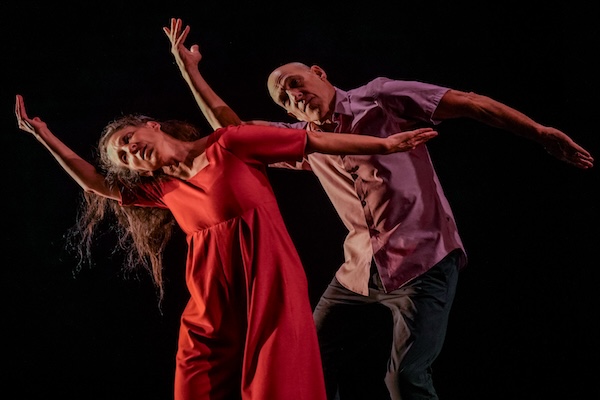
Karen Kaeja and Allen Kaeja in Lasterday. (photo by Kendra Epik)

Featuring more than 30 performances June 13-22, Dancing on the Edge audiences will see world premières, Western Canadian debuts and works-in-progress. This year’s lineup includes the Vancouver première of Lasterday, with choreography by Hanna Kiel, music by Adam Campbell, lighting by Gavin McDonald and performances by Kaeja d’Dance, Toronto Jewish community members Karen and Allen Kaeja.

Lasterday is part of EDGE 1, which also features Tiger Princess Dance Projects and Calder White. Performances are June 16 and 17, 7 p.m., at the Firehall Arts Centre.

Lasterday delves into the relationship of two individuals who carry different memories and perceptions of the same events from their past – sense of timeline, emotional impacts and interactions – revealing how they remember and interpret their shared history. Lasterday is part of the Kaeja d’Dance’s lifeDUET commissioning series. The works explore the Kaejas’ creative and personal partnership. Many duets have toured across the world through Canada and to Spain, India, England, Japan, Mexico, Venezuela and Israel. (For more, see jewishindependent.ca/life-stories-told-in-dance.)

Kiel is a Dora Award-winning artist hailing from Seoul, South Korea, who made Vancouver her home in 1996. Founder and artistic director of Human Body Expression, Kiel is also a resident choreographer at Canada’s JörgenDance.

Campbell is a sound designer, composer, percussionist and singer-songwriter. Originally from Summerside, PEI, and currently living in Stratford, Ont., he has worked as sound designer/composer with many festivals.

McDonald has designed lighting for more than 25 years, across North America and the United Kingdom, and teaches lighting and media design at York University.

Karen Kaeja is an award-winning choreographer, performer and educator. The heart of her research, creation and writing concentrates on the agency of touch. She develops platforms for collaborative relationships between dancers and everyday people, highlighted in her Porch View Dances festival and concept. She is currently co-choreographing with Roshanak Jaberi for Jaberi Dance Theatre’s international collaboration with Sweden – Architecture of Violence.

Allen Kaeja is an award-winning choreographer and dance film director. The child of a refugee and Holocaust survivor, he has created 30 years of Holocaust-inspired stage and film works. He has created more than 210 stage works and choreographed/directed 35 films. His works have been featured in commercials, films and festivals around the world. He teaches Kaeja Elevations and Dance Film master classes worldwide. 

About the overall DOTE program this year, the festival’s artistic producer, Donna Spencer, said, “This year, we are pleased to honour one of Canada’s great dance and contact improvisation creators, Peter Bingham, and share his work with the presentation of EDAM’s Dead Weighting. Peter’s body of work has had such an impactful ripple on many of the artists participating in this year’s festival. We are also excited to offer what was a work-in-progress at last year’s festival as a world première this year with Company 605’s lossy; and to bring new choreographic voices such as Anya Saugstad, Clala Dance Project and Simran Sachar to the festival. Stirring things up is in DOTE’s DNA, and we can’t wait for audiences to experience this year’s lineup.” 

The complete festival schedule is available at dancingontheedge.org. Tickets can be purchased online via the website or by phone at 604-689-0926. 

– Courtesy Dancing on the Edge

Stand Up celebrates 20th

Stand Up for Mental Health founder David Granirer. (photo from smhcomedysociety.org)

Stand Up for Mental Health (SMH), a program started in Vancouver that teaches stand-up comedy to people with mental health issues as a form of therapy and to destigmatize mental illness, celebrated its 20th anniversary this spring. 

“It feels like such an accomplishment. Helping so many people has been the highlight of my life,” said David Granirer, the founder of SMH. “One thing I am really good at is making other people into stars, and I feel like I have done that a lot. Over the past 20 years, I have trained about 700 comics. So, that’s a lot of stars.

“I had no idea what I was doing when I started out, so I had no expectations about the program being successful or not. I could never have imagined this,” he said.

Granirer, a counselor by profession, as well as a stand-up comic, told the Independent that the two-decade journey has been unforgettable. “Everything stands out,” he said. “Every show, every comic I have ever trained, every laugh we have gotten.”

When considering some of the more memorable bits over the years, he recalled writing a mental health version of the Beatles song “While My Guitar Gently Weeps.” In Granirer’s rendition, the guitar has dizziness, dry mouth and is too depressed to get out of bed.

Granirer, who is open about his own struggles with mental illness, has trained groups in more than 50 cities, in Canada, the United States and Australia, in partnership with various mental health organizations. He plans to continue the program and run it in more cities in the coming years.

The idea for SMH originated from a course Granirer has been teaching at Langara College since 1998 called Stand-Up Comedy Clinic. Occasionally, he would see people have life-changing experiences by getting on stage and using comedy to tell a club full of people who they were.

“One woman had a fear of flying and told me that the day after our event she had to get on a plane and she said, ‘My fear was gone. I felt like once I’d done stand-up I could do anything,’” Granirer said. “And I thought, wouldn’t it be amazing to be able to give this experience to people who wanted to do comedy but who also wanted to change their lives? And since I work in mental health and I also have a mental illness, I thought that would be the perfect place to start.”

For Filomena Black, a graduate of the course, SMH has been a lifeline. An introvert by nature, she said she has been able to be more comfortable around people.

“I’ve lost my self-conscious focus and become more engaged in enjoying other people’s company. I’m now looking forward to successfully meeting challenges in all aspects of my life rather than avoiding them,” Black said.

Asked to tell one of the jokes in her repertoire, Black responded, “I used to run away from home a lot, but my kids always found me.”

Another SMH graduate, April Soon, also speaks highly of the program, lauding Granirer for shining a light on what people with mental health issues can do and not letting finances be a barrier to participation.

Soon, a veteran of public speaking through Toastmasters, did not find standing up before a crowd as intimidating as others might have and, these days, she not only performs at SMH gigs but at other venues around Vancouver.

“When bad things happen to me now, I wonder how I can use it as material,” said Soon. “SMH has helped reframe my thinking and provided good resilience training.”

On a lighter note, she added, “Being involved with SMH has exposed me to many other mental illnesses I want to try out.”

Kevin Scow similarly expresses his gratitude, saying the program has given him his voice and was vital to his recovery.

“This came to me at exactly the right time,” he said. “Instead of seeming strange … now they know I am strange … and they love me all the more for it. Thanks to David and my fellow alumni for nurturing my voice and helping with making it funny. My First Nations side says thanks.”

image - SMH’s 20th anniversary was recognized last month with a proclamation from the Province of British Columbia declaring April 13 as Stand-Up for Mental Health Day
SMH’s 20th anniversary was recognized last month with a proclamation from the Province of British Columbia declaring April 13 as Stand-Up for Mental Health Day.

SMH’s 20th anniversary was recognized last month with a proclamation from the Province of British Columbia declaring April 13 as Stand-Up for Mental Health Day. The proclamation reads, in part, that SMH provides a program for thousands of people “to improve their lives and combat the stigma surrounding mental health and … is an opportunity to raise awareness of and show support for people managing mental health issues or illnesses.”

Since 2004, Granirer and his comics have performed more than 500 shows for mental health organizations, government departments, corporations, universities, correctional facilities and the military. Granirer also gives “laughter in the workplace presentations” to organizations across North America, helping them use humour to lower stress, improve wellness and cope with change. Granirer, too, is the author of The Happy Neurotic: How Fear and Angst Can Lead to Happiness and Success.

SMH’s classes in Vancouver last for six months and students step on stage for two shows, a debut and a graduating performance. As Granirer says, “The comics go from knowing nothing about stand-up to killing it.”

Stand Up for Mental Health is currently recruiting for its next class, which starts July 30. For more information, visit smhcomedysociety.org. 

Sam Margolis has written for the Globe and Mail, the National Post, UPI and MSNBC.

Highlighting seniors’ issues

Berlin’s Nana Schewitz brings her show Florida! Ya Kill Me! to Vancouver May 31-June 2. (photo from Nana Schewitz)

Florida! Ya Kill Me! is a “love letter to aging,” says Berlin-based drag artist Nana Schewitz, who created the show with Josh Walker. But it’s also a “wakeup call,” she warned, about the systems we have in place for aging.

Florida! Ya Kill Me! comes to Vancouver for three nights, opening May 31 at the Dusty Flowerpot Cabaret.

“JQT is so excited to bring Nana Schewitz to both Toronto and Vancouver, as part of our JQT [Jewish Queer Trans] Mental Health Support Series in partnership with JFS Vancouver, a series supported by the 

Jewish Community Foundation of Greater Vancouver,” said Carmel Tanaka, executive director of JQT Vancouver, noting that the shows are being sponsored in both cities by Goethe-Institut Toronto, which is part of a global network that works to foster understanding of Germany’s cultural diversity.

“The content of her show addresses the challenges of Jewish queer trans seniors, which is a very near and dear topic to JQT,” Tanaka said of Nana’s Florida! Ya Kill Me! “We hope that, through drag and comedy, we will be able to raise awareness of the work our JQT Seniors Initiative is doing to create safer long-term care homes and spaces, so our aging JQT community members can proudly celebrate all their identities into their twilight years.”

Florida! Ya Kill Me! is a theatrical retelling of Nana’s 2021 trip to Florida in search of a final resting place, Nana told the Independent. The character is a feisty 96 years old.

“Josh and I traveled up and down the state in search of retirement paradise, visiting every bingo hall, craft fair and 55-and-up pool we could find along the way,” she explained. “We met some incredible seniors who really opened up to me about their experiences with aging, finding love, losing love, accepting change and finding joy. I have the privilege to share these words through both my own retelling, and some filmed interviews we took. You’ll meet Josie, the 109-year-old bingo master. You’ll meet Doris, born and raised in Berlin (my current home) who lives in Florida’s largest retirement city (with over 100,000 residents). You’ll even meet my dead Cuban grandmother!

“The ability to tell these often-overlooked stories and cement the legacies of some of my favourite friends is my favourite thing about what this show is,” said Nana. “It’s a love letter to aging, but also a wakeup call to its effects. The systems in place around aging are crumbling quickly while our average life expectancy is getting higher and higher. I don’t want us to have to sacrifice our quality of life as we age, and this show is a call to action to make that happen!”

The name Nana Schewitz was inspired by Manischewitz, perhaps after a few glasses of its sweet kosher wine. The 96-year-old – who doesn’t “look a day over 69” – was brought to life by almost-30-something Bryan Schall, who studied at Philadelphia University of the Arts and graduated in performance design and production.

She emerged as an entity “out of a little hole-in-the-wall disco in Philadelphia. She stayed dormant for awhile, as her ‘style’ didn’t really fit in my idea of what drag in the US was. When I got to Berlin, however, I said, ‘Ooooohhh!!! Nana totally could work here!’

“The drag scene of Berlin was very different,” explained Nana. “It was quirky, brash, silly – all the things I wanted out of a drag performer. And I found myself really missing this very specific branch of Ashkenazi-Americana Judaism that I took for granted at home. I didn’t realize how much I missed it until moving to Berlin.

“Being Nana really allowed for space to connect with my Judaism, while also allowing me to rewrite Judaic tradition in a way that serves queer people,” she added. “I’ve hosted Passover seders, Hanukkah shows, Rosh Hashanah events and more in Berlin, and it’s been a beautiful connective tissue to bring the Jews of Germany (yes, we’re here!) together in a meaningful and unexpected way.”

Nana moved to Berlin in 2016 and says she hasn’t looked back.

“I grew up in South Florida, and just could not do one more winter of beautiful, it was just getting to be unbearable,” she said. “I couldn’t take the beaches and the sunshine of Florida anymore. Call me a masochist, I guess.”

Berlin has her heart, Nana said, “But all cities change, and the Berlin I moved to looks very different than the city I currently live in. I’ve learned here how precious community is, but it is something that requires maintenance and care, and cannot be taken for granted. I’m able to live my most authentic life here, but that is not a forever guarantee…. I worry about the future of this city, especially as a Jew. Your life can be taken very quickly if you stop paying attention and take things for granted.”

Describing herself as “50% lighting designer and 50% drag queen,” Nana said, “I studied lighting design and do it professionally, but doing drag gives me the outlet and access to say and do the things that are really meaningful to me. The lighting design definitely pays for the drag, but I love to light up a room nonetheless. I actually just came off tour doing lights for Canadian-Jewish icon Peaches around the US and Canada! It was a blast, but I really feel the most myself when I’m dressed up as a 96-year-old Jewish grandmother, singing sexually perverse parodies of Barbra Streisand songs in a dark smelly bar.”

Joining Nana in the Vancouver performances will be co-creator Josh Walker.

photo - Josh Walker is an integral part of Florida! Ya Kill Me!
Josh Walker is an integral part of Florida! Ya Kill Me! (photo from Nana Schewitz)

“I’m always so grateful to have my life partner/grandson by my side,” she said. “I’ve been working on Nana with Josh Walker for almost 10 years now. He is my most treasured collaborator, and we actually just came back from another two-month trip to Florida where we (along with my new grandson, filmmaker Lucky Marvel) just filmed the Florida! You Kill Me! documentary. We’re in production now after having visited and filmed in different Jewish and queer retirement homes, RV parks, assisted living facilities, etc., around the Sunshine State. The show me and Josh are about to put on in Canada is just a small taste of the incredible shenanigans we got up to around the state. You can catch Josh playing some classic Jimmy Buffett tunes on the banjo during this show.”

Nana exudes confidence, but that doesn’t mean she doesn’t have concerns about people’s reactions.

“I’ve had to stop being afraid, it wasn’t doing anything for me! When we went to Florida, I was extremely nervous,” she admitted. “A lot of what Nana is about is being out on the streets, very public and very vocal. I’m not sure if you know this, but there was recently a drag ban in Florida, as well. I’m not exaggerating, ‘adult live performances featuring sexual content’ were banned in Florida. I’m not sure if you’d consider my matzoh ball titties to be sexual content, but that’s beside the point. So, I went there with my guard up, worried for my safety and for the safety of my team. We had an ‘in case Nana gets arrested’ plan and everything. I’m proud to say, the ban eventually got overturned due, in part, to the relentless work of some of the drag queens of Fort Lauderdale (my hometown). But the damage had been done.

“I came in expecting bigotry,” she said, “but I really believe in my heart of hearts that is not our human nature. I think a lot of people are confused these days. There’s a lot of anger and hurt in the world and lot of information, and people are looking for where to place it and what to do with it all. This ‘drag queens bad’ narrative is political propaganda, but people will think what they want to think. Lucky for me, this Nana can move fast. When some of these Floridians see me, they’re not sure if they should pull out a gun and shoot me dead on the street, or give me a five dollar bill! By the time they’ve made up their mind, I’m gone. Whoosh!”

All jokes aside, Nana and Florida! Ya Kill Me! have a serious message.

“A new friend told me this as I was filming my documentary, and I think about it all the time so wanted to share it here as well,” said Nana. “She worked at the McArtor senior centre [in Florida], taking care of LGBT+ patients with Alzheimer’s and dementia. She told me, ‘If I can get you to do one thing after speaking to me, it’s call an older loved one in your life. A parent, a grandparent, an aunt, whoever. There will come a day when you call them and they won’t remember who you are anymore. Don’t wait for that moment to reach out. Enjoy every interaction you can, while you still can.’”

For tickets ($18) to Florida! Ya Kill Me!, visit jqtvancouver.ca. 

The birth of a classic movie

David Wallace, J.D. Dueckman, Matt Ramer and Rachel Craft in Metro Theatre’s Moonlight & Magnolias, which runs to May 18. (photo by Emma Chan)

Gone With the Wind (GWTW) is my all-time favourite movie and, if adjusted for inflation, the highest ranking movie of all time. To think that the screenplay for Margaret Mitchell’s 1037-page tome was hashed out in a five-day marathon by two Jews and a WASP holed up in producer David O. Selznick’s Hollywood office beggars belief. And yet, that is what happened – and Moonlight and Magnolias, currently playing at Metro Theatre, is Ron Hutchinson’s hilarious take on what went on in that office.

It is 1939, Selznick is producing both GWTW and The Wizard of Oz (TWO). He has just sacked director George Cukor three weeks into production (due to a run-in with Clark Gable) and pulled Victor Fleming off the set of TWO (he allegedly slapped Judy Garland) to direct. There are only five days until production resumes. Selznick’s reputation with his father-in-law, studio head Louis B. Mayer, is at stake. He needs a hit. Enter Ben Hecht, a successful Hollywood screenwriter, to the rescue. However, Hecht has not read the book and is not crazy about the job – as he says, “No Civil War movie has ever made a dime.” But he succumbs to Selznick’s relentless pressure, sacrificing his artistic standards for financial security.

Selznick gives strict instructions to his assistant, Miss Poppenghul, to hold all calls and let no one in or out of his office. He orders up a diet of peanuts and bananas (apparently brain food) for the triumvirate’s sustenance. 

As Hecht pecks away at his typewriter, Selznick and Fleming reenact various scenes from the book in zany physical comedy fashion, giving life to the iconic characters Scarlett O’Hara, Rhett Butler, Melanie and Ashley Wilkes and even Prissy, the maid. 

In Metro’s production, J.D. Dueckman is sublime as the neurotic Selznick. Kudos to him for mastering his dialogue-intense role and for his parodies of various GWTW cast. From his first approach to Fleming, played by Matt Ramer – “How do you feel about being locked up in a room with two crazy Jews?” – to his eureka moment for Clark Gable’s famous last line where yes, my dear, he frankly did give a damn, you can feel the passion behind the independent producer’s quest for his holy grail. 

In counterpoint, David Wallace as Ben Hecht plays his role in a much more subdued manner. The audience gets that he is torn between writing the screenplay as Selznick envisions it and his own activist leanings to not glorify the Antebellum South but, rather, “make America look its ugly mug in the face” – its racism and antisemitism (sound familiar?). He astutely points out to Selznick that, no matter what his successes are, he will never be allowed to join the country clubs of the WASP elite or buy a house in certain parts of Beverly Hills and that the handful of Jews who created Hollywood are always worried about being shipped back to a Polish shtetl.

Ramer captures Fleming’s broody persona and does a wonderful job portraying Melanie during her childbirth scene. All three men have great chemistry together.

Rachel Craft brings a feminine presence to the testosterone-fueled stage as the ever-suffering and sleep-deprived Selznick assistant. 

As the writing marathon continues, the order of the office disintegrates into paper- and peanut-shell-strewn chaos as the three amigos stumble around the office in a disheveled and bleary-eyed stupor. As they finish the project, the men realize that, indeed, “tomorrow is another day.” Cue the melodramatic theme song to close out the show.

Francesca Albertazzi’s set is what you would expect of a Hollywood mogul’s office – a polished mahogany desk, a crushed velvet couch, leather-bound armchairs and elegant light sconces. In a subtle nod to detail, the office window is framed in the iconic green velvet drop curtains fringed with gold tassels (that Scarlett used to fashion the gown she wore to visit Rhett in jail to ask for money to save her beloved Tara). The glorious reds, oranges and golds of the film are reproduced throughout the play by lighting director Les Erskine.

Director Catherine Morrison has ably helmed the production with her talented crew in this hidden gem of a funky theatre. You don’t have to be a GWTW fan to appreciate the show. Just go and see it. It will give you a nice escape from these troubled times. 

Tickets can be purchased at metrotheatre.com or from the box office, 604-266-7191. 

Tova Kornfeld is a Vancouver freelance writer and lawyer.

Festival unites sparks of light

The Options Israeli music cover band closes the Festival of Israeli Culture on May 26. (photo from the JCC)

This year’s Festival of Israeli Culture takes place May 21-26, with the main event at the Jewish Community Centre of Greater Vancouver the afternoon of Lag b’Omer, May 26.

Falling on the 33rd day of the counting of the Omer, between the second night of Passover and Shavuot 49 days later, Lag b’Omer is a celebration amid tragedy. It commemorates the end of a plague that is said to have killed 24,000 of Rabbi Akiva ben Yosef’s students during the Bar Kochba rebellion against the Roman Empire in the second century. Only five students survived, one of whom was Rabbi Shimon bar Yochai, the sage who wrote the Zohar, among other things. Jewish tradition states that, after Rabbi Shimon offered his last kabbalist teaching, he died, on Lag b’Omer, having requested that his death not be mourned. For Rabbi Shimon, death means a soul has taken its place with God.

Among the traditions of Lag b’Omer are bonfires (perhaps in remembrance of fires the Bar Kochba rebels lit to relay messages), weddings, a boy’s first haircut, singing and dancing.

“I felt that it is so sensitive to be celebrating when there is such a complex and sad situation going on in Israel,” Nomi Zysblat, organizer of the annual JCC festival this year, told the Independent. “But, after researching the meaning of Lag b’Omer, I really see it as our community coming together with our individual sparks of light, a way of staying together, of communicating, a collective medura [bonfire or campfire] of strength and warmth.”

This year’s festival will be on the quieter side.

“We thought about this a lot,” said Zysblat. “Is it OK to ‘celebrate’? Is it safe? After many conversations, we decided that we need a gathering, we need to feel safe, we need to remember and we also need to be proud. We aren’t having a huge event, it’s going to be slightly more intimate … more gatherings and community enjoyment rather than huge events, both for the general feeling and also for security reasons. We aren’t flaunting but are also still wanting to enjoy being together.”

On May 21, there will be a dance party, kibbutz-style, at the Anza Club (tickets, $15). The night will be hosted by DJ Guy Hajaj, who will showcase modern and alternative Israeli music.

“He’s had a show for 10 years on Israeli radio and also a popular music blog, among other things,” explained Zysblat. “He DJs at events in Israel throughout the year but has been based in Vancouver for six years.”

photo - On May 23, Moshe Bonen performs a sing-along-style show with festival organizer Nomi Zysblat
On May 23, Moshe Bonen performs a sing-along-style show with festival organizer Nomi Zysblat. (photo from the JCC)

On the afternoon of May 22, the JCC parking lot will become an arts space where kids/teens can participate in a collaborative mural project led by Zohar Hagbi, a local Israeli artist. And, on the evening of May 23, the JCC atrium will come alive with music in a sing-along-style show led by musician and former Israeli radio broadcaster Moshe Bonen with Zysblat (tickets, $10, include a glass of wine).

“I have a music degree from Berklee College of Music in Boston and used to write and perform my own folk/rock music back in the day,” said Zysblat. “But, my favourite thing in the world to do when I was living in New York was to go up to the Bronx to Moshe’s loft and sing while he played his grand piano. He is an amazing player and accompanist.”

Zysblat’s professional background is both in music management and in the food industry. She started her own company 12 years ago – Paletas, which makes and sells natural popsicles. She got the idea while living in New York, discovering the icy Mexican treat at a grocery store. 

“After she brought the idea to the restaurant where she worked as a cook in Brooklyn and created unique desserts for the restaurant’s menu, she realized that it could be a lot of fun to make them in Israel,” it says on the company’s website. “Naomi went on a trip to Mexico to learn from local paleteros, their method and tradition, and get inspiration for special and different flavours, then came back and opened her small business here in Tel Aviv.”

“I was born in Jerusalem to Canadian-born parents – my dad was from Calgary and my mom is from Vancouver,” Zysblat told the Independent. “We grew up visiting our grandparents and aunts and uncles and cousins every summer in Canada so it’s like a second home to me. I even spent a few sabbatical years my parents took here in Vancouver, and attended school here. I knew this was an experience I wanted for my kids as well and, after Oct. 7, realized there’s no better time to come here. My husband Adi always loved BC because he was a mountain biker and beer brewer, so it was a win-win.”

It’s not surprising then that a nature walk is also part of this year’s festival. On the morning of May 25 at Central Park in Burnaby, there will be a walk led by young community madrichim (leaders). The terrain is suitable for all ages and abilities. There will be songs, stories, snacks.

At the festival’s main event at the JCC on May 26, there will be food trucks (Planted and Meet2Eat), a marketplace (jewelry, glass work, flower arrangements, photography, home decor, Israeli popsicles and jachnun, a Yemenite Jewish pastry), DJ’ed Israeli music, Israeli dance shows (troops from across Metro Vancouver, including Or Atid youth dancers), a drum circle, wine-tasting, arts and crafts, a gaga pit, face-painting, and dance, art and hummus workshops. In the Zack Gallery, the Tikun Olam Community Art Installation is already on display. The day closes with a performance by the Options, a group of local Israelis who cover Israeli rock and other songs. 

For more information, visit jccgv.com/ event/festival-of-israeli-culture. 

Klezcadia a June highlight

Veretski Pass – Joshua Horowitz, left, Cookie Segelstein and Stuart Brotman – will be joined by clarinetist Joel Rubin to present the world première of music from their new album, Makonovetsky’s Scion. (photo from Klezcadia)

Victoria will host Klezcadia, a hybrid klezmer and Yiddish culture festival showcasing a West Coast lineup of musical mastery and mavenry. Running June 4-9 in-person and online, there is no charge to attend.

According to festival director Laura Rosenberg, Klezcadia intends to position Victoria as a focal point for klezmer and Yiddish cultural tourism. In conjunction with the music, the six-day event will present classes, workshops, lectures, demonstrations and open rehearsals conducted by artists, language faculty and other guests.

“Klezcadia’s audiences can expect cutting-edge performances – including three world premières – by some of the world’s leading klezmer artists. Additionally, participants at any level of experience will have opportunities to attend classes, workshops and presentations by these same artists and their Yiddish-language colleagues,” Rosenberg told the Independent.

“Our guiding principle is to make the safe in-person attendance experience and the virtual attendance experience as equivalent and rich as current technology allows, as well as to give the same level of respect to all attendees,” she said.

Some of the featured artists will be Veretski Pass, a Bay Area trio that will perform with clarinetist Joel Rubin; Vancouver musician Geoff Berner; and Jeanette Lewicki in her new show as Pepi Litman, an early 20th-century Yiddish theatre drag star.

Comprised of Cookie Segelstein (violin), Joshua Horowitz (19th-century button accordion) and Stuart Brotman (bass), Veretski Pass offers a wide mix of East European influences. Reuniting with Rubin, they will present the world première of music from Makonovetsky’s Scion, their new album for the Borscht Beat label. 

Berner, a singer, songwriter, accordionist, novelist and political activist, will stage the première of Second Fleet, the Yiddish song cycle he recently co-wrote with Canadian writer Michael Wex, author of the bestseller Born to Kvetch, a humorous and scholarly look at the Yiddish language.

Lewicki will transmit the spirit of Litman, the original “drag king” of Yiddish theatre, in another première. The Pepi Litman Project will examine the time when a groundbreaking performer literally “wore the pants,” led her own touring troupe, turned taverns into theatres, and tested societal boundaries with her satire. Litman toured Europe and reportedly North America, too, singing, in male garb, at spas, inns and private homes in small towns and large cities alike. 

Some of the talks and workshops on offer at the festival are The Barry Sisters: America’s Yiddish Swingsters, with Andy Muchin, the host of the Sounds Jewish radio show on PRX; Yiddish Through Song Lyrics, with Seattle-based Marianne Tatom, a Yiddish teacher and klezmer musician; and Yiddish Through Conversation, with Sasha Berenstein, a multi-instrument musician and fellow with the Yiddish Book Centre’s Yiddish Pedagogy Program. 

On June 5, Christina Crowder of the Klezmer Institute will speak about the Kiselgof-Makonovetsky Digital Manuscript Project, an international endeavour connecting participants with the work of important klezmer musicians from the late-19th and early-20th centuries.

The festival will take a walk on the vilde side on June 8 with what organizers describe as “musical mash-ups, klezmer-adjacent adventures, song parodies, unusual instruments” and offering the forecast “you never know what will pop up in this clearing in the klezmer/Yiddish jungle.” The evening will feature Seattle neo-vaudevillian Mai Li Pittard, as well as local klezmer bands Kvells Angels and the Klezbians. A new klezmer ensemble, Kvells Angels, gave a concert last fall at the University of Victoria in which they performed works previously unavailable to musicians. The Klezbians, meanwhile, are a well-known band of “chutzpah-licious” musicians, and the group goes back many a year.

Victoria’s Congregation Emanu-El, under whose auspices Klezcadia is being produced, will host the finale concert at the Cameron Bandshell, located in Beacon Hill Park. The closing concert will be a gift to the city in celebration of the congregation’s 160th anniversary. 

Festival organizers have made a concentrated effort to ensure that all participants enjoy a safe experience. The hybrid environment, they stress, will prioritize the well-being of immunocompromised and high-risk participants, for both those onstage and in the audience. Indoor activities will include protective protocols, such as supplemental air purification, required masking and daily onsite COVID testing. 

“Klezcadia was inspired by deep listening to an online meeting of immunocompromised and high-risk musicians and Yiddish-language enthusiasts in early 2023,” Rosenberg said. “During the first two years of the pandemic, they had finally felt included in the klezmer/Yiddish community, since everyone’s only option was to gather online.”

The same groups felt marginalized again when most festivals returned to unmasked, in-person formats. Through dialogue with these groups, Rosenberg realized, Victoria had a chance “to become a host community for an inclusive form of cultural tourism.”

Rosenberg said her 45-year arts administration career came in handy when building a music festival from the ground up; she had already done so with two other festivals. It has been a year’s worth of full-time work to plan the format, bring in the artists and teachers, scout venues, initiate community engagement and, importantly, raise the money.

Locals seem eager for the festival to start. “I am optimistic based on expressions of pride I have heard from Victoria residents, on how quickly Klezcadia’s in-person registration reached capacity and on the eagerness of local tourism-sector businesses to be included in our visitors’ guide,” Rosenberg said.

People from more than a dozen countries have signed up to view events streamed online.

For more information, visit klezcadia.org. 

Sam Margolis has written for the Globe and Mail, the National Post, UPI and MSNBC.

The rise and fall of a giant

Michael Shamata directs The Lehman Trilogy, which will be at Victoria’s Belfry Theatre from April 23 to May 19. (photo from Belfry Theatre)

From April 23 to May 19, Victoria’s Belfry Theatre will stage The Lehman Trilogy, a three-act play that follows the Lehman family’s story, from three immigrant brothers arriving in the United States in the mid-1800s to the founding of their investment firm, which became a financial giant, then fell.

Michael Shamata, the Belfry’s artistic director, said he knew at once after reading the play that The Lehman Trilogy had to be shown in Victoria. 

“I couldn’t put the script down,” he said. “In literary terms – it’s a ‘page-turner.’ In theatrical terms – it is a stunning high-wire act. Three exceptional actors play three brothers and three generations of the Lehman dynasty. It’s a wild ride: from a tiny store in Alabama to a Wall Street juggernaut – from small-town enterprise to full-on moral corruption.”

The Lehman Trilogy was written by Italian novelist and playwright Stefano Massini. It has since been translated into 24 languages and appeared on London’s West End and on Broadway. In 2022, the show picked up five Tony Awards.

Ben Power, associate director at London’s National Theatre, adapted the play from Mirella Cheeseman’s English translation. Massini’s original work started as a nine-hour radio play before being shortened to a five-hour, three-act theatrical work written in free verse. The length was whittled down again when it hit the London stage under the direction of Sam Mendes and the cast, which once numbered 20, was cut to three.

The tale is remarkable. Lehman Brothers started out as a dry goods store in Montgomery, Ala. The firm grew exponentially, moved to Wall Street and rose to become a corporate behemoth before its demise during the 2008 financial crisis. As the Belfry states on its website, “We view The Lehman Trilogy as an exploration of the American Dream, and ultimately a critique of American capitalism.”

The story of Lehman Brothers, once one of the world’s most esteemed financial institutions, offers a worthwhile glimpse into “this journey which is so emblematic of the evolution of consumerism, capitalism and the American way of life,” notes the Belfry. In its heyday, Lehman Brothers employed 25,000 people. At the time it declared bankruptcy, it was in debt more than $600 billion.

One reason the play is compelling theatre, Ben Power told NPR’s The Indicator from Planet Money in 2020, is that it explores the abstract, as the Lehman company grows into a financial powerhouse by being, essentially, a middleman. Whereas, at one time, a trader might have had to bring goods, such as cotton, to a market to be seen (and touched) by a purchaser, trade on a stock exchange involves no such visibility or tangibility, as goods are traded through companies like Lehman Brothers.

“There is a move into the imagination, a move into metaphor. Instead of having a thing, you just have a word,” Power said. “And I think one of the reasons the story works is that at the heart of all these financial systems is the idea that one thing stands for something else. You get the distance from the actual thing that you are selling and the people’s lives you are impacting when you do that. The more you move into the abstract, maybe, the harder it gets to have a moral framework around what you are doing.”

The Victoria production features actors Brian Markinson (Henry Lehman), Celine Stubel (Mayer Lehman) and Nigel Shawn Williams (Emmanuel Lehman). The three take on the roles of dozens of other characters throughout the play.

“Casting across race, religion and gender highlights the universal seductiveness of both the American Dream and capitalism,” says the Belfry on its website. “In addition, given that the production’s three actors are playing multiple characters – crossing genders, cultures and ethnicities – why should the casting not do the same?”

A Broadway staging of The Lehman Brothers encountered some snags due to the pandemic. The March 26, 2020, official opening at the Nederlander Theatre was postponed and did not reopen until September 2021.

Though widely acclaimed by reviewers, The Lehman Trilogy did not receive universal praise. Writing for The Observer, David Rich called the play “profoundly antisemitic.”

“Not in a crude way – a clumsy turn of phrase here, a jarring stereotype there – but in its innermost essence, connecting a modern audience to malevolent beliefs about Jews and money that are buried deep within Western thought. Most striking of all, none of the people responsible for writing, acting, directing or producing this play seem remotely aware, and most reviews have missed it entirely,” Rich wrote.

The play is the first Jewish-related work to be in the Belfry’s lineup since the cancellation of The Runner late last year. The planned scheduling of that play, about an Israeli ZAKA volunteer, made national headlines after anti-Israel protesters demanded that it not be shown. 

To order tickets for The Lehman Trilogy, go to belfry.bc.ca. 

Sam Margolis has written for the Globe and Mail, the National Post, UPI and MSNBC.

Parade’s story remains relevant

Josh Epstein stars as Leo Frank in Raincity Theatre’s production of Parade, which runs until April 13. (photo by Nicol Spinola)

Raincity Theatre’s production of the musical Parade opened March 21 at 191 Alexander St., a heritage venue in Gastown. It runs until April 13.

The story of Leo Frank, who was kidnapped from the Georgia State Penitentiary by members of the Ku Klux Klan on Aug. 17, 1915, and lynched, might not seem the stuff of musicals. However, playwright Alfred Uhry and Broadway producer Hal Prince saw the potential of reaching new audiences with this important story that had already been told in novels, plays, film and television. With a book by Uhry and music and lyrics by Jason Robert Brown, the Prince-produced show opened on Broadway in 1998 – it won two Tony Awards. In 2023, Parade had a Broadway revival, again winning two Tonys.

Frank’s alleged crime was the rape and murder of a 13-year-old factory worker, Mary Phagan, but his real crime was being Jewish in the American South, which was, at the time, still feeling humiliation and anger over losing the Civil War.

Mary was last seen alive when she came to pick up her wages on the morning of April 26, 1913. Her body was found in the factory basement later that day. Frank was arrested and charged with the crime.

Several factors prevented a just trial, including a district attorney wanting a conviction to support his bid for governor, the antisemitism of a right-wing newspaper publisher, sloppy police work, the withholding of evidence, witness tampering, perjured testimony, and an all-white jury. This was America’s version of France’s Dreyfus Affair.

Frank’s wife, Lucille, lobbied everyone she could to intervene, and prominent newspapermen and others campaigned on Frank’s behalf. Finally, after two years in jail, Frank’s death sentence was reduced to life in prison, but the news was not welcomed by everyone. Mobs stormed the governor’s mansion and the National Guard was called out; martial law was declared. Frank was transferred into protective custody but the lynch mob – some of whom had been jurors in his trial – managed to kidnap and murder him.

“Our production will plunge our guests into the depths of human emotion, amidst the backdrop of a true historical event that still resonates today,” writes director Chris Adams in Raincity Theatre’s press material. “The passion and the tragedy of Leo and Lucille Frank’s story, enveloped in the haunting beauty of Jason Robert Brown’s score, will be simply unforgettable and I hope the undeniable resilience of the human spirit will deeply move audiences.” 

Many Jewish community members are part of the show’s creative team, both on stage and off. Josh Epstein plays Frank. Warren Kimmel, Richard Newman, Stephen Aberle and Erin Aberle-Palm play various roles. Itai Erdal is the lighting designer, Michael Groberman the researcher and Kat Palmer, one of the producers. Rabbi Kylynn Cohen and Cantor Shani Cohen are consultants.

The Jewish Independent interviewed Epstein regarding his role.

JI: How did you get the part of Leo Frank?

JE: I was fortunate. I had it offered to me. I did not have to audition. I was asked to do this a year ago. I said yes immediately. Parade is my favourite piece of musical theatre. I am obsessed with it. I even went down to Seattle years ago to see it when the original Broadway cast toured it and got Jason Robert Brown’s autograph (my favourite composer) on the program, which I still have today. I remember just sitting there being gripped the entire show. The music is so gorgeous. However, it is not your typical Broadway production. 

JI: The director said in an interview that you were born to play this part.

JE: I do feel like it is right for me. I have been waiting a long time to get a chance to play Frank and, when it was offered to me, I grabbed the opportunity. It was offered to me even before Oct. 7 and I knew it was an important role as, even then, there was a very antisemitic YouTube clip being circulated and, as a Jew, it was on the top of my mind with incidents happening and growing, and it is even more relevant today after Oct. 7.

JI: What research did you do to prepare for the role?

JE: I read what I could. The trial is a fascinating story that has everything in it, not just antisemitism but racism and women’s suffrage and children working in factories and people’s attitudes even 50 years after the Civil War is over. The parade was organized to honour the Confederate soldiers and then this explosion comes out of it with a resurgence of the KKK and the formation of the B’nai B’rith Anti-Defamation League. As far as the role goes, it is a deep acting role, but you also have to be able to sing. It has a lot of layers to it. I just read the script over and over to get some sense of the depth of Leo’s character. 

JI: How would you classify the production?

JE: It is dark but there are moments of levity. It is the music that brings you joy. It will be an intense experience. It is such an incredible musical that you get swept away and it soaks into you. It is very visceral. People crave that. You won’t get that experience anywhere else. 

JI: What can you tell us about the space and the cast?

JE: It is a gorgeous, intimate space with the audience close to the action and a really strong cast. The original production had a cast of 40. This one is pared down to 20. It is huge to have 20 people in a 70-seat space – it feels like a giant production yet there still is a sense of intimacy about it. Lucille is the real star in a way as she becomes the driving force behind Leo’s sentencing being reduced and the resurgence of their love.

JI: How has the experience of playing Frank been for you?

JE: This experience has been incredible. Sometimes, I can’t always speak about the experience but I feel it. When I am in the show, I trust it, the material is great. I don’t have to come up with any tricks or think of the next joke or push the drama, I just stay present in the scene and give my version of what Leo is going through. 

JI: Why should people come and see it?

JE: People love true crime stories and it is one of the most interesting cases in history, still talked about today. The production takes everything interesting about the case and puts it to the most gorgeous music you will ever hear.

JI: What would you like to have the audience take away from the production?

JE: They don’t have to take any theatrical thing away. Just come and watch. The story is there. It is a true story. They should just come, watch and feel.

For more information and tickets, visit raincitytheatre.com. 

Tova Kornfeld is a Vancouver freelance writer and lawyer.