Sasha Velour speaks April 18

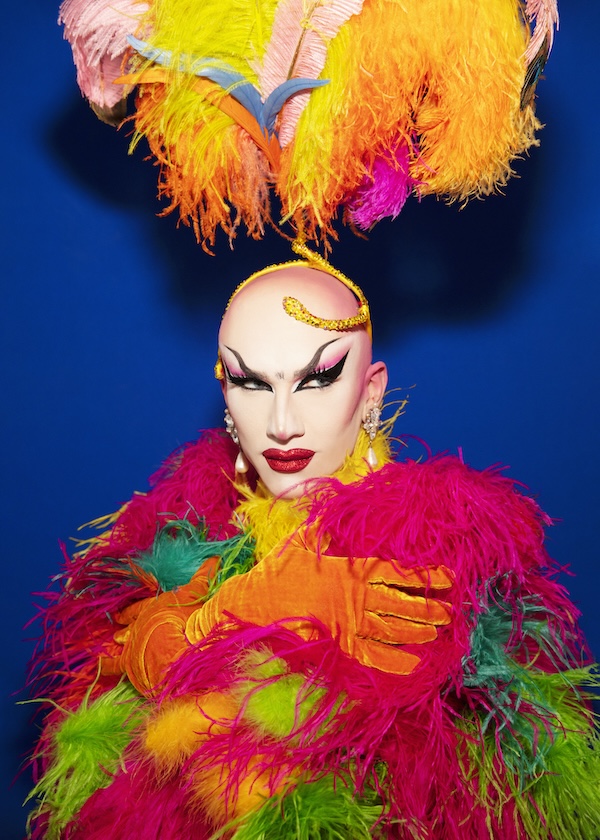
Jewish drag queen, visual artist, speaker, illustrator and author Sasha Velour. (photo from UBC)

The 2024 Phil Lind Initiative speaker series concludes on April 18 with Jewish drag queen, visual artist, speaker, illustrator and author Sasha Velour, winner of the ninth season of RuPaul’s Drag Race and a co-host of the current season of HBO’s We’re Here. Velour will give a talk titled The Big Reveal: Why Drag Matters. Exploring the intersections of pop politics and pop culture, she will delve into the roots of drag, its historical significance in queer culture and its evolution into a politically charged art form. “Drag embodies the queer possibility that exists within each of us, the infinite ways in which gender, good taste and art can be lived,” she said.

The Phil Lind Initiative is hosted by the School of Public Policy and Global Affairs in the faculty of arts at the University of British Columbia. The initiative’s mandate is to invite prominent US scholars, writers and intellectuals to UBC to share ideas on some of the most urgent issues of our time.

Velour’s talk takes place April 18, 6 p.m., at the Chan Centre for the Performing Arts. Tickets are free (maximum two per order), but registration is required. Audience members can attend in person or watch online via livestream. You do not need a ticket but you do need to sign up for the Phil Lind Initiative email list. For full details, go to lindinitiative.ubc.ca.

– Courtesy University of British Columbia

JSA celebrates its 20th

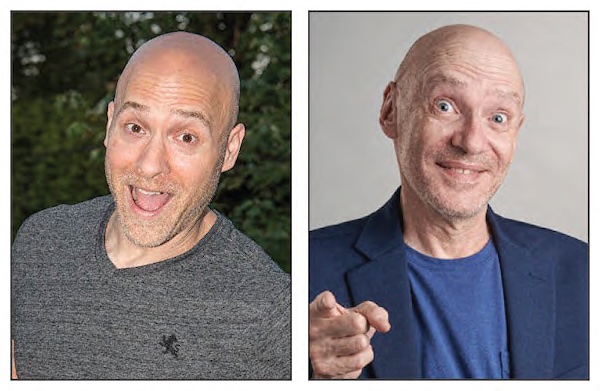
Kyle Berger, left, and David Granirer headline the Jewish Seniors Alliance’s A Night in the Catskills on March 17. (photos from JSA)

The Jewish Seniors Alliance of Greater Vancouver is celebrating its 20th anniversary with an event that’s all about laughter.

A Night in the Catskills: Jewish Humour Then and Now takes place at Congregation Schara Tzedeck March 17, 6 p.m.

“Jewish humour has enabled the Jewish world to gain strength through a history that shows that we should not be in existence today, but here we are bigger, stronger and better than ever!” said Marilyn Berger, a past president of JSA, who will make her debut as a stand-up comedian at the event. “Ask Kyle,” she said, referring to one of her sons. “I have given my family plenty to laugh about.”

It is perhaps not a coincidence then that Kyle Berger preceded his mother on the standup stage, and also produces comedy shows. He and David Granirer, founder of Stand Up for Mental Health, are headliners of the 20th anniversary event, which will include a performance by magician Stephen R. Kaplan, aka the Maestro. The whole megillah will be emceed by JSA board member Michael Geller, whose involvement in JSA was inspired by his late father, Sam Geller.

“He derived a great deal of joy from regularly attending JSA events and this is one of the reasons why the organization is so special to me,” Geller told the Independent.

photo - Michael Geller emcees JSA’s A Night in the Catskills at Schara Tzedeck
Michael Geller emcees JSA’s A Night in the Catskills at Schara Tzedeck. (photo from JSA)

“This comedy night is a follow up to a similar event organized by JSA 13 years ago,” he explained. “It was initiated by a phone call from the late Serge Haber, who called to tell me that the province had just canceled JSA’s gaming grant, but he knew my father would want me to help replace the funds. I asked how much was the grant. He said it was $18,000. I told him that was too much for me, but I had an idea.

“I was a fan of the website Old Jews Telling Jokes. Since JSA served many older Jews, I offered to book a room, buy some deli, and invite 17 of my friends to join me and each put up $1,000 and we would entertain one another with our favourite Jewish jokes.”

Haber – who founded JSA – liked the idea, as did the board, but they also wanted to join, and couldn’t afford to pay $1,000 each. So, the format was changed to one where people would attend and donate what they could, said Geller. Held at Congregation Beth Israel, almost 250 showed up.

“We presented clips from Old Jews Telling Jokes and invited people in the audience to share a joke in return for a donation. Everybody agreed it was a fabulous event,” said Geller. “There was just one small problem. We didn’t raise very much money. 

“So, this year we are charging $118 dollars to attend. Some generous members of the community are coming forward and agreeing to be sponsors. This will allow other seniors in the community who can’t afford $118 to attend. It has also allowed us to hire Tim Bissett, an experienced professional event organizer to assist with the program.”

photo - Stephen R. Kaplan will perform at the 20th anniversary celebration
Stephen R. Kaplan is a special guest performer at the 20th anniversary celebration. (photo from JSA)

Expressing gratitude to the sponsors on behalf of JSA, Geller said, “we are hoping other community members will come forward, especially those who regularly share their favourite Jewish jokes on the golf course. Sponsors will be invited to participate in the program by telling a favourite joke or two, or introducing a favourite comedian or routine.”

For his part, Geller is preparing for his role as emcee by watching vintage and contemporary Jewish comedians and selecting material. “The program will also include some professional comedians who are volunteering their time, and special appearances by local rabbis who have been urged to share stories they would never tell in shul,” he said.

“I am thrilled to be celebrating our 20th anniversary and look forward to going from strength to strength as my own children now, believe it or not, become seniors!” said Berger, who shared her appreciation for the organization that Haber started.

“As I gracefully age,” she said, “I thank Serge for enabling me to spend my golden senior years embraced by the love that Seniors Alliance offers.”

“JSA undertakes many programs that benefit so many Jewish seniors, including the excellent Senior Line magazine,” said Geller. “While we are supported by many community organizations and foundations, we need additional funding. I am, therefore, hoping this evening will help promote the organization’s good work and, this time, actually raise money to allow it to continue.”

For tickets to A Night in the Catskills or to become an event sponsor, visit jsalliance.org or call 604-732-1555. 

Chelsea Hotel is heavenly

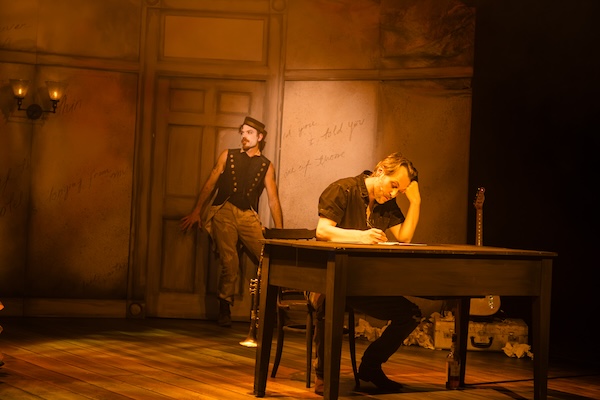
Jack Garton, playing a Jokeresque bellhop, manipulates the memories and thoughts of the Writer, played by Adrian Glynn McMorran. (Sarah Race Photography)

In Paper Thin Hotel, Leonard Cohen writes, “It is written on the walls of this hotel, you go to heaven once you’ve been to hell.” Heaven is where you will be if you catch Steve Charles and Tracey Power’s 2024 iteration of their 2012 hit Chelsea Hotel, playing at the Firehall Arts Centre until March 3.

Chelsea Hotel is a loving tribute to Cohen and his poetry, which transcends time and space while touching on enduring universal topics – passion, loss, sex, religion and politics. Although Cohen has been dead for more than seven years, his music and lyrics live on and perhaps are more relevant than ever given the troubled state of our world. 

I saw the world première of the show back in 2012 (jewishindependent.ca/oldsite/archives/feb12/archives12feb10-02.html) and did not think anything could make it better but, after a cross-country tour and 400 performances, like a fine wine, it has improved with age. Half of the original cast returns to reprise their roles and they, too, have only become better with time. Power does triple duty as she choreographs, acts and directs, while Charles is musical director/arranger and musician/actor.

The sung-through musical revolves around a tortured writer (Adrian Glynn McMorran) shuttered up in a shabby room in New York’s Chelsea Hotel trying to forget his past so that he can be creative again. The show opens with him outstretched on a bed towering with crumpled paper, a metaphor for his cluttered mind. Each time he writes something down and throws it away, we feel his existential angst as he searches for inspiration from his life’s memories. Five actors, playing multiple characters, move in and out of his various visions, reminding him of his past romantic entanglements and indiscretions through songs like “Suzanne,” “Take this Waltz,” “First We Take Manhattan,” “Tower of Song,” “Dance Me to the End of Earth,” “Bird on a Wire” and, of course, “Hallelujah.”

All the scenes play out in the Writer’s mind – illusions in a carnival-like setting guided by a Jokeresque bellhop (a terrific Jack Garton) who pops in and out of the set as he manipulates the Writer’s memories and thoughts.

This truly ensemble production is a fusion of dance, music and theatre, with the multi-talented cast of six all triple threats – each capable of singing, dancing and playing the myriad instruments used in the show, ranging from the traditional – guitar, violin, keyboards and drums – to the more unconventional – banjo, ukulele, accordion and even a kazoo (showcased in the very erotic “I’m Your Man” number).

McMorran is sensational as the Writer. His vocals run the gamut from softly crooned ballads to frenetic rock ’n’ roll numbers. Power, Marlene Ginader and Michelle Bouey play the lovers and the muses, moving through the various vignettes in dreamlike, ethereal fashion. Ginader, in her blue raincoat, is touching in her portrayal of the jilted lover trying to get back into the Writer’s heart. Hovering quietly in the shadowy background, Charles switches effortlessly from instrument to instrument, until he emerges front and centre stage to sing a poignant “Famous Blue Raincoat.”

The staging is sublime. Kudos to set and costume designer Drew Facey for his fragile, paper-like set and simple costumes. John Webber’s mood lighting completes the surreal atmosphere.

As you unwrap the layers of this performance, so ably packaged by this wonderful cast, the pleasure only increases. There is so much to like in this production – don’t miss it.

As a bonus, on Feb. 23, the theatre is holding a special event, Endless Love, toasting the legacy of Cohen, which includes pre- and post-show receptions, cast mingling and, of course, the show. Tickets can be purchased at firehallartscentre.ca or by calling the box office at 604-689-0926. 

Tova Kornfeld is a Vancouver freelance writer and lawyer.

“Moses” does standup at JFL

Samson Koletkar, dubbed the “world’s only Indian Jewish standup comedian, performs Feb. 15 as part of Just for Laughs Vancouver. (photo from Just for Laughs Vancouver)

This year’s Just for Laughs Vancouver features several members of the Jewish community, including Samson Koletkar, aka Mahatma Moses. He comes as part of Desi Comedy Fest – On Tour, which takes place at the Biltmore Cabaret Feb. 20, 9 p.m.

Koletkar is a co-founder of the Desi Comedy Fest with fellow San Francisco Bay Area comedian Abhay Nadkarni, who also hails from India. The biggest South Asian comedy festival in the United States, it is described as “celebrat[ing] subcontinental diversity with punchlines that transcend boundaries.”

Desi Comedy Fest isn’t Koletkar’s only entrepreneurial venture. He has a background in technology and also started Comedy Oakland, which “features funny, diverse, industry pros alongside up-and-coming comedians at various venues across Oakland,” according to its website.

Koletkar, who claims to be the “world’s only Indian Jewish standup comedian,” spoke with the Jewish Independent earlier this week.

JI: How does one go from being a techie to a standup comedian? Are there overlaps in skill sets? Do you still work in both areas or are your entrepreneurial endeavours your focus?

SK: I have tried a few things in my life, and standup started the same way. It seemed like a fun thing to do, I gave it a try and, the first time I was on stage, I was hooked. There is definitely an overlap from my tech life into standup – bulletproof logic in my jokes. If I am making a point, and I like to make many, there is no room for bugs, the jokes have to be tested thoroughly and any gaps in logic have to be fixed.

Standup has also helped make my day job easier with the ability to inject humour during tough situations. One of my ex-bosses actually made me realize the value of my standup comedy at work – he used to invite me to the tough customer meetings because invariably I would make the room laugh and the meetings got much easier after that.

JI: What were you like growing up – have you always seen the world with a humourous eye?

SK: I think so. I have always had this urge to crack a joke. There were a lot of inappropriate ones at inappropriate times, but isn’t that how we all learn, by making mistakes? Now, every time I meet parents who think their kids are funny, the one thing I advise them is to accommodate their kids’ misspeaks, and keep that funny bone intact. More often than not, the only mistake we as comedians make is saying out loud what everyone is thinking but politely holding back.

JI: When did you move from Mumbai to the San Francisco Bay Area?

SK: I took the first opportunity I got to move as far away from my parents as I could and, at the age of 24, I moved to the Silicon Valley in October 2000. I felt like the needle that burst the Y2K bubble.

JI: When did you first perform standup?

SK: Late 2005, but then jumped all in in January 2006.

JI: What led you to start Comedy Oakland?

SK: Standup is the one art form you can’t practise in your garage. You need a live audience. After grinding through three years of empty open mics and sub-par independent shows, I decided I could either sit and complain about how poorly some shows were produced, or try to do it myself. That led to Comedy Oakland, in May 2009, starting with one show on Friday nights. My goal was to create a space where comedians needed to only bring good jokes and audience experience was optimized for the art.

Just before the pandemic, I used to run 250+ shows (five shows a week), featuring 400+ comics entertaining 12,000-13,000 [person] audiences every year. In 2024, 15 years running, I am back to five shows a week at three venues in Oakland. These venues are 40 to 90 seaters.

JI: When you envisioned the Desi Comedy Fest, did you think it would become as huge as it is?

SK: I don’t think it is huge enough yet. Yes, the fest has grown from its early days, but we have a long way to go, and partnering with JFL is a big step in that journey. What I knew was that it was going to be fun, and it continues to be one of the most fun shows every year in my calendar.

JI: In what ways have you experienced racism and antisemitism, how do you handle such incidents and how do they impact you?

SK: Those stories are more fun to hear in my standup than they are to read, although they only form a small part of my routine because racism and antisemitism are a small part of my life. The world has a lot more good than bad in it and I don’t let the bad overshadow the good. An optimistic comedian – go figure! But, yes, they do impact me, not only when it happens to me but when I see it happen to others. So, some of my content is driven out of that and I tend to focus on the logical hypocrisy/fallacy of it.

JI: You’ve had much success. What are one or two things that you’d still like to achieve or do professionally?

SK: When my joke offends someone in America, it’s “Go back to where you came from.” When my joke offends someone in India, it’s “Go to Pakistan.” I want to tell an offensive joke in every single country in the world, just to see where they send me next, sort of like The Offensive Joke World Comedy Tour!

JI: If there is anything else you’d like to add, please do.

SK: Come watch a show, nothing gives me more happiness than seeing you laugh!

***

Desi Comedy Fest – On Tour also features Alisha Dillon, Amar Singh and UK Shah. For the full Just for Laughs Vancouver line-up and tickets, visit jflvancouver.com. 

Artist’s threat sees PuSh cave

At the weekly rally Jan. 14, Ezra Shanken, chief executive officer of the Jewish Federation of Greater Vancouver, called on attendees to take action around the latest flashpoint of anti-Israel activism locally.

Earlier in the week, the PuSh International Performing Arts Festival announced they were canceling the scheduled presentation of The Runner, a play by a Canadian playwright Christopher Morris. The move followed an earlier decision to cancel the play at Victoria’s Belfry Theatre after a chaotic public meeting and vandalism of the theatre building. (See jewishindependent.ca/canceled-play-should-not-be-canceled.)

The PuSh decision, according to a Jan. 11 statement, was the result of pressure from another festival artist, Basel Zaraa, who threatened to pull his installation, Dear Laila, rather than have it appear at the same festival as a play that he describes as not depicting the “fundamental context of Israel’s occupation, apartheid and ethnic cleansing of the Palestinian people.”

“As a Festival, we respect Basel’s perspective,” wrote the festival organizers. “We will honour the artist whose work reflects their lived experience and cancel the presentations of The Runner by Canadian playwright Christopher Morris, whose work is rooted in years of research but who has no religious or cultural ties to the region.”

In the same dispatch, Morris released a statement.

While saying, “If removing The Runner is the only way Canadians can hear Basel’s crucial voice, then there is value in stepping aside,” Morris concluded, “It’s unsettling when Canadian theatres cannot be a space for the public to engage in a dynamic exchange of ideas. I believe theatre must be a place where contrasting perspectives are programmed and celebrated. Now more than ever, we need to listen to each other, engage in different viewpoints, and find our shared humanity.”

The Runner is, Shanken said, “an acclaimed play by a non-Jewish playwright, one that actually talks about the challenge of what’s going on on the ground.”

He told attendees at the Sunday rally that the PuSh Festival’s decision is “a new front” in which “they are trying to silence other voices.”

“When you don’t have the facts on your side, you silence the opposition,” said Shanken. “Each one of us should take a moment today when we get home, write an email to the PuSh Festival. Tell them enough is enough. We ask not for the other play to be canceled but just for our own equal billing. We allow for their voices to be heard, all we ask is for peaceful voices of ours to be heard, too. We ask for nothing but equality.”

The PuSh Festival receives funding from the City of Vancouver, the Province of British Columbia and the Canada Council for the Arts, as well as numerous businesses and foundations. Sponsors of the event can be found on the festival’s website – pushfestival.ca – under “Partnerships.”

Just for Laughs coming soon

Ben Schwartz and Jessica Kirson are on the lineup of this year’s Just for Laughs Vancouver.

Just for Laughs Vancouver, which runs Feb. 15-24 at various venues in the city, features several members of the Jewish community.

All three of Brett Goldstein’s shows Feb. 16-18 at Queen Elizabeth Theatre have almost sold out. Goldstein was a co-executive producer, co-writer and co-star of Ted Lasso. He is also the creator and executive producer of the comedy Shrinking, alongside Jason Segel and Bill Lawrence, and of Soulmates, with Will Bridges. Goldstein is host of the podcast Films to be Buried With, which finds him in conversation with guests as they discuss the films that have shaped them.

Rafi Bastos performs at the Rio Feb. 17-18. Many of his viral stand-up clips come from nightly performances at the Comedy Cellar. In his home-country of Brazil, he was one of the first comedians to pioneer the art of American-style stand-up comedy. He has starred in movies, had his own talk show, been an infield journalist and hosted reality show Ultimate Beastmaster. He is co-founder and owner of Comedians, the largest comedy club in South America. 

Ben Schwartz and friends take to the Orpheum stage Feb. 18. Schwartz is part of the cast of The After Party, as well as the second season of Space Force. He was in the comedy series House of Lies and Parks and Recreation. As a writer, he has published four books and written television shows and movies for many major studios.

Jessica Kirson is at the Vogue Feb. 18. Her countless comedic character videos have racked up more than 200 million views on social media. She produced the feature-length documentary Hysterical. In addition to her one-hour special, called Talking to Myself, she is a regular on This Week at the Comedy Cellar and has appeared on many other shows.

At the Rio Feb. 23-24 is Catherine Cohen, best known for her comedy special The Twist…? She’s Gorgeous. She can be seen in the feature film At Midnight and in the upcoming series What I Was Doing While You Were Breeding. In 2021, she published her first book, God I Feel Modern Tonight, a collection of comedic poetry.

Comic, podcaster, writer and actress Annie Lederman will be at the Biltmore Feb. 21-22. Lederman is co-host of the podcast Trash Tuesdays. Most recently, she can be seen in the documentary miniseries The Comedy Store, alongside Jay Leno, David Letterman, Joe Rogan, and many other Comedy Store legends. She wrote and starred in Stand Ups, Impractical Jokers and Borat, among other things.

The full JFL lineup and tickets are available at jflvancouver.com. 

– Courtesy Just for Laughs Vancouver

CANCELED – See The Runner at PuSh

Christopher Morris as Jacob in The Runner, which is at Fei and Milton Wong Experimental Theatre Jan. 24-26. (photo by Dylan Hewlett)

Since this article was published, PuSh has canceled the production. For the statement, click here.

Among the offerings of this year’s PuSh International Performing Arts Festival is Christopher Morris’s The Runner, which runs Jan. 24-26 at Fei and Milton Wong Experimental Theatre.

The one-man play is dedicated to Jakoff Mueller, a ZAKA member in Israel who died in 2018. The main character is Jacob, an Orthodox Jew with the Israeli volunteer emergency response organization. In one of the emergencies depicted, Jacob helps an injured Arab woman before he tends to a soldier, and his choice has significant repercussions. The actor in the role – in Vancouver, it will be Morris – performs the whole 60 minutes of the play while walking/running on a treadmill.

The Jewish Independent interviewed Morris by email before the playwright stepped back from doing media after a scheduled Victoria run of the play was canceled due to pressure from protesters, who objected to the story being told “from an exclusively Israeli perspective.”

JI: Can you share more about your relationship with Jakoff Mueller, how you came to meet him, to be invited into his home, and how he contributed to writing of The Runner?

CM: I first met Jakoff in 2009 at a small get-together in the house I was staying at in Jerusalem. This was during my first research trip to Israel to write this play. The owner of the house was a friend of Jakoff and she thought it would be interesting for me to speak with him, seeing as I was doing research about ZAKA. Jakoff was an incredibly thoughtful man with a great sense of humour, and we hit it off. He invited me to come and visit him where he lived in northern Israel and I did, over many occasions during the research trips I made to Israel. Though no event or fact from Jakoff’s life is represented in the play, his compassion for valuing all human life and his spirit of questioning is in the play. The world was a better place with him in it.

JI: When did you start writing The Runner and when and where did it première?

CM: My curiosity with ZAKA began when I was a teenager in Markham, Ont., in the 1990s. I heard a media interview about the work ZAKA did and it really struck me. I kept thinking that ZAKA’s work would be an interesting premise for a play but didn’t know how to do it. So, in 2009, I made my first trip to Israel to begin researching the play. I spent nine years (on and off) writing it and it premièred at Theatre Passe Muraille in Toronto in 2018.   

JI: You’ll be playing the role of Jacob, but I see in much of the material Gord Rand as the actor. Are you stepping in for him, does the role rotate, is he no longer part of the production?

CM: Yes, I’ll be playing the role of Jacob in Vancouver. The show had critical success when it premièred in Toronto, winning three Dora Mavor Moore Awards (best script, best production and best direction for the late Daniel Brooks). We were receiving a lot of interest to tour the show, so we rehearsed in multiples of every role in the production (actor, stage managers, director, designers) in the event that one person from the original team may not be available. Daniel Brooks rehearsed me into the role so I could play it when Gord wasn’t available. Over the years, I’ve played it on and off a few times and am really looking forward to performing the role in Vancouver.

JI: You’ve written a one-pager offering guidance for venues presenting The Runner. Is there anything you’d add to that, given the Israel-Hamas war? Not only because tensions are higher, but, for example, there are direct parallels in the description of victims in the mass grave in Ukraine [where ZAKA members, including Jacob, travel in the play] and what happened to Israelis on Oct. 7, which could be triggering.

CM: It’s always been important when presenting The Runner in collaboration with theatres to give some social context when the show is being presented. I am always available to the staff at the theatre to offer any specific insight about the play in the context it’s being presented in. PuSh and I have been in constant contact about how to support the play and the audiences who will see it in January.  

JI: When were the PuSh shows booked and, if there have there been other productions mounted since Oct. 7, what has reaction been overall?

CM: We’ve been discussing doing this show with PuSh for over a year and it was officially booked last May. We completed a run of the show from Nov. 2nd to the 19th, 2023, at the Thousand Islands Playhouse in Gananoque, Ont., and the reaction to the show was extremely positive. A few hours ago, it was publicly announced that the Belfry Theatre will not be presenting The Runner in March.

I support the conversations taking place in response to The Runner right now, I always think it’s important to discuss things. It’s hard to know how audiences will experience any play right now, let alone one set in Israel, like The Runner. But the power of this production, and why so many people have connected with it since it premièred in 2018, is that it’s a nuanced and thoughtful conversation about the preciousness of human life.

JI: Are you a member of the Jewish community? Either way, why did you choose to write a play about terrorism from the perspective of an Orthodox Jewish man?

CM: I’m not a member of the Jewish community. I was brought up Catholic but regard myself as an ex-Catholic (since the age of 13). I wrote a play about medical triage in the perspective of an Orthodox Jewish man because I wanted to write a play about ZAKA.

JI: I’m struck by what I interpret, perhaps mistakenly, as calls for humanity/morality only from Jews/Israelis, not from terrorists or people who see terrorism as a valid form of resistance. In the thinly veiled Gilad Shalit reference, for example, Jacob bemoans the un-Jewishness of Israel keeping the remains of dead terrorists in case of an exchange but he doesn’t seem to question the morality or humanity of the terrorists. Similarly, the only ones who seem to be called to account for killing in this play are Jews – presumably an Israeli shot the Arab woman in the back, an Israeli shooting an Arab protester leads to an Israeli boy being killed, a Jewish Israeli accidentally shoots another Jew when trying to shoot a terrorist, and another gunshot by a Jew, after a vehicular terrorist attack, has fatal consequences for a Jew.

CM: Because it’s a one-person show, Jacob’s view is a singular perspective, and I wrote about the unique situations he would be facing as a ZAKA member. Jacob is dismayed by all the violence that surrounds him and, throughout the play, he advocates for seeing all human life as equal. As a disempowered, isolated person, with limited interactions to people outside of his community, I believe Jacob feels his best bet to effect change is by addressing those around him.

JI:  While ZAKA prioritizes victims over terrorists, other Israeli medical professionals are supposed to triage patients. In the play, an ambulance takes the Arab girl away and obviously keeps her alive. Why does no Jew in the play support Jacob or show him kindness?

CM: It is true that Israeli medical professionals give care to patients, like the ambulance described in the show that takes the Palestinian teenager away and a hospital which no doubt helped her with her wounds. When writing the complex character of Jacob, it was important to include examples in the play of how hard it was for him to connect to other people before he offers medical care to the teenager. This was important to create a complex human being and an interesting dramatic context. Jacob’s mother supports him and shows him kindness. As does the Palestinian teenager when he arrives unexpectedly at her door, and the Palestinian man who saves him by helping Jacob get to his car.

JI: There is a line in the play that has been highlighted by reviewers as powerful, and that’s [Jacob’s brother] Ari’s dictate about why he’s a settler on the land – “because it’s mine!” Again, this doesn’t come up in your play, but is relevant: the chant for Palestine to be free from the river to the sea. What hope do you see, or does Jacob see, if you’d rather – can one get off “the treadmill” alive?

CM: Though my play is set in Israel, I feel I lack the experience or expertise to offer a fully informed answer to the complexities of the overall conflict. But the biggest hope for me in the play and the only statement about life I feel I wrote (as opposed to the numerous questions I ask in the play) is Jacob’s description of how the Palestinian teenager treated him with kindness:

Her hand on my shoulder.
Are you alright.
That’s all that matters.
Kindness.
An act of kindness.

This is my offering for the complex world we live in. 

To read my op-ed on the Belfry Theatre’s cancelation of The Runner, click here. To read other statements on the cancelation, including from Morris, click here.

For tickets to the PuSh Festival, which includes BLOT, co-created by Vanessa Goodman, and Pli, co-presented by Chutzpah! Festival, go to pushfestival.ca.

CANCELED Statements on The Runner

The Jewish Independent received the following statements regarding the play The Runner after the Belfry Theatre in Victoria canceled the scheduled March performances of the play, which is set to run as part of the PuSh Festival in Vancouver Jan. 24-26.

Since this article was published, PuSh has canceled the production. For the statement, click here.

Christopher Morris, artistic director of Human Cargo and playwright of The Runner:

As a playwright who values the role of theatre as a platform to explore ideas about the complexities of life, I was disappointed to learn that the Belfry removed The Runner from its programming. I also empathize with the challenging situation they were facing. I am saddened that people in Victoria – especially those with very divergent views and those traumatized by the atrocities in Israel and Gaza – will be denied the opportunity to come together in a theatre to explore their common humanity, share their grief and perhaps discover a flicker of solace and hope. 

Since it premièred in 2018, my play The Runner has been seen by audiences in six cities, received numerous awards and unanimous critical acclaim. I am humbled that theatre companies have produced this play, which is a nuanced and thoughtful conversation about the preciousness of human life. Their endorsement tells me that they also see its effectiveness in creating a dialogue with their audience.  

I am deeply traumatized and saddened by humankind’s capacity to wage war. As a Canadian, I want our politicians to do all they can to make the violence in Gaza and Israel stop. I hope theatre companies and playwrights do all they can to give audiences the opportunity for dialogue and to build bridges between our silos. I believe The Runner is an excellent opportunity for those things to happen. And Vancouver audiences will get the chance to experience this production in a few weeks, at the upcoming PuSh Festival.

***

Gabrielle Martin, director of programming, and Keltie Forsyth, director of operations, PuSh Festival:

The PuSh Festival recognizes the pain of those watching or connected to the conflict in Gaza and Israel and the feelings of hurt and helplessness, knowing our experiences here in Vancouver are nothing like those who are suffering direct violence or who have lost homes, friends and family members.

We understand the objections to our programming of The Runner as a part of that shared hurt. When we see death, particularly civilian death, on this scale, we feel the injustice and the inhumanity at work, and we want to do something about it. Here in Canada, far from the conflict, it’s easy to feel helpless, to feel like contacting politicians, rallying or protesting isn’t enough. At PuSh, what we do is present live art, and sometimes we share the feeling that what we do isn’t sufficient. 

Art reflects the world and the times in which we live. At its best, it’s an essential cultural force that builds empathy and understanding. Our aim is that PuSh brings us together and inspires us to have complex conversations; to challenge ourselves and each other not only to think differently, but to feel differently. The festival experience is greater than the sum of its parts and defined in how each piece sits in conversation with the other. These pieces share a sense of cultural urgency and, together, welcome generative friction through plurality as a cultural strategy. 

The Runner is situated within a program that explores our shared humanity in ways that transform the political into the personal, intimate and domestic. This play, by Canadian playwright Christopher Morris, is a story about triage that’s set in Israel. It is not funded by the Israeli government, and Christopher has no direct ties to any country in the region. The play unpacks one character’s dilemma between humanist impulse and socially imposed morals, as he advocates for seeing all human life as equal. In its commitment to examining the polarizing tensions and conflicting ideologies at work within its Israeli protagonist, it exposes painful racism behind the dehumanizing sentiments encountered by the character. Christopher shares: “I lack the experience, or expertise, to speak on or write a play about the extremely complicated conflict that’s happening right now in that part of the world. And what I’ve been offering since 2018 is a play, from my Canadian perspective, that explores the complexities, and limitations, of empathy and kindness.” Ultimately, he frames The Runner as “an offer for discussion.”

We believe this work offers one voice in a diversity of perspectives that diverge in specifics of identity and experience, but that all advocate for empathy and compassion. Dear Laila, playing parallel to The Runner, offers an autobiographical perspective on the forced displacement of Palestinians through one family’s experience of war and exile. Basel Zaraa, the artist behind the project, is a Palestinian refugee who grew up in Yarmouk refugee camp in Damascus, Syria. Dear Laila features a miniature model of his destroyed family home in Yarmouk camp, and three stories that represent the three generations who lived in the house. Intimate and interactive, the experience invites each audience member to connect with this story of “[a] family, like many families of our communities, who are stuck in a loop of losses.” Basel further frames it as “a way for me to face and express and understand the trauma that we live with.”

These two works form part of the wider 2024 festival ecology, and each plays an integral role to a balance that has been curated with care. In the face of violence and atrocity, presenting live art can feel small. We hope that, collectively, the performances and multimedia experiences of this year’s festival offer opportunities for self-reflection, better understanding others’ experiences, and dialogue – actions that, in our view, can sometimes offer building blocks for meaningful political change.

***

The Jewish Federation of Victoria and Vancouver Island is disappointed by the decision of the Belfry Theatre to cancel its production of the acclaimed play The Runner. 

It is regrettable that the Belfry Theatre felt the need to cancel an artistic production, for the first time in its 46 years of existence, because it featured an Israeli Jewish man. 

It is regrettable and disheartening that, when the Belfry Theatre attempted to have an open dialogue, it was vandalized and threatened by a “pro-Palestinian” mob, which ultimately led to a very quick decision without any meaningful consultation. The Belfry’s stated reasons for this decision were: “we believe that presenting The Runner at this particular time does not ensure the well-being of all segments of our community … this is not the time for a play which may further tensions among our community.” This decision does not reflect the wishes of the community as expressed in competing petitions: 1,400 against showing the play vs. 2,400 wanting the play to proceed.  

We fear this decision will lead to other cultural events being canceled, as other venues may also give in to mob mentality and bullying. This is not what we expect from our cultural institutions, nor our community. It is not too late for the Belfry Theatre to reconsider their actions, as we hope they will. 

The decision does not bode well for artistic and cultural expression in Victoria and Vancouver Island. It matters to stand up for what is right. 

To read the Jewish Independents interview with playwright Christopher Morris, click here. To read the Independents op-ed on the Belfry Theatres choice to cancel its March run of The Runner, click here.

Gertrude Stein and Alice B. Toklas “visit” the Jericho Arts Centre

photo - Kelsi James as Alice, left, and Tanja Dixon-Warren as Gertrude in Gertrude & Alice
Kelsi James as Alice, left, and Tanja Dixon-Warren as Gertrude in Gertrude & Alice, by Anna Chatterton, Evalyn Parry & Karin Randoja. (photo by Nancy Caldwell)

Gertrude Stein and Alice B. Toklas “visit” the Jericho Arts Centre to tell of their 40-year relationship, of friendships with iconic artists, of Alice’s overwhelming devotion to Gertrude’s genius and how, as two Jewish lesbians, they survived in Paris in the Second World War. They want to find out how their lives are – or are not – remembered.

Lois Anderson directs the United Players production at Jericho Arts Centre Jan. 19-Feb. 11. For tickets, visit unitedplayers.com/gertrude-alice.

– Courtesy Jericho Arts Centre

Supported by paper, by fragility

Inbal Ben Haim in Pli, which will be at the Vancouver Playhouse Feb. 2-3. (photo by Loic Nys)

Imagine flying through the air on … paper?! That’s just what the circus artists do in Pli, which is being co-presented by the PuSh and Chutzpah! festivals Feb. 2-3 at the Vancouver Playhouse.

The show’s concept came from Israeli French circus artist Inbal Ben Haim, who performs the work with Domitille Martin and Alvaro Valdes. Ben Haim has always been attracted to working with various materials. In her first show, Racine(s), which means “root(s)” in French, soil was used as “poetic matter to talk about the connection of human beings with the earth and [their] homeland,” Ben Haim told the Independent. Racine(s) premièred in 2018.

“But my story of paper started from a workshop I had while I was in CNAC [Centre national des arts du cirque], with the artist Johann Le Guillem. In the point of view of Johann, circus is a ‘minor practice’ – a practice that has never been made, that no one’s practising anymore, or that it is very rare. He asked us to prepare a small presentation … and I wanted to work with paper, to create a huge bird of paper and to fly on it. Well, I didn’t manage to do it, but I started sculpting the paper and made a paper puppet, which I suspended in the air and climbed on it.”

“A little bit later,” she continued, “I met Alexis Mérat, who is a paper artist [and who used to perform in Pli], and we figured out we do the same gesture with our hand – he is crumpling, and I am hanging from my rope. So, we wanted to try to do the two actions at the same time – to crumple and suspend. We were sure that the paper would break, but when we discovered that hanging from paper was possible, it inspired us a lot in the poetical point of view of this image – putting your body, your weight, your life, on something so fragile as paper. In a way, it’s a human action that we all do sometimes. It seemed to us that we absolutely needed to continue this research.”

As they did, Ben Haim said it became clear that they had to involve Martin, who she knew from Racine(s). Martin is not only a performer but a scenographer and one of Martin’s specialties is creating a set that is also circus apparatus, said Ben Haim. “This is how we started to work together.”

Ben Haim studied both visual arts and physical practice, and the visual circuses she creates are a melding of those two passions.

“I was always a hyperactive child,” she said. “I did sports, athletics and martial arts since [I was] very young. But, when I discovered circus practice, and especially aerial acrobatics, I found a space of quiet, of high intensity in a calm place. I found a different relation to gravity and to the body, and also a practice that was very physical but at the same time poetic and interior. It touched me deeply.”

Ben Haim said she wasn’t scared the first time she climbed a rope or was suspended from a trapeze. “I was used to climbing on very high places – trees, mountains, and so on,” she explained. “My parents tell that when I was 1 year old, they found me one day up on a ladder – which means I learned how to climb before I knew how to walk.”

It’s only as she has worked longer in the profession that she has felt more fear. “I get to be more aware of all the risks we take, not only in the acrobatic act but in the hanging and rigging – this is where most of the accidents happened,” she said. “I get to be more and more careful with age and with experience.”

Ben Haim moved to France in 2011 to pursue her art and training, first at Piste d’Azur: Centre régional des arts du cirque PACA, then the CNAC de Châlons-en-Champagne, from which she graduated in 2017. Her bio also notes that “she developed a teaching method for therapeutic circus and worked in various contexts in Israel and France. By blending circus, dance, theatre, improvisation and visual arts, Ben Haim has created her own form of poetic expression. Largely inspired by the human bond made possible by the stage, the ring and the street, she aims to create strong connections between the audience and the artist, the intimate and the spectacular, the earth and air, and the here and there.”

This interplay of connections is evident in Pli and how Ben Haim, Martin and Mérat worked together.

“In the moment we discovered that hanging and climbing on paper was possible, we dove into this research, and we wanted to discover and understand all the possible ways to do that,” said Ben Haim. “We did a lot of experiments which are visual and physical, but also mechanical. Alexis is an engineer, so he held all this point of view that finally makes all that we do quite safe.

“We were creating nine apparatus of hanging on paper in different ways, and we observed how the body changed the paper,” she continued. “We created also many scenographies from paper in which I entered to transform them, getting in a different relationship with the matter…. I metamorphose it, and then it holds me differently – it becomes a duet with lots of listening and care.

“In parallel, we were creating costumes from paper, we made lots of sound work, [registering] the different sonorities of paper to compose the music and doing … research on the possibilities of lighting paper on stage. We can say that the paper guided us in this journey.”

Jessica Mann Gutteridge, artistic managing director of the Chutzpah! Festival, was drawn to Pli right away when she was introduced to it by the PuSh Festival, whose director of programming is Gabrielle Martin.

“Chutzpah! and the PuSh Festival share many common interests in terms of the kind of work we present and have been looking for opportunities to work together,” said Gutteridge. “PuSh knows that Chutzpah! has a particular interest in presenting Israeli artists, as well as audiences who are interested in dance and innovative performance, so this project was an excellent opportunity for us to join forces and co-present.”

The 2023 Chutzpah! Festival, which took place just last month, “included a project that centred on long sheets of paper used to create visual artworks on scrolls, with professional and community artists exploring the centuries-old art form of crankies,” said Gutteridge. “This resonance with Inbal’s work creates a lovely bridge to our winter Chutzpah! PLUS collaboration with the PuSh Festival.” (Crankies are a centuries-old artform in which an illustrated scroll is wound on two spools set in a viewing window.)

Chutzpah! took place as the Israel-Hamas war continued, and the probability is that the war will still be going on when PuSh begins Jan. 18.

“We can say that art is not saving anyone’s life in times of war, so what is its power in front of violence?” responded Ben Haim when asked the role of the arts, even in times of conflict.

“I believe that art has the power to bypass the mind and touch beyond it – the heart, the emotions, the curiosity, our sense of humanity,” she said. “Art has the chance to connect us – above the definitions and identities, as nationality, history and politics. And can connect us into something bigger than what we think we are, something which is common.”

She said, “As someone who searches more for solutions than accusations in any conflict (personal or geopolitical), I search the space of connection moreover than the reasons of separation. I believe that that’s the only way we can find peaceful and respectful solutions for all sides. I feel the need of being able to deeply see each other, human beings, beyond the grief, the fear, the sadness. I think art offers us this kind of space, where we can feel all humans, and experience ourselves as a connected grid. It is not the ‘solution,’ but I think it’s a good starting point, especially in our days.”

Having lived for many years in Israel, in a region of recurring conflict, Ben Haim said, “I know how persistent experiences of fear, pain, loss and distress make us become less and less sensitive, and more into defensive and violence. It happens in order to protect ourselves from those difficult experiences, and it is common for all sides. But, in the long run, it is devastating, for ourselves and for our partners. 

“Even in the middle of a storm of violence, I think art helps us keep a space of sensibility in this crazy world,” she said. “An untouched place where we can simply be, observe, experience, feel. To marvel in front of some piece of beauty, beside the destruction. Having, for short moments, a sense of hope. To feel the strength in the subtlety, in vulnerability, the power in the creative act, in being alive. And this sensibility can be a window of connection. A thread to follow slowly and gently.”

Pli is 60 minutes with no intermission and the teaser can be viewed on YouTube or Vimeo. It is recommended for ages 11+. For tickets to the Feb. 2-3 shows at the Playhouse (in-person and livestream), visit pushfestival.ca.