

Skip to content
  • Home
  • Subscribe / donate
  • Events calendar
  • Business Directory
  • FAQ
  • News
    • Local
    • National
    • Israel
    • World
    • עניין בחדשות
      A roundup of news in Canada and further afield, in Hebrew.
  • Opinion
    • From the JI
    • Op-Ed
  • Arts & Culture
    • Performing Arts
    • Music
    • Books
    • Visual Arts
    • TV & Film
  • Life
    • Celebrating the Holidays
    • Travel
    • The Daily Snooze
      Cartoons by Jacob Samuel
    • Mystery Photo
      Help the JI and JMABC fill in the gaps in our archives.
  • Community Links
    • Organizations, Etc.
    • Other News Sources & Blogs
  • JI Chai Celebration
  • JI@88! video

Recent Posts

  • Or Shalom reopens its doors
  • JFS from past to future
  • Need holistic approach
  • Sharing stories, advice
  • Journalist shares fears
  • Skills to live together
  • Road to independence
  • Cutting grass with scissors
  • Zionism as a solution
  • Deceit, desire & the divine
  • Reclaiming sacredness
  • Creative project ideas
  • Summer squares and cobbler
  • Thou shalt … summer commandments
  • Legal help for students
  • Revisiting myth of Lilith
  • Wrong person rebuked
  • Canada’s mixed messages
  • Questions for museum
  • Symposium on antizionism
  • Making soccer political
  • CJPAC lauds Pulver’s impact
  • City recognizes Vrba’s legacy  
  • Organ donation saves lives
  • Theodore’s March premiere
  • A healing Shabbaton
  • Supplying healthy food
  • A chime of metal tags
  • Yellowknife seder a first
  • Ishai energizes, unifies
  • A Lag b’Omer to remember
  • Expanding the healing
  • Hannah Senesh – a unique hero
  • Community milestones … May 2026
  • Деньги до зарплаты на карту Займ до зп онлайн за 5 минут 2026
  • Микрокредит онлайн в Казахстане Микрозайм в Акшамат

Archives

Follow @JewishIndie
image - The CJN - Visit Us Banner - 300x600 - 101625

Byline: Sam Margolis

Hurdles to become a doctor

Hurdles to become a doctor

Ruth Simkin with her dog, Kelly. (photo by Chris Wilson)

Feminism is really true equality between women and men; nothing more, and nothing less,” Ruth Simkin writes in her new book, Dear Sophie: Life Lessons in Feminism & Medicine, a memoir dedicated to her great-niece.

“There are many people who scoff at the word ‘feminism,’” Simkin adds. “But consider this – when I was in my first year of medical school, I, and any other woman, could not get a credit card in our own name. Until 1974, a husband’s signature was needed for women to have credit cards. At that time, I met women who were teachers who lost their jobs because they and their husbands wanted to start a family and they became pregnant – a no-no for working teachers until 1978. I could go on and on with examples like this to show why feminism was, and still is, such an important part of all our lives.”

Born in Winnipeg in 1944, Simkin has prevailed over many obstacles throughout her life and career. In Dear Sophie, readers join her as she struggles to get into medical school.

“There was stiff competition to get into an innovative medical program launched at the University of Calgary in the late 1960s,” she told the Independent from her home in Victoria. “I was one of 32 of roughly 1,200 applicants to be accepted.”

Admission to the program, however, would turn out to be an easier hurdle than those that were yet to come during her schooling and subsequent training. The length of her time in med school is replete with stories of sexual harassment and discrimination by both fellow classmates and senior members of the faculty.

“Male doctors, on more than one occasion, did all they could to get me expelled from med school, but I stood my ground,” Simkin said.

She managed to complete her residency, despite being blocked at almost every step, and clashing with the established medical community. But she prevailed. She was the first U of C med school graduate to open a practice – one that thrived – while also working as a professor and preceptor at the school.
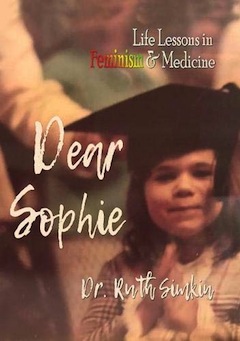
image - Dear Sophie book coverIn the memoir, Simkin details her experiences from that time to the present and uses her account as a way to demonstrate to Sophie, and to other women, how to live a happy, feminist life. She hopes that Sophie, a pre-adolescent during the time Simkin was writing the book, will learn from her experiences before entering adulthood.

Simkin’s long and varied career has seen her undertake many ventures. In the 1980s, she learned acupuncture in Shanghai and, ultimately, became the first physician to be approved by the Alberta College of Physicians and Surgeons to incorporate acupuncture in a medical practice. Later that decade, she went to London, England, to study with Dr. Katharina Dalton, who brought premenstrual syndrome to the world’s attention and also coined the term.

Upon her return to Canada, Simkin opened the first PMS clinic in Western Canada. She also has opened Western Canada’s first hologram gallery, produced concerts, been involved in theatre projects and started the lesbian and gay political action group CLAGPAG.

In the 1990s, she moved to Salt Spring Island, where she became a farmer – growing “yuppie” veggies. A return to medicine saw her become the first fellow to study palliative care at the University of British Columbia. In 2014, she was honoured with a life membership from the College of Family Physicians of Canada.

Among her other published works, Simkin has written What Makes You Happy, a collection of short stories, both autobiographical and fictional; The Y Syndrome, a medical thriller set in 1990s Calgary; and Like an Orange on a Seder Plate, a feminist Haggadah. The Jagged Years of Ruthie J (2012) is an autobiographical account of her experiences in Winnipeg before medical school.

Over the years, she has written scores of medical papers and contributed to textbooks, as well as mixed media presentations. Having travelled extensively, she has an (as-yet) unpublished book, Come Away with Me, about her journeys through China.

Dear Sophie received the 2019 Rainbow Award in the LGBT biography/memoir category. In its review of the book, the prize committee said, “Dear Sophie is a flawless memoir that is not only a story of Dr. Ruth Simkin, but a story of feminism and women in Canada and the field of medicine, skilfully woven together with valuable life lessons.”


Sam Margolis has written for the Globe and Mail, the National Post, UPI and MSNBC.
Format ImagePosted on February 14, 2020February 12, 2020Author Sam MargolisCategories BooksTags family, feminism, history, LGBTQ+, medicine, memoir, Ruth Simkin, Victoria
The comics rise again on Feb. 20

The comics rise again on Feb. 20

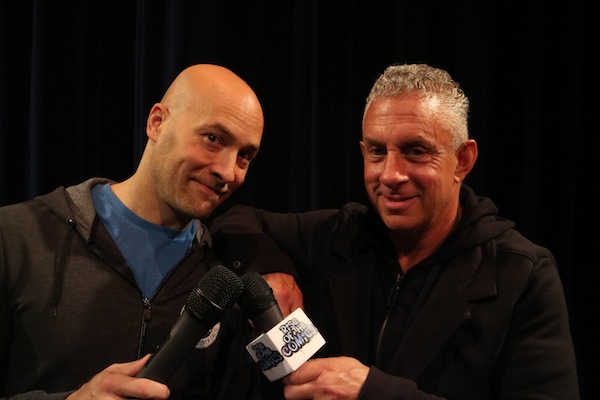
Kyle Berger, left, and Scotty Aceman, co-producers of Rise of the Comics. (photo from Rise of the Comics)

The outer limits of the laugh-o-meter will be tested on Feb. 20 at the Jewish Community Centre of Greater Vancouver’s Rothstein Theatre, when a group of Canada’s top funny people step on stage for A Night of Shticks & Giggles, presented by local comedy producer Rise of the Comics. This will be the third Shticks and Giggles show to raise money for the JCC Maccabi Games.

Headlining the event is Julie Kim, a two-time Canadian Comedy Award nominee for stand-up, who has performed at comedy festivals around the continent and appeared on CBC’s The Debaters and Laugh Out Loud. Her YouTube videos have amassed millions of views and, in 2018, she released her debut comedy album, Outside Voice.

Among other topics, Kim’s routine delves into modern parenting and various cultural issues, sometimes involving life seen from an Asian perspective. Yuk Yuk’s comedy club co-founder Mark Breslin called her “smart, funny, with enough self-awareness to deconstruct her life in a very sophisticated way.”

Other acts in the show, which Rise of the Comics describes as its “best line-up to date,” include Robert Peng, who bills himself as “an unemployed engineer who turned to stand-up comedy out of desperation”; New Zealander Sophia Johnson, “the one who keyed your car but probably shouldn’t have told you that”; Sean McDonnell, who Canadian comedy star Norm MacDonald has praised as “a fantastic talent”; and Brett Nikolic, a maven on Mountain Dew-flavoured weed.

Rise of the Comics is the brainchild of Vancouver stand-up comedian Scotty Aceman, who will also be on stage at Shticks & Giggles. Starting off as a weekly 30-minute program on Shaw Cable with the same name in 2015, the show has highlighted the work of many stand-up comedians who got their start on the local scene, such as Dino Archie and Ivan Decker, who has appeared on Late Night with Conan O’Brien.

Aceman, a University of British Columbia and B.C. Institute of Technology graduate, switched to comedy five years ago, after a 20-year stint in a sales job with Rogers in the corporate wireless phone department.

“Leaving the cellphone business after 20 years was a tough call,” he said. “But you have to chase your dreams. People would ask me, ‘What about my dignity and respect?’ I’d say dignity and respect went out the window the minute I had a Thursday morning bar mitzvah!”

In 2019, Aceman brought in Kyle Berger as co-producer of Rise of the Comics. Berger, sports coordinator at the JCCGV, will be the master of ceremonies for the Feb. 20 Shticks & Giggles.

Before joining the crew, Berger, in his role as JCC Maccabi Games delegation head, had hired Rise of the Comics for a fundraiser. He credits Aceman for allowing him to get his stand-up feet wet, with a debut performance at the Charqui Grill in Kitsilano in 2018.

“Stand-up was one of those things on my bucket list to do by the time I turned 40,” Berger told the Independent. “Scotty (and my then-girlfriend, now fiancée) were both big helpers in getting me up there on stage for a five-minute routine. My fiancée had had enough of me saying I was going to do it.”

Berger said, “Scotty’s reputation within the local comic community is a great asset. Nowadays, Rise of the Comics does all sorts of things, including parties in people’s living rooms. And, last year, we were hired by the Chutzpah! Festival to put on a show.”

Rise of the Comics currently works with a roster of more than 50 stand-up performers of all styles and experiences, and tailors its shows to any situation. They have created performances at such diverse venues as Hy’s Steak House, the Jericho Arts Centre and Ronald McDonald House, among others. Their gigs can cover everything from clean to dirty, social commentary to observational, but always, they say, with an emphasis on the funny.

Berger promises that he and fellow Shticks & Giggles comedians are likely to make mention, in one way or another, that their show is backed by the foundation created by Dr. Neil Pollock, a leading Vancouver male sexual health and circumcision expert, and his wife Michelle.

The show starts at 7:30 p.m. Tickets are $20 and can be purchased at m.bpt.me/event/4499277. For more information about Rise of the Comics, visit riseofthecomics.com.

Sam Margolis has written for the Globe and Mail, the National Post, UPI and MSNBC.
Format ImagePosted on February 7, 2020February 6, 2020Author Sam MargolisCategories Performing ArtsTags comedy, JCC, JCC Maccabi Games, Kyle Berger, Pollock, Rise of the Comics, Scotty Aceman, Shticks & Giggles, stand-up
Eclectic Jewish sounds

Eclectic Jewish sounds

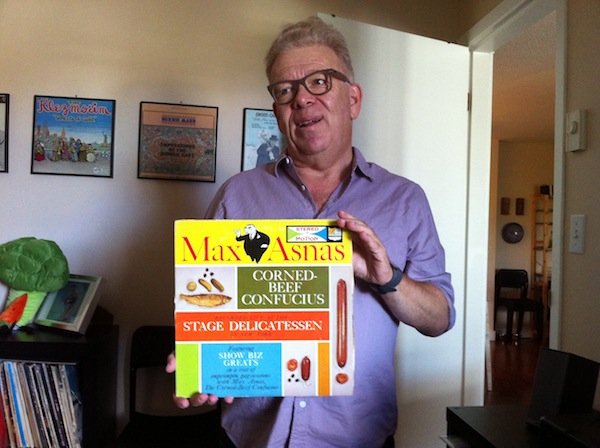
Andy Muchin with a record from his collection. (photo from Sounds Jewish)

The American South may not be the first place you would consider tuning the dial for an hour-long radio program that runs the gamut of Jewish music and many other audio facets of Yiddishkeit. That the show is assembled half the year on Vancouver Island might add another element of unexpectedness to the equation.

“I realize it might appear a bit incongruous,” Andrew Muchin told the Independent, from his Victoria home. “But, thanks to the internet age, things like this are no longer that difficult to do.”

Fifty weeks a year, Muchin goes through his collection of more than 1,000 vinyl records, scores of CDs and hour upon hour of digitized music to produce Sounds Jewish, a weekly radio program for Mississippi Public Broadcasting, based in Jackson, Miss. The show is broadcast on Sunday afternoons there and heard anytime online.

Having celebrated its ninth anniversary at the end of last September, Sounds Jewish focuses on a relevant theme, often within the Jewish and secular calendars. Avid listeners soon realize the problem for Muchin is not finding material but sifting through all the material that is out there. It takes several hours to select music for, record and produce each show, and programs often contain a range of offerings, anything from a 1960s comedy routine to Israeli hip-hop.

For American Thanksgiving in late November, Muchin spun a number of discs, including a Ladino number, “These Beautiful Tables” by the Ruth Yaakov Ensemble, and “Tish Niggun” (“Table Melody”) from the band Klezmer Plus! The show then mixed in songs of gratitude, such as a melodic rendition of Psalm 118 with Israeli singer/keyboardist Idan Raichel and Malian singer/guitarist Vieux Farka Touré and a counting of blessings from British singer Daniel Cainer – who opened the 2019 Chutzpah! Festival – in “How We’re Blessed,” from his album Jewish Chronicles.

In October, Muchin prepared a World Series show dedicated to Jews and baseball, and particularly to the home cities of the two teams involved in this year’s Fall Classic, the Houston Astros and the Washington Nationals. This show featured a country version of the prayer Modeh Ani from Houston-born country singer-songwriter Joe Buchanan; a cut from Kramer’s The Greenberg Variations, an instrumental tribute to Detroit slugger Hank Greenberg; and ballpark favourites “Take Me Out to the Ballgame” and “God Bless America” belted out in Yiddish by Mandy Patinkin.

In marking recent holidays and occasions, Muchin has taken his listeners on a musical tour of Jewish labour songs ahead of Labour Day, rhythmically reminded them of many sins to avoid during the month of Elul, leading up to the High Holidays, and melodically explored the ongoing desire for self-improvement ahead of Yom Kippur, the Day of Atonement.

“I try never to be preachy, but I like to inform my listeners of various Jewish or Jewy practices they can incorporate in their lives – or not. Mostly, though, Sounds Jewish presents the diversity of Jewish music across time and space. To my ear, Jewish music is the ultimate world music, since Jews have lived almost everywhere on earth, blending the native music with Jewish themes,” he said.

A native of Manitowoc, Wis., Muchin was raised in a traditional Jewish home, growing up versed in Hebrew and liturgical melodies. He later learned Israeli songs at a Zionist summer camp, but said he didn’t become steeped in Jewish music until long after the klezmer revival of the 1970s.

Muchin has been active in Jewish media and Jewish life since 1986, when he started as an assistant editor for the Jewish Telegraphic Agency. He moved back to his home state to serve as editor for the Wisconsin Jewish Chronicle in Milwaukee and edited and co-published (with Marge Eiseman) Jewish Heartland magazine. He also has written for the Forward, Moment, Jewish Week and numerous other publications.

In 2009, Muchin landed in Jackson, as the cultural program director of the Goldring/Woldenberg Institute of Southern Jewish Life, a nonprofit that provides a variety of educational, cultural and religious services to underserved Jewish communities throughout the South. There, he met the director of Mississippi Public Broadcasting’s radio division, Jason Klein, who also happened to be Jewish, and Sounds Jewish took flight.

In Victoria, Muchin served as director of the 2019 Victoria International Jewish Film Festival and has written and presented two Purim shpiels (plays).

As for the future of Sounds Jewish, Muchin hopes to continue adding to his Jewish music collection – he said he accepts donations of LPs – and to broaden and deepen the content of the show.

“I expect the show to have an increasingly Canadian feel as I learn more about the very creative Canadian Jewish music scene and its history,” he said.

Sounds Jewish can be heard at mpbonline.org/soundsjewish, exchange.prx.org/series/32262-sounds-jewish and radio-j.com.

Sam Margolis has written for the Globe and Mail, the National Post, UPI and MSNBC.

Format ImagePosted on January 31, 2020January 28, 2020Author Sam MargolisCategories MusicTags Andy Muchin, Mississippi Public Broadcasting, radio

Campaign wraps up

“We’re making our final push toward another record-breaking campaign,” Jonathon Leipsic, chair of Jewish Federation of Greater Vancouver’s annual campaign, said when the Independent caught up with him last month, as the 2019 fundraising drive was entering the home stretch.

The campaign’s goals for the year are “to continue to grow to meet the ongoing needs around security, education, affordability and beyond.” The distinguishing message of the 2019 campaign, when it kicked off on Sept. 1, was to amplify the impact of donors’ giving and to “create a ripple effect.”

That amplification can be seen on several fronts, such as affordable housing, the most pressing concern of Lower Mainland residents. In 2007, long before real estate prices reached the levels of the late 2010s, Jewish Federation helped establish the Tikva Housing Society. Tikva serves all those who have been impacted by the high costs of rent – families, young individuals and seniors. The society now manages 98 affordable housing units, 37 of which came about in late September through a joint project with the YWCA – awarded by the City of Vancouver – for rentals at the new Arbutus Centre at 4188 Yew St.

Jewish Federation’s work encompasses all phases of a person’s life by providing community planning expertise, developing partnerships and raising funding for critical programs and services throughout the region. These are delivered through its many partner agencies, including programs that support seniors, Jewish education, arts and culture, and services for youth and young adults.

By 2031, it is predicted that the number of Jewish seniors in Greater Vancouver will double to 6,200. With this comes the challenge of helping them keep living independently and stay engaged within the Jewish community. As part of its strategic planning process, Jewish Federation co-hosted the second annual Changing Landscapes Forum on Nov. 26, which focused on three areas to address the high-priority needs of elderly community members: aging in place, caregiver support and social connection.

As for Jewish education and educational programs, Jewish Federation currently partners with Jewish day schools, summer camps and supplementary school programs across the region. As well, its vision reaches beyond the metropolitan area, to Israel. More than a decade ago, it identified at-risk youth in its partnership region of the Upper Galilee as a group in urgent need. It then invested in tech education, which has allowed other organizations to build on its success. The Israeli government recently selected an international consortium of venture capital groups to develop a food-tech centre in Kiryat Shmona, the Upper Galilee’s largest city. The centre will benefit residents of the region and position the area as a global hub of innovation.

Jewish Federation’s work also extends to eastern Russia, home to some of the most impoverished Jews in the world. Through its partnership with the Joint Distribution Committee, an international rescue and relief organization, Federation provides needed services to 27,000 Jewish children and their families and more than 165,000 elderly Jews. As the nearest federated community to these Jews, Federation’s efforts help bring humanitarian aid in the form of food packages, medicine, heating fuel and home-care visits, among other things.

For his part, Leipsic said, “I am always humbled by the generosity of our Jewish community and the incredible volunteerism exhibited by the army of volunteers and canvassers that give their time in support of Am Yisrael.

“It is a privilege and honour to serve,” he added, in explaining why he took on the role as campaign chair, on top of having a full schedule as a physician, radiologist and professor of radiology. “I try to live my life in accordance with the talmudic saying klal Yisrael arevim zeh bazeh – all of Israel is a guarantor for each other.”

Sam Margolis has written for the Globe and Mail, the National Post, UPI and MSNBC.
Posted on January 24, 2020January 22, 2020Author Sam MargolisCategories LocalTags annual campaign, education, Israel, Jewish Federation, Jonathon Leipsic, philanthropy, Russia, seniors, tikkun olam
Two new scholarships

Two new scholarships

In an effort to lighten the financial challenges presented by the growing costs of higher education, Hillel International announced in November that it is launching two annual scholarships for students attending college anywhere in the United States and Canada. The two merit-based scholarships will total $4,000 US (roughly $5,200 Cdn) each and are available to any student who identifies as Jewish. The deadline for applications is March 15.

The Handeli First-Year Scholarship will be awarded annually to graduating high school students who demonstrate a record of leadership and volunteerism and are preparing to enter a four-year college or university. Students currently on a gap-year program are also eligible to apply.

The Hillel Campus Leadership Award, meanwhile, will be presented to full-time college students in their freshmen, sophomore or junior year who exhibit exceptional leadership skills and are pursuing a degree at an accredited school.

“Thanks to the estate of a wonderful donor, David Handeli, we were able to create the two new scholarship opportunities. Four students will receive awards this year, and we’ve already received more than 200 applications since the application went live in November and more than 1,000 applications have been started. Our hope is to expand these scholarships down the road, since we will have way more demand than supply,” Etan Harmalech, Hillel International’s vice-president of marketing, told the Independent.

For both scholarships, applicants must have a grade point average (GPA) of 2.5 or above to be considered. A full list of eligibility requirements can be found on the Hillel International website, hillel.org/college-guide/hillel-scholarships/eligibility-requirements-and-faqs. The applications for the respective scholarships can be also be found on the site, at hillel.org/college-guide/hillel-scholarships.

Like their counterparts throughout North America, Jewish college students and their families have had to contend with ever-mounting educational expenses, the increase in which over the past 20 years has exceeded the rise in household income.

The daunting cost in the United States, for example, was cited in a recent report by the College Board, an American nonprofit whose goal is to expand access to higher education. The report noted that the annual tuition for a college student had increased by more than 25% in the past decade for both private and public institutions. In several states, the cost for a year’s tuition competes with average income.

The average Canadian undergraduate pays close to $7,000 a year in tuition. Surveys conducted by Macleans in 2017 and 2018, however, found that the average cost of post-secondary education – with all of its expenses, such as rent, tuition and food, included – came in at just under $20,000 per year, with the commensurate level of debt rising with each additional year of study.

In British Columbia, students are confronted with one more challenge: finding affordable lodging near campus in an overheated housing market, an obstacle that is further exacerbated by the scarcity of available units, often leading to crowded living conditions or dwellings located far from the schools students attend.

“I am happy to see that these scholarships incentivize student involvement in Jewish life on campus. Hillels are a hub for Jewish life and often act as the last gas station before students head off into the working world,” said Sam Heller, the executive director of Hillel BC. “If we don’t get to them in college, there are fewer opportunities for Jewish young adults to engage with the community in an easy way and we may not see them until they start to have families and so on.”

Founded in 1923 at the University of Illinois Urbana-Champaign, Hillel is the largest international Jewish student organization, with representation at more than 550 colleges and universities around the world. In British Columbia, a Hillel presence can be found at University of British Columbia, Simon Fraser University, University of Victoria, Langara College, Quest University Canada, Kwantlen Polytechnic University and Emily Carr University of Art and Design.

All applications will be reviewed by Hillel’s scholarship committee following the March 15 deadline. The recipients of the scholarships will be chosen and announced on May 1.

Students looking for more scholarship opportunities should visit Hillel’s Jewish Scholarship Portal (hillel.org/college-guide/hillel-scholarships/jewish-scholarships), which contains information on several hundred scholarships available to Jewish students.

Sam Margolis has written for the Globe and Mail, the National Post, UPI and MSNBC.
Format ImagePosted on January 24, 2020January 22, 2020Author Sam MargolisCategories NationalTags education, financial aid, Hillel, scholarships, university, youth
Victoria hosts Klondike

Victoria hosts Klondike

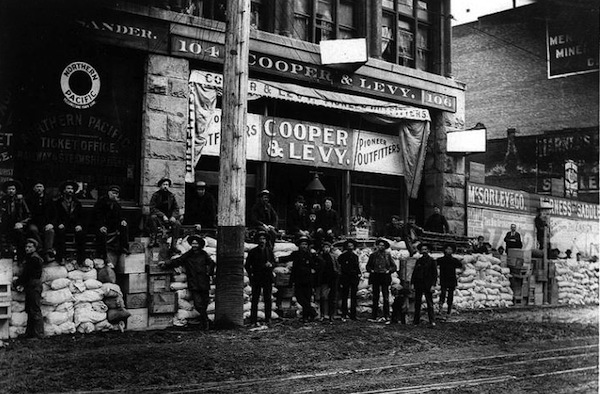
Cooper & Levy store, 104-106 1st Ave. S. near Yesler Way, Seattle, 1897. The store was one of the major outfitters of the Klondike Gold Rush. (photo from Asahel Curtis Collection, University of Washington UW 4770)

The archival images and newspaper headlines contained in the Gold Rush exhibit now on display at the Jewish Community Centre of Victoria (JCCV) evoke a sense of the hysteria that gripped the West Coast more than century ago, in spite of the risks involved in traveling to a severe and treacherous terrain. And Jews were not immune from the mania, as the three-panel display, entitled “The Jewish Presence During the Klondike Gold Rush 1897-1918,” distinctly demonstrates.

The exhibit will be at the JCCV through January. It brings with it a number of revisions from the one that toured Canada from 2016 to 2018 and included a stop in Vancouver.

“During its previous run, we received a lot of additional information from people who visited the exhibit, so much so that we couldn’t include it all in the current display. We are seriously thinking about doing a book starting later this year,” Rick Karp, president of the Jewish Cultural Society of Yukon (JCSY), told the Independent.

Once the previous display returned to Whitehorse, Karp followed up on the input he received and updated the three panels and the booklet accompanying the exhibit.

“As well, we revised the video that details the finding of the Jewish cemetery from the Gold Rush in Dawson, the cleaning and bringing it back to its original condition, and the rededication ceremony,” Karp said. “All the information about the cemetery in the accompanying booklet has been added, as well as the section entitled ‘The History of the Jews in the Klondike Gold Rush’ and the ‘Stories of the Gold Rush.’”

A significant addition to the Gold Rush stories is that of Joseph Barron, one of the first to open a mercantile store in Dawson. Barron came from Winnipeg and followed the stampede of 1898. He mushed into the Yukon via the White Pass route, bringing with him a stock of merchandise.

His beginnings in the north were not the most fortuitous. He lost his supplies on three occasions to fire between 1899 and 1901. Undeterred by adversity, he restocked and started over.

The Barrons would become a prominent Calgary family. Joseph’s son Abe founded the law firm Barron & Barron, which is still operated by the family today. His other son, Jacob (J.B.), was a leading businessman and theatre owner in the city, building Calgary’s first high-rise, the Barron Building, and breaking ground on its first Modern Orthodox synagogue, Shaarey Tzedec (which was demolished in 2013).

Joseph Barron’s wife and children did not come to Dawson until 1902. The younger Barrons only stayed for two years before they left to complete their education. The senior Barrons eventually left Dawson to join their children in Calgary in 1915.

Henry Isaacs was another entrepreneur who ventured north. He earned the moniker “the Butter King of the Klondike” upon learning about a technique using sea water to re-churn a shipment of what others had considered rancid butter into something edible.

Among the most enterprising adventurers was David Gross, a Russian immigrant and dropout trained as tailor, who, not yet 20 years of age when he made the journey north, found ways to make money selling groceries, stoves and other provisions, though his primary business was a clothing store. His ingenuity led him to see opportunities where others did not. For example, if butter had turned rancid and was unsalvageable for food purposes, he would sell it as axle grease for squeaky wheels. After learning that water can only penetrate an inch or two into flour, he would purchase large sacks of flour other merchants thought had been drenched and, therefore, ruined and then sell the flour that the water had not reached at a much higher price. Gross also became active in the nascent movie theatre business in Dawson City.

Yet the prize for the most daring Jewish seeker of fortune would have to go to Max Hirschberg. After losing his supplies en route and then finding, in 1890, that many of the good claims in Dawson had been staked, Hirschberg pushed on to Nome, where more gold was reported to be, on a bicycle!

Later in life, before his passing in 1964, he recounted the 11-week journey in which he made his way along a two-inch trail, confronting snow-blindness, exposure and exhaustion, nearly drowning in the Shaktoolik River and losing $1,500 in gold dust. When his bike chain broke, he made a sail from his coat and rigged it to his bicycle, then crossed the Norton Sound to Nome.

Interest in the Jewish community during the Gold Rush was ignited after the discovery of the aforementioned Jewish cemetery in Dawson City in 1995, and its ensuing restoration in 1997 and 1998. “The discovery of lives lost inevitably leads to questions about lives lived,” the exhibit booklet reads.

“The Jewish Community Centre of Victoria is excited to host the mobile exhibit. We would like to thank Rick for making it possible,” said Larry Gontovnick, president of the JCCV.

After it completes its current tour around Canada, the exhibit will be on permanent display at the Dawson City Museum in the Yukon. A duplicate copy will tour various communities in the United States.

Sam Margolis has written for the Globe and Mail, the National Post, UPI and MSNBC.
Format ImagePosted on January 17, 2020January 15, 2020Author Sam MargolisCategories LocalTags Gold Rush, history, JCSY, Jewish Cultural Society of Yukon, Klondike, Rick Karp, Victoria, VJCC, Yukon
Funds for Jewish studies

Funds for Jewish studies

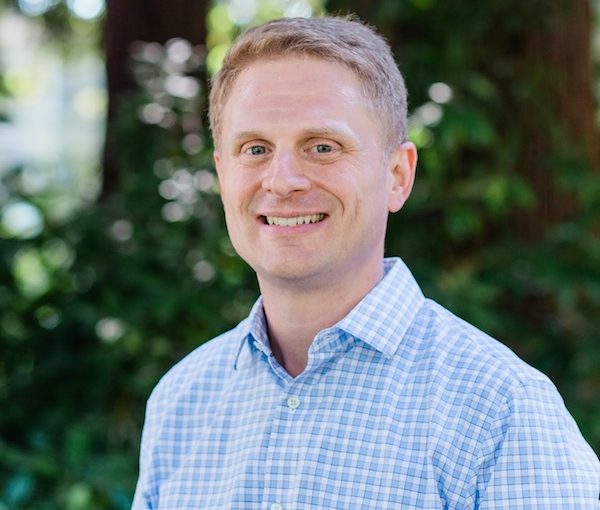
Prof. Gregg Gardner has held the Diamond Chair in Jewish Law and Ethics at the University of British Columbia since 2011. (photo from UBC Media Relations)

Gregg Gardner conveys an infectious exuberance when speaking of the $1 million donation from the Diamond Foundation to the University of British Columbia this September.

“None of this would have been possible in terms of Jewish studies at UBC without the Diamond family,” Gardner, an associate UBC professor, told the Independent. “Their sense of giving is felt not just here but throughout the broader community.”

The Diamond Foundation’s most recent gift to the school will build on achievements of the Diamond Chair in Jewish Law and Ethics at UBC to date, with a particular focus on the expansion of Jewish studies programming both in the classroom and beyond the UBC campus.

“The gift is part of a larger initiative which will really go a long way in helping to create and augment programming, assist in having students travel to Israel, bring in new speakers and assist in new research,” said Gardner, current holder of the Diamond Chair.

He plans to invite an array of speakers during the 2020 and 2021 academic years.

“The money from the Diamonds can be used to bring in authorities in various aspects of Jewish research to Vancouver. Once here, they can speak at the university as well as at synagogues, retirement homes or cultural centres in town,” he said.

Gardner also hopes the new funds can serve as a stepping stone towards such things as creating a centre for Jewish studies at UBC and, ultimately, bringing the field of Jewish research at the institution to a level commensurate with that of other universities in North America.

Students at UBC, he said, have shown a widespread interest in Jewish studies, and this interest extends well beyond their own personal background.

The Diamond Chair in Jewish Law and Ethics was established in 2001. Gardner has held the position since 2011, with his research concentrating largely on the history of Jewish thought. At UBC, his classes focus on the history of religions, together with exploring Jewish history, texts and traditions.

In 2018, he teamed up with the Hebrew University of Jerusalem to lead a group of UBC students in an archeological field school at Horvat Midras in Israel, a site that may have been developed by King Herod. There, they helped excavate a pyramid that marked a tomb from the first century and an elaborate underground system of tunnels and caves that served as hideouts for Jewish rebels against Rome in the second century.

The Diamond gift will additionally allow Gardner himself to present more lectures locally and internationally. Heretofore, he has given has public talks at Hillel BC (UBC) and academic lectures at Oxford, Cambridge and Yale universities.

Gardner has authored several academic papers and books, including The Origins of Organized Charity in Rabbinic Judaism (Cambridge University Press, 2015), which examines foundational rabbinic texts and places their discourses on giving within their historical – second- and third-century – contexts.

The Diamonds are equally enthusiastic about the results their donations have brought and will bring.

“We wanted to enhance the current chair and enable Dr. Gardner to play a pivotal role in generating sophisticated research and understanding of Jews and Judaism,” said Leslie Diamond. “He has inspired students and the community by enriching their knowledge of Judaism through his courses, public talks and events with visiting scholars.”

She added, “I am very proud with what our funding of the Jewish Chair in Ethics and Jewish Law has accomplished.”

The Diamond Foundation has long played a pivotal and prominent role in Vancouver philanthropy. Created by Jack, z’l, and Gordon Diamond in 1984, its mission is to improve the quality of life for people in the communities in which the Diamonds live and do business. It donates to organizations throughout the Greater Vancouver area, including schools, hospitals and numerous Jewish organizations. The foundation seeks investments in organizations and issues that strengthen Jewish community life throughout the city and its environs. At age 25, family members are invited to become directors of the foundation.

Jack Diamond arrived in British Columbia as a near-penniless refugee from Poland in 1927 and went on to create the province’s largest meat-packing firm, Pacific Meats. He is credited with setting up Vancouver’s first kosher butcher shop and was instrumental in building the Schara Tzedeck Synagogue, among countless other endeavours.

Sam Margolis has written for the Globe and Mail, the National Post, UPI and MSNBC.

Format ImagePosted on December 20, 2019December 18, 2019Author Sam MargolisCategories LocalTags Diamond Foundation, education, Gregg Gardner, Jewish studies, philanthropy, UBC, University of British Columbia
Classes on being a DJ

Classes on being a DJ

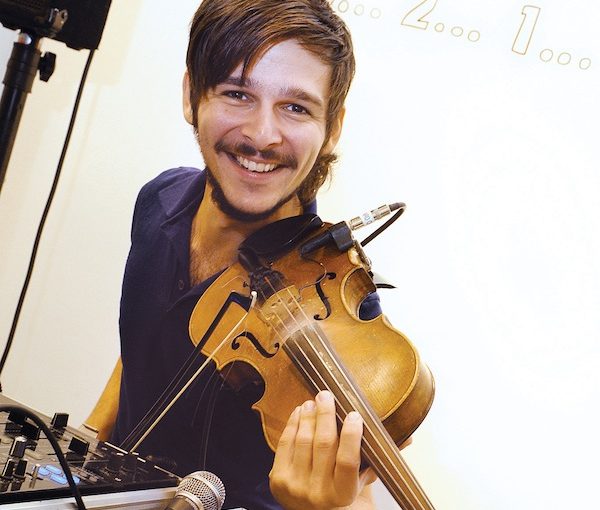
Michael Fraser teaches group electronic music and DJ classes at the Jewish Community Centre of Greater Vancouver. (photo from Michael Fraser)

As a violinist, music producer and DJ, Michael Fraser’s musical talents traverse many realms. Yet, despite the proficiency and versatility he has to create his art, Fraser believes that “personal connection to music transcends skill.”

It is that personal musical connection that the 30-year-old, born-and-raised Vancouverite hopes to instil in the next generations – be they performers or devotees – in the group electronic music and DJ classes he is teaching at the Jewish Community Centre of Greater Vancouver through spring 2020.

The early stages of Fraser’s musical trajectory began in grade school as a Suzuki violin player, though numerous other styles – from classical to hip-hop – seeped into his sphere of artistic influences through various musical mentors. Among them was Vancouver-based saxophonist and flautist Tom Keenlyside, who had a tremendous impact and helped Fraser “connect with music in an abstract, rather than a theoretical, way.”

Marrying and starting a family with his partner Camille, though, has brought about a shift in Fraser’s musical focus in recent years. The sense of wonder possessed by children, and the simple way it is often expressed, led him to view things from a different perspective and to feel a sense of responsibility to teach.

Fraser began playing music for his son before his son was even born. When Isaac turned three, Fraser observed him connecting to the process of making music himself.

“After Isaac was born, I started to see that my purpose as a musician is to help young artists develop their innate creativity and coach artists to deeper levels of emotional intelligence,” said Fraser. “When my son asks to hear my music, I want to help him cultivate a relationship to music and life that goes beyond what words can express.”

Fraser’s professional musical career began in 2007, while in his late teens. Since then, he has collaborated with numerous recording artists, including the Ault Sisters, a Toronto-based vocal jazz trio; performed at the Shambhala Music Festival and the Montreal Jazz Festival, among many other venues; and opened for internationally known acts, such as Michael Bublé, Caravan Palace and Arrested Development.

His success as a live performer led him to working with Ben Affleck on the original score for Ben Affleck on the Meaning of Life, an animated short film about the actor and director’s Eastern Congo Initiative, which premièred at the 2012 Toronto International Film Festival. Fraser also appeared as a violin player in a scene of The Revenant, an Academy Award nominee for best picture in 2016 and for which Leonardo DiCaprio won the prize for best actor.

Currently, Fraser is devoting his expertise to artist development (on both the career and creative sides), as well as working with Black Octopus Sound, a company that produces samples and musical production tools.

Fraser said he has always felt “a visceral connection to Jewish music that can only be explained as being deeply embedded in my DNA. It is the main access point for a depth of emotion that can only be expressed through tones and rhythms.”

On Oct. 29, he began facilitating his first DJ course at the JCCGV for youth aged 10-16, showing them the basics of how music is composed electronically, and the ins and outs of being a DJ. This session ran until Dec. 17.

He could feel how the group connected with the music, and foresaw many new up-and-coming DJs in the Vancouver Jewish community.

“When I am in the class with students, we are focused on how the beat feels. Are there styles of music that feel good? Knowing your tastes is going to differentiate yourself from other DJs,” Fraser explained. “I will sit with a class and play various drums and figure out which one speaks to a particular student. Having that distinction brings us closer to the music – which chords carry tension and which carry release in chord progression? What does that connection to music feel like? How is it one can play the same series of notes in different order and have a different outcome feeling?”

His students take what was done in class and make musical experiments when they get home. Fraser finds that, when they open up GarageBand or Caustic, two of the more popular DJing apps, they don’t feel as though they are doing homework.

Often, he noted, students have used DJing apps before. He also pointed out that, unlike kids from earlier times, kids today don’t differentiate between DJs and music creators. Those barriers are completely gone, he said.

The courses – $180 for JCCGV members and $225 for non-members – comprise 10 lessons, run Tuesday evenings and are open to kids 10-16. Students should bring a pen and paper, a mobile device (laptop, tablet, cellphone) and headphones. For more information, visit jccgv.com/performing-arts/school-of-music.

Sam Margolis has written for the Globe and Mail, the National Post, UPI and MSNBC.
Format ImagePosted on December 20, 2019December 18, 2019Author Sam MargolisCategories MusicTags DJing, education, electronic music, JCCGV, Jewish Community Centre, Michael Fraser, youth

Sketching historic shuls

Ben and Carla Levinson (photo by Sam Margolis)

With the speed of a street-corner caricaturist yet the precision of someone who seemingly misses nothing, Ben Levinson has for decades been capturing the cityscapes of the many places to which he has traveled with his wife, Carla. No pencil, no erasing. Just a black ink pen and a small sketchbook.

“My architectural career taught me to sketch quickly and furiously, and I am able to see details that most would not see,” Levinson told the Independent in an interview earlier this fall.

During these adventures, Levinson has sketched everything of architectural interest to him: churches, cathedrals, mosques, pyramids and, of course, synagogues, while Carla would station herself at a café.

image - Synagogue at Tomar, Portugal. Sketch by Ben Levinson
Synagogue at Tomar, Portugal. Sketch by Ben Levinson.

By the time she was done with her coffee and croissant, Ben would have a complete rendering to show her. During the infrequent occasions she would finish first, incomplete drawings would be filled out when they reached their hotel.

The alacrity, accuracy and artistry of the sketches were at times the envy of those whom they encountered on their travels.

“We met artists whose wives and partners waited all too patiently and were ready to move on, whereas Ben was long done,” Carla said.

After looking through Ben’s sketchbooks one day, Carla suggested he do a show devoted to synagogues. Carla, who ran Victoria’s Gallery 1248, helped curate the selection of sketches that appeared at the Wings of Peace Gallery at Victoria’s Congregation Emanu-El from Sept. 4 through Yom Kippur. Now those sketches have been compiled into a book which is tentatively titled In Search of Identity: The Story of the Wandering Jew.

The book’s 49 sketches transport the viewer throughout the old and the new worlds. Many of the sketches are connected by the common experience of Jews moving on because of antisemitic treatment, despite centuries of coexistence in a community.

The figurative journey, which includes interiors and exteriors and is really the result of several holidays the Levinsons took over the span of two decades, sets off in Toledo, Spain, home to one of the few remaining synagogues left after the Spanish Inquisition scattered Jews throughout Europe and the Americas. Levinson’s exhibit and book spend a lot of time in Sephardi lands: a 14th-century Moorish-style synagogue in Cordoba; a tiny shul in Tomar, Portugal, the only pre-Renaissance temple in the country; larger houses of worship in Morocco, home to the largest Jewish population in the Arab world; and, finally, to the Portuguese Synagogue in Amsterdam, completed in 1675.

Poignant reminders of the once-thriving Jewish communities of Eastern Europe follow. Levinson leads the viewer through Berlin, Prague and Budapest, along with artistic reconstructions of the Terezin sleeping barracks and an ancient dig in Vienna.

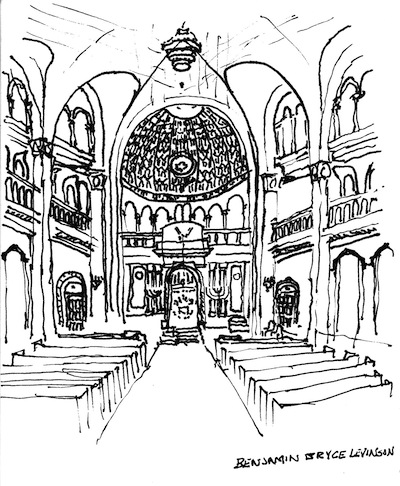
image - Templo Libertad in Buenos Aires, Argentina. Sketch by Ben Levinson
Templo Libertad in Buenos Aires, Argentina. Sketch by Ben Levinson.

The voyage shifts to France, Italy and Scandinavia, with the majestic Marais synagogue in Paris, the synagogue at the Museum of Jewish Life in Trieste and the Gothenburg Synagogue, the scene of a firebomb attack in 2017.

Levinson also presents active scenes of a crowd forming outside a Venice synagogue on a sunny Shabbat morning, passersby in front of an Antwerp temple and a sea of bicycles by the Great Synagogue of Copenhagen.

The visual trip wraps up with drawings from Mexico City and the Byzantine-style building of Libertad Synagogue in Buenos Aires.

Born in Medicine Hat, Alta., in 1942, Levinson graduated from the University of Manitoba’s architectural program. In 1966, he moved to Victoria and worked for various firms before starting his 30-year private practice as president of Benjamin Bryce Levinson Architects in 1980. In addition to leading his practice, he continued sketching and showing his work at various venues, including the Architectural Institute of British Columbia and the Jewish Community Centre of Greater Vancouver.

Levinson was instrumental in restoring Congregation Emanu-El in the early 1980s. When he arrived in town, he felt an initial disappointment upon seeing the synagogue with “its pink stucco, balcony balustrade pickets, missing fence and hidden dome ceiling.” He helped the synagogue’s leadership in obtaining grants and helped steer the building and fundraising committees to get the money necessary to revitalize the region’s most historic Jewish building.

Small Town Architect, the name of his first book, documents his 40-year career in architectural design and recounts his travels and artistic endeavours. His work can be found throughout Victoria and in numerous communities throughout the province; in elementary schools, municipal halls, grocery stores and restaurants, among other buildings.

Sam Margolis has written for the Globe and Mail, the National Post, UPI and MSNBC.
Format ImagePosted on December 13, 2019December 12, 2019Author Sam MargolisCategories Visual ArtsTags architecture, art, Ben Levinson, Emanu-El, history, Judaism, travel
Jewish film festival moves

Jewish film festival moves

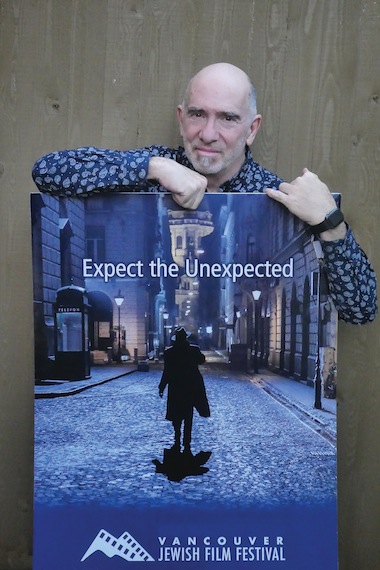
Robert Albanese, executive and artistic director of the Vancouver Jewish Film Centre. (photo from Vancouver Jewish Film Centre)

Community members who associate November with grey skies, falling leaves, American Thanksgiving and, in recent memory, the Vancouver Jewish Film Festival, can now cross the last item off the list. In 2020, the VJFF will be presenting films from Feb. 27 to March 8 instead.

The VJFF, the longest-running Jewish film festival in Canada and one of the longest-running film festivals in North America, will feature a collection of 32 offerings from 14 countries – including many Canadian premières – addressing current, varied and sometimes controversial subjects.

photo - Robert Albanese, executive and artistic director of the Vancouver Jewish Film CentreThis new annual time period is the most popular season for Jewish film festivals. Of the more than 200 international Jewish film festivals, the majority present films in March. In Vancouver, this will mean warmer weather and less rain.

The move to March also permits the Vancouver Jewish Film Centre (VJFC), the society which oversees the festival, to raise funds at the beginning of the calendar year. Moreover, members of the festival staff believe they will have an opportunity to select from an even wider pool of relevant and available films.

Robert Albanese, who was brought in as executive and artistic director of the VJFC in 2010, highlights the past decade of growth the festival has had in the community, and its impact. He is adamant when it comes to the relevance of film and motion pictures in modern culture.

“Film is the most engaging art form of our era … film accesses and engages the broadest community,” he told the Independent.

“We provide Jewish continuity and an awareness of Israel beyond the front page through storytelling in today’s visually oriented world. It is vastly important to have a visible presence of our culture out in this media-centric world,” he added.

Albanese stresses that the VJFF seeks to engage with the broader community by offering the very best film stories it can find. Three of the international films scheduled to screen in March have been submitted by their respective countries to vie for the Best Foreign Film Award at the 2020 Oscars. In spite of Vancouver’s relatively smaller population, the VJFF has consistently been ranked as one of the top 10 Jewish film festivals for the past several years.

Albanese’s name has been ensconced in the minds of local film aficionados for more than three decades. Before coming to the VJFC, he was a general manager for Cineplex Entertainment for 15 years and served as director of exhibitions for the Vancouver International Film Festival for 10 years. Albanese also helps in the selection process for other Jewish film festivals, such as the one held in Victoria in early November.

According to Albanese, the VJFF aims “to showcase the diversity of Jewish culture, heritage and identity through film.” This can be seen in a quick glance at last year’s program which, as festival-goers might recall, included films on an array of topics, such as The Syrian Patient, about wounded Syrians brought to Israel for treatment; Heading Home, a documentary on the Israeli national baseball team; and Chewdaism, a full-length film on Jewish Montreal and its eateries from internet stars Jamie Elman and Eli Batalion of YidLife Crisis fame.

In addition to the annual festival and other events, the VJFF presents films on the last Tuesday of every month. The November film – on Nov. 26 at 1 p.m. – will be The Invisibles, a 2017 German docudrama following the lives of four Holocaust survivors. The monthly screenings take place at the Peretz Centre for Secular Jewish Culture, where the VJFC office is located, and admission is by donation.

The 2020 festival’s opening film will be held on the evening of Thursday, Feb. 27, at the Rothstein Theatre in the Jewish Community Centre of Greater Vancouver, and will be followed by a hosted reception in the centre’s Wosk Auditorium. The festival then moves to Fifth Avenue Cinemas, screening films from Feb. 28 to March 5. For its conclusion, the festival returns to the Rothstein Theatre, with films March 6-8 and special closing day celebrations March 8.

There are presently openings at the VJFC for volunteers to help with film research and selection, event planning, distribution of promotional materials and assistance at the festival, among other tasks. Volunteers receive complimentary tickets based on the number of shifts worked.

The full list of 2020 films will be available in early January on the VJFF website (vjff.org) and elsewhere. The 2020 festival is rolling back admission prices, with passes for $144 for all films, a five-film package of $60 for adults ($50 for students and seniors) and individual tickets at $15 for adults ($12 students/seniors). Tickets for gala events are $25 and an annual VJFF membership card is $2.

Sam Margolis has written for the Globe and Mail, the National Post, UPI and MSNBC.
Format ImagePosted on November 22, 2019November 19, 2019Author Sam MargolisCategories TV & FilmTags Robert Albanese, Vancouver Jewish Film Centre, VJFF

Posts pagination

Previous page Page 1 … Page 23 Page 24 Page 25 Next page
Proudly powered by WordPress