Skip to content
  • Home
  • Subscribe / donate
  • Events calendar
  • News
    • Local
    • National
    • Israel
    • World
    • עניין בחדשות
      A roundup of news in Canada and further afield, in Hebrew.
  • Opinion
    • From the JI
    • Op-Ed
  • Arts & Culture
    • Performing Arts
    • Music
    • Books
    • Visual Arts
    • TV & Film
  • Life
    • Celebrating the Holidays
    • Travel
    • The Daily Snooze
      Cartoons by Jacob Samuel
    • Mystery Photo
      Help the JI and JMABC fill in the gaps in our archives.
  • Community Links
    • Organizations, Etc.
    • Other News Sources & Blogs
    • Business Directory
  • FAQ
  • JI Chai Celebration
  • JI@88! video

Recent Posts

  • Eby touts government record
  • Keep lighting candles
  • Facing a complex situation
  • Unique interview show a hit
  • See Annie at Gateway
  • Explorations of light
  • Help with the legal aspects
  • Stories create impact
  • Different faiths gather
  • Advocating for girls’ rights
  • An oral song tradition
  • Genealogy tools and tips
  • Jew-hatred is centuries old
  • Aiding medical research
  • Connecting Jews to Judaism
  • Beacon of light in heart of city
  • Drag & Dreidel: A Queer Jewish Hanukkah Celebration
  • An emotional reunion
  • Post-tumble, lights still shine
  • Visit to cradle of Ashkenaz
  • Unique, memorable travels
  • Family memoir a work of art
  • A little holiday romance
  • The Maccabees, old and new
  • My Hanukkah miracle
  • After the rededication … a Hanukkah cartoon
  • Improving the holiday table
  • Vive la différence!
  • Fresh, healthy comfort foods
  • From the archives … Hanukkah
  • תגובתי לכתבה על ישראלים שרצו להגר לקנדה ולא קיבלו אותם עם שטיח אדום
  • Lessons in Mamdani’s win
  • West Van Story at the York
  • Words hold much power
  • Plenty of hopefulness
  • Lessons from past for today

Archives

Follow @JewishIndie
image - The CJN - Visit Us Banner - 300x600 - 101625

Tag: Klondike

Victoria hosts Klondike

Victoria hosts Klondike

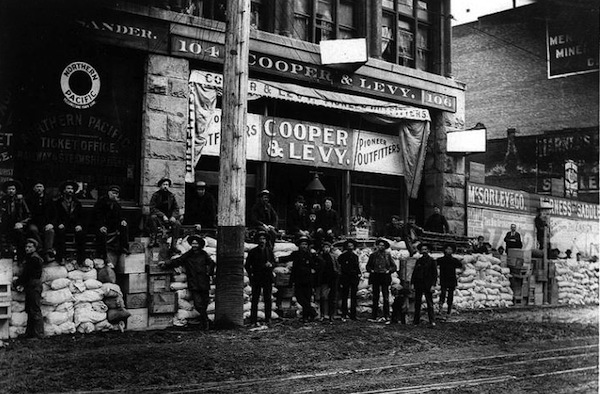
Cooper & Levy store, 104-106 1st Ave. S. near Yesler Way, Seattle, 1897. The store was one of the major outfitters of the Klondike Gold Rush. (photo from Asahel Curtis Collection, University of Washington UW 4770)

The archival images and newspaper headlines contained in the Gold Rush exhibit now on display at the Jewish Community Centre of Victoria (JCCV) evoke a sense of the hysteria that gripped the West Coast more than century ago, in spite of the risks involved in traveling to a severe and treacherous terrain. And Jews were not immune from the mania, as the three-panel display, entitled “The Jewish Presence During the Klondike Gold Rush 1897-1918,” distinctly demonstrates.

The exhibit will be at the JCCV through January. It brings with it a number of revisions from the one that toured Canada from 2016 to 2018 and included a stop in Vancouver.

“During its previous run, we received a lot of additional information from people who visited the exhibit, so much so that we couldn’t include it all in the current display. We are seriously thinking about doing a book starting later this year,” Rick Karp, president of the Jewish Cultural Society of Yukon (JCSY), told the Independent.

Once the previous display returned to Whitehorse, Karp followed up on the input he received and updated the three panels and the booklet accompanying the exhibit.

“As well, we revised the video that details the finding of the Jewish cemetery from the Gold Rush in Dawson, the cleaning and bringing it back to its original condition, and the rededication ceremony,” Karp said. “All the information about the cemetery in the accompanying booklet has been added, as well as the section entitled ‘The History of the Jews in the Klondike Gold Rush’ and the ‘Stories of the Gold Rush.’”

A significant addition to the Gold Rush stories is that of Joseph Barron, one of the first to open a mercantile store in Dawson. Barron came from Winnipeg and followed the stampede of 1898. He mushed into the Yukon via the White Pass route, bringing with him a stock of merchandise.

His beginnings in the north were not the most fortuitous. He lost his supplies on three occasions to fire between 1899 and 1901. Undeterred by adversity, he restocked and started over.

The Barrons would become a prominent Calgary family. Joseph’s son Abe founded the law firm Barron & Barron, which is still operated by the family today. His other son, Jacob (J.B.), was a leading businessman and theatre owner in the city, building Calgary’s first high-rise, the Barron Building, and breaking ground on its first Modern Orthodox synagogue, Shaarey Tzedec (which was demolished in 2013).

Joseph Barron’s wife and children did not come to Dawson until 1902. The younger Barrons only stayed for two years before they left to complete their education. The senior Barrons eventually left Dawson to join their children in Calgary in 1915.

Henry Isaacs was another entrepreneur who ventured north. He earned the moniker “the Butter King of the Klondike” upon learning about a technique using sea water to re-churn a shipment of what others had considered rancid butter into something edible.

Among the most enterprising adventurers was David Gross, a Russian immigrant and dropout trained as tailor, who, not yet 20 years of age when he made the journey north, found ways to make money selling groceries, stoves and other provisions, though his primary business was a clothing store. His ingenuity led him to see opportunities where others did not. For example, if butter had turned rancid and was unsalvageable for food purposes, he would sell it as axle grease for squeaky wheels. After learning that water can only penetrate an inch or two into flour, he would purchase large sacks of flour other merchants thought had been drenched and, therefore, ruined and then sell the flour that the water had not reached at a much higher price. Gross also became active in the nascent movie theatre business in Dawson City.

Yet the prize for the most daring Jewish seeker of fortune would have to go to Max Hirschberg. After losing his supplies en route and then finding, in 1890, that many of the good claims in Dawson had been staked, Hirschberg pushed on to Nome, where more gold was reported to be, on a bicycle!

Later in life, before his passing in 1964, he recounted the 11-week journey in which he made his way along a two-inch trail, confronting snow-blindness, exposure and exhaustion, nearly drowning in the Shaktoolik River and losing $1,500 in gold dust. When his bike chain broke, he made a sail from his coat and rigged it to his bicycle, then crossed the Norton Sound to Nome.

Interest in the Jewish community during the Gold Rush was ignited after the discovery of the aforementioned Jewish cemetery in Dawson City in 1995, and its ensuing restoration in 1997 and 1998. “The discovery of lives lost inevitably leads to questions about lives lived,” the exhibit booklet reads.

“The Jewish Community Centre of Victoria is excited to host the mobile exhibit. We would like to thank Rick for making it possible,” said Larry Gontovnick, president of the JCCV.

After it completes its current tour around Canada, the exhibit will be on permanent display at the Dawson City Museum in the Yukon. A duplicate copy will tour various communities in the United States.

Sam Margolis has written for the Globe and Mail, the National Post, UPI and MSNBC.

Format ImagePosted on January 17, 2020January 15, 2020Author Sam MargolisCategories LocalTags Gold Rush, history, JCSY, Jewish Cultural Society of Yukon, Klondike, Rick Karp, Victoria, VJCC, Yukon
Klondike’s Jewish links

Klondike’s Jewish links

Entrance of the Jewish Cemetery in Dawson City, Yukon. The sign reads Bet Chaim (House of the Living). The photo was taken in 1961. (photo by Irving Snider; Dr. Irving and Phyliss Snider fonds; Jewish Museum and Archives of BC L.18992)

As visitors to the traveling exhibit The Jewish Presence During the Klondike Gold Rush 1897-1918 will learn, while the hope of striking it rich drew thousands upon thousands to the Klondike during the gold rush, most had left the region within five years, many as poor as when they arrived.

The exhibit, created by the Jewish Cultural Society of Yukon, is currently at Temple Sholom and will open at Congregation Beth Israel on Jan. 31, 7:30 p.m. The opening will feature a talk by Michael Schwartz of the Jewish Museum and Archives of British Columbia, and the exhibit will be on display at BI until Feb. 7.

The first panel, called “Gold Fever Strikes,” begins, “It was at Schwabacher’s dock on Seattle’s Elliott Bay that the steamer Portland arrived on July 17, 1897, with her ‘ton of gold’ that electrified the world and sparked the Klondike gold rush. Soon thousands would leave that dock and others on their way to Alaska.” It notes that the Schwabachers – Abraham, Sigmund and Louis – who founded their Seattle merchandising business in 1869, had been born “in Germany of Jewish heritage” and “they left to escape the oppression of Bismarck.” The rest of the panel highlights several Jews who were involved in supplying goods and transportation to Yukon.

The second panel – “Life in the Klondike” – relates some of the stories of successful, and not so successful, Jewish prospectors and merchants. For example, “Louis Brier, a native of Romania, followed the rush and provided grubstakes to prospectors on a percentage basis. He eventually left for British Columbia with what he called ‘a rather bulging bankroll,’” it notes.

One of the less happy outcomes is that of the Shudenfreis. Among the first Jews to arrive, in fall 1897 to Dawson City, Solomon and Rebecca Shudenfrei came to the Klondike without their children. By September 1898, Rebecca had left and, soon after a fire in March 1899 that destroyed many of the city’s homes and businesses, including Solomon’s hotel, Solomon also left. The loss of the hotel was a mixed blessing, according to a letter he wrote: “I only lost all I had, which is not much, and I was glad that the fire occurred so that I could get rid of all my bed-bugs, which I could not do otherwise … the loss is not so great when you come to consider that we would have to remove the building anyhow by May 1, and [that] would have been a great expense to me…. The whole town is on the buy, and all my acquaintances are not any better off than I. This is the only consolation we have.”

The second panel also touches upon other aspects of life at the time – religious observance, politics, the Jewish cemetery and crime (of which Jews, as much as anyone else, were among the victims and perpetrators). The third panel, “After the Gold Rush, Where Did They Go?” provides brief descriptions of where some 15 Jews went after the rush was over.

The exhibit includes a booklet, as well as four videos, each about eight minutes long. They centre on the finding and rededication of the Jewish cemetery in Dawson City in 1998. One video shows the finding of the cemetery, which was established in 1902 but fell into disrepair as the Jewish presence in the area disappeared; one video covers the cemetery’s restoration; and one the July 31, 1998, rededication ceremony, which included many guests, including then-deputy prime minister Herb Gray, who spoke at the ceremony. (Gray passed away in 2014.) The fourth video, explains the document about the exhibit’s setup, “is the CBC TV coverage of the arrival of a Torah, the first time in history that Shabbat services were held in Whitehorse, a little tour of Dawson City … and the rededication services.”

That Torah, in 1998, was only the second to have been brought to Whitehorse – the first having been brought during the gold rush. With the rededication, the Dawson City Jewish cemetery, Bet Chaim (House of the Living), once again became a place where Jews can be buried.

photo - Rick Karp, president of the Jewish Cultural Society of Yukon
Rick Karp, president of the Jewish Cultural Society of Yukon. (photo from JCSY)

“Cyril Leonoff’s book Pioneers, Pedlars and Prayershawls: The Jewish Communities in British Columbia and the Yukon was what started all of our research,” said Rick Karp, president of the Jewish Cultural Society of Yukon, in an email. Additional research was contributed by Dr. Brent Slobodin, who has a doctorate in Canadian history from Queen’s University and was the assistant deputy minister of advanced education in Yukon. Slobodin has been a member of a number of heritage advisory and volunteer boards.

Karp’s day job is president of the Whitehorse Chamber of Commerce, and Slobodin joined the chamber when he retired to manage its Partnering for Success Program, Karp told the Independent. “As an historian, he was fascinated with the work we were doing on the Jewish presence during and after the Klondike gold rush and we hired him to work on the research, design and preparation of the mobile display,” said Karp.

Now that the exhibit has been completed and displayed both within and outside of Yukon, Karp said the cultural society has two main priorities, the first of which is keeping “the display going across the country, so, after Vancouver, it will go to Edmonton, Calgary and Winnipeg. Then we will get it back here and it will go to Alaska and a few other cities in the U.S.”

The second priority is closer to home. “We are also educating the Yukon on what it is to be Jewish so, for example, we celebrate Passover and have the seder in the United Church meeting hall (about 40 people attended last year), and we are part of the interfaith community in Whitehorse,” said Karp.

“We also have more than 12 Israelis living in Whitehorse and have visits from Israel often,” he added. “For example, we have Dr. Wayne Horowitz coming … from Hebrew University and we will have him do presentations when he is here, and Dr. Paul Sidoun, as well, who is coming in February.”

Format ImagePosted on January 26, 2018January 24, 2018Author Cynthia RamsayCategories NationalTags Beth Israel, history, Klondike, museum, Rick Karp, Yukon
Proudly powered by WordPress