Skip to content
  • Home
  • Subscribe / donate
  • Events calendar
  • News
    • Local
    • National
    • Israel
    • World
    • עניין בחדשות
      A roundup of news in Canada and further afield, in Hebrew.
  • Opinion
    • From the JI
    • Op-Ed
  • Arts & Culture
    • Performing Arts
    • Music
    • Books
    • Visual Arts
    • TV & Film
  • Life
    • Celebrating the Holidays
    • Travel
    • The Daily Snooze
      Cartoons by Jacob Samuel
    • Mystery Photo
      Help the JI and JMABC fill in the gaps in our archives.
  • Community Links
    • Organizations, Etc.
    • Other News Sources & Blogs
    • Business Directory
  • FAQ
  • JI Chai Celebration
  • JI@88! video

Recent Posts

  • Story of Israel’s north
  • Sheltering in train stations
  • Teach critical thinking
  • Learning to bridge divides
  • Supporting Iranian community
  • Art dismantles systems
  • Beth Tikvah celebrates 50th
  • What is Jewish music?
  • Celebrate joy of music
  • Women share experiences 
  • Raising funds for Survivors
  • Call for digital literacy
  • The hidden hand of hate
  • Tarot as spiritual ritual
  • Students create fancy meal
  • Encouraging young voices
  • Rose’s Angels delivers
  • Living life to its fullest
  • Drawing on his roots
  • Panama City welcoming
  • Pesach cleaning
  • On the wings of griffon vultures
  • Vast recipe & story collection
  • A word, please …
  • מארק קרני לא ממתין לטראמפ
  • On war and antisemitism
  • Jews shine in Canucks colours
  • Moment of opportunity
  • Shooting response
  • BC budget fails seniors
  • Ritual is what makes life holy
  • Dogs help war veterans live again
  • Remain vital and outspoken
  • An urgent play to see
  • Pop-up exhibit popular
  • An invite to join JWest

Archives

Follow @JewishIndie
image - The CJN - Visit Us Banner - 300x600 - 101625

Byline: Cynthia Ramsay

Security through peace

Security through peace

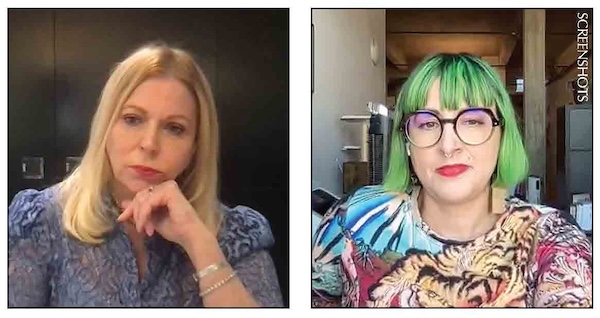
Noa in conversation with Rabbi Dan Moskovitz at Temple Sholom Oct. 30. (screenshot)

Israeli singer/songwriter and peace activist Achinoam Nini (Noa) was in British Columbia recently to do a Vipassana meditation. While here, she stopped at Temple Sholom Oct. 30 for a conversation with Rabbi Dan Moskovitz (which is on YouTube) and at Congregation Emanu-El Nov. 4 for a talk with Rabbi Harry Brechner.

Noa was born in Israel in 1969. She’s the fifth generation of her family in Israel, their presence dating back to the mid-1800s. They immigrated from Yemen.

“They came because they were persecuted at the time and they came to the only place they knew, that their heart drew them to, and that was Jerusalem and the Kinneret,” she said. “That was the two places. They walked across the desert and took boats and were smuggled by Bedouins. It’s a very dramatic story, how the family made it to the Holy Land.”

Noa’s father got a scholarship to study at the University of Rochester, so she spent the first couple of years of her life in Rochester, NY.

“When I went into first grade, my family moved to the Bronx, NY. My dad was now doing his PhD in Columbia University. And my parents decided to send my brother and I to yeshivah…. I was the only dark-skinned kid in the school, the only Israeli kid in the school, the only family that didn’t live in something that looked like a mansion. 

“My way of dealing was in two ways,” said Noa. “First, fortunately, I was a gifted student, so I had a scholarship to school that helped my parents…. And music. I started writing songs at a very young age…. I was interested in physics and mathematics, I loved history. I wanted to go to Harvard and do a PhD in physics and history, but that didn’t happen, obviously. Music … chose me.”

At age 17, on a summer vacation in Israel, Noa met a soldier on leave.

“I went back home,” she said. “I told my parents, I’m making aliyah. I said, you raised me to be a Zionist. We love Israel. I want to live in Israel.”

To this day, Noa is married to that man (Asher Barak, now a medical specialist and entrepreneur), and they have three children, two of whom are in the Israel Defence Forces, one in service, the other in the reserves.

Noa did her army service in a military entertainment unit, then started her music career. While at the Rimon School of Music, she met Gil Dor, who was one of her teachers. “He’s an extraordinary and amazing, brilliant musician and we’ve been working together now for 34 years,” said Noa.

They caught the attention of guitarist Pat Metheny, who produced Noa’s first album and brought it to David Geffen, who then signed Noa at Geffen Records.

“I started performing abroad and foreign journalists started asking me my opinion about the Palestinian-Israeli conflict and I’m like, I’m an artist, I don’t speak about things like that, don’t ask me questions like that.”

But she didn’t feel good about not responding. “And so, I started learning more and reading more and I became more and more depressed,” she said. “And then came Yitzchak Rabin and he started talking about peace. And I was like, yes, this is great!”

A believer in the Oslo Accords, Noa was the only leading Israeli musician to agree to perform at the peace rally where Rabin was murdered.

“I saw Rabin and I hugged him … and I walked down the stairs. Ten minutes later, he walked down the stairs and was killed…. I remember the rush and the cry and everybody running, and panic, and myself running and pushing to see what had happened,” Noa shared. “It was a trauma. I haven’t recovered, absolutely not. I haven’t recovered – and neither has Israel.”

At that moment, said Noa, “I said, OK, well, if this guy just paid with his life for our future, the future of Israel, the future of my children, then I, too, can do something. And then, maybe, I’ll pay a price and that’ll be OK because it’s the right thing to do. And that’s when I started becoming an activist for peace.”

There were two other life-changing events for Noa in the 1990s. She was invited to sing at the Vatican for Pope John Paul II and she was asked to write the lyrics and sing the theme song of the film Life is Beautiful (La Vita e Bella), which won an Oscar.

Among her many achievements, Noa represented Israel in the Eurovision Song Contest in 2009. She did so with Palestinian-Israeli singer/songwriter Mira Awad. “I wrote a song called ‘There Must Be Another Way,’ and we sang it in English, Hebrew and Arabic,” said Noa. “It made a lot of waves around the world and I have to say that, until today, it is taught in schools around the world.”

She related a story about that experience. 

“Mira, her mother is from Bulgaria and her father is Palestinian. She’s quite fair-skinned, with green eyes. My family is from Yemen…. I’m an Arabic Jew. And so, when we sat in front of media, I remember there was one day where they had BBC Iran, they had Al Jazeera, they had all kinds of media…. All the Arab media immediately came up to me in Arabic and to her in English, [assuming] she’s the Jew. And so, I told them, you see, that is the role of art – our role is to shake you up a little. You think you understand everything. Maybe you don’t. Maybe there’s another way of looking at it…. You can’t think that you understand everything about everything. No, it’s not black and white. And that’s, of course, very relevant to where we are today.”

That said, there has been progress towards peace, she contended.

“There’s a huge polemic about whether there should be or there shouldn’t be a Palestinian state,” she admitted, “but there is a conversation being had about it…. In the past, it was not even talked about at all. It was underground.”

She also pointed to the many organizations that work with and/or are staffed by Arabs and Jews. Noa is on the boards of the Arava Institute and the Umm el-Fahem Museum of Art, for example. She’s also involved with the Parents Circle – Families Forum.

“The world in general is not a great place for people who believe in peace right now,” she acknowledged. “I think that we are under attack by forces, if you like, forces of darkness from everywhere. But, like I always say, that’s not reason enough not to continue raising the voice…. I believe in peace. I don’t see any other way to live. Has the peace camp changed? It has transformed in many ways.”

She gave the example of a WhatsApp group called Voices of Solidarity. She said a lot of young people are doing things – “it’s either art, it’s underground theatre, it’s alternative music.” She mentioned the organization Standing Together.

“Yitzhak Rabin, when he started talking to [Yasser] Arafat, the terrorist, everyone was like, what, no way, forget it. Seventy-five percent of the Israeli public were against any kind of interaction with Palestinians but then he came [along] with his charisma and his leadership and his integrity and his honesty and his track record, and he started saying, we’re going to be doing this and this is the right thing and this is for Israel’s future, for our children, we’ve made enough wars…. And then, it was like a month later, the entire public opinion, it shifted towards being positive about the chances for peace.”

That could happen again. A change in circumstances, a particular leader’s personality, the right timing, she said.

For Noa, Israel is in a worse situation now than immediately after Oct. 7.

“The hostage situation … is a nightmare beyond words. I go every week, sometimes I go twice a week, three times a week, to stand with them [the families and others calling for the hostages to be brought home]…. They’re desperate. I don’t know how they are still sane…. And the fact that that their children are still there [in Gaza], that they haven’t been brought back, that not everything has been done to bring them back, is not anything that Israel will ever recover from.”

She is appalled that the government is still in power.

“Not only did they not resign,” she said, “they then turned around to blame everybody that saved Israel, including Brothers and Sisters in Arms, including all the organizations that volunteered, [and] to blame the hostage families for daring to want their children back…. It’s beyond words.”

She advised diaspora Jews to distance themselves from the government: “separate the Israeli government from the Israeli people, it’s not the same thing,” she said.

“If you are going to look at a lot of consistent polls, you’ll see that people – even people that voted for the present government – feel betrayed by what the government has eventually done. They don’t understand how the government is not taking responsibility. They don’t understand how the dictatorship coup keeps moving forward when we’re in such a stressful situation. They don’t understand how our relationship with the entire world has come to a complete collapse under the auspices of this government. The Israeli government right now is the enemy of the Israeli people. And you can say that…. We support the Israeli people, we support the country of Israel, but we do not support the government of Israel.”

She warned of the dangers extremists pose in any country, and asked people to “strengthen the moderates in civil society in any way you can.”

She added, “Throughout history, countries have fallen into terrible situations of leadership. Italy, my favourite country in the world after Israel, became a fascist country at some point, with Mussolini, and there was Franco [in Spain] and there were other people, other countries that came into [similar] situations. Does that delegitimize the country? No. It means that a certain combination of events led to the fact that a country was now held hostage by leadership that did not work in her benefit. That is what is happening right now to Israel, and we have to work through it together with the help of our friends, and you are our friends.”

Noa doesn’t just fault the Israeli government. “In my opinion,” she said, “everybody in the region is to blame for the horrible situation we’re in. Nobody made the efforts. The leadership did not make efforts to make peace, not Israeli leadership, definitely not Palestinian leadership.”

She believes Israel had to defend itself after Oct. 7.

“What were we supposed to do? Sit around [twiddling our thumbs] while our kids were being massacred and our women were being raped? Yes, Israel needed to go in. The war was legitimate. But – it was legitimate to the extent that there was a plan. There needs to be a plan. Say, we have to fight, but now, let’s see, we’ve attacked, we’ve retaliated, we’ve done this, we’ve shown that, we’re there for our people. But we have to bring the hostages back…. Second, we have to see, who are our allies? We’re a small country, we’re nine million people – whoa, we want to attack the entire world? No. Who are our allies? Who are our friends? How can we start progressing towards a solution to this? Not endless warfare. Who are the people that want to talk to us? The UAE, the Saudis, the Americans, the Europeans, let’s reach out to them. This is what the Israeli government should have done immediately.”

While acknowledging that Israel needs a strong army, Noa said, “at the same time, parallel institutions need to come in and do their job, the diplomatic job, to reach out to our friends … and make sure that Israel is secure. Our security will come with peace, only with peace, and we have to look at this as an opportunity to make peace. And are there partners? There are.”

She said, “As a woman who lives in Israel, loves Israel and sends her kids to the army…. We need to be able to look forward to a time when we will not be sending our children to the army. Is it possible? Yes.” 
Format ImagePosted on November 29, 2024November 28, 2024Author Cynthia RamsayCategories LocalTags Achinoam Nini, Israel, Israel-Hamas war, music, Noa, Oct. 7, peace, politics, terrorism, two-state soloution
Diversity in health care

Diversity in health care

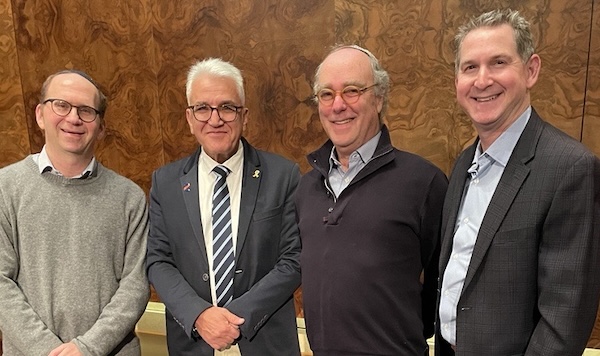
Left to right are Rabbi Jonathan Infeld, Dr. Salman Zarka, Dr. Tim Oberlander and Dr. Erik Swartz at Congregation Beth Israel, where Zarka gave a few talks Nov. 21-23. (photo from Beth Israel)

“Our professional ethics, as well as Israeli legislation, mandate that we provide life-saving medical care to anyone in need. We do so for all citizens in Israel without discrimination based on religion, origin, race or political beliefs. We provided this care for Syrians and previously treated Lebanese patients, until the border was closed in 2000,” Dr. Salman Zarka, director of Ziv Medical Centre, told the Independent.

Zarka was in Vancouver last week, speaking at Congregation Beth Israel on the ethics of triage, on treating Syrian patients in Israel, and about his community, the Druze.

“I am delighted to visit Canada and share with different audiences the amazing work we’ve been doing at Ziv Medical Centre this past year, dealing with both war and emergency situations,” Zarka told the Independent. “This visit is also a great chance to thank the supporters in Canada from the Jewish community, Beth Israel, the Federation and the Ronald S. Roadburg Foundation.

“The visit is a chance to share our ongoing efforts in treating the wounded, as well as past activities related to caring for Syrian casualties,” he said.

Caring for an “enemy”

“The humanitarian aid to Syrians lasted for around five years, from 2013 to 2018, until [Bashar al-]Assad took back control of southern Syria, closed the border, thereby stopping patients and wounded from Syria coming to Israel,” said Zarka, who led the establishment of the now-closed military field hospital that provided medical support to Syrians wounded in the country’s ongoing civil war. He and his colleagues at Ziv Medical Centre have also provided care to Syrians.

“It is indeed unusual and uncommon to extend a professional and human hand to your enemies during their time of need,” he said. “On the other hand, we have an ethical duty to treat every patient and every wounded person. This dilemma existed at the start of the process, when wounded Syrians arrived at the Israel-Syria border. We treated them and asked ourselves what we should do next. On one hand, the Syrians are one of our most severe enemies, yet our ethics and professional standards oblige us to save lives and provide aid to all in need. Moreover, Israel is known for its global humanitarian assistance. Ultimately, we chose to provide care, treating close to 4,600 Syrians, including children, women and men.”

Before he retired from the military, Zarka served in various capacities in the Israel Defence Forces, including many leadership roles, and is currently a colonel brigadier in the reserve force. He is an expert in public health and public health administration, as well as being a practising physician, among other things. He was Israel’s chief COVID officer during the pandemic. In 2014, he became the director at Ziv Medical Centre, in Tzfat, about 11 kilometres from Israel’s border with Lebanon.

“Ziv Medical Centre employs about 2,200 staff members who come from the unique multicultural background of the region,” said Zarka. “At Ziv, secular Jews work alongside ultra-Orthodox Jews, Muslims, Christians, Druze, Circassians and Bedouins,” he said. “The hospital atmosphere is familial, and everyone collaborates to achieve the noble goals of saving lives and bringing healing to those in need. Cultural differences influence how people perceive illness, and our multicultural staff enables us to offer culturally sensitive care for various health needs.”

After the Oct. 7, 2023, Hamas attacks on southern Israel, the northern part of the country faced increased threats from Hezbollah in Lebanon, leading to mass evacuations of the region.

“For over a year now, the north has faced a complex situation with rocket fire and evacuations,” said Zarka. “This state of conflict forces Ziv Medical Centre to operate from protected spaces and remain prepared for mass casualty incidents. The need for readiness and staying in protected areas limits our ability to treat patients comprehensively, but it is unethical to deny necessary medical treatment to our northern population, which depends on Ziv for their routine treatment.”

The challenges are numerous.

“Some of our patients left the area, preventing us from continuing their care, while others relocated nearby and continued their treatment,” Zarka said. “Both the evacuated population and those facing rocket fire, injury and loss require increased mental health support, leading to a rise in emergency room visits. Additionally, some of our staff had to evacuate from their homes, posing challenges for employees who continued to work at Ziv despite the distance.”

The security situation in the north requires the medical centre to reassess its reinforced spaces, while continuing to provide necessary medical care to patients, even during emergencies, said Zarka.

“The end of the war and the return of residents to their homes will pose significant mental health challenges for both adults and youth, as was seen following the COVID-19 pandemic,” he added. “Preparing to expand services in the region is essential. The north will require substantial investment not only for recovery but for growth, making it a beautiful and unique area, home to multicultural residents, many of whom are from lower socioeconomic backgrounds, who depend on Ziv Medical Centre for their health care.”

Israel’s Druze community

There are about 150,000 Israeli Druze. The Druze religion is monotheistic; it branched off from Shia Islam in the 11th century and has since incorporated elements of other religions. The Druze are ethnically and linguistically Arabic, mainly living in Syria, Lebanon, Jordan and Israel, notably, in northern Israel.

“The Druze community in Israel chose, even prior to the state’s establishment (back in the 1930s), to ally with the Jewish population, a minority at the time, possibly as a bond between minorities,” explained Zarka. “The Druze supported the Jews before the state was founded and fought in the War of Independence. Afterward, the Druze decided to enlist in the IDF as volunteers and requested mandatory enlistment for their men, which began in 1956. Druze men serve in the IDF like Jewish men, with high enlistment rates in combat units, continuing with a significant service, achieving senior ranks. I served in the IDF for over 25 years in key roles in the Medical Corps, commander of medical services in the Northern Command and head of medical services, retiring with the rank of colonel.”

A 2023 article in the National Post noted, “Aside from combat roles, the Druze have a presence in health care: in 2011, the Druze made up 16% of the IDF’s medics, despite making up only 1.6% of the force.”  The article gave Zarka as an example of a prominent Druze, having achieved success in both the military and in health care. 

There are challenges for the Druze community in Israel, however. 

“Much has been said about the ‘blood pact’ forged between the Druze and the Jews in Israel, which, unfortunately, translates into casualties in Israel’s various military conflicts,” Zarka told the Independent. “Alongside this connection, particularly strong in the IDF and security forces, there exists a civilian gap in the so-called ‘pact of life.’ The Nation-State Law [in 2018] did not address minorities in Israel, omitting the crucial term ‘equality,’ making the Druze feel relegated to a lesser status compared to their Jewish fellow citizens.

“Beyond the significance of this matter, which is not merely declarative, Druze towns (mainly villages) have long suffered from planning and land allocation issues, complicating construction and housing, even for discharged IDF soldiers. Addressing these two issues, namely equality and long-term planning, is central to the relationship between the Druze and the government.” 

Format ImagePosted on November 29, 2024December 2, 2024Author Cynthia RamsayCategories LocalTags Druze, health care, Hezbollah, Israel, medical ethics, medicine, Salman Zarka, Syria, war, Ziv Medical Centre

Two great books for giving – Tali and the Toucan & Oy, Santa!

Honestly, I think adults would benefit from reading children’s books, even if they don’t have kids. Generally, the books impart good messages, like how to overcome challenges or be proud of who you are, and their illustrations are works of art. The two I reviewed for this issue of the Jewish Independent are prime examples.

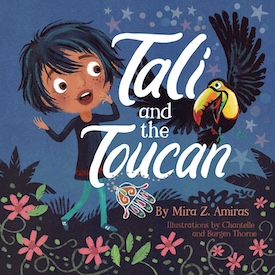
image - Tali and the Toucan book coverTali and the Toucan by writer Mira Z. Amiras and illustrators Chantelle and Burgen Thorne (Collective Book Studio) is set in San Francisco. The young protagonist, Tali, longs to tumble, swing and cartwheel like other kids, and she would love to take martial arts. But she is debilitated by fear – that the world will shatter, that she will break into a million pieces, that she will get hurt. Then, one night, she has a dream. At first, it’s kind of a scary dream, with a storm raging, chickens flapping about. One chicken makes it to the roof, pecks a hole in the window glass, and transforms into a toucan. The colourful-beaked bird teaches Tali how to tumble and soar in the sky. She awakes with new spirit and courage, no longer feeling like a chicken but like a toucan, ready to fly – and fall – with the other kids.

While not spelled out in the story, at the end of the book, there’s a note that explains that Tali’s fear of the world shattering “is taken from Jewish teachings that the world is indeed broken and that our job, called in Hebrew tikkun olam, is to put it back together again – starting with ourselves.” In addition to the “hamsa she wears – an amulet common to peoples of the  Middle East worn to protect children – her dreams lead her to conquer her fears, begin her tikkun and follow the path of Aikido, the Japanese martial art of nonviolence that teaches harmony, mutual assistance and peaceful resolutions to conflict.”

Other than the fact that Tali wants to do martial arts, the text of Tali and the Toucan doesn’t touch upon ideas like multiculturalism, cooperation or what a well-functioning society looks like, but rather expresses these concepts through the artwork. There’s a lot to look at in the illustrations and they beautifully capture Tali’s emotional journey.

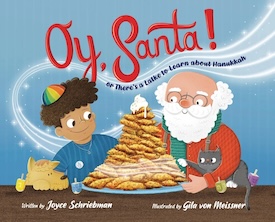
image - Oy, Santa! book coverOy, Santa!, or There’s a Latke to Learn about Hanukkah by writer Joyce Schriebman and illustrator Gil von Meissner (Intergalactic Afikoman) also expresses so much with its artwork. Whereas Tali’s hamsa makes an appearance on almost every page of her book, different kinds of light run through Oy, Santa! – white swirls full of stars, hanukkiyot with candles lit, strings of Christmas lights and exploding fireworks. While Tali and the Toucan only hints at multiculturalism and doesn’t explicitly talk about Judaism, Oy, Santa! puts both topics front and centre.

On Christmas Eve, young Oliver Overstreet writes an email to Santa: “I know you’re busy making toys, so I won’t write much. But I’m Jewish. And that means you don’t have to come down my chimney on Christmas Eve. I just wanna make sure you know.”

And so begins a delightful – and educational – email exchange between Oliver and Santa, who assures Oliver that he knows that both Oliver, and Oliver’s friend Ibrahim, do not celebrate Christmas. Oliver rails at Santa’s signoff, wishing Oliver a “Happy Chrismukkah!”

“Dear Santa,” he writes. “I know you’re still very busy. But please don’t write Chrismukkah. That’s not my holiday. I celebrate HANUKKAH. And Hanukkah and Christmas are different….” Oliver goes on to explain the story of Hanukkah and some of the fun ways the holiday is celebrated.

Santa and Oliver talk about many things in subsequent emails, from elves getting time off to celebrate whatever holidays are in their culture, to miracles and how reindeers fly, to whether it’s acceptable to put ketchup on latkes, and more. The conversation even gets a little heated, but – spoiler alert – Oliver and Santa work things out.

Oy, Santa! is a wonderful read, with lots of humour, fun illustrations, and great takeaways about identity, diversity, culture, civil discourse and friendship. 

Posted on November 29, 2024November 28, 2024Author Cynthia RamsayCategories BooksTags children's books, Collective Book Studio, Hanukkah, Intergalactic Afikoman, tikkun olam
Ageism is everywhere

Ageism is everywhere

Panelists Margaret Gillis, left, and Dr. Melanie Doucet were the experts featured at this year’s Simces & Rabkin Family Dialogue on Human Rights, which focused on ageism.

“Ageism is anytime we make an assumption, a judgment, a stereotype, or discriminate based on age. And this can go in any direction. You’ve often heard people say, ‘too young to understand,’ ‘too old to understand.’ It can be directed toward oneself. It manifests in our interrelationships with others. And it is evident in our institutions and organizations. In fact, it is everywhere,” said Zena Simces in her remarks at the sixth annual Simces & Rabkin Family Dialogue on Human Rights, which took place over Zoom on Oct. 28.

Ageism impacts many aspects of life, said Dr. Simon Rabkin. “It affects our health, both physical and mental,” he said. “Studies have shown that psychosocial impacts of ageism include low self-esteem, self-exclusion, lack of self-confidence and loss of autonomy, both for older and younger people. The data indicate that workplace ageism is associated with increased depression and long-term illness. Importantly, studies have found that older persons with more negative self-perceptions of aging have significantly reduced longevity.”

Simces and Rabkin set the stage for the dialogue, which was called Too Old, Too Young: A Conversation on Ageism and Human Rights. It featured Margaret Gillis, founding president of the International Longevity Centre Canada (ILCC) and co-president of the International Longevity Centre Global Alliance, and Dr. Melanie Doucet, an associate with the Centre for Research on Children and Families at McGill University, who is a former youth in care. The discussion was moderated by Andrea Reimer, an adjunct professor at the University of British Columbia’s School of Public Policy and Global Affairs, who herself survived as a street-involved youth.

Gillis focused on the impact of ageism on older persons. She gave examples of human rights violations taking place in Canada, including that Canada’s long-term care homes have been under strain and in need of reform for at least two decades. She said an estimated one in 10 older Canadians experiences some form of elder abuse, adding that such abuse is underreported. She spoke about ageist employment practices and negative media representations of older persons.

“Ageism is toxic to the global economy and to health,” she said. “For instance, a US study showed a massive $63 billion per year impact on the economy as a result of ageism in health care. Perhaps one of the most distressing aspects of ageism is its prevalence, the World Health Organization finding one in every two persons is ageist.”

Nonetheless, not much is being done about it, said Gillis.

“I should note that there are protections against ageism in the Canadian Human Rights Code and the provincial human rights codes. But, the problem is, this takes time, money and know-how and our legislation and court process are not well-equipped to remedy complex situations like ageism easily and cost-effectively.”

Gillis encouraged people to join the Canadian Coalition Against Ageism, which she established. It comprises organizations and individuals who are working to confront ageism and bring about changes, based on the WHO global report on ageism. 

She advocates for the adoption of a United Nations Convention on the Rights of Older Persons. 

“In general, a convention is a method to achieve positive change by combating ageism, guiding policy-making and improving the accountability of governments at all levels, which we most certainly need,” said Gillis. “A convention would also educate and empower, and we’d see older people as rights holders with binding protections under international law.”

Doucet spoke about the human rights of younger persons, specifically youth who age out of the care system. She explained that youth age out of care at the age of majority and that, in British Columbia, about 1,000 youth age out annually.

A video Doucet made as part of her doctoral research included data on the difficulties most young people exiting care experience: 200 times the risk of homelessness, post-traumatic stress disorder rates on par with war veterans, and fewer than 50% finish high school.

Statistics Canada Census data from 2016 indicated that nearly 63% of youth ages 20 to 24 were still living with their parents, with almost 50% staying home until the age of 30. “And I’m sure those statistics have even increased since the pandemic,” said Doucet.

“Youth in care don’t have that luxury. They’re legislated to leave the system at age of majority. So, they’re deemed too old to remain in the child-welfare system after they reach age 18 or 19, depending on where they live in Canada, but, yet, too young to be sitting at the table when policy decisions are being made that impact them, sometimes even at their own intervention planning meetings with social workers.”

Additionally, in the last 20 years or so, a new developmental phase – “emerging adulthood,” which occurs between the ages of 19 and 29 – has been acknowledged in the academic literature, said Doucet. “It’s a phase that encompasses young people who are not necessarily children anymore but they’re not quite adults, and it provides room for identity exploration, trial and error, obtaining post-secondary education, and just figuring out one’s own place in the world. Youth in care aren’t able to experience this crucial developmental phase because of the legislated age cutoffs.”

There are studies that measure the benefits to both the youth affected and society at large of extending the age cutoff: “a return of $1.36 for every $1 spent on extending care up to age 25,” Doucet said.

Meanwhile, the cost of not extending care is high. For example, youth in care lose their lives up to five times the rate of their peers in the general population, she said. Poverty is more prevalent, as is homelessness, as previously noted.

“Out of the 36 countries in the global north, Canada is one of the six that does not have federal legislation to protect the rights of youth in care,” said Doucet. “While Canada has ratified the UN Convention on the Rights of the Child [CRC], it only provides human rights protections for children and youth until the age of 18. So, youth in care who are transitioning into adulthood actually don’t fit within the UN CRC because they’re deemed too old, even though they are a vulnerable population that experiences multiple human rights violations. This highlights that age-based discrimination is very much entrenched into the mainstream child welfare system in Canada.”

In the question-and-answer period, Gillis outlined three recommendations in the UN’s report on ageism: education/awareness campaigns; changes to laws, programs and policies, starting with long-term care and other basic human rights; and intergenerational work. We need to look at what other countries are doing, the evidence, best practices, she said, and pensions and other financial programs must keep up with cost-of-living.

Doucet spoke about initiatives she and her colleagues have undertaken.

“We developed what we’re calling the equitable standards for transitions to adulthood for youth in care. We released those in 2021, myself and the National Council of Youth in Care Advocates, which is comprised of people with lived experience from across the country, youth-in-care networks, and a couple of ally organizations, like Away Home Canada and Child Welfare League of Canada. This was our way to provide a step-by-step rights-based approach that centred on lived expertise, research and best practices, to guide how youth in care need to be supported as they transition to adulthood.”

There are eight pillars: financial, educational and professional development, housing, relationships, culture and spirituality, health and well-being, advocacy and rights, emerging adulthood development. And each pillar has an equitable standards evaluation model. For example, about housing: “Every young person should have a place they can call home, without strict rules and conditions to abide by.” 

“The ultimate goal [of] this project for us is, eventually, we are living in a society where the term ‘aging out’ no longer exists for youth in care, that they transition to adulthood based on readiness and developmental capacity instead of an arbitrary age,” said Doucet.

The Simces & Rabkin Family Dialogue on Human Rights was introduced by Angeliki Bogiatji of the Canadian Museum for Human Rights, which is a partner of the annual event. Juanita Gonzalez of Equitas – International Centre for Human Rights Education, also a program partner, closed out the proceedings. 

Format ImagePosted on November 8, 2024November 7, 2024Author Cynthia RamsayCategories NationalTags ageism, discrimination, elder persons, health, human rights, law, Margaret Gillis, Melanie Doucet, policy, Simon Rabkin, United Nations, youth, youth in care, Zena Simces
Learning from her ancestors

Learning from her ancestors

Tasha Faye Evans shares a work in progress at Dance in Vancouver. (photo courtesy Scotiabank Dance Centre)

“With everything I do, I always ask myself, what is the medicine of this work? How is this dance, this play, this project, contributing to the greater health and well-being of my community? Who is this character speaking for? Who am I dedicating this work to? Then, when it comes time to perform,” said Tasha Faye Evans, “I am rarely nervous, because it’s not about me and my skills, its more about the work I am doing and who I am doing it for.”

Evans was speaking to the Independent in advance of Dance in Vancouver, which runs Nov. 20-24 at the Scotiabank Dance Centre. The dance and theatre artist, who has Coast Salish, Welsh and European-Jewish grandparents, is presenting t’emək’ʷqən-seed, a work in progress, in a free-to-attend double bill with Starr Muranko/Raven Spirit Dance on Nov. 22, 2 p.m. A moderated conversation with the artists will follow the performances.

“There is not a word in Coast Salish culture for art,” writes Evans on her website. “Our art is functional. Our dances, prayers. Our songs, blessings. I am an artist because I love fiercely and creating work is my way of having hope, preserving the sacred and imagining a better future for all our relations.”

“My own body of work has always been because I am not a blockader, I don’t write the letters to the people in charge, I am weary of shaking my fist in the air,” she told the Independent. “My dance, theatre and community work are my way of addressing a helplessness I feel in the face of the misused powers in the world. My community work is mostly about redress and recalibrating values to align with the original caregivers of these Coast Salish lands and waters. We all share in a sacred responsibility to ensure a future of health and well-being for all our relations, and my work is in service of this sacred responsibility.”

Evans’s choreography has been presented by various companies and she has participated in performances and festivals around the world. She has many projects on the go, in dance and more broadly. One initiative is In the Presence of Ancestors, an exhibition of five Coast Salish House posts being carved and raised in Port Moody along its Shoreline Trail. She was recognized for the 

exhibit with a 2023 Edge Prize, which is given to leaders, or “Edgewalkers,” in the Salmon Nation, described on the prize’s website as “a bioregion defined by the historic range of wild Pacific salmon, from the Salinas River in California, north to the Yukon River in Alaska.”

seed was inspired by a sculpture created by Coast Salish artist James Harry.

“The sculpture was part of KWÍKWI – The Seventh, an exhibit James Harry and his partner Lauren Brevner dedicated to their daughter, the seventh generation born in James’s family since colonization,” said Evans. “seed draws upon what master carver Xwalacktun [James Harry] refers to as the Ancestor’s Eye or the Salish Eye, and the fundamental shapes and teachings of Coast Salish art and design, the sphere, crescent and trigon. The Salish Eye can be found carved into the oldest Coast Salish tools and, for that matter, I refer to these shapes as sxwōxwiyám, part of our original stories, written into the land and shared generation to generation, teaching us how to be human.”

Having collaborated with master carvers for more than a decade now, Evans said her “choreography experiments with how Coast Salish art and design can be expressed in movement, gesture and architecture of the space. I am developing a methodology that is based in the shapes and cultural teachings of the Ancestor’s Eye, the sphere, trigon, crescents, and the space in between. I am passionate about showcasing Coast Salish art form and culture and I am driven to share sxwōxwiyám and invoke a sacred responsibility in my audiences for all our relations.”

photo - Tasha Faye Evans
Tasha Faye Evans (photo by Yasuhiro Okada)

What people will see at Dance in Vancouver is “the tap root of t’emək’ʷqən-seed,” said Evans, “the first part of the work to grow, unfolding itself first towards the earth. I’ll be sharing that vulnerable moment of the creative process where the story is newly manifesting, taking root in the body and just beginning to grow.”

seed was commissioned by Odd Meridian Arts, whose artistic director is Ziyian Kwan. While in residence there, Evans created another work, Song.

“My connection with Odd Meridian Arts began decades ago when I was a shaved-head theatre kid and Ziyian was one of those dancers I’d see on posters and just stare at in awe,” shared Evans. “She’s always represented ambition for me and what a successful career as an artist looks like. (I don’t think I’ve told her this.) Ziyian has always been one of those artists whom I could only aspire to be.”

It was during COVID that Evans said she “got over” herself and responded to a message Kwan had posted on Facebook.

“Song was also a seed,” said Evans. “It was a section of a larger piece I am still creating called Cedar Woman. It was a landing piece in my creative process, when I was exploring how to re-member myself to a legacy of Coast Salish women. I follow the song I hear calling me in my heart. The dance is a journey through the song, all the way back in time to my first grandmother, singing the song as prayer for her grandchildren during the great flood. I don’t dance Song the same in Cedar Woman any longer, but the core of Song, is finding itself in seed.”

For Evans, being part of such diverse ancestry, holding space for her Coast Salish, Welsh and Jewish heritage, is challenging. 

“For much of my adult life, it has been learning how to sit in the circle within my Indigenous community,” she said.

“I didn’t grow up in Jewish culture more than our comfort foods like chicken soup, matzah, and lox and cream cheese. We did not practise being Jewish and I learned very little about this part of me other than the trauma we all carry. For years, I wore a Star of David, mostly because it was a gift from my Nana. Sometimes, I feel my Jewish great-grandmother Faye nudging me disgruntledly until I mention her name, too, when I introduce myself. I’m not sure how to hold being Jewish in this body while living here in these Coast Salish lands and waters.

“There is a piece I’d like to create for my GG Faye, actually. I have a long mink coat that reminds me of one of the photos I have of her, taken just before World War II. I know she’d really appreciate that and I welcome the parts of me I would discover dancing for her.”

Her Welsh heritage has also been less explored, but, said Evans, “I have always longed to go to Wales. To dance on those lands and waters and listen to the language calls me for sure.

“While it’s these Coast Salish lands and stories that dance in me the loudest, I do honour that I am the dream of all my ancestors.”

Dance in Vancouver also features a work by Action at a Distance/Vanessa Goodman on Nov. 23 and DIV Unstructured on Nov. 24 includes Idan Cohen/Ne.Sans Opera & Dance. For more information and tickets, visit thedancecentre.ca.

Format ImagePosted on November 8, 2024November 7, 2024Author Cynthia RamsayCategories Performing ArtsTags ancestry, choreography, Coast Salish, culture, dance, Dance in Vancouver, history, indigenous, Tasha Faye Evans
Comedy can unite and heal

Comedy can unite and heal

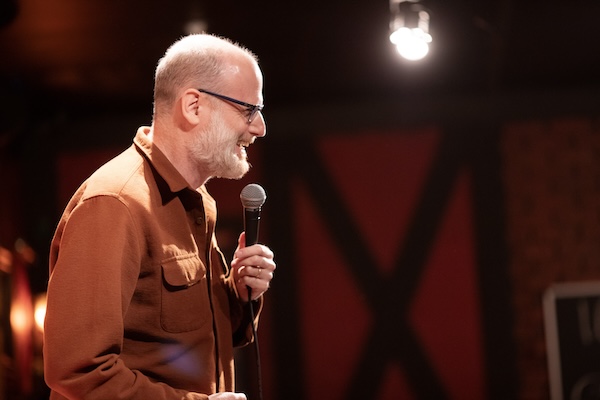
Comedian Erik Angel performs his one-man standup show, Speaking Falafel, at the Jewish Community Centre of Greater Vancouver on Nov. 14. (photo from Erik Angel)

“This year, I discovered even more how comedy is an important tool to bring people together, for release and relief, and I won’t be exaggerating if I say that comedy saved me this year,” Erik Angel told the Independent in an interview in advance of his solo performance Nov. 14, 8 p.m., at the Jewish Community Centre of Greater Vancouver. He’ll also be taking part in a show for students at the University of British Columbia while he’s here.

“This is perhaps the saddest time in my life, with a lot of pain, sorrow and worry, and going on stage night after night and making people laugh, helps me clear my mind and move on,” said Angel of the year since Oct. 7, 2023. “On stage, I deal with my reality today, with antisemitism, but I do it in an entertaining way. They say that comedy is tragedy plus time and I call my performance a humanitarian respite for the soul.”

Angel, who lives in New York, has opened for headliners like Maz Jobrani and Zarna Garg. He’s been part of several comedy festivals and has performed in more than a dozen countries to date. This will be his first time in Vancouver.

Born and raised in Israel, Angel moved to the United States for love, he said, after meeting his bashert at, of all places, the Jewish community centre in Krakow, Poland, in 2015. 

“I went to Krakow for a long weekend and all my life changed completely,” he said. 

Angel has worked in several creative fields. As a singer-songwriter, he released three albums in Israel. He studied drama and worked as an actor for five years. He did some standup comedy in Hebrew at open mics in Israel almost a decade ago, but said he quickly switched to doing routines in English, even while still in Israel.

“Since summer 2016,” he said, “I’ve been doing comedy in English, almost on a daily basis.”

The show that Angel is bringing to the Vancouver JCC next week is the product of a lot of work. 

“Speaking Falafel is an hour of comedy that I worked on for seven long years of comedy spots, day after day, and I am very proud of it. It’s a very funny show about my journey since I went on this long weekend in Krakow and met the love of my life. I share the difficulties of becoming a new immigrant, newly married in my 40s, the differences between Israeli culture and other cultures in the world, how to be now ‘the Jew’ everywhere, to live 24/7 with a second language. I tell stories, I speak with the audience, and I even sing a little bit.”

The Nov. 14 show is a bonus for Vancouverites, as Angel’s main purpose for coming to the city is the UBC show, which is the start of a winter tour for Comedy for Peace. 

Angel established Comedy for Peace five years ago.

“I grew up in Israel with two million Muslims. I never met one – not in school, not in my basketball team,” he said. “I started to meet Muslims when I started to travel the world. The meetings were always friendly, and I wanted to do something artistic together. When I moved to New York, I became part of the New York comedy scene. I produced the first show, that was a huge success, and since then we have had shows in more than 50 cities in the US and Canada.

“Comedy for Peace is not a political event,” he stressed. “It’s about different communities who sit together under one roof and have fun. Simple as it sounds, we want to show people how easy it is to collaborate, laugh, learn about each other and discover how much we are more alike than different. Today, we also have a version with Christian comedians that will travel with the West Coast tour. Nov. 9, Comedy for Peace will be part of the New York Comedy Festival for the second time.

“After Oct. 7, a few shows were canceled (and a few not) and very fast we decided that, for us now, it’s more important than ever and this is why we keep going,” added Angel. “There are comedians, mostly Muslim or Christian Arabs, that cut me off and don’t want to be a part of it – it’s painful because I didn’t change – but most of the comedians are still on board. And our goal now is to bring our message everywhere possible, and [I] will never give up and will always believe most of us, the people, just want to live together peacefully.”

Performing alongside Angel at UBC will be Liz Glazer, Gibran Saleem and Paul Schissler.

“From my experience, people that come to support the show support the idea and are not coming to protest or say something against it and I hope it will be the same this time,” said Angel when asked if he was concerned about the protests and vandalism that have taken place at UBC and other universities. “We are a non-political peace show, so it’s crazy for me to think that things will go differently. Until today, the only problem we have had to deal with was people calling/writing or trying to shame online our Muslim/Christian Arab comedians or asking them not to do it anymore. Most of them just want to do it more since then. But still, we have the reality, there are many haters out there and everything can happen. We have a Q&A session at the end and we are open to speaking with reasonable people that will come with an open heart and ask questions they want to speak about or to understand more. This is part of our mission, to be there together on stage.”

To watch some clips of Angel’s performances from around the world, visit his YouTube channel, youtube.com/@erikangelcomedy9702, or his Instagram page, instagram.com/erikangelcomedy/?hl=en. For tickets to Speaking Falafel, go to eventbrite.com. 

Format ImagePosted on November 8, 2024November 7, 2024Author Cynthia RamsayCategories Performing ArtsTags antisemitism, comedy, Comedy for Peace, Erik Angel, immigration, JCC, marriage, peace, Speaking Falafel
Eastside artists open studios

Eastside artists open studios

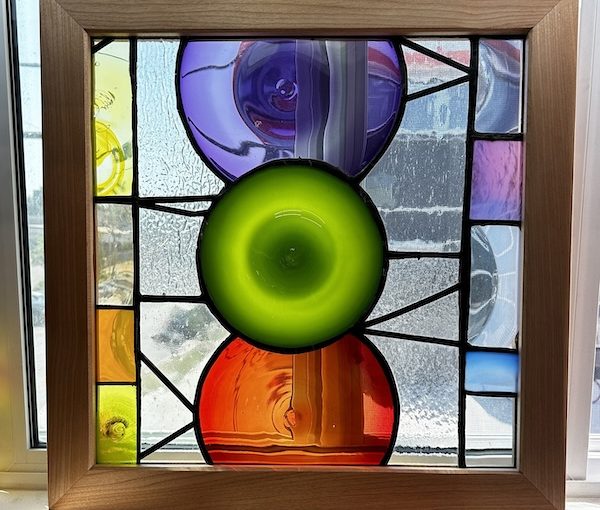
A stained-glass panel in a wood frame by Hope Forstenzer. (photo by Hope Forstenzer)

More than 500 artists are opening their studios, galleries or workshops to the public Nov. 14-17 for the 28th annual Eastside Culture Crawl Visual Arts, Design & Craft Festival. Among the artists are many Jewish community members, including Suzy Birstein, Olga Campbell, Ana Clara Feldman, Hope Forstenzer, penny eisenberg, Lori Goldberg, Lynna Goldhar Smith, Ideet Sharon, Stacy Lederman, Shevy Levy, Lauren Morris and Esther Rausenberg. 

“The Culture Crawl offers a unique opportunity to connect with our communities, to support artists in their livelihoods, and to come away inspired and reinvigorated by the countless ways in which artists explore and share their creativity with the world,” said Rausenberg, who is also the artistic and executive director of the Eastside Arts Society, which puts on the event.

Birstein, who creates and showcases her work from her 1000 Parker Street studio, is a figurative artist whose ceramic sculptures and paintings are self-portraits connecting her to women of history and mythology. 

“I am merging my own personal narratives with the narratives of inspiring women artists whose lives and art ‘embrace enchanting intrigues’ to transcend life’s challenges,” she explained. “This includes Frida Kahlo, Leonora Carrington, Leonor Fini, Vali Myers, Artemesia Gentileschi and Niki de Saint Phalle,” as well as figures like Athena and Alice in Wonderland.

photo - “I’m Going With Myself” by Suzy Birstein
“I’m Going With Myself” by Suzy Birstein. (photo by Byron Dauncey)

Her upcoming solo retrospective, curated by Dr. Angela Clarke at Il Museo, is now scheduled for 2026, rather than next year, which is what was originally planned. The retrospective will combine her Tsipora and Ladies-Not-Waiting series.

“This past year has brought me two profound highlights that resonate deeply in my artwork,” said Birstein. “First, I’ve embraced the idea that the Tsiporas – my Hebrew name, meaning ‘Bird’ – have always been part of the Ladies-Not-Waiting.

“On the personal side, my husband courageously and successfully underwent two major surgeries in 2024, which deepened my appreciation for life and the importance of love and compassion. Additionally, our daughter-in-law became a permanent resident of Canada, allowing our family to thrive together.

“These experiences have infused my art with newfound freedom, imagination, and a willingness to experiment with construction, colour and concept. Each piece I create reflects this journey and the richness of these connections, as with my Ladies-Not-Waiting.”

Birstein and fellow Crawl artist Lori Goldberg spent October in Italy on a self-directed residency, which comprised four segments, each with its own and overlapping purposes, said Birstein.

They explored art at Venice Biennale and other exhibits in Venice. They went to Amalfi, where, Birstein said, “I created a most special and memorable experience – to visit Gianni Menichetti, who was the partner of Vali Myers (one of my artists). In a valley above Positano, Gianni lives off the grid with his family of animals – 10 dogs, ancient doves, chickens, fish, a rooster and others. Gianni himself is a well-known poet, artist, writer, as well as protector and preserver of the land and its natural inhabitants. He’s a most unique human being. Although we were only together for 24 hours, it is as though we have always known each other and always will.”

In Napoli, said Birstein, “within the ancient graffiti-covered walls of this chaotic, lively city, we [were] exploring, experimenting and expressing evolving directions for our art practice.”

Lastly, they went to the island of Ischia for a family celebration, visiting thermal springs, gardens and the sea.

photo - "You sing my songs" by Suzy Birstein
“You sing my songs” by Suzy Birstein. (photo by Alan @ Fidelis Art Prints)

“There are moments in my life when personal and global experiences intertwine – what I like to call destiny with focus,” said Birstein. “My Italian adventure, from connecting with Gianni in Positano, family in Ischia and gallerists in Naples, to engaging with art at the Venice Biennale, inspires every aspect of my life. I sense that I’m in the midst of crafting my next ‘big story,’ which will undoubtedly reflect in my evolving art practice. These experiences shape not just who I am, but also how I create.”

Ceramics and glass artist Hope Forstenzer is also expanding the way she creates. 

“I got a grant to learn woodworking throughout 2024, and that’s been a big highlight,” she told the Independent. “I’ve been working to make pieces that use both glass and wood, and it’s been exciting and challenging to learn a whole new medium. My progress has been slow and steady, and some of the work I made will be in the Crawl this year.”

This is Forstenzer’s third year of making clocks for the Crawl, and she said she’s really been enjoying the process. 

“This year, I’m experimenting with different colours and patterns, and I’ve also got one that’s in a stained-glass panel in a wood frame I made. I’ve spent more time with clockworks and hand design, as well, and am experimenting with different materials for those aspects of the clocks.”

photo - A seder plate by Hope Forstenzer
A seder plate by Hope Forstenzer. (photo by Hope Forstenzer)

In addition to the clocks, visitors to Forstenzer’s studio in the Mergatroid Building, 975 Vernon Dr., will see her stained-glass panels in wood frames, blown seder plates, dreidel blown ornaments, small blown lamps with battery-powered LEDs inside, and some vessels and bowls.

“One of my roles at Terminal City Glass Co-op is the coordinator of the Learning Fire Program, and I’ll be doing a glassblowing demonstration with some of our students on Saturday the 16th from 1:15-3:15,” said Forstenzer.

For more about Learning Fire, visit terminalcityglass.com/pages/learning-fire.

Both Birstein and Forstenzer have works in the Culture Crawl’s preview exhibition, which runs to Nov. 29 at Pendulum Gallery, Alternative Creations Gallery, the Cultch and Charles Clark Gallery, with display dates depending on the venue.

For the full list of events and participating artists, go to culturecrawl.ca. 

Format ImagePosted on November 8, 2024November 7, 2024Author Cynthia RamsayCategories Visual ArtsTags 1000 Parker Street, art, Eastside Culture Crawl, glass, glass-blowing, Hope Forstenzer, Mergatroid Building, painting, sculpture, Suzy Birstein, Terminal City Glass Co-op

The joys of connection

Actor Kerry Sandomirsky – who has more than 130 stage and screen credits – is making her producing debut with the Vancouver première of The Sound Inside, written by Adam Rapp, which was nominated for six Tony Awards in 2020, including best play. The Nov. 14-24 performances at Vancity Culture Lab represent two other milestones – the first production of Sandomirksy’s newly established company, all day breakfast theatre, and the launch of the Search Party’s New Cartography initiative.

photo - Actor Kerry Sandomirsky produces her first play – the Vancouver première of The Sound Inside, by Adam Rapp – and launches her new company, all day breakfast theatre
Actor Kerry Sandomirsky produces her first play – the Vancouver première of The Sound Inside, by Adam Rapp – and launches her new company, all day breakfast theatre. (photo from the Cultch)

“I was looking for something to produce, so I was reading a lot of scripts,” Sandomirsky, who is Jewish, told the Independent. “There was something about The Sound Inside that kept pulling me back. Adam Rapp describes it as haunting, and I think I was haunted by it. My aunt and uncle who live in LA are avid theatre-goers. On two previous occasions they have suggested work I should consider. Coincidently, those pieces became important touchstones in my career. When I was in the middle of negotiating rights for The Sound Inside, they contacted me once again about this compelling show they had just seen. I hung up and bought the rights.”

Being a producer comprises multiple responsibilities.

“Producing involves raising money, putting a team together, creating a budget, getting insurance, finding a theatre, organizing and initiating publicity and marketing campaigns, and ensuring the production is created in a supportive environment,” said Sandomirsky. “So often in life we are in a state of reactive business, and producing was a way for me to take agency.”

Sandomirsky not only produces The Sound Inside, but co-stars in it with Jacob Leonard; Mindy Parfitt, founding artistic director of the Search Party, directs.

Sandomirsky portrays the character of Bella Baird, “an under-appreciated novelist and tenured creative writing professor who forms an unlikely bond with a mysterious yet talented student, Christopher Dunn,” played by Leonard, who happens to have been a student of Sandomirsky’s when she taught at Studio 58. “Brimming with suspense, Rapp’s riveting play explores the limits of what one person can ask of another,” reads one description of the 90-minute play.

“The Sound Inside is about two people who have isolated themselves from the world, but, to their great surprise, find in each other a reprieve from loneliness,” said Sandomirsky of the play’s appeal. “It is about the delight of connection, the joy of a shared sense of humour, and the power of being seen.”

“The Search Party created New Cartography as a response to Kerry’s desire to produce The Sound Inside,” Parfitt told the Independent. “It has been a way for us to expand how we create theatre and to identify ways we can support and encourage artists to develop themselves.”

photo - Mindy Parfitt, founding artistic director of the Search Party, whose New Cartography initiative offered Kerry Sandomirsky support in her first producing role
Mindy Parfitt, founding artistic director of the Search Party, whose New Cartography initiative offered Kerry Sandomirsky support in her first producing role. (photo from the Cultch)

The Search Party’s website notes that the initiative’s purpose is “to provide mid-career and established artists an opportunity to develop new aspects of their practice. Initiated by the artist, it provides hands-on practical experience in a previously unexplored area of their own creative landscape. Through the New Cartography program, artists receive mentorship, resources, tools and systems in theatre production.”

An application process for the initiative isn’t in place yet, said Parfitt. But, if artists are interested, they can contact her through the company’s website, searchpartyproductions.com.

“There are many aspects to this process which are new for me,” Parfitt said. “Kerry brought me the script. She and Jacob had done considerable work on it before I got involved and so there was some catching up for me to do. This is unusual as a director. Usually that process is completely reversed.

“We have been rehearsing part-time over several weeks, which also is different from the complete immersion that all of us are used to,” she continued. “The Search Party is dedicated to marrying a strong design with a compelling script. Kerry’s company – all day breakfast theatre – prioritizes actor-driven theatre.  is an exploration in uniting our two visions.”

“Mindy has been instrumental in demystifying the many logistics of producing,” said Sandomirsky. “She has provided practical advice and infrastructural support. The experience has given both of us an opportunity to make theatre in a new way.”

For tickets to The Sound Inside, visit thecultch.com/ticket/the-sound-inside. 

Posted on November 8, 2024November 7, 2024Author Cynthia RamsayCategories Performing ArtsTags drama, Kerry Sandomirsky, Mindy Parfitt, New Cartography, producing, the Cultch, The Sound Inside
Feel-good comedy at Metro

Feel-good comedy at Metro

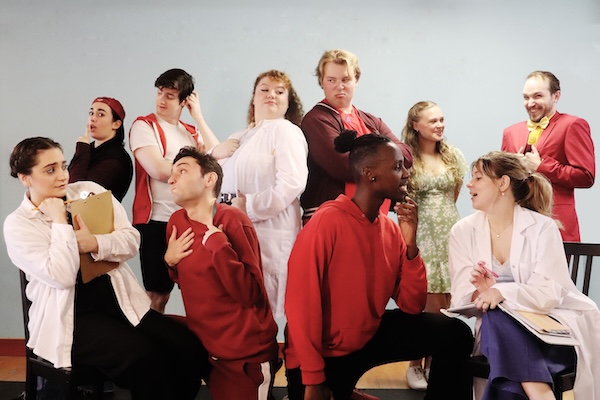
The cast of Bound! The Musical (In Concert), a quirky, character-based show, the story of which is a vehicle for the characters’ journeys and personal growth. (photo by Joelle Wyminga)

For two nights only, Nov. 19-20, Metro Theatre and Bound Musical Theatre Society are presenting the world première of the feel-good comedy Bound! The Musical (In Concert). 

Written by longtime friends Wayne Morris and Glen Freedman, their collaboration on Bound! – music and lyrics by Morris, book by Freedman and Morris – began in 2015. Morris had been working on the concept for several months.

The show is a reimagining of Shakespeare’s Love’s Labour’s Lost. Four Olympic-bound male athletes “are tricked into abstaining from vices and ‘romance’ during their high-intensive training, only to find themselves suddenly at the centre of a research study run by a group of attractive, brilliant and highly driven women,” reads the synopsis. “What follows is a hilarious battle of wills as their desires and the binds of their stringent guidelines battle for the win.”

“Glen and I were hanging out at Kits Beach, and I started telling him about the show,” Morris recalled. “Glen peppered me with all kinds of questions about the characters and the story. It turned into a two-hour conversation, after which I said, ‘Glen, you have to write this with me.’”

“To which, without any hesitation, I said, ‘yes,’” Freedman told the Independent. “The idea of working with Wayne on a creative project again (yes, we’ve been down this road before, though many years ago) carried a sentimental nostalgia for me.”

“When we first met, we started writing and performing songs together,” said Morris. “Together, we joined an ’80s band led by one of Glen’s friends. It was the ’80s after all!”

“It was a blast, even though they wouldn’t let me sing,” quipped Freedman.

The pair has lived in Metro Vancouver for more than 25 years, Morris in Maple Ridge, Freedman in Yaletown.

“We met at Marianopolis College in Montreal in our late teens, and became great friends. After university, we backpacked through Europe together,” said Morris.

Morris was an actor before becoming a singer-songwriter and then music producer as well. Freedman, while a keyboardist, took a less musical route and became a psychiatrist. Along the way, he also completed a creative writing program at Simon Fraser University and attended Bishop’s University in Quebec, where he performed in Chekhov’s The Cherry Orchard.

Morris and Freedman formed the Bound Musical Theatre Society earlier this year “as the vehicle for this and future productions,” said Morris. “Our lawyer recommended a not-for-profit society as the type of entity the local theatre industry is used to working with.”

The Metro Theatre production of Bound! is directed by Hailey Fowler, with musical direction by Kylie Fonacier. It features a diverse ensemble cast in what Morris describes as “a character-based show, and the story is a vehicle for the characters’ journeys and personal growth.

“For me,” he said, “this focus on character was challenging at first as a lyricist, in that the lyrics needed to reflect 10 distinct voices. As the show and characters continued to develop, and the songs were continually rewritten and refined, this process became easier, as both the characters and the lyric-writing process became more familiar.”

“As our show is about resilience and the possibility of change at times of challenge,” said Freedman, “it was my view that we had to create characters, each with their own unique personality quirk that was getting in their way – ‘bounding’ them up, you might say. Each character would then get their own story arc, in which they would overcome these constraints, to a realistic degree. The goal was to induce the audience to see themselves in these characters, such that they would walk away from the show with a feeling of hope and a bounce in their step.”

No doubt the musical’s 16 original songs will contribute to that bounce. Morris said his biggest musical influence is the Beatles, “and so that is a big musical influence for the show, including having a wide variety of musical styles across the show, in the same way the Beatles do.”

In a similar vein, Morris based the story on Shakespeare’s Love’s Labour’s Lost because, he said, “I wanted to have the best possible source material, and what better source than Shakespeare? Using Shakespeare ensured a solid story structure. Love’s Labour’s Lost is a very fun story, with silliness and great wordplay. That’s the type of show I wanted to write. Also, in Love’s Labour’s Lost, I loved the fact that the women in the story consistently have the upper hand over the men; very progressive then, and seems to fit our world today!”

“I couldn’t agree more,” said Freedman, whose day job has helped him in the creation process.

“Due to the nature of my work as a psychiatrist, I have, over time, developed an understanding of the nature of suffering – a human experience that ties us all together – and how personality informs how we suffer,” he said. “I have also had the privilege of having seen firsthand how change in how we think can manifest. This, I feel, has helped in our creating characters that are true to life, and who undergo change for the better, in a manner that we hope will be experienced by the audience as believable and relatable.”

And which will leave audiences feeling positive, though Morris and Freedman differ slightly in their outlook.

The press material describes Morris as a “glass half-full person.”

“It’s part of my nature to look for the good in everyone, and I’ve discovered that almost everyone means well deep down,” he said, acknowledging, “I’ve also been very fortunate that hard work and some good life decisions have led to things working out for the most part in my life.”

As for Freedman, optimism comes a little harder.

“Through my adult life (and with lots of therapy), I’ve gradually moved to a place of being able to recognize what’s in and out of my control, of what I have agency over and what I have to accept, of understanding that, just because I accept something does not mean I have to like it, and of letting go of expectations of how I wish things should go,” he said. “This mindset has fostered within me a capacity to face the events of life, sometimes tumultuous, with curiosity, a sense of humour and presence.”

While neither Morris nor Freedman are religious, Judaism does impact their lives.

“Judaism has shown me the value of a strong sense of community and connection,” said Morris. “The importance of these is a huge theme of the show.”

“I would add,” said Freedman, “that feeling oneself to be part of a community helps to add meaning to our lives.”

For more information and tickets to Bound!, go to boundthemusical.com/in-concert. 

Format ImagePosted on November 8, 2024November 7, 2024Author Cynthia RamsayCategories Performing ArtsTags Bound Musical Theatre Society, comedy, Glen Freedma, Metro Theatre, musicals, Wayne Morris
More than an edgy cabaret

More than an edgy cabaret

Left to right: Shane Baker, Sasha Lurje and Michael Wex in The Last Night at the Cabaret Yitesh (Di Letste Nakht Baym Yitesh), which closes this year’s Chutzpah! Festival Nov. 9-10. (photo by Shendl Copitman)

“The final sketch in the show, ‘The Last Jew in Poland,’ is based on a real 1930s cabaret sketch of the same name that got Ararat, the famous Yiddish cabaret, closed down,” said creator Michael Wex of The Last Night at the Cabaret Yitesh (Di Letste Nakht Baym Yitesh), which plays at the Rothstein Theatre Nov. 9-10 as part of the Chutzpah! Festival.

“The sketch, however, hasn’t survived,” he continued. “Shimon Dzigan (of Dzigan and Shumacher), who was a member of the troupe, describes the general set-up of the piece in his autobiography, but doesn’t give many details, except to say that everybody involved expected to be arrested the next day (and was surprised not to be). I’ve tried to reconstruct something that would have bothered the censors of the 1930s as much as the original.

“‘Di Endekuvne,’ one of the genuine old songs in the show, was actually banned following its first performance,” he said.

The Last Night at the Cabaret Yitesh is set in Poland in the spring of 1938. With only one performance left before the censor’s office closes the cabaret, and with their visas secured to leave the country, the performers decide to put on a show of forbidden material and greatest hits.

The idea for The Last Night at the Cabaret Yitesh came from Andreas Schmitges of Germany’s Yiddish Summer Weimar, who called Wex with a request.

“Since 2019 was the 100th anniversary of the Weimar Republic, Yiddish Summer was planning a commemorative program and Andreas wanted to know if I could put together a Yiddish-language cabaret revue that would reflect the way Yiddish culture absorbed and was influenced by the zeitgeist of the Weimar era,” said Wex.

photo - Michael Wex
Michael Wex (photo by Zoe Gemelli)

Wex, who is Canadian, is an internationally recognized expert on Yiddish. He has many nonfiction books to his name, including Born to Kvetch: Yiddish Language and Culture in All of Its Moods, on the history of Yiddish, and Rhapsody in Schmaltz: Yiddish Food and Why We Can’t Stop Eating It. He’s also a translator, novelist, playwright, columnist, public speaker and performer. His creative process involves much research. For Schmitges’ proposed project, Wex first sought out surviving Yiddish cabaret material.

“I dove into scores of books, listened to even more recordings, in search of authentic material that would still resonate with a 21st-century audience,” he said. “Much of the older material just didn’t ‘read’ anymore: there were a lot of jokes about local politics and references to long-forgotten celebrities. There was fairly strong political censorship in interwar Poland, especially in the years following the Nazi takeover of Germany, which means that much of the surviving satirical material is pretty bland. I deliberately sought out lesser-known Yiddish cabaret songs, including at least one that was never recorded.

“My next resort was to see what was going on in non-Yiddish Polish culture at the time. I went through newspapers from the period to try to figure out how much international pop culture was available in 1920s and ’30s Poland and was delighted to find that Hollywood movies that would have played in Vancouver in, say, 1934, were playing in Warsaw at pretty much the same time, and that Louis Armstrong records were on sale in Warsaw record stores. I looked at the pop music charts: the most popular song in Poland in 1928 was ‘Ain’t She Sweet’ translated into Polish. This information widened the range of material that could plausibly be presented as being performed at the time and gave me the licence I needed to adapt and translate some well-known pop songs of the era into Yiddish.”

photo - Patrick Farrell in The Last Night at the Cabaret Yitesh (Di Letste Nakht Baym Yitesh), which is at the Rothstein Theatre Nov. 9-10
Patrick Farrell in The Last Night at the Cabaret Yitesh (Di Letste Nakht Baym Yitesh), which is at the Rothstein Theatre Nov. 9-10. (photo by Shendl Copitman)

Wex wrote some songs and sketches to round out the show, then came up with the storyline that adds context: the performers whose cabaret is about to be closed, but who have ship tickets and visas to leave the country.

“Suddenly, they’re free to perform what they want to, not only what they’re allowed to,” said Wex, who also directs and acts in The Last Night at the Cabaret Yitesh.

The other people involved – Shane Baker (United States; co-director, performer), Patrick Farrell (US/Germany; original music, arrangements, piano, accordion, percussion), Regina Hopfgartner (Austria; vocals), Daniel Kahn (US/Germany; vocals) and Sasha Lurje (Latvia/Germany; vocals) – “are the people for whom the show was written,” Wex said. “It’s like an A-list of contemporary Yiddish performers and I recall telling Andreas that I wouldn’t do the show without them. It was my one diva moment – but I think it worked.”

The current incarnation of the show premièred at the Ashkenaz Festival in Toronto in 2022. It had changed so much from the 2019 Yiddish Summer Weimar production that, Wex said, “Weimar could almost be seen as a workshop.”

For Wex, giving audiences an idea of what 1938 Poland was like is important “because the whole world is looking more like 1938 Poland with every passing day.”

“Arts and culture,” he said, “including but not limited to comedy and music, is really the best way we have of trying to find a common ground from which to understand conflict, stand up to tragedy and, ultimately, seek out ways to mitigate or ameliorate the feelings and attitudes from which such conflicts and their accompanying tragedies have grown. As we see every day, shouting slogans might make us feel good and brave and involved but it does nothing to establish the common ground necessary to arrive at any kind of understanding with our opponents. Arts and culture, comedy and music – they’re all bulwarks against dehumanization.”

The Last Night at the Cabaret Yitesh is in Yiddish with English supertitles. For tickets, go to chutzpahfestival.com – where you’ll find the whole Chutzpah! lineup – or call 604-257-5145. The festival runs Nov. 1-10. 

Format ImagePosted on October 25, 2024October 24, 2024Author Cynthia RamsayCategories Performing ArtsTags Cabaret Yitesh, Chutzpah! Festival, Holocaust, Michael Wex, music, politics, Rothstein Theatre, social commentary, Yiddish

Posts pagination

Previous page Page 1 … Page 11 Page 12 Page 13 … Page 84 Next page
Proudly powered by WordPress