Skip to content
  • Home
  • Subscribe / donate
  • Events calendar
  • News
    • Local
    • National
    • Israel
    • World
    • עניין בחדשות
      A roundup of news in Canada and further afield, in Hebrew.
  • Opinion
    • From the JI
    • Op-Ed
  • Arts & Culture
    • Performing Arts
    • Music
    • Books
    • Visual Arts
    • TV & Film
  • Life
    • Celebrating the Holidays
    • Travel
    • The Daily Snooze
      Cartoons by Jacob Samuel
    • Mystery Photo
      Help the JI and JMABC fill in the gaps in our archives.
  • Community Links
    • Organizations, Etc.
    • Other News Sources & Blogs
    • Business Directory
  • FAQ
  • JI Chai Celebration
  • JI@88! video

Recent Posts

  • Story of Israel’s north
  • Sheltering in train stations
  • Teach critical thinking
  • Learning to bridge divides
  • Supporting Iranian community
  • Art dismantles systems
  • Beth Tikvah celebrates 50th
  • What is Jewish music?
  • Celebrate joy of music
  • Women share experiences 
  • Raising funds for Survivors
  • Call for digital literacy
  • The hidden hand of hate
  • Tarot as spiritual ritual
  • Students create fancy meal
  • Encouraging young voices
  • Rose’s Angels delivers
  • Living life to its fullest
  • Drawing on his roots
  • Panama City welcoming
  • Pesach cleaning
  • On the wings of griffon vultures
  • Vast recipe & story collection
  • A word, please …
  • מארק קרני לא ממתין לטראמפ
  • On war and antisemitism
  • Jews shine in Canucks colours
  • Moment of opportunity
  • Shooting response
  • BC budget fails seniors
  • Ritual is what makes life holy
  • Dogs help war veterans live again
  • Remain vital and outspoken
  • An urgent play to see
  • Pop-up exhibit popular
  • An invite to join JWest

Archives

Follow @JewishIndie
image - The CJN - Visit Us Banner - 300x600 - 101625

Month: August 2025

Webinar on Syria and Iran

On Aug. 5, B’nai Brith Canada hosted an online discussion on the crises affecting Druze communities in Syria and the Iranian people, with a focus on the impact on these diasporas in Canada and potential actions by the Canadian government. 

The speakers were Kiumars Rezvanifar, president of the Canadian Ethnic Media Association and founder of the Iranian Canadian Cultural Fellowship, and Jamal Sehnawi, an advisor to the Supreme Druze Council and a member of the Canadian Druze Society. 

Rezvanifar said the recent violence in Syria’s Suwayda (Sweida) governorate could have resulted in “hundreds of thousands” of Druze deaths if the Israel Defence Forces had not intervened. He said the attacks included the killing of civilians and kidnappings, highlighting the case of a 5-year-old girl who was kidnapped, assaulted, and her family killed, allegedly by members of Hayat Tahrir al-Sham (HTS). He lamented that major Arab media outlets like Al Jazeera and Al Arabiya have downplayed the crisis, a silence he called “a moral issue.”

Independent casualty figures vary. The Washington Institute reported more than 800 dead and 900 injured. Reuters-verified footage and the Syrian Network for Human Rights cited more than 1,000 deaths, mostly Druze, including women and children. The Syrian Observatory for Human Rights documented 182 executions by government-affiliated forces as of July 19. Le Monde reported 1,311 deaths, while Anadolu Agency cited at least 321 killed, including six children and nine women. 

These attacks have deeply shaken Canada’s Druze community, said Rezvanifar, who estimated the Druze population in Canada at about 50,000, mainly in Montreal, Toronto and Edmonton. 

Sehnawi described the violence in Suwayda as “ethnic cleansing,” attributing it to the Syrian Ministry of Defence and Interior and to foreign fighters. He said the Druze community’s requests were for peace and recognition similar to that afforded to other communities worldwide. 

Throughout the discussion, Sehnawi spoke about historical and cultural ties between Jewish and Druze communities, referring to Druze as “direct descendants to the sons of Jacob (Israel)” and noting traditions of service and community support. 

The online conversation also addressed the situation in Iran. Rezvanifar spoke about decades of repression by the Iranian government, citing executions, censorship and the suppression of protests. He criticized European countries for “prioritizing economic interests over human rights,” noting that international attention often came “too late to effectively help the Iranian people facing brutal repression.”

In the face of internet blackouts and censorship, Rezvanifar praised citizen journalists, saying, “The Iranian population is tech-savvy and educated, constantly finding ways to circumvent restrictions.”

Rezvanifar alleged that Iranian regime operatives live openly in Canadian cities such as Vancouver and Richmond Hill (part of the Greater Toronto Area), claiming “thousands of visas may have been issued to regime members” and “fewer than 10 deportations have occurred in the past five to eight years.” These figures have not been independently confirmed. 

He commented on the fact that it took repeated calls before Canada designated the Iranian Revolutionary Guard Corps a terrorist organization in 2024. The measure had been sought by various groups since the January 2020 downing of Ukraine International Airlines Flight PS752, which killed 176 people, most of them Canadian citizens or residents. Both speakers called for Canada and the international community to take action in support of affected communities.

“In real estate, it’s all about location, location, location,” Sehnawi concluded. “In this situation, it’s all about information, information, information.” 

Uriel Presman Chikiar is a student at Queen’s University and serves as executive vice-president of external relations at Hillel Queen’s.

Posted on August 22, 2025August 21, 2025Author Uriel Presman ChikiarCategories NationalTags B’nai Brith Canada, Canada, Druze, human rights, Iran, Jamal Sehnawi, Kiumars Rezvanifar, politics, Syria, terrorism
FSWC gives workshop

FSWC gives workshop

Left to right: Emily Bonnell-Marcus (Friends of Simon Wiesenthal Centre), Zelda Dean (Emanu-El), Johanna Herman (FSWC), April Nowell (Jewish Federation of Victoria and Vancouver Island), Frances Grunberg (JFVVI) and Jaime Stein (FSWC, Western Canada). (photo from  FSWC)

On Aug. 12, more than 80 people from diverse faith backgrounds gathered at Victoria’s Congregation Emanu-El for Friends of Simon Wiesenthal Centre’s flagship antisemitism education workshop – Antisemitism: Then and Now. 

Geared for professionals, community members and volunteers who are interested in combating hatred, the workshop is presented by Jewish Federation of Victoria and Vancouver Island in partnership with FSWC. It is designed to build historical understanding of antisemitism and the Holocaust, examine how antisemitism shows up today, offer practical strategies to recognize and respond to antisemitic rhetoric and behaviour, and strengthen an organization’s capacity for allyship and inclusivity.

While in British Columbia, FSWC advocacy team members also attended the Canadian Association of Chiefs of Police Annual Conference. During the event, they strengthened their partnership with the Canadian Police Knowledge Network to advance the development of a national antisemitism training module, which will be made available to police services across the country. They also established new connections to support their law enforcement training initiatives, and promoted the upcoming Building a Case Against Hate Conference in Vancouver, scheduled for February.

For more information, visit fswc.ca. 

– Courtesy Friends of Simon Wiesenthal Centre

Format ImagePosted on August 22, 2025August 21, 2025Author Friends of Simon Wiesenthal CentreCategories LocalTags antisemitism, education, Friends of Simon Wiesenthal Centre, FSWC, interfaith, police, Victoria

Power of propaganda

Understanding the past, including the darkest eras, can help people recognize the symptoms of a society going off the rails. 

A forthcoming book for young readers, titled Can Posters Kill? Antisemitic Propaganda and World War II, by Torontonians Jerry Faivish and Kathryn Cole, explores how propaganda and racist imagery desensitized a society to atrocities. 

Faivish, a retired lawyer, has collected Jewish posters since young adulthood, building one of the world’s largest private collections. The son of Holocaust survivors, he created this book with Cole, an illustrator, art director, editor, designer and publisher, to educate young people about the dangers of hatred and the powers of persuasion used for evil ends.

image - Can Posters Kill? book coverThe richly illustrated publication spotlights how vivid imagery and repetition intended to evoke fear, distrust, loyalty or revulsion served to influence populations to accept (even collaborate in) barbarism.

“By understanding the visual language of propaganda from the past, we can learn to recognize and resist messages of hate – an essential skill in a digital world where information is spread in seconds,” according to the publisher, Second Story Press.

Aimed at readers 13 and up, this book about the past has its purpose firmly planted in the present and future.

“Like social media today,” write the authors, “visual communication in the ’30s and ’40s – from movies to newspapers to paper posters – was clever and interesting, engaging and effective. But, under Nazi manipulation, it became deadly.”

The focus of the book is visual, befitting a volume of this topic, with just enough copy to contextualize the imagery and point out salient aspects that the reader might not have noticed. It is also perhaps a perfect mix of text and graphics for the generation it aims to reach.

The authors provide a brief overview of the post-First World War economic conditions in Germany, the impacts of the Treaty of Versailles, and Hitler’s rise to power. This history tilled the soil for the hate-messaging showcased. 

“A false message, when repeated often enough, can become the truth in the minds of people who are frightened, oppressed and searching for someone to blame for their misfortune during hard times,” the book warns. 

Can Posters Kill? also delves into how graphic design played into the success of the brainwashing – “clever use of different typefaces grabs the attention of passersby,” among other innovations.

Joseph Goebbels, the Nazis’ minister of propaganda, who more than any other individual is associated with this sort of material, did not overestimate his audience.

“The rank and file are usually much more primitive than we imagine,” he is quoted in the book. “Propaganda must, therefore, always be essentially simple and repetitious. In the long run, only he will achieve basic results in influencing public opinion who is able to reduce problems to the simplest terms and who has the courage to keep forever repeating them in the simplified form, despite the objections of intellectuals.”

The messages his department imparted were subtle as sledgehammers. 

In one poster, a doctor or scientist is looking through a microscope at a vicious “Jewish” disease devouring healthy tissue. Jews are characterized as sexual deviants and blamed for spreading tuberculosis, syphilis and cancer. 

“It’s a chilling message because it can quickly turn into ‘kill or be killed,’” the book says.

In another poster, a Jew hovers menacingly over the globe, spinning a web from his index finger. 

“This reinforces the Nazi-supported notion that Jews are power-hungry and backed by secret cabals or conspirators,” the authors write.

Jews are depicted as the mortal enemy of Christianity and the Star of David is equated alongside the communist red star, implying a dual-pronged threat to German society.

Faivish shares his family’s story: his mother’s experiences in various ghettos, work and concentration camps, and at extermination sites such as Auschwitz, and his father’s defiant escape from a cattle car headed for the gas chambers. Faivish’s father lost his parents and his eight siblings in the Holocaust. His mother had just one surviving brother and one remaining sister out of a family of 10. 

Faivish goes into some detail about the experiences of his mother in the constellation of Nazi ghettos and camps, and his father’s unlikely survival in hiding, thanks to a gentile Polish family. He places significant emphasis on the heroism of non-Jews. 

“After the war, my parents met in Bergen-Belsen, the DP camp where they married and started a family,” he writes. “My older sister was born there in 1949.… In 1952, my parents immigrated to Canada. In 1953, I was born in Montreal. For my parents, the question of how to deal with recurring hate, and what could be done about it, was more than philosophical. It became a guideline for how to live their lives and what to pass on to their children. The lessons they taught us are still applicable and valuable today.”

He includes nine values his parents instilled in him and that he hopes the book will pass on to others, including: be proud of who you are and embrace your faith and culture [because the] aim of the “Final Solution” was to annihilate Jews and to destroy Judaism; respect your fellow human beings and treat them well; and recognize and eliminate hate and evil as much as possible.

A timeline of historical events and an excellent glossary of relevant terms are included at the end of the book.

As British Columbia and other provinces institute mandatory Holocaust education in school curricula, books like Can Posters Kill? Antisemitic Propaganda and World War II provide powerful resources for educators to convey the lessons of history in ways that are impactful but age-appropriate, with undeniable and clear lessons around critical media consumption for contemporary generations. 

While not formally related, the book is also a valuable complement to the Vancouver Holocaust Education Centre’s current exhibition, Age of Influence: Youth & Nazi Propaganda, which is being reconfigured into a traveling exhibit. 

Posted on August 22, 2025August 22, 2025Author Pat JohnsonCategories BooksTags Can Posters Kill?, education, genocide, Holocaust, Jerry Faivish, Kathryn Cole, propaganda, Second Story Press
Hebrew Bible stories inspire

Hebrew Bible stories inspire

On Sept. 16, Stephen Schecter will retell three stories from the Hebrew Bible at the 40th anniversary celebration of L’Chaim Adult Day Centre. He promises the stories will bring laughter and tears. (photo from Stephen Schecter)

“I love the Hebrew Bible,” Stephen Schecter told the Independent. “It is, after all, the template of Western literature and the DNA of the Jewish people. Its stories are all told twice, inviting the reader to ask what is going on here. And the stories invariably end badly, teaching us the importance of getting a handle on our passions if we want to have a halfway decent life together.”

On Sept. 16, in celebration of L’Chaim Adult Day Centre’s 40th anniversary, Schecter will share a few of his favourite biblical tales. 

“Retelling these stories,” he said, “is my way of giving the Jews back their pride and their backbone, steeling them to be proud Zionists, once again going back to ‘In the beginning,’ which is the title of my show on Sept. 16. The stories – and I will be retelling three of them – when you examine them closely are rather funny, but this is no laughing matter. Some of them bring you even to tears.”

Schecter, who was a sociology professor at Université du Québec à Montréal, has always been interested in literature, but not necessarily the Hebrew Bible. 

“When my kids had their bat and bar mitzvahs, I started going to Shabbat services again, which meant I read the weekly Torah portion and, lo and behold, I was swept away,” he said. “When a friend put me on to a contemporary rewrite of some of the books of The Iliad, I thought I could do that too but within my tradition. The upshot turned out to be a 170-page poem called ‘David and Jonathan,’ published in 1996. 

“From there, I went on to lecturing about the Hebrew Bible to multiple audiences in Montreal and ended up doing a one-man show on the first half of the book of Genesis in 2003 at the Saidye Bronfman Centre theatre [now the Segal Centre for Performing Arts]. In 2005, I moved to Vancouver and gave a number of series of talks on the Hebrew Bible to seniors at the JCC.”

Schecter continued to write about sociology and, in 2012, published a book called Grasshoppers in Zion about Israel’s situation in the Middle East. In that book, he said, “I explained how a reading of the Hebrew Bible could help Jews immeasurably in dealing with the Palestinians. No one listened, but I continued to write and now do so on Substack at schecter.substack.com.”

He also noted how people don’t listen to – or even know about – the lessons of the Hebrew Bible. Hence, he quipped, “the constant rewrites. Steinbeck’s East of Eden retells Cain and Abel. Shakespeare’s Romeo and Juliet turns the Dinah story into a five-act play. The end of the Book of Judges replays Sodom and Gomorrah, which now finds its rehash on our TV screens in Gaza. Not for nothing is the Hebrew Bible laced with irony, engendering that particular form of Jewish humour Sholem Aleichem and S.Y. Agnon each captured.”

The English-speaking world once used the Hebrew Bible to learn to read, but people have stopped reading it altogether, said Schecter.

“Many Jewish day schools do not teach it, especially at the high school level, which is where Jewish youngsters could begin to immerse themselves in their tradition,” he said. “When I attend shul, I often hear more about food banks than the wild poetry of the parashah [weekly Torah portion]. The answer to antisemitism lies not in refuting the arguments of those who slander us; it is in asserting the timeless truths of this sacred text, which lay out the indissoluble link between the Hebrew Bible and the land of Israel and our identity as Jews.

“I am blown away every time I reread these stories,” he said. 

“So, I hope Jews come to see the show,” said Schecter. “I hope especially community leaders, activists, rabbis, principals and teachers come and hear these magnificent tales and see how they still speak to a modern audience. It is a show to celebrate the 40th anniversary of L’Chaim, the only adult Jewish day centre in the Lower Mainland, whose exceptional level of care would have well served even our founding patriarchs, all of whom could have used its services. Come and see why.”

“We are on our way to becoming the gold standard of adult day programs in Vancouver,” said L’Chaim executive director Leah Deslauriers of but one of the many reasons to celebrate the organization’s 40th year.

“L’Chaim is fortunate to have community support, from foundations to private donors, which allows us to offer an enriched program to our clients and their families. All of us at L’Chaim are forever grateful for this support,” she said, adding that “L’Chaim continues to grow, and shows no signs of slowing down.”

In the coming years, said Deslauriers, “L’Chaim will prepare to move into the new JWest building upon its completion. In the next 10 years, our hope is to increase our funded spaces from 16 to 22 each day. And, if demand increases, maybe even add an additional day and be open on Sundays.”

Tickets ($18) for In the Beginning, which takes place Sept. 16, 7 p.m., at the Rothstein Theatre, can be purchased at eventbrite.ca. 

Format ImagePosted on August 22, 2025August 21, 2025Author Cynthia RamsayCategories LocalTags Judaism, Leah Deslauriers, L’Chaim Adult Day Centre, seniors, Stephen Schecter, storytelling
Victoria Fringe has started

Victoria Fringe has started

Director Francis G. Matheu, right, with actors Nolan Fidyk and Dan Landry rehearsing Alan Segal’s Shade Apparel. (photo by Sarah Nicole Faucher)

This year’s Victoria Fringe Festival, billed as “12 days of madcap fun this summer,” started on Aug. 20 and runs to Aug. 31. Included in the lineup are pieces by two local Jewish community members, Alan Segal and David Heyman.

Segal describes his play, Shade Apparel, as “comedy, drama and absurdity.” It features Danver, a playwright rooted in daily routine, who tries to find answers to questions he never knew he had. And, Segal told the Independent, “He is not prepared for the answers. Shade Apparel is a play about wanting to know more and not knowing where to find anything.”

In Segal’s words, our society is “heavily psychologized,” in that everything is given a psychological or emotional origin story, he said.  “But, if we breathe, we absorb culture, ideas, ideals and assumptions.

“Most of the time, we have a slight awareness of the precise origin of these. Their origin tale, however, is found in the social cauldron of daily life. This, too, is our apparel. We are clothed in more than material fabric,” he said.

From an early age, Segal has had an interest in how people become, well, anything; for example, how are allegiance, assurance, belonging, anger, dissent, happiness, or its opposite, created?

Segal’s first Victoria Fringe experience was not as a playwright but as a supporter of the arts who was captivated by the aura and array of creativity he observed. Last year, he founded Imbroglio Theatre, which will put on Shade Apparel.

“Beyond headlines and supposed fame, people venture into many realms of expression. I loved it from the start, and I expect many will be enlivened by what is approaching in Victoria at the end of August,” he said.

The creative team for the Fringe show comprises Dan Landry, Nolan Fidyk and Kendra Bidwell (cast), Alan Segal (writer), Francis G. Matheu (director), Elaine Montgomery (stage manager), Luke Weston and Andrea Gregg (lighting design), Phil Letourneau (music and sound design), Sarah Nicole Faucher (costume design) and Doug Wills (poster and program).

“Shade Apparel is the second play I have written – a project I never intended to write and had no inkling of, until it leaped into my mind as a single scene,” said Segal.

His first play, Frey’s Anguish, premiered in March 2024 at Paul Phillips Hall in Victoria.

photo - David Heyman’s Ducks co-stars, right to left, Gloria Snider, Lorene Cammiade, Ryan Kniel and Danielle Greschner
David Heyman’s Ducks co-stars, right to left, Gloria Snider, Lorene Cammiade, Ryan Kniel and Danielle Greschner. (photo from David Heyman)

Heyman’s play, Ducks, takes place in the aftermath of an incident in which 1,600 ducks flew into an oilsands tailings pond in northern Alberta and died – a true event that caused international criticism of the provincial government. Years later, the oil company that owned and operated the pond was fined and the government promised tighter restrictions; however, the damage to Alberta’s reputation was significant.

The fictionalized theatrical story centres on a government communications director who has 20 minutes to retrieve an embarrassing, career-ending invitation erroneously sent out in his name before the media or public find out about it.

“I was communications manager for the premier of Alberta at the time [of the real-life incident] and, although I was not involved in managing the issue …  I was able to observe the crisis-management efforts from up close,” Heyman said.

“The characters and events in the play are entirely made up but are informed by my inside knowledge of how communications offices work, and how the media deal with such situations,” he said. “Before joining the Alberta Premier’s Office, I was a political reporter at the Calgary Herald for many years. Many people who work in governments in Alberta and BC have told me that the play feels authentic, which was my goal.”

When Ducks premiered at the Victoria One-Act Play Festival in 2023, it won the prize for outstanding original script. When it was performed at the 2024 Edmonton Fringe Festival, five of eight shows sold out and the play received stellar reviews. The play has also been performed at the Nanaimo Fringe Festival and in Tofino.

Heading into the Victoria Fringe, Heyman said, “We’ve got a top-notch cast, a great director and a great stage manager this year. The rehearsals are going very well and I’m confident it will be a hit.”

Heyman is the show’s producer and, joining him in mounting the Fringe show are Ryan Kniel, Lorene Cammiade, Gloria Snider and Danielle Greschner (cast), Francis G. Matheu (director), Andrea Gregg (stage manager) and Sarah Heyman (associate producer).

David Heyman has written an as-yet-unperformed sequel, Rhymes with Ducks, that he hopes to put on at next year’s festival. “The sequel is designed also to be a second (and final) act, and perhaps one day both will be performed as a single show,” he said.

For the Fringe, Shade Apparel is at Victoria Conservatory of Music’s Wood Hall, while Ducks is at James Bay United Church. Both plays are 45 minutes long. For tickets and more information, visit victoriafringe.com. 

Sam Margolis has written for the Globe and Mail, the National Post, UPI and MSNBC.

Format ImagePosted on August 22, 2025August 21, 2025Author Sam MargolisCategories Performing ArtsTags Alan Segal, David Heyman, identity, playwrighting, politics, social commentary, Victoria Fringe Festival
Israeli dance sessions

Israeli dance sessions

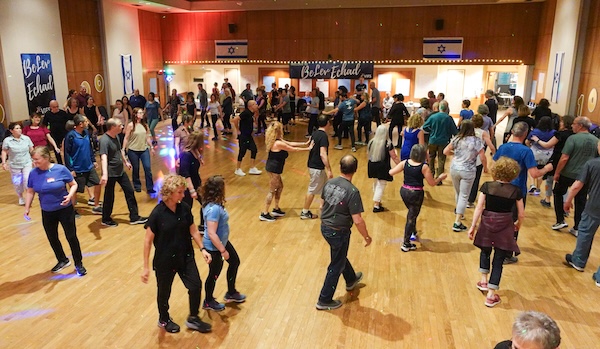
The Vancouver Israeli Folk Dance Society hosted their annual BeLev Echad Workshop at the Jewish Community Centre of Greater Vancouver May 23-25. The society is holding an open house on Sept. 10 for anyone interested in seeing what Israeli dance is all about. (photo from VIFS)

The Vancouver Israeli Folk Dance Society (VIFS) hosted their annual BeLev Echad Workshop at the Jewish Community Centre of Greater Vancouver May 23-25. With a spring theme and the Dance with One Heart slogan, VIFS welcomed more than 100 dancers from at least 12 different cities from all over the world, as far east as Italy and as far south as Costa Rica. This year’s guest choreographers/teachers were Tamir Shalev from Israel, on his first visit to Vancouver, and Marcelo Marianoff from Argentina – on his fifth consecutive visit.

The weekend started with a Shabbat dinner catered by Nava Creative Kosher Cuisine, followed by a dance party that only wrapped up at 1 a.m. Saturday was devoted to teaching and dancing, meeting new friends and catching up with old acquaintances, and even trying one’s hand at a 1,000-piece puzzle. Attendees could choose between a more relaxed-paced room or the main auditorium for more advanced dancers.  Both circle and couple dances were taught. The evening session began with games of balloon pickle ball, and there was a caricaturist artist on site as well. After Havdalah, the dance party began with line dances, circle and couple dances. The hardiest and most energetic dancers continued dancing until 2 a.m.! On Sunday morning, dancers once more gathered for some new learning and a review of all the dances introduced over the weekend.

The event was sponsored by the Snider Foundation, the Lorna Donner Fund, the JCC and the Jewish Federation of Greater Vancouver. It could not have been as great a success as it was without all of those who organized and led it. Many thanks to the wonderful volunteer helpers throughout the weekend. Planning for next year’s workshop is already underway: mark May 29-31, 2026, on your calendar.

VIFS is an inclusive and welcoming community where people of all ages, background and abilities come together to explore and nurture a deep love for Israeli dance and music. On Wednesday, Sept. 10, the society will hold its annual open house, and all those who are interested are encouraged to come and see what Israeli dance is all about.

On Oct. 22, VIFS starts its next season of Beginner’s 1, where new dancers and those who may want a refresher course can learn the basics and start to learn the repertoire. The intermediate class season will also begin on this date, and it will help incorporate dancers into the larger group, as well as teach more of the repertoire. This will be followed by an open session, which combines circles and couples, teaching the newer dances that are currently circulating. There will also be a Monday afternoon session that is only circles, and is devoted to dancing and teaching older repertoire that may not have been danced for many years.

Everyone is welcome to any of VIFS’s sessions – no dance experience is necessary, just a smile and lots of enthusiasm. For more information, contact Pam at 604-839-3931, Nona at 778-834-3488 or Yael at 604-993-0223; or visit vancouverisraelidance.com. 

– Courtesy Vancouver Israeli Folk Dance Society

Format ImagePosted on August 22, 2025August 22, 2025Author Vancouver Israeli Folk Dance SocietyCategories LocalTags culture, education, Israeli Dance, open houses, Vancouver Israeli Folk Dance Society, VIFS
The Dark Lady enlightens

The Dark Lady enlightens

Arghavan Jenati as Emilia Bassano and Nathan Kay as William Shakespeare in Jessica B. Hill’s The Dark Lady, now playing at Bard on the Beach. (photo by Tim Matheson)

There has always been a controversy over whether William Shakespeare was the sole author of all his works. He penned 37 plays and 154 sonnets, with 25 of the sonnets referencing a “Dark Lady,” with raven black brows and wiry hair. Perhaps she contributed to his writing in more tangible ways?

Current thinking is that the Dark Lady was Emilia Bassano, a Jewish woman whose father was Italian and mother Moroccan. She was headstrong and wanted to find success in her own right – something unheard of in Elizabethan England. She was the first woman there to have a work published, her Salve Deus, Rexum Judaeum (Hail G-d, King of the Jews). 

In The Dark Lady, playwright Jessica B. Hill invites audiences to imagine what could have happened if Bassano and Shakespeare had met, particularly early on in his career, around 1589. At that time, Bassano was also starting on her quest to be a published poet. Hill postulates that Bassano enchanted Shakespeare and became his muse, collaborator and lover – and bore his child. 

Bard on the Beach brings this Canadian work to the Douglas Campbell Stage under the steady hand of director Moya O’Connell. With only two characters and 90 minutes long with no intermission, it is an opportunity for the audience to invest in the all-consuming tension, both intellectual and sexual, between the protagonists.

photo - Arghavan Jenati as Emilia Bassano and Nathan Kay as Shakespeare. The opening scene of Jessica B. Hill’s The Dark Lady, with the couple’s Elizabethan pas de deux is a precursor to their complex relationship dance
Arghavan Jenati as Emilia Bassano and Nathan Kay as Shakespeare. The opening scene of Jessica B. Hill’s The Dark Lady, with the couple’s Elizabethan pas de deux is a precursor to their complex relationship dance. (photo by Tim Matheson)

Bassano is an intelligent match for Shakespeare and has no difficulty exchanging witty repartee with him. She challenges him to portray his female characters in a stronger light. At one point, he tells her, “Collaborate with me, I need your mind.” And she willingly gives him the benefit of it. However, despite her contributions, she watches his career flourish while her work remains unrecognized. Ironically, her influence becomes apparent in Shakespeare’s later works, where he does pen female characters who defy traditional stereotypes. 

After Shakespeare’s death in 1616, Bassano comes across his folio of published works and is surprised to find that many of his female characters are named Emilia – clearly a tribute to her – which surprisingly appears to satisfy her thirst for recognition. 

Arghavan Jenati plays Bassano with passion and fury, while Nathan Kay infuses the Bard with the right mix of angst and joy. The opening scene with their Elizabethan pas de deux is a precursor to their complex relationship dance and its inherent power struggle. One memorable scene is their experiment with cross-dressing, as trousered Jenati becomes an aggressive alpha male and Kay an innocent maiden.

While I enjoyed both performances, Jenati was more one-dimensional in her presentation, while Kay provided a more varied interpretation. The dialogue, while mostly classical, is peppered with modern jargon. Throughout, there are references to Bassano’s Judaism, including her grandfather’s forced conversion to Catholicism, his translation of the New Testament into Hebrew, the persecution of her people and her placing of a stone on Shakespeare’s grave in the final scene. 

Ryan Cormack’s sparse set is simple, a series of stacked crates containing various props and costumes. Flowing red silks become bed sheets for the lovers while a cape morphs from a picnic blanket to a shawl to a baby’s coverlet to a shroud. The lighting plays dark or light as needed. Bespoke music by composer and sound designer Anju Singh becomes the third actor in the play, as it accompanies the couple through their 30-year relationship. Alaia Hamer, the costumer, outfits Bassano in a whimsical white frock covered with a suede drawstring bodice while Kay is given a period look for a gentleman of his time. 

This is a production well worth seeing. As artistic director Christopher Gaze notes in the press release, “The Dark Lady invites us to consider how stories are shaped and who gets to shape them.” Director O’Connell sees the play as “an opportunity to shine a light on Bassano and spend time in her orbit.”

Running on alternate nights with The Dark Lady on the small stage is the fast-paced, slapstick romp through all of Shakespeare’s plays and sonnets, The Complete Works of William Shakespeare (abridged) [revised][again]. Jenati and Kay, along with Craig Erickson and Tess Degenstein, share duties with a different combination of three of them taking the stage each night. Director Mark Chavez is at the helm of this irreverent take on the Bard’s repertoire.

On opening night, Kay, Erickson and Degenstein were on stage and were hilarious in their efforts to cover all of the Bard’s works in 90 minutes to avoid a penalty (an offstage voice counts down the minutes). Rife with contemporary references to all things Vancouver and Bard, the audience was in nonstop laugh mode from the start. The second act is all Hamlet, done forwards, backwards and upside down – a credit to the talented, energetic thespian trio. Warning: audience participation is part of the shtick, so you may not want to sit in the front rows.

Cormack’s set is lined with shelves of props from past Bard productions and Hamer brings back statement pieces from the past for the show. Jewish community member Anton Lipovetsky provides the sound design.

This show is probably the most fun you will have at Bard this season. And, if you’ve hated Shakespeare since your high school English classes, it might just change your mind. 

For tickets to all the Bard shows, which run to Sept. 19/20, go to bardonthebeach.org or call 604-739-0559. 

Tova Kornfeld is a Vancouver freelance writer and lawyer.

Format ImagePosted on August 22, 2025August 21, 2025Author Tova KornfeldCategories Performing ArtsTags Bard on the Beach, Emilia Bassano, history, Jessica B. Hill, playwriting, Shakespeare
Making space for kids to play

Making space for kids to play

Simon Fraser Elementary School’s playground, which opened in 2024, was a beneficiary of financial support from the Dayhu Family Foundation. (photo from Dayhu Family Foundation)

For more than 30 years, the Dayhu Family Foundation, formerly known as the Ben and Esther Dayson Charitable Foundation, has helped create playgrounds both locally and in Israel.

“My mother and father always liked the idea of children playing,” said Shirley Barnett, chair of the Dayhu Family Foundation, about her late parents, Esther and Ben Dayson.

In Vancouver, finding the monetary support for playgrounds can be orchestrated by parent advisory councils (PACs) within the public schools. The PACs initiate the fundraising drives, sometimes years in advance, through a multitude of means, from bake sales and lemonade stands to other forms of financial outreach.

According to Barnett, the PAC at Simon Fraser Elementary School was an enterprising group that canvassed the neighbourhood in search of support for their playground project. Dayhu Group of Companies, a real estate investment, development and property management company with a large development near the school, was approached and quickly recognized that this was a worthy endeavour. Before the playground, put together by Habitat Systems, opened in 2024, Simon Fraser had to make do with an area ill-suited for children’s recreational activities.

“My son Jonathan said to me, ‘Didn’t we build two playgrounds in Israel and one at the JCC?  Why don’t we just stick with playgrounds and fund a couple because children need to play?’  It is such a good fit for us,” Barnett explained.

photo - Shirley Barnett at Dayhu Family Foundation’s first venture into playgrounds – the Dayson Playground in Modi’in, Israel, which was built in 1993
Shirley Barnett at Dayhu Family Foundation’s first venture into playgrounds – the Dayson Playground in Modi’in, Israel, which was built in 1993. (photo from Dayhu Family Foundation)

The foundation has a long history of providing financial support to cultural, educational and social causes both within and outside the Jewish community of Greater Vancouver. Its first venture into playgrounds started with the Dayson Playground, a Jewish National Fund project, which was built in Modi’in (outside of Jerusalem) in 1993.

The second playground was also in Israel. Launched in 2018, the Ben and Esther Dayson Outdoor Learning Centre at the Ilanot School in Jerusalem was designed for children with special needs, as the Ilanot School serves children with severe motor and cognitive impairment, including many with cerebral palsy. Its pupils come from many cultural backgrounds, including Jewish, Muslim and Christian. 

“We have also been very involved with the JCC for many years, and so we helped the early childhood education playground, on my son’s initiative, in 2012, at the current JCC,” Barnett said of the Dayhu initiative at the Jewish Community Centre of Greater Vancouver.

A new project at Britannia Community Elementary School is a good fit for the foundation as well, said Barnett, who described the reactions from both Simon Fraser and Britannia as “phenomenal.”

“These are schools that really needed help. The parent committees at Simon Fraser and Britannia have worked so hard to bring about these playgrounds. They are in need and the parents can’t raise much money,” Barnett said.

“A playground can make a huge difference in getting kids outdoors and getting them active, rather than them just running around a gravel field. I think it is obvious that kids need to play. We trust their design, we trust their need and their rationale.”

With both elementary school playground projects, Dayhu operated swiftly after being approached, understanding that there is a process involved before work can commence. Dayhu is not involved in the creativity or development of these projects; rather, it looks at a site and how much money has been raised. When it sees that more funds cannot be raised, it steps in as the lead donor. 

Cassandra Torok, a parent at Britannia, said that, after four years of advocating and fundraising for an expansion and upgrade to the school’s playground, the East Vancouver community felt stuck, unable to obtain the money needed. 

“Meeting Jonathan and Shirley was this amazing tipping point for our school’s playground project,” Torok said. “Her family’s generosity and openness gave our community the support and agency needed to reach the fundraising goals that felt impossible before. Providing the necessary funds to meet students’ needs was a surprising gift that we are so grateful for.

“Without her, her family’s and Dayhu’s philanthropic commitment, we know that we would not be getting the playground needed at our school, the playground our children deserve to grow, develop and improve their well-being as a whole,” Torok added.

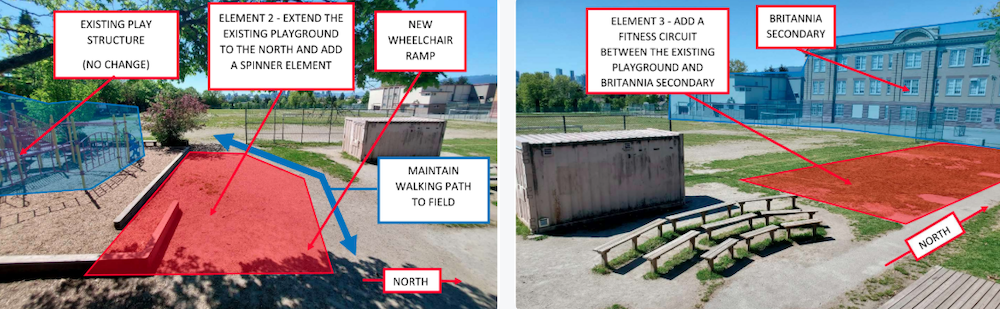
image - A rendering of the proposed playground enhancements at Britannia Community Elementary School, which will be built with financial assistance from the Dayhu Family Foundation
A rendering of the proposed playground enhancements at Britannia Community Elementary School, which will be built with financial assistance from the Dayhu Family Foundation. (image from Dayhu Family Foundation)

Britannia school expects to have shovels in the ground within the next few months. When it opens, the playground will also be accessible to the larger community after school hours, on weekends and during the summer months. 

Dayhu’s efforts have led others to back the creation of playgrounds. At least one other family foundation saw what Dayhu had supported at the JCC and was motivated to help fund similar projects, said Barnett.

“It is a huge accomplishment to be an inspiration for someone else,” Barnett said. “We are not trying to promote our philanthropy. I would love it if someone read this article, and said, ‘You know, we have a few dollars and there is a neighbourhood school with a gravel field, maybe we could do something there.’” 

Sam Margolis has written for the Globe and Mail, the National Post, UPI and MSNBC.

Format ImagePosted on August 22, 2025August 21, 2025Author Sam MargolisCategories LocalTags children, Dayhu Family Foundation, philanthropy, playgrounds, schools, Shirley Barnett

From the JI archives … education

Not surprisingly – “People of the Book,” and all – education is an always-relevant topic that has been covered in the Jewish Independent / Jewish Western Bulletin. The paper seems to have steered clear of editorially supporting any particular Jewish school or type of Jewish schooling, but rather consistently stressed the need for Jewish education, especially for children, but also for youth and adults.

A 1956 editorial noted that “an estimated 50 percent of Jewish children in Canada do not get any Jewish education whatsoever.” While admitting that there were no data to suggest Vancouver fared better than other Canadian cities in this regard, it noted that there were several types of schooling available here, day school, evening classes, religious and secular options. “Only the anti-Semites try to cast all Jews in a common mold, a hateful mold,” it noted. “But the Jews among themselves have always followed diverse paths in the perpetuation of their history, ideals and spiritual heritage.” So, it concluded, “Register your child in the Jewish school of your choice. And, if your child is already enrolled, remind your friend or neighbor about enrolling his child.”

image - clippings from the JI at 95 years about education

Posted on August 22, 2025August 22, 2025Author Cynthia RamsayCategories From the JITags advertising, advice, archives, education spending, history, Jewish Independent, Jewish Western Bulletin, Judaism

טראמפ עוזר לנתניהו ונתניהו עוזר לטראמפ

 במדינות מתוקנות מנהיגים כמו ראש ממשלת ישראל בנימין נתניהו, ונשיא ארצות הברית דונלד טראמפ, היו יושבים בכלא כבר מזמן. אך כיום לצערנו ישראל וארה”ב כבר מזמן לא מדינות מתוקנות, הדמוקרטיה בהן חלשה ומחולשת מדי יום. והציבור או שאינו מבין את חומרת המצב או שלא אכפת לו. מכל מקום: הנזק שגורמים נתניהו וטראמפ למדינותיהם הוא קבוע ובר קיימה ולא יתוקן גם לאחר שהם יעלמו מהמפה הפולטית. יקח מספר דורות אם בכלל להחזיר את המצב לקדומו

בביקורו השלישי בחודשים האחרונים של נתניהו בבית הלבן, נראה המנהיג הישראלי זורח כאילו זכה בפייס. הרי בישראל נתניהו כבר אינו מקובל, ורבים מבינים עד כמה הוא הזיק ומזיק למדינה. אך בבית הלבן כשטראמפ לצידו, מרגיש נתניהו ממש כמו בבית. הרי מה אפכת לו שהוא האחראי הראשי למחדלי השבעה באוקטובר, שחטופים נהרגו כיוון שהוא סירב להגיע להסכמות עם החאמס, ושחיילים רבים כמו פלסטינים רבים נהרגים כמעט כל יום לחינם בעזה

נתניהו המושחת לא התבייש להציע שחברו האמריקני המושחת יקבל את פרס נובל לשלום. עבור מה? עבור הצלחתו להפסיק את המלחמה בין רוסיה לאוקראיינה? האם הצליח טראמפ להביא שלום בין ישראל לאיראן, או בין ישראל לפלסטינים, או בין ישראל לחמאס, או בין ישראל לסוריה, או בין ישראל לערב הסעודית, או בין ישראל ללבנון

אך כאשר שני מנהיגים מושחתחים נפגשים, כל אחד רוחץ את גבו של השני ויש הרבה מה לרחוץ שם. לכן טראמפ לא התבייש לקרוא למערכת המשפט בישראל להפסיק את משפטו של נתניהו. איזה מעמד יש לנשיא ארה”ב שהוא יכול בכלל לצאת בדרישה שכזו

ועל התערבות טראמפ במערכת המשפט בישראל כותב פרופסור אמנון סלע:
אינני קורא מתמיד של ישראל היום. לכן מזמן לא קראתי כתבה של אמנון לורד. כבר לפני שנים רבות הוא הסתמן כאיום כעיתונאי של ה-דיפ-סטייט, מתלהם, לא מדוד. בכתבה החדשה של רבעי אמיתות וחצאי שקרים, הבנתי את גודל החרפה בהתערבותו החצופה של טראמפ במערכת המשפט. נצחון הבורות השמרנית התאפשר, בין השאר בשל התערבות האוונגליסטים ושאר עובדי הדת. מיד יצא הקבינט המטורלל נגד הדמוקרטיה, ומה שנשאר, תוך עשרים וארבע שעות הוא ליבה את המלחמה בין רוסיה לאוקראינה. בהבל-פה הוא סיפח את קנדה וגרנלנד. והסיר מיסים משכבת המיליונרים שהשמינה

בשניה הפכה אמריקה לגדולה כשמפרץ מכסיקו הפך למפרץ אמריקה. באצילות אופיינית לימין לורד תקף את הנשיא ביידן. באותו שאר-רוח שביבי תקף את אובמה. את תמיכת שתי המפלגות ביבי ולורד השליכו הימה לאחר הליך הרס שיטתי של מערכת המשפט האמריקנית, עם נגיחות בקונסטיטוציה. נפנה הנשיא האמריקני הידיד (לפעמים) לנפץ את מערכת המשפט בישראל. זה הנשיא שעסק בפרוסטיטוציה תחת שמי אותו אל. לפני שבע שנים בעצת ביבי ידידו הוא סייע לאיראן להעשיר אורניום. בעצת ביבי ידידו הוא יצא למלחמה נגד אותו איום, ולא הואילו אזהרות הפנטגון והסי.אי.איי, נגד סמכות הקונגרס, אותו קונגרס שתקפו תומכיו, בליווי תפילות דרעי בעל הנס הטרמפיזם מטמא את העולם. נכון, לא לדעת כולם

ועל התנהלות ממשלת ישראל הפוגעת בשלטון החוק אומר איש הצבא הבכיר לשעבר בני ברבש: מחובתנו להציב מול הבריונות השלטונית אמצעי הרתעה יעילים ולמתוח קו עצירה שממנו לא נסוגים. מחיקת עברו והוויתו של כל אדם, יהיה זה אלוף, טוראי או סתם אזרח שלא בא לשלטון טוב בעיניים, היא פרקטיקה מוכרת וידועה של המשטרים האפלים ביותר במאה העשרים, שמפני אחד מהם הזהיר יאיר גולן עצמו. מחר תחליט הממשלה לשלול את תאריו האקדמיים של מדען מזהיר ומחרתיים היא תפקיע משופט עליון את משרתו כי פסיקתו לא תישא חן בעיניהם

Posted on August 20, 2025July 15, 2025Author Roni RachmaniCategories עניין בחדשותTags Amnon Sela, democracy, Israel, Netanyahu, Oct. 7, Trump, United States, אמנון סלע, ארה"ב, דמוקרטיה, טראמפ, ישראל, נתניהו, שבעה אוקטובר

Posts pagination

Previous page Page 1 Page 2 Page 3 Page 4 Next page
Proudly powered by WordPress