Skip to content
  • Home
  • Subscribe / donate
  • Events calendar
  • News
    • Local
    • National
    • Israel
    • World
    • עניין בחדשות
      A roundup of news in Canada and further afield, in Hebrew.
  • Opinion
    • From the JI
    • Op-Ed
  • Arts & Culture
    • Performing Arts
    • Music
    • Books
    • Visual Arts
    • TV & Film
  • Life
    • Celebrating the Holidays
    • Travel
    • The Daily Snooze
      Cartoons by Jacob Samuel
    • Mystery Photo
      Help the JI and JMABC fill in the gaps in our archives.
  • Community Links
    • Organizations, Etc.
    • Other News Sources & Blogs
    • Business Directory
  • FAQ
  • JI Chai Celebration
  • JI@88! video

Recent Posts

  • Sharing her testimony
  • Fall fight takes leap forward
  • The balancing of rights
  • Multiple Tony n’ Tina roles
  • Stories of trauma, resilience
  • Celebrate our culture
  • A responsibility to help
  • What wellness means at JCC
  • Together in mourning
  • Downhill after Trump?
  • Birth control even easier now
  • Eco-Sisters mentorship
  • Unexpected discoveries
  • Study’s results hopeful
  • Bad behaviour affects us all
  • Thankful for the police
  • UBC needs a wake-up call
  • Recalling a shining star
  • Sleep well …
  • BGU fosters startup culture
  • Photography and glass
  • Is it the end of an era?
  • Taking life a step at a time
  • Nakba exhibit biased
  • Film festival starts next week
  • Musical with heart and soul
  • Rabbi marks 13 years
  • Keeper of VTT’s history
  • Gala fêtes Infeld’s 20th
  • Building JWest together
  • Challah Mom comes to Vancouver
  • What to do about media bias
  • Education offers hope
  • Remembrance – a moral act
  • What makes us human
  • המלחמות של נתניהו וטראמפ

Archives

Follow @JewishIndie
image - The CJN - Visit Us Banner - 300x600 - 101625

Images

Leading amid change

Leading amid change

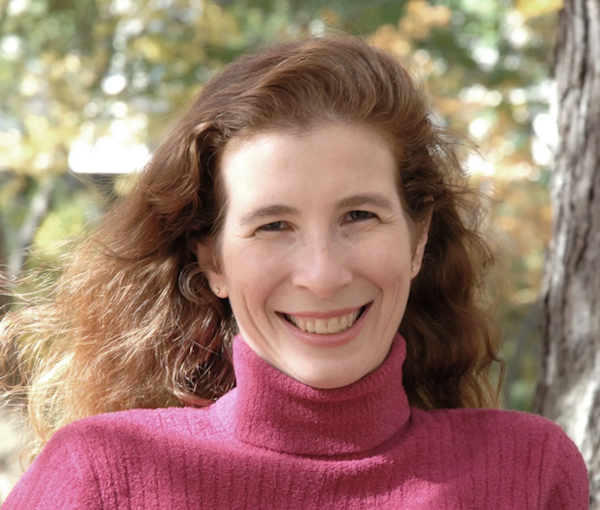
Michelle Ray’s latest book is Leading in Real Time: How to Drive Success in a Radically Changing World. (photo from espeakers.com)

Michelle Ray was recently inducted into the Canadian Speaking Hall of Fame, which is bestowed, in part, for excellence in “educating others to excel.” Of course, it is awarded to exemplary speakers, but Ray also educates using the written word. Her articles have appeared in various publications and she is now the author of two books: Lead Yourself First! Indispensable Lessons in Business and in Life, which was released in 2014, and Leading in Real Time: How to Drive Success in a Radically Changing World, which just came out in the fall of 2021.

Originally from Australia, Ray started her career in media and advertising while living there. She established her own business – as a professional speaker, leadership educator and consultant – in 1995, after she settled in Vancouver. In the conclusion of her new book, she shares what she learned from her parents, who were Holocaust survivors and faced several other challenges in their lives. Though they passed away many years ago, Ray writes, “the enormity of their respective losses is still with me…. They were truly my greatest mentors, and I believe there will never be another generation like theirs. As leaders, we have much to learn, appreciate and apply from their timeless legacy.”

The three lessons Ray highlights in this chapter are to be prepared for unanticipated events, to be optimistic and resilient in the face of difficulties, and to control what you can: “The now is all we know. It’s what we have. It’s the sum total of present moments and what we choose to do with them that prepares us for the unknown.”
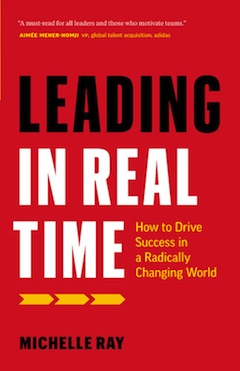
image - Leading in Real Time book coverRay started writing Real Time in 2018, taking notes while traveling for speaking engagements and doing other work. Her schedule got so busy that the book project was set aside until January 2020. “Several months into the process,” she writes, as the pandemic hit, “it occurred to me that my teachings about leaders remaining relevant, flexible and open to new ideas applied to me. Realizing that the world had forever changed, I found myself questioning not only what lay ahead, but my own identity as a leadership expert and whether or not I had the energy to persevere in the face of so much uncertainty. I developed a deeper affinity with the challenges and struggles my clients faced, wanting to explore them further. I became more intrigued by their passion, ongoing success and commitment to the well-being of their workforce during a very difficult period.”

There are eight traits of a “real-time leader,” according to Ray. A real-time leader is transformative, emotionally intelligent, open-minded, humble, exceptional at listening, optimistic, consistent and trustworthy, and authentic. She explains each of these characteristics in more depth and examines the ways in which the workplace, workers and the economy have changed, and continue to change. She offers takeaways at the end of every chapter, as well as some homework, or what she calls real-time action steps. She suggests ways in which leaders having trouble with any aspect of leadership can improve, including hiring a coach or working with a mentor.

It’s not just a matter of personal growth. “There is a high cost to poor leadership choices,” she writes. “Especially when rolling the dice on leaders who are unprepared or who are incapable of immediately assessing real-time situations, including ongoing volatility, pressure from key stakeholders, and shifts in employee expectations.”

And yet, according to Gallup research cited by Ray, “companies in an array of industries put the wrong leaders into the wrong job over 80% of the time” and “65% of managers are not engaged or are actively disengaged. That’s not the workforce,” she writes. “That’s the leadership.”

It might sound obvious that disengagement compromises employee retention but Ray notes how often leaders do not move with the times, and hold on to outdated approaches. She recommends change management education so that leaders can model behaviour for their team regarding adapting to such things as technological innovation, as well as social advances, like women’s equality. Accountability is key and Ray offers readers of her book many ways “to recognize when they have a me problem rather than a we problem.” For example, do you step in to help when needed, are you respectful of others, do you keep your promises?

In the chapter on the human factors at play in running a business, Ray notes that “intelligence and self-awareness are traits that do not always come hand in hand.” But being self-aware and capable of learning – from experiences and from other people, including those working for you – is vital for someone wanting to be a capable leader.

For more on Ray, her books and learning programs, visit michelleray.com.
Format ImagePosted on February 11, 2022February 10, 2022Author Cynthia RamsayCategories BooksTags business, education, leadership, Michelle Ray
Novel informed by life

Novel informed by life

Alina Adams, author of The Nesting Dolls, spoke at a recent Zoom webinar organized by the Jewish Community Centre of Victoria. (photo from alinaadams.com)

New York City-based writer Alina Adams, author of the 2020 novel The Nesting Dolls – about three generations of Russian-Jewish women – spoke at a Jan. 27 Zoom webinar organized by the Jewish Community Centre of Victoria.

Adams began with her personal story. Born in the port city of Odessa, she spent the first seven years of her life in a communal apartment: a dwelling, including kitchen and bathroom, that was shared by two families.

“As I mention in The Nesting Dolls, these relationships were not always positive. My parents were lucky in that they got along well with the people they were assigned to share with,” said Adams.

In 1976, her parents decided to emigrate. Two years earlier, the United States had passed the Jackson-Vanik Amendment, which linked U.S. trade with the free movement of Jews and other groups in the Communist bloc.

“I like to say we were traded for wheat,” Adams quipped.

To those leaving the USSR, she said, “it was like stepping off the edge of the earth. You didn’t know where you were going, you didn’t know what life would be like when you were there, and you certainly knew you couldn’t come back.”

The family’s first stop was Vienna. From there, they took a bus to Rome, where they stayed for four months before traveling on to North America in January 1977, first to New York and then to San Francisco.

Adams recounted some of the reactions upon coming to America in the 1970s as a young child: for example, the surprise of watching a television screen in full colour. It was television, namely soap operas, that Adams later credited for helping her learn English.

The young immigrant started out in a Jewish day school, where the differences in various customs – her life in the new versus the old world – became very apparent. Parents in North America, she recalled, did not send their kids to school in the same dress every day; they used Band-Aids instead of green antiseptic to treat cuts; and, if their child had the sniffles, they did not place the child’s feet in hot water and then into socks filled with dried mustard.

Over time, Adams and her family got the hang of life in America. She graduated high school and college. All along, she knew she wanted to be a writer.

“My parents claim my first words were ‘pencil’ and ‘paper,’” said Adams. “And what’s the advice all writers get? Write about what you know. Well, what did I know? I knew about being a Soviet immigrant. I knew about living a culture that wasn’t mine.”

Publishers, at first, were not interested in those themes. Nonetheless, an editor at Avon Publishing did like her writing and contacted Adams, asking if she would write a Regency romance. This would become The Fictitious Marquis, a unique book in the Regency romance genre in that Jews are central characters.

Adams now has more than a dozen titles to her credit, including mysteries, books on figure skating (non-fiction) and other romances.

image - The Nesting Dolls book coverAbout four years ago, Adams’ literary agent told her that editors were becoming interested in Russia, and this led Adams to write The Nesting Dolls. The novel begins in the Soviet Union of the 1930s and ends in 21st-century, pre-pandemic Brighton Beach, in New York City. It focuses on the lives of three generations of Russian Jewish women in one family; the periods parallel those of Adams’ grandmother, mother and herself.

For Adams, it is the everyday events that are the most fascinating part of writing historical fiction. “Anyone can look up which date Nikita Khrushchev denounced Joseph Stalin, but it is the small details which make historical fiction compelling,” she said.

As an example, she pointed to a personal account she used in the novel. According to her mother, Adams did not want to be breastfed. This caused her mother to go to a doctor and ask him to write up a prescription for yogurt. “These are the little things, in this case how difficult it was to get regular foodstuffs in the Soviet Union, that bring a situation to life and show the reader what an era was like,” said Adams.

The novel was scheduled to be released in 2019 but was delayed to 2020, which, for Adams, turned out to be a blessing for the story’s timeline, in that she wasn’t finishing it during the pandemic. The last section of the book takes place in pre-pandemic Brooklyn in summer. “The things my characters do in the summer of 2019, they could not have done in the summer of 2020,” she said.

Adams lives in New York with her husband and their three children. She has written about her interracial, interfaith and intercultural family for Interfaith Family Magazine and the Forward, and has written columns and articles for dozens of publications.

Sam Margolis has written for the Globe and Mail, the National Post, UPI and MSNBC.

Format ImagePosted on February 11, 2022February 10, 2022Author Sam MargolisCategories BooksTags Alina Adams, immigration, memoir, romance novels, Russia, United States, Victoria JCC, writing
Singing on social issues

Singing on social issues

Mike Kobluk (the Chad Mitchell Trio) is one of the musicians featured in Under the Radar, by David Eisenstadt. (photo from Trail Times)

image - Under the Radar book coverUnder the Radar: 30 Notable Canadian Jewish Musicians, which I wrote with Alan L. Simons (editor), takes an historical approach, covering musicians of most genres and genders, some alive and others having passed on, all skilled, but excelling somewhat out of sight. This is the third in a three-part series of excerpts from the book, which was released last November, and is available in paperback and as an ebook from amazon.ca. The excerpts feature performers with B.C. roots: Robert Silverman, Ben Mink and Mike Kobluk.

In 1958, as students attending Gonzaga University in Spokane, Wash., William Chadbourne Mitchell, Mike Kobluk and Mike Pugh formed the Chad Mitchell Trio. Their repertoire criticized the Cold War and the Vietnam War while championing civil rights. Many of John Denver’s early songs were part of their songlist.

Kobluk, who is Jewish, was born in Trail, B.C. As a child, he sang for fun, but “singing for a career … never entered [his] mind.” He majored in English and math at Gonzaga. He spent 10 years – the longest-serving vocalist with the trio – before leaving in 1969.

But, going back. In the summer of 1959, a friend of Mitchell’s “hatched the plan that started us on a professional career” and the trio journeyed to New York to begin that chapter in their lives, according to Kobluk.

By May 1960, they signed with Harry Belafonte’s management company and performed with Belafonte, Pat Boone and Arthur Godfrey.

After two albums were pressed – The Chad Mitchell Trio and In Concert – Everybody’s Listening – Pugh left the group in the fall of 1960 to return to university. Mitchell and Kobluk auditioned more than 150 vocalists, including Tom Paxton. They chose Joe Frazier and, according to The Virgin Encyclopedia of Popular Music, the group cut nine albums together.

Initially, the trio recorded on the Colpix label. Their sound soared recording for Kapp Records, with tunes like “Lizzie Borden” (about the accused axe murderer), “Mighty Day” (remembering the Galveston, Tex., hurricane of 1900) and the Prohibition-era tune “Rum by Gum.” Other songs included “The Ides of Texas” (about financier Billie Sol Estes) and “The John Birch Society.” On their live album, they sang “Moscow Nights” in Russian, a controversial decision at the time.

Interviewed by the Trail Times, Kobluk said that, “in the early 1960s, we worked with Belafonte, culminating in a Carnegie Hall concert he hosted featuring Miriam Makeba, Odetta, the Belafonte Singers and us.” As part of a U.S. cultural exchange program, the trio also toured South America in 1962.

“Over time,” he added, “we’d renew our association with Belafonte and, years later, when the Selma, Ala., march with Dr. Martin Luther King was being organized, our reputation put us on Belafonte’s list.”

They left Belafonte Enterprises in 1962 for Mercury Records, adding provocative songs like “The Draft Dodger Rag” and “Barry’s Boys,” the latter of which lampooned Barry Goldwater’s Republican 1964 presidential run.

Mitchell quit the band in 1965, replaced by John Denver, then a relatively unknown singer/songwriter. The musicians retained the well-known Mitchell Trio name with Denver, “who stayed for three years, writing many of the group’s songs,” notes The Virgin Encyclopedia. In 1966, Frazier was replaced by David Boise. In 1969, when Kobluk departed, Michael Johnson joined. Because of contract legalities, the Mitchell name could no longer be used and the group became known as Denver, Boise and Johnson. But it was shortlived – they disbanded in 1969.

Kobluk told the Trail Times, “[We] performed songs of political and social commentary, not exclusively, but such material was an important part of any program. Equal opportunity and voting rights for all were high on our personal and professional priority list and fodder for such commentary.”

Kobluk, Frazier and Boise moved to careers outside the music business, Mitchell cut various solo albums and Denver’s career as a solo performer soared. Johnson recorded more than 15 solo albums and Frazier became an Episcopal Church priest.

On Nov. 15, 2014, in Bethesda, Md., the trio shared a final stage at a “farewell” concert, with singer/guitarist Ron Greenstein replacing Frazier, who died in March of that year.

Format ImagePosted on February 11, 2022February 10, 2022Author David EisenstadtCategories BooksTags Chad Mitchell Trio, Mike Kobluk, music, Under the Radar
Alarming population decline

Alarming population decline

Since 1970, the population sizes of mammals, birds, fish, amphibians and reptiles have declined by 68% – or more. (photo from CABGU)

Over the past 24 years, Living Planet Report has been published biannually by the Zoological Society of London and the World Wildlife Fund. It highlights the major declines that some 20,811 vertebrate populations, representing 4,392 species monitored around the world, have experienced globally. The 2020 report (which is the latest one) showed that, on average, the population sizes of mammals, birds, fish, amphibians and reptiles declined by 68% between 1970 and 2016.

As large as that decline is, a paper published in the journal Nature last month by a group of scientists based in Israel – Drs. Gopal Murali and Gabriel Caetano from Ben-Gurion University were lead authors of the paper – shows that it might greatly underestimate the situation.

As part of their research, the authors analyzed the overlap of the monitored populations with protected areas. They then compared these to a random sample of locations and the placement of the global network of protected areas. They found that the populations sampled in Living Planet are much more likely to be found inside protected areas than would be expected to occur by chance.

“This is truly alarming,” said Caetano. “If populations inside protected areas – where we focus a lot of our conservation efforts – are doing so badly, those that reside outside protected areas are probably worse off. The true situation of nature – mostly not monitored or protected – may be much worse.”

The authors highlight the need for proper accounting of the status of nature when making generalizations (as they have done in their paper). However, they also advocate for greater monitoring of populations and species in different locations and stress that many animal populations and natural environments will be lost forever without concentrated and direct action.

The world is experiencing massive transformations that are expected to intensify in the coming decades and have fundamental and dire consequences for the natural world. Prof. Shai Meiri from Tel Aviv University, also a co-author of the Nature article, said, “Rather than discourage us from action, we feel that our work should be viewed as a call to arms. Rapid and comprehensive changes in how we view our relationships with nature are needed – and the onus is on us to make sure they happen before it is too late.”

– Courtesy Canadian Associates of Ben-Gurion University of the Negev, B.C. & Alberta Region

Format ImagePosted on February 11, 2022February 10, 2022Author CABGU - BC & Alberta RegionCategories IsraelTags Ben-Gurion University, BGU, climate crisis, endangered species, environment, Gabriel Caetano
Rabbi talks of healing

Rabbi talks of healing

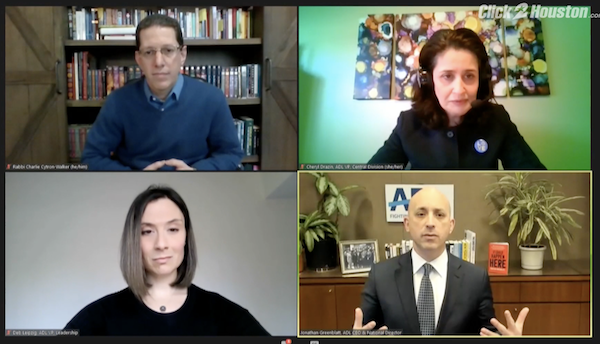
Clockwise from top left: Rabbi Charlie Cytron-Walker of Congregation Beth Israel in Texas speaks with the Anti-Defamation League’s Cheryl Drazin, Jonathan Greenblatt and Deb Leipzig. (screenshot)

Rabbi Charlie Cytron-Walker was bustling around Congregation Beth Israel, in the Dallas suburb of Colleyville, Tex., getting ready for Shabbat morning services. There was a knock on the synagogue’s door and the rabbi welcomed a stranger who was looking for shelter from the unusually cold morning. Cytron-Walker prepared the man a cup of tea and made conversation.

“There were no initial red flags,” the rabbi recalled Jan. 20, in an Anti-Defamation League web event that included the director of the Federal Bureau of Investigation. The man exhibited no signs that he would be a danger, said Cytron-Walker.

“The sense of nervousness, the darting around, those kinds of things that you might expect,” were absent, said the rabbi. “He was calm, he was appreciative, he was able to talk with me all the way throughout, look me in the eye.… I didn’t have a lot of suspicions.”

The unexpected guest was, of course, Malik Faisal Akram, an armed British man who would take the rabbi and three congregants hostage in an 11-hour standoff on Jan. 15. In the end, for all the responders mobilized and crisis negotiators assembled, the incident ended when the rabbi threw a chair at the attacker and the four hostages escaped.

Cytron-Walker explained how he put together the man’s motivations by listening to his rantings and the conversations he was having by phone. Akram was seeking the release of Aafia Siddiqui, a convicted terrorist known as Lady Al Qaeda, who is incarcerated in an American prison not far from Beth Israel synagogue. The hostage-taker apparently subscribed to antisemitic ideas, including the belief that the United States would do whatever was necessary to save the lives of Jewish hostages and that pressure by Jews could lead to his demands being met. At some point, Akram became aware of Rabbi Angela Buchdahl, senior rabbi at Central Synagogue in New York City, and demanded to speak with her during the incident.

“I don’t know how or why he chose her exactly, other than the fact that he thought that she was the most influential rabbi,” said Cytron-Walker. “And I was thinking, this guy really believes that Jews control the world.… I tried to explain to him to the best of my ability that it doesn’t work that way.”

The rabbi credited law enforcement for their response, and spoke at length about the security preparations that synagogues and other Jewish institutions take, with the support of groups like UJA Federations, the Anti-Defamation League, the Secure Community Network and the FBI.

“We had a security plan in place,” said Cytron-Walker. “All of it was helpful, and yet, one of the things that we are aware of is that no matter how good the plan is, no matter how good the security is, these kinds of things can still happen.”

Christopher Wray, director of the FBI, expressed solidarity with not just those immediately affected by the incident but the entire Jewish community.

“We understand all too well that these kinds of attacks are terrifying and that they are not only terrifying to the individuals directly and physically involved, they are also terrifying for all the members of Congregation Beth Israel and, really, for the entire Jewish community, many of whom understandably worry about other threats still out there,” Wray said. “Our joint terrorism task forces across the country will continue to investigate why this individual specifically targeted Congregation Beth Israel on their day of worship.”

Neither Wray, nor any other individual on the livestream, addressed remarks by the FBI’s special agent in charge of the case. As the hostage-taking in the synagogue was unfolding, Matthew DeSarno told media that the assailant was “singularly focused on one issue, and it was not specifically related to the Jewish community, but we are continuing to work to find motive.” His remarks have been condemned as erasing the antisemitic motivations of the terrorist.

While none of the hostages was physically harmed, Cytron-Walker spoke of the emotional recovery that he, the other hostages and the broader community are undergoing.

“It’s going to be one step at a time for us,” he said. “We are doing the best we can to heal. We’re going to have services on Shabbat evening, we’re going to have services on Shabbat morning, we’re going to have religious school on Sunday and we already had a beautiful healing service on Monday night that was so meaningful – to actually see people, to be able to hug people.… But it’s one step at a time.… I’m getting the care that I need. I’m trying to make sure that I take care of my family and, at the same time, one of those pieces that we’re going to have to get past is that sense of fear.

“There was something traumatic that happened within the congregation,” he continued, “and we know that it’s not just our congregation that feels a sense of fear. It’s something that a lot of people and a lot of Jewish people in particular, our people, are living with.… We want to be able to go to services and pray and be together because one of the most important things is to be with one another within that sense of community. That’s needed right now more than anything else.”

Jonathan Greenblatt, chief executive officer of the Anti-Defamation League, moderated the online event.

Format ImagePosted on January 28, 2022January 27, 2022Author Pat JohnsonCategories WorldTags ADL, Anti-Defamation League, antisemitism, Charlie Cytron-Walker, hostage-taking, security, terrorism, Texas
A chance to journal, create

A chance to journal, create

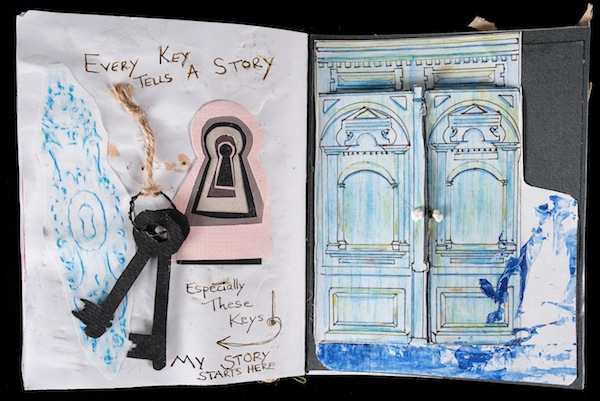
Kathy Bilinsky’s two-page collage makes us wonder what story – or two or three or more – we could find behind the mysterious ornate blue door. (photo by Byron Dauncey)

The Sketchbook Show officially opened at the Zack Gallery on Jan. 12. The brainchild of Hope Forstenzer, gallery director, and Lisa Cohen Quay, coordinator of the Jewish Community Centre of Greater Vancouver’s Adults 55+ program, the exhibit is the culmination of a journaling workshop.

“We wanted to give JCC members the opportunity to say what they felt about COVID and everything else in their lives,” Forstenzer told the Independent. She offered the gallery as a place for the in-person workshop and invited instructor Lex Ireton to lead it.

photo - Lex Ireton led the workshop that resulted to the Zack Gallery’s current exhibit, the Sketchbook Show
Lex Ireton led the workshop that resulted to the Zack Gallery’s current exhibit, the Sketchbook Show. (photo from Lex Ireton)

Ireton, a graduate of Alberta College of Art and Design, and Forstenzer know each other through their work as glass artists.

“I recently went back to school to get an art therapy diploma,” said Ireton. “When Hope contacted me about the workshop she had in mind, I was excited. I’ve taught art classes before, but this one was my first class for adults.”

Putting It All Down: A Creative Journaling Workshop started in the fall of 2021, well into the second year of the pandemic.

“The beauty of journaling is that you don’t have to be an artist,” said Ireton. “We provided all the participants with blank journals plus writing, drawing and crafting supplies. And they had the gallery space itself to work together and create.”

Although more people initially came to the workshop, only six participants stayed to the end. “We met once a week for eight weeks,” Ireton said. “Everyone wore masks, of course. I came up with an exercise, and we did it during the session, sometimes timed, sometimes not. Often, people were so involved, they continued the work at home.”

One of the exercises was called 30 Circles. Ireton explained: “I gave each participant a sheet with 30 empty circles and asked them to fill each circle in any way they chose: a line, a colour, words, images. The circles could be filled thematically or not. Nobody was forced to fill all the circles. Just a few could spark a direction the person wanted to go. It was a warm-up activity, a way to explore the materials and ideas without the pressures of a final completed project. Later, we used the circles as inspirations for journal pages or utilized them for collages.”

Another exercise was a thematic prompt to fire participants’ imaginations, so they could write or draw on a subject. Some wrote poetry or essays. Others did collages using materials they wanted: old magazines, coloured paper, their own paintings or drawings, dry leaves and flowers, fabric fragments.

photo - A page of Judy Stern’s sketchbook expresses a lamentation familiar to any writer
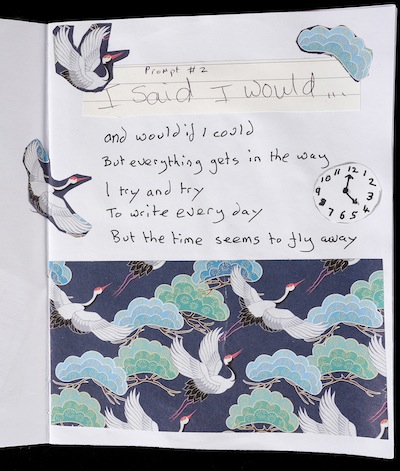
A page of Judy Stern’s sketchbook expresses a lamentation familiar to any writer. (photo by Byron Dauncey)

“As the workshop progressed, participants wanted to know more about each other. We talked a lot. People shared ideas and finished pages. Everyone became more confident with the techniques and media,” Ireton said. “Each session was a joyful social event as much as a journaling workshop. We were all tired of the isolation restrictions caused by COVID.”

While the JCC supplied materials for the workshop, local artist Susan Lee created the empty journals everyone used. “Susan donated the journals for the workshop,” said Forstenzer.

This month, Forstenzer mounted the show, which comprises selected pages of participants’ journals.

“This show is a tangible result of the workshop,” she said. “It is imbued with the energy of the participants putting their imagination to work, creating something meaningful regardless of their personal history as art-makers. The show reflects the child-like pleasure everyone experiences while playing with glue and paper and colours. The weeks of working on their creative sketchbooks has yielded a look into the beauty of putting thoughts on paper in words and images.”

The show is anonymous – there are no names attached to any of the pages, but each image serves as a window into the author’s personality. Some are humorous, like a tongue-in-cheek collage of two pages from a magazine. The collage contains two contradictory lists: What Men Love in Women juxtaposed with What Women Love in Men.

Other images are colourful and lyrical drawings, like a leafy branch with no words. And others combine drawings with poetry and cuttings.

Several workshop participants agreed to talk to the Independent about themselves and their journals.

Judy Stern, a retiree, didn’t have any artistic experience prior to the workshop. “In high school,” she said, “art was the only subject I ever failed. This took away any confidence I might have had, so I have never taken an art class, although I often thought about doing so. Last fall, I received information from the JCC about the upcoming journaling class. I enjoy writing and do have an interest in art, so I asked whether I needed any art experience. I was told, absolutely not…. I was so excited about this, as it was my first group social activity since the beginning of COVID. I was eager to be out and about again, doing something different.”

At first, she was nervous, but the welcoming atmosphere of the workshop soon put her at ease. One image from her journal, cranes flying away among the clouds, integrate her poem – a lamentation familiar to any writer – into a beautiful metaphoric collage.

“I would’ve been happy for the class to go on indefinitely,” she said. “I hope that something similar will be offered again. I am already thinking about my next journal.”

Kathy Bilinsky, another retiree, admitted to having some previous artistic exposure. “I’ve always enjoyed the creative process,” she said. “I have taken various art classes over the years, including two certificate programs at Emily Carr.”

Bilinsky, joined the workshop at the recommendation of Stern, who is a friend. “Judy said I might like it, and she was right. Before, when we could still travel, I always worked in sketchbooks. I have many travel journals documenting our trips with sketches, watercolours, and a bit of cut and paste. As we’re not traveling these days, I looked at this workshop as the opportunity to create.”

Her adjoined journal pages, “Keys and Door,” feature a key ring and a keyhole, above which is written, “Every key tells a story.” We wonder what story – or two or three or more – we could find behind the mysterious ornate blue door depicted on the opposite page.

“I didn’t fill all the pages in my journal,” said Bilinsky, “but so many ideas have been circulating in my mind that I would like to fill in the remaining pages.”

The show can be viewed in person at the Zack Gallery or online at online.flippingbook.com/view/892314086. It runs until Feb. 11.

Olga Livshin is a Vancouver freelance writer. She can be reached at [email protected].

Format ImagePosted on January 28, 2022January 27, 2022Author Olga LivshinCategories Visual ArtsTags journaling, Judy Stern, Kathy Bilinsky, Lex Ireton, Sketchbook Show, Zack Gallery
A blind view of terror

A blind view of terror

Another violent attack on a North American synagogue, this one in Texas, has undermined the feelings of security among Jewish people everywhere.

It is important to see the incident in perspective. Thankfully, the rabbi and three other hostages survived the 11-hour ordeal and the only physical casualty was the perpetrator himself. Second, although such incidents happen too frequently, it must be remembered that, in the context of the many Jewish institutions in North America, this remains a highly unusual phenomenon. Third, the community – Jewish and non-Jewish – locally and internationally condemned the attack and celebrated the escape of the hostages. This differs from situations we have seen in other times and places in which those in power – police, political leaders, the general public – were either complicit or indifferent. A service of healing two days after the incident brought a thousand people of many religious and demographic backgrounds together in response. Police, interfaith leaders and elected officials were united in their expressions of condolence and solidarity.

As Rabbi Charlie Cytron-Walker noted in a presentation with the Anti-Defamation League (click here for story), Jewish community organizations benefit from the (sadly necessary but well-developed) security protocols created and implemented in partnership with Jewish organizations and law enforcement officials. These precautions are familiar to anyone who has set foot in a Jewish institution in recent decades. The visible presence of security can be a reassurance but also is a reminder of the potential for such an attack for people entering a synagogue for services or a Jewish community centre for a workout or sending their children to a Jewish day school. However, another byproduct of this increase in security and comfort for some Jews is the discomfort and lack of safety these protocols elicit in racialized Jews and others who experience more harm from policing. The answer to the problem of a lack of security cannot only be addressed by ever-increasing security, be it walls, cameras, guards, or bollards.

It is perhaps one of the most enduring cognitive disconnects that, while almost any Jew has, at least in the back of their mind, the potential for attack, whenever such an incident does take place, a seemingly opposite reaction occurs among some non-Jewish observers.

In the Texas case, it was exemplified by Matthew DeSarno, the FBI agent in charge of the case, who, in the midst of the crisis, told media that the perpetrator “was singularly focused on one issue, and it was not specifically related to the Jewish community, but we are continuing to work to find motive.”

Even without knowing the details of the individual perpetrator or his motivations, the idea that an official would insist that an attack on a synagogue is unrelated to the Jewish community is jaw-dropping. Unfortunately, it is a common response.

The most celebrated example was after terrorists in Paris targeted a kosher supermarket in 2015, when then-U.S. president Barack Obama condemned those who “randomly shoot a bunch of folks in a deli in Paris.” If the Islamist terrorists who perpetrated the attacks on multiple Jewish targets that day didn’t know that Hypercacher was a kosher supermarket with a primarily Jewish clientele, it was an incredibly lucky coincidence for them.

This refusal to see explicit attacks on Jews as explicit attacks on Jews may be a psychological phenomenon beyond our realm to unravel. Yet there seems to be some socio-psychological need to search for any alternative explanation than plain old antisemitism when a synagogue or other Jewish institution is attacked.

To be kind, perhaps it is wishful thinking. Decent people might search for a rationale that alleviates the fear that the oldest prejudice is as alive today as ever. More realistically, there is a web of conscious and, probably more commonly, unconscious biases that blind people to the blatantly obvious.

As we learned more about the perpetrator, we discovered that he subscribed to a form of conspiracy thinking that sees Jews as having unparalleled power – in this case, the ability to induce the American government to release an imprisoned terrorist. Nevertheless, because the perpetrator was using Jews as an avenue meet his objectives, rather than being motivated solely by a desire to attack Jewish people, the FBI agent eliminated antisemitism as a motive – a truly confounding perspective from a law enforcement official standing outside a synagogue where Jews were being held hostage.

This reaction happens too frequently to be dismissed as a coincidence. There is something baked into the Western imagination that makes denial and deflection the default response to an attack on Jewish people.

One explanation may be that the very ideas that the Texas assailant held – that Jews are inordinately powerful – although rarely expressed so crudely, is actually held by a large swath of the general public, perhaps leading people to conclude that, no matter what befalls an individual Jew or two, “the Jews,” as a people, still hold all the cards or will be just fine.

Other obfuscations dismiss clear and unequivocal attacks on Jews as mere “political statements” on Middle East affairs. Interestingly, those who sometimes explicitly blame Israel or Israeli policies for overseas antisemitic incidents are playing into another familiar and ancient trope about Jews: whatever befalls them, they have brought upon themselves.

It is never bad advice for Jews to be vigilant about our individual and collective security and each violent attack is a timely reminder. But what we need to see are more non-Jews, especially those in positions of authority, addressing the blindness they have as individuals and institutions to what is, to Jewish eyes, absolutely obvious.

Format ImagePosted on January 28, 2022January 27, 2022Author The Editorial BoardCategories From the JITags antisemitism, Charlie Cytron-Walker, FBI, security, terrorism, Texas
Iconic musical at Studio 58

Iconic musical at Studio 58

Left to right: Sofie Kane, Zachary Bellward and Angus Yam in Studio 58’s The Rocky Horror Show, with costume design by Donnie Tejani and makeup by Weebee Drippin. (photo by Emily Cooper)

“It’s the fun and freaky escape we’ve all been craving!” announces the press release for Studio 58 at Langara College’s The Rocky Horror Show. And it’s a statement that’s proven true, with an almost sold-out run as the JI went to press this week.

At least two Jewish community members are involved in the production, which takes place live in the theatre Feb. 3-20. Josh Epstein directs and Itai Erdal created the lighting design.

Amid the happy news regarding ticket sales, COVID continues to cause challenges. “We have multiple Plan Bs and we update them often,” Epstein told the Independent. “Enough of the show has been learned that I know, wherever we end up, this incredible group of performers can entertain.”

While Epstein has done other creative works over the past two years, and so has experience dealing with all the pandemic regulations, this show has been “way harder,” he said.

“I was involved in Craigslist Cantata, which was a filmed production; and a workshop of a new musical at Studio 58 I co-wrote, it was basically an outdoor concert. With Rocky Horror, the cast is large, the lighting, sets and costumes are all world-class. We are being extremely careful to follow all regulations, Studio 58 guidelines and avoid infection. We took a week on Zoom when needed and made other adjustments as needed. I also have two kids under 2 – that’s really the harder part!”

Erdal also has been busier than many in the performing arts sector, but he, too, is finding the situation difficult.

“I have been luckier than most designers I suppose, but still, the last couple of years have been a real struggle, both financially and mentally,” said Erdal. “Just last week, I had to postpone my one-man show How to Disappear Completely, which was scheduled to run at Presentation House in North Van – one of the toughest decisions I had to make.

“Making a living as a theatre artist is tough in the best of times,” he added. “Right now, it’s damn near impossible. It’s been tough mentally too – I basically sat at home for a year between November 2020 and 2021. Fortunately, I’ve been writing a play about my military service [in Israel], so that kept me busy and sane for that year.”

That Erdal is also a writer, producer, performer and artistic director (of the Elbow Theatre) must help in his design of lighting for a production, which begins with his reading of the play in question, “taking notes of things like locations, time of day, mood, atmosphere, effects (lighting, gun shots, smoke, haze, etc.).”

He then meets with the director to “hear their vision of the piece and if they have any specific ideas about lighting. Ideally, this is before the set is designed so I have some input into the set design – Is it an abstract set or a naturalistic one? If the set has walls on the sides, then I can’t use side lighting; if it’s staged in the round, it will obviously change my design.”

He takes more notes while watching rehearsals and, for a musical, like Rocky Horror, he needs to know exactly where the performers are for every song.

“Then I will go home and draw the lighting plot – this show has about 150 lights and the crew needs to know where every light is hung, which way it’s facing and what colour or pattern it takes. Then we hang all the lights, circuit them and patch them to the lighting board.

“After the hang is finished,” he said, “we focus all the lights and then we record the cues. A musical will typically have anywhere between 200 and 300 lighting cues, so that will take awhile to record, at least 12 hours. I use light walkers and ask them to stand where the performers will be standing and we record all the cues and put them all in the prompt script so the stage manager can call the show.”

The performers are then shown their every cue, being told “where to stand, making sure the director likes how it looks and the stage manager knows exactly when the cue is called. In a musical like Rocky Horror,” said Erdal, “the vast majority of the cues will be called with the music, so I would give the stage manager a detailed cue list that includes bar numbers so the show can be called musically. After practising all that for a few days, we add the costumes and all other design elements and do a tech dress and then a dress rehearsal. After that, the audience comes in for previews and we do a few last tweaks before we open the show.”

Collaboration is crucial and it’s one of Epstein’s favourite parts of directing this show – working with the students and the creative team. “After a few years away from this process,” he said, “there is nothing that gets me jazzed more than bouncing artistic ideas off each other and then guiding them to life.”

Given the popularity and longevity of The Rocky Horror Show – first staged in 1973 and then made iconic by the 1975 film adaptation – one might be intimidated when faced with staging it, but not Epstein.

“I love and trust my artistic team and give them a lot of ownership over where we’re headed. If we each dream big and make it happen, it will be unlike any other production – and I think we’ve done that,” said the director.

“Usually,” he added, “I avoid any other productions or history of a show but Rocky Horror has had such a unique life. I researched its beginnings, looked for lyric changes, did consultations with different communities, made conscious decisions about context and intention. I really took to heart ‘Don’t dream it, be it’ and have made that a touchstone of our show – that you can be whoever you want to be and, more importantly, be fabulous.

“One thing that’s going to happen,” Epstein concluded, “is we’re going to honour the audience that this show created, in a big way.”

For showtimes and tickets, visit studio58.ca.

Format ImagePosted on January 28, 2022January 27, 2022Author Cynthia RamsayCategories Performing ArtsTags COVID, Itai Erdal, Josh Epstein, Langara College, musical, Rocky Horror, Studio 58, theatre
Secret Jewish fighters

Secret Jewish fighters

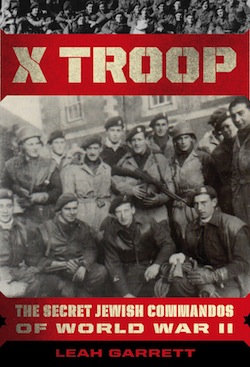
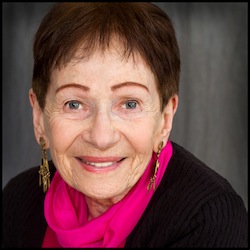
Leah Garrett has pieced together the most comprehensive story yet of a little-known but fascinating footnote to the Second World War, and she shares her findings in her new book, X Troop. (photo by Deb Caponera / Hunter College)

Using recently declassified military records and interviewing family members, author Leah Garrett has pieced together the most comprehensive story yet of a little-known but fascinating footnote to Second World War history – and the role that a few score of Jewish men played at pivotal moments in the conflict.

Garrett is a professor at Hunter College, in New York City. As part of the Cherie Smith JCC Jewish Book Festival, she will speak about her new book, X Troop: The Secret Jewish Commandos of World War Two, in a virtual event on Feb. 6.

X Troop tells of the 87 men – 83 of them Jewish – who made up the No. 10 (Inter-Allied) Commando, 3 Troop. The secret weapon X Troop members shared was that most of them were from German-speaking parts of Europe, had escaped occupied countries and, as Jews, had a deeply personal drive to defeat the Nazis.

Formed officially on July 2, 1942, the unique commando unit would, among other things, allow British forces to expedite interrogation of captured Axis soldiers.

“X Troop would be Britain’s secret shock troop in the war against Germany,” Garrett writes. “They would kill and capture Nazis on the battlefield. But that would not be all. They would also immediately interrogate captured Germans, be it in the heat of battle or right afterward. The men’s fluency in German would enable them to get essential intelligence that would guide the next moment’s choices rather than having to wait to interview prisoners until they were back at headquarters.”

No less than Winston Churchill himself gave the group their nickname.

“Because they will be unknown warriors … they must perforce be considered an unknown quantity. Since the algebraic symbol for the unknown is X, let us call them X Troop,” declared the then-prime minister of the United Kingdom.

One of the many consequential incidents, which could have turned disastrous, was when two troop members, whose anglicized noms de guerre were Roy Wooldridge and George Lane, were captured by the Germans and taken to a command post. The next day, they were driven to the French countryside and, instead of being summarily executed as they had feared, found themselves in the château that was serving as headquarters for field marshal Erwin Rommel.

“During his training … Lane had been taught to give only his (fake) name, rank and serial number if he was captured,” writes Garrett. “But instead he found himself having an extended conversation with the field marshal over tea. Lane fortunately recovered his composure and didn’t say anything that would give him and his comrade away.”

Later, when they were transferred to a POW camp in central Germany, which was filled with 300 British officers, the pair was able to share their knowledge of Rommel’s location – information that was surreptitiously conveyed back to London through a hidden homemade wireless radio.

“A few months later … during the Normandy campaign, Rommel’s staff car was strafed by RAF Spitfires as he drove from Château de La Roche-Guyon to the front near Saint-Lô. The attack left Rommel, one of Germany’s best and most creative generals, with serious injuries, and from that moment on his participation in the war was effectively over,” notes Garrett.

The irony was that some of the members of X Troop suddenly transformed from prisoners of war – Jews of German or Austrian origin, who were viewed as “enemy aliens” – to members of an elite British military troop.

image - X Troop book cover“I found it rather odd that one day I could not be trusted with anything more lethal than a broomstick and the next I was told that I was going to be a spy for the British,” said one member, Tony Firth. “But who said that the English are logical?”

The men faced a fourfold risk if captured. Hitler had ordered Allied commandos to be shot on sight. As refugees from Europe who may have still had family in Nazi-occupied areas, they risked not only their own lives, but those of their families. As Jews, they were the explicit target of state-sanctioned murder and, as German or Austrian nationals, they would be considered traitors to their homelands if captured.

The commandos were trained in a Welsh village and, though each had each created a false persona, it took wilful blindness for the village folk to not realize there was something odd about these particular British soldiers. Recalled one townswoman, “… when we would ask them what nationality they were, they would say: ‘Vee are English.’” (A memorial to X Troop in that Welsh village today ostentatiously omits the fact that almost all of them were Jewish.)

Though trained together and with a tight-knit sense of camaraderie, the troop was deployed not as a group but across the British military. The book follows members of the troop through heroics and horrors at Normandy and in Egypt, Italy, Greece and Yugoslavia. In the end, half of the men would be killed, wounded or forever missing in action.

Some reviewers have drawn parallels between the real-life exploits of X Troop and a 2009 Hollywood blockbuster, but Garrett contrasts the facts and fictions. “Whenever possible, the X Troopers used their intelligence to outmanoeuvre the Nazis and to capture them before a shot was fired,” she writes. “In this regard, the X Troopers were the opposite of Quentin Tarantino’s vengeful Jews in his film Inglourious Basterds. Rather than wreaking personal revenge on the Germans, they followed the rules of war. They coolly collected battlefield intelligence from the enemy and outwitted them using their intellect rather than brute force. And even in extreme instances, such as when Colin Anson confronted the man who had been responsible for his own father’s death, they refused to compromise their own moral standards.”

Among the lessons the author aims to convey is the heroism of Jews in the fight against Nazism, adding a new layer to a growing literature on resistance of various forms.

“Through their exemplary and courageous service,” Garrett writes, “their story challenges the idea that only in Israel did the Jews become armed warriors who fought to try to establish a safe life for themselves and their families.”

Garrett’s Feb. 6 book festival event starts at 3:30 p.m. For tickets, visit jccgv.com/jewish-book-festival.

Format ImagePosted on January 28, 2022January 27, 2022Author Pat JohnsonCategories BooksTags history, Holocaust, JCC Jewish Book Festival, Leah Garrett, war, X Troop
Poetry and painting flourish

Poetry and painting flourish

Pnina Granirer launches her new book, Garden of Words, at the Cherie Smith JCC Jewish Book Festival Feb. 9. (photo from JBF)

“Unexpected and unplanned, like small gifts offered by a kind friend, poems have been forming in my head ever since I was a child,” writes Pnina Granirer in her most recent book, Garden of Words. “Unexpected” is the perfect word for Granirer, who continually reinvents her artistic self.

Garden of Words is a beautiful mix of Granirer’s painted “words” and her written ones, her more distant past and recent experiences, including the loss of her life-partner of more than 65 years, in August 2020. The book is dedicated to Eddy and the final poem (“Goodbye”) and image (“Eddy Studying During Power Outage,” 1957, charcoal on paper) are of him.

This collection is a very personal work that shows Granirer’s powers of observation, both in her paintings and drawings, as well as in her poetry. It also shows her strength via her willingness to be vulnerable.

photo - Pnina Granirer
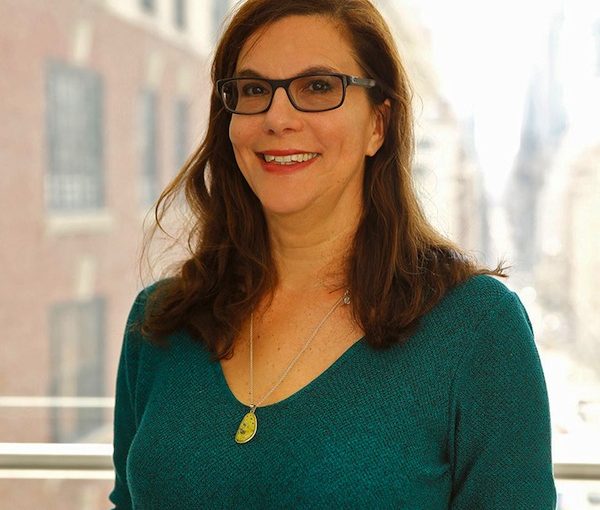
Pnina Granirer (photo courtesy JBF)

Two poems are part of the book’s foreword. The first, explains Granirer, who was born in Romania, “expresses the joy and happiness of a 10-year-old when on August 23, 1944, the Soviet Red Army entered our town, on the day that the cattle cars were waiting at the train station to take us away to the concentration camps. It had been a narrow escape, indeed!” The second is the title poem, in which Granirer notes that she is a painter, “I speak with paint and brush / my words are written / with colour and with line.” But, she recognizes the power of words, their ability to “conjure a Universe”: “I should so like to plant / a garden of words / in my field of colours // and watch them grow.”

Garden of Words has six sections: Sea and Stones; Pandemic; Dancers; Memories of Spain; This and That; and Closure. Her poems are short, concisely capturing the ephemerality of life – not even stones are permanent, the ebb and flow of water covers and exposes them, reshapes them, while they absorb past lives (fossils) and form sculptures. Stones offer inspiration and company to Granirer, who listens to their “quiet whispering.”

While all of the paintings Granirer has selected for this book interact wonderfully with her poems, reinforcing their themes, particularly powerful is the interplay between the poems about COVID-19 and artworks that had, of course, other meanings when they were created years ago. The new poem “All Together Now,” which starts, “This novel enemy is democratic. // In its indifference / all prey is equal,” is followed by the 2008 painting “Utopia – All Together Now,” which features four people dancing within a diamond-shaped boundary. One dancer’s head and their left foot cross the barrier. With dancing as one of the activities that has been restricted during the pandemic and the fact that we’ve all had to create bubbles (diamonds?) within which we can socialize safely, this probably once-joyous painting takes on a more sombre joy.

There are also sparks of sombre humour in various poems, including “Visit with El Greco” and “City Woman.” And the fear is palpable and relatable in the prose poem “Grenada,” which includes the stark reflection: “Five hundred years after the Inquisition, the burnings and autos-da-fé are pushed out of memory, conveniently forgotten, but the ceremonies persist; the dark past is not taught in Spanish schools. It has been turned into an Easter celebration, a parade, a fun event.” But, for Granirer, the crowds are ominous, evoking images of the Inquisition: “I am a Jew and it is coming for me. I am a Muslim and I am afraid. I am a Black woman and here is the KKK coming. I am terrified. The sight of those pointed hoods unleashes a flood of emotion I did not know I was capable of. My anxiety is close to panic.”

There are happier reflections. “Pas-de-deux,” for example, describes two men, each flying their own kite, but close together: “They leap / they dance / they bend and kneel / they sway from side to side / and turn as one.” When the men and their kites finish their dance, they receive “scattered applause from the small gathered crowd.”

At age 86, Granirer continues to create in new and meaningful ways. She launches her new book at the Cherie Smith JCC Jewish Book Festival on Feb. 9, 1 p.m. Visit jccgv.com/jewish-book-festival.

Format ImagePosted on January 28, 2022January 27, 2022Author Cynthia RamsayCategories BooksTags art, Garden of Words, JCC Jewish Book Festival, painting, Pnina Granirer, poetry

Posts pagination

Previous page Page 1 … Page 122 Page 123 Page 124 … Page 492 Next page
Proudly powered by WordPress