Skip to content
  • Home
  • Subscribe / donate
  • Events calendar
  • News
    • Local
    • National
    • Israel
    • World
    • עניין בחדשות
      A roundup of news in Canada and further afield, in Hebrew.
  • Opinion
    • From the JI
    • Op-Ed
  • Arts & Culture
    • Performing Arts
    • Music
    • Books
    • Visual Arts
    • TV & Film
  • Life
    • Celebrating the Holidays
    • Travel
    • The Daily Snooze
      Cartoons by Jacob Samuel
    • Mystery Photo
      Help the JI and JMABC fill in the gaps in our archives.
  • Community Links
    • Organizations, Etc.
    • Other News Sources & Blogs
    • Business Directory
  • FAQ
  • JI Chai Celebration
  • JI@88! video

Recent Posts

  • Sharing her testimony
  • Fall fight takes leap forward
  • The balancing of rights
  • Multiple Tony n’ Tina roles
  • Stories of trauma, resilience
  • Celebrate our culture
  • A responsibility to help
  • What wellness means at JCC
  • Together in mourning
  • Downhill after Trump?
  • Birth control even easier now
  • Eco-Sisters mentorship
  • Unexpected discoveries
  • Study’s results hopeful
  • Bad behaviour affects us all
  • Thankful for the police
  • UBC needs a wake-up call
  • Recalling a shining star
  • Sleep well …
  • BGU fosters startup culture
  • Photography and glass
  • Is it the end of an era?
  • Taking life a step at a time
  • Nakba exhibit biased
  • Film festival starts next week
  • Musical with heart and soul
  • Rabbi marks 13 years
  • Keeper of VTT’s history
  • Gala fêtes Infeld’s 20th
  • Building JWest together
  • Challah Mom comes to Vancouver
  • What to do about media bias
  • Education offers hope
  • Remembrance – a moral act
  • What makes us human
  • המלחמות של נתניהו וטראמפ

Archives

Follow @JewishIndie
image - The CJN - Visit Us Banner - 300x600 - 101625

Tag: technology

Global, contextualized access

Global, contextualized access

The Vancouver Holocaust Education Centre has developed a collections management system (CMS) that integrates the components of the centre’s diverse holdings into an online platform featuring educational resources aligned with the B.C. secondary curriculum to support teaching with primary source materials.

The CMS allows visitors to the VHEC and online users to explore the various holdings in a way that eliminates divisions between the museum, archives, library and audio-visual testimony collections.

“When you search for a keyword term, it will return records from each collection,” said Caitlin Donaldson, the VHEC’s registrar, who was on the project team that coordinated the development of the system. “We worked collaboratively to design the metadata so that catalogue records are fulsome and so that users will get really rich relationships between items.”

The user-centred design approach prioritized the needs of the centre’s educational mandate and community.

“The VHEC’s system has some administrative modules and features that can track conservation, storage location, loans, accessions and donations,” said Donaldson. “So it’s a really powerful tool for us as a nonprofit organization with a small staff.”

A researcher, student or visitor to the VHEC can view the video testimony of a survivor, then easily see all the centre’s holdings that relate to the individual, such as books written by or about them, documents or artifacts donated by them and broader information about their place of birth, their Holocaust experiences and the camps, ghettoes or other places they survived.

The VHEC is committed to assisting teachers to use primary sources effectively in the classroom to teach about the Holocaust and social justice broadly. The centre has created materials to guide students through searching the CMS and analyzing artifacts. Lightbox is a tool within the CMS through which users can create, manage and share collections of items from the catalogue. Students can use this digital workspace to collaborate on projects and further independent research.

The CMS was developed using Collective Access, an open-source collections management and presentation software created by Whirl-i-Gig, which provided development services for the VHEC. Collective Access is also used locally by the Vancouver Maritime Museum and the newly opened Indian Residential School History and Dialogue Centre at the University of British Columbia.

“The open-source software allowed us to benefit from the collected knowledge of other institutions and to also contribute back to that base of knowledge through the development of some modules that were created just for our needs,” said Nina Krieger, executive director of the VHEC. “This collections management system allows us, our visitors, researchers, students and anyone in the world unprecedented access to our collections, with the opportunity to contextualize artifacts and information in ways that were not remotely possible when the centre was created two decades ago.”

The VHEC is continually adding records and digitized items to the catalogue. Researchers are encouraged to contact VHEC collections staff to inquire about its full holdings and to access non-digitized materials.

The development of the online catalogue and CMS was made possible through a gift from the Paul and Edwina Heller Memorial Fund of the Jewish Community Foundation of Greater Vancouver. To explore the VHEC collections online, visit collections.vhec.org.

A version of this article was published in Roundup, Spring 2018, issue 272, by the B.C. Museums Association.

Format ImagePosted on September 7, 2018September 6, 2018Author Pat JohnsonCategories LocalTags history, Holocaust, museum, technology, VHEC
New way to see apartments

New way to see apartments

Jordan Billinkoff, left, and Josh Glow started the company Gryd, winner of the Canadian Federation of Apartment Associations’ New Product or Service of the Year Award. (photo from Gryd)

The Toronto-based start-up Gryd is reinventing the look and feel of finding a place to rent.

Created by Winnipeg Jewish community members Jordan Billinkoff and Josh Glow – who started their careers as b’nai mitzvah photographers/videographers – Gryd provides property management companies with a virtual reality (VR) video of the place they want to rent out.

The idea is sometimes a hard sell to management companies, Billinkoff told the Independent, but renters are lining up to use it. The Canadian Federation of Apartment Associations has recognized Gryd as the best new product on the market.

“I’ve always been very interested in technology and digital media,” said Billinkoff. “And, when I was younger, I was making a lot of videos for fun, and people started saying I could make money shooting videos. So, I started shooting bar mitzvah videos.”

At 24, he started doing more commercial work, mainly in real estate, which led him to start a company called Property Reel, which produced photos and videos for real estate properties.

“And then,” he said, “I realized there are a lot more opportunities for new technologies and enhancing the user experience … the way people search for properties online. So, I decided to change the name to Gryd and we got involved with VR [virtual reality], augmented reality (AR), technologies.”

Billinkoff went to Gray Academy of Jewish Education until Grade 7 before transferring to Grant Park High School and then finishing high school at the University of Winnipeg Collegiate.

“I was always curious about what was coming up next and I wanted to experiment with new technologies that I thought would be promising,” said Billinkoff. “I saw a lot of promise and potential in 3-D technology.

“When I say 3-D technology, I think of VR and AR. Both of these technologies are built on video game engines. The same tools that developers use to make video games are what our developers use to create 3-D models for VR and AR apps.”

So, they bought a 3-D camera and started filming some properties and some 3-D models of properties to gauge public interest. It was a hit with some of their already existing clients.

The product takes a couple of different forms.

“There are the 3-D tours,” said Billinkoff. “With the 3-D tours, you can view them with the headset on. So, the 3-D tours you can put online and you can use them on a desktop, tablet or phone.

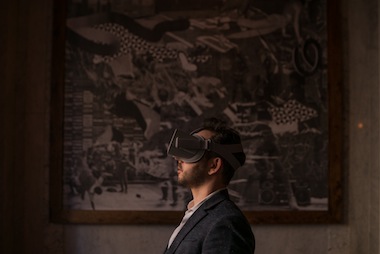
“Taking it to the next level, you have a virtual reality headset and can view it in VR. So, you’re immersed in the property, which creates a dimensionally accurate 3-D model.”

To achieve this, Gryd uses a 3-D scanning camera that creates a wire frame of the environment it’s in. It places each VR photograph on top of the wire frame to make a 3-D model of the property. It is not a mere rendering, but a 3-D model that is dimensionally accurate.

On top of this, there is the floor plan, which users can view by clicking that option. “You can move it around in 3-D, so you can see different vantage points of the floor plan,” said Billinkoff. “The traditional virtual tours were 360-degree panoramic photos, where you click on one, wait for it to load, then click on another. But, with these 3-D models, you can actually walk around with a full range of motion … and, there are no loading wait times.”

photo - Gryd allows users to see a rental space as if they were actually in it
Gryd allows users to see a rental space as if they were actually in it. (photo from Gryd)

VR goggles are a new technology and most companies are just starting to use them in their leasing centres or corporate offices. The technology allows a potential lessee or buyer to be immersed in a place that is not yet built.

Because the technology is so new, Billinkoff has been holding off on releasing his 3-D videos for the past few years in order to build up a content library of tours before they launch.

While the 3-D headsets cost close to $300, Gryd is selling ones that are only $15 and allow anyone to use their own smartphone as the 3-D screen.

The biggest challenge has been convincing property managers to invest $250 on a property that typically rents in a couple of weeks during a slow period.

“So, we’re kind of fighting for the renters, to create a better user experience even in these markets where everything is leasing anyways,” said Billinkoff.

While most property managers are open to the idea of shooting 3-D tours, he said, “They just have such low vacancies that, a lot of times, they won’t even have a vacancy available, to be able to shoot the unit, for another half a year. So, there are a lot of logistical issues with that, because of the low vacancy.

“Also, property management isn’t known for being the most innovative industry. So, a lot of property managers are comfortable with their old-school routines and processes. This is something very new and high-tech.”

When Gryd first started shooting VR in 2015-2016, they would not mention it in the sales pitch, knowing it would likely cause resistance. Instead, they shot as many 3-D tours as they could over two to three years. Then, they launched a VR app, which has a library of 3-D tours, and property managers receive this bonus.

“We sold them the 3-D tours,” said Billinkoff. “Then, one day, which was a couple months ago, we put the switch on, and all the tours turned VR. And we informed all our clients that they now have this new and awesome bonus.”

At first, Billinkoff did all the shooting, but now Gryd has a network of trained photographers all over the country. Both Billinkoff and Glow have relocated from Winnipeg to Toronto to expand their business.

If someone visits gryd.com now, they will not yet be able to search for a place in Vancouver. But, that addition is currently in the works. Billinkoff anticipates that it will come into effect as of spring 2019.

“The number one thing we hear from all the property managers is that having the 3-D tours pre-qualifies the renters,” said Billinkoff. “So, if a renter is coming in to see the unit in person, they’re already very well-informed. They’ve already seen everything they need to know online. So, if they are coming in, they are already ready to put down a deposit on the property. They are just confirming everything is what it looks like online.

“It just makes the process more efficient, as they [the property managers] are weeding out tire kickers from coming in and taking a look at the apartment. Then, on the opposite end, it works great for renters, as they don’t need to waste time going to apartments they aren’t interested in. When they go to an apartment, they already know they like it, as they’ve seen everything online.”

For more information, visit gryd.com.

Rebeca Kuropatwa is a Winnipeg freelance writer.

Format ImagePosted on August 31, 2018August 29, 2018Author Rebeca KuropatwaCategories NationalTags Gryd, housing, Jordan Billinkoff, Josh Glow, technology, Winnipeg
Mobileye’s self-driving tech

Mobileye’s self-driving tech

A total of 12 cameras offer a 360-degree configuration for long-range surround view and parking in the Intel Mobileye autonomous car. (photo from Intel Corp.)

Jerusalem-based Intel subsidiary Mobileye reportedly has struck a deal to supply its future EyeQ5 chips for integration in eight million partially automated cars to be manufactured by an unidentified European automaker in 2021.

Partial automation, a step toward the eventual goal of fully self-driving vehicles, requires the driver to remain alert to road conditions. Mobileye is a world leader in advanced driver-assistance technology, dominating about 70% of the current market.

Intel acquired Mobileye in March 2017 for $15.3 billion, the largest-ever acquisition of an Israeli high-tech company.

“By the end of 2019, we expect over 100,000 Level 3 cars with Mobileye installed,” said Amnon Shashua, chief executive officer and chief technology officer, referring to self-driving cars in which the driver has about 10 seconds to take over if the system fails.

Shashua announced last month that Intel and Mobileye are starting to test their responsibility-sensitive safety (RSS) model in a 100-car autonomous vehicle (AV) fleet – each equipped with 12 cameras for 360-degree visibility – on the notoriously difficult-to-navigate streets of Jerusalem.

“In the coming months, the fleet will expand to the U.S. and other regions,” he said in a May 17 statement. “While our AV fleet is not the first on the road, it represents a novel approach that challenges conventional wisdom in multiple areas. Leveraging over 20 years of experience in computer vision and artificial intelligence, our vehicles are proving the Mobileye-Intel solution is the most efficient and effective.”

Shashua said a radar/lidar layer will be added to the cars in the second phase of development.

Regarding the next-gen EyeQ5-based compute system due out in early 2019, he added, “the current system on roads today includes approximately one-tenth of the computing power we will have available [then].”

Israel21c is a nonprofit educational foundation with a mission to focus media and public attention on the 21st-century Israel that exists beyond the conflict. For more, or to donate, visit israel21c.org.

Format ImagePosted on June 15, 2018June 14, 2018Author ISRAEL21CCategories WorldTags automotive, Israel, Mobileye, self-driving cars, technology
Voice will have control

Voice will have control

One day, your car might be able to sense your mood and, if you’re agitated, send soothing music. (photo from autospies.com)

Back in 1995, Shlomo Peller founded Rubidium in the visionary belief that voice user interface (VUI) could be embedded in anything from a TV remote to a microwave oven, if only the technology were sufficiently small, powerful, inexpensive and reliable.

“This was way before IoT [the Internet of Things], when voice recognition was done by computers the size of a room,” Peller told Israel21c. “Our first product was a board that cost $1,000. Four years later, we deployed our technology in a single-chip solution at the cost of $1. That’s how fast technology moves.”

But consumers’ trust moved more slowly. Although Rubidium’s VUI technology was gradually deployed in tens of millions of products, people didn’t consider voice-recognition technology truly reliable until Apple’s virtual personal assistant, Siri, came on the scene in 2011.

“Siri made the market soar. It was the first technology with a strong market presence that people felt they could count on,” said Peller, whose Ra’anana-based company’s voice-trigger technology now is built into Jabra wireless sports earbuds and 66 Audio PRO Voice’s smart wireless headphones.

“People see that VUI is now something you can put anywhere in your house,” said Peller. “You just talk to it and it talks back and it makes sense. All the giants are suddenly playing in this playground and voice recognition is everywhere. Voice is becoming the most desirable user interface.”

Still, the technology is not yet as fast, fluent and reliable as it could be. VUI depends on good internet connectivity and can be battery-draining.

Peller said, in five years’ time, voice user interface will be part of everything we do, from turning on lights, to doing laundry, to driving.

“I met with a big automaker to discuss voice interface in cars, and their working assumption is that, within a couple of years, all cars will be continuously connected to the internet, and that connection will include voice interface,” he said.

As voice user interface moves to the cloud, privacy concerns will have to be dealt with, he added. “We see that there has to be a seamless integration of local (embedded) technology and technology in the cloud. The first part of what you say, your greeting or ‘wakeup phrase,’ is recognized locally and the second part (like, ‘What’s the weather tomorrow?’) is sent to the cloud. It already works like that on Alexa but it’s not efficient. Eventually, we’ll see it on smartwatches and sports devices.”


Diagnosing illness

Tel Aviv-based Beyond Verbal analyzes emotions from vocal intonations. Its Moodies app is used in 174 countries to help gauge what speakers’ voices (in any language) reveal about their emotional status. Moodies is used by employers for job interviewees, retailers for customers, and in many other scenarios.

The company’s direction is shifting to health, as the voice-analysis platform has been found to hold clues to well-being and medical conditions, said Yoram Levanon, Beyond Verbal’s chief scientist. “There are distortions in the voice if somebody is ill and, if we can correlate the source of the distortions to the illness we can get a lot of information about the illness,” he told Israel21c. “We worked with the Mayo Clinic for two years confirming that our technology can detect the presence or absence of a cardio disorder in a 90-second voice clip.

“We are also working with other hospitals in the world on finding verbal links to ADHD, Parkinson’s, dyslexia and mental diseases. We’re developing products and licensing the platform, and also looking to do joint ventures with AI companies to combine their products with ours.”

Levanon said that, in five years, healthcare expenses will rise dramatically and many countries will experience a severe shortage of physicians. He envisions Beyond Verbal’s technology as a low-cost decision-support system for doctors.

“The population is aging and living longer, so the period of time we have to monitor, from age 60 to 110, takes a lot of money and health professionals. Recording a voice costs nearly nothing and we can find a vocal biomarker for a problem before it gets serious,” said Levanon.

Beyond Verbal could synch with the AI (artificial intelligence) elements in phones, smart home devices or other IoT devices to understand the user’s health situation and deliver alerts.


Sensing your mood

Banks use voice-analysis technology from Herzliya-based VoiceSense to determine potential customers’ likelihood of defaulting on a loan. Pilot projects with banks and insurance companies in the United States, Australia and Europe are helping to improve sales, loyalty and risk assessment regardless of the language spoken.

“We were founded more than a decade ago with speech analytics for call centres to monitor customer dissatisfaction in real time,” said chief executive officer Yoav Degani. “We noticed some of the speech patterns reflected current state of mind but others tended to reflect ongoing personality aspects, and our research linked speech patterns to particular behaviour tendencies. Now we can offer a full personality profile in real time for many different use cases such as medical and financial.”

Degani said the future of voice-recognition tech is about integrating data from multiple sensors for enhanced predictive analytics of intonation and content. “Also of interest,” he said, “is the level of analysis that could be achieved by integrating current state of mind with overall personal tendencies, since both contribute to a person’s behaviour. You could be dissatisfied at the moment and won’t purchase something but perhaps you tend to buy online in general, and you tend to buy these types of products.”

In connected cars, automakers will use voice analysis to adjust the web content sent to each passenger in the vehicle. “If the person is feeling agitated, they could send soothing music,” said Degani.

Personal robots, he predicted, will advance from understanding the content of the user’s speech to understanding the user’s state of mind. “Once they can do that, they can respond more intelligently and even pick up on depression and illness,” he said.

Degani predicted that, in five years’ time, people will routinely provide voice samples to healthcare providers for analytics, and human resources professionals will be able to judge a job applicant’s suitability for a specific position on the basis of recorded voice analysis using a job-matching score.

Israel21c is a nonprofit educational foundation with a mission to focus media and public attention on the 21st-century Israel that exists beyond the conflict. For more, or to donate, visit israel21c.org.

Format ImagePosted on June 15, 2018June 14, 2018Author Abigail Klein Leichman ISRAEL21CCategories WorldTags automotive, Israel, technology
Digital impact on our lives

Digital impact on our lives

(photo from publicdomainpictures.net)

Dr. Simon Trepel, child analyst and psychiatrist at the Manitoba Adolescent Treatment Centre, is seeing an increasing number of children and teenagers using phones – even during sessions.

“I was hearing more and more from parents about some difficulties they were having around technology and screen time,” said Trepel. “I was noticing, even in my own family, how pervasive screens are becoming … as a preferred source of entertainment, as well.

“When this stuff marinates in you for awhile, it makes you curious about deeper questions about what’s going on. It ultimately behooves anybody who is working in mental health to start wondering about all the ingredients that might be contributing to someone’s mental health…. I became more curious about how these devices and screen time might be affecting, not just kids and teens, but, really, all of us.”

According to Trepel, using technology in daily life is no longer a choice. It is a fundamental part of how we all get by. Most of us check our phones several times a day, and conduct business and communication on our phones or tablets almost exclusively.

He said there are about four billion people using the internet right now worldwide, and a third of those people are children and teens. There are about five billion people using mobile phones and a little over three billion people on social media at any given time, he said. And, these are all increases of anywhere from five to 15% in comparison to the previous year.

“These trends are changing how we communicate,” said Trepel. “They are changing how much face-to-face communication we have and the nature of the communication itself. The previous generation would use words and texts. Now, videos, pictures and memos are the preferred way to communicate. It’s changing the very ingredients we use to communicate with one another.”

There are implications to this change, especially in children, whose not yet fully developed brains are particularly susceptible to getting into trouble online. But, Trepel said, there is something that can be done – and it starts with adults getting off their phones and other screens, especially when around young people. We also need to start talking about these issues, as kids who come from homes that discuss such topics tend to be less at risk.

“When there’s a more negotiated amount of technology use and supervision and things like that, that is a good thing,” said Trepel. “But, there are many, many kids who have a combination of not a lot of supervision combined with having an immature brain, and these kids are the ones we are most worried about getting into trouble online.

“We worry that screens are displacing a lot of other activities that might be healthier than being on technology – things like getting adequate sleep or being outside. The amount of hours spent outside is now at about half of what it used to be. It’s gone from about 18 hours a week to about seven hours a week in one single generation.”

Getting a handle on this will not be easy, but it starts with parents making the time to fully understand the tech diet of their kids. Just like we monitor their food intake, we need to monitor their tech intake.

“Sit down with them and let them take you through a typical day,” advised Trepel. “What types of sites are they using and for how long? What types of interactions are they are having on this site? The timing of this is important. Is it the first thing they do in the day, getting on their device? Is it the last thing they do before bed? Do they themselves detect any problems with their screen use? Are they running into any cyber-bullying or being taken advantage of? Do they feel better or worse after using their phones? Do they notice phones cutting into their sleep, or do they notice themselves having a difficult time stopping themselves from checking? This is the beginning of getting data about how your kids and teens are using their phones. But, it’s also starting to ask the question of whether or not this is becoming a problem for your kid or teen.”

Trepel suggested that, when you monitor your kids, you want to make sure it is active monitoring – that you are co-viewing and discussing the sites that they are on. It is also important to avoid spy-type programs, he said, as kids will find ways to work around them.

Aim to be playing together, following each other on social media. Use any opportunity for educational guidance – not so much making it a single conversation, but, instead, an ongoing dialogue about the device. You can ask for their help learning about social media, for example. “I think that’s a very elegant way to cover a lot of bases,” said Trepel. “It allows the parent to learn a lot about what the kid is using, in terms of technology use. But, it also updates the parents as to what these social media sites are all about – how they are navigated, how they are used.

“It may also be a great way for kids and parents to spend more time together, interacting with each other, teaching each other. While they might teach you about Twitter, you might be able to point out various ways they are using the technology that might be helpful or harmful. You might, if the child teaches you Twitter, find out if the child has a public account and is being followed by hundreds of people the child has never met before.

“It’s not only a way to have a child feel good about helping a parent, but, once the parent knows more about the technology, the parent can start to look for red flags.”

Studies have shown that parental behaviour is one of the most powerful influences on a child’s behaviour. So, Trepel suggests taking an honest look at yourself as a parent, about how embedded these devices are in your own life. And then, start to change that for yourself, while also becoming a good role model for your kids.

“You want to be proactive with your kids,” said Trepel. “You don’t want to wait until there’s a problem. You want to educate them to the possibility of problems.

“You also want to be proactive about texting and driving. This really might be the drinking and driving of our generation. I remember, when I was in high school, there was MADD, Mother’s Against Drunk Driving. I think we need some sort of revival of that, looking at parents being concerned about texting and driving. The stats from Manitoba are striking that, just five or 10 years ago, we were seeing maybe 3,000 collisions per year. And, in the span of just a few years, it’s now up to 11,000 collisions involving distracted driving per year – a four- or fivefold increase, about 30 distracted driving collisions a day.”

Trepel said it is best to avoid taking technology away without offering an alternative. Make it easy for kids to see their friends in real life, he said. Let them go over to their friends’ houses, take them places they want to go, and do things they want to do – provide them with in-person opportunities. Play a board game, do arts-and-crafts, encourage them to learn to play an instrument or participate in a sport. Off-screen activities, he said, have a greater likelihood of making your kids feel happy as compared to on-screen activities.

Trepel suggested having your kids turn off their phone notifications at important times of the day, like sleep time, family time, meal time, school time, and so on. And make sure that you do the same.

“Every time we get a signal from our phone, it could be someone liking our photo or giving us a compliment, or something we anticipate might be good,” said Trepel. “And that reward system in our brain kicks into gear and compels us to want to check what the notifications are. Once our screen is on and in our hands, we might end up surfing or doing something else we weren’t even intending to do – at the expense of whatever original activity we were doing before the notification occurred. So, we have to make sure that we turn off all those attention stealers.”

Trepel recommended that parents turn off the wifi after 9 p.m., or even earlier, if they think there will be a significant battle to have their kids turn off their screens in the evening or if it is affecting their ability to do homework.

Or, he added, you can get your kids a phone with no internet capabilities. Some executives, he said, have even switched back to such phones, as they were wasting too much of their time when they had a phone with more tech capabilities.

For starters, Trepel said, begin the conversation. Ask your kids for ways to keep things under control. Dialogue, go back and forth, and find ways that work for your family.

Rebeca Kuropatwa is a Winnipeg freelance writer.

Format ImagePosted on June 8, 2018June 6, 2018Author Rebeca KuropatwaCategories NationalTags cellphones, children, family, health, Simon Trepel, technology, teenagers
Try to reduce screen time

Try to reduce screen time

In her latest book, Be the Parent, Please (Templeton Press, 2018), author Naomi Schaefer Riley reminds parents to take back control and help their kids find healthier means of entertainment.

Originally from Massachusetts, this New York mom of three kids (ages 11, 9 and 5) is no stranger to society’s pressure to give children whatever they want, including the latest technology.

“Over the last few years, I myself struggled with the issues of how to handle screen time, and I’ve watched a lot of other parents struggle with it,” Schaefer Riley told the Independent. “As a journalist, I wanted to talk to experts and do reading, and find out what the research says … and talk to parents about strategies they were using to deal with this.

“The pressure to hand over screens to kids starts almost immediately these days,” she said, “The iPhone came out a little more than 10 years ago, coinciding with the birth of my oldest daughter. It took a couple years but, by the time she was in preschool, a lot of parents, even to have a basic conversation with another person, would hand over their phone just in order to distract the child.”

Today, tablets and cellphones have become a source of all things entertainment for kids (let alone adults), whether that involves looking at pictures of themselves, creating videos or playing games.

“When my kids were younger, we let them watch one show every night, some half-an-hour cartoon,” said Schaefer Riley. “Then, my son was born and the fight began over what they were watching and who gets to pick each night. And it became more of a struggle to tell them you’re going to turn off the TV…. A book I read enlightened me, called The Plug-In Drug. It came out a little more than 40 years ago and was mostly about TV and videogames.

“The author noted that, when you turn off a screen, it’s almost like waking a child up from a nap. It’s a trance-like state and they’re so into it that it’s almost like a change from sleep to wakefulness when you turn it off. And they become cranky. It can be as long as a half hour before they adjust back to reality. I think I was tired of the crankiness, too, of every time I turned it off, to have this fight ensue.”

At the Schaefer Riley house, there are a lot of toys and the kids are expected to entertain themselves without the TV. “But, a lot of parents don’t make that expectation,” she said. “They assume that, unless the child has a screen, the parent has to be entertaining them at all times, that the child can never be restless or irritated.”

She went on to explain that it’s not a parent’s job to ensure that their child is 100% engaged in something at all times. Instead of screens, she suggested, “Why not give your kids some pots and pans to bang together or some cardboard boxes? These are things we know are good for building fine and gross motor skills, and [that] encourage kids to explore things.

image - Be the Parent, Please book cover“I think what the screens have allowed is for us to exercise more control over our kids and keep them on a tighter leash. You don’t need to go all the way to the park. You can just sit in the living room and give your kid an iPad. That way, I don’t need to worry about whether you know enough about crossing the street or whether you’ve achieved that level of independence. The phone will allow me to have this tether on you. This is not very beneficial to kids in the long run.”

Children are now finding tasks difficult to handle if they cannot immediately text their parents for advice or counsel about their lives, argued Schaefer Riley. There is constant communication, with technology serving as a crutch for helicopter parenting.

“A lot of parents have confessed to me … they know, deep down … that they don’t need studies to tell them that their kids are on screens too much,” said Schaefer Riley. “Parents know this.”

It’s time to apply basic parenting strategies to technology, she said. “I know it sounds simplistic to say, but your kid doesn’t generally ask for chocolate cake for breakfast in the morning; they know there’s none for breakfast. If you talk about screen-time limits and stick to them, your kid will not be on you constantly…. If you stick with the rules you set for a few weeks or months, your child will learn that there is no point in asking again; they already know what the answer is and will stop asking for things you consistently say ‘no’ to. The idea is to bring parents back to reality and back to a sense of where they do have control.”

According to Schaefer Riley, the life skill of asking for assistance from an adult is one that many children are missing out on, due to the reliance on tablets and phones.

“I see the kids … my daughter is on the swim team … and they all walk out of practice and everyone is texting their parents – pick me up in five or 10 minutes outside,” said Schaefer Riley. “I’m like, ‘who are you?’ These are not your chauffeurs. I think that’s how we’ve come to think of ourselves.”

Schaefer Riley said observant families, who turn off their phones on Shabbat, have an advantage, as the children come to appreciate that there is something to be gained from family time. “I think,” she said, “that more and more people, whether they are religious or not, are trying to find that ‘technology Sabbath,’ as they like to call it, to give themselves a break … either at meal times, or one day a week, or on vacation. It’s considered a luxury now, to be able to get away from your phone.”

Schaefer Riley emphasized that her book is not meant to scold anyone. She herself faces these challenges.

“There’s a lot of pressure coming from technology companies and schools, and from the culture generally, that are really pushing you to hand over these devices to your kids,” she said. “It takes some willpower to say no, that’s not for my child, or this much time is not for my child.

“There’s a point at which you need to go into your community and find allies,” she added. “Everywhere I went, every community of people I’ve spoken with, there wasn’t just one family trying to hold the line. There were several and, sometimes, they weren’t connected with each other. But, if you do a little searching, you can find people trying to take a similar tactic, and it helps to have allies.”

Rebeca Kuropatwa is a Winnipeg freelance writer.

Format ImagePosted on April 27, 2018April 25, 2018Author Rebeca KuropatwaCategories BooksTags children, Naomi Schaefer Riley, parenting, technology
שיתוף הפעולה הטכנולוגי

שיתוף הפעולה הטכנולוגי

שיתוף הפעולה הטכנולוגי בין קנדה לישראל מתרחב משמעותית. (צילום: tec_estromberg)

מועצת המנהלים של קרן קנדה-ישראל תממן שמונה פרוייקטים חדשים בסכום כולל של כחמישה עשר מליון שקל (שהם כמישה מיליון ושלוש מאות אלף דולר קנדי). הפרוייקטים יבוצעו בשיתוף פעולה עם חברות בתחומים הבאים: חקלאות, רובטיקה, תקשורת לווינים, טכנולוגיות, מזון וטכנולוגיה נקייה (קלינטק). רשימת שמונה החברות שזכו בתקציבים של קרן קנדה-ישראל כוללת את: פלורה-פוטוניקה – בתחומי החקלאות, אינובופרו – בתחומי החקלאות, סי-נייצ’ר – בתחומי החקלאות, אף.אף.אר רובוטקס – בתחומי הרובוטים לחקלאות, גילת רשתות לווינים – בתחומי תקשורת לווינים, קנופי מדיה – בתחומי הטכנולגיות לאינפורמציה ותקשורת, אטלנטיום טכנולוגיות – בתחומי המזון והטכנולוגיה הנקייה (קלינטק) ואפקון בקרה ואוטומציה – בתחומי הטכנולוגיה הנקייה (קלינטק).

יצויין שקנדה כיום היא אחת השותפות המשמעותיות של ישראל, בתחום החדשנות. בנוסף לשיתוף הפעולה עם קרן קנדה-ישראל, מתבצעים שיתופי פעולה נוספים עם ממשלת מחוז קוויבק, ממשלת מחוז אונטריו וגורמים נוספים, בתחומי בריאות, תחבורה חכמה ועוד. התקציב הכולל של מחקר ופיתוח הכולל של פרוייקטים בין קנדה וישראל שאושרו בשנה האחרונה, עומד על לא פחות מכארבעים ושניים מיליון שקל (שהם כחמישה עשר מיליון דולר קנדי).

אומר שר הכלכלה של ממשלת ישראל, אלי כהן: “קשרי החדשנות בין ישראל לקנדה קיימים כבר יותר מארבעים שנה. מדובר במנוף כלכלי בילטרלי חשוב מאין כמוהו, המחבר בין חברות, חוקרים, ויזמים ישראלים וקנדים. שיתוף הפעולה הטכנולוגי שלנו עם קנדה, על מגוון ערוציו הוא נכס אסטרטגי חשוב למדינת ישראל ולאקוסיסטם הטכנולוגי שלנו”.

מנכ”ל רשות החדשנות ,אהרון אהרון, מוסיף: “קנדה מפעילה מערכות חדשנות מתקדמות ומפותחות מאד, הן ברמה הפדרלית והן ברמה המקומית. רשות החדשנות מפעילה מגוון תכניות ברמות שונות שמאפשרות לחברות טכנולוגיה ישראליות בתחומים שונים ליהנות ממערכות חדשנות אלה, ולשתף פעולה עם חברות וגופים קנדיים”.

הקרן הדו-לאומית קנדה-ישראל שמופעלת על ידי רשות החדשנות הוקמה לפני כעשרים וארבע שנים (ב-1994). מאז היא עוסקת בחיבור שבין חברות טכנולוגיה בין שתי המדינות. וזאת במימון של פרוייקטים של מחקר ופיתוח משותפים. בנוסף לקרן הדו-לאומית, רשות החדשנות מפעילה מספר הסכמי שיתוף פעולה עם גורמים נוספים בקנדה. כאמור בהם בין היתר ממשלת מחוז אונטריו. במסגרת זו אושרו בחודש פברואר שנה זו ארבעה פרוייקטים חדשים בתחומי: החקלאות, טכנולוגיה נקייה (קלינטק), תעופה, חלל וטכנולוגיות לאינפורמציה ותקשורת. ההיקף הכספי של פרוייקטים אלה עומד על כארבעה מיליון שקל (שהם כמיליון וחצי דולר קנדי). גם עם ממשלת קוויבק נחתמו (בשנה שעברה) הסכמים ליישום ארבעה פרוייקטים חדשים, בסכום של כעשרה מיליון שקל (שהם כשלושה וחצי מיליון דולר קנדי). הרשות לחדשנות מפעילה בנוסף תוכנית ייעודית של אימות פתרונות בריאות לקשישים בבתי חולים בכל רחבי קנדה. ובמקביל הרשות לחדשנות מפעילה תוכנית חדשה בתחומי התחבורה החכמה בקנדה.

המפלגה השמרנית תכיר בירושלים כבירת ישראל

מפלגת השמרנים הקנדית בראשות אנדרו שייר, תכיר בירושלים כבירת ישראל כפי שארה”ב עשתה. ארה”ב הבטיחה להעביר את שגרירותה מתל אביב לירושלים בקרוב. כך הכריז שייר אם מפלגתו תנצח בבחירות 2019 את מפלגת השלטון הליבראלית בראשות ג’סטין טרודו. בהודעה רשמית של השמרנים נאמר בין היתר כי: “המפלגה מכירה בעובדה כי ישראל, כמו לכל מדינה ריבונית אחרת, שמורה הזכות לקבוע היכן תמצא בירתה”.

יש לזכור שהמפלגה השמרנית בראשות סטיבן הרפר, החזיקה בשלטון במשך קרוב לעשר שנים. דווקא הרפר שהיה מקורב מאוד לישראל, לא חשב להכיר בירושלים כבירת ישראל. שייר חושב אחרת.

Format ImagePosted on April 25, 2018April 25, 2018Author Roni RachmaniCategories עניין בחדשותTags Andrew Scheer, Canada, Conservative Party, Israel, Jerusalem, technology, אנדרו שייר, טכנולוגיה, ירושלים, ישראל, מפלגה השמרנית, קנדה
High-tech medicine

High-tech medicine

A 1-year-old boy being treated with a novel gene therapy drug. “Usually, this type of injury with a hemophiliac patient would involve hours in the emergency room, with repeated doses of intravenous coagulation factors,” said Prof. Gili Kenet, director of the National Hemophilia Centre at Sheba Medical Centre. (photo from IMP)

From wearables that allow cardiac specialists at a hospital in Ramat Gan to monitor a patient’s cardiac performance thousands of miles away from home, to giving gravely ill patients a new lease on life with groundbreaking new therapies, Israeli medical innovators are almost literally thumbing their noses at the Angel of Death and changing the way we live.

According to start-up “ecosystem” sources, there are at least 6,000 active start-up companies operating in Israel. Within the realm of digital health, the number of active start-up companies engaged in this field has grown from 65 companies in 2005 to more than 400 in 2018. A significant number of these start-ups are being financially supported by global corporations such as Philips, GE Healthcare, Merck and IBM. Some of these companies have opened up offices close to start-up hubs in Haifa (near the Technion) and Metro Tel Aviv, the recognized “capital” of Israeli business and high-tech.

photo - This digital watch developed by the Sheba medical team and Datos Health is equipped with an app that contains a care path specially designed for each patient
This digital watch developed by the Sheba medical team and Datos Health is equipped with an app that contains a care path specially designed for each patient. (photo from IMP)

“Israel serves as a global incubator of innovative ideas for a variety of reasons,” said Dr. Eyal Zimlichman, deputy director general, chief medical officer and chief innovation officer at Sheba Medical Centre, which is located in Ramat Gan and is the largest facility of its kind in the Middle East. “First of all, it’s in our genes. Secondly, there is the military aspect, where we are taught to improvise when necessary in the field. These things allow us to be naturally innovative. This has trickled down into the medical field, where we are offering the highest level of medical care. I also believe unique innovations in medicine, that will impact the world for the next 100 years, will be developed in Israel.”

Prime examples of Sheba Medical Centre’s innovative efforts revolve around combating potentially fatal diseases such as cancer with immunotherapy, oncology’s new medical “magic bullet”; targeting hemophilia with a novel gene therapy drug; and creating an app for a wearable device used by people with serious heart and diabetes issues.

Immunotherapy is a treatment that uses our body’s own immune system to invade and destroy cancer. CAR-T (chimeric antigen receptor) and TIL (tumour-infiltrating lymphocytes) are not universal cancer cures at this stage. However, there are ongoing clinical trials being conducted for major pharmaceutical companies and America’s National Institutes of Health at Sheba Medical Centre’s oncology unit, where end-stage cancer patients are being treated with CAR-T, which specifically targets leukemia and lymphoma, and TIL, which zeroes in on melanoma and ovarian cancer patients.

Seventeen people with cancer were treated at Sheba during an initial CAR-T trial, after all of these patients had displayed zero improvement in the wake of traditional chemotherapy treatments and bone marrow transplants. Of the 17, 75% had a complete response to the CAR-T. One of those patients, an 8-year-old girl from Bnei Brak, was the first child to achieve complete remission from childhood leukemia. A Sheba centre oncologist said, “When we came to give her the CAR-T cells, she was very, very sick. She couldn’t even get out of bed. When we came back to visit her three weeks later, she was going back and forth on her rollerblades.”

A few weeks ago, a 1-year-old boy became the youngest patient in the world suffering from both severe hemophilia A and an unusual allergy to be treated with a gene therapy drug that only recently was approved for use in the United States. The new drug, developed by an American biopharmaceutical company, contained a “bispecific antibody” that was injected into the child at Sheba Medical Centre. According to clinical trial results published in The New England Journal of Medicine, the drug has shown a 90% reduction in bleeding in children and a 70% reduction in adults.

photo - Prof. Gili Kenet
Prof. Gili Kenet (photo from IMP)

“This is a new, exciting era with many novel options for improved care and even complete cure of patients with hemophilia,” said Prof. Gili Kenet, director of the National Hemophilia Centre at Sheba. “The child’s mother is so happy with the new treatment. The child had experienced a head trauma, but required no further therapy at all. Usually, this type of injury with a hemophiliac patient would involve hours in the emergency room, with repeated doses of intravenous coagulation factors. However, there were no complications, as his hemostasis (blood factors) was completely normal.”

Within the realm of what is known as IoT (internet of things), Prof. Robert Klempfner is blazing a trail of what he has dubbed IoMT (internet of medical things), where heart patients are able to engage in cardiac care and rehabilitation using wearables (for example, a high-tech watch), without having to return to the hospital for treatment.

“Today, the challenge for both heart doctors and cardiac care patients is what happens after a coronary event (heart attack), intervention or heart surgery,” said Klempfner. “What kind of regimen can be created for someone who might have had surgery at Sheba but lives and works in faraway places such as the United States or other countries? Within the new world of telemedicine and digital health, we have the technology to create rehab programs that are a win-win experience for both the hospital and the patient.

“We give cardiac care patients a watch,” he explained, “that is equipped with an app developed by the Sheba medical team and Datos Health [an Israeli start-up company]. The app contains a care path specially designed for each patient, containing rehab regimens, education material and secure communication with our patients. The medical centre receives data from wherever he/she is located when they are walking, exercising, doing other physical activities. Our technicians then analyze the info and provide ongoing feedback, assisted by smart algorithms provided by the innovative system.

“The program is also primed,” he said, “for patients who suffer from hypertension and diabetes that are now able to transmit all their measurements automatically to our system. This not only saves the patient time, by not having him/her return to the hospital, it saves the hospital time and bed space, so we are able to treat more patients. This ushers in a new era in digital healthcare.”

For more information on Sheba Medical Centre’s oncology unit, visit shebaonline.org.

Format ImagePosted on April 20, 2018September 30, 2019Author Steve K. Walz IMP MEDIA LTD.Categories IsraelTags cancer, children, health, IoMT, IoT, science, Sheba Medical Centre, technology
How to cope with technology

How to cope with technology

Entrepreneur, venture capitalist, author and media visionary Leonard Brody is the keynote speaker at this year’s JFS Innovators Lunch April 24. (photo from JFS Vancouver

On Tuesday, April 24, Jewish Family Services (JFS) will be hosting its annual Innovators Lunch. The event, which encourages people to think as innovators and uplift lives to bring about meaningful and lasting social change, raises essential funds that go directly to serve JFS clients, programs and services. It has attracted more than 600 people in each of its 14 years.

This year, the keynote speaker is Leonard Brody, chair of Creative Labs, a joint-venture with Creative Artists Agency, the largest sport and entertainment agency in the world. He and his team are building new ventures and companies for some of the biggest celebrities and sports personalities in the world. He acts as principal in several venture capital funds throughout the world, and is behind the financing and creation of dozens of start-up companies every year. He is also one of the owners of Coventry City Football Club in England.

The award-winning entrepreneur, venture capitalist, bestselling author and two-time Emmy nominated media visionary has been called “a controversial leader of the new world order.” His upcoming book, in partnership with Forbes Magazine, is The Great Rewrite. In it, he addresses the rapid pace of change, innovation and disruption brought about by the internet and how to respond to its profound changes on our social and economic ways of life.

“Everything we do, from how we speak, how we buy, how we employ people, is being rewritten,” he told JFS. “The internet is the first time in our history where millions of people can speak directly to millions of other people at little cost, no regulation; the first time in our species that we have owned our communication at mass scale on a global level. The tools for innovation are nothing, the playing field is now level.”

Wherein lies the controversy? Brody argues that the resulting change in communication is “a massive disconnect between the institutions we’ve created and the people we’ve become.” He contends that it is the largest level of institutional shift in human history.

“Our world is inverted,” he explained. “We are fundamentally different than the people we were 100 years ago.” The institutions that run society are traditionally top down, he said. Take, for example, politics, with a prime minister at the top and the people at the bottom. Once the internet became ubiquitous, the power pyramids started to flip, or invert.

The pace can be disorienting, and Brody seeks to raise the level of our dialogue and provide a useful framework for action that people can look to and use. Through concrete stories, he provides many answers, ultimately offering a playbook on how we can engage in the world that’s being rewritten around us.

For tickets to JFS’s Innovators Lunch on April 24 at the Hyatt Regency Vancouver, visit jfsvancouver.ca/innovators. There is a limited number available, so book your space early.

Format ImagePosted on April 13, 2018April 11, 2018Author Jewish Family Services VancouverCategories LocalTags business, fundraiser, Innovators Lunch, internet, Jewish Family Services, JFS, Leonard Brody, technology, tikkun olam
VR is coming to your home

VR is coming to your home

Inception’s collaboration with FashionTV brings viewers backstage. (photo from Inception)

Netflix has become the go-to service for finding the latest and greatest movie and television programming. An Israeli startup called Inception wants to do the same for virtual reality.

The Tel Aviv-based company operates as both a production studio and an aggregator of curated virtual reality (VR) content. On Feb. 6, it announced the launch of a new channel to introduce more VR into the news experience, offering 360 top Associated Press (AP) videos across a broad spectrum of historical, cultural and social topics. The channel can be downloaded from the Inception app across platforms including Oculus Rift, HTC Vive, Microsoft MR, Samsung Gear, Google Daydream, iOS and Android.

Inception, which first caught Israel21c’s attention at the launch of the Tower of David Museum’s Innovation Lab last fall, received a $15 million investment in August 2017 from European television conglomerate RTL Group. The Series A round also included angel investors James Packer, Gigi Levy-Weiss and iAngels.

RTL’s FreemantleMedia owns the rights to dozens of big-name television shows, which helps explain where Inception is going. For example, Inception wants to use VR to transport viewers truly behind the scenes of the reality TV program The X Factor. Imagine standing beside the singer – or sitting with the judges watching the performance – in a 3-D immersive and interactive environment. Right now, that experience has to be pre-recorded but, someday, VR users will be able to jump into a program as it happens.

Live streaming is “already technically available today and we believe that, with the right content it will become mainstream,” Inception chief executive officer Benny Arbel told Israel21c.

Or, here’s another scenario. Imagine exploring in virtual reality the Shadow Monster’s tunnels in the Upside Down on the hit Netflix show Stranger Things.

“The beauty of VR is that it lets you actually enter a new location or scene,” said Arbel, “whether you’re a spectator or a participant.”

Inception’s focus on serialized TV sets it apart from other VR companies like Within and Here Be Dragons, which produce beautiful but mostly one-off VR experiences. Among the dozens of VR entries on Inception’s website are collaborations with Time Out for virtual walks through exotic locations (from Thailand to Tel Aviv) and FashionTV, where you can sidle up to a super-model as she heads down the catwalk.

Inception has standalone projects, too: a partnership with Pitchfork is the driving force behind the pop culture magazine’s new VR Music Channel. And Inception is developing a VR experience that transports visitors to the world of medieval knights at Jerusalem’s Tower of David Museum.

It’s the episodic content that gets Arbel most excited. With Time Out, he said, “we continuously add new content about different city locations and venues. We hope users will start using these channels for their city updates instead of existing TV or the web.”

If and when they do, it’s likely to start with a “360” experience, which Arbel called “the biggest enemy of VR.” He explained that 360s are flat, non-interactive videos that allow you to explore VR on your computer, often via YouTube. While Inception makes 360 video versions, too, Arbel said, “It’s a necessary evil, a way of promoting what we do to everyone.”

photo - Inception’s collaboration with Time Out brings virutal reality to virtual tours
Inception’s collaboration with Time Out brings virutal reality to virtual tours. (photo from Inception)

Inception’s VR content is video-based. Depending on which way you turn your head or make a gesture, a new video will be triggered. This is a bit reminiscent of Israeli pop-star-turned-startup-maven Yoni Bloch’s Interlude, now renamed Eko, which develops tools for making interactive (though not VR) videos.

Inception was founded in 2016 by Arbel, Dana Porter, Effi Wizen and Nitzan Shenar. The company’s 30 employees are spread out in offices in London, New York and Los Angeles, in addition to the Tel Aviv headquarters.

Inception is “platform agnostic,” Arbel stressed. That means its content “will play well with all the different kinds of headsets out there,” including Oculus, which Facebook acquired for some $3 billion in 2014, as well as Samsung’s Gear, the HTC Vive and Microsoft MR.

Some of these devices operate by placing one’s mobile phone into the headset, but those aren’t so popular or user-friendly. “People don’t like giving their phone to someone else,” said Arbel. “The most interesting segment is the standalone headsets, where there’s no phone or computer required; the graphic engine is built into the device and it’s connected to the cloud via wi-fi.”

Arbel added that new and improved headsets come out every few months and the next generation of the Oculus may be the “hero device that changes things for everyone.” According to Statista, the installed base of VR headsets is projected to grow to 37 million by 2020.

What about the kind of virtual experiences made terrifying by science-fiction TV shows such as Black Mirror, where the VR is broadcast directly into a user’s mind without the need for goggles or other external hardware?

“We know for a fact that what we are seeing today is just early days of VR form factors,” Arbel said. “We are sure hardware will change dramatically and become much easier for us to include as part of our daily lives. Precisely because of this, we make sure that our content can be viewed on any type of device – even the futuristic ones.”

In the meantime, and for those without a headset, Inception’s VR experiences are available on the Apple and Android app stores. For more information, visit inceptionvr.com.

Israel21c is a nonprofit educational foundation with a mission to focus media and public attention on the 21st-century Israel that exists beyond the conflict. For more, or to donate, visit israel21c.org.

Format ImagePosted on March 9, 2018March 7, 2018Author Brian Blum ISRAEL21CCategories Visual ArtsTags high-tech, Inception, Israel, technology, television, virtual reality

Posts pagination

Previous page Page 1 … Page 5 Page 6 Page 7 … Page 11 Next page
Proudly powered by WordPress