Skip to content
  • Home
  • Subscribe / donate
  • Events calendar
  • Business Directory
  • FAQ
  • News
    • Local
    • National
    • Israel
    • World
    • עניין בחדשות
      A roundup of news in Canada and further afield, in Hebrew.
  • Opinion
    • From the JI
    • Op-Ed
  • Arts & Culture
    • Performing Arts
    • Music
    • Books
    • Visual Arts
    • TV & Film
  • Life
    • Celebrating the Holidays
    • Travel
    • The Daily Snooze
      Cartoons by Jacob Samuel
    • Mystery Photo
      Help the JI and JMABC fill in the gaps in our archives.
  • Community Links
    • Organizations, Etc.
    • Other News Sources & Blogs
  • JI Chai Celebration
  • JI@88! video

Recent Posts

  • SFU honours Gloria Gutman
  • Lifting people’s spirits
  • Wedding a ray of light
  • Indigeneity and Zionism
  • Rule of law broken: councilor
  • Football and its roles
  • The burden of defence
  • Fish Café returns after fire
  • All right in what goes wrong
  • Nuns & mermaids at TUTS
  • Camp offers holiday retreat
  • Students and mentors inspire
  • Once-in-a-lifetime trip
  • 100 dancers, one heart
  • Money for the sciences
  • What “Jewish food” means
  • Have a cookie, schnitzel too
  • Federation now across BC
  • Israel fighting for its existence
  • Deal strengthens Iran
  • Patriotic belonging diminishes
  • A campaign to engage
  • Upstanders’ first live event
  • Responding to Carney
  • Having your own home
  • Music a family tradition
  • Musical to warm heart
  • Community milestones … June 2026
  • Sharing her passion for Israel
  • Or Shalom reopens its doors
  • JFS from past to future
  • Need holistic approach
  • Sharing stories, advice
  • Journalist shares fears
  • Skills to live together
  • Road to independence

Archives

Follow @JewishIndie
image - CJN box ad Rockowers 2026

Tag: painting

What makes art Jewish?

What makes art Jewish?

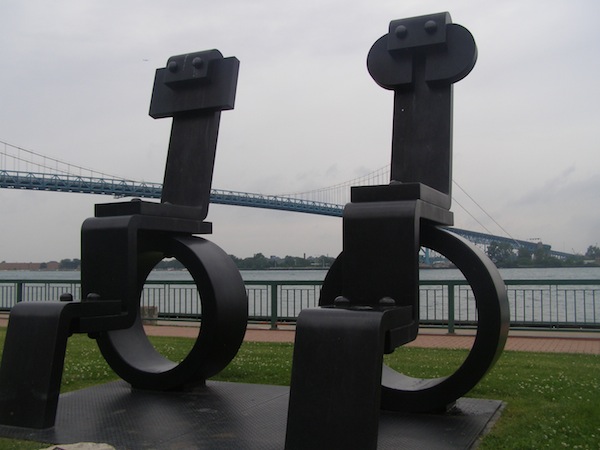
Sorel Etrog’s sculpture in Odette Sculpture Park, in Windsor, Ont. Etrog was one of four artists featured in Prof. Jennifer Eiserman’s March 7 lecture, Is There Such a Thing as Canadian Jewish Art? (photo by Matt Glaman)

Is there such a thing as “Jewish art” in Canada? Dr. Jennifer Eiserman explored this question in a March 7 Zoom lecture organized by Victoria’s Kolot Mayim Reform Temple.

Eiserman, an artist and an art professor at the University of Calgary, shared some of the preliminary findings of her investigation. She pointed out that, with respect to the concept of “Jewish art,” she was not referring to Judaica or Jewish themes in art. “I’m curious about whether artists with some kind of Jewish background make art that is qualitatively different from other artists. If so, I am interested in how these Jewish artists speak and think Jewishly,” she explained.

She began by providing a background to Canadian art history and, specifically, how it has been taught. There has been a profound shift, to put it mildly, in focus, she said. Prior to 1990, the study of Canadian art was a colonial one, concentrating mostly on male artists of European descent. Now, the works of women, Indigenous people and others are part of the curriculum.

Eiserman then discussed four artists and how they speak both Jewishly and as Canadians. She started with sculptor Sorel Etrog (1933-2014) and his contribution to Canadian Modernism. Etrog was a Romanian-born Holocaust survivor who spent time in Israel before immigrating to Canada. His biography is one of movement from place to place.

“The way I see Etrog speaking Jewishly is through the tension between tradition and innovation and the notion of interweaving roads, the idea of the new, which occurs in Etrog’s work,” Eiserman said.

His work, she added, also speaks Jewishly, in that it maintains certain core principles of the genre of public sculpture while addressing the contemporary context in which the sculpture is being placed. Just as we place Jewish law from generation to generation into contemporary contexts, Etrog’s art innovates while carrying on traditional elements.

The figurative art of Betty Goodwin (1923-2008) was demonstrated as being the work of “an outsider, someone not part of the Old Boys’ Club and one who had to find her own way.” Her work, according to Eiserman, contributed internationally to how drawing was defined and what it was to become.

“Her floating figures might express the experience of being in a world that does not welcome one’s experience. The experience of being neither here nor there. Her work speaks to the experience of losing and finding,” Eiserman noted.

Sylvia Safdie’s video installations of flowing water, sand, light and sound advance the traditional concerns of Canadian art with landscape and nature, most commonly associated with the Group of Seven. Safdie was born in Lebanon in 1942 and her family moved to Montreal in 1953.

Safdie’s video can be perceived as exploring a variety of themes that allow her to bring her own voice into the world. “Her work is part of a post-colonial narrative in which some people have experienced harm as the nation of Canada came into being, and speaks Jewishly of the central issues of living in the Diaspora – how to adapt and yet maintain our identity,” said Eiserman.

The distinctively Jewish fantastical creatures of sculptor David Altmejd (born 1974), who represented Canada at the Venice Biennale in 2007, were the final set of slides shown by Eiserman. She described Altmejd as the “quintessential 21st-century Canadian artist. He is bicultural, multilingual, internationally known and now lives in another country (United States) yet is still deeply rooted in Canada.

“Life is complicated, Altmejd reminds us, we can’t have the good without the bad. Yet, always in his work, life shines through. While he rarely discusses his Jewish roots … one can see that his works speak Jewishly in many aspects,” Eiserman said.

Growing up in Montreal, Eiserman experienced the national influence that the Saidye Bronfman Centre had in disseminating Canadian Jewish art. She received her bachelor’s in art history and master’s in education through the arts at McGill University in Montreal, and a bachelor’s in fine arts (visual art) at the University of Regina in Saskatchewan. Her doctorate, one of the first to use studio art as its method of inquiry, is from the University of Calgary, where she is now an associate professor. Her current research is in North American contemporary Jewish art and community-based Jewish art.

In her artistic endeavours, Eiserman uses mixed media, crochet, watercolour, installation and public art projects to explore issues related to Jewish theology, philosophy and identity. She refers to her work as “visual Midrash, an artistic response to sacred Jewish texts.”

Sam Margolis has written for the Globe and Mail, the National Post, UPI and MSNBC.
Format ImagePosted on March 19, 2021March 18, 2021Author Sam MargolisCategories Visual ArtsTags art, Betty Goodwin, Canada, David Altmejd, Jennifer Eiserman, Kolot Mayim, painting, sculpture, Sorel Etrog, Sylvia Safdie, University of Calgary, visual midrash

Canadian Jewish art?

Does Canada have Jewish art? What defines Jewish art? University of Calgary art professor Jennifer Eiserman will address those questions on March 7, at 11am. The Zoom event is the fifth in Kolot Mayim Reform Temple’s 2020-21 Building Bridges lecture series.

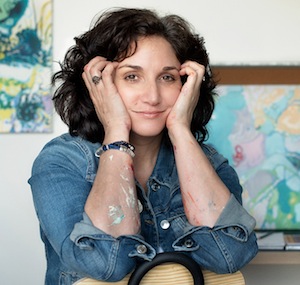
photo - Prof. Jennifer Eiserman
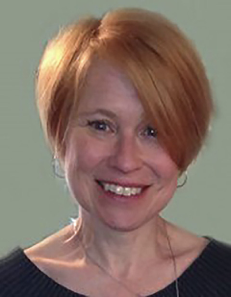
Prof. Jennifer Eiserman (photo from art.ucalgary.ca)

With a wealth of visual support, Eiserman will introduce the rich esthetic traditions that inform contemporary Jewish art in Canada. The artists to be discussed include Sorel Etrog and his contribution to Canadian Modernism, the figurative work of printmaker Betty Goodwin, and the Jewish fantastical creatures of sculptor David Altmedj, who represented Canada at the Venice Biennale in 2007. Sylvia Safdie’s video installations of flowing water, sand, light and sound advance the traditional concerns of Canadian art with landscape and nature more commonly associated with the Group of Seven.

Growing up in Montreal, Eiserman experienced firsthand the national influence that the Saidye Bronfman Centre had in disseminating Canadian Jewish art. She spent her childhood in Montreal and her adolescence in Alberta’s Cypress Hills. She did her bachelor’s (art history) and master’s (education through the arts) at McGill University in Montreal, and a bachelor of fine arts (visual art) at the University of Regina. Her PhD, one of the first ever to use studio art as its method of inquiry, is from the University of Calgary, where she is now associate professor in the department of art. Her current research is in North American contemporary Jewish art and community-based Jewish art.

Eiserman is also a successful practising artist. She uses mixed media, crochet, watercolour painting, installation and public art projects to explore issues related to Jewish theology, philosophy and identity. Eiserman explains that her work is “what I call ‘visual midrash,’ my artistic response to sacred Jewish texts.”

For more information on and to register for Eiserman’s talk, visit kolotmayimreformtemple.com. For coverage of the Jan. 3 lecture of the Building Bridges series, click here.

Posted on February 26, 2021February 24, 2021Author Kolot MayimCategories Visual ArtsTags art, Canada, Jennifer Eiserman, Judaism, painting
Nature’s riot of colour

Nature’s riot of colour

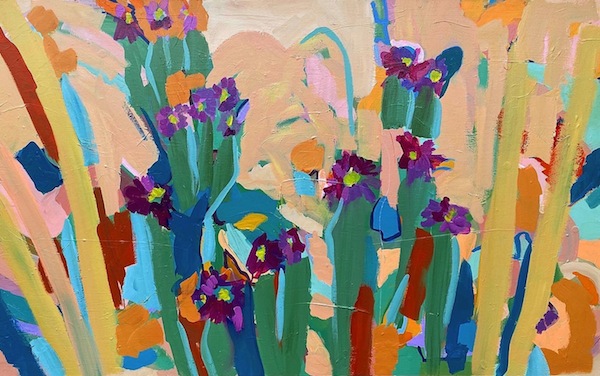
“Desert Spring” by Jessica Ruth Freedman.

A harsh critique early in her career didn’t stop Victoria-based Jessica Ruth Freedman from doing what she loves – painting – and becoming a successful artist.

“I was born in Montreal, and then my brother and I were whisked away to Kibbutz Ein Dor in the Galilee,” Freedman told the Independent. “After a few years there, we returned to reside in Calgary. I attended what was then called the Calgary Hebrew School-Talmud Torah. I was filled with the love for Jewish lifecycle events, food, and being part of a community. Apart from a fabulous school experience, one episode of failing an art assignment in kindergarten stands out. We were told to pick a rock and paint it like a ladybug. Creatively, I painted it black on red, rather than red on black, so that the white dots would stand out better. I sadly was singled out as an art failure in front of the whole class!

photo - Jessica Ruth Freedman was to participate next month in the Art Vancouver fair, which has been postponed
Jessica Ruth Freedman was to participate next month in the Art Vancouver fair, which has been postponed. (photo from Jessica Ruth Freedman)

“Fast forward a few years, a career as a contemporary dancer, yoga teacher and accountant, [then] I returned to my love of painting,” said Freedman, who has a bachelor of arts, with a major in dance and a minor in fine arts, from Simon Fraser University. “At this time, I had moved to Victoria to chase the warmer weather and, after a few holidays in nearby Hawaii, I was hooked on representing the juxtaposition of botanicals versus the urban in my artwork.”

Freedman is one of the artists participating in Art Vancouver, which has been postponed from its scheduled dates, April 16-19, because of COVID-19.

“These days, the traditional way of selling art through a gallery is changing,” she said. “Many galleries are shutting their doors due to increasing rents and a growing online marketplace. Art fairs give individual artists an opportunity to connect directly with new collectors. I also love the communal spirit of the artists working and showing together. There is a lot of sharing of process and information that goes on at these types of events. Since I live on the West Coast, Art Vancouver is the best art fair to participate in, and Vancouverites are a knowledgeable art bunch.”

She said she likes to create fresh work for each art fair. “I consider carefully the city, people, environment and sizes of artwork,” she said. “At this Art Vancouver, I will be debuting some non-traditional materials in my paintings, all while keeping the abstract botanical theme. My aim is to always create work that uplifts and inspires, and I attempt to do this through colour, theme and design.”

Freedman works in acrylic, ink and mixed media. She has exhibited internationally and her work is in private and public collections around the world. On her website, she notes, “My journey through life can only be described as an artistic DIY.” She says she “was always the child who wanted to be left alone to explore and discover” and yet that it is her “path in life to share my art to celebrate connection, serenity and humour and to share this journey together.”

“Many artists will agree that one needs to look inward to find the source of creation,” Freedman explained of her need for both solitude and community. “Even realist painters rely on an internal compass based on technique and free expression. As a Jewish person, I honour the spirit of creation within me, and I also pay tribute to the concept of tikkun olam, the repair of the world. I feel fortunate to explore the creative side of myself for a living, but I also feel it’s necessary to do good work in the world. This might mean volunteering for Jewish events, donating my paintings to charity auctions, or just being a positive person with a solution-focused outlook.”

For Jewish community members who come to see her work at Art Vancouver, the dates for which will be released in the near future, Freedman said, “Surprisingly, a fair amount of Hebrew – my first language – appears in my paintings. If readers come visit my booth, I’ll look forward to pointing it out!”

Though she paints the natural world, Freedman noted a certain irony – she is not very good at caring for actual plants. “I am lucky that I can send my husband out to purchase plants – I paint them and he cares for them,” she said. “I am mostly fascinated by the riot of colour, of chaos, that Hashem has let loose in the natural world. The process of growth and decay, while natural, is obviously hard on us humans but is a natural part of life. I am also very interested in urban design that incorporates the natural world in ways that increase sustainability, beauty, communication and wonder.”

For more information on Freedman, visit jessicaruthfreedman.com. For more on Art Vancouver, go to artvancouver.net.

Format ImagePosted on March 27, 2020March 26, 2020Author Cynthia RamsayCategories Visual ArtsTags Art! Vancouver, Jessica Ruth Freedman, nature, painting
Artistic visions on belonging

Artistic visions on belonging

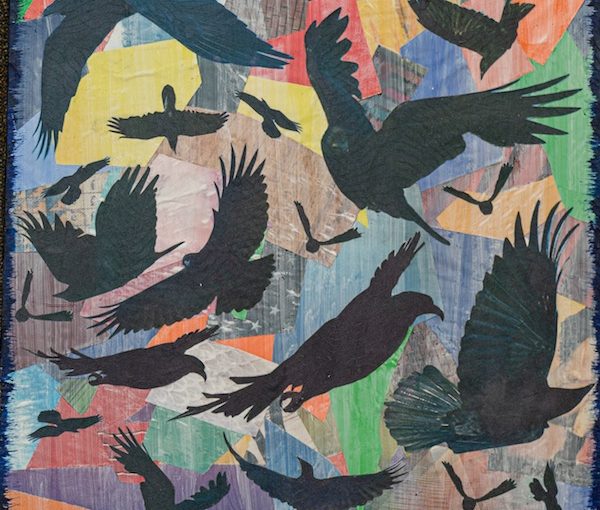
“We are Family” by Cat L’Hirondelle is now on exhibit at the Zack Gallery, as part of he group show Community Longing and Belonging, which runs to March 29.

The new group show at the Zack Gallery, Community Longing and Belonging, is the second annual exhibit in celebration of Jewish Disability Awareness, Acceptance and Inclusion Month. Organized by Jewish Community Centre of Greater Vancouver’s inclusion services and its coordinator, Leamore Cohen, the show is a silent auction. Half of the proceeds will go to the artists, and the other half will be divided between inclusion services and the gallery.

The show consists of 50 paintings by different artists. The size and shape of all the paintings are the same – small rectangles – but the contents and media used are vastly different, indicative of the artists’ various styles and training levels. Some are highly professional. Some are figurative; others abstract. But all reflect their creators’ need to belong, to be part of a community. Each painting tells a story.

One of the prevalent themes of the show is flight. Wings appear on several paintings, emphasizing the yearning for the freedom flight entails, but also for the brotherhood of other fliers. The white ornamental wings on Mikaela Zitron’s multimedia piece are bigger than the background board. They take the artist into the sky, into a joyful aerial dance, while Jamie Drie’s feathers, drifting in a sad emptiness, invoke the feeling of disconnection.

The murder of crows in Cat L’Hirondelle’s painting relates yet a different story. “I am a feminist,” said L’Hirondelle. “I was thinking about the importance of being part of a community of like-minded women. My group of longtime women friends is my family, my tribe and, like the crows, I know that they will always be there for me. Since I became disabled, I have felt more and more disassociated with the able-bodied-centric society in general. Just look at the history of people with disabilities in different societies – genocide, forced sterilizations, segregation, isolation, etc. I would love to feel that people with disabilities belong in the world. My piece is trying to impart that sense of longing to be included in general community and how crow communities seem to include everyone: the old, the disabled, the young. I have lived in the crow flight path for many years and have been watching crows’ behaviour; sometimes, I wished people were more like crows.”

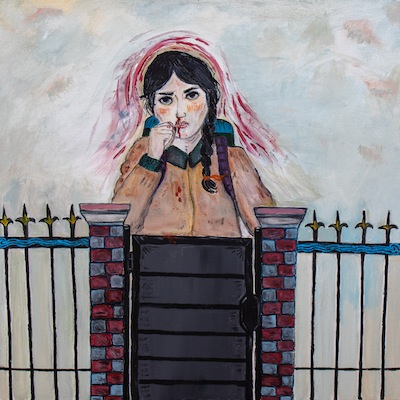
image - “Leaving for Awhile” by Daniel Malenica
“Leaving for Awhile” by Daniel Malenica

The second recurring motif in the show is loneliness, the sense of separation. Daniel Malenica’s image is distinctive among such pictures. The woman in the painting stands behind closed garden gates. She gazes at us from the painting, and the naked longing in her eyes is painful to behold. She desperately wants to open that gate and step through, to join us, but she lacks the courage. What if the people inside reject her? So, she just lingers outside, desolate and alone, waiting for an invitation.

Another outstanding piece on the same theme is Estelle Liebenberg’s black and white painting “Solitude Standing.” She told the Independent, “I work primarily as a potter and a metalsmith, but I accepted the challenge to paint something for the exhibition because I’ve had wonderful times working as a substitute art instructor at the JCC. I chose the monochromatic colour palette because, at the moment, I am quite fascinated by shadows, specifically how they change the shape of objects but still remain recognizable.”

image - Estelle Liebenberg’s “Solitude Standing”
Estelle Liebenberg’s “Solitude Standing.”

Her focus for the piece was the idea of a community in general. “I’ve spent my life dealing with different communities and, I guess, for me, the lines have softened over time,” she said. “We spend so much time in our lives working on belonging, or longing to belong somewhere, to someone or something. It’s an integral part of the beauty, the joy, the frustration and the heartbreak of life. For me, this was longing and belonging as an immigrant, as an introvert, as a mother of grown children, as a single person living in a city.”

She explained the title of her painting: “It is a hat tip to a song by Suzanne Vega. For me, her words truly encapsulate the feeling of longing to belong somewhere: ‘Solitude stands in the doorway / And I’m struck once again by her black silhouette / By her long cool stare and her silence / I suddenly remember each time we’ve met.’”

Different artists explore different aspects of community and belonging, and not all the communities are small or local. For Marcie Levitt-Cooper, the community in her painting is the universe, the earth and stars encompassed by love. Esther Tennenhouse, on the other hand, contemplates the darker side of belonging.

“My piece is a photocopy from a pre-World War Two Jewish encyclopedia, Allgemeine Ensiklopedya,” Tennenhouse explained. “It was labeled in Yiddish and issued in New York in 1940, the year Germany occupied France. On first seeing this old map, I found it very poignant. The map had to fit the 16-by-16 canvas given to all participants. The format left space, and I filled it with the music of two nigguns and lyrics of six Yiddish songs.”

That colourful map with Hebrew lettering, published just before the Nazis unleashed the full horrors of the Holocaust on European Jews, made for a tragic, frightening image, despite its bright and cheery appearance.

While the exhibit includes other figurative paintings, the majority of the pictures are abstract, either simple swirls of paint or complex geometric patterns, like Daniel Wajsman’s piece – two irregular overlapping rectangles.

“I wanted to emphasize that we should bring everyone in, not leave anyone out,” he said.

Community Longing and Belonging runs to March 29.

Olga Livshin is a Vancouver freelance writer. She can be reached at [email protected].

Format ImagePosted on March 6, 2020March 4, 2020Author Olga LivshinCategories Visual ArtsTags art, Cat L’Hirondelle, Daniel Wajsman, disability awareness, Estelle Liebenberg, Esther Tennenhouse, inclusion, JCC, Jewish Community Centre, Leamore Cohen, painting
Inspiring optimism with art

Inspiring optimism with art

Linda Frimer’s exhibit, Beckoned by the Light, runs until Feb. 23 at the Zack Gallery. (photo from Linda Frimer)

“Since I was a child, I’ve always looked for the light – in the forest near my home and in the stories of my family. All the paintings in my show were inspired by light, the light of creation,” said Linda Frimer.

The exhibit, Beckoned by the Light, opened at the Zack Gallery on Jan 30. Originally, Frimer thought that her show would open simultaneously with the launch of her upcoming book, Connecting the Dots, and this is why the gallery exhibit opened in conjunction with the Cherie Smith JCC Jewish Book Festival. But life interfered, and the book is still a work-in-progress. Nevertheless, Frimer told the Independent, “I decided to go ahead with the show.”

Frimer’s paintings are beautiful, suffused with light. They are closer to impressionism than to realism, but every piece is unmistakably and uniquely hers. Light bathes the trees and the streams. It filters among the branches. It soars on dove’s wings over brilliant abstractions and illuminates mysterious paths winding through the woods. Light bursts into explosions of gladness and swirls like dancing fairies, inviting gallery visitors to share the luminous joy, to rejoice in the rainbow of colours.

“When I paint, I want to be positive,” the artist said. “Life is hard. That’s why I want joy in my paintings.”

To express her joy, Frimer uses bright colours, including gold and silver. “Gold and silver are great for all the recurring symbols in my paintings,” she explained. “One of my favourite symbols is wings – wings of the birds, like a dove, which is a metaphor for light.”

Another symbol that appears frequently is a tree. “Trees have wings, too. Sure, they are rooted in earth, but they reach for the sky, for the light,” Frimer said.

One more symbol populates many of her paintings – a flower, specifically a sunflower, which always strives to stretch higher, to touch the sun.

And then there are paths, roads to the light. Or to a better place. Or to someone you love. “I love people,” she said. “Love being a member of a group. I’m a member of several different groups.”

One of her groups – with five artist friends – attended her opening night and brought a gift: a wooden staff adorned with symbols of her art. Each object that was attached to the staff was created by a member of the group.

“We met through a project of the Hebrew University about 15 years ago,” Frimer said. “Now, we meet regularly, support each other in life and art. Whenever one of us has a show, the rest of us always make something symbolic for her.”

The group comprises Frimer, Nomi Kaplan, Lilian Broca, Barbara Heller, Sid Akselrod and Melenie Fleischer. “We call our group Five Hens and a Rooster,” Fleischer said with a laugh, as she presented the group’s gift to Frimer.

Music also plays a big part in Frimer’s artistic life. One could almost hear notes thrumming in her imagery. “I often listen to music when I paint,” she said. “I even dance sometimes. I love classical music, pop, all kinds, really.”

Frimer always starts a painting with an idea, but then her imagination takes over. “I follow my intuition,” she said. “Painting is a spiritual act for me. It’s like meditation. I love the process, the magic of creating. It’s wonderful to be able to express all that positive energy.”

In her opinion, everyone is an artist. Not necessarily a visual artist, but we all create in our own way. “It’s about how you feel, how you express yourself,” she said. “The process is much more important than the end result. I taught art a lot and I facilitated several healing artistic projects. It is great when I can help people tell their stories through creativity.”

Her new book is about that, too. “It’s my life story through art,” she said. “There are also creative exercises there, and some essays about different aspects of creativity. It’s about the healing power of the arts.”

Many of Frimer’s canvasses are large, expensive, fit for corporate headquarters or ballrooms, but the artist wants more than to sell her paintings for profit. “I believe in art reaching the public, being accessible. That’s why I make reproductions of my own work,” she said. “I make posters and giclée prints in different sizes. While my original paintings might not be affordable to many, anyone can afford a small print or appreciate a poster.”

In the same spirit, she often makes donations of her art to hospitals and synagogues. “When a painting hangs in a hospital,” she said, “I hope it might make someone feel better, help with their healing. In a synagogue, I hope my paintings might inspire and support. I studied colours and how they could aid in healing a body or a spirit. I even wrote about it in my book.”

Frimer’s bright paintings are permeated with hope and energy. They are celebrations of possibilities, as if the artist sees everything through the lens of optimism. And she shares that optimism freely with all of us.

Beckoned by the Light runs until Feb 23. For more information on Frimer and her work, visit lindafrimer.ca.

Olga Livshin is a Vancouver freelance writer. She can be reached at [email protected].

Format ImagePosted on February 7, 2020February 6, 2020Author Olga LivshinCategories Visual ArtsTags art, Beckoned by the Light, Linda Frimer, painting, tikkun olam, Zack Gallery
Letting imagination fly

Letting imagination fly

Janet Strayer at the opening of her solo exhibit, Wings of Imagination, on Nov. 28 at the Zack Gallery. (photo by Olga Livshin)

Janet Strayer first conceived the idea for her new show at the Zack Gallery, Wings of Imagination, about a year ago. “I was talking with Linda, and the bird theme came about,” she said in an interview with the Independent, referring to Linda Lando, director of the gallery.

“Birds appeared in my paintings before,” said Strayer. “They take us into the air, into a different place. Birds symbolize freedom – freedom of movement, freedom of imagination. The flight of imagination allows us to envision different possibilities, different solutions, even different ways to see familiar things. When I considered the name for this show, I thought about [Albert] Einstein and his words that knowledge is always limited, but imagination is limitless. Imagination is the most important thing for any artist.”

Wings of Imagination is all about flight and wings. Birds populate the paintings. Bright and whimsical, they flitter around birdhouses, soar towards a distant sky or interact with other creatures, real or imaginary. Some images are bright, almost cartoonish, inviting a smile, while others seem more serious, characterized by quiet intensity and misty, pastel colours. And then there are funky collages, with real 3-D birdhouses attached to the two-dimensional pictures.

“There are three distinct styles of paintings in this show,” said Strayer. “The three styles are consistent with the theme of the show. I started it conceptually, as I always do, but I couldn’t explore it in any one direction. Wings of imagination is a huge theme, and there is no one way to approach it – all the possible ways should be expressed. Freedom of expression is what it is all about; it is like several different directions of flight.”

image - “Papageno” by Janet Strayer, whose exhibit at the Zack Gallery runs until Jan. 5
“Papageno” by Janet Strayer, whose exhibit at the Zack Gallery runs until Jan. 5.

One of the styles is almost impressionism. The paintings’ blurry lines are reminiscent of Claude Monet’s foggy nights. The dream-like imagery catapults the viewers into some eldritch realms of sublime illusions with their wings and birds, sky and air.

“Another style is magic realism,” the artist explained. “I wanted to go magical. Imagination is magic. The Canada goose is flying, but his wings are magical – you can’t see such pattern on a real goose, except in your imagination. Beside the goose hangs my homage to Leonard Cohen, as he walks across the sky.”

The two paintings of “Birdwoman” seem similar in composition but entirely different in their palettes and in their emotional subtext. “The colours in ‘Birdwoman on the Roof’ are muted compared to the other one,” said Strayer. “On the roof, she is open to the sky, not as loud as the other, more of a mystery. It has space for you to come in and indulge in your own perception, while the other one is more enclosed inside its room and its brilliant colours.”

Strayer’s magic realism paintings are eccentric and capricious, with clear lines between the colours and frolicking creatures from fantasy novels, while her third style, the collages, appear at first glance as a jumble of small images punctuated by birdhouses.

“Birds need places to live in,” said the artist. “I took a risk with the collages, didn’t know what would happen, but it was such fun working with them. It took me three months to finish those two collages. They started with fragments, and then they led to other fragments. And feathers. And birdhouses. Things tell you what to do, until the entire image comes alive. It was like an adventure in my studio every day. Where would it go?”

Strayer’s playful adventure resulted in two unique art installations. “I wanted people to be surprised by these collages,” she said. “I wanted them to stop and look at all the tiny details. We don’t always stop and look. Even with art, so often, we come to a gallery, but we just glance. We don’t stop and really look.”

Strayer’s is a familiar name to Zack Gallery patrons. She had a solo show at the gallery in 2010, but the difference between the two shows is not only temporal but esthetic. While the previous show was black-and-white digital art and a poetic look at childhood, this one is bursting with colour and exuberance, and features mostly acrylic paintings.

“I enjoy creating digital art,” she said, “but I wouldn’t want it as a steady diet. I’m an explorer. I always want to try something different. I love to work on real paintings. And I’ve always loved colour.”

For Strayer, a predominantly abstract artist, the esthetics of her creations are more important than the telling of a story or the conveying of a message.

“A message should come through the esthetics,” she said. “And, if someone has a different interpretation than me, it’s fine, too. As soon as the paintings are on the gallery wall, they are not mine anymore, even though I created them. Everyone could see something different, compatible with their own memories and experience.”

Wings of Imagination opened on Nov. 28 and runs until Jan. 5. To learn more about Strayer, visit janetstrayerart.com.

Olga Livshin is a Vancouver freelance writer. She can be reached at [email protected].

Format ImagePosted on December 13, 2019December 12, 2019Author Olga LivshinCategories Visual ArtsTags art, collage, Janet Strayer, nature, painting, Zack Gallery
Trees bring Zack to life

Trees bring Zack to life

Michael Seelig is donating the proceeds from his exhibit Trees to the Zack Gallery. (photo by Olga Livshin)

Trees, Michael Seelig’s new solo photography exhibit at the Zack Gallery, opened last week. It is a fundraiser for the gallery, which is located in the Jewish Community Centre of Greater Vancouver.

Such philanthropic initiatives “are of ultimate importance to the gallery and the community, as everybody wins when the gallery is well-supported,” said Zack director Linda Lando. “We have approximately three benefits a year, and they come in different ways. Sometimes, they’re initiated by the artist, sometimes by myself or another staff member of the JCC.”

Seelig’s decision to donate all the proceeds came from the heart, and it’s not the first time. His previous show at the Zack, which was held five years ago, was also a benefit. “This is my way of contributing to the JCC,” he said in an interview with the Independent. “We have a longstanding connection to the centre. My wife was president of the JCC some time ago, and we’ve given several donations to the community over the years.”

Unlike his previous show, which focused on architectural images – Seelig was an architect before he retired – this show is all about trees. A cornucopia of greens dominates the gallery walls.

“When Linda asked me to do a show this year, I didn’t have much in mind,” he said. “I started going through my photographs, selected the best 20, and then realized that eight of them were photos of trees. Looking back, I’ve always photographed trees. Maybe I have an affinity for trees. So, I thought I’d make it the theme of this entire show.”

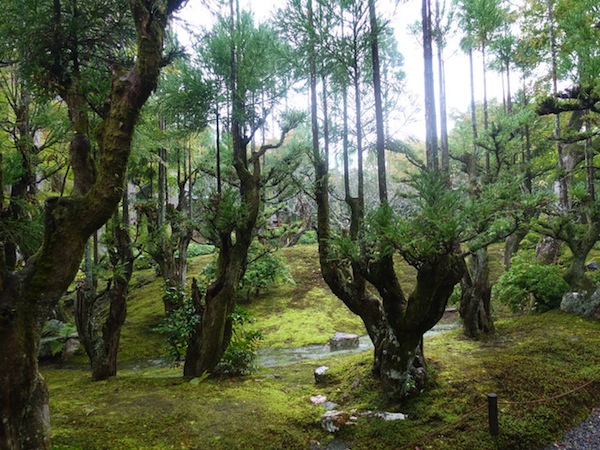
photo - “Garden Kyoto” by Michael Seelig
“Garden Kyoto” by Michael Seelig.

Seelig has been drawn to trees and their unique charm for a long time. “I think my love of trees comes from my childhood, when I was growing up in Israel,” he said. “Jewish people are the only ones I know who have a holiday dedicated to trees: Tu b’Shevat. During that holiday, we cherish trees, plant them, take care of them, so they can take care of us. That tradition probably influenced me from a young age to love trees and photograph them. I take photos of trees wherever I travel.”

In the Zack exhibition, there are pictures of trees from Israel and Scotland, Canada and Japan.

“There is a book I read recently,” Seelig said, “called The Hidden Life of Trees, by Peter Wohlleben. He is a German forester and writer and he knows trees. He says trees form communities. They communicate with each other and with us. It was a fascinating book, and I agree with the author; his book inspired me. Have you noticed that old stumps sprout new growth sometimes? That is because there are other trees around. Trees are life-givers; they create the air we breathe. Without trees, there would be no life on earth.… In Canada, and particularly in British Columbia, we often take trees for granted. Most of us do not pause to look at them and admire their beauty, solidity and permanence. We forget that, without trees, our planet cannot survive. This show pays homage to trees in many parts of the world.”

Seelig’s trees are all different; each one has its own shape and personality. Some are gnarled and twisted, while others stretch up in straight lines.

“I like it that they don’t talk to me,” he joked. “Trees are my models, but they’re more obedient than people when it comes to posing for a photo. I can take my time snapping pictures of trees. They are perfect photography objects. A tree just stands there. You can walk around it, see it from 360 degrees or from underneath. And every view is different. You can’t do this with a person.”

In addition to Seelig’s photographs of trees, the show includes several watercolours, most of which he painted specifically for this exhibit. Only two small works are exceptions. “When I was looking through my archives in preparation for this show, I found a small painting, created by my father in 1940. He painted a street in Haifa, and there is a tree in the image. The second painting is mine; I painted it in 2010, also in Haifa. Seventy years passed between these two paintings, but their colour schemes are surprisingly similar. And there are trees in both paintings.”

The sizes of the images on display vary greatly. While Seelig’s father’s painting would fit in a school notebook, and most of the photographs are the perfect size for a family home, a huge triptych on canvas of one of his Kyoto garden photos would enliven a hotel foyer or a corporate conference room. “I invited some designers to the show,” Seelig said. “Maybe one of them would like it.”

Seelig’s approach to photography is consistently organic. He doesn’t edit his photos with Photoshop, doesn’t even crop them.

“My pictures are exactly what I see,” he said. “And now you see them, too. There are other photographers who manipulate their photos with editing software, many of them wonderful artists, but I don’t do that. I don’t call myself an artist either, even though I use my creativity for many things in my life. I used artistic judgment for my work as an architect, before I retired. Now, I make greeting cards and wedding invitations with my photographs and my paintings. I illustrated a couple of children’s books, written by my daughter and her husband. Even making dinner for our friends is a form of art for me.”

The Trees exhibit runs until Oct. 20.

Olga Livshin is a Vancouver freelance writer. She can be reached at [email protected].

Format ImagePosted on October 4, 2019October 2, 2019Author Olga LivshinCategories Visual ArtsTags environment, Michael Seelig, painting, philanthropy, photography, trees, Zack Gallery
Exhibit of inscriptional art

Exhibit of inscriptional art

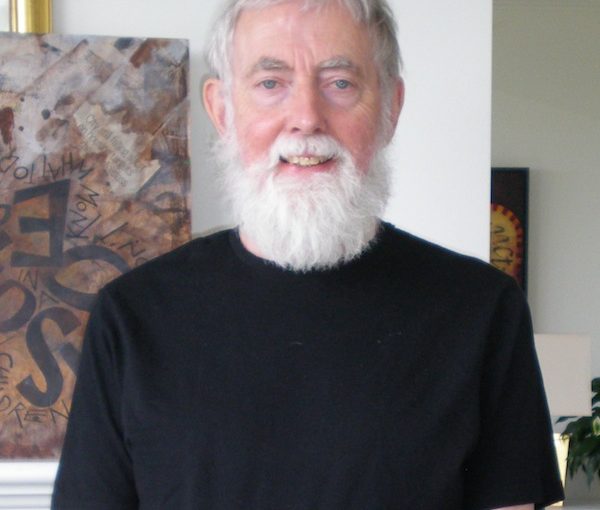
Ken Hughes infuses his paintings with messages. (photo by Olga Livshin)

Ken Hughes has always been fascinated with typography. “Since childhood, letters of the alphabet have intrigued me,” he said in an interview with the Independent.

“Public lettering is a centuries-old method of civic communication, both official and informal,” he said. “It goes back to Mesopotamia. By Greek and Roman times, public writing – inscriptions on buildings, commercial graphics, signs, epitaphs on tombs, graffiti – was common. The messages could be political or commercial, funerial or commemorative, religious or frivolous. In more contemporary times, particularly in Europe, public inscriptions have undergone a revival.”

The artist draws from this rich tradition for his paintings and his new show at the Zack Gallery, Ancient Writings in Contemporary Contexts, opens next week. A collection of inscriptional paintings, beautiful and evocative, colours and shapes of the images enhance and deepen the meanings of the lettering, and every piece tells a story.

Before retiring, Hughes was a professional graphic designer. He taught graphic design for years at Emily Carr and Kwantlen universities. He turned to art five years ago.

“Inscriptions – texts expressed formally or otherwise in different alphabets or languages – are a major source of inspiration for my paintings,” he said. “This particular exhibition’s goal is to visually express texts related to Jewish beliefs and culture. Some of the paintings have writings in the Hebrew alphabet. Others have transliterated Hebrew using the Roman alphabet.”

He explained that the messages in his paintings come from various sources: the Hebrew Bible, fiction and nonfiction by Jewish writers, as well as quotes by famous people, all related in one way or another to Jewish culture.

“I don’t speak Hebrew,” he said, “but I have friends who do. I always ask them to check the writing before I incorporate it into my paintings.”

In his work, the esthetics of the letters are intertwined with the message of the citation used. He has been collecting quotes, personal mottos, sayings and other forms of public texts for a long time. “I sing in a choir, and much of choral music is liturgical,” he said. “It has incredible messages, many of them in Latin. I also read a lot and get my messages from books, from newspapers, from common idioms.”

In 2002, Hughes took a yearlong sabbatical from teaching to prepare for what he does now.

“I traveled through Europe – Poland, France, Turkey, Belgium, Greece and Israel,” he said. “I took photos of the public inscriptions on civic buildings, in churches, at cemeteries. I wrote down quotes from illuminated manuscripts in national libraries. There are incredible inscriptions on the tombstones in Budapest, where many famous Hungarians are buried. Jewish cemeteries have beautiful inscriptions in Hebrew.”

Sometimes, a line of text or a quote stays in his memory or in his notebooks for decades before appearing in one of his paintings. Many of his pieces are sad, executed in a darkish palette, underscoring words of deep emotion: grief, fear, despair, memories of hard times and bleak thoughts. But there is hope and joy, too, and Hughes uses bright and colourful compositions to accentuate those messages.

One of his uplifting works, a multi-paneled cycle based on the story of Genesis, with Hebrew lettering dancing across the panels, is decorative as well as informative. The series will be in the exhibit at the Zack.

“Alphabets are amazing inventions, incredible almost,” Hughes said. “They allow people to communicate ideas with just a few symbols. And they are all different – the Roman alphabet, the Cyrillic letters, the Hebrew. In all cases, letters by themselves mean nothing; they’re just symbols. But a combination of letters, a phrase, could have profound meaning.”

When Hughes starts working on a piece, he approaches it as a designer, with a typographer’s attention to detail. He makes many sketches while investigating each idea. What colours should be employed and in what combinations? What is the best number of panels for this message and the most expressive configuration to highlight the meaning of the words? Even the font used can make a difference.

“Some letters look better in a rounded font; others need a blockier typeface,” he said. “The positioning of the letters and the words could be of paramount importance in my paintings. They constitute the composition. And, of course, the message itself often dictates the font type.”

There are not many artists in Canada who dedicate their art to this kind of painting.

“I wanted my paintings at the Zack,” Hughes said. “I don’t want to display at commercial galleries. I think my works are much more suited to schools, churches or community centres.”

Ancient Writings in Contemporary Contexts runs from July 25 to Aug. 25. To learn more, visit kenhughes-art.com.

Olga Livshin is a Vancouver freelance writer. She can be reached at [email protected].

Format ImagePosted on July 19, 2019July 18, 2019Author Olga LivshinCategories Visual ArtsTags inscriptional art, Ken Hughes, painting, writing, Zack Gallery
Colour bursts forth in Conjunction

Colour bursts forth in Conjunction

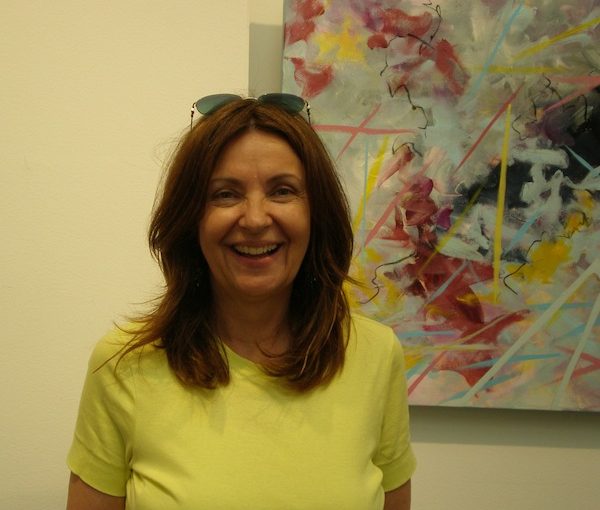
Ira Hoffecker’s current solo exhibit at the Zack Gallery, Conjunction, runs until July 21. (photo by Olga Livshin)

Conjunction, Ira Hoffecker’s current solo exhibit at the Zack Gallery, opened on June 13 and runs until July 21.

German-born Hoffecker and her family moved to Canada in 2004. “I always liked art, but when I lived in Germany, my husband and I worked in marketing for the movie industry,” she explained in an interview with the Independent.

Once, when her children were still young, they came here for a family vacation and traveled Vancouver Island. “We loved it,” she said. So much that, when they moved here permanently, they settled in Victoria. As if that wasn’t change enough, Hoffecker also decided to switch careers and follow her lifelong love of art. She enrolled in the Vancouver Island School of Art and has been studying and creating ever since.

Hoffecker’s previous show at the Zack Gallery, in 2016, was dedicated to maps. Since then, her art has undergone a couple of transformations. Conjunction is much brighter and more expressive set of works, although the abstract component remains.

On the journey to her new colourful mode, Hoffecker went through a black-and-white stage, which was the focus of her master’s in fine arts’ thesis, which she completed last year. The works she created for her master’s degree include a number of huge paintings – abstracts made with tar on canvas – plus three documentary videos. The theme – “History as Personal Memory” – was a painful one for the artist. She recalled, “One of my professors said that my works are the interconnected layers of urban setting and history. ‘Where is your personal layer?’ he asked me.”

Taking this advice, she has been trying to delve into her personal recollections, to uncover her place in history, her “personal layer” among the historical layers dominating her art. “In ‘History as Personal Memory,’ I tore pages from a history book about the Third Reich, an era in history that many Germans would prefer to forget. Yet I think it is important to face and discuss this past. Such dialogue might prevent the horrors from happening again,” she said.

In Hoffecker’s art, the artist’s memories are intertwined with the history of her nation. “Correlations between my childhood abuse, which I tried to forget, and the history of Germany, which the Germans tried to eradicate from their memories, exist in my paintings and films,” she said.

In her art and her videos, she opens up about the abuse she suffered as a child at the hands of her grandfather, who was also a Nazi. She is convinced that such openness has helped her heal, whereas suppressing the memories led only to the festering of her inner wounds.

The same is true for historical memories, Hoffecker insisted. “Germany needs to remember, to confront and challenge complacency to prevent a repetition of historical atrocities,” she said.

Her master’s thesis was a deep and painful discovery, a journey in black-and-white to underscore the grimness and tragedy of the topic. Once it was completed, she was ready for a change of direction.

“I spent the summer last year in Berlin,” she said. “When I came back home to Victoria, I wanted to paint some colours again.”

Hoffecker’s current exhibit bursts with vibrant colours and optimism. The series Berlin Spaces, like most of her paintings, has several layers. “There are outlines of many famous Berlin buildings there,” she said, tracing the architectural lines embedded in the abstract patterns with her finger. “The Jewish Museum, the Philharmonie, the library, the Reichstag. It is like a reconstruction, when I think about the past. I overlay history and architecture.”

One of the paintings, a bright yellow-and-pink abstract, has writing among its patterns. “It means ‘forgetting’ in German,” Hoffecker explained. “A few years ago, I was invited to have a solo show in Hof, a city in Germany. I worked there in the archives, found many old maps and records. One of their buildings is a factory now. After the war, it was a refugee camp, and there is a plaque to commemorate the fact. But, during the war, it was a labour camp, a place from where Jewish prisoners were transported to concentration camps and death, but nothing is there to remind [people] of that past. The painting reflects the current happy state of the building, but it also reflects the tragic past, the past we shouldn’t forget.”

While not many art lovers will see the horrors of the labour camp in the airy and cheerful palette of the painting, Hoffecker doesn’t mind. Like other abstract artists, she infuses her images with hidden messages, but doesn’t insist on her personal intentions.

“I own the making,” she said. “I bring in my memories and my heart, but I have to leave the interpretation to the viewers. One man in Victoria loves my art. He bought two of my paintings. He said he sees animal in them. I don’t paint animals, but I’m glad people’s own experience resonates with my paintings.”

Hoffecker is very serious about her art, but bemoans the need for promotion. “I did marketing for movies professionally, but I never really cared [about the reaction]. If someone didn’t like the movie we were pushing, it was his business,” she said. “But to promote my own paintings is scary. When someone doesn’t like what I do, I care. It hurts. I don’t want to do it. An artist wants to be in her studio and paint. It is all I want: to paint and to exhibit. I want people to see my work. Besides, a show is the only time when I see many of my paintings together. I never can do that in my studio. I only see one or two at a time.”

To learn more about Hoffecker’s work, visit irahoffecker.com.

Olga Livshin is a Vancouver freelance writer. She can be reached at [email protected].

Format ImagePosted on July 5, 2019July 10, 2019Author Olga LivshinCategories Visual ArtsTags abuse, art, Germany, history, Holocaust, Ira Hoffecker, maps, memory, painting, Zack Gallery
Rootman’s night scenes

Rootman’s night scenes

Jack Rootman, in front of his painting “Homage to Degas.” (photo by Olga Livshin)

Jack Rootman’s new solo show, Scene at Night, opens tomorrow, June 1, at the Visual Space Gallery on Dunbar Street. As the name implies, the exhibition is dedicated to Rootman’s paintings of urban night scenes.

“There are several reasons I’m interested in painting the night,” he said in an interview with the Independent. “First, I wanted to show human activity as it is spotlighted at night. People move from one light source to another, from the indoor balcony to the moving lights of cars. You don’t see it so focused during the day. When you look in the daytime, there is a panorama in front of you, your attention wanders; there is too much to see. But, at night, you see activity encapsulated. Someone drinks coffee. Someone crosses a street. Someone is sad or crying or laughing. Your attention is drawn to a spot of light.”

The second reason for his fascination with the nocturnal setting has to do with the constantly changing colours and contrasts. “There are many light sources wherever you are at night – streetlights, lights from the windows, moonlight – and each combination gives off different colour nuances and shadows, depending on where you stand, on the angle of your view,” he explained.

Rootman thinks an element of colour always exists, even at night, when there is a “dynamic blackness. If you look at my paintings,” he said, “there is red black and purple black, blue black and green black.”

Night’s more limited spectrum of colours intrigues and challenges the artist. “Of course, it is more difficult to paint night, to see colours in the darkness,” he said. “Sometimes, I have to use Photoshop to analyze what colours appear in a photograph, before I transfer the image to an oil painting.”

Rootman started painting night scenes years ago, although the bulk of the 22 paintings in the current exhibit have been created in the past five years. During his travels, he took many photographs at night in Paris, Venice, New York and Montreal. He also made sketches and recorded the colours as he saw them. But his paintings never follow the photos to the letter. One painting, a ribbon of light, might be an abstract representation of the night traffic along a boulevard, based on a photo taken from the balcony of his hotel room. Another might be a composition of images from different years and cities.

“My painting ‘Homage to Degas’ is one such a composition,” he said. “I saw this marijuana shop in Vancouver and it reminded me of a Degas painting. I included two of his paintings in this piece.”

In addition to the technical challenges of depicting a city scene at night, Rootman is interested in the loneliness that is most profound at night. “During the day,” he said, “we are at work, but the night brings isolation. It also brings possibilities – many people are lonely, and they go out during the night to meet others.”

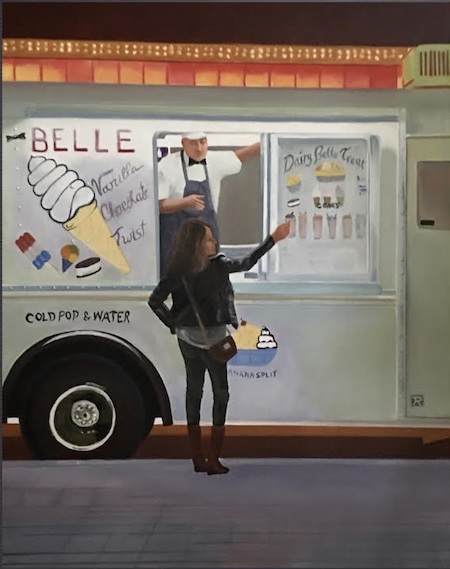
photo - “Ice Cream,” by Jack Rootman, is among the works featured in his solo show, Scene at Night, which opens June 1 at the Visual Space Gallery
“Ice Cream,” by Jack Rootman, is among the works featured in his solo show, Scene at Night, which opens June 1 at the Visual Space Gallery.

Some of the paintings show this disconnection. Everyone is absorbed in what they are doing, alone in their own spots of light, talking on their cellphone or lost in thought, and darkness separates them from one another.

“The night is also traditionally associated with a sense of danger,” the artist mused. “Several paintings in this series are lanes, particularly lanes in downtown Vancouver. Anything could hide in such a lane, with insufficient light: from rats to human predators.”

While his lanes are bleak, despite the illumination of neon signs and streetlights, there is always hope in Rootman’s paintings. Perhaps his medical background brings that sense to the fore of everything he does, both in his professional field of eye surgery and in his art.

“My most comfortable mental state is when I’m doing something creative and visual,” he said. “It works for my art. It also worked for my job as a surgeon, before I retired. Surgery is very creative. Like art, surgery is a discovery. Nothing is ever as you expected.”

And, like in his medical practice, where every patient had a story, all of his paintings are stories, too, stories of danger and loneliness, separation and connection, all linked together by darkness and light.

“My work has a certain affiliation with music and poetry,” said Rootman. “That’s why I decided to have a music night and a poetry night as parts of this show.”

The music night with Amicus Ensemble will be held at the gallery on June 5, 6-8 p.m., and the poetry night the next evening, June 6, 6-8 p.m. Scene at Night is at the Visual Space Gallery until June 9.

Olga Livshin is a Vancouver freelance writer. She can be reached at [email protected].

Format ImagePosted on May 31, 2019May 30, 2019Author Olga LivshinCategories Visual ArtsTags Jack Rootman, music, painting, poetry

Posts pagination

Previous page Page 1 … Page 6 Page 7 Page 8 Page 9 Next page
Proudly powered by WordPress