Skip to content
  • Home
  • Subscribe / donate
  • Events calendar
  • News
    • Local
    • National
    • Israel
    • World
    • עניין בחדשות
      A roundup of news in Canada and further afield, in Hebrew.
  • Opinion
    • From the JI
    • Op-Ed
  • Arts & Culture
    • Performing Arts
    • Music
    • Books
    • Visual Arts
    • TV & Film
  • Life
    • Celebrating the Holidays
    • Travel
    • The Daily Snooze
      Cartoons by Jacob Samuel
    • Mystery Photo
      Help the JI and JMABC fill in the gaps in our archives.
  • Community Links
    • Organizations, Etc.
    • Other News Sources & Blogs
    • Business Directory
  • FAQ
  • JI Chai Celebration
  • JI@88! video

Recent Posts

  • Sharing her testimony
  • Fall fight takes leap forward
  • The balancing of rights
  • Multiple Tony n’ Tina roles
  • Stories of trauma, resilience
  • Celebrate our culture
  • A responsibility to help
  • What wellness means at JCC
  • Together in mourning
  • Downhill after Trump?
  • Birth control even easier now
  • Eco-Sisters mentorship
  • Unexpected discoveries
  • Study’s results hopeful
  • Bad behaviour affects us all
  • Thankful for the police
  • UBC needs a wake-up call
  • Recalling a shining star
  • Sleep well …
  • BGU fosters startup culture
  • Photography and glass
  • Is it the end of an era?
  • Taking life a step at a time
  • Nakba exhibit biased
  • Film festival starts next week
  • Musical with heart and soul
  • Rabbi marks 13 years
  • Keeper of VTT’s history
  • Gala fêtes Infeld’s 20th
  • Building JWest together
  • Challah Mom comes to Vancouver
  • What to do about media bias
  • Education offers hope
  • Remembrance – a moral act
  • What makes us human
  • המלחמות של נתניהו וטראמפ

Archives

Follow @JewishIndie
image - The CJN - Visit Us Banner - 300x600 - 101625

Tag: painting

Whisper Across Time

Whisper Across Time

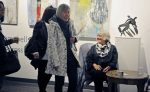
Olga Campbell (seated) takes a break from signing books at the opening of her exhibit A Whisper Across Time, which also served as a launch of her book by the same name. (photo by Gordon E. McCaw)

The impacts of the Holocaust continue to reverberate. Even though most of the first-generation survivors have passed away, the next generations, the survivors’ children and grandchildren, remember.

Local artist Olga Campbell belongs to the second generation. Her parents survived the Holocaust, but her mother’s entire family was murdered by the Nazis. The need to give those family members a voice was Campbell’s driving force in writing her new book, A Whisper Across Time: My Family’s Story of the Holocaust Told Through Art and Poetry. Her solo exhibit with the same name, co-presented with the Cherie Smith JCC Jewish Book Festival, opened at the Zack Gallery on Nov. 15. The night also served as a book launch.

“The art in this show are mostly prints from the book,” she said in an interview with the Independent. “There are also some pieces that are offshoots on the same theme, even though they aren’t in the book.”

Campbell has always known that her mother’s family didn’t survive the war, but the emotional impact of their deaths built slowly over the years. It took decades for this book to emerge.

“In 1997,” she said, “I heard a program on the radio about the second-generation survivors. Their words about the trauma being passed between generations resonated with me.”

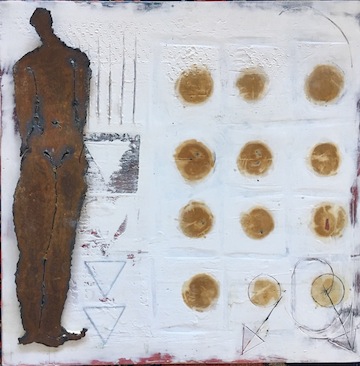
She embarked on an artistic journey, and she is still following a path of exploration. Her art reflects her emotional upheaval. Her paintings and statues are fragmented, with broken lines and distorted figures, evoking feelings of loss and anguish. One look at her paintings and a disquiet tension washes over the viewer. It is apparent that a huge tragedy inspired her work.

In 2005, Campbell had a show at the Zack, called Whispers Across Time. “Even then,” she said, “I knew I had to write about my family. The art show was not enough. I had to say more, but, at that time, I couldn’t. I was too raw, too emotional. But my family kept tugging at me. I needed to tell their story. I was compelled to write this book.”

Unfortunately, she knew only the bare bones of her mother’s life. So she plunged into a deep and long research period, surfed the internet, contacted Yad Vashem and other sources. After several years, the book crystallized.

“My book is a tribute to my family, the family I never knew,” she said.

“Of course, it is only one family of the millions of families killed during the Holocaust.”

Campbell spoke of the relevance of her book in today’s political climate. “Our world is a chaotic place right now, somewhat reminiscent of the period before the war,” she said. “There are over 68 million people around the world that are refugees or displaced. My book is not only about my family. It is a cautionary tale. It is about intergenerational trauma and its repercussions across time.”

image - artwork by Olga Campbell
(artwork by Olga Campbell)

She created new art for the book, wrote poetry to supplement the imagery, and also included an essay on her family members and their lives, destroyed by the war. The paintings in the book and on the gallery walls are powerful but melancholy, even distressing.

“My work always had this darkness, the sadness, but also a bit of hope,” she said. “I never know what will happen when I start a piece. I’m very intuitive. I would throw some paint on an empty canvas and let my emotions and the art itself guide me through the process. I use photos in my works and digital collages. My finished pieces always surprise me.”

When the book was ready, Campbell applied for another show at the Zack, to coincide with the book launch.

“I wanted to give it the same name as the previous show, Whispers Across Time,” she said, “but I checked the internet, and there are a couple other books already published with the same title. I decided to change it.” The book and the show are called A Whisper Across Time. “I feel a lot lighter now, after the book is finished and published,” she said.

A Whisper Across Time is Campbell’s second publication. In 2009, she published Graffiti Alphabet. She has been doing art for more than 30 years, but that is not how she started her professional career. She was a social worker until, in 1986, she took her first art class. That year changed her life.

“It was such fun. I loved it,” she said. “I went back to work afterwards but it didn’t feel as much fun. I decided to get an art education. I enrolled in Emily Carr when I was 44.”

Campbell finished the art program, continued working part-time as a social worker, and dedicated the rest of her time to painting, sculpture and photography.

“I’ve been a member of the Eastside Culture Crawl for 22 years, since its beginning,” she said. “I participated in the Artists in Our Midst for many years, too. At first, when people asked me, I would say I do art. Now, I say, I’m an artist. I must be. That’s what I do. I’m retired now, but I did art when I was working, too, and it was always very healing and rewarding – still is…. If, for some reason, I don’t paint for awhile, I feel as if something is missing.”

The A Whisper Across Time exhibit continues until Dec. 9. For more about her work and books, visit olgacampbell.com.

Olga Livshin is a Vancouver freelance writer. She can be reached at [email protected].


Format ImagePosted on November 23, 2018November 20, 2018Author Olga LivshinCategories Visual ArtsTags art, Holocaust, memorial, Olga Campbell, painting, Zack Gallery
Exhibit celebrates life

Exhibit celebrates life

The paintings of Frank Levine are on display at the Zack Gallery until Aug. 31 in a shared show, called Celebration, with Melanie Fogell. (photo by Olga Livshin)

The latest show at the Zack Gallery, Celebration, showcases two artists, Melanie Fogell and Frank Levine. At first glance, they don’t seem to have much in common.

Fogell’s art is bright and flamboyant, totally abstract, and her canvases are large, while Levine’s paintings are generally smaller, more intimate, his colours more muted and his compositions tend to have recognizable figurative patterns: people, musical instruments, landscapes, cityscapes.

However, both artists celebrate life through their paintings. For years, both approached art as a hobby – it is only recently that Fogell started painting full-time, while Levine still works as an accountant. Both artists also lived for some time in Gibsons, B.C., where they met a few years ago. Fogell still lives there, while Levine has moved to Richmond.

Levine’s life has involved several drastic moves, geographic and professional. Born in England, he received his art education in London. He majored in fashion design. Upon graduation, he opened his own fashion boutique in London, but that didn’t last long in the cutthroat industry. After that, he worked for 10 years as a clothing designer for a large factory in the city.

“The clothing industry in London is very stressful and loud. Everyone shouts and screams,” he explained in an interview with the Independent. “The designers had to produce a new design every week, two collections a year. If a particular coat sold, the owners congratulated themselves at how good they were at selling. If it didn’t sell, the designers were to blame.”

After a decade of the stress and screaming, Levine switched to accounting, which he considers an occupation much less taxing on his nerves. In 1978, he moved to Canada and settled in Vancouver. “Antisemitism in England was a consideration in my decision to move,” he said.

Wherever he has lived, and whatever his day job, he has kept on painting.

“I have always painted when I had the time,” he said. “I don’t paint every day, only when I’m inspired. Once a week, my son and his children come for a visit, and we paint together.”

One of the paintings in the show, “Prism,” came from one of those weekly sessions. The small image features a blue-and-gold cityscape, happy and bright, vaguely reminiscent of a Greek city. “My son suggested the theme of prism,” said Levine.

Many of the artist’s paintings are landscapes, but he portrays them through a mesh of geometric figures. The lines creating the geometric patterns add mysticism to the trees and lakes. “I’m drawn to the images that have passion, not something everyone would paint,” he said.

Whatever his brush depicts – his backyard in Gibsons with a visiting bear, a small café in the Luxembourg Gardens in Paris or picturesque gates in China – his love for the places shines through the canvas.

Unfortunately, not many people have seen his charming work. “I didn’t do any promotion until recently and I sell maybe two or three paintings a year,” he said. “I only joined Facebook a month ago.”

Over the years, Levine has participated in several exhibitions in Gibsons and has had his paintings displayed at a Richmond community centre. This Zack Gallery show is only the second time in Vancouver that the public has had a chance to admire them, and it is his first exhibit in a Vancouver art gallery.

photo - Melanie Fogell’s art is bright and flamboyant, totally abstract, and her canvases are large
Melanie Fogell’s art is bright and flamboyant, totally abstract, and her canvases are large. (photo from Melanie Fogell)

Unlike Levine, Fogell is well known on the Vancouver art scene. She had a solo show at the Zack in 2011 and another one in 2014. Her early art education at Emily Carr University of Art + Design could have led to a career in the arts, but, like many others, she discovered that it was extremely difficult to make a living as an artist. She became a piano teacher instead.

Years later, Fogell went back to university for a master’s in women’s studies and then did a PhD in educational research. She has taught women’s studies at the University of British Columbia and piano as a private tutor, but, throughout the years, just like Levine, she has never stopped painting. She loved art too much, and the need to express herself through imagery drove her to paint. She paints full-time now.

“I did this group of paintings, the Oval Series, over the last two years,” she said about the work in the Zack Gallery show. “It began by me doodling oval shapes. Then I started thinking of possible meanings of this particular shape. The oval could stand for an egg, which is a symbol of life, a celebration of life. Or it could be a face, the beginning of a face, not ready to be recognized. They could be faces of people in my life or people I have yet to meet.”

Fogell’s paintings burst with primal colours, and her ovals seem like gladness enclosed, surrounding the viewers like a collection of exuberant eggs, or new leaves shimmering in the sunlight, or a field of tulips swaying in a breeze. They promise renewal and hope. “I paint how it feels to be connected to everything in my life, both present and past,” she said.

The exhibition Celebration opened on Aug. 9 and continues until Aug. 31. For more information, check out the artists’ websites, melaniefogell.com and franklevineart.com.

Olga Livshin is a Vancouver freelance writer. She can be reached at [email protected].

Format ImagePosted on August 24, 2018August 22, 2018Author Olga LivshinCategories Visual ArtsTags art, Frank Levine, Melanie Fogell, painting, Zack Gallery
Eclectic mix of art and artists

Eclectic mix of art and artists

Artist Paula Mines combines photography and abstract work whenever possible. This image by Mines is part of the current group exhibit now on display at the Peretz Centre until July 22.

The current art show at the Peretz Centre for Secular Jewish Culture is reflective of the centre’s nature – it is inclusive and eclectic. The group exhibit encompasses various genres and techniques: oil paintings and watercolour, photography, textile art and even animation. The artists participating in the show are as different as their art, their only point of connection being the Peretz Centre.

Of the eight artists featured in the exhibit, JI readers are already familiar with at least three: Colin Nicol-Smith, Hinda Avery and

Simon Bonettemaker. All three took part in the inaugural Peretz Centre Art Show in 2014. For all three, art has been a hobby: Nicol-Smith was a professional engineer, Bonettemaker was an architectural technologist and Avery taught women’s studies at the University of British Columbia before retirement.

Unlike them, Avrom Osipov built his life around creative endeavours. “I grew up at the Peretz Centre,” he told the Independent. “Started coming here with my parents when I was 5. It took me 65 years to grow up,” he joked.

image - Avrom Osipov built his life around creative endeavours
Avrom Osipov built his life around creative endeavours.

At one time, Osipov made a living as an artist, producing his own line of handpainted clothing and T-shirts and selling them to department stores. “I’ve made 1,200 original T-shirts, never copied a design once,” he said.

Afterwards, he worked as an actor in film and television. “I have always been creative, but, before this show came along, I hadn’t painted in awhile,” he said. “I did some image manipulation on my computer. The show made me pick up a brush again, and it’s fantastic. Now, I paint every day.”

Paula Mines is also a regular at the centre. “I’m from Montreal,” she said. “My parents and I arrived in Vancouver in 1953 and almost immediately became involved at the Peretz. They felt at home here, and so do I.”

She has always been interested in art, even as she worked in social services. She paints and draws but, since her retirement, she has been focusing on photography. “My place is too small for an easel and paintings,” she said, laughing. “Photography just takes a computer. I combine my photography and abstract work whenever possible. My images are semi-realistic. I take a photo, clean it, crop it, change things or add things from other photos. Not all photos lend themselves to this kind of transformation. Of every 1,000 photos I take, I might keep about 25. To turn out a good image is so exciting.”

Another member of the Peretz community, Natalia Bogolepova, is an immigrant from Russia. She worked as a doctor in Russia for 20 years, specializing in plastic surgery and cosmetology, before coming to Vancouver in 2011. “I always loved art, always painted, even when I practised medicine,” she said. “I participated in several amateur art shows in Moscow. My mother was a professional artist and, since childhood, I enjoyed the smell of oil paints.”

Even though Bogolepova couldn’t work as a doctor in Canada without a licence, she didn’t try to pass the exam. Instead, she switched careers and worked in security for several years. Fortunately, serendipity took a hand in her life. Her security post at the Vancouver Art Gallery pushed her back into the arts. “I observed the art and the people who visited the gallery,” she said. “I watched children as they drew inside the gallery. I knew I had to get back to my painting.”

image - Karl Epstein’s paintings can be found in private collections throughout Belarus, Israel, Canada and the United States
Karl Epstein’s paintings can be found in private collections throughout Belarus, Israel, Canada and the United States.

Another Soviet immigrant, Karl Epstein, is a professional artist and architect. He graduated from Belarus Academy of Arts in 1972 and worked as an architect in his native Belarus before immigrating to Israel in 1990. In Israel, he painted a lot and participated in a number of exhibitions. His paintings can be found in private collections throughout Belarus, Israel, Canada and the United States. He kept on painting after he moved to Canada.

Rounding out the eight artists featured in the Peretz show is Lesley Richmond, the only one not previously connected to the centre. This exhibit will be her first appearance there.

A professional fibre artist, Richmond received her art teaching training in London, England. She taught textile art at Capilano University until 2003, when she dedicated herself full time to art. Private and corporate collections in the United States, Japan, Poland, Korea and Canada have some of her work on display.

The idea to bring eight wildly different artists together in one show was Nicol-Smith’s. “I wanted to have another show at the centre after the success of our first one in 2014,” he recalled. “I started talking about it at one of the Peretz events with food and music, and suddenly people at the other tables perked up. ‘I’m an artist,’ sounded all around me. ‘I want to be in this show, too.’” Nicol-Smith partnered with Lena Sverdlov, vice-president of the Peretz Centre for the past four years, and, together, they made the current show a reality.

The exhibit opens today, July 13, and will be on display until July 22.

Olga Livshin is a Vancouver freelance writer. She can be reached at [email protected].

Format ImagePosted on July 13, 2018July 11, 2018Author Olga LivshinCategories Visual ArtsTags art, Avrom Osipov, Colin Nicol-Smith, fundraiser, Natalia Bogolepova, painting, Paula Mines, Peretz Centre, philanthropy
Art reflects constant change

Art reflects constant change

Carly Belzberg’s solo show is at Zack Gallery until Aug. 3. (photo by Nathan Garfinkel)

Carly Belzberg is a Zen practitioner, and her art reflects her beliefs. Her solo show at the Zack Gallery – The Spirit of Cloud, The Spirit of River – is all about change.

“I’m frequently at the Zen Centre of Vancouver,” she said in an interview with the Independent. “I study there and I realize that everything in life is in flux. A river is always changing. Water is quiet one moment, turbulent the next. It could be playful or angry, rushing or swirling, transforming from moment to moment. There are bubbles and spray and flow. Nothing is ever constant. The same is true of clouds. You can’t say a cloud is fluffy. It’s only fluffy one moment. It’s dynamic, fluid. The same is true of humans. We change from one day to the next, under the influence of the world. That’s what I wanted to express in my paintings: the freedom of change, its boundlessness. Nothing stays ‘this way.’ Everything evolves. Everything grows, and the essence of change is clearest when watching the river or the clouds.”

Watching the river or the sky helps her meditate. “Nature comes into you,” she said. “You breathe it in, and then it comes out again.”

Part of what comes out for Belzberg is her art. Colours and lines coalesce and crisscross in her abstract images of movement and form. The paintings represent the essence of change, as she sees it.

“It is my first-ever solo show,” she said, although she has participated in several group shows at the Zack in the last few years. “My art is a joy, and I wanted to spread my joy. I’m really happy to share my vision, something I’ve been nurturing for so long.”

Her path to this exhibit was as complicated as a water drop. She grew up in Vancouver, then studied at Concordia University in Montreal, Drexel University in Philadelphia and, later, at Simon Fraser University. With a bachelor of fine arts and art education and a master’s in art psychotherapy, she started her working life in Baltimore as an art therapist.

“I painted as a school girl and loved it. Had an amazing art teacher. That’s why I decided to do a master’s in art therapy. Art helped me a lot when I was sick as a teenager, and I wanted to learn how to use art to help others.”

Her work in Baltimore was in crisis intervention and with elderly dementia patients. She loved both sides of her job.

photo - Carly Belzberg at the July 5 opening of her solo exhibit at the Zack Gallery, called The Spirit of Cloud, The Spirit of River
Carly Belzberg at the July 5 opening of her solo exhibit at the Zack Gallery, called The Spirit of Cloud, The Spirit of River. (photo by Nathan Garfinkel)

“Art gives people in crisis a voice,” she said. “It soothes. It supplies cathartic relief. Art is much better than talk because it gives people distance from their trouble and their feelings. Art provides a safe outlet.”

She also explained about the people she worked with who had dementia: “Some of them lost their memories in words, but the images are still there and they come out in the … paintings, even if they don’t remember. They draw their memories.”

While she kept on painting all that time, her focus was on building her art therapy career. Like many hobbies, her painting became relegated to the sidelines of her life.

After awhile, she moved to Winnipeg and, a few years later, around 2007, returned to Vancouver.

“I didn’t do much art, and it made me unhappy,” she said. “I wasn’t connected to who I really am. I found the lack of liveliness inside. I needed art. It is something to look forward to in the morning.”

Unfortunately, between her work for the Vancouver School Board and her private therapy practice, she couldn’t seem to find a place for her own art. Then, about three years ago, things changed.

“There was a demo at Opus, the art supply shop on Hastings in downtown,” Belzberg recalled. “It was held by a wonderful Vancouver artist, Suzan Marczak. I went there and I loved it. There were some difficult people attending that demo, and Suzan dealt well with them. I was impressed, and we talked. Suddenly, I wanted to get back to my painting. I guess I needed a push in the right direction. I started studying with Suzan. She is a very talented teacher, demanding but generous.”

Since their first meeting, the two have become such good friends that Marczak helped Belzberg hang the paintings for her Zack show.

“Suzan reminded me how much I loved painting,” said Belzberg. “It happens sometimes – you forget parts of what you are, and then you remember, and you have this desire to create again.”

About the same time, Belzberg made a serious commitment to studying Zen. This also led her back to her artistic core.

And her work for the school board helped, too. “I offer art therapy classes for the children of Vancouver elementary schools. Young kids don’t have stereotypes, their minds are free,” she said. “They see everything with fresh eyes, and it meshes with the Zen philosophy. In Zen, you let go of your preconceived ideas, of stereotypes. Eternal change means there are no stereotypes.”

This approach is what led to the current exhibit. “This show was a spontaneous exploration of change, prompted by curiosity. I never knew what would happen when I started a piece. As one of my teachers said, painting without a final product in mind is akin to driving on a dark highway, where you only see a short distance ahead of you at a time. Each decision is based on moment-by-moment input, on what you see on your canvas right now.”

Despite the prolonged period of partial withdrawal from the arts, Belzberg has had some sales and commissions over the years. One of her biggest commissions was the purchase of 14 paintings for a nursing home in Winnipeg. But she doesn’t paint for money.

“If I had to paint for money only, I think I’d get sick,” she said. “I want my paintings to go to people’s homes, make their space beautiful. You know, they say sometimes, ‘This house is so you.’ That’s how it is with me in my house. I like crystals and plants, they make me feel good, so I buy them for my home. If someone buys my paintings to make them feel good, to create an environment that resonates with their souls, that makes me happy.”

The Spirit of Cloud, The Spirit of River exhibit opened July 5 and continues until Aug. 3. For more information on Belzberg and her work, visit carlybelzberg.com.

Olga Livshin is a Vancouver freelance writer. She can be reached at [email protected].

Format ImagePosted on July 13, 2018July 11, 2018Author Olga LivshinCategories Visual ArtsTags art, Carly Belzberg, painting, Zack Gallery, Zen
Painting a lasting impression

Painting a lasting impression

Diana Zoe Coop stands beside her painting “Frida Kahlo’s Garden.” (photo by Olga Livshin)

Diana Zoe Coop paints gardens. She paints them on canvas and paper. She paints them on costumes and wall panels. Her new show at the Zack Gallery, The Artist’s Garden, is an explosion of colours and shapes that sprout not only from nature, but from the garden of the artist’s imagination.

“All my life, I painted,” she said in an interview with the Jewish Independent. She studied for her bachelor of fine arts at the University of Manitoba, continued her education at Syracuse University in New York and finished her postgraduate specialty training at Saint Martin’s School of Art in London, England. She graduated with a degree in printmaking and thought herself more a graphic designer than a painter, but, as time passed, she gradually switched to painting.

“I didn’t always have access to a printer studio and equipment,” she explained. “Without it, I gravitated towards painting.”

Her favourite subjects are gardens and flowers. “People send me photos of beautiful gardens, the places they live or the places they travel,” she said. “These photos feed me ideas and often become paintings. My own travels also result in paintings.”

During her most recent trip to Mexico, in 2016, she visited Frida Kahlo’s home. Again.

“I’ve visited Frida’s home many times,” said Coop. “I always loved her art, felt an affinity for Kahlo’s work. She painted what she knew, even when she couldn’t move from her bed. I also paint what I know: my garden or the forest behind my house. Someone sent me a photo of a fiord, and I painted it…. Many of my paintings have a distinct blue colour. It is the colour of Frida’s house. She had walls painted with it, and this particular blue bleeds into my paintings.”

Coop’s paintings explore far beyond blue. In the gallery, her pieces are an explosion of hues and forms, bright arabesques of brushwork interspaced with dazzling sprinklings of gold and silver. The collective work is the representation of a garden through the lens of the artist’s perception.

“Recently, I read an interesting quote that I felt really defined the creative process,” said Coop. “It was written by Gordon Atkins, the renowned Canadian architect. He said something like this: ‘I don’t think we create. I think we interpret and I think our interpretations are the result of all the visual and actual experiences we go through.’ This seems to me to be an accurate definition of what happens when we paint or draw or sculpt. We are the storytellers of our generation. We make real and tangible our thoughts and emotions, our visceral interactions with the landscape around us.”

Many of the images in the show are mixed media collages, with pansies applied to the paint and bright crystals bringing sparkle to the compositions. “I grow pansies in my garden. It’s not easy to care for them, especially through the winters, and I do need many of them for my paintings,” Coop said.

Coop also uses art to convey her memories of “the myriad experiences of decades of relationships. And, most sadly, the profound losses of people I loved,” she said. “There were friends who passed away before their time, far too early and far too young.

“Roberta Mickelson inspired me to paint the wild gardens of my discontent and my anger, an anger directed at the unfairness of her life cut short. She was a talented artist herself, and it pained me to think that she could not paint anymore.

“And my friend Shelley Dyer, who passed, tragically, a year ago, was a beacon of brightness, beauty and creativity. Shelley loved the garden and all creatures great and small. Her laughter still echoes in my mind, and these paintings bear witness to the questions I asked myself every day, as I struggled to comprehend where she was now. One day, it just came to me: she was right here with me, in my paintings.”

Coop’s works hang in private and corporate collections in Canada, the United States, the United Kingdom, the Netherlands, Italy, Australia, Bulgaria, Poland, Czech Republic, Austria, Serbia, France and Finland. But painting pictures is only part of her creative journey. She also designs unique costumes for rhythmic gymnastics, dance, circus, aerial and skating. For years, many Canadian athletes wore her designs at international competitions, including at the Olympic Games.

“A girl gymnast once saw my paintings and said naively that they looked like her costume. I didn’t have the heart to tell her it was the other way around,” Coop said with a smile.

Her costume design business started as a personal necessity. “My daughters were gymnasts when they were young. I made costumes for them. Their friends on the team saw the costumes, liked them and asked me to help them with their costumes. And the word spread.”

In addition to making costumes, Coop volunteers as a judge of rhythmic gymnastics. “I studied for it, took an exam. Since 1997,” she said, “when I became an internationally qualified judge, I’ve traveled all over the world to judge the competitions.”

But art remains her passion and her joy. “I can’t stand when I don’t paint,” she confessed. “I become very cranky. Painting for me is as much a physical release as an emotional one. I need it. I don’t like being still. That’s why I enjoy working in my garden when I don’t paint. And I dance. I dance salsa and zumba, with their lively music, but I paint in silence.”

Coop sees her paintings as a reminder to the ones who come after her. “As we grow older, we hope to leave a part of ourselves behind,” she said. “Through our interactions, our deeds, our love of family and friends, and the people we meet, even briefly, we all attempt to be remembered. I consider making art the definitive memory-maker. Centuries after I depart from this visceral world, my art will still be a testament that I was here now.”

The Artist’s Garden exhibit continues to June 29. To learn more, visit the artist’s website, dianazoecoopartist.com, and her costume design site, zoeycouture.com.

Olga Livshin is a Vancouver freelance writer. She can be reached at [email protected].

Format ImagePosted on June 15, 2018June 14, 2018Author Olga LivshinCategories Visual ArtsTags Diana Zoe Coop, painting, Zack Gallery
Zack displays art and music

Zack displays art and music

“Rikud” by Givon (photo by Olga Livshin)

The current exhibit at the Zack Gallery – the Festival Ha’Rikud group show, called Israeli Music through the Years – is a fundraiser. Every painting on display has a silent auction sheet beside it, and people can bid on the pieces they like. The bidding closes on June 1, with all the proceeds going to the gallery.

photo - “Babushka” by Carl Rothschild
“Babushka” by Carl Rothschild (photo by Olga Livshin)

Opening night on May 15 was a festive affair. Almost all of the 60 participating artists came to mingle and cheer one another on.

“The gallery offered all the artists boards of a universal size to paint on,” explained gallery director Linda Lando. “I sent the boards to the artists about three months ago to give them plenty of time. Every painting in the show is the exact same size, while the selection of the artists is eclectic. Some are professional artists I’ve had on my radar for years. Others are JCC members or their friends who learned about the show and applied. One entire wall of the show is dedicated to paintings created by Louis Brier’s residents attending art lessons. For many, it is their first show. Some never even painted before. It’s very brave of them to put their art out for everyone to see and judge.”

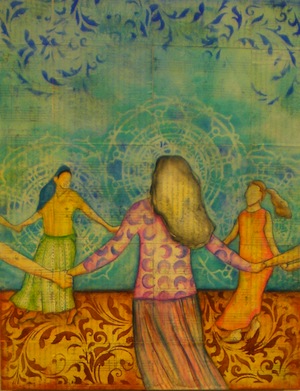
The paintings are as different as the artists themselves, although the theme is the same: music in one guise or another. Some artists lean towards Jewish mythology, like Penelope Harris’s mixed media “Miriam and her Sisters.” Three women dance in the painting, all wearing timeless clothing in soft colours.

photo - “Legacy” by Wing Yee Wong
“Legacy” by Wing Yee Wong (photo by Olga Livshin)

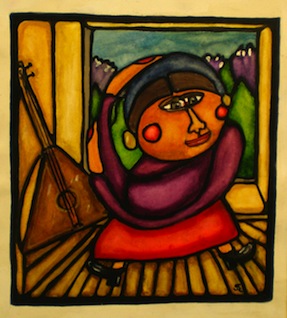
Dancing seems to be a popular subject. In the artist Givon’s painting “Rikud,” four stylized women dance, their colours and shapes flowing into one another, while “Babushka,” by Carl Rothschild, dances alone, exuding humour and sharp lines; her balalaika leans on a wall beside the dancer, adding a Russian flavour to the painting.

Nini Rostoker-Shipman’s “Let’s Dance” is all about shoes. In the subdued brownish image, a couple dozen pairs of worn shoes – sandals, slippers and flats – lie docilely side by side, like a collection. Only one pair of shoes stands out. These are high-heels with sparkly buckles – real shoes glued to the image. Perhaps some fashionable woman from the artist’s family danced in those shoes long ago? The shoes look impertinent enough to enjoy dancing.

Other works explore music’s players, the musicians, as well as musical notations or instruments. In this stream, Maggie Farrar’s portrait of Leonard Cohen attracts attention. The showman’s ubiquitous hat sits rakishly on his head, and the names of his famous songs scroll across the canvas.

photo - “Sabras Rejoicing” by Marlene Konyves
“Sabras Rejoicing” by Marlene Konyves (photo by Olga Livshin)

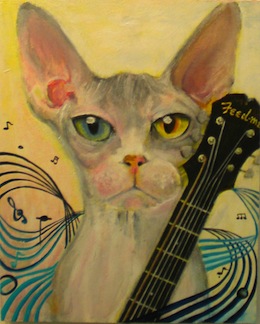
Below the portrait of Cohen hangs a piece by Wing Yee Wong called “Legacy.” The painting is popular with the auction bidders. It depicts an Abyssinian cat with its disproportionately big ears and haughty eyes, one yellow, another green. The cat is clutching a guitar and staring at viewers with contempt. There is an inscription on the guitar handle, demanding, “Feed me.” It’s hard not to smile while looking at it.

Musical instruments are also featured in “Where are the Ladies?” by Marion Eisman. In the mischievous painting, an all-male klezmer ensemble jams a merry tune on a shtetl street.

Another orchestra, in a piece by Alan Woolf using a pastel palette, is much more serious. These musicians perform a classical concert in the ruins of an ancient amphitheatre. The musicians’ tiny, delicate figures look like pencil sketches on the background of an azure Israeli sky.

photo - “Miriam And Her Sisters” by Penelope Harris
“Miriam And Her Sisters” by Penelope Harris (photo by Olga Livshin)

In contrast, Iza Radinsky’s instruments play by themselves. No people populate her bold painting, just bright colours and ringing notes.

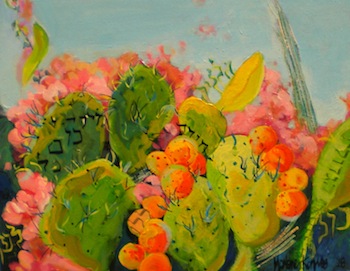
Bright colours also characterize Marlene Konyves’ “Sabras Rejoicing” – a bunch of gleeful blooming cacti – and Jocelyne Halle’s collage, which incorporates several of her Israeli photographs. “It is my first attempt at collage,” said the well-known photographer, who has exhibited her work at the Zack before.

And then there are abstracts. A rhapsody in green in Claire Cohen’s painting hints at melodic skeins and vague instrumental shapes. Sidi Schaffer’s “Eli, Eli,” with its butterflies flitting across the joyful blue ether, is infused with faint sadness – the title of the painting is the same as the song that inspired it.

“I love that song,” said Schaffer. “It is well known in Israel. It was written by Hannah Szenes, a Hungarian Jew. She immigrated to Palestine and became a paratrooper during the Second World War. She was killed by the Nazis when she was only 23, but her poetry is famous in Israel.”

It is impossible to mention all 60 artists who are participating in this show, but it can be said that all of the work on display demonstrates a love of art and music.

Olga Livshin is a Vancouver freelance writer. She can be reached at [email protected].

Format ImagePosted on May 25, 2018May 24, 2018Author Olga LivshinCategories Visual ArtsTags art, Festival Ha’Rikud, painting, Zack Gallery
Intimate portraits at the Zack

Intimate portraits at the Zack

The exhibit Painting Intimate, showcasing the work of penny eisenberg and Ray Ophoff, is at the Zack Gallery until May 11. (photo by Olga Livshin)

The exhibit Painting Intimate introduces Vancouver art lovers to two very different local artists: penny eisenberg and Ray Ophoff. Different in their approaches, their styles and their creative philosophies.

“I have always liked painting,” eisenberg told the Independent. “I painted as a teenager, then stopped for a few years. I resumed painting in my 20s, but I was a closet painter then. I had several jobs in those years, worked as a cook and in retail. I kept on painting as a hobby, but, when I was 30, I took a class at Emily Carr. The instructor liked my works and suggested I apply for a full-time program.” She did.

Graduating from Emily Carr in 1995, she has been a full-time artist ever since, working in various themes and in a range of sizes as she tried to find her niche. For her, there is a huge gap between the words “picture” and “painting.”

“People buy pictures and hang them on their walls,” she said. “But I’m interested in paintings, not pictures. I’m trying to learn what is painting in the 21st century, when there are so many pictures around.”

Lately, as this exhibition demonstrates, all her paintings have been small. “I like working on small canvases,” she said. “I want to figure out what I want, and the small size allows me to create more paintings, to experiment with different series and subjects. Sometimes, I even work on a few different series simultaneously.”

The current show displays several of her series. There are hazy cityscapes, pulsing with light. There are brightly textured flower bouquets. A number of the paintings are from her latest series.

“In this series, I’ve been exploring the history of women in the arts, how other artists painted their female models,” she said. From 18th-century artist Jean-Baptiste-Simon Chardin to fashion photographers of the 20th and 21st centuries, eisenberg has transformed other artists’ women through the prism of her own artistic vision. In her abstracted compositions, which follow the others’ outlines but express her own esthetic, eisenberg had made all the portraits small and intimate – and faceless.

“There are two reasons for all my figures being faceless,” she said. “When we identify emotions, faces are what we look at. I wanted to show emotions without the faces, through paints, colours and shapes. In this series, I also examined who influenced whom in the art history, and how it reflected in their female model paintings.”

The internet age is another reason for this approach. “I view the reality of contemporary culture as a series of faceless interactions through social media,” she said. “That’s what I wanted to express. Hence, the hashtag in the title of the series, #otherartistswomen.”

photo - Ray Ophoff has 15 paintings in this show, most of them flowers and landscapes in exuberant, uplifting colours
Ray Ophoff has 15 paintings in this show, most of them flowers and landscapes in exuberant, uplifting colours. (photo by Olga Livshin)

When Zack Gallery director Linda Lando suggested eisenberg apply for a show, the artist embraced the opportunity. “I wanted a show at the Zack, but it is a large space,” said eisenberg. “I couldn’t handle the stress of filling it all by myself. I asked Linda if I could invite a friend artist, Ray Ophoff, to share it with me.”

Like Eisenberg, Ophoff is a long-time participant in the East Side Culture Crawl. In fact, that’s how they met.

“Many years ago, I visited her studio during the Culture Crawl,” recalled Ophoff. “I had a painting – a landscape – in my own studio at the time, and I saw that she had painted the same place, but it was much better than mine. We started talking and became friends.”

Ophoff has never studied art formally, or taken classes. He is a salesman by profession and paints in his spare time. “I’m entirely self-taught,” he said. “But I read a lot about art. My yearly spending for various art magazines runs to $900.”

Ophoff has 15 paintings in this show, most of them flowers and landscapes in exuberant, uplifting colours. Blown-up to 10 times or more of their real size, his flowers attract viewers with their deceptively simple beauty and their graceful allure. They would gladden any space, and people appreciate the optimism of his imagery.

“I sell almost everything I paint,” he said. “Mostly it is through the Culture Crawl or the First Saturday project. People come to my studio. I don’t even have a website.”

For Ophoff, his art is the only outlet where all the decisions are his alone. “I paint what I want,” he said. “When I walk through the woods or parks or gardens, I take photos. I always know: this is the image I want to paint. Not the entire photo, just a small fragment of it. My painting is not a tree or a flower. It is about that tree or that flower, my version of that tree.”

He considers himself an editor of imagery. “I edit everything unnecessary out of the image,” he explained. “When I find the perfect image, I always know. It is almost like time stops. I know: this will be a great one. Maybe not my painting of it, but the image itself.”

Ophoff’s canvases tell stories. They animate the flora around us and invite our imaginations to unfold. Despite their larger size, his works are, in their own way, as intimate as eisenberg’s much smaller compositions.

For both Ophoff and eisenberg, Painting Intimate is their first show at the Zack Gallery. The exhibit opened on April 11 and continues until May 11.

Olga Livshin is a Vancouver freelance writer. She can be reached at [email protected].

Format ImagePosted on April 27, 2018April 25, 2018Author Olga LivshinCategories Visual ArtsTags art, painting, penny eisenberg, Ray Ophoff, Zack Gallery
Combining love of music, art

Combining love of music, art

Ava Lee Millman Fisher at the opening of her solo exhibit, I See Music, on March 1. (photo by Olga Livshin)

The new solo exhibit by Ava Lee Millman Fisher, which opened at the Sidney and Gertrude Zack Gallery on March 1, seems eclectic at first glance. It includes landscapes and floral compositions, Judaica and symbolism. But all the paintings are united by the theme and name of the show: I See Music. That’s how the artist perceives the world around her.

“I see music and I hear colours,” said Millman Fisher in an interview with the Independent. “It’s what my art is all about. I have synesthesia.”

According to a dictionary, “Synesthesia is a perceptual phenomenon in which stimulation of one sensory or cognitive pathway leads to automatic, involuntary experiences in a second sensory or cognitive pathway. People who report a lifelong history of such experiences are known as synesthetes.”

Every one of Millman Fisher’s images includes musical notations, and the compositions’ colours flow like notes in a symphony. “I’ve always loved both music and art, since I was a child,” said the artist. “I had trouble choosing what I wanted to do professionally, until life interfered. After high school, I won a vocal scholarship to McGill University. But I never stopped painting.”

Millman Fisher specialized in classical opera and lieder (songs for solo voice, with piano). She sang a lot and taught music for awhile. Later, she went back to school to become a licensed music therapist. Throughout her entire career in music and mental health, she painted. “I love painting,” she said. “It is my visual voice. I often think in musical terms when I paint.”

She has been fortunate as a commercial artist. “I started selling my works when still at university,” she said. “Friends saw my paintings. They liked them. Someone wanted to buy. The word-of-mouth spread.”

From the beginning, Millman Fisher has painted in watercolours and created works with Jewish themes and images. “My paintings could be subdivided into two categories,” she said, “both well-represented in this show: secular art and Judaica. My Judaic pieces are very important to me. Unfortunately, there are not many places in Vancouver to showcase them. On the other hand, people from all over the world buy them. I have a Facebook page, and it helps a lot with promotion. By now, my Judaica paintings have found homes in Canada, Israel, the United States. Imagine: they want to buy my paintings in Israel, despite there being such a wide selection [of Jewish-themed work] inside the country. And, of course, I’m willing to ship anywhere.”

Millman Fisher recently sold a large Judaic painting to a client in New York. She couldn’t hide her joy as she told the story. “That lady from New York has been following my Facebook page for years,” explained Millman Fisher. “She said she loved my art but had no space in her home. When she moved to a larger home, she bought one of my paintings.”

image - The Zack Gallery show includes the piece “Libretto of the Lilies”
The Zack Gallery show includes Ava Lee Millman Fisher’s piece “Libretto of the Lilies.”

But Millman Fisher doesn’t only sell her art. “I’m always happy to share, to give them away,” she said. “I like donating my paintings to Jewish causes and organizations. Some of my pieces hang in Vancouver Talmud Torah and in the Louis Brier Home.”

One of her most interesting Judaic pieces in the show is a large painting called “Miriam,” which also has a long subtitle. Its visual structure is no less complex. “I needed to tell Miriam’s story,” Millman Fisher said. “She was the first music therapist in history. She always brought her tambourine to the gatherings and employed music to calm people.”

The artist pointed to a dense flock of birds framing the painting. “Each bird is individually made from rice paper, cut and glued to the painting,” she explained. “There are dozens of them, and they are all different.”

The musical snippets written inside each bird are also different but, together, they could be built into a song of Miriam. The painting is representative of Millman Fisher’s mixed media work.

“Originally, I painted in watercolours,” she said. “I still do and I love watercolours, but, about 15 years ago, I began experimenting with mixed media. At first, I saw the technique in other artists’ works and liked it. They would put anything into their paintings: coins, fabrics, souvenirs. Then I became a friend with a Jewish lady from Iraq. She passed away some time ago but, before that, we were good friends for years. When she escaped Iraq, she brought some golden chains with her, concealed in her clothing. She gave them to me and urged me to include them in my paintings. That was the first mixed media I did. Those paintings are almost all sold by now, and the chains practically gone. I have only a few fragments left. I used some of them in the ‘Miriam’ painting.”

Millman Fisher creates her mixed media on wood panels, and the works consist of many layers and involve a number of materials, including crystals and rice paper, metal and ribbons. “Sometimes, I cover the paintings with lacquer to make them shiny, but it doesn’t always work,” she said. “I would have an idea when I start a piece, but then it might change as I keep painting. The images have a life and will of their own. They often depend on the music I listen to when I paint. The pieces dictate, and I follow.”

Like everything else she does, Millman Fisher signs her name in a unique way. Her signature is her first name, Ava Lee, followed by a treble clef below. “My favourite moment is when I finish a painting and sign my name,” she joked. “The treble clef denotes my connection to music. It shows my double nature: a musician and an artist.”

I See Music is on display at the Zack until April 7, and there is an exhibit-inspired poetry night on March 15 at the gallery. For more information on Millman Fisher’s art, check out her website, creatavalee.net.

Olga Livshin is a Vancouver freelance writer. She can be reached at [email protected].

Format ImagePosted on March 9, 2018March 7, 2018Author Olga LivshinCategories Visual ArtsTags Judaica, Millman Fisher, painting, Zack Gallery
Bursting with colours and joy

Bursting with colours and joy

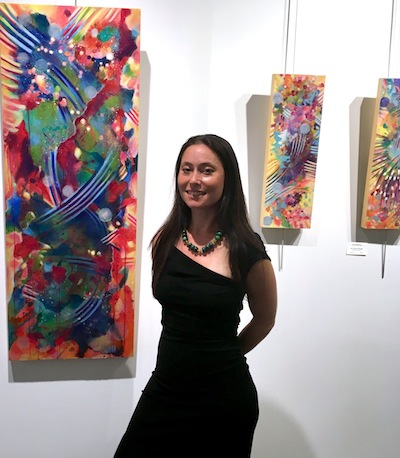
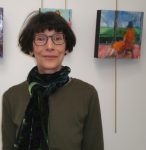
Artist Lauren Morris at the opening of her solo show, Dressed in Colour, at the Zack Gallery Jan. 25. (photo from Lauren Morris)

Dressed in Colour, Lauren Morris’s new solo exhibition at the Zack Gallery, perfectly reflects the artist’s relationship with the world. “Everything about me is colour,” she said in an interview with the Independent. “Colours bring this show together.”

This is Morris’s second solo show at the gallery, the first having been in 2015. She is known for her vivid flowers and colour-infused compositions.

“I always explore new colours, always learn, always take new photos. Living in Vancouver makes me want to paint even more colours,” she said.

Inspiration has not always come easily, though.

“About five years ago, I took a sabbatical. I didn’t paint for more than a year, didn’t know what to paint. I was stuck,” she said. “Before that period, I always used someone else’s vision as a starting point: photographs I found online, other artists’ pieces. But it stopped working for me. Then, I realized that it doesn’t matter what I paint. I began taking my own photographs. Now, I base everything I paint on my own experiences. I love nature, I enjoy flowers, and it all comes out in my art.”

Influenced by nature, Morris creates large canvases where colours, shapes and light intertwine into unique flowery abstractions, beautiful but never photographic or even realistic. Her flowers come from her imagination, with depth and texture adding meaning. “There is always something mystical in my paintings, something unknown,” she said. “A lot is going on in every picture, and the multiple layers create reflections.”

Morris paints with acrylics, but this medium, despite its growing popularity, has its quirks. “Acrylics dry fast, and they often become dull when dry,” she explained. “To brighten the images, I use varnish on top of acrylics. Varnish makes the magic come out. People even ask me if I paint in oils.”

photo - “Water Lilies” by Lauren Morris
“Water Lilies” by Lauren Morris.

Her flowers are larger than life. One can’t even see the overall image until one is at a distance from the work. “When I paint, I often stand back a lot,” Morris said of her creative process.

For her, a painting is never finished until it is no longer in her possession. “Yesterday, I saw something wrong in one painting in this show,” she said the day before the exhibit’s opening night. “Something bothered me, so I brought my paints and touched it up.”

Sometimes, she starts a painting with a preconceived image, but, like living things, her pieces frequently have a mind of their own. “My paintings often surprise me, and I always allow them to happen,” she said. “If I planned something else, but the image evolved somehow, I find it fascinating. If something doesn’t work, I fix it. I don’t have an anxiety. I don’t fear the canvas.”

Morris trusts her intuition, and it makes her paintings vibrant. It also makes her an excellent teacher. Lately, she has been teaching adult art workshops at the Designers Collective. “Most of my students are beginners,” she said. “They come to the workshop and they’re unsure. They think they can’t paint. I teach them not to be afraid. I bring art to people. I tell them: there are no mistakes in art. It’s not about technique. Art is a self-exploration. If you don’t like something you already painted, we’ll cover it up with something new. Maybe the old image will peek through, like a reflection of something different…. I try to make people believe in themselves. It’s almost a therapy class.”

She applies the same approach of playful exploration to her own work, fearlessly searching for beauty in her art. “I’m never bored when I paint. My art excites me. I get absorbed by my paintings,” she said happily.

Morris’s canvases seem to thrum with the strands of silent music, a quiet serenade of water lilies in a deep-green pond or a loud trumpeting from the white, extravagant bouquet exploding with elation.

“Before, I always listened to classical music when I painted, but, a few years ago, I stopped,” she said. “Now, I paint in silence. I still love music, but not when I paint. Maybe, it happened because there is so much noise around us, with the internet and the city life.” She doesn’t want the ambient noise of the urban sprawl to interfere with her paintings. “I want to create a mood,” she said. “I want to make people happy.”

Not surprisingly, people find delight in her paintings. In the past five years, she has been participating in the Eastside Culture Crawl, and sales – a challenge for any artist – have been encouraging. She has donated several of her paintings to various medical establishments around Vancouver, and her website also gets lots of traffic.

Her commissions have become almost a business, and she treats them as such. She starts practically every day with a few hours in her studio. “Each painting becomes a project to complete,” she said. “When clients come to me with a commission, my interior designer’s background kicks in. They have a vision of what they want: a size, a shape, a place on a wall in their home. I understand someone’s vision. It doesn’t make me feel constricted. If I’m able to get their vision right – the size, the colour scheme, the overall impression – I’m glad.”

Dressed in Colour is on display until Feb. 24. For more information about Morris and her work, visit lmdesignsstudio.com.

Olga Livshin is a Vancouver freelance writer. She can be reached at [email protected].

Format ImagePosted on February 9, 2018February 7, 2018Author Olga LivshinCategories Visual ArtsTags Lauren Morris, nature, painting, Zack Gallery
Celebration of Venice

Celebration of Venice

Artist Iza Radinsky at Zack Gallery. (photo by Olga Livshin)

Just over 500 years ago, in 1516, the Venetian Republic forcibly moved 700 Venetian Jews to an island, the abandoned site of a 14th-century foundry. In doing so, they created the first ghetto. The word ghetto means “foundry” in the old Venetian dialect.

photo - Rachel Singel
Rachel Singel (photo from Rachel Singer)

The Venetian ghetto had two access bridges, both guarded at night, and boats also patrolled the canals. Despite the isolation and other restrictions, the republic was relatively tolerant. Inside the ghetto, Jews were free to practise their religion and traditions; they were not forced to convert, as was the case in Spain and many other places throughout Europe. The ghetto became known as a place of study and scholarship, and its population grew from 700 in 1516 to more than 6,000 a hundred years later. The area – which existed until 1797, when Napoleon conquered the republic and gave equality to all citizens – remains a centre of Jewish culture.

Many Jewish and Italian organizations in North America and Europe have commemorated the 500th anniversary of the Venetian ghetto in some way. Here in Vancouver, Zack Gallery, in conjunction with Il Museo at the Italian Cultural Centre, are presenting Stories from the Stones of Venice: The Art of Rachel Singel and Iza Radinsky. The exhibit was the brainchild of Singel, an artist, printmaker and assistant professor at the University of Louisville, in Kentucky.

“The year 2016 marked the 500th year since the establishment of the Jewish ghetto in Venice,” she said in an email interview with the Jewish Independent. “To honour the historical anniversary and the influence of this uniquely urban space, I worked onsite in Venice for two months to create a series of etchings illustrating the buildings, structures and streets of the ghetto.”

That was not Singel’s first visit to Venice. “I first went to Venice in 2012 for an artist residency,” she said. “I have had the opportunity to return to Venice every year since. My artworks have been increasingly influenced by Venice and its fragile state…. The last two years, I have also brought my students to the Scuola Internazionale di Grafica Venezia.”

photo - “The Corner Synagogue” by Rachel Singel
“The Corner Synagogue” by Rachel Singel. (photo from Rachel Singer)

Singel has exhibited her 10 ghetto prints at the international school and at the Jewish community centre in Louisville.

“Each of the 10 images seeks to call attention to the Venetian ghetto’s importance, not only as an architectural complex within the confines of Venice, but also its worth internationally. Its structures are resonantly symbolic, representing the community’s resolute will to survive and prosper in what was an exceedingly hostile social environment.”

When Singel heard about the exhibition that was being planned at Il Museo – The Venetian Ghetto: A Virtual Reconstruction 1516-2017, which opened on July 25 – she looked into the possibility of engaging with their event. “I reached out to the Zack Gallery director, Linda Lando, about exhibiting my prints at the JCC,” Singel said.

Lando liked the idea of a Venice exhibition, but 10 small prints were not enough to fill the Zack, so Lando invited Radinsky, a local artist, to exhibit her paintings of Venice in the same show.

“Linda Lando saw five of my paintings of Venice before,” Radinsky said. “She asked me if I had more and if I would like to participate in a two-artist show together with Rachel Singel. I was happy to.”

Radinsky’s 14 large paintings and Singel’s prints form the Zack exhibit.

“I love Venice,” Radinsky said. “I first visited it in 2006, with my 86-year-old father. I was awed by the city. It was as beautiful as in the old masters’ paintings I admired as a child in the museums of Moscow and St. Petersburg, even better. Afterwards, every time I go to Europe, I visit Venice. It draws me. It’s quiet there, no cars. People walk and gondolas float on the canals. Nothing artificial, just earthy colours, red roofs, water and sky – and reflections in the canals.”

photo - “Gondolier” by Iza Radinsky
“Gondolier” by Iza Radinsky. (photo from Iza Radinsky)

In her paintings, gondolas and gondoliers look as intrinsic to the ancient city as the sunlight and shadows, the unique water streets and multiple bridges of Venice. The muted colours coalesce into one another, creating combinations that have no names. The sky and the water blend together, weaving one fantastic, living canvas.

“Venice is built on water,” Radinsky explained. “Because of the dampness, it’s hard to maintain the paint of the outside walls of the buildings. The paint often flakes off, and green mold grows close to the water. But gondolas – those look luxurious. Lots of gilt and bright colours, golden ornaments and lush fabrics and cushions for the passengers. Every gondola is an amazing piece of art. In the past, gondolas were part of the Venetian fleet. They could ram into an enemy ship, and their sharp iron bows could cut like knifes. Now, they are tourist attractions, and gondoliers are very friendly and knowledgeable. They wear special hats and traditional striped shirts. They have to study long and hard to learn manoeuvring in the narrow canals. They have to pass an exam and get a licence.”

The artist’s eyes glowed with enthusiasm as she talked about her beloved Venice. “I’ve been there four times already and I want to go again,” said Radinsky.

Stories from the Stones of Venice opened at Zack Gallery on July 27 and continues until Sept. 3.

Olga Livshin is a Vancouver freelance writer. She can be reached at [email protected].


Format ImagePosted on August 18, 2017August 16, 2017Author Olga LivshinCategories Visual ArtsTags antisemitism, ghetto, history, painting, Venice, Zack Gallery

Posts pagination

Previous page Page 1 … Page 7 Page 8 Page 9 Next page
Proudly powered by WordPress