
Skip to content
  • Home
  • Subscribe / donate
  • Events calendar
  • Business Directory
  • FAQ
  • News
    • Local
    • National
    • Israel
    • World
    • עניין בחדשות
      A roundup of news in Canada and further afield, in Hebrew.
  • Opinion
    • From the JI
    • Op-Ed
  • Arts & Culture
    • Performing Arts
    • Music
    • Books
    • Visual Arts
    • TV & Film
  • Life
    • Celebrating the Holidays
    • Travel
    • The Daily Snooze
      Cartoons by Jacob Samuel
    • Mystery Photo
      Help the JI and JMABC fill in the gaps in our archives.
  • Community Links
    • Organizations, Etc.
    • Other News Sources & Blogs
  • JI Chai Celebration
  • JI@88! video

Recent Posts

  • Or Shalom reopens its doors
  • JFS from past to future
  • Need holistic approach
  • Sharing stories, advice
  • Journalist shares fears
  • Skills to live together
  • Road to independence
  • Cutting grass with scissors
  • Zionism as a solution
  • Deceit, desire & the divine
  • Reclaiming sacredness
  • Creative project ideas
  • Summer squares and cobbler
  • Thou shalt … summer commandments
  • Legal help for students
  • Revisiting myth of Lilith
  • Wrong person rebuked
  • Canada’s mixed messages
  • Questions for museum
  • Symposium on antizionism
  • Making soccer political
  • CJPAC lauds Pulver’s impact
  • City recognizes Vrba’s legacy  
  • Organ donation saves lives
  • Theodore’s March premiere
  • A healing Shabbaton
  • Supplying healthy food
  • A chime of metal tags
  • Yellowknife seder a first
  • Ishai energizes, unifies
  • A Lag b’Omer to remember
  • Expanding the healing
  • Hannah Senesh – a unique hero
  • Community milestones … May 2026
  • Sharing her testimony
  • Fall fight takes leap forward

Archives

Follow @JewishIndie
image - The CJN - Visit Us Banner - 300x600 - 101625

Tag: Zen

Cutting grass with scissors

Nine years ago, I was walking with my twins, then age 6, to synagogue, when we passed an older woman in her yard, using scissors to cut the grass along the boulevard. At that moment, herding Grade 1 kids along, it felt hard to imagine why anyone would do this. It became a discussion topic.  Why was this lady using scissors to do this? Was this a sign she wasn’t feeling well (in “kid” talk, aka mental illness)? Did we have to do something to help? We passed this person and her lawn several times on Saturday mornings that summer.

Recently, I, too, was using scissors to cut the lawn. I wanted to plant some runner beans along our chain link fence. Cutting the longer grass thatch away from this small space before planting was hard to do with our manual reel lawn mower, but the scissors made quick work of the problem. Within moments, I’d cleared away a strip of two to three inches on each side of the fence. With a satisfyingly large pile of thatch and grass for the yard waste, I was ready to start planting.

This morning, during a heat wave, I was using our mower, which is powered only by human efforts, no gas, no electricity, just a quiet whirr as it works. It struck me that people would look at me the way we looked at the neighbour cutting grass with her scissors. We choose a more environmentally friendly, retro, way to mow. Yes, it’s slower and more work. Yet, cutting the lawn is remarkably Zen. It’s an exercise in meditation, even when it’s hot out.

Modern spirituality often uses words like Zen, flow, meditation, spiritually alive and “finding deeper meaning” to help us access these experiences. These buzz words are supposed to differentiate spirituality from religion. As is, “I’m not religious or observant, but I’m spiritual.” Still, there’s nothing new about the concepts behind these terms. Our ancestors also worked to find flow or a Zen state of “being nothing” (a Buddhist/East Asian concept) in their lives.

I pondered this while attending an after-Kiddush lunch learning session on Shabbat. The speaker, a therapist, introduced the notion of mussar to the crowd with words like “journey” and “spiritual growth.” He spoke for 45 minutes. I wished I’d gone home to nap. The speaker, recently trained to discuss this Jewish concept, quoted a saying of the Kotzker Rebbe, Rabbi Menachem Mendel of Kotzk (1787-1859), but didn’t even give his name.  

To summarize the core concepts of mussar to a friend later, here’s what I knew before the talk:

Mussar was invented in the 19th century in Lithuania based, in part, on medieval Jewish texts. It focuses on moral conduct and positive character building from a Jewish perspective via specific values such as humility and gratitude. Practitioners explore these values via self-reflection, meditation, pair and group dialogue. This growth is intended to be an ongoing self-improvement effort to draw the individual soul towards the Divine.

Aside from concluding that I may not be destined for these 45 minute after-lunch sessions, I also summed this up in four sentences without using any buzz words to express it. There’s nothing wrong with learning mussar. It’s an approximately 170-year-old form of modern group and individual self-betterment and therapy, through a Jewish lens. This presentation offered it in 21st-century lingo.

Summer is a great time for celebrations, but it’s also a time to embrace the meditative moments of just being, like hearing the water hit the shore at the ocean, swinging in a hammock, laying in the grass watching clouds, digging in the dirt or pushing the mower back and forth in straight rows. Some of my most transcendent Jewish prayer experiences have happened at Jewish summer camp, outside, singing in harmony while overlooking the lake. The sunshine and the bugs and birds singing – it’s all a chance to slow down and enjoy amazing moments of wonder and observation in the natural world. It’s a moment to express gratitude for the divine creation we get to experience.

I, for one, feel wrought up over wars, constant misinformation, concern about relatives and friends in Israel, and in need of more calm. Closer to home, the recent data about the rise in Canadian antisemitic incidents can put a Jewish person’s nervous system in high alert. It’s legitimate to feel anxiety. Still, that’s not healthy all the time. 

For many, big gatherings in the sunshine are not what helps us relax. It’s the quiet state that comes from “being nothingness,” according to the Buddhists, our own Jewish traditions and from being alone outdoors and celebrating G-d’s creation.

Maintaining wonder comes in different forms for all of us. It’s OK to find that flow state, or, as Rabbi Sari Laufer expressed it in a recent Torah commentary about the parsha (portion) Naso: “Flow is the mental state where we are deeply immersed, focused and energized – so much so that time disappears. We forget to eat and sleep. Flow is a peak experience of purpose, creativity and connection. Crucially, flow is not meant to be permanent. We are designed to move in and out of it. A person living perpetually in flow would burn out, would find it utterly unsustainable.”

Settling down our nervous systems, escaping that adrenalin-fueled anxiety, is essential to maintaining balance during difficult times. One way to do that is through flow-state activities, whether grounded in mussar, daily routines, knitting or attending minyan. It’s sometimes found in a long walk to shul. Still others find it by trimming the grass by hand, a few blades at a time, with scissors. I think back on that woman, sitting on the ground, rapt with concentration, and marvel. In the Babylonian Talmud, in the Tractate of Berachot, on page 62a, the rabbis recount stories of students following their mentors to the bathroom and even the bedroom. Why? Everyday activities can be holy and essential to our wellbeing. Like cutting blades of grass, staring at the clouds, or finding one’s flow state – this is also Torah. 

Joanne Seiff has written regularly for the Winnipeg Free Press and various Jewish publications. She is the author of three books, including From the Outside In: Jewish Post Columns 2015-2016, a collection of essays available for digital download or as a paperback from Amazon. Check her out on Instagram @yrnspinner or at joanneseiff.blogspot.com.

Posted on June 12, 2026June 10, 2026Author Joanne SeiffCategories Op-EdTags Judaism, lifestyle, mussar, Torah, Zen
Art reflects constant change

Art reflects constant change

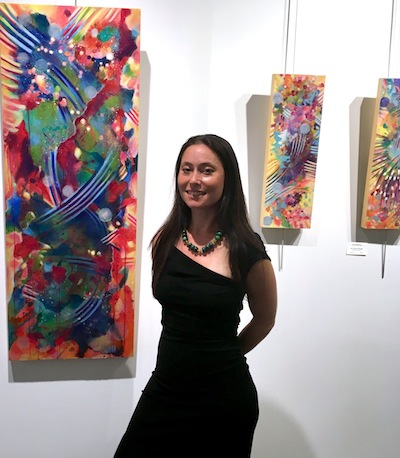
Carly Belzberg’s solo show is at Zack Gallery until Aug. 3. (photo by Nathan Garfinkel)

Carly Belzberg is a Zen practitioner, and her art reflects her beliefs. Her solo show at the Zack Gallery – The Spirit of Cloud, The Spirit of River – is all about change.

“I’m frequently at the Zen Centre of Vancouver,” she said in an interview with the Independent. “I study there and I realize that everything in life is in flux. A river is always changing. Water is quiet one moment, turbulent the next. It could be playful or angry, rushing or swirling, transforming from moment to moment. There are bubbles and spray and flow. Nothing is ever constant. The same is true of clouds. You can’t say a cloud is fluffy. It’s only fluffy one moment. It’s dynamic, fluid. The same is true of humans. We change from one day to the next, under the influence of the world. That’s what I wanted to express in my paintings: the freedom of change, its boundlessness. Nothing stays ‘this way.’ Everything evolves. Everything grows, and the essence of change is clearest when watching the river or the clouds.”

Watching the river or the sky helps her meditate. “Nature comes into you,” she said. “You breathe it in, and then it comes out again.”

Part of what comes out for Belzberg is her art. Colours and lines coalesce and crisscross in her abstract images of movement and form. The paintings represent the essence of change, as she sees it.

“It is my first-ever solo show,” she said, although she has participated in several group shows at the Zack in the last few years. “My art is a joy, and I wanted to spread my joy. I’m really happy to share my vision, something I’ve been nurturing for so long.”

Her path to this exhibit was as complicated as a water drop. She grew up in Vancouver, then studied at Concordia University in Montreal, Drexel University in Philadelphia and, later, at Simon Fraser University. With a bachelor of fine arts and art education and a master’s in art psychotherapy, she started her working life in Baltimore as an art therapist.

“I painted as a school girl and loved it. Had an amazing art teacher. That’s why I decided to do a master’s in art therapy. Art helped me a lot when I was sick as a teenager, and I wanted to learn how to use art to help others.”

Her work in Baltimore was in crisis intervention and with elderly dementia patients. She loved both sides of her job.

photo - Carly Belzberg at the July 5 opening of her solo exhibit at the Zack Gallery, called The Spirit of Cloud, The Spirit of River
Carly Belzberg at the July 5 opening of her solo exhibit at the Zack Gallery, called The Spirit of Cloud, The Spirit of River. (photo by Nathan Garfinkel)

“Art gives people in crisis a voice,” she said. “It soothes. It supplies cathartic relief. Art is much better than talk because it gives people distance from their trouble and their feelings. Art provides a safe outlet.”

She also explained about the people she worked with who had dementia: “Some of them lost their memories in words, but the images are still there and they come out in the … paintings, even if they don’t remember. They draw their memories.”

While she kept on painting all that time, her focus was on building her art therapy career. Like many hobbies, her painting became relegated to the sidelines of her life.

After awhile, she moved to Winnipeg and, a few years later, around 2007, returned to Vancouver.

“I didn’t do much art, and it made me unhappy,” she said. “I wasn’t connected to who I really am. I found the lack of liveliness inside. I needed art. It is something to look forward to in the morning.”

Unfortunately, between her work for the Vancouver School Board and her private therapy practice, she couldn’t seem to find a place for her own art. Then, about three years ago, things changed.

“There was a demo at Opus, the art supply shop on Hastings in downtown,” Belzberg recalled. “It was held by a wonderful Vancouver artist, Suzan Marczak. I went there and I loved it. There were some difficult people attending that demo, and Suzan dealt well with them. I was impressed, and we talked. Suddenly, I wanted to get back to my painting. I guess I needed a push in the right direction. I started studying with Suzan. She is a very talented teacher, demanding but generous.”

Since their first meeting, the two have become such good friends that Marczak helped Belzberg hang the paintings for her Zack show.

“Suzan reminded me how much I loved painting,” said Belzberg. “It happens sometimes – you forget parts of what you are, and then you remember, and you have this desire to create again.”

About the same time, Belzberg made a serious commitment to studying Zen. This also led her back to her artistic core.

And her work for the school board helped, too. “I offer art therapy classes for the children of Vancouver elementary schools. Young kids don’t have stereotypes, their minds are free,” she said. “They see everything with fresh eyes, and it meshes with the Zen philosophy. In Zen, you let go of your preconceived ideas, of stereotypes. Eternal change means there are no stereotypes.”

This approach is what led to the current exhibit. “This show was a spontaneous exploration of change, prompted by curiosity. I never knew what would happen when I started a piece. As one of my teachers said, painting without a final product in mind is akin to driving on a dark highway, where you only see a short distance ahead of you at a time. Each decision is based on moment-by-moment input, on what you see on your canvas right now.”

Despite the prolonged period of partial withdrawal from the arts, Belzberg has had some sales and commissions over the years. One of her biggest commissions was the purchase of 14 paintings for a nursing home in Winnipeg. But she doesn’t paint for money.

“If I had to paint for money only, I think I’d get sick,” she said. “I want my paintings to go to people’s homes, make their space beautiful. You know, they say sometimes, ‘This house is so you.’ That’s how it is with me in my house. I like crystals and plants, they make me feel good, so I buy them for my home. If someone buys my paintings to make them feel good, to create an environment that resonates with their souls, that makes me happy.”

The Spirit of Cloud, The Spirit of River exhibit opened July 5 and continues until Aug. 3. For more information on Belzberg and her work, visit carlybelzberg.com.

Olga Livshin is a Vancouver freelance writer. She can be reached at [email protected].

Format ImagePosted on July 13, 2018July 11, 2018Author Olga LivshinCategories Visual ArtsTags art, Carly Belzberg, painting, Zack Gallery, Zen
Proudly powered by WordPress