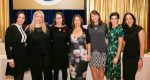
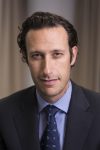
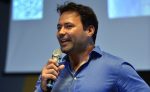
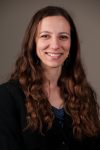
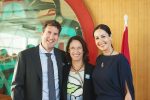
Left to right are Megan Laskin, Sherri Wise, Karen James, Jane Stoller, Jeannie Smith, Alyssa Schottland-Bauman and Sharon Goldman. (photo from Jewish Federation)
For the past 14 years, the Jewish Federation of Greater Vancouver has organized a women’s philanthropy event called Choices. The evening is meant to inspire women to understand the power of their tzedakah and to feel part of the community. On Sunday, Nov. 4, in Congregation Beth Israel’s Gales Family Ballroom, the informal consensus in the room of more than 500 women was that Choices exceeded its objectives.
One of this year’s achievements, according to event co-chair Jane Stoller, was that there were 50 first-time attendees. Stoller explained that a table of Hillel BC students had been sponsored and there were new faces from Federation’s young adult program, Axis, in the crowd. In addition, she said a record number of Israeli women were among the new attendees.
As for the featured speakers this year, both not only spoke movingly, but they also tied in Federation as an important component of their respective stories.
Sherri Wise is a dentist who lives and works in Vancouver. She survived a triple bombing on Ben Yehuda Street in Jerusalem on Sept. 4, 1997.
Wise described the sequence of events that led her to be at a café on a beautiful sunny day and what transpired after three Palestinian terrorists each blew themselves up in the immediate vicinity. Wise was seriously injured, with more than 100 nails embedded in her limbs and second- and third-degree burns on many areas of her body. After recounting the details of this tragedy, Wise was able to focus on some of the positives that arose from the horror. “Someone from Jewish Federation in Vancouver contacted Federation in Jerusalem and a kind woman named Trudy came every day to visit me.… I never even learned her last name,” she said.
Wise said she has managed to get on with her life not only with the help of her parents and the Jewish community, but also by making a decision not to harbour anger or hatred toward those who injured her, killed seven and injured 200 others. “Those men were born innocent babies and they were taught to hate – what chance did they have?”
Wise has since helped craft, advocate for and see enacted the Justice for Victims of Terrorism Act. This bill includes deterrents to those who would support terrorist organizations financially and materially, and grants rights to Canadian victims of terrorism. Wise imparted a message of healing, gratitude and finding a way to make a positive difference.
Jeannie Smith, the daughter of Irene Gut Opdyke, was the second speaker. Opdyke, who passed away in 2003, saved the lives of 12 Jews in Poland during the Holocaust and was recognized by the Israeli Holocaust Commission as one of the Righteous Among the Nations. Smith recounted many details of her mother’s story to a captivated crowd.
At the age of 17, Gut was forced to work in, among other places, the home of a high-ranking German officer stationed in Poland near her hometown. Prior to “keeping house” for this officer, she had worked in a laundry facility at a German officer’s camp. When she learned that she would be relocated to a villa in the town and that the Jews of that town would be liquidated, she managed to smuggle the group of Jews she had worked with in the camp’s laundry into the basement of the villa.
Eventually, the officer discovered the hidden Jews but, for a variety of reasons – none of them altruistic – he did not turn them in. As the Soviets approached and the Germans fled Poland, the 12 Jews, one of whom was pregnant, fled to the forest and joined the partisans.
There are many more twists and turns to Gut Opdyke’s story, but she ended up in California, where she married an American man who was the only person in the United States who knew anything about her painful and heroic past. Gut Opdyke was moved to begin speaking about her experiences only after she received a random call from a Holocaust denier. For the rest of her life, she was a Holocaust educator who shared the story her daughter, Smith, shared with the women at Choices.
Smith expressed gratitude toward the Jewish Federation of Portland because they paid for her father to live out his life in the Jewish seniors home once he developed Alzheimer’s. Commenting about Federation, she said, “One person can make a difference, and an organization can make a mighty difference.” She concluded with what she said her mother used to end her speeches with as well: “Every day we have an opportunity to be kind, to stand up for what is right and to go against what is wrong. We can be the difference in someone’s life.”
Both Wise and Smith received standing ovations for their heartfelt stories of love and resilience.
Leanne Hazon was one of the first-time attendees at the event. Having lived in Toronto for the last 18 years, the Richmond native returned to Metro Vancouver earlier this year for work.
“I thought the whole event was amazing!” she said. “It had such a nice vibe and feeling of community, very warm and welcoming. And the speakers were exceptional…. Sherri Wise’s message of forgiveness was so powerful and Jeannie Smith’s story about her mom was very moving.”
For more information on Jewish Federation and its annual campaign, visit jewishvancouver.com.
Michelle Dodekis a freelance writer living in Vancouver.
Dr. Jonathon Leipsic (photo from Jewish Federation of Greater Vancouver)
When Jonathon Leipsic decided to take on the role of campaign chair for the Jewish Federation of Greater Vancouver this year, it was not because he had too much free time on his hands.
Leipsic is a physician and practising radiologist, with a focus on heart and lung imaging. He holds a number of positions, including being a professor of radiology and cardiology at the University of British Columbia, vice-chair of research for the UBC department of radiology, chair of the department of radiology for Providence Health Care and regional department head of medical imaging of Vancouver Coastal Health. He has published extensively and is the editor of two textbooks; he also speaks internationally on cardiopulmonary imaging.
“I decided to take on this role as campaign chair for a number of reasons,” Leipsic told the Independent. “I am deeply grateful and proud to be part of this incredible Jewish community and am driven to contribute to making it and all of Klal Israel stronger. I have served as board chair at Vancouver Talmud Torah, and currently serve on the board there and at Schara Tzedeck and King David High School.
“The Federation annual campaign leadership, for me, is a tremendous honour and privilege, enabling me to work with such a great team and a group of volunteers with the goal of supporting, nurturing and strengthening our community.”
For Leipsic, Jewish peoplehood and the continuity of the community and Jewish traditions are paramount. He hopes that his passion and commitment will be clear to community members, and that they will share in his vision of further building the community and ensuring that Jewish life is accessible to all who desire it.
“I want to express my gratitude to the entire community for their support and commitment,” said Leipsic. “I feel blessed to be part of a community filled with so many exceptional people and institutions, and I will work tirelessly throughout this campaign to help make it even stronger.
“The community and Am Israel are incredibly important to me, and both Karly and I will continue to volunteer and donate to the greatest extent possible to ensure that our children and, God-willing, our grandchildren, will share in the same blessings we have – to live in a strong Jewish community filled with love and strong institutions, and with a strong and prospering state of Israel.”
Leipsic praised the annual campaign volunteers. “There are nearly 300 volunteer canvassers who take time out of their busy lives to make calls and meet with donors about their gifts,” he said. “They are busy making those calls right now and I want to thank them.
“I also want to thank all of our donors for answering those calls, for meeting with their canvassers and for fulfilling the mitzvah of tzedakah.
“Thank you for supporting the community through the annual campaign. You are helping families struggling with the high cost of living to fully participate in Jewish community life. And, you’re bringing Jewish programs to members of our community who live beyond Vancouver’s city limits – from the Fraser Valley to the Sea-to-Sky corridor. Todah rabah.”
For information about and to donate to the Federation annual campaign, visit jewishvancouver.com.
Smack in the middle of the Days of Awe, hundreds of members of our community came together for an inspiring, entertaining and occasionally emotional evening celebrating unity and inclusion.
The opening event of the 2018 Jewish Federation of Greater Vancouver annual campaign Sunday night once again took the form of FEDtalks, four presentations from individuals with starkly divergent life experiences.
Zoya Schvartzman, whose career now is devoted to improving the lives of individual Jews in Europe and revivifying once nearly obliterated Jewish communities there through her work with the Joint Distribution Committee, talked about how a comparatively simple gesture by the Vancouver Jewish community, when she and her single mother lived here several years back, was a testament to paying it forward. By providing a family in need with a small hand up, probably nobody involved at the time imagined that a kind word and a bag of groceries, including a jar of chocolate spread, would inspire a young woman to positively change the lives of some of the most marginalized Jews in the contemporary world.
Arik Zeevi, an Israeli judo Olympian, talked about the importance of setting goals that seem to exceed our grasp as a means of self-improvement and collective advancement.
Pamela Schuller, a disability activist and stand-up comedian, spoke of how Tourette syndrome went from being her defining characteristic to becoming an integral, appreciated and complementary component of her complex identity. Her endearing and humorous presentation encouraged everyone to look at perceived disabilities as unanticipated gifts.
Rabbi Irwin Kula, in an intellectually packed tour de force, spoke of Judaism’s ability to transform itself, saying that the first Jews of Vancouver would not recognize the Judaism of today and that our descendants a century hence will not recognize our Judaism – and that this is a sign of constructive adaptivity.
The four speakers offered very different perspectives, which, together, reminded all of us at the Vancouver Playhouse that unity and diversity are complementary and not exclusive.
Everyone in the audience certainly left with a lot think about. However, standouts as we reflected afterwards included the idea that, while Judaism treasures tradition, its millennia of continuity is due at least in part to a willingness to break existing paradigms and make room for new ways of being and thinking, as well as fresh voices, being inclusive of multiple identities and ensuring that successive generations are welcomed and included even – perhaps especially – when they challenge the way things have always been done.
Also underlying much of the evening was the concept that our actions have powerful ripple effects that we cannot forecast. Small actions – teaching judo to a 7-year-old, standing up for a classmate with a disability, reaching out to members of the community in their times of need – can lead to life-altering consequences.
Underscoring these messages were words from leaders of our local Federation and campaign, including Federation board chair Karen James, past chair Stephen Gaerber, women’s philanthropy chair Megan Laskin, chair of this year’s campaign Jonathon Leipsic, and Federation chief executive officer Ezra Shanken, all of whom, in particular ways, reminded attendees of the obligation and privilege of participating in a collective movement that changes lives in British Columbia, Israel and around the world.
Leipsic singled out members of his generation, pleading that they maintain and expand upon the institutions and infrastructure that previous generations built for us. He made special note of Charles Diamond, whose funeral had taken place earlier that day. Diamond’s parents were among our community’s pioneers and the Diamond family, through generations, have been role models of the involvement needed for a community to thrive.
In these days of introspection, teshuvah and transcendence, FEDtalks proved a perfect opportunity to come together, reflect, celebrate, think big and rededicate ourselves to making positive contributions individually and collectively.
Israeli judo master Arik Zeevi will speak at FEDtalks Sept. 16. (photo from JFGV)
When we’re faced with a challenge, most of us are naturally cautious. But, says Israeli judo master Arik Zeevi, if you have a passion for something, go for it, explore it and, even if you fail, “you will always be proud that you took the challenge.”
Zeevi, who will be one of four keynote speakers at this year’s FEDtalks Sept. 16, advises in a 2014 TED Talk, “Go for the challenge because, I personally think that, by taking a challenge, that is the best way to grow, to improve your life.”
In that TED Talk, Zeevi shares the story of his experience at the 2001 World Judo Championship. Having trained intensely for two years and becoming a national hero in Israel – and with his journey to the championship being filmed by a team of videographers – Zeevi was “knocked out” (in judo terms, his opponent “threw [him] by ippon”) two minutes after setting foot in the ring.
Undaunted by losing the world championship match, Zeevi, a lightweight, registered to fight in the open match in which fighters of any weight could spar. Friends and colleagues warned him to back out, and the Israeli media fretted over what injuries he might sustain. But, Zeevi beat one opponent, a second, then a third; the fourth knocked him down. Though he failed to win the gold medal, he took the silver – and set a precedent. In the years that followed, having witnessed Zeevi’s success, more and more lightweights competed in the open category, and also won medals. The match morphed into its own championship event.
Zeevi won many judo medals in his time, and he is the 2000, 2003, 2004 and 2012 European champion. He is currently ranked eighth in the world, though he retired from fighting in 2012. Today, Zeevi is an inspirational speaker whose main income comes from talking to companies about what he calls “the similar worlds of sports and business.”
“It is all related,” he told the Jewish Independent, “excellence in sport and excellence in life.”
Zeevi also heads the nonprofit Israeli Foundation for Olympic Excellence (IFOE), which hires and funds Olympic coaches who identify, support and train Israeli children and youth they hope have Olympic potential.
“We scout kids who have talent, we try to nurture them and connect them to the sport that is right for them,” said Zeevi. “You could be Michael Phelps, but unless you’re living next to a swimming pool, you’ll never know.
“The biggest problem in Israeli sport,” he said, “is that all sports are coached by amateurs in private clubs. The coaches are getting income according to the numbers of kids, putting quantity over quality. Professional coaching is rare.”
Zeevi grew up in a tough neighbourhood in Bnei Brak and knows what it is like to have few opportunities.
“My coach was very young, and he was like an older brother to me,” said Zeevi. The coach played a role for Zeevi that he is now trying to play for others. “He pushed me to discover myself,” explained Zeevi. “Around 12, I became very serious. Before that, I was just trying to be part of something. At 12, I got my first invitation to train on the national team. My coach was a Soviet Georgian guy – they are fighters, warriors. By 13 or 14, I was already very big, and he pushed me to fight bigger guys. When 15, I won the championship against seniors over 21. He did a great thing for me, pushing me like that. When you find an athlete, you have to challenge them.”
It is the appreciation for what sports did for him that motivates Zeevi to make high-level training available to more young people. “I really believe in sports as education,” he said. “It is the best way to stimulate mental skills, and it teaches you how to deal with stress, failure, difficulty.”
Zeevi himself has three children. His daughter won the Israeli championship in gymnastics, and his middle son is into basketball and judo. Zeevi said his son has also taught him the lesson that sometimes pushing is not what brings success. “The more I push him forward, the more he goes backward,” he said, “so I have to take a gentler approach. The most important thing is just to be there for them. Then they will succeed.”
While in Canada, Zeevi will also be visiting a judo club in Toronto, which is run by an Israeli friend from his training days. There, he will be giving a master class for advanced fighters before he returns to Israel for Yom Kippur.
FEDtalks, which launches the Jewish Federation of Greater Vancouver’s annual campaign, is being held this year on Sept. 16, 7 p.m., at the Vancouver Playhouse. For tickets and more information, visit jewishvancouver.com.
Matthew Gindin is a freelance journalist, writer and lecturer. He is Pacific correspondent for the CJN, writes regularly for the Forward, Tricycle and the Wisdom Daily, and has been published in Sojourners, Religion Dispatches and elsewhere. He can be found on Medium and Twitter.
The JDC’s Zoya Shvartzman is part of the FEDtalks lineup Sept. 16. (photo from JFGV)
In returning to Vancouver, Zoya Shvartzman is retracing the route that has seen the Moldova-born woman help “write the next chapter of the history of European Jewry.”
Those words, while spoken by Shvartzman, are not about herself – she was crediting North Americans and others who support the American Jewish Joint Distribution Committee (JDC) with helping revivify communities that were almost annihilated under Nazism and then suppressed by communism. But the work Shvartzman does in her role at the JDC means she could rightly claim to be among a number of authors altering the future for Jews in Europe.
Shvartzman and her parents made aliyah from the East European nation when she was 8 years old. At 15, she and her mother migrated to Vancouver. Here, the family had some hard times and they turned to the Jewish community.
“The Jewish community welcomed us with open arms and gave us almost a second home,” she recalled recently in a phone interview with the Independent. “It was a very, very fond memory of my time there and it has a lot to do with the Jewish community that became our family.” She will speak about this time when she presents as one of four speakers at FEDtalks, the opening event of the 2018 Jewish Federation of Greater Vancouver annual campaign, Sept. 16.
Shvartzman chose to pursue a degree in international development studies and political science at McGill University and so, after four years on the West Coast, she and her mother decamped for Montreal.
“After that, I decided to move to Budapest to pursue my master’s in political science because I was focusing on Eastern European politics and transitions from communism to democracy,” she said. “Because I’m from that part of the world, it made sense to go back and be there, be where it’s taking place.”
She completed her studies at Central European University, which was founded and funded by the democracy philanthropist George Soros, and, after graduation, worked for the Canadian embassy in Budapest. In 2007, she was offered a position at the JDC, where she is now director of strategic partnerships.
Shvartzman’s role is to identify on-the-ground needs of Jewish communities in Europe and convey those needs to potential funders, primarily in North America. Federations, foundations and philanthropists then contribute to help the JDC complete its projects.
“In Europe, basically, our main mission is that we build resilient communities,” she said. “We help build communities where they were shattered after the Holocaust and after communist regimes.
“In Eastern and Central Europe, we help poor Jews with basic services like food and medicine and winter relief, help to pay their utilities,” she explained. “Most of the elderly are Holocaust survivors. We work extensively with Holocaust survivors together with the Claims Conference funding. In the last 10 years or so, we developed services for children and families, modeled on the JFS [Jewish Family Services] model that you’re familiar with in Canada and the U.S., addressing the needs of poor children and families.”
Examples of projects that the JDC has spearheaded or supported include a Jewish community centre in Warsaw and a summer camp in Hungary, where children from 25 countries come to strengthen – or, in some cases, learn about for the first time – their Jewish identity. But the work is not limited to Eastern and Central Europe.
In France, the JDC has opened a “resilience centre,” to help Jewish schools, social workers, teachers, children and families respond to threats experienced by Jews in the country. Several acts of anti-Jewish terror in recent years in France have compounded existing anxieties about the security of its Jewish population and institutions.
The decade-plus that Shvartzman has been with the JDC has been a time of challenge for Jews and others across the continent.
“Especially the last four or five years have been particularly tumultuous for Jews in Europe,” she said. “There are different threats – external, internal threats. We see communities that have nearly collapsed, like the community in Greece, in terms of the economic crisis that really, really shattered it.”
In addition to the generalized economic challenges experienced by people in many countries, Jews have faced particular difficulties. Rising antisemitism and political extremism in places like Hungary and Poland have stoked once-dormant apprehensions.
Even so, Shvartzman is bullish about Jewish life in Europe and plans to share her enthusiasm with Vancouverites.
“There are many causes for optimism,” she said. “When you look at the revival of Jewish life in Europe and how these communities have gone from survival to really thriving Jewish communities, I think that’s a big cause of optimism.
“This is quite remarkable when you consider the history and some of the deep, deep traumas that this community has suffered and, today, Jews are reclaiming their heritage and are proud to be Jewish,” she continued. “All of this gives us great causes of optimism that Jewish life in Europe is thriving.”
Shvartzman’s Moldovan childhood and her current work both reflect and embody the JDC’s mission to save and build Jewish lives, said Michael Geller, the JDC’s North American director of communications.
“In her professional life and her personal life and in her life’s journey, she understands quite deeply the importance, the critical importance, of the work we do every day to ensure that needy Jews have the basic needs to continue to live their lives and, in addition, to have a strong Jewish identity, one that is their own, that they make themselves, and one that we help strengthen and empower through the kind of work that we do,” he said.
Returning to the theme of writing the next chapter of European Jewish history, Shvartzman credits overseas allies with making possible all of the achievements she and the JDC have realized.
“It’s only possible because of the support of the North American communities, North American Jewry, that chose to invest in that part of the world over the past 20, 25 years,” she said. “If I had to underline one message, it would be that: North American Jewry helping to write the next chapter of the history of European Jewry.”
FEDtalks features keynote speakers Rabbi Irwin Kula, Pamela Schuller, Arik Zeevi and Zoya Shvartzman. The event takes place at the Vancouver Playhouse on Sept. 16, 7 p.m. Tickets ($36) are available from jewishvancouver.com.
Pamela Schuller will share her story at FEDtalks Sept. 16. (photo from JFGV)
On Sept .16 at Vancouver Playhouse, as part of FEDtalks, Pamela Schuller, an internationally known disability and mental health advocate and professional stand-up comedian, will share her story. Her aim? To inspire attendees to remember and cherish what makes them unique.
Schuller divides her time between being running a Jewish teen mental health initiative in New York City and traveling the world, using her own experiences to discuss inclusion and the importance of embracing differences and disabilities.
“I tell my story of growing up with a severe case of Tourette syndrome (TS) and obsessive compulsive disorder (OCD) … and how, over time, I learned how to be more than OK with those things,” said Schuller. “I learned to love them and embrace them, and found that they add positive, incredible things to my life when I allow them to.”
According to the website tourette.ca, TS is “a neurodevelopmental or brain-based condition that causes people who have it to make involuntary sounds and movements called tics.” And, according to the Canadian Mental Health Association (cmha.ca), OCD is “a mental illness … made up of two parts – obsessions and compulsions. People may experience obsessions, compulsions or both, and they cause a lot of distress.”
Growing up in America’s Midwest, Schuller felt she stood out as the oddball kid with TS. Her mom had a hard time raising her. And, as her mom struggled, so did Schuller – dealing with having TS, as well as with numerous trips to the hospital for broken bones and depression. It took a boarding school environment for Schuller to be able to come out of her shell.
“I’d always felt like I was something my community had to work through, that I was a nuisance,” Schuller told the Independent. “But, at this boarding school … well, I’m not going to tell the whole story … I’ll save that for when I’m in Vancouver. But, I can tell you that the school knew that, if I was going to pull myself out of this space of feeling worthless, I’d need to have something about myself that I loved. So, their goal was to help me find one thing about myself that I loved. And we used that to catapult me into realizing that the one thing I love about myself translates into other areas of my life. And that, maybe, I don’t love this thing despite TS, but maybe, in actuality, TS adds to this thing that I love.”
Schuller speaks openly about being depressed before experiencing this mental shift, and of not having wanted to be a part of this world.
“To be honest, I think it’s a journey that doesn’t stop,” she said. “I still have days where it feels like having TS is bad, embarrassing or painful. And I have to remind myself that it’s OK and that there are still things I love about myself … and that, a lot of them, I learned because of TS.
“The first thing I learned that I love about myself was my sense of humour. But, it took some time to channel that sense of humour from snarky and sarcastic … to a more channeled sense of humour.
“Then, over time, I started talking seriously, not using humour, about what it means to love differences, to love the most challenging thing about yourself, the thing you struggle with the most.
“A few years ago, I realized that stand-up and talking about disabilities don’t have to be separate. So, I combined them into a talk, with humour and storytelling.”
A few years ago, Schuller earned a master’s degree in child advocacy and policy, with an emphasis on creating inclusive communities.
She believes that much of celebrating differences is about believing it is possible – that, whatever you bring to a community, you can be a part of that community.
Stand-up comedy serves as a sort of therapy for Schuller. “When I’m on stage, it’s not that my TS calms down … but, even on a tough day, I’m reminded that I love my brain,” she said. “And my brain allows me to do stand-up and have TS.
“That reminder allows me to see other things about me that I love. I think I’ve always seen the world from a different point of view, in part, because of TS. Comedy allows me to point those things out and, in a way, speak without being judged.”
Schuller encourages people to find the one thing that makes them incredible and unique.
As far as what people can expect to get out of her talk, Schuller said, “It doesn’t matter if you have a disability or not, the message is pretty universal. So, you can expect to laugh, to think about things and, maybe, sometimes, to cry, because feelings come up.
“Some of these conversations are tough. We’re all afraid of what we don’t know or maybe we don’t feel so great about ourselves or what we bring into this world. I think, by pairing humour with some of these messages and storytelling, it makes people think – about themselves and how they treat others, how they treat people in their community and what their community is doing.
“I walk into teen communities and I have everyone laughing and thinking,” she said. “And, when I finish, the teens line up to talk to me, share with me or ask questions. So, I think that my goal is to not be preachy, but to be a conversation starter.
“Typically, when communities bring me, they’ll have me perform for everyone. Then, I’ll do workshops, classes and programs. I’ve been working with communities around being inclusive for years, professionally, sharing ideas and talking about the tension points in your community around inclusion and how can we come up with some ideas that might help that.”
Schuller and her family have realized that, sometimes, the things they struggle with the most can also be their greatest strengths.
“It doesn’t mean I don’t still end up in the hospital from broken bones, from TS, but, even in those tough moments, as a family, we’re able to find humour … and to find those moments where, we’re like, ‘OK, this is so amazing … how cool that we’re learning this, doing this or experiencing this.’”
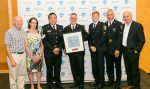
This year, Jewish Federation honoured, for the first time, an organization outside of the Jewish community. The inaugural recipient of the honour was the Vancouver Police Department.
***
At its annual general meeting June 19, the Jewish Federation of Greater Vancouver honoured four volunteers: Alex Cristall, Judi Korbin, Judith Cohen and Courtney Cohen. It also honoured, for the first time, an organization outside of the Jewish community – the Vancouver Police Department.
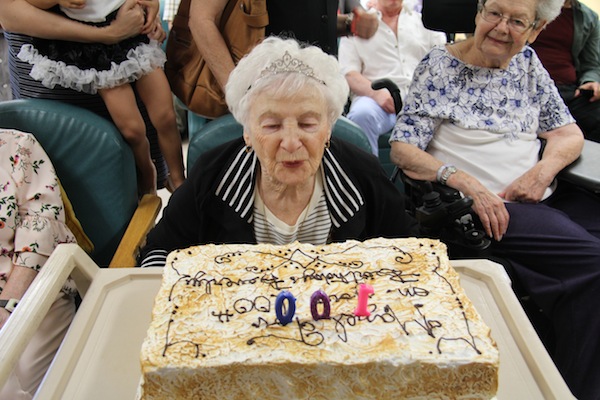
On June 18, L’Chaim Adult Day Centre celebrated its first 100th birthday, with program participant Beverly Klein.
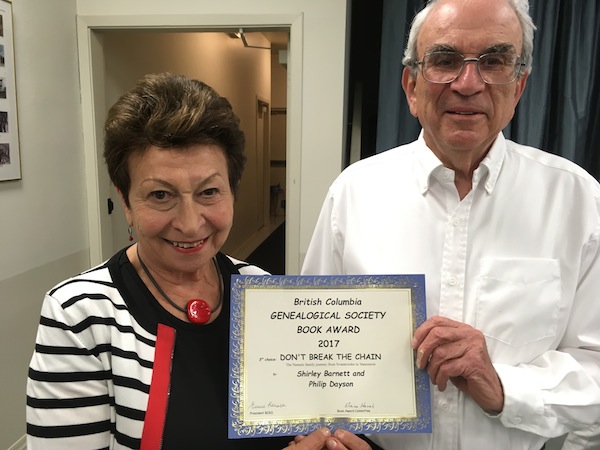
On the evening of June 13, siblings Shirley Barnett and Philip Dayson were honoured with the B.C. Genealogical Society Book Award.
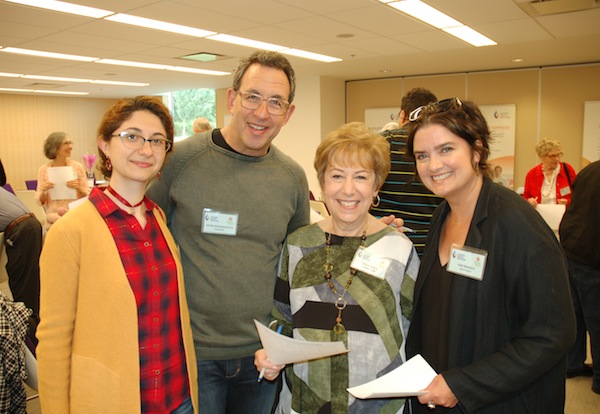
On the evening of June 5, Jewish Family Services held its first annual Volunteer Appreciation Event, celebrating the dedicated volunteers of JFS and the Better at Home program.
Louis Brier Home and Hospital has successfully achieved accreditation with exemplary standing from Accreditation Canada.
Among the B.C. Civil Liberties Association’s Liberty Award winners on May 17 were Ken Klonsky, for excellence in the arts, and Peter Klein, for excellence in journalism.
***
At its annual general meeting June 19, the Jewish Federation of Greater Vancouver honoured four volunteers.
Alex Cristall was presented with the Harry Woogman Award, which recognizes a volunteer who leads consistently and conscientiously by example and has long-standing and diligent campaign involvement. Cristall is the outgoing annual campaign chair. His dedication and commitment to leadership excellence has made an enormous impact on Federation and the community as a whole.
Judi Korbin was given the Arthur Fouks Award, which honours leaders who demonstrate dedication to the goals and principles of Jewish Federation and who provide outstanding leadership to the annual campaign. Korbin is the outgoing chair of Federation’s endowment program, the Jewish Community Foundation, and is a past chair of the annual campaign.
The Kipnis-Wilson/Friedland Award went to Judith Cohen. As a past volunteer chair of women’s philanthropy, Cohen is no stranger to philanthropic work. She draws the inspiration for her community involvement from having grown up seeing her parents “pour their time and energies into the Jewish community.” She received the Kipnis-Wilson/Friedland Award from Jewish Federations of North America for demonstrating the highest ideals of leadership and involvement.
The Young Leadership Award was presented to Courtney Cohen for her extensive volunteer work with many Jewish organizations around Greater Vancouver. Just two examples among many are her involvement in Federation’s Axis program for young Jewish adults as the co-chair of the leadership development pillar, and her founding of Rose’s Angels, a care-package project created to honour her grandmother.
This year, Jewish Federation also honoured, for the first time, an organization outside of the Jewish community, with the first recipient of the honour being the Vancouver Police Department.
“Our Federation has had a long and valued relationship with the department and our staff have been able to count on their assistance and intervention during crisis situations and high-profile events attracting protesters, as well as being willing to provide education and training to our communal professionals on an as-needed basis,” said Bernard Pinsky, chair of Federation’s community security advisory committee, in presenting the award, which was accepted by Deputy Chief Lawrence Rankin on behalf of the VPD.
Pinksy expressed Federation’s “appreciation to constables Ryan Hooper and Dale Quiring for their support over the years,” and said Federation was looking forward “to a continued positive relationship with Constables James Hooper and Jacqueline Abbot.”
In introducing the video created for Federation’s 30th anniversary, board chair Karen James thanked “Jonathan and Heather Berkowitz, whose experience editing the Federation Magazine for many years was invaluable to this project, as well as past Federation president Sondi Green, whose father, Arthur Fouks, was a founder of our Federation, and Al Szajman, chair of our marketing and communications resource group for their work on this project.”
***
On June 18, L’Chaim Adult Day Centre threw a party for Beverly Klein’s 100th birthday.
On June 18, L’Chaim Adult Day Centre celebrated its first 100th birthday, with program participant Beverly Klein. Four generations of her family, friends, fellow program participants, L’Chaim board members, staff and volunteers, as well as Jewish community leaders, threw a party at L’Chaim to commemorate her reaching this milestone.
Knowing her love of music, she was honoured with the musical talents of Allison Berry, who performed classics from the 1940s. Beverly was delighted to receive congratulations and warm wishes from Prime Minister Justin Trudeau and the Queen’s representative, the governor general of Canada, Julie Payette.
Ezra Shanken, chief executive officer of the Jewish Federation of Greater Vancouver, spoke about Beverly and said that she didn’t look a day over 40, to which she replied, “Hey, I like this guy!”
A much-loved program participant since 2013, the birthday girl was born in Poland near Warsaw in Meserich, and was one of 11 children. A story treasured by her children is Beverly’s childhood memory of preparing for Shabbat by “building a floor” and “doing the stove” – her home’s dirt floors had to be swept and pounded down, and Beverly would pile up the bricks for the oven, which was then whitewashed. Her family immigrated to Canada in 1929 with only the clothes on their backs, which were sewn from potato sacks. During the Second World War, Beverly came to Vancouver to spend time with her sister Ruby, and she met her husband Dave. They married and had two daughters and a wonderful life together.
Beverly continues to live in her own home because of the love and devotion of her family. The Turnbulls – Wendy, husband Steve and boys Ryan and Gavin – and the Blonds – Arlene, husband Les and children Amanda and Ben – are all devoted to their mom and bubbie.
Both daughters Arlene and Wendy gave heartfelt speeches at the birthday party. Arlene said, “It’s very reassuring to families to know that their loved ones have a safe place to go where they are not only stimulated but treated like family.” Wendy said, “L’Chaim remembers that older people deserve respect for a lifetime of achievements and all that they are today. The sheer joy with which the staff planned Beverly’s party touched all of us.”
The L’Chaim Adult Day Centre strives to improve the quality of life of its participants by providing a caring and stimulating group experience for those who might otherwise be socially isolated, while also providing support and respite for care-giving families and friends. It is funded in part by Vancouver Coastal Health, Jewish Federation of Greater Vancouver, the Jewish Community Centre of Greater Vancouver and private donations from the larger community.
***
Shirley Barnett and Philip Dayson
On the evening of June 13, siblings Shirley Barnett and Philip Dayson were honoured with the B.C. Genealogical Society Book Award. Barnett and Dayson were recognized for their book Don’t Break the Chain, which describes the journey of Abraham and Toba Nemetz from Svatatroiske in Ukraine to Vancouver and points in between.
Fleeing from pogroms in 1922, Abraham and Toba began a new life in Canada. One of the pages in Don’t Break the Chain outlines how their family of nine children grew into 196 descendants. Family trees and portraits – both individual and group – are part of a fascinating picture of a family whose lives became an important part of both the Jewish and general communities of Vancouver.
In her acceptance of the award, Barnett said that, while researching the book, numerous family members (known and previously unknown) were reached with 100% cooperation from all of them in helping to compile information for the book. The title comes from Ben Dayson, Barnett and Dayson’s father. Although he married into the family, because of his belief in the value of family ties, Ben Dayson often “ended his conversations and speeches with the sentence, ‘don’t break the chain.’”
Barnett thanked the Jewish Museum and Archives of British Columbia for their support and rich accumulation of archival material. For more information, interested readers may access nemetzfamily.ca or the Jewish Museum at jewishmuseum.ca.
Congratulations to Shirley Barnett and Philip Dayson for being honoured by the B.C. Genealogical Society, who recognized the positive impact of their family and this book on the history and development of our province.
***
Left to right are Mariam Harutyunyan, Dr. Mark Rosengarten, Linda Glick and Kim Branch. Harutyunyan and Branch are Better at Home volunteers. Rosengarten and Glick are JFS volunteers.
On the evening of June 5, Jewish Family Services hosted more than 70 people at its first annual Volunteer Appreciation Event. It was a wonderful opportunity to celebrate the dedicated volunteers of JFS and the Better at Home program, a government-funded service for seniors managed by United Way and administered by JFS. The guest speaker, Dr. Rotem Regev, presented on the value of human connection, empathy and the power of giving back.
Richard Fruchter, chief executive officer of JFS, spoke about the commitment of volunteers to the agency, describing “volunteers as the life-blood of JFS.” It was volunteers, he said, who founded the Jewish Family Welfare Bureau of Vancouver (JFS’s original name) when it opened more than 80 years ago to assist the poor and elderly living in Vancouver, and to help resettle new immigrants fleeing antisemitism in Europe.
“Your commitment to uplifting lives, for our clients and community, is an example for us all,” Fruchter said. “By stepping up to help, offering your time, skills and resources, you are the reason we can meet more of the needs in our community and accomplish the work that we do.”
There are more than 170 people who volunteer regularly through JFS and Better at Home, and some have been serving for more than 15 years. JFS’s youngest volunteers are in grades 7 and 8 from Vancouver Talmud Torah and King David High School who help regularly at the Jewish Food Bank.
JFS volunteers are responsible for a wide range of work. They support the Jewish Food Bank at the Peretz Centre; seniors lunches and outreach services, such as grocery shopping, visiting and driving to and from appointments; English-language practice for newcomers to Canada; interviewing skills for job seekers; mental health outreach; and administrative support in the office. Chanukah helpers, Passover hampers, Rosh Hashanah activities and Project Isaiah are all programs that rely almost entirely on volunteers. For many individuals and families, these Jewish holiday programs are the only connections they have with their Jewish heritage.
For more information on volunteering with JFS, contact Ayana Honig at ahonig@jfsvancouver.ca or call 604-226-5151.
***
Louis Brier Home and Hospital has successfully achieved accreditation with exemplary standing from Accreditation Canada.
Accreditation Canada is an independent, not-for-profit organization that sets standards for quality and safety in health care and accredits health organizations in Canada and around the world. Louis Brier Home and Hospital voluntarily participated in accreditation because it believes that quality and safety matter to residents and their families/significant others. Improving the quality of care is a continuous journey – a journey to which Louis Brier is fully committed.
As part of the Qmentum program, the home and hospital has undergone a rigorous evaluation process. Following a comprehensive self-assessment, external peer surveyors conducted an on-site survey during which they assessed the organization’s leadership, governance, clinical programs and services against Accreditation Canada requirements for quality and safety. These requirements include national standards of excellence; required safety practices to reduce potential harm; and questionnaires to assess the work environment, resident safety culture, governance functioning and client experience. Results from all these components were considered in the accreditation decision.
The accreditation survey team spent four days at Louis Brier, and reviewed a total of 19 required organizational practices (ROPs), 216 high priority criteria and 295 other criteria for a total of 551 criteria. The accreditation surveyors determined that the Louis Brier successfully met 100% of the ROPs and 100% of the criteria evaluated.
“I am very proud of everyone at Louis Brier Home and Hospital,” said Dr. David Keselman, chief executive officer. “Our staff worked and continue to work incredibly hard to make sure we meet the needs of our residents in every possible way, helping them and their loved ones maintain optimal health status, control and dignity every day, every time. Receiving exemplary standing from Accreditation Canada is a real testament to the changing culture and focus at Louis Brier Home and Hospital. Accreditation Canada standards and requirements will continue to guide us into the future as we continue to evolve and continuously improve our practices and care delivery efforts.”
He added, “I will, of course, be remiss if I do not mention the ongoing support and generosity of the LBHH and WR [Weinberg Residence] and the [Louis Brier Jewish Aged] foundation boards, without whom this journey may not have been as smooth or possible.”
***
The B.C. Civil Liberties Association’s Liberty Awards recognize outstanding achievements to protect and promote human rights and freedoms in Canada. Among the 2018 award winners were Ken Klonsky, for excellence in the arts, and Peter Klein, for excellence in journalism.
Klonsky, co-author of Dr. Rubin Carter’s Eye of the Hurricane, is a former Toronto teacher and writer now living in Vancouver. He is a director of Innocence International, the organization conceived by Carter to help free wrongly convicted prisoners worldwide. His artistic works call readers to action to defend civil liberties and improve the justice system. His art and advocacy on behalf of those who have been wrongfully convicted has contributed greatly to the advancement of human rights in Canada and internationally.
Klein is a journalist, writer and documentary filmmaker. He has been a producer for the CBS newsmagazine 60 Minutes since 1999, produces video projects for the New York Times and writes columns regularly for the Globe and Mail. He is the founder of the Global Reporting Centre, a nonprofit organization dedicated to reporting on neglected global issues and innovating the practice of global journalism. His record of groundbreaking broadcast journalism exposing human rights abuses around the world deserves to be celebrated. His efforts are empowering the next generation to continue to hold the powerful to account.
The other 2018 Liberty Awards were Miranda Hlady (youth or community activism), Stockwoods LLP (legal advocacy, group) and Dr. Pamela Palmater (legal advocacy, individual). Hassan Diab, Rania Tfaily and Don Bayne, on behalf of the Hassan Diab Support Committee, were recognized with the Reg Robson Award, which is given annually to honour substantial contributions to the cause of civil liberties in British Columbia and Canada.
Alex Cristall, chair of the 2017 Jewish Federation of Greater Vancouver annual campaign, with Federation board chair Karen James, centre, and Megan Laskin, women’s philanthropy chair. (photo from JFGV)
The Jewish Federation of Greater Vancouver annual campaign surpassed its 2017 goal and generated $8.7 million to meet community needs, including $850,000 in targeted funding. An additional $1.1 million in funding was generated outside the campaign for specific projects. Nearly 500 new or lapsed donors were inspired to give for the first time or to renew their giving, which is a record.
As the local community’s primary fundraising initiative, the annual campaign supports programs and services delivered by 35 partners locally and globally, reaching thousands of community members who rely on them.
Targeted funding supports specific programs that address particular community priorities. Many steadfast supporters of the campaign have the capacity and motivation to fund such projects or programs and Federation works with these donors to connect them to the priorities that align with their philanthropic interests.
Exceeding the campaign goal and growing the donor base positions Federation and its partners to continue to address the many needs identified in Federation’s 2020 Strategic Priorities. It’s a clear indication that partner agencies can continue to rely on the campaign as a consistent source of ongoing funding.
“The strong campaign achievement means we can make an impact on the issues of affordability and accessibility of Jewish life, which affect people across our community,” said Alex Cristall, chair of the 2017 Federation annual campaign.
In the emerging Jewish communities outside of Vancouver, Federation is focused on extending its reach and that of its partners to develop grassroots Jewish programming, such as its Connect Me In initiative. In Vancouver, with its very high cost of living, the focus is on keeping the cost of Jewish programs and services low, and on funding more robust subsidies for those who need additional help.
“At its heart, Jewish life is about community, and this year’s campaign reflected that. We could not have achieved this incredible result without the support of our nearly 3,000 donors. I would like to extend a huge thank you to everyone who donated,” said Cristall.
Overall, Federation generated an unprecedented $18.5 million this year. This includes a record $8.7 million in contributions to endowment funds at the Jewish Community Foundation, along with the $8.7 million campaign total and the additional $1.1 million in targeted funding.
“Diversifying the ways in which Jewish Federation generates funds is a key factor in being able to address growing and evolving community needs,” said Karen James, Federation’s board chair. “Jewish Federation is adapting to changing philanthropic trends and working proactively with donors to meet these needs. At the same time, we continue to deliver a strong annual campaign that benefits thousands of people, and that is great news for our community.”
Twenty-three students from Metro Vancouver joined more than 10,000 other students in this year’s March of the Living. They are pictured here with Jewish Federation of Greater Vancouver board chair Karen James, far left, and trip chaperones Susan Siklos, standing to James’ left, and Charlotte Katzen, standing fourth from the right. (photo by Jennifer Freedman)
Twenty-three Grade 11 and 12 students from Metro Vancouver headed to Poland and Israel on the annual March of the Living last month, and nine of those were students from public schools. In the past, Vancouver has sent about 14 students every couple of years. The increased numbers this year were the result of outreach by a volunteer committee headed by Charlotte Katzen.
“March of the Living is a life transforming experience,” she told the Independent. “Every participant will tell you that. It strengthens students’ Jewish identity, their understanding of who they are as Jews in the world today and their commitment to Israel.”
Katzen helped assemble a video in which march alumni, their parents and Holocaust survivors talked about their experience, the impact of the journey on young people and how important it is for them to become a witness. The committee showed the video in open houses at King David High School and at Jewish afterschool programs and other Jewish venues.
“When march alumni tell their friends, ‘You have no idea how impactful this journey is,’ it’s a powerful message and they want to join,” said Katzen about the video.
March of the Living is not an inexpensive venture, so Katzen worked with Jewish Federation of Greater Vancouver to help secure funding for students who couldn’t afford the trip.
“Federation really came through,” she said. “We’ve not yet reached the point of having sufficient funding, but, this year, Federation made a commitment that no child would be turned away. That commitment enabled us to say, during our outreach, ‘Don’t worry about your financial situation. If you want to go, you will go.’”
Federation offset the cost of the trip by $2,000 for each participant using funds raised by the annual campaign. Scholarships were also offered to families that needed them.
Noa Platner, a Grade 12 student at King David, was one of the participants. She described her time in Poland as “very hard, intense in a way I didn’t expect. We’d go to the camps and hear the story of a specific family, which helped us feel really connected,” she reflected. “But it was very hard, and it crushes you on the inside. I realized all the people who went through the Holocaust had their own individual stories. You always hear the number of people, but you don’t think of the emotions they felt.”
For Trevin Kiel, a Grade 11 student at Hugh Boyd Secondary School in Richmond, the march, which was attended by more than 10,000 Jewish students worldwide this year, was an opportunity to get a sense of the scale of the Holocaust. “I wanted to see what 10,000 Jews looked like, to compare it to six million,” he said. The stories of Nazi brutality were hard to absorb, he admitted, “but we debriefed every night as a group, and it felt reassuring to share our feelings with others and know they were feeling the same way.”
Kiel had visited Israel previously with his family, but said this time was much different. “It was the best trip I’ve ever been on, it was just so much fun and such an eye-opening experience.”
The group was in Israel for Yom Hazikaron and Yom Ha’atzmaut.
“I didn’t expect it would be an emotional time but I was more emotional in Israel than at the camps in Poland,” Platner said. “After all we Jews have been through already, to realize we’re still fighting and innocent people are dying was very crushing. But one of our guides told us we should feel proud that we’re still standing, strong enough to fight this time and do the best we can.”
Katzen helped prepare the students before they left Vancouver and participated in the march as well, co-chaperoning this year’s trip with Susan Siklos; Federation board chair Karen James was also part of the group.
“The students bond with each other and become so close by the end of the trip,” Katzen observed. “We grieve and celebrate collectively and we become one big, beautiful, coherent family. This trip changes them profoundly and makes them stronger, more tolerant of others and of each other.”
Being in Israel for Yom Hazikaron was no minor detail of the itinerary. “They realize, on Yom Hazikaron, that having a homeland comes at a very high cost,” said Katzen. “We can celebrate but we have to be aware that our homeland also has very tragic stories.”
A guide on the trip shared with Vancouver students the story of a friend who was ambushed and killed while serving in the military. “It’s one story of thousands,” Katzen said, “but the kids understood how difficult it is for families to put their own children’s lives at such high risk in order for the country to exist. They got it.”
Kiel and Platner both agreed that their participation in March of the Living has changed them in ways they’re only beginning to understand.
“My Jewish identity has changed,” Platner said. “I feel a stronger sense of purpose to follow the traditions and be a part of my community in honour of those who died and are still dying for our nation.”
Kiel said, prior to the march, if non-Jewish friends at school made jokes about Jews or about the Holocaust he would get angry or frustrated. “Now I feel like I can educate people on why it’s wrong to make jokes like that, and make sure they never tell a joke like that again,” he said. “If they knew the scale of the Holocaust, they wouldn’t make jokes.”
He’s returned with a stronger Jewish identity, he added. “I’ve started to wrap tefillin two to three times a week now. It reminds me of the trip and the memories I made there.”
He said, “I know there are lots of other trips that go to Poland, but not like this one.”
Platner agreed. “March of the Living gave me a sense of hope, pride and belonging.”
For information on joining a future March of the Living trip, contact Federation or visit marchoftheliving.org.
Lauren Kramer, an award-winning writer and editor, lives in Richmond. To read her work online, visit laurenkramer.net.
Shlomi Shaban will be joined by Ninet Tayeb (right) at Metro Vancouver’s celebration of Yom Ha’atzmaut on April 18 at the Chan Centre. (photo from Jewish Federation)
Two award-winning veteran musicians, not to mention good and longtime friends, will be headlining our community’s Yom Ha’atzmaut celebration on April 18 at the Chan Centre for the Performing Arts. Tel Aviv’s Shlomi Shaban will be joined by Los Angeles-based Ninet Tayeb.
“I have performed once outside the country on Yom Ha’atzmaut,” Shaban told the Independent. “It was Israel’s 60th anniversary. It was in Stockholm, Sweden. A lot of musicians and myself traveled over there, like Beri Sacharov, Eran Tzur and many others. We had a great show over there. But, beside that, I can’t remember performing outside Israel on Yom Ha’atzmaut, mostly I’m here in Israel, performing across the country or just being with my family, it depends.
“I’ve never been to Canada before, so, naturally, I’m very, very excited,” he said. “I’ve heard a lot of really great things about Vancouver and I’m really looking forward to just hang there, travel around and explore the place, although we’re going to be there for too short [a time] I’m afraid, two days, but I hope to catch as much as I can.
“I remember my friends Jane Bordeaux performing there last year,” he added, “and they came back really excited about the crowd and the place.”
Shaban was born in Tel Aviv and has lived there his whole life, except for a few years, when he was in London, England, to study classical piano. “I’m in love with Tel Aviv,” he said.
Like Tel Aviv, music has always been a part of Shaban’s life.
“I started learning how to play the piano when I was 6 years old,” he said. “I started privately, like a lot of kids. Then I went to a conservatory, and studied there for 10 years. And then, in London … I received an artist’s diploma from the Royal College of Music. I’m very proud of that, though I haven’t looked at that diploma since I got it.
“I always wrote little songs, since I was 10, I think, and always considered that as kind of a hobby, or kind of an intermission – I was practising a lot of piano, five hours a day, six hours a day, and more and more, and I always saw that as kind of a comic relief from practising…. When I was 21, I started thinking, maybe I went the wrong direction, so to speak, and the little hobby that I considered to be a comic relief, might be my main interest, and tried to publish my songs. I was very lucky, I was signed by a major label, here in Israel, of course, and faded away from the classical world, and never went back.”
Shaban now has four albums under his belt, and has won several awards for his work.
“In terms of career highlights,” he said, “I would mention two. As I said, I left the classical world but, five years ago, or six years ago, I was approached by the Israel Philharmonic. They celebrated their 75th year, and they asked me to do a concert of my music, my songs, with the orchestra.
“It was a great closure for me because, when I was 17, I played with the orchestra as a classical pianist with Maestro Zubin Mehta. I was a kid, so, naturally, very excited and very nervous, and now I came back through the main door with my own songs. It was another exciting and, again, nerve-wracking in a way, event for me. I had to practise piano again because I played my own songs and a little classical music we mixed throughout the songs. That was definitely a highlight.
“Nowadays, I’m touring with Chava Alberstein,” he continued. “She’s Israel’s, let’s say, Edith Piaf. I don’t know. She’s Chava Alberstein – she has more than 60 albums. I recorded a song with her four years ago, and asked her to consider touring with me and being her pianist – just me and her, she sings and I play…. We planned to do four or five shows, and now the tour has evolved and it’s sold out, and we are adding more and more shows. I sing only one song during the show, the song that I wrote for her…. It’s a great, great pleasure for me and I learn so much and enjoy so much doing it. So, that’s another big highlight for me.”
Shaban has been inspired by many musicians.
“I’ve covered many artists, Israelis and non-Israelis,” he said. “Mostly, I tend to cover storytelling songs, people like Bob Dylan, Leonard Cohen … I’m going to play a few songs by him in the show.
“I was trained as a classical musician and, when I left it and began hearing popular music, in a weird way, my heart went to very simple music, very text-based music, people, as I say, Dylan and Leonard Cohen, Tom Waits, Lou Reed, all that gang. And, during the years, they have remained my main love and inspiration, but I have listened to a lot of other music – new music, old music, jazz. I love jazz pianists and composers, people like [Thelonious] Monk … Miles Davis, and many, many others. I’m not interested in a specific genre, just getting as much inspiration as I can from different genres. But, as I said, my main interest always was the lyrics, funnily enough, and the story that the song conveys, and that hasn’t changed.”
In terms of his creative evolution, however, Shaban has been focusing more on the music. He described his early composing as “very functional,” something he used mainly to help the story to come across. “Nowadays,” he said, “I’m writing more rich music. I think, in that way, I’m heading backwards to the classical time and thriving on inspiration from all kinds of music, and not just folk music or rock music.”
Ninet Tayeb (photo from Jewish Federation)
Shaban is excited to be performing in Vancouver with Tayeb, who he described as “one of the best singers I have ever heard.” He added, “She’s a great friend of mine, so that’s another bonus, meeting her in Canada – she’s in L.A. now and I rarely see her, so I’m looking forward to that, and meeting you all.”
For her part, Tayeb has recorded five albums and, like Shaban, has been recognized numerous times for her work. Also like Shaban, music has been a lifelong passion.
“Music has been my life ever since I was a little girl,” she told the Independent. “I started writing my own music at the age of 23. To be able to express myself through music is the most amazing gift I could have.”
Tayeb said, “My style is a mixture between Israel, L.A., Berlin and New York, kind of a Middle Eastern rock ’n’ roll with a slight hint of electronic. Music keeps evolving all the time and so do I – thank God! – and, for me, the most important thing is to keep moving forward and keep my mind open.”
It was this drive to continually enrich her knowledge and creative spirit that took her to Los Angeles, she said. She moved there from Tel Aviv.
On Yom Ha’atzmaut, said Tayeb, “The show will be me singing with Shlomi and Shlomi will sing alone, as well. One thing I can promise you – the show will be full of love and true spirit.”
For tickets ($18) to the April 18, 7:30 p.m., concert at the Chan Centre, visit jewishvancouver.com.