Skip to content
  • Home
  • Subscribe / donate
  • Events calendar
  • Business Directory
  • FAQ
  • News
    • Local
    • National
    • Israel
    • World
    • עניין בחדשות
      A roundup of news in Canada and further afield, in Hebrew.
  • Opinion
    • From the JI
    • Op-Ed
  • Arts & Culture
    • Performing Arts
    • Music
    • Books
    • Visual Arts
    • TV & Film
  • Life
    • Celebrating the Holidays
    • Travel
    • The Daily Snooze
      Cartoons by Jacob Samuel
    • Mystery Photo
      Help the JI and JMABC fill in the gaps in our archives.
  • Community Links
    • Organizations, Etc.
    • Other News Sources & Blogs
  • JI Chai Celebration
  • JI@88! video

Recent Posts

  • Legal help for students
  • Revisiting myth of Lilith
  • Wrong person rebuked
  • Canada’s mixed messages
  • Questions for museum
  • Symposium on antizionism
  • Making soccer political
  • CJPAC lauds Pulver’s impact
  • City recognizes Vrba’s legacy  
  • Organ donation saves lives
  • Theodore’s March premiere
  • A healing Shabbaton
  • Supplying healthy food
  • A chime of metal tags
  • Yellowknife seder a first
  • Ishai energizes, unifies
  • A Lag b’Omer to remember
  • Expanding the healing
  • Hannah Senesh – a unique hero
  • Community milestones … May 2026
  • Sharing her testimony
  • Fall fight takes leap forward
  • The balancing of rights
  • Multiple Tony n’ Tina roles
  • Stories of trauma, resilience
  • Celebrate our culture
  • A responsibility to help
  • What wellness means at JCC
  • Together in mourning
  • Downhill after Trump?
  • Birth control even easier now
  • Eco-Sisters mentorship
  • Unexpected discoveries
  • Study’s results hopeful
  • Bad behaviour affects us all
  • Thankful for the police

Archives

Follow @JewishIndie
image - The CJN - Visit Us Banner - 300x600 - 101625

Tag: Jewish Federation

Jessies, Order of Canada, Korczak, Rockowers, Federation & VHEC

Jessies, Order of Canada, Korczak, Rockowers, Federation & VHEC

Warren Kimmel won a Jessie Award for his portrayal of the title character in the Snapshots Collective’s Sweeney Todd: The Demon Barber of Fleet Street. (photo from Snapshots Collective)

The 37th annual Jessie Richardson Theatre Awards were held on July 15 at Bard on the Beach’s BMO Mainstage in Vanier Park. Fifty theatrical productions were nominated from last year’s theatre season.

In the small theatre category, the Snapshots Collective’s Sweeney Todd: The Demon Barber of Fleet Street, which included several Jewish community members in its creative team, garnered eight nominations: director Chris Adams and costume designer Emily Fraser were acknowledged, along with the outstanding performances by Jewish community member Warren Kimmel, Colleen Winton, Oliver Castillo and Jonathan Winsby, and the production as a whole for its quality and innovation. In the end, the show won four Jessies, for the performances of Kimmel, Winton and Castillo, as well as nabbing the award for outstanding musical production.

Jewish community member Itai Erdal won the award for outstanding lighting design category for his work in Arts Club Theatre Company’s The Curious Incident of the Dog in the Night-Time. Erdal was also nominated for his lighting in Théâtre la Seizième’s Le Soulier.

At the July 15 ceremony, community member David Diamond received the Greater Vancouver Professional Theatre Alliance Career Achievement Award.

For more information, visit jessieawards.com.

* * *

On June 27, 2019, Governor General of Canada Julie Payette announced this year’s appointments to the Order of Canada, including, as officers, two local Jewish community members: Gordon Diamond, for “his steadfast leadership in business and for his philanthropic support for causes related to health care, education and social services,” and Dr. Peter Suedfeld, for “his groundbreaking research on the psychological impacts of extreme environments and stressors on human behaviour.”

* * *

On June 18, 2019, at Government House in Victoria, B.C., the Janusz Korczak Medal was awarded to Ted Hughes, OC, and Helen Hughes, OC, while the Janusz Korczak Statuette was awarded to Irwin Elman, the past advocate for children and youth of Ontario. The awards were bestowed in recognition of caring for children in the spirit of Dr. Janusz Korczak.

The ceremony started with welcoming remarks by the event’s host, Lieutenant Governor Janet Austin, and Holocaust survivor and writer Lillian Boraks-Nemetz spoke about Korczak, with a personal touch. The awards were presented jointly by Jennifer Charlesworth, B.C. representative for children and youth, and Jerry Nussbaum, president of the Janusz Korczak Association of Canada. And the event was emceed by Jerymy Brownridge, private secretary to the lieutenant governor and executive director of Government House.

* * *

The Jewish Independent won two American Jewish Press Association Simon Rockower Awards for excellence in Jewish journalism this year (for work published in 2018). The awards were presented at the 38th annual AJPA banquet, held in conjunction with the association’s annual conference in St. Louis, Mo., June 23-26.

Bruce Brown’s “The draft: a dad reflects” – in which he shares his experience of sending his son off to serve in the Israeli Air Force – placed first in the personal essay category for its circulation class.

The JI’s editorial board – Pat Johnson, Basya Laye and Cynthia Ramsay – took second place in the editorial writing category for its circulation group. The submission, which included the editorials “Holocaust education needed,” “Impacts of nation-state” and “What is anti-Zionism?” elicited the following comment from the Rockower judges: “Riveting and well-explained editorials on anti-Zionism, the identity of Israel as a nation-state, and a local controversy involving Holocaust education.”

* * *

photo - Ambassador Nimrod Barkan at Jewish Federation of Greater Vancouver’s annual general meeting on June 18
Ambassador Nimrod Barkan at Jewish Federation of Greater Vancouver’s annual general meeting on June 18. (photo from facebook.com/pg/jewishvancouver)

At Jewish Federation of Greater Vancouver’s annual general meeting on June 18 at King David High School, Federation elected two new directors – Karen Levitt and Melanie Samuels – and the board appointed a new executive. While Karen James has completed her term as board chair, she remains on the board as immediate past chair. Alex Cristall takes over as chair, Penny Gurstein is vice-chair, Bruce Cohen is secretary and Jim Crooks is treasurer.

At the AGM, several honours were bestowed: Stephen Gaerber was the recipient of the Arthur Fouks Award, Megan Laskin the Elaine Charkow Award and Sam Heller the Young Leadership Award. Tribute was also paid to James; as well as Jason Murray, outgoing chair of CIJA’s local partnership council; Richard Fruchter, chief executive officer of Jewish Family Services; Rabbi Noam Abramchik and Rabbi Aaron Kamin, rosh yeshivah of Pacific Torah Institute; and Cathy Lowenstein, head of school at Vancouver Talmud Torah. Ambassador Nimrod Barkan attended the AGM as part of his last visit to Vancouver before he completes his term as Israel’s ambassador to Canada.

Federation thanks the directors who came off the board – Eric Bulmash, Bryan Hack, Rozanne Kipnes and Laskin – for their dedication to community and that they chose to share their time and talents with Federation. In Bulmash’s case, he will continue to contribute, but in a different capacity, as he is Federation’s new vice-president, operations.

* * *

At its annual general meeting on June 19, the Vancouver Holocaust Education Centre announced the two winners of the Kron Sigal Award for Excellence in Holocaust Education. The VHEC also inducted two new recipients of the Life Fellows designation.

The designation of Life Fellow recognizes outstanding dedication and engagement with the Vancouver Holocaust Education Centre Society through long-term involvement and significant contributions to the organization’s programs and mandate. This year, VHEC is delighted to have two recipients, Wendy and Ron Stuart, in recognition of their longstanding contributions as artistic directors of the VHEC’s community-wide Yom Hashoah commemoration.

Each year, the VHEC presents the Meyer and Gita Kron and Ruth Kron Sigal Award to a B.C. elementary or secondary teacher who has shown a remarkable commitment to teaching students about the Holocaust and its important lessons. This year’s recipients are Nicola Colhoun and Dr. Christine Paget from West Vancouver Secondary School.

In their remarks, Colhoun and Paget shared, “As social studies teachers … we are tasked with the lofty goal of having students care about what has come before them to shape the world they live in now…. Through the testimonies of survivors, the past becomes tangible, it becomes human, and it becomes relevant to students…. So many of our students come away from the Holocaust Symposium saying things like, ‘I get it now.’ ‘I didn’t realize, but now I understand.’ They understand why the history of the Holocaust matters. And they also understand why they need to speak up for inclusion, and stand against racism and persecution of any kind, from the school hallways to the hallways of power.”

The VHEC’s executive is Philip Levinson, president; Corinne Zimmerman, vice-president; Marcus Brandt, second vice-president; Joshua Sorin, treasurer; Al Szajman, secretary; and Ed Lewin, past president.

Format ImagePosted on July 19, 2019July 18, 2019Author Community members/organizationsCategories LocalTags AJPA, Christine Paget, Gordon Diamond, Itai Erdal, Janusz Korczak Association, Jessie Awards, Jewish Federation, journalism, Kron Sigal Award, Megan Laskin, Nicola Colhoun, Peter Suedfeld, Rockower, Ron Stuart, Sam Heller, Snapshots Collective, Stephen Gaerber, theatre, Vancouver Holocaust Education Centre, VHEC, Warren Kimmel, Wendy Bross-Stuart, Yom Hashoah
Community milestones – Silber Theatre, RJDS-Pawer tzedakah, Rudolph wedding, Pawer and Baitelman grads

Community milestones – Silber Theatre, RJDS-Pawer tzedakah, Rudolph wedding, Pawer and Baitelman grads

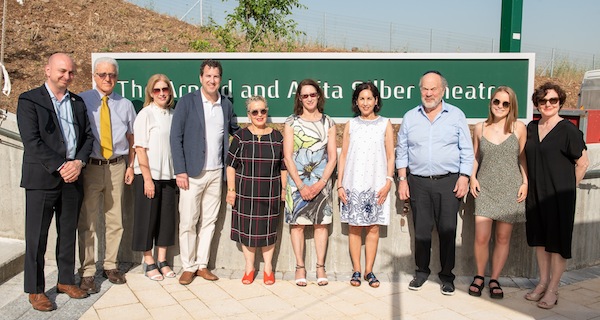
The Arnold and Anita Silber Theatre at Tel-Hai College officially opened last month. (photo from Jewish Federation of Greater Vancouver)

Last month, Jewish Federation of Greater Vancouver chief executive officer Ezra Shanken, as well as board members Karen James, Alex Cristall and Candace Kwinter, and Jewish Community Foundation executive director Marcie Flom were in Israel for the official opening of the Arnold and Anita Silber Theatre at Tel-Hai College. This new 1,200-seat outdoor theatre will be a hub of activity for the university and surrounding area. The theatre is located at the centre of the Tel-Hai campus, and is a key component in the college’s long-term development plan.

The Silbers have long supported Federation’s partnership region of the Galilee Panhandle, and its work there. They have supported a number of projects and established the Friends of Beit Vancouver, a donor-recognition program for supporters of Beit Vancouver. Anita Silber serves on Federation’s Israel and overseas affairs committee, and has for several years. Recognizing that Tel-Hai is a significant economic driver in the region led the Silbers to fund this legacy project and lend their name to it.

The official opening of the theatre began with a welcome reception with Tel-Hai’s board of trustees, followed by a ribbon cutting. The Silbers were joined by their granddaughter, Samantha Addison, and family members from Israel. In reply to the address honouring them that was delivered by Tel-Hai’s president, Prof. Yossi Mekori, Arnold Silber stressed that the students were the primary motivation for this investment. They are the ones to whom the future of the region is entrusted, and it is they who will take it to the next level.

A number of families and individuals from our community agree, and they are funding scholarships, which were awarded to students at the ceremony by James and Cristall: the Coleman Family Scholarships, the Krell Family Scholarships, the Evelynne Loomer z”l Scholarships, the Bernard Lotzkar Scholarships and the Zalkow Family Scholarships.

* * *

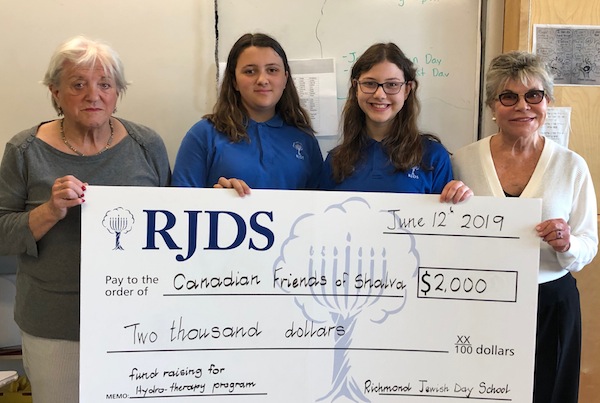
photo - Left to right are Lola Pawer, RJDS students Maya Bernal and Penina Berger, and Leslie Diamond
Left to right are Lola Pawer, RJDS students Maya Bernal and Penina Berger, and Leslie Diamond.

Over the course of the 2018/2019 school year, the Student Council Committee of Richmond Jewish Day School took it upon themselves to raise money for the Shalva Centre Hydrotherapy Program in Israel.

With the support of families, the school raised $1,000, which was generously matched by Lola Pawer. Pawer and Leslie Diamond, who is a board member of the Shalva Centre, came to RJDS to teach students about the work Shalva provides for children with disabilities.

The students presented a cheque to Diamond in the amount of $2,000. For anyone wanting to learn more about Shalva or make a donation, visit shalva.org.

* * *

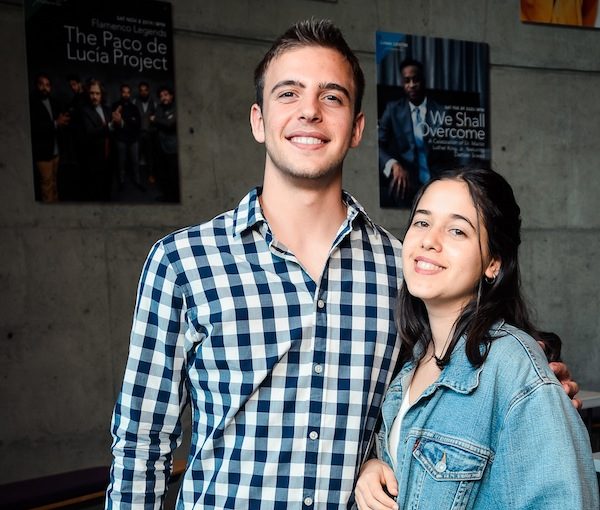
photo - Brett and Caro Rudolph
Brett and Caro Rudolph

Brett and Caro Rudolph have fun at their wedding in Syracuse, Sicily. Brett is the son of Les and Anita Rudolph of Vancouver (previously from South Africa) and Caro is the daughter of André and Svetli Wanne of Vienna. The wedding was officiated by Rabbi Paul Chaim Eisenberg of Vienna and was thoroughly enjoyed by family and friends. Brett and Caro live in Israel.

* * *

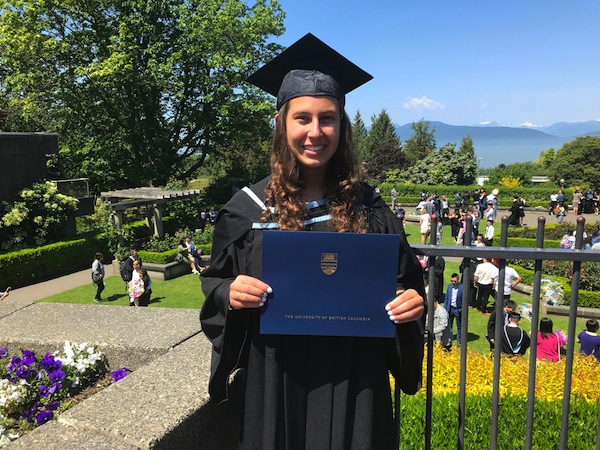
photo - Samantha Pawer
Samantha Pawer

On May 25, 2019, Samantha Pawer was conferred the degree of bachelor of science honours in integrated sciences with distinction from the University of British Columbia. Samantha is an alumna of Richmond Jewish Day School and Hugh Boyd Secondary School. Proud are parents Jeff Pawer and Beverly Pawer and big brother Brayden Pawer.

* * *

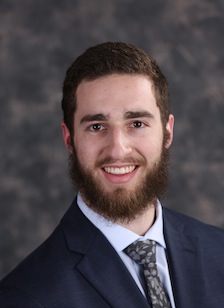
Moshe Baitelman decided to become a doctor when he took his first biology class in high school. On May 26, 2019, the Vancouverite graduated as valedictorian at Touro’s Lander College of Arts and Sciences in Flatbush, Brooklyn, N.Y. He will begin medical school in the fall.

photo - Moshe Baitelman
Moshe Baitelman

Baitelman chose Touro because it offered a strong Jewish environment as well as academic rigour. He majored in honours biology and minored in computer science. Along the way, he built strong relationships with his professors. “They all pushed me to be my best,” he said.

Living in Brooklyn, Baitelman found support for his career goals via the Gedaliah Society, a local network of Chabad men and women in the healthcare profession who offered advice and shared their own experiences in preparing for medical school. He also served as executive editor of Touro’s science journal and president of the Touro Science Society.

“Moshe has distinguished himself as a gifted, multitalented student with outstanding leadership skills. We are confident that he will become a respected physician, who will create a Kiddush Hashem in all his patient and professional interactions,” said Dr. Robert Goldschmidt, vice-president and executive dean of the Lander College.

Prior to Touro, Baitelman attended Vancouver Hebrew Academy for elementary and then the Pacific Torah Institute. Both schools imparted a strong Torah education with Jewish morals and values, and a first-class education. Baitelman’s education in Vancouver was the solid foundation for a life of strong Jewish identity and commitment to Jewish observance and learning, as well as enabling him to pursue further career education.

Baitelman credits his parents for his drive; they instilled a strong work ethic and have continued to encourage him. He offers similar advice to students getting ready to start college: “Be proactive. It will be the difference between just passing through and actually gaining from college. Find activities that will be conducive to your professional and educational growth – use your network of professors, advisors and other students.”

Format ImagePosted on June 28, 2019July 3, 2019Author Community members/organizationsCategories LocalTags Anita Silber, Arnold Silber, Baitelman, education, graduations, Israel, Jewish Federation, Lander College, Leslie Diamond, Lola Pawer, Pawer, philanthropy, Richmond Jewish Day School, RJDS, Rudolph, Shalva Centre, Tel-Hai College, tikkun olam, Touro, UBC, weddings
Teens bring Israel to Vancouver

Teens bring Israel to Vancouver

Israelis Ofir Gadi and Or Aharoni are rounding up their year of volunteering in Metro Vancouver. (photo from Jewish Federation of Greater Vancouver)

In Israel, high school graduates can go straight into the Israel Defence Forces (IDF) or opt to do a shnat sherut (year of service, for which the acronym is shinshin). The vast majority of 18-year-olds who do a shnat sherut do so inside Israel, volunteering with a variety of social welfare and other nonprofit organizations throughout the country. But, through the Jewish Agency, approximately 100 teens do their year of volunteering in Jewish communities around the world.

Vancouver began to take part in the program in 2015. In August of that year, Jewish Federation of Greater Vancouver brought three young women to split their time between Vancouver Talmud Torah, Richmond Jewish Day School, King David High School, Beth Israel, Temple Sholom, Beth Tikvah and the Jewish Community Centre of Greater Vancouver. The final quarter of the year was spent volunteering at camps Hatikvah and Miriam and the JCC day camp. Each agency contributed a portion of money to cover the expenses needed to bring the shinshiniot (female plural for shinshin) here from Israel and to contribute to a small monthly stipend. Host families, who welcomed an 18-year-old Israeli into their family for a period of three months, took care of living arrangements and meals.

Nearly four years later, all of the original host organizations continue to participate in the program. Shinshin coordinator Dan Stern helps make the connections between the organizations and the volunteers as smooth as possible. The main challenge continues to be finding host families. While it is a significant responsibility, the fact that many host families have hosted volunteers multiple times speaks to the rewards of doing so.

This year, for the first time, Vancouver picked one male and one female shinshin. Ofir Gadi and Or Aharoni arrived in early September and settled in right away. They spent two days each week at VTT, interacting with students through activities including song, dance, multimedia presentations focusing on Israel, Israeli-style Jewish holiday celebrations, and Hebrew. RJDS had them once a week for similar activities and the pair helped at the JCC with teen programming. On Sundays, they split up to give a special Israeli flavour to various synagogue religious schools. Federation also has had them working at many community events and its outreach program, Connect Me In, which services Squamish, Langley and Burquest. Additionally, the two have helped make other community-wide celebrations special, including making a presentation at this year’s Yom Ha’atzmaut celebration at the Chan Centre for the Performing Arts.

Gadi and Aharoni have proven to have complementary personalities. They have worked together, smiling through the challenges they have faced and thoroughly enjoying almost everything they’ve encountered here.

“Vancouver is my favourite city in the world,” said Aharoni with her typical warm smile. “The weather is much better than what the other Canadian shinshinim have and the people we have met here have been so welcoming and amazing. Also, being here, I’m not the only one saying thank you on the bus!”

Gadi has also had terrific experiences. “We have worked a lot in many areas of the Vancouver Jewish community and the good thing about that is we have met so many wonderful people,” he said.

While they were prepared to a certain degree about what to expect, both Aharoni and Gadi have said being in Vancouver has exceeded their expectations. “We both love it here and plan to return,” said Gadi.

The biggest surprise for Aharoni was that she felt at home as soon as she arrived. “I didn’t know that it would be such a good fit,” she said. “I was positive coming in but I have found the energy and the vibe of the students amazing and the community, host families and friends I’ve made have been so special.”

Although she has traveled outside of Israel, she said she didn’t know anything about what it is like to live as a Jewish person outside of Israel. She comes from a secular Israeli family and, she said, living here has brought up questions about Jewish identity that had never been an issue before.

“Firstly, I am an Israeli. Secondly, I feel fully Jewish even though I am not at all religious,” she said. “I see that it’s important to live the Jewish life the way you want. I also understand that going to synagogue is important here in order to be part of something, and being part of a community is very special.”

Both teens have stayed with families with whom they have deeply connected. “It’s been great to be part of a different family every few months,” said Gadi. “I have enjoyed my host siblings and I hope our connection will continue and my family in Israel will have a chance to host my families from here.”

Gadi is from a small community near Modi’in called Reut and Aharoni’s family lives on a moshav called Aviel, near Caesarea. Both shinshinim expect visitors, as host families and friends of past shinshiniot have kept in touch and visited when in Israel.

“The connections with people makes this experience more powerful and meaningful. Both Ofir and I have made so many special connections with students, families and the Vancouver Jewish community,” said Aharoni.

Up next for both shinshinim is summer camp. Aharoni will help augment the Israel programming at Camp Hatikvah and Gadi will be at Camp Miriam lending an additional Israeli vibe to the camp.

For more information about the shinshin program or how to host one of the two shinshinim who will arrive in September, contact Jewish Federation at 604-257-5100.

Michelle Dodek is a freelance writer living in Vancouver.

Format ImagePosted on June 21, 2019June 20, 2019Author Michelle DodekCategories LocalTags Diaspora, Israel, Jewish Federation, Ofir Gadi, Or Aharoni, shinshin, tikkun olam, youth
Israeli music icon sings here

Israeli music icon sings here

Yoni Rechter will be in Vancouver to perform for Yom Hazikaron and Yom Ha’atzmaut. (photo from Jewish Federation of Greater Vancouver)

“I love to know the world through music, and music has brought me to many places …. When I come and play and then I also make connection with the place, I prefer it to being the usual tourist. So, I’m glad I have the opportunity to come back to Canada after so many years … especially to Vancouver, that I heard so much about it,” Yoni Rechter told the Jewish Independent in a phone interview.

Rechter headlines the community Yom Ha’atzmaut celebration May 8 at the Chan Centre for the Performing Arts. While he has toured around the world, he hasn’t ever performed outside of Israel on Israel’s Independence Day. So, why now?

“There are two artists,” he said, “who were previously in this concert – Nurit Galron [2013] and Shlomi Shaban [2018] – they are both friends of mine, I work with them. Each one of them told me how nice it was to be there at the Yom Ha’atzmaut event, so I got good recommendations.”

Since he wrote his first song more than 50 years ago, Rechter has become a virtual icon of Israeli music. The composer, pianist, singer and arranger has created music for solo performances, bands, theatre, film, symphony, dance and opera. He has more than a dozen albums and has collaborated with a large portion of the who’s who of the Israeli cultural arts scene. Yet, he remains humble.

“I worked with the right people. I mean, people that I had the opportunity to learn from them, from the beginning of my musical career,” he said of his success. “I was first in the group Kaveret – you know, Poogy? By the way, we performed in Canada in ’76. We were in Montreal and Toronto and Winnipeg, and I still remember the temperature in Winnipeg. I think it was in winter; it really was the lowest temperature I ever felt. Anyway, then I worked with Arik Einstein, then I worked with Yossi Banai … and then I had the opportunity to work with very important theatre directors, like Hanoch Levin, Nissim Aloni and Miki Gurevich, and, also in movies. Because this is a small country, if you are willing to work, you can do various musical activities…. I had a lot of people to learn from, and really great, great artists.”

He said Israel is different than the United States or Canada with regard to the concept of celebrity. In Israel, he said, “We grew up very simply, and I go every day to swim. It’s not that I live in a protected house and I have bodyguards. It’s not this type of culture in Israel, first of all, but still there are people in Israel who might use their publicity for power or this kind of thing, but my character, I feel that I’m a musician, it’s the music and not me…. I feel that I have what to say in my music, but I never speak about myself; nobody knows about my wife, about my children, my private life. I’m really not into doing something with it, and it’s many years like this, but, I must confess, that I’m also not required by people or by journalists to speak about my personal life. Really, people accept me as I am.”

Rechter almost didn’t become a musician. When he was about to go into the army, at age 18, his father had what was probably the biggest architecture firm in Israel at the time. Even though his parents separated when Rechter was very young and he didn’t live with his father, he said it was a big decision as to whether to follow in his father’s footsteps. But, also, he said, music came easily to him.

“You know, I was just sitting at the piano and I composed, everything flowed, so I thought maybe life should be more difficult, and I should go to places that are more requiring of effort,” he said. “And this feeling I had, I was sure I was going to be an architect, but, in the army, I played in a military group of the artillery … and, when I finished the army, I thought to go to study architecture but then I got a telephone call from the members of what was going to be Kaveret group (Poogy group), and they called me for an audition. I heard the music and I fell in love. In the end, it came out to be [that I became] pianist of this group and a member of this group that changed … my career…. I have a brother who continues my father’s legacy.”

As to music and the projects he takes on, Rechter said there are a couple of factors he considers, notably the seriousness of the request and whether he has something to contribute musically. He gave the example of the Israeli Opera, who asked him to create a work for them, which will play again next year. He based the opera, Schitz, on the play by Levin.

“To write an opera,” he said, “it’s a year of 12-hours-a-day work; it’s really very [intensive]. It was an 80-minute opera, symphonic – I made all the arrangements and orchestration and I worked with the singers; it’s a huge work. It takes one year to do it, so, the first condition is that I know the project is serious.

“I have to find the right text,” he added, “because I really connect it to lyrics, to text, and I feel I have something to say in this. It’s a process. So, I start to improvise on this and I see if I have something to say musically. And, when I feel it’s all connected, I start to work on it. For example, the other [opera] … it was by David Grossman. Itamar Pogesh Arnav, it’s called, Itamar Meets a Rabbit. It’s a for-children opera, we made it with the Israeli Philharmonic. Of course, David Grossman, I knew he’s a very interesting man and I can find a way to connect with him, to communicate.”

Rechter said it is hard to define “Israeli music.” From the state’s inception through the 1970s, he said, “before the great internet and … we became one global ‘forum’ … [Israel] developed its own voice, which was, I would say, influenced by Russian music, from the immigrants that came, and also by music from the east, from Sinai, from Jordan, from all our neighbours. I think I grew up with influences of this spirit – sometimes I liked it, sometimes I didn’t like it. It depends on the people; for example, there was Sasha Argov, who was a very famous composer, and I really liked his music, which was very rich harmonically. Today, I think, after this explosion of communication, I don’t think it’s different from other places.”

That said, Rechter singled out some Israeli jazz performers, like Avishai Cohen, who is now based in New York, and others. “So, there is something here,” he said. “I think that living under pressure all the time [has something to do with it] … your life, all the time, is in danger because you don’t know when the next missile will fall in Tel Aviv. In my life, it has happened already two or three times…. Last week, there was one missile or two that fell near Tel Aviv. So, our life is, all the time, not protected, in a way. I believe it influences in a positive way our art, because we make art – all the Israeli artists – like you must survive. It gives us some very different energy than Europe, that used to be very calm.” He said, “The good artists that are serious become very known in the world [outside of] Israel.”

Music is important, said Rechter, “because it, especially in this time, I think that music should be a messenger. It has a task, and the task is to bring people back to real feeling, to themselves, to touch their souls, their energy, their spirit. Music is a force of nature, something that comes out of real creativity, at its best. Sometimes, I go to a concert and I cry from the music, it touches me so deeply. And that’s what I want to make. I don’t want to be somebody who’s going there to make lots of money; it doesn’t interest me. I want to touch people and, when it happens, for me, it’s the best prize.”

Rechter is coming to Vancouver with a band, “all of them Israeli, who live in New York” – singer Tammy Scheffer, saxophonist and player of multiple woodwinds Eitan Goffman, guitarist Shahar Mintz, bassist Uri Kleinman and drummer Shay Wetzler. “I sent them all the notes and the recordings of what I plan to play in Vancouver,” he said. “They’ll practise and we’ll meet at the beginning of May for two rehearsals n Manhattan.”

The audience at the Chan Centre can expect some of their favourites, said Rechter.

“I started to write songs when I was like 14, because of the Beatles,” he said. “I fell in love with the Beatles…. The first songs [of mine] were written in this age. I think the most famous song was – there is a song called ‘Dma’ot Shel Mal’achim,’ ‘Angels’ Tears.’ It became a song of memorial, and I wrote it in high school … with my friend who was sitting near me, his name is Danny Minster, he wrote the lyrics and I wrote the music. I tell this to you because I will sing it in Vancouver at the Yom Hazikaron memorial.”

Rechter will perform just the one song at the memorial May 7, 7:30 p.m., at the Jewish Community Centre of Greater Vancouver. On Yom Ha’atzmaut, May 8, 7:30 p.m., at the Chan Centre, he will perform more than 20.

Presented by Jewish Federation of Greater Vancouver, Yom Ha’atzmaut is supported by 46 community partners, with the Jewish Independent as the media sponsor and Georgian Court Hotel as the hotel sponsor. For the first time, there will be a party after the concert, though there is limited space available and only guests who attend the Yom Ha’atzmaut celebration may purchase tickets to the party. Visit jewishvancouver.com/yh2019.

Format ImagePosted on April 19, 2019April 17, 2019Author Cynthia RamsayCategories MusicTags Israel, Jewish Federation, music, Yom Ha'atzmaut, Yoni Rechter
A rewarding trip to Siberia

A rewarding trip to Siberia

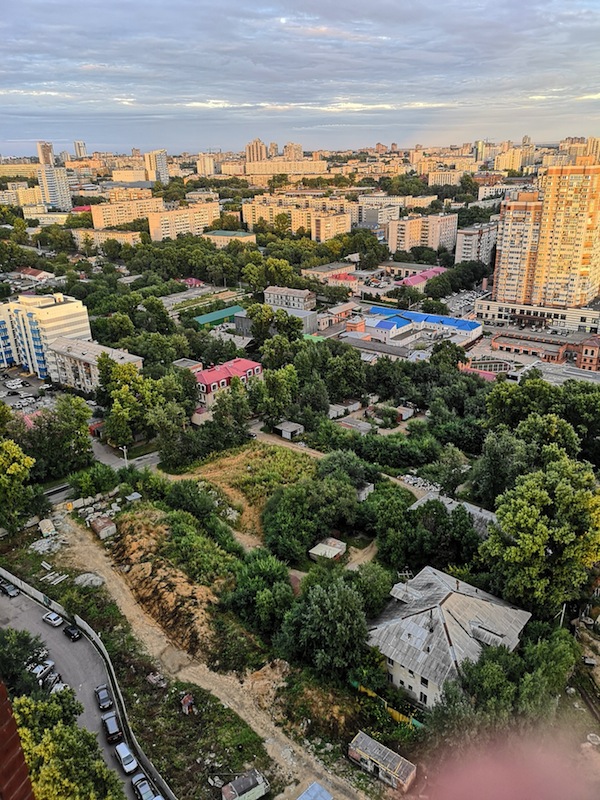
Several Vancouverites traveled to Siberia to see members of the Jewish community, which the Jewish Federation of Greater Vancouver helps support. (photo from Michael Moscovich)

Last September, a group of seven travelers representing the Jewish Federation of Greater Vancouver set off on an expedition to the far east of Siberia. Jews going to Siberia? Had to be a very good reason. And there was.

For more than a decade, the Jewish Federation, in partnership with the American Jewish Joint Distribution Committee (JDC), has been contributing to the support of Jews in need, wherever they may live in the world. Federation’s Israel and overseas committee chose to help the closest Jewish communities in abject poverty and those are in Siberia’s far east. Khabarovsk is the main city in the area and Birobidzhan is the capital of the Jewish republic, or oblast, of Russia. Jewish republic! Long story.

photo - The Russian city of Khabarovsk
The Russian city of Khabarovsk. (photo from Michael Moscovich)

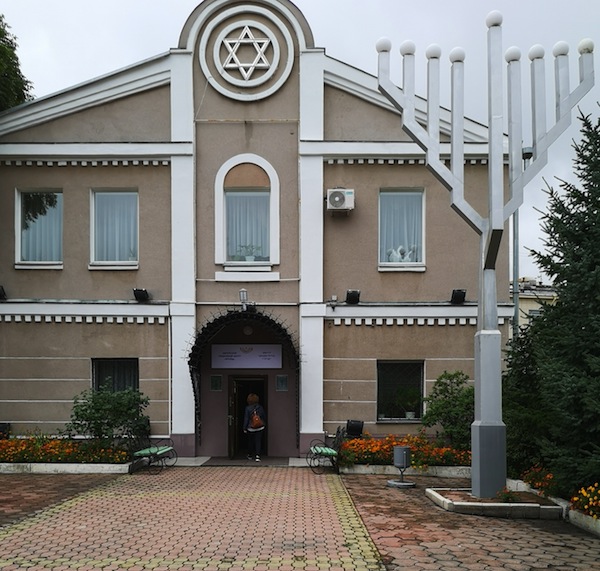
Khabarovsk is about the size of Winnipeg and the winters are about the same, only a little colder – when we were there in the fall, it was generally above 20°C. Birobidzhan has a population of only about 75,000 and both cities are located by very large rivers. Each has a new synagogue/community centre.

photo - The synagogue in Birobidzhan
The synagogue in Birobidzhan. (photo from Michael Moscovich)

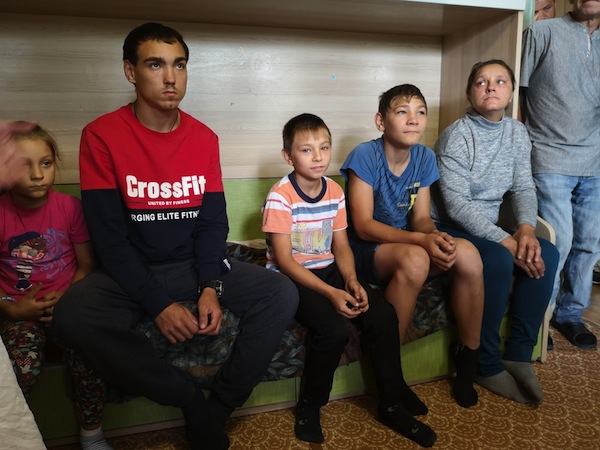
In Siberia, the younger people have jobs and seem to do well, but the pensioners are lost. Their pensions may have been adequate 20 years ago but the ruble has fallen to two cents. Their income is maybe $20 to $40 a month. Their choice is to feed themselves, heat their home or buy their medicines. Through the JDC, Federation makes it possible to do all three by supplementing their monthly income. It also supports people with disabilities who are unable to work.

I am a founding member of Federation and its Israel and overseas committee, and have visited Jewish communities in Poland, western Russia, Austria, Morocco and Cuba. No Vancouver representative had visited our Siberian partners before to see what we’re helping to accomplish. The trip was very rewarding. We saw signs of the rebirth of Siberian Jewish life.

The Russian city of Khabarovsk. (photo from Michael Moscovich)
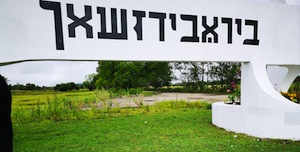
photo - Biribojan, in Yiddish
Biribojan, in Yiddish. (photo from Michael Moscovich)

Most of the people we met were not English speakers, but we had enough interpreters that language was never a problem. We were also bonded by Yiddishkeit, though the community had had no Jewish education or ceremonies for decades, since Stalin decided to ban the Jewish part of the Jewish republic. No one even spoke a word of Yiddish – this in a place where there was a thriving Yiddish-based culture until the 1950s. But the street signs in Birobidzhan are still written in Yiddish and there are other symbols of Jewish life, such as a menorah on the monument at the train station.

During our visit, we joined in baking challot and delivered them to elderly widows. Upon entering one home, our hostess staggered and almost collapsed. Subsequently, whenever she looked at me she blanched and teared up. I asked what was the matter and she said I looked so much like her father it was like seeing a ghost. She showed me pictures of him and, indeed, he was a handsome devil and doppelgänger.

There are maybe 15,000 Jews left in the area. All have the option of relocating to Israel and most have. However, one guy returned, as there was no ice fishing in Israel. Another returned as a Chabad rabbi to lead the Birobidzhan congregation. A young woman came back to be with her grandmother. So many stories.

The elderly spoke to us of the war and survival. I asked what happens to the non-Jewish people in similar circumstances with no outside support. They just died, was the reply. We are truly saving lives.

Format ImagePosted on January 11, 2019January 9, 2019Author Michael MoscovichCategories WorldTags former Soviet Union, FSU, JDC, Jewish Federation, Joint Distribution Committee, philanthropy, Siberia, tikkun olam
To forgive and to save others

To forgive and to save others

Left to right are Megan Laskin, Sherri Wise, Karen James, Jane Stoller, Jeannie Smith, Alyssa Schottland-Bauman and Sharon Goldman. (photo from Jewish Federation)

For the past 14 years, the Jewish Federation of Greater Vancouver has organized a women’s philanthropy event called Choices. The evening is meant to inspire women to understand the power of their tzedakah and to feel part of the community. On Sunday, Nov. 4, in Congregation Beth Israel’s Gales Family Ballroom, the informal consensus in the room of more than 500 women was that Choices exceeded its objectives.

One of this year’s achievements, according to event co-chair Jane Stoller, was that there were 50 first-time attendees. Stoller explained that a table of Hillel BC students had been sponsored and there were new faces from Federation’s young adult program, Axis, in the crowd. In addition, she said a record number of Israeli women were among the new attendees.

As for the featured speakers this year, both not only spoke movingly, but they also tied in Federation as an important component of their respective stories.

Sherri Wise is a dentist who lives and works in Vancouver. She survived a triple bombing on Ben Yehuda Street in Jerusalem on Sept. 4, 1997.

Wise described the sequence of events that led her to be at a café on a beautiful sunny day and what transpired after three Palestinian terrorists each blew themselves up in the immediate vicinity. Wise was seriously injured, with more than 100 nails embedded in her limbs and second- and third-degree burns on many areas of her body. After recounting the details of this tragedy, Wise was able to focus on some of the positives that arose from the horror. “Someone from Jewish Federation in Vancouver contacted Federation in Jerusalem and a kind woman named Trudy came every day to visit me.… I never even learned her last name,” she said.

Wise said she has managed to get on with her life not only with the help of her parents and the Jewish community, but also by making a decision not to harbour anger or hatred toward those who injured her, killed seven and injured 200 others. “Those men were born innocent babies and they were taught to hate – what chance did they have?”

Wise has since helped craft, advocate for and see enacted the Justice for Victims of Terrorism Act. This bill includes deterrents to those who would support terrorist organizations financially and materially, and grants rights to Canadian victims of terrorism. Wise imparted a message of healing, gratitude and finding a way to make a positive difference.

Jeannie Smith, the daughter of Irene Gut Opdyke, was the second speaker. Opdyke, who passed away in 2003, saved the lives of 12 Jews in Poland during the Holocaust and was recognized by the Israeli Holocaust Commission as one of the Righteous Among the Nations. Smith recounted many details of her mother’s story to a captivated crowd.

At the age of 17, Gut was forced to work in, among other places, the home of a high-ranking German officer stationed in Poland near her hometown. Prior to “keeping house” for this officer, she had worked in a laundry facility at a German officer’s camp. When she learned that she would be relocated to a villa in the town and that the Jews of that town would be liquidated, she managed to smuggle the group of Jews she had worked with in the camp’s laundry into the basement of the villa.

Eventually, the officer discovered the hidden Jews but, for a variety of reasons – none of them altruistic – he did not turn them in. As the Soviets approached and the Germans fled Poland, the 12 Jews, one of whom was pregnant, fled to the forest and joined the partisans.

There are many more twists and turns to Gut Opdyke’s story, but she ended up in California, where she married an American man who was the only person in the United States who knew anything about her painful and heroic past. Gut Opdyke was moved to begin speaking about her experiences only after she received a random call from a Holocaust denier. For the rest of her life, she was a Holocaust educator who shared the story her daughter, Smith, shared with the women at Choices.

Smith expressed gratitude toward the Jewish Federation of Portland because they paid for her father to live out his life in the Jewish seniors home once he developed Alzheimer’s. Commenting about Federation, she said, “One person can make a difference, and an organization can make a mighty difference.” She concluded with what she said her mother used to end her speeches with as well: “Every day we have an opportunity to be kind, to stand up for what is right and to go against what is wrong. We can be the difference in someone’s life.”

Both Wise and Smith received standing ovations for their heartfelt stories of love and resilience.

Leanne Hazon was one of the first-time attendees at the event. Having lived in Toronto for the last 18 years, the Richmond native returned to Metro Vancouver earlier this year for work.

“I thought the whole event was amazing!” she said. “It had such a nice vibe and feeling of community, very warm and welcoming. And the speakers were exceptional…. Sherri Wise’s message of forgiveness was so powerful and Jeannie Smith’s story about her mom was very moving.”

For more information on Jewish Federation and its annual campaign, visit jewishvancouver.com. 

Michelle Dodek is a freelance writer living in Vancouver.

Format ImagePosted on November 16, 2018November 15, 2018Author Michelle DodekCategories LocalTags Choices, forgiveness, Holocaust, Jeannie Smith, Jewish Federation, philanthropy, Sherri Wise, terrorism, tikkun olam, women
Campaign’s new chair

Campaign’s new chair

Dr. Jonathon Leipsic (photo from Jewish Federation of Greater Vancouver)

When Jonathon Leipsic decided to take on the role of campaign chair for the Jewish Federation of Greater Vancouver this year, it was not because he had too much free time on his hands.

Leipsic is a physician and practising radiologist, with a focus on heart and lung imaging. He holds a number of positions, including being a professor of radiology and cardiology at the University of British Columbia, vice-chair of research for the UBC department of radiology, chair of the department of radiology for Providence Health Care and regional department head of medical imaging of Vancouver Coastal Health. He has published extensively and is the editor of two textbooks; he also speaks internationally on cardiopulmonary imaging.

“I decided to take on this role as campaign chair for a number of reasons,” Leipsic told the Independent. “I am deeply grateful and proud to be part of this incredible Jewish community and am driven to contribute to making it and all of Klal Israel stronger. I have served as board chair at Vancouver Talmud Torah, and currently serve on the board there and at Schara Tzedeck and King David High School.

“The Federation annual campaign leadership, for me, is a tremendous honour and privilege, enabling me to work with such a great team and a group of volunteers with the goal of supporting, nurturing and strengthening our community.”

For Leipsic, Jewish peoplehood and the continuity of the community and Jewish traditions are paramount. He hopes that his passion and commitment will be clear to community members, and that they will share in his vision of further building the community and ensuring that Jewish life is accessible to all who desire it.

“I want to express my gratitude to the entire community for their support and commitment,” said Leipsic. “I feel blessed to be part of a community filled with so many exceptional people and institutions, and I will work tirelessly throughout this campaign to help make it even stronger.

“The community and Am Israel are incredibly important to me, and both Karly and I will continue to volunteer and donate to the greatest extent possible to ensure that our children and, God-willing, our grandchildren, will share in the same blessings we have – to live in a strong Jewish community filled with love and strong institutions, and with a strong and prospering state of Israel.”

Leipsic praised the annual campaign volunteers. “There are nearly 300 volunteer canvassers who take time out of their busy lives to make calls and meet with donors about their gifts,” he said. “They are busy making those calls right now and I want to thank them.

“I also want to thank all of our donors for answering those calls, for meeting with their canvassers and for fulfilling the mitzvah of tzedakah.

“Thank you for supporting the community through the annual campaign. You are helping families struggling with the high cost of living to fully participate in Jewish community life. And, you’re bringing Jewish programs to members of our community who live beyond Vancouver’s city limits – from the Fraser Valley to the Sea-to-Sky corridor. Todah rabah.”

For information about and to donate to the Federation annual campaign, visit jewishvancouver.com.

Rebeca Kuropatwa is a Winnipeg freelance writer.

Format ImagePosted on September 21, 2018September 20, 2018Author Rebeca KuropatwaCategories LocalTags annual campaign, Jewish Federation, Jonathon Leipsic, philanthropy

Feast for mind and soul

Smack in the middle of the Days of Awe, hundreds of members of our community came together for an inspiring, entertaining and occasionally emotional evening celebrating unity and inclusion.

The opening event of the 2018 Jewish Federation of Greater Vancouver annual campaign Sunday night once again took the form of FEDtalks, four presentations from individuals with starkly divergent life experiences.

Zoya Schvartzman, whose career now is devoted to improving the lives of individual Jews in Europe and revivifying once nearly obliterated Jewish communities there through her work with the Joint Distribution Committee, talked about how a comparatively simple gesture by the Vancouver Jewish community, when she and her single mother lived here several years back, was a testament to paying it forward. By providing a family in need with a small hand up, probably nobody involved at the time imagined that a kind word and a bag of groceries, including a jar of chocolate spread, would inspire a young woman to positively change the lives of some of the most marginalized Jews in the contemporary world.

Arik Zeevi, an Israeli judo Olympian, talked about the importance of setting goals that seem to exceed our grasp as a means of self-improvement and collective advancement.

Pamela Schuller, a disability activist and stand-up comedian, spoke of how Tourette syndrome went from being her defining characteristic to becoming an integral, appreciated and complementary component of her complex identity. Her endearing and humorous presentation encouraged everyone to look at perceived disabilities as unanticipated gifts.

Rabbi Irwin Kula, in an intellectually packed tour de force, spoke of Judaism’s ability to transform itself, saying that the first Jews of Vancouver would not recognize the Judaism of today and that our descendants a century hence will not recognize our Judaism – and that this is a sign of constructive adaptivity.

The four speakers offered very different perspectives, which, together, reminded all of us at the Vancouver Playhouse that unity and diversity are complementary and not exclusive.

Everyone in the audience certainly left with a lot think about. However, standouts as we reflected afterwards included the idea that, while Judaism treasures tradition, its millennia of continuity is due at least in part to a willingness to break existing paradigms and make room for new ways of being and thinking, as well as fresh voices, being inclusive of multiple identities and ensuring that successive generations are welcomed and included even – perhaps especially – when they challenge the way things have always been done.

Also underlying much of the evening was the concept that our actions have powerful ripple effects that we cannot forecast. Small actions – teaching judo to a 7-year-old, standing up for a classmate with a disability, reaching out to members of the community in their times of need – can lead to life-altering consequences.

Underscoring these messages were words from leaders of our local Federation and campaign, including Federation board chair Karen James, past chair Stephen Gaerber, women’s philanthropy chair Megan Laskin, chair of this year’s campaign Jonathon Leipsic, and Federation chief executive officer Ezra Shanken, all of whom, in particular ways, reminded attendees of the obligation and privilege of participating in a collective movement that changes lives in British Columbia, Israel and around the world.

Leipsic singled out members of his generation, pleading that they maintain and expand upon the institutions and infrastructure that previous generations built for us. He made special note of Charles Diamond, whose funeral had taken place earlier that day. Diamond’s parents were among our community’s pioneers and the Diamond family, through generations, have been role models of the involvement needed for a community to thrive.

In these days of introspection, teshuvah and transcendence, FEDtalks proved a perfect opportunity to come together, reflect, celebrate, think big and rededicate ourselves to making positive contributions individually and collectively.

Posted on September 21, 2018September 20, 2018Author The Editorial BoardCategories From the JITags annual campaign, FEDtalks, Jewish Federation, philanthropy
Challenges improve life

Challenges improve life

Israeli judo master Arik Zeevi will speak at FEDtalks Sept. 16. (photo from JFGV)

When we’re faced with a challenge, most of us are naturally cautious. But, says Israeli judo master Arik Zeevi, if you have a passion for something, go for it, explore it and, even if you fail, “you will always be proud that you took the challenge.”

Zeevi, who will be one of four keynote speakers at this year’s FEDtalks Sept. 16, advises in a 2014 TED Talk, “Go for the challenge because, I personally think that, by taking a challenge, that is the best way to grow, to improve your life.”

In that TED Talk, Zeevi shares the story of his experience at the 2001 World Judo Championship. Having trained intensely for two years and becoming a national hero in Israel – and with his journey to the championship being filmed by a team of videographers – Zeevi was “knocked out” (in judo terms, his opponent “threw [him] by ippon”) two minutes after setting foot in the ring.

Undaunted by losing the world championship match, Zeevi, a lightweight, registered to fight in the open match in which fighters of any weight could spar. Friends and colleagues warned him to back out, and the Israeli media fretted over what injuries he might sustain. But, Zeevi beat one opponent, a second, then a third; the fourth knocked him down. Though he failed to win the gold medal, he took the silver – and set a precedent. In the years that followed, having witnessed Zeevi’s success, more and more lightweights competed in the open category, and also won medals. The match morphed into its own championship event.

Zeevi won many judo medals in his time, and he is the 2000, 2003, 2004 and 2012 European champion. He is currently ranked eighth in the world, though he retired from fighting in 2012. Today, Zeevi is an inspirational speaker whose main income comes from talking to companies about what he calls “the similar worlds of sports and business.”

“It is all related,” he told the Jewish Independent, “excellence in sport and excellence in life.”

Zeevi also heads the nonprofit Israeli Foundation for Olympic Excellence (IFOE), which hires and funds Olympic coaches who identify, support and train Israeli children and youth they hope have Olympic potential.

“We scout kids who have talent, we try to nurture them and connect them to the sport that is right for them,” said Zeevi. “You could be Michael Phelps, but unless you’re living next to a swimming pool, you’ll never know.

“The biggest problem in Israeli sport,” he said, “is that all sports are coached by amateurs in private clubs. The coaches are getting income according to the numbers of kids, putting quantity over quality. Professional coaching is rare.”

Zeevi grew up in a tough neighbourhood in Bnei Brak and knows what it is like to have few opportunities.

“My coach was very young, and he was like an older brother to me,” said Zeevi. The coach played a role for Zeevi that he is now trying to play for others. “He pushed me to discover myself,” explained Zeevi. “Around 12, I became very serious. Before that, I was just trying to be part of something. At 12, I got my first invitation to train on the national team. My coach was a Soviet Georgian guy – they are fighters, warriors. By 13 or 14, I was already very big, and he pushed me to fight bigger guys. When 15, I won the championship against seniors over 21. He did a great thing for me, pushing me like that. When you find an athlete, you have to challenge them.”

It is the appreciation for what sports did for him that motivates Zeevi to make high-level training available to more young people. “I really believe in sports as education,” he said. “It is the best way to stimulate mental skills, and it teaches you how to deal with stress, failure, difficulty.”

Zeevi himself has three children. His daughter won the Israeli championship in gymnastics, and his middle son is into basketball and judo. Zeevi said his son has also taught him the lesson that sometimes pushing is not what brings success. “The more I push him forward, the more he goes backward,” he said, “so I have to take a gentler approach. The most important thing is just to be there for them. Then they will succeed.”

While in Canada, Zeevi will also be visiting a judo club in Toronto, which is run by an Israeli friend from his training days. There, he will be giving a master class for advanced fighters before he returns to Israel for Yom Kippur.

FEDtalks, which launches the Jewish Federation of Greater Vancouver’s annual campaign, is being held this year on Sept. 16, 7 p.m., at the Vancouver Playhouse. For tickets and more information, visit jewishvancouver.com.

Matthew Gindin is a freelance journalist, writer and lecturer. He is Pacific correspondent for the CJN, writes regularly for the Forward, Tricycle and the Wisdom Daily, and has been published in Sojourners, Religion Dispatches and elsewhere. He can be found on Medium and Twitter.

Format ImagePosted on August 31, 2018August 29, 2018Author Matthew GindinCategories LocalTags Arik Zeevi, FEDtalks, Israel, Jewish Federation, judo, philanthropy, sports
Jewish history’s next chapter

Jewish history’s next chapter

The JDC’s Zoya Shvartzman is part of the FEDtalks lineup Sept. 16. (photo from JFGV)

In returning to Vancouver, Zoya Shvartzman is retracing the route that has seen the Moldova-born woman help “write the next chapter of the history of European Jewry.”

Those words, while spoken by Shvartzman, are not about herself – she was crediting North Americans and others who support the American Jewish Joint Distribution Committee (JDC) with helping revivify communities that were almost annihilated under Nazism and then suppressed by communism. But the work Shvartzman does in her role at the JDC means she could rightly claim to be among a number of authors altering the future for Jews in Europe.

Shvartzman and her parents made aliyah from the East European nation when she was 8 years old. At 15, she and her mother migrated to Vancouver. Here, the family had some hard times and they turned to the Jewish community.

“The Jewish community welcomed us with open arms and gave us almost a second home,” she recalled recently in a phone interview with the Independent. “It was a very, very fond memory of my time there and it has a lot to do with the Jewish community that became our family.” She will speak about this time when she presents as one of four speakers at FEDtalks, the opening event of the 2018 Jewish Federation of Greater Vancouver annual campaign, Sept. 16.

Shvartzman chose to pursue a degree in international development studies and political science at McGill University and so, after four years on the West Coast, she and her mother decamped for Montreal.

“After that, I decided to move to Budapest to pursue my master’s in political science because I was focusing on Eastern European politics and transitions from communism to democracy,” she said. “Because I’m from that part of the world, it made sense to go back and be there, be where it’s taking place.”

She completed her studies at Central European University, which was founded and funded by the democracy philanthropist George Soros, and, after graduation, worked for the Canadian embassy in Budapest. In 2007, she was offered a position at the JDC, where she is now director of strategic partnerships.

Shvartzman’s role is to identify on-the-ground needs of Jewish communities in Europe and convey those needs to potential funders, primarily in North America. Federations, foundations and philanthropists then contribute to help the JDC complete its projects.

“In Europe, basically, our main mission is that we build resilient communities,” she said. “We help build communities where they were shattered after the Holocaust and after communist regimes.

“In Eastern and Central Europe, we help poor Jews with basic services like food and medicine and winter relief, help to pay their utilities,” she explained. “Most of the elderly are Holocaust survivors. We work extensively with Holocaust survivors together with the Claims Conference funding. In the last 10 years or so, we developed services for children and families, modeled on the JFS [Jewish Family Services] model that you’re familiar with in Canada and the U.S., addressing the needs of poor children and families.”

Examples of projects that the JDC has spearheaded or supported include a Jewish community centre in Warsaw and a summer camp in Hungary, where children from 25 countries come to strengthen – or, in some cases, learn about for the first time – their Jewish identity. But the work is not limited to Eastern and Central Europe.

In France, the JDC has opened a “resilience centre,” to help Jewish schools, social workers, teachers, children and families respond to threats experienced by Jews in the country. Several acts of anti-Jewish terror in recent years in France have compounded existing anxieties about the security of its Jewish population and institutions.

The decade-plus that Shvartzman has been with the JDC has been a time of challenge for Jews and others across the continent.

“Especially the last four or five years have been particularly tumultuous for Jews in Europe,” she said. “There are different threats – external, internal threats. We see communities that have nearly collapsed, like the community in Greece, in terms of the economic crisis that really, really shattered it.”

In addition to the generalized economic challenges experienced by people in many countries, Jews have faced particular difficulties. Rising antisemitism and political extremism in places like Hungary and Poland have stoked once-dormant apprehensions.

Even so, Shvartzman is bullish about Jewish life in Europe and plans to share her enthusiasm with Vancouverites.

“There are many causes for optimism,” she said. “When you look at the revival of Jewish life in Europe and how these communities have gone from survival to really thriving Jewish communities, I think that’s a big cause of optimism.

“This is quite remarkable when you consider the history and some of the deep, deep traumas that this community has suffered and, today, Jews are reclaiming their heritage and are proud to be Jewish,” she continued. “All of this gives us great causes of optimism that Jewish life in Europe is thriving.”

Shvartzman’s Moldovan childhood and her current work both reflect and embody the JDC’s mission to save and build Jewish lives, said Michael Geller, the JDC’s North American director of communications.

“In her professional life and her personal life and in her life’s journey, she understands quite deeply the importance, the critical importance, of the work we do every day to ensure that needy Jews have the basic needs to continue to live their lives and, in addition, to have a strong Jewish identity, one that is their own, that they make themselves, and one that we help strengthen and empower through the kind of work that we do,” he said.

Returning to the theme of writing the next chapter of European Jewish history, Shvartzman credits overseas allies with making possible all of the achievements she and the JDC have realized.

“It’s only possible because of the support of the North American communities, North American Jewry, that chose to invest in that part of the world over the past 20, 25 years,” she said. “If I had to underline one message, it would be that: North American Jewry helping to write the next chapter of the history of European Jewry.”

FEDtalks features keynote speakers Rabbi Irwin Kula, Pamela Schuller, Arik Zeevi and Zoya Shvartzman. The event takes place at the Vancouver Playhouse on Sept. 16, 7 p.m. Tickets ($36) are available from jewishvancouver.com.

Format ImagePosted on August 24, 2018August 22, 2018Author Pat JohnsonCategories LocalTags American Jewish Joint Distribution Committee, annual campaign, FEDtalks, Holocaust, JDC, Jewish Federation, philanthropy, Renewal, Zoya Shvartzman

Posts pagination

Previous page Page 1 … Page 9 Page 10 Page 11 … Page 14 Next page
Proudly powered by WordPress