I was driving home from work the other day. Left the office early to reduce driving time in the evening hours. Hamas likes their 6 p.m. missile barrage and I’m honing my missile-avoidance routine.
I was listening to talk-radio, but have kind of had enough of the news. Too much war talk and it’s getting a bit overwhelming. So, I switched to Spotify and up popped Supertramp, “The Logical Song.” How “wonderful, beautiful, magical” life once felt. Before Oct. 7. Before Hamas.
Then, as if on cue. I gazed towards the sky and saw missiles flying overhead. At first, it didn’t really click. And then, yikes! I quickly switched back to the news where, in a very calming voice, they were announcing areas under missile attack, which is another reason to listen to the radio while driving during war – real-time information. Lesson learned.
Suddenly, my smartphone’s flashlight started flashing, which was pretty darn cool! And there I was, on Star Trek, standing on the bridge. I even recalled the vessel number, NCC-1701. I was with Captain Kirk. No! I was Captain Kirk, Dr. McCoy by my side, Sulu and Chekov at the controls. The Klingons were attacking and Mr. Spock, standing to the side, was calmly advising the attack coordinates. No, wait! That was the radio announcer. Seriously, this all took place within a split second in my over-active imagination.
The flashing continued. I realized my cellphone was communicating with me, warning of danger. I have the Home Front Command application, which sounds an amazingly loud alarm during a missile attack in my area, but changing between the radio and Spotify prevented the siren from going off. So, instead, the phone activated my flashlight, sending out an SOS. Now how neat is that?! In a geeky sort of way. Like for someone who imagines himself on Star Trek during a real-life missile attack.
Reality set in. There were Home Front Command instructions to follow.
Momentary panic set in. Where was my wife, to tell me what to do? Like she always does … but that’s another story. This time, I wanted her there, instructing me.
All these thoughts raced through my mind in milliseconds. As I calmly slowed the car and veered to the shoulder, like other cars around me, I put on the blinkers. More flashing lights, but the bridge of the USS Enterprise was now a distant thought. Looking both ways, I left the car and hopped over the road barrier, moving away from the car, although probably not far enough, because there was a steep decline just below. It was getting dark and, suffering from poor night vision, I didn’t want to trip and hurt myself. I heard my son laughing at me. “Nerd!” he called out. But that was just my imagination.
I should have laid flat, prostrating myself for maximum protection. But it had rained earlier that day, the ground was wet and I didn’t want to get muddy. “Nerd!” This time, it was my daughter in my mind’s eye. “OK,” I said to no one in particular, “I’ll squat.” Good enough, but not really.
The family in the car ahead were huddling together but too close to their vehicle. I shouted for them to move further away, but they didn’t react. Maybe they didn’t understand me, given my still heavily accented Canadian Hebrew. This time, I heard both my kids teasing me – 30 years and still talking like an immigrant! “Hey, they just don’t hear me,” I said to the darkness.
It was very moving seeing the father crouching down on top of his brood, in a protective sort of way. “Isn’t that touching,” I said to my wife in my imaginings. “For sure,” she responded, somewhat sarcastically, in the back of my mind. “I know you’d do the same.”
Then it was over. The sky went quiet. People returned to their cars. The nestled family broke apart and entered theirs. We should have stayed in place several more minutes. Ten minutes is the recommended time. But it was dark, getting late, also a bit cold. I just wanted to get home, back to the real chiding of my kids and to my wife, somehow longing for her ordering me about.
A few minutes later, my wife called, to make sure I was safe. And then routine set in. “Don’t forget to pick up some milk and bread from the corner store,” she instructed me.
Am Israel chai.
Bruce Brown, a Canadian-Israeli, made aliyah 25 years ago. He works in high-tech and is happily married, with two kids. He is the winner of a 2019 American Jewish Press Association Simon Rockower Award for excellence in Jewish writing.
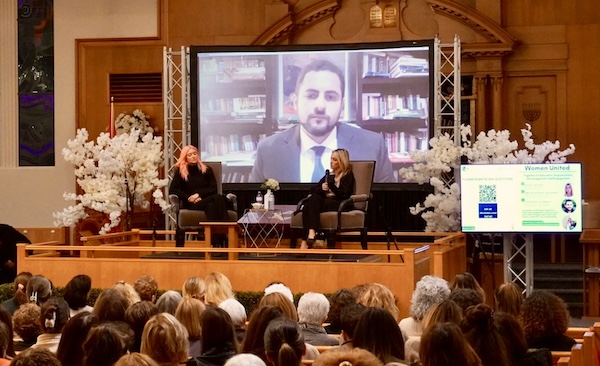
Caroline D’Amore, left, Hussein Aboubakr Mansour and Emily Austin spoke to an audience of more than 550 at Congregation Schara Tzedeck Nov. 26 for the event Women United. (photo by Kyle Berger)
Some 550 Vancouver women packed the sanctuary at Congregation Schara Tzedeck Nov. 26 for Women United, a talk arranged by Jewish National Fund, Jewish Federation of Greater Vancouver, Stand With Us Canada and Schara Tzedeck, and sponsored by the Diamond Foundation. Jewish women were encouraged to bring their non-Jewish friends, and Federation reported that 40% of attendants were non-Jewish.
“The idea was to bring together a diverse range of women from all faiths, to engage in dialogue and empower us to speak up with bravery,” said Megan Laskin, who initiated the concept for the event. She noted that there are just 15 million Jews worldwide “but we are the victims of half of the hate crimes that occur. Our pain, our fear and our loneliness are very real and very deep.”
Emily Austin, 22, an American social media influencer who is the host of a National Basketball Association podcast called The Hoop Chat w/ Emily Austin, was the first speaker. She described how she took a deep dive into Jewish history to understand it better. “One thing Israel will always have on its side is facts,” she noted. “The Palestinians have truly sad videos with no facts, but people tend to overlook the facts because of the emotional nature of the narrative.”
Austin delivered some of those facts to the audience, refuting the Palestinians’ claims of genocide. “Go to UN.org and you’ll see that their population has quadrupled in the last 20 years,” she said.
In discussing land claims, she said, “this is not about land. It’s about Jew hatred.” She argued that, when Israel left Gaza in 2005, the Gaza Strip was a prosperous area filled with resorts, cafés and nightclubs. “They turned it into a terrorist capital,” she said of Hamas.
Austin urged members of the audience to educate themselves so they can address false claims with confidence. “There are no excuses to not be a voice when we have the facts. If you’ve not been vocal, please be vocal now,” she said. “Silence is compliance, and those people who want Jews dead are not being silent.”
Austin warned that this conflict is not just about Israel, or even just about Jews. “When they say kill the infidels, the West is next. The common denominator is hatred, and it’s a disease,” said Austin.
Caroline D’Amore, 39, a single mom, social media influencer and the entrepreneur behind Pizza Girl pizza sauce, was the second speaker. She described herself as “a not-so-subtle, pink-haired, Malibu Italian chick” and a high school dropout. She said learning about the Holocaust and reading Anne Frank’s diary made a deep impression on her, but that she was unaware of antisemitism until Oct. 7, after which she started seeing it everywhere, and felt compelled to speak out.
D’Amore said she published a video expressing her dismay and a fact that was obvious to her. “The terrorists are the bad guys. There is no context on this earth that could justify rape and murder,” she told the audience.
The video went viral and D’Amore received hundreds of messages from mothers who were so relieved that a non-Jew could see what was going on.
“I could feel their pain, sadness and fear,” D’Amore said. “So many people are saying nothing, or shaming Jewish people for feeling this fear right now. Jews are being told to ‘stop playing the victim,’ and even I get accused of playing ‘the Zionist victim card.’ What I want to say to my accusers is ‘how dare you?’
“It’s very clear to me that this is about good versus evil,” she continued. “I dove right in and started screaming about this at the top of my lungs, and though I’ve been attacked online for over a month now, I’m still here, proudly showing my face. I plan on being on the right side of history, which means standing up against terror in the Middle East and against those who are justifying what happened on Oct. 7. My promise is that I’ll continue to use my voice to stand up against evil, to stand up for humans who are suffering, to speak up against terrorism, and to encourage and empower others to use their voices.”
D’Amore said the Jewish community was her inspiration. “You guys find the light and it shines so damn bright,” she said. “You come together in the most beautiful ways, and it’s inspired me in ways I’ve never known possible.”
Hussein Aboubakr Mansour, the third speaker, addressed the audience by Zoom from his home in Washington, DC. Now the director of the Endowment for Middle East Truth’s Program for Emerging Democratic Voices from the Middle East, he was born in Cairo, into an environment that he said inspired him and his peers to hate Jews and become jihadists.
“From an early age, there was a story I heard everywhere, that there are people who epitomize wickedness, want to destroy Arabs and Muslims and steal our land, and want to destroy everything that is good and sacred. Those people are the Jews and Zionism is the embodiment of that ideal,” he said.
Curious, he started teaching himself Hebrew and learning about Jewish history. That led him on a long journey that transformed his relationship with the world and turned him into an ardent Zionist and supporter of the Jewish people.
His metamorphosis and his insistence on publishing, blogging and talking about what he learned, has cost him dearly. He was disowned by his family, was arrested on suspicion of being a Zionist spy, and was tortured in Egyptian jails before receiving political asylum in the United States in 2012.
“I spend every day of my life thinking about how to help end this epidemic of antisemitism that’s been going on for so long,” he said. While the massacres on Oct. 7 destroyed much of his optimism, Mansour said he still believes a change for the better is possible.
He ended his remarks by saying that he is proud to be a friend of the Jewish people and of the state of Israel. “And I have no doubt that I’m not the only Arab who feels this way – I’m just ahead of the curve,” he said. “There will be more who will see this truth.”
Lauren Kramer, an award-winning writer and editor, lives in Richmond.
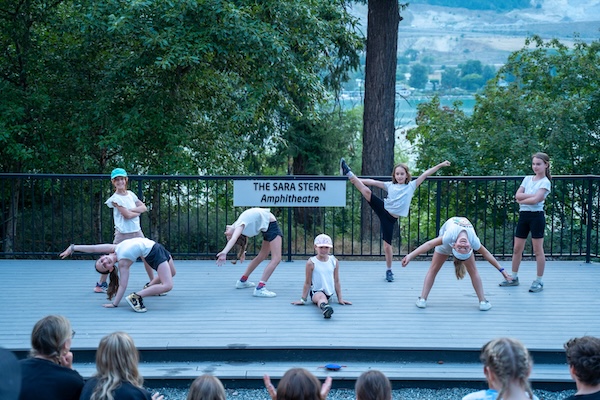
“This summer, the grounds of Camp Hatikvah will echo with laughter, song, and the spirited expressions of Jewish and Israel pride”: Liza Rozen-Delman, camp executive director. (photo from Camp Hatikvah)
For decades, Camp Hatikvah has been a cornerstone of the Jewish community, serving as a summer haven where traditions are cherished, friendships blossom and identities are proudly embraced. It has always been more than just a recreational retreat; it has been a powerful catalyst in shaping the future leaders of the Jewish community.
Developed in the aftermath of the Holocaust, Hatikvah was created to produce proud, happy Jewish youth who were committed to the rebuilding of the Jewish people and a homeland in Israel. As a 1949 article in the Jewish Western Bulletin (the predecessor of the Jewish Independent) stated, Camp Hatikvah provided early participants with a “place where they could live and express themselves as Jews, unhampered with fear of others and free from the out-of-place feeling that is so often a part of North American Jewishness.”
Today, as we witness a disheartening resurgence of antisemitism, the original mission of Camp Hatikvah seems to be as important as it was at the time of the camp’s creation.
“The need for a space where children can feel safe, embrace their heritage and express their identity without reservation is, once again, vital” said Liza Rozen-Delman, the camp’s executive director. “I am devastated by the current state of the world, but we are dedicated to rising above it and playing a critical role in combating hate.”
The camp’s leadership recognizes the need to renew its dedication to its original mandate, emphasizing that, in the face of external threats, the camp becomes not only a refuge but a dynamic force in cultivating resilience and unity.
“In response to the current crisis, this summer promises to be a rallying point for Jewish pride, a resolute stand against the hate we have seen, and a celebration of every aspect of who we are as a people,” said Joanna Wasel, board president.
As they begin preparing for summer, Rozen-Delman explained that the camp staff are gearing up to create an immersive experience that fosters a sense of pride, belonging, and love for all things Jewish. Through carefully curated activities and the camaraderie that comes from being part of a supportive community, campers will leave with not just memories of a fun-filled summer but also a strengthened sense of identity.
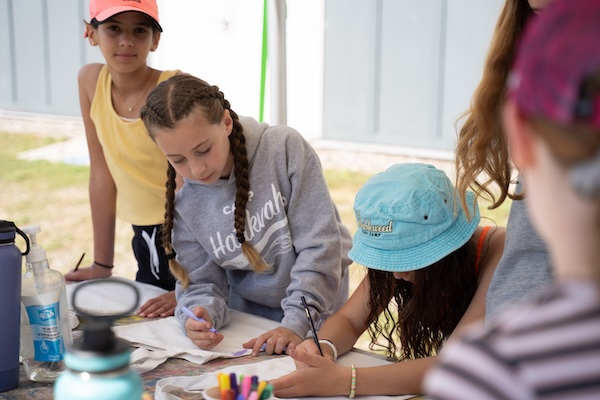
Kids working on a project at summer camp. (photo from Camp Hatikvah)
Camp Hatikvah also plans to intensify its Israel programming this summer in an effort to empower its campers with a more profound understanding of the Jewish state’s history and culture but, most importantly, its necessity. In a world where misinformation and delegitimization about Israel is rampant, Camp Hatikvah is determined to ensure that its campers and staff are equipped to advocate for the right of the Jewish people to live in peace and security in a homeland of their own.
“This summer, the grounds of Camp Hatikvah will echo with laughter, song, and the spirited expressions of Jewish and Israel pride,” said Rozen-Delman. “From the youngest to the oldest, everyone will be encouraged to stand tall, speak loud, and embrace every aspect of who they are.”
The importance of Camp Hatikvah extends beyond the traditional camp experience; it is a cornerstone for fostering resilience, unity, and an unapologetic celebration of one’s identity. Camp Hatikvah continues to play a pivotal role in creating a space where yet another generation of Jewish youth feel not only safe but truly at home.
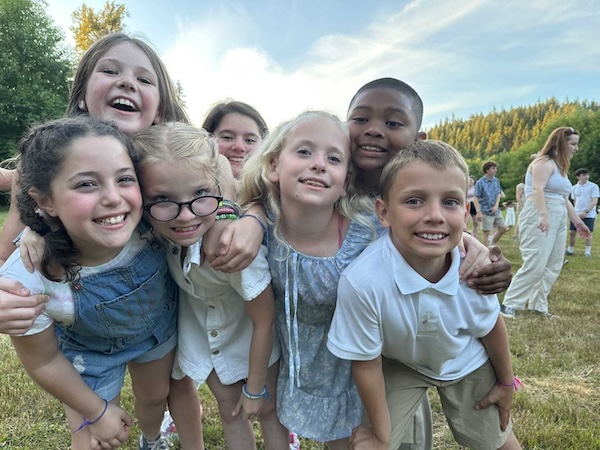
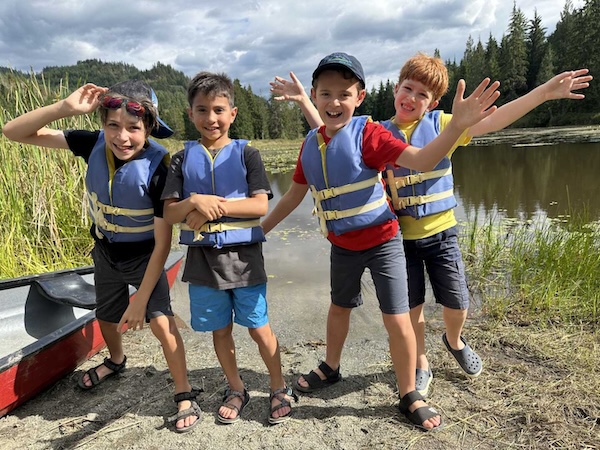
Lifelong friends can be made at summer camp. (photo from Camp Kalsman)
Fun is in all that we do,” Rabbi Ilana Mills, director of URJ Camp Kalsman, told the Independent. “Our staff creates dynamic programming that lets campers laugh and play in a way that doesn’t happen anywhere else. Where else can you spend a day with your friends and your evening doing messy night with a slip-n-slide, water balloons, shaving cream, and more?”
Summer camp is a unique experience for children and young people, for campers and counselors. While fun is at the forefront of programming, so is learning. In the case of Jewish camps, there is the added element of Shabbat observance and other elements of Judaic practise and values.
Looking at the example of Camp Kalsman, which is located north of Seattle, one can see the breadth of activities summer camp can offer. A typical day at Kalsman includes singing, pool time, prayers, and activities that range from canoeing and kayaking on the lake, to climbing the camp’s tower and/or high ropes, to farming or gardening, to painting or having a cook-out.
The camp has chugim (electives), which usually run three to four days, and campers do a project during them, said Mills. “Campers will get to rank their choice from a list of options and we do our best to give campers their choices,” she said. Chugim includes such things as pottery, embroidery, hiking, water aerobics, yoga or soccer.
And older campers have “Sababa Time,” said Mill. “Sababa Time is an hour each day where older campers get to choose their own activities from a number of creative options that changes each day. Those might include volleyball, board games, outdoor cooking, or spa days.”
The camp schedule also carves out free time for campers.
“Life is so busy and camp is as well. Free time enables campers to choose what they need on any given day,” said Mills. “Whenever we have free time, we have options for campers to choose which option best fits their needs.Some campers need to get energy out, so they play basketball or go to the pool. Others may need down time, so they may read a book in the trees. Campers use free time to relax, recharge and have fun in a manner that best suits them. Recreation can be a time to re-create, to rejuvenate.”
Kids at Camp Kalsman get ready to take a canoe out onto the lake. (photo from Camp Kalsman)
In addition to obvious practices, such as the celebration of Shabbat and group tefillah (prayer), Kalsman tries to impart Jewish values and culture throughout activities.
“We design our programs to foster a holy community through connection between campers, between campers and staff and between campers and the larger community,” said Mills. “We believe connection is important on every level, so our cabins do cabin time every night to form connections and, every week, we have all-camp programs, where campers of different ages can get to know one another. When we eat, pray and sing together, we connect to the larger community.”
Camp Kalsman ends each night in siyum, “a special closing prayer where we pray Hashkiveinu and Shema using a special tune written just for Camp Kalsman,” said Mills.
When asked what summer camps in general – and Jewish camps specifically – can give kids that schools can’t, Mills shared a quote from a 10-year-old camper, who said, “Kalsman lets me take off all the masks I have to wear at school and really be me.”
“At Kalsman, our campers know that they are valued, honoured and supported for who they are,” said Mills. “Camp enables kids to be kids, to be free, and to have fun in a way that they don’t get anywhere else. It frees them of the burdens of school and competition and allows them an outlet to be part of a great community. Kalsman campers disconnect from their devices and connect to a larger, holy community. Campers learn independence and problem solving, they learn they can make mistakes and how to manage mistakes in a safe environment. Camp is the place where kids can explore who they want to be in the world.”
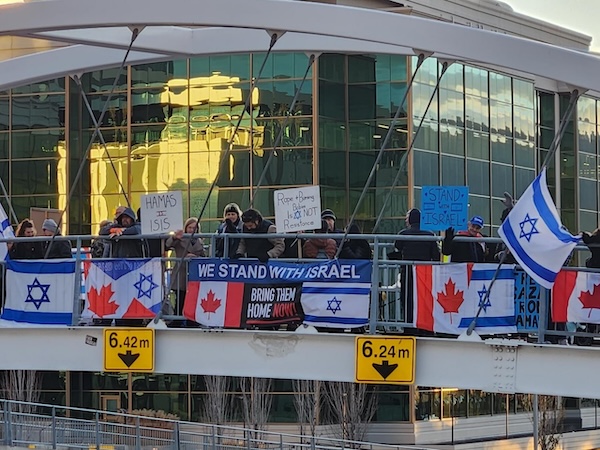
A vigil in solidarity with Israel took place on the Dayton Street pedestrian overpass in Kelowna on Nov. 19. (photo from vigil organizers)
About 100 people held a vigil in solidarity with Israel in Kelowna on Nov. 19, which proceeded without incident.
The two-hour gathering on the Dayton Street pedestrian overpass, which straddles Highway 97, was organized by members of the Jewish community, following a series of peaceful pro-Palestinian demonstrations since Hamas’s Oct. 7 attack on Israel.
The organizer (who asked that their name be withheld because of security concerns) said that, in addition to community members, the participants included representatives of at least two churches, as well as Kelowna city councilor Ron Cannan, a former Conservative member of Parliament for Kelowna-Lake Country.
The vigil was encouraged by Rabbi Shmuly Hecht, director of the Okanagan Chabad Centre, who led men present in the putting on of tefillin in a display of Jewish confidence.
The organizer said the pro-Israel public demonstration was the first of its kind in the area. The main purpose was twofold: to give the area’s small Jewish population an opportunity to unite and have its voice heard and to show other citizens that there is “another side” to the Israel-Hamas conflict not reflected by the public activities of Palestinian supporters.
One week earlier, around 300 people held a pro-Palestinian demonstration that started on the steps of the courthouse and concluded with a march. That event, which received local media coverage, was organized by the Okanagan chapter of Canadians for Peace and Justice in the Middle East, a Montreal-based anti-Israel lobby group.
The organizer said they and the other organizers decided not to alert the media to their event in order to avoid attracting any conflict with the other camp. There were no tensions, and the only show of disagreement came from a motorist driving under the overpass displaying a Palestinian flag and honking, they said.
There were a few honks of apparent approval and passersby did engage with those in the crowd, asking questions, they added.
The demonstrators carried Israeli and Canadian flags, and placards mostly reading “We stand with Israel” and “Bring them home now,” referring to the hostages taken by Hamas,but also “Hamas (equals) ISIS” and “Rape is not resistance.”
The organizer said those supporting the Palestinians and condemning Israel are getting attention in the Okanagan because of the frequency of their protests and the media coverage. The result is people “only hear one side of the story.”
The Palestinian demonstration outside the Kelowna courthouse Nov. 12 was especially visual: an individual identifying themselves only as Haneen, a Palestinian studying locally, unfurled down the steps a computer printout listing what was said to be the names of every Palestinian civilian casualty between Oct. 7 and 26.
Kelowna is home to about 1,000 Jews, and an equal number are scattered throughout the Okanagan. At the time this article was written, the organizer said they did not feel any antisemitism in Kelowna or hostility as a result of the war and, in fact, finds a fair degree of sympathy for Israel’s position. “We haven’t removed the mezuzah from our door or things like that, like in other places. We feel quite comfortable.”
They said of the Chabad Centre, with which they are also involved: “There has been nothing there so far, but we need to be vigilant. It’s an easy place to find.”
Unlike elsewhere in British Columbia, Okanagan elected officials have generally remained neutral or understanding of Israel’s position. The area’s MPs, Tracy Gray for Kelowna-Lake Country and Dan Albas for Central Okanagan-Similkameen-Nicola are Conservatives, and have not strayed from that party’s stance supporting Israel’s right to defend itself. Right after the Hamas attack, Albas issued a clear statement “I stand with Israel” and condemned those in Canada who “celebrated these terrorist actions.”
In contrast, some 60 British Columbia politicians, at three levels of government, have signed a parliamentary e-petition sponsored by Quebec New Democrat Alexandre Boulerice calling on Prime Minister Justin Trudeau to demand an immediate ceasefire (before one happened), as well as an end to Israel’s blockade of the Gaza Strip. Over 286,000 signatures appeared on the petition by the Nov. 23 deadline. The only Okanagan official among the signatories is Penticton city councilor Isaac Gilbert.
At home, Rabbi Hecht is appreciative of the “care and assistance” the Kelowna RCMP detachment has shown to the Jewish community from the start, increasing its presence around the Chabad Centre and the Okanagan Jewish Community Centre, which houses Beth Shalom Synagogue.
Overall, he said, the Jewish community has “displayed incredible resilience and pride” as the conflict goes on.
Hecht has been urging greater public expressions of Jewishness during this time, such as putting up mezuzot and wearing kippot on the street.
“We have to shine our Jewish light right now; retreating is not an option,” he said. “We all need to be more outwardly Jewish, not less.”
The OJC did not play any role in the vigil but, in its latest newsletter, states “many members of our community” took part, that it was peaceful and received “a great response from drivers and passersby.” There is an accompanying photo.
“Everyone is praying for a swift conclusion to the war, an end to the violence in the region, and for the safe return of the hostages,” the newsletter states, continuing with the proviso: “Please note that the OJC is a social and religious community. We stand for Judaism and peace. Political events and activities of individual members are at their own discretion and are not organized by the OJC.”
OJC past president Steven Finkleman, who currently chairs several synagogue committees, told the the Jewish Independent, “We are all Jews here, and we do not want to be divisive amongst ourselves.” He emphasized that he was speaking personally and his comments do not necessarily reflect OJC policy.
“I am not on the board, so I can’t answer officially from the board’s point-of-view but only as an individual member of OJC,” Finkleman said via email. “I do know that there were several members of OJC at the event, but I’m not certain how they were made aware of the event, perhaps they are on Chabad’s emailing list.
“There is a fairly strong and active pro-Palestinian group whom I monitor, far outnumbering the group of Jews that were at the vigil. I personally think that flag-waving and asking members of the community to participate only contributes to possible division in the greater Kelowna community.
“We have had a lot of supportive emails (about 50), mainly from Christians, and have received zero negative communications. I think we have to be cautious about lowering ourselves to the level of flag waving and demonstrations that the opposition has done on a few occasions here in Kelowna.”
Finkleman, a retired pediatrician originally from Winnipeg who has lived in Kelowna 40 years, said he has had “some very gratifying contacts with Muslim students” and engaged confidentially with Palestinian supporters at the University of British Columbia campus in Kelowna and in the community,” private dialogue that he believes is more productive than public demonstrations.
Janice Arnoldis a freelance writer living in Summerland, BC.
Editor’s Note: This article was edited after publication in print and online, in response to a request for anonymity because of security concerns.
Hanukkah is a reminder that darkness can be transformed into light, and that miracles are possible.
With so much conflict, misery, anxiety and hopelessness in the world, we need some miracles.
There have been a few rays of hope in Israel in recent days – the release of hostages from Gaza has brought a world of relief to the families and friends of those freed and to Jews and others abroad. As a people, we will not rest until all those who have been kidnapped are returned home safely.
Even then, the war will likely continue, with the stated goal of eradicating Hamas. As catastrophic and heartbreaking as the war and the atrocities that sparked it have been, this is a single battle in a longer conflict that seems destined to go on, at least for the time being.
When we look at today’s events in the context of a larger history, it is understandable to conclude that things are not getting better, but worse. Silver linings in such a situation seem few and far between. To be honest, in this space we try to find something constructive and hopeful in every topic we confront, and it has rarely been more difficult than in the past two months.
As students of history, we can only offer this piece of hope: many times, in our individual lives, in the story of the world and in the 3,500 years of history of the Jewish people, seemingly intractable problems have been resolved in stunning and unexpected ways.
Consider three massive geopolitical examples that have happened in the living memory of most of us.
Many of us grew up under the shadow of nuclear catastrophe. Some of us may recall practising hiding under our desks in preparation for a nuclear explosion. All of us who are middle-aged or older certainly remember a world viewed as a binary of “us” (the capitalist West) and “them” (the communist East).
From the perspective of the child cowering under the desk, the idea that the defining global status quo would end not in a bang – the ultimate bang – but with the relatively peaceful dismantling of the Soviet Union and its client regimes, would have seemed unimaginable. The Cold War, which defined our worldview and, at times, threatened our very existence, ended peacefully more than 30 years ago. Just a short time before it did, nobody could have foreseen the unfolding of events.
Likewise, the end of the racist regime in South Africa and its apartheid institutions. One of the most venal systems ever imagined was ended not by bloody revolution, but by a relatively peaceful, collaborative transition to democratic majority rule.
A third example, the Irish conflict, understatedly referred to as the “Troubles,” largely ended with the successes of the Good Friday accords of 1998.
In all three of these instances, the resolution of what seemed like intractable, even existential, challenges were overcome with remarkably sudden and unanticipated events.
It should be noted as well that, in all three cases, events played out very much because of specific leaders who were involved, who took immense risks, were willing to compromise, and placed an immense amount of hope in the goodwill of their people to make their societies and, by extension, the world a better place.
We might say that we don’t see great figures on the horizon on either side of the conflict that presently consumes us with such intensity. But this is precisely the point. Vast historic changes have happened when least expected because movements and visionary individuals emerged and ushered in changes, upending the seemingly rigid status quo.
The Israeli leadership has promised that the current war will eliminate the terrorist autocrats who have run Gaza. The leadership in the West Bank is inevitably going to change before long as well, if only because the current president is aged 88.
Not incidentally, when this horrible war finally ends, Israelis will be undertaking a very serious review of recent events. It is entirely reasonable to expect significant changes at the top of both Israeli and Palestinian power structures in the very near future.
The truth is, in change there is hope. And, indeed, change is the only thing that is inevitable.
It might be also time to dig up an old chestnut from David Ben-Gurion, who said something that is relevant here not only because of the time of year – Hanukkah – but because of the time of history.
“In Israel, in order to be a realist, you must believe in miracles.”
The silence of some Canadian universities in addressing antisemitism, in particular when considered alongside otherwise active approaches toward equity, diversity, inclusion, decolonization (EDID) and racial justiceneeds to be explicitly addressed.
I’m an education scholar whose work centres on equity, diversity, inclusion, decolonization and anti-racism.
My engagement in this work has been shaped by my own background migrating to Canada from Israel 12 years ago. My graduate studies in Jewish history, with focus on Holocaust memory, made me attuned to injustice.
My migration was informed by concern my children wouldn’t be able to grow up without absorbing the racism against Palestinians that is pervasive in Israeli society. I now fear that my children, and students, will be absorbing antisemitism.
There has been work at some post-secondary institutions to consider how EDID frameworks need to address antisemitism and also Islamophobia and anti-Palestinian racism both in the context of Israel and Palestinian issues and in the everyday.
But many EDID frameworks — both of specific institutions, and larger guiding frameworks — do not explicitly address these problems. For example, the Federation for the Humanities and Social Sciences’ 2021 “Charter on EDID,” which states the need for “a more resolute effort to achieve [EDID] in our disciplines [and] fields of inquiry,” mentions categories of race, ethnicity and does not name antisemitism.
Addressing covert and explicit discrimination
Because racism and discrimination are often covert in higher education institutions, EDID initiatives focus on creating systemic and institutional changes in all levels and aspects of institutions, including through policies, leadership, hiring, curriculum and student experiences. But this frame is also applied to specific discrimination cases and complaints in higher education.
For example, the second part of the Social Sciences and Humanities Research Council’s Igniting Change 2021 report, from the Advisory Committee on Equity, Diversity, Inclusion and Decolonization, focuses on “Principles, Guidelines, and Promising Practices of Decolonization.”
In Canadian universities, an EDID focus on issues of decolonization and racism is important, given histories and legacies of colonial oppression, racism, exclusion and marginalization affecting Black, Indigenous and people of colour in Canada.
Several factors have contributed to this. The majority of North American Jews self-identify as white. “Whitening” allowed white-passing Jews to become part of a white Christian mainstream in ambivalent ways.
No doubt, it is complex to identify Jews as a category under “race,” since such a categorization is reminiscent of Nazi ideology. On the other hand, if we understand race as a social construct, the absence of naming antisemitism in EDID frameworks is deeply problematic.
Academics working on anti-racism issues trying to bring up antisemitism are often told this is not part of the EDID agenda.
A report by a senior adviser on antisemitism at the University of Toronto’s medical school described how instances of antisemitism were dismissed as political activism against Israel, protected under academic freedom even while this activism was rife with antisemitic dog whistles (such as seeing Jews as “controlling the media” or “owning the university.”)
This conflation points to EDID settler-colonial discourses that position Jews as white colonial forces.
This framing fails to acknowledge the historical, cultural, and spiritual ties of Jews to the land of Israel and also erases the reality that Jews both in Israel and in diasporic communities globally are not a uniform ethnic group. For example, about half of the Jewish population of Israel are “Mizrachi”, descendants of Jews from the Middle East and North Africa.
Not about shielding Israel from critique
Addressing the complexity of Jewish identities doesn’t mean justifying Israeli state politics or shielding Israel from critique.
Critiquing Israel is not antisemitism. Many Jewish and Israeli scholars have strong criticisms toward Israeli politics, just as many Jews object to the killing of civilians in Gaza, and support “free Palestine.”
CBC news video announcing the death of Canadian Israeli peace activist Vivian Silver who was killed in the Hamas attacks.
But portraying Jewish peoples as the embodiment of colonial oppression is an antisemitic trope that legitimizes hate and violence.
Antisemitic tones, slogans in political calls
Antisemitism was seen after Oct. 7 when some academics publicly celebrated the Hamas massacre as a form of decolonizing and liberation, while victim-blaming those murdered and kidnapped.
Universities must aim to create educational institutions in which all lived experiences are included.
A good way to address antisemitism would be for specific universities and the higher education sector to launch a task force. In so doing universities would also need to address hard political conversations surrounding Israel and settler colonialism. Universities have tended not to address this because of complexity, but this can no longer be avoided.
Jewish students should not be made to feel less than or illegitimate as they attend university. We have a responsibility to condemn and actively address antisemitism as part of our commitment to EDID.
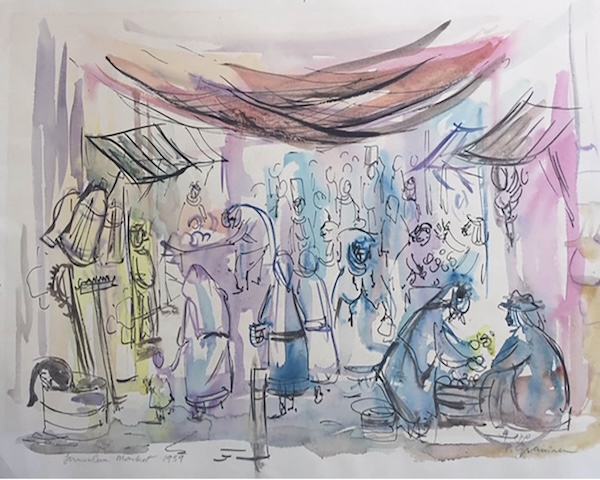
“Jerusalem Market, 1959,” watercolour and pencil, by artist Pnina Granirer, a graduate of Bezalel Academy of Art and Design in Jerusalem. Granirer will have a table of her artwork for sale in the atrium of the Jewish Community Centre of Greater Vancouver on Dec. 3, 10 a.m.-3 p.m., as part of the Chanukah Around the World party marketplace. The works will be unframed, priced from $100 to $500, with all proceeds being donated to Israel, in the hope that the donation will help it in its hour of need. For more on Granirer, go to pninagranirer.com.
The party is a joint event with multiple community partners: King David High School, Vancouver Talmud Torah, Richmond Jewish Day School, PJ Library, Camp Miriam, Jewish Museum and Archives of British Columbia, and the Kollel. In addition to the marketplace, it will feature games, iSTEAM activities, food, arts & crafts, museum displays, entertainment throughout, a community singalong and a JCC membership sale. Visit jccgv.com/jcc-chanukah-carnival.
“Dear Hostages, as the world rallies to celebrate your desecration I will not forsake you,” begins the poem written by Seattle-based multimedia artist and educator Loolwa Khazzoom. Posted on her Facebook page, with a #BringThemHomeNow poster featuring photos of Israelis kidnapped on Oct. 7, it continues, “My instinct is to deprive myself of oxygen / Because you are underground / And I will not forget you // But I know that you would dance / In the sun / If given the chance / So I now rise up / And dance for you.”
Many of Khazzoom’s songs begin as poems. In this case, she told the Independent, “I felt as if I could not breathe and as if I did not even want to breathe, out of solidarity with the hostages and with all of Israel, in particular, all the victims of the Oct. 7 massacre. It’s like I wanted to physically feel their pain and suffering, as a way of physically demonstrating that I would not forsake them or forget them.”
In a traumatized mental state, Khazzoom returned to the “healing tools of poetry and music,” which was another way she could show her solidarity and do her part in keeping the issue of the hostages in frontof people.
Similarly, Khazzoom and her band, Iraqis in Pajamas, recently released another poem-turned-song, “#MahsaAmini.” They did so this past Sept. 16, the first anniversary of the death of 22-year-old Mahsa Amini at the hands of Iranian “morality police.”
Finding out about Amini’s murder soon after it took place, from TikTok videos posted by Iranian women, Khazzoom “jumped into action.” She wrote to her political representatives, raised funds for United 4 Iran and reposted Iranian women’s videos on her feed constantly, to help boost the content’s views. “In addition,” she said, “a day after I found out about what happened, a poem with my feelings poured out of me, and I posted it on social media. Months later, I put that poem to a melody, and the band developed it into a full band song, which we released on the [anniversary of the] day of Amini’s murder.”
The death affected Khazzoom deeply for many reasons.
“First, the women in my family wore the abaya, the Iraqi equivalent of the hijab – Jewish women throughout the region were subject to Muslim dress codes, so it’s a Jewish issue, too,” she said. “Second, so many people assume that Islam is indigenous throughout the Middle East and North Africa, but it’s not. Arab Muslims rose up from the Arabian Peninsula and conquered the entire region, forcibly converting masses under the threat of death. So many indigenous ethnicities and religions predated the Muslim conquest, including Jews, Persians, Berbers and Kurds. The Iranian women protesting and burning their hijabs felt to me like challenging that Muslim conquest and awakening the ancient Persian warriors. Third, Persia is central to Jewish history and the origins of the Mizrahi community, dating back nearly three millennia ago…. And, lastly, the fire of these women, and the men who joined them, and their willingness to risk their lives for their dignity and freedom was just breathtaking and profoundly inspirational.”
Another of Iraqis in Pajamas’ releases this year was also intensely personal for Khazzoom.
“I wrote ‘The Convert’s Quest’ in response to some friends on social media sharing how hurt they were, coming under attack during the process of their conversion to Judaism. I had ample experience witnessing variations on this theme throughout my life – both first-person, seeing it happen to friends, and through my research as a Jewish multicultural educator. For decades, I felt very disturbed by this seemingly growing trend.
“I am the daughter of a Jew by choice, as my mother called herself, so the matter of conversion to Judaism is very personal for me,” she said. “I remember understanding very clearly as an Orthodox Jewish child that, according to halachah (Jewish law), once you convert, you are no longer to be called ‘a convert,’ but rather, a Jew, period. So, even from a religious Jewish perspective itself, I was very distraught by the ways that Jewish leaders and communities were rejecting or harassing converts, or even all-out forbidding people from converting. It all flies in the face of Jewish history, theology and practice.”
The band released “The Convert’s Quest” on May 24, on the harvest holiday of Shavuot, which celebrates the giving of the Torah to the Jewish people and on which the Book of Ruth is read. It tells the story of Ruth, a Moabite woman who converted to Judaism, whom Jewish tradition teaches will be the ancestor of the Messiah.
“To me, Jewish converts are the lifeblood of the Jewish people,” said Khazzoom. “I have a provocative line in my song, saying that converts are ‘the most Jewish Jews of all,’ because they are intentionally and consciously practising the foundational precepts of Judaism, which so many either take for granted or do rote, as is often the case in the Orthodox Jewish world where I was raised. In addition, amidst life-threatening levels of racism and violence against Jews, converts choose Judaism…. Why would we reject, in any way, from subtle to blatant, someone with such a heroic Jewish soul?”
Even when delivered in a playful manner, Khazzoom’s song are serious to the core. The campy “Kitchen Pirate,” for example, “emerged from my choice to reject the conventional option of surgery, in the wake of a cancer diagnosis in 2010,” she said. “Instead, I chose to radically alter my diet and lifestyle. Simply by overhauling my diet, I cold-stopped the growth of the nodules, which remained stable for the next five years – neither growing nor shrinking – until I returned to my lost-love of music, following which they began shrinking.”
Khazzoom said her songs “are always questioning, always challenging, always defiant. Sometimes, it’s more explicit, other times it’s embedded in silliness, which, parenthetically, I also see as defiant. I am and forever will be a curious, playful and awe-inspired child. I think that, if and when we ‘outgrow’ that, we die inside. And I refuse to capitulate to that norm of expected behaviour once we enter adulthood. By way of example, to this day, at age 54, when I am flying in a plane, if there is nobody sitting next to me, I will stretch out my arms and pretend I’m a bird, during takeoff.”
Not everyone has appreciated this aspect of her personality. “I have constantly gotten into trouble for it and have been at odds with my family, my community and society at large,” said Khazzoom. “I have endured terrible loneliness and often even self-doubt as a result. But I always come back to my core. And all of my songs emerge from that place – that raw, gut-wrenching place of being fiercely alive and allowing the clash with everything around me, and then writing about it.”
It is this enthusiasm that Victoria-based band member Mike Deeth enjoys about being in Iraqis in Pajamas, whose third member is Chris Belin.
“Loolwa and Chris are both easy-going, creative people. The energy is very positive, which makes collaborating with them fun and organic,” Deeth told the Independent. “Further, I appreciate the passion Loolwa has for the subject matter she writes about. One thing I always struggled with as a musician is ‘What do I have to say?’ At the end of the day, I’m a privileged guy who has never had to face oppression, hate, war or genocide. I have a lot of respect for artists who have experienced darker parts of humanity and have the courage to bring that perspective into their art.”
Born in Toronto, Deeth, who is not Jewish, spent most of his adolescence in Calgary, and moved to Vancouver Island when he was 18. He first picked up a guitar a few years earlier and has been playing ever since. “I was in my first band at 18 and played in bands throughout my 20s. For the past several years, I have been mainly focused on recording,” he said.
Mike Deeth (photo from Mike Deeth)
Deeth got hooked on music production in his teens, getting his first digital recorder at age 16. “I still remember pulling all-nighters with friends trying to write songs and get ideas down on tape. Production was always fascinating to me, as I could layer parts together into something bigger than I could ever play on my own.”
Deeth and Khazzoom met a couple of years ago through a Craigslist posting. “She was looking for a guitarist to contribute to an early version of her track ‘The Convert’s Quest,’” he explained, complimenting Khazzoom on the fact that she “puts her full heart into her songs.”
“I recorded some initial guitar demos and, about a year later, we reconnected and worked up the current releases,” he said.
Deeth adds guitar to the songs and completes the mix and master of the songs when they are ready for those steps. Khazzoom sings, writes and plays bass, while Belin – who lives in Pennsylvania – composes the drum parts and performs them.
Among his other music ventures, Deeth has “played the guitar with Bryce Allan, a country musician here on the island, and recorded a few tracks with him. I also work closely with Jennie Tuttle, another musician from Victoria. We have been recording together for seven or eight years now.”
For Deeth, “recording is such an interesting combination of art and science. I get to be musically creative, but I also get to play with cool machines, solve problems and think about gain staging, compression ratios and other technical aspects. I thoroughly enjoy both the artistic and scientific parts of the process – they work my mind in different ways.
“I also love how each project starts as a blank canvas and ends with a new piece of music out in the world. There are an almost infinite number of possibilities when recording a track (all the possible settings on the equipment, the subtleties of different instruments) and it always fascinates me how each song takes shape during the process.”
“Mike has an exquisite sensitivity in his musical composition, performance and recording,” said Khazzoom. “He’s not only super-talented and -skilled, but he’s warm, upbeat, enthusiastic and professional. It’s a joy to create music with him. As is the case with our drummer Chris Belin, Mike has an uncanny ability to capture the essence of the songs I write, to the point that I feel he is playing back to me the sound of my soul. I have literally sat and cried after hearing the mixes.”
For more on Khazzoom, visit khazzoom.com. For more on Deeth’s production and sound services, visit glowingwires.com.
The Ben-Gurion family in their Tel Aviv home, 1929. From left: David and Paula with youngest daughter Renana on Ben-Gurion’s lap, daughter Geula, father Avigdor Grün and son Amos. (photo from National Photo Collection of Israel / Government Press Office)
David Ben-Gurion, who died 50 years ago, insisted Israelis needed Hebrew names. The process was controversial – but the outcome is clear.
The 50th anniversary of the death of David Ben-Gurion will be marked Dec. 1. The first prime minister of Israel is generally remembered in noble terms, though we live in an era when heroes are being toppled from their plinths. His actions in times of war and peace have been parsed by historians – fairly and unfairly, as seems inevitable – but Ben-Gurion’s legacy among Zionists appears generally secure. Those with ideological axes to grind will grind, but the esteem in which most Israelis and overseas Jews view “the Old Man” remains largely favourable. However, an aspect of his policy that affected people in a very personal way has come in for a reconsideration in the past couple of decades, though it is hardly the stuff that will make or break a reputation. It is the Hebraization of names.
Ben-Gurion was a fierce advocate of Israelis (or, before 1948, Palestinian Jews) adopting names that reflect their new reality and that, by extension, turn their backs on the past and the diaspora. Ben-Gurion himself was born David Grün (or Gruen), changing his name to the Hebrew Ben-Gurion (son a lion cub) in 1910. By 1920, at the latest, he had become an evangelist for Hebraizing names and, when he was in power, he insisted that leading military and political figures adopt Hebrew names.
Ben-Gurion did not start this trend – though he is perhaps most closely associated with it because he was in a position to make it the force of law and custom. He instituted an administrative order that senior military figures and diplomatic officials representing Israel abroad must have Hebrew names. Others, like Golda Meir, he browbeat into the change.
Of course, Jews – and others – have been changing their names since the dawn of migration. People have frequently altered their names when moving to a new society, in order to fit in. Iberian Jews migrating en masse to the Low Countries after the expulsions of the 1490s are an early, well-documented example. Jews arriving on North American shores routinely changed their names, but so did non-Jewish migrants. It was not necessarily (or only) antisemitism that name-changers sought to outrun, but differentness in general. There are stories of French newcomers changing from Boisvert to Greenwood.
Dara Horn, in her book People Love Dead Jews, emphatically debunks the long-held belief passed down by generations that their family names had been changed at Ellis Island (or whatever entry point was appropriate to the story). No, she argues, that didn’t happen. The changing of names by Jewish new Canadians and Americans was, she contends, done by the migrants themselves and represents a sad realization that the Goldene Medina might not be the refuge from antisemitism they had hoped.
But changing one’s name to fit into a society already in progress, like America’s, was different than the situation of arriving in the pre-state Yishuv. This was not a matter of looking around for a local-sounding name and changing Moses to Murray or Lipschitz to Lipson. This required inventing a whole new lexicon of names. It was not the act of taking a common name in the new place, but of inventing entirely fresh first and last names.
The process was a legacy, ultimately, of Eliezer Ben-Yehuda (né Perlman), who was the driving force behind the revival of Hebrew as a vernacular language. After making aliyah in 1881, he came to believe that the redemption of both the people and the land of Israel required a new language to replace Yiddish. This represented a rejection of the diaspora reality and mentality, and served to create a medium through which an eventual (hoped-for) ingathering of exiles from around the world, including places where Yiddish was not the Jewish lingua franca, could communicate. The revival of an ancient land would coincide with the revival of an ancient language, both modernized to meet the needs of a new type of Jew. Ben-Yehuda raised his son and daughter exclusively in Hebrew, which must have made for a somewhat lonely childhood, being effectively the only two people in the world to speak the language as a mother tongue.
Eliezer Ben-Yehuda (né Perlman) was the driving force behind the revival of Hebrew as a vernacular language. (photo by Av Yaacov Ben Dov / Widener Library, Cambridge)
As the language spread – in large part thanks to Ben-Yehuda’s continued perseverance in promoting it and inventing modern words where the ancient language lacked them – the application of the new tongue to family and given names likewise grew.
The repudiation of the diaspora took on an entirely new relevance after the Holocaust. Some who made aliyah resisted changing their names, being attached, as is understandable, to one’s family name. Even so, no Jewish surnames were particularly long-established in the first place, since the practice of Jews adopting inheritable family names was only a century old, or a little more, at that time. The Austro-Hungarian Empire required Jews to take surnames in 1789 and in the Russian Empire and the German principalities not until the following century. At that time, choosing a name followed predictable patterns for Jews and non-Jews: a variation on “son of,” (Aronoff, son of Aron; Mendelsohn, son of Mendel), a reference to a profession (Becker for a baker; Melamed for a teacher), or a connection to the town or region (Frankel, from Franconia; Warshavski, from Warsaw; Wiener, from Vienna).
The adoption of Hebraized names in Palestine and Israel took four primary approaches.
The first was the traditional use of patronyms or matronyms, which is probably the oldest form of naming. Yiddish names, but also names that were German, Polish, Russian, English or French patronyms could be Hebraized: Davidson to Ben-David, Mendelson to Ben-Menachem, Simmons to Shimoni.
A second approach was to choose a Hebrew name that sounded like the original name. In some cases, the new name had a (sometimes remote) connotation with the original, as in the case of Lempel (little lamp) becoming Lapid (torch). Levi Shkolnik would become Israel’s third prime minister as Levi Eshkol. This was more than simply a near-homophone. It reflected another trend in the process, which was to adopt a name that spoke to the commitment of the chalutzim, the pioneers, whose Zionism was deeply informed by a back-to-the-land ethos. Eshkol means “cluster of fruit,” so it did double duty, sounding something like the original and also having a kinship with the blooming desert.
A third strategy was basic translation. Goldberg might become Har-Zahav (mountain of gold); Silver or Silverman might become Kaspi; Herbst, which in German and Yiddish means autumn, could be changed to a Hebrew equivalent, Stav or Stavi.
The fourth approach took the pioneer spirit and connection with the land to greater depths (with or without the homophonic advantage of Shkolnik/Eshkol). Flora, fauna and geography of the new homeland were attractive new names that situated the migrants linguistically and geographically. The writer Carrie-Anne Brownian cites such examples as Rotem (desert broom), Nitzan (flower bud), Yarden (Jordan), Alon (oak tree) and Tomer (palm tree). Simply adopting a place name gives us Hermoni, Eilat, Golani, Kineret and many others.
Those whose names already had a nature theme were at an advantage. The Haganah commander Moshe Klaynboym changed his family name, which meant “little tree” in Yiddish, to Sneh, Hebrew for “bush.”
Not necessarily related to nature, but to the idealization of the Zionist spirit, some took names like Amichai (my people live), Maor (light), Eyal (strength), Cherut (freedom) and Bat Or (daughter of light).
Golda Meyerson, after prodding from Ben-Gurion, became Golda Meir. Interestingly, her rather emphatically Yiddish given name she kept, presumably making Ben-Gurion half-satisfied.
Golda Meyerson, with prodding from David Ben-Gurion, became Golda Meir. (photo from mosaicmagazine.com)
As refugees from the Middle East and North Africa began pouring into Israel in the 1950s and ’60s, the Hebraization of names came to be seen as Ashkenormative, the taking of one’s ancestral name being another indignity (alongside inadequate housing and social stigmatization, among other things) that different-looking newcomers faced in their presumed Promised Land.
It seems, for example, that teachers encountering “strange” Mizrachi and Sephardi given names took it upon themselves, in some cases, to assign kids new names based not on any Zionist ideological imperative but for the same reason Canadian teachers in the early to mid-20th century dubbed kids with “foreign” names new ones the teachers could more easily pronounce. In retrospect, some have complained that this phenomenon was an insidious part of a larger (conscious, unconscious or some of both) effort to force Mizrahim and Sephardim to comport to Ashkenazi expectations even in things as intimate as a given name.
Sami Shalom Chetrit, a professor at Queens College in New York, who is of Moroccan-Israeli origin, recalled in a Forward article by Naomi Zeveloff, feeling outraged when an Israeli elementary school teacher nonchalantly renamed him, along with other non-Hebrew-named kids.
“Alif, your name from now on will be Aliza,” Chetrit recalled the teacher declaring. “Jackie, your name is Jacob, and Michele, your name is Michal. She kept going alphabetically. Then she said, ‘Sami, your name will be Shmuel Shalom.’
“I went to my father, crying.… I really felt like something was stolen from me, something precious. I said: ‘They changed my name! They changed it!’”
Chetrit’s father taught the teacher something the next day, according to the story. In Arabic, “Sami” comes from the root “samar,” the father said, meaning “heavenly superior,” and that, the father declared, is “international.”
The tendency eventually faded out. When a million migrants from the former Soviet Union arrived in Israel, after 1991, almost none chose to, or were pressured to, change their names.
There are contemporary exceptions even to this, though. Anatoly Shcharansky, one of the most famous of the Soviet “refuseniks,” became Natan Sharansky on arrival in Israel in 1986. The American historian Michael Bornstein became the Israeli politician-cum-diplomat Michael Oren, having changed his name when he made aliyah in 1979.
Newcomers to Israel today are free to change their names – and free to keep their “galut” (“exile”) names. Israel, today, is an overwhelmingly Hebrew society, though. New arrivals do not present a risk of swamping the place with Yiddish, Arabic, German, Polish or English, as might have seemed a danger 75 years ago, creating a Babel where cultural unity was desperately needed.
In addition to the psychological impacts of adopting Hebrew names (and language) as a refutation of the diaspora that had so recently been the locus of calamity, there was the practical reality of finding commonality among wildly diverse new citizens. That has been achieved. Even sorbing a million Russian-speaking new Israelis after 1990 did not dilute the ascendency of the Hebrew language. For whatever criticisms the forced (or vigorously encouraged) adoption of Hebrew names might invite, there is no doubt the intended outcome has been realized. Ben-Gurion’s dream not only of a Jewish state, but a Hebrew one, is firmly in place.