Skip to content
  • Home
  • Subscribe / donate
  • Events calendar
  • Business Directory
  • FAQ
  • News
    • Local
    • National
    • Israel
    • World
    • עניין בחדשות
      A roundup of news in Canada and further afield, in Hebrew.
  • Opinion
    • From the JI
    • Op-Ed
  • Arts & Culture
    • Performing Arts
    • Music
    • Books
    • Visual Arts
    • TV & Film
  • Life
    • Celebrating the Holidays
    • Travel
    • The Daily Snooze
      Cartoons by Jacob Samuel
    • Mystery Photo
      Help the JI and JMABC fill in the gaps in our archives.
  • Community Links
    • Organizations, Etc.
    • Other News Sources & Blogs
  • JI Chai Celebration
  • JI@88! video

Recent Posts

  • Or Shalom reopens its doors
  • JFS from past to future
  • Need holistic approach
  • Sharing stories, advice
  • Journalist shares fears
  • Skills to live together
  • Road to independence
  • Cutting grass with scissors
  • Zionism as a solution
  • Deceit, desire & the divine
  • Reclaiming sacredness
  • Creative project ideas
  • Summer squares and cobbler
  • Thou shalt … summer commandments
  • Legal help for students
  • Revisiting myth of Lilith
  • Wrong person rebuked
  • Canada’s mixed messages
  • Questions for museum
  • Symposium on antizionism
  • Making soccer political
  • CJPAC lauds Pulver’s impact
  • City recognizes Vrba’s legacy  
  • Organ donation saves lives
  • Theodore’s March premiere
  • A healing Shabbaton
  • Supplying healthy food
  • A chime of metal tags
  • Yellowknife seder a first
  • Ishai energizes, unifies
  • A Lag b’Omer to remember
  • Expanding the healing
  • Hannah Senesh – a unique hero
  • Community milestones … May 2026
  • Sharing her testimony
  • Fall fight takes leap forward

Archives

Follow @JewishIndie
image - The CJN - Visit Us Banner - 300x600 - 101625

Tag: Holocaust

Survivors a cautionary tale

Survivors a cautionary tale

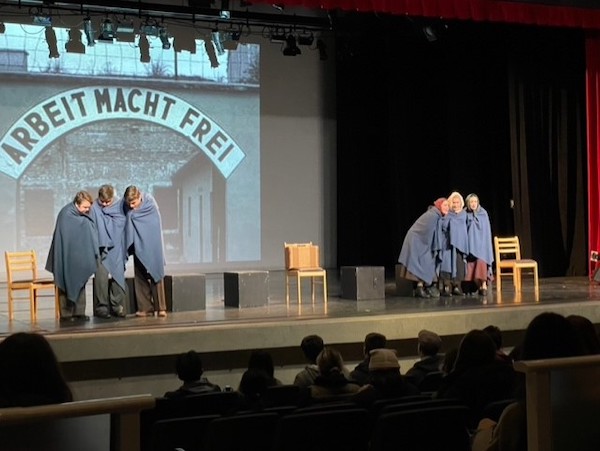
On Oct. 29 at the Phoenix Theatre in Victoria, there will be a one-night-only performance of Wendy Kout’s play Survivors, which is touring schools this month. (photo by Peter Nadler)

In light of the success of last year’s pilot tour, the educational play Survivors is touring middle and secondary schools throughout Vancouver Island this month. And, with the support of the University of Victoria, there will be one public performance of the play this month: at the Phoenix Theatre, Oct. 29, 2 p.m. Last year’s public shows sold out.

Following the mistaken honouring in Parliament recently of Ukrainian-Canadian Yaroslav Hunka, who fought in a Nazi unit during the Holocaust, there should no longer be any doubt about the ignorance of the history of the Holocaust. This conclusion is further supported by the existence of monuments in Canada that honour Nazi veterans who were members of the Galicia division of the SS in Ukraine. Furthermore, Canada’s Governor General Mary Simon has apologized for the Order of Canada given to Peter Savaryn in 1987. Savaryn was chancellor of the University of Alberta and president of the Progressive Conservative Party of Alberta in the 1980s – he also served with the Waffen-SS, a voluntary Nazi unit in Ukraine during the Second World War.

A 2019 study done by the Azrieli Foundation, Yad Vashem, the United States Holocaust Memorial Museum and the Claims Conference revealed Canadians’ lack of knowledge of this period in history. For example: 62% of millennials did not know that six million Jews were killed in the Holocaust and 22% of millennials hadn’t heard or were not sure if they had heard of the Holocaust. Nearly one-quarter of all Canadians believe that substantially fewer than six million Jews were killed (two million or fewer) during the Holocaust.

History shows that when it comes to racist attacks and xenophobia, Jews are often the “canary in the coal mine.” Holocaust awareness and education could not be more timely or important. “We’re not just telling history,” said Survivors playwright Wendy Kout. “We’re telling history as a cautionary tale for the present and the future.”

Survivors explores hatred, the capacity to survive and thrive, and serves as a call to consciousness of the present challenges. Combining history with life lessons, the audience is guided through a time when hatred was normalized. The audience is both uplifted by the survivors’ triumphs and inspired to take action against present and future racism.

The play tells a chronological history of the Holocaust through the personal prism of experience, interweaving the stories of 10 Holocaust survivors, four of whom were still alive when the play premièred in New York in 2018. Though each has a unique story, all the survivors “went through this horror and came through the other side to build meaningful, contributing, beautiful lives,” said playwright Wendy Kout.

The Victoria production of Survivors will be touring throughout the four Western provinces for the next few years. For more about those tours and the organizations collaborating on them, visit jewishindependent.ca/theatre-that-educates and holocausttheatre.com. For tickets to the Oct. 29 matinée at Phoenix Theatre, go to eventbrite.ca.

– Courtesy Victoria Theatre Productions

Format ImagePosted on October 12, 2023November 9, 2023Author Victoria Theatre ProductionsCategories Performing ArtsTags education, Holocaust, play, theatre, Victoria, Wendy Kout
A voice to Lithuania’s victims

A voice to Lithuania’s victims

Grant Gochin in J’Accuse!, which can be screened online as part of the South African Film Festival Nov. 2-12. (screenshot)

The award-winning film J’Accuse! is about the alliance between Grant Gochin, a Jewish activist for Lithuanian Holocaust truth, and Silvia Foti, the author of Storm in the Land of Rain, which reveals that her grandfather – Jonas Noreika – operated as a Nazi collaborator who ordered the massacre of thousands of Lithuania’s Jews. However, Lithuania continues to view Noreika as a freedom fighter because he fought against the Communists.

J’Accuse!, by filmmaker Michael Kretzmer, screens as part of the South African Film Festival, which runs Nov. 2-12, presenting more than 20 movies.

SAFF Canada brings together the combined histories and volunteer efforts of two in-person festivals – the Toronto South African Film Festival and the Vancouver South African Film Festival. When the pandemic hit in 2020, the organizations transitioned to one virtual South African Film Festival that could reach audiences across Canada. While most films are online, there are some in-person screenings and events in both Vancouver and Toronto.

photo - Silvia Foti in J’Accuse!, a documentary by filmmaker Michael Kretzmer
Silvia Foti in J’Accuse!, a documentary by filmmaker Michael Kretzmer. (screenshot)

The festival is part of, and raises funds for, Education without Borders, created in 2002 by local Jewish community members Cecil and Ruth Hershler.

“It is estimated that over 90% of South African Jews are Litvaks, [are] of Lithuanian descent,” said Cecil Hershler. “On a personal note, my maternal grandparents were born in Plunge. My grandmother, Ethel Sher, arrived on a ship in Cape Town in 1905 – she was 10 years old, she never saw her parents in Plunge again. On Ruth’s side, her paternal ancestors come from Riteva.”

More than 220,000 Jews – more than 95% of the prewar Jewish population – were murdered in the Holocaust. Kretzmer’s documentary exposes the scale and scandal of Lithuanian Holocaust denial by focusing on Noreika, who murdered as many as 14,500 Jews in the Plunge region in 1941. Gochin, whose family was murdered by Noreika, brought almost 30 legal actions against the Lithuanian government over more than three decades. In focusing on Noreika, the film also examines the role of the Lithuanian Genocide and Resistance Research Centre.

For tickets to watch J’Accuse! – the Vancouver Holocaust Education Centre is a community partner on the film – or any of the South African Film Festival offerings, go to saffcanada.ca.

– Courtesy Education without Borders

Format ImagePosted on October 12, 2023October 12, 2023Author Education without BordersCategories TV & FilmTags Grant Gochin, Holocaust, J'Accuse!, Jonas Noreika, Lithuania, Michael Kretzmer, SAFF Canada, Silvia Foti, South African Film Festival
Jews and superheroes

Jews and superheroes

Mark Leiren-Young (photo from Mark Leiren-Young)

From a neurotic gentleman who dresses like a bat, to a wise-cracking human spider, to a Super-Mensch appearing in the bulrushes, not to mention a green golem – it is impossible to escape the Jewish influences of comic superheroes, says Mark Leiren-Young, a creative writing instructor at the University of Victoria.

Put another way, Leiren-Young told the Independent, “It would be simpler to name the iconic comic superheroes who were not shaped by Jewish immigrants. It’s a very small list: Wonder Woman and Shazam. That’s it.  That’s all of them.”

In his classes, Leiren-Young and his UVic students examine and analyze the origins of the classic superheroes, almost all of whom were created by Jewish immigrants in the United States. In the first half of the 20th century, these creators were working in comics at least in part because they were not allowed to get jobs in advertising or journalism at the time. In other words, Jews were permitted to do the low-class work that “proper people” would not consider.

Superman, Batman, Spider-Man, Green Lantern, the Flash, Dr. Strange and numerous others on the superhero roster were all products of Yiddishkeit, according to Leiren-Young, whose classes on the DC Universe and the Marvel Universe are among the most popular electives at the university.

“One of the things that fascinated me when I did a deep dive into this – all of these Jewish creators were creating characters who were not shy about their religion, though there were none who overtly identified as Jewish. For example, Spider-Man’s sense of humour is absolutely Borscht Belt humour. It is Stan Lee’s humour,” he said, referring to the character’s creator. “Now, you’re seeing the actor playing Spider-Man (Andrew Garfield) saying he just assumed he was a Jewish character. That’s how he reads.”

The perceived Jewishness of the early manifestations of comic superheroes was not lost on the Nazis. In 1940, a copy of Look magazine, featuring a two-page segment on how Superman would end the war, made its way to the desk of Das Schwartze Korps, the weekly publication of the SS, in Germany. The Nazis attacked Superman’s creator, writing, “Jerry Siegel, an intellectually and physically circumcised chap who has his headquarters in New York, is the inventor of a colourful figure with an impressive appearance, a powerful body, and a red swim suit who enjoys the ability to fly through the ether.

“The inventive Israelite named this pleasant guy with an overdeveloped body and underdeveloped mind ‘Superman.’ He advertised widely Superman’s sense of justice, well-suited for imitation by the American youth. As you can see, there is nothing (they) won’t do for money!”

The Nazis, led by Joseph Goebbels, their chief propagandist, were concerned about Superman’s sense of justice, Leiren-Young contends. The effects of the German invective against Superman and his creators carried over to these shores as well, with DC Comics being picketed by American Nazis in 1940.

“The creators of Superman were living in a Jewish section of Cleveland and were emphatically impressed with the idea of social justice,” Leiren-Young said.

The Superman-going-to-war spread in Look magazine preceded another daring Jewish-inspired comic – Captain America punching Hitler – that would be published in 1941, before the United States entered the war.

The Jewish creators of Superman and Captain America essentially were going to war and defining Hitler as the enemy before any American troops were involved, Leiren-Young explained.

“Captain America was created to punch Hitler. He looks like a nerdy Jew until he gets the super serum and then turns into the All-American Hero, which also created protests from the American Nazi Party. These were controversial because there were still so many Americans who were really not keen on the United States going to war,” said Leiren-Young.

Such imagery continued after the war. In the 1961 comic “The Death of Superman,” for example, the setting for the trial of Lex Luthor, Superman’s archenemy, strongly resembles the trial of Adolf Eichmann in Israel.

In another postwar Jewish connection, the scientist who invented Captain America in the comic series looks increasingly like Albert Einstein as the story progresses.

Leiren-Young developed an interest in comics at an early age, “raiding” his uncle’s collection after Shabbat dinners. “He had everything, but for me it was all about the DC Comics. I remember there were all sorts of different comics, but a lot of DC superheroes,” said Leiren-Young, who has more than 15,000 comic books in his collection.

In 2014, when Swerve magazine asked writers across Canada to name the most influential book they read as a youth, Leiren-Young responded, “I’ve written a few stories about how and why I fell in love with comics, but I never imagined that having a collection of 15,000-plus comics would launch my career as a television writer or become a job qualification for teaching certain university classes,” he tells his students.

Leiren-Young has written and/or developed animated shows for Netflix, BBC Kids, ABC, Teletoon and other broadcasters. He has also written for BBC’s live-action CGI superhero series Ace Lightning, and his other cartoon credits include scripts for ReBoot, Transformers: Beast Wars, RollBots, Class of the Titans and Pucca.

Beyond his classes and comics, Leiren-Young is a playwright, author, journalist, filmmaker and performer. The Hundred-Year-Old Whale, a film he wrote and directed, received the 2017 Writers Guild of Canada award for best documentary. His memoir, Never Shoot a Stampede Queen, won the 2009 Stephen Leacock Memorial Medal for Humour.

Leiren-Young recently gave a talk about comic superheroes at Victoria’s Congregation Emanu-El and hopes to address a Vancouver audience about the subject in the near future. His knowledge and enthusiasm for comics extends well beyond the confines of a standard newspaper article. He recommends Up, Up and Oy Vey by Simcha Weinstein, Stan Lee: A Life in Comics by Liel Leibowitz and Is Superman Circumcised? The Complete Jewish History of the World’s Greatest Hero by Roy Schwartz for further reading on the subject.

Sam Margolis has written for the Globe and Mail, the National Post, UPI and MSNBC.

Format ImagePosted on July 21, 2023August 1, 2023Author Sam MargolisCategories LocalTags comics, education, Holocaust, immigrants, Mark Leiren-Young, superheroes, University of Victoria, UVic
Theatre that educates

Theatre that educates

Wendy Kout’s play Survivors is based on 10 real-life stories of young people’s Holocaust experiences. (photo by Peter Nadler)

Last year, Victoria-based Bema Productions and the Victoria Shoah Project collaborated on a pilot project: a nine-performance tour to middle and secondary schools of Survivors, a Holocaust-themed play by Wendy Kout. The success of the tour, which reached more than 1,100 students and 500 adults in the Victoria area, has led the organizations to broaden their reach throughout Vancouver Island, Metro Vancouver and other Western provinces beginning this autumn.

“Following our pilot tour in Victoria, we were asked to cover the Western provinces, and I happily accepted the challenge,” said Zelda Dean, the director of the play. “We will be touring to 30 schools on Vancouver Island in October 2023. In the fall of 2024, we will tour on the Mainland and in Alberta. Saskatchewan and Manitoba will be toured in 2025 – 150 performances in total will be presented.”

Citing a 2018 Canadian survey produced by the Azrieli Foundation, Yad Vashem, the United States Holocaust Memorial Museum and the Claims Conference, the Victoria organizers offer compelling reasons why Holocaust education is necessary today, particularly (but not only) for youth. According to the survey, 52% of millennials cannot name a concentration camp or ghetto; 62% of millennials did not know that six million Jews were killed in the Holocaust; 22% of millennials haven’t heard or are not sure if they have heard of the Holocaust; and 23% of all Canadians believe that substantially fewer than six million Jews were killed (two million or fewer) during the Holocaust, while another 24% were unsure of how many were killed.

“I have been alarmed at the ongoing rise in antisemitism for some years and have been looking for a suitable educational play. I had previously produced a play by Wendy and loved her work,” said Dean, regarding the selection of Survivors.

The intention of the one-hour play, suitable for those from Grade 6 to adulthood, is to provide a vehicle to teach lessons from the Shoah to younger audiences. Based on 10 real-life stories of young people’s Holocaust experiences, the play hopes to enable students to recognize the short- and long-term causes and effects of prejudice, discrimination and, ultimately, genocide. It also aims to foster critical thinking and bring the importance of human rights and social justice advocacy to the forefront.

Survivors goes through the chronological history of the Holocaust by enacting the experiences of Jewish children and teenagers from Europe. The young cast of six professional actors portrays the survivors, starting at innocence and continuing through the terrifying rise and rule of bigotry, xenophobia and violence, before they immigrate to America.

The play includes the true stories of a teen who watched her boyfriend being taken away to a concentration camp, a girl who was separated from her parents and relocated to England through the Kindertransport and a boy whose family struggled to escape to China.

Dean credited the young actors in the production for their diligence and dedication to their parts. “I put a casting call out and was delighted that a large number of very skilled young actors tried out for the roles. Those who were cast were tasked with doing considerable research into the Holocaust prior to rehearsals starting,” she said.

Survivors was originally commissioned and developed by CenterStage Theatre in Rochester, N.Y., in 2017, when Kout was asked to write a Holocaust play about survivors who had immigrated to the city. Shortly thereafter, while watching neo-Nazis march in Charlottesville, Va., Kout expressed the feeling that she was not simply writing an historical play but also a “warning play.”

The Victoria production in November and December 2022 – which played in school auditoriums, theatres and libraries, and had four public performances – was the first international tour of the play. There are other tours currently on both coasts of the United States, with Kout, along with the New York company that developed Survivors, creating a documentary on how the play came to be.

“Sharing the history of the Holocaust with students provides an important historical example of the dangers of allowing hatred and intolerance to take hold within a society,” said former B.C. minister of education Rob Fleming about the Victoria tour.

Additionally, several students who saw the play offered their input concerning how the performance affected them.

“I want to continue to learn more about the Holocaust and people’s stories. I’ve read [Elie Wiesel’s] Night and seen this play but other than that I haven’t heard many personal stories, so I’d like to learn more,” said one.

“I learned once again that I should not judge others selfishly based on race, religion, appearance or prejudice, and I will try to [remember that] whenever I meet new people from now on,” contributed another.

The organizers are looking for financial support to fund the upcoming Western Canadian tours.

“Over $450,000 is required to offer this powerful educational play to so many students, and we are actively fundraising to individuals, corporations, foundations, etc. We are running a campaign inviting folks to sponsor a school in their area for only $500,” Dean explained.

For more information about the play and to contribute, visit holocausttheatre.com or email [email protected].

Sam Margolis has written for the Globe and Mail, the National Post, UPI and MSNBC.

Format ImagePosted on July 7, 2023November 9, 2023Author Sam MargolisCategories Performing ArtsTags Bema Productions, education, Holocaust, survivors, theatre, Victoria Shoah Project, Wendy Kout, Zelda Dean
Remembering Alex Buckman

Remembering Alex Buckman

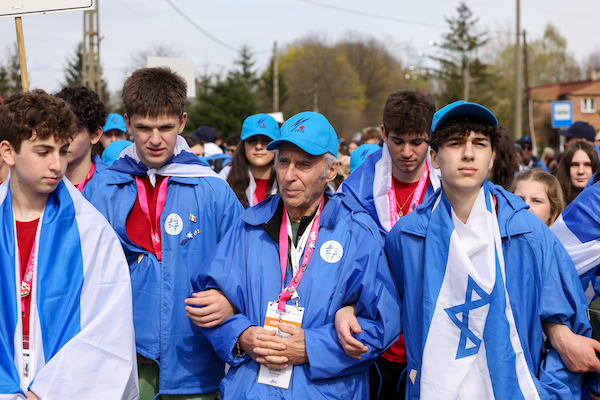
Alex Buckman with students on the March of the Living. (photo from thecjn.ca)

Alex Buckman, a tireless stalwart for Holocaust education in British Columbia and a steadfast advocate for his fellow child survivors, died in Warsaw on April 21. He was 83. Buckman had been on a trip to Poland accompanying the Coast-to-Coast Canada March of the Living delegation.

Described by those who knew and worked with him as a caring and gentle person, Buckman was president of the Vancouver Child Survivors Group, served as treasurer of the World Federation of Jewish Holocaust Survivors & Descendants and had, in recent decades, spoken to thousands of students in the province through the Vancouver Holocaust Education Centre.

In his 2017 memoir Afraid of the Dark, Buckman wrote that he felt compelled to share his story as a Holocaust survivor for two reasons: “First, I want others to know the price of hate. Hate destroys the lives of innocent people. It breaks families apart and its effects are felt for a lifetime. Second, and most importantly, I share my story to honour the memory of my parents. Talking about our stories gives them a chance to live again and gives me the opportunity to remember them.”

Born in Brussels, Buckman was seven months old when Germany invaded Belgium on May 10, 1940. At age 2, his parents sent him into hiding, and he would find shelter in a dozen different non-Jewish homes over the course of the following two years.

Buckman was next handed over to Andrée Geulen, a 20-year-old teacher, for safekeeping. Geulen, who helped to save many other Jewish children during the Holocaust and was later named one of the Righteous Among the Nations, moved Buckman to an orphanage in the town of Namor.

Buckman’s parents would ultimately be sent to Auschwitz-Birkenau, where they perished.

Under the care of his aunt, Rebecca Teitelbaum (Aunt Becky), Buckman immigrated to Canada in 1951. They settled in Montreal. As a young man, Buckman got his first job as a cost accountant for the bakery and delicatessen at a Steinberg grocery store. He went on to attend night school before entering Sir George Williams University to obtain a degree in accounting.

In 1962, he married Colette Roy, and they embarked on what he called a “normal life.” Their son Patrick was born in 1964 and, in 1967, he took his family west to Vancouver, where Buckman found a job as a housing officer for the Canada Mortgage and Housing Corporation. The position entailed developing homes for Indigenous people across British Columbia.

“It felt so good helping people move into their own homes. It really changed their lives and I loved meeting and working with the First Nations bands. I felt connected to them,” Buckman would write.

Concurrently, he developed an interest in running, competing in both half and full marathons.

Buckman had made a previous excursion to Poland to join the March of the Living in 2010, which he described as one of the “most meaningful” trips of his life. Speaking to the students traveling with him at that time, he reflected, “What will happen when we will go home? How will we deal with injustice? How will we continue to do all the things we have to do? How will you continue the legacy? How will you remember? I know I will remember you always. We spent a week in Poland together. I don’t think I would have made if it wouldn’t be for you. Some people tell me I was there for them – but most of you were there for me.”

He would further ruminate on that trip to Poland in his memoir, writing: “We Holocaust survivors, accompanied by students from around the world, silently walked the three kilometres that separate Auschwitz from Birkenau in tribute to all the innocent lives that were ended there. I walked into the shower room/gas chamber where my mother once stood, her arms most likely tightly holding onto her sister, in 1943. I wept, surrounded by people who truly understood my loss.”

Prior to that trip, Buckman had avoided speaking about his mother’s experiences to, as he said, “protect the kids from the grim reality of the death camps” – not wanting to tell young people that up to 2,500 people were killed at a time in the gas chambers. “But after I had stood in her place, I decided her death deserved to be spoken about.”

During his talks to young people, Buckman would often share the story of the recipe book his aunt created in a dangerous and defiant act while a prisoner at the Ravensbrück concentration camp, where she held an office job at a Siemens factory.

As a means to keep her mind off the dire conditions at a concentration camp, Rebecca Teitelbaum would reminisce about the family meals she prepared before the war. One evening while working at Siemens, she found some brown paper that she concealed in her dress. Later, after stealing a pencil and scissors, she went to her barracks and started cutting the paper into the little squares onto which she would write her recipes.

Buckman held on to the recipe book and, at his speaking engagements, he would leave his young audience members with a copy of Aunt Becky’s gâteau à l’orange (orange cake). He would ask the students to invite their families to make the cake together and to share his story with their mothers, fathers and siblings.

As he detailed in the final section of his memoir, by bringing families together through the recipe and having them share his story, Buckman’s hope was to stop the spread of hate and honour the memory of his own family.

“As a group, we thrived in his care,” said Vancouver author and child survivor Lillian Boraks-Nemetz. “He was a great speaker and carried an important message to masses of students against hate, intolerance and bigotry. Alex is and will be missed by all. May his soul continue to watch over us. May he rest in peace knowing that he is loved.”

Buckman is survived by his wife Colette; son Patrick and his wife Elsi (née Towes); grandchildren Alexander, Jameson and Rachael; and sister Annie Kidorf. Patrick Buckman had accompanied his father to Poland for the March of the Living.

Sam Margolis has written for the Globe and Mail, the National Post, UPI and MSNBC. This obituary was originally published in the Canadian Jewish News, thecjn.ca.

Format ImagePosted on June 23, 2023June 22, 2023Author Sam MargolisCategories LocalTags Alex Buckman, Holocaust, March of the Living, survivor
Helping Jews globally

Helping Jews globally

Candace Kwinter (photo from Jewish Federation)

“Tikkun olam,” said Candace Kwinter, Jewish Federation of Greater Vancouver board chair and Jewish Agency for Israel board member, about what drives her to donate so much of her time and energy both locally and globally.

“I feel it in my heart and soul to assist every Jew in the world who needs help in whatever way necessary,” said Kwinter, who is concluding her two-year term as chair. She will continue with the board as immediate past chair.

As board chair, Kwinter works alongside fellow volunteers and Federation staff.

“We provide our more than 30 partner agencies, including the day schools, supplementary Hebrew schools, Jewish Family Services, the Jewish Community Centre and more, with support, not only through funding but by bringing our partners together to collaborate and innovate to meet our community’s evolving needs today and in the future,” she said.

With the Jewish Agency, Kwinter attends the board of governors meetings twice a year; additionally, she sits on the agency’s aliyah, unity of the Jewish people, and antisemitism committees.

“With antisemitism on the rise and aliyah doubling because of Ukraine and Russia, the Jewish Agency has been extremely busy. We are working hard to connect Israelis to world Jewry and, from a local perspective, more Jews in British Columbia specifically,” she said.

According to Kwinter, the partnership between Federation and the Jewish Agency is vital because each can achieve much more by joining forces. She noted that it is the federation system across North America – not only the local federation – that partners with the Jewish Agency by financially supporting the agency’s work on the ground.

“The impact our community can make at an international level is so much greater when we work together,” she said. “Locally, Federation supports the Jewish Agency and the Joint Distribution Committee (JDC) with funding to assist world Jewry in aliyah, humanitarian needs and security concerns, as well as bridging the gaps between Israelis and world Jewry.”

Largely due to the global pandemic, needs have shifted during Kwinter’s time on both boards. “COVID changed everything. We all had to pivot when the pandemic hit and it created a lot of uncertainty,” she said.

Among the social consequences resulting from COVID-19 – locally, in Israel and around the world – have been increased food insecurity, a surge in mental health issues, inflation and isolation. In 2022, humanitarian needs were exacerbated by Russia’s invasion of Ukraine, thereby increasing the demand for aliyah.

“I am incredibly proud of the way our community responded and, because of the partnerships already in place with organizations like the JDC and the Jewish Agency, we were able to get people the help they needed quickly and effectively,” said Kwinter.

Concurrent with the European conflict, the Jewish Agency established Tzur Israel at the beginning of 2022 to unite the remaining Ethiopian Jews with their families in Israel, she said. “Once again, world Jewry came together to fund the aliyah segment – the Israeli government funds the entire absorption costs. I had the privilege of being on the first plane of Operation Tzur Israel last June, where we brought 179 Ethiopians to Israel. It was incredible.” (See jewishindependent.ca/israels-new-ethiopian-airlift.)

Kwinter’s love of Israel derives from a concern about antisemitism and the history of the Holocaust and a commitment to “Never Again.”

“To me, Israel represents ‘Never Again’ and gives me a sense of security as the homeland for every Jew in the world,” Kwinter said. “It is with great pride I speak of Israel and all it has achieved in the past 75 years. It is truly a beacon of tikkun olam and innovation, for all the world to benefit. It is a light among the nations.”

Kwinter holds 40-plus years of experience in financial services, including owning and operating her own financial services agency for 29 years, before selling it in 2017. She has been involved with Federation in various capacities and volunteers with the Jewish Community Foundation of Greater Vancouver, the Canadian Jewish Political Affairs Committee, and the Centre for Israel and Jewish Affairs, Pacific Region. She is president of the North Shore Jewish Community Centre / Congregation Har El, having also served as synagogue president from 2005 to 2007. From 2008 to 2011, she served on the Pacific Northwest Region of the United Synagogue of Conservative Judaism.

Sam Margolis has written for the Globe and Mail, the National Post, UPI and MSNBC.

Format ImagePosted on June 23, 2023June 22, 2023Author Sam MargolisCategories LocalTags Candace Kwinter, Holocaust, Israel, Jewish Federation of Greater Vancouver, tikkun olam, volunteerism

This year’s book award winners

image - The House of Wives book coverThe fourth edition of the Western Canada Jewish Book Awards, presented by the Cherie Smith JCC Jewish Book Festival, culminated in a May 24 event at the Jewish Community Centre of Greater Vancouver at which the winners in six categories – fiction, non-fiction, memoir/biography, children and youth, poetry, and Holocaust writing – were announced.

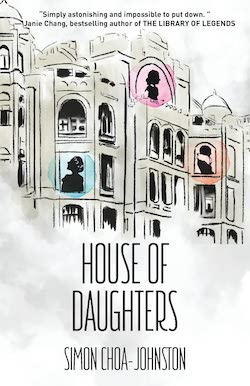
Winning the Nancy Richler Memorial Prize for fiction was Simon Choa-Johnston for House of Daughters, a stand-alone sequel to The House of Wives. Based on the author’s family, this multi-generational family saga opens when Emanuel Belilios, a wealthy Jewish opium oligarch, suddenly leaves Hong Kong, and his junior-wife, Pearl, blames Semah, the senior-wife. Pearl kicks Semah out of the mansion where the polyamorous trio had lived and shuns everyone, including her daughter. This is a story of passions and regrets, wealth and survival, set in Eurasian Hong Kong’s high society.

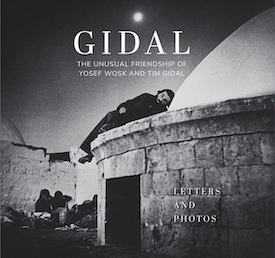
image - Gidal coverIn the non-fiction category, the Pinsky Givon Family Prize went to Alan Twigg, editor of Gidal: The Unusual Friendship of Yosef Wosk and Tim Gidal, a selection of letters between Israeli Tim Gidal, a pioneer in photojournalism, and Vancouver scholar and art collector Yosef Wosk. In the late 1920s, with his handheld Leica, Gidal was able to travel in interwar Europe, capturing rare images of Polish Jews prior to the Holocaust. Wosk first encountered Gidal’s work in a magazine in 1991 – the photo “Night of the Kabbalist” captivated him. Wosk was determined to meet the photographer and eventually did. The two became close and the letters – selected by Twigg from hundreds the friends exchanged over two decades – both memorialize Gidal as an artist, scholar, historian of photography and “hero among the Jewish people,” and also capture the essence of Gidal and Wosk’s friendship.

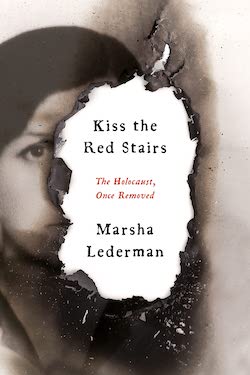
image - Kiss the Red Stairs coverThe Cindy Roadburg Memorial Prize for memoir/biography was given to Marsha Lederman for Kiss the Red Stairs: The Holocaust, Once Removed. In it, Lederman delves into her parents’ Holocaust stories in the wake of her own divorce, investigating how trauma migrates through generations. At the age of 5, Lederman asked her mother why she didn’t have any grandparents, and her mother told her the truth: the Holocaust. Decades later, her parents having died and now a mother herself, Lederman began to wonder how much history had shaped her life and started her journey into the past, to tell her family’s stories of loss and resilience.

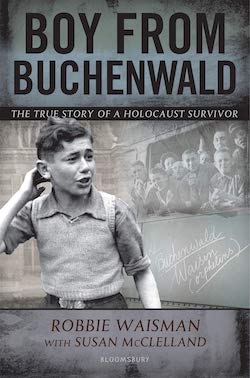
image - Boy from Buchenwald cover Boy from Buchenwald by Robbie Waisman (with Susan McClelland) took the Diamond Foundation Prize for children and youth writing. In 1945, Robbie Waisman, then Romek Wajsman, had just been liberated from Buchenwald, a concentration camp where more than 60,000 people were killed. He was starving, tortured and had no idea if his family was alive. Along with 472 other boys, these teens were dubbed “the Buchenwald Boys.” They were angry at the world for their abuse, and turned to violence: stealing, fighting and struggling for power. Few thought they would ever be able to lead functional lives again, but everything changed for Romek and the other boys when Albert Einstein and Rabbi Herschel Schacter brought them to a home for rehabilitation.

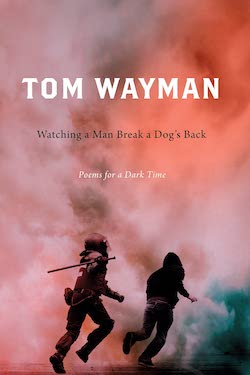
image - Watching a Man Break a Dog’s Back coverThe Betty Averbach Foundation Prize for poetry went to Tom Wayman’s Watching a Man Break a Dog’s Back: Poems for a Dark Time, which explores the question of how to live in a natural landscape that offers beauty while being consumed by industry, and in an economy that offers material benefits while denying dignity, meaning and a voice to many in order to satisfy the outsized appetites of a few. A cri de coeur from a poet who has long celebrated the voices of working people, the collection also grapples with why “anyone, in this era so profoundly lacking in grace, might want to make poems – or any kind of art.”

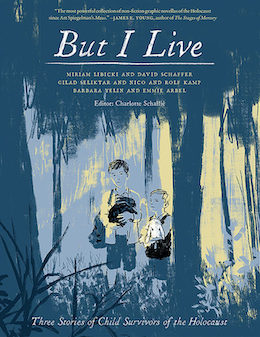
Rounding out the awards was the Kahn Family Foundation Prize for Holocaust writing, which was given to But I Live: Three Stories of Child Survivors of the Holocaust by Charlotte Schallié (editor) and illustrators Miriam Libicki, Barbara Yelin and Gilad Seliktar. But I Live is a co-creation of the novelists and four Holocaust survivors: David Schaffer, brothers Nico and Rolf Kamp, and Emmie Arbel. Schaffer and his family survived in Romania due to their refusal to obey Nazi collaborators; in the Netherlands, the Kamps were hidden by the Dutch resistance in 13 different places; and, through the story of Arbel, who survived Ravensbrück and Bergen-Belsen concentration camps, we see the lifelong trauma inflicted by the Holocaust. The book includes historical essays, a postscript from the artists and words of the survivors.

image - But I Live coverEach category in the 2023 Western Canada Jewish Book Awards was assessed by five jurors, in different configurations, from the following professionals: Linda Bonder, a retired librarian; Susanna Egan, professor emeritus of literature in English from the University of British Columbia; Dave Margoshes, who writes fiction and poetry on a farm west of Saskatoon; Norman Ravvin, a writer, teacher and critic living in Montreal; Rhea Tregebov, an author of fiction, poetry and children’s picture books, and a retired professor in the UBC Creative Writing Program; Elisabeth Kushner, a librarian and writer living in Vancouver; Karen Corrin, former head librarian of the Isaac Waldman Jewish Public Library at the JCC; Nicole Nozick, former executive director of the Vancouver Writers Fest and former director of the JCC Jewish Book Festival; and Anita Brown, who is working with the Waldman Library.

Daniella Givon, chair of the awards committee, introduced the May 24 event, sharing a bit about the awards and thanking all the sponsors and participants for the high calibre and diversity of the submissions. The winning authors then said a few words, and Dana Camil Hewitt, director of the JCC Jewish Book Festival, closed the proceedings with more thank yous, and an invitation for everyone to purchase and enjoy the books.

– Courtesy Cherie Smith JCC Jewish Book Festival

Posted on June 9, 2023June 8, 2023Author Cherie Smith JCC Jewish Book FestivalCategories BooksTags Alan Twigg, Barbara Yelin, Charlotte Schallié, David Schaffer, Emmie Arbel, fiction, Gilad Seliktar, Holocaust, Marsha Lederman, Miriam Libicki, Nico Kamp, non-fiction, photography, poetry, Robbie Waisman, Rolf Kamp, Simon Choa-Johnston, Susan McClelland, Tom Wayman, Western Canada Jewish Book Awards, writing
Düsseldorf returns painting

Düsseldorf returns painting

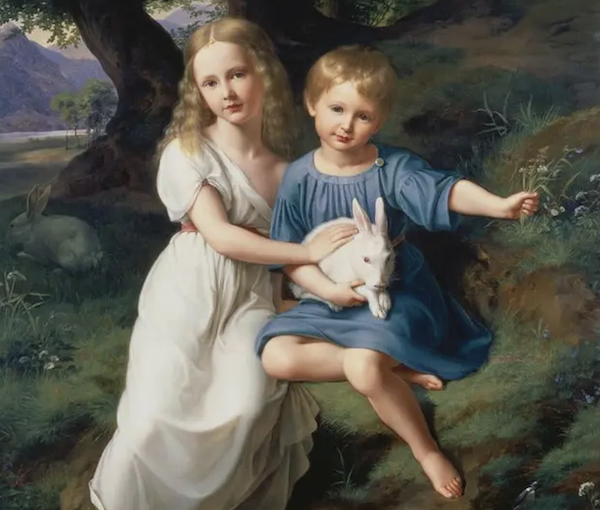
Wilhelm von Schadow’s “The Artist’s Children” (1830).

The German city of Düsseldorf reached an agreement recently with the heirs of Max Stern (1904-1987), a Jewish art dealer forced to flee the city in 1937, ending a long-standing battle over the ownership of a painting, according to The Art Newspaper, which first reported the deal.

The family portrait from 1830, “The Artist’s Children,” by 19th-century Romantic painter Wilhelm von Schadow, has been held by the city since 1959, when it acquired the canvas from a private collector. It was discovered when a researcher from the National Archives in Ottawa found it in a catalogue for a 1967 Düsseldorf Museum Kunstpalast exhibition, which listed the painting’s location as the Stadtmuseum. In recent years, the Max Stern Art Restitution Project, based at Montreal’s Concordia University, and the Dr. Max and Iris Stern Foundation sought to reclaim it, contending that Stern sold the painting under duress.

Founded in 2002, the Stern Project, headed by Dr. Clarence Epstein, is seeking to track down the 220 Old Masters and Northern European artworks that formed Lot 168 in the November 1937 sale at Cologne’s Mathias Lempertz auction house, known as Auktion 392. The paintings constituted the inventory of Düsseldorf’s Galerie Stern that Nazi officials forced him to liquidate at vastly discounted prices. As well as the 1937 auction canvases, the Stern Project is seeking to regain the paintings the art dealer left with Cologne shipping agent Josef Roggendorf, which the Gestapo confiscated in 1938, when Stern was already in Britain.

As part of the agreement, Düsseldorf handed over the portrait on condition that the municipality immediately buys it back. The terms of the settlement, including how much the city paid to re-acquire the artwork, were undisclosed.

In a press release, Düsseldorf mayor Stephan Keller said he was pleased with the “fair and just solution” between the parties and that von Schadow’s artwork “will remain in Düsseldorf.” He added that the painting will go on view at the city’s Museum Kunstpalast starting in August.

Stern took over Galerie Stern on Königsallee, which was founded by his father Julius, in 1934. By order of the Nazi government, the gallery was “aryanized” in 1937. Its inventory was sold at a forced auction for a fraction of its value.

Armed with a single suitcase stuffed with his remaining possessions, Stern fled to London that year. But, in May 1940, when Hitler’s invasion of Britain seemed imminent, Scotland Yard rounded up more than 2,000 German and Austrian citizens, mostly Jews, and incarcerated them as enemy aliens. Stern was sent to an internment camp on the Isle of Man.

Hearing that some detainees were being sent to Canada to free up soldiers guarding British camps, Stern volunteered to join them. In North America, he believed, he would be well-positioned to help his mother and one sister in Britain, as well as his other sister and her family in France. But Canada, where he was greeted by bayonet-wielding soldiers, was even less hospitable than Britain. As Stern recalled years later, “We had to stage a hunger strike to convince the Canadian authorities that we were certainly not Nazis but, on the contrary, anti-Nazi.”

Held in a camp first near Fredericton, N.B., and later in Farnham, Que., he was put to work cutting down trees. Still, he remained optimistic, thankful for the food, shelter, clothing, exercise and 20 cents per day in pay. He also welcomed the opportunity to teach. Twelve years earlier, he had earned a doctorate in art history, which he put to use in classes for his fellow internees.

Stern’s talent and positive outlook caught the attention of William Birks, scion of the Montreal jewelry family, who headed the local branch of the National Committee on Refugees. Birks was openly critical of Canada’s restrictive and antisemitic immigration policy, which he called “narrow, bigoted and very short-sighted.” He believed the government should have sent trade missions to Europe to recruit men like Stern, “not wait for them to seek and beg us.” In 1941, he sponsored Stern’s release and move to Montreal.

Needing a job and hoping to assist in Canada’s war effort, Stern looked for work in an airplane factory. When he was not hired, he turned to the thing he understood best – art. “You’ll starve,” people told him, but he was certain he could be successful as a dealer in Montreal, because he had spotted a void he knew how to fill. Most of the city’s galleries were pushing stuffy 19th-century European genre and landscape paintings. No one was promoting or selling home-grown works because, as he later explained, “Canada didn’t have any confidence in its own artists.”

Stern pitched his vision to Rose Millman, who had just opened a space on rue Sainte-Catherine called the Dominion Gallery of Fine Art. Impressed by his assurance and expertise, she offered him a job for $12.50 a week. Stern said he wanted $17.50 and her promise to make him a full-fledged partner once he built up her business by conquering Canada, as he put it, “by selling Canadian artists.”

Within months, he was mounting exhibitions by contemporary Canadian painters. Over the years, they would include John Lyman, Goodridge Roberts, E. J. Hughes, Stanley Cosgrove, Jean-Paul Riopelle, and others whose names he would play a pivotal role in establishing. Stern secured their loyalty and best work by offering them monthly retainers for an agreed-upon number of works, already an established practice in France, Britain and the United States, but not yet in Canada.

Stern’s first major coup came in 1944, when he visited Emily Carr, then 72, at her home in Victoria. She showed him a room packed with 300 paintings. Struck speechless by her talent, he asked if he could mount an exhibition.

Laughing, she replied, “You will not sell a single painting.” The recipient of critical praise, Carr had yet to enjoy commercial success. “If you let me choose the paintings,” Stern replied, “I think I can make it a perfect success.”

In 1947, Stern and his wife Iris became the sole owners of the gallery.

Following the defeat of Nazi Germany, Stern endeavoured to track down his confiscated paintings. His efforts were largely unsuccessful. He died childless in 1987, and left his estate to Concordia University and McGill University in Montreal, as well as Hebrew University in Jerusalem.

The three schools later founded the Max Stern Art Restitution Project to reclaim the estimated 400 artworks lost during the 1930s. To date, the project has recovered 24 pieces, including paintings by Otto Erdmann, Nicolas Neufchatel and Jan Brueghel the Elder.

The case of von Schadow’s “The Artist’s Children” proved to be particularly complicated due to questions of provenance. When the city of Düsseldorf acquired the portrait in 1959, it was hung in the office of the city’s mayor. Decades later, when the Stern Foundation filed a claim for the artwork, it pointed out that, in 1937, Galerie Stern allowed for the piece to be reproduced in a book about paintings of children. But Düsseldorf city officials pushed back, arguing that the book did not prove the gallery owned the artwork at that point. There was no evidence of the painting being surrendered under Nazi persecution, the city contended.

In 2017, a scheduled exhibition in Düsseldorf about Stern and the Restitution Project was abruptly canceled due to local opposition, leading to intense controversy. The city’s stance apparently softened following the 2020 municipal elections.

“We couldn’t prove that it was not a restitution case, so we, as the city government, recommended to the assembly that it should be restituted,” Miriam Koch, the Düsseldorf city official in charge of culture, told The Art Newspaper. “The big parties in the city council supported restitution.”

According to Lynn H. Nicholas’ 1995 book The Rape of Europa: The Fate of Europe’s Treasures in the Third Reich and the Second World War, more than 140,000 pieces of artwork were looted under the Nazi regime. Most of them remain unclaimed.

Gil Zohar is a writer and tour guide in Jerusalem.

Format ImagePosted on May 26, 2023May 26, 2023Author Gil ZoharCategories Visual ArtsTags art, Düsseldorf, history, Holocaust, Max Stern Project, restitution, Wilhelm von Schadow
Flamenco of contrasts

Flamenco of contrasts

Lili Flamenco / Liat Har Lev performs two solos in the Dance Centre’s Open Stage Edition #3 on May 6, 8 p.m. (photo from Lili Flamenco)

The Scotiabank Dance Centre’s Open Stage Edition #3 on May 6 includes two solos choreographed and performed by Lili Flamenco / Liat Har Lev: We Shall Not Forget, dedicated to the six million Jews killed in the Holocaust, and Lemons, in the flamenco style Alegrias, which means “happiness” in Spanish.

“Although my family was not directly affected by the Holocaust, growing up in a Jewish family I heard and learned about it…. I created this piece with the hope that I and the audience will connect to the experience of the victims and survivors on a deeper level and remember what they endured just because they were Jewish,” Har Lev told the Independent.

In contrast, she said, “Lemons has an uplifting, joyful mood and a vibrant rhythm, harmony and pulse. It has more of a traditional flamenco flavour and will be performed with a guitarist [Peter Mole] and singer [Pat Keith]. It is inspired by my personal artistic journey and celebrates optimism and grit. I chose to perform it in conjunction with We Shall Not Forget because it has a lighter mood … and is completely different stylistically.”

Har Lev performed We Shall Not Forget last year as part of the Dance Centre’s International Dance Day events. (See jewishindependent.ca/a-celebration-of-dance.)

“I started developing We Shall Not Forget in 2020 during the pandemic with the support of the 12 Minutes Max program. I had access to support and feedback from facilitators, I received subsidized studio space at Scotiabank Dance Centre, and had the opportunity to participate in an informal public showing which, unfortunately, had to be featured on Zoom because of the pandemic. I never actually performed We Shall Not Forget to a live audience.”

In addition to Har Lev, Open Stage Edition #3 features dance works by Kiruthika Rathanaswami and Malavika Santhosh (in the classical Indian dance style of bharata natyam), Lili Shilpa Shankar (bharata natyam) and Voirelia Dance Hub (contemporary dance). For tickets, visit thedancecentre.ca.

Har Lev will also be performing at the Festival of Israeli Culture at the Jewish Community Centre of Greater Vancouver on May 14.

Format ImagePosted on April 28, 2023April 26, 2023Author Cynthia RamsayCategories Performing ArtsTags Alegrias, dance, Festival of Israeli Culture, flamenco, Holocaust, Liat Har Lev, Lili Flamenco, Scotiabank Dance Centre

Witness to “longest hatred”

The Vancouver Holocaust Education Centre maintains significant holdings of Nazi and antisemitic propaganda that bears witness to centuries of anti-Jewish hatred. Acquired through the generosity of local historians and collectors – Peter N. Moogk, professor emeritus, history, University of British Columbia; Kit Krieger, Joseph Tan, Harrison and Hilary Brown, and others – the propaganda in the VHEC collection promoted antisemitic stereotypes, including Nazi ideology, in Europe and North America from 1770 to the postwar period. Although the content is offensive, these primary sources serve as an important historical record of the “longest hatred.”

The study of propaganda is critical to Holocaust scholarship. Historic antisemitica reveals a cultural tradition in Europe that the Nazis were able to exploit in pursuit of their “Final Solution.” The stereotypes found in Nazi propaganda were hardly new; Nazi propaganda was built upon the same antisemitic rhetoric and tropes that had been repeated over centuries and across countries and continents. Viewed in this context, propaganda provides insight as to why the Nazis’ message met with little resistance from an audience familiar with the language and imagery of anti-Jewish hatred.

The study of propaganda is also important to our understanding of the use of a state’s authority to control targeted segments of its population. This dynamic is explored in the VHEC’s new exhibition, Age of Influence: Youth & Nazi Propaganda. Drawing upon diverse primary sources, Age of Influence examines the Nazis’ efforts to manipulate the experiences, attitudes and aspirations of German children and teens.

photo - Photograph of a girl wearing the uniform of the League of German Girls, circa 1940. Donated by Peter N. Moogk
Photograph of a girl wearing the uniform of the League of German Girls, circa 1940. Donated by Peter N. Moogk. (photo from VHEC)

Many of the materials featured in this exhibition will be new to visitors, such as family photographs, Nazi youth magazines and anti-Roma youth fiction. Other artifacts will be instantly recognizable, like the infamous children’s books on display at the VHEC for the first time: The Poisonous Mushroom (Ernst Hiemer, Der Giftpilz, Nuremberg: Stürmerverlag, 1938) and Trust No Fox (Elvira Bauer, Trau keinem Fuchs auf grüner Heid und keinem Jud auf seinem Eid [Trust No Fox on his Green Heath and No Jew on his Oath], Nuremberg: Der Stürmer Verlag, 1936). Age of Influence is designed to encourage active engagement with these artifacts and images. Throughout the exhibition, questions prompt visitors to critically analyze materials on display and identify common techniques used to disseminate both positive and negative propaganda.

The exhibition’s storyline begins in the early 20th century, when youth in Germany started defining themselves as a distinct socio-cultural group, attracting the attention of parties across the political spectrum. Popularized by youth-led groups like the Wandervogel, the German youth movement sought independence from adult authority and embraced communal and back-to-nature ideals. Their activities focused on hiking, survival skills and group pursuits in nature. Against this backdrop, the Nazi party emerged and cast itself as the future-facing “movement of youth.” With its Hitler Youth organization, the Nazi party tapped into the German youth movement and set its sights on this demographic to shape the future of a “racially pure” and physically fit national community.

Age of Influence examines how the Hitler Youth became the regime’s most effective tool to indoctrinate children and teens in Nazi ideology. It offered German youth a powerful group identity and appealed to adolescent yearnings such as the desire to belong, the quest for action and adventure, a sense of purpose and independence from parents. With separate organizations for boys and girls, Hitler Youth glorified gender roles. Boys were prepared for military and leadership responsibilities while girls were groomed to become wives, mothers and caregivers for the nation.

image - June 1934 issue of Der Aufbruch, a Hitler Youth magazine. Donated by Joseph Tan
June 1934 issue of Der Aufbruch, a Hitler Youth magazine. Donated by Joseph Tan. (image from VHEC)

An array of Nazi youth magazines from 1934 to 1943 are featured in Age of Influence, as well as family photographs, collectible cigarette cards, video clips and Hitler Youth paraphernalia. Visitors can browse the pages of Nazi youth magazines to discover for themselves the eye-catching fonts, unique graphics and captivating images, which were carefully designed to attract young audiences. At its height, the Nazi youth press published 57 different magazine titles for children.

While participation in Hitler Youth was compulsory for most children, Jewish youths were banned from membership. Their experience is given voice in the exhibition by local survivors. In video testimony clips, Serge Vanry, Jannushka Jakoubovitch and Judith Eisinger describe their feelings of fear, shame and rejection as Jewish children confronted with pervasive antisemitic propaganda and excluded from the activities of their non-Jewish peers.

Perhaps the best-known propaganda tactic used by the Nazis was the creation of common enemies. Antisemitism and racism were key educational goals in the Nazi German school system, where students were taught that the health of the German nation was threatened by “inferior” groups like the Jews, Roma and individuals with disabilities. By demonizing and scapegoating these groups, the Nazis created a climate of hostility and indifference toward their treatment. Age of Influence depicts this process with reference to artifacts such as children’s books and instructional posters used in German schools.

Contextualizing Nazi propaganda within a broad historical framework is essential. For this reason, Age of Influence has been mounted in conjunction with In Focus: The Holocaust through the VHEC Collection. In Focus presents a thematic history of the Holocaust, illustrated by artifacts donated to the VHEC by local survivors and collectors. A curated selection of antisemitica in this exhibition conveys the long-held perceptions and representations of Jews through time.

This history is also important as we navigate escalating antisemitism and racism around the globe and in Canada, where reports of antisemitic incidents have reached record levels. The use of digital media has amplified hate, and the ease with which disinformation can be spread on social media platforms perpetuates Holocaust distortion and denial. In this milieu, it is imperative to equip students with the media literacy skills required to critically evaluate information they encounter. Age of Influence will assist educators to promote key curricular objectives such as digital literacy, critical thinking and social responsibility.

For more information on Age of Influence and In Focus, visit vhec.org.

Lise Kirchner has worked with the Vancouver Holocaust Education Centre since 1999 in the development and delivery of its educational programs. She was part of the exhibition team that developed Age of Influence: Youth & Nazi Propaganda, along with Tessa Coutu, Franziska Schurr and Illene Yu. This article was originally published in the VHEC’s Spring 2023 issue of Zachor.

Posted on April 28, 2023April 26, 2023Author Lise KirchnerCategories LocalTags antisemitism, education, exhibits, Holocaust, Nazis, propaganda, Vancouver Holocaust Education Centre, VHEC

Posts pagination

Previous page Page 1 … Page 6 Page 7 Page 8 … Page 44 Next page
Proudly powered by WordPress