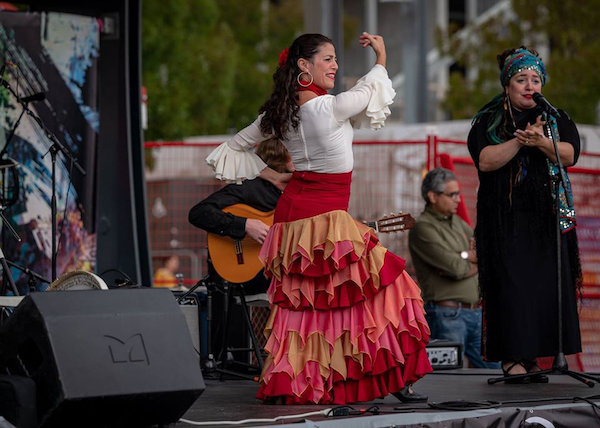
Lili Flamenco / Liat Har Lev performs two solos in the Dance Centre’s Open Stage Edition #3 on May 6, 8 p.m. (photo from Lili Flamenco)
The Scotiabank Dance Centre’s Open Stage Edition #3 on May 6 includes two solos choreographed and performed by Lili Flamenco / Liat Har Lev: We Shall Not Forget, dedicated to the six million Jews killed in the Holocaust, and Lemons, in the flamenco style Alegrias, which means “happiness” in Spanish.
“Although my family was not directly affected by the Holocaust, growing up in a Jewish family I heard and learned about it…. I created this piece with the hope that I and the audience will connect to the experience of the victims and survivors on a deeper level and remember what they endured just because they were Jewish,” Har Lev told the Independent.
In contrast, she said, “Lemons has an uplifting, joyful mood and a vibrant rhythm, harmony and pulse. It has more of a traditional flamenco flavour and will be performed with a guitarist [Peter Mole] and singer [Pat Keith]. It is inspired by my personal artistic journey and celebrates optimism and grit. I chose to perform it in conjunction with We Shall Not Forget because it has a lighter mood … and is completely different stylistically.”
Har Lev performed We Shall Not Forget last year as part of the Dance Centre’s International Dance Day events. (See jewishindependent.ca/a-celebration-of-dance.)
“I started developing We Shall Not Forget in 2020 during the pandemic with the support of the 12 Minutes Max program. I had access to support and feedback from facilitators, I received subsidized studio space at Scotiabank Dance Centre, and had the opportunity to participate in an informal public showing which, unfortunately, had to be featured on Zoom because of the pandemic. I never actually performed We Shall Not Forget to a live audience.”
In addition to Har Lev, Open Stage Edition #3 features dance works by Kiruthika Rathanaswami and Malavika Santhosh (in the classical Indian dance style of bharata natyam), Lili Shilpa Shankar (bharata natyam) and Voirelia Dance Hub (contemporary dance). For tickets, visit thedancecentre.ca.
Har Lev will also be performing at the Festival of Israeli Culture at the Jewish Community Centre of Greater Vancouver on May 14.
The Vancouver Holocaust Education Centre maintains significant holdings of Nazi and antisemitic propaganda that bears witness to centuries of anti-Jewish hatred. Acquired through the generosity of local historians and collectors – Peter N. Moogk, professor emeritus, history, University of British Columbia; Kit Krieger, Joseph Tan, Harrison and Hilary Brown, and others – the propaganda in the VHEC collection promoted antisemitic stereotypes, including Nazi ideology, in Europe and North America from 1770 to the postwar period. Although the content is offensive, these primary sources serve as an important historical record of the “longest hatred.”
The study of propaganda is critical to Holocaust scholarship. Historic antisemitica reveals a cultural tradition in Europe that the Nazis were able to exploit in pursuit of their “Final Solution.” The stereotypes found in Nazi propaganda were hardly new; Nazi propaganda was built upon the same antisemitic rhetoric and tropes that had been repeated over centuries and across countries and continents. Viewed in this context, propaganda provides insight as to why the Nazis’ message met with little resistance from an audience familiar with the language and imagery of anti-Jewish hatred.
The study of propaganda is also important to our understanding of the use of a state’s authority to control targeted segments of its population. This dynamic is explored in the VHEC’s new exhibition, Age of Influence: Youth & Nazi Propaganda. Drawing upon diverse primary sources, Age of Influence examines the Nazis’ efforts to manipulate the experiences, attitudes and aspirations of German children and teens.
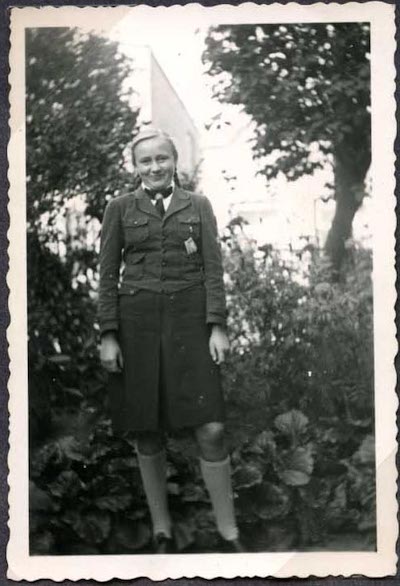
Photograph of a girl wearing the uniform of the League of German Girls, circa 1940. Donated by Peter N. Moogk. (photo from VHEC)
Many of the materials featured in this exhibition will be new to visitors, such as family photographs, Nazi youth magazines and anti-Roma youth fiction. Other artifacts will be instantly recognizable, like the infamous children’s books on display at the VHEC for the first time: The Poisonous Mushroom (Ernst Hiemer, Der Giftpilz, Nuremberg: Stürmerverlag, 1938) and Trust No Fox (Elvira Bauer, Trau keinem Fuchs auf grüner Heid und keinem Jud auf seinem Eid [Trust No Fox on his Green Heath and No Jew on his Oath], Nuremberg: Der Stürmer Verlag, 1936). Age of Influence is designed to encourage active engagement with these artifacts and images. Throughout the exhibition, questions prompt visitors to critically analyze materials on display and identify common techniques used to disseminate both positive and negative propaganda.
The exhibition’s storyline begins in the early 20th century, when youth in Germany started defining themselves as a distinct socio-cultural group, attracting the attention of parties across the political spectrum. Popularized by youth-led groups like the Wandervogel, the German youth movement sought independence from adult authority and embraced communal and back-to-nature ideals. Their activities focused on hiking, survival skills and group pursuits in nature. Against this backdrop, the Nazi party emerged and cast itself as the future-facing “movement of youth.” With its Hitler Youth organization, the Nazi party tapped into the German youth movement and set its sights on this demographic to shape the future of a “racially pure” and physically fit national community.
Age of Influence examines how the Hitler Youth became the regime’s most effective tool to indoctrinate children and teens in Nazi ideology. It offered German youth a powerful group identity and appealed to adolescent yearnings such as the desire to belong, the quest for action and adventure, a sense of purpose and independence from parents. With separate organizations for boys and girls, Hitler Youth glorified gender roles. Boys were prepared for military and leadership responsibilities while girls were groomed to become wives, mothers and caregivers for the nation.
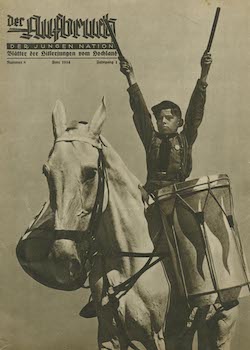
June 1934 issue of Der Aufbruch, a Hitler Youth magazine. Donated by Joseph Tan. (image from VHEC)
An array of Nazi youth magazines from 1934 to 1943 are featured in Age of Influence, as well as family photographs, collectible cigarette cards, video clips and Hitler Youth paraphernalia. Visitors can browse the pages of Nazi youth magazines to discover for themselves the eye-catching fonts, unique graphics and captivating images, which were carefully designed to attract young audiences. At its height, the Nazi youth press published 57 different magazine titles for children.
While participation in Hitler Youth was compulsory for most children, Jewish youths were banned from membership. Their experience is given voice in the exhibition by local survivors. In video testimony clips, Serge Vanry, Jannushka Jakoubovitch and Judith Eisinger describe their feelings of fear, shame and rejection as Jewish children confronted with pervasive antisemitic propaganda and excluded from the activities of their non-Jewish peers.
Perhaps the best-known propaganda tactic used by the Nazis was the creation of common enemies. Antisemitism and racism were key educational goals in the Nazi German school system, where students were taught that the health of the German nation was threatened by “inferior” groups like the Jews, Roma and individuals with disabilities. By demonizing and scapegoating these groups, the Nazis created a climate of hostility and indifference toward their treatment. Age of Influence depicts this process with reference to artifacts such as children’s books and instructional posters used in German schools.
Contextualizing Nazi propaganda within a broad historical framework is essential. For this reason, Age of Influence has been mounted in conjunction with In Focus: The Holocaust through the VHEC Collection. In Focus presents a thematic history of the Holocaust, illustrated by artifacts donated to the VHEC by local survivors and collectors. A curated selection of antisemitica in this exhibition conveys the long-held perceptions and representations of Jews through time.
This history is also important as we navigate escalating antisemitism and racism around the globe and in Canada, where reports of antisemitic incidents have reached record levels. The use of digital media has amplified hate, and the ease with which disinformation can be spread on social media platforms perpetuates Holocaust distortion and denial. In this milieu, it is imperative to equip students with the media literacy skills required to critically evaluate information they encounter. Age of Influence will assist educators to promote key curricular objectives such as digital literacy, critical thinking and social responsibility.
For more information on Age of Influence and In Focus, visit vhec.org.
Lise Kirchnerhas worked with the Vancouver Holocaust Education Centre since 1999 in the development and delivery of its educational programs. She was part of the exhibition team that developed Age of Influence: Youth & Nazi Propaganda, along with Tessa Coutu, Franziska Schurr and Illene Yu. This article was originally published in the VHEC’s Spring 2023 issue of Zachor.
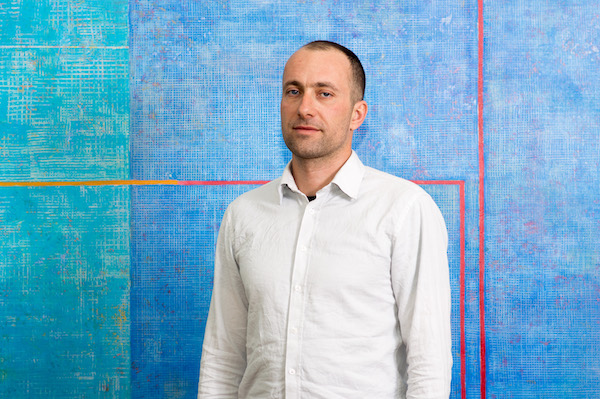
Dr. Kamil Kijek of the University of Wrocław, in Poland. (photo from University of British Columbia)
For Polish Jews who survived the Holocaust, the question of where to begin life anew after the cataclysm was not as clear as it might seem in hindsight.
Looking back at the successive tragedies of postwar life for Jews in Poland, it might seem obvious that the blood-soaked homeland held little hope for the future. The choices for survivors limited their options, though, and the faith that, surely, the worst had passed played a role in the decision by tens of thousands to try rebuilding their families on the soil of their ancestors.
The disastrous history of Jews in postwar Poland was the subject of a special presentation at the University of British Columbia by Dr. Kamil Kijek, an assistant professor in the Jewish studies department at the University of Wrocław, in Poland. Speaking virtually from Poland to students in-class and to a wider audience online, Kijek addressed the decision faced by Polish Jewish communities to stay in or leave post-Holocaust Poland. He was speaking to a class led by Dr. Ania Switzer, a sessional lecturer at UBC, who was born in communist Poland and who is a translator and historian specializing in Jewish studies and Holocaust education.
“Most of Poland did not become the desert of Jewish life right away,” said Kijek. “It happened over time.”
About 50,000 Jews survived the Holocaust in Polish territory. In early 1946, about 136,000 Polish Jews returned from the Soviet Union, where they had survived the war, and a few thousand others found their way back from other parts of Europe. By July 1946, there were about 200,000 Jews in Poland, compared with about 3.3 million in 1938.
The vast majority of Jews who remained in or returned to Poland after the war did not take up life in the places they had been born. The borders of the country had shifted enormously, with the Soviets taking large swaths of what had been eastern Poland and Poland being compensated with formerly German lands in the west. Jews, along with other displaced Poles, were encouraged to take up residency in these newly acquired places in the west of the country, replacing Germans who were expelled.
“It is almost impossible to understand the tragedy of the people the moment when they are freed,” said Kijek. “We need to understand that the end of the war and so-called freedom actually was a time of psychological collapse for most of these people.… These people, when they come back to the places [of their origin], they see their whole communities destroyed and it’s the first time they are sure that most of their friends and family were killed.”
Significant American and other Western funds flowed into the Jewish communities of the country, intended to rebuild Jewish society there. Hebrew schools, synagogues and other institutions were constructed and supported by the Jewish Joint Distribution Committee and other international Jewish welfare and aid agencies.
The postwar period saw continuous upheaval in Poland, with civil war between pro- and anti-communist forces. It was not immediately clear that Poland would fall to communism, nor was it apparent at the time that, even if that did transpire, an Iron Curtain would fall across the continent. Polish Jews in the immediate aftermath of the war maintained close and supportive personal and institutional connections with family and Jewish organizations abroad. A degree of political pluralism revived before the country fell into the Soviet orbit.
Government oppression was not the only concern, though. On July 4, 1946, a pogrom in the southern Polish city of Kielce saw 42 Jews murdered and more than 40 injured. This was just the most deadly and well-known of a series of attacks against Jewish survivors after the war. The immediacy of antisemitic violence by their Polish neighbours disabused many Jews of the hope that they could rebuild a life in the country of their birth.
An exodus followed, but Kijek noted that, while contemporary observers might have seen abandoning Poland as an obvious choice, for people then, there were many considerations. They may not have had any money to facilitate relocation. At middle age or later, it might be natural to resist relocating to a place where one’s language is not spoken and one’s work experience is not transferable. And the prewar barriers that left European Jews to their fate remained largely in place: Western countries still did not open their borders to refugees.
Events unfolded quickly as the communists gained the upper hand in the country, the Cold War arose and the state of Israel was founded, providing at least a place where fleeing Polish Jews could find a welcome.
About 100,000 Jews were still in Poland in 1948, when an estimated 30,000 made aliyah. There was a tremendous amount of judgment, even suggestions of sedition, toward Jews who remained in Poland when Israel existed as an alternative, said Kijek.
“For Zionist leaders, any decision to stay in Poland was an act of a kind of national treason or an act of not understanding the lessons of the Holocaust,” he said, adding that those who remained were not all driven by ideological commitment to communism. The remaining Polish Jews represented a cross-section of Jewish society, including Orthodox, socialist and Zionist individuals. Eventually, even Zionist organizations accepted that not all Jews would make aliyah.
About one-third of Polish Jews who survived the war remained in Poland by 1950, but the emergence of the Cold War isolated them from Jews worldwide.
“All these ties are suddenly cut off in the end of 1948 and 1949,” said Kijek. The burgeoning of Hebrew schools and Jewish cultural organizations was stanched by a communist crackdown on “Zionist” institutions. The state nationalized much of the Jewish community’s remaining assets.
A liberalization occurred after the Stalin era and a number of Jews were able to flee Poland in the late 1950s. Those Jews who remained in Poland into the 1960s were, to a large extent, living a non-Jewish life and may have believed that their identity was no longer a barrier to whatever success they could attain in the country. However, following the 1967 Six Day War, in which Soviet-backed Arab countries were defeated by Israel, and 1968 student demonstrations that posed a genuine threat to the continued dominance of the communist regime, the scapegoat of “Zionism” emerged again, with Jews being accused of disloyalty to Poland, some being forced from their jobs, and the final mass exodus of Polish Jews occurred.
When the communist regime fell, in 1989, there were an estimated 5,000 to 10,000 Jews in Poland, the last remaining of a millennia-old civilization.
The harrowing history of Ukraine’s past was recounted recently in the annual lecture honouring Rudolf Vrba, the late Vancouver scientist whose 1944 escape from Auschwitz brought the most concrete proof of the Nazi “Final Solution” to the world.
Dr. Nataliia Ivchyk delivered the 2023 Rudolf Vrba Memorial Lecture, titled The Holocaust in Ukraine: Violence, Gender and Memory. Ivchyk is at the University of British Columbia on a visiting fellowship that was created by Dr. Richard Menkis and Dr. Heidi Tworek to bring to Vancouver a Ukrainian scholar at risk. Ivchyk is associate professor in the department of political sciences at Rivne State University for the Humanities in her hometown of Rivne, Ukraine, and her work is focused on public history and memory politics.
Ivchyk’s presentation was based on survivor testimonies held at the USC Shoah Foundation, and narrowed in on the experiences of Jews in the western Ukrainian region of Volhynia and Podilia. Of the approximately 27,000 Jews who lived in Rivne (then known as Rovno) in 1937, it is estimated that just around 1,200 survived to the 1944 liberation by the Red Army. In a single day, on Nov. 6, 1941, about 21,000 Jews were murdered by Einsatzgruppe C and Ukrainian collaborators. The surviving Jews were imprisoned in the Rovno Ghetto, which was created the following month. In July 1942, remaining Jews, about 5,000, were transported to a stone quarry and murdered.
About 1.5 million Jews died in Ukrainian territory during the war years, most of them shot in what has been called the “Holocaust by bullets.”
“The Holocaust has long remained on the margins of collective memory in Ukraine,” said Ivchyk. Babyn Yar, a ravine outside Kyiv where more than 33,000 Jews were murdered over two days in 1941, has become a national symbol of Holocaust remembrance, she said. “However, the local level of remembrance remained low.”
There are many other sites of atrocities that were committed in Ukraine. “Some are marked by monuments, others are still forgotten and lost,” she said.
Of the several thousand Jews who survived the initial mass executions, anyone over the age of 13 was forced into slave labour.
“Nobody wanted to work for the Germans,” Ivchyk quoted one survivor, “but we had to. We hoped it would somehow balance our relationship with the Germans and would help us survive.”
Violence against women was mainly carried out by Ukrainian collaborators, she said, though Nazis also took part.
“I remember many times Germans came at night, knocked on the windows, took away beautiful girls,” Ivchyk quoted a survivor. “Sometimes, they raped and killed them right away. Sometimes, they said we will come again.”
Rabbis became a particular target of violence against men, given their social and symbolic status, and their role as spiritual leaders.
In the Soviet era, historical memorialization was subordinated to the priorities of the regime.
“The Holodomor [the deliberate Soviet famine that killed millions of Ukrainians], the deportation of Crimean Tatars, the Holocaust and the genocide of the Roma – all of these events were suppressed in collective memory by the Soviet regime,” she said.
Today, support in Ukraine for Holocaust memorialization is ambivalent.
“The activities of the state today do not prohibit academic, educational or public activities in the field of Holocaust remembrance, but neither does it act as a financial or ideological initiator,” she said.
The Vrba event was funded by the Holocaust education committee of UBC’s department of history, which is responsible for the annual lecture, as well as a number of other organizations, including the Vancouver Holocaust Education Centre and the Diamond Chair in Jewish Law and Ethics.
Menkis, associate professor of modern Jewish history at UBC and chair of the Holocaust education committee, noted that the event recognizes Vrba’s contributions to two primary areas to which Vrba’s life was devoted: Holocaust education and science, particularly pharmacology. The annual lectures alternate between these topics.
Menkis told the audience how Vrba and his friend Alfréd Wetzler made the momentous decision to escape from Auschwitz after overhearing conversations around the planned deportation of Hungarian Jewry. After a difficult and dangerous trek, the pair reached northern Slovakia, where they compiled a report documenting the layout of Auschwitz and the extermination process there.
“Although the report is credited with saving many lives,” said Menkis, “Vrba and Wetzler were keenly aware that more decisive action could have saved more. After the war, Dr. Vrba continued to speak about Auschwitz and his experiences. His book, I Cannot Forgive, written with Alan Bestic, was first published in 1963 and has been issued in a number of translations and re-editions since. He is also well known for his unforgettable testimony in Claude Lanzmann’s [documentary film] Shoah and perhaps less well-known but also important was his effective testimony in the Canadian trials against Holocaust denier Ernst Zundel.”
Vrba’s widow, Robin, attended the event virtually. Vrba died in 2006.
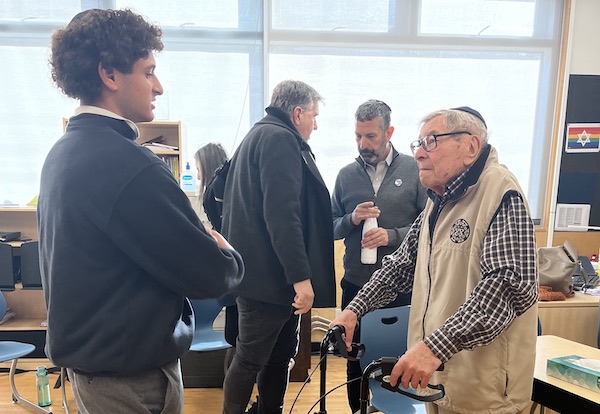
Emerich Klein speaks to a student following his recent talk at King David High School. (photo from KDHS)
For decades, Emerich Klein kept his story of survival during the Holocaust to himself. While raising two children in Vancouver and making a life, he shared nothing of what had happened to him after he, together with his family, was deported to Auschwitz.
After years of cajoling, Klein shared his experiences with Russ Klein, his son, who is principal of King David High School. In 2019, he also sat with interviewer Hodie Kahn and recorded almost four hours of testimony for the Vancouver Holocaust Education Centre.
On Feb. 14, with his son the principal at his side, Emerich Klein spoke of his survival story for the first time to an audience, addressing students in a Holocaust studies class. The students had viewed the recorded testimony in advance of the visit.
Klein was born in Uzhorod, Czechoslovakia, in 1930, and lived with his sister Judith and their parents Isidor and Rose on the site of the electric power plant where Isidor worked. They had a large extended family and Emerich remembers Shabbat dinners at his grandparents’ home, with throngs of cousins. His grandparents, who were very traditional, were in charge of the mikveh and his grandfather was a melamed, a teacher.
Emerich’s early childhood was largely uneventful, except for being taunted and beaten up on his way to and from school by non-Jewish kids. At one point, on the advice of a teacher, he loaded his school bag with rocks and took revenge on his tormentors. When one of the bullies dragged the police to the Kleins’ door urging assault charges, Emerich’s father explained how his son frequently returned from school bloody. The cop apologized and left. The father of the bully beat his own son – not for bullying, it would seem, but for being bested by a Jew.
While older people may have sensed the shifting social climate, for kids like Emerich, things seemed pretty good for a time. By 1941, though, Jewish businesses could operate only with an Aryan partner and so an uncle had to close his small bakery.
When Isidor was conscripted – first into the army and then, when Jews could no longer serve in the military, in a work battalion – the family’s fortunes suffered. His boss at the power plant eventually convinced authorities that he was an irreplaceable employee.
One day, a stranger showed up in town, speaking a language Emerich did not understand. The boy took the man to a rabbi and, after the rabbi shooed Emerich away, the man explained that he had escaped Poland and told the rabbi what was happening to Jews there. The man’s stories of ghettoization, forced starvation and worse was unimaginable to the Jews of Uzhorod.
Under the 1938 Munich Agreement, which British prime minister Neville Chamberlain signed with Hitler to partition Czechoslovakia, Uzhorod was returned to Hungary, to which it had belonged until the First World War. (It is now in Ukraine.) In 1944, the Nazis occupied Hungary, and things got much worse for the Jews living there. When they heard the word “ghetto,” the words of the Polish stranger who had shown up in town returned to them.
Emerich’s grandfather was stopped on the street, beaten up and had his beard cut off. Jews were ordered to report to a cordoned-off area but, because this ghetto was so small, it served mostly as a deportation area. The Kleins remained there only for a couple of days.
They were packed into railway cars, with only room to stand. One big drum served as a potable water supply and another as a toilet. Children were crying, people were moaning.
After several days – Emerich doesn’t know how long – the train stopped. People were banging on the outside of the cars and the doors were flung open. People in striped clothes screamed at them to get out. They had arrived at Auschwitz.
Once they got down off the train, the women and children were separated from the men. The old and sick were yanked across the tracks and packed into big waiting trucks. Rose pushed Emerich to join the men. The boy didn’t want to let go of his mother but she screamed at him to leave. He ran and found his father.
While waiting for the next step in their processing, Emerich saw what he thought were piles of cordwood but he soon realized they were human bodies. The new arrivals were taken to a building for a cold shower, then they were shaved, doused in disinfectant and handed clothing in random sizes.
When an army officer called for metal workers, Isidor volunteered and a fellow prisoner advised Emerich to step forward or risk being separated from his father. Despite his lack of knowledge in the field, Emerich passed himself off as an apprentice. Together, the father and son were separated from the rest of the group and transported out of Auschwitz, on a train again for days, until they arrived in France.
Isidor and Emerich worked at a mine in tolerable conditions, with survival rations for a time, until they were moved again, to a salt mine in Germany. There, they were joined by 1,000 inmates from Poland and Emerich and the others learned the horrors of what was happening further east.
At the salt mine, their job was to break boulders to make gravel and then level out the ground, so concrete could be pored over it. After a time, Emerich was put on burial duty, which was less physically onerous work. A Russian prisoner assured Emerich that the war would soon be over and to keep up his strength. He would move on to factory work, cleaning the floor and cutting aluminum.
In April 1945, the workers were forced on a death march. Planes were flying so low that the prisoners could see the pilots. As the march continued, Isidor insisted he couldn’t go on, but Emerich and two of their friends stuck together and forced the father to keep moving. Eventually, they were loaded onto a train and provided food for the first time in nine days. Then, in the midst of a great commotion, the incarcerated passengers realized that the German army was in full retreat. The guards abandoned the prisoners.
Emerich and his group walked into the nearest town, which was already overrun with freed prisoners. They were put up in a German army base that had been repurposed as a repatriation centre. Tables had been set up for each country and people registered their names and hometowns.
Emerich and Isidor eventually made it back to Uzhorod, but Emerich’s mother Rose and sister Judith never returned. All the extended relatives but two cousins were gone. Emerich spent most of the time crying.
After a few weeks, Emerich left by himself for Prague and registered with the Joint Distribution Committee, after which he was transferred to a displaced persons camp in Germany. He intended to go to Palestine with members of his youth movement, but word came that the British were halting migration.
A friend told him of an opportunity to go to Canada, so they signed up. Six months later, Emerich docked in Halifax and made his way to Toronto, where he stayed for two years. The Jewish community there was highly supportive and Emerich became an apprentice jeweler. Isidor, who in the new world would be known as Robert, and his new wife arrived during this time.
Isidor/Robert had remarried a fellow survivor from Uzhorod, who had a sibling in Chilliwack, B.C., so the family headed to the West Coast. Emerich met his wife, the Vancouver-born Jenny, in a bowling alley during a B’nai B’rith event.
In the King David classroom last month, students asked thoughtful questions and Klein responded. His son told students they were lucky to see the elder Mr. Klein at his most talkative, as getting a sentence from the soft-spoken senior is considered by family members to be an accomplishment.
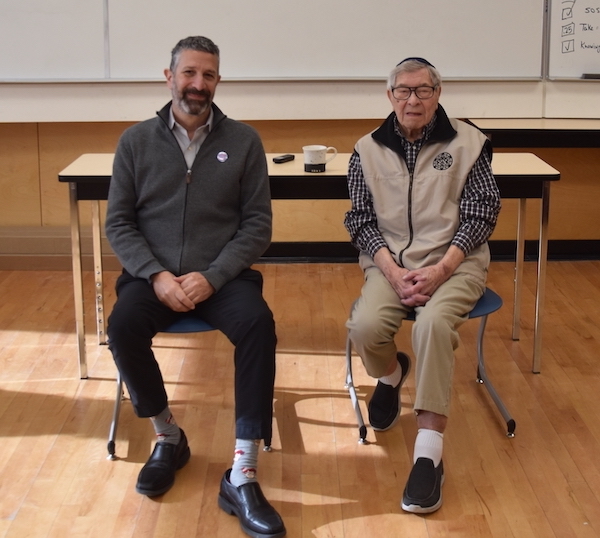
Russ Klein, principal of King David High School, and his father, Emerich Klein, who spoke to a KDHS class in February about his experiences during the Holocaust. (photo from KDHS)
A student asked if he ever lost faith that he would survive.
“Yes, definitely,” said Klein. “We lived not from week to week or day to day, but from hour to hour. Life didn’t mean a thing.”
About liberation, he said, “I felt wonderful. I felt that I’d been given a chance to live again, to be human again.”
Asked how his experiences under the Nazis and their collaborators had affected his attitudes toward religion, Klein was blunt.
“It sort of turned me against it,” he said. Nevertheless, he insisted that his two children attend Talmud Torah elementary school. Why?
“To learn about Judaism and to learn about the Holocaust,” he said, turning to his son. “I was not able to talk about it, but you had to know about it. That was the only way that I could get my children to learn about it. They couldn’t learn it through me.”
His decades-long refusal to discuss the past with his children was intended to prevent the next generation from anguish, he said.
“Why should they suffer my pain?” he asked. “That was a terrible thing to think about. Bad enough that I suffered, [why should] they suffer the same thing through me?”
Reflecting on his postwar return to Uzhorod, Klein was again straightforward.
“I went back to see who came back from the family. I spent a month, maybe six weeks there and then I left, never to return,” he said. “It was very difficult. I came up against reality there. Up until then, we did not know what happened to the rest of our family. We were separated and that’s all I knew. I had hopes that everybody was coming back. Nobody came back. So there was no point in me staying there.”
Coming to Canada was wonderful and difficult, he said.
“Wonderful just to get out of Europe – doesn’t matter where,” he said. “I just wanted to get out of that country that was soaked in Jewish blood.” But, he added: “It was difficult – difficult to get used to a new life, a new way of living, a new language, a new country. I was 17 years old. It was very difficult but you make do. You do the best you can. You adjust.”
Settling into life in Vancouver, Klein made family and stability his focus.
“A normal person would try to make a living and get themselves a better position, work your way up in life,” he said. “To me, that was not important. To me, the important thing was family. I concentrated on one thing only. Just to give you an example, all my friends went into business – I did not. They asked me, why don’t you go into business? I said … what happens if it doesn’t go right? These children cannot be hungry. I knew what hunger was. It was so important for me to stay just at a low level but make sure that my family will not go without. That was an effect of what happened to me.”
A student asked why, after all these years, Klein decided to speak.
“Because I was convinced after an awful long time that to be silent is being complicit in what happened,” he said. “You’ve got to talk about it, even if it hurts, you’ve got to talk about it.”
He is concerned by some of the political developments he sees in the world today.
“Most of humanity is very good,” he said. “There are parts of society that are not good. Let’s face it, people can be influenced very easily. If you get a charismatic person, [they] can convince people of almost anything they want.”
In March ’68, the shocking events of the Polish political and social crisis of that time are dramatized through the eyes of two families. Hania, a young woman who is Jewish, is in love with Janek, a boy whose father is a member of the nomenklatura, a senior official whose career is endangered by the political activism his son is dabbling in.
But careers are only one of the concerns for Jewish Poles, whose very identities as citizens of the country are in jeopardy, as the society spirals with a chilling and apparent suddenness into antisemitic frenzy. The blatant antisemitism is masqueraded as an “anti-Zionist” campaign and a defence against “non-Polish” elements.
Poland was in a financial panic, with wage reductions and assorted economic turmoil. Events spiraled after the expulsion from the university of political dissidents and the closure of a theatre presentation deemed anti-government. No prerequisites are required. The film, from director Krzysztof Lang, tells the viewer all they need to know about the history – and the petty and not-so-petty indignities of living under a repressive regime.
Through the braying voices of the country’s communist leaders and parallel street-level Jew-baiting, the status of Jewish Poles deteriorates rapidly and Hania’s family is faced with a choice for their future.
This Romeo and Juliet story is endearingly told against the heartbreaking backdrop of generational divisions that were tearing at families all over the world in 1968, a microcosm of the larger tumult. In Poland, these divisions were exacerbated by a social contagion that forced an exodus of much of the tiny remnant of post-Shoah Polish Jews, a disappearance that is emotionally depicted in black-and-white at the end of the film.
* * *
Lost Transport opens like a war-era cinematic news short, an elementary map of Europe being encroached by Allied forces from the West and Red Army movements from the east.
As the Soviets advanced, the Nazis selected from among the prisoners at Bergen-Belsen a few thousand of what they called Austauschjuden, “exchange Jews,” who they imagined to be of particular value to the Allies and who, as a result, the Nazis intended to barter for German prisoners of war or money. Almost 7,000 inmates, in three train transports, were being moved from the advancing front. A train bound for Theresienstadt (now in Czechia) encountered a blown-up bridge and was stranded near the German town of Tröbitz. Within days, the incarcerated passengers were liberated by the Red Army (and, later, by Americans).
Lost Transport demonstrates the chaos and confusion of liberation for the Jewish passengers and defeat for the German residents.
It seems a tactless quibble with these sorts of dramatizations to note that healthy actors are obligated to believably depict the victims of atrocities, but in this instance the task seems particularly stark, with almost all of the liberated people well-clothed, clean, remarkably well-groomed and bright-eyed.
The story is viewed primarily through the eyes of Isaac and Simone, a Dutch couple liberated from the train; Vera, a Russian sniper; and Winnie, a young German woman who sees her mother shot by the Red Army and her home taken over by the other main figures in the film. The characterizations are often cardboard – the individuals are rough stand-ins for their respective peoples – and the script ham-fisted. The three women eventually see one another’s humanity (even if the viewer struggles to do so) and the resolution is almost painfully perfect.
March ’68 and Lost Transport screen as part of this year’s Vancouver Jewish Film Festival. For tickets and the full festival lineup, visit vjff.org.
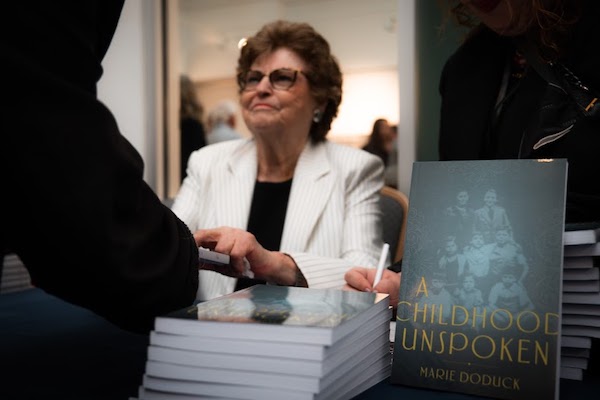
Marie Doduck speaks with a guest at the launch of her book A Childhood Unspoken on Jan. 22. (photo by Josias Tschanz)
“We survived.” These are the words that adult Marie Doduck would tell her childhood self, Mariette, who survived the Holocaust being moved from hiding place to hiding place over a period of five years.
Doduck was answering a question during a book launch laden with emotion – deeply sad as well as celebratory and with moments of laughter – Jan. 22 at a packed Rothstein Theatre. Her book, A Childhood Unspoken, was just released by the Azrieli Foundation’s Holocaust Survivor Memoirs Program.
In a conversation with Jody Spiegel, director of the memoirs program, Doduck spoke of how she is two people – the European Jewish child, Mariette Rozen, who never grew up, and the Canadian adult, Marie, who she had to create to suit her new surroundings after arriving in Vancouver with three orphaned siblings in 1947.
“Mariette will never grow old,” she said. “The child Mariette will always be the child inside and that’s what survivors live. We left the child that was in Europe, we created a wonderful life here in Canada, but when I speak and when I leave this room Mariette stays in this room and I become Marie again.”
Doduck explained her long hesitancy in sharing her story, not only because of the vulnerability it requires, but because the experiences of survivors like her had been dismissed and diminished in the past.
“As a child survivor,” she said, “we were told that we didn’t have a story.”
For decades after the end of the Holocaust, the term “survivor” was largely reserved for those who had been in concentration camps or subjected to forced labour. Child survivors who had been hidden or otherwise managed to escape capture and murder were deemed not to have suffered like older survivors.
This silent or quietly conveyed message was underscored by the way child survivors were treated after the war, even by well-intentioned adults like the families who fostered some of the 1,123 orphans, including Doduck, who came to Canada under the auspices of Canadian Jewish Congress from 1947 to 1949.
“We were from outer space,” she said of the reactions she and fellow child refugees received from Canadians. “We saw things that children should never have seen.”
Placed in homes with new families, with little or no assistance in addressing what they had experienced, many children did not do well.
“Of the 40 children who came to Vancouver, my brother Jacques and myself, I think, were the only two lucky children who stayed with the same family,” Doduck said. “My sister [Esther] didn’t stay with her first family, she became an au pair. Henri jumped from family to family.”
In some cases, said Doduck, the children were told they would die by the time they were 30 “because we were not normal in the Canadian eyes.”
Doduck wrote the book with Dr. Lauren Faulkner Rossi, assistant professor of history at Simon Fraser University. Speaking at the event and addressing Doduck directly, Faulkner Rossi acknowledged that the process was difficult.
“You would have to become the child Mariette many times,” she said, noting that Doduck was forced to plumb memories she has tried to forget. Faulkner Rossi said Doduck had to trust her, though Doduck’s “inclination is to trust no one – a crucial Holocaust childhood lesson that is never quite unlearned.”
“It’s a hard process for any child survivor to write their story,” Doduck said, not only because of the emotional toll but also because of the imperfections of childhood memories. “Did we hear it from adults? Did we live it? I wanted the truth.”
Doduck pressed Faulkner Rossi wherever possible to substantiate her recollections with historical evidence. During the process, Doduck recalled things she thought had been lost. “Sometimes one memory triggers another that you thought you had forgotten,” she said.
Doduck is a founding member of the Vancouver Holocaust Education Centre, through which she has shared her history with tens of thousands of students and others. She is also a philanthropist and community leader, volunteering and leading events, including co-chairing, with fellow VHEC co-founder Dr. Robert Krell, the 2019 conference of the World Federation of Jewish Child Survivors of the Holocaust and Descendants, in Vancouver.
Before Doduck’s presentation, VHEC executive director Nina Krieger described Doduck as “a force … a formidable and sought-after champion for many community organizations. She is also a mentor and a friend to so many, including me, and has inspired more than a generation of community leaders, especially young women, with her vision, passion, tenacity and work ethic, not to mention good humour and grace.”
The book launch event was presented by the VHEC and the Azrieli Foundation. Doduck’s daughters Cathy Golden and Bernice Carmeli read from the book. Arielle Berger, managing editor of the Azrieli Foundation, noted that, since 2005, the foundation has published more than 150 memoirs of Canadian survivors of the Holocaust. The foundation provides the books for free to schools and universities and also provides teaching resources and training to educators. This was the first in-person book launch since the pandemic.
The full theatre was still during an emotional moment when Doduck addressed her family in the front rows.
“I don’t say it often and I want to say it publicly to my children, my family sitting here, thank you for accepting who I am,” said Doduck, now a great-grandmother, before acknowledging the lack of experience with which she approached parenting. “When I was blessed with my children, my husband had to teach me how to go to the library and get a book,” she said. “I never knew a story to tell the kids.”
As a child, she said, Mariette was never hugged, never put to bed, was never kissed, never had a toy and never had a bedtime story.
“My first toy, I was 36 years old, I was the guest speaker in Winnipeg at a fundraiser,” she said, “and they gave me my first doll. I still have it. The only doll I ever had in my whole life.”
As a founding member of the local group of child survivors who meet regularly, Doduck tried to explain the uniqueness of child survivors to their own children.
“We all passed something to them that we didn’t realize we were doing, a burden that we gave to our children, our firstborn,” she said. “I apologize to all the firstborn. We didn’t mean to put a burden on you.”
She takes pride and sees a sense of progress in the different ways her three daughters have viewed her.
“My middle daughter, Bernice, always accepted me. That’s the way mom is,” she said. “That’s the middle child of all the survivors’ children. And my youngest daughter, Cheryl, may she rest in peace, only thought of me as a Canadian. So, I progressed. I fulfilled my duty in becoming Marie, the Canadian.”
This article was originally presented as a d’var Torah called “Healing our relationship, as Jewish Canadians, with Ukraine and Ukrainians.” It was delivered at Or Shalom Synagogue on Shabbat, 14th of Tevet, 5783; Jan. 7, 2023. It is intended as a beginning of a conversation about how we, as Canadian Jews, can heal our relationship with Ukrainians and Ukraine.
When many of us Canadian Jews think about Jewish experience on Ukrainian territory, we think of antisemitic violence. We think of pogroms, of rape, of plunder. And, ultimately, of either escape or death. For those of us with personal ancestral history in the territory of Ukraine, this pairing of the land with violence is particularly acute. One Or Shalom member told me, with raw emotion, about his father’s experiences at the hands of brutal Ukrainian guards in various Nazi concentration camps. My Uncle Leo referred to Easter as pogrom season in the town of Yavorov, the town presently in western Ukraine, called Yavariv in Ukrainian, where he lived until the age of 11. He spoke to me of his childhood as a past from which he had, thankfully, escaped.
It is not uncommon for individuals to seek escape from a painful childhood past. However, we are learning from contemporary trauma theory that, as much as we may want to leave the past behind us, it lives on within us. Ukraine lives on in the deep psychic life of many of us and in the psychic life of the Canadian Jewish community with its extensive roots on Ukrainian territory.
As we are all aware, the Ukrainian people are heroically resisting a brutal assault by Russian forces. As well as eliciting fear, horror and outrage, this situation presents us with an invitation to move beyond our feelings of separation from our history on Ukrainian soil and from the Ukrainian people. The war provides us with the opportunity to claim our own legacy and place in the new, complex, multiethnic, multiracial, democratic Ukraine, with all its triumphs, challenges and contradictions. This is an opportunity for healing.
I want to share some of what I have learned that has helped me on this healing path.
If we look at the historic record of Jewish life on Ukrainian territory, we see that Jewish-Ukrainian coexistence was deep, complex and multi-dimensional. Demographically, Ukrainian territory was one of the main centres of Jewish life for more than 400 years. On the eve of the Holocaust, there were more than two-and-a-half million Jews in that area.
There were periods of horrific violence and crippling antisemitism against Jews on Ukrainian territory, as well as periods of ongoing systematic prejudice. These realities must not be overlooked or minimized. But we also see many examples of interconnection between Ukrainian Jews and ethnic Ukrainians. We see many examples of shared music with similar melodies and even bilingual songs; of similar folk stories; and of similar folk remedies and folk healing practices, with Jewish Ukrainian and ethnic Ukrainian folk healers sharing their remedies with each other and tending to both populations.
And there is considerable similarity in those quintessential Jewish activities – food preparation and consumption. This past summer, I made pickles with my Ukrainian-Canadian friend Beverly Dobrinsky, using an old family recipe of hers. The next day, I discovered the exact same recipe, grain of salt per grain of salt, in my own disordered family recipe collection.
Looking at literary translation, one of my passions, we find many examples of the translation of works between Yiddish and Ukrainian and between Ukrainian and Yiddish. In the late 1920s, Ukrainian writer Yuriy Budiak wrote two bird-themed children’s books that have been described as delightful and playful. Shortly thereafter, the books were published in Yiddish translation and enjoyed by Yiddish-speaking Jewish children. These books were recently published by Naydus Press in the United States in a trilingual edition – Ukrainian, Yiddish and English – to raise funds for the Ukrainian war effort.
During the 1930s, both Yiddish and Ukrainian writers experienced repression by the Stalinist Soviet government and experienced difficulty publishing their own writing. In response, they began translating one another’s work and the work of Soviet-sanctioned writers from one another’s cultures. The esteemed Yiddish poet Dovid Hofshteyn translated the work of Taras Shevchenko, known as “the national bard of Ukraine.” The Yiddish writer Leib Kvitko taught Yiddish to the Ukrainian writer Pavlo Tychyna, who went on to translate a number of Yiddish writers into Ukrainian.
As Prof. David Fishman from the Jewish Theological Centre in New York points out, all these similarities and interconnections‚“only happen with close contact.”
Moving into the present, by focusing solely or predominantly on past violence and persecution, we fail to take into account the cataclysmic changes Ukraine has undergone, notably since the breakup of the Soviet Union and the country’s emergence in 1991 as an independent nation with a sizable contemporary Jewish population. David Klion estimated, in Jewish Currents, that the Jewish population of Ukraine at the time of the Russian invasion in February of 2022 was more than 100,000 people.
Since independence, Ukrainians have been redefining what it means to be Ukrainian, moving from an ethnic category of belonging based on ethnic and religious identity to a civic category based on citizenship. This is an important issue for all Ukrainians, but particularly for the many individuals, including Jews, who are not ethnically Ukrainian.
Last April, I had the enormous privilege of hearing a Zoom talk organized by the Vancouver Holocaust Education Centre and given by Dr. Magda Havryshko, a Ukrainian academic. Havryshko spoke of two different national narratives in Ukraine, an ethnocentric narrative focusing on the country as the homeland of the Ukrainian people, and a multiethnic narrative “that priorizes examining Ukraine’s difficult history in relation to Jews.” Havryshko shared information about several inspiring initiatives undertaken in Ukraine in relation to its Jewish population. I will outline three of these initiatives here: during the celebration of Ukrainian independence in 2021, Holocaust history and memory was central; the history of the Holocaust on Ukrainian territory is now taught in all schools beginning at the elementary level; and, lastly, President Volodymir Zelensky and his government have set out a definition of antisemitism, introducing legal punishments for antisemitic acts.
Prof. Amelia Glaser, who studies and teaches comparative literature and translation, has spoken about a desire among contemporary Ukrainian writers to “look very closely at past moments of history and of ethnic violence as Ukrainian tragedies‚” rather than solely as Jewish tragedies. The book-length poem “Babyn Yar in Voices‚” by Marianna Kiyanovska, a non-Jewish Ukrainian, about the 1941 slaughter of Jews in a ravine outside Kyiv, was recently published in English translation by Oksana Maksymshuk. Further, several works by Ukrainian Yiddish writers have been recently translated into Ukrainian, including the fabulous avant-garde Yiddish poetry of Debora Vogel and Sholem Aleichem’s Tevye, which many of you know as Fiddler on the Roof. By the way, Sholem Aleichem lived most of his adult life in Kyiv, a city that he loved.
Without in any way discounting the violence and antisemitism against Jews on Ukrainian territory, I hope I have provided a little forshpayz, an appetizer, about areas of cooperation and interconnection between Ukrainian Jews and ethnic Ukrainians. I have focused on translation and literature, two of my passions, but I encourage you to look for examples of interconnection in the areas of your own interest.
When I think about healing my relationship with Ukraine, it helps me to think about the complexity of my own identity and experience. I am the granddaughter of Jewish immigrants who fled poverty and persecution in different parts of the former Russian Empire, including Ukrainian territory, at the beginning of the 20th century. My maternal grandparents settled in Montreal; my paternal grandparents, in New York. It is telling that I do not know the specific history of the Indigenous nations in the areas in which my grandparents settled but I think I can assume that the lands had been forcibly taken from the Indigenous inhabitants. Two generations later, I continue to live on unceded (that is – stolen) territory, that of the Squamish (Sḵwx̱wú7mesh), Tsleil-Waututh (səlilwətaɬ), Musqueam (xʷməθkʷəy̓əm) and Kwikwetlem (kʷikʷəƛ̓əm) First Nations.
Canadian society is involved in a collective process of teshuvah, of redefining the relationship between us settlers and the Indigenous peoples on this land. Like all settlers, as Canadian Jews, we are challenged to take responsibility for our active involvement or silent complicity in the ongoing Canadian genocidal project against our country’s Indigenous inhabitants. Can we see our commonality with Ukrainians as we both address our brutal oppression of “the other”? Are we, as Canadian Jews, willing to embrace the complexity of our lived experience, to look both at our privilege, especially when it is experienced at the expense of others, as well as at our own painful experience of victimization? Can we hold both at once with integrity?
I finish by sharing the wisdom spoken by an Indigenous man, whose name I unfortunately did not get, at Grandview Park at this past year’s Orange Shirt Day. “When you take a step to heal, you also heal the ancestors. You heal the ones behind and the ones ahead.”
I welcome ongoing dialogue on the issues raised in this talk. Thank you for your kind and open attention.
Helen Mintz’s translation of Vilna My Vilna: Stories by Abraham Karpinowitz (Syracuse University Press, 2016) garnered three literary awards, and her translation of Janusz Korczak: Teacher and Child Advocate by Zalmen Wassertzug is under consideration by the University of Poznan Press. Mintz’s translations have appeared in In Geveb, Jewishfiction.net and Pakn Treger, and her writings about translation in Words without Borders and BC Studies. Her website is helenmintz.net.
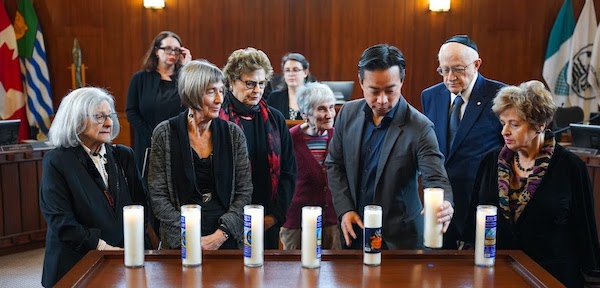
Vancouver Mayor Ken Sim (third from right) lit memorial candles with Holocaust survivors (from left) Rita Akselrod, Amalia Boe-Fishman, Marie Doduck, Claude Romney, Peter Suedfeld and Ella Levitt. Behind are Nina Krieger of the Vancouver Holocaust Education Centre and Cantor Shani Cohen of Temple Sholom.(photo from VHEC)
Until 1943, Amsterdam’s Hollandsche Schouwburg theatre was used by the Nazis as a deportation centre for Dutch Jews. The youngest children were placed in a Jewish orphanage across the street. A tram would come at 10-minute intervals, providing a brief window of time during which the Nazi guards outside the theatre would lose sight of the orphanage.
The Dutch underground, in cahoots with the nurses at the orphanage, would smuggle babies and toddlers out of the orphanage during this fleeting moment. A member of the resistance would ride by on a bicycle pulling a garbage can and a nurse would pass a child through a ground-floor window into the receptacle and replace the lid.
One of those children was Peter Voormeij, who shared his Holocaust survival experience with a standing-room audience at the Bayit in Richmond, Jan. 29, marking International Holocaust Remembrance Day.
“My mother’s family were Orthodox Jewish and my father’s Roman Catholic,” he said at the event. Both families were against the union, partly due to the religious differences but perceived differences in social status were also a factor. “In any case, they got married and I was a result of their union.”
Soon after Peter was born, in late 1940, his father was arrested by the Nazis, suspected of being a spy, and was incarcerated at a Gestapo facility in Berlin.
Peter’s mother’s extended family fled into hiding, but his mother mistakenly believed that her marriage to a Catholic man, even an accused spy, provided her some security from deportations.
“She refused to wear the yellow star as was demanded of the Jews,” Voormeij recalled. “But a girlfriend of hers told the local police that she was a Jew, they confronted her and insisted that she should wear the yellow star. She did and, as a result, I clearly remember that we were not allowed in the park playground, which I was so looking forward to. No Jews allowed.”
He was only 2-and-a-half when he was separated from his mother. She was taken to Westerbork, the Nazi transit camp in the Netherlands, and transported by cattle car to Sobibor. “I often think of her alone, without her little boy, to have her beautiful blond hair cut and forced into a shower with many other women,” said Voormeij. “But no shower – gas.”
At the end of the war, Voormeij’s father returned to the Netherlands. Through his connections in the underground, he located his son, who had survived in hiding – and who, not yet 5, didn’t know he was a Jew.
Peter was raised for a few years by his beloved paternal grandmother. “There, I grew up in a Catholic household, went to a school attached to the church,” he said. “My memories of the time are reasonably good, albeit one time I was sexually molested by a [Catholic] brother – what else is new?”
When Peter was 12 years old, his grandmother died. He then returned to his father’s home, but now had a stepmother who he detested – and the feeling was mutual. One day, during a row, she yelled at him: “You are a typical Jew!”
“From that moment on, my life changed,” he said. “I realized that I am indeed a Jew. I looked at the church in a different way and I couldn’t understand why the Jews were persecuted and killed.”
However, he understood the implications of his new identity. “I became afraid of being a Jew and kept my mouth shut from then on,” he said. “Nobody will ever know that I’m a Jew.”
He indeed kept his identity largely secret. He excelled in school and received a scholarship to art school in Adelaide, Australia – four years with all expenses covered. He became a noted painter and art teacher, completing a master’s degree at what would become Concordia University, in Montreal, and later moving to New York City and back to the Netherlands. A turning point came in the early 1980s, during a conversation with a Dutch gallery owner who was to exhibit some of Voormeij’s work.
“She told me she despised the Jews,” he recalled. “At that point, something broke in me and I told her I was a Jew and left the gallery for good.”
He contacted his uncle, a brother of his mother who had survived by escaping to Switzerland. “My uncle introduced me to what it was like to be a Jew,” he said. “He gave me my first kippah and taught me some Jewish prayers. He also took me on my very first visit to a synagogue.”
At times, when he was alone with his uncle, he would ask about his mother. “I was dying to know more about her,” he said. “He was the only one that could remember. There was nobody else I could ask. Each time I brought her up, he would cry and I would cry with him while holding his hand.”
Eventually, Voormeij and his wife moved to British Columbia and he met a member of the Child Survivors Group that operates out of the Vancouver Holocaust Education Centre (VHEC). He joined and found a place among fellow child survivors.
The Jan. 29 event was the fourth annual commemoration of International Holocaust Remembrance Day in Richmond. It was co-sponsored by the Kehila Society of Richmond, the VHEC and the Jewish Federation of Greater Vancouver.
Rabbi Levi Varnai emceed the ceremony and spoke as a child of a survivor, noting that his grandfather was murdered when he was younger than Varnai is now. Cantor Yaakov Orzech recited the memorial prayer El Moleh Rachamim.
Parm Bains, member of Parliament for Steveston-Richmond East, brought a message from Prime Minister Justin Trudeau and the federal government. Kelly Greene, member of the B.C. Legislature for Richmond Steveston, brought greetings from Premier David Eby and the provincial government. Members of the Legislative Assembly, Henry Yao and Teresa Wat, were also in attendance. Richmond Mayor Malcolm Brodie spoke and four councilors – Bill McNulty, Chak Au, Andy Hobbs and Laura Gillanders – also attended.
Pascale Higham-Leisen, VHEC program coordinator, introduced Voormeij. Bayit president Keith Liedtke introduced the mayor, who noted that the day of the commemoration – Jan. 29, two days after the official International Holocaust Remembrance Day – was also the sixth anniversary of the mass shooting at a Quebec City mosque, in which six worshippers were murdered.
A smaller, invitation-only ceremony was held Jan. 27 at Vancouver City Hall. Vancouver Mayor Ken Sim lit memorial candles with six Holocaust survivors: Rita Akselrod, Amalia Boe-Fishman, Marie Doduck, Ella Levitt, Claude Romney and Peter Suedfeld. He also expressed condolences for a terror attack that happened earlier in the day at a Jerusalem synagogue, where seven people were killed. Bridges and buildings around the province were illuminated in yellow that evening to mark the memorial day.
Nina Krieger, executive director of the VHEC, which partnered with the Centre for Israel and Jewish Affairs and the Jewish Federation of Greater Vancouver to organize the civic event, thanked the assembled city councilors for recently adopting the International Holocaust Remembrance Alliance Working Definition of Antisemitism. Cantor Shani Cohen of Temple Sholom recited El Moleh Rachamim.
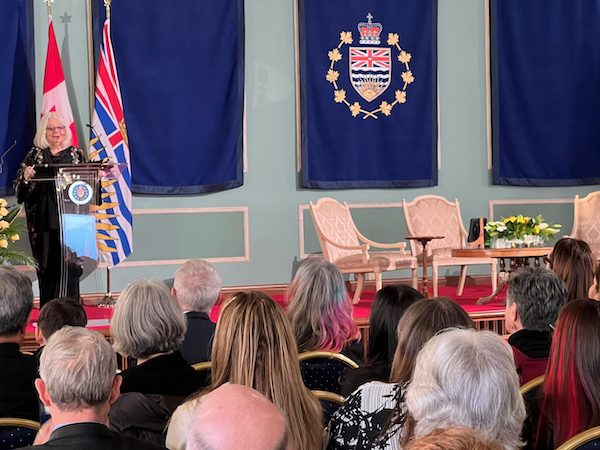
Lillian Boraks-Nemetz speaks at Government House on Jan. 19. (photo from ltgov.bc.ca)
On Jan. 19, Lillian Boraks-Nemetz received a standing ovation for her speech at an event hosted by the lieutenant governor of British Columbia, Janet Austin, at Government House in Victoria.
In a mere 12 minutes, Boraks-Nemetz took the audience through the horrors she suffered during the Holocaust: the rise of anti-Jewish laws, the killing of her younger sister, the escape from the Warsaw Ghetto, the separation of family and the loss of identity – each with its own devastating consequences. She also spoke about the trauma that accompanied her after moving to Canada.
She began by quoting the words of Janusz Korczak, the Polish doctor, educator and head of an orphanage in Warsaw, who was killed with his charges at Treblinka in 1942. He wrote, “the well-being of a country is as good as the well-being of its children.”
To that quote, Boraks-Nemetz added, “When you look around, it seems that the world itself is not in good standing on this issue. I know this to be true as a childhood witness of the Holocaust and as an adult witnessing the present lives of strife for many children in various countries: fighting wars, poverty and hunger.
“My own childhood ended the day Nazi Germany invaded Poland and World War II began. Our happy lives ended and I became an adult at the age of 6. All Jewish children were automatically sentenced to death by Hitler and the Third Reich, and I was one of them. A million and a half Jewish children were murdered in the Holocaust – among them almost all my cousins and my sweet little sister.”
Boraks-Nemetz described her experiences as both a First and Second Generation survivor. She spoke of bearing not only her legacy, but the legacies of her parents, who survived the Holocaust but were not the same parents as before, mourning the loss of their young child and other tragedies. She discussed the interval following the war to the time the barbarity of what occurred began to register.
“The hidden child gnawed at my soul wanting to get out. I chose to live for many years like a good Canadian housewife and mother, but when I reached the age of 40, all hell broke loose. I fell apart and there was no help,” Boraks-Nemetz said.
“Trauma,” she added, “leaves behind a deep wound that, when unhealed, will eventually begin to start creating an emotional pain which won’t let you cope with an ordinary life. [It’s] a pain that few understand.”
The ensuing breakup of her family, she recounted, took many years to repair. At a certain point, she was able to put the pieces back together and begin to understand the root of her pain through telling her story to students and adult groups, and through writing novels and poetry. Boraks-Nemetz is the author of several books, including The Old Brown Suitcase, Mouth of Truth and, most recently, Out of the Dark, a collection of poetry.
“I wanted to understand how the past shaped my present and, above all, I wanted to mend my relationships with my children of whom I am so proud – my Second Generation children who also bore the brunt of my pain and whose forgiveness and understanding mean more to me than life,” she concluded.
The moment Boraks-Nemetz finished speaking, the crowd rose to its feet.
Titled Reconciliation and Holocaust Remembrance: Conversations on Intergenerational Trauma and Healing in Jewish and Indigenous Communities, the evening included short presentations by Nina Krieger, executive director of the Vancouver Holocaust Education Centre, and Chief Robert Joseph, ambassador for Reconciliation Canada and a former member of the National Assembly of First Nations Elders Council.
Afterwards, Austin led a dialogue between panelists Marsha Lederman, arts correspondent for the Globe and Mail and author of Kiss the Red Stairs: The Holocaust Once Removed, and Carey Newman, a multi-disciplinary Indigenous artist, master carver, filmmaker and author. Their discussion explored experiences of healing across communities that have suffered intergenerational trauma from the Holocaust, residential schools and racism.
“I am grateful for the courage of these survivors and their children for the gift of their stories and sharing such intensely personal experiences so generously. In the pursuit of truth, we must deepen understanding and seek to connect in our hearts, to heal together,” said Austin.
“It is always my honour to sit with Holocaust and residential school survivors, as well as distinguished advocates for hope, help, healing and reconciliation. Acknowledging and addressing trauma is the key to better health and recovery. A good friend of mine once said to me: ‘We must always work together in dialogue and never compare trauma,’” said Joseph.
The Government House event was held in partnership with the Jewish Federation of Greater Vancouver, and the Jewish Federation of Victoria and Vancouver Island.
“With discrimination and racism on the rise here in B.C. and around the world, it is now more important than ever that the experiences and lessons learned from the Holocaust, residential schools and other forms of discrimination and racism remain present in the public mind so that history does not repeat itself,” said Ezra Shanken, chief executive officer of Vancouver’s Jewish Federation. “Only by learning from the past can we prevent such hatred and atrocities in the future.”
Sam Margolishas written for the Globe and Mail, the National Post, UPI and MSNBC.