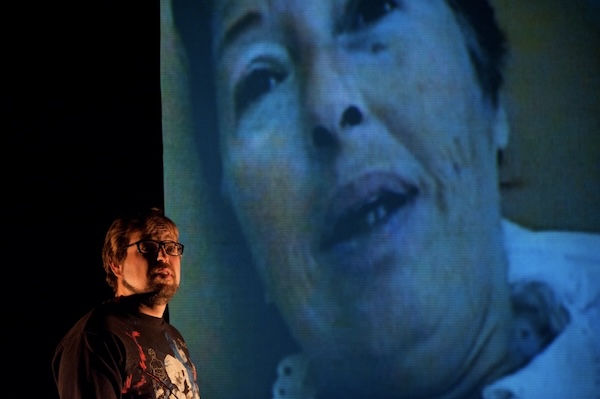
Itai Erdal, with his mom, Mery Erdal, z”l, on screen, in How to Disappear Completely, which opens at the Historic Theatre in Vancouver March 15. (photo from The Chop Theatre)
Itai Erdal’s award-winning How to Disappear Completely, which has toured the globe, will be at the Historic Theatre in Vancouver March 15-22.
Created by Erdal, with James Long, Anita Rochon and Emelia Symington Fedy, How to Disappear Completely premiered at the 2011 Chutzpah! Festival. The one-man show then toured internationally, being performed in more than two dozen cities around the world before COVID hit. The March run marks its first remount since the pandemic.
“It’s been a dream come true,” said Erdal about traveling with the production. “Performing this show is the closest thing I have to hanging out with my mom, so being able to introduce my mom to so many people around the world has been wonderful. I also got to do it in Hebrew – I performed the show in Jerusalem and Tel Aviv and many of the people in the audience knew my mom so that was really special.”
Erdal immigrated to Canada from Israel in 1999. The following year, he found out his mother had been diagnosed with lung cancer and only had months to live. He returned to Israel to be with her as much as possible and, during that time, encouraged by his mother to do so, he shot hours of film and took hundreds of photos.
“We laughed a lot, and you can see it in the show,” Erdal told the Independent in 2012, when How to Disappear Completely had its first remount. “It’s a tragedy turned to joyful memories,” he said about the piece, which also focuses on his approach to theatrical lighting. Erdal is amultiple-award-winning expert in lighting design.
“This was the first show I wrote and the first time I performed, so we had to come up with a theatrical device to explain why a lighting designer is standing on stage and telling this story,” Erdal told the Independent in an email interview earlier this month. “So, the premise was that this was a lecture about lighting design, and I ran all the lights from the stage. The connection between my mother’s story and lighting design wasn’t obvious at first, but when we started doing workshops, the audience loved all the lighting stuff and responded very strongly to it. I wanted to show how a PAR [parabolic aluminized reflector] can get warmer as it dims, so I took it down one percent at a time, and people got emotional because they thought about the life leaving my mom’s body. The show is full of these accidental metaphors, and the lighting became the emotional heartbeat of the show.”
Over the 14 years since he first wrote and performed How to Disappear Completely, Erdal – who founded the Elbow Theatre – has co-written and performed several other works: Soldiers of Tomorrow, Hyperlink, This is Not a Conversation and A Very Narrow Bridge. So, while How to Disappear Completely hasn’t changed much since it was written, Erdal said, “I am much more relaxed as a performer, so the show got better.”
He added, “The main thing that’s changed in the past 14 years is that I have become a father and I understand better why my mother said it was so important to be a parent. I often think about what a great grandmother my mom would’ve been and I wonder how she would’ve handled some tough parenting moments.”
Erdal doesn’t tire of performing How to Disappear Completely, and he sees how affected audiences continue to be.
“Creating this show has been the most exciting and rewarding thing I’ve ever done,” he said. “You would think that reliving the hardest moment of your life on stage every night would be a daunting task, but it’s a joyful experience. My mother was smart and funny and her personality really shines through. Every time I perform the show, there is a lineup of people waiting to talk to me after, wanting to tell me their stories about finding love and about losing their parents, and I love connecting with them and feeling that my show might help them a bit with their grief.”
And that’s what makes this very personal show widely popular.
“Unfortunately, almost everyone in the world knows someone who died from cancer, and the grief of losing a parent is something almost everyone can relate to, so the show has many universal themes,” said Erdal. “It also deals with loneliness and the search for love, which are also very relatable themes.”
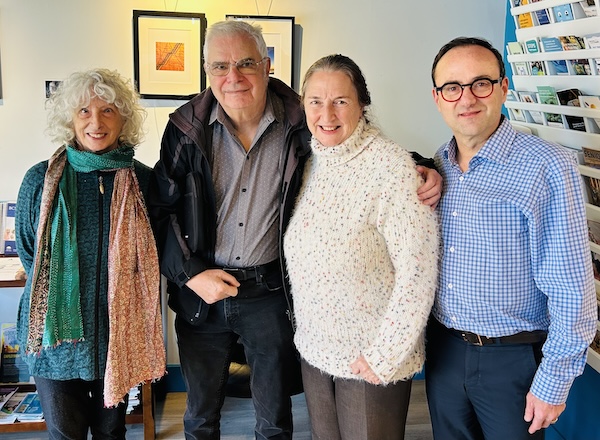
Jewish Seniors Alliance of British Columbia’s Margot Beauchamp, left, and Jeff Moss, right, with advocate for seniors’ rights Howard Glick and Parliamentary Secretary for Seniors’ Care and Long-Term Care Susie Chant. (photo from JSA)
Jewish Seniors Alliance, whose mission is to reduce isolation, build connection and uplift and support Jewish and other seniorsin the province, started 2025 with a new name.
At its annual general meeting last November, the organization chose to rename itself the Jewish Seniors Alliance of British Columbia. Formerly, it was called the Jewish Seniors Alliance of Greater Vancouver. One of the motivations for the change was to better reflect the organization’s goals and the services it provides.
The new name comes as JSA expands its advocacy work throughout the province, with efforts such as extending its reach, via its Senior Line magazine, to more communities. The new name, it maintains, recognizes the need to connect with more seniors in the province. Initially, JSA intends to partner with outreach programs in the Sea-to-Sky, Burquitlam and Surrey regions.
Similarly, the JSA Peer Support Services program has been rebranded. It will now be known as Community Support Services (CSS), which the organization believes will express its objectives and more clearly define the services it offers with senior volunteers and clients: senior peer support and friendly visiting/calling.
Concurrently, JSA has relaunched its advocacy work around free home support for all BC seniors, stating that it had success with this effort in the run-up to the provincial election. It will continue to meet with government and opposition MLAs, as well as work with and through community partners to ask people to contact their MLAs to voice their support for the initiative.
“The JSA approach to advocacy and government relations has been focused and targeted on decision-makers,” said JSA executive director Jeff Moss during a Jan. 22 Zoom event, in which he discussed the proposal for universal home care in British Columbia as a way to reduce the burden on individuals and government spending.
Moss summarized a recent mandate letter to Susie Chant, parliamentary secretary for seniors’ care and long-term care, which advocated for increased health-care availability, cost containment, responsive health systems, increased senior care, engagement with stakeholders and communication with the health ministry.
Howard Glick, an advocate for seniors’ rights and barrier-free healthcare, joined Moss on the Zoom panel. Glick had recently produced a short video, The Home Care Imperative: A Humanitarian Solution, on the need for free home support in the province, which was shown to the audience.
The video emphasized the advantages of home care, including aging in place, which can allow seniors to preserve their independence and dignity. It can also produce systemic savings that reduce waits for long-term care and free up hospital beds. And its implementation can be expedited, as home care can be scaled more quickly than construction for long-term care facilities.
Also stressed in the video was the idea of accessible, personalized home care as a better way to benefit seniors in their daily lives. The video argued that such a measure would foster independence and connection while strengthening the health-care system overall. This issue is particularly pressing, as the number of seniorsin the province, and across the country, is set to increase in the coming two decades.
Most older adults, the video pointed out, would prefer to stay at home. Research from the Office of the Seniors Advocate, under the leadership of both former seniors advocate Isobel MacKenzie (now a JSA board member) and current advocate Dan Levitt, shows that many admissions to long-term care could have been treated at home with the right supports. Women, people in rural communities and those living alone make up a greater percentage of those moving into long-term care, according to the office’s report.
According to the video, British Columbia, when compared to Ontario, is lacking in several features that pertain to senior care, such as funding, services, eligibility, caregiver support and integration. The costs associated with accessing care for seniors in British Columbia greatly exceed those of other provinces as well, the video contends, noting that Alberta, Ontario and other provinces offer free home support for older adults.
Following the video, Moss reviewed a long list of advantages of providing free home care.
“The benefits are personalized at-home care, ease of access, reduced hospitalizations, fewer unnecessary admissions to long-term care, better health outcomes, increased independence and peace of mind,” he said.
During the question-and-answer session, it was conceded that the home-care model proposed in the video is, at present, far from the current reality.
“At this point, the system is fragmented, disorganized and unreliable, and there are a whole bunch of other problems. What our video is advocating is how to make things work for people in the future and that means reevaluating the structure of the system completely,” Glick said.
“Before any changes can be made, we have to have influence and contacts, we don’t have that yet. We’re just in the starting process of trying to get our foot in the door with the people who have the money and make policy,” he added.
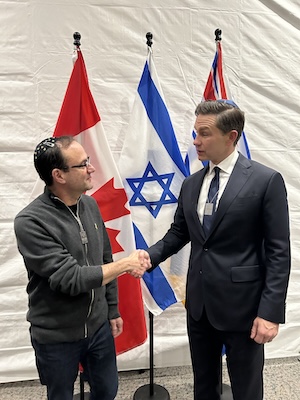
Jewish Senior Alliance of British Columbia executive director Jeff Moss, left, with Conservative Party of Canada leader Pierre Polievre. (photo from JSA)
The January event was part of the JSA-Phyliss and Irving Snider Foundation Empowerment Series and was co-sponsored by the Kehila Society of Richmond, COSCO and West End Seniors’ Network.
Moss, Glick and Margot Beauchamp, JSA’s quality assurance liaison, have since met with Chant. According to Moss, Chant gave them her support to move the initiative forward by way of making an introduction to the ministers of finance and health, along with opportunities to speak with all MLAs. JSA is also seeking the support of Brennan Day, opposition critic for rural health and seniors’ health.
JSA is working to advance the interests of seniors at the national level as well. During Conservative Party of Canada head and leader of the Official Opposition Pierre Poilievre’s visit to Temple Sholom on Feb. 2, Moss said he took a moment to let Poilievre “know that 65% of BC seniors are living on less than $40,000 annually and that adjustments are needed in the Guaranteed Income Supplement for seniors so that they can ensure more sustainability to age better.”
Poilievre directed Moss to follow up with his policy team.
Vancouver Talmud Torah students in the new Hildy Barnett Wellness Centre. (photo from VTT)
“It was a dream that came true,” said Jeffrey Barnett of the new Hildy Barnett Wellness Centre at Vancouver Talmud Torah.
The centre, named in honour of his late wife, was dedicated last November.
“As a graduate of Vancouver Talmud Torah and as a teacher of over 30 years, and also being a child psychologist, she knew the value of supporting kids in a Jewish environment,” said Barnett of Hildy, who died April 25, 2024. She and Jeffrey were married 47 years; they have two children and four grandchildren.
Hildy Barnett specialized in education for children with special needs. She worked with the Vancouver School Board for three decades and, after retiring, continued to work with children and teens in various capacities. She volunteered at Canuck Place and with the Jewish Community Centre of Greater Vancouver, among other things. She helped start Jewish Family Services Vancouver’s Innovators Lunch, with friends Naomi Gropper Steiner, z”l, and Kristina Berman.
Shortly before Hildy Barnett passed away, she and Jeffrey made the decision to fund the wellness centre at VTT. Hildy had asked Shirley Barnett, who had a relationship, via her sons, with Shane Foxman, associate director of development at VTT, to inquire about legacy opportunities at the school. Foxman connected Shirley with Emily Greenberg, VTT head of school.
“When Shirley first told me about Hildy, I asked her to tell me a bit more about what she did, her passions, her career,” Greenberg told the Independent. “It became almost immediately clear that she should be part of realizing the vision for the wellness centre. As her health diminished rapidly, Shirley came to the school and I told her to film me speaking about my vision for the space, the children it would serve and the reason we needed to create such a space for our students. I knew what I wanted it to look like, but I wanted to paint that picture for her. I remember, when we stopped recording, I had goosebumps because I could feel how special this room was going to become.
“We hurriedly sent the recording over to Hildy’s daughter, Mira, to show her in her hospital bed,” continued Greenberg. “I remember Shirley got a text back from her within a few minutes. She said that it was exactly what she had hoped for. Hildy, unfortunately, passed away just a couple hours later, but I have always been so grateful that she knew about the wellness centre before she left this world. I think this has made this work even more sentimental. We really wanted to get every detail right.”
Before she died last April, Hildy Barnett, with her husband Jeffrey, decided to fund the building of a wellness centre at Vancouver Talmud Torah, which has been named in her honour. (photo by Alexandre D. Legere)
A VTT newsletter leading up to the centre’s November dedication noted, “Approximately 20% of our students require some form of extra assistance to fully engage in the curriculum and to meet their full potential…. Over the last several years, we have completed a landscape study to understand best practices for supporting students with learning needs and have implemented several new layers of services to help create unique learning pathways.”
The study comprised a review of what many other schools are doing for student support services, said Greenberg. “There were many takeaways,” she said, “but one of them was that the spaces we create can really enable the programming and support we want to offer. The wellness centre has catapulted our counselors from being in a windowless, uninspiring, tiny office to in a centre that exudes safety, support, belonging and comfort.”
Over the past five years, VTT has gone from having a half-time counselor to two full-time counselors: Donna Cantor and Shakaed Greif. The two are both experienced counselors who are helping “to better support our students, parents and, sometimes, staff, as they navigate the many pressures and challenges of life, especially in a post-Oct. 7 world,” said Greenberg.
The counseling team “has been imperative in helping our many new Israeli students settle into life at VTT. They also run many support groups, including our Free to Be Me club, Chesed club and more,” she said.
The Hildy Barnett Wellness Centre allows Cantor and Greif to have their own offices, as well as a shared space for working with small groups and families.
“When I look back, in a very quiet way, Hildy did what she loved and, having the facility at TT is the ultimate,” Jeffrey Barnett told the Independent. “It brought smiles to her face. She knew that she wasn’t going to be around. She knew that the legacy she was doing would benefit so many youngsters, including the fact that our own grandchildren would be at the school, and that not only this generation but future generations [would be helped]. And it made me feel good that she felt good. It’s still very sad, very touching, and we miss her a great amount.”
Barnett spoke of Hildy’s approach to education, which was based on the methods of the late Dr. Reuven Feuerstein, with whom Hildy Barnett had studied.
Feuerstein was a psychologist from Romania, who trained with the Russian psychologist Lev Vygotsky, explained Charlene Goldstein, who, with Hildy Barnett, years ago established with the Vancouver School Board a learning centre for speech language pathologists, teachers, counselors and others, which has since faded away. Goldstein is a registered psychologist in the neonatal follow-up program at BC Women’s Hospital and Health Centre; she also has a private practice.
“Reuven came to Israel right after the Holocaust and he began to work with children from the Holocaust, as he did with children from Ethiopia,” Goldstein told the Independent. “And what he saw was that these children only lived in the present, that they had limited memories of the past and very few [visions] of the future, and that was because, to protect them, their parents didn’t want them to know too much, plus they had a lot of losses. So, he had a group of volunteers together who would sit by the beds of these children, so if they had nightmares, they would calm them.
“Then, he began to notice that some people were saying that these children were incapable of learning, that type of thing,” she continued. “But what Reuven and Vygotsky believed in [is that] you can have direct learning, where, let’s say I’m a child and I’m looking at putting some blocks together and I figure it out and nobody has to tell me what to do. Or, you could have mediated learning, which is, someone is between the child and the activity helping them to learn what to do.
“So Reuven, and I still do this now – when a child says to me, I can’t do this, I say, well, what do you already know here? What do you already recognize? What about this is new? And I start asking questions about things. So, what do you call this? Oh, my goodness, look at all of these things that you already know. Reuven would also say to teachers, think of the child, and his logo was ‘just a minute … let me think.’ Because he believed, as I do, that everybody has the potential to think, everyone has the potential to learn. We may not all learn everything the same, but we have potential to learn. And that everyone has potential to give back to society.”
Part of the funds raised by the Hadassah Bazaars – which Hildy’s mother, Marjorie Groberman, helped start here and in other places across Canada – were sent to Israel to support Feuerstein with his work, said Jeffrey Barnett.
Groberman, who was “Mrs. Hadassah-WIZO for many years,” had heard Feuerstein speak at a Hadassah convention, said Goldstein. He was brought to Vancouver by Hadassah-WIZO and Variety Clubs International, with which Jeffrey Barnett was involved, she said.
Feuerstein came back to Vancouver many times, said Goldstein. When here, he trained many educators, including those who worked with Indigenous children.
“Some of the children would think he was Santa Claus and would call him that because he had a long, white beard and his beret,” said Goldstein.
Among the people in Feuerstein’s sphere was Dr. Lorna Wanosts’a7 Williams, an expert in Indigenous language revitalization and education. Williams met Goldstein and Barnett in the mid-1980s, when she was hired by the Vancouver School Board as a specialist in First Nations education.
“I was looking at Reuven’s work because of his ideas around what happens with children when they get separated from the knowledge, from their parents,” Williams told the Independent. (People wanting to know more about this aspect of Williams’s work should watch the 1994 National Film Board of Canada documentary The Mind of a Child.)
Williams said Hildy Barnett was focused on “supporting all children to learn and enable them to overcome all their trauma. She just was so dedicated to that kind of work.”
Barnett knew how to move things along, said Williams. “She was able to bring people together in such a beautiful way.”
She added, “I really honour her for all the help she gave me and that she gave many other people. She was very quiet but she was very strong.”
Goldstein, who knew Barnett from having grown up in the local Jewish community, before they connected more in Hadassah-WIZO and with Feuerstein’s work, echoed Williams’s observation.
“Hildy had the most gentle voice, she had a great sense of humour, but she had strong determination,” said Goldstein. “In Star Trek, there’s one person who says, ‘Make it so,’ and that’s what Hildy was like. She would say, ‘Make it so,’ and you just didn’t say no to Hildy because Hildy listened to everybody and had such compassion, such compassion.”
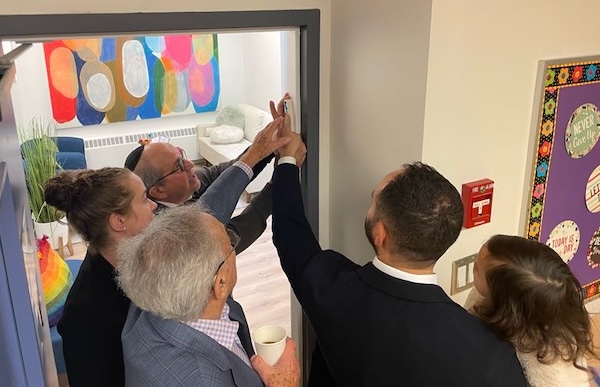
Rabbi Philip Bregman, at back, and Jeffrey Barnett, middle, hang the mezuzah at the door of the Hildy Barnett Wellness Centre, along with Barnett’s daughter, Mira, and son, Joel, who is holding one of Barnett’s grandchildren, Blake. (photo from VTT)
The Nov. 24, 2024, dedication ceremony of the Hildy Barnett Wellness Centre was originally envisioned as a small family gathering to honour Barnett’s legacy, said VTT’s Greenberg. “But, to our delight, she was so beloved in the community that many more people attended.
“I think it was an opportunity for many people to pay their respects to her powerful legacy of believing in children, and the Hildy Barnett Wellness Centre has become a healing place in so many ways, including for those who are grieving Hildy’s loss.”
Heterodox Academy is a nonprofit organization dedicated to promoting viewpoint diversity, open inquiry and constructive debate in higher education. It works to counter ideological conformity on campuses by providing research, resources and programming that foster an environment where diverse perspectives are welcomed and critically examined.
If that sounds like what a university is intended to be, says one local professor, it’s a commentary on the state of contemporary campuses that such an organization is necessary to encourage the academy to live up to its principles.
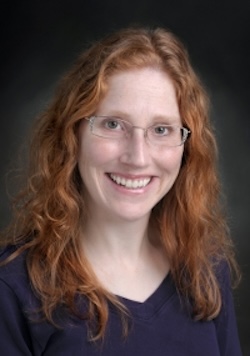
Dr. Rachel Altman, associate professor in the statistics and actuarial science department at Simon Fraser University, is one of the campus co-chairs of the Heterodox Academy chapter at SFU.
“Heterodox Academy is an organization that fosters free, open inquiry and free discussion even about controversial issues,” she said. “It’s not just about freedom of speech. It’s also about our conduct, the way we have these conversations. I think that’s what really distinguishes it from the general free speech advocacy groups.”
Dr. Rachel Altman is one of the campus co-chairs of the Heterodox Academy chapter at Simon Fraser University. (photo from SFU)
Heterodox Academy provides guidelines that urge interlocutors to present their case with evidence, bring data when possible, assume the best of one’s opponent and be intellectually humble, among other principles.
HxA, as it is shorthanded, offers events, conferences, resources and other materials that “try to teach our society, especially within academia, how to interact in a productive and civilized way, even when we disagree,” she said.
These tools are intended to help bridge the divide between the ideal of a university and the reality of creating a dynamic marketplace of ideas.
“Just because we have it in our head that in the academy we should be able to discuss anything in a civilized way doesn’t mean we actually know how to do it,” she said. “They provide tools and modeling of those tools to actually teach people how to be civilized.”
The HxA chapter at SFU emerged after a group of scholars got together because they were concerned about the state of academic freedom at the university. They founded the SFU Academic Freedom Group.
Within a few months of that group’s founding, Heterodox Academy launched its Campus Community Program, recognizing chapters on individual campuses. Some SFU professors applied and were accepted among the first chapters chartered.
“We hosted a so-called Heterodox Conversation event this past September,” she said. “That’s a model developed by HxA where you invite two people who have different views on a topic and they sit down and have a conversation with the model [called] the Heterodox Way and then the audience gets involved and we have a group discussion.”
The topic of that dialogue was “The purpose of today’s Canadian universities.”
“The timing was perfect because, just the previous week, our president had issued a statement on institutional neutrality,” she said, referring to an announcement by SFU’s president, Joy Johnson, on maintaining an environment where scholarly inquiry remains unbiased by partisan agendas. “For me, I was celebrating like crazy, but there were others on campus who were very unhappy.”
Altman can’t say whether the Heterodox Academy chapter or the SFU Academic Freedom Group deserve credit for the president’s statement or for other recent developments she and her colleagues view as positive.
“I’m a statistician, so I rarely claim causation,” she said wryly. “I’m very conservative that way. But I think so.”
The groups are comparatively small, but they may be having an outsized impact.
“Everybody knows about us,” she said. “The administration clearly knows and it’s just been so gratifying to see the change in the whole tenor of the administration’s approaches over the last couple of years. It’s a clear change.”
Numbers may remain relatively small, Altman suspects, because of a false perception of their group.
“We are consistently being cast as this right-wing, conservative group and it’s not true,” she said. “We have people across the political spectrum in the group. It is a nonpartisan group.”
The idea that academic freedom and institutional neutrality are right-wing positions, she said, is belied, for example, by the gay rights movement, which emerged in the 1960s, in part thanks to the viewpoint diversity of campuses.
It is not a coincidence, Altman believes, that several HxA members, including herself, are Jewish.
“Jews have a long tradition of arguing and debating in a civilized way, the whole ‘two Jews, three opinions’ thing,” she said. “Jews are just a natural fit with the HxA model.”
In contrast, the equity, diversity and inclusion (EDI) model that has become increasingly prevalent on North American campuses in recent years is antithetical both to the academic ideal and to Jews, she argued.
“For some Jews like myself, I realized very early on that the EDI ideology that’s become so predominant in academia and elsewhere, that it was terrible for Jews,” she said. “This model of the oppressed and the oppressor, it didn’t work. Jews did not fit into that mold.”
EDI is the opposite of what it claims to be, said Altman.
“I think it’s exclusionary, it discriminates against groups,” she said. “It’s antithetical to everything I believe in because I truly believe in inclusion and anti-discrimination.… I was very unhappy about the rise of the EDI ideology and, in my groups of people who are also similarly concerned about that ideology, I think Jews are overrepresented. That would suggest I’m not the only Jewish person who sees the fundamental conflict, the contradictions in the EDI ideology.”
Altman said few people would openly admit they oppose academic freedom.
“Really, it becomes about the definition of academic freedom,” she said. “When I say I support academic freedom, that’s the end of my sentence. What I look for when I’m talking to people is the ‘but’ that can follow. ‘Of course, I support academic freedom, but … there are limits.’ Things like that.”
In some cases, Altman thinks, this equivocation comes from a lack of understanding around the core principles of academic freedom.
“But then, there are some people who truly want to change the foundation of the term, the concept,” she said. “They truly believe that we should have limits on both our academic freedom and our freedom of expression more generally.”
In addition to the SFU branch, Heterodox Academy has a chapter at the University of British Columbia, Okanagan. While there are some HxA members at the Vancouver campus of UBC, Altman said, there is not yet an official chapter there.
Canada’s westernmost Reform rabbis, Dan Moskovitz of Vancouver’s Temple Sholom, and Lynn Greenhough of Victoria’s Kolot Mayim, sat down for a discussion (and celebration) of the resilience of the Jewish people during a Zoom webinar on Feb. 2.
Greenhough, who posed questions to Moskovitz for an event that was part of Kolot Mayim Reform Temple’s 2024/25 Kvell at the Well series, described him in her introduction as a “one-man advertisement for Jewish resilience.”
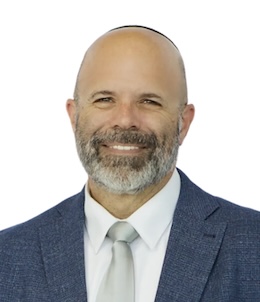
Rabbi Dan Moskovitz of Temple Sholom was the most recent speaker in Kolot Mayim Reform Temple’s Kvell at the Well Zoom series. (photo from rabbidanmoskovitz.com)
Moskovitz began by bringing historical context to the topic, noting that the sages would often say that new questions and problems are the reframing of events that have happened in the past.
“Sadly, we have a history that can take us back to times of trial and challenge just as easily as it could to triumph,” said Moskovitz. “So, part of it is that we’ve seen this before and we’re still here. That is, I think, a key to our resilience.”
Another element to resiliency is adaptability, he said. Here, the senior rabbi at Temple Sholom cited a section of the Talmud that debates whether it is better to be a cedar tree or a reed.
“The rabbis conclude it’s better to be a reed than a cedar. While we can stand firm at some point, a strong enough wind from just the right angle will topple us over [if we are a cedar],” Moskovitz said. “But the reed can adjust. And that’s how we dealt with the destruction of the First and the Second Temple.”
Judaism, he continued, has maintained a fluidity that allows it to be open to new ways to grapple with present-day issues like identity, the role of women and modern concepts of morality, discarding past practices that might be distasteful today.
“I think that important to our resilience has been our ability to change,” he said. “When groups or religions don’t change, their survival becomes precarious.”
Judaism’s resilience, too, can be attributed to its portability; namely, texts were printed and studied. Further, discussions, such as those occurring in the Talmud – which Moskovitz described as the “original Wikipedia” – could be had not just in one place in time but across time, to create an “ongoing dialogue.”
“I think about Pesach and the printed Haggadah, but also the technology, if we can call it that, of the socialization of the story, that coming together every year to retell our story, as opposed to telling it and forgetting it,” he said. “What Pesach does is remind us of the story of redemption, remind us of our role, Moses’s role, God’s role, the role of miracles, and to reinterpret that through the lens of our modern experience, to see the pharaohs of our time.”
A recent illustration of Judaism’s ability to adapt, he said, occurred during the pandemic, as events and services shifted to Zoom. Most of Temple Sholom’s minyan services are still held online, as they have proved a valuable means for congregants to connect in a meaningful way.
Change and innovation, Moskovitz argued, are always going to happen, and it has been to Judaism’s advantage to move forward, to progress, and not shelter itself from the outside world. One such step practised by Reform Judaism, for example, is to use transliteration and English translations of the Hebrew text in prayer books, making the prayers and other material accessible to a wider range of people.
Later in his talk, Moskovitz referenced how times of crises and discrimination have empowered Jews to create their own institutions.
“I think that we have to have a deep appreciation for the resourcefulness of the generations that came before us,” he said. “Most of the institutions that we have been raised in were built by a generation of Jews who were excluded from general society.”
To the question of the post-Oct. 7 world in which university campuses and other spaces have become hotbeds of vitriol against Jews, Moskovitz stressed that flexibility and adaptability do not mean capitulation.
“If there are places that we have been and rightfully should still be and want to be, then we do have to stand our ground there,” he said. “We do have to insist and we do have to call out the hypocrisy of certain things or the blatant discrimination.”
Crucial in this pursuit, said Moskovitz, is to find allies. He told the Zoom audience that Jews will not defeat antisemitism, but non-Jews will.
“We can’t separate ourselves from the community,” he said. “While we could use our money to pull out of places like Harvard, we should absolutely stay at the boardroom table as long as they will have us. If not, then go to whatever audience will receive our message of why we were kicked out of that place, and stay in for the argument and the fight.
“I think that we shouldn’t abandon these institutions and say, I’m not going to send my kid there anymore because it’s antisemitic. It will only become more antisemitic if we stop sending our kids.”
Jonathan Bergwerk, author of the Audacious Jewish Lives books, is the next speaker in the Kolot Mayim Kvell at the Well series. On March 2, at 11 a.m., he will discuss Jewish innovators who have changed the world. Visit kolotmayimreformtemple.com to register.
Sam Margolishas written for the Globe and Mail, the National Post, UPI and MSNBC.
Sara Ciacci, z”l, was a passionate advocate against domestic violence, establishing ASTEH, an emergency shelter for women escaping abuse. (photo from JFS Vancouver)
Sara Ciacci, z”l, is, in many ways, an urban legend – a name synonymous with impact, compassion and transformative change in our community.
Ciacci dedicated her life to fighting food insecurity, most notably co-founding the Jewish Food Bank in 1984. She was also a passionate advocate against domestic violence, establishing ASTEH (Alternative Short Term Emergency Housing), an emergency shelter for women escaping abuse. And JFS Vancouver has recently honoured Ciacci’s extraordinary impact by renaming ASTEH to Sara’s House, a tribute to her unwavering commitment to empowering women and building their resilience.
A survivor of domestic violence herself, Ciacci deeply understood the fear, shame and stigma that women and children face when escaping abuse. Her firsthand experience drove her determination to create a safe space where Jewish women and their children could find refuge and rebuild their lives.
Sanctuary for women, children
Sara’s House is a community-based housing facility providing security, stability and support to Jewish women and their children fleeing violence or at risk of homelessness. With the guidance of JFS counselors and care managers, women are empowered to explore their options and make decisions that lead to a safer, more hopeful future.
Over the years, Sara’s House has been a haven for dozens of women and their children. One such story is Abby’s.
When Abby first walked into JFS, she was overwhelmed with fear and desperation. Fifteen years into her marriage, a sudden violent shift forced her to confront the emotional, verbal and financial abuse that had been present from the start. She never thought she would find herself in this situation.
Abby recalled a comment from JFS executive director Tanja Demajo.
“Tanja told me she felt I had a very good chance of getting out of the abuse and I was a good candidate for ASTEH housing,” said Abby. “By the end, I felt overwhelming relief. It was the life preserver I needed to get out.”
A lasting tribute
JFS Vancouver is profoundly grateful for Ciacci’s legacy of dedication, empathy and action. With the renaming of ASTEH to Sara’s House, her vision of providing a haven for women and children will live on, inspiring future generations to continue the work of protecting and empowering those in need.
Community support helps sustain Sara’s House and the life-changing services it provides. To learn more or to contribute, visit jfsvancouver.ca/donate.
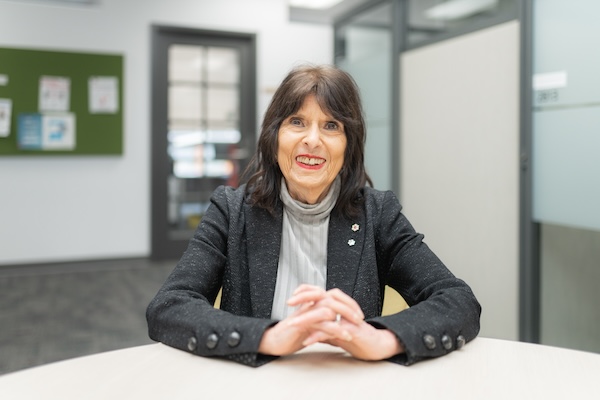
Gloria Gutman, PhD, has been honoured with the King Charles III Coronation Medal, which recognizes individuals who have made a significant contribution to Canada, or an outstanding achievement abroad that brings credit to Canada. She will receive the medal in a ceremony March 21.
A research associate and professor emeritus at Simon Fraser University, Gutman founded the Gerontology Research Centre and the department of gerontology at SFU, serving as director of both units from 1982 to 2005. She is the author/editor of 23 books, the most recent (with Claire Robson and Jen Marchbank) titled Elder Abuse in the LGBTQ2SA+ Community (Springer, 2023).
Dr. Gloria Gutman (photo from SFU)
During her career, Gutman has held many prominent roles, including president of the Canadian Association on Gerontology, president of the International Association of Gerontology and Geriatrics and president of the International Network for Prevention of Elder Abuse. Currently, she is president of the North American chapter of the International Society for Gerontechnology, vice-president of the International Longevity Centre-Canada and a member of the research management committee of the Canadian Frailty Network. Previously, she served on the World Economic Forum’s Council on the Ageing Society, World Health Organization’s expert advisory panel on aging and health, and the CIHR-Institute of Aging advisory board.
“I am grateful to SFU for having nominated me for this award.
Developing the gerontology department and Gerontology Research Centre, serving on boards, organizing conferences, and advocating for seniors in other ways nationally and internationally, has been a privilege and a pleasure,” said Gutman. “It could not have taken place without the strong support of FASS [the faculty of arts and social sciences] and senior administration.”
In 2012, Gutman was awarded a Queen Elizabeth II Diamond Jubilee Medal by the Government of Canada and, in 2016, she was appointed to the Order of Canada, the country’s highest civilian honour.
– Courtesy Simon Fraser University
* * *
Lana Marks Pulver (photo from Jewish Federation)
Jewish Federation of Greater Vancouver is proud to congratulate its board chair, Lana Marks Pulver, who was honoured by Jewish Federations of North America with the Kipnis-Wilson/Friedland Award for exemplifying the higheststandards of philanthropy and volunteerism. Marks Pulver’s selection for this award is a testament to her exceptional dedication and leadership.
– Courtesy Jewish Federation of Greater Vancouver
* * *
The Louis Brier Jewish Aged Foundation is pleased to announce the appointment of long-time volunteer leaders Marie Doduck and Lee Simpson as co-chairs of the 2025/26 campaign. Please join board directors Harry Lipetz, Rick Cohen, Mel Moss, Bernard Pinsky, David Zacks, Michelle Karby and Abbe Chivers, and staff Ayelet Cohen Weil and Wendy Habif in congratulating and thanking them for their tireless commitment to our Jewish elderly.
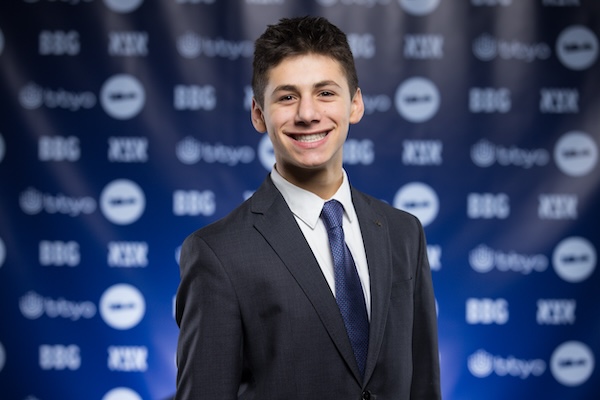
Levi Moskovitz has been elected to the BBYO International executive board. (photo by Jason Dixson Photography)
Vancouver teens joined thousands of peers, educators, business leaders and philanthropists from around the world at BBYO’s International Convention (IC) 2025 in Denver, Colo., Feb. 12-17. Levi Moskovitz, a student at King David High School, was elected as BBYO’s international teen treasurer (grand aleph gizbor) for the 2025-26 term. He is the only Canadian on the BBYO international board, which represents 70,000 teens from 64 different countries.
Moskovitz has been an active and dedicated member of BBYO Vancouver since he joined in Grade 8. He currently serves as regional godol (president) for Vancouver, where, along with a small cohort of fellow teen leaders, he has expanded the region from one chapter and a handful of teens to four chapters and more than 100 active teens.
Prior to being elected president, Moskovitz was the regional gizbor (treasurer). This position gave him real-world experience in leading successful fundraising initiatives, expanding community partnerships and empowering younger members to take on leadership roles. He also has been instrumental in growing chapter programming and strengthening BBYO’s presence across British Columbia.
For the next year, Moskovitz will help lead the organization as it celebrates Jewish identity, combats antisemitism, develops the next generation of youth leaders, and promotes its core values of faith, fraternity, patriotism, charity and integrity. As international teen treasurer, he will lead BBYO’s global philanthropy efforts, oversee the International Service Fund (ISF) and support chapter treasurers worldwide. He will help guide the movement as it raises and distributes more than $1 million in tzedakah (charity), including #GivingBBYODay. He will also collaborate with BBYO’s chief financial officer and board of governors on financial priorities within the organization’s $54 million annual budget. As part of the 12-person international teen board, he will shape BBYO’s global vision.
“Being elected as BBYO’s international teen treasurer is an honour,” said Moskovitz. “BBYO has given me incredible opportunities to grow as a leader, and I’m excited to help Jewish teens worldwide make an impact through philanthropy and financial empowerment.”
BBYO Vancouver’sgrowth in recent years has been helped largely by two major multi-year capacity-building grants: from the Ronald S. Roadburg Foundation and from the Diamond Foundation. Moskovitz’s election marks another milestone for the region’s legacy of leadership in BBYO’s international movement.
Vancouver BBYO has been at the forefront of community impact, organizing service projects and fundraisers that benefit local and global Jewish causes. The chapter’s close partnerships with King David High School, the Jewish Community Centre of Greater Vancouver and local synagogues continue to provide teens with opportunities for leadership, Jewish engagement and community service.
This year, Vancouver BBYO’s presence was felt beyond the election stage, with a delegation of 26 teens representing the city at IC 2025.
“Levi’s leadership and dedication have left a lasting mark on Vancouver BBYO,” said Persio Bider, BBYO Vancouver regional director. “His election to the international board reflects the strength of our growing community and the incredible potential of Jewish teens to lead on a global stage.”
– Courtesy BBYO International
***
All in the family
Levi Moskovitz’s older brother, Judah, was the last Canadian elected to the BBYO international board, in 2023, as grand aleph shaliach (Jewish identity and Israel). His father, Temple Sholom’s Rabbi Dan Moskovitz, is a past international president (grand aleph godol, 1989-90).
The 100th anniversary of BBYO in Canada happens in 2026. “That anniversary will be part of a major effort to identify Canadian BBYO alumni,” Rabbi Moskovitz told the Independent.
For more information about BBYO in the Vancouver region, visit their website (via bbyo.org) or contact the regional director, Persio Bider, at [email protected]. If you are a BBYO alumn, join the BBYO Alumni Association to stay connected with the organization and support its mission.
Living in a condominium steps away from the Seawall and the marina is surreal. (photo from flickr.com/photos/nuntz)
Nobody would deny that the concept of a new home is exhilarating. It’s the packing up a lifetime of belongings, and having to sell and give away a plethora of things that plunges you into ice-cold reality. And let’s not forget the joys of the actual move.
A therapist once advised me to “get comfortable with uncertainty.” Hmmm. That’s like saying, “Learn to enjoy having hot oil poured down your back.” I think not. Much as I strive to embrace that pithy advice (and, on occasion, even succeed), I am just not cut out for it. You can only imagine how well I did with our recent move to a new condo.
It’s been almost a month and I still can’t find my passport or oven mitts. Not that I’m planning to travel anytime soon. But I would like to cook.
Without exaggeration, I packed at least 75 boxes and countless bags of belongings to shlep from our two-bedroom apartment to our new place. And lest you assume that we did what most retirees do and downsized – our collective wisdom ushered us into a bigger space. It is a condo with a kitchen large enough to land an aircraft carrier – which has always been a dream of mine (the size, not the aircraft carrier part). But the dream turned into a miniature nightmare when we moved in and I realized that I had next to no general storage space. Hall closet? Big enough to house a miniature turtle. Bathroom cupboards? Spacious enough for an extra roll of toilet paper and some air freshener. But I do have my humongous kitchen, and you can bet that I plan to cook and bake till the cows come home.
If I’ve learned nothing else, I’ve learned that you can’t have it all. You prioritize and maybe get 80% of what you originally wanted. Then, you just have to swallow the 20% and move forward. And get creative. Despite my apparent whining, I am truly feeling blessed and in awe of where we live now. We are mere steps from the Seawall and the marina, flanked by gorgeous condos. We are forced to peer daily at the spectacular mountains and sparkling lights of downtown. I keep asking myself, “Is this really my new neighbourhood?” When I come home and walk down the hall to our place, I feel like I’m in a hotel. Surreal, to say the least.
I had always been fiercely protective of our rental apartment and South Granville – we had great neighbours, little coffee shops where I was a regular, we were walking distance to grocery stores, drugstores, restaurants and the beach. Having lived in that apartment building for 37 years, I was their longest tenant. It was really all I knew. I had not lived in a house since I left home in 1974 to go away to university. Owning a home was always something I aspired to do. Until it became an unreachable reality. Being a single librarian until I was 53, owning a home was a pipe dream.
Then, I married, and we enjoyed our little love nest until October 2023, when we learned that our building (along with half the neighbourhood) was going to be torn down so high-rises could be built. Thank you, Broadway Plan! At first, I freaked out. And then, I started packing. I knew not where we would end up, but the writing was on the wall. Actually, the first indicator was in the summer of 2023, when men started hammering little metal plaques on the trees in our area and spray-painting the sidewalks. It was cryptic, for sure, but the mystery didn’t last long.
In February 2024, the company hired to “transition” renters into new homes held a Zoom meeting with all the tenants in our building. No promises were made, but the starkness of the facts hit us like ice water in the face. Right of first refusal. Financial compensation. Rent top-up. Blah, blah, blah. The one phrase that stuck with me though was TRPP – Tenant Relocation and Protection Policy. Luckily, tenants do have some protection, but it doesn’t solve the fundamental issue of unaffordable housing that plagues this city.
Time passed, we considered our options, I fretted over everything. It was a maelstrom of emotions. It took me awhile to wrap my head around the possibility that buying something could actually be within reach. But, events collaborated, luck joined the party, I took my head out of my nether regions, and, voilà, the unimaginable happened! We bought a condo!
Now, I am trying to “get comfortable with uncertainty” and change (as though change is a dirty word). I got my first test when I figured out that my lovely oak desk, which my beloved father, alav ha-shalom, bought me, wouldn’t fit in our condo. Our second bedroom has a Murphy bed and, well, let’s just say that my oak desk is the size of a blue whale. Living in that big river in Egypt (denial), I hoped against hope that something would happen and either the desk or the bed would miraculously shrink overnight. Not a chance. So, I paid movers to move the desk into the condo and, two weeks later, I paid them to move it to the SPCA Thrift Store. And, while I tried to heed my late father’s advice to “cry over people, not things,” I failed miserably. I had a full-on, deep-dish cry-fest after dropping off the desk. All I could do on my drive home was to talk to my father’s spirit and tell him I love him, and tell him how much I miss him, and how much it meant to me that he got that desk for me specially.
I had to do something to honour my father. So, I decided to toast him. Knowing he liked Cutty Sark Scotch, I spent the next hour driving to three different liquor stores to find it, and was finally successful. It was only then that a sense of calm came over me. Maybe it was the Scotch. Maybe it was my dad telling me it was OK to cry over him. Whatever it was, the desk is now in its new home. And so am I. And both of us are very happy.
And I finally have a big kitchen, in-suite laundry, hardwood floors and I don’t face south.
Shelley Civkin, aka the Accidental Balabusta, is a happily retired librarian and communications officer. For 17 years, she wrote a weekly book review column for the Richmond Review. She’s currently a freelance writer and volunteer.
We Are Here! We Are Alive! The Diary of Alfredo Sarano, with historical commentary by Roberto Mazzoli and translated from the Italian by Avigayil Diana Kelman, is a book of double magnitude.
We Are Here! We Are Alive! is a riveting diary, with fiction-like suspense and drama, written in northern Italy during the Second World War under Mussolini’s fascist regime and Nazi German occupation, combined with an outside scholar’s comments, which set the diary into its day-to-day historical events. To make the reading easier, the diary is astutely printed as though typewritten, while the commentary is in regular book font.
Originally published in 2017 by noted Italian publishing house Edizioni San Paolo, in Milan, We Are Here! We Are Alive! garnered wide praise in Italy’s general press and from the country’s leading officials and public figures.
It must be accented that first-person Holocaust memoirs were usually written after the war, and the memoirist had to choose from past events and sort them out in the calm of peace time. A diary like this, composed in situ, while in hiding, is rather rare – and likely more reliable than one written with the fluidity of memory after events.
“This is the story of how this chapter of the history of Italian Jewry unfolded, which I experienced day by day,” writes Sarano. Kept for more than 70 years in a drawer by his daughters Matilde, Vittoria and Miriam, Sarano’s diary reemerges from the past, adding new, precious pages of history to the record of the genocide of the Jewish people.
We Are Here! We Are Alive! is the result of Mazzoli’s research, the Italian literary scholar who brought Sarano’s diary to light, placing it in the historical context of the time. The book accents the heroism of Sarano, who portrays himself humbly and with modesty. Yet, he was the farsighted secretary of the Milan Jewish community, the man who saved thousands of lives by hiding from the occupying Germans the lists of community members. The fact that he knew the entire list by heart, names and addresses, bore heavily on Sarano, and he realized he would have to escape detection by the Germans for the safety of the entire community.
The Germans relied thoroughly on these communal lists in various cities for their roundups and deportation of all known Jews to the death camps.
One tragic incident revolves around the Venice list. When the Germans came, they ordered the president of the Jewish community, Giuseppe Jona, to hand over the list. He quickly found a secure place to hide it and then committed suicide before the Germans could get to him.
In Sarano’s diary, we also learn about, and take joy with, the Jewish soldiers from the Land of Israel who fought the Germans in Italy during the Second World War as members of the Jewish Brigade, and helped save countless Jewish lives.
In his introduction, Mazzoli describes the fascinating background as to how this remarkable book came to be written. It is the combination of persistence, good luck and serendipity.
Mazzoli had been looking for information about a good-hearted Nazi officer, Erich Eder, who, in 1944, when the German army had already occupied northern Italy, had at great risk disobeyed orders and helped save local refugees, including Jews, from deportation. Mazzoli had read a few details in a memoir written by an Italian friar and wanted to contact Eder, but in vain.
Then, through a series of coincidences, he ran across the three Sarano sisters and learned about their father’s diary. It is here that Mazzoli learned more about the humane German officer, whose family back home in Bavaria had also saved a Jewish woman by hiding her in their house.
When the Sarano sisters became acquainted with Mazzoli, they entrusted him with their father’s precious manuscript with the touching words, “These pages have been waiting for you.” And then Mazzoli spent several years reading and notatingthe diary.
In We Are Here! We Are Alive!, we learn how ordinary peasants and kindly friars in the small town of Mambroccio and other places were able to thwart the Nazi plan of total annihilation of the Jews by hiding them in remote villages and sustaining them until liberation. There is even a moving description of how the Sarano family, with the help of the villagers, was able to celebrate a seder while in hiding.
Sarano served for decades as the secretary of the Milan Jewish community, until he made aliyah in 1969. That year, some 25 years after the events, in the town of Bnei Brak (near Tel Aviv), a memorable, emotional reunion took place, when Padre Sante Raffaelli, the friar who was instrumental in saving the family, visited the Saranos.
We Are Here! We Are Alive! is a must-read, enthralling book. It is so beautifully translated from the Italian by Kelman that one would think this diary was originally written in English.
Curt Leviant’s most recent novels are Tinocchia: The Adventures of a Jewish Puppetta and The Woman Who Looked Like Sophia L.