Skip to content
  • Home
  • Subscribe / donate
  • Events calendar
  • News
    • Local
    • National
    • Israel
    • World
    • עניין בחדשות
      A roundup of news in Canada and further afield, in Hebrew.
  • Opinion
    • From the JI
    • Op-Ed
  • Arts & Culture
    • Performing Arts
    • Music
    • Books
    • Visual Arts
    • TV & Film
  • Life
    • Celebrating the Holidays
    • Travel
    • The Daily Snooze
      Cartoons by Jacob Samuel
    • Mystery Photo
      Help the JI and JMABC fill in the gaps in our archives.
  • Community Links
    • Organizations, Etc.
    • Other News Sources & Blogs
    • Business Directory
  • FAQ
  • JI Chai Celebration
  • JI@88! video

Recent Posts

  • Zionism wins big in Vegas
  • Different but connected
  • Survival not passive
  • Musical celebration of Israel
  • Shoppe celebrates 25 years
  • Human “book” event
  • Reclaiming Jewish stories
  • Bema presents Perseverance
  • CSS honours Bellas z”l
  • Sheba Promise here May 7
  • Reflections from Be’eri
  • New law a desecration
  • Resilient joy in tough times
  • Rescue dog brings joy
  • Art chosen for new museum
  • Reminder of hope, resilience
  • The national food of Israel?
  • Story of Israel’s north
  • Sheltering in train stations
  • Teach critical thinking
  • Learning to bridge divides
  • Supporting Iranian community
  • Art dismantles systems
  • Beth Tikvah celebrates 50th
  • What is Jewish music?
  • Celebrate joy of music
  • Women share experiences 
  • Raising funds for Survivors
  • Call for digital literacy
  • The hidden hand of hate
  • Tarot as spiritual ritual
  • Students create fancy meal
  • Encouraging young voices
  • Rose’s Angels delivers
  • Living life to its fullest
  • Drawing on his roots

Archives

Follow @JewishIndie
image - The CJN - Visit Us Banner - 300x600 - 101625

Richmond marks the Shoah

Richmond marks the Shoah

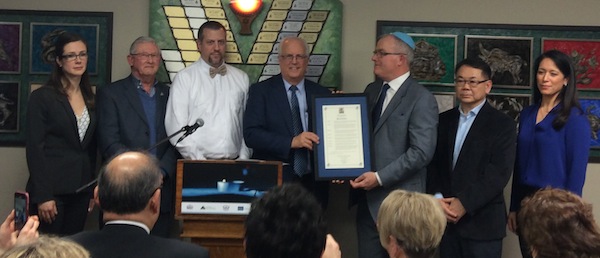
Left to right: Councilor Kelly Greene, Councilor Bill McNulty, Bayit past president Michael Sachs, Richmond Mayor Malcolm Brodie, Bayit president Keith Liedtke, Councilor Chak Au and Councilor Alexa Loo at the Bayit, after the mayor officially proclaims Jan. 27 as International Holocaust Remembrance Day in the city of Richmond. (photo by Cynthia Ramsay)

On Jan. 22, emotions were near the surface in a Holocaust commemoration that included the official proclamation of Jan. 27 as International Holocaust Remembrance Day in the city of Richmond. In a packed sanctuary at the Bayit, a synagogue in the province’s second-largest Jewish community, survivors, rabbis, community leaders and a host of elected officials from all levels of government were on hand to mark what was billed as an historic day.

Writer and teacher Lillian Boraks-Nemetz spoke as a survivor of the Holocaust and shared her first-person account, as well as the moral implications of what happened and the weight of survival.
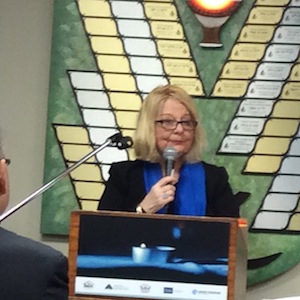
photo - Lillian Boraks-Nemetz
Lillian Boraks-Nemetz (photo by Cynthia Ramsay)

“Not a day passes when I don’t ask myself why did I survive when six million perished, 1.5 million children and among them my 5-year-old sister,” said Boraks-Nemetz. “And I survived. Why? When every European Jewish child was automatically sentenced to death by Hitler, I won. Was my survival a miracle? A twist of fate? The will of God? Why me?”

She recalled the day everything changed, Sept. 1, 1939.

“I was alone on the porch of my grandfather’s summer home when masses of airplanes passed over my head. I heard shots, explosions, my dad ran to get me and we barely made it to the shelter, where the sight of crying children and frightened people confirmed my own fears,” she said. The Nazis invaded her Polish homeland. Jews lost all human rights, her father lost his right to practise law, her uncle was prevented from practising medicine. Teachers, professors and businesspeople were all kicked out of their positions. Jewish children did not attend schools and they were bullied, a precursor of the much graver fate to come.

Soon the Jews of Warsaw were imprisoned in the ghetto, where a Nazi-created dystopia developed.

“People stole food from each other,” she said. “All morality ceased to exist in an amoral world.”

Young Lillian was smuggled into the factory where her mother was a slave labourer. Lillian’s grandmother had bought a small house in a village and promised it to a man in exchange for posing as her husband, creating a pretext of a non-Jewish Polish family. Lillian was then smuggled from the ghetto through bribery and survived the war with her grandmother and the man.

“What were my chances of surviving? The rate of a child’s surviving the ghetto was seven percent,” she said. “We were liberated in 1945 by the Russians. But liberation isn’t liberating to survivors.”

While adults worked to reestablish their lives in a new country, children were left largely to their own devices to assimilate all that had happened. Psychiatry or any professional help was largely nonexistent.

“I was told to forget and to let go by people who didn’t have a clue what was on my mind or my soul,” she told the audience. “This was not a physical wound that results in a bruise or a scab, which then falls off and mostly disappears. This is a branding on the soul of fire caused by man’s inhumanity to man, woman and child. The enormity of the Holocaust is still largely incomprehensible and still emotionally inaccessible to those who were born here.”
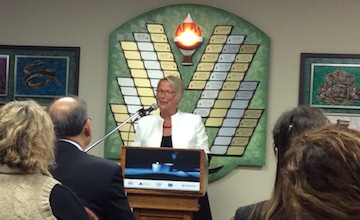
photo - Judy Darcy
Judy Darcy (photo by Cynthia Ramsay)

Judy Darcy, British Columbia’s minister of mental health and addictions, shared the story of how her father survived the Holocaust and subsequently hid his Jewish identity to everyone, including his own children, until the last years of his life, when he tried to reconcile his experiences in meetings with the late Toronto rabbi Gunter Plaut. Darcy’s story was featured in the Independent (Feb. 24, 2017, jewishindependent.ca/mlas-father-hid-past).
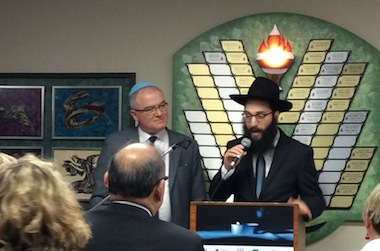
photo - Rabbi Levi Varnai speaks as Keith Liedtke looks on
Rabbi Levi Varnai speaks as Keith Liedtke looks on. (photo by Cynthia Ramsay)

Rabbi Levi Varnai, spiritual leader of the Bayit, recalled his family’s survival during the Holocaust, and Ezra Shanken, chief executive officer of the Jewish Federation of Greater Vancouver, spoke of the human potential for good and evil.

“We must understand that we as human beings have the capacity for immense love but also to create immense pain and it’s only through disciplining ourselves through education and through moments like this that we ensure that the community that I think we all want, which is a community of love, is what will remain,” Shanken said.
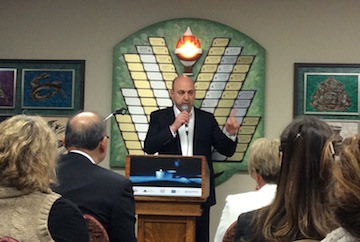
photo - Ezra Shanken
Ezra Shanken (photo by Cynthia Ramsay)

Richmond’s Mayor Malcolm Brodie spoke at the event. In an interview with the Independent after, he noted that he often receives requests for proclamations. Recently, the urgency for making a statement and standing with Jewish people was accentuated when a Richmond auction house had to be pressured to cancel the sale of Nazi military memorabilia. Participating in the commemoration with the Jewish community was significant for him, said the mayor, and the past is a lesson for the future.

“I found it quite moving,” said Brodie, noting the remarks by Boraks-Nemetz and Darcy. It is important, he said, “to remind people, and the greater community, to watch out for the signs, because something like this – hopefully never on the scale – but something could happen again.… There have been enough times recently that antisemitism is still a real thing. It is something that we don’t hear too much about but it is something that is very real. In addition to honouring these millions who died, we have to educate young people to make sure that everybody knows the facts and we make sure that it never happens again.”

Michael Sachs, a Jewish community activist and past president of the Bayit, was pivotal in organizing the event – which was co-hosted by the Bayit, Vancouver Holocaust Education Centre, Centre for Israel and Jewish Affairs, Kehila Society of Richmond and Jewish Federation of Greater Vancouver – and ensuring the attendance of the elected officials. Among the attendees were the mayor, most of Richmond’s city councilors, all four of the city’s members in the Legislature, Member of Parliament Alice Wong and former MP Joe Peschisolido, as well as others.

“There were 100 chairs and it was standing room only,” Sachs said afterward. “It’s historic because it’s the first time in Richmond that this proclamation has been made. To have such an outpouring of elected officials, VIPs and all these people coming out – it’s the first in history in Richmond.”

Sachs was effusive in his praise for the mayor for his actions. While many commemorations are taking place because it is the 75th anniversary of the liberation of Auschwitz, that was not a prime motivator of the Richmond event, said Sachs.

“It’s the first step of many that will come,” he said. “It’s the beginning of a real public acknowledgement that will lead to more public education. We had someone who was there, one of the aides of an elected official, and he came up to me afterwards and he said, ‘I didn’t know anything about the Holocaust.’ That’s one person right there,” Sachs said. “And, hopefully, this moment continues to help bring Holocaust education into every classroom in this province.”
Format ImagePosted on January 31, 2020January 28, 2020Author Pat Johnson and Cynthia RamsayCategories LocalTags Bayit, Holocaust, Malcolm Brodie, Michael Sachs, Richmond
JFL NorthWest returns

JFL NorthWest returns

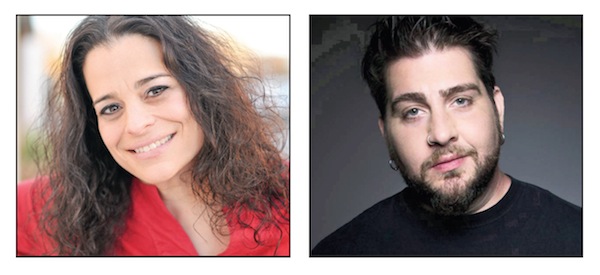
Jessica Kirson and Big Jay Oakerson are part of the Just for Laughs NorthWest comedy festival lineup in Vancouver Feb. 13-25. (photos from JFL NorthWest)

The Just for Laughs NorthWest comedy festival takes place around Metro Vancouver Feb. 13-25. Among the performers are several members of the Jewish community, including Andy Kindler, Jessica Kirson, Big Jay Oakerson and Esther Povitsky. The Jewish Independent recently spoke with Kirson and Oakerson.

Kirson is an award-winning comedian. She has appeared on several talk and TV shows, and has her own podcast, Relatively Sane. She was a consultant, producer, writer and actor in the Robert De Niro film The Comedian and will play herself on the HBO series Crashing with Pete Holmes. As part of JFL NorthWest, she will be at the Biltmore Cabaret on Feb. 17, 9 p.m.

JI: Since the JI spoke with you in 2016 ahead of your Chutzpah! show (jewishindependent.ca/gonna-be-a-fun-night), a lot has happened in your world. Could you share some of your professional highlights over the last few years?

JK: So much has happened. I have done a ton of television and movie appearances. I’m loving traveling all over the world doing stand-up. I am executive producing a movie for FX, a documentary about female comedians; it will première this summer. I had a special come out on Comedy Central called Talking to Myself, in addition to a bunch of other projects.

JI: You’ve been in the podcast world for a long time now. What do you particularly like about the medium?

JK: I started Relatively Sane because I wanted to create a podcast that wasn’t just funny and silly. I wanted it to get real also. I wanted to talk about anxiety, depression, etc. I love it. It’s one of my favorite creative mediums now.

JI: What is the difference, if any, performance or prep-wise between working on a radio show versus a podcast?

JK: It’s very similar. I don’t do a ton of prep work with my guests. I love finding things out while I’m talking to them. It’s more real that way.

JI: Can you tell me a bit about your Comedy Central special, how it came about and what it has meant to you career-wise?

JK: I had felt like I deserved a comedy special years ago. It was the one thing I felt I deserved that I didn’t get. I got a call from Bill Burr. He told me he wanted to produce my special. He shocked me. I feel very grateful to him. When comics do things like that for other performers, it’s amazing. We should all do it for each other.

JI: Similarly, The Comedian and Robert DeNiro. How did that happen?

JK: DeNiro saw me performing at the Comedy Cellar in New York City. He was looking for comics to be in his movie. We met up that week, we connected and I became his right-hand person. I ended up being in the movie and getting a producer credit. The hardest part was showing up every day, giving my opinion and not caring what the producers and director thought. It was very intimidating but I had him by my side so it worked out.

JI: Is getting your own television show still something you’d like to achieve?

JK: Yes, I would love to have a talk show.

* * *

Oakerson has appeared on many television shows. He has recorded two specials, one for Comedy Central in 2016 and one for Netflix in 2018, as well as three albums. He was the host and creator of What’s Your F#$king Deal?! and currently co-hosts the podcasts The Legions of Skanks, The SDR Show and The Bonfire with Big Jay Oakerson and Dan Soder. For the JFL NorthWest festival, he will perform at the Biltmore Cabaret Feb. 19-20, 9:30 p.m.

JI: When did you first start doing stand-up and what motivated you to do it?

BJO: I started doing comedy in 1999 at the urging of a friend who caught up with me after high school and expressed her disappointment in me never trying it before.

JI: In what ways has your stand-up style changed since you first started?

BJO: First of all, my level of nerves is significantly down. I think I’ve evolved it into a very comfortable style of storytelling and interaction versus joke writing/telling than I started with.

JI: Did you grow up in a household where you were encouraged to form and express your own opinions?

BJO: I don’t recall anyone in my household being highly opinionated about anything.

JI: Were you a witty or mouthy child?

BJO: 30% mouthy, 70% witty.

JI: What role, if any, does being Jewish, Judaism, Jewish culture or community have in your life and/or your career?

BJO: I thought I’d get a bump in this business because I’m Jewish, and nothing. I guess I’m not that kind of Jewish.

JI: What is it about pushing the boundaries that you most enjoy, and to what purpose do you do it?

BJO: “Edgy comedy” was generally the comedy I was drawn to growing up, so it’s just sort of how my humour developed. If I can make you question things or think about a different perspective on something, great, but, ultimately, I’m just trying to make people laugh.

JI: Are there any red lines you won’t cross?

BJO: Not if I think I can make the subject more funny than offensive.

JI: What do you enjoy most about doing podcasts?

BJO: Freedom.

Both Oakerson’s and Kirson’s shows are 19+. For tickets and the full JFL NorthWest lineup, visit jflnorthwest.com.

In next week’s JI: an interview with Esther Povitsky.

Format ImagePosted on January 31, 2020January 28, 2020Author Cynthia RamsayCategories Performing ArtsTags Big Jay Oakerson, comedy, Jessica Kirson, JFL NorthWest
War heroism recalled

War heroism recalled

Prof. George Bluman speaks at the 15th annual Raoul Wallenberg Day commemoration, Jan. 19. (photo by Masumi Kikuchi)

Japanese diplomat Chiune Sugihara was honoured in Vancouver this month with a lecture on his wartime heroism – by a man who owes his life to the actions of Sugihara when the diplomat served as consul for the Imperial Japanese government in Lithuania, near the start of the Second World War.

George Bluman, a professor emeritus of mathematics at the University of British Columbia, spoke at the 15th annual Raoul Wallenberg Day commemoration Jan. 19, which was held at the H.R. MacMillan Space Centre. The annual event is presented by the Wallenberg-Sugihara Civil Courage Society and took place 75 years and two days after Wallenberg, a Swedish diplomat in Hungary whose actions saved the lives of tens of thousands of Jews, was last seen alive. The actions of Sugihara, vice-consul of the Japanese embassy in Kaunas, Lithuania, paralleled those of Wallenberg in that he issued visas and took extraordinary actions to save the lives of the threatened Jews of Europe.

Bluman’s parents, Nathan and Susan Bluman, fled to Lithuania after Germany invaded Poland in 1939. There, they received transit visas from Sugihara, which enabled them to travel through the Soviet Union to Japan. They then obtained temporary permits to enter Canada and they were aboard the last ship sailing from Japan to Vancouver prior to the attack on Pearl Harbor.

An estimated 15% of Sugihara survivors became Canadians, many of them remaining in Vancouver, including the Bluman family, which has come to number 23, now including great-grandchildren of Susan and Nathan. It is estimated that Sugihara’s actions facilitated the escape of thousands of Jewish refugees.

In addition to the Sugihara descendants living in Vancouver, Bluman noted an additional local connection. On his way to Europe for the series of diplomatic postings that would lead to his heroic acts, Sugihara and his wife Yukiko arrived by ship in Vancouver in 1937, then took a transcontinental train to the East Coast to board another ship, which would take them to Europe.

A 2017 poll in a Tokyo publication rated Sugihara as the most important Japanese person ever. “Why?” Bluman asked. “Against advice from his superiors in Tokyo, he issued transit visas to Japan that ended up saving about 2,100 Jewish refugees who otherwise would have been likely murdered. Those saved included my parents as well as one of my uncles and his wife.… Perhaps as many as 40,000 people owe their lives due to the extraordinary heroic deeds of Sugihara.”

Two diplomats from the Netherlands played crucial roles in Sugihara’s heroics, Bluman said. After the Nazi occupation of that country, in May 1940, an anti-Nazi Dutch government-in-exile was established in London and remained in charge of all Dutch embassies. The anti-Nazi Dutch ambassador in Latvia, L.P.J. de Decker, dismissed his pro-Nazi Lithuanian honorary consul, replacing him with Jan Zwartendijk, a Dutch engineer heading Philips electronics in Kaunas.

“Two young Dutch rabbinical students approached Zwartendijk, requesting documentation to go to Curaçao, a Dutch colony in the West Indies, with the aim of traveling east through the Soviet Union, Japan, the Pacific Ocean and the Panama Canal to tiny Curaçao, an island off the coast of Venezuela, about one-sixth the size of Metro Vancouver. They also sought permits for their mostly Polish classmates.

“Why Curaçao?” asked Bluman. “Because no visa was required to enter Curaçao. The local governor had sole authority to permit entry. But this was rarely granted. Zwartendijk was given permission by de Decker, the Dutch ambassador in Riga [Latvia], to issue permits to Curaçao to their fellow rabbinical students that stated, in French, ‘A visa for entry is not required,’ leaving out the condition of the governor’s permission. Moreover, Zwartendijk courageously agreed to issue such permits to all Jewish refugees who applied for them.”

A delegation of Jewish refugees approached Sugihara about obtaining Japanese transit visas, a necessary step for the scheme’s success.

“Without permission from Tokyo, and after getting Soviet approval, signed by Stalin, for refugee transit through the Soviet Union, Sugihara issued transit visas valid for a stay of 10 days in Japan, based on the seemingly sufficient Zwartendijk Curaçao permits,” said Bluman. “Zwartendijk signed 2,300 such permits, until his office was forced to close on the day Lithuania was annexed by the Soviet Union.… The scam worked.”

With the annexation of the Baltic states to the Soviet Union, all foreign embassies were ordered closed. Though Zwartendijk left, Sugihara managed to stay on for a further four weeks to continue writing transit visas – even for Jews who had not obtained a visa from Zwartendijk.

“These Jews included my parents, who approached Sugihara’s office six days after Zwartendijk had left,” Bluman said.

Ultimately, about 80% of the Jewish refugees issued Sugihara visas survived and about three-quarters made it to Japan. Almost half carried on to Shanghai, China, to wait out the war.

Sugihara’s diplomatic career effectively ended in Romania, where he was posted at the end of the war. When the Soviets occupied Bucharest, Sugihara and his family were imprisoned in a prisoner-of-war camp for 18 months.

Back in Japan in 1946, Sugihara was dismissed from diplomatic service and spent the next several decades in low-key positions in Japan and Moscow. His retirement from service was ostensibly a matter of downsizing, but some have speculated that his heroic insubordination was a cause.

Only in 1968 did Sugihara learn that most of the Jews he had helped had survived. In 1985, he was recognized by the state of Israel, receiving the Righteous Among the Nations award from Yad Vashem, as well as perpetual Israeli citizenship for himself and his family. Zwartendijk was posthumously honoured in 1997. Sugihara died in 1986, at the age of 86. Bluman retains close contact with the family in Japan.

“In my family,” Bluman concluded, “there is one great hero we always carry in our hearts and to whom we will be forever grateful: Chiune Sugihara.”

After Bluman’s presentation, attendees watched the film Persona Non Grata: The Story of Chiune Sugihara. Earlier, Alan La Fevre, president of the Wallenberg-Sugihara Civil Courage Society, welcomed guests, including the deputy mayor of the city of Vancouver, Christine Boyle, who read a proclamation declaring Raoul Wallenberg Day. Diplomats from Japan and Ukraine were in attendance.

The Wallenberg-Sugihara Civil Courage Society was formed in 2013 by members of the Swedish and Jewish communities. The society continues the legacy of the annual Wallenberg Day events in Vancouver, recognizing and honouring individuals who, at great personal risk, have helped others by acting against unjust laws, norms or conventions.

Format ImagePosted on January 31, 2020January 28, 2020Author Pat JohnsonCategories LocalTags Chiune Sugihara, George Bluman, Holocaust, Wallenberg-Sugihara Civil Courage Society

When is never again?

Monday was International Holocaust Remembrance Day. Scrolling through social media, it was jarring to see the juxtaposition of images and ideas reflecting on that terrible history intermingled with the mundane and fantastical miscellany of everyday 21st-century life. This is the reality of our world: the grave realities of yesterday and today poking through the onslaught of witty memes, outrage over a vast range of real and imagined evils, cute kittens and the panorama of detritus and riches available to, and bombarding us, at every moment.

This is how it is. Even as we recommit ourselves to the promise of “never again,” still we carry on with our daily lives. Yet these realities are not, and should not be, disconnected from one another. The memory of the Holocaust and its victims, and the importance of listening to and learning from its survivors and its messages, are sacred obligations. But their lessons and meanings can and should be applied to the more commonplace events we experience. History is a prism through which we should view the present and the future.

Like the jarring extremes that can be found scrolling social media on Holocaust Remembrance Day, this collision of gravity and triviality is problematic. We recoil from inappropriate comparisons. Yet, in a world where legitimate causes struggle to be heard above the competing din, we often fall back on the most incendiary formulations, so every injustice becomes “fascism,” every leader we dislike a “Nazi.” This dilutes the seriousness of the history it invokes – and it also makes it more difficult to identify and draw attention to genuinely grave dangers, including literal fascism or fascist-adjacent ideas and actions emerging in Europe and closer to home.

The number of lessons to be drawn from the Holocaust are as innumerable as there are human behaviours. A relevant one for our time is the fragility of democracy and civil order. The actions of Raoul Wallenberg and Chiune Sugihara (click here to read story) are examples of a dystopic situation where good people are driven to break laws and norms promulgated by evil forces. In situations where democracy and social order are upended, goodness is criminalized and malevolence is institutionalized.

Democracy is under threat in much of the world right now. Human nature is such that we take for granted once-unimaginable wonders – gadgets in our pockets containing the breadth of human knowledge, the perceived right of every individual to live free from fear of tyranny – almost as soon as we access them. We forget that democracy is barely two centuries old and that it is not only imperfect but tenuous. With extraordinary ease, individuals of various stripes have managed to smother or at least severely disfigure nascent democracies in Russia, Poland, Hungary and elsewhere in Eastern Europe. A more established democracy in Turkey has been twisted away from its secularist, pluralist roots. The world’s largest democracy, India, is engaged in serious religious-based oppression.

In Israel, there are social forces and political parties pushing the extremes, as well. The Kahanist party, Otzma Yehudit, is aiming to again contest the March elections and has been rooting around the emerging electoral alliances for a slot. To his credit, Naftali Bennett, head of the New Right bloc and no raging moderate himself, rejects being in a tent with Otzma Yehudit and rightly warns other parties to steer clear.

And, in ways whose significance we may not yet be able to judge, the fabric of American democracy – checks and balances between branches of government – is being threatened. The president, indicted for attempting to extort our ally Ukraine to participate in political dirty tricks in exchange for desperately needed military funding to defend itself against the encroaching Russian military, seems destined to be exonerated by a Senate more concerned with party discipline than the rule of law, the constitution or human decency. If the probable outcome is realized, it will represent a blow to the grand ideals of the world’s oldest contemporary democracy.

Is raising this example itself a symptom of the problem we are discussing? Is it relevant and proper to discuss the American or Israeli situation in the same context as Russia, Poland or Hungary? Do we diminish the memory of the Holocaust by raising this topic in this perspective? Is it equally specious to assert that we won’t know, perhaps until it is too late, whether we should have been more or less vigilant when a man with little or no respect for norms of nicety or constitutionality ascended to the highest office in the democratic world?

This is the line we walk when we say “never again.” The magnitude of the history underpinning this promise is so enormous that we risk lessening it through invocation. Yet, if we isolate that history and its lessons, like good china saved only for the most special occasions, are we not conversely risking the very promise we undertake?

Posted on January 31, 2020January 28, 2020Author The Editorial BoardCategories From the JITags antisemitism, democracy, history, Holocaust, Israel, racism, United States
Artistic visions of hope

Artistic visions of hope

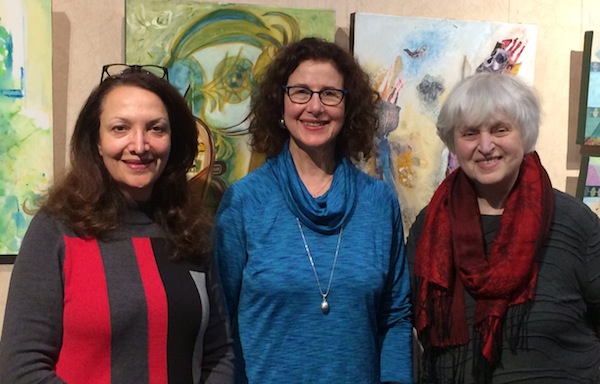
Left to right, Three Echoes artists Sorour Abdollahi, Devora and Sidi Schaffer. Their exhibit, Hope and Transformation, is at Amelia Douglas Gallery until Feb. 29. (photo from Three Echoes)

Connected by similar values and inspirations in their creative work and in their lives more generally, Sidi Schaffer, Sorour Abdollahi and Devora are longtime friends. Their fifth exhibit together – as the informal collective Three Echoes – is called Hope and Transformation. It is at the Amelia Douglas Gallery at Douglas College in New Westminster until Feb. 29.

“Art transcends the limitations of time, space, language and cultural background,” said Devora in her written remarks, prepared for the exhibit’s opening Jan. 16, which was postponed because of the snow, and given Jan. 21. “The echoes from within spill over onto the canvases,” she said. “Together, our works create a dialogue of hope and transformation.”

Devora told the Independent that the name for the exhibit came “through talk and discussion between the three of us in reflecting on our individual and collective journeys and where we found ourselves, and the world, at that moment.”

“Today, there is a lot of anxiety about globalization and migration,” Abdollahi said. “As an immigrant artist, my art deals with connections between cultures and hybridity. Therefore, my works might help serve as a bridge and tell the immigrant story.”

Abdollahi was born and raised in Iran, where she graduated with a diploma in Persian literature from Yazd University and a bachelor’s in fine arts from the University of Art in Tehran. In Vancouver, where she settled 20 years ago, she studied at Emily Carr University of Art and Design. She writes in the exhibit catalogue that her Iranian heritage and Canadian experience “have had a tremendous influence on my works’ subject matter, dealing with the mediation between the modern and the ancient, the old and the new, the West and the East.”

The artist uses collage, a multi-layering technique and mixed media. “My works show the relationship between culture and environment and migration,” Abdollahi explained to the Independent. “Our environments are changing both internally in our mind and externally, and my works illustrate this change. My works create negotiation between different cultures and societies.”

Schaffer also started her fine arts education in her birth country, Romania. In Israel, she received a degree in art education and taught in the school system for more than a decade. When she came to Canada in 1975, she studied at the University of Alberta, where she majored in printmaking and painting. Initially focused on abstraction, her work has become “more integrated, combining abstract and figurative forms,” she writes in the catalogue. “Now I am continually exploring new possibilities with mixed media, a combination of print, drawing, painting and collage. Important for me is the visual poetry, the relationship of form, space, colour and light. Some of my works in this show are a combination of collages of different things from nature and painting; others are collages of my own imagination.”

“I am an optimist and also I am amazed about the continuous transformation in nature around me,” Schaffer told the Independent. “I combined my love and respect for the beauty of flowers and leaves, surrounding them with hope, and new imaginary landscapes. In a way, I give the dry flowers a new life, bringing them out from the pages of old books.”

As for Devora, she told the JI, “What gives me hope is my relationship with the Divine – that there is no separation, that we are all connected and made of stardust, that we are all on an unfolding journey of being together. I attempt to express that emotion onto the canvas.”

For Devora, art has the power to transform the viewer when the viewer can hear her work speak to them from their own experience. “At the opening,” she said, “the Douglas College students from two classes – one poetry class and one art history class – gathered around and engaged with all three of our works, asking questions, wanting to understand the process, the intention and how they could relate from their own lives to what they were seeing.”

Normally, only the art history students attend each artist talk. However, after Devora shared that the Zack Gallery at the Jewish Community Centre of Greater Vancouver hosts Pandora’s Collective poetry nights, where members of the collective create works inspired by the art, the Amelia Douglas Gallery invited the poetry class, as well.

Growing up in Berkeley, Calif., where she earned a master’s at California School of Professional Psychology, Deborah Ross does all of her creative work under her maternal grandmother’s name, Devora, in honour of her grandmother, who was murdered in the Holocaust. “Her spirit gives me the strength and confidence to create,” said the artist in her remarks for the exhibit.

Devora, who now lives both in Vancouver and on Salt Spring Island, came to Canada in 1993. She has studied art at Emily Carr, Langara College and elsewhere. “My artwork reflects the love I have for the creative process and exploration,” she writes in the exhibit catalogue. “I am fascinated by the inner world of emotion, dream, metaphor and story and strive to illuminate both the universal and personal by bringing them onto the canvas.

“My latest works explore the interplay and continuum between abstract and representational images of landscapes and figure, and a fascination with the surreal, in mixed media combining acrylic and collage.”

In her remarks for the exhibit opening, Devora explained, “My art reflects a search for understanding and clarity about my personal and ancestral history and the world. My experiences inform my work as I go inside and bring them onto the canvas. I endeavour to transform darkness into the light of hope. I am interested in what is hidden and how it informs what is revealed.”

She noted that she, Abdollahi and Schaffer “turned to esthetics as a way to focus and navigate our journey.” And she expanded on this concept. “Through the lens of esthetics combined with the common immigrant experience and effects of war and displacement,” she said, “the three of us have managed to bridge all other divides: language, ethnicity, culture, religion and country of origin. Our childhood environments and experiences could not have been more different on the surface and yet the foundations of connection and similarity were already being laid down, established through the development of the lens of sensitivity to beauty in the world and compassion for the human experience.

“Our ideal, of different cultures living in harmony, is reflected in our own personal experiences, in which intimate exposure to the world of ‘the other,’ unearths commonalities and gives rise to a greater depth of understanding about our own lives.”

She concluded, “In closing, I would like to quote Sorour, as Sidi and I feel that her words speak for all three of us: ‘In my friendship and collaboration with Sidi and Deborah, I see an opportunity to explore and express my own culture, but also to relate these themes to other cultural experiences – recognizing the echoes of each other in our works and our lives. My works side by side those of my friends’ works create a dialogue and negotiation which hopefully provides the viewer with a different vision of the world – one which is borderless, free and peaceful.’”

Format ImagePosted on January 31, 2020January 28, 2020Author Cynthia RamsayCategories Visual ArtsTags art, Devora, immigration, Sidi Schaffer, social commentary, Sorour Abdollahi, Three Echoes
Directing a favourite musical

Directing a favourite musical

Malka Martz-Oberlander, left, and Dalia Currie are co-directing Little Shop of Horrors, which is at the Red Gate Revue Stage from Feb. 6-9. (photos from TES Theatre)

At 17, many Jewish Independent readers were probably spending most of their time hanging out with friends, maybe doing a music or art class or two, some sports activities. In addition to being a student, 17-year-old Jewish community member Malka Martz-Oberlander is a filmmaker, writer, film and theatre director, cartoonist, musical theatre actress and photographer. Her latest initiative is a production of Little Shop of Horrors, which is at the Red Gate Revue Stage on Granville Island Feb. 6-9.

Presenting the production is TES Theatre, or Transforming Education, which, explained Martz-Oberlander, was “originally the theatre program at the one-of-a-kind Windsor House School: a democratic, multi-campus, K-12 school in East Vancouver.

“When Windsor House School closed down last year,” she said, “former principal Meghan Carrico decided to start a theatre company for the students, like myself, who wanted to continue to do theatre and musical theatre together. The program that arose after the school’s devastating closure is grounded in the same democratic philosophy. Our mission is to make sure any student who wants to do any aspect of musical theatre can and will be supported by a willing cast and a professional musical theatre teacher.”

Martz-Oberlander is co-directing Little Shop of Horrors with Dalia Currie. Last June, the pair co-directed a production of Much Ado About Nothing that Currie adapted. According to Martz-Oberlander, Currie “loves Shakespeare” and has “co-directed and acted in many of the Bard’s shows,” including playing the role of Theseus in A Midsummer Night’s Dream in 2018, as part of the Carousel Theatre Teen Shakespeare Program.

Currie found musical theatre through joining Windsor House in 2018, said Martz-Oberlander. “She played Olive Ostrovsky in The 20th Annual Putnam County Spelling Bee and Gaston in Beauty vs. Beast, an original parody of the tale as old as time.”

For her part, Martz-Oberlander performed with Encore Musical Theatre (formerly Broadway Edge) for four years, then performed in two shows with Windsor House School and, this year, is a member of Arts Umbrella’s Pre-professional Musical Theatre Troupe.

illustration - Crystal, Ronette and Chiffon are the three narrators of Little Shop of Horrors. Malka Martz-Oberlander sketched this image of the trio, which was colourized by Emi Lavoie
Crystal, Ronette and Chiffon are the three narrators of Little Shop of Horrors. Malka Martz-Oberlander sketched this image of the trio, which was colourized by Emi Lavoie. (image from TES Theatre)

Martz-Oberlander said she and Currie initially pitched Little Shop of Horrors to the theatre company because they had both grown up watching it, “and we were very excited at the thought of directing our first musical together this year with the mentorship of our new musical theatre teacher, Isabella Halladay, who is a local musical theatre artist.”

The production involves around 30 people, said Martz-Oberlander, “and all but three of them are students. We held auditions for people within our theatre community,” she said. “We made sure that anyone who was interested has been involved in some way, whether it be onstage or in the tech booth. The actors range from age 14 to 19. There is no live band, we have backing tracks.”

Little Shop of Horrors, both a film and a Broadway musical from the 1980s, is now back on Broadway, said Martz-Oberlander. “It’s about an orphan boy taken in and given a job by Mr. Mushnik, a European Jewish immigrant and the owner of a run-down flower shop in the ‘bad part of town.’”

Despite the fact that both writers of the musical were Jewish – Howard Ashman (who passed away in 1991) and Alan Menken – Martz-Oberlander said that she and Currie were concerned about the portrayal of certain characters, in particular that of Mr. Mushnik.

“As a cast and individually, we have discussed when it’s good to bring out stereotypes and when it’s actually really harmful,” Martz-Oberlander told the Independent. “For example, the character Mr. Mushnik seems like a two-dimensional, money-hungry shop owner. The character embodies this Jewish stereotype throughout the whole story. My non-Jewish co-director and I have tried our best to approach this thought-provoking comedic piece with the intention of not perpetuating hurtful stereotypes. When producing a show written in a different decade, when values were different, it’s so important to come at it from an authentic, respectful and knowledgeable way.”

Martz-Oberlander had only praise for the production’s venue, the Red Gate Revue Stage. Saying that the cast and creative team were “incredibly lucky to get to rehearse and perform” there, she added, “I think a place like the Revue is vital at a time in Vancouver where things are less and less affordable – to have arts spaces and small theatres like the Revue is very important.”

As for Little Shop of Horrors, Martz-Oberlander said, “I think it’s a great opportunity to come out and support local youth-directed theatre and watch a fantastic show! This show is really a one-of-a-kind, hilarious science fiction musical that will have you humming tunes for weeks after.”

Tickets to Little Shop of Horrors ($5-$15) can be purchased at the door or online from brownpapertickets.com/event/4481952.

Format ImagePosted on January 31, 2020January 28, 2020Author Cynthia RamsayCategories Performing ArtsTags Dalia Currie, Little Shop of Horrors, Malka Martz-Oberlander, musical theatre, Red Gate Revue Stage, TES Theatre, youth
Magnifying emotions

Magnifying emotions

Gila Green will talk about her two latest books at the Jewish Book Festival on Feb. 9. (photo from JCC Jewish Book Festival)

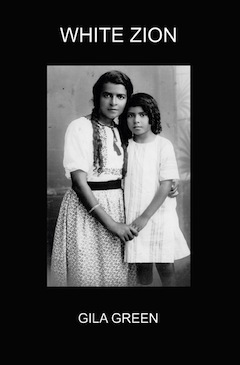
From the first page, White Zion reads like a memoir. Through 16 short stories, we get to know Miriam and her family, from her great-grandparents to her own children, as well as the places they are from, including Yemen, Israel at various points in its history and Canada. It is easy to wonder how much of Miriam is her creator, Israeli-based writer Gila Green, who will be at the Cherie Smith JCC Jewish Book Festival Feb. 9.

“The stories in White Zion are all about emotional truths,” Green told the Jewish Independent. “So, if that’s what’s coming across, that is some measure of success. I did not say this but Alice Munro did – I recall reading an interview with her in which she said: ‘If your audience thinks all you did was wake up and write down everything that happened to you yesterday, then you’ve succeeded.’ I would love to hear about how readers relate to these emotional truths, how they connect.”

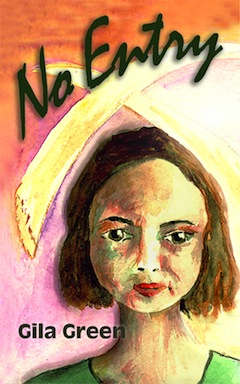
Green will also bring her young adult novel No Entry to the festival, for which she will talk at both the Jewish Community Centre of Greater Vancouver (12:30 p.m.) and the White Rock/South Surrey Jewish Community Centre (4 p.m.) that Sunday.

The heroine of No Entry is Yael Amar, a teenager from Ottawa, which was where Green was born and has lived. Yael has traveled to South Africa to intern for a spell at a private bush camp near Kruger National Park. (Green’s husband is South African, and Green has lived in the country.) There with the intent of helping protect elephants from poachers, Yael ends up in danger herself.

Despite the connections her books may, or may not, have with her own family, Green prefers to write fiction. She described nonfiction as “limiting” for her.

“As soon as someone tells me to write a true story, I’m suffocating,” she said. “I have to start questioning what is fact, what is memory, what lacks context, what is something I’ve just convinced myself is true and on and on. I spent four years at Carleton [University in Ottawa] studying for a journalism degree, so all of that kicks in. In the end, the short story is a wrung-out sock, more like a dozen tangled wrung-out socks. No one wants to read a sock. There is no connecting with it.”

Fiction allows for the expression of emotional truths that would be impossible to express otherwise, she said.

“Writing fiction allows me to hone in on a feeling – something I want my audience to feel, which is how I start every story I write. I ask myself, ‘How do I want this story to make the reader feel?’ and I start from there – and I can hold that emotion under a magnifying glass. I can distort it, blow it sky high, cut interference to ant height or delete. I can take one characteristic of one person on a single day about a single event and I can magnify it, so that the rest of the human being is rendered invisible. These were some of my goals with White Zion. The characters are all gross distortions of one human trait or another.”

But that doesn’t mean that facts don’t enter her work.

image - White Zion book cover“I tried to be as faithful as possible to the historical period,” she said, referring to the stories in White Zion, “and I spent months researching everything, from what vegetables they could have been selling in the Jerusalem market post-1948 to how they could possibly have been heating their homes. I also used the same biographical details for two of the characters, Miriam and her father. It was important for me that Jewish fiction expand to include Yemenite voices, religious voices, gay voices, the more voices the better.”

Green also did much research for No Entry and, in addition to crafting an entertaining, at-times tense, thriller-like novel, she educates readers on the nature of elephants and the very real threat of their extinction.

“Yael is a Jewish eco-heroine,” said Green, who noted that the character’s boyfriend, David, is also Jewish. “She’s not religious but both of her parents are Jewish – she mentions in No Entry how the South African traditional dish she tastes for the first time reminds her of her mother’s chulnt on the Sabbath and, in No Fly Zone, she has an Israeli-themed dinner with her parents. None of the other characters are Jewish…. I do like exploring different kinds of Jews though. If readers want a more obvious Jewish heroine in the sequel[s], please write to me.”

Green has finished writing No Fly Zone, the next book in what might become a series. In it, she said, “Yael Amar is back with her best friend Nadine Kelly, this time protecting Kruger National Park from the skies. But she is about to learn a big lesson when it comes to moral relativity and friendship.”

image - No Entry book coverGreen added, “I set out to thread the senseless loss of human life with the equally nonsensical destruction of animals in No Entry and I continue this in the sequel. I did this not because I’m trying to make a point about the connection or status between humans and animals – that’s the wrong way to understand my motivation. Rather, I’m trying to weave together the criminals who commit these inhuman acts: they’re connected.

“Often,” she said, “the same people willing to sell illegal blood ivory are involved in terrorism, human slavery and other acts that bring nothing but grief to the planet. I wish to emphasize this linkage, to shout it from the rooftops. But, in real life, I figured an exciting, adventurous, teen novel was a more effective way to go.

“I purposely made the terrorist event [in No Entry] happen in Canada because I want to get the message across that fatal betrayal doesn’t just happen in Africa or the Middle East. That attitude might allow some of us to feel off the hook. It happens everywhere and we all have to make sure we are part of the solution or there won’t be one and that thought is too devastating to imagine. I refuse to go there and No Entry ends on a victorious note for a reason.”

Though the sequel has been written, its publication date will depend on what happens in Australia and the bushfires that continue to destroy the country. Green shared, “I am very sad to say that my publisher Stormbird Press was on Kangaroo Island and has burned to the ground. The staff was evacuated on Dec. 20th. We are all praying for their safety and that they fully recover but, for now, everything is at a standstill and there is terrible devastation.”

Green is already working on her next novel. In A Prayer Apart, her main character, for the first time, is male, she said. “He’s an Israeli-Jewish teenager living through the 2014 war with Hamas, knowing he’s next in line for the front line. By the same token, he’s had it with his parents and school and his rebellious behaviour lands him in lockdown, one step away from juvenile jail.”

She said she will let readers know on her website, gilagreenwrites.com, when the publication details are finalized.

An avid reader since childhood and now a prolific writer, with four books published since 2013 and two more on the way, Green said, “Mankind cannot live without stories. Period. We are our stories. When people are down, what they are really saying very often is they don’t feel connected. Stories connect us.”

For the Jewish Book Festival lineup and schedule, visit jewishbookfestival.ca.

Format ImagePosted on January 31, 2020January 28, 2020Author Cynthia RamsayCategories BooksTags fiction, Gila Green, JCC, Jewish Book Festival, memoir, storytelling, young adults
Mark and Seth Rogen honoured

Mark and Seth Rogen honoured

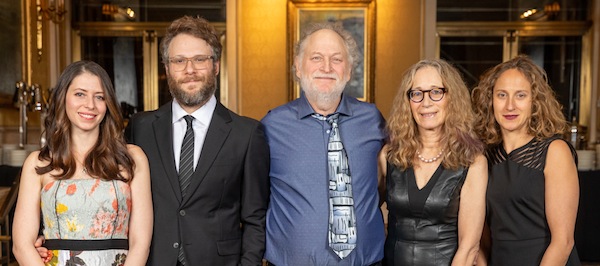
Left to right: Lauren Miller Rogen, Seth Rogen, Mark Rogen, Sandy Rogen and Danya Rogen at the ceremony in New York City at which Mark and Seth were honoured with the Generation to Generation Activism Award from the Workmen’s Circle. (photo from Mark Rogen)

Vancouver’s Mark and Sandy Rogen have good reason to be proud of their children and the Jewish values with which they raised them. Some of those values were highlighted as 2019 came to a close, when Mark Rogen and his actor, writer and producer son Seth were honoured on Dec. 2 with the Generation to Generation Activism Award from the Workmen’s Circle in New York.

The award recognizes the Rogens’ work promoting Jewish culture and traditions, while also carrying on the traditions of tikkun olam, repairing the world.

“What made it meaningful for us and for everyone who came was that it was an award about values,” Mark Rogen said in an interview with the Jewish Independent after a game of basketball at the Jewish Community Centre of Greater Vancouver. “It wasn’t about someone giving $2 million to get their name on a hospital. It was about recognizing people living in a positive way.”

Rogen said he and Sandy have always preached that value to their kids, along with the idea that they should always strive to “be a blessing.”

“That’s the way Sandy and I tried to raise Danya and Seth – to try to be a blessing and do what you can,” he explained. “Doing something one-to-one is just as good as doing something internationally. It’s where your heart is and I think Sandy and I are very happy to see that’s how Danya and Seth live their lives. That’s the pride.”

Rogen noted that, when his kids were young, they experienced many blessings. In those years, he said, the family had little money and institutions like Vancouver Talmud Torah, the JCC and Camp Miriam treated his children well, and “didn’t charge us a lot. So, Danya and Seth spent their formative years in the Vancouver Jewish community, and their friends today are from those years. Seth met Evan [Goldberg, his writing partner] at the JCC doing karate, and then they did bar mitzvah classes together.”

Knowing that his children are giving back as adults is important, said Rogen, who worked for the Workmen’s Circle for two years when the family temporarily moved to Los Angeles when Seth filmed Freaks and Geeks. Among other things, Seth and wife Lauren Miller Rogen founded Hilarity for Charity, which raises money for Alzheimer’s care, research and support.

That the recent award was a joint honour made it more meaningful to Seth Rogen. “To be honoured in any capacity is rare and lovely for me, but, to be honoured alongside my father was truly special and memorable,” he told the Independent. “My dad has always been dedicated to helping others and spreading goodness wherever he can. He worked for nonprofits most of my childhood and always strived to make the world a better place. He is someone I always go to for advice and his guidance is consistently geared towards not just what’s good for me, but what’s good for everyone.”

As for the Jewishness he often displays on screen, the actor said he rarely separates that part of himself from his work. “Being Jewish is inseparable from my identity in many ways, so it’s something I’ve always thought was good to acknowledge and integrate into my work,” he explained. “I simply am Jewish and I’m proud of myself and what I’ve done with my life.”

Seth Rogen’s biggest Jewish role, however, might be coming in the soon-to-be-released American Pickle, in which he plays a young man who comes to the United States in 1918 from a European shtetl, then gets trapped and preserved in a pickle barrel for 100 years before being united with his grandson in Brooklyn.

Danya Rogen – who is currently on the board of Vancouver Talmud Torah, on the personnel committee for Habonim Dror Camp Miriam and a regular participant on the JCC softball league team her father captains – joined many family members and friends in New York for the ceremony honouring her father and brother. She remembers her parents raising their awareness of important issues at a very young age.

“My parents, and my dad in particular, taught us to stand up for what we believe in and stand up for others who can’t do it for themselves,” she said. “My parents were also incredibly kind and generous, even when we didn’t have so much ourselves. All of those values have stuck with me my whole life. “I hope to live up to being a blessing and can pass those values on to my own children. I suppose the fact that I have become a social worker isn’t that surprising.”

Kyle Berger is Jewish Community Centre of Greater Vancouver sports coordinator, and a freelance writer living in Richmond.

Format ImagePosted on January 31, 2020January 28, 2020Author Kyle BergerCategories LocalTags family, Judaism, milestones, Rogen, tikkun olam, Workmen’s Circle
Eclectic Jewish sounds

Eclectic Jewish sounds

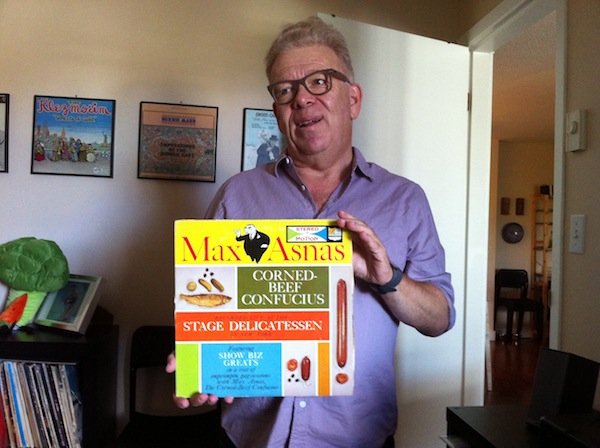
Andy Muchin with a record from his collection. (photo from Sounds Jewish)

The American South may not be the first place you would consider tuning the dial for an hour-long radio program that runs the gamut of Jewish music and many other audio facets of Yiddishkeit. That the show is assembled half the year on Vancouver Island might add another element of unexpectedness to the equation.

“I realize it might appear a bit incongruous,” Andrew Muchin told the Independent, from his Victoria home. “But, thanks to the internet age, things like this are no longer that difficult to do.”

Fifty weeks a year, Muchin goes through his collection of more than 1,000 vinyl records, scores of CDs and hour upon hour of digitized music to produce Sounds Jewish, a weekly radio program for Mississippi Public Broadcasting, based in Jackson, Miss. The show is broadcast on Sunday afternoons there and heard anytime online.

Having celebrated its ninth anniversary at the end of last September, Sounds Jewish focuses on a relevant theme, often within the Jewish and secular calendars. Avid listeners soon realize the problem for Muchin is not finding material but sifting through all the material that is out there. It takes several hours to select music for, record and produce each show, and programs often contain a range of offerings, anything from a 1960s comedy routine to Israeli hip-hop.

For American Thanksgiving in late November, Muchin spun a number of discs, including a Ladino number, “These Beautiful Tables” by the Ruth Yaakov Ensemble, and “Tish Niggun” (“Table Melody”) from the band Klezmer Plus! The show then mixed in songs of gratitude, such as a melodic rendition of Psalm 118 with Israeli singer/keyboardist Idan Raichel and Malian singer/guitarist Vieux Farka Touré and a counting of blessings from British singer Daniel Cainer – who opened the 2019 Chutzpah! Festival – in “How We’re Blessed,” from his album Jewish Chronicles.

In October, Muchin prepared a World Series show dedicated to Jews and baseball, and particularly to the home cities of the two teams involved in this year’s Fall Classic, the Houston Astros and the Washington Nationals. This show featured a country version of the prayer Modeh Ani from Houston-born country singer-songwriter Joe Buchanan; a cut from Kramer’s The Greenberg Variations, an instrumental tribute to Detroit slugger Hank Greenberg; and ballpark favourites “Take Me Out to the Ballgame” and “God Bless America” belted out in Yiddish by Mandy Patinkin.

In marking recent holidays and occasions, Muchin has taken his listeners on a musical tour of Jewish labour songs ahead of Labour Day, rhythmically reminded them of many sins to avoid during the month of Elul, leading up to the High Holidays, and melodically explored the ongoing desire for self-improvement ahead of Yom Kippur, the Day of Atonement.

“I try never to be preachy, but I like to inform my listeners of various Jewish or Jewy practices they can incorporate in their lives – or not. Mostly, though, Sounds Jewish presents the diversity of Jewish music across time and space. To my ear, Jewish music is the ultimate world music, since Jews have lived almost everywhere on earth, blending the native music with Jewish themes,” he said.

A native of Manitowoc, Wis., Muchin was raised in a traditional Jewish home, growing up versed in Hebrew and liturgical melodies. He later learned Israeli songs at a Zionist summer camp, but said he didn’t become steeped in Jewish music until long after the klezmer revival of the 1970s.

Muchin has been active in Jewish media and Jewish life since 1986, when he started as an assistant editor for the Jewish Telegraphic Agency. He moved back to his home state to serve as editor for the Wisconsin Jewish Chronicle in Milwaukee and edited and co-published (with Marge Eiseman) Jewish Heartland magazine. He also has written for the Forward, Moment, Jewish Week and numerous other publications.

In 2009, Muchin landed in Jackson, as the cultural program director of the Goldring/Woldenberg Institute of Southern Jewish Life, a nonprofit that provides a variety of educational, cultural and religious services to underserved Jewish communities throughout the South. There, he met the director of Mississippi Public Broadcasting’s radio division, Jason Klein, who also happened to be Jewish, and Sounds Jewish took flight.

In Victoria, Muchin served as director of the 2019 Victoria International Jewish Film Festival and has written and presented two Purim shpiels (plays).

As for the future of Sounds Jewish, Muchin hopes to continue adding to his Jewish music collection – he said he accepts donations of LPs – and to broaden and deepen the content of the show.

“I expect the show to have an increasingly Canadian feel as I learn more about the very creative Canadian Jewish music scene and its history,” he said.

Sounds Jewish can be heard at mpbonline.org/soundsjewish, exchange.prx.org/series/32262-sounds-jewish and radio-j.com.

Sam Margolis has written for the Globe and Mail, the National Post, UPI and MSNBC.

Format ImagePosted on January 31, 2020January 28, 2020Author Sam MargolisCategories MusicTags Andy Muchin, Mississippi Public Broadcasting, radio
Community milestones … Suedfeld, Averbach, Phillip, Gutteridge, BI

Community milestones … Suedfeld, Averbach, Phillip, Gutteridge, BI

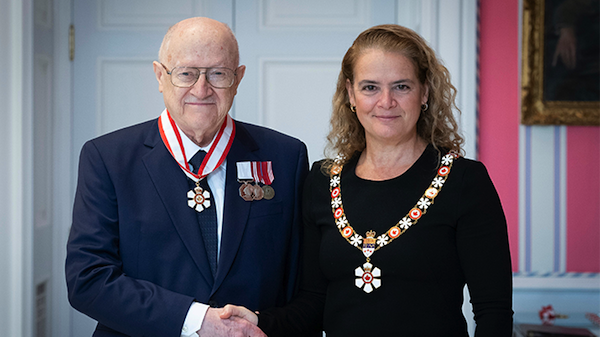
Dr. Peter Suedfeld with Governor General Julie Payette at Rideau Hall. (photo by Sgt. Johanie Maheu)

On Nov. 21, 2019, Vancouver’s Dr. Peter Suedfeld was among those invested into the Order of Canada by Governor General Julie Payette during a ceremony at Rideau Hall in Ottawa.

The Order of Canada is one of the country’s highest civilian honours. Its companions, officers and members take to heart the motto of the order: “Desiderantes meliorem patriam” (“They desire a better country”).

Suedfeld was invested as an officer of the order. The honour’s website notes that his “groundbreaking research expands our notions of resilience and transcends academic fields. Professor emeritus at the University of British Columbia and a prolific writer, he is internationally acclaimed for documenting previously ignored positive psychological and physical effects of extreme and challenging environments. His work has taken a critical look at the impacts on humans experiencing polar isolation, space exploration, sensory deprivation, decision-making during international crises, and such traumatic experiences as genocide. He is highly regarded both as a mentor and active member of his community.”

Created in 1967, the Order of Canada recognizes outstanding achievement, dedication to the community and service to the nation. Close to 7,500 people from all sectors of society have been invested into the order. Those who bear its iconic snowflake insignia have changed Canada’s measure of success and, through the sum of their accomplishments, have helped build a better country.

Appointments are made by the governor general on the recommendation of the Advisory Council for the Order of Canada. For more information about the Order of Canada or to nominate someone, visit gg.ca/en/honours.

* * *

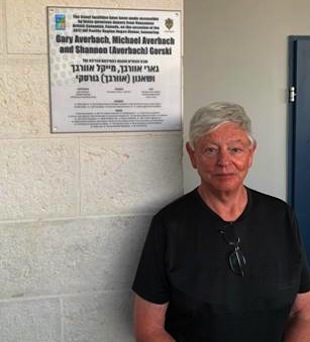
photo - Gary Averbach at the Israeli Scout’s facilities in the city of Ra’anana
Gary Averbach at the Israeli Scout’s facilities in the city of Ra’anana.

JNF Canada is proud to have completed renovating the infrastructure of the Israeli Scout’s facilities in the city of Ra’anana, to be more accessible for children and youth with disabilities. This project was the focus of the JNF Vancouver 2017 Negev Dinner, honouring the Averbach family.

The Israeli Scouts, Tzofei Tzamid, run programming for more than 80,000 members aged 9-21 (including more than 2,500 with disabilities) throughout Israel. They bring together children and youth from across the spectrum of Israeli society to learn leadership skills and the value of inclusive community, and to enhance their self-image.

A special thank you to Gary Averbach, Michael Averbach and Shannon (Averbach) Gorski, and the entire Vancouver community for taking this vision forward and helping JNF improve the lives of the members of Tzofei Tzamid. To learn more about the project, visit jnf.ca/tzofei-tzamid.

* * *

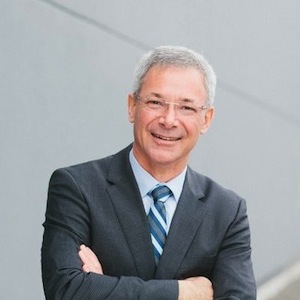
photo - Rob Philipp will start his position as chief executive officer of Hillel BC in June
Rob Philipp will start his position as chief executive officer of Hillel BC in June.

Rob Philipp has been appointed to the position of chief executive officer of Hillel BC, effective in June.

Philipp’s appointment follows a Canada-wide process engaged by the search committee of the Hillel board of directors, comprised of Gordon Brandt (chair), Eric Andrew, Rebecca Recant, Frank Cohn, Talia Magder, Alexis Pavlich, Rachael Segal and Isaac Thau (board president). Philipp was the unanimous recommendation of the search committee and unanimous choice of the board of directors.

Philipp has a long history with the Vancouver Jewish community, having served on several boards, including 20 years on the board of Temple Sholom and being president of that organization. He participated in the Vancouver Wexner Heritage Leadership Group, which was a selected group of local Jewish leaders that studied and learned together for two years.

Philipp brings a unique and impressive set of experience, credentials and passion to Hillel. After graduating from the University of British Columbia, where he was an active member of Hillel, he worked as a chartered professional accountant. He then developed his career in sales, marketing and management in both for-profit and nonprofit organizations, most recently as the chief executive officer of the Fraser Valley Real Estate Board and as interim executive director of Temple Sholom.

He is known for being a creative and innovative leader, with a warm and strong team approach and a people-first mentality. His experience in developing and executing strategy, program development and delivery, combined with his business, governance and financial acumen, will be tremendously valuable to the continued growth of Hillel based on the strong foundation built by Rabbi Philip Bregman and Sam Heller in recent years.

* * * 

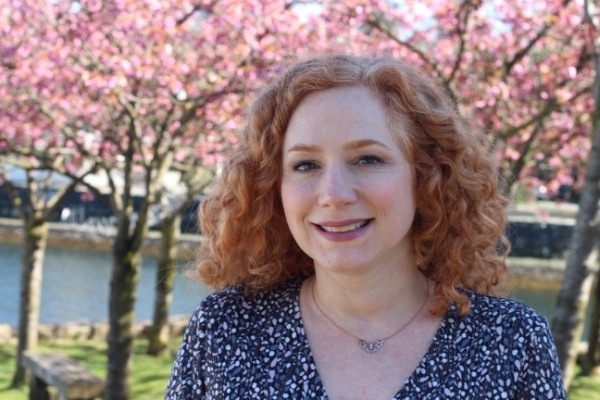
photo - Jessica Mann Gutteridge is the new artistic managing director of the Rothstein Theatre and Chutzpah! Festival
Jessica Mann Gutteridge is the new artistic managing director of the Rothstein Theatre and Chutzpah! Festival.

The Jewish Community Centre of Greater Vancouver welcomes Jessica Mann Gutteridge as the new artistic managing director of the Norman and Annette Rothstein Theatre and Chutzpah! Festival. The position was previously held by Mary-Louise Albert, who is leaving after 15 successful years. The JCC thanks Albert for her excellence in service and dedication to the community and the arts.

Gutteridge joins the JCC from Boca del Lupo, where she managed Performance Works on Granville Island. She was also a founding board member of the Granville Island Theatre District. She held positions of managing director and education manager at Carousel Theatre for Young People. Her work as a dramaturg has included new plays for young audiences and playwrights from Shakespeare to Genet to Edwin Sánchez.

She received her master’s in fine arts from the Yale School of Drama’s department of dramaturgy and dramatic criticism, and studied directing at Wesleyan University. Born and raised in New York, she returned to the theatre after nearly two decades as a lawyer specializing in advertising and trademark law. At Columbia Law School, she was editor-in-chief of the Columbia-VLA Journal of Law and the Arts. Her nonprofit board work has included serving as co-president of Landmark on Main Street (a performing arts and community centre on Long Island, N.Y.), the Vancouver International Burlesque Festival, and the Bayview Treehouse Preschool. She was a member of the 2018-19 Cultural Leadership Program at the Banff Centre in Alberta.

“I look forward to continuing to bring diverse, world-quality artists to present their work to Chutzpah! Festival audiences and to reach a new generation with exciting performances. I am also delighted to steward the Rothstein Theatre as a gem appreciated by professional artists and community members throughout Metro Vancouver.”

The JCC is excited to see Gutteridge apply her industry experience and talents to the management of the centre’s fully equipped 318-seat performance venue, and the creative direction of the Chutzpah! Festival, one of the major art events in Vancouver’s cultural calendar.

* * *

At Congregation Beth Israel’s annual general meeting Dec. 5, several volunteers were recognized. Mazal tov to Howard Mickelson and Keren Gertsman (President’s Award), Lloyd Baron (Board of Directors Special Service Award), Michael Harris (Board Recognition Award) and Lissa Weinberger (Special Service Volunteer Award).

The congregation also welcomed its incoming board for 2019-2020: Helen Pinsky (president), David Silver (vice-president), Heather Sirlin (secretary), Keren Gertsman (treasurer), Lisa Averbach, Anton Bloem, Alexis Doctor, Kevan Jacobson, Lisa Marcoe, Christie Menzo, Dale Porte, Jennifer Wolf and David Woogman.

Format ImagePosted on January 31, 2020January 28, 2020Author Community members/organizationsCategories LocalTags Averbach, Beth Israel, Chutzpah!, Hillel BC, Jessica Mann Gutteridge, JNF Canada, Order of Canada, Peter Suedfeld, Rob Philipp

Posts pagination

Previous page Page 1 … Page 279 Page 280 Page 281 … Page 664 Next page
Proudly powered by WordPress