Skip to content
  • Home
  • Subscribe / donate
  • Events calendar
  • News
    • Local
    • National
    • Israel
    • World
    • עניין בחדשות
      A roundup of news in Canada and further afield, in Hebrew.
  • Opinion
    • From the JI
    • Op-Ed
  • Arts & Culture
    • Performing Arts
    • Music
    • Books
    • Visual Arts
    • TV & Film
  • Life
    • Celebrating the Holidays
    • Travel
    • The Daily Snooze
      Cartoons by Jacob Samuel
    • Mystery Photo
      Help the JI and JMABC fill in the gaps in our archives.
  • Community Links
    • Organizations, Etc.
    • Other News Sources & Blogs
    • Business Directory
  • FAQ
  • JI Chai Celebration
  • JI@88! video

Recent Posts

  • Story of Israel’s north
  • Sheltering in train stations
  • Teach critical thinking
  • Learning to bridge divides
  • Supporting Iranian community
  • Art dismantles systems
  • Beth Tikvah celebrates 50th
  • What is Jewish music?
  • Celebrate joy of music
  • Women share experiences 
  • Raising funds for Survivors
  • Call for digital literacy
  • The hidden hand of hate
  • Tarot as spiritual ritual
  • Students create fancy meal
  • Encouraging young voices
  • Rose’s Angels delivers
  • Living life to its fullest
  • Drawing on his roots
  • Panama City welcoming
  • Pesach cleaning
  • On the wings of griffon vultures
  • Vast recipe & story collection
  • A word, please …
  • מארק קרני לא ממתין לטראמפ
  • On war and antisemitism
  • Jews shine in Canucks colours
  • Moment of opportunity
  • Shooting response
  • BC budget fails seniors
  • Ritual is what makes life holy
  • Dogs help war veterans live again
  • Remain vital and outspoken
  • An urgent play to see
  • Pop-up exhibit popular
  • An invite to join JWest

Archives

Follow @JewishIndie
image - The CJN - Visit Us Banner - 300x600 - 101625

Honouring volunteers

Honouring volunteers

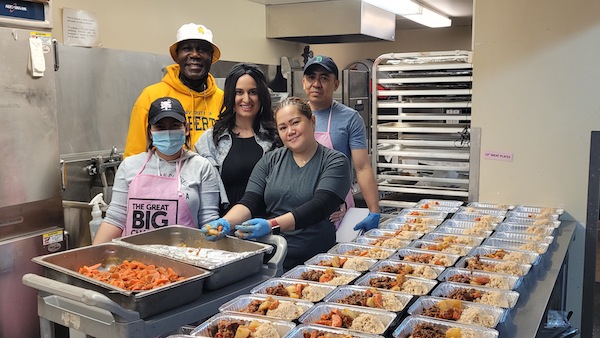
Shabbat In a Box preparations. Left to right are Jenny Rivera, Moshe Maurice King (from JFS), Rachael Lewinski, Michelle Pascua and Freddie Santiago. (photo from Schara Tzedeck)

At this year’s Mosaic gala May 29, Congregation Schara Tzedeck will celebrate the team that oversees and orchestrates the synagogue’s In the Box meal program – the people who “have sustained and nurtured our community through the pandemic.”

Just over two years ago, as the pandemic started in March 2020, Schara Tzedeck launched In the Box. The program delivers meals to congregants and other community members in an effort to provide support for those living alone and those in need.

Every week before Shabbat, as well as during the holidays – Rosh Hashanah, Hanukkah, Passover – 32 drivers set out from the synagogue’s Oak Street location and deliver kosher meals to 250 households throughout the Greater Vancouver area.

“In an extraordinary partnership with Jewish Family Services, our donors and members, together with our staff and volunteers, have delivered more than 25,000 meals since the program’s inception in March 2020. Through the holiday and Shabbat In a Box initiative, we have not only nourished our shul family and wider community with hearty Jewish cooking, we have nourished them with constant personal connections,” Schara Tzedeck president Jonathon Leipsic wrote in a message to congregants.

In recognition for their efforts throughout the pandemic, volunteers and drivers will receive a challah board made especially by Schara Tzedeck spiritual leader Rabbi Andrew Rosenblatt.

photo - Rabbi Andrew Rosenblatt making one of the challah boards that will be given to honour In a Box volunteers
Rabbi Andrew Rosenblatt making one of the challah boards that will be given to honour In a Box volunteers. (photo from Schara Tzedeck)

The 2022 Mosaic gala coincides with Yom Yerushalayim (Jerusalem Day), a national holiday in Israel that commemorates the reunification of Jerusalem and the establishment of Israeli control over the Old City following the Six Day War in June 1967. As such, this year’s gala will have an Israeli vibe, or, more precisely, the feel of “the shuk,” the Jerusalem marketplace. Food will consist of Moroccan salmon, kebabs, burekas and other delicacies that would be sold by vendors in the Holy City. There will also be candy stations, dried fruits, a spice market and fresh breads.

“This is the first gala since the pandemic started, and it is an interesting twist that what started as a program during a time when we were far apart from one another in terms of spacing is now bringing us back to the same physical space,” said Rachael Lewinski, facilities director at Congregation Schara Tzedeck, which had been hosting in-person Mosaic galas for more than a decade before COVID-19 struck.

Juleen Axler will be one of the drivers who will be honoured at the gala. Axler, who has been delivering meals to seniors and those with low incomes since the beginning of COVID, gets to the synagogue around noon on Fridays. She then takes the meals – consisting of a starter, an entrée, a dessert and a challah – to eight or nine homes each week.

The meals, Axler said, vary from week to week and, at holiday times, contain food symbolic of the occasion. For example, during Hanukkah, a box is certain to carry potato latkes.

“It’s an extremely rewarding process to be helping and to be doing my part during COVID. It has not been easy for many seniors to get a meal made and to have human connection for two years. Even now that is easier to move around and gather, seniors are still isolated. And, for my part, it is nice to witness the appreciation people have and to establish a relationship with them,” Axler said.

Despite the pandemic, Schara Tzedeck created a memorable event in 2021 through Zoom with Israeli President Isaac Herzog as their featured speaker. The evening also included footage of Shulem, the Orthodox singer; Rabbi Naftali Schiff, chief executive officer and founder of Jewish Futures; and a pre-recorded conversation between Rosenblatt and Leipsic.

Now back in person for the first time since 2019, this year’s Mosaic starts at 6:30 pm. Tickets can be purchased, and donations can be made, by visiting scharatzedeck.com.

Sam Margolis has written for the Globe and Mail, the National Post, UPI and MSNBC.
Format ImagePosted on May 20, 2022May 19, 2022Author Sam MargolisCategories LocalTags gala, In a Box, Jonathon Leipsic, Juleen Axler, Mosaic, Rachael Lewinski, Schara Tzedeck, tikkun olam, volunteers

Race to the bottom

It may not be a total coincidence that one of the most recent conflicts over book banning is taking place in McMinn County, Tenn., less than an hour from the town of Dayton, in the same state, which was the site of the renowned Scopes “Monkey” Trial, 97 years ago.

The fight over whether Art Spiegelman’s graphic memoir about the Holocaust, Maus, is suitable reading for high schoolers echoes the earlier debate over whether teaching the theory of evolution was appropriate fare for students in a place and time where the biblical creation story was the only accepted narrative.

The debate over the banning of books and ideas is a hot topic these days, though hardly a new one.

Fortunately, we live in an age when banning ideas is nearly impossible in a free, or even partly free, society. Only in totalitarian and authoritarian regimes are governments able to block information. Around the world, in many countries, gaining access to forbidden ideas is relatively easy. In North America, the New York Public Library, among others, has made it easier for people anywhere to access specifically banned or challenged materials. People who want to seek out publications that authority figures try to limit are generally able to do so.

A phenomenon less easily addressed is the proliferation of misinformation and disinformation. This proliferation is the flip side of the ability to access banned ideas. In a world where anyone with a computer can access information, anyone with a computer can just as easily invent information and then circulate it widely.

Misinformation and disinformation have always existed. But almost certainly never have they so dramatically defined civil discourse. The difference between these two terms is important. One source calls misinformation “false information that is spread, regardless of intent to mislead.” Disinformation, from the same source, is deemed “deliberately misleading or biased information; manipulated narrative or facts; propaganda.” Both are problematic, but intent matters. Misinformation can sometimes be righted through correctives. Disinformation is often formulated in ways that actively deter correction.

For example, the greatest threat to American democracy right now is a narrative that has been formulated in such a perverse, Orwellian manner that the perpetrators of the lie that the 2020 U.S. presidential election was illegitimately “stolen” are the very people who are trying to steal a legitimate election. Those who perpetuate a lie accuse opponents of lying.

The first issue of The Atlantic magazine this year was almost entirely devoted to this subject and the thesis, if we may summarize crudely, is that, unless some dramatic corrective is applied, American democracy has less than two years to survive.

The internet, which is the keystone of our 21st-century ability to read and write virtually anything, has also emerged at a time of massive diffusion of so-called “mainstream media.” The grandchildren of those who grew up with three TV channels can now access thousands. We self-select our information and entertainment, with the impact that we have more, but smaller, frames of reference. One of the results of this is that we have largely been able to choose our own “truths.”

There are no simple solutions to these problems. But, if there is an antidote to ignorance, misinformation and disinformation, it is a recommitment to liberal values of free expression and unbridled academic inquiry. Applied to younger generations, this means inculcating in them an ability to assess and analyze context, information and sources. This sounds like a simple remedy but, of course, learning to think critically is a lifelong pursuit and cannot be taught in a single semester.

Yet, this is the primary way forward. As a society, we need to acknowledge that critical thinking is the foundation upon which democracy and civil society rests. We have abandoned balanced discussion and nuanced consideration of topics in favour of memes and slogans that suit our purposes.

We face a tough crawl out of the hole we find ourselves in – that is, assuming we have stopped digging – but confronting and contending with challenging ideas is the ideal we must strive for. Every banned book is another shovelful of dirt in our democracy’s race to the bottom.

Posted on May 20, 2022May 19, 2022Author The Editorial BoardCategories From the JITags Art Spiegelman, book banning, censorship, democracy, disinformation, freedom of speech, internet, Maus, misinformation
Celebrating Richmond

Celebrating Richmond

Doors Open Richmond is organized by the Richmond Museum Society and the museum will welcome event attendees. The Kehila Society will be participating as an online site. (photo from Richmond Museum)

The Richmond Museum’s 15th annual Doors Open Richmond (DOR) returns next month as a free hybrid event. All in-person activities will take place June 4-5, and will be complemented by virtual content available June 2-5. This year’s edition features 35 sites representing the city’s cultural diversity and rich heritage, including 21 that will welcome visitors in-person. There are five new sites that are participating in DOR for the first time, including the Kehila Society of Richmond.

“This is the first year that the Jewish community of Richmond has been involved and for us it is a milestone to be included,” said Lynne Fader, co-executive director of the Kehila Society, which has been in operation since 1999. “Richmond has the second largest Jewish population in B.C. and yet sometimes we are a hidden gem in this city. Kehila has worked hard to bring the Jewish community to the forefront and increase awareness of our culture. To be included in such a diverse cultural event that showcases all the multi-ethnic groups in our community is an honour.”

The Kehila Society will be participating as an online site. The Doors Open Richmond team has worked closely with the society to produce a video that introduces the organization. The video will be available to view from June 2 on the event website, richmondmuseum.ca/ doors-open.

“Richmond is one of the most diverse cities in Canada, with more than 60% of residents born outside of the country,” said Jaeden Dela Torre, vice-chair of the Richmond Museum Society. “Doors Open Richmond is a chance to celebrate this diversity and a way to bring together the many communities that comprise the city. The event offers the public an inclusive platform to become more familiar with our local businesses, organizations, museums, places of worship, and more. Doors Open Richmond celebrates the very essence that makes this city a welcoming place to live.”

The in-person program offers visitors a range of activities. Saint Germain Bakery, another of the new sites this year, will give tours of their central facility where cakes and pastries are produced; tours will conclude with sample tastings. Richmond Media Lab will show how to bring drawings and figurines to life using the magic of stop-motion technology. Visitors can experience a day in the life of a firefighter at Fire Hall #1, Richmond’s largest and busiest fire hall, with hands-on activities and demonstrations. Family-run restaurant Anar Persian Cuisine will offer an introduction to Persian food, customs and traditions.

photo - Anar Persian Cuisine will offer Doors Open Richmond attendees an introduction to Persian food, customs and traditions
Anar Persian Cuisine will offer Doors Open Richmond attendees an introduction to Persian food, customs and traditions. (photo from Anar Persian Cuisine)

A special shuttle tour will be available on June 4, taking visitors to various places of worship along No. 5 Road, also known as the “Highway to Heaven.” The tour will stop at the Az-Zahraa Islamic Centre, Lingyen Mountain Temple and the Richmond Jamia Mosque.

Among the many other participants are Britannia Shipyards National Historic Site, Gulf of Georgia Cannery National Historic Site, Richmond Art Gallery, Richmond City Hall, Richmond Public Library, Richmond RCMP, Immigrant Services Society of British Columbia, London Farm Heritage Site, Nanaksar Gurdwara Gursikh Temple, Richmond Olympic Experience and SUCCESS Richmond Service Centre.

photo - London Farm Heritage Site is one of 35 sites participating in this year’s Doors Open Richmond
London Farm Heritage Site is one of 35 sites participating in this year’s Doors Open Richmond. (photo from London Farm)

The local event is part of the Doors Open Canada program supported by the City of Richmond, Public Art Richmond, Richmond Heritage Commission, the B.C. Arts Council, the Province of British Columbia and the Government of Canada. The event is organized by the Richmond Museum Society.

Most in-person programs require advance registration, with a select number of sites offering drop-in activities. Visitors can plan their weekend in advance by visiting richmondmuseum.ca/doors-open for more information.

– Courtesy Doors Open Richmond

Format ImagePosted on May 20, 2022May 19, 2022Author Doors Open RichmondCategories LocalTags Doors Open Richmond, Kehila Society, Lynne Fader
Poetry-art book launch and exhibit

Poetry-art book launch and exhibit

Suzy Birstein’s “Ladies-not-Waiting: Harlequin Zsa Zsa.” (photo from  ParkerArtSalon)

Suzy Birstein’s “Ladies-not-Waiting: Harlequin Zsa Zsa,” made of fired ceramic with glazes and lusters, is featured in the book the poetry project: where poetry expands upon a visual idea, published by ParkerArtSalon. The artwork is accompanied by a poem it inspired, written by Majka Pauchly: “I’m not home décor / I shift on the shelf, and plot / To make my next move.”

Beedie Luminaries students were invited to participate in the project by submitting a work of poetry, inspired by a selection of art provided by the ParkerArtSalon artists. The book launch and an exhibit of the poems with the corresponding artwork by the artists – who also include Miriam Aroeste – takes place at Gallery George June 1-July 3, Wednesday-Sunday, noon-5 p.m., with the official opening weekend June 4-5, 2-4 p.m., with artists in attendance. Visit parkerartsalon.com for details.

– Courtesy ParkerArtSalon

Format ImagePosted on May 20, 2022May 19, 2022Author ParkerArtSalonCategories Visual ArtsTags art, Gallery George, Majka Pauchly, ParkerArtSalon, poetry, Suzy Birstein
Maus not too graphic

Maus not too graphic

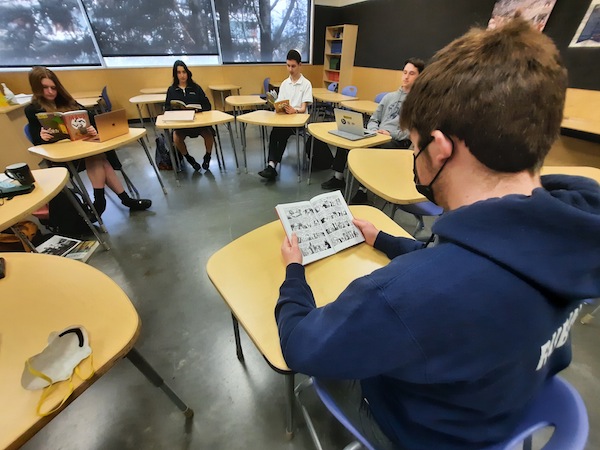
Students in Anna-Mae Wiesenthal’s Holocaust and Genocide Studies class at King David High School discuss the graphic memoir Maus. (photo by Pat Johnson)

In January, the school board in McMinn County, Tenn., voted to remove the graphic novel Maus from its eighth grade curriculum.

The book by Art Spiegelman won a Pulitzer Prize in 1992 under a special category created specifically for Maus. The two-volume collection of previously serialized comic-style narratives was viewed at the time as revolutionary for its approach to a subject like the Holocaust in a medium more commonly associated with superheroes and humour.

In the books, racial and national identities are represented through anthropomorphized animals. Jews are depicted as mice, Germans as cats, Poles as pigs, Americans as dogs, British as fish and so on. In each instance, the characters have the bodies of humans and the heads of the respective animals. This form has been criticized by some critics over the decades as overly simplistic but has caused particular discomfort to many Poles, who do not appreciate being depicted as pigs.

Spiegelman, the author, called the McMinn County decision “Orwellian,” but has seen sales of his books skyrocket since the ban thrust the works back into the spotlight.

The Independent joined in a class discussion with the five students in the Holocaust and Genocide Studies course at King David High School, led by teacher Anna-Mae Wiesenthal. Discussing the Tennessee book banning, students questioned the sincerity of the school board’s grounds for opposing the book.

In a graphic memoir dealing with the attempted annihilation of a people and which touches on history’s most horrific acts of inhumanity, students found it “absurd” that the board’s primary concerns appeared to be a couple of instances of mild profanity and the depiction of a nude cartoon cat.

The book follows the true journey of the author in pressing his father, Vladek, to share his Holocaust experiences openly for the first time.

Nitzan Berger, a great-granddaughter of a Holocaust survivor, observed that many survivors hesitated to share their narratives and that the graphic novels capture the challenges of the younger generation in approaching the subject, as well as the reticence on the part of the older generation to relive the horrors of their past. While the passing down of these stories is important, it can be painful for both generations.

“It’s interesting for us to hear about the stories, but we don’t think about the other side,” she said.

Ethan Dreyshner was struck by the speed with which an entire society, down to its youngest members, could be transformed.

“It just really shows how this whole society was changed to think the Jews were terrible people,” he said. “Six years earlier, Jews were regular citizens. It’s crazy to think that a whole society, a whole population, can just turn on their neighbours that quickly.”

Noting that young people need to begin learning about this challenging subject at some point, students contrasted Maus with Anne Frank’s diary, which for generations has been an entry point to discussion of the topic.

Olivia Levsky said a graphic novel that is intense but not particularly long may be a good starting point as well, especially for young people who rebel against assigned readings.

“It’s a very interesting way to learn something that’s very important to learn,” she said. “I didn’t feel like it was incredibly graphic or too much when I was reading it. It was graphic at times, but the Holocaust was graphic. I didn’t feel it was overly triggering or traumatizing. I didn’t feel it was inappropriate.”

Levsky also noted that Spiegelman, in some respects, depicted the national groups through the eyes of the victimizer.

“He drew each character and each race in the way that the Nazis saw them,” she said, noting particularly the Nazis’ association of Jews with vermin. “I imagine toward the end [of the war], the Americans felt like threatening dogs to the Nazis.”

image - cover of Maus I by Art SpiegelmanStudents concurred with Wiesenthal that there also may have been a practical purpose to depicting each group as a type of animal. It made each character’s identity more immediately understandable to the reader without having to repeatedly point out the race or nationality of each individual – in one instance, a Jew (mouse) hides in plain sight with the mask of a pig (Pole).

Wiesenthal noted that the second volume, which the class has not read together, is somewhat more explicit in its violence.

The teacher also stressed that the book tells the story of the Holocaust experience and intergenerational trauma through one family.

“We often talk about numbers – six million – which can serve to depersonalize what is really an impossible number to grasp,” the teacher said. “I think that we need to remember each of them had a name, each of them had a family. It’s very impersonal, often, the way we attach the number to the Holocaust.”

Maus includes situations in which non-Jewish people assisted in the survival of Jews. While it is not addressed in the book, students discussed the fact that Yad Vashem’s criteria for designation as Righteous Among the Nations excludes people who received compensation for their often-life-endangering efforts.

Shai Rubin noted that, in some cases, Jews may have given valuables voluntarily as gratitude to their rescuers. He also noted that, in addition to risking their lives, many non-Jewish helpers were experiencing economic destitution due to the war and what small amount of food they could provide to Jews in hiding may have come at a great price to their own families.

Of one woman in the story, Rubin said: “There’s a difference between doing something for money and doing something and getting money for it. She did it out of the goodness of her heart.”

In what was a shocking sequence for students, Art, the author, discovers that his father has burned the diaries of Art’s mother, Anja, who committed suicide. In response, the son lashes out at his father: “Murderer!”

This opened a discussion of what Wiesenthal called “the murder of memory” and raised the quote by Elie Wiesel (not mentioned explicitly in the book), who said of the Holocaust and its victims, “If we forget, the dead will be killed a second time.”

The Grade 12 students analyzed the content, style and medium of Maus. They observed that, often when the wrought iron gate to Auschwitz is pictured, the focus is on the words themselves, Arbeit Macht Frei, while, in this book, the eye is drawn to the individual people in the frame, a reminder that the Holocaust can often be depicted in broad strokes but it is, ultimately, about the killing of individuals.

On the medium itself, all the students concurred that it is an effective avenue for conveying challenging material.

“I think this is a really effective form of teaching the Holocaust, especially to kids,” said Dreyshner. “Something like the diary of Anne Frank, you might feel a little disconnected, you can’t see it, you can’t understand it because it’s hard to show actual images of the Holocaust to children. I think a graphic novel really does the job because you can see what happened, you can get a sense of what happened, without seeing the horrific things exactly.”

Richard Helper agreed, but subtly criticized those who are concerned about the graphic nature of the book.

“This is easily digestible, it’s effective, it has quite a bit of information on the specifics of the Nazis’ war machine as well,” he said. “While some people, I think, try and attack it for being either too simplistic or too graphic, we’re teaching a book on the Holocaust.… It’s the Holocaust.”

Wiesenthal, who has a master’s in Holocaust and genocide studies and is pursuing a PhD in the same field, pioneered the course three years ago. Until then, the Holocaust was dealt with as part of the larger Jewish history curriculum.

She acknowledged that most King David students come to the subject with some familial or other knowledge of the subject, whereas non-Jewish students, such as those in places like Tennessee, might have no knowledge of the history.

“It’s important to contextualize it,” she said.

Format ImagePosted on May 20, 2022May 19, 2022Author Pat JohnsonCategories LocalTags Anna-Mae Wiesenthal, book banning, censorship, education, Ethan Dreyshner, Holocaust, KDHS, King David High School, Maus, Nitzan Berger, Olivia Levsky, Richard Helper, Shai Rubin

Honouring those who’ve died

Four decades ago, Chaya Harel was approached by one of the teachers at her son’s Jerusalem high school. The son, Yuval, who was in his final year of school, had come to the teacher seeking advice. He was in love with Sigal, but knew the importance of succeeding in the upcoming matriculation exams. How should he allocate his time?

The teacher asked the mother for her advice and promised to pass it along as coming from the teacher, rather from Yuval’s mother, Chaya.

The mother’s advice was to spend more time with Sigal. Yuval, she reasoned, could always improve his grades later.

Tragically, Yuval Harel was killed in 1982, during the First Lebanon War. Later, in grief, Chaya Harel would say, “I had some comfort knowing it was my best advice.”

The story was shared May 3 by Geoffrey Druker at Vancouver’s annual ceremony marking Yom Hazikaron, Israel’s official day of remembrance for those fallen in war and victims of terror attacks.

Yuval Harel was one of two young men of the same name who died in the same war, a few days apart. They were two of more than 24,000 killed over 74 years, whose memories were honoured at the Vancouver event and at similar ceremonies worldwide.

“This year, as in previous years, we remember our fallen,” said Druker, who is chair of Vancouver’s Yom Hazikaron committee. “And the list painfully keeps lengthening. These past months, Israelis and foreign citizens, Jews and non-Jews, men and women, were killed on the streets, in the pubs, gas stations [and] shopping strips in Israel by terrorist attacks. Fifty-six people were added this year to the list and 84 injured soldiers [who] passed away are recognized as fallen soldiers.”

This year’s ceremony also marked 25 years since the deadliest crash in the history of the Israeli Air Force. (See jewishindependent.ca/25-years-since-deadly-crash.)

Druker shared the story of Yigal Amster, a son of Holocaust survivors who lived with asthma.

“When he joined the army, he tried to hide it,” said Druker. “He asked to join the tank corps. He wished to become an officer.” When his commanders noticed his difficulty breathing in poor air quality, Amster was assigned to a medic course.

“When the Yom Kippur [War] broke out, in 1973, he was sent to help the troops in the Suez Canal. While in an armoured vehicle, he was hit and later died from his injuries. He was 20 years old.”

Amster’s cousin, Vancouverite Charlotte Katzen, read Yizkor in his memory and in memory of all the fallen.

“May the nation of Israel remember its sons and daughters, faithful and courageous,” Katzen read the prayer in English. “The soldiers of the Israel Defence Forces, members of the undergrounds, members of the intelligence community, security and policemen, who fell in the wars of Israel, and all of whom that were killed – within Israel and outside of Israel – by terrorists. May the people of Israel keep them in their memory and be blessed with their seed; mourn the splendour of youth, the altruism of valour, the dedication of will and the dignity of self-sacrifice, which came to an end in the heavy battles. May our fallen be sealed forever within the hearts of all Israel, in this generation and forevermore.”

Michael Balshine read Yizkor for his father, Avigdor Balshine, a member of the Haganah and a pioneer in Israel’s water sector. On Feb. 23, 1948, while working with Mekorot, the national water company of Israel, Avigdor Balshine and his colleague Mark Feigin were ambushed and killed in Wadi Milik. Michael Balshine was 6 years old.

Ilene-Jo Bellas lit a candle in memory of her cousin, Fern Rykiss, who was a 17-year-old from Winnipeg who was murdered on a bus from Tel Aviv to Jerusalem in 1989.

Tamara Frankel lit a candle in memory of her family member Amnon Shapira.

Photographs were projected of family members and friends of members of the Vancouver community whose lives are among those lost in the past 74 years.

Idit Shamir, consul general of Israel in Toronto and Western Canada, sent video greetings.

“On this day, Israelis and Jews around the world remember the pain the bereaved families carry with them every day,” said Shamir. “We remember that our independence has come with a heavy price. We bow our heads with eternal gratitude to those who have paid the price, Jews and non-Jews, Israeli-born and immigrants, all those who have fallen for the state of Israel. We know that we are here because of them…. We thank the fallen sons and daughters who have protected us. We embrace their families and all the bereaved families who have sacrificed so much. We promise that their immense sacrifice will never be in vain and we pledge to do whatever is necessary to ensure that the privilege they have given us, we will give to others, to our children, their children and to the countless generations to come, the privilege of standing tall. The privilege of standing proud. The privilege of standing strong. The privilege of being a free people in our land.”

In attendance at the ceremony was Commander Robert D’Eon of the Royal Canadian Navy.

Posted on May 20, 2022May 19, 2022Author Pat JohnsonCategories Israel, LocalTags commemoration, Geoffrey Druker, Israel, memorial, Yom Hazikaron

State of Jewish media

Editors from three Canadian Jewish publications gathered on May 11 for a wide-ranging and passionate online discussion about the state of Jewish media in the country.

Yoni Goldstein of the Canadian Jewish News, based in the Toronto area, Bernie Bellan of the Jewish Post and News in Winnipeg and Cynthia Ramsay of Greater Vancouver’s Jewish Independent examined such topics as the economic viability of Canadian Jewish media, antisemitism, and the ability to balance an array of differing opinions within the community. All three publications have a long-standing history of Jewish journalism, with the Post and News and the Independent able to trace their beginnings to 1925 and 1930, respectively. (Though the JI started as a mimeo in 1925, the newspaper began five years later.)

Goldstein led off by explaining the recent manifestation of the CJN, which, founded in 1960, is the baby of the group. The paper closed in mid-2013 and again in April 2020, but reopened each time. The current version restarted in January 2021 with a reduced staff and a focus on online media.

When introducing his paper, Bellan noted that the Post and News readership skews to an older demographic yet endeavours to be as inclusive as possible. “With the advent of the internet, there are so many different news sources that it is hard to establish a clear identity for a lot of Jewish media,” he said. “You have to change with the times and know your audience.”

Ramsay, too, addressed the fine line between keeping established readers interested and also bringing in a younger audience. “We celebrate Jews in the community whether or not they are doing something specifically Jewish. We want to look forward and also respect the past. We try to be a window to the world and not be too insular.”

image - Screenshot of May 11 panelist Yoni Goldstein
CJN’s Yoni Goldstein
image - Screenshot of May 11 panelist Bernie Bellan
JPN’s Bernie Bellan
JI’s Cynthia Ramsay

Moderator Bryan Borzykowski, the president of the CJN, next pressed the panelists on staying relevant in an age when connections to Jewish organizations are waning.

“One of the positive sides of the digital age is that you can dive in and see what sorts of stories people are engaged in,” Goldstein responded, highlighting the numerous subjects CJN offers in its podcasts, from politics to arts, sports to humour.

Bellan said he features newcomers to Winnipeg in his paper, whether they are from Russia, Israel or elsewhere in Canada. “We want them to know that the established Jewish community welcomes them and we want them to feel integrated in the community,” he said.

“As long as you are writing a paper that is in this moment and not dwelling on the past, then you are relevant, and your readers will decide that,” said Ramsay.

Borzykowski asked about revenues, particularly during a pandemic, which has challenged further the solvency of media in general.

“Most of our money still comes from advertising. For now, it is great because we are small, lean and we are able to ‘pivot’ quite easily. I don’t have to get OKs to do anything. And our community has been very supportive,” Ramsay said.

For the CJN there are three money planks, according to Goldstein: advertising, subscriptions and donations. The publication hopes to be able to provide tax receipts to donors in the future.

Bellan credited a loyal local subscriber base and an attachment that former residents of Winnipeg have towards the city as reasons that place his paper in an enviable position when it comes to sustainability. “There are probably more Jewish ex-Winnipeggers in the world than there are current Jewish Winnipeggers,” he noted.

Balancing the range of opinions readers have on issues, such as Israel, was the next phase of the discussion. Ramsay welcomes a diverse selection of views on the Jewish state, with the ground rule being the recognition of Israel’s right to exist. “We had to bring the readership along to the concept that you don’t have to be afraid if someone does not agree with you on Israel,” she said.

Goldstein brought attention to the number of reputable publications based in Israel, which, from the CJN’s perspective, would not be worth competing against. Instead, when the publication does run an Israeli story, it will likely have a Canadian connection, he said.

Bellan’s Post and News presents a vast spectrum of views on the Holy Land, from running pieces by a Palestinian scholar to a hawkish opinion writer, and Bellan stated that differing views on topics can contribute to the vibrancy of a publication.

When questioned about reporting on antisemitism, Goldstein said it could be seen as one of the key reasons for the existence of Jewish media in that it will cover the topic in a more sensitive and journalistically appropriate manner than the mainstream press.

Bellan said his paper has taken note of the recent increase in antisemitism, especially in universities, and has published a lot more articles on the subject of late.

Ramsay emphasized that, while acknowledging and dealing with the topic of antisemitism, the Independentdoesn’t write from a position of fear or panic, but rather one of pride in celebrating Jewish identity.

No present-day conversation of modern media would be complete without the mention of “fake news” and what responsible publications can do to prevent it.

“The challenge is to build trust with audiences,” Goldstein said. “You have to build your reputation as being honest and rigorous in your reporting.”

In Winnipeg, the anti-vaccine movement became a problem for Bellan as his main columnist is one of its adherents. Bellan’s response was to counter with facts and chronicle his own battle with COVID-19 without denying anti-vaxxers space in his paper.

Ramsay stressed the importance of fact-checking and sourcing material while, at the same time, providing room for as many views as possible. That said, she said she does censor material, such as that from anti-vaxxers, which could harm public health.

Borzykowski ended the evening by noting that the CJN is a national paper and touching on the possibility of collaboration between the CJN and local Jewish newspapers across the country.

Congregation Etz Chayim in Winnipeg hosted the event, with Monica Neiman supplying the technical support.

Sam Margolis has written for the Globe and Mail, the National Post, UPI and MSNBC.

Posted on May 20, 2022May 19, 2022Author Sam MargolisCategories UncategorizedTags Bernie Bellan, Bryan Borzykowski, Canadian Jewish News, CJN, COVID, Cynthia Ramsay, Jewish Independent, Jewish journalism, Jewish Post and News, JI, media, newspapers, Toronto, Vancouver, Winnipeg, Yoni Goldstein
Debating profit vs. nonprofit

Debating profit vs. nonprofit

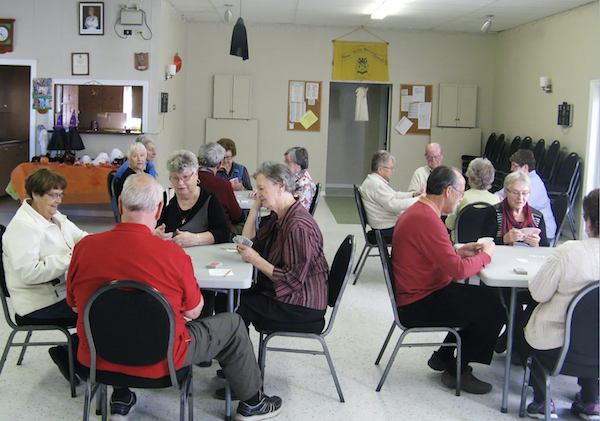
(photo from Humber Valley Senior Citizens Club)

***

In Volume 28 of the Jewish Seniors Alliance’s Senior Line magazine, JSA members Kenneth Levitt and Larry Shapiro debated some of the arguments for and against for-profit long-term-care facilities. They offered their personal opinions in the debate, as JSA does not have a position on this topic. Their views are reprinted here, with permission.

For-profits here to stay
by Kenneth Levitt

The COVID-19 pandemic with its various mutations has caused a justified focus on long-term care (LTC) in Canada. Organizations such as the B.C. Health Coalition, the NDP, unions and other left-leaning activists or progressives, as well as some physicians, have called for the abolition of all for-profit (FP) facilities, recommending that they be taken over by provincial governments or government-approved not-for-profits (NP). This will not happen in the near future. For-profits (FP) are here to stay and, furthermore, provincial governments support them with LTC operating agreements.

The two main issues are profit and quality of care. In British Columbia, there are 27,000 persons in LTC. Approximately one-third are in each of government-operated, NP and FP facilities. When an FP builds or upgrades a facility, there is no government capital fund support. Capital funds for FPs come from investors and shareholders, whereas NPs depend on governments and their own fundraising efforts. FPs have saved governments billions of dollars in capital costs.

In general, residents are financially responsible for their room and board. Their care is paid for by the local funding authority. Should residents pay from their assets (as in the United States) or continue to pay based on income testing? Should residents who are capable contribute more for their room and board? Many NPs raise funds to subsidize care; others permit paid companions to provide extra care for residents. Should investors who put up their own risk capital (with government “ipso facto” approval) be permitted to make a profit? Is it immoral?

FPs did not do well in terms of COVID-19 deaths. Horrendous stories from Ontario and Quebec came to light that noted the squalor and the shameful living conditions of many vulnerable residents. In British Columbia, a number of NPs and FPs had too many COVID infections and deaths. Staff were not exempt from contracting COVID. How do we account for this? When we factor in those facilities with two or more residents per room, the number of COVID-19 infections, complications and deaths increase dramatically for NPs and FPs. In most cases, staff and visitors were responsible for importing the virus. Governments/health authorities were totally unaware, at the outset of the pandemic, of the extent of the problems. However, most care homes planned well, had few infections with a high percentage of vaccinated staff, and are faring well during the pandemic.

It is not just a move to single beds that will solve the problem of COVID and seasonal flu outbreaks, it is the design of the facilities. We need new and upgraded buildings now. It is also imperative that all staff be vaccinated, and that they be supported by management to better prepare for future health crises.

Canada needs FPs. FPs have the capacity to provide needed accommodation for older adults who qualify, and can build more LTC beds faster than governments. They can provide improved efficiency and greater innovation than NPs. The naysayers want to nationalize all private-sector nursing homes in Canada. The National Institute on Aging at Ryerson University in Toronto recently noted, “Some of the FPs are doing well because they have deeper pockets and much better planning procedures than NPs. It is not clear that one class of ownership is better than the other.”

In an April 2021 report, Isobel McKenzie, B.C. Seniors Advocate, criticized FPs for apparently short-changing the number of direct care hours for which they were paid and making a profit by doing so. At the same time, McKenzie noted that capital costs (building maintenance) is one area where FPs outperform NPs.

There is one FP LTC operator in Ontario, Schlegel Villages, that is at the cutting-edge of services and programs for their residents. Schlegel is a family-owned company that has about 5,000 residents and about 5,000 staff in 19 villages. It did not escape COVID-19, but they have excelled in what is known as “best practices”:

  • Their philosophy: a purposeful life for each resident.
  • Each village is accredited.
  • Staff are unionized and pay is the same as at NPs.
  • Owners are committed to providing exceptional care, and are good corporate citizens who are involved in and contribute to the communities they serve.
  • Newer villages are 60% private rooms and 40% with two persons per room. Moving forward, all new construction will be single rooms with ensuites.
  • Each resident has two bathing opportunities per week.
  • Villages have several neighbourhoods, with 32 residents residing in each self-contained neighbourhood that is well-supported by seven staff with a variety of skills.
  • Each village has programs and space open to outside community organizations and they encourage locals to hold events in the available space.

How can we move forward in a constructive way that includes government-operated facilities, not-for-profits and for-profits?

  • The federal government, in partnership with the provinces, needs to develop and to legislate a set of standards of care and service that will be enforced with consequences. This can be done through accreditation, which is currently voluntary. Once the feds have placed standards of care and service into law, each province should enact similar legislation to require that all LTC facilities be accredited. A provincial accreditation body would be responsible for accrediting, monitoring and enforcing standards.
  • Accreditation would ensure every LTC facility is delivering the hours of care and support for which they are receiving funds.
  • Wages and benefits for full-time staff should be uniform for all LTC facilities and part-time staff should be equally entitled to the same wages and benefits.
  • Hours for home care and Better at Home need to be increased. The financial threshold needs to be lowered to allow more persons in need to take advantage of such a service. This has the potential to put less strain on waitlists for LTC admissions.
  • When an FP is for sale, give preference to a quality NP to purchase it or allow a local (new) society to purchase and operate it.
  • Require all LTC facilities that plan to expand to have only single rooms with ensuites.
  • Develop a timetable and a budget for NPs to upgrade/replace current outdated institutional/hospital-style buildings.
  • Healthcare leaders, their boards of directors and seniors should be the ones who are advocating and pushing for changes. The status quo is not acceptable.

To eliminate FPs is specious and politically and/or ideologically motivated and is a short-sighted non-pragmatic position. Canada’s Parliament last year voted against such a proposal put forth by the NDP. The issue is not between the NPs or the FPs. The issue is how to ensure that the interests of the residents come first.

The billions of dollars that would be required to eliminate the FPs can better be used for increased and quantifiable quality programs and services. This would be the best and the most ethical way to honour those lost in the pandemic and to ensure it will never happen again. The issue is how we treat our most vulnerable older adults. After all, is it not a matter of human rights and choices?

No place for profits
by Larry Shapiro

photo - Policy decisions have encouraged raising the profits of private long-term care facilities by replacing union staff with contract workers, which has resulted in creating personnel shortages, declining working conditions and less access to public funding, argues Larry Shapiro
(photo from cdc.gov)

My goal in this debate is to paint a comprehensive picture illustrating conclusively why many of the for-profit long-term-care facilities (LTCFs) are squandering public funds, with little transparency or few accountability requirements to honour any predetermined set of standards in the areas of quality of service, accountability and profit. We need to see profit taken out of long-term care and need new investments in public and nonprofit beds so that we can reduce our dependence on the private, for-profit sector.

Decades of budget cuts, underfunding and privatization by successive governments have resulted in the catastrophic state of the many private care facilities that have been the sites of the loss of a great number of our loved ones. Nobody should be profiting from the care of our senior citizens. Policy decisions going back 20 years have encouraged raising the profits of private LTCFs by replacing union staff with contract workers, which has resulted in personnel shortages, declining working conditions and less access to public funding. The centre of most COVID-19 outbreaks in British Columbia and throughout the rest of the country have been in our LTCFs.

Let us examine the causes and effects of some of the common characteristics of for-profit LTC facilities that negatively affect the quality of care being dispensed to our seniors. Statistically, 67% of LTC in British Columbia is supplied by both nonprofit and for-profit organizations with the remaining 33% being supplied directly by provincial health authorities. The practice of sub-contracting care services occurs when service providers like LTCFs and assisted living facilities, which are contracted by regional health authorities to provide care, proceed to sub-contract with other companies that offer care workers, kitchen staff and maintenance crews.

These sub-contractors are able to bid lower than qualified unionized staff would cost, all to the detriment of the senior residents who are being served by these workers who are receiving lower wages and poorer benefits and who enjoy fewer full-time positions. The prevalence of sub-contracting in elder care began about 22 years ago, when the B.C. government, by virtue of Bills 29 and 94, stripped out no-contracting and job-security provisions from the collective agreements governing healthcare workers. These laws resulted in the loss of 8,000 jobs by the end of 2004. These laws (which were repealed in 2018) provided health-sector employers, including private LTCFs, with unprecedented rights to lay off unionized staff and hire them back as non-union workers through sub-contracted companies. Predictably, this negatively impacted wages and working conditions.

Reduced funding for and access to publicly funded seniors care, from the early 2000s, resulted in the rationing of care. This meant that access to publicly funded care is limited to those with more acute needs, leaving seniors with less complex needs without access to support services that could keep them from deteriorating and requiring institutional care. So, as staffing levels have declined, the care needs of many LTC residents have increased. More of the publicly funded services are being delivered by for-profit companies, often in LTCFs that combine publicly funded and private-pay beds. The latest data shows that more than 35% of beds are run by the for-profit companies. The health authorities pay for the services through block funding, which accounts for the direct care hours that each resident is to receive per day, and the cost of other services and supplies such as meals. There are no restrictions on how operators spend these dollars and health authorities do not perform payroll or expense audits to ensure public funds are actually spent on direct care.

A report from the Seniors Advocate exposed the fact that most direct care (67%) is delivered by care aides, the lowest paid care workers. For-profit care companies generate profits by underpaying the workers who provide most of the direct care, despite receiving funding based on the assumption they pay union rates contained in the master collective agreement (industry standard). Operators are not monitored to ensure that they are providing the number of care hours for which they are being paid. Without adequate oversight and reporting, companies also make profits by understaffing, which impacts the amount and quality of care that residents receive.

Many LTCFs have a combination of publicly subsidized and private-pay beds, but the co-located private-pay beds are not consistently included in the calculation of care hours delivered. This practice results in publicly funded care hours used to cross-subsidize the care of private-care residents who pay out-of-pocket (for the generation of greater profits) and, at the same time, exacerbates staffing shortages, as companies use the same staff to cover both publicly funded and private-pay beds, which should have their own dedicated staff.

Notwithstanding that the last period for which data is available is 2017-2018, it is noteworthy that while receiving, on average, the same level of public funding, contracted not-for-profit LTCF operators spent $10,000 more per resident per year than did for-profit providers. In addition, and not surprisingly, the for-profit LTCFs failed to deliver 207,000 funded direct-care hours while the nonprofit LTCFs exceeded direct-care hour targets by delivering an additional 80,000 hours of direct care beyond what they were funded to deliver.

Low staffing levels and resulting poor working conditions deteriorate the quality of care, as low staffing places both workers and residents under increased stress and reduces the amount of time care workers can spend with residents. The combination of low pay and understaffing makes it difficult to recruit and retain staff. There is adequate proof that staffing levels and staffing mix are key predictors of resident health outcomes and care quality, and that care provided in for-profit long-term care facilities is generally inferior to that provided by public- and nonprofit-owned facilities.

The B.C. government’s long-standing reliance on attracting private capital into the seniors care sector has benefited corporate chains with the ability to finance and build new facilities. In the decade between 2009 and 2018, British Columbia invested less than one half of one percent of the total healthcare capital spending (which is not very much money). More than one-third of all publicly subsidized and private-pay long-term care and assisted living spaces are controlled by large corporations, while the balance is owned by either nonprofit agencies or health authorities.

Corporate chain consolidation in seniors care has become popular among investors in this sector because the business is real estate-focused, resulting in care facilities being treated and traded as financial commodities. This being the case, the care chains are prone to engage in risky business practices. These chains are routinely bought and sold after using debt-leveraged buyouts, ultimately leaving the chains with debt-servicing costs that revenues, including the government funding, cannot cover, resulting in financial crisis and creating disruptions that undermine the quality of relational care due to high staff turnover.

The evidence is clear: profit-making has no place in seniors care. Public dollars are flowing into profits not into frontline care as intended.

Let us strive to provide the care and support for our parents, grandparents, siblings and others who gave us so much and for whom we care so much. Nobody should be profiting from the care of our seniors and that, dear readers, is why profit should be eliminated from long-term care.

Kenneth Levitt is a past president of Jewish Seniors Alliance, former chief executive officer of Louis Brier Home and Hospital, and a past chair of Camp Miriam. In 1985, he co-edited, The Challenge of Child Welfare, the first textbook on child welfare in Canada. Larry Shapiro studied accounting and worked at major firms as well as with the federal government. In 1977, he studied real estate and opened his own business. Since moving from Montreal to Vancouver, Shapiro has been an active member of the JSA board.

Format ImagePosted on May 20, 2022May 19, 2022Author Kenneth Levitt & Larry ShapiroCategories LocalTags healthcare, Jewish Seniors Alliance, JSA, long-term care, private sector, public sector, Senior Line
Community milestones … B.C. lieutenant governor visits, Diamond invested into OC, Belfer a Star of Richmond

Community milestones … B.C. lieutenant governor visits, Diamond invested into OC, Belfer a Star of Richmond

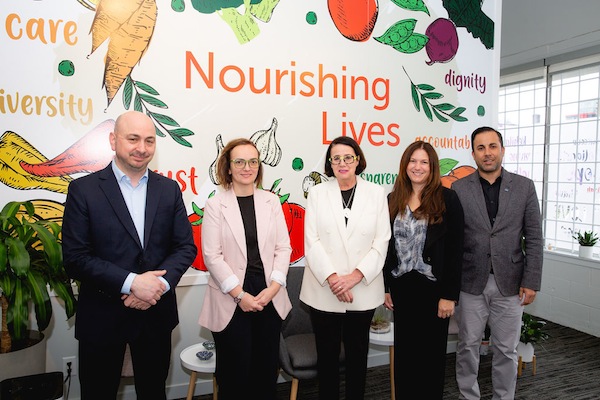
Left to right: Ezra Shanken (Jewish Federation), Tanja Demajo (Jewish Family Services), B.C. Lieutenant Governor Janet Austin, Simone Kallner (JFS board member) and Nico Slobinsky (CIJA). (photo from Jewish Federation)

Earlier this month, B.C. Lieutenant Governor Janet Austin, honorary patron of the Jewish Federation of Greater Vancouver, spent a full day getting to know the Metro Vancouver Jewish community.

Austin visited the Kitchen at Jewish Family Services, Schara Tzedeck Synagogue, the Jewish Community Centre of Greater Vancouver, the Vancouver Holocaust Education Centre, and Hillel House at the University of British Columbia.

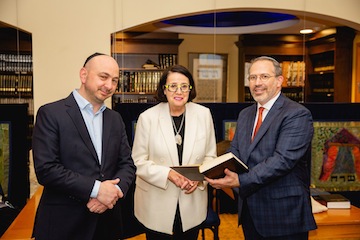
photo - Ezra Shanken, left, with Lt. Gov. Janet Austin and Schara Tzedeck Synagogue’s Rabbi Andrew Rosenblatt.
Ezra Shanken, left, with Lt. Gov. Janet Austin and Schara Tzedeck Synagogue’s Rabbi Andrew Rosenblatt. (photo from Jewish Federation)

It was an opportunity to talk together about the strategic work that Jewish Federation and its partners are doing. The Jewish Museum and Archives of British Columbia, Shelley Rivkin and Daniella Givon gave presentations about the community.

The visit to Hillel was an opportunity to see not just their good work, but how Jewish students are dealing with antisemitism on campus. They are singled out in ways other students and groups simply are not, including students connected with countries that are wrestling with difficult issues within their borders, or are led by dictators, or have dismal human rights records.

The dichotomy is shocking, and it is part of why Jewish Federation continues to push for local and provincial governments to follow the federal government in adopting the International Holocaust Remembrance Alliance definition of antisemitism.

For more photos of the day, visit facebook.com/jewishvancouver.

– Taken from Jewish Federation of Greater Vancouver chief executive officer Ezra S. Shanken’s weekly email update (May 6)

***

photo - Gordon Diamond
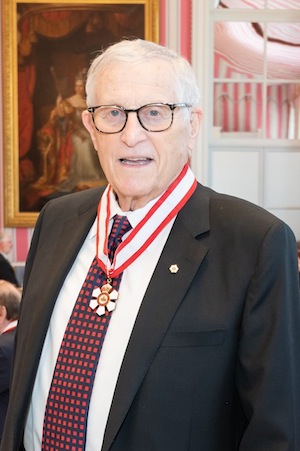
Gordon Diamond (photo from gg.ca)

On May 6, Governor General of Canada Mary Simon invested 10 Officers (OC) and 13 Members (CM) into the Order of Canada during a ceremony at Rideau Hall. Vancouver Jewish community member Gordon Diamond, OC, OBC, was among the honourees:

“Gordon Diamond has upheld the family’s exceptional legacy in philanthropy and business. Chair and owner of West Coast Reduction Ltd. and Austeville Properties Ltd., he has built them into two of Western Canada’s largest family-owned businesses. As one of our country’s leading philanthropists, he and his eponymous foundation focus on health care and social services. He is noted for his landmark donation to a major Vancouver outpatient health centre, and his support for Jerusalem’s Shalva National Centre for disabled persons and the Simon Wiesenthal Museum of Tolerance.”

– From the website of the Governor General of Canada

 ***

Richmond Cares, Richmond Gives presented the 2022 Volunteers Are Stars Awards virtually on April 27, during National Volunteer Week. Tammi Belfer was one of the four winners.

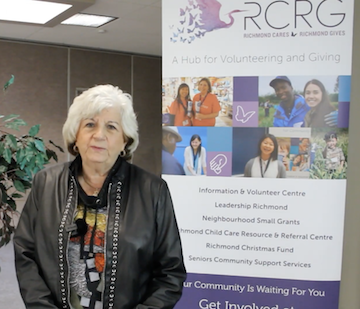
image - screenshot of Tammi Belfer shares some of the reasons she volunteers in a video on the awards website
Tammi Belfer shares some of the reasons she volunteers in a video on the awards website. (screenshot)

The 18 individuals and groups who were nominated all made a meaningful difference in the Richmond community. Collectively, they’ve contributed thousands of hours to dozens of causes, enhancing the lives of residents. Their volunteer work has impacted children and youth, seniors and families, and those experiencing poverty and homelessness. In short, every one of them is a star, and their light makes our community shine so much brighter.

Belfer was honoured as a Star of Richmond for excellence in nonprofit leadership. Li Qing Wang of Richmond Women’s Resource Centre was Shooting Star Award Winner (outstanding youth volunteer); South Arm United Church Outreach Committee was the Constellation Award Winner (outstanding volunteer group); and Dawn Thomson, Special Olympics B.C.-Richmond and Salvation Army Rotary Hospice House was the Nova Star Award Winner (outstanding individual volunteer).

Belfer has been volunteering for nearly five decades, often in leadership roles.

From 1974 to 2000, she served as a board member with the Organization Through Rehabilitation and Training (ORT). Rooted in Jewish values, the organization enhances the economic prospects of individuals and communities by providing them with employment and entrepreneurial skills.

Through much of the 1980s, Belfer was a board member with the Richmond Aquanaut Swim Club, which later merged with the Richmond Racers to become the Richmond Rapids Swim Club. During her time there, she served as treasurer, supported membership development and regularly volunteered at swim meets.

She also served eight years on the board of Richmond Cares, Richmond Gives, back when the organization was known as Volunteer Richmond Information Services. Here, too, she volunteered as treasurer. She remains involved with the organization’s Richmond Christmas Fund program, volunteering each holiday season to assist families in need.

Since 2015, Belfer has served as board president of the Richmond Women’s Resource Centre, where she’s had a transformational impact. She’s played a key role in developing the organization’s board, recruiting a diverse group of new members – including many young people – who are passionate about helping women build connections and thrive in their community.  She also volunteers as project manager for the organization’s annual International Women’s Day event, which is both a community gathering and a major fundraiser, complete with an auction and raffle. Recently, she helped lead the Resource Centre in drafting a five-year strategic plan and, in 2019, was a key voice in the organization’s rebranding effort, which resulted in a new logo created in consultation with the community.

During COVID, Belfer worked with the organization’s executive director to bring all of its programs and services online, so they would remain accessible throughout the pandemic.

Speaking of programs, it’s another area where Belfer has had a substantial impact. She helped create many of the Resource Centre’s most popular initiatives, from Hot Ink, a creative writing program for teenage girls, to Work Ready, which supports women in developing employment and job-search skills.

Belfer is also a current board member of the Jewish Seniors Alliance and of Beth Tikvah Synagogue, where she actively participates on committees and generously shares her knowledge and experience, so both organizations can better serve their constituents.

Through her decades of service, Belfer has left an indelible mark on the Richmond community, and improved thousands of lives. She’s still giving her time, and still making a difference, even as she mentors young volunteers on their way to becoming community leaders. She’s one of the giants on whose shoulders they’ll stand.

Belfer shares some of the reasons she volunteers in a video on the awards website, rcrg.org/vas.

– Courtesy Richmond Cares, Richmond Gives

Format ImagePosted on May 20, 2022May 19, 2022Author Community members/organizationsCategories LocalTags Gordon Diamond, Janet Austin, Jewish Federation, Order of Canada, Richmond Cares Richmond Gives, Tammi Belfer

Opportunity to be healthier

There’s been much discussion about mental health, physical health and well-being as it relates to the pandemic. This can only be a good thing. It shines a light on something we should all think more about. For example, asking: “How are you doing? How are your family members and friends doing? Do they need support? Are they sad, isolated, lonely or not feeling well?” and actually hearing the responses.

Yet, once we start raising these questions about well-being, we have to acknowledge that we just don’t have the bandwidth or the social and medical infrastructure to deal with the outcomes. Many times, no one has cared, asked or listened when someone has spoken up and said things weren’t OK. It might be new for some to acknowledge that we’re not always “fine” and that there’s often not much professional help available either. (Just look at wait times to get mental health or addictions support.)

Our household had a great weekend recently. The weather was outstanding, warm and sunny, with highs of 20 to 23°C. We had outdoor experiences, with low-risk social experiences. We participated in a friendly neighbourhood cleanup and a big picnic with soccer and badminton. My kids gave me handmade art for Mother’s Day, with notes they wrote themselves. There was time for lots of good food, walks, playing and even some household cleaning. All four of us commented on Sunday night that we’d done so much, eaten well, and had so much fun.

I had so many feelings about this. I, too, loved the sunshine and the weekend’s events. I also felt physically well and energetic, capable of celebrating it all. That said, being absolutely prepared ahead of time, with lists of what we needed for each outing, a schedule, and carefully pre-organized and prepared meals was a lot of emotional labour. Like moms everywhere through the pandemic, I’ve shouldered much of this. When I woke up Monday morning, I was really tired.

The kids went to school. My partner settled down to his online meeting. I threw together food in two slow cookers for dinner and went to my desk – to work and to process my intense feelings. I knew I’d been starved for company. Seeing people outdoors, even strangers, with smiles and an intention to socialize and get to know us, was gratifying. Also, breaking out of our normal cold weather weekend pandemic routine was both fabulous and more work. Choosing to go out and chat with strangers – it was all good but also alien. That strange mix of feelings led me to think harder.

Working, I opened a fascinating listserv email about an informal comparison between Modern Hebrew, Yemenite Hebrew and Samaritan Hebrew. A Canadian engineer named Bahador Alast hosts YouTube interviews for a wide variety of languages in which he explores language, linguistics and culture. In this video, an Israeli speaker of Modern Hebrew, a Samaritan Israeli and a Yemenite Israeli all take apart informal sentences, a sentence of poetry, a sentence from the Torah (and liturgy) and another from the Mishnah (part of the Talmud). They easily code switch between their dialects of origin (Samaritan/Yemenite), Modern Hebrew, English and Arabic. They discuss the origins of their community’s pronunciations and conversational styles, their relationship to other Semitic languages and Modern Hebrew. With focus, they do all this in less than 20 minutes. It’s also done in such a friendly, open way that the moderator, Alast, who does this with many different cultures and languages, mostly sits and listens to the magic unfold.

This content stretched me intellectually, especially my auditory capacity, since I hadn’t heard these differences explained and formalized before. I loved this rare learning moment and the very specific linguistic context and comparison.

My personal realization about the weekend’s events and warmth and my Monday morning exhaustion was that context matters. The reason why it was all so fun was that we came into the weekend prepared. Also, all felt well rested and ready for lots of activity. Since the pandemic started, there has been acknowledgement of women’s household burdens with the cancellation of “regular” activities, but context matters. I had mostly the same burdens pre-pandemic and the normal run of activities made life overwhelmingly busy. The break in obligations allowed me to see the emotional labour in getting everything ready. I now sometimes can get my spouse to take on some of the load. Sometimes, we restructure things or do less.

The pandemic forced us to hit pause in many ways. Hopefully, it’s also opened up moments to make positive changes. People have always asked each other how we were, but did everyone listen to the responses? No. Many of us didn’t even have the time to listen to ourselves. Our own health and well-being can sometimes be hard to figure out. We need that quiet space to contextualize our experience. “Does this hip hurt more than it used to?” a physio might ask. However, if we don’t stop to think about what hurts or to discuss our feelings, experiences and needs, we cannot possibly contextualize them, either.

Judaism teaches us that we’re obligated to one another, in families, communities and society. Yet, if we aren’t listening to one another, we can’t help one another. Whether it’s speaking a common language with dialects or providing one another with mental health and other supports, we cannot lift one another up if we’re not listening or trying. We need to be self-aware to listen to our own bodies, minds and feelings. Then we can listen to and help others, too.

We may have a lot of health issues ahead, from long-COVID, health concerns left undiagnosed and mental health struggles. We have an obligation to recognize that we don’t have the social and medical infrastructure we need to manage it all. It’s up to us to start bridging the gaps. Listening to one another, offering context and support, is a first step. It’s an important opportunity to make things better.

Joanne Seiff has written regularly for CBC Manitoba and various Jewish publications. She is the author of three books, including From the Outside In: Jewish Post Columns 2015-2016, a collection of essays available for digital download or as a paperback from Amazon. Check her out on Instagram @yrnspinner or at joanneseiff.blogspot.com.

Posted on May 20, 2022May 19, 2022Author Joanne SeiffCategories Op-EdTags COVID, health, Judaism, lifestyle, mental health, pandemic

Posts pagination

Previous page Page 1 … Page 170 Page 171 Page 172 … Page 662 Next page
Proudly powered by WordPress