Skip to content
  • Home
  • Subscribe / donate
  • Events calendar
  • Business Directory
  • FAQ
  • News
    • Local
    • National
    • Israel
    • World
    • עניין בחדשות
      A roundup of news in Canada and further afield, in Hebrew.
  • Opinion
    • From the JI
    • Op-Ed
  • Arts & Culture
    • Performing Arts
    • Music
    • Books
    • Visual Arts
    • TV & Film
  • Life
    • Celebrating the Holidays
    • Travel
    • The Daily Snooze
      Cartoons by Jacob Samuel
    • Mystery Photo
      Help the JI and JMABC fill in the gaps in our archives.
  • Community Links
    • Organizations, Etc.
    • Other News Sources & Blogs
  • JI Chai Celebration
  • JI@88! video

Recent Posts

  • Federation now across BC
  • Israel fighting for its existence
  • Deal strengthens Iran
  • Patriotic belonging diminishes
  • A campaign to engage
  • Upstanders’ first live event
  • Responding to Carney
  • Having your own home
  • Music a family tradition
  • Musical to warm heart
  • Community milestones … June 2026
  • Sharing her passion for Israel
  • Or Shalom reopens its doors
  • JFS from past to future
  • Need holistic approach
  • Sharing stories, advice
  • Journalist shares fears
  • Skills to live together
  • Road to independence
  • Cutting grass with scissors
  • Zionism as a solution
  • Deceit, desire & the divine
  • Reclaiming sacredness
  • Creative project ideas
  • Summer squares and cobbler
  • Thou shalt … summer commandments
  • Legal help for students
  • Revisiting myth of Lilith
  • Wrong person rebuked
  • Canada’s mixed messages
  • Questions for museum
  • Symposium on antizionism
  • Making soccer political
  • CJPAC lauds Pulver’s impact
  • City recognizes Vrba’s legacy  
  • Organ donation saves lives

Archives

Follow @JewishIndie
image - CJN box ad Rockowers 2026

Category: Op-Ed

The man behind the curtain

It was a beautiful Wednesday morning. I awoke in a tangle of bed sheets and to an IV stuck in my left arm. I had been in a road biking accident in the city the night before, breaking my now throbbing right leg in three places. The night had been a blur of ambulances, narcotics and doctors bustling around the noisy emergency room. It was quiet now. I had been moved to a shared room on the seventh floor. Long beige curtains had been pulled around my hospital bed, shielding me from the other patients. I could see the sunlight splashing through the window on my left, as I looked out to the surrounding city buildings. It was still summer, but mine was over.

A tired nurse interrupted my thoughts, rushing in with an awkward blood pressure machine and a temperature wand. I wondered if the frequent checks were to ensure I was clear of infection and, perhaps, COVID-19. The ward was eerily empty of visitors. Strict regulations were now in place because of the pandemic, and the impact was evident. Suddenly, with fewer family members visiting, there was more for the staff to do. The nursing station seemed to be a never-ending symphony of ringing, as patients buzzed for attention.

On the other side of my bed curtain, I heard a patient cheerfully chatting to a nurse who had arrived to assist with his medication. The nurse’s smile was audible as she told him about her coming birthday plans at the beach, physically distanced, of course. I eavesdropped that day and I realized that my roommate knew the name of every care aide and nurse who came to his side. He greeted them with enthusiasm as they entered the room, as if welcoming each into his home. He called them by name and asked with sincerity about their families and futures. I never once heard this man whisper a word about his own pain.

That night I wept, overwhelmed by self-pity and my coming trip to the operating theatre, where they would screw my splintered bones back together. I lay still and stared at the ceiling, listening to the hum of the machines around me. I thought about how I was going to get the kids to school, how my work would be affected and all the things I could, temporarily, no longer do. This year was not getting any easier. And then, as I attempted to use my bedpan, it spilled.

I awoke the next day to the sunshine dappling on my starchy bed sheets and the scattered magazines on my bedside table. It was agonizingly early, and the birds were chirping loudly as if to flaunt the beauty of the day. I was disheartened by my bedridden state, my swollen leg wrapped in plaster and the unsightly road rash that covered my body. I sat up in bed and dreaded the lonely hours that lay ahead.

The silence of the room was soon broken by a quiet voice from behind the curtain.

“Good morning,” the voice said calmly, clearly directed at me. “Are you doing OK?”

The patient next to me must have heard my sobs the night before. Hesitantly, I responded. From there, he drew me into a conversation and brought me into his world, spinning my despair on its head.

For days, we talked endlessly through the hanging fabric to pass the time, without seeing each other. Each morning he would greet me with unwavering cheer, found somewhere in the depths of his own being, despite his medical challenges.

“Good morning, Caroline,” he would beam. “You are going to get through this.”

He was almost 80 years old, he proudly told me. He had a wonderful life filled with a loving family, amazing friends and memories. His heart was full. And come hell or high water, he was going to get better and get out of this joint.

This stranger became my unrelenting cheerleader, as if it was his personal mission to lift me up from my melancholy. As I told him about my family, he reminded me to enjoy these precious years with my young children and how fortunate I was to have a partner who was by my side, when the hospital allowed. As we talked through the curtain, he encouraged me to find the best in all difficult circumstances, including this one, and to remember that the glass is always half full. Life is not always easy, he would say, but you have to carry on and look for the positive. His optimism radiated throughout our hospital room.

After our hours of conversation, we asked the nurse if we could see each other. Bedridden, connected to IV poles and draped in matching hospital gowns, we waited in anticipation as the curtain was drawn. As his eyes sparkled, he smiled knowingly and told me that I had so much to look forward to. I felt a sense of exhilaration, seeing him for the first time, after all that had been shared in our intimate room.

Despite his own ill health, he continued to coach me from his hospital bed in the days that followed, gracefully placing my injury in perspective. It was left unsaid that I was one of the lucky ones. I only needed to look over to the third patient in our room, who had been in a motorcycle accident, to count my blessings.

My roommate was wise and unrelenting with his words of encouragement. He was infectiously optimistic and didn’t complain, except about the food, assigning a score out of 10 to each meal. We joked about this often, that and the dismal TV options. My discharge papers were finally signed on the fifth day and I waited eagerly to get home to my family. As I was wheeled out of the room, our eyes met and we said our final goodbyes. I felt emotional, as I knew that I would likely never see him again.

I think of my exceptional roommate often and of what a gift he was to me. The impact he made during those difficult days on the hospital ward still resonates. Everything will be okay and there are brighter days ahead, for all of us. Thank you, Sanford, for being my silver lining, my ray of sunshine. I am grateful.

Caroline Dickson lives in Vancouver. This story was originally published in the Globe & Mail and a Jewish community member shared it with the JI. In recognition of Sanford Cohen’s kindness towards everyone he meets, Dickson is collecting Chanukah gifts from the community for him this year. If you would like to contribute a gift or send a card, please email [email protected]. Drop-off locations are available in Richmond and Vancouver.

Posted on December 4, 2020December 2, 2020Author Caroline DicksonCategories Op-EdTags Chanukah, health, kindness, lifestyle, Sanford Cohen
Mother saved by flowing milk

Mother saved by flowing milk

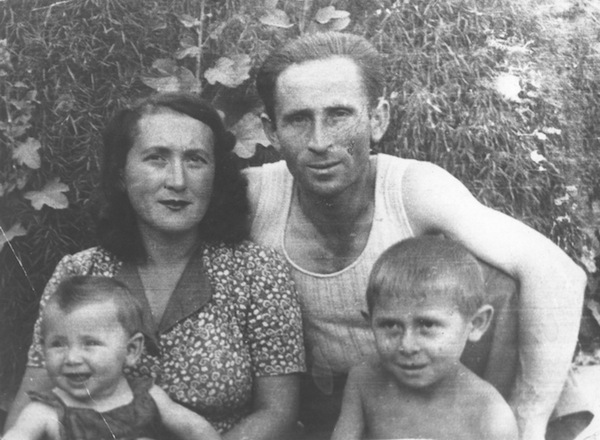
The author as an infant with her parents Sarah and Mechel, and brother Hy, in Kazakhstan, where she was born in 1944. (photo from Reva Kanner Dexter)

A year ago, I attended the 31st Annual World Federation of Jewish Child Survivors of the Holocaust and Descendants, hosted by our own Vancouver Holocaust Education Centre. I have kept the story of my own Holocaust experience suppressed because it never seemed as tragic nor as diabolical as others’. Furthermore, because I was an infant, born in 1944, I did not think that I had the right to call myself a child survivor. However, attending the conference changed that perception.

I claim the dubious distinction of being in the one percent of children born of Polish parents who survived. As three million Jews of Poland were murdered, I feel very privileged.

Of course, the circumstance of my miraculous survival is due to several factors. First, my parents escaped Poland in September of 1939. Second, they were living close to the Ukraine border. Third, they had the essential skills and resilience to overcome many hardships.

My mother Sarah (daughter of Pinchus and Chana) and my father Mechel (son of Israel and Esther) were born and grew up in small towns in southeastern Poland. Krasnystaw and Izbica were 12 kilometres apart. Close enough for biking and walking between the two towns along the Wieprz River.

Typical of small towns in that region and era, Sarah and Mechel grew up poor. Sarah’s father was a barber, who taught her his skills as soon as she could hold a razor blade. Mechel’s father was a tailor who had taught him the art of sewing, also at a young age.

Sarah and my father had moved to Chelm after their marriage, and Sarah was already six months pregnant when the German troops invaded.

Mechel was a member of a Zionist/socialist club, so he got the news early that the Nazis had taken over the town – 1,500 young men were rounded up and shot. Rumours of castration created panic. Mechel took off by bike with some of his pals, telling Sarah he would be returning.

Sarah’s birth mother lived in Rovno, Ukraine, so she made her way alone across the border with the help of a Yiddish-speaking Russian soldier. She had the prescience to bring her barbering tools. Little did she know that trains and train stations were going to dominate her life from that night forward for the next six years.

Sarah and Mechel gave birth to their first child, Chaim (Hy), who an aunt testified was born in Rovno, while an immigration document states that he was born in Novosibirsk, Siberia. Memories do seem to play tricks when the brain is violently assaulted.

The Russians saw and seized the opportunity of so many Jews fleeing Poland into Ukraine. They tricked Jews by telling them that eastern Poland was now under Soviet rule and that they would be given safe passage back home.

It was a lie, a big one. The Jews were shoved into open cattle cars and sent to forced labour camps all over the U.S.S.R. Workers were required to keep the country running under the murderous hand of Stalin.

My parents and baby brother survived the train ride from Rovno or Kiev, which finally stopped in a logging camp on the banks of the Ob River, in Siberia. They realized immediately that their lives were only worth what their labours could produce.

I recall stories of wolves howling in the night and rats “as big as kittens” stealing their meagre rations while they slaved in the tundra in the day and tried to sleep in the frozen barracks in the night.

My father organized a strike – after all, they were in a communist country weren’t they? The demands for better working conditions were answered rapidly by rounding up the leaders during the night and incarcerating them in the Gulag.

Sarah had to fend for herself again. Even though she was freezing, undernourished and exhausted, she had an ample amount of milk flowing from her body. This was noticed by the commandant, whose wife had just given birth and could not nurse their sickly baby. Sarah was promoted from lumberjack to nursemaid.

As the two women became friends, Sarah got news that Mechel and the other men were still alive.

photo - A photo taken at a displaced persons camp in Germany, 1947. The author and her older brother, Hy, are in the centre, with their arms draped over each other
A photo taken at a displaced persons camp in Germany, 1947. The author and her older brother, Hy, are in the centre, with their arms draped over each other. (photo from Reva Kanner Dexter)

In June 1941, when the Nazis attacked Russia, the Soviets granted amnesty to the surviving Polish citizens. Poland and Russia became allies. The Jewish prisoners were released, only into a more dangerous predicament.

With Mechel’s leadership, the ragtag group of Jewish lumberjacks built rafts, trusting the river to lead them to safety. They navigated the Ob River by day, roping up by night.

During the night, the women would scramble up the banks, scavenging for food on adjacent farms. My mother told us that she dodged many bullets through the darkness. But the plan succeeded in getting them to a train station.

The next few years, they were underground, following trains, bartering at train stations, trying to regain health. Sarah would do pop-up barbering, thankful for her tools and endurance.

They finally made it to Czymkient, Kazakhstan, where Mechel got a job sewing uniforms for pilots at a pilot training academy. I was born in December 1944. Hope and optimism returned to our little family.

Of course, the story does not end here. Other chapters will emerge, as I continue to pull pieces of the survival puzzle together.

Thanks to the conference, I realize how important it is to keep searching for objects and recording memories, which return our beloved victims and survivors to us in spirit.

Reva (Rivka) Kanner Dexter has been a docent at the Vancouver Holocaust Education Centre since 2007.

Format ImagePosted on December 4, 2020December 2, 2020Author Reva Kanner DexterCategories Op-EdTags child survivor, Holocaust, memoir, survivors, VHEC
Emerging from the shadows

Emerging from the shadows

Pepi Eirew (photo by Rob Gilbert)

I looked across the table and a boy stared back. I was 11 years old. “Yes! A girl!” he said, incredulous. “A boy,” I replied dryly. We shook hands and took our first moves.

Oddly, Ms. Janet England, my kindergarten teacher, taught the whole class to play chess on Tuesday mornings, because she felt that it was a wonderful game. More than that, she invited non-playing parents to come, too. So, I learned chess and it has been beside me ever since, like one of Phillip Pulman’s The Golden Compass daemons.

It is the best game to take on holiday, as, whatever the location, I can play beyond my years and without a shared language. I remember, when I was small, being in a tough park in New York. My parents wanted to leave, but then we saw some chessboards and, well, my parents’ worries about the surrounding drugs and darkness meant nothing – we just had to stay. Contrary to what is depicted in The Queen’s Gambit, that is the only drug-taking I have seen near the board; never in a tournament. Players know each other quite well, seeing each other at regular events, so anomalies in personality, behaviour or play would quickly be spotted.

I really hope that The Queen’s Gambit will spur many girls on to play more. What other game lets you play on an even footing, irrespective of size or age or language? Under one metre tall, I would approach grown men to play as we traveled. “Are you any good?” they’d invariably ask. I’d shrug and we’d have a good game.

I was selected to play for Canada Girls U18 two years ago, and then invited to the World Youth Championships. It is an amazing hobby, although one I confess I have hidden until fairly recently. I love the game and thinking things through. It is endlessly exciting. I was inspired by the Polgár sisters: grandmasters Susan and Judit and international master Sofia.

photo - Pepi Eirew at the 2015 Canadian Youth Chess Championships
Pepi Eirew at the 2015 Canadian Youth Chess Championships. (photo by Gaby Eirew)

I have played in tournaments that took me into a world of fancy halls and hotels. Some hotels are lovely and offer very reduced room rates, which doubled as our family holidays. Sometimes, I have taken Pesach seder plates with me during weeklong games! Sometimes, the choice of venues is odd, like the time we were part-sponsored to play the National Youth Chess Championships in the halls of a casino, from which I could not buy a Starbucks, as I was underage.

Games are intense and you lose all sense of time, although you are looking at the minutiae of time on the clocks; yours and theirs. Sometimes, I have played five days of 10-hour days of long games, only popping out to the sealed toilets area or to eat a spoonful of yogurt between matches. Other times, I go for long walks or swim in breaks, but, mostly, chess is a gorgeous thinking game and it’s not unusual for my siblings and I to play Bughouse and Crazyhouse, as we rest between significant games.

Six years ago, my brothers and I noticed that many chess-playing girls seemed to evaporate from major tournaments in their teens. At some youth tournaments, girls could win a prize just for turning up! We figured it was because of chess’s macho reputation and stone silent rooms. We sometimes saw kids attend with harsh parents or strict coaches. So, my brothers and I started the Chess Table, a jolly centrepiece at all-day girls’ tournaments, where we offer immediate, free supportive chess coaching, sponsored chocolate chess pieces and pizza, water and buckets of reassurance.

The Queen’s Gambit games are real games from real grandmaster tournaments (like Borat’s real Ivrit in his movies). Every tournament usually has a skittles room, where you meet the person you just played, go over the game or hang out; that is also real. It is a wonderful opportunity to analyze your moves and further understand the opponent’s approach.

I have found the chess community to be a mix of quiet, quirky, erudite people from all disciplines and backgrounds. It is a leveller. My Mr. Scheibel, Stephen Wright, is a wonderful chess tournament director and coach. He is incredibly knowledgeable about music, history and ancestry, too – a real Renaissance man.

What is lovely is that there is space for everyone in chess. It is not as sexy as portrayed in The Queen’s Gambit, but I applaud world champion Magnus Carlsen for being both a chess player and a fashion model, challenging all stereotypes. We play in comfortable clothing, as we want to focus entirely on the game. You dress as you would for an exam. I know that I like to move freely, kneel on the chair, and breathe well, so sports attire works. As ratings grow, so does confidence, which itself is appealing.

Chess has let me think about many things, steps ahead. It lets you focus on what you want the outcome of a project or relationship to be, and then let that inform your actions. It is maybe less good if you want a calm, switched-off brain. I don’t think out things on the ceiling, as the The Queen Gambit’s Beth Harmon does, but any plain surface is fine to think multiple moves through, and many good players can win against a whole room of people simultaneously.

I would like to go on the European Chess Train that Stephen told me about. It takes place each year, winding its way round Europe, with games all the way, so you can jump off and see the sights, get back on and play.

Beth might feel isolated and alone for much of the show. In chess nowadays, you can’t help but see the support in the community, from the coach who patiently explains something important or the doctor volunteer who gives up a week of holiday to be there, and the individuals who spend months planning and hosting tournaments. It is quite a community.

I look forward to there not being division between boys and girls sections in the junior tournaments, when we can all play as equals. I have not had a sponsor or stylist yet, but, then, I wore the same pair of boots for tournaments for 11 years!

Pepi Eirew, Disney scholar in animation at California Institute of the Arts, was invited to the World Youth Chess Championships, 2018-19, and she played U12 to U18 in Canadian Youth Chess Championships. She lives in Vancouver.

Format ImagePosted on December 4, 2020December 2, 2020Author Pepi EirewCategories Op-EdTags chess, games, memoir, Queen’s Gambit, women

Harris-Emhoff’s significance

After the election of Joe Biden and Kamala Harris, many Jews were quick to celebrate that Harris’s husband Doug Emhoff is Jewish. Indeed, it is a win given the sharp rise in antisemitic expression and white supremacy we’ve seen in the United States, and which is bleeding over into Canada.

Jews often celebrate when someone like us makes it into a position of some influence. This time, it isn’t any particular achievement of Emhoff’s but, rather, his proximity to someone powerful.

Harris represents so many firsts: the first woman, the first person of South Asian and of Black heritage, and the first person married to a Jew to reach the vice-presidency. Her family is a positive representation of the dream of the United States, where anyone can become anything and where, crucially, diversity is a strength.

In open and free democracies, intermarriage is inevitable. If we are to live and work alongside each other, we will fall in love with each other. This isn’t a bad thing. Given how many people seem to hate Jews, it is nice that some people actually love us. I realize intermarriage is a perceived threat to Judaism; fears of assimilation are very real. And yet, Emhoff is proudly Jewish. His identity is not threatened by the multiple identities of his partner – they celebrate the many elements of who they are and where they come from.

Since the election, there have been many pieces published about how nice it is to see one’s intermarried family represented in the White House. Jewish communities have spent the past several decades trying to stop intermarriage. These efforts have failed and have even driven some Jews and their loved ones away from Judaism.

If we care about Jews and Judaism, including challenging the multiple threats we face, this kind of infighting really needs to stop. It’s time we embrace our pluralistic and diverse families, celebrate all those who wish to be and do Jewish, and recognize that there is so much in Judaism that is beautiful and meaningful, joys that can be experienced by all who are part of the wide web of Jewish families.

Rabbi Denise Handlarski lives in Toronto. She is the author of The A-Z of Intermarriage, published by New Jewish Press, and the leader of the online community Secular Synagogue.

***

Editor’s Note: For a response to Rabbi Denise Handlarski’s opinion piece, see “We Jews Are a People of Destiny” by Rabbi Ari Federgrun.

Posted on November 27, 2020December 16, 2020Author Rabbi Denise HandlarskiCategories Op-EdTags democracy, diversity, Doug Emhoff, family, intermarriage, Joe Biden, Judaism, Kamala Harris

Past helps decode present

My husband saw the pair of decoder rings in a catalogue, long before our twins were old enough for them. Still, he ordered them and put them away. At the time, it amused me. How could he predict the future? Would our kids want these someday?

Fast forward to one October 2020 pandemic weekend. I’m not sure how he knew it was the right time. Before I knew it, two 9-year-olds were whizzing around the house, holding onto rings much too large for their fingers, and sending each other secret messages in code.

When they returned to school that Monday, they continued with the crazy codes, trying to teach their classmates about it. Unfortunately, this fun was short-lived. About a week later, we got an email from the school. It said that remote learning “may” be offered, and that we could sign up if we “might” be interested.

The situation was worsening in Manitoba, so we clicked through late on a Saturday night. This seemed wise, if we indeed understood the confusing letter correctly, that this remote learning might be happening. In any case, if some people signed up for the remote learning, it would allow more room in our older, smaller school building for others to social distance. Well, surprise! We were contacted on Monday morning and, by that Wednesday, our kids were at home again, learning with us. In the long run, this is the right choice – Judaism teaches us to value life above all else.

Both my husband and I are already working from home. At the beginning of my career, I used to teach school. Although I’ve never taught Grade 4 before, we’re muddling through. The remote learning we’re offered doesn’t continue the Hebrew curriculum we had before. It started with a single Hebrew packet, but, when it looked like we were nearing the end and I asked the school if it had more to share, I got a stern “no” in response. Remote learning offers only the basics, even if we can see via Instagram that, in class, the kids’ schoolmates are still doing fun projects without us.

It’s hard on children to feel left out. However, since there’s already been a COVID virus exposure at the school, we made the safe choice for us. My kids are lonely for their friends. My husband, a biology professor, thinks that schools should shut down now, until the infection rate lessens and the health system isn’t so overburdened.

Yet, here we are, with an everyday virtual, multi-age “school lesson” that lasts an hour. We do the reading, writing, math and science on our own. We also do something Jewish. One night, it was a discussion about Mezritch, which was a centre of Chassidism. Another day we talked about tefillin. On a third day, we learned about Sigd, the Ethiopian Jewish holiday celebrated 50 days after Yom Kippur, which is now a national holiday in Israel. The kids keep up their Hebrew as best we can, with my support and by using a free language program online.

Today, we hit the very last page of the Hebrew packet sent home by the school a couple weeks ago. There were moans about how hard it was and further cries when they realized there was no more of the “packet Hebrew.” For me, the last page left a special, coded gift.

This page taught about how each letter of the aleph bet, the Hebrew alphabet, also signified a number. Aleph is one, for instance. The numerical values of the letters of chai, the word for life, add up to 18.

My kids struggled with this page for entirely different reasons. But, if we can learn to write the numbers in Arabic numerals (also called the Hindu-Arabic system), we can learn the Hebrew ones. We’ll learn to spell out the number names in Hebrew. Like magic, I’d been given a gift, a secret decoder system to share. We just have to learn all the symbols together!

I won’t lie. I wish my kids’ class had all gone “remote” together, so they could see their classmates for an hour a day. I wish the pandemic hadn’t happened. I wish I’d gone to bed earlier over the weekend, instead of staying up late, reading the huge obituary section – but wait, that’s not right.

My biggest wish that puts all these little ones to shame? I want to honour every life that’s in those obits, every life that has been lost. There’s so much suffering, death and loss right now, and we’re all working our way through it.

I also want to honour the diverse positive ways we’ve innovated and managed during a scary, singular experience. Studying a textual tradition like ours, that’s thousands of years old, means we have deep resources. We can hear about deaths and the first obituaries in the Torah portions this time of year. We imagine similar chaotic experiences like Noah’s ark in the flood, or the destruction of Sodom and Gomorrah. There are plenty of opportunities to think through our rich history during remote or home school.

On the plus side? It also means that I have a Hebrew lesson plan for tomorrow and beyond. We have access to an ancient, special Hebrew numerical code, called Gematria, and a mom teacher who now gets to figure out how to use that, along with those fancy decoder rings, for good – for the twins to learn math, puzzles, Hebrew and more … in Grade 4.

Joanne Seiff has written regularly for CBC Manitoba and various Jewish publications. She is the author of three books, including From the Outside In: Jewish Post Columns 2015-2016, a collection of essays available for digital download or as a paperback from Amazon. Check her out on Instagram @yrnspinner or at joanneseiff.blogspot.com.


Posted on November 27, 2020November 25, 2020Author Joanne SeiffCategories Op-EdTags coronavirus, COVID-19, education, family, Gematria, Judaism, kids, lifestyle, parenting

Help repair the world

I am flipping through one of my social media outlets, as I lie on my bed, cuddling my 7-month-old baby to sleep. A picture catches my eye. Garbage strewn in front of a restaurant. I look closer, puzzled as to why someone would post a picture of garbage. Then I see. Discarded needles littered amongst the garbage. I read the accompanying message. The poster says that we need to relocate addicts to a secured facility in the north. Provide them with drugs and food and medical care, but we need to get them off of our streets.

I scroll through the comments. I cringe as I read them. I see posts such as, “These people,” “Get them off of our streets,” “Decided to act against societal norms,” “Until they wish to act like proper citizens,” “Undesirables” and so much worse.

The poster is Jewish. Many of the people commenting are Jewish.

My mouth drops open. I take a sharp breath and feel a pain deep inside of me. My heart hurts. I want to cry. My hands shake. It takes all the strength I have not to respond. I am hurt and angry. I shake my head in pain.

I am a recovering alcoholic and drug addict. I haven’t had a drink or a drug in a little over 20 years.

Yes, I am one of those undesirables. So is my husband. My mother and some of my best, most cherished friends.

I was 25 years old when I found recovery. I am one of the lucky ones. I never lived on the street. I didn’t do needles. I didn’t have to experience that kind of bottom, but what being in recovery has taught me is that I am no different than those who live on the streets, than those who inject themselves with needles. Because I am an addict. Once I use, I can’t stop.

The American Psychiatric Association classifies addiction as a complex brain disease that is manifested by compulsive substance use despite harmful consequence. I have a brain disease. I will drink and drug even though it causes harm to me and those close to me. Once I use, I don’t care about anything else. I have a disease that I have to live with and battle for the rest of my life. It is painful. It is a struggle. Some days are easier than others, but the fact of the matter is, I have to live with a disease that can return at any moment. Like a person in remission from cancer.

Does the Jewish community not want me or my children because I am an addict? Am I less of a worthy Jew because of my disease? What about my children? Even as I write this, my heart is beating fast, my breathing is shaky. I think of v’ahavta l’reacha kamocha. I think of how we, as Jews, are commanded to love the stranger who dwells among us, to have one law for the stranger and the citizen, to never embarrass our fellow human beings in public, and to guard our tongues and speak no evil.

Where is the love of humankind when we classify human beings as undesirables? Where is the humanity in suggesting that we take human beings and put them into remote locations, away from civilization? Is this starting to sound familiar? Perhaps like the Shoah? When Hitler classified us Jews as undesirables? Did those Jews have a choice as to whether or not they were classified as Jews even?

I have a disease. I did not choose to be an addict. I did not know, when I drank my first drink and smoked my first joint that I would end up addicted. I was a kid. I did what almost every other teenager did. I experimented. None of my friends from high school are addicts. I am. I got it.

Addicts come from all walks of life. They are your teachers, your lawyers, your doctors, heads of companies, celebrities. They are also those living on the street and leaving their dirty needles behind. Addiction doesn’t discriminate based on your ethnicity, your socioeconomic status or your religion, yet we, as a community, want to believe that addiction doesn’t happen among our tribe. I can tell you that it does. I can also tell you that there are many Jewish addicts and their families who are afraid to come forward precisely because they are afraid that they will be looked down upon and judged as morally impaired. As undesirables.

This, to me, is morally reprehensible. We, as a community, need to act with love. Let’s help repair the world that we live in so that we can love and support all people, even when they are sick with a disease that we don’t understand. It is our duty as Jews. V’ahavta l’reacha kamocha and tikkun olam. Love your fellow as yourself and help repair what is broken.

Amanda Haymond Malul is a JACS (Jewish Addiction Community Service) Vancouver supporter.

Posted on November 13, 2020November 11, 2020Author Amanda Haymond MalulCategories Op-EdTags addiction, health, JACS, Judaism, recovery, tikkun olam
Must teach about Holocaust

Must teach about Holocaust

An item from the Nov. 10, 1938, newspaper in Helen Waldstein Wilkes’ mother’s hometown, Cham, Bavaria. It reads: “In Brief. Jews Taken into Protective Custody. As was the case everywhere in Germany, news of the death of the German Councilor von Rath in Paris unleashed a storm of bitterness and fury against the cowardly Jewboys who are now threatening the lives of Germans abroad because they can no longer unleash their terror and hatred within the Reich. Since, by the Grace of God, we no longer have any Jewish shops in Cham, anti-Jewish action did not take place as it did in so many other German cities. However, for their own safety, those Jews still living here had to be taken into custody yesterday morning.” (Translation by Waldstein Wilkes.)

As we have sat waiting to hear who will be president of the land that was once the beacon of hope for so many, we have asked ourselves, “What can I do? Are there meaningful avenues for action?”

Election day Nov. 3, Kristallnacht Nov. 9 and Remembrance Day Nov. 11 form a cluster. For Jews who became refugees or who lost family in the Holocaust and for all their descendants, Nov. 9 has particular resonance. Peter Gay was there. Here’s how he describes it:

“Synagogues were severely damaged or totally burnt out, sacred scrolls desecrated with the peculiar elation and ingenuity that the plunderers brought to their work. Businesses were destroyed, private houses and apartments were reduced to piles of rubble, with furniture, pictures, clothing and kitchen equipment thrown around so that they were barely recognizable. There was some looting…. But for the majority, the thrill lay in destruction for its own sake.

“The world watched, disapproved, and did almost nothing. In the United States, the public’s attention was still focusing on the midterm congressional elections of November 8, and the press was busy assessing the results.” (From Gay’s My German Question: Growing Up in Nazi Berlin, Yale University Press, 1998.)

For me, the parallels to today send shivers down my spine. The world must not be allowed to forget the depths to which humans can sink.

Awareness of the Holocaust is shrinking. In the United States, a 2018 survey showed that 66% of millennials could not identify what Auschwitz was. A recent survey revealed that about a third of 7,000 European respondents across seven countries knew “just a little or nothing at all” about the Holocaust.

Knowing about the Holocaust can provide a necessary understanding of how an entire population was bullied and manipulated by demagogues before succumbing to hate and fear-mongering. It can also serve as a blueprint for recognizing the dangers of demonization and incitement and help guard human rights and strengthen core democratic values.

Instead of endlessly fretting about social isolation and the threat of COVID-19, I’ve been seeking ways to make the gift of my days here on earth matter. I, a woman who calls herself “accidentally alive,” a woman who left her first home by horse and buggy, now count technology as among the miracles of my life. Recently, from out of the blue, the wife of a second cousin in New York, whom I’d met only once many years ago, decided to gather the extended family (all that’s left, thanks to Hitler and his efficient helpers) via Zoom. Welcoming me to this gathering of the mishpocha was a man in Israel claiming that his great-great-grandparent and mine had been siblings, and that he had read my book Letters from the Lost in connection with his volunteer work at a museum there. The museum used to be a kibbutz, founded by survivors from Theresienstadt, the concentration camp where both of my grandmothers perished and where most of my family suffered before being sent to their final destination, Auschwitz. Perhaps to distance itself from the German and to place upon it the stamp of renewal that Israel became for these lost souls, the kibbutz was named Beit Terezin.

Together with David, this fourth cousin in Israel, I am building a pathway for keeping alive that which we forget at our peril. Please, if you can, go to jgive.com and search for “Letters from Arnold.”

Using artwork and graphics contributed by those early survivors in Beit Terezin, alongside the words of my beloved Uncle Arnold, who spent 17 months in Theresienstadt before enduring the hellfires of Auschwitz, we hope to create a book that will find a home in every Holocaust museum in the world. If finances permit, we will use technology to bring the contents to life in new ways so that those who cannot visit a Holocaust museum in person nonetheless can receive our reminder that it must not happen again. Never Again.

I urge you to visit our website. And if you’d like to do an additional mitzvah, please forward the link to contacts near and far whose family members may once have lived through the hell of Theresienstadt – or worse.

Born in a country that no longer exists at a time hopefully never to be repeated, Helen Waldstein Wilkes describes herself as “accidentally alive” because she, too, was marked for eradication. Now an energized octogenarian with a richly rewarding life, she is author of two award-winning books, The Aging of Aquarius, an uplifting book that encourages people to live their passion by striving to effect change for the better, and Letters from the Lost (also available in German and Spanish translation), a moving memoir of how a box of letters from prewar and postwar Europe changed everything.

Format ImagePosted on November 13, 2020November 11, 2020Author Helen Waldstein WilkesCategories Op-EdTags Auschwitz, elections, history, Holocaust, Israel, Kristallnacht, Peter Gay, Remembrance Day, Shoah, Terezin, Theresienstadt, United States

That which no one else can do

Listening to an online class by a Chassidic rabbi, I heard this: “We’re each put on this earth to do something unique, something which no one else can do. No one before you, and no one after you.”

A little pressure? No kidding.

He went on to say: “Fulfil your true and essential purpose. That’s where you will see and experience your ultimate blessings.”

High expectations? Heck, yeah.

I hear these words time and again. Why? Because they’re one of the countless mantras of Chassidim. What’s more, they’re encouraging, positive and impressive, so who wouldn’t be curious? Until you find yourself asking: “But what is my purpose in this world?”

I ask myself that regularly. There are days when maybe I do a good deed for someone and see that person benefit and I think, “There it is.” Maybe I call an elderly friend and wish them good Shabbos. Perhaps I bake a bunch of challah to give away and I think, “There it is. That’s my purpose. Or is it?”

The $64,000 questions are, How do we identify our purpose? And can we have more than one purpose in life? I think the answer to the second question is a resounding yes.

According to a wise rabbi I know, “Every element of our lives is an integral part of our purpose. It’s multi-faceted at every moment.” Sometimes, our purpose can be doing something that makes us happy. Sometimes, it’s the exact opposite – it’s something we struggle with that, in the end, serves a higher purpose and maybe even has a holy outcome. It’s certainly not random though.

As for identifying our purpose, that can be a bit trickier. My guess is that often we don’t even recognize it in the moment, but it’s there, nonetheless. If you have the privilege of recognizing G-d’s purpose for you, consider yourself lucky.

Some people are blessed to have one, humongous, overarching talent, like being an inspirational public speaker. Or a devoted caregiver. Or whatever. Most of us though – we fumble along searching for what resonates, not only with us, but with others. Because, in the end, we are a collective. What we do is never in isolation. Never. We always impact others. Even if it’s not immediately apparent.

We are not single humans floating around this world, alone, or islands unto ourselves. We’re an integral part of relationships – with G-d, with our loved ones, with our co-workers, with our friends. Even with strangers. What purpose we have in life only comes to life when it impacts others. We don’t exist in a vacuum, thank goodness, because those are filled with shmutz.

The thing is, the details of each individual’s purpose look different. Your purpose is something that no one else on earth can do. However, it all converges at the same point, which is to make the world a holier, more light-filled, compassionate place where G-d’s presence is revealed. Whoa, that’s some heaviosity! I dare you to unpack that.

Constantly dipping my amateur toes in the ocean of Judaism – Chassidism, to be specific – I am struck by how often I hear those words: revealing G-d’s presence in this world. Don’t ask me to explain it. I’m just a rookie, trying to understand it a tiny bit more every day. I have miles to go. But I’m certainly up for the challenge.

All I know is this: sometimes we seek out our purpose, sometimes it seeks us out; sometimes gently, sometimes it whacks us upside the head. It doesn’t matter how it happens. It only matters that it does happen. Sooner rather than later. Because sooner gives us an opportunity to do something great, even if it seems small or insignificant. Purpose is all relative. But to what? To the precise moment when that specific purpose finds its way into the world and affects another human being. That’s all it takes. Simple. Like neuroscience. Or astrophysics.

I don’t profess to have any answers or even suggestions, or insights. I just have my own experiences to share. For most of my life, it never crossed my mind that each of us has a purpose that we’re put on this earth to fulfil, except maybe for the obvious ones: teachers help kids learn, doctors heal people, mechanics fix cars. But what was my purpose?

I spent my working life as a librarian and communications officer at a public library. I mostly helped people find things and do research. For a short period, I was a children’s librarian, so I shared the love of literacy, reading stories, singing songs and teaching rhymes to little ones and their parents. Is that purpose? I’m not sure. Certainly it was fun. But it wasn’t what I would call meaningful, in the spiritual realm. Maybe I impacted a few people in some way, who knows. But did I change lives? It didn’t feel like it.

As a communications officer, I spent a good part of each day writing: annual reports, speeches, press releases, book reviews, brochures. Anything and everything. Was that my purpose in life? I doubt it. Maybe I touched a few people with the annual article I wrote in memory of my father’s yahrzeit. But did that give me purpose? Only momentarily.

Then I retired. And started volunteering.

First, I started baking challah buns, as part of the Light of Shabbat meals that Chabad Richmond delivers to homebound seniors on a regular basis, and delivering some of those meals. Now, I know it sounds kind of flimsy and trivial, but baking challah gave my life more meaning. I wasn’t just mixing ingredients, forming them into buns and baking them. As I learned from some rebbetzins, making challah is an auspicious time to give tzedakah and pray for what you want or need for yourself, for your family and for others. I knew that the people who’d be receiving my challah buns might not otherwise have challah for Shabbat. And, even if it wasn’t meaningful to them, it was to me. Oddly enough, that simple act of baking challah gave me a sense of purpose. Delivering it and shmoozing with the seniors was an extra bonus.

As my volunteer activities increased, so did my sense of purpose. When I began tutoring English to Israeli high school students via video chat through the Israel Connect program, I was terrified, but willing to try. After all, what did I know about teaching? Exactly bupkis. Little did I realize that the curriculum was only the supporting cast. The main actors were my student and me. While the goal of the program is for Israeli teens to become proficient in English vocabulary, comprehension and conversation – and they do – the meaningful stuff happens in our connection to one another. When you parse it, life is all about building relationships. About finding ways to connect. It’s about trust and compassion, learning and discovery. It’s about impact. Traveling both ways.

All that to say that having a sense of purpose in life doesn’t require monumental acts. It simply requires meaningful acts. Acts of giving.

So, go out and find your purpose. Or let it find you. Just get out of your own way.

Shelley Civkin is a happily retired librarian and communications officer. For 17 years, she wrote a weekly book review column for the Richmond Review. She’s currently a freelance writer and volunteer.

Posted on November 13, 2020November 11, 2020Author Shelley CivkinCategories Op-EdTags Chassidim, Judaism, lifestyle, spirituality, volunteerism

Comfort food and COVID

There’s been an uptick in the eating of comfort food in our house since the pandemic began. Cooking and eating are a big deal during stressful times.

Now, we were “into” food pre-pandemic. I cook a lot. However, everything went up a notch when our focus turned inwards, particularly for holidays like Passover, Rosh Hashanah, Sukkot and Thanksgiving. When our neighbourhood bakery closed down in the spring, I went from making only challah to making all our bread. My kids, surprised, said, “Mommy, you made this? It’s really good!” – as they gobbled up the crusty spelt bread I turned out. Over these months, it’s gone from bread production to canning. Once the shelves filled up with jams, pickles and applesauce, autumn became baking and roasting season.

We’ve eaten too much: apple pie and crisp, sweet potato pie, cherry pies, and more. I tried for moderation – and then my husband bought Halloween candy. He started doling out two snack-sized chocolates a day. I couldn’t resist.

In the summer, I combated all this “extra” with dog walks and playing outside, but now it’s cold out again. It’s harder to take long walks. Fall virus numbers have soared, so swim lessons, gym visits and other kinds of exercise are off the table for now.

Imagine my surprise when Daf Yomi, the practice of reading a page of Talmud a day, came to the rescue! I found good advice while reading Eruvin 82b and 83b. After all, it’s not the first time in Jewish history that we’ve gone through periods of stress. When feeling out of control, it might only be natural to struggle with basics like “how much is enough to eat?”

In Eruvin 82b, a discussion emerges. To extend the eruv, the boundary of how far you can go on Shabbat, you can place food in a location, usually cooperatively, with your neighbours, so that you all “share” the space. When you establish this with your neighbours, it’s communal space, like in your house. You can carry things within a larger area. Imagine a block party potluck, and you’re understanding this.

How much food is enough? It’s supposed to be enough when each neighbour puts in enough for two meals. However, that amount must be defined. Is that food enough for two “work day” meals, when people might be doing hard labour? On Shabbat, we eat more, so do we put more out to designate the eruv? How much should it weigh? Does it need to be expensive or fancy food?

The rabbis then do math, which is always a bit dodgy, to be honest. Why? Measurements in the ancient world varied from one geographic location to another. Food staples varied, too – for instance, some places had better access to one kind of grain as compared to others. Rice bread is acceptable, for example, but millet bread can’t be used, because the rabbis say it’s hard to make edible millet bread.

Different communities couldn’t afford the same things and, even if they could afford them, in some cases, the bread they produced was simply not edible. In Eruvin 81a, there’s a discussion about a kind of mixed grain lentil bread, a concoction of wheat, barley, beans, lentil, millet and spelt as spelled out in Ezekiel 4:9. “Rav Hiyya bar Avin said that Rav said: One may establish an eruv with lentil bread.” The Gemara determines that there was a bread made like this in the days of Mar Shmuel, and even his dog wouldn’t eat it. So, the food put out for the eruv must be edible to humans (and dogs) and taste good!

The rabbis refer to the Torah and decide that the manna the Jewish people received while wandering in the desert was about an omer (two litres) each. There’s some dubious calculating to determine how much food is “enough.” The most helpful information I found was repeated by multiple sages over more than a thousand years.

In Sue Parker Gerson’s introduction of Eruvin 83 on myjewishlearning.com, she offers some context for understanding the talmudic text. The sages say, “One who eats roughly this amount [an omer] each day is healthy, as he is able to eat a proper meal; and he is also blessed, as he is not a glutton who requires more. One who eats more than this is a glutton, while one who eats less than this has damaged bowels and must see to his health.”

Maimonides, a physician and a Torah scholar more than 800 years ago, wrote a lot on healthful eating. In Gerson’s article, she includes eating tips from him, as well as from Rashi and Adin Steinsaltz. Regarding Maimonides, he said, “One should not eat until his stomach is full. Rather, he should stop eating when he has eaten close to three-quarters of his full satisfaction.… Overeating is like poison to anyone’s body.”

It’s only natural to use food to celebrate, to comfort and to cope during this crazy time of upheaval. How can we combat this temptation? The rabbis advise: remember not to overeat, eat only what is edible and healthy, and practise moderation.

This is hard. We live in a world of plenty, possibly even including leftover Halloween chocolates. But there are Jewish teachings, over generations, about avoiding overeating. Weight gain could make us more susceptible to complications from COVID-19, and so many other illnesses. It’s not good for us, but, knowing how much food is “enough” isn’t a new issue and, like everything else, it’s a Jewish one. The rabbis probably didn’t have leftover candy or sweet potato pie, but they knew the temptations we might feel to make, or eat, too much of them.

Joanne Seiff has written regularly for CBC Manitoba and various Jewish publications. She is the author of three books, including From the Outside In: Jewish Post Columns 2015-2016, a collection of essays available for digital download or as a paperback from Amazon. Check her out on Instagram @yrnspinner or at joanneseiff.blogspot.com.


Posted on November 13, 2020November 11, 2020Author Joanne SeiffCategories Op-EdTags coronavirus, COVID-19, daf yomi, food, health, Judaism, lifestyle, moderation, Talmud
COVID’s impact on new year

COVID’s impact on new year

(photo by Shelley Civkin)

Not only did I never imagine that I wouldn’t be able to hug and kiss my family during Rosh Hashanah dinner; I didn’t even get to see them this year. Everyone is still hunkering down, keeping out of COVID’s way and staying close to home. At least most people are.

In case you’re one of those people waiting for things to “get back to normal,” I hate to be the one to deliver the bad news, but there is no going back. Normal is a setting on a dryer. Once the world claws its way out of this pandemic, we will be forever changed. Like grief and loss over time, we may not feel worse, but I guarantee we’ll feel different.

What will come out of this topsy-turvy pandemic is something much better. I’m hopeful that everything we’ve lost and sacrificed will be not only rectified, but made even more hopeful, soul-sustaining and life-affirming. I struggle to say these words, because it sounds downright arrogant, considering the losses people have suffered in the last many months, physically, financially and emotionally. But, if I choose to take the other fork in the road, it’s a dark and scary path, and I just don’t want to go there.

This Rosh Hashanah, like every Rosh Hashanah, we celebrated. Just differently. There was no fanfare. There was no cooking. There were no guests. Not even family. Being cautious by nature has stood me in good stead so far this year, and there was no way I was risking it all after such a long haul. So, we scaled down the physical celebration and revved up the spiritual one. We read more about the High Holiday rituals and their significance this year than ever before; we recited the blessings more powerfully than in the past; and, from our very core, my husband and I sincerely wished each other a healthy, sweet and good new year. And we meant it like never before.

In past years, I would fuss and bother and cook and bake. This year, I didn’t have the emotional or physical koach (strength) for it all. Preoccupied with health challenges, I decided to take the easy way out and have our meals catered from Chef Menajem. Not only was the food spectacular, but it made things (read: pandemic isolation) a bit easier to accept. I set an elegant (if empty) table, got out my silver candlesticks, draped the sweet challah with my homemade Yom Tov challah cover, and we proceeded to eat Rosh Hashanah dinner alone. Just the two of us. It was slightly eerie, but, at the same time, absolutely perfect. And, yes, that’s an acorn squash adorning the table. I didn’t even have the wherewithal to track down a pomegranate. And, while an acorn squash isn’t a first fruit, it was my first squash of the year. I’m sure G-d will understand.

A feeling of tremendous blessing came over me as I realized just how lucky we are to have each other, my husband Harvey and I. Thinking of our single, divorced and widowed friends, and the loneliness and isolation they’re feeling right now, my heart breaks. How I would have loved to invite those friends to our home to join our modest New Year’s celebration. A little wine, a lot of food, some brachot, some honey cake. But COVID-19 was having none of it.

Turns out, COVID-19 is a big, huge bully. It doesn’t care one iota about anyone’s feelings; it doesn’t want to know from suffering or depression or desperation. But, we know, and we’re fighting back. With joy. As many of you know, lots of local Jews took to the parks and beaches to hear the shofar on Rosh Hashanah this year and I, for one, infused much more meaning into the holiday than I can ever remember. Because I could. And it was a very conscious choice. Not only is Rosh Hashanah part of our heritage, it’s our right. And we sure as heck weren’t going to let COVID take that away from us, too. Everything just seemed to magnify this year – the holiness, the urgency, the depth of feeling. And, while it may have seemed a bit lonely from the long view, it was nothing short of superb close up.

Stepping in to fill the spiritual void so many of us are experiencing this year, there are dozens (if not hundreds) of rabbis and synagogues around the world offering online Jewish learning. I want to say a personal thank you to all of you. You are a lifeline, literally. Because of you, I am studying and learning more about my Judaism, and participating in its mitzvot to an extent that’s surprising even me. Never before has finding meaning and purpose taken on such enormous importance. Our mission isn’t just to stay alive; it’s to thrive, even in the face of this brutal pandemic. We, as a people, are stronger than that. Unfathomably stronger.

The pandemic has, for the most part, brought out the best in humanity, and certainly within our Jewish community. People are helping strangers, feeding strangers, doing errands for strangers and wanting to do more. And it’s not just Jews helping Jews. It’s Jews helping everybody. Truly, the world has become one people. When we climb out of our little hidey holes and show up for life in the most positive, compassionate ways we can, each of us makes the world a bit better. And the light grows.

Not a single one of us will come out of this pandemic the same person. We do have the choice to become a better version of ourselves though. Stretched beyond our comfort zone, tired from doing too little for too long, we do have the ability (and the desire) to puff ourselves up and accept the challenges facing us. Or even go beyond. If that’s all that’s within our control right now, that’s enough.

No one is asking us to perform miracles – that’s not in our job description anyway. All we’re being asked to do is help one another through this challenging time. Even just a kind word can get the job done. Do something. Do anything.

Shelley Civkin, aka the Accidental Balabusta, is a happily retired librarian and communications officer. For 17 years, she wrote a weekly book review column for the Richmond Review. She’s currently a freelance writer and volunteer.

Format ImagePosted on October 30, 2020October 29, 2020Author Shelley CivkinCategories Op-EdTags Accidental Balabusta, coronavirus, COVID-19, family, lifestyle, philosophy, Rosh Hashanah

Posts pagination

Previous page Page 1 … Page 25 Page 26 Page 27 … Page 56 Next page
Proudly powered by WordPress