Skip to content
  • Home
  • Subscribe / donate
  • Events calendar
  • Business Directory
  • FAQ
  • News
    • Local
    • National
    • Israel
    • World
    • עניין בחדשות
      A roundup of news in Canada and further afield, in Hebrew.
  • Opinion
    • From the JI
    • Op-Ed
  • Arts & Culture
    • Performing Arts
    • Music
    • Books
    • Visual Arts
    • TV & Film
  • Life
    • Celebrating the Holidays
    • Travel
    • The Daily Snooze
      Cartoons by Jacob Samuel
    • Mystery Photo
      Help the JI and JMABC fill in the gaps in our archives.
  • Community Links
    • Organizations, Etc.
    • Other News Sources & Blogs
  • JI Chai Celebration
  • JI@88! video

Recent Posts

  • Federation now across BC
  • Israel fighting for its existence
  • Deal strengthens Iran
  • Patriotic belonging diminishes
  • A campaign to engage
  • Upstanders’ first live event
  • Responding to Carney
  • Having your own home
  • Music a family tradition
  • Musical to warm heart
  • Community milestones … June 2026
  • Sharing her passion for Israel
  • Or Shalom reopens its doors
  • JFS from past to future
  • Need holistic approach
  • Sharing stories, advice
  • Journalist shares fears
  • Skills to live together
  • Road to independence
  • Cutting grass with scissors
  • Zionism as a solution
  • Deceit, desire & the divine
  • Reclaiming sacredness
  • Creative project ideas
  • Summer squares and cobbler
  • Thou shalt … summer commandments
  • Legal help for students
  • Revisiting myth of Lilith
  • Wrong person rebuked
  • Canada’s mixed messages
  • Questions for museum
  • Symposium on antizionism
  • Making soccer political
  • CJPAC lauds Pulver’s impact
  • City recognizes Vrba’s legacy  
  • Organ donation saves lives

Archives

Follow @JewishIndie
image - CJN box ad Rockowers 2026

Category: Op-Ed

It’s RRSP and TFSA season again

It’s RRSP and TFSA season again

Registered retirement savings plans (RRSPs) and tax-free savings accounts (TFSAs) are always topical at the beginning of the year. And, for anyone considering these options, there are two primary considerations right now: what new available contribution room you may have for your TFSA, and that you have the first 60 days of the year to make an RRSP contribution against your previous year’s income.

To help you understand the differences between the two tax-sheltered investment vehicles, we put together a general FAQ. However, before going over the mechanics, we want to stress how important it is to use these programs in your financial plan. There is almost no circumstance where it would make sense to hold investments that generate growth or income in a non-registered account rather than in a TFSA.

As an example of the power of the RRSP, we ran some numbers to consider. This is based on a high-income earner, age 30, and compares saving within an RRSP and investing the resulting tax savings as well, for 41 years, until age 71, and then cashing it all in and paying tax thereon, versus simply saving in a non-registered account.

In the example, the individual invested $24,000 per year in a portfolio that generated an income of 5% per year. We used a tax rate of 50%. At age 71, the after-tax cash savings in the hands of the individual, having used the RRSP program, is $808,000 greater than the traditional non-registered plan.

As you can see, the advantage of the RRSP is extremely significant and cannot be overstated.

TFSA basics

The tax-free savings account program began in 2009 to provide Canadians with an account to contribute and invest money tax-free throughout their lifetime. Contributions to a TFSA are not deductible for income tax purposes. Any amount contributed, as well as any income earned in the account (investment income and capital gains) are tax-free, even when it is withdrawn.

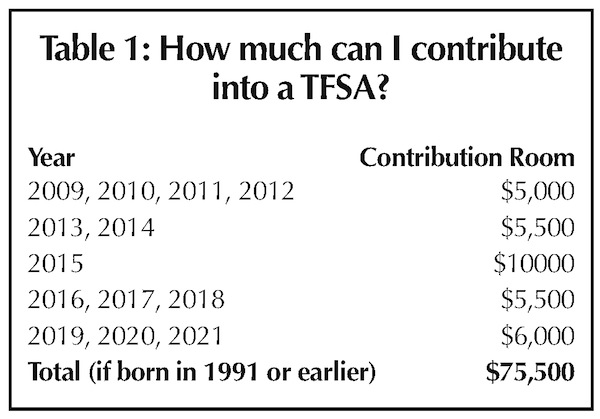
The allowable contribution room for a TFSA has changed over the years, and can be seen in Table 1.

TFSA has many important features:

  • to have one, you must be 18 years of age or older with a valid social insurance number,
  • there is a tax-free accumulation of income and gains,
  • you have tax-free withdrawals – at any time, for any reason,
  • they have no impact on income-tested benefits such as child tax benefits and guaranteed income supplement,
  • you can invest in any RRSP-qualified investment, such as mutual funds, ETFs, stocks, GICs, etc.,
  • the interest on money borrowed to contribute is not tax-deductible,
  • no attribution rules apply – it’s good for income splitting between spouses and can be transferred to the surviving spouse’s TFSA if they are the designated beneficiary,
  • to avoid penalties, you must be careful to not over-contribute, and
  • you can recontribute amounts withdrawn in previous years, and there is a 1% penalty per month if recontributed in the same calendar year.

RRSP basics

The registered retirement savings plan program was introduced by the Canadian government in 1957 to help Canadians save for retirement. All income accumulates on a tax-deferred basis and contributions are deducted against your taxable income in that particular tax year. As of 2020, the RRSP deduction limit is 18% of your earned income, to a maximum of $27,230. You should always check this amount with your accountant and/or CRA.

The important features of an RRSP include the contribution period, which is from Jan. 1 to the 60th day of the following year, and that the maximum age to contribute is 71. There is no minimum age for contributing, but, starting in the year after the year you turn 71, you must start making specified annual withdrawals from your RRSP, which now becomes a registered retirement income fund (RRIF).

The Home Buyers’ Plan (HBP) allows you to withdraw from your RRSP to buy or build your first home. In this case, the money must be in the RRSP for 90 days before withdrawal is permitted, and you can withdraw up to $35,000. Regarding repayment of the withdrawal, participants must repay 1/15th per year (starting in year 2), with the total amount paid off in 15 years.

The Lifelong Learning Plan (LLP) allows you to withdraw funds from your RRSP to finance full-time training or education expenses for you or your spouse or common-law partner. You can participate in the LLP for yourself, while your spouse or common-law partner participates in the LLP for him or herself; you can both participate in the LLP for either of you; or you can participate in the LLP for each other. Withdrawals of up to $10,000 in a calendar year and up to total of $20,000 are permitted, and participants must repay 1/10th of the amount withdrawn per year, with the total amount paid off in 10 years.

Philip Levinson, CPA, CA, and Brent Davis are associates at ZLC Financial, a boutique financial services firm that has served the Vancouver community for more than 70 years. Each individual’s needs are unique and warrant a customized solution. Should you have any questions about the information in this article, visit zlc.net or call 604-688-7208.

***

Disclaimer: This information is not to be construed as investment, legal, taxation or account advice, nor as an offer to sell or the solicitation of an offer to buy any securities. It is designed only to educate and inform you of strategies and products currently available. The views expressed in this commentary are those of the authors alone and are not necessarily those of ZLC Financial or Monarch Wealth Corp. As each situation is different, please seek advice based on your specific circumstance.

Format ImagePosted on February 12, 2021February 11, 2021Author Philip Levinson & Brent DavisCategories Op-EdTags financial planning, investing, retirement, RRSP, savings, taxes, TFSA, ZLC

Tu b’Shevat when it’s -30°C

As I went through my undergraduate and graduate school years, I cobbled together several different part-time jobs. One of my favourites was teaching Jewish music at weekend religious schools. This time of year, Tu b’Shevat (aka the New Year of Trees), songs were part of the lesson plan. Often, the kids I taught were just learning Hebrew for the first time, so I taught in English, too. One of my all-time hits was “The Garden Song,” which started with “Inch by inch, row by row, I’m gonna make this garden grow. All it takes is a rake and a hoe and a piece of fertile ground.” My second chart-topper was “Inchworm, inchworm, measuring the marigolds, won’t you stop and try to see how beautiful they are?”

Now, as I write this, I feel transported to a warm, sunny day in my garden, which is good, because it was -30°C with the windchill when I walked my dog in Winnipeg this morning! It’s good to be in touch with both the long-term hopes and dreams of summer and the realities of where we are. Holding that paradox, of both frostbite weather and sunny heat at once, is a great metaphor for where many of us are these days.

As a dual U.S.-Canadian citizen, I’ve been in knots over the unrest “down south” and the U.S. presidential transition. As well, I’m worried about the pandemic and about how poorly vaccine roll out has gone so far in Manitoba, and in Canada overall. I’m both thrilled to hear that all my children’s grandparents have gotten their first vaccine shot in the States, and also so sad to know that our local “adopted” Manitoba grandparents, both over 80, have no idea when they’ll get theirs.

Many people who have been sick with COVID-19 have struggled with challenging effects afterwards, including significant mental health issues. The anxiety and mortality struggles are pretty serious concerns for many of us, even if we haven’t gotten sick. One way my household has succeeded in coping is in burrowing in at home – into learning, good books, art and other DIY projects, building Lego and cooking. Everyone here, from age 9 and up, has kept busy with work and learning. We try to keep positive things in mind as much as we can.

I’ve been thinking about all of this, as I’ve considered what my plans are for the next days, months and even the year. In early January, I celebrated a birthday and the one-year anniversary of starting to study Daf Yomi, a page of Talmud a day. I am proud of finding the time to do this, however brief and poor my attention span may be sometimes. While I struggled with finding good (quick) resources for study, I found an Instagram page, posted by a rabbi, which seemed to summarize each page of study.

Hurray! I thought, I can review this in a glance while I help my kids with remote school lessons. Of course, anything that is in my Instagram feed has to then be kid-safe. Imagine my surprise when my account dumped two Daf Yomi posts with very scary images at me. One showed a person with a plastic bag over her head, struggling to breathe. The other showed someone’s hands, coated and dripping with blood.

Normally, I would simply unfollow this kind of thing without comment. However, these posts about Talmud were written by a rabbi, so I messaged her. “Hey!” I said, “I am so pleased to be doing Daf Yomi. I followed your posts, but I have to unfollow. These images on Tractate Pesachim 57 & 59 are too graphic. I don’t want my kids to see them.”

I got a response that left me, well, reminded that rabbis are just people, and that some of them may miss the mark at times. It was a “sorry to offend” kind of message. She indicated that she was a visual learner, that these posts were meant for those over 18 and that, to her, these seemed essential as an artist/interpreter, and she was guessing others felt the same. While she congratulated me on taking on Talmud study, I was also “othered,” as she, an artist, felt that dedicated followers would prefer this gory imagery in their social media feed.

I was disappointed. Although I am way past age 18, I am choosing, over and over, to focus on what I can gain positively from the talmudic text, even during a hard time. The talmudic rabbis, in parsing what had happened in Temple sacrifice, were trying to understand ritual events that had occurred a long time before. It was a disruptive period in history. Things weren’t stable. In fact, they weren’t actually doing sacrifices or actively harming people who didn’t observe properly. They were ironing out Jewish law for centuries to come, by confronting the past and figuring out the future through discussion, debate and study.

They did this by examining one small thing at a time. Much like the “Inchworm” song, Jewish rabbinic tradition teaches us to examine what is in front of us and to find solutions to challenges. I am distraught when I have to “hold” overwhelming images of rioting in the U.S. Capitol, the pandemic illness and deaths, and even a gory Instagram feed in my mind. Instead, I’m choosing a different path. It’s one that focuses on the next kids’ snack and meal, the next dog walk, and the next time I pick up the warm handknit mitts from the radiator as I face a cold morning outside. Inch by inch, row by row, we will get to sunny days in the garden ahead.

Sometimes, we do best when we embrace the ritual of “one thing at a time.” It’s one wintertime walk and, even, to knit each stitch as it presents itself on the needle to make more mittens. We’ve got a lot on our plate these days. Even so, we must eat only one bite at a time. It’s a metaphor and a paradox that the talmudic rabbis knew well. It might be a cliché but, for us, it also works.

Joanne Seiff has written regularly for CBC Manitoba and various Jewish publications. She is the author of three books, including From the Outside In: Jewish Post Columns 2015-2016, a collection of essays available for digital download or as a paperback from Amazon. Check her out on Instagram @yrnspinner or at joanneseiff.blogspot.com.

Posted on January 29, 2021January 27, 2021Author Joanne SeiffCategories Op-EdTags coronavirus, COVID-19, daf yomi, education, Instagram, Judaism, lifestyle, parenting, ritual, social media, Tu b’Shevat

Critical to take a stand against hate

Since time immemorial, no matter what calamity occurred in the world, if there was a problem plaguing humanity, Jews were used as the convenient scapegoat.

Earlier this year, as the coronavirus pandemic spread across Europe and then throughout North America, conspiracy theorists claimed that Israel and Jews around the world were secretly involved in spreading and even engineering the deadly disease. While these conspiracies are baseless and seem almost comical at first glance, thanks to the power and ubiquity of social media, even the most bizarre falsehoods can find fertile ground and poison the minds of millions of people almost instantaneously.

Unfortunately, the pandemic continues to rage across Canada and the world and, though the claim that Jews are behind COVID-19 remains utterly fictional, that hasn’t stopped a dangerous new crop of antisemites from spreading their toxic bigotry.

Not only is Canada not immune to the age-old virus of antisemitism, but British Columbia has also been infected. As was reported in the Georgia Straight, an anti-mask activist in Vancouver, Marco Pietro, who organized and participated in a number of rallies protesting coronavirus restrictions and policies, released a Holocaust denial video on social media. The two-minute-long video features Pietro saying that the Holocaust is a myth perpetrated by fake survivors to scam money out of the wider, unsuspecting public. He also claimed that Mein Kampf – Adolf Hitler’s antisemitic manifesto – didn’t contain any objectionable material, and that the coronavirus pandemic is a plot used by Jews in a quest for control. Pietro also said that concentration-camp survivors are liars and accused “a bunch of Zionist Jews” of “setting up” Hitler.

Meanwhile, on Nov. 15, a speaker at an anti-mask rally in Vancouver condemned “satanic, talmudic” people. The Canadian Anti-Hate Network (CAHN) reported that the No More Lockdowns group (which now goes by the name “Human Rights Movement”) produced an event in Vancouver organized by antisemitic conspiracy theorist Raoul Taylor van Haastert, who has decried the “Zionist media” and stated “our WWII history is a lie.” CAHN’s report cited Vancouver neo-Nazi Brian Ruhe, who, in an antisemitic post that went viral, shared his beliefs about “Rothschild-Zionist-communist control” that is being covered up, claiming that Jews control the media.

Let there be no doubt, there’s no evidence whatsoever that the Jewish people or the state of Israel are behind the coronavirus pandemic or any of these other odious libels. Conversely, the evidence supporting the Holocaust’s veracity is so overwhelming and indisputable that, to deny its occurrence, far from being a legitimate disagreement on historical facts, is rather merely an attempt to deny the Jewish people’s collective suffering at the hand of the Nazis to further an antisemitic agenda.

Most British Columbians would rightly brush off Pietro’s and Ruhe’s words as illogical rants of mad men, but, tragically, as bothersome and as offensive as their statements are, antisemitic acts are at or near all-time highs across Canada, including in British Columbia.

Earlier this year, B’nai Brith Canada’s annual audit of antisemitism logged more than 200 such incidents in British Columbia alone, ranging from harassment to vandalism. In one such incident, for example, Camp Miriam, on Gabriola Island, was vandalized with graffiti, including a swastika and other images. The image and symbol that represented the Nazi regime that murdered six million Jews in Europe less than 100 years ago is today being used to attack young Jewish summer campers. One can only imagine the long-lasting psychological damage inflicted on young people as a result of such an incident – and multiply that by more than 200 incidents last year alone.

Such antisemitic conspiracy theories, as espoused by Pietro, Ruhe and others must be forcefully repudiated and condemned by all. Thanks to social media, even the most bizarre lie can have a worldwide impact, and that’s why it’s so critical to take a public stand against antisemitic hate and propaganda. As history has taught, while antisemitic words are bad enough, the paramount concern is that they can often morph into violence. Enough is enough.

Mike Fegelman is the executive director of HonestReporting Canada (honestreporting.ca), a nonprofit organization working to ensure fair and accurate Canadian media coverage of Israel.

Posted on January 15, 2021January 13, 2021Author Mike FegelmanCategories Op-EdTags antisemitism, Brian Ruhe, B’nai Brith Canada, CAHN, Canadian Anti-Hate Network, coronavirus, COVID-19, democracy, education, history, HonestReporting, Marco Pietro, neo-Nazi

I owe a Dutch family my life

The following article was published in the Globe & Mail, as “A Dutch family hid me from the Nazis: I owe them my life,” in advance of Remembrance Day, Nov. 11, 2020. It is reprinted here with permission, in recognition of International Holocaust Remembrance Day, Jan. 27.

I can never pass Remembrance Day without reflection. This year, we marked the 75th anniversary of the liberation of the Netherlands. It meant freedom for Dutch men, women and children after a brutal five-year occupation by German military forces. More than 5,000 Canadian soldiers rest in Dutch soil and are mourned and remembered there annually. They were our liberators and will never be forgotten, for Canadians and Canada are seared into the collective memory of the population. I myself saw Canadian tanks chasing German half-tracks down the streets of The Hague. On May 4, 1945, I was looking out the window of my mother’s small apartment, where she had been hiding. A man across the street opened his door one day too early. He was shot by a retreating German soldier. I was dragged away from the window. I was not yet 5 years old.

Unlike most Dutch children who began their lives anew after the war, I was a Jewish child hidden with Albert and Violette Munnik and their daughter, Nora, from November 1942 to May 1945. I became Robbie Munnik and was returned to my parents, who had miraculously survived, the only survivors of their families of origin. My grandparents, aunts, uncles and numerous cousins had all been murdered. For Jews, the postwar world offered precious little solace or hope: it was a world of death and of mourning. Liberation did not feel particularly liberating. Within that depressing atmosphere, I made the transition from Robbie Munnik back to Robbie Krell.

For this Remembrance Day 2020, I want to honour the memory of my Christian Vader, my second father.

When my mother passed me on to Moeder (Mother), who agreed to take me for a few weeks while she secured a hiding place, Vader accepted me without hesitation. Did he know of the risk to his family, hiding a Jewish child? If not in 1942, certainly he did by 1943. But, unlike many in this situation, he did not dwell on possible consequences. He simply set about loving me.

Early in my hiding, they allowed Nora to take me out, but that was a mistake. A woman recognized me. She happened to know my mother and asked Nora why she was looking after me. Vader contacted her immediately to ensure she remained silent. From then on, I was housebound. He read to me and made toys for me. His brothers and a sister all kept the secret of my presence. One slip could lead to betrayal. I was beyond lucky. Vader worked hard, loved deeply and enjoyed his hobbies, which included playing the piano by ear and carving wood and shaping metal. He was talented.

The danger increased. Only after the war would we learn that more than 80% of Dutch Jews were deported and murdered, primarily in Auschwitz and Sobibor. Of 108,000 souls sent to the death camps, only about 5,000 returned. And of about 14,000 children in hiding, more than half were betrayed, as was Anne Frank and her family in Amsterdam.

Because of his modest nature, Vader stands in danger of being forgotten. Of course, not by me. Unlike so many, including princes and popes, presidents and prime ministers, industrialists and intellectuals, he defied the Nazis and accepted the risk of my presence. So, while the names of the Nazis that murdered us linger on, as do the names of leaders who either did not lift a finger, or worse, actively prevented Jews from reaching safe havens, he might have been forgotten. So, I choose to remember him. In the hour of need, he included me in his life then and thereafter. His only reward was that I called him “Vader” and that he had, in addition to his daughter, a son.

In 1965, he and Moeder were brought to Vancouver by my parents to attend my graduation from medical school. My fellow graduates were drawn to him especially. He spoke no English, but the twinkle in his eyes spoke volumes. He was a people magnet. When they returned for my wedding in 1971, he fell ill shortly after and was briefly hospitalized at St. Vincent’s in Vancouver. There, he enchanted the nurses. When I came to visit, everyone on staff already knew him. They flocked to him. He radiated good humour and optimism. He did not know from anger, fear or bitterness. He hoped that I would not be consumed with anger over the Holocaust of my people, and that I would not turn away from Judaism or from Israel. And then, in 1972, he died. I do not know what he would have thought about the resurgence of antisemitism, the BDS movement and the antipathy toward Israel. But I can guess. And so can you.

But Vader will be remembered because Albert, Violette and Nora Munnik have been inscribed among “the Righteous” at Yad Vashem, the official site of Holocaust remembrance in Jerusalem. A tree planted as a seedling in 1981 grows at the site of the plaque bearing their names. And, in Vancouver, at Vancouver Talmud Torah Jewish day school, a sanctuary has been named in their memory and the entire story of their heroism lines the walls.

So, this year my memory is not consumed by what took place in Auschwitz and Sobibor, where so many of my family perished; this year, I will concentrate on remembering Albert Munnik, my Christian Vader, on Remembrance Day, and the Canadian troops that freed us.

Dr. Robert Krell is professor emeritus, department of psychiatry, University of British Columbia, distinguished life fellow of the American Psychiatric Association and founding president of the Vancouver Holocaust Education Centre.

Posted on January 15, 2021January 13, 2021Author Robert KrellCategories Op-EdTags Albert Munnik, gratitude, Holocaust, IHRD, International Holocaust Remembrance Day, memoir, Remembrance Day, Righteous Among the Nations

Kindness a blessing to share

I was crying in front of the computer screen during a funeral service livestream. Again. It wasn’t my first of this pandemic. Even if the person didn’t ostensibly die of COVID, he’d been ill alone, unable to see family for long stretches because of it. And, because of COVID, I couldn’t be at the funerals in person, which were all in the United States. In normal times, I’d be rushing across the continent to be at these services with my family.

The person being eulogized, Rabbi Laszlo Berkowits, was a family friend, and was close to my parents. I called him “uncle” as a kid. He and his family were always part of our family’s holiday celebrations and gatherings. I played with his kids at his house. Their phone number was my elementary school’s emergency contact for me.

Rabbi Berkowits (Uncle Larry) was my family’s rabbi. He was also a Holocaust survivor. For a person who spent his teenage years in concentration camps, including Auschwitz, my Uncle Larry’s positivity, joy and ability to find the good in others were amazing. He had an incredible, long career, supporting and inspiring others to make positive change.

At the funeral, his family and friends (including my pediatrician) talked about how my Uncle Larry felt so grateful for the kindness of others, including the kindness of strangers. Without that help, he wouldn’t have survived the Second World War. Without the assistance and loving kindness of strangers – in Sweden, the United States and beyond – he wouldn’t have regained his health, gone on to serve in the U.S. military or received a full scholarship to become a rabbi. He wouldn’t have had the opportunities that truly enabled him to make such a difference in so many others’ lives.

This pandemic makes me think about how important that effort, to be kind and to reach out to one another, is for all of us right now. A year ago, the CBC Manitoba webpage ran a piece I wrote, “Mom’s emergency granola bar is there when you need it – no matter who you are.”

The article was about how I try to carry around snacks (granola bars) for my kids, just in case they need one, but that, sometimes, the best option for me is to offer that extra snack to someone else on the street, who is hungry, instead.

The thing is, since the pandemic started, like many Manitobans, we haven’t been out and about nearly as often. I don’t carry around snacks now because my kids are remote schooling. We’re working and learning at home, trying, like most of us, to reduce the number of people who might get sick or die from COVID. On a daily basis, I am not physically handing out those granola bars to anybody other than my kids.

A week ago, I got the most amazing email from a single mom friend who is a grocery store cashier in a city more than 200 kilometres away. She works very hard to keep her family afloat. She’d been waiting until her break to write me: “A man came through with 25 boxes of granola bars. No judgment – they were on sale! Then, he tells me he read an article about someone and their child or children who handed a person a granola bar and it stuck with him. So, now he has granola bars in his car and always hands them out to panhandlers and people who need them when he can.”

I could imagine her hearing this at the grocery store, her jaw dropping in surprise. She told the man that we were good friends and that she would tell me about this. The man said to pass along that, she wrote, “he has been doing this since the week he read your article and to thank you! Simple acts of kindness are what is keeping him going these days.”

When I read her email, I cried. It had been “one of those pandemic days” – where the news, the work and learning struggles at home, had all felt so hard. We’re all tired of worrying, so concerned about our loved ones. In fact, I’d been feeling badly that I couldn’t do more for others, write more, donate more, while juggling things on the stay-at-home front.

Another email from my friend arrived. She’d mentioned this man’s purchase to one of the grocery store owners. He’d said, if she sees this man again, the store would give him a discount on these purchases. Then he printed out the story to pass along, too.

I felt so grateful to this anonymous stranger who was carrying around all these granola bars to feed others, and continuing this kindness when I couldn’t. I wanted to thank him, but I also respect just how many anonymous givers might be out there. It takes all of us to beat this pandemic. Next year, I hope to host my amazing essential worker friend and her kids for a big celebratory Chanukah dinner again.

I’m so heartened to hear that the kindness my Uncle Larry encouraged in others is continuing to be passed along. I carry with me his constant reminders to be an upstanding person who does the right thing, who helps others, shines a light for others, even if he himself isn’t here anymore.

My Uncle Larry would say, “Be the best. Be a blessing.” He’d add something like, “We never know how long we’ll be here on earth. It’s our job to do good for others whenever we can – right now.”

At his funeral, another longtime family friend, Sam Simon, spoke, reminding us: “Be that stranger whose kindness is a blessing to someone so that they, too, can become a blessing to the world.” I am sure the biggest blessing of all would be if more people took that to heart.

Joanne Seiff has written regularly for CBC Manitoba and various Jewish publications. She is the author of three books, including From the Outside In: Jewish Post Columns 2015-2016, a collection of essays available for digital download or as a paperback from Amazon. Check her out on Instagram @yrnspinner or at joanneseiff.blogspot.com.

Posted on January 15, 2021January 13, 2021Author Joanne SeiffCategories Op-EdTags CBC, coronavirus, COVID-19, death, funeral, granola bars, gratitude, kindness, Laszlo Berkowits, lifestyle, tikkun olam

We Jews are a people of destiny

It was heartbreaking to read Rabbi Denise Handlarski’s op-ed titled “Harris-Emhoff’s significance.” [Jewish Independent, Nov. 27] Heartbreaking, yes. Shocking, unfortunately, not at all. Almost every single Jewish family, including my own, has a relative or close friend who has intermarried or has seriously contemplated intermarriage were the opportunity to present itself. A 2017 Jewish People Policy Institute study shows that, in the United States, 60% of non-Orthodox Jews, aged 40-44, are intermarried. In the 35-39 age bracket, 73% are intermarried; the percentage rises to 75% when dealing with those between 30 and 34. We are clearly witnessing a dramatic upward trend.

Rabbi Handlarski, ordained by the International Institute for Secular Humanistic Judaism, an institution that focuses on living a life with a cultural Jewish identity through a “non-theistic philosophy of life,” expresses her excitement over this popular trend and its prevalence among families of our global leaders. She writes, “Jewish communities have spent the past several decades trying to stop intermarriage. These efforts have failed…. It’s time we embrace our pluralistic and diverse families….”

It is true: we have failed. We have failed as a people to teach about the centrality of Judaism in our lives, the impact we, as a small nation, have made upon the entire world, the destiny of our future and the need to secure our traditions, beliefs and values within our families.

However, as a believer in God and the mission that we, the Jewish People, were charged with more than 3,000 years ago, the embracement of a non-Jewish spouse is: 1) an option that is simply not on the table and 2) even if it were on the table, the acceptance of such marriages is a recipe for failure for anyone with an interest to preserve Judaism.

Why is intermarriage off the table?

There is a well-known atheist, European author and philosopher Alain De Betton, who speaks about Atheism 2.0, a version of atheism that also incorporates our human need for connection, ritual and transcendence. He believes that religion adds a great deal to the world, but he just doesn’t believe in God.

De Betton articulates a defence of the halachic system that is both true and profound. He states: “The starting point of religion is that we are children and we need guidance. The secular world often gets offended by this. It assumes that all adults are mature – and, therefore, it hates didacticism, it hates the idea of moral instruction. But, of course, we are children, big children who need guidance and reminders of how to live. And yet the modern education system denies this. It treats us all as far too rational, reasonable, in control. We are far more desperate than secular modernity recognizes. All of us are on the edge of panic and terror, pretty much all the time – and religions recognize this.”

I once heard an insightful comment from a rabbinic teacher of mine: the word “mitzvah” has two very different connotations – a good deed and an obligation. For an action to be a good deed, it just needs to embed an inherent goodness. To fulfil a commandment means that there is a Commander. As soon as I acknowledge that I am doing a mitzvah, I am metzuvah – I am commanded and there is a Commander. Therefore, God’s word comes before mine.

Even if my rationale leads me to the conclusion that intermarriage expresses the positive values of acceptance and diversity, God has already decided that other values, perhaps unbeknownst to humankind, outweigh it. Maimonides, the 12th-century leading philosopher and codifier of Jewish law, writes in his code of law: “There is a biblical prohibition when a Jew engages in relations with a woman from other nations, [taking her] as his wife or a Jewess engages in relations with a non-Jew as his wife. As [Deuteronomy 7:3] states: ‘You shall not intermarry with them. Do not give your daughter to his son, and do not take his daughter for your son.’”

In truth, the conversation should stop here; it is a law from God and there is nothing more to discuss.

Why is intermarriage destined to fail?

However, not all of us find the word of God a compelling argument, or believe in His existence to begin with. To that group, the statistics should speak for themselves.

Rabbi Handlarski admits that there are very real grounds to fear assimilation, but, she argues, Jewish pride and identity can and does exist within many intermarried families. However, a 2013 Pew Research study showed that more than one in five Americans identify themselves as without a religion, more than two-thirds do not have any affiliation with any synagogue, and more than a third believe that Jesus being the Messiah is compatible with Judaism. The average Jew in North America knows who Jesus and his mother were, but they cannot name our forefathers, foremothers and who was married to whom. The average Jew knows more about Christmas carols than they do about Jewish liturgy.

Doron Kornbluth, author of Why Marry Jewish, writes that even among intermarried families who raise their children as “Jews only,” a mere 11% of those children would be very upset if their own kids did not view themselves as Jewish. The fears of assimilation are very real indeed, and there is an undeniable and direct causal link between intermarriage and assimilation.

Former British chief rabbi Lord Jonathan Sacks, of blessed memory, in his book The Dignity of Difference, writes that the prohibition to intermarry is not racist or intolerant; just the opposite! Without diminishing our love and concern for any fellow Jew, irrespective of her choices, Rabbi Sacks explains that, in our day, global cultural homogenization threatens to

destroy all minority groups and their culture. When we have a bit of everything, we represent nothing. This global phenomenon impacts many minority cultures and limits their impact on the broader world. In order for the Jewish people to continue to spread their values and be a light onto the nations, we must secure and safeguard our tradition from the threat of homogenization. We must first ignite a light before it can shine on others. To choose “romantic” love over faith is to set the trajectory for all future descendants towards a path of Jewish annihilation.

Finally, a few years ago, a guest rabbi lecturer was speaking here in Vancouver. He told the following story. A few years back, he was speaking to university-aged students and, a few minutes into the talk, a young woman raised her hand and said: “Rabbi, we are in attendance today for you to

answer just one question: Why should we marry Jewish?” He responded, “The question is not, Why marry Jewish? The question is, Why isn’t Judaism the central and integral part of your life such that ‘Why marry Jewish?’ is not even entertained as a question?”

The real question we must ask ourselves is, What does it mean to be a Jew? Are we culturally Jewish? Are we socially Jewish? Is our Judaism the same thing as Zionism? History has proven that none of these defines Judaism. Judaism has existed for thousands of years, and the state of Israel is but 70 years old. A Jew from Eastern Europe lived a drastically different cultural life from the Iranian Jew. Judaism is a charge that we were given at Mount Sinai to live a life in service of God, to better the world, and to pass the commandments and values down from generation to generation. It is a heavy responsibility, but history has proven that we can persevere with great pride and fulfilment.

Today, Dec. 18, is the last day of Chanukah. Ironically, if we saw any beauty in intermarriage as Rabbi Handlarski views it, then there would be no holiday, no celebration. The essence of Chanukah is about strong-willed Jews and their ability to withstand the pressure of Greek culture and to retain their identity. “Maoz Tzur,” the song that we sing when lighting the menorah, is all about the survival of the Jew throughout the centuries and our ability to maintain not just some of our values and traditions, but all of them. The solution is not to accept defeat. The solution is to become more aware of our history, understand what it means to be a Jew – today and every day – and live towards a viable future.

Rabbi Ari Federgrun is associate rabbi at Congregation Schara Tzedeck.

Posted on December 18, 2020December 16, 2020Author Rabbi Ari FedergrunCategories Op-EdTags assimilation, Denise Handlarski, intermarriage, Judaism, lifestyle

That glitter gets everywhere

I’ve been thinking about Caillou, a TV show for toddlers and preschoolers. It’s been on television since 1997. Caillou is a little bald French-Canadian kid. He’s broadcast in both French and English, and offers gentle lessons to kids everywhere. My twins watched a lot of Caillou.

The episode I’ve been remembering offers something basic that we should all know. The summary: Caillou’s doing art at preschool with glitter. When he finishes, he doesn’t clean up or wash his hands. The rest of the episode shows off exactly where the glitter ends up, from light switches to friends’ bodies to snack and the table and chairs. That’s why it’s so important to wash your hands after playing with glitter.

The glitter message sticks with kids. It’s also a remarkably easy way to explain germ theory – useful during a pandemic. Glitter, like germs, gets everywhere.

As an early glitter fan, I found this lesson powerful. As a kid, I had several surgeries for birth defects by the time I was 5. I was in the hospital a lot. During one recovery period, I was brought to a big sunny room in the pediatrics ward to do arts and crafts, including glitter, which I loved. My mother still jokes about this more than 40 years later – remembering the day the surgeon came to check my incisions. My mom likely hovered, anxious, as he checked my abdomen and sides. He looked up and grinned when she asked how things were healing. He said things were coming along nicely and were “very colourful!”

What does this have to do with Judaism? I’ve been studying Tractate Pesachim as part of my pursuit of Daf Yomi (a page of Talmud a day). Pesachim’s topic is Passover. In Pesachim 15, the issue is how to burn all the chametz (leavened bread) that we get rid of right before the holiday. It’s considered “impure.”

Impurity here is often defined as something “in the wrong place at the wrong time.” There are many reasons why something is considered impure. The questions the rabbis are weighing are interesting. They wonder, “Is it OK to burn two different kinds of impure things together?” They imagine the Temple priests having to get rid of all this and finish cleaning by the start of the holiday.

The other impure things brought up – and this rabbinic impurity topic is complex – are pigul and nottar, two categories of sacrificial meats that have gone wrong. Jane Shapiro, in introducing this issue on the My Jewish Learning website, explains that pigul is something sacrificed “with improper thought.” That is, something sacrificed in error; that is, the priest thought it was to be burnt or eaten at the wrong time. Nottar was an offering made at the right time and not eaten – basically, leftovers, which are then considered impure. There’s common sense in this. Sometimes we cook things incorrectly (pigul) or, lacking refrigeration, we might just have to get rid of leftovers (nottar) to avoid food poisoning. In these cases, the impurity’s a mess-up. It’s not an unclean animal, another source of impurity, but, rather, a human mistake that leads to the disposing of something.

As the rabbis sort through what can be burned together, they examine how one kind of impurity causes a first-degree impurity, which, if it touches something else, becomes a second or a third degree of impurity. Something in this discussion reminded me of glitter and, then, germ theory.

Even the most careful person can be surprised by a sneeze, or get too close to someone when they are supposed to be social distancing. In fact, keeping oneself safe from invisible germs, like the coronavirus, can be difficult. Even healthcare workers, swathed in protective equipment, can slip up. In a sense, this rabbinic concept of impurity is a lot like catching germs. If we accidently mix items or people inappropriately, we pass along impurity, or germs.

If we visualize germs like Caillou’s glitter or my preschooler hospital craft project, we better understand how tricky a time we’re in. We’re still facing a long haul.

Yes, we hear a vaccine is on its way, but we don’t yet know how long it will take for enough Canadians to be vaccinated. We don’t know how effective the vaccine will be, or if enough people will be willing to take it. Meanwhile, COVID-19 is spreading just like that glitter. It’s everywhere that we are, and it’s scary. There’s every chance that we might encounter the virus through an inadvertent slip up (like the rabbinic impurity of pigul or nottar) but, since it’s germs and not glitter, we won’t know until later. We must act as if we are impure because the virus isn’t visible.

The most poignant part of this whole complicated impurity narrative is that the rabbis just can’t figure it all out. They say more than once that we’ll just have to wait for the prophet Elijah to return to give us the right answers. Reading it, you can imagine their shoulders shrugging as they struggle with what they don’t know and can’t figure out.

Scientists and doctors everywhere are also figuring things out as they go. They have to learn to live with the mystery. We don’t know everything – about the pandemic, how it works, when it will end and about those germs that spread like glitter.

For most, 2020 has been a rocky year. As we turn towards the secular year 2021, it’s important to remember that a vaccine might not be an instant fix. We face the future much as the rabbis faced some of these difficult questions about impurity long ago, and the researchers do today. We don’t know all the answers. We must do our best, square our shoulders, and keep on keeping on.

Yet, every week, as we end Shabbat, we sing about Eliyahu (Elijah) and we welcome him to every Passover and every bris. It’s in yearning for Elijah that we find the faith to keep trying.

Wishing you a happy and healthy 2021! I hope your home celebrations are great – and without glitter!

Joanne Seiff has written regularly for CBC Manitoba and various Jewish publications. She is the author of three books, including From the Outside In: Jewish Post Columns 2015-2016, a collection of essays available for digital download or as a paperback from Amazon. Check her out on Instagram @yrnspinner or at joanneseiff.blogspot.com.

Posted on December 18, 2020December 16, 2020Author Joanne SeiffCategories Op-EdTags arts, Caillou, coronavirus, COVID-19, germs, glitter, health, Judaism, lifestyle

Sabbath of life

I am one of the fortunates who has achieved the treasured time of contemplation, a time to appreciate in the profoundest way some inkling of what it has meant to be alive. I am not unique; I do not claim that. There are many around us who share, and have shared, this gift. Usually, it comes to those who have added years to their time on earth.

We have survived the birthing process in the wider sense. We have learned what it takes to live among our fellows. We have found a trade to gain the resources to provide for our creature comforts. We have succeeded in making connections with others to ensure our emotional needs are met. Hopefully, we have made a contribution to others. These things are in our past although we may carry them on for our own pleasure. They seem to be necessary elements in arriving at a time of peace within ourselves.

No matter what your religious persuasion is, or if you are agnostic or an atheist, there is room for this idea within your consciousness. We can survive “the slings and arrows of outrageous fortune,” as Shakespeare wrote in Hamlet, to arrive at this state and spend some of our time contemplating the mysteries of life. Behind us are so many things we would do differently if only we could. Behind us are the many times of terror, threatening unknowns regarding our plans and projects. Behind us are our brushes with an untimely death for which we were not ready.

If we have been incredibly lucky, we may be leaving behind some material evidence of our passage – a child, a service, some indelible scratch in the wall of time, whether remembered by others or not. Some of us may still have a file folder full of plans, a list of to-do items on our agenda. Godspeed to you! But, if you recognize that this is your Sabbath time, you are now more than willing to pass the baton to others. You are now more than willing to accept that there will always be more things to be done. And you are ready to contemplate that others will be found to carry out and complete those tasks. You are ready to sit back for awhile in the sun, enjoy the beauties of nature, the bounties of nature, the beauty of your children and your children’s children. Or the beauty of other people’s accomplishments, the beauty of other people’s children!

Much remains to be fixed in the world and some of it hurts dreadfully to contemplate. It is not surprising that we sometimes feel overwhelmed. But there are blessings we can count on our fingers. There are things you can point to that you have been responsible for, some positives that you can take credit for. You can take a deep breath and hug yourself. You did good! Real good! You deserve to celebrate the Sabbath, a rest day for your soul.

Max Roytenberg is a Vancouver-based poet, writer and blogger. His book Hero in My Own Eyes: Tripping a Life Fantastic is available from Amazon and other online booksellers.

Posted on December 18, 2020December 16, 2020Author Max RoytenbergCategories Op-EdTags aging, Judaism, lifestyle, philosophy

Views on various occupations

COVID-19 changed a lot of people’s perceptions as to what types of jobs are essential. Not only doctors, nurses and other healthcare workers are on the front lines, but so are retail clerks, maintenance workers, truck drivers and many others. In this context, it is interesting to think about what occupations, if any, have been promoted or praised in Judaism.

As it turns out, Jewish scholars gave work considerable attention. Talmudic sages advocated for working rather than living off charity. Indeed, this principle provides some food for thought for modern-day Israel, where many ultra-Orthodox do live off charity. According to a January 2020 report by Dr. Lee Cahaner and Dr. Gilad Malach for the Israel Democratic Institute, between the years 2003 and 2018, about 50% of ultra-Orthodox men aged 25-64 and 76% of women in the same age bracket worked.

Scholars had a great deal of respect for labour. The Talmud abhorred idleness and argues that it leads to mental illness and sexual immorality. (See Babylonian Talmud, Tractate Ketubot 59b, at jlaw.com/articles/idealoccupa.html.)

“Rabban Gamliel the son of Rabbi Judah HaNasi would say: Beautiful is the study of Torah with the way of the world, for the toil of them both causes sin to be forgotten. Ultimately, all Torah study that is not accompanied with work is destined to cease and to cause sin.” (Pirkei Avot, Ethics of the Fathers, 2:2). Midrash Rabbah Bereshit (Vayetze chapter) goes even further, saying that practising a craft saved lives.

Yet, the sages believed that being absorbed with making money is not the ideal for an individual. Again referring to the Pirkei Avot (4:10), Rabbi Meir asserted: “Rather limit your business activities and occupy yourself with the Torah instead.”

Historically, teachers were valued – but only to a point. The high priest Joshua ben Gamla (circa the first century CE) issued an opinion that “teachers had to be appointed in each district and every city and that boys of the age of six or seven should be sent.” Where the boy had a father, it was the father’s responsibility to make sure his son had a basic education. Significantly, between the third and the fifth century CE, providing the salary of the Torah and Mishnah teacher became a communal task. Even those without children contributed to the teacher’s wages.

But teachers were not fully trusted. The Mishnah of Tractate Kiddushin 82a teaches that a single man or single woman should not become a teacher. The Gemara explains that the rabbis worried that such a teacher might have an affair with a parent of one of the students.

On torahinmotion.org, Rabbi Jay Kelman contends that the Gemara initially suggests that the Mishnah is afraid that an unmarried teacher might molest his students, but then rejects this explanation, noting that molestation is not something we need to suspect happening. Kelman, however, says, “this is something which no longer can be said with any degree of certainty. What we can say with certainty is such a fear is warranted even with those who are married and that, while rare, when it occurs, the results are devastating and tragic.”

While on the subject of sexual misconduct in certain occupations, here is an idea that might resonate with the #MeToo movement: the Talmud lists certain precarious trades that require men to often be alone with women. For example, a male goldsmith who makes jewelry for women. Talmud scholars were uneasy that such a businessman would be tempted to sin.

Curiously, harsh words were said about doctors. Tractate Kiddushin 82a ends with this statement by Rabbi Yehudah: “The best of physicians deserves Gehenna.” Why do they deserve a damned place? An article on talmudology.com contends that the opinion was based either on the belief that doctors were haughty before G-d or the fact that their treatment sometimes killed the patient.

Even though Israeli citizens highly value their army, Shalom Sabar points out in a Forward video that, in Medieval Haggadot, the “bad son” was portrayed as a soldier. This was because, at the time, non-Jewish soldiers would come to kill Jews.

Sailors, on the other hand, “are mostly pious … with many a ship sinking, sailors were in constant fear causing most to be super honest in the hope that G-d would protect them.” As Kelman summarizes, there really are no atheists in the foxhole.

On myjewishlearning.com, Rabbi Jill Jacobs states that, since Mishnah Zeraim (Seeds) deals solely with agricultural issues, we have proof that Judaism emerged from an agriculturally based community. Yet, in the Torah, farmers get off to a really bad start. Early in Genesis, we learn that Cain was the first farmer. Notwithstanding, G-d refused to accept his offering, accepting only his brother Abel’s. Cain couldn’t accept this rejection. In a jealous rage, Cain killed his brother and hid what he had done. G-d, consequently, reduced Cain to a life of wandering.

At a time when, around the globe, people are learning more about the extreme misconduct of some police officers, it is worth looking further into the Torah to see what Deuteronomy 16:18 and later commentators wrote about the police. Deuteronomy points out that both judges and police should be appointed to govern the people with due justice. Drawing on various Jewish sources, Rabbi Jacobs divides the function of the Deuteronomy-based police into several specific, but integrated parts: the patroling police person who “reminds the public to obey the law”; the roving inspector who ensures fair pricing and compliance with local ordinances; the arresting police officer who, while assuming the person is innocent until judged guilty, nevertheless begins the judgment process by arresting the suspect; the bill collector police officer who extracts payment from the obligated party to give to the aggrieved party; and the police officer who is a leader in his/her community. From Jacob’s assessment on truah.org, it would appear that today’s police have what to improve, especially when it comes to trust-building measures.

Over the centuries, Jewish scholars have taken into account the fallibility of people engaged in certain occupations. With tremendous insight into human behaviour, our sages apparently realized progress is not always in a forward direction. We have a long way to go in (re)establishing the integrity that Jewish scholars outlined for certain professions.

Deborah Rubin Fields is an Israel-based features writer. She is also the author of Take a Peek Inside: A Child’s Guide to Radiology Exams, published in English, Hebrew and Arabic.

***

The abstract of the article “Jewish Occupational Selection: Education, Restrictions or Minorities?” (The Journal of Economic History 65, no. 4 [2005]), Maristella Botticini and Zvi Eckstein reads: “Before the eighth-ninth centuries CE, most Jews, like the rest of the population, were farmers. With the establishment of the Muslim Empire, almost all Jews entered urban occupations

despite no restrictions prohibiting them from remaining in agriculture. This occupational selection remained their distinctive mark thereafter. Our thesis is that this transition away from agriculture into crafts and trade was the outcome of their widespread literacy, prompted by a religious and educational reform in Judaism in the first and second centuries CE, which gave them a comparative advantage in urban, skilled occupations.”

The full article is available at jstor.org.

– DRF

Posted on December 18, 2020December 16, 2020Author Deborah Rubin FieldsCategories Op-EdTags COVID-19, education, history, jobs, Judaism, minorities, Mishnah, occupations, Talmud, work

Gift of doing nothing at all

Recently, one of my twins convinced me we needed to look at an online mindfulness app. It featured ocean beaches, a sunset, a waterfall, a forest, a rainstorm …. you get the picture. The notion was that one could stare at each image, take deep cleansing breaths and feel restored. Except, with the twins crowding my iPad screen, within moments we had hopped from one view to the next. The app kicked us out, as we had “seen” all its tranquil views. What was supposed to be meditative became a crazed, erratic two-minute virtual tour of all the outdoors, at once. Oops. That didn’t work out right.

There’s a lot of discussion online and in the media about how the pandemic has caused mental health issues because people are lonely, restless and bored, and many have a hard time with restrictions and lockdown. This may well be true for many people.

For those of us with kids, it feels more like a Ferris wheel/merry-go-round mash-up, where both rides have the music playing, it’s all set on a fast speed and there’s NO. WAY. TO. GET. OFF. We’re crazy busy staying home. We chose remote schooling for safety. This gives no breaks from parenting, and no way to get all the work done. My house is a mess. The housework and cooking? – seriously out of control.

My parents, living alone in Virginia, have an opposite experience. Due to their age and health, they, too, are staying home to stay safe, with lots of time, not enough socializing in person, feeling adrift without their usual travel plans and volunteer activities.

Our extended family is far away and cannot help us in Winnipeg. We can’t support them in person either, so we’ve had a long stretch of time, including holidays, on our own. Chanukah won’t be different. My parents are sending fun toys in the mail, ordered online, to keep the kids busy during the hours and hours ahead indoors this winter, which we will appreciate, whenever they arrive.

We’ve also been planning way in advance. When you celebrate Passover, Rosh Hashanah, Yom Kippur, Sukkot, etc., on your own as a nuclear family, it takes more thought to make it special. Giving ourselves time to prepare has meant we have had some amazing meals and meaningful home-based observances, without going farther than our back deck sukkah.

My husband and I prepared for Chanukah by worrying if we had enough candles or if we had to shop for them – were Chanukah candles considered essential by the Manitoba government? To our relief, unless the kids insist on lighting all the chanukiyot at once, we’re fine. We’ve got plenty left over from last year, no need to go out and buy more. This, and internet ordering for kids, has been the extent of our preparations.

My twins, however, started the Chanukah countdown much earlier than usual. On a quiet Sunday afternoon, I discovered they were making paper chains and complicated construction paper cut-outs of dreidels, jugs of oil, a menorah, and more. The cut-outs were carefully hung up on our living room’s French doors – approximately 17 days before the first candles would be lit. Anticipation makes a holiday special.

However, the gift I love the absolute best these days won’t come on Chanukah. It’s Shabbat, which happens every week. It’s an opportunity to just sit on the couch. We stream services and I cook ahead so there’s nothing to do on Saturday. We sometimes magically find take-out appearing on the table Saturday night, when the leftovers don’t seem appealing. We’re not shomer Shabbat, and I’ve been known to disappear for a cozy chair and some knitting or to spend time with my sewing machine to deepen my relaxation, but Jewish traditional practice was really onto something with Shabbat.

Since having twins – they are now 9 years old – I’ve had people ask what would help, if I could have absolutely anything. I’d say: going to a quiet place in the country, alone, with a big bed with clean white sheets, lots of good food prepared, and time to just sleep, eat, read and hang out by myself. In reality, I felt that leaving my household for any length of time might result in worse chaos when I returned. My husband is well-intended, but an absentminded professor. He often forgets to feed the kids snack or the dog dinner if I don’t remind him over and over.

However, Shabbat at our house has become that oasis, where I get the chance to just be. It’s not the sunset, waterfall, rainfall, forest walk, ocean waves vision that the mindfulness app thinks we need. Not at all. It’s nothing idyllic – or tidy – but it’s a time to step away from social media, the chores, the craziness, and just be. Nowadays, I don’t have to get everyone dressed up for Shabbat services. I can’t invite guests or stress about getting a fancy meal made. I have many fewer work deadlines. And while, yes, there are some negatives in that, there’s a whole lot of positives, too.

We’re facing so many things that aren’t like anything we’ve experienced before. The unexpected can be scary. It can also be an amazing opportunity to let go, embrace and learn something different. Shabbat has long been my favourite holiday, but it took a pandemic for me to settle even more fully into one day a week of rest.

Turns out I don’t need to gaze at a mindfulness app to unwind. I’ll stick with making a huge Shabbat dinner, sleeping (late!) until 8 a.m., and participating in services from the couch, surrounded by the kids’ Lego and Playmobil congregation.

This year might be a chance to discover new gifts within this very challenging experience. Mine might be the best thing I could imagine – doing nothing at all.

Joanne Seiff has written regularly for CBC Manitoba and various Jewish publications. She is the author of three books, including From the Outside In: Jewish Post Columns 2015-2016, a collection of essays available for digital download or as a paperback from Amazon. Check her out on Instagram @yrnspinner or at joanneseiff.blogspot.com.

Posted on December 4, 2020December 2, 2020Author Joanne SeiffCategories Op-EdTags Chanukah, coronavirus, COVID-19, family, gratitude, Judaism, kids, parenting, Shabbat

Posts pagination

Previous page Page 1 … Page 24 Page 25 Page 26 … Page 56 Next page
Proudly powered by WordPress