Skip to content
  • Home
  • Subscribe / donate
  • Events calendar
  • News
    • Local
    • National
    • Israel
    • World
    • עניין בחדשות
      A roundup of news in Canada and further afield, in Hebrew.
  • Opinion
    • From the JI
    • Op-Ed
  • Arts & Culture
    • Performing Arts
    • Music
    • Books
    • Visual Arts
    • TV & Film
  • Life
    • Celebrating the Holidays
    • Travel
    • The Daily Snooze
      Cartoons by Jacob Samuel
    • Mystery Photo
      Help the JI and JMABC fill in the gaps in our archives.
  • Community Links
    • Organizations, Etc.
    • Other News Sources & Blogs
    • Business Directory
  • FAQ
  • JI Chai Celebration
  • JI@88! video

Recent Posts

  • עשרים ואחת שנים להגעתי לונקובר
  • Eby touts government record
  • Keep lighting candles
  • Facing a complex situation
  • Unique interview show a hit
  • See Annie at Gateway
  • Explorations of light
  • Help with the legal aspects
  • Stories create impact
  • Different faiths gather
  • Advocating for girls’ rights
  • An oral song tradition
  • Genealogy tools and tips
  • Jew-hatred is centuries old
  • Aiding medical research
  • Connecting Jews to Judaism
  • Beacon of light in heart of city
  • Drag & Dreidel: A Queer Jewish Hanukkah Celebration
  • An emotional reunion
  • Post-tumble, lights still shine
  • Visit to cradle of Ashkenaz
  • Unique, memorable travels
  • Family memoir a work of art
  • A little holiday romance
  • The Maccabees, old and new
  • My Hanukkah miracle
  • After the rededication … a Hanukkah cartoon
  • Improving the holiday table
  • Vive la différence!
  • Fresh, healthy comfort foods
  • From the archives … Hanukkah
  • תגובתי לכתבה על ישראלים שרצו להגר לקנדה ולא קיבלו אותם עם שטיח אדום
  • Lessons in Mamdani’s win
  • West Van Story at the York
  • Words hold much power
  • Plenty of hopefulness

Archives

Follow @JewishIndie
image - The CJN - Visit Us Banner - 300x600 - 101625

Category: News

Krieger takes on new roles

Krieger takes on new roles

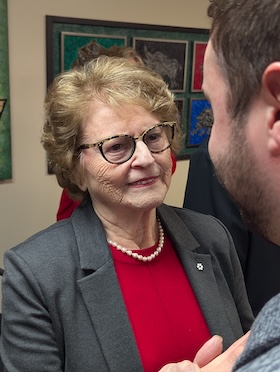
Nina Krieger, centre, member of the BC Legislative Assembly for Victoria-Swan Lake, connects with community members. Krieger is the new public safety minister and solicitor general. (photo from Nina Krieger)

After a cabinet shuffle last week, Nina Krieger, member of the legislative assembly for Victoria-Swan Lake, is the new public safety minister and solicitor general, replacing Garry Begg, who became parliamentary secretary for Surrey infrastructure. 

Saying she is “humbled and excited” to take on the position, Krieger told the Independent: “Our province faces complex challenges, and I am committed to working with my colleagues, local governments, Indigenous leadership, police services, business and community organizations to build safe, healthy and resilient communities for everyone.

“Public safety is one of the central issues of our time,” she said, “and British Columbians are looking to us to strengthen public safety through effective support of our law enforcement services and working across government to address the root causes of public disorder. 

“I look forward to working with partners around the province to take meaningful action to keep BC a safe place to live, work and enjoy this beautiful province we call home,” she added.

Before being elected to the Legislative Assembly of British Columbia last fall, Krieger was the executive director of the Vancouver Holocaust Education Centre (VHEC). She takes over her new cabinet position after having served as parliamentary secretary for arts and film. Prior to this shift in roles, she spoke with the Independent about her time in office since being sworn in.

“The role of MLA is a unique opportunity and responsibility. I don’t think anything can quite prepare you for the busy, ever-changing schedule, and the range of issues and people that you encounter on any given day,” Krieger said.

“The learning curve is steep but exciting and I’m grateful to be learning alongside other new MLAs, from veteran members of caucus and from the incredible teams behind the scenes at the BC legislature.”

Krieger describes the move from the VHEC as “bittersweet,” saying it was difficult to leave an organization and a community for which she cares deeply. Nonetheless, she said the skills, experience and values she honed during her work at VHEC have proved meaningful and timely in her current role.

“I keep in close touch with former colleagues and the Holocaust survivor community and was honoured to return to the VHEC this spring to emcee a Yom Hashoah commemorative program featuring Premier David Eby, presented in partnership with the Province of BC and the Centre for Israel and Jewish Affairs,” she said.

Her introduction to the legislative side of the MLA job came during the recent spring session that concluded in May. She sat in the house and committee rooms, sometimes late into the night, delivering speeches about her community and constituents’ achievements and needs, as well as debating and voting on proposed legislation. 

“I was proud to deliver several statements in the house, marking days of significance for BC’s Jewish community,” said Krieger.

“This spring, government passed legislation to protect consumers, respond to the threat of tariffs and implement countermeasures, deliver more renewable energy projects and major infrastructure projects, among other work,” she said.

During the summer months, MLAs return to their communities. 

“I visit and meet with local organizations to hear about the work they do and how we can spotlight and support them,” she said. “I also have the chance to attend local events as an MLA over the summer, from graduation ceremonies to festivals, markets and sports games. With so many amazing people putting on great events around town here over the summer, it adds to the fun of this role.”

As the parliamentary secretary for arts and film, Krieger worked closely with the minister of tourism, arts, culture and sport to advance the 

development and growth of British Columbia’s film, television and animation sectors, as well as supporting and growing the arts and culture sectors in the province. One of the perks of that job was attending film-related events and meetings, like local film festivals.

“It has been amazing to see the talent and work coming out of BC, and rewarding to stand strong in support of workers in the face of tariff threats,” she said.

Krieger acknowledges that it is a difficult time for Jews in the province and throughout Canada, with challenges in finding their political “homes.” She is grateful that there were Jewish voters whose values aligned with those of the BC NDP.

“I know that there is work to do to ensure that Jewish people in BC feel safe and supported, and that nobody is targeted because of who they are,” Krieger said. “Combatting antisemitism – which is illiberal, toxic to democracy and dangerous – requires the work of all levels of government and civil society.”

She continues to be in active contact with Jewish constituents and community leaders in Victoria, which, she says, is home to a diverse Jewish community. Constituents from a range of backgrounds have contacted her and expressed deep concern about the toll of the ongoing Israel-Hamas war on the civilian populations of the region. 

“While foreign policy is beyond my scope as a provincial representative, it is vital to discuss ways to ensure that BC is a safe and inclusive place for all people,” Krieger said. “From my work as a Holocaust educator, I know that it is vital to counter misinformation, disinformation and conspiracy theories, which can fan the flames of xenophobia, antisemitism and hate, and keep communities divided. In my work as MLA, I hope to counter this by bringing people together, modeling respectful dialogue and upholding the values of truth and trust in democratic institutions.”

Krieger explained that her experience as an anti-racism educator showed her the importance of listening and continually learning with openness and compassion. It is relevant to her current work, she believes, because she is entrusted with the stories and experiences of many constituents, which are often shared to build a more just and inclusive society.

“The province helps fund anti-racism and anti-hate work done around BC,” said Krieger, “and I have the opportunity to talk to organizers that are the recipients of grant funding and hear about their work, share experiences and learn how we can continue to collaborate to do this vital work effectively.”

Sam Margolis has written for the Globe and Mail, the National Post, UPI and MSNBC.

Format ImagePosted on July 25, 2025July 23, 2025Author Sam MargolisCategories LocalTags antisemitism, British Columbia, governance, MLAs, Nina Krieger, politics, Vancouver Holocaust Education Centre, VHEC
New day school opens

New day school opens

Tamim Academy of Vancouver is accepting kindergarten through Grade 5 applications for the 2025-2026 school year. (photo from TAV)

Tamim Academy of Vancouver, a new Jewish day school, is accepting applications for the 2025-2026 school year.

Located at Granville and 62nd, in what was the premises of Vancouver Hebrew Academy, Tamim will offer an integrated Judaic and general studies curriculum, with small class sizes.

Vancouver Hebrew Academy had been struggling financially. Several VHA staff members will help as the transition to Tamim takes place. New staff will also be joining the team and “will undergo intensive summer training to prepare for Tamim’s unique, child-centred educational approach,” Rabbi Shmulik Yeshayahu, who sits on the board of the school, told the Independent.

Open to all Jewish families, no matter how observant, Tamim will start this fall with a kindergarten through Grade 5 program and expand to include Grade 6 in 2026 and Grade 7 in 2027. Additionally, Ner Atid, a full-day early-years program for children 5 years old and under, just launched, with the aim of providing a smooth transition into the elementary school. Spots for younger siblings in the Ner Atid daycare program, adjacent to the school, are available as well.

“Together, Tamim and Ner Atid offer a seamless educational journey rooted in tradition and ready for the future, beginning in infancy and extending through the foundational years of learning and growth,” said Yeshayahu, who is also the director the Ohel Ya’akov Community Kollel.

The school day will be from 9 a.m. to 4 p.m., with optional extracurricular activities – an hour before and/or an hour after those times – included at no extra cost. 

“Our objective is to create a school that offers a unified, child-centred and future-ready approach to Jewish education, where academic excellence and spiritual development go hand in hand,” Yeshayahu said.

“At Tamim, general and Judaic studies are integrated, not compartmentalized – reflecting the belief that students should be empowered to live as their whole selves in every environment. We educate the whole child,” he said, “nurturing intellectual growth, emotional well-being, social responsibility and Jewish identity in equal measure.”

Yeshayahu emphasized that each student at the school will have their own learning plan, developed to meet their unique strengths, interests and areas for growth. Tamim offers an educational model that is personal, and designed for the real world, he said.

According to Yeshayahu, the school will include Hebrew taught by native speakers; a values-based culture that stresses kindness, responsibility, resilience and leadership; a nutritious hot lunch; and a diverse community.

photo - Tamim Academy of Vancouver will offer an integrated Judaic and general studies curriculum, with small class sizes
Tamim Academy of Vancouver will offer an integrated Judaic and general studies curriculum, with small class sizes. (photo from TAV)

Among some of the additional program highlights will be gardening, nature exploration (hiking and wildlife observation) and art across several media. The school, with access to a large field and playground, will also feature outdoor play.  

“Tamim students don’t just learn, they flourish,” said Yeshayahu. “They leave school each day feeling capable, connected and proud of who they are.”

Yeshayahu made clear that, while the Tamim Academy is situated on the location of the former Vancouver Hebrew Academy, it is a completely new school with a distinct vision, leadership team and educational model. 

“Tamim Academy of Vancouver is part of a growing international network of schools that are reimagining Jewish education for today’s world,” he said.

“We honour the legacy of Jewish education in this city,” said Yeshayahu. “Tamim carries that commitment forward with renewed energy, a modern educational philosophy and a warm, inclusive community. We welcome Jewish families of all levels of observance and are proud to offer a space where every child is supported, celebrated and inspired to grow.”

Laen Hershler, the school’s director of education, is currently a teaching associate and mentor for pre-service teachers at the University of British Columbia. His work focuses on literacy education, creative pedagogy and inclusive teaching methods. He has previously served as a Judaic educator at King David High School, developed interactive and performance-based learning programs, and contributed to curriculum development across K-12 and post-secondary education.

Itay Reuven – a former army officer and commander, with a background in business studies – is the school’s operations and safety coordinator, and Preet Brar serves as director of student life, innovation and learning enrichment.

Khezia Gibbons is the manager of Ner Atid Early Childhood Centre. She brings more than a decade of experience in early childhood education and, most recently, worked with the Township of Langley, where she guided young learners.

Tamim Academy of Vancouver will be the third Tamim in Canada after those established in the York region north of Toronto and the Kineret Tamim Academy, which opened in Victoria last year. (See jewishindependent.ca/groundbreaking-may-26.) There are 20 such academies in North America, and others around the world. The name stems from Tomchei Temimim, the first formal yeshiva system of the Chabad-Lubavitch movement that was founded in 1897 by Rabbi Sholom DovBer Schneerson in Russia. Each student was referred to as tamim: pure, perfect or complete. The assumption is that each child is inherently holy and good, with the concept of “wholeness” being the foundation of the education model.

For more information, visit tamimvancouver.org. 

Sam Margolis has written for the Globe and Mail, the National Post, UPI and MSNBC.

Format ImagePosted on July 25, 2025July 23, 2025Author Sam MargolisCategories LocalTags education, Jewish day school, Judaism, schools, Shmulik Yeshayahu, Tamim Academy of Vancouver, Vancouver Hebrew Academy, VHA
Marazzi at VHEC helm

Marazzi at VHEC helm

Hannah Marazzi is the new executive director of the Vancouver Holocaust Education Centre. (photo by Alina Ilyasova)

The Vancouver Holocaust Education Centre, which is marking three decades of educating about and commemorating the Shoah, has a new executive director: Hannah Marazzi. She is the first person of non-Jewish background to hold the role.

Barry Dunner was the first executive director of the Vancouver Holocaust Centre Society for Education and Remembrance, the not-for-profit organization that operates the VHEC. Ronnie Tessler then helmed the centre, followed by the late Dr. Roberta Kremer, then Frieda Miller. Nina Krieger served more than a decade as head of the institution before successfully running for the British Columbia legislature last fall. (See story, jewishindependent.ca/krieger-takes-on-new-roles.)

Marazzi had been the VHEC’s director of communications and special projects for about 10 months before being appointed interim executive director. Her permanent appointment was announced on June 17, at the annual general meeting of the society.

The organization’s president, Al Szajman, credited Marazzi’s background as a good fit.

Formally announcing Marazzi’s appointment, Szajman noted her role as “Irwin Cotler’s right-hand person” and her existing relationships with partner groups like the International Holocaust Remembrance Alliance, and with various foundations, government leaders and influencers locally, nationally and internationally.

“In short, we’ve come to recognize Hannah as a leader, someone with passion, vision and maturity. Her Italian-Mennonite background reminds everyone that you don’t have to be Jewish to stand against antisemitism and advance the lessons that everyone should have learned about the Shoah,” he said.

Marazzi has an undergraduate degree in history, political science and government from Trinity Western University and a master’s degree in public policy from Cambridge, where she served as an assistant editor of the Cambridge Review of International Affairs. 

Early in her career, she was working on Parliament Hill when Cotler reached out to her boss, then-MP for West Vancouver-Sunshine Coast-Sea to Sky Country John Weston, to become involved in the case of a woman sentenced to death in Iran. Through the Cotler connection, Marazzi went on to help organize the Nuremberg Legal Symposium. The gathering, which was co-created by March of the Living and the Raoul Wallenberg Centre for Human Rights, in 2016, educated legal professionals and the next generation about the lessons of Nuremberg and how to apply them today, especially as the legal sector addresses hate, denial and incitement. Marazzi became administrative coordinator for the event.

She went on to work for the Cardus Institute, a Christian think tank, and then for United Nations Volunteers, in Amman, Jordan, before Cotler coaxed her to join him when he was appointed to inaugurate the office of Canada’s Special Envoy on Preserving Holocaust Remembrance and Combatting Antisemitism.

Marazzi returned to the West Coast – she grew up in the Fraser Valley – to be closer to her family when her father faced a health crisis.

Addressing the VHEC annual meeting, Marazzi paid tribute to the founders of the organization, who opened the doors to the centre 30 years ago, including Dr. Robert Krell, the founding president, who was present at the meeting.

She reflected on her first visit to Auschwitz, at age 22, 10 days after graduating from university.

“I did not know then that I would return to places like Auschwitz, Treblinka and many other sites of memory and begin learning in my own country at places like the Vancouver Holocaust Education Centre,” she said. “I feel strongly in my bones that we must not allow the lessons of the Holocaust to fade from memory. As my mentor Irwin Cotler says, ‘No one can say that we did not know. We knew. But we did not act.’ This is why I believe so resolutely in the power of Holocaust education to awaken us to the reality of what happens when a society, through silence and inaction, allows evil to flourish unchecked.”

The VHEC has become Western Canada’s leading Holocaust museum dedicated to the promotion of social justice, human rights and genocide awareness. It is at a turning point in its history, as all such facilities prepare for an era when there are no longer eyewitnesses to the events who can share their narratives.

Holocaust museums have increasingly used technology to capture and immortalize those stories – and Marazzi credited Krell as a pioneer in that field, having begun one of the world’s earliest archives of video-recorded survivor testimonies, beginning when the technology was fresh.

Broader developments in the community will have a profound impact on the VHEC. The centre is slated to double in size and attain a new visibility thanks to JWest, the redevelopment of the Jewish Community Centre of Greater Vancouver, where the VHEC is located.

Marazzi emphasized the importance of partnerships in the VHEC’s success, including local connections, such as with the Roma and Rwandan communities. After the Russian invasion of Ukraine, the VHEC partnered with the University of British Columbia to bring to Vancouver 

Dr. Nataliia Ivchyk – an expert on Holocaust studies in Ukraine and East-Central Europe, focusing on gender, memory politics and the experiences of Jewish children during the Holocaust – who was identified as a scholar-at-risk. At the VHEC, Ivchyk took on the Russian-Language Holocaust Testimony Project, conducting interviews with Russian-speaking survivors in the Lower Mainland.

Internationally, World Jewish Congress has reached out to borrow the centre’s current exhibit, Age of Influence, which focuses on how the Nazi regime used propaganda specifically targeted at raising and indoctrinating young Germans. Demand for this exhibit, an original VHEC creation, has led to the creation of traveling versions. 

Marazzi acknowledged that, when she tells people where she works, they sometimes suggest it must be a depressing daily grind.

“It’s actually the most hopeful place you can be at this time,” she said. “You have the survivors who have experienced unimaginable horrors and yet not only are they here with us contributing to society in extraordinary ways, they are willing to dig deep into what was the worst experience of their life and share it to educate students.”

The VHEC has never been busier, she added. Hundreds of kids, teachers and adults, including elected officials and diplomats, law enforcement, groups of coworkers, unions and others, attend the exhibits every week. At national and international conferences, Marazzi has discovered this is not the case in all such institutions. Security fears and possibly other factors have seen attendance drop in many Holocaust education institutions, she said, even amid a flourishing of antisemitism and intolerance, the phenomena they are intended to address.

Marazzi credits the trajectory of success with the work that the VHEC has done for the past 30 years in creating relationships based on trust and mutual respect with other communities, school districts and educators across the province. 

“We are completely inundated and it’s exhausting but it’s delightful,” she said.

The confluence of events – Marazzi’s appointment, the impending expansion of the VHEC and the global increase of antisemitism – place the organization at a moment of challenge and opportunity, said Szajman.

“The moment is – I was going to say big, but it’s huge,” he said. “In my lifetime, I’ve never seen the kind of antisemitism that I’m witnessing now. It sounds horrible, but I’m glad my father, a Holocaust survivor who passed away a few years ago, doesn’t have to see it. I think there’s been a very overt and visible right-wing antisemitism for decades. What we’ve witnessed over the last few years in particular is this explosion of left-wing antisemitism, sometimes overt, sometimes veiled – and thinly veiled at that.” 

The organization’s work has never been more important, he said.

While the eventually expanded VHEC will accommodate more visitors, Szajman noted that the centre has always reached beyond its walls, going to audiences where they are – both in-person and through virtual technologies even before these became everyday tools during COVID.

Szajman used to call the VHEC “the little engine that could.”

That’s not true, though, he said.

“It’s the little engine that does. It’s remarkable. This tiny little group of people who bust their butts every day putting in incredible hours, are so committed, including not just Jewish staff. It’s non-Jewish staff, too, that are so committed to this that, as a board member and as president, I couldn’t be any more motivated if you paid me,” he said, adding with a trademark laugh: “And they don’t.”

Editor’s note: This article is different than the print version that ran July 25, 2025, to reflect more fully the list of executive directors who helmed the VHEC.

Format ImagePosted on July 25, 2025August 19, 2025Author Pat JohnsonCategories LocalTags Al Szajman, antisemitism, education, Hannah Marazzi, museums, Vancouver Holocaust Education Centre, VHEC
Victoria’s new market

Victoria’s new market

The grand opening of Essential Kosher on March 26. Cutting the ribbon are Rebbetzin Chani and Rabbi Meir Kaplan, centre, and Essential Kosher co-managers Zev Kantorovich, left, with wife Andrea and daughter Stephie, and David Franco, second from the right, with his wife, Claudia, and son, Jacob. (photo by David J. Litvak)

Victoria’s observant Jewish community can now do one-stop shopping – at a new kosher market.

Essential Kosher opened March 26. The brainchild of Rabbi Meir Kaplan of Chabad of Vancouver Island, the market is co-managed by two Mexican Jews, David Franco and Zev Kantorovich, who came to Victoria with their respective families to embark on a Canadian adventure together.

Until now, Jewish residents of Victoria had limited options in purchasing kosher food. They could buy challah from Chabad before Shabbat, a selection of kosher products from Fernwood General Store, and products with hechshers (kosher certifications) in various local supermarkets. Kosher meat and poultry would have to be shipped in from places like Omnitsky’s in Vancouver.

photo - Essential Kosher in Victoria, adjacent to Chabad of Vancouver Island, is open Sundays to Fridays
Essential Kosher in Victoria, adjacent to Chabad of Vancouver Island, is open Sundays to Fridays. (photo by David J. Litvak)

Kaplan said he conceived of the idea of a kosher market after concluding that “no affordable kosher food was available on the island, which made it very difficult for people to keep kosher in Victoria and the rest of Vancouver Island.

“The idea became a reality once we realized that we had a space next to the synagogue that could accommodate a market, and we had two Jewish families who moved here from Mexico and who were looking to do something for the community,” he said. “It turned out be a great opportunity and a match made in heaven for all of us.”

Both the Franco and Kantorovich families had established businesses in Mexico. 

Kantorovich’s grandfather, Kiva, migrated from Russia during the Second World War and, starting from scratch, opened a hardware store in downtown Mexico City. The store survived for more than 70 years and could have continued, but, after managing it for 30 years, Kantorovich decided to sell the business, hoping for a fresh start someplace else.

Franco had a company that sold plastic bags used for food packaging but decided to leave Mexico, he said, because of “the growing insecurity and increasing crime rates” and out of a desire “to look for a better place for our son to grow up.” 

The two families chose to move to Victoria because Franco’s wife, Claudia, and Kantorovich’s wife, Andrea, both had an opportunity to pursue master’s degrees at Royal Roads University. While the Franco family had never been to Victoria before, the Kantoroviches had fallen in love with the city when their cruise ship to Alaska stopped there for a day. This short stay was the catalyst for the two families, who are close friends, to move to Victoria together.

The families were invited by Kaplan for a Shabbat dinner, and their connection to Jewish life in Victoria began.

The Chabad community “has been especially kind to us, even though we are not Orthodox,” said Franco. “They include all kinds of Jewish families in their programs and events and make everyone feel at home.”

Franco likes that the Victoria Jewish community is growing, and offering more educational opportunities and activities for children. He remarked “how warm and welcoming people have been here.

“Back home, people tend to be a bit more distant or indifferent,” he said.

Mexico City’s Jewish community is much larger than that of Victoria.

“Victoria feels calm, friendly and full of nature,” said Franco.

Initially, Franco and Kantorovich were thinking about opening a business on their own, however, Kaplan convinced them to open a kosher store “because the community really needed one and he also explained how kosher supplies were missing.” 

The three of them decided to run the store together.

“Rabbi Kaplan supports and guides the store, and we manage the store on a day-to-day basis,” said Franco.

The market, which is open Sundays to Fridays, offers a variety of kosher items, including meat, cold cuts and poultry, Chalav Yisrael dairy products, grape juice and gefilte fish, Israeli snacks and fresh baked challah every Friday, which is baked by Rebbetzin Chani Kaplan, with her family sometimes sharing baking and cooking duties with her. Soon, customers should be able to shop online, and additional products will be available. Opening just prior to Passover, Essential Kosher offered customers kosher-for-Passover items.

For more information about the market, visit chabadvi.org or email [email protected]. 

David J. Litvak is a prairie refugee from the North End of Winnipeg who is a freelance writer and publicist, and a mashgiach at Louis Brier Home and Hospital. His articles have been published in the Forward, Globe and Mail and Seattle Post-Intelligencer. His website is cascadiapublicity.com.

Format ImagePosted on July 25, 2025July 29, 2025Author David J. LitvakCategories LocalTags Chabad of Vancouver Island, Chani Kaplan, David Franco, Essential Kosher, food, immigration, kashrut, kosher, Meir Kaplan, Victoria, Zev Kantorovich
Tikva secures 45 rental units

Tikva secures 45 rental units

Anat Gogo of Tikva Housing unveils the sign for the Ronald S. Roadburg Residences, with Tikva board co-chairs Andrew Charney and Penny Gurstein, former minister of housing and municipal affairs Ravi Kahlon, Richmond Mayor Malcolm Brodie and Richmond city councilors, and Bernard Pinsky of the Ronald S. Roadburg Foundation with staff and board members. (photo by Alina Ilyasova)

Tikva Housing has acquired a 45-unit apartment building in Richmond, now officially named the Ronald S. Roadburg Residences. The purchase marks the largest acquisition in Tikva’s history and secures 30 two-bedroom and 15 one-bedroom units as long-term affordable housing.

This acquisition was made possible through a transformational gift from the Ronald S. Roadburg Foundation and capital funding from British Columbia’s Rental Protection Fund, which enables nonprofit organizations to purchase rental housing at risk of being lost to private redevelopment.

“We’re working on every front to address the housing crisis and rising costs, so people have an affordable home in the community they love,” said Ravi Kahlon, who was at the time BC minister of housing and municipal affairs. “When a building changes hands, residents worry whether they will be forced to move or pay much higher rent. By helping nonprofits to buy these buildings, we are protecting the people who have lived there for years, close to their families, their jobs and the activities they enjoy.”

Located at 8660 Westminster Hwy., rents at the property average approximately $1,500 to $1,600, or about 42% below community averages, and will remain below local market rates, providing stability and peace of mind for more than 110 residents.

“It’s a relief that Tikva has stepped in to secure the future of the Ronald S. Roadburg building. It’s helped me set aside a nagging fear of needing to relocate due to redevelopment or similar,” said tenant Timothy Schafli. “I’m happy to have called Richmond home for over a decade and that I’m confident I’ll be able to continue to do that. Thanks to Tikva for the excellent communication during the transition as well.”

The property in central Richmond offers residents access to amenities like transit and schools, along with opportunities for individuals and families to engage in religious, cultural and social networks.

“This momentous acquisition embodies the core of Tikva’s mission to provide access to innovative housing solutions – giving new hope to individuals and families in need, transforming lives and strengthening the community,” said Anat Gogo, executive director, Tikva Housing. “We are deeply grateful to the Ronald S. Roadburg Foundation for their extraordinary generosity and to the Rental Protection Fund for ensuring these 45 homes will remain protected and affordable for generations to come.”

The building is named in honour of the late businessman and philanthropist Ronald S. Roadburg.

“Providing secure and affordable homes strengthens the entire community, and we are honoured to help make this happen,” said Bernard Pinsky, chair of the foundation. 

photo - Bernard Pinsky, chair of the Ronald S. Roadburg Foundation, helps Chabad Richmond Rabbi Yechiel Baitelman hang the mezuzah at the entry of the Ronald S. Roadburg Residences
Bernard Pinsky, chair of the Ronald S. Roadburg Foundation, helps Chabad Richmond Rabbi Yechiel Baitelman hang the mezuzah at the entry of the Ronald S. Roadburg Residences. (photo by Alina Ilyasova)

The project also received support from the BC Rental Protection Fund. Marking its first acquisition in the City of Richmond, the fund contributed $5 million toward the purchase, helping keep housing affordable for tenants. This includes $1.2 million in renewal grants to help with building improvements to keep the homes safe and comfortable. 

“Investing in protecting the affordable housing we already have means we spend less while achieving more – more capacity, more resilience, more opportunity,” said Katie Maslechko, chief executive officer of the Rental Protection Fund. 

According to the Metro Vancouver Jewish Housing Registry, of its 450 applicants, 200 are specifically seeking affordable housing in Richmond.

“Today’s announcement of Tikva acquiring 45 units of rental housing at the Ronald S. Roadburg Residences is great news for Richmond residents, as these 45 units will provide much-needed rental tenure housing for seniors, families and members of the local workforce for years to come,” said Richmond Mayor Malcolm Brodie.

Tikva’s rental portfolio includes a mix of rental rates, ranging from shelter to below market and adhering to relevant provincial and federal social housing standards.

“This acquisition represents a strategic investment in long-term affordability and community stability in a region where purpose-built rental housing is increasingly scarce,” said Wei Liu, Tikva’s housing development manager. 

For more information, visit tikvahousing.org. 

– Courtesy Tikva Housing Society

Format ImagePosted on July 25, 2025July 24, 2025Author Tikva Housing SocietyCategories LocalTags affordable housing, Ronald S. Roadburg Foundation, Tikva Housing
Family Day at the farm

Family Day at the farm

Family Day at Stable Harvest Farm was educational – and fun! (photo by Cynthia Ramsay)

Sunday, July 6, was a beautiful sunny day. Perfect for a visit to Stable Harvest Farms, in Langley, to enjoy one of its Family Days.

My wife and I joined the first tours of the morning. Our group of maybe 50 people, including lots of young children, was split into two, after a brief introduction by one of the university student interns who work on the farm over the summer. We were then led through some of the fields, where we learned a bit about the vegetables and flowers being grown there, while the other half of the group started at the petting zoo.

photo - two pigs at Stable Harvest Farm
Just two of the many animals at Stable Harvest Farm. (photo by Cynthia Ramsay)

Stable Harvest Farms, a nonprofit founded by Syd Belzberg, welcomes more than 15,000 visitors a year – families, educators, students, volunteers, members of various groups. Several Jewish organizations have participated in the educational offerings. For example, Vancouver Talmud Torah has been involved since the farm’s establishment five years ago, with students from grades 2 to 7 visiting once or twice a year.

“We continue to feed and support organizations both Jewish and non-Jewish through JFS [Jewish Family Services] and Meals on Wheels, and countless other nonprofit organizations,” Belzberg told the JI.

Stable Harvest has donated well over 360,000 pounds of produce since 2020 to various communities in Greater Vancouver. On our tour, we found out how that produce is grown and harvested organically, stopping at some of the 12 education stations that have been created for visiting schoolchildren and others. The stations cover a wide range, from what’s in a seed, to what organic agriculture is, to methods of irrigation. One of the coolest stops was the bat boxes, houses for owls and bug hotels station. But, I have to admit, feeding the sheep and the Nigerian dwarf goats was the most fun. And we got to see the beekeeper in action.

photo - On our tour, we found out how that produce is grown and harvested organically, stopping at some of the 12 education stations that have been created for visiting schoolchildren and others
On our tour, we found out how that produce is grown and harvested organically, stopping at some of the 12 education stations that have been created for visiting schoolchildren and others. (photo by Cynthia Ramsay)

In addition to the learning stations, there are signs everywhere. All the crops are labeled with what’s being grown and fun facts abound. Did you know that there are some 27 different types of broccoli, for instance? Or that snapdragons are edible, and can be used for dyeing cloth?

Farmer Maya led our group, making sure we all had enough water and were faring well in the heat. All the staff are “mentored by an experienced educator to develop and deliver impactful, age-appropriate learning experiences aligned with BC’s Ministry of Education goals,” Belzberg told me later. 

The focus, he said, has been making sure the learning stations “link directly to the BC curriculum’s ‘Big Ideas’ and core competencies (e.g., communication, thinking, social responsibility),” as well as being sensory- and inquiry-based.

photo - The beekeeper in action at Stable Harvest Farm
The beekeeper in action at Stable Harvest Farm. (photo by Cynthia Ramsay)

“Students engage through touch, smell, sight and movement – using storytelling, questioning and games to spark curiosity,” he said.

As our Family Day tour proved, the activities offered are inclusive and adaptable for diverse needs, and the staff are well-trained to keep visitors young and old, with varying levels of physical and mental nimbleness, engaged. My wife and I had both an educational and entertaining time. It was well worth the drive from North Vancouver, where we live. Most everyone would enjoy the fresh air and welcoming atmosphere, I think. 

To keep track of the many things going on at the farm, including volunteer opportunities, follow it on Instagram and check out the website, stableharvestfarm.com, every now and again. You can find out when the next Family Day is and book a visit on the website or by email, [email protected]. 

Format ImagePosted on July 25, 2025July 24, 2025Author Cynthia RamsayCategories LocalTags education, families, Stable Harvest Farm, Syd Belzberg, tours, Vancouver Talmud Torah, VTT

Looking for volunteers

Israel Connect is once again seeking English tutors.

Have time to volunteer? Consider Israel Connect, a program where local adult volunteers connect one-on-one, via Zoom, with Israeli high school students to help them improve their English conversation and reading skills. The program starts in November and is organized by Chabad Richmond, with Israel Connect and the Israeli Ministry of Education. It entails a commitment of 45 to 60 minutes once a week for the school year. 

“No previous tutoring or teaching experience is necessary, and the curriculum is provided,” said Shelley Civkin, local Israel Connect coordinator.

The only requirements are that the volunteer be an adult, fluent in English, have basic computer skills and own a computer with a camera – for continuity reasons, a minimum commitment of one school year is requested. Volunteers do not need to speak Hebrew and can tutor from home. Basic training and technical support are available. A criminal background check is necessary for all tutors and will be arranged through Israel Connect. Time preferences of volunteer tutors/mentors will be coordinated beforehand.

To register as a volunteer, go to chabadrichmond.com/israelconnect. For more information, contact Civkin at 604-789-5806 or [email protected].

To support the Israel Connect program, contact Chabad Richmond at 604-277-6427 or [email protected]. 

– Courtesy Chabad Richmond

Posted on July 25, 2025July 24, 2025Author Chabad RichmondCategories LocalTags Chabad Richmond, education, Israel Connect, tutoring, volunteering

Community milestones … for July 2025

photo - David Bercovici-Artieda’s The Fast Runner was nominated for six Leo Awards, with Bercovici-Artieda taking home the award for cinematography
David Bercovici-Artieda’s The Fast Runner was nominated for six Leo Awards, with Bercovici-Artieda taking home the award for cinematography. (photo © David Bercovici-Artieda)

The short film The Fast Runner, which was shot in the Greater Victoria area, won a 2025 Leo Award in cinematography for David Bercovici-Artieda. Bercovici-Artieda was also nominated for best direction, and the piece had six nominations in total.

The Leo Awards are a Project of the Motion Picture Arts & Sciences Foundation of British Columbia. This year, there were more than 1,300 eligible entries in 16 different program categories. 

In addition to nominations for direction and cinematography, The Fast Runner was nominated for screenwriting (Michael Adams), production design (Sarah Monteith), costume design (Constance Moerman and Josie Saldat) and make-up (Teia Dumaresq, Akina McCrea, Lindsay Pilkey, Donia Nikoo, Naomi Burnell and Mayhanna Haslam).

“It’s not just about telling a story,” Bercovici-Artieda, the son of a Holocaust survivor, told the Independent earlier this year. “It’s about honouring the memory of those who lived through unimaginable horrors, including my own father. Every frame, every scene and every creative choice carries the weight of history – my family’s history.” (See jewishindependent.ca/balancing-education-and-art.)

For more about Bercovici-Artieda, the film and the many other awards and recognition it has received, visit thefastrunnerfilm.com.

* * *

At its annual general meeting last month, the Vancouver Holocaust Centre Society for Education and Remembrance presented its annual Life Fellow Award to Sidi Schaffer and Keith Morgan. The award is given to individuals who have made exceptional contributions to Holocaust education and remembrance.

Sidi is a Holocaust survivor and talented artist whose life and work are powerful testaments to resilience and remembrance.

photo - Sidi Schaffer
Sidi Schaffer (photo from VHEC)

Born in northern Romania, Sidi was just a child when she and her family were forced into the Czernowitz ghetto in 1940, and later deported to the Djurin concentration camp in what’s now Ukraine. They endured unimaginable hardship for four years before returning to Romania in 1945. Sidi later moved to Israel, where she earned her degree in art education, and eventually settled in Canada with her husband David and their three sons.

After completing a bachelor of fine arts at the University of Alberta, Sidi continued to use art as a way of processing and sharing her experience. Her piece “Earth, Don’t Cover Their Blood” (featured in the VHEC’s 1998 Gesher Project) remains a moving tribute to those lost – and a powerful educational tool.

Sidi continues to share her story and use her art to bear witness as a long-time member of the VHEC’s Child Survivor Group. 

Keith, a best-selling author and award-winning journalist, has dedicated his work to preserving Holocaust memory.

photo - Keith Morgan
Keith Morgan (photo from VHEC)

Born in Blackpool, England, in 1954, he moved to Vancouver in 1980, where he became a columnist on cars and motoring for the Province and Sun newspapers.

In 1997, he wrote a newspaper feature about Ruth Kron Sigal and her community impact. Moved by Ruth’s family story and motivated by his own limited knowledge of the Holocaust in the Baltics, Keith collaborated with Ruth, the eldest daughter of Meyer and Gita Kron, on her memoir, Ruta’s Closet (Shavl Publishing, 2008), about the murder of 200,000 Lithuanian Jews during the Holocaust and the Kron Sigal family’s survival during the Nazi occupation of Lithuania.

Keith worked on Ruta’s Closet while working as a journalist, researching daily, conducting interviews and using his holidays to travel across Europe, Israel and North America. Since its publication in 2008, the book has become a vital educational resource. According to historian Sir Martin Gilbert, it is “one of the finest Holocaust memoirs.”

* * *

Wendy Cocchia, lieutenant governor of British Columbia, has accepted to serve as honorary patron of the Holocaust Theatre Production Society’s Survivors program. Patronage, in the spirit of supporting and encouraging meaningful initiatives, is a role of the Office of the Lieutenant Governor, rooted in the Crown’s tradition of recognizing and uplifting worthy endeavours. 

The play Survivors, by Wendy Kout, is an hour-long educational drama that enacts the story of the Holocaust through eyewitness testimony of 10 survivors. Young and diverse audiences relate to the young and diverse cast, who are guides on the perilous journey of their ever-changing world. The survivors in the play also provide life lessons and encouragement to speak up and act up against hatred and bullying today. Suitable for young adult and adult audiences, this play about the past is a warning and a wakeup call for the present and the future.

As of June 30, Survivors was booked for more than 30 performances across Vancouver Island, bringing the society’s Holocaust education program to middle and high schools, both public and private, as far north as Campbell River.

Thank you to the Victoria Foundation for their support, which will ensure that the program can be delivered to Victoria schools in October.

Visit holocausttheatre.com for more information and to watch the trailer. 

* * *

Last month, the Vancouver Holocaust Education Centre presented the 2025 Meyer and Gita Kron and Ruth Kron Sigal Award for Excellence in Holocaust Education to Chantel Parsons. Chantel has consistently demonstrated an exceptional commitment to Holocaust education throughout her career, significantly impacting her students, colleagues and the broader school community.

photo - Chantel Parsons
Chantel Parsons (photo from VHEC)

Chantel is a geography and history teacher at Mark R. Isfeld Secondary School in the Comox Valley. The teacher’s Genocide 12 course, which centres on the Holocaust, remains one of the most popular senior-level electives at her school, drawing students eager to engage deeply with this critical history.

Chantel’s approach to Holocaust education is marked by historical precision, critical inquiry and meaningful impact. Her students explore complex issues around historical responsibility and the roles of perpetrators, victims, bystanders and resistors, challenging simplified narratives and examining the complexities of human behaviour during the Holocaust.

The lasting influence of her teaching is reflected in the words of a former student: “You were probably one of the best teachers I had. The focus you put on the atrocities in WWII, and the effort you put into teaching us how to recognize the patterns that lead up to events like this made me question a lot of things I probably wouldn’t have otherwise…. I often think back to things I learned in your class.”

A distinctive feature of Chantel’s teaching is her focus on Holocaust denial and distortion – topics often underrepresented in high school curricula. Her students study landmark Canadian legal cases concerning Holocaust denial, and benefit from guest speakers and witnesses connected to these cases. 

Despite teaching in the smaller community of Courtenay, Chantel’s students access extensive enrichment opportunities through VHEC’s online programs. This year, her class participated in multiple live Zoom workshops, survivor speaker presentations, virtual exhibition tours and accessed a wealth of online teaching materials. 

The Kron Sigal Award was established in memory of Meyer and Gita Kron and their daughter Ruth Kron Sigal, Lithuanian Jewish survivors of the Holocaust who reestablished their lives in Vancouver. Through their lifelong involvement with education and community, the family touched the lives of thousands of students. The award in their name is presented annually to British Columbian teachers who have demonstrated excellence and commitment to teaching students about the Holocaust and its important lessons for humankind.

* * *

photo - Gerri Klein (centre, seated) with some of her graduating colleagues at the 50th anniversary of the Winnipeg Health Science Centre School of Nursing
Gerri Klein (centre, seated) with some of her graduating colleagues at the 50th anniversary of the Winnipeg Health Science Centre School of Nursing. (photo from Gerri Klein)

Gerri Klein recently celebrated 50 years as a nurse! She was part of the first nursing class from the Winnipeg Health Science Centre School of Nursing.

During her career, Gerri, who now has a master’s in nursing (2003, University of British Columbia), has been honoured with the Canadian Diabetes Educator of the Year Award in 2020 and a Nurses and Nurse Practitioners of BC 2023 Nursing Award of Excellence: Excellence in Advancing Nursing Knowledge and Research. She currently works as a diabetes educator at BC Diabetes in Vancouver.

* * *

photo - Dr. Aaron Klein
Dr. Aaron Klein (photo from Gerri Klein)

Aaron Klein graduated from the University of Toronto with a doctor of philosophy, aerospace studies, department of mechanical and industrial engineering, on June 17, 2025. Aaron, who is working and living in Toronto, stays busy raising his young family with his wife Carolyn.


Posted on July 25, 2025July 24, 2025Author Community members/organizationsCategories LocalTags anniversaries, Chantel Parsons, David Bercovici-Artieda, Gerri Klein, Holocaust, Holocaust Theatre Production Society, Keith Morgan, Kron Sigal Award, Leo Awards, Life Fellow Award, milestones, Sidi Schaffer, survivors, Vancouver Holocaust Centre Society, VHEC, Wendy Cocchia, Winnipeg Health Science Centre School of Nursing
Two Yiddish-speaking Bluenosers

Two Yiddish-speaking Bluenosers

Writer Adina Horwich only met Yehuda Miklaf and his wife Maurene in Jerusalem, even though both Adina and Yehuda are from Nova Scotia. (photo by Adina Horwich)

So, this guy walks into my Yiddish group one fine Sunday in Jerusalem – this is not the beginning of a joke. In the group, we welcome anyone who is into Yiddish, with any background, and, on that day, Yehuda was introduced to us. We went around the room asking him questions. I asked where he hailed from. Little could I have anticipated his answer: Nova Scotia.

“I don’t believe it!” I said. “So do I!” Then, “From where, exactly?”

“Annapolis Valley.”

 “Oh,” I paused, thinking to myself, I’d be hard-pressed to find any Jews there. 

Later, Yehuda’s story was revealed when the teacher matched us up to work together.

Yehuda, an Esperanto speaker and aficionado, has only recently started to learn Yiddish, while I have been at it for 15 years. I started off with little but the smattering I heard as a child. Yehuda happened upon it by the by, via a friend in the hand-printing scene, where he is an active, prominent member. With the characteristic zeal that he tackles so many projects, and lots of gumption, he has taken to Yiddish very well. 

The sight and sound of us two old-time Bluenosers (nickname for Nova Scotians) hacking a chainik in Yiddish, is too precious. But, most of all, I like when Yehuda slips into the down-home accent I grew up with. That is when I really kvell.

Né Seamas Brian McClafferty, Yehuda was born in the mid-1940s to a father with Irish roots and a mother with origins in Quebec. The youngest of eight, he had an idyllic childhood, as a small-town Catholic youngster in Annapolis Royal, which today has a population of only 530.

In his last year of high school, Yehuda attended a Fransciscan seminary in upstate New York, his first foray away from home. With his fellow students, he passed a building with Hebrew letters, which intrigued him. A friend he asked about these unfamiliar markings promptly replied: “That’s just Hebrew.” Yehuda had never seen, much less met, any Jews. 

He completed his last year of high school and then spent a year of silence and meditation at the novitiate in the Adirondacks. The following year, he furthered his studies towards the priesthood, commencing a rigorous and intense program that sounds like a yeshiva govoha (Torah academy of higher learning).

Discipline and training, mostly in silence, hours of meditation and living under austere conditions, Yehuda carried on through to the second of four years. He heard a lecture about the Torah, which was demonstrated by a small model scroll, and delved deeply from then on, backed by the church’s ecumenical approach of spirituality and faith. He availed himself of the library to his heart’s content and took to reading the Hebrew Bible over and over again. He didn’t know it at the time, but his first steps towards life as an Orthodox Jew were taken, while he was encouraged to become a scholar of the “Old Testament.”

Over the four years of study, Yehuda began to have rather different ideas about how he wanted to live his life.

Returning to Canada in the mid-1960s, he spent time in Toronto and in Nova Scotia, taking road trips home to tend to his father who had taken ill. Things grew clearer.

Yehuda absorbed every mention of things Jewish. It was an emotional attachment. In 1966, after having left Christianity, he discussed his evolving beliefs with a Jewish friend, who said: “You sound more Jewish than me. I’m surprised that you haven’t converted.”

The conversion process was long but not arduous. Yehuda took a class in Toronto and eventually went to the mikvah. 

He and his wife Maurene – who he met through his roommate in Toronto – visited Israel, as tourists, for an extended vacation. They had not intended to make aliyah, but, smitten with Israel, as so many of us are, did so three years later.

After making aliyah, Yehuda had to “rinse and repeat,” so to speak, as often happens with conversion. Israeli rabbinic courts do not automatically accept even the most stringent diaspora Orthodox ones, and Yehuda had to go through it again, studying for a year and then going to the mikvah. The converting rabbi gave him the option of choosing a name and Yehuda suited him, since that’s where the word Jew comes from. Miklaf (literally, “from parchment”) was a good abbreviation of McClafferty, he thought, and could not have been more fitting for his chosen profession of printer and bookbinder.

Like most new immigrants at the time, they started out at an absorption centre and had a routine klita (absorption/integration), including Hebrew language studies at ulpan. Maurene got a job in high-tech and Yehuda opened a studio. He started out by binding the original of David Moss’s My Haggadah: The Book of Freedom, and branched out into printing.

The couple attends an Ashkenazi shul but try not to be pigeonholed as being from one background (Sephardi or Ashkenazi). Early on, Yehuda tasted some traditional Ashkenazi delicacies and learned how to make potato kugel, for which he’s now famous, along with kneidlach.

Yehuda still has two siblings in Nova Scotia and visits his longtime friends in Annapolis Royal.

Our paths from the Atlantic led us to meet in Jerusalem, where we raised our families. The Miklafs have two children and several grandkids. Their daughter was a high school friend of my daughter’s, and both women have been living in the same community, and they see each other now and again.

Ma’aseh avot siman l’banim – the deeds of the fathers are a sign for the children – or, in this case, Ma’aseh horim siman l’banot, the deeds of the parents are a sign for the daughters. 

Adina Horwich was born in Israel to Canadian parents. In 1960, the family returned to Canada, first living in Halifax, then in a Montreal suburb. In 1975, at age 17, Horwich made aliyah, and has lived mostly in the Jerusalem area. She won a Rockower Award for journalistic excellence in covering Zionism, aliyah and Israel for her article “Immigration challenges.”

Format ImagePosted on July 25, 2025July 24, 2025Author Adina HorwichCategories IsraelTags aliyah, Canada, conversion, education, immigration, Israel, Jerusalem, Judaism, Nova Scotia, Yehuda Miklaf, Yiddish
Forgotten music performed

Forgotten music performed

Through a chance conversation with a curator at the Auschwitz Memorial and Museum, conductor and composer Leo Geyer came across musical scores composed by concentration camp prisoners during the Holocaust. June 3 to 7, at London’s Bloomsbury Theatre, the music Geyer documented was played for the first time in 80 years. (photo from Sky Arts)

In 2015, London-based musician and composer Leo Geyer was commissioned to write a tribute honouring British historian Sir Martin Gilbert, who had recently died. Visiting Oświęcim, Poland, to better understand the Holocaust historian’s research, a chance conversation with a curator at the Auschwitz Memorial and Museum led Geyer to a trove of forgotten musical scores composed by prisoners who had been forced to perform in the SS-run orchestras in the Nazi concentration camp, where more than 1.1 million died in gas chambers, mass executions, torture, medical experiments, exhaustion and from starvation, disease and random acts of violence.

The deteriorating and fragile sheets of music, written in pencil, were faded and ripped. Many had burn damage. Intrigued, Geyer devoted nearly a decade of detective work to studying the documents and filling in missing gaps, and the music formed the basis for his doctorate at Oxford University. From June 3 to 7, at London’s Bloomsbury Theatre, the music Geyer documented was played for the first time in 80 years, to commemorate the liberation of Auschwitz in January 1945. The opera ballet included the unfinished scores that Geyer completed and choreography by New York-born choreographer Claudia Schreier.

“The musicians took incredible risks to make brazen acts of rebellion. When good news of the war [of the Allies’ June 6, 1944, D-Day landings] reached the men’s orchestra in Auschwitz I, they performed marches not by German composers but by American composers,” Geyer said in an interview with France 24’s daily broadcast Perspective.

The guards couldn’t distinguish between a Strauss waltz and a John Philip Sousa march.

The musicians “would also weave in melodies from Polish national identity such as St. Mary’s Trumpet Call (a five-note Polish bugle call closely bound to the history of Kraków). We also know of secret performances [that] would take place, which would principally encompass Polish music, but we also know Jewish music was performed as well,” said Geyer.

The story of the orchestras at Auschwitz was popularized by Fania Fénelon, née Fanja Goldstein (1908-1983), a French pianist, composer and cabaret singer whose 1976 memoir Sursis pour l’orchestre, about survival in the women’s orchestra at the Nazi concentration camp, was adapted as the 1980 television film Playing for Time. The orchestra, active from April 1943 to October 1944, consisted of mostly young female Jewish and Slavic prisoners of varying nationalities. The Germans regarded their performances as helpful in the daily running of the camp in so far as they brought solace to those trapped in unimaginable horror. As well, the musicians held a concert every Sunday for the amusement of the SS.

Geyer explained that the SS organized at least six men’s and women’s orchestras at Auschwitz, and perhaps as many as 12. The groups principally played marching music as prisoners trudged to the munitions factories and other industrial sites, where they worked as slave labourers, he explained.

“Musicians had marginally better conditions than other prisoners,” he noted. Nonetheless, he said, “The vast majority of the musicians and composers did not survive the war.” Most of their names are lost. Geyer was able to track down the composer of one unsigned composition by comparing the handwriting to a document found at a conservatory in Warsaw.

Adding poignancy to the performances in London, the musicians played from copies of the original scores.

“We poured our heart and soul into these performances,” said Geyer. “I am neither Jewish nor Romani. But I am human.” 

Gil Zohar is a writer and tour guide in Jerusalem.

* * *

A replica of Auschwitz

Due to conservation issues, the Auschwitz Memorial and Museum no longer permits the filming of movies at the historic site. Using advanced spatial scanning technology, the museum employed a team of specialists, led by Maciej Żemojcin, to create a digital replica of the Auschwitz I camp. The project was recognized at the Cannes Film Festival.

Museum spokesperson Bartosz Bartyzel told Euronews Culture that the replica was created “out of the growing interest of directors in the history of the German camp.”

“The Auschwitz Museum has been working with filmmakers for many years – both documentary filmmakers and feature film directors,” he said. “However, due to the conservation protection of the authentic memorial site, it is not possible to shoot feature films [there]. The idea to create a digital replica was born out of the need to respond to the growing interest in the history of the Auschwitz German camp in cinema and the daily experience of dealing with the film industry. This tool offers an opportunity to develop this cooperation in a new, responsible and ethical formula.”

– GZ

Format ImagePosted on July 25, 2025July 24, 2025Author Gil ZoharCategories Music, WorldTags Auschwitz, Claudia Schreier, history, Holocaust, Jewish composers, Leo Geyer, music, virtual reality

Posts pagination

Previous page Page 1 … Page 7 Page 8 Page 9 … Page 314 Next page
Proudly powered by WordPress