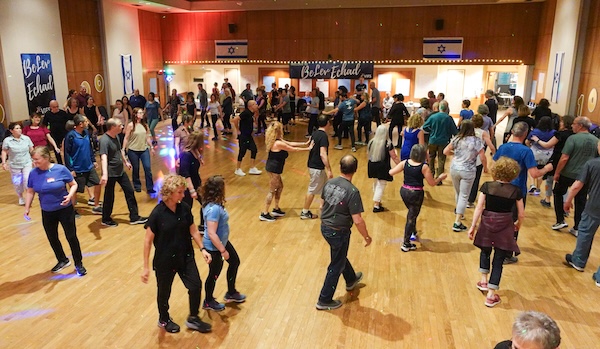
Elana Wenner (with folder) leads the Jewish Museum and Archives of British Columbia walking tour of Jewish Strathcona. (photo from JMABC)
Having taken the Jewish Museum and Archives of British Columbia’s tour of Jewish Strathcona, I know firsthand how interesting and worthwhile it is. This summer, there will be a little more swing to the July 27 tour – Kol Halev Performance Society will once again take part, but in an expanded role.
“Kol Halev has created a script for theatrical additions to the tour, along with musical components. Actors in full period costume will accompany the group and act out key scenes from the stories told along the way,” Elana Wenner, director of programming and development at the museum, told the Independent. “A full musical dance number is included as well, along with a reenactment of a wedding that mirrors cultural traditions from the past.”
Wenner got in touch with Sue Cohene, co-founder and current president of Kol Halev, after having taken some theatrical tours produced by other museums in the city and elsewhere.
“In the past,” said Wenner, “Kol Halev has put on productions based on BC Jewish history in conjunction with JMABC, before I worked here.”
“Kol Halev has been involved with the Jewish Museum since 2006, performing at their various galas and special events over the years,” Cohene explained. “In 2017, the museum created a photographic exhibit, shown alongside Kol Halev’s historically based play, Two Views from the Sylvia, which was presented at the Waterfront Theatre.
“Kol Halev Performance Society and the Jewish Museum and Archives have a long-standing collaboration and we update the museum on a regular basis about our shows, community teachings and future plans.”
A couple of years ago, said Cohene, Marcy Babins, interim executive director of the museum, suggested that she meet with Wenner, then the newly appointed director of programming and development, to discuss possible joint ventures.
“Connecting with Elana has been like carrying on a family tradition,” said Cohene. “Elana’s grandmother, Irene Dodek, was instrumental, along with Dr. Rabbi Yosef Wosk, in bringing Kol Halev on board to provide entertainment and theatrical historical education for Jewish Museum projects. Elana’s mother, Dr. Gail Wenner, has danced with Kol Halev and continues to share her creativity by creating historically influenced hats for our performers.”
Last summer, Kol Halev added a Yiddish dance performance to complement one of Wenner’s Jewish Strathcona walking tours. This summer, actors from the performance group will portray early Jewish community leaders during the tour, in addition to weaving in some traditional dance pieces.
Cathy Moss, one of Kol Halev’s main writers since the group was established, worked with the research provided by Wenner to create a script.
“Elana shared the tour route and basic information about Strathcona historical community leaders from the early 1900s to the 1940s,” said Cohene. “She kindly led Kol Halev on the tour, where we all looked at locations that could accommodate acting and dancing.”
“Elana did a great job compiling the research on the area,” said Moss. “Once I took the tour, it was easy to see what a compelling cast of characters inhabited Strathcona in the early days. It was fun to write dialogue for such interesting and lively folks.”
Moss relied on the museum’s material for each location along the tour, writing the dialogue for the characters based on the biographical details and context Wenner provided.
“The tour is great and informative on its own,” said Moss. “I would add that inviting Kol Halev to be part of it was an excellent idea. It adds another dimension that makes the experience that much more enjoyable. The wedding dance in particular will be appreciated by the tour-takers. It’s very entertaining.”
Kol Halev rehearses the Patsh dance, choreographed by Santa Aloi. The group will dance and act in the July 27 JMABC Strathcona walking tour. (photo by Adam Abrams)
Kol Halev has several on-site rehearsals planned before the shows in which they’re participating – the July 27 public tour and a private tour in late June – “particularly to familiarize dancers and actors who were not involved last year,” said Cohene.
“We will have between eight and 10 dancers this summer and a few actors,” she said. “It’s a small working production that has room to grow.”
Cohene will be part of the performances.
“I’ll be playing a mother-in-law role in the 1940s wedding dance, which was choreographed by Tamara Thompson Levi,” she said. “I’ll also tap dance in the Yiddish Patsh dance choreographed by Santa Aloi.”
Wenner leads the Strathcona walking tours.
“This tour is a journey through the footsteps and choices made by the first community leaders in Vancouver,” she said. “It follows in the footsteps of community-building, highlighting the institutions and people who laid the groundwork for today’s thriving Jewish Vancouver institutions. Along the way, we see buildings that held components of the first Jewish community organizations, as well as the homes of some of the first leaders. We also explore the ideas of what Jewish community requires in general, and what it was like to live as a Jew in this part of the world at the turn of the last century. The tour is a synthesis of past and present, weaving together the origins and future of Vancouver’s Jewish community.”
The Jewish Museum has four different walking tours on offer this summer. In addition to the Strathcona neighbourhood tours led by Wenner on July 13 and 27, Aug. 10 and 24, Daniella Givon leads tours of the Mountain View Jewish Cemetery on July 6 and Aug. 10. In Victoria, Amber Woods leads both the Downtown (July 6 and Aug. 10) and Jewish cemetery (July 20 and Aug. 24) tours. All the walks start at 10:30 a.m. For tickets, visit jewishmuseum.ca, email [email protected] or call 604-257-5199.
Hastings Mill Store was part of this year’s Heritage Discovery Day. (photo by Cynthia Ramsay)
This year’s Heritage Discovery Day – which has been hosted by Vancouver Heritage Foundation since 2003 – featured nine sites in Kitsilano, highlighting, but not confined to, the Craftsman style of house, which, according to the self-guided tour book, “is characterized by decorative brackets, exposed rafter ends, mock trusses in the gable ends, expansive low-pitched gable roofs and a rich variety of finishing materials and textures.” Saturday, June 7, was an ideal day for the event and this year’s Summer cover features photos taken throughout the neighbourhood, while going house to house. Driving home along Cornwall Avenue, the number of people enjoying Kits Beach was incredible. When it’s sunny here, the people emerge!
City Farmer Garden’s Cob shed, made with clay from Haida artist Bill Reid. (photo by Cynthia Ramsay)One of the heritage homes on the tour. (photo by Cynthia Ramsay)Kits Beach on June 7. (photo by Cynthia Ramsay)
Kits directional post. (photo by Cynthia Ramsay)
A cyclist amid the flowers. (photo by Cynthia Ramsay)
Last month, 16 students from three different high schools in the Galilee visited Vancouver, where they participated in several activities. (photo by Kristin McIlhenney)
“It is nearly impossible to put into words the profound experience we had in Vancouver,” Dr. Rachel Ravid, co-director of Galilee Dreamers, told the Independent. “For the first time, host families welcomed us directly at the airport – a moment of emotion I will never forget. The level of care and thought given to our visit was evident even before our arrival, through a preliminary Zoom meeting during which we shared about the Galilee Dreamers program and the backgrounds of the students they would be hosting. From afar, we could already feel the warmth that awaited us.”
Galilee Dreamers is a program of Oranim College of Education, in Israel. Established nearly a decade ago, it “brings together Jewish and Arab high school students from northern Israel, cultivating dialogue, empathy and mutual respect, while helping participants explore their personal and collective identities,” Ravid said.
A key aspect of the program is connecting these Israeli students with peers abroad and Galilee Dreamers groups have traveled to cities in several countries, including Canada, where Toronto has participated in previous years. Last month, 16 students from three different high schools in the Galilee came to Vancouver, where they were hosted by 12 local families, visited a few schools and participated in several activities. The delegation then headed to Seattle.
There were six students from Akhva-brotherhood High School in Yarka, a Druze school; five students from Jewish schools Einot Yarden and Misgav Regional High School; and five students from Atid Bir al-Maksur, a Muslim school representing a Bedouin way of life, said Ravid. “The students ranged in age from 16 to 18 and were selected for their leadership potential and their capacity to develop leadership skills.”
The co-director of Galilee Dreamers, Dr. Malek Hujeirat, who is deputy principle at Atid, led the group from there, and Diana Mulla, a Druze English teacher, led the delegation from the Druze school. “I was responsible for accompanying the Jewish students and overseeing the delegation,” said Ravid.
While the process of planning the April 18-25 trip was challenging, Ravid said “the spirit of volunteerism and support from community members in Vancouver was truly remarkable. Marion Rom led the planning team with vision and dedication, alongside Dalia Margalit, who offered support from both near and afar.
Galilee Dreamers participants at Tsleil-Waututh Nation siʔáḿθət School. (photo by Kristin McIlhenney)
“The intention was to create as many opportunities as possible for interaction with different parts of the Vancouver community, in order to better understand the local realities and challenges,” said Ravid. “In parallel, we aimed to connect the visiting students with the natural environment, the region’s history and its diverse cultures.
“Alongside school visits with Jewish students – where we discussed the core values of the Galilee Dreamers and universal values such as solidarity, listening, compassion and empathy – our students also learned what daily life looks like for peers their own age in a different society.
“A key element of the itinerary was community volunteering,” said Ravid, and, at the Jewish Community Garden, the group spent some time working and learning.
The host families also “initiated activities rooted in their own strengths and passions, allowing each student to experience something unique within each household,” added Ravid.
One of those families – Tal and Avital Jarus Hakak, who had two Jewish students stay at their home – “hosted a dinner that included another host family of two Druze students and a hike afterwards. One of us also helped with a tour of UBC,” the couple said.
“The positive impact of this trip on the students’ attitudes towards their peers and teachers from different communities and cultures was heartwarming. We felt like these impacts have a great importance for the future,” said the couple, who were motivated to take part because, they said, “The idea of a youth program for facilitating dialogue between Jewish, Arab and Druze sounded very appealing and interesting, particularly in this time of local and global conflicts.”
Kristin McIlhenney found out about the visit from a friend.
“Knowing I had previously hosted international students, she encouraged me to consider it,” said McIlhenney, who hosted a student from the Bedouin school and teacher Hujeirat, “who also serves as the principal overseeing multiple schools in his village.”
“As an educator, I deeply believe in the transformative power of travel and intercultural exchange to build empathy and global awareness,” she said. “That belief, combined with my background, made me genuinely enthusiastic about supporting the Galilee Dreamers by becoming a host.”
Beyond providing room, board and transportation for her guests, McIlhenney said “the experience organically evolved into something much richer. Groups often gathered in the evenings, leading to shared dinners and deeper connections, both in our home and in others’. It was incredibly moving to hear three languages spoken under our roof, and to learn everything from simple cultural details – like the high price of sushi where they live – to complex and personal perspectives on life in a conflict-affected region.”
For McIlhenney, there were two particularly special benefits of being a host. “First,” she said, “my two elementary-aged sons formed a strong bond with the student who stayed with us. A gifted soccer player, he spent hours playing with them and they even accompanied him to a match where they watched [Lionel] Messi play against the Whitecaps – a memory they’ll cherish for years. Second, as a former educator, I deeply appreciated the profound conversations I had with the principal. Whether while preparing meals, driving or winding down in the evening, our discussions gave me a rare and meaningful glimpse into his reality – and helped me reflect more critically on my own.”
Both McIlhenney and the Jarus Hakaks would “absolutely” host again. And trip co-organizer Rom would “definitely help bring those kids in the northern Galilee next year if they want to come back.”
Rom, Margalit’s brother and Galilee Dreamers co-founder Dr. Desmond Kaplan all went to high school together in South Africa, explained Rom of the local connection to the program and how the Vancouver stop came to be.
Rom and Margalit found the host families, and Margalit, who was out of town when the visit took place, “gave this program ‘legs’ in the early stages of planning,” said Rom.
“I wanted to help because I believe that dialogue and interaction of the Jewish, Bedouin and Druze high school youth in the northern Galilee is one of the most impressive paths to peace in that region,” said Rom.
“The most moving part,” she added, “was when the youth and host families all met together one evening to talk about life in northern Israel since Oct. 7, 2023, and what this program means to them.”
“For my part,” said Margalit, “I agreed to assist in arranging the visit when I heard that the group would be made up of students from the Bedouin, Druze and Jewish communities. At this time of tensions between Israel and Palestine, I felt this was a particularly important aspect of the visit, and of daily life in Israel, that would be very important for the Vancouver Jewish community to hear about.”
“As the region faces heightened tensions and conflict, the lack of mutual understanding and shared vision between Arab and Jewish communities threatens the very fabric of society,” said Ravid. “These divisions are compounded by systemic separations: Jewish and Arab teenagers grow up in separate neighbourhoods and towns, attend schools where different languages are spoken, and rarely – if ever – encounter one another in meaningful ways that could challenge stereotypes and foster understanding. Frameworks that nurture mutual respect, empathy and collaboration are critically absent.
“This reality not only affects the people of Israel,” she said, “but also perpetuates a global lack of awareness about the rich and diverse voices that make up Israeli society. Around the world, young people often have little understanding of the complexities of life in Israel and few models for overcoming divisions to build shared futures.”
Galilee Dreamers “creates safe and meaningful spaces where young people from different backgrounds – who might otherwise remain strangers – build real relationships based on trust, empathy and common purpose,” said Ravid.
“Equally important is the program’s impact on the communities that host us – whether in Israel or abroad,” she continued. “By sharing their personal stories and experiences of living in a complex, multicultural society, Galilee Dreamers offer host communities a window into what grassroots peacebuilding can look like. These encounters inspire interfaith dialogue, foster global solidarity and leave lasting impressions on local families, educators and youth who engage with the group. The mutual learning is profound, and many host communities describe the visit as hopeful, eye-opening and deeply moving.”
While some communities and institutions in Israel and the diaspora “have become more cautious about engaging with programs like Galilee Dreamers” since Oct. 7, “the program continues to operate, with participants expressing a renewed commitment to dialogue and understanding,” Ravid said.
Galilee Dreamers students visited Jewish and other institutions, including Peace Mennonite Church, while they were in Vancouver. (photo by Kristin McIlhenney)
The students who participated in the delegation that came to Vancouver shared with Ravid “that they had never experienced such a meaningful and warm form of hospitality. They spoke about the deep love and care shown to them, and how much the host families prioritized their personal well-being,” she said. “They expressed sincere gratitude for the time and attention their hosts gave to hearing their personal stories – and the stories of their families. The connection was so strong that many of the students affectionately referred to their hosts as their ‘second parents.’
“In addition to the emotional connection, the students also appreciated the opportunity to take part in activities they had never experienced in Israel: from ice hockey games and bike rides, to hiking in nature, riding a ferry, and taking a cable car up a snow-covered mountain. Perhaps most enthusiastically, they spoke about the unique food experiences, especially the sheer number of donuts they joyfully consumed without pause!”
For Ravid, “One of the most emotional moments of the trip was the community gathering toward the end of our stay,” she said. “Each of us shared reflections and feelings from the journey. I was particularly moved by the words of Ezra Shanken, chief executive officer of the Jewish Federation of Greater Vancouver, who said that the Galilee Dreamers’ visit brought out the strengths of the local Jewish community and its ability to mobilize around a meaningful initiative. His emphasis on solidarity was incredibly powerful and deeply relevant – especially in these days, when personal and collective security in Israel and around the world feels fragile.”
Both the Jewish Community Centre of Greater Vancouver and the Jewish Federation contributed to the local visit, the latter helping with the planning as well as funding. There were many other organizations and people that Rom, Margalit and Ravid thanked.
“On the day of departure,” said Ravid, “I saw many tears and heartfelt hugs – testament to the meaningful connections and impact this journey had on both the students and the families.”
Rabbi Andrew Rosenblatt speaks with Einat Wilf, Israeli author and thinker, who shared her views on the ongoing Israeli-Palestinian conflict. (photo by AdeleLewin)
Israel and its region are in a moment of danger and opportunity, according to Einat Wilf, who spoke in Vancouver April 25.
The Israeli author, commentator and former Labour Party member of the Knesset, said Israel and those who wish to destroy it have been locked in a repetitive series of disasters for almost 80 years. The current moment could alter – or enforce – that dynamic.
“This is a moment when, if we do not do the right things, we will remain stuck in a loop,” she said at Schara Tzedeck Synagogue.
The cycle of conflict has dragged on because of a scenario in which, she said, “the Jews are never allowed to win, the Arabs are never allowed to lose – or at least are never allowed to acknowledge defeat.”
Wilf calls this the “tragedy of ceasefires.”
The Arab world tried to prevent the creation of a Jewish state and then, since 1948, has attempted to undo the existence of that state. This is the core of the conflict, she argued.
“When it becomes clear that they are about to fail, what people call for is a ceasefire,” she said. “But what would actually help us is not a ceasefire. What would help us is to bring back the great ideas of victory and defeat, because those are actually necessary for us to get to peace.”
Instead, the world demands that the parties go back to the negotiating table, as if nothing had happened, she said.
“People talk about the conflict constantly going on, as if it’s by some bizarre coincidence,” she said. “It’s not. It’s because the Arab side for decades has been constantly told, try again, try again. If you haven’t succeeded this time, try again.”
One of the ruptures in the dialogue, Wilf said, is the idea that the only thing standing between
Israelis and peace is the establishment of a Palestinian state. This has been the driving force in decades of peace efforts, “only to realize that this is not what the Palestinians had ever wanted.”
The problem, she said, is that many Jews and others refuse to take the plainly stated Palestinian and Arab message at face value. Many Jews on her social media feed disagree with her, she said. Many Arabs, by contrast, are up-front.
“The Arabs on my feed would write this: ‘You are settler-colonialist, white Europeans. Get out.’ I love that,” she said. “They’re saying there shouldn’t be a Jewish state.” And yet, the Jews who comment, she said, keep coming back to settlements, the occupation and other issues that ignore that the root of the problem is a Palestinian and larger Arab refusal to accept the existence of a Jewish state in any part of the region, said Wilf.
Two Israeli prime ministers, Ehud Barack in 2000 and Ehud Olmert in 2008, tried to negotiate a resolution, only to find that two different Palestinian leaders, Yasser Arafat in 2000 and Mahmoud Abbas in 2008, walked away and reverted to violence, she said. Between those two administrations, a different prime minister, Ariel Sharon, decided that, if the Palestinians would not sign an agreement, he would just give them land.
“He gets out of the Gaza Strip to the last square inch, and we know what they did with that control of the territory,” said Wilf.
The devastation experienced by Gaza and its people in the current war is a tragic moment, but also a possible turning point.
“Moments of ruin and destruction, both in personal as in collective lives, can be moments of growth and transformation,” she said. “But only if you acknowledge the possibility.”
Wilf admits that people say she speaks harshly.
“I do,” she agreed. “Because we have not benefited from people who soften the message. We try to cut corners, we don’t go to touch the molten lava that is at the core of our conflict.”
For years, long before Oct. 7, European capitals have been sending money to Palestinian regimes to feel good about themselves, she said. “But it does no good. It just extends the conflict.”
She tells European audiences to change their approach. “You want to do good?” she asks. “You need to tell the Palestinians, given that your goal in the last century was to prevent and then to undo the existence of a Jewish state: you lost, and it’s over. You can find a dignified life next to a Jewish state but not instead of it.”
Hard truths are difficult to dislodge, said Wilf, and they can be perpetuated at the highest levels. When Joe Biden, then the US president, visited Israel after Oct. 7, Wilf said, he went out of his way to argue that Hamas does not represent ordinary Palestinians.
“It’s a lie that we often tell to comfort ourselves,” argued Wilf. “Hamas is merely the most brutal and successful executor of the ideology that we’ve come to call Palestinianism.”
The ideology, she said, does not hide its goal of eradicating the existence of Israel “from the river to the sea.”
Terms like “right of return” hold equally brutal meanings.
“You look at Palestinian Arab texts from the ’50s, the ’60s, they are very clear about the term,” she said. “They talk about ‘We will tear their hearts out of their bodies, their fingernails from their limbs.’ That’s why you have euphoria on Oct. 7 – euphoria across the people of Gaza, euphoria across the people of the West Bank, Palestinians and their collaborators around the world. The euphoria was not [because Palestinians were] breaking out of some open-air prison…. The euphoria was that they finally saw the moment that they had been groomed for, for decades.… Hamas executed Oct. 7 on behalf of Palestinianism, on behalf of the Palestinian people – for them and of them.”
That is the only way to understand what happened, she argued, or to understand how billions of dollars in international aid have resulted not in social progress but in a militarized terror regime with hundreds of kilometres of tunnels under schools, mosques, homes and kindergartens.
“You can only do something like that among a supportive population, when you are intent on carrying out the vision of that population,” she said. “So, the enemy is not just Hamas. That’s too easy. The enemy is Palestinianism. And that ideology has to die so that Jews and Arabs can finally live.”
An ideology can indeed be killed, she argued. “In fact, it happens all the time. We all live in a world where ideologies are constantly killed and dying and replaced by others.”
A first step, Wilf contended, is rejecting what she calls “trauma determinism” – the idea that people who are collectively traumatized can only respond with violence and stubborn resistance. This manifests in the idea that Israel’s actions will only further radicalize Palestinians. “I don’t know that there is much further to radicalize,” she noted.
Trauma determinism is not real, she said – or, at least, it need not be. “Exhibit A: the Jewish people,” she said. But she also raised the examples of Nazi Germany and imperial Japan. “They suffered violence. The issue is not the violence,” she said. “The issue is what is the story that gets told. That’s why this moment is so important. Because, just like nothing succeeds like success, nothing fails like failure. People begin to run away from failure.”
To move on and embrace peace, she said, Palestinians, like Germans and Japanese before them, have to acknowledge defeat.
“Embracing defeat is not necessarily a bad thing,” she said. “And that process needs to happen. I’m not denying that there is ruin and devastation in Gaza. The question is, how is that ruin and devastation understood? Because, if the story is big, bad evil Israel did that to you and you are just innocent Gazan victims of Israel’s evil nature, then nothing will change. What needs to happen is something that has never happened in the last century of the conflict, which is a connection between cause and effect, action and consequences.”
Palestinians, the broader Arab polity and the world need to understand that the ruin and devastation inflicted upon Gaza is the outcome of their ideology. Some other peoples in the region have awakened to this idea and begun to give up their fruitless hostility to Israel, Wilf said.
“It is always the mark of failed societies in crisis, looking to scapegoat, looking to find someone to blame, looking to divert attention from their failures,” she said. “It’s not a coincidence, therefore, that those countries in the Arab world who are trying to forge a modern vision, a forward-looking vision of what it means to be an Arab and Muslim, are the ones that are letting go of anti-Zionism and normalizing relations with Israel. This is the only vision forward. And I’m under no illusions. It remains a minority view in the Arab and Islamic world. But, for the first time ever, it exists, vocally.”
Israeli commentator and former member of the Knesset Einat Wilf, right, was thanked after her presentation by Tracy Ames. (photo by Adele Lewin)
While they might not embrace the term themselves, Wilf suggests these parties are exhibiting what she calls “Arab Zionism” – the simple acknowledgement that Israel exists and has a right to do so.
It is voices in the West who are most resistant to change, she said.
“The tragedy of this moment is that some in the Arab world are waking up from decades of anti-Zionism as a waste and a ruin, and seeking to have a different vision,” said Wilf. “You have so many here in the West rushing to fill the void and to essentially keep fueling the conflict so that the erasure of Israel can finally be achieved. That is the tragedy. It is also, of course, remarkably dangerous. Because what’s happening now in the West, as much as it pretends to be about the conflict, it’s not.”
It’s about something more insidious, she contended. What is portrayed as anti-Zionism has historically shown itself to be something baser.
“What happens to Jews when societies allow anti-Zionism to become institutionalized?” she asked. Everywhere that anti-Zionism rises to the level of being institutionalized or legislated, the environment turns hostile to Jewish life, she said.
“In the Arab world, how did they get rid of their Jews in the two decades when anti-Zionism was at its height? They never legislated against the Jews. They legislated against Zionists. Iraq, Egypt – the legislation was against Zionists,” she said. “But the way it works is that the Jews are charged with Zionism and no Jew – I know some really try hard but no Jew – will ever be able to disavow Zionism because, heaven forbid, they just celebrated Passover and said, ‘Next year in Jerusalem.’ And that’s how it works.” If such actions are not stopped, she said, “ultimately, no Jews are left.”
“This is what happened in the Arab world, in Iran, in the history of Europe, in the Soviet Union, in Venezuela and it’s happening on American campuses as we speak,” she contended.
Now, efforts are underway in Canada and elsewhere to codify “anti-Palestinian racism,” which Wilf dismisses as a prohibition against Zionism.
On the other hand, there is, she clarified, genuine anti-Palestinian racism. “It is the racism of refusing to listen to Palestinians and take them at their word,” she said. “There is a refusal to really acknowledge them as agents in history who know what they are doing and who actually have their own rational vision of no Jewish state.”
The future depends on how Palestinians and the world interpret the destruction that has taken place in Gaza.
“We are facing a moment that has at once great peril but also great hope,” said Wilf. “Amazingly, so much rides on whether we will ensure that the ruin and destruction in Gaza will finally be associated as the consequence, the outcome, the effect of the Palestinian choice to pursue the always-destructive vision of no Jewish state, because, if they can finally be made to embrace defeat, and to begin the slow process [toward peace] then, at the end of the day, I can assure you that, if they become Arab Zionists, it would be better for everyone.”
Rabbi Andrew Rosenblatt welcomed the audience and thanked the Hayes Family Israel Initiative for funding Wilf’s visit, in memory of Dr. Arthur and Arlene Hayes z”l.
Or Shalom held a groundbreaking ceremony on April 27, launching the MoreOR project. (photo from Or Shalom)
On Sunday, April 27, Or Shalom Synagogue marked a major milestone with a groundbreaking ceremony, launching the MoreOR project – a long-anticipated renovation and expansion that will transform the synagogue on East 10th Avenue into a more sustainable, accessible and welcoming community hub for generations to come.
John Fuerst, lead for Or Shalom’s housing task force, at the April 27 groundbreaking. (photo from Or Shalom)
The ceremony began with a niggun, a wordless melody, and a moment of silence in remembrance of the victims of the tragic events at the Lapu Lapu Day festival, grounding the day in both reflection and hope.
Several special guests joined the community to mark the occasion, including David Bogdonov of the Ronald S. Roadburg Foundation and Quelamia Sparrow, who offered a meaningful land acknowledgement. Sparrow’s words reminded those gathered of the importance of community, and the deep history and ongoing responsibilities connected to the land on which Or Shalom stands.
Synagogue board member Mira Oreck and project lead John Fuerst shared the story of the MoreOR project. Reflections from Bogdonov and board member Jodie Eaton emphasized the importance of building spaces that will serve future generations.
Rabbi Arik Labowitz highlighted that MoreOR is far more than a construction project – it’s a bold investment in the spirit of Or Shalom, a commitment to nurturing Jewish life in Vancouver.
The shul’s Rabbi Arik Labowitz was one of the speakers. (photo from Or Shalom)
The groundbreaking ceremony included a ritual inspired by Jewish tradition: the breaking of a glass. Commonly seen at Jewish weddings, this act served as a poignant reminder that, even in moments of profound joy, we remain mindful of the brokenness in the world – a symbol of resilience, responsibility and hope, as Or Shalom embarks on this next chapter.
The MoreOR project takes advantage of the current synagogue building’s solid foundation and central location. It will add new classrooms, expand the kitchen, renovate the social hall, improve accessibility with the addition of an elevator and create a zero-carbon, environmentally sustainable facility.
“We are deeply grateful to all of our donors and community members, whose vision, commitment and generosity have brought us to this milestone,” said Oreck. “This project is about more than just bricks and mortar – it’s about building a future rooted in sustainability, inclusivity and connection.”
To learn more about the MoreOR project or to contribute, visit orshalom.ca/moreor.
Rain or shine, the Jewish Culture Festival organized by Chabad of the Tri-Cities will take place at Rocky Point Park on Sunday, June 8. Everyone is welcome. (photo from Chabad of the Tri-Cities)
The Jewish Culture Festival returns to Rocky Point Park next month, as the first-ever Tri-Cities festival, which took place last year, was such a success.
Last May, the skies over Port Moody were grey and heavy. Rain fell steadily as volunteers scrambled to cover tables, musicians huddled under tents with their instruments, and the grassy fields of Rocky Point Park threatened to turn to mud.
But then – the people came.
One by one, in raincoats and rubber boots, carrying umbrellas and warm drinks, more than 300 people streamed into the Tri-Cities Jewish Culture Festival. Children ran between tents with falafel. Seniors gathered to listen to the sounds of klezmer. Local vendors served up kosher food, fresh baked goods and Israeli dishes. There were smiles. There was singing. Above all, there was ruach, the joyful Jewish spirit.
(photo from Chabad of the Tri-Cities)
It was the first festival of its kind in the Tri-Cities, and it was clear from the start: rain or shine, the Jewish community shows up.
Organized by Chabad of the Tri-Cities, the Jewish Culture Festival was created to bring together Jews from all walks of life and to share the beauty of Jewish culture with the broader public. “This festival is about celebrating what connects us – our heritage, our values and our joy,” said Rabbi Mottel Gurevitz, director of Chabad of the Tri-Cities.
Booths lined the park, offering Judaica, hands-on learning, face-painting for kids and even a spirited parent-vs-child trivia challenge. The energy was palpable, and the sense of community was unmistakable. And, now, it’s happening again.
The Jewish Culture Festival returns to Rocky Point Park on Sunday, June 8, and it’s set to be even bigger and better. This year’s festival will feature Jewish music and entertainment throughout the day, an expanded lineup of kosher food vendors, offering everything from deli sandwiches to Mediterranean street food. Families can look forward to inflatables, carnival games and a magician. Judaica will once again be on display and available for purchase, including artwork, books, Shabbat items, and more.
(photo from Chabad of the Tri-Cities)
Whether you’re Jewish or just curious, religious or cultural, new to the Tri-Cities or a lifelong resident, this festival is for you. It’s not just about food or music – it’s about connection: to tradition, to community and to one another.
So, bring your appetite, bring your family, and come celebrate the joy of Jewish culture – in all its flavour, sound, colour and heart.
Admission is free, thanks to generous sponsors, but tickets are required for entry. Reserve them in advance at JewishFestTC.com.
Jerusalem Mayor Moshe Lion speaks in Vancouver on June 9. (photo from CFHU)
Moshe Lion, mayor of Jerusalem, will be in Vancouver June 9 and Calgary June 11 for a special series of events organized by the Jerusalem Foundation of Canada in collaboration with the Canadian Friends of the Hebrew University (CFHU). The visit marks an opportunity to strengthen ties between Jerusalem and Canadian communities, and to highlight the transformative work taking place in Israel’s capital through the power of education, innovation and philanthropy.
Lion was elected the 10th mayor of Jerusalem in 2018 and reelected for his second term in 2024. The city council under his leadership is a united coalition with no opposition – an unusual and uncommon achievement.
Lion has played a pivotal role in expanding Jerusalem’s infrastructure, cultural institutions and global partnerships. His visit here will offer guests the chance to hear firsthand about the city’s challenges, its remarkable diversity and its bold vision for the future.
Joining him will be Arik Grebelsky, president of the Jerusalem Foundation in Israel, and Canadian and Israeli leaders, including Joel Reitman, chair of the Jerusalem Foundation of Canada.
At the heart of this visit is the unique partnership between the Hebrew University of Jerusalem and the Jerusalem Foundation –two pillars of the city’s intellectual and civic life. Together, they are investing in projects that elevate academic excellence, empower underserved communities, and position Jerusalem as a global city of knowledge and inclusion.
The Vancouver and Calgary events will bring together philanthropists, community leaders and alumni to celebrate this shared mission. With Hebrew University celebrating its 100th anniversary this year, the visit underscores the enduring ties between Canada and Jerusalem – and the power of education to shape a brighter future. To register, go to cfhu.org/upcoming-events.
– Courtesy Canadian Friends of the Hebrew University
Rev. Joseph Marciano has served the Jewish community in many roles, notably as head of the Chevra Kadisha (Burial Society). (photo from cemeteryboard.com)
“It means a tremendous amount to us, as we have dedicated the past 40-plus years of our lives, day and night, to serving the Schara Tzedeck congregation and Schara Tzedeck Cemetery Board and the entire Vancouver Jewish community in so many various capacities,” said Rev. Joseph Marciano about being recognized, with his wife Simone, for their decades of service. “We have come to know many generations of congregants and it means a lot to celebrate with everyone.”
The June 10 dinner honouring the Marcianos has sold out, but people can still buy tickets to the community program.
There are some people who are able to rise to every occasion, says Rabbi Andrew Rosenblatt, and his colleague is an exemplar of that extraordinary characteristic.
Rev. Joseph Marciano is being honoured on June 10, along with his wife Simone, for their decades of service to the community. (photo from cemeteryboard.com)
Marciano, who joined the staff of Schara Tzedeck more than 40 years ago, is a trained schochet, ritual slaughterer, ordained by a prestigious Sephardi rabbi from Morocco. Over the years, Rosenblatt said, and depending on need, Marciano “graduated into various other roles.”
He serves as a teacher, a Torah reader, a funeral director and head of the Chevra Kadisha (Burial Society). But this does not cover the formal and informal roles Marciano plays, according to the rabbi.
“If there is a need, he learns to fill it,” said Rosenblatt. “There is an idea in Judaism, in the teachings of Pirkei Avot [Ethics of Our Fathers], that, if there is no one to lead, you need to come to that position of leadership.”
Rosenblatt hesitates to apply the term “social worker,” but said Marciano has a knack for filling a need in the lives of others.
“Sometimes, it would be, this person needs horseradish for their seder,” the rabbi said, “or this person needs medical care, and there are different kinds of home support. Maybe it was to find someone to help them clean their apartment. It could be driving people to the airport, or bringing people candles for certain things. He’s one of those people who just rises to occasions.”
Adapting is second nature to Marciano, who tells an amusing story about a misunderstanding around a life-changing moment for the Marciano family.
“When Joseph first came to British Columbia, he thought that Canada was a French-speaking country and, coming from Morocco, and being a French speaker, he thought, OK, sure, no problem,” Rosenblatt said, noting that Marciano has adapted fine to living and working in a primarily Anglophone province.
“He’s a deeply pious person,” Rosenblatt said of his colleague, with whom he has worked for 22 years, since the rabbi came to Vancouver. “He’s the real deal.”
“Simone is, by virtue of personality, a very quiet person,” Rosenblatt said of the evening’s other honouree. “For her, family has been an extremely important thing. They have raised four really remarkable children who are committed to their Judaism and are also individually successful in different ways.”
A special guest for the event will be a rabbi who has gained a deep affection for the Marcianos during their visits to see family in California.
“One of my colleagues, the rabbi of Beth Jacob in Los Angeles, Rabbi Kalman Topp, has developed such a fondness for Joseph on his visits down to LA that he is coming up here to be our keynote speaker,” said Rosenblatt.
Marciano credits his leadership of the Burial Society to the late Jack Diamond, who asked him to become an assistant to the funeral director at the time.
“Then, later on, when the late Harley Feldstein moved from Vancouver, Dr. Jack Kowarsky, with the late Charles Diamond, hired me to be the funeral director,” Marciano said. “I chose this path because it allowed me to be there for many families at times of grief and offer them comfort, as well as help them arrange for a Jewish and dignified burial and farewell for their loved ones, which has been extremely fulfilling. I trained for this role under the previous funeral director, as well as by taking a three-year intensive course through the Province of British Columbia to be an accredited funeral director.”
Among many highlights of his time with the synagogue has been working with the youngest congregants, “teaching hundreds of bar mitzvah boys to read the Torah and Haftorah and learning with bat mitzvah girls, as well as participating in the hundreds of weddings of our members and their families,” he said. “Another extremely special honour I have had in my role has been reading the Torah week in and week out for the past 40-plus years, as well as blowing the shofar for so many years.”
Marciano attributes his accomplishments to the partnership he has with Simone.
“As much as I have been on call 24/7 for any and all situations and emergencies, and it may have been me showing up to assist in various situations, my wife was there behind the scenes encouraging me,” he said. “I would say everything I was able to accomplish here is a testament to her dedication and she shares in this honour as much as I do.”
Bay Area klezmer trio Veretski Pass returns to Klezcadia, which runs in-person and online June 10-15. (photo from Klezcadia)
Klezcadia, a festival of klezmer music and Yiddish culture, is back for a second year. The June 10-15 event can be experienced in-person in Victoria or virtually from around the world.
The 2025 festival, free for all who register, features author and playwright Michael Wex, who will be offering a two-part webinar titled Jews, Germans and Jive: Yiddish as a Language of Resistance.
Wex, the author of the bestseller Born to Kvetch and Just Say Nu, will be delivering the talks from his home in Toronto. No stranger to Vancouver audiences, his play, The Last Night at the Cabaret Yitesh (Di Letste Nakht Baym Yitesh), in which he also performed, closed the 2024 Chutzpah! Festival.
Laura Rosenberg, the director and driving force behind Klezcadia, said Wex “is arguably the most famous person to interpret the public impact of the Yiddish language on the English language.”
She told the Independent that the festival’s mission, operating principles and format will be the same as they were in its inaugural season. “The performance and workshop content, on the other hand, will be completely new for 2025, though obviously within the same klezmer music and Yiddish culture arena as last year, and involving many of the same artists and faculty members,” she said.
Between in-person and virtual attendees, Klezcadia had more than 500 participants from 21 countries in 2024 and the 2025 registration looks to be at least on par with those data, according to Rosenberg.
“Everything from concerts to workshops to open rehearsals is designed to equalize as much as possible the experience of in-person and virtual participants,” she said. “And, thanks to our generous donors, registration is once again free.”
Other notable appearances this year include returning Bay Area klezmer trio Veretski Pass, who will appear on both the concert and workshop rosters. Members Cookie Segelstein (violin), Joshua Horowitz (19th-century button accordion) and Stuart Brotman (bass) play a wide variety of East European numbers. This year, they will offer “band-to-band master classes” with two Victoria-based klezmer ensembles.
Vancouver singer/songwriter Geoff Berner, joined by Segelstein, will perform songs from his upcoming album – Berner’s first to be completely in Yiddish. Over the past 25 years, Berner has toured in 17 countries, opened for rock stars in stadiums and, the Klezcadia notes state, “played nearly every dirty little café bar in Western Europe.”
Klezcadia 2025 will see the Victoria debut of Jordan Wax, a rising star on the Yiddish singer/songwriter scene, who will share music from his newly released album, The Heart Deciphers, on the Borscht Beat label. The New Mexico musician blends many influences, from the Missouri Ozarks to the Indo-Hispanic world and the entire Ashkenazic diaspora.
Christina Crowder, director of the Klezmer Institute, based in Yonkers, NY, will be on hand to perform century-old music rediscovered in Ukraine’s Vernadsky Library, which recently was published for global use via the Kiselgof-Makonovetsky Digital Manuscript Project.
As it did in 2024, this year’s festival will conclude with the entire Klezcadia cohort performing a finale concert at the Stage in the Park (Cameron Bandshell) in Victoria’s Beacon Hill Park.
Billing itself as “A Safer Shtetl,” Klezcadia’s hybrid environment prioritizes the safe experience of immunocompromised and high-risk participants, for the performers, crew and volunteers, and for attendees. Indoor activities feature the use of protective protocols such as supplemental air purification, required masking and daily onsite COVID testing.
“We learned from our inaugural-season experience that our fully hybrid format was extremely valuable, both to our immunocompromised and high-risk participants, but also to a vast number of people who, for geographic or financial reasons, were unable to attend in person,” Rosenberg said.
Rosenberg gives credit to other members of the Klezcadia team for helping with the various technical tools needed to put together a hybrid festival. She said some of the evolving challenges faced in viral safety and communal safety, and the current cross-border political situation, have provided added appreciation to how much a hybrid design can be adapted at short notice, if needed.
People who were not able to attend a live event in 2024 have expressed their thanks to Rosenberg in the lead-up to this year’s festival.
“One of my greatest delights in the intervening year since our inaugural season has been hearing what a difference Klezcadia made to our immunocompromised and high-risk attendees,” she said. “Whether local or halfway across the world, many of these people have felt shut out of their communities, including their Jewish cultural communities, and they expressed in heartfelt terms how life-changing it was for them to be able to participate in a cultural festival that prioritized their safety but was open to everyone.”
All Klezcadia events will take place within a 10-minute drive from downtown Victoria. Specific venue information will be provided only after registration, and only to in-person participants. For more information, visit klezcadia.org.
Sam Margolishas written for the Globe and Mail, the National Post, UPI and MSNBC.
An artist’s rendering of the new Ashdod Rehabilitation and Therapy Centre for which the 2025 Negev Event is raising funds. (photo from jnf.ca/PacificNegev2025)
Hosted by Jewish National Fund of Canada Pacific Region and Israel Magen Fund of Canada, the June 19 Negev Event in Vancouver will feature rescued hostage and speaker Noa Argamani, Australian actor and advocate for Israel Nate Buzz, and editor-in-chief of the National Post Rob Roberts. Funds raised will help build the Ashdod Rehabilitation and Therapy Centre, providing increased levels of care for trauma victims, children with disabilities and children with cancer.
As the name indicates, the new centre will be located in Ashdod, which is about 50 kilometres north of the border with Gaza. With almost 250,000 residents, it is Israel’s sixth largest city. “It is home to the largest Moroccan and Karaite Jewish communities in Israel, and the largest Georgian Jewish population in the world,” notes the JNF.
However, there is a shortage of rehabilitation services in southern Israel, a shortage that has worsened since the Oct. 7, 2023, terror attacks and the ensuing war.
The June 19 Negev Event raises funds to help build the Ashdod Rehabilitation and Therapy Centre, thereby increasing levels of care for trauma victims, children with disabilities and children with cancer. (photos from jnf.ca/PacificNegev2025)
“Thirty percent of wounded patients and most of the war victims are residents of the south,” according to JNF. “Fourteen thousand residents were treated in hospitals following Oct. 7, with 42% coming with injured limbs and 35% seeking support with emotional trauma. The system cannot support the hundreds of thousands of children, adolescents and adults who were physically injured and emotionally crushed by horrific traumas that left deep scars.”
There are only 11 rehabilitation centres in Israel’s periphery communities, while central Israel has 43, says JNF. “Currently, wait times for rehabilitation in the south are at least one year…. Southern residents, including recovering patients and children, must travel about an hour-and-a-half to Israel’s centre for care.”
(photo from jnf.ca/PacificNegev2025)
Among the services the Ashdod Rehabilitation and Therapy Centre will expand upon is the range of care and support that Rachashei Lev, which was established in 1989, provides in other medical centres. (Rachashei Lev roughly translates as Whispers of the Heart, or Heart of Compassion.)
“I visited Rachashei Lev in July [last year] as part of JNF’s resilience task force, a group consisting of professional leaders and lay leadership from across Canada,” David Greaves, executive director of JNF Manitoba/Saskatchewan and Vancouver/Pacific region, told the Independent. “I was there with Harvey Dales and we were all touched by what this organization did. As well, while touring the facility, we were surprised when Noa Argamani joined us and shared her story and how much support she and her family received from Rachashei Lev after her rescue and repatriation. This is, of course, why we chose this particular project, as Noa will be one of our special guests on June 19.” (Argamani was chosen by TIME magazine as one of the 100 Most Influential People of 2025.)
Greaves will be here for the event, working out of the Vancouver office with the local JNF team and Megan Laskin, the event chair. He took on the additional role of Vancouver/Pacific region head after Michael Sachs left the position to become the director for Western Canada of the Friends of Simon Wiesenthal Centre.
“My first official meeting with the board was mid-December,” said Greaves. “They were so welcoming, I felt like I had been here for months.”
Greaves gave the JI an update on the Canada Revenue Agency’s revocation of JNF Canada’s charitable status.
“We have two pending court dates,” he said. “We have a judicial review scheduled for May 28 [after the JI went to press]. We are calling on the court to overturn our revocation, as we had a commitment from the CRA that our revocation would not be published, which finalizes the revocation process, until we exhausted our legal options. We assert that a pillar of Canadian justice is the presumption of innocence, so taking action to revoke us before the opportunity to appeal to the courts is fundamentally unjust. Our underlying appeal, which will focus on the merits of our case, does not yet have a date set. We have called upon the CRA to settle this matter before we litigate, as this is a waste of time and resources for both the taxpayer and JNF. Disappointingly, the CRA has rejected our offer to settle.”
JNF Canada is partnering with the charity Israel Magen Fund of Canada (IMFoC) for all the Negev events across the country.
“We are sharing the responsibilities in executing these campaigns and galas,” Greaves said. “Both organizations have signed agreements outlining the nature of the collaboration. The IMFoC has an agency agreement with the two organizations in Israel at which these projects will be realized, the Parenthood Home in Sderot and the Ashdod Rehabilitation and Therapy Centre. We have the same passion for Zionism and supporting vulnerable Israelis from all walks of life, so it was sensible to work together as, through this collaboration, we can achieve more.”
Intergenerational support
JNF Pacific board president Shannon Gorski is excited about the Rachashei Lev project. She knows firsthand the impact that JNF initiatives can have.
“In 2017, our family supported the Tzofei Tzamid (Israeli Scouts) centre in Ra’anana,” she said. “The project raised money to remodel the centre to ensure that it was inclusive to all the scouts who participated. This meant providing resources and equipment that made it possible for all teens to be able to participate in the outdoor excursions regardless of physical or mental limitations.”
She visited the centre that same year and saw how the money raised here positively affected the participants in Israel. “It was quite emotional,” she said.
Gorski is in her third year as board president; she was vice-president from 2019 to 2023.
“I began my service on the JNF board in 2017,” she said, “following the 2017 Negev, in which my father [Gary Averbach] was honoured with the support of my brother, Michael [Averbach], and me.”
It truly has been a lifelong endeavour for Gorski.
“My father was JNF president from 1991 to 1992, and I remember many occasions that I spent time at the home of the residing shaliach’s [emissary’s] residence,” said Gorski. “Of course, our home always had a JNF box, which I believe I took trick or treating with me in place of the UNICEF box. Purchasing trees to forest Israel became a gift that I either gave or received to commemorate many Jewish milestones.”
Board vice-president Howard Jampolsky also grew up with JNF.
“As a child,” he said, “I first became involved in JNF raising money for trees and driving around with my uncle, John Eskin, z”l, picking up blue boxes in the 1970s. Uncle Johnny was a tireless worker for JNF and was honoured in 1976 with a Negev Dinner.
“My father, Abe Jampolsky, z”l, was also involved in JNF as a regional president. He, too, was honoured by JNF in 1987 with a Negev Dinner, during which the guest speaker was Prime Minister [Binyamin] Netanyahu, who, at the time, was Israel’s ambassador to the United Nations.”
In 2015, then-executive director of JNF’s regional office, Ilan Pilo, asked Jampolsky to join the executive committee of the local board, and he has been involved ever since, becoming vice-president in 2023. Jampolsky has been on the JNF national board since 2022.
For Jampolsky, helping fund projects like the Ashdod Rehabilitation and Therapy Centre is what we, as Jews, do.
“We value life, and part of valuing life is to ensure that each life is fulfilled in every possible way,” he said. “On Oct. 7, 2023, that fulfillment for thousands of Israelis was dashed when Hamas attacked us. I say ‘us’ because when one of our people is attacked, we are all attacked.
“This centre provides life-saving health care for young cancer victims, but it also provides vital health care for many who were impacted by the terrible events of Oct. 7. Both those with physical injuries and emotional trauma will benefit from this important place.”