Skip to content
  • Home
  • Subscribe / donate
  • Events calendar
  • Business Directory
  • FAQ
  • News
    • Local
    • National
    • Israel
    • World
    • עניין בחדשות
      A roundup of news in Canada and further afield, in Hebrew.
  • Opinion
    • From the JI
    • Op-Ed
  • Arts & Culture
    • Performing Arts
    • Music
    • Books
    • Visual Arts
    • TV & Film
  • Life
    • Celebrating the Holidays
    • Travel
    • The Daily Snooze
      Cartoons by Jacob Samuel
    • Mystery Photo
      Help the JI and JMABC fill in the gaps in our archives.
  • Community Links
    • Organizations, Etc.
    • Other News Sources & Blogs
  • JI Chai Celebration
  • JI@88! video

Recent Posts

  • SFU honours Gloria Gutman
  • Lifting people’s spirits
  • Wedding a ray of light
  • Indigeneity and Zionism
  • Rule of law broken: councilor
  • Football and its roles
  • The burden of defence
  • Fish Café returns after fire
  • All right in what goes wrong
  • Nuns & mermaids at TUTS
  • Camp offers holiday retreat
  • Students and mentors inspire
  • Once-in-a-lifetime trip
  • 100 dancers, one heart
  • Money for the sciences
  • What “Jewish food” means
  • Have a cookie, schnitzel too
  • Federation now across BC
  • Israel fighting for its existence
  • Deal strengthens Iran
  • Patriotic belonging diminishes
  • A campaign to engage
  • Upstanders’ first live event
  • Responding to Carney
  • Having your own home
  • Music a family tradition
  • Musical to warm heart
  • Community milestones … June 2026
  • Sharing her passion for Israel
  • Or Shalom reopens its doors
  • JFS from past to future
  • Need holistic approach
  • Sharing stories, advice
  • Journalist shares fears
  • Skills to live together
  • Road to independence

Archives

Follow @JewishIndie
image - CJN box ad Rockowers 2026

Byline: Lauren Kramer

We have power, voice

On the International Day for the Elimination of Violence Against Women, Rolene Marks had a heartrending plea to the hundreds of people who attended a virtual event titled Stop the Violence.

“As our hostage plight fades from the minds of the world, we plead to you, be the voices of our hostages,” she said. “We know what our women and girls are enduring – they’ve been sexually violated and continue to be violated. The impact on their mental health is unfathomable. Don’t let your government or the world forget that there are 101 hostages and we need them home now. We are a devastated nation, deep in trauma. Unless we get them home, this will be a wound that will never, ever heal.”

Marks, a South African-Israeli consultant and journalist, was one of two panelists interviewed by Dana Levenson on Nov. 25 in a virtual event organized by CHW (Canadian Hadassah-WIZO), Na’amat Canada, Momentum Canada, Canadian Women Against Antisemitism and National Council of Jewish Women of Canada. She was joined by Jay Rosenzweig, a lawyer dedicated to advancing safety for women, in speaking out about violence and femicide.

Globally, in 2023, a woman was killed every 10 minutes. In 2022, 133 women or girls were killed daily by someone in their own family. And one in every three women experiences  physical or sexual violence in their lives. But statistics don’t resonate, Marks insisted. People remember stories, not numbers.

Both panelists said the silence from the United Nations and the media with respect to the sexual violence perpetrated by Hamas against women in Israel is – and continues to be – deplorable. Marks said that, in October 2024, when members of the foreign press visited the sites decimated by Hamas terrorists, she saw a complete lack of empathy. “It was like they were ticking something off their to-do list by being there. They’ve completely lost any impetus to report and tell the truth,” she said.

But it’s possible to “fell an elephant with a mosquito,” she continued, citing an African proverb. “We’re not powerless or voiceless. We need to become that mosquito, to demand that journalists employ the ethics of good journalism. We’ve got the law and ombudsmen there to adjudicate, and we need to make use of the tools available to us, remembering that every one of us has power.”

Rosenzweig said members of the Jewish community need to do more in leveraging technology to confront injustice.

“We can do better when it comes to communicating online, because technology and the digital world can be a neutralizer,” he said. “Dialoging outside of our community can also help turn the tide, so we should be reaching outside the Jewish community to find commonality with other communities, for example the Indigenous community. We can find common cause with them by speaking as one indigenous people to another.”

Marks suggested participants host screenings of the documentary Screams Before Silence. She encouraged younger members of the community to get involved by “adopting a hostage” or a victim of the Oct. 7, 2023, attacks and becoming familiar with their lives.

“By making those stories very personal, it is easier to share with others and to connect with peers from other communities,” she said. “Tell the stories of Naama Levy, Daniella Gilboa and the other girls being held hostage. They are stories of teenagers who went to dance for peace, and our teenagers can connect to these people. These stories help to humanize us as a people at a time when dehumanization is so pervasive.”

To watch the event, go to YouTube and search “Stop the Violence – A Collaborative Virtual Event.” 

Lauren Kramer, an award-winning writer and editor, lives in Richmond.
Posted on December 13, 2024December 11, 2024Author Lauren KramerCategories NationalTags abuse, femicide, International Day for the Elimination of Violence Against Women, Jay Rosenzweig, Oct. 7, Rolene Marks, violence against women, women

Update on taskforce

Since Oct. 7, 2023, many members of the Jewish community have experienced antisemitism in some form or another. Jewish Federation of Greater Vancouver and the Centre for Israel and Jewish Affairs have been addressing these incidents, as well as progressing on a strategy to combat it.

A taskforce on antisemitism was appointed last November. Phase 1 was an emergency response in the months directly after Hamas’s attack on Israel. Phase 2, well underway, is about protecting the local community, strengthening relationships with allies, expanding education and raising awareness. This second phase includes an examination of how antisemitism is preventing community members from thriving, and research on how other communities have responded to similar challenges. It seeks to answer the questions, what can we learn from others and what are the best practices for combating antisemitism?

The taskforce is composed of volunteer professionals with different subject matter expertise from across the Jewish community. Between now and April 2025, they will examine manifestations of antisemitism in various sectors and how community members are responding to it. In April, they will deliver findings to the Federation board, with a formal presentation scheduled for the annual general meeting in June. The goal is to develop insights that will ensure the Jewish community can continue to thrive.

“We’re looking at different aspects of community life, including schools for children K-12, Hillel and campus life, the unions and the experiences of new Israelis coming to Vancouver,” said Mijal Ben Dori, vice-president, community planning, partnerships and innovation at Federation. “For example, new-to-Vancouver Israelis are having challenges finding jobs because they have to answer questions about whether they’ve served in the IDF and if they were in Israel after Oct. 7. Based on their answers to these questions, fewer Israelis are passing through the human resource departments of firms in BC.” 

Emet Davis, director of Community Organizing Against Antisemitism, at Federation, said the taskforce has identified key areas that are particularly egregious “In the K-12 school system, school boards and teachers unions are engaged in rewriting history or the erasure of the Jewish experience in curriculum and lesson planning,” said Davis. “At post-secondary institutions across BC, antisemitic tactics this year have been more vitriolic and widespread, posing safety threats to our Jewish students. These are areas where we really have to focus our attention.” 

The arts community is another concerning sector. “Groups like the BC Arts Council and Canada Council for the Arts are using DEI criteria to issue grants, which excludes Jews,” Davis said. “That’s not the only area where Jews are being excluded based on DEI criteria.”

This three-to-five year phase of Community Organizing Against Antisemitism will require a budget of $10 million, for staffing, fight-back advertising and a legal resiliency fund. The hope is that funding will come from private foundations, the Jewish and broader communities. 

Lauren Kramer, an award-winning writer and editor, lives in Richmond.

Posted on November 29, 2024November 28, 2024Author Lauren KramerCategories LocalTags antisemitism, CIJA, Community Organizing Against Antisemitism, Emet Davis, Jewish Federation, Mijal Ben Dori, Oct. 7
Judaism’s funny sides

Judaism’s funny sides

Los Angeles-based comedian and podcaster Antonia Lassar brings The Best Jew to Vancouver Performing Stars’ theatre on Nov. 30. (photo by Xander DePascale)

Ever wonder how Sarah might have welcomed back Abraham and Isaac from their “camping trip”? Who’s the biggest diva in the Hebrew Bible? What elements an interior designer for synagogues considers? These are just a few of the questions comedian Antonia Lassar answers in recent social media posts.

On Nov. 30, Vancouverites can see the Canadian debut of Lassar’s The Best Jew, in which she shares anecdotes about her Reform Judaism upbringing, contemplates questions like whether the late Debbie Friedman is the Messiah, and much more. Music and singing play a big part in the show, which will be opened by the Klezbians, a band from Victoria.

Lassar draws her inspiration from the Jewish communities she’s lived in, in Boston, New York and Los Angeles. “It’s sometimes brutal to be sitting in shul and not be able to pull out my phone to take notes, because I just noticed something hilarious that I need to write about,” she said. “I’m constantly having great ideas in places where I’m not allowed to write anything down!”

Lassar grew up in Newton, Mass., and attended theatre school before moving to New York City. Two years ago, she relocated to Los Angeles to focus on film and television. “I’ve known since I was a kid that I wanted to perform, but I didn’t pinpoint comedy as my strong suit until I got out of college,” she said. 

Today, she describes herself as being deeply immersed in the Jewish community, but, for many years, Lassar found her Jewish life uninspiring. “I didn’t like Judaism growing up,” she admitted. “It felt like an afterschool activity I was forced to do, in the same way I was forced to take piano lessons. I thought both were useless and probably just child abuse.”

It took a foray into other religions before Lassar returned to Judaism with genuine interest and curiosity. For that, she thanks Chabad in Brooklyn. “They sucked me in and gave me a great love for Judaism,” she said. “But I wouldn’t call myself Reform or Chabad. Like many Jews of my generation, I feel like I’m between denominations.”

When it came to writing comedy, Lassar turned to what she knew best, and that was Judaism. “Most Jewish comedy stays at the level of cultural Ashkenazi stereotypes of bagels and overbearing mothers,” she said. “This never felt representative of my experience. I wanted to write comedy for Jews that went beyond stereotypes and that shows a different side to Judaism, one that’s not commonly portrayed in comedy.”

She wrote The Best Jew for a pluralistic Jewish audience and has performed it for a wide range of Jews, from Reform to Hassidic. “My material is very clean, and any passing reference to controversial subjects like the Holocaust is extremely respectful,” she said. “This is an 18+ show, but it won’t offend anyone.”

In the show, Lassar jokes about the Reform movement’s obsession with the word “meaningful,” and Chabad’s distribution of menorahs, among many other subjects. “It’s so much more fun performing for Jewish communities than at comedy clubs, where you’re just another comedian,” she reflected. “When I perform at a synagogue, they treat you like you’re Moshiach! It’s a dream job to travel around the country and meet amazing Jewish communities who are so diverse and so welcoming.”

Lassar comes to Vancouver as a guest of JQT Vancouver, a volunteer-run Jewish, queer and trans nonprofit, and Jewish Family Services Vancouver, as part of the organizations’ Mental Health Support Series. While Lassar’s queer identity does come up, “it’s not a huge part of the show,” she said. “I’ve spent a lot of time in very Orthodox spaces, where the question of queerness is unavoidable. And I’m proud to be a queer Jew who is deeply engaged in Judaism.”

To get an idea of Lassar’s comedy, check out her sketches on Instagram and TikTok. She also co-hosts, with comedian Raye Schiller, Yenta Pod, a weekly podcast with the tagline “Sometimes funny, sometimes Jewish, always gossip.”

For tickets ($18) to The Best Jew on Nov. 30, 7 p.m., at Vancouver Performing Stars’ theatre, visit comedynightwithantonia.eventbrite.ca. 

Lauren Kramer, an award-winning writer and editor, lives in Richmond.
Format ImagePosted on November 8, 2024November 7, 2024Author Lauren KramerCategories Performing ArtsTags Antonia Lassar, comedy, JFS Vancouver, JQT Vancouver, mental health, The Best jew
Samidoun on terrorist list

Samidoun on terrorist list

Samidoun was an organizer of an Oct. 7 rally celebrating Hamas’s terror attacks on Israel a  year earlier. Protesters tried to burn the Canadian flag while shouting that Israel should burn. They also chanted “death to” Canada, the United States and Israel. (screenshot Global News)

Last week, the Government of Canada designated Samidoun, a not-for-profit corporation based in Canada, as a terrorist entity under the Criminal Code. At the same time, the United States Department of the Treasury announced Samidoun is now a “specially designated global terrorist group.”

Also known as the Palestinian Prisoner Solidarity Network, Samidoun has close ties to the Popular Front for the Liberation of Palestine (PFLP), which has been designated by Canada and other countries as a terrorist group for many years. 

At rallies in Vancouver and throughout Canada, Samidoun’s international coordinator, Charlotte Kates, has expressed open support for the Oct. 7 attacks on Israel. On the one-year anniversary of the attacks, she led a rally where chants of “death to Canada, death to the United States and death to Israel” were heard. Videos show rally participants setting fire to the Canadian flag, while shouting “Israel, burn, burn,” among other things. 

“We’re very thankful for today’s decision by the Government of Canada to designate Samidoun as a terrorist entity under the Criminal Code,” said Nico Slobinsky, vice-president, Pacific Region, Centre for Israel and Jewish Affairs (CIJA). “For the past year, they’ve organized some of the most vicious protests in Canada, openly and explicitly celebrating the Oct. 7 attacks and, just last week, they were chanting ‘we are Hamas, we are Hezbollah’ at their rally.”

Kates was arrested after an April 26 rally, at which she called the Oct. 7 terrorist attacks “heroic and brave” and led chants of “Long live Oct. 7.” The conditions of her release order – which prohibited her participation or attendance at any protests, rallies or assemblies for a period of six months – expired Oct. 8 because the Crown had yet to file charges against her.

Slobinsky said CIJA called for the BC Prosecution Service (BCPS) to charge Kates under hate speech laws four months ago, so that she face the full consequences of her actions for glorifying terrorism. But just how long it will take for the BCPS to make a decision is unknown. 

Damienne Darby, communications counsel for the BCPS, confirmed that the BCPS had received a Report to Crown Counsel in relation to Kates. “We are reviewing it for charge assessment, and I am unable to provide a timeline for completion,” she wrote in an email, declining to provide further comment. 

In a statement, Shimon Koffler Fogel, president and chief executive officer of CIJA, said, “Listing the group as a terrorist entity means they will no longer be able to use our streets as a platform to incite hate and division against the Jewish community; this is a significant step toward ensuring the safety and security of Canada’s Jews.” 

But, while the designation as a terrorist group will affect Samidoun’s ability to fundraise, recruit and travel, it is unclear whether it will affect their ability to hold rallies and further promulgate hatred. 

CIJA has asked the federal government to re-examine whether Kates and her husband, Khaled Barakat, obtained Canadian citizenship fraudulently by failing to fully disclose their affiliation with the PFLP. The United States has put Barakat on a terrorism watch list for his connections with the PFLP.

Public Safety Canada notes that one of the consequences of being listed as a terrorist organization is that the entity’s property can be seized or forfeited. Banks and brokerages are required to report that entity’s property and cannot allow the entity to access their property. It’s an offence for people to knowingly participate in or contribute to the activity of a terrorist group. Including Samidoun, there are now 78 terrorist entities listed under the Criminal Code, according to Public Safety Canada.

This terrorist designation is long overdue, said Rabbi Jonathan Infeld, chair of the Rabbinical Association of Vancouver. “To have an organization that creates chaos, hatred and threatens the Jewish community operating freely in Vancouver and Canada was terrible,” he said. “When Samidoun burned the Canadian flag and called for the destruction of the US and Canada on Oct. 7, they demonstrated who they truly are. I hope this decision will give the Canadian government and the police the ability to prevent Samidoun from operating in the manner they have and to prosecute.” 

Lauren Kramer, an award-winning writer and editor, lives in Richmond.
(Editor’s Note: For the CJN Daily podcast host Ellin Bessner’s conversation with NGO Monitor’s Gerald Steinberg about Samidoun’s terror links and more, click here.)

Format ImagePosted on October 25, 2024October 24, 2024Author Lauren KramerCategories Local, NationalTags antisemitism, Centre for Israel and Jewish Affairs, Charlotte Kates, CIJA, Damienne Darby, Jonathan Infeld, Khaled Barakat, law, Nico Slobinsky, Oct. 7, Samidoun, Shimon Koffler Fogel, terrorism
Specializing in safety checks

Specializing in safety checks

Verify Digital’s Fred Ullrich, who served as sergeant of digital forensics at the Vancouver Police Department until his retirement this year, has extensive experience in search techniques. (photo from Verify Digital)

These days, especially, you can’t take any chances when you’re hiring someone to work for you, bringing them into your home as a service provider or taking them on as a tenant. What do they really think about Jews, about Israel and about the world? Are they a safe bet or a threat to your family and business? Most of us would do a Google search to check, or look at someone’s social media handles. What we don’t realize is that the information our searches reveal barely scratches the surface of what might be out there.

That’s why Vancouver-based Verify Digital was created by Fred Ullrich and Jewish community members Jamie Wosk and David Wosk: to conduct in-depth searches into individuals’ digital footprints and deliver a full perspective on their background and beliefs. 

The new business partners go back a long way.

In the late 1980s, David Wosk – who established and ran Wosks Coffee Service for almost 60 years – became one of the original members of the Vancouver Police Department’s Community Crime Watch, which is where he met Ullrich, who was a Crime Watch volunteer before becoming a police officer.

photo - David Wosk is as a business advisor at Verify Digital
David Wosk is as a business advisor at Verify Digital. (photo from Verify Digital)

The Vancouver Police Department awarded Wosk the 2024 Community Safety Leader Award for his decades of dedication to community service, crime prevention and public safety. He has received many other awards, such as the Attorney General’s Award, and commendations for his helpful role in various incidents.

Jamie Wosk – David’s son, who was general manager of Wosks Coffee while also serving as a Vancouver Lifeguard for more than 33 years – also has received recognition for his life-saving actions over the years.

In Verify Digital, Jamie Wosk oversees sales, while David Wosk acts as a business advisor. Ullrich, who served as sergeant of digital forensics at the VPD until his retirement this year, brings his extensive experience in search techniques to the company. He was tasked with doing some 1,500 pre-employment background files for the VPD.

“There were only a few where I was unable to find an online footprint, either because they were much older, or because they’d previously been involved in police services and knew they had to be covert online,” he told the Independent. “But, today, there’s not one young person without a social media footprint. And, if they’re not there, it’s because they’re using secret names or have deleted their profiles to prevent future employers from looking into their past.”

photo - Jamie Wosk oversees sales at Verify Digital.
Jamie Wosk oversees sales at Verify Digital. (photo from Verify Digital)

Verify Digital’s main clients are institutions who hire many new employees each year. But, out of care and concern for the safety of the Jewish community, Ullrich is offering basic and in-depth searches to individuals, too. 

“As a patrol officer, I spent many nights guarding synagogues and I responded to calls at Vancouver Talmud Torah regarding suspicious people on the school grounds. I also saw the firebombing at Schara Tzedeck,” he said. “The reason we’re doing this is that there’s a need, and it will help the Jewish community know who they are dealing with.”

Ullrich conducts all the background searches using a proprietary software that searches across some 28 social media platforms. It yields results you’d never find on a Google search, he explained, because Google is a marketing tool that provides results based on what it thinks you’re looking for.

“There’s a huge science behind finding material,” he said. “And, there’s a consistent percentage of people who have social media content that is embarrassing, inappropriate, highly offensive or simply does not align with the views of their potential employer, especially if they are hired to be in a position of trust.” 

Ullrich has had many of what he calls “OMG moments.” One individual who was applying for a position of trust had started a business in Richmond and was taking customer money while not providing a product. She was looking to extend her fraud through the new employer, and they were on the cusp of hiring her until they learned this information.

Another had a clean social media presence until Ullrich discovered he was using a secret username. That revealed six years of racist and misogynistic comments on social media that more accurately depicted his beliefs.

The cost of Verify Digital’s services depends on the kind of screening you need and ranges from $99 to $199 per person, with a two-to-three-day turnaround time. 

Ullrich said the “old way” of reference checking just doesn’t cut it anymore. “Social media tells a more complete, telling picture of a person’s character and beliefs,” he said. 

“I encourage my clients to do a search themselves, and compare what they find to what I find using proper systems, because there’s a big difference,” he added. “To find information, you really have to know where to look.”

For more on Verify Digital, visit verifydigital.com.

Lauren Kramer, an award-winning writer and editor, lives in Richmond.
Format ImagePosted on October 25, 2024October 24, 2024Author Lauren KramerCategories LocalTags computers, David Wosk, employment, Fred Ullrich, hiring, internet, Jamie Wosk, safety, security, social media, Verify Digital, World Wide Web
Trip sparks realization 

Trip sparks realization 

Starting in 1539, it took Spain 250 years to construct the six-level fortress El Morro in Puerto Rico, and Spain’s former power still emanates from the walls. (photo by Lauren Kramer)

I was in Old San Juan, Puerto Rico, recently, when the full magnitude of the Spanish Inquisition hit me like a ton of bricks.

The scene seemed an unlikely one for a blast from the Jewish past. I was with Pablo Garcia, a fast-speaking guide with Spoon, a boutique food and history company, and we were standing in the Plaza del Quinto Centenario, in front of fortifications that were more than 500 years old.

These were fortifications Spain built in the 1500s, not long after Christopher Columbus “discovered” Puerto Rico in 1493. “Discovered,” because the indigenous Taino people had been there for centuries but, for reasons that seem unfathomable now, that didn’t matter to the Spaniards.

Back home in Spain, 300,000 Jews were being expelled, murdered in the Inquisition or forced to convert to Catholicism, with some of them practising their Judaism underground. To appreciate the kind of force they were up against, you just need to pay a visit to Old San Juan and lay eyes on El Morro.

Spain started building El Morro in 1539 and it took 250 years to construct the six-level fortress. Its thick, stone walls, 185 feet above sea level, were punctuated by garritas, dome-shaped sentry booths located shouting distance from one another, so that, when one sentry perceived a threat on the horizon, he simply yelled a warning to his cohorts. El Morro guarded the city’s harbour from invaders and its bastion, with barracks, dungeons and storerooms, still holds original cannons that face the ocean in preparation for defence. 

The sites are so well preserved that, were the Spanish to resume control today, one feels certain they’d need very little additional infrastructure to guard the island. I looked at those stone walls that safeguarded the island from many battles over the centuries and marveled at the sheer strength of the Iberian Union. It dawned on me that the Jews of Spain really didn’t stand a chance against a power like this in 1492.

I was jolted back to reality when we stopped for a caffeine buzz at Don Ruiz, a coffee shop located in what was once Spain’s Ballajá Barracks. The coffee beans are from a four-generation family farm specializing in single-harvest, hand-picked beans, Garcia said. “In the 1700s, coffee was big business in Puerto Rico and one in every six cups of coffee worldwide was made with beans grown on the island. Coffee money built our roads and sealed our dams,” he said. 

Over the next three hours, I wandered between restaurants in beautifully preserved, colourful buildings in Old San Juan’s narrow, brick-laid streets. I sipped soursop juice, a local hangover cure with a pear-like taste, and sampled mofongo, a pastry made from mashed, fried green plantains. 

Spain maintained a stronghold on the island until 1898, when it became the US territory it remains to this day. But the Spanish influence remains pervasive, easily perceptible in the cuisine, the history of the island, the language and the islanders’ distinct cultural identity. 

Garcia stopped outside a local bank with a circular symbol above the door. “That’s the seal of Puerto Rico, still used to stamp new laws to this day,” he said. The seal depicts a tower representing Queen Isabella of Castille, a lion representing King Ferdinand II of Aragon and a cross, symbolizing Catholicism and Spain’s “discovery” of the “New World.”

It struck me as interesting that these two Catholic monarchs, the architects of the Spanish Inquisition, are still being lauded. Their legacies are sealed in Puerto Rico’s legal documents even today, and the authority they wielded 500 years ago still can be seen in those seemingly impenetrably thick stone walls of El Morro. 

Lauren Kramer, an award-winning writer and editor, lives in Richmond.

Format ImagePosted on September 20, 2024September 18, 2024Author Lauren KramerCategories TravelTags colonization, El Morro, history, Inquisition, Puerto Rico, Spain
Hate on many BC campuses

Hate on many BC campuses

An X post about an antisemitic takeover of the Simon Fraser University library downtown, named after Jewish philanthropists Samuel and Frances Belzberg. Khalida Jarrar is a member of the Popular Front for the Liberation of Palestine, which Canada listed as a terror entity in 2003. (screenshot)

More than 250 members of the Jewish community gathered at Congregation Beth Israel last week to learn more about antisemitism occurring on BC campuses. The discussion was led by a panel of Jewish students representing the University of British Columbia, the University of Victoria and Simon Fraser University, as well as educators and a spokesperson from Hillel BC. Panelists spoke about how pro-Palestinian activists have created an environment that has made Jewish students and educators feel unsafe, and that their concerns are, by and large, not being taken seriously by university administrators.

“Hillel has shifted from being a place where students explore their identity to being an emergency room for antisemitic incidents,” said Ohad Gavrieli, executive director of Hillel BC. “What we’re encountering is unprecedented, and our main role has been to protect and defend Jewish identity.”

Hillel is focused on safety, education, programming and advocacy, said Gavrieli. It is assisting students as they try to file complaints about antisemitism, while continuing with events like Shabbat dinners and bagel lunches, critical components that allow for the continuity of Jewish life during this crisis.

Gavrieli said universities’ approaches to antisemitism have been very ineffective.

“While they understand we’re hurting as a community, they’re politicians and they care about their institutional reputation. They want to please both sides,” he argued. “So, when we talk with them about the encampments, they tell us to be patient, that they’re working on it and will come up with a solution.”

Member of the Legislative Assembly Selina Robinson described a similar “deafness and silence” when she spoke about antisemitism with her political colleagues.

“I heard stories from Langara students who were afraid to leave the bathroom because there was marching in the hallways. I got calls from students whose instructors were telling them they needed to participate in a march, and from educators whose administrators were involved in BDS [boycott, sanction and divestment] activity,” she recalled. “I felt I needed to say something, so I said lots – to the attorney general, the solicitor general, the chief of staff. And I got silence, or responses like, ‘we’re looking into it’ – but nothing happened.”

For Aria Levitt, a Jewish student leader entering her second year at UVic, the campus environment is daunting.

“When an encampment was established in the Quad at UVic, the university issued a statement that overnight camping there was not allowed. But the encampment is still there, and they’re not doing anything about it, which is a statement in itself,” said Levitt. “I heard the marches, protests and chants and it was very scary. I don’t feel proud to wear a UVic sweater,” she added.

At Simon Fraser University, Rachel Altman, an associate professor, said the Faculty for Palestine group has been relentless about holding anti-Israel events, and that those events even count towards the educators’ professional credit. “I attended one of their events and I was shaking by the end of it, it was so deeply unsettling,” she confessed. 

“The hatred in the room was palpable,” said Altman. “They were clearly talking about me and my colleagues, misrepresenting my responses and not giving me a chance to defend myself. I felt hated by colleagues who have never spoken to me face-to-face. One person made a claim that Israel is stealing organs. This group is large and it’s having an impact on the general climate at SFU.”

Altman is trying to get her faculty association to adopt a neutrality policy and to develop institutional neutrality. Dr. Estie Ford, a professor at the Peter A. Allard School of Law at UBC, is working with her colleagues to establish the Jewish Academic Alliance of BC, with the goal of being a face for Jewish faculty who are not anti-Zionist, across the province. “This is a new time when people are coming together and there’s so much amazing work being done,” Ford said. 

Gavrieli fields calls from Jewish parents wondering how safe BC campuses are for their children. He tells students to continue to hold their heads high, to not be afraid and to tackle the issues head-on.

“Antisemitism right now is being driven from campus and it’s rooted on campus,” he said. “Any parent with a child entering university should encourage them to engage in Jewish life on campus, to make it more vibrant and to deal with this issue fearlessly, because this is the time to fight.” 

Lauren Kramer, an award-winning writer and editor, lives in Richmond.

Format ImagePosted on June 28, 2024June 27, 2024Author Lauren KramerCategories LocalTags antisemitism, Aria Levitt, British Columbia, campuses, hate, Hillel BC, Ohad Gavrieli, Rachel Altman, Selina Robinson
Enjoy weekend in Montreal

Enjoy weekend in Montreal

A bike tour with Fitz Montreal. (photo © Fitz and Follwell Co)

There’s nothing like a weekend in Montreal, whether you’re in the mood for a classic bagel, a mouthwatering babka dripping with chocolate, or a heaping smoked meat sandwich from Schwartz’s Deli. Now that Porter Airlines has launched direct daily flights between Vancouver and Montreal, it’s a great time to explore this fabulous city, which oozes with personality, culture, history and great food. 

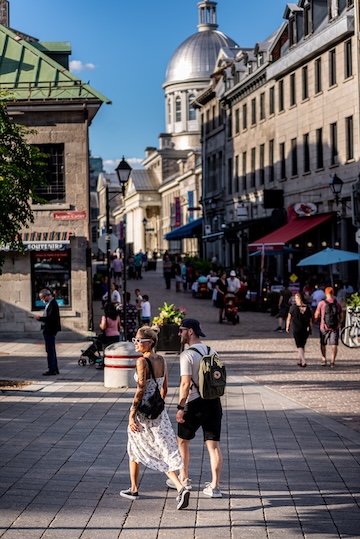
We joined a fast-paced bike tour to see the city’s highlights, pedaling 15 kilometres through green alleyways, busy boulevards and along the Lachine Canal to get a broad overview of Montreal’s history. We rode through the Old Quarter, with its ancient stone buildings, following the canal past factories and warehouses reincarnated into swanky apartments. We puffed up the hill to the base of Mount Royal and zipped back down past the austere buildings of McGill University. 

At Place d’Armes, we stopped to gaze at a pair of statues called “The Two Snobs.” On one side, a Francophone woman holds her poodle, looking with contempt at the head office of the Bank of Montreal, a symbol of English power. On the other, an Anglophone holds his pug, looking with similar disdain at the Notre-Dame Basilica, a symbol of the Catholic Church in Quebec. The statues hint loudly at the enduring, simmering tensions between English and French in Montreal.

photo - The Old Quarter of Montreal
The Old Quarter of Montreal. (photo © Freddy Arciniegas – Arcpixel – Tourisme Montréal)

We escaped the tourist crowds in the Old Quarter by heading to Mile End to join a food and history tour offered by the Museum of Jewish Montreal. Our guide, Avery Monette, a 23-year-old master’s student at Concordia, led us on a gastronomic feast as she described the city’s Jewish origins in 1760. That’s when Jews first arrived in Montreal to work as fur trade merchants. The community stayed small until the 1880s, when pogroms drove Eastern European Jews to the safety of Montreal’s Mile End. Over the next 90 years, it would become the largest Jewish community in Canada.

We bit into a sweet, rich cheese crown from Boulangerie Cheskie, a small kosher bakery in the neighbourhood, and then braved the cold wind to line up outside St-Viateur Bagel, one of Montreal’s two most famous bagel shops. Established in 1957 by Hyman Zeligman and Myer Lewkowicz, the store never closes. Ever. “In April 2023, there was an ice and snowstorm that knocked out all the electricity in the area,” Monette recalled. “Even then, this place was open!” 

We strolled along rue Jeanne-Mance in Mile End, where frum families pushed strollers alongside us and a man wearing a shtreimel strode by, headed for the synagogue with his tallit tucked under his arm. The Jewish influence was easily spotted, with most houses having mezuzot on their doors and many with the skeleton of a sukkah in their front yard. 

By the 1950s, Jews in Montreal had migrated to the middle class, and many left Mile End for larger homes in Côte Saint-Luc, Hampstead and Côte-des-Neiges. We passed the College Français, once the home of the B’nai Jacob Synagogue, which was known as the Carnegie Hall of cantorial singing in its heyday. 

Our Vancouver jackets were feeling pretty inadequate in Montreal weather by the time we arrived at Fairmount Bagel, where the line out the door was even longer than at St-Viateur. Once inside, we were surrounded by garlic, pumpernickel, cranberry and muesli bagels, as well as matzah with sesame, onion and poppy seeds. While none of it is kosher, the store is still owned by the same Shlafman family that first opened it in 1949. 

A few doors away is Wilensky’s, a small restaurant with origins in 1932 and family members still at the helm. With its Formica counters, bar stools and what could easily be the world’s tiniest washroom, the store feels like a 1930s time capsule. Monette orders the Wilensky Special, an original family recipe featuring beef salami, beef bologna and mustard on a grilled roll. No special requests or modifications are allowed, not for us or for Anthony Bourdain and Mordecai Richler, both of whom were customers. 

On Boulevard Saint-Laurent, new stories mingle with the old. We picked up a babka at Hof Kelsten, where Jeffrey Finkelstein is turning heads with his challah, rugelach and rye. We passed Leonard Cohen’s grey-stoned triplex, a house he lived in from 1968 and that’s still owned by his family. “He was well known for padding around the streets in the slippers he bought right here,” Monette says, gesturing at J. Schreter, a shoe shop on the corner.

photo - Lunch at Schwartz’s Deli
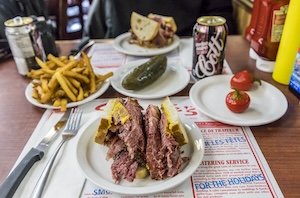
Lunch at Schwartz’s Deli. (photo © Eva Blue)

Between the bagels, the babkas and the Wilensky Special, it’s hard to make room for more food, but the length of the line outside Schwartz’s Deli tells us this one is not skippable, so on we go. Famous for its smoked meat sandwiches since its inception in 1928, the deli is now owned by Celine Dion and her partners, who have kept things much the same, adding a smoked meat poutine to the menu. Take a bite of one of Schwartz’s sandwiches, which literally bulge with hefty portions of meat, and you understand precisely why the little deli is such a cultural icon in the city. Quite simply, it’s unforgettable. It’s a fitting symbol for the city of Montreal, which is bursting with flavour.

Whether you come for the food, the history, the arts scene or the culture, Montreal is charmingly seductive, and so vastly different from Vancouver that it feels like an entirely different country. Now just four-and-a-half hours away, it’s an easy decision to put this sophisticated French city on the itinerary. 

If you go …

• In April, Porter Airlines launched its daily round trip service between Vancouver and Montreal (flyporter.com)

• A bike tour with Fitz Montreal is a great way to explore Montreal’s highlights, with many sights packed into an exhilarating, fast-paced ride (fitzmontreal.com)

• Museum of Jewish Montreal offers regular Beyond the Bagel Tours in the spring, summer and fall. The three-hour tours include food and range from $79-$95 per person (museemontrealjuif.ca/beyond-the-bagel)

• Humaniti Hotel offers sophisticated accommodation in the heart of the city, steps from Old Montreal, the Palais des congrès and the Quartier des Spectacles (humanitihotel.com)

Lauren Kramer, an award-winning writer and editor, lives in Richmond. 

Format ImagePosted on May 24, 2024May 23, 2024Author Lauren KramerCategories TravelTags arts, culture, food, history, Montreal, Porter Airlines, travel

A creator of unique places

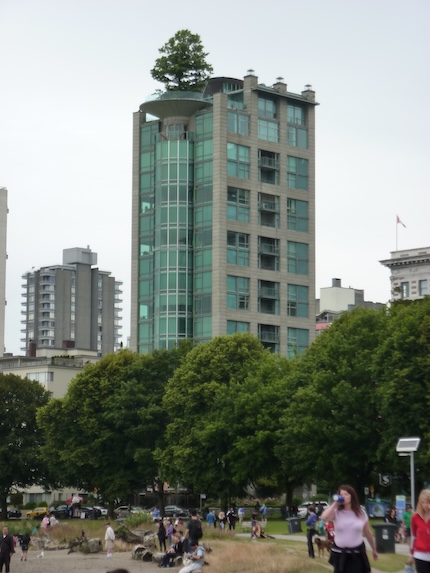
You may not know his name, but you certainly know his work. Vancouver Jewish architect Richard Henriquez has designed iconic local buildings including Eugenia Place in English Bay (the one with the pin oak on its penthouse terrace), the Sylvia Tower, the Sinclair Centre and the BC Cancer Research Centre. He designed New Westminster’s Justice Institute of BC, the UBC Michael Smith Laboratory, the UBC Recreation Centre and the Presidio. And that’s just scratching the surface of his 53 years of work in Vancouver, and well beyond. 

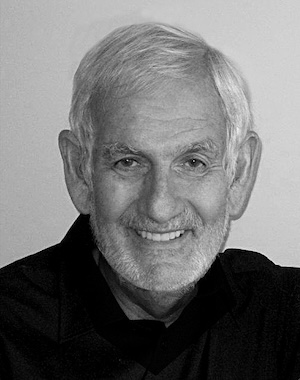
photo - Richard Henriquez
Richard Henriquez (photo from Richard Henriquez)

Henriquez, 83, was born in Jamaica in 1941. That same year, his father, Alfred George Henriques, aware of the danger facing the Jews of Europe, joined the Royal Air Force as a bomber pilot. He did not survive the war.

One of Richard Henriquez’s earliest childhood memories is of a powerful hurricane that brought wind speeds of 150 miles per hour, devastating Jamaica’s north coast. At the time, the 3-year-old Henriquez was living on the north coast with his mother, grandmother and sister. “I still remember the sound of the metal roofing being torn off the roof, the screaming of the wind and the crashing of crockery being blown off the kitchen shelves,” he told the Independent. “The next morning, there were fish all over the yard and trees flattened everywhere.”

With their family home ruined, Henriquez and his sister joined their grandparents on a citrus plantation in Greenwood, Jamaica. Later, they moved to Buff Bay, to a new home with their mother and stepfather. Henriquez attended boarding school and Hebrew school in Jamaica. “Over the High Holy Days, I’d go to synagogue but I was never very religious,” he said.

By age 10, Henriquez had already decided on a career in architecture, a choice influenced by his grand-uncle Dossie, an architect, engineer and artist who would take him along on building visits. Rudolph “Dossie” Henriques, whose firm was Henriques and Sons, had designed the Kingston synagogue in 1912, after the original was destroyed by a 1907 earthquake. He also won a competition to design and build Jamaica’s Ward Theatre in 1912, and worked on the structural drawings for New York City’s Grand Central Terminal. 

In 1958, after graduating from high school, Richard Henriquez left Jamaica to study architecture at the University of Manitoba. He returned to Jamaica after graduation and spent a couple of years working there before returning to North America to do a master’s degree at the Massachusetts Institute of Technology in 1967. He then settled in Vancouver.

“My wife, Carol, is from Saskatoon, and she didn’t love Jamaica. She preferred to come back to Canada,” said Henriquez, whose time in Jamaica had a lifelong influence on his architectural style.

“In Jamaica, materials are expensive and labour is cheap, so I tend to want to renovate rather than tear down a house,” he explained. “I think that’s much more interesting than creating a new building. Later on in my career, I designed a couple of buildings that look like they were built a long time ago and renovated, like the Sylvia Tower in the West End.” 

His talent as an architect has won Henriquez many accolades. In 1994, he won a Governor General’s Medal. In 2005, he won the Royal Architectural Institute of Canada’s gold medal. And, in 2017, he received an Order of Canada for his contribution to Canadian architecture.

“To me, architecture is about creating a unique place in the world,” he reflected. “Unlike West Coast modernists, who were inspired by light and connection to the outdoors, I was more interested in the specificity of a site, in researching the history of a site and incorporating it into the concept for a building.” 

photo - Richard Henriquez’s Eugenia Place, in English Bay, is topped with a 35-foot pin oak, brought to Vancouver from Oregon, representing a first-growth forest that covered the area decades ago
Richard Henriquez’s Eugenia Place, in English Bay, is topped with a 35-foot pin oak, brought to Vancouver from Oregon, representing a first-growth forest that covered the area decades ago. (photo by Andrew Bowden / flickr)

The Eugenia is a perfect example of Henriquez’s respect for the specific history and culture of a community. That 35-foot pin oak, brought to Vancouver from Oregon, represents a first-growth forest that covered the area decades ago. By incorporating it into the building, he paid homage to the landscape.

Henriquez’s son Gregory has followed in his footsteps and works alongside him at Henriquez Partners Architects in Vancouver, where Gregory Henriquez is overseeing the Oakridge Park complex in Vancouver, valued at over $5 billion. Richard Henriquez’s grandson is completing a master’s degree at the University of Toronto and will soon be joining the firm as the newest architect in the family.

Among his varied works, Henriquez designed Vancouver’s Temple Sholom Synagogue and, at one time, he had hoped to build something in Jerusalem, a goal that now seems remote.

These days, there are many projects competing for his time. A man keenly interested in genealogy, he traced his family history back more than 12 generations to Portugal, learning that his eighth-great-grandmother, Anna Rodriguez, was burned at the stake in 1643. He’s working on his second book on that family history, while also devoting time to art and sculpture, lifelong passions. Some of his work was on display at the Monica Reyes Gallery in Vancouver last month.

To learn more about Henriquez’s work, watch the 30-minute documentary Richard Henriquez: Building Stories on Shelter, an architecture streaming service. Commissioned by Marcon Developments, it celebrates his 53rd year of work in Vancouver and beyond. Also interesting to peruse is henriquezpartners.com/work. 

Lauren Kramer, an award-winning writer and editor, lives in Richmond.
Posted on March 8, 2024March 7, 2024Author Lauren KramerCategories LocalTags architecture, Eugenia Place, Jamaica, Richard Henriquez
Exploring Jamaica’s Jewish history

Exploring Jamaica’s Jewish history

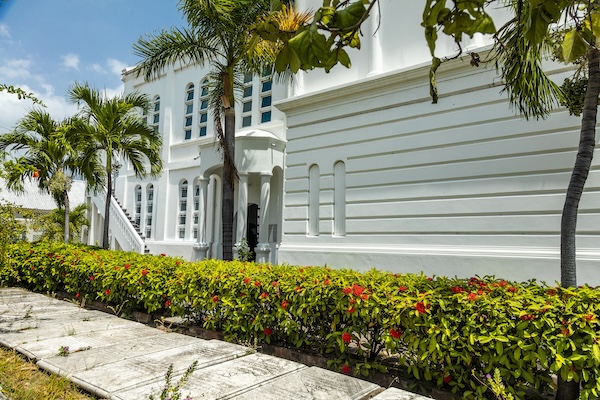
Congregation Sha’are Shalom in Kingston, Jamaica. (photo from Jamaica Tourist Board)

It was a muggy Friday afternoon just hours after my family and I had touched down in Jamaica for a two-week vacation, and the plan was to attend evening services at Kingston’s only synagogue, Congregation Sha’are Shalom. Too tired to argue, my kids and spouse changed clothes, we squashed six into the rental car and ventured into the city.

Though we knew the stately synagogue on Kingston’s Duke Street had been there since 1912, it still felt surprising to go inside and find eight members of the tribe leading a Shabbat service. The two-level synagogue is a magnificent piece of architecture, with a majestic, mahogany aron hakodesh filled with Torah scrolls from other Jamaican synagogues that closed or merged over the years. The ground floor is composed of sand, making this one of just five sand-floored synagogues worldwide. One story says the sand hearkens back to when Jews were worshipping in basements in Spain and Portugal, during the Inquisition, and sandy floors silenced their footsteps. Another legend says the sand is there as a reminder that we should multiply like sand on the seashore. 

Sha’are Shalom has space for at least 300 congregants, but when we arrived, there were just the eight locals and the six of us. The deep, sonorous baritone of one member, who led the service from the mahogany bimah, filled the air with a spiritual melody and, above us, ceiling fans whirred, adding a reprieve to the humid evening. From the bimah, Stephen Henriques, the spiritual leader, spoke of the dispersal of Kingston’s Jewish community over the past four decades, adding that many of today’s members are interfaith. “Still, we are here, celebrating and living our Jewishness, as we have done for centuries,” he said.

We were warmly welcomed to the service, and happily joined in a kiddush of grape juice, challah and sweet Jamaican coco bread. I tried to imagine a time when the synagogue was brimming with Jews, its walls resonating with children’s laughter, congregants’ prayers and Jewish possibilities. There were times like this, but they happened many, many years ago.

Jamaica was occupied by the Spanish from 1494 until 1655. During that time, Jews from Spain and Portugal began trickling onto the island. With the Spanish Inquisition underway, those Jews became Marranos, practising their faith in secret. In 1655, when the British occupied Jamaica, Jews were able to practise their faith without secrecy, but they weren’t completely free from discrimination. Between 1690 and 1740, a “Jew Tax” was levied and only in 1831, the year of the largest slave rebellion in the country, were Jews allowed to vote and participate fully in public life. 

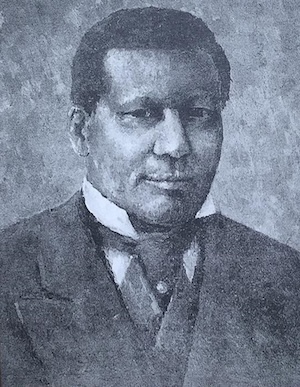
photo - Jewish businessman George Stiebel (1821-1896) was Jamaica’s first Black millionaire, in 1881
Jewish businessman George Stiebel (1821-1896) was Jamaica’s first Black millionaire, in 1881. (photo by CoCoLumps / wikimedia)

Jews had been quietly involved for years before that, but they embraced this opportunity with gusto. By 1849, eight of the members of Jamaica’s House of Assembly were Jewish. George Stiebel, a Jewish businessman who made his fortune in gold mining in Venezuela, was the country’s first Black millionaire, in 1881. He built Devon House, one of the country’s flagship mansions and a national monument today. 

We continued to nibble on coco bread in the Jewish Heritage Centre adjacent to the synagogue, wishing we had more time to peruse the walls, where there is lots of historical data on Jewish contributions to the island. It was dark by the time we left, so we didn’t have time to see the memorial garden, where tombstones dating back to the 18th century have been relocated.  

A few days into our stay, we left Kingston for Ocho Rios and Montego Bay on the north coast. When the sun shone, we explored Jamaica’s beaches, relishing the feel of the warm water on our skin. When the rain came pouring down, we drove to neighbouring parishes to explore small towns.

One such drive took us to Falmouth, a small town whose poverty and neglect is loudly revealed in its deeply potholed roads and dilapidated homes and buildings. Coming, as we did, from an all-inclusive resort just 20 minutes away, the disparity between the two environments was glaring. 

But it wasn’t always this way. The Jewish cemetery in Falmouth is filled with the graves of Jewish merchants who dominated the once-flourishing trade here in the 19th century. When I announced we were making a stop at the cemetery, there was a collective groan from the back of the car. “We went to synagogue – now we have to visit dead Jews?” my son asked. As my husband valiantly navigated through potholes the size of small swimming pools, I tried to explain how a cemetery could be a fascinating place to explore history. 

Though we were probably only a stone’s throw away from the cemetery, we never made it. After one particularly large pothole, and another ahead that threatened to drown the rental car, a decision was made. “I love you, sweetheart, but I just don’t want to get stuck out here,” my husband declared.

I couldn’t blame him.

Drive around Jamaica and safety is not a feeling that comes easily. For one, the drivers overtake with such reckless disregard for life that road accidents always feel imminent. For another, the looks you get from some locals leave your Spidey sense tingling with fear. Leave the resorts and there are few warm welcomes from the community at large it seems, with the exception of those who have something to sell. Jamaica is known for its violence, with a rate of 52.9 homicides per 100,000 people, as compared to Canada’s, at 2.5.

We turned around and headed back to the resort, where staff sweep trash off the beach daily, and food and booze are readily available day and night. Moving between the pool and the ocean, it didn’t take long to relax. As the mojitos flowed, though, my mind kept returning to those tenacious Jews who arrived in Jamaica hundreds of years ago. They came with sand in their shoes and buckets of determination to pursue their religion and build success in a new land. I wondered what they’d say if they could see Jamaica today. 

Lauren Kramer, an award-winning writer and editor, lives in Richmond. 
Format ImagePosted on March 8, 2024March 7, 2024Author Lauren KramerCategories TravelTags Congregation Sha’are Shalom, history, Jamaica, Jewish community, Judaism

Posts pagination

Previous page Page 1 Page 2 Page 3 Page 4 … Page 15 Next page
Proudly powered by WordPress