Skip to content
  • Home
  • Subscribe / donate
  • Events calendar
  • News
    • Local
    • National
    • Israel
    • World
    • עניין בחדשות
      A roundup of news in Canada and further afield, in Hebrew.
  • Opinion
    • From the JI
    • Op-Ed
  • Arts & Culture
    • Performing Arts
    • Music
    • Books
    • Visual Arts
    • TV & Film
  • Life
    • Celebrating the Holidays
    • Travel
    • The Daily Snooze
      Cartoons by Jacob Samuel
    • Mystery Photo
      Help the JI and JMABC fill in the gaps in our archives.
  • Community Links
    • Organizations, Etc.
    • Other News Sources & Blogs
    • Business Directory
  • FAQ
  • JI Chai Celebration
  • JI@88! video

Recent Posts

  • Story of Israel’s north
  • Sheltering in train stations
  • Teach critical thinking
  • Learning to bridge divides
  • Supporting Iranian community
  • Art dismantles systems
  • Beth Tikvah celebrates 50th
  • What is Jewish music?
  • Celebrate joy of music
  • Women share experiences 
  • Raising funds for Survivors
  • Call for digital literacy
  • The hidden hand of hate
  • Tarot as spiritual ritual
  • Students create fancy meal
  • Encouraging young voices
  • Rose’s Angels delivers
  • Living life to its fullest
  • Drawing on his roots
  • Panama City welcoming
  • Pesach cleaning
  • On the wings of griffon vultures
  • Vast recipe & story collection
  • A word, please …
  • מארק קרני לא ממתין לטראמפ
  • On war and antisemitism
  • Jews shine in Canucks colours
  • Moment of opportunity
  • Shooting response
  • BC budget fails seniors
  • Ritual is what makes life holy
  • Dogs help war veterans live again
  • Remain vital and outspoken
  • An urgent play to see
  • Pop-up exhibit popular
  • An invite to join JWest

Archives

Follow @JewishIndie
image - The CJN - Visit Us Banner - 300x600 - 101625

Byline: Cynthia Ramsay

Novelist explores Trump era

Novelist explores Trump era

Gary Shteyngart opens the Cherie Smith JCC Jewish Book Festival on Feb. 8 at Rothstein Theatre. (photo by Brigitte Lacombe)

“You want to know the first rule of running a billion-dollar-plus hedge fund?” Lake Success protagonist Barry Cohen recalls telling the high school boys who invited him to speak to their Investors’ Club. “Don’t sweat the metrics. We’re not really about the numbers. Do you know what we are? We are a story. Hedge funds are a story about how we’re going to make money. They’re about being smart, gaining access, associating with someone great. You. You are someone smart enough to make others feel smart. You are bringing your investors something far more elusive than a metric. You’re bringing them the story of how great you’ll be together.”

Through the character of Barry Cohen, on his journey to what would be self-discovery if he were at all self-aware, author Gary Shteyngart explores the societal circumstances in the United States that led to the election of President Donald Trump – and could well do so again.

Shteyngart opens the Cherie Smith JCC Jewish Book Festival on the night of Feb. 8. In conversation with CBC’s Lisa Christiansen at Rothstein Theatre, he will no doubt talk about his latest novel, Lake Success, about a hedge-fund manager who flees his wife and young child, who has recently been diagnosed with severe autism, as well as a Securities and Exchange Commission investigation into his financial dealings.

Barry is stuck in a childlike state. He had a difficult father and his mother was killed in a car crash, a death Barry witnessed and which haunts him. Barry yearns for affection; he cannot regulate his emotions. He believes himself to be a self-made man and he is constantly coming across people he thinks would benefit from his mentorship, from fellow fund managers to a poor black youth he encounters on his travels to his first girlfriend, with whom he is trying to reconnect – hence, the bus trip. He is trying to find her, in the hopes of rekindling that relationship, and all the lost hope it encapsulated, while disregarding all the relationships – personal and business – he has left behind in New York City.
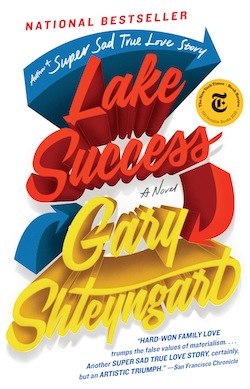
image - Lake Success book coverThe main female characters in Lake Success – Barry’s wife, Seema, and his former girlfriend, Layla – are not as well-constructed as is Barry. Despite a sympathetic portrayal, it is hard to understand what anyone would see in Barry, yet he manages to attract smart and beautiful women. The novel provides some explanation as to why Seema would marry him, including family expectations. And, after meeting him for the first time, she recalls, “she went home and Googled Barry’s net worth and found it comforting. A man that rich couldn’t be stupid. Or, Seema thought now, was that the grand fallacy of 21st-century America?” So, she thought she was connecting with an intelligent and wealthy man, but how Barry continues to be an attractive prospect to women (and men) after he cowardly runs away from his responsibilities and is nearly penniless is a bit of a mystery.

For some readers, Shteyngart might come down a little too easy on the one-percent, as exemplified by Barry, Seema and the few people we meet in their realm. When the Jewish Independent asked the author why it was important to imbue the character of Barry with humanity, Shteyngart said, “Books about inhumane characters are not fun to write. Imagine an entire novel set from Trump’s point of view. Eat burger, get angry, eat burger, get angry. It’s just not 330 pages worth of material.”

That is not to say that Shteyngart is condoning the lifestyle of the ultra-rich; in fact, quite the opposite, though he does so with seeming resignation.

“Without giving too much away for the new reader,” he said, “Barry does change. Somewhat. Slightly. But the damage that has been done to the country socially and politically by Barry-like oligarchs is not going to go away, even if the next election ends the so-called Trump Era.”

While Lake Success doesn’t offer insight into how the divisions in Trump’s United States could be repaired, Shteyngart’s acerbic wit and astute observations offer an entertaining read that will hopefully elicit readers’ introspection about our own privilege and identities, how we define and carry ourselves in the world. Both Barry and Seema have a conflicted relationship with their cultural heritage; Barry his Jewish, Seema her Tamil.

As Barry holds his three-week-old son in his arms – long before the autism has been diagnosed – “he whispered through all his agnostic lapsed-Jew bullshit, ‘Please, God, just don’t do anything to him, okay? My sins are my own.’”

Later in the novel, on the bus as it enters Louisiana, Barry overhears a conversation between two white men, one an aspiring preacher who declares hatred of “any kind of ignorance,” then goes on to explain why “they nailed Jews to the cross” and that “Muhammad was killed, because he couldn’t accept Jesus Christ as permanent.” At that moment, “Barry realized that the man was now looking at him. And also that he was a Jew. He hadn’t really thought of being Jewish since he was in grade school. But he did now.”

Even later, Barry would again look at his heritage differently, considering how it could be passed on to his son. For the most part, though, Barry is perceived as a white male throughout the novel.

“Yes, it’s very strange,” said Shteyngart about being Jewish in America. “I was being interviewed by a Jewish intellectual who was trying to convince me that we weren’t white. Which is oddly enough the talking point of the neo-fascist right. In any case, the feeling that Jews were a part of the American mainstream – think Seinfeld – has been badly shaken both by the physical attacks against Jews and by the general feeling that the country is now being run as an exclusive enclave for straight white Christian males with the occasional sprinkling of Sheldon Adelson.”

Lake Success is a provocative read with some brilliant one-liners, such as the description of neighbours in their building, whom Barry hates, as being “so featureless, they could have come with the hallway,” and, when he faces difficulty becoming a writer, Barry concludes, “He was a damaged person, but not damaged enough to make a life out of it.”

The Jewish Book Festival runs to Feb. 13 at the Jewish Community Centre of Greater Vancouver and other venues. For the full lineup, visit jewishbookfestival.ca.

Format ImagePosted on January 24, 2020January 22, 2020Author Cynthia RamsayCategories BooksTags Cherie Smith JCC Jewish Book Festival, Gary Shteyngart, humour, Lake Success, novelist, social commentary, Trump
Searching for a safe harbour

Searching for a safe harbour

Ben Caplan is narrator and co-creator of Old Stock: A Refugee Love Story, which runs Jan. 24-30 at Frederic Wood Theatre, as part of the PuSh festival. (photo by Stoo Metz Photography)

The 2020 PuSh International Performing Arts Festival opens next week. Among the highlights is Old Stock: A Refugee Love Story, which follows Chaim and Chaya from the pogroms in Romania they are fleeing, to Halifax’s Pier 21, where they meet in 1908, to Montreal, where they end up living. The show, which runs Jan. 24-30 at Frederic Wood Theatre, is narrated and co-created by Halifax-based musician and performer Ben Caplan, with whom the Jewish Independent recently spoke.

JI: How and when did you become involved in the production?

BC: It all started with a phone call from 2b Theatre Company’s artistic co-director Christian Barry in mid-2015. Christian was familiar with my work as a songwriter and performer in the music world and he wondered if I would be interested in collaborating on creating a theatrical production featuring new songs that we would write together.

To be honest, I was skeptical at first. I tend to be a very solitary writer and, though I had a lot of experience in theatre many years ago, it had been a decade since I had performed in theatre. The first few writing sessions were pleasant enough and Christian and I got along great, but we were struggling to find the story that we wanted to tell. As we were searching and exploring to find the substance of what the work would consist of, a confluence of events conspired to show us the story that would become Old Stock.

The first thing was our growing consciousness of the scale of the human tragedy emerging in Syria as a growing number of refugees started trying to find their way out of the violence. Next came Prime Minister Stephen Harper’s comments about “Old Stock Canadians” during the 2015 leadership debate. This othering of “non-Old Stock Canadians” seemed to be vile and absurd. At what point does one get to call themselves “Old Stock”? I am the great-grandson of Jewish immigrants who came to Canada fleeing violence in their own home countries. Was I supposed to think of myself as “Old Stock” or did I fit into some other category in our [then] prime minister’s logic.

Around this time, Christian’s wife, who happens to be the celebrated playwright Hannah Moscovitch, gave birth to their first child, Elijah, and came across the immigration records of her own great-grandparents who immigrated to Canada in 1908 through Pier 2 in Halifax. She realized that, if her great-grandparents hadn’t made the journey to Canada, she would not exist, let alone her infant child. It was then that Hannah asked if she could write the scenes for the show we were trying to create.

With Christian’s vision of the artistic whole, my work as composer and lyricist, and Hannah’s work as playwright, we were off to the races and we worked together to create the show. We thought that the Jewish story from 110 years ago had a striking and tragic resonance with the tragedy unfolding in our own time. I should mention that, of course, the originating cast, musical director Graham Scott, our production manager and designer Louisa Adamson, and many others played a huge role in realizing the vision and bringing the music and the play into the world.

JI: In broad strokes, could you describe how the co-writing process worked?

BC: Christian Barry created the structures and conditions that made it possible for any of these songs to be written. I was probably not always the easiest artist to work with – I tend to desire quiet and solitude when I am writing.

The way it usually worked is that Christian would book a time and a space in whatever city we were able to meet up in (we did writing in Halifax, Montreal, Stratford and Banff) and the day would start with conversations and questions. We would talk, share ideas, listen to music, read texts, Google things, etc.

Out of our conversations and questions, the idea for a song would emerge. The first one we wrote was something for their arrival at Pier 2. We didn’t have a scene or a broader context to work with but, after awhile, Christian would say something like, “We know they are going to come through Pier 2, let’s start there.” I sat at the piano and started mashing out some chords and throwing words into the air. Christian had a wonderfully delicate touch after I got rolling, and would provide helpful comments, critiques, and throw ideas into the room.

JI: What is it about the production that drew you back to performing?

BC: I had stopped performing in the theatre after I became somewhat disillusioned of the possibilities of making a career in theatre. In 2005, the year I did my last theatre performance, I was working on academic pursuits, theatre and my hobby as a singer-songwriter. My life was over-full and something had to give. My logic was something like, in theatre, you need to rely on finding a lot of talented people who are willing to work on a project that takes a lot of time and resources to complete. As a singer-songwriter, there is more room to work solo and bring other people into the project as interest and resources permit. So, that’s the path I chose to express my artistic impulses. I gave up the dream of becoming an actor to focus on the more reasonable and safe path of becoming a songwriter. Ha!

When Christian called me to ask me to make a piece of theatre with him, it was a no-brainer. Being a part of this show has been one of the great privileges of my life. Not only did I get to collaborate with a crazy good team on writing the thing, but I had the opportunity to perform on stages that I wouldn’t have dared to dream of stepping onto when I was making theatre 10 years ago. It’s been an amazing learning experience and one that is sure to influence my work as a performer for the rest of my career.

JI: In what ways does the story and/or themes of Old Stock speak to you as a Canadian in 2020?

BC: What is most meaningful for me about the story and themes of the show is the humanization of the character of the refugee. It has been disturbing to see the ways in which migrants have been portrayed by so many politicians and media outlets around the world. They are often spoken of as hordes, masses and statistics. What is lost are the individual human lives – people with hopes, dreams, fears and trauma searching for a safe harbour.

In Old Stock, we tell the story of Hannah Moscovitch’s great-grandparents coming to Canada. We see their struggles to overcome their past and to generate new and complicated identities. I think that we all, as human beings, have complicated and multi-layered identities. I think that, among other things, this show is about demonstrating layered and sometimes tragic identities with compassion and a healthy dose of humour. That’s basically the most Canadian thing I can think of.

For tickets to Old Stock: A Refugee Love Story and other PuSh shows, visit pushfestival.ca. The soundtrack to Old Stock is available on Spotify, YouTube and elsewhere.

Format ImagePosted on January 17, 2020January 15, 2020Author Cynthia RamsayCategories Performing ArtsTags Ben Caplan, Christian Barry, Hannah Moscovitch, immigration, music, Old Stock, PuSh International Performing Arts Festival, refugees, theatre
Last Cabaret almost sold out

Last Cabaret almost sold out

Joanna Garfinkel is part of the creative team behind the world première production of Berlin: The Last Cabaret, part of the PuSh festival. (photo from the artist)

The world première of Berlin: The Last Cabaret, presented at Performance Works Jan. 23-26 by City Opera Vancouver in association with Sound the Alarm: Music/Theatre, is almost sold out. Part of the PuSh International Performing Arts Festival, the only tickets that remain will be sold at the door, though writer and Jewish community member Joanna Garfinkel told the Independent, “I hope we are able to add more presentation opportunities, as well, since this is truly becoming an exciting and rich production.”

Set in Nazi Germany in 1934, a group of artists must decide whether or not to perform their new political show – which, reads the press release for Berlin, “challenges state media, calls out the Nazi classification of gay individuals as ‘degenerates’ and includes parodic inflection that women are being marginalized” under the new regime – or save themselves.

The opera takes place “two weeks after ‘the Night of Long Knives,’” said Garfinkel, “when the future had been cast, but many were not yet seeing it, including my own family. One thing that interested me a great deal is how people are forced to make compromises under oppression, and even make excuses for what’s happening around them.”

The “Night of the Long Knives” was the June 30, 1934, purge by Hitler of more than 85 members of the Sturmabteilung, the Nazi party’s initial paramilitary wing.

Rather than being a satire itself, Garfinkel explained that Berlin: The Last Cabaret “is more an unearthing of the under-heard Jewish and queer artists who flourished in the Weimar era and were crushed by the Holocaust. The humour we employ is their urgent satire, which feels fresh and relevant with all that is going in the world right now.

“My own family escaped from Berlin to Winnipeg (eventually), so I am both bound to respect and honour the history, and also privy to the dark humour we employ about it.”

City Opera Vancouver approached Garfinkel last spring, she said. They had “heard about me from my dramaturgical work with Playwrights Theatre Centre and the historically based Japanese Problem for my own company, Universal Limited. I was excited by the opportunity to work with an opera company, which would be new to me, but on something quite close to my heart, history and interest.”

The relevance of the opera was one of the reasons she joined its creative team. In regard to choosing projects in general, she said, “Right now, it feels like art must be speaking to the world and on behalf of marginalized voices. Theatre is too much work, and the world too messed up, to work on projects that don’t resonate on an activist level. I am lucky right now to get to choose to work on things that are so resonant.”

Garfinkel, who is billed as librettist for the production, clarified that categorization.

“I contributed story, structure and additional dialogue for this piece,” she said, “but it’s important to note that the songs themselves are historical, written by composers Eisler, Spoliansky, Hollaender and Weil, so I am not, technically, the librettist. However, building a story and play around preexisting songs presents its own challenges. It was of central importance to me that the Jewish/queer and other marginalized artists of the time were centred in our story.

“We were working with excellent (but unavailable!) collaborators in our composers and, together with director Alan Corbishley, music director and historian Roger Parton and choreographer Tara Cheyenne Friedenberg, tried to honour their work and build a vital story around it.”

Cheyenne Friedenberg is also a member of the Jewish community.

Berlin: The Last Cabaret stars actors with a background in music and spoken theatre, rather than traditional opera singers, and each performer, according to the press release, “was involved in the creation of their on-stage characters and storylines.” The production features a live four-person band.

For more information on PuSh, visit pushfestival.ca.

Format ImagePosted on January 17, 2020January 15, 2020Author Cynthia RamsayCategories Performing ArtsTags Berlin, free speech, Hitler, Holocaust, Joanna Garfinkel, LGBTQ+, Nazis, PuSh International Performing Arts Festival, satire, theatre
BRCAinBC’s inaugural event

BRCAinBC’s inaugural event

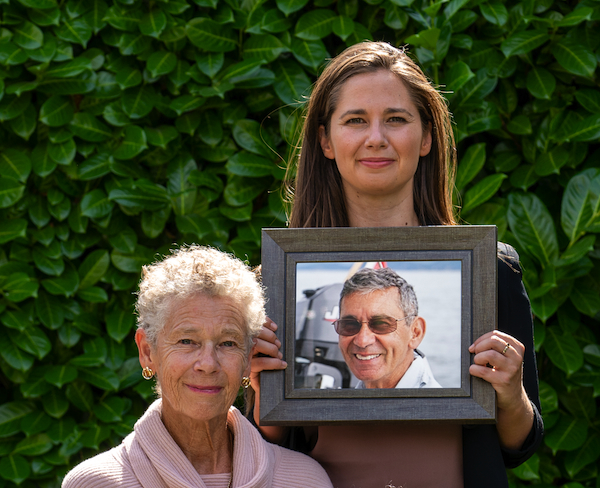
Jane Remocker and her daughter, Catriona, holding a photo of Geoff Remocker, who passed away in 2016 from pancreatic cancer. (photo from BRCAinBC Committee)

Education is a key goal of the upcoming One in 40: From Awareness to Empowerment event being held at Congregation Beth Israel on Jan. 8.

“BRCA 1 and 2 is the code for variant mutations of two genes known to increase the lifetime risk of several serious cancers, including breast and ovarian cancers and other cancers linked to reproduction in women and prostate cancers in men, as well as pancreatic cancers and melanoma in all genders,” explains the BRCAinBC Committee’s project primer. One in 40 is the probability of carrying the genes among Ashkenazi Jews – compared to a risk of 1/500 to 1/1000 in the general population.

The BRCAinBC Committee, organizer of the One in 40 event, describes itself as “a group of concerned members of the Jewish community in British Columbia, many of whom have been affected personally or in our families by the BRCA 1 or BRCA 2 genes and genetically linked cancers.”

The committee’s work is supported by Beth Israel, which is its home, as well as many other community members, organizations and institutions, including the B.C. Cancer Agency, the Centre for Israel and Jewish Affairs, the Jewish Federation of Greater Vancouver and the Diamond Family Philanthropic Fund.

“There are currently no efforts being made in British Columbia to create awareness or cover general genetic testing for people of Ashkenazi Jewish heritage – in the past, this was due to the prohibitive expense of testing,” notes the primer.

“There have been significant recent gains in the medical community around improving the affordability of testing for genetic mutations,” it continues, “however, awareness of risk is still low amongst members of the Jewish community and, currently, holding a risk profile of being of Ashkenazi Jewish descent is not sufficient to be covered for genetic testing under B.C.’s Medical Services Plan (MSP).”

The impetus for the committee and the One in 40 event was the death of Geoff Remocker of aggressive prostate cancer in 2016. After he died, his wife, Jane Remocker, and the family met with Beth Israel’s Rabbi Jonathan Infeld. She explained to the Jewish Independent in a phone interview that, as members of the congregation, there were donations being made to the synagogue in her husband’s honour, and the rabbi wanted to know where the family wanted to direct the funds. The couple’s youngest daughter, Catriona, who works in the healthcare field, suggested they do something with respect to BRCA genes. Since they weren’t quite sure what they wanted to do on the topic, the donations were held in a discretionary fund until Jane Remocker scheduled a meeting with the rabbi and her daughter two years later, in June 2018.

“By then, she and I had ideas and came up with our three basic goals,” Jane Remocker told the Independent. The three short-term goals of the committee were education and awareness within the Jewish community, and easier access to information about the BRCA genes; advocacy, which involves providing information about and access to screening options, both private and public; and fundraising to cover what has become the One in 40 community-wide education event and the BRCAinBC.ca website, which will be launched in January.

Since Geoff Remocker didn’t meet the criteria for B.C. Cancer Agency’s Hereditary Cancer Program, which offers genetic counseling and testing for “residents who may have inherited an increased risk for specific types of cancer,” he signed up for a B.C. Cancer study of drugs that treat prostate cancer, which included gene testing.

Remocker said he signed up for the study because, “as he said to me, ‘I don’t think the drugs will help me, I think it’s too late. But, if there’s a gene that’s driving this cancer to be aggressive and resistant to treatment needed, that knowledge will help other people.’” It was discovered that he was indeed a BRCA carrier.

Part of the issue, said Remocker about why her husband wasn’t eligible for the Hereditary Cancer Program, was that, while they knew some of her mother-in-law’s medical history, they knew nothing about her father-in-law’s side of the family, who came from Poland and Russia.

“And this is not uncommon,” she said. In addition to this generation not talking about health issues, in general, there wasn’t so much knowledge about health back then.

While a lack of family medical history can be one obstacle in getting genetic testing, she said, another is that many people don’t realize that men can be carriers of the BRCA mutant genes.

“They thought it was only a gene that affected women as breast cancer,” said Remocker. It is important, therefore, and a goal of the committee’s educational program, to make sure that Jewish men – especially if they have roots in Europe – know that they are possible carriers and, therefore, consider getting screening.

photo - Libby Znaimer, national spokesperson for Pancreatic Cancer Canada, will be the keynote speaker at One in 40: From Awareness to Empowerment, which takes place Jan. 8 at Congregation Beth Israel
Libby Znaimer, national spokesperson for Pancreatic Cancer Canada, will be the keynote speaker at One in 40: From Awareness to Empowerment, which takes place Jan. 8 at Congregation Beth Israel. (photo from BRCAinBC Committee)

Confirmed panelists for the One in 40 event are Dr. Rona Cheifetz, medical lead of the Hereditary High Risk Clinic, B.C. Cancer Agency; and Dr. Intan Shrader, who, along with Dr. Sophie Sun, is co-medical director of the B.C. Cancer Hereditary Cancer Program. The panel will also feature medical oncologist Dr. Daniel Khalaf of the B.C. Cancer Agency and Jewish community member Tovah Carr, a BRCA carrier. There will be a chance for audience members to ask questions.

Keynote speaker Libby Znaimer of Zoom Media is national spokesperson for Pancreatic Cancer Canada; she is a cancer survivor and a BRCA gene carrier. Her personal fight against breast and pancreatic cancer is the subject of the 60-minute documentary Cancer Saved My Life, which discusses “the BRCA 1 and BRCA 2 gene mutations that predispose people to pancreatic cancer, and the connection between BRCA and breast and ovarian cancer,” as well as the “groundbreaking research going on in Canada and Israel, where there is a BRCA-rich population.”

The BRCAinBC.ca website will be “a one-stop place for people to go to get information about the genes and the mutations that indicate the cancer risk and where they can go for private screening if they don’t meet Hereditary Cancer’s criteria or they don’t want to wait,” said Remocker.

Hereditary Cancer has a long wait list, she said, so the website will have some options for private screening. “We’ve researched and found a number of accredited medical genetic labs that do specific inherited Jewish genes screening and we know that, [for] at least two of them, the results are accept[ed] by the Hereditary Cancer Program.”

Currently, the cost for private testing is about $250 US, said Remocker. This alternative means that, “instead of waiting six to 12 months to get your first interview with the Hereditary Cancer Program, you get a saliva test, you apply. They send the package to you, you send it back and you get your results anywhere from two to six weeks.”

A person can then take those results to their family doctor, she said, as a referral is needed for the HCP.

The website will also feature personal stories of those who have been affected by the BRCA 1 and BRCA 2 genes, as well as links to current research and resources.

Michelle Capobianco, the executive director of Pancreatic Cancer Canada, will be in attendance at One in 40, Catriona Remocker told the Independent. “[T]hey are considering working with us to roll out similar events to Jewish communities across Canada to improve awareness,” she said.

To register for the event, which runs 7-9 p.m., visit bethisraelvan.ca/ event/one-in-forty.

Format ImagePosted on December 20, 2019December 18, 2019Author Cynthia RamsayCategories LocalTags Ashkenazi, Beth Israel, BRCA, cancer, education, health, Remocker
Jacob Samuel records album

Jacob Samuel records album

Jacob Samuel is at Yuk Yuk’s Vancouver Dec. 27-28 to record his debut stand-up comedy album. (photo from Jacob Samuel)

Jacob Samuel’s headlining performances at Yuk Yuk’s Vancouver Dec. 27 and 28 are special – Samuel is recording his debut stand-up comedy album live.

“I have complete freedom content-wise, and I am trying to record an album that has 45 minutes of the best jokes possible,” Samuel told the Independent. “I’ll mainly be recording jokes from the act I’ve honed over the last five to six years in venues throughout Canada. Part of my act has jokes about being Jewish and Judaism that I’m very proud of because they challenge stereotypes people may have about Jewish people as opposed to confirming them.”

The last couple of years have been productive for Samuel.

In 2017, he was part of the television taping at the Winnipeg Comedy Festival and he made his first appearance on CBC’s The Debaters. Since then, he has appeared two more times at the Winnipeg Comedy Festival and has returned to The Debaters, as well.

In 2018, he made his debut at the Just for Laughs Festival in Montreal and he was featured on JFL Northwest’s Best of the West Compilation album last year. In total, he has now taped five sets for Canadian TV and has performed even more times on CBC Radio.

“This summer,” said Samuel, “I got booked to go to the Just for Laughs Festival in Montreal for the second time, back-to-back. I went to perform on the Hasan Minhaj Gala. The galas are taped for TV in the 3,000-person theatre at Place des Arts.

“Getting on a JFL gala is the most coveted spot in Canadian comedy because those are the biggest shows at the festival. Every year, only a dozen or so Canadian comics get that opportunity.

“JFL Montreal, by the way, is the biggest comedy festival in the world – the entire comedy industry is there. So, when I was there, I was able to connect with 800 Pound Gorilla, an American Record label (based in Nashville) for comedy, and I told them I was doing a gala and wanted to record an album soon and, luckily, they were interested in signing me.”

Success entails doing harder gigs and carries the pressure to produce material at a faster pace, said Samuel, but he seems to be keeping things in perspective.

“I’m in my early 30s now, so the main thing in my life is that I enjoy getting home and going to bed earlier more than I use to. I don’t stay up late hanging out and drinking with other comics as much after shows. Not that I was ever a big partier, but it’s just nice to admit you like being in pajamas now.

“I also met my girlfriend/partner through comedy and we’ve been living together for a year-and-a-half now. So, I do a lot of writing by bouncing ideas back and forth with her. I have many more jokes now about being in a long-term relationship. My partner is not Jewish and did not know many Jewish people growing up, so it’s been interesting observing what she thinks about Jewish culture. I took her to her first Passover seder last year. On the way there, she asked me what it would be like and I said, ‘It’s hard to describe but tonight will be the most excited you’ll ever be to eat a hard-boiled egg.’”

Samuel recalled his early days in comedy.

“When I did my first open mic, I just wanted to see if I could physically do it,” he said. “I did not intend to become a comedian but, somehow, I got hooked and kept going. I’m starting to close in on 10 years and it’s weird to think about because, in some ways, comedy still feels like such a new thing. Having said that, when I look at very old videos, I cringe. I keep a hard copy of some of my earliest jokes in a drawer just to remind myself how far I’ve come (those jokes were very bad).”

When asked how his comedic content, delivery or style has changed since he began, Samuel said, “In short, it’s gotten a lot better. Part of learning how to do comedy is trying a lot of different types of jokes and seeing what works for you. So, now, I have a much better idea of what my ‘style’ is. Also, after countless professional club gigs, five TV tapings and several radio appearances, I’m a much stronger performer than I used to be. I’m able to do more complicated bits of material and I can now take ideas that used to be too abstract or subtle and make them work. I now have way fewer jokes about being single and way more jokes about things like carrot cake and moths.”

In addition to stand-up, Samuel is also a talented cartoonist, even having his work published in The New Yorker. While this aspect of his creative life has been put on the backburner for the last few years, he said, “I’m still cartooning but I’d like to put more time into it after this album.”

Other than that, he said he doesn’t have any other major projects planned at the moment.

“I’d like to do a second album in a few years, when I have more material. In the meantime,” he said, “I’ll keep trying to return to Canadian festivals and TV and radio. My partner and I would also like to do more sketch writing. Maybe I’ll submit to write for Canadian TV.”

Tickets for the live album recording shows Dec. 27 (8 and 10:30 p.m.) and Dec. 28 (7 and 9 p.m.) are on sale at yukyuks.com/vancouver.

Format ImagePosted on December 20, 2019December 18, 2019Author Cynthia RamsayCategories TV & FilmTags comedy, Jacob Samuel, Just for Laughs, television, Yuk Yuk's
It’s a Wonderful Life in music

It’s a Wonderful Life in music

Erin Palm and Nick Fontaine reprise their roles as Mary and George Bailey in Patrick Street Productions’ musical It’s a Wonderful Life. (photo by David Cooper)

So ingrained in popular culture is Frank Capra’s It’s a Wonderful Life that many Jews probably make it an annual tradition to watch the 1946 film. This year, there is also the chance to see a musical adaptation of the classic, in which the angel Clarence is assigned the job of trying to save Bailey Building and Loan owner George Bailey from committing suicide on Christmas Eve, after there is a run on the bank and George faces the possibility not only of financial ruin but of believing his life has been a waste.

Patrick Street Productions presents the musical version by Peter Jorgensen, with arrangements and orchestrations by Nico Rhodes, at the Anvil Centre Theatre in New Westminster from Dec. 19 to Jan. 5. The show is the only ticketed event of Winter Celebrations, free daily performances by professional artists, singers and musicians at the Anvil Centre until Jan. 5.

It’s a Wonderful Life features a few Jewish community members: Erin Palm as George’s wife, Mary; Andrew Cohen as Ernie, who Cohen describes as “everyone’s favourite Bedford Falls cabbie”; and Stephen Aberle playing, in his words, “the ruthless, cold-hearted capitalist Mr. Potter, as well as the Sheriff, and hero George Bailey’s father, Peter.”

“Mr. Potter is the antagonist of the piece,” explained Aberle. “He owns practically everything in the small town of Bedford Falls, other than the little Bailey Building and Loan Society that George Bailey’s father founded and that George continues. Potter hates the Building and Loan and does everything he can to crush it because it helps working people to save and buy their own homes instead of having to rent from him and live in the slums he owns.”

While Cohen and Aberle are new to the show, Palm played Mary in the 2018 Patrick Street production at the Gateway Theatre. As an aside, she said, “I also auditioned for the original production in Chemainus so many moons ago. I am so happy it all worked out the way it did. I truly believe it was the right fit for me at this time in my life. I have so much more personal growth and experience to bring to the role of Mary.”

Never wanting her acting to be a copy of someone else’s work, Palm said she has not seen the movie in its entirety. “I have seen some clips,” she said, “but not enough to develop a multifaceted character. Peter has written a great script and all I need to bring Mary to life is in the text. The musical aspect is completely different from the movie, and I think a beautiful addition.”

About her character, Palm said, “I appreciate Mary’s faith in community and her love for her family. She’s really strong and an anchor for George. When she wants something in her life, she goes after it. She’s the matriarch and heroine of the story. She comes through for her family and for her community when times are at their worst.

“I also appreciate her love of the simple life. In complex times like ours, and when I find my ambition too great, it’s people like Mary that remind me I can be happy and grateful for what I have, what I have worked so hard to create.”

One of Palm’s favourite scenes is “the moment right before we meet Clarence,” she said. “George is on the bridge and he’s deciding the fate of his own life, the same bridge where so many of his life’s highlights happen. It often makes me weep backstage. It’s difficult to think of people who carry the weight of the world with them, feeling isolated and alone, especially around the holidays, but the reality is the troubles of the world do not stop around those times and are in fact amplified for people who are struggling with depression and financial hardship. It’s a beautiful reminder how important it is to reach out to those around you, be a light in their lives. It only takes one person, one gesture to change the outcome of the lives of many.”

For her part, Palm is grateful to be working with the cast and especially Aberle, who happens to be her father-in-law. “Working on a show that has to do with family makes me long for family during the holidays and it is a gift to work with him,” she said.

Of the Christmas aspect of the show, Palm said the story is based in community and, “while we sing some Christmas carols, the heart of the piece is a very human story of how communities can overcome hardship by coming together around the holidays to help those who need it most, to support each other and to celebrate life. It touches on how faith can be a guiding light, but, ultimately, it’s in our own hands. Our daily work, prayer and decisions can change our own lives and people around us.”

While acknowledging that the story “seems to be somewhat synonymous with this season,” Cohen said it’s “the story of a stalwart man who continually puts the needs of his community members above his own. He learns that the value of life is not determined by monetary gain or ambition but rather the positive impact you have made on the lives of others. Even though we like to watch this story around Christmas time, it is not a story about any one holiday, but rather a family man who learns how to be a mensch.”

Aberle echoed his co-stars’ comments, adding more context and noting some Jewish connections.

“It’s a Wonderful Life is about the importance of family, fairness, justice, courage in resistance to oppression and people sticking together in hard times,” he said. “It celebrates the human spirit and the importance of individual action and responsibility. While it’s true that the climactic scenes of the story are set at Christmas time and that our production (like perennial TV broadcasts of the film) is coming out at that time of year, I’d say (with director Frank Capra himself) that it’s not a Christmas story. To quote Capra: ‘I didn’t even think of it as a Christmas story when I first ran across it. I just liked the idea.’ In a 1946 interview, Capra described the film’s theme as ‘the individual’s belief in himself.’

“It happens that several of the writers who were involved with it were Jews, or of Jewish descent,” Aberle added. “The original short story, The Greatest Gift, was by Philip Van Doren Stern, whose father was of Bavarian Jewish extraction, and the writers who contributed to the film screenplay included Clifford Odets and Jo Swerling, both Jewish, and Dorothy Parker, whose father was a Jew.

“A heck of a lot of the music in this adaptation – like a heck of a lot of American musicals in general – is by Jewish composers and librettists, including George and Ira Gershwin, Alan Jay Lerner, Kurt Weill.”

For tickets to It’s a Wonderful Life, call 604-684-2787 or visit patrickstreetproductions.com. The show is recommended for ages 9+.

Format ImagePosted on December 20, 2019December 18, 2019Author Cynthia RamsayCategories Performing ArtsTags Andrew Cohen, Christmas, Erin Palm, musicals, Patrick Street Productions, Stephen Aberle, theatre
Be in on the joke in AI

Be in on the joke in AI

Hannah Everett, left, and Drew Carlson co-star in Artisanal Intelligence, at the Havana Theatre Jan. 14-18. (photo from Spec Theatre)

Drew Carlson and Jewish community member Hannah Everett are reprising their roles in Artisanal Intelligence, which again plays at the Havana Theatre, Jan. 14-18.

Written by Jewish community member Ira Cooper, the show had a limited two-show run this past July at the Havana; both of those performances sold out. It also traveled to a few Fringe festivals, garnering positive reviews.

Carlson plays Barry, a hipster customer-service robot who is filled with esoteric knowledge and mad skills. Everett plays Jane, the entrepreneur who created Barry.

“The content will be the same, aside from a few tweaks and tightens,” Cooper told the Independent about how the January production differs from the summer show. “One of the songs, ‘No Off-Switch for Love,’ will be fully orchestrated, as opposed to the passable version of it that I created on GarageBand with digital instrumentation, so that is exciting and new. I am hoping it will fill out the song more, give it its deserved panache, and get people dancing in and out of their seats. It’s a Boney M.-inspired funk track, so I am really happy that it will finally be given the backtrack it has always longed for.”

photo - Ira Cooper’s Artisanal Intelligence is at the Havana Theatre Jan. 14-18
Ira Cooper (photo from Spec Theatre)

The idea for Artisanal Intelligence took a couple of years to develop.

“In 2017, I went to live in China for a year to teach at a Canadian high school abroad,” said Cooper, who teaches the younger grades English and drama at King David High School. “My partner stayed in Canada and so I was there, in a new city, in a massive apartment, concocting, creating and percolating thoughts, ideas, words and scribbles to fill a void. Artisanal Intelligence was my attempt to write an accessible Fringe show…. Hipsterism just has so much great material to rib and, being that I would self-identify as a ‘hipster,’ I needn’t go too far to do my research. And robots. And AI. All are distinct and widely known, relevant, partaken in and discussed topics, so it seemed like an easy fit with my own personal playwriting aspirations this time around.

“I do not remember much about the writing process for the initial drafts. Knowing myself, it was probably over a three- or four-week period. Then drafts. Collaboration is integral to everything I and Spec Theatre do, so, early on in the process, I had people reading the script and giving me notes. Then it was sitting down with the director, Bronwen Marsden, for more edits. Then with the actors. Then with my partner, who is also the artistic designer for Spec, Ruby Arnold. The more feedback the better. The end result is a deeply heart-filled joint-effort, which we are all proud of and which we all had a part in molding, from the very words on the page outwards.”

Cooper said Artisanal Intelligence lampoons and lambasts hipster culture, as opposed to critiquing it.

“The show uses a lot of recognizable hipster motifs, tropes and allusions, but the audience is consistently in on the joke,” he said. “The show is a discussion on identity, self-perseverance, self-reliance and the impending (or not) robot apocalypse, but in a soft and humorous way.

“I think the show actually exemplifies why culture can be important, how it can bind us to something bigger than ourselves. We are constantly looking for the ‘bigger than ourselves’ entities. And so, with the culture references, the clearly identifiable razzing and fun that takes place in the 55 minutes of Artisanal Intelligence, the audience, who get what the show is alluding to, are part of each joke’s equation – that knowledge links culture, the audience and the performers.”

The performances at the Havana in January will be relaxed, said Cooper, which means “the houselights will never fully dim and people are free, if they need or want, to get up, stretch, move, go for a walk, etc. We want theatre to be accessible to everyone and we respect, acknowledge and cherish the diversity of our audiences. Also, if you’re an artist of any kind, Spec Theatre is always looking to collaborate, to make unique, experimental, new things. Reach out!”

For tickets to Artisanal Intelligence, go to spectheatre.com.

Format ImagePosted on December 20, 2019December 18, 2019Author Cynthia RamsayCategories Performing ArtsTags artificial intelligence, artisanal, Hannah Everett, Havana Theatre, Ira Cooper, theatre
Alice’s wonder and silliness

Alice’s wonder and silliness

Kat Palmer, left, and Kyra Leroux during the final dress rehearsal for Alice in Wonderland – The Panto, which opened at Metro Theatre Dec. 13 and runs to Jan. 4. (photo by Tracy-Lynn Chernaske)

“In Alice in Wonderland – The Panto, audiences will see all of their favourite characters from the original story in a new, more hilarious light,” Kyra Leroux told the Independent. The panto opened at Metro Theatre on Dec. 13 and runs to Jan. 4.

“This show is definitely a lot more silly and ridiculous than the original Alice in Wonderland story, but the difference that really strikes me the most is my character, Alice,” said Leroux, who is a member of Perry Ehrlich’s ShowStoppers and a past participant in the Gotta Sing! Gotta Dance! annual summer theatre program at the Jewish Community Centre of Greater Vancouver. “In this show, Alice has so much confidence and spunk, which is exactly what you would expect from a curious, forward-thinking young woman!

“She’s such a fun character to play because I see myself in her in so many ways. Although at first she is confused about which direction she wants to take her life, relying on others to show her the way, she soon realizes that she can make her own decisions and take charge of her own life, thereby gaining so much confidence.

“Alice loves to joke around,” added Leroux, “and, at times, even matches the absolute absurdity of characters such as the Mad Hatter, the Cheshire Cat and the Queen of Hearts. Despite feeling stuck in her confusing situation, Alice is never one to take herself too seriously, which is exactly like me in real life.”

An easy-going attitude will also help Jewish community member Kat Palmer in her role as stage manager of the production.

“Pantos definitely conjure up the phrase ‘controlled chaos.’ While there is always a certain element of surprise with live theatre,” said Palmer, “each performance of the panto is undoubtedly ever-changing, with a unique audience every night – so much of this show is determined by audience participation and the actors improvising.

“Pantos are always a family favourite,” she said, “because kids are encouraged to react loudly – they boo the Demon and cheer for the Good Fairy. As a stage manager, I might plan to call a sound or lighting cue on a certain line but, if the actor is ad-libbing or we have a particularly rowdy audience, the line may not happen when it’s supposed to. You have to be on your toes and focused all the time. Whereas musicals and plays are more set in stone, the panto will be a different show every night.”

The silliness of it all is what Leroux most enjoys.

“Throughout the process,” she said, “it has been so much fun to just let go and allow myself to be absolutely ridiculous along with my castmates. My favourite days in rehearsal are when I get to watch other actors make choices that make me laugh so hard I feel like I could explode! With that in mind, the most challenging thing about being in a panto is being so focused and in character onstage that you will never break character and laugh at what others are doing. There are so many hilarious moments in the show that even I, after seeing them over and over again, have to work hard not to laugh. That being said, I’m so excited to see how audiences will react when they see all of my favourite moments for the first time.”

For tickets to Alice in Wonderland – The Panto, call 604-266-7191 or visit tickets.metrotheatre.com.

Format ImagePosted on December 20, 2019December 18, 2019Author Cynthia RamsayCategories Performing ArtsTags Alice in Wonderland, Kat Palmer, Kyra Leroux, Metro Theatre, panto
A life of music, poetry

A life of music, poetry

Ayelet Rose Gottlieb released two new collaborative CDs this year. (photo by Sergio Veranes)

Ayelet Rose Gottlieb released two new collaborative CDs this year: Who Has Seen the Wind? by the group Pneuma and I Carry Your Heart: A Tribute to Arnie Lawrence. Both creative endeavours will appeal to those who appreciate top-level musicianship, improvisation and meaning beyond the notes.

As she has done with other recordings, Who Has Seen the Wind?, which was released on Songlines, centres around a theme. In this case, the wind. Gottlieb and James Falzone, François Houle and Michael Winograd – clarinetists and fellow composers – have written music inspired by a range of poetry from various cultures, including Iranian and Japanese. The title of the CD comes from a poem by English poet Christina Rossetti of the same name, and Pneuma means breath, spirit or soul in ancient Greek.

I Carry Your Heart: A Tribute to Arnie Lawrence, which was released on Ride Symbol Records, also has poetry as one of its foundations, but it is, as its name says, a tribute to Arnie Lawrence and, specifically, his record Inside An Hourglass.

“Arnie’s Inside an Hourglass album has always been one of my favourite Arnie Lawrence records,” Gottlieb told the Independent. “In 1969, he went into the studio with his band and with his 8-year-old son Erik and with 5-year-old Dickie Davis Jr. (son of bassist Richard Davis). The band and children played a full record worth of improvised music together. This improvisation was released on the record label owned by the great flautist Herbie Mann.

“When I became a mother, this record started resonating with me in a new way. It reflected something of how I wanted to be a parent – in freedom, in music, in improvisation, with my kids and not in an ‘alternate reality’ that is separate from them.

“At one point,” she said, “I spoke to Arnie’s son, Erik, about the idea of revisiting the concept of that original album. Erik jumped on board and, along with my three little kids and our mutual friend and musical partner, Anat Fort, we went into pianist Chris Gestrin’s home studio in Coquitlam, B.C. My three little kids were 2 years old (twins) and 7 months old at the time of the recording. Baby Maia was with us for the full eight hours and the twins were there for about four hours. We also used some pre-recorded sounds that I edited in advance to create daily-sound tapestries for us to improvise over.

“We brought in some poetry by Arnie and E. E. Cummings and we let the day unfold as it did. The music on this album is all fully improvised – unrehearsed and unplanned. The biggest challenge was then to choose what to toss and what to keep. We loved so much of what came of this once-in-a-lifetime session.

“Our album is not a remake, but rather a revisiting of Arnie’s 1969 concept,” she stressed. “It’s a tribute to him and an extension of what he started back then, when his son was 8 years old. Fifty years later, Erik was creating this homage to his first album, now as the adult in the room, with his father’s mentee and her three children.”

Gottlieb met the elder Lawrence in Israel, where she grew up, when she was 16 years old; he had moved to Jerusalem from New York.

“He was the first to throw me into the deep waters of jazz,” she said. “My dear friend, fellow vocalist Julia Feldman, and I would go hear him play at the restaurant above the Khan Theatre. One day, someone told Arnie that the two teenagers sitting in the corner night after night are singers! At the start of the next set, somewhere around the middle of the first tune, Arnie walked up to me with a mic and commanded – ‘Sing.’ And that, I did.

“From that night on, Julia and I would frequent any restaurant, café or club he played at. In order to be able to hang with the ever-changing, always burning band, I memorized hundreds of tunes off of my father’s LPs and transcribed countless solos. After awhile, Arnie started calling me to perform with him, not as a sit-in guest, but as an equal on the bandstand. I always felt that playing alongside Arnie elevated my own playing to new levels. His trust in me allowed me to trust myself and my own musicality, at the fragile age of 17.”

Around this time, Gottlieb began composing. “I was finding my voice and my place in music,” she said. “When, at 19, I decided to go study at New England Conservatory in Boston, Arnie, who was my greatest advocate, wrote a wonderful recommendation letter, which felt like he was delivering me to my future teachers – Ran Blake, Dominique Eade, George Russell and others.

“Though my time with Arnie was spent primarily playing jazz standards, I feel that he gave me my foundations as a composer, improviser and as an educator. He taught me to work deeply with my ears, and to be present and connected. He gave me his trust, before I really did anything to deserve it. And this trust gave me the wings I still use to fly.”

Gottlieb is an avid poetry reader and collector, and has “shelves full of books and folders full of files with texts that I may or may not use some day, but they ‘feed’ me with inspiration and insight, daily. In recent years,” she said, “I’ve also been working as a poetry and prose translator from Hebrew to English.”

She sees everything, “through ‘glasses’ of music and poetry,” she said. “Music informs all of my experiences and poetry is built into my world of associations and my way of expressing myself in the world. When I compose, perform or improvise, I am the most ‘me,’ without filters. It feels like a calling, and a personal necessity. I’ve never had a time in my life in which I didn’t have music. It has been my companion and an extension of me, ever since I can remember myself. Some of my earliest memories involve music-making.

“It is also my portal into the world of spirit,” she said. “I experience inspiration in a great variety of ways. I often feel that the music I’m writing or improvising is received, rather than created. Of course, there is lots of knowledge, experience and work that goes into it, too. But this instinctual, primal connection is at the core of all of my works. This is why, when I make music, I do not think about anything other than what the music asks of me.

“I start thinking about the audience when it’s time to birth the music into a physical existence – when I’m working on packaging, releasing an album, bookings, getting the word out about it, etc.”

As an example of this transition from inner to outer focus, Gottlieb gave Pneuma, all of the members of which contributed to Who Has Seen the Wind?

“My contribution,” she said, “was a six-part song cycle based on Christina Rossetti’s poem ‘Who Has Seen the Wind?’…. This song cycle is a great example of my connection to music and poetry.

“The idea to work with clarinets was inspired by my paternal grandfather, who was an amateur clarinetist. Right from the start, this project was a way for me to communicate with him, and continue our connection and relationship beyond the limitations of the physical world. How wonderful to have such a thing as music, which bridges the gap between the earthly and the spheres beyond it!

“Christina Rossetti’s poem, which I know so well, kept surfacing in my associations as I was walking the streets of Vancouver with my babies in the stroller, in autumn 2016. From this poem, eventually emerged the form of this composition.”

When it came time to bring the music into physical form, the band members and their producer, Tony Reif, chose photographs for the CD sleeve by B.C.-based photographer Gem Salsberg, which, said Gottlieb, “pair a visual with the music, making it all the more accessible and clarifying our intensions with this set of music, inspired by the wind. We wrote liner notes, to bring our audience even further into the process of the creation and the stories behind the tunes. The album was released with a beautiful 16-page booklet, with all of the poetry printed.”

While the CD was released just this year, Pneuma’s première performance was at the Vancouver Jazz Festival in 2017.

“I love interacting with audiences,” said Gottlieb, “hearing people’s experiences with the music I make, answering questions, sharing muses, etc. The audience and their support fills my batteries as I continue on my path in music. There is always that back and forth between the internal work that is required in order to create the work and the external, open part of it – which is about sharing it generously, with as many people as possible.”

For more information on or to purchase either of these CDs, or other Gottlieb albums, visit ayeletrose.com.

Format ImagePosted on December 13, 2019December 12, 2019Author Cynthia RamsayCategories MusicTags Arnie Lawrence, Ayelet Rose Gottlieb, improv, jazz
The real and imaginary mix

The real and imaginary mix

Norman Ravvin (photo by Allen McInnis/The Gazette)

For anyone interested in the history and landmarks of Vancouver, especially, but also cities in Poland, reading Norman Ravvin’s new novel, The Girl Who Stole Everything (Linda Leith Editions, 2019), will take longer than its 310 pages would suggest. You’ll want to allot time for side trips to the internet to see what the Army & Navy building on West Cordova Street looked like in the middle of the last century, for example, or Stan Douglas’s mural at the Woodward’s complex of the 1971 Gastown riot. Stalin’s Palace of Culture and Science in Warsaw? The main square in the town of Radzanów, Poland?

While The Girl Who Stole Everything is set in real places described in detailed accuracy by Ravvin, there is still much left to the imagination. The discovery of family secrets – in one case, which were literally buried; in the other, figuratively – leads to events that bring Vancouver dulcimer musician Nadia and bookseller-café owner Simon together and, eventually, take both to Poland. Nadia’s father never told her that her uncle, who owned a pawnshop on West Cordova, was murdered in 1962, beaten to death in a robbery gone wrong, and Simon’s father told him nothing of their prewar Polish heritage. Both a little lost in life before friends drop these revelations on them, Nadia and Simon find meaning and direction as they search out the truth of their histories.

The Jewish Independent interviewed Ravvin, who lives in Montreal, about his novel, which is available for purchase most anywhere. Ravvin said he will be in Vancouver for the Cherie Smith JCC Jewish Book Festival in February, for readers who would like the chance to speak with him themselves.

Jewish Independent: I was struck by your attention to detail in the history and geography of Vancouver, and I imagine the same with Warsaw and Radzanów, though I wouldn’t know that from personal experience. Have you lived in all these places? If not, from where did you gather your local knowledge?

Norman Ravvin: I came to know Vancouver as a child, traveling from Calgary with my family to visit my mother’s mother, who lived on Willow Street. Those trips and her presence in the city contributed to my coming back to study at UBC, where my dad went for a few years in the wartime before enlisting in the Navy. I did my undergrad degree and a one-year MA in the English department.

So, I lived in the city, altogether, only about six years. I lived at UBC, then on the West Side, then in the West End, which I came to think of as “my neighbourhood.” Having left in the mid-80s, with family still there, I continued to come back and never really let go of it as “home,” or maybe a “second home.” We tend to spend two or three weeks in the city in the summer each year. My background knowledge of the city then is also connected with my mom’s youth in the city, my dad’s time there in the wartime, and my grandmother’s life in the city.

Radzanów requires a longer answer. It is my ancestral place on my mother’s side. I first visited it in 1999. I have traveled to Poland seven or eight times since then, making three follow-up trips to Radzanów. I went with different guides in each case, so some of the visits were more revealing than others. In a few cases, standing in the village square, we ended up talking to locals and, in one case, sitting for a beer in a local kufelek, or little beer hall. Going with Poles is key: you cannot access the locals or understand the scene or get a feeling for things otherwise. I met people who remembered my family. I was shown the interior of the intact synagogue building.

More recently, I was back as part of an event organized through a high school class and teacher from a larger nearby place called Mława. The students and their teacher took part in a program that Polish schools follow, called To Bring Memory Back. In their case, they held an event to “open” the synagogue – which took place in the village community centre, since the synagogue is a hollow shell – hoping to raise interest and funds to have the building renewed in some way.

As you’d expect, I added great amounts of reading and research to these visits, in order to try to understand Radzanów from a contemporary as well as historical perspective. I did not want to make up things on this front. The scenes with a film crew are imagined, but a film on the wartime was in fact filmed in the Radzanów square, a kind of lucky coincidence for me. I looked at how that film looked. And research into the Germans’ activities in the area is quite developed, since there was an SS headquarters in the nearby town of Ciechanów. I have not had the guts or the opportunity to live in Radzanów. That aspect of the book is built from all the other related work and research and visits.

JI: In a similar vein, your references to music seem from an insider’s view. What instruments, if any, do you or have you played?

NR: I play the guitar. My son is a first-rate musician, which I am not. So, music is a very established fact in our home life. I am interested in things that overlap between Jewish and Polish identity and, certainly, along with food, music was an area of shared culture and knowledge before the war. Aspects of this inhabit the realm of cliché in contemporary “world music” culture. Klezmer, as it was played before the war, and its nearness to other Polish folk music, is really a kind of untapped source of possible nearness between the two groups. So my character, Nadia, almost inadvertently stumbles into this territory. She finds her way to Eastern European music and is drawn, without her meaning it to happen, to Poland.

JI: The Night Jew, Gentle Jew, Dulcimer Girl, Typewriter Girl … could you talk a bit about these “labels” that appear in the novel? Are they to evoke an archetype, a uniqueness or something else?

NR: This is a challenging query, which goes to the matter of how this book changed over time, through different drafts, and also points to other key aspects of the book.

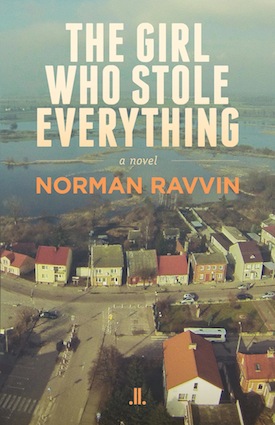
image - The Girl Who Stole Everything coverFor a long time it had the title The Dulcimer Girl, which is one of Nadia’s alter egos once she arrives in Poland. And the instrument itself, key to early klezmer, in its Polish guise, as a hammered instrument, was something I thought of as a talismanic object, which evoked the locale, the culture of Jews and Poles in another time.

The Typewriter Girl was also an early title that fell by the wayside, and relates to the other main female character, Ania. She is “the Typewriter Girl” by way of her work for a Polish government bureaucratic special office, which is tasked with investigating the files kept on people during the communist era. Understanding the typewriters used on each file is a way of verifying the files or revealing fraudulence.

The typewriter, like other technologies in the book – cars, books, recorded music – is evocative of a time when things worked in a way that they no longer do. So, the dulcimer and the typewriter, even hardcover books, are surely objects of nostalgic and loveable possibilities.

The Night Jew is central to the novel’s sense of Poland being haunted by the Jews murdered in the wartime. One can spend time in Poland and either look for these Night Jews or, as I sometimes feel, be one. There are plenty of real Jews in Poland today. But the Night Jew must be someone from another world altogether.

The Gentle Jew is in fact a particular nickname for a key figure in the narrative. He is an early ’60s denizen of West Cordova Street.

JI: There are many parallels in the lives of Simon and Nadia – a father’s secrets, their love of walking, etc. – and their lives do overlap, of course, but what inspired you to connect these disparate stories?

NR: Some of these parallels develop intentionally, but then others work themselves out as a book goes through drafts. Certainly, you’re right, walking is a returning motif. Nadia does seem to walk cities after the example of her father, as if she walks to be like him when she cannot know him.

The secrets of fathers: I guess, in this book, one of the premises is that ancestral stories, which go untold, can irrupt without warning. So, in the case of the younger characters in Canada, Simon and Nadia, they share this predicament, and their own lives are changed by the irruptions when they finally happen. It is satisfying when these kinds of patterns develop almost without meaning them to. This is where writing can be a bit like making music, where refrains, verse and chorus structure allow for such catchy and satisfying effects – a rhyming of sound and idea.

JI: If there is anything else you’d like to add, please do.

NR: I guess it’s important to say that I’ve returned to Vancouver in fiction for another try at it. My second novel, Lola by Night, was a Vancouver book. And, in The Girl Who Stole Everything, I felt strongly about doing things with the city that others hadn’t. I’m a walker in Vancouver, whenever I can be, so that element, which you ask about, is motivated by my own appreciation of what different parts of the city have to offer. When I walk, I do think of what’s changed since my last visit, so it may be that writing about a place can be well done from afar, as long as you keep it close enough and periodically in view. It’s interesting to have a Vancouver book come out in Montreal, where the West Coast is a kind of terra incognita.

Format ImagePosted on December 13, 2019December 12, 2019Author Cynthia RamsayCategories BooksTags Cherie Smith JCC Jewish Book Festival, fiction, history, Norman Ravvin, Poland, Vancouver

Posts pagination

Previous page Page 1 … Page 42 Page 43 Page 44 … Page 84 Next page
Proudly powered by WordPress