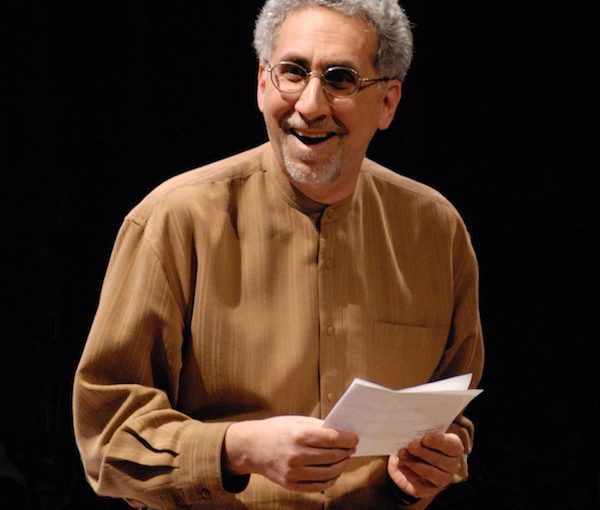
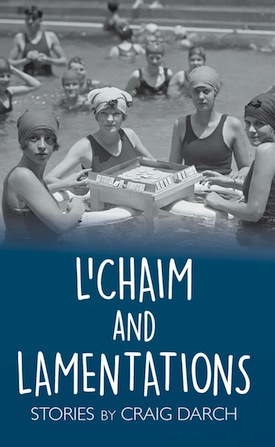
Craig Darch’s L’Chaim and Lamentations (NewSouth Books, 2019) is a bittersweet collection of seven short stories. Most of the characters in his first foray into fiction are older Ashkenazi Jews whose pasts are almost characters themselves. Yet, as strong as are their memories, these Jews are doing their most to live in the present, and to even assure the future.
Darch is the Humana-Sherman-Germany Distinguished Professor of Special Education at Auburn University, in Alabama, where he has taught for 37 years. He has lived several places in the United States, but New York City and Poland are the locations of import in these stories. At least one – “Who’s the Old Crone?” – was inspired by his birthplace, Chicago.
Having moved to South Bend, Indiana, with his family when he was 6 years old, Darch shares in an article on the Auburn website, “We attended synagogue in South Bend and continued to travel to Chicago to see my grandparents, where we frequented the famous Jewish deli called Ashkenazi. I remember always seeing the same three old men in there. I wondered about them, about their lives. Now, through fiction, I can give them names and their own story.”
In the humorous tale Darch has imagined, Rabbi Fiddleman, “held court each day in Schwartzman’s with his two followers – Pincus Eisenberg and Mendel Nachman.” As described by another customer at the deli, the “group of three old men, the only other customers in the place, huddled together with covered heads at a booth in the far corner, all remnants from the Romanian synagogue, bankrupt and boarded up years ago. Now, with no place for them to go, the octogenarians arrived early each morning and stayed for several hours – sipping tea, noshing on the cheapest fare, and kibbitzing about spiritualism and life after death, debates that frequently drifted into polemical arguments concerning the metaphysics of Spinoza and Kant. Though generous with their opinions, when it came to money each one was more frugal than the next, and each had a knack for consuming great quantities of Schwartzman’s tea while nibbling a single bagel over the course of several hours.”
Darch’s characters are recognizable people with whom readers will feel loneliness and friendship (“Sadie’s Prayer”), fear (“Wasserman’s Ride Home”), heartache and bewilderment (“Kaddish for Two”), justice tinged with bitterness (“Leonard Saperstein & Company”), mystery and hope (“The Last Jew in Krotoszyn”), joy and possibility (“Who’s the Old Crone?”), acceptance and perseverance (“Miss Bargman”).
The young people in these stories represent both forces of change and the need for new traditions, as in the emotional story “Kaddish for Two,” in which a son finally gets the courage to tell his Orthodox parents that he is gay, and as preservers of the past, as in the somehow cheering “The Last Jew in Krotoszyn,” in which Magda, a 13-year-old non-Jewish girl, befriends Ruta, the story title’s last Jew.
“Ruta watched Magda run out the cemetery gate, heading toward home,” writes Darch. “Then Ruta shuffled slowly away, each step more difficult than the last. She stopped for just a moment to catch her breath. Bone tired, she rested her hands on her hips. She understood such fatigue was just one more signal, a tweak from the Almighty himself; her time in this world was coming to an end. But strangely, she had no fear of dying. She had faith that Magda would tend the cemetery and pass on the stories, the truth of Krotoszyn.”
Human connections – positive, negative and in between – are at the foundation of every story in L’Chaim and Lamentations. Enjoy.
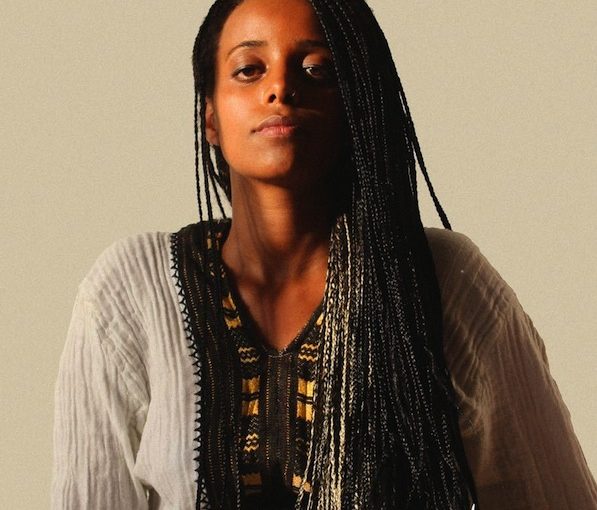
Taali’s EP Were Most of Your Stars Out? was released last month.
“Kol ha’olam kulo gesher tzar me’od, veha’ikar lo lifached k’lal” – “The entire world is a narrow bridge, and the main thing is to not be afraid.” Taali’s recently released EP Were Most of Your Stars Out? begins with “The Main Thing Is,” and, it seems, the singer-songwriter and producer has followed Rabbi Nachman of Breslov’s advice from more than 200 years ago, and made the prayer her own. While there are countless versions, Taali’s a cappella take showcases her rich, full sound and sets the mood for the entire recording.
The name of the EP comes from J.D. Salinger’s novella Seymour: An Introduction, which Taali (née Talia Billig) highlights as her favourite book. On her Facebook page, she cites the passage from which the album title comes: “Do you know what I was smiling at? You wrote down that you were a writer by profession. It sounded to me like the loveliest euphemism I had ever heard. When was writing ever your profession? It’s never been anything but your religion. Never. I’m a little over-excited now. Since it is your religion, do you know what you will be asked when you die? … I’m so sure you’ll get asked only two questions. Were most of your stars out? Were you busy writing your heart out?”
Were Most of Your Stars Out? comprises acoustic versions of seven songs. It was produced by the label Rainbow Blonde Records, a collective she co-founded with her partner, singer-songwriter and producer José James, and engineer and producer Brian Bender. Released last month, the EP follows almost on the heels of Taali’s full-length record I Am Here, which came out in March.
Taali describes her music as Jewish contemporary pop, but, while Jewish melodies and/or concepts permeate her compositions, the sound is definitely more pop than liturgical, though she likes her minor keys. And all listeners, regardless of religious or secular affiliations, will find something to connect to in the lyrics. In an extensive interview with the now-defunct online publication Arq, Taali – whose stage name is a family nickname – talks about music being communal. “If I’m promoting it,” she said, “it has to be in the service of community.”
That philosophy, combined with her appreciation for the Jewish tradition of storytelling, which was instilled in her growing up, and her musical skill and knowledge, makes Taali’s songs eminently listenable and relatable. That Were Most of Your Stars Out? is an acoustic recording adds to the intimacy. The use of synthesizer on “This Is What Love Is” and “Wayward Star” takes away some of that atmosphere, but one nonetheless gets the feeling that Taali doesn’t put on airs, and would put as much heart into singing off the cuff at a small gathering as she does performing on a concert stage.
Born in Manhattan, Taali has lived most of her life in New York City, with the exception of a couple of years in Los Angeles. One of the narrow bridges she has had to cross is vocal cord surgery, in 2016, which meant months of being unable to speak or sing. She turned her focus to songwriting for other performers during this period of recovery but, she told Billboard, there was one song she “couldn’t conceive of just giving” to another singer, and that was “Hear You Now.”
“I have quite a bit of trauma myself that I’ve never really felt safe enough to address,” she said about the song in that interview. “It was really wrenching, but I tried to do justice to those feelings. It’s the beginnings of talking to myself rather than an on-the-nose accounting of what happened, and what I tried to do, lyrically, was apologize to myself for the years I didn’t have the words or strength to name or push away these people who were treating me badly.”
“Hear You Now” is about finally saying “all the words you haven’t said,” “the words that you swallowed down” – “You held it in, now lay it all to rest…. Lift away the weight of everything you couldn’t say” and “Make them hear you now.”
The song “Snowfall on Orchard,” which closes Were Most of Your Stars Out?, also has special meaning. It was written about five years ago with José James, who provides some lovely vocals and beautiful harmony on the track.
“It’s the first original song that we wrote together,” says Taali in her bio, “and I think it’s a little postcard of a very, very optimistic moment in our lives, and a very in love moment.”
Were Most of Your Stars Out? is available from several online music services, including Spotify, iTunes and Amazon.
Jazz artist Maya Rae has a busy week ahead. Tomorrow night, Nov. 30, she takes part in Temple Sholom’s Fall Fest Fun-raiser, after a benefit concert earlier in the day at Brentwood Presbyterian Church called Socks for Souls. On Sunday, Dec. 1, she is among 11 bands that will perform in Jazz Walk at the Shadbolt. And, on Dec. 4, she is at the Vancouver Playhouse, participating in the show Strings and Jazz.
“Definitely this time of year is very busy when it comes to gigging and playing shows,” Rae told the Independent. “Because it’s surrounding the holidays, people are needing musicians for lots of things, so there are more opportunities to work right now. I’ve also been lucky enough to have played numerous shows throughout the years, so people are reaching out more now, hiring me for future gigs as well.”
One of the highlights of Rae’s past year was a trip to the southern United States.
“I went to Nashville last March to record my album and that was definitely one of the most amazing experiences I’ve had so far in my career,” said Rae.
The album, which will see its release in April, is the young musician’s second.
“Every song on it was written by my brother and myself, so the whole project is composed of originals,” she said. “My debut album, Sapphire Birds, is made up of some jazz standards, rearranged pop tunes and a few originals as well. The upcoming album, Can You See Me?, focuses on my original music from the past year, a lot of it reflecting on what I’ve learned and experienced. The music is incredibly personal, but I’m super-excited to share it with the rest of the world.”
Most of the songs on the new recording were inspired by things that have happened to Rae or to people close to her.
“I graduated high school back in June, and so a lot of the songs are about what I experienced throughout that journey,” she explained. “For example, ‘Can You See Me?,’ the title track of the record, is about removing the mask that hides one’s true self and not being afraid to be who you are. I found that, throughout high school (and outside of it), people try so hard to fit a certain box and be who they think they should be rather than who they really are. This song is about removing that façade and being OK with showing your true colours.
“‘Sun Will Come Out Again’ is another tune on the record that I wrote with so many people in mind. So much of the time, when we’re stressed, sad, angry, or any other uncomfortable feeling, it feels like the end of the world. This song is about how, no matter one’s current situation, whether it be big or small, there is always light at the end of the tunnel. That dark, upsetting feeling will not last forever.”
For more information on Rae’s music and upcoming performances, visit mayaraemusic.com.
The Fall Fest Fun-raiser (templesholom.ca/fall-fest-fun-raiser) on Saturday starts at 7 p.m. and also features Annette Kozicki and Friends and Tal & Yael’s Israeli dance, while Strings and Jazz on Dec. 4 includes Sinfonietta, VSO School of Music’s honour jazz combo (vsoschoolofmusic.ca).
The Dec. 1 Jazz Walk is a daylong event, 11 a.m. to 10 p.m., at the Shadbolt Cenre for the Arts. The scheduled lineup includes Rae, Dave Robbins Sextet, Lucine Yeghiazaryan, Dawn Pemberton Quartet, Brad Turner Quintet, Grant Stewart Trio, Cory Weeds Quintet featuring Roy Mccurdy, Steve Kaldesta, Grant Stewart, Alyssa Allgood, Stephen Riley, Chris Hazelton, Jill Townsend Jazz Orchestra and Ernest Turner. It also includes roundtable discussions with various people in the field, such as archival record producer Zev Feldman of Resonance Records in Los Angeles. Tickets and more information can be found at shadboltcentre.com.
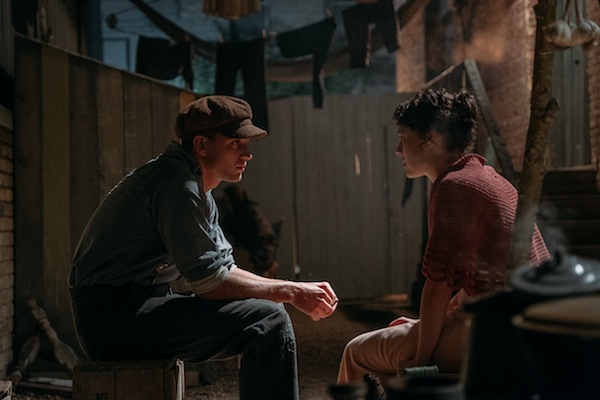
Marshall Williams as Stefan Sokolowski and Laura Slade Wiggins as Rebecca Almazoff fall in love in the movie musical Stand! (still from the movie)
The film Stand! comes out in Cineplex theatres across Canada on Nov. 29. Locally, it will play at SilverCity Riverport Cinemas in Richmond. The story of how the independent film got to the big screen is as interesting as the movie itself. And both it, and the musical on which it is based, started with a simple conversation.
The idea for the musical Strike! came over a deli sandwich in 2002. Then-Winnipeg Free Press editor Nicholas Hirst suggested to Winnipeg composer, producer and writer Danny Schur that there might be some musical-worthy drama found in the Winnipeg General Strike of 1919. Schur – who already had two full-scale musicals on his CV – followed up, coming across a photo of Ukrainian-Canadian Mike Sokolowski, who was killed by one of the “special police” – the actual police force, who sympathized with the strikers, had been fired and replaced with thugs – in what is now known as “Bloody Saturday,” June 21, 1919. Being Ukrainian-Canadian himself, Schur was hooked.
He wrote 18 songs and the script for the musical Strike! by 2003. A workshop of it at the University of Winnipeg connected Schur to director Anne Hodges and writer Rick Chafe, who helped get the production ready for its première – first an abridged version, an outdoor show in 2004; then the full version in 2005. (Chafe is also co-writer of the film with Schur.)
“The idea for the movie first sprang from a conversation I had with Jeff Goldblum in 2005,” Schur told the Independent in an interview. “He was sitting beside me at the Winnipeg world première (he was in a relationship with our Winnipeg female star [Catherine Wreford], whom at that time had a Broadway career). After seeing the musical, he stated, ‘Big story, big ideas, it would make a great movie.’ And I thought, ‘If Jeff Goldblum says it will make a great movie, that must surely be the case.’ I naively believed it would take two or three years to come to fruition and it took 14. Shows what I knew!”
Those years would be filled with adapting the musical from stage to screen, raising the large amount of money needed to film a movie, casting the roles, finding a director, finding a production company, etc., etc.
The considerations in translating the stage production to film were legion, said Schur. “First, some songs had to go, because the average number of songs in a movie musical is eight; the stage show has 18. Some of the cuts were obvious – because some of the actors we cast were not singers. In all cases, it was a matter of what served the story best. What works on stage does not necessarily translate to screen. Rob [Adetuyi] was extremely helpful in this regard, having as much experience as he does with film.
“But the biggest change to screen was Rob’s doing: to make the film more diverse. Emma, the black maid, was a conscious change to reflect history better and have a more diverse film. So, too, was the case with the character of Gabriel [a Métis soldier who served in the war].”
When Adetuyi, the director of Stand! (whose mother is Jewish, as it happens), changed the maid character from being Irish to being a black woman who had fled racist violence in the United States, Schur wrote a new song, “Stand,” which became the title of the film.
Sokolowski is one of the main characters in both the musical and film. He and his son, Stefan, are struggling to earn enough money to bring the rest of their family to Canada from Ukraine. Among their neighbours are Jewish siblings Rebecca and Moishe Almazoff, the latter of whom is based on a real person. (Moishe Almazoff is the pen name for Solomon Pearl.)
Amid the harshness of life and their bleak future, Stefan and Rebecca fall in love. Schur told the JI that he based the interfaith romance on that of his aunt and uncle, “she the Christian, he the Jew.” Of course, the couple’s relationship isn’t welcomed by their families and respective communities. And, of course, the poor living and working conditions, the labour unrest, the threat of deportation and the violence are not conducive to love.
In a neat turn, the making of the film has led to changes in the musical.
“I always say, musicals are never written, they’re rewritten,” explained Schur. “So, where, before, the movie was substantially different from the stage musical, we have now edited the stage version to reflect the movie. So, now they’re pretty close. Having said that, the stage play has more songs.”
The music is certainly one of the highlights of the film. In this regard, and also another of the Jewish connections to the production, Schur noted, “Gail Asper is the hugest supporter of the movie, having invested in the stage show and the movie, and she convinced Montreal’s Sharon Azrieli to do the same. Sharon, who is an opera singer, sang the closing credit song, ‘Change,’ which I wrote for her.”
As for the feat of getting an independent movie a national release, not to mention deals for distribution in the United States and Japan, Schur said, “This is a truly indie release; in other words, there is no distributor involved. We went to Cineplex and said, ‘We have an audience. Please give us some screens.’ Where Cineplex could have given us a token, small number of screens, they provided screens from sea to shining sea, which is a testament to their belief in the film. I cannot say enough good things about the good people at Cineplex for giving us our chance to make a stand, especially in the midst of so busy a late fall season.”
“The movie is a unique opportunity to take the experience of the Jewish community in Canada circa 1919 and apply the lessons of the era to today, be those lessons for the community itself, or the broader community of immigrants,” said Schur. “In an era where discrimination is on the rise, the movie is a metaphor that teaches us that ‘love thy brother’ is the best way forward.”
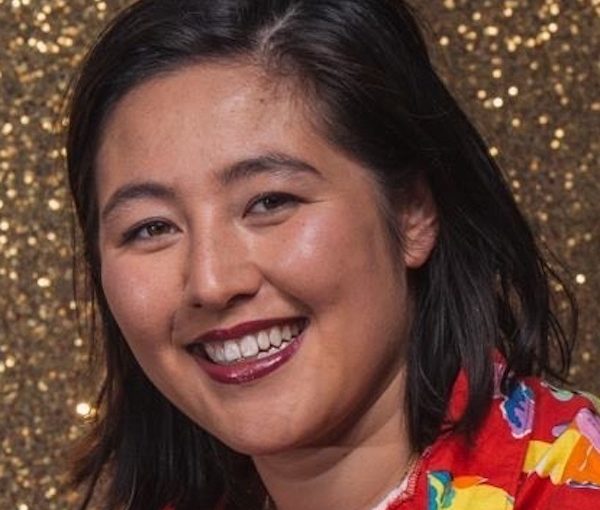
Brigitte May plays many characters in The Tragic Comedy of Macbeth, which runs Dec. 5-15 at the Jericho Arts Centre. (photo from Literary Larceny Artistic Collective)
“I love the spontaneity of it all. Improv is so magical because it can and will go anywhere,” actor Brigitte May told the Independent. “The agreement that improvisers have to commit to whatever has been established in the scene is such an amazing thing because, if done well, the scene can bear an undeniable truth in complete absurdity.”
May is part of the cast of The Tragic Comedy of Macbeth, which opens Dec. 5 at the Jericho Arts Centre. The production uses comedy, improvisation and the words of William Shakespeare to reveal more of the real Macbeth. It has its origins in a show envisaged by David C. Jones and created with the students of Langara College’s Studio 58 in 2014.
“As a professional improviser and actor, I have loved playing with existing stories and finding a way to make them more inventive and funny,” said Jones. “I was one of the original creators of a hit show that was remounted by several theatre companies (including the Arts Club) across Canada entitled A Twisted Christmas Carol. I also created an award-wining street theatre show called A Twisted Cyrano de Bergerac and toured England with a show called Twisted Anne of Green Gables.
“A decade later, I was approached by Kathryn Shaw, the artistic director at Studio 58, the professional theatre training program, to create a theatrical performance piece with the fourth-term students. We decided to do a partially scripted and partially improvised Macbeth. The premise of that one was very different and it was only one hour. It was narrated by the Porter, Hecate and Lady Lennox and they got the suggestions to change the show, and the focus was more of fixing ‘plot holes’ and problems with the original text. Although Shakespeare is brilliant, he does have some hiccups in some of his scripts.”
The Tragic Comedy of Macbeth is being staged by the Literary Larceny Artistic Collective.
“We are a group of professional actors and improvisers who came together specially to make this new expanded version of the show,” said Jones of the collective. “Now under the direction of Shakespearean actor Bernard Cuffling and veteran professional improviser Gary Jones, we have created this new slightly darker version.
“The real Macbeth (Mac Bethad Mac Findlaích) was actually a ruler of Scotland from 1040 to 1057 and was not at all like the man portrayed in Shakespeare’s play,” explained Jones. “He is trapped in the play in our production and he is trying to get free so he doesn’t have to suffer the beheading for the six billionth time. The witches in the play have agreed that, if he can derail the play and survive to the end, then his spirit can be set free. So, it is up to the audience to help him change the play to survive, or not.”
May plays many characters in The Tragic Comedy of Macbeth, but, she said, “the witch Hecate is the most prominent. Hecate is the queen of the witches, the mistress of charms, a very powerful expert of the dark arts, but she gets cut out of most versions of the play. In TCOM, Hecate seeks revenge for constantly being omitted and attempts to foil Macbeth’s plan.”
In improv, how much of the plot and action are laid out ahead of time depends on the show, said May. “In TCOM,” she said, “we have a fairly concrete structure. We are able to manipulate and play with it a little through audience suggestion, but David C. Jones and Brent Hirose (the writers of the play) worked hard to create a fascinating twist on a classic tale.
“Practising improv sounds like a joke, but it’s actually super-important!” she added. “Making sure your brain is warmed up to take whatever is being thrown at it, building trust with your castmates, and practising and learning the format that you’re performing are integral to the success of any improv show.”
In addition to being an improviser and actor – she has performed with Affair of Honour and Blind Tiger theatre companies and is a cast member of Instant Theatre’s Fistful of Kicks improv comedy show – May is a staff writer for the satirical news website, the Beaverton, and works in retail. She graduated from Queen’s University in Kingston, Ont., with a bachelor of arts (honours) in English with a film minor, but was born here.
“I am a first-generation Vancouverite,” she said. “My father and mother moved here from Ottawa and Manila, respectively, got married and raised my brothers and me on the west side of Vancouver.”
Intentionally or unintentionally, those brothers helped direct her to the stage.
“As a kid, I was always performing. I am the youngest in my family and have three older brothers, so I was always vying for attention and trying to prove myself,” she explained. “I wasn’t too much of a troublemaker (I feel like my brothers had that covered), but I would frequently get into fights if I were told I couldn’t do something because I was a girl. Still, my parents were supportive of my creative pursuits, they signed me up for dance lessons (at the JCC), music lessons and acting camps. I didn’t really start writing comedy till late in high school and into college, but I had been on my school’s improv team, which heavily influenced my love for comedy.”
As for the roles played by Judaism, Jewish culture or Jewish community in her life, May said, “The Jewish community has always been a part of my life. I have been a member of the Jewish Community Centre of Greater Vancouver ever since I was born. I remember swimming in the pool with my bubbie, and watching my dad and zaidie play racquetball. Now that I think about it, a lot of my childhood was spent running around the halls of the JCC.
“It was also where I was first introduced to performing. I had my first ballet lessons there – there’s actually a photo of me in the lobby of the JCC in my first-ever dance recital … we did The Little Mermaid! – then did a couple years in Gotta Sing! Gotta Dance! in my teens. I was even a counselor at Camp Shalom for a couple of years. The JCC was where I first was introduced to the arts, so I owe a lot to the community.
“In regards to Judaism and Jewish culture,” she said, “I find myself being drawn to it. Being half-Jewish and half-Chinese comes with a lot of ambiguity, so, when I was younger, I used to grasp at anything that gave me any notion of identity and history. My grandfather was a drummer and artist by trade, so, while my siblings and I might not have been the most educated in the religious aspect of Judaism, we were exposed to a lot of the cultural aspects. We would watch old Saturday Night Lives with Adam Sander, Mel Brooks movies, old(ish?) SNL with Andy Samberg, and were constantly being told jokes by our uncles. I think growing up having those comedians as my role models greatly influenced and shaped who I am today.”
The Tragic Comedy of Macbeth previews Dec. 4. Opening Dec. 5, it runs Wednesday through Saturday, 7:30 p.m., with 2 p.m. shows on Sundays, until Dec. 15. For tickets, visit tickets.theatrewire.com.
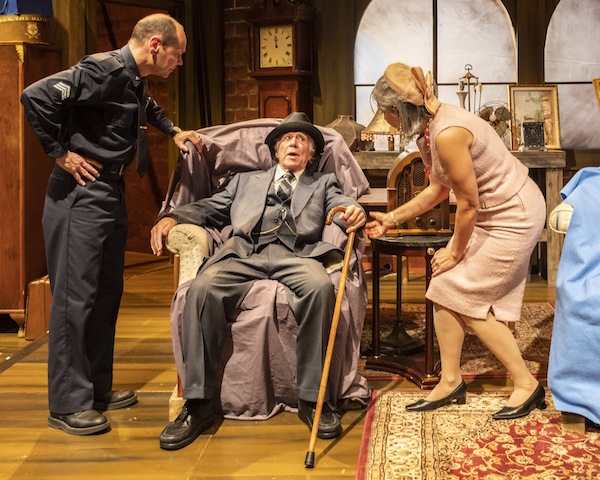
Left to right, Patrick Bahrich, Sjahari Hollands and Christine Iannetta co-star, along with Rob Monk, in United Players’ production of The Price by Arthur Miller, which is at Jericho Arts Centre until Dec. 1. (photo by Nancy Caldwell)
United Players of Vancouver theatre company has a reputation for tackling challenging, thought-provoking material and, with its current production, The Price, by Arthur Miller, it lives up to that reputation.
Playing at Jericho Arts Centre until Dec. 1, The Price is a densely packed play, covering several themes: sibling rivalry, self-perception, filial and spousal duty, memory, modernity, the Depression, materialism, success, failure, and more. In a play where dialogue is the main action, actors Patrick Bahrich, Sjahari Hollands, Christine Iannetta and Rob Monk do an adept job at keeping the audience engaged.
First to enter the scene – a room full of heavy, dated furniture, piled high and seemingly haphazardly – is Victor Franz (Bahrich), a New York City policeman. He slowly and almost lovingly uncovers some of the many items and puts a record on a Victrola – a laugh track of sorts, apparently a popular type of recording, once upon a time.
Victor’s wife Esther (Iannetta) arrives, amid the laughter, which contrasts to the obvious tension between the two. Victor immediately accuses her of being drunk, and she defensively replies, “I had one!”
The furniture belonged to Victor’s family and is being stored on the upper floor of the building in which they lived. His brother Walter (Monk) is supposed to be coming to help him sell it to an appraiser (Hollands), as the building is soon to be demolished.
The Franzes’ marriage could be summarized by the phrase “unfulfilled expectations.” Director Adam Henderson – who is a member of the Jewish community – has chosen to stage the play as a period piece, so that viewers will ponder how the roles of men and women have changed, and how societal norms have evolved (or not), since 1968, when The Price premièred on Broadway. Miller’s opening direction is, “Today. New York.” However, the today of 2019 is very different from that of 50 years ago, as is evident on several occasions, especially in how the men talk to and about Esther, and how her character is written overall.
Eventually, the appraiser stomps and puffs his way up the stairs to home-cum-storage unit. Eighty-nine-year-old Gregory Solomon was expecting there to be only a few pieces to consider and is overwhelmed by the volume of furniture. He also ends up entangled in the volume of resentment and distrust between the brothers, who haven’t spoken to each other for ages. Walter shows up at the end of Act 1, just as Solomon is paying Victor the agreed-upon price for the lot, $1,100, one $100 bill at a time.
Sweeping in, expensively dressed and broadcasting on more than one level his success and confidence, Walter is the brother who managed to escape their controling father and follow his dreams, while self-effacing Victor dropped out of college to take care of their father, who lost almost everything in the Stock Market Crash of 1929. But, as the conversation and argument proceed, it becomes apparent that neither characterization is accurate. Nor is there a clear verdict on what really happened all those years ago, as they are unable to reconcile their recollections of the past or their beliefs about each other and themselves.
Solomon – who has his own regrets in life – tells Victor, “… the price of used furniture is nothing but a viewpoint and, if you wouldn’t understand the viewpoint, it’s impossible to understand the price.”
We do not understand everything we do in life, let alone everything that other people do. The price that we – and others – pay for our choices is as obscure. And time doesn’t allow us to go back and change things; time is an ever-present weight in The Price.
There is no happy ending here, despite the humour that runs throughout, and the fact that the play both starts and ends with the laughter record. Once the Franzes have all left, the deal done, Solomon puts on the record. He flops into one of the big armchairs and laughs and laughs.
The Price will leave you with much to think and talk about. For tickets, visit unitedplayers.com or purchase them at the door.
Writer and comedian Iris Bahr performs at the Rothstein Theatre on Nov. 12 and 13, as part of the Chutzpah! Festival. (photo by Gail Hadini)
Award-winning writer, actor, director and producer Iris Bahr delves into serious issues using humour – and by being someone other than herself. She will bring some of her many characters to the Rothstein Theatre stage Nov. 12 and 13 as part of the Chutzpah! Festival.
Bahr hosts the weekly podcast X-RAE, as alter ego Rae Lynn Caspar White. In her one-woman show DAI (enough), she portrays 11 different characters in a Tel Aviv coffee shop. In her comedy series Svetlana, which ran for a couple of seasons, she starred as the Russian prostitute and political consultant. These are but a few examples of the personas she has created.
“I think I was about 6 years old,” Bahr told the Independent about when she did her first impression. “My family went on a trip to Italy and I began to imitate the tour guide, who kept going on and on in a heavy Italian accent about ‘marble from Carrera’ and so, for years after that, I would always be asked to ‘perform my Italian woman’ when my parents had company over.”
Using the example of the character of Rae Lynn, Bahr explained how an alter ego allows for a better conversation.
“I host my X-RAE podcast in character because I find it puts people at ease and they open up about topics they wouldn’t otherwise,” she said. “Rae Lynn flips from highbrow to lowbrow in a heartbeat and talks openly and outrageously about parenting, marriage and various R-rated topics. During my interview with Lawrence O’Donnell, for example, we veered from Marxism to Penn Gillette’s sex parties in a single breath.”
A magna cum laude graduate of Brown University, in Providence, R.I., Bahr studied neuropsychology, and has done brain research, as well as cancer research.
“I think I gravitated towards neuroscience because the inner workings of the brain fascinate me and I’m equal parts cerebral and highly emotional, and so that translates into all my work,” she explained. “I have a splintered identity, but not in a 50-50 kind of way – I actually feel 100% American and 100% Israeli at all times and that feeling of connection yet constant alienation lends itself to me inhabiting different characters and being able to truly commit to different viewpoints.”
Bahr was born and raised in the Bronx but moved to Israel as a teenager, staying there through military service; she still has family there. Her latest satire, The Olive Tree, about the Israeli-Palestinian conflict, recently had a soldout reading in New York and is set to open in spring of next year. DAI came to the stage in 2006 and audiences have included the United Nations, in 2007.
“I was invited to perform the show for over 100 ambassadors and delegates and the experience was unforgettable,” she said. “They were highly attentive and laughed at all the right moments, which I was not sure was going to happen. I felt like a diplomat for a day.”
Bahr said she wrote DAI “to communicate the intricacy and complexity of life in Israel, the inner conflicts prevalent in Israeli society, and how they are affected by living under constant threat of suicide bombings/sudden death, which, as any Israeli will tell you, instil not a feeling of helplessness but a vibrancy and love for life. On the flip side, is how that very fact is perceived by visiting outsiders and Palestinians affected by the conflict. The characters we meet in the café – from all walks of life, ideological spectrums and backgrounds – have no idea their lives will be ending abruptly [by a suicide bomber] and so their monologues range from outrageously humourous, vengeful, disillusioned and more.”
She first performed DAI at Baruch College in New York City, “as part of a festival sponsored by the Culture Project,” she said. “I had no idea it would get picked up immediately for a commercial run, and so that was a phenomenal development.
“A lot has changed since I first wrote DAI, in terms of how the conflict is manifesting itself on both sides, and yet the situation has sadly stayed the same. Thankfully, suicide bombings seem to be a thing of the past, but my dear childhood friend and father of four was stabbed to death only last year while out shopping, the Palestinian plight has not improved and the political climate is worse than ever. Nevertheless, the characters in DAI have sustained their relevancy; my German character talks about rising antisemitism in modern-day Germany, for example; my Israeli former military man talks of his son who doesn’t want to serve in the military; and the snooty ex-pat woman who lives in New York City, well, those types of women only seem to multiply by the minute.”
She stressed, “The play is not a polemic – it is a collection of social observations that speak from many different viewpoints. The piece aims to entertain, offer a visceral theatrical experience and, hopefully, also illuminate and enlighten. Thankfully, it has been warmly received amongst extremely ‘pro-Israel’ audiences and also ‘pro-Palestinian’-leaning crowds both in Europe and here in America. Of course, certain right-wingers think it’s too leftist and left-wingers think it’s too right, which is all I could really hope for as a piece about humanity.”
For tickets to see Bahr perform at Chutzpah!, and for more festival offerings, visit chutzpahfestival.com.
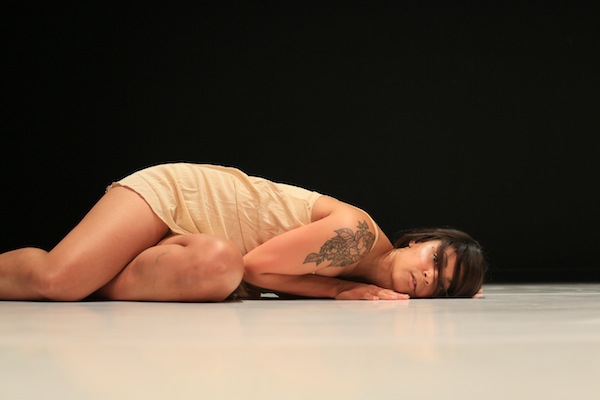
Amber Funk Barton presents VAST at the Dance Centre Nov. 22, as part of Dance in Vancouver. (photo by Chris Barton)
From Nov. 20 to 24, the Dance Centre presents the 12th biennial Dance in Vancouver. This year’s event was programmed by Dieter Jaenicke, director of the internationale tanzmesse nrw in Dusseldorf, Germany, and features the work of at least two Jewish community members, Amber Funk Barton and Noam Gagnon.
“What I find most impressive about dance in Vancouver is the fact that there are so many different identities of contemporary dance, connected to certain studios, companies, artists,” Jaenicke told the Independent. “It feels like the dance is spread out in the entire city, in very different and distant neighbourhoods, with the Dance Centre in the centre…. Trying to get familiar with dance in Vancouver, I felt like a collector of stories, stories about dance, stories about human beings…. That is why I chose the sentence of the Vancouver dancer and choreographer Amber Funk Barton as a kind of motto for this edition of Dance in Vancouver: ‘There are global stories in everything.’”
Barton, an award-winning choreographer, formed her company response. in 2008, but she will be performing the solo piece VAST, “an ode to the explorer that resides in all of us, the traveler and the dreamer who wonders what resides beyond the edge,” at DIV on Nov. 22. Noam Gagnon’s company, Vision Impure, will be presenting Pathways, which “explores the intricate push and pull of relationships impacted by urban living,” on Nov. 21. During DIV, there will also be performances by Raven Spirit Dance, Joshua Beamish/MOVETHECOMPANY and OURO Collective, with installations by Company 605 and Lee Su-Feh/battery opera, as well as discussions and other free events.
About how he chose the program, Jaenicke said, “First, I tried to get an overview of what is happening in dance in Vancouver – I visited companies, studios; saw rehearsals, performances; talked to many artists from the dance field. I was impressed by the diversity, the different backgrounds, cultures, approaches to dance and about the high quality of dancers and choreographic creativity.
“The selection was very difficult due to the amount of very interesting and convincing proposals,” he said. “With the choices I had to make, I tried to follow the diversity which I found so impressive, to include established and emerging artists, include the different cultural and artistic backgrounds of the choreographers, include indigenous works, different styles and genres of contemporary dance. But, the most important criteria was, of course, the artistic quality. Although it is difficult to describe what is artistic quality, I believe it is something objective to be seen, to be discovered, to be chosen.”
Both VAST and Pathways saw their premières at the Vancouver International Dance Festival.
“I am so pleased and honoured to perform VAST as it originally premièred in 2018 – and in the same theatre – for Dance in Vancouver,” Barton told the Independent.
The creation of the work started in 2015. Surfing the internet, Barton came across the quote from Carl Sagan that is included in the description of VAST: “We are a way for the universe to know itself. Some part of our being knows this is where we came from. We long to return. And we can, because the cosmos is also within us. We’re made of star stuff.”
“I was so struck by the poetic nature of the quote and found it so beautiful and comforting,” said Barton. “It made me start to think a lot about life, my life, and how everything and all of us in the universe are connected.
“That also got my imagination going and soon I realized I had an idea for my next work. I knew quite early on that this was supposed to be a solo and that I needed to perform it. I knew, as a choreographer and dance artist, that all the feelings and emotions and images I wanted to explore and express would have to come from my body and personal expression.
“I also knew, but was unclear at the start of the project, how to transform the performance space so that the audience could suspend belief and be transported with me into an otherworldly arena. My instincts told me I needed to work with a scenographer or set designer.”
Barton approached Andreas Kahre and they “started to have many discussions about universal space and The Little Prince.” She also brought her long-term collaborator and light designer, Mike Inwood, into the process.
“Together, our research began in the theatre, playing with objects and materials to create the surface of the moon and other environments relating to space and scale,” she said.
After that, “I knew it was time to go back and figure out how to create a journey through dance and movement, which then seemed like such a daunting task.
“By this time, I brought in another dear long-term collaborator of mine, music and sound designer Marc Stewart. He had the opportunity to have a glimpse and visit us while we were building environments in the theatre and, from there, he created a couple of 20-minute series of sound samples. Upon hearing one, I knew it was the direction I wanted to go and it helped me immensely to start creating a movement journey.
“Because the music at that point was a series of samples, the sound was constantly changing, which I thought was perfect,” said Barton. “As far as the loose narrative of the solo goes, I wanted to create the sense of waking up in a dream, being lost and, as in a dream, constantly dealing with new environments and surroundings out of my control.”
Along the way, the creative team engaged more support to both flesh out and edit down their ideas. They also had a two-week residency supported by Dance Victoria, which, said Barton, “was instrumental in finalizing the set and visual aesthetic of the production.” About a year later, they had a week residency at the Massey Theatre, which led to the première, in March 2018, at the Dance Centre, as a co-production with the Vancouver International Dance Festival.
On the response. website, VAST is described as “a singular expression of an individual’s choice to be by oneself, a meditation on our limitations as human beings and how, despite these limitations, we still desire to propel ourselves forward into unknown territory.”
“As human beings, there are times we assert our agency and choose to be ‘by oneself’; that night you wanted to stay in, the decision to leave a relationship, the choice to travel and/or explore alone. For me,” said Barton, “‘being alone’ can be similar, such as being alone with your thoughts and/or feelings, but then ‘being alone’ is that liminal space I think we’ve all experienced: feeling so small, as if you couldn’t possibly make a difference in the world. Feeling overwhelmed by how we want to, or should, live our life. Feeling lost as to what our purpose on this planet is. And then, hopefully, to choose to face our fears by ‘being alone’ and to overcome and/or embrace them.”
The story of the protagonist of VAST “starts with waking up in an environment and quickly realizing she has no control of the world around her,” said Barton. “At times, this is playful and full of wonder but, for the most part, it is terrifying. When I perform the work, I always imagine myself being trapped in a dream and being unable to wake up. And, of course, it is terrifying being in unknown territory alone.
“Being alone, traveling by yourself, exploring on your own – I believe these are the biggest gifts we can give ourselves because they ultimately bring us closer to meeting our true selves. There is a point, where we learn to stop fighting the rhythm of life and accept it, embrace it, realize that there is a force greater than us that is allowing our heart to beat and the conjunction of the planets. There are simply things we will never be able to understand and/or explain or have the answers to.”
Towards the end of Barton’s solo, when she is “exhausted and feeling completely alone, there is a faint sound in the distance,” she said. “A message. A song. Something that connects with our molecules and convinces us to keep going. I think we have to be very quiet to get our ‘messages.’ For me, in the dance, when I receive my message, it is also completely submitting to the universe, accepting my fate, accepting my weaknesses and limitations, realizing I am no better or worse than anyone else…. My absolute final movement is inspired by the whirling dervishes of Turkey, who spin with one open palm towards the sky, the other palm facing downwards towards the ground in recognition of the soul’s connection to both heaven and earth. I can’t think of a more appropriate image for VAST to end with.”
VAST does not provide any answers to life’s questions, but, rather, said Barton, “I think of VAST as a moving meditation and I feel it is quite interactive for the audience with regards to how they interpret the journey of the protagonist.”
Of venturing into the unknown herself as a creative person, Barton said, “We all have the capacity to investigate change. But, of course, it is not easy and certainly not encouraged in our society. It’s scary so, sometimes, we need people to remind us to take that leap. I think artists play a very important part in our society, of not only inspiring their communities but also reminding them that we are not alone in our thoughts and feelings. I believe art is a confirmation of our humanity and, a lot of the time, it is art that encourages people to take that next step or to pursue their dreams.”
“Speaking as a creator,” Gagnon told the Independent, “the act of creating a new work is an act of courage. There is no guarantee that the images I initially picture in my mind and what I intend to evoke will reach the audience with the right attention to tension. What is required of me is the deepest awareness and careful attention to each and every aspect I can think of in order to find the perfect physicality, musicality and intention in the talented dance artists with whom I am working. That awareness of and attention to every aspect is what I was referring to when I described Pathways as being my ‘heart, soul and brain.’”
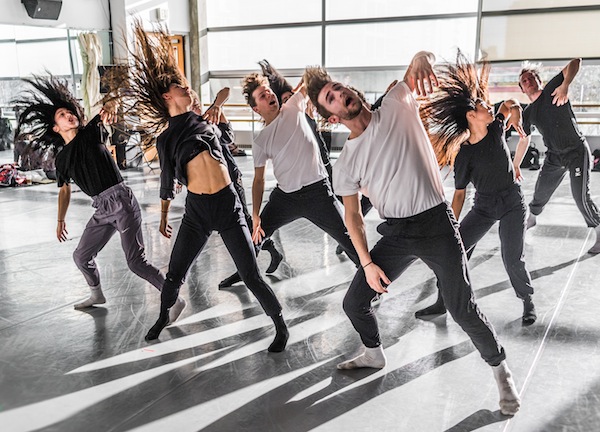
Vision Impure in rehearsal for Pathways, which is at the Dance Centre Nov. 21. (photo by Erik Zennström PhotoArt)
The Independent interviewed Gagnon prior to the première performances of Pathways at the Vancouver International Dance Festival this past March. (See jewishindependent.ca/dance-explores-our-relationships.) The JI asked him whether any elements of the work had changed since then.
“When the 10 incredibly generous and talented dance artists of Vision Impure return to rehearse one week before the Dance in Vancouver biennial begins, I will likely be making the few changes that I feel are most needed,” said Gagnon. “My first priority for the upcoming process is keeping my dance artists safe and ready to blow the roof off the theatre the night they perform Pathways. The work is mentally, physically and emotionally demanding and requires the same focus from the dance artists that I required of myself during creation. We have a tough job ahead of us because, with this kind of intense work, nothing can be taken for granted.”
Pathways has not been performed since the dance festival in March, but Gagnon would like more audiences to see it.
“Speaking for this generous cast of dance artists, they can hardly wait to be performing this beast of a work,” he said. “Like me, they are deeply aware that the effort and demands required to perform this work may seem impossible at times, but the result is this incredibly empowering, life-changing reward. We are all keeping our fingers crossed that the Dance in Vancouver biennial presentation will be productive.”
For tickets ($34/$25) to DIV, visit ticketstonight.ca or call 604-684-2787. For more information, visit thedancecentre.ca or call 604-606-6400.
Moshe Denburg’s music will be featured in a tribute concert by the Orchid Ensemble on Nov. 10 at the Annex. (photo from Orchid Ensemble)
The Orchid Ensemble is giving composer Moshe Denburg a most appropriate gift for his 70th birthday – a concert.
The Nov. 10 tribute at the Annex will feature Denburg’s music, as well as the world première of a new work inspired by the melody of one of his first recorded songs. Denburg has collaborated with the Orchid Ensemble over the years and has been a driving force in intercultural music in Canada, including being the founder of the Vancouver Inter-Cultural Orchestra, in 2001.
On the Orchid Ensemble’s tribute program are the three pieces Denburg wrote for the group’s Road to Kashgar (2001), which was nominated for a Juno Award; “El Adon” (2009), a four-movement work that will be performed consecutively as a suite for the first time (one movement being a world première); “Petals of the Flame” (2012), which will be performed with flamenco dancer Michelle Harding; and the North American première of “In Midstream” (2010), a solo zheng (Chinese zither) work performed by Dailin Hsieh.
The icing on the cake, so to speak, will be the performance by the ensemble – Lan Tung (erhu/Chinese violin), Hsieh (zheng) and Jonathan Bernard (percussion) – of “And Gather Our Dispersed from the Ends of the Earth,” by Denburg’s nephew, composer Elisha Denburg.
“I haven’t heard it yet, so I can’t say much about it at all!” said the elder Denburg. “As he has said, it is based on a musical melody of mine, which I set to the liturgical text ‘Gather our dispersed from the ends of the earth….’ This song appears on one of my first albums, and was recorded in New York City in the mid-’70s with a certain well-known ensemble there called the Neginah Orchestra. For many years, it received regular airplay on Kol Israel Radio. I am really looking forward to hearing what Elisha did with it. I will plug him here – he is a composer of depth and originality.”
The younger Denburg’s music has been commissioned, performed and recorded across Canada, as well as in the United States. The award-winning composer has collaborated with numerous artists and his music has aired on CBC Radio 2. Essential Opera commissioned him, with librettist Maya Rabinovitch, to create a one-act chamber opera, titled Regina, about the first female rabbi, Regina Jonas, who was ordained in 1935.
About how his uncle’s melody inspired him, Elisha Denburg told the Independent, “It is a song that invokes very specific and special memories for me, singing around the Shabbat table with him and my family when I was young. It also espouses a key Jewish value: the strength of community. This is why I always try to incorporate it into my chanting whenever I help lead Rosh Hashanah services at my synagogue in Toronto (First Narayever Egalitarian Congregation). In composing a new work for intercultural trio, inspired by this melody, I am attempting to give back to him and our community the musical and spiritual gifts I have been so fortunate to receive in my life so far.”
In looking back at his professional life and how his composing has evolved, Moshe Denburg said, “At the beginning, I was mainly a songwriter and melodist, though I did take it seriously and I still consider a good song and a well-formed melody to be a real achievement. However, over the years, I delved much more deeply into the art of composition, and by that I mean writing for larger forces (like orchestras) and utilizing a broader musical language.”
Denburg has been creating music for almost all of his 70 years; his first composition coming before he was 10 years old. “As a child,” he said, “I improvised melodies, even at the age of 4 or 5. I believe it was when I was 8, I improvised a melody to the words of the synagogue prayer ‘Hashiveinu Hashem eilecha …’ (‘God, bring us back to you …’), and it stuck. It was very cantorial, as this, being the son of a rabbi, was my first influence and inspiration – the modes of synagogue prayer.”
The interest in world music came later. “For many of my generation,” said Denburg, “this connection with and attraction to the music of other cultures started in the 1960s, with the Beatles and others, who were incorporating non-Western instruments – tabla and sitar, for example – into their works. It was a great new stream to draw upon, in order to create something new and exciting. I still think of intercultural music-making as having unlimited potential, with a much larger palette of sounds, and a noble endeavour and homage to everyone’s humanity.”
Retirement is not in Denburg’s plans. He said, “There are three prongs to my musical life, which continue unabated:
“1. Tzimmes, my Jewish music ensemble, is back in the studio, working on some tracks both old and new. Some tracks were begun in 2005-06 and have sat on the back burner for many years. Some pieces are newly composed and arranged. I hope to release them, perhaps as an album or perhaps singly online, over the next year or two.
“2. The Vancouver Inter-Cultural Orchestra (VICO) continues to be a going concern and, though I have stepped back from being hands-on in the organization, I am still involved creatively, contributing compositions and participating in a variety of concert and recording projects.
“3. Apart from the VICO, I am still a composer for hire. In fact, Lan Tung, the leader of the Orchid Ensemble and my musical colleague of many years, recently initiated a project that would see me, funding permitting, commissioned to write for another intercultural ensemble of hers, the Sound of Dragon Ensemble.”
In addition, Denburg has at least two “bucket list” items: “Writing a large-scale work of many movements for the full Vancouver Inter-Cultural Orchestra (25-30 players); continuing to record my works, both Jewish and intercultural.”
For tickets to And Gather Our Dispersed from the Ends of the Earth – Moshe Denburg Tribute Concert at the Annex on Nov. 10, at 4 p.m., visit mosheorchid.brownpapertickets.com.
AvevA and her band perform at the Rickshaw Theatre Nov. 14. (photo from Chutzpah!)
“I’m really looking forward to performing for a new audience in Vancouver, and to seeing Vancouver for the first time,” Israeli-Ethiopian singer-songwriter AvevA Dese – who goes by her first name – told the Independent.
The Rehovot-based musician will perform at the Rickshaw Theatre Nov. 14 as part of the Chutzpah! Festival. She will be coming with a band: Noam Israeli (drums), Nadav Peled (guitar) and Itamar Gov-Ari (keyboard). While in North America, the group will also perform in New York and Los Angeles.
Though AvevA has been singing since she can remember, she started songwriting in her teens. Her participation, in 2012, on the Israeli reality TV show The Voice led her to Rimon School of Music, in Ramat Hasharon, a suburb of Tel Aviv. This, in turn, led the musician – who mainly listened to American soul music when she was a kid – to explore her roots. While AvevA was born in Israel, her parents made aliyah in 1984, having escaped civil war and famine in Ethiopia by making the weeks-long journey to a refugee camp in Sudan, from where they were brought to Israel as part of Operation Moses.
“It was a process, trying to get in touch with my roots, my heritage,” she said. “As a child, I wasn’t interested in my heritage because I felt I had to choose either I’m Ethiopian or I’m Israeli. So, I chose Israeli because I wanted to fit in.
“Growing up, I understood that I can be both, but I wasn’t eager to learn and know about my Ethiopian roots – that acutely started through music. When I was at Rimon School of Music, I started singing in an ensemble called Afro-Pop, where the music we played was mostly African music, and I fell in love with it. That same year, I was invited to perform with the Idan Raichel Project, where I performed an Ethiopian song for the first time. I started collaborating with Ethiopian writers, I’ve visited Ethiopia three times in the last four years, and I’m still learning more each day.”
AvevA’s discography includes the EP Who Am I, which was released in November 2016, and the LP In My Thoughts, released in March of this year. “I’m now working on some new songs that I can’t wait to release,” she said. “I hope it will happen in 2020.”
AvevA said she generally begins composing on the guitar. “I’ll start jamming and, when I find something that I like, I just go with it and try to complete that idea into a song.” However, she added, “A song can change a lot in the process of recording and working with a producer. For example, my song ‘Won’t Let You’ wasn’t written before I started working with the producer Isaac DaBom. I had a whole different song that he didn’t think was good enough, so he asked me to rewrite it and that’s how I wrote ‘Won’t Let You.’”
AvevA sings in English and Amharic (the national language of Ethiopia), and some of her songs use Ethiopian scales.
“Ethiopian music is primarily based on a five-tone scale system, known as a pentatonic scale, and the Western scale generally consists of seven notes,” she explained.
AvevA said she feels no pressure to be a “poster girl” for Israel’s openness to diversity. “I don’t feel that pressure,” she stressed. “I share my story and the way that I see things. In Israel, like in any other place, there are beautiful sides and there are ugly sides.”
B.C.-based Leila Neverland, in her trio Mountain Sound, opens for AvevA on Nov. 14, 8 p.m. For tickets to the concert – Rickshaw Theatre is a 19+ venue – and other Chutzpah! shows, visit chutzpahfestival.com.


 In the humorous tale Darch has imagined, Rabbi Fiddleman, “held court each day in Schwartzman’s with his two followers – Pincus Eisenberg and Mendel Nachman.” As described by another customer at the deli, the “group of three old men, the only other customers in the place, huddled together with covered heads at a booth in the far corner, all remnants from the Romanian synagogue, bankrupt and boarded up years ago. Now, with no place for them to go, the octogenarians arrived early each morning and stayed for several hours – sipping tea, noshing on the cheapest fare, and kibbitzing about spiritualism and life after death, debates that frequently drifted into polemical arguments concerning the metaphysics of Spinoza and Kant. Though generous with their opinions, when it came to money each one was more frugal than the next, and each had a knack for consuming great quantities of Schwartzman’s tea while nibbling a single bagel over the course of several hours.”