Skip to content
  • Home
  • Subscribe / donate
  • Events calendar
  • News
    • Local
    • National
    • Israel
    • World
    • עניין בחדשות
      A roundup of news in Canada and further afield, in Hebrew.
  • Opinion
    • From the JI
    • Op-Ed
  • Arts & Culture
    • Performing Arts
    • Music
    • Books
    • Visual Arts
    • TV & Film
  • Life
    • Celebrating the Holidays
    • Travel
    • The Daily Snooze
      Cartoons by Jacob Samuel
    • Mystery Photo
      Help the JI and JMABC fill in the gaps in our archives.
  • Community Links
    • Organizations, Etc.
    • Other News Sources & Blogs
    • Business Directory
  • FAQ
  • JI Chai Celebration
  • JI@88! video

Recent Posts

  • עשרים ואחת שנים להגעתי לונקובר
  • Eby touts government record
  • Keep lighting candles
  • Facing a complex situation
  • Unique interview show a hit
  • See Annie at Gateway
  • Explorations of light
  • Help with the legal aspects
  • Stories create impact
  • Different faiths gather
  • Advocating for girls’ rights
  • An oral song tradition
  • Genealogy tools and tips
  • Jew-hatred is centuries old
  • Aiding medical research
  • Connecting Jews to Judaism
  • Beacon of light in heart of city
  • Drag & Dreidel: A Queer Jewish Hanukkah Celebration
  • An emotional reunion
  • Post-tumble, lights still shine
  • Visit to cradle of Ashkenaz
  • Unique, memorable travels
  • Family memoir a work of art
  • A little holiday romance
  • The Maccabees, old and new
  • My Hanukkah miracle
  • After the rededication … a Hanukkah cartoon
  • Improving the holiday table
  • Vive la différence!
  • Fresh, healthy comfort foods
  • From the archives … Hanukkah
  • תגובתי לכתבה על ישראלים שרצו להגר לקנדה ולא קיבלו אותם עם שטיח אדום
  • Lessons in Mamdani’s win
  • West Van Story at the York
  • Words hold much power
  • Plenty of hopefulness

Archives

Follow @JewishIndie
image - The CJN - Visit Us Banner - 300x600 - 101625

Author: Cynthia Ramsay

Last Cabaret almost sold out

Last Cabaret almost sold out

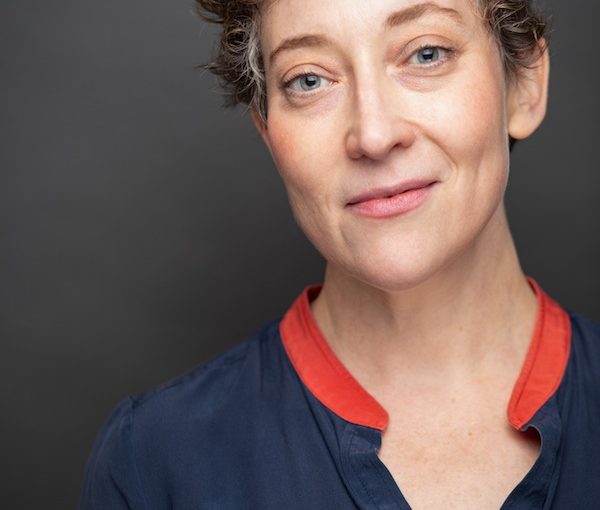
Joanna Garfinkel is part of the creative team behind the world première production of Berlin: The Last Cabaret, part of the PuSh festival. (photo from the artist)

The world première of Berlin: The Last Cabaret, presented at Performance Works Jan. 23-26 by City Opera Vancouver in association with Sound the Alarm: Music/Theatre, is almost sold out. Part of the PuSh International Performing Arts Festival, the only tickets that remain will be sold at the door, though writer and Jewish community member Joanna Garfinkel told the Independent, “I hope we are able to add more presentation opportunities, as well, since this is truly becoming an exciting and rich production.”

Set in Nazi Germany in 1934, a group of artists must decide whether or not to perform their new political show – which, reads the press release for Berlin, “challenges state media, calls out the Nazi classification of gay individuals as ‘degenerates’ and includes parodic inflection that women are being marginalized” under the new regime – or save themselves.

The opera takes place “two weeks after ‘the Night of Long Knives,’” said Garfinkel, “when the future had been cast, but many were not yet seeing it, including my own family. One thing that interested me a great deal is how people are forced to make compromises under oppression, and even make excuses for what’s happening around them.”

The “Night of the Long Knives” was the June 30, 1934, purge by Hitler of more than 85 members of the Sturmabteilung, the Nazi party’s initial paramilitary wing.

Rather than being a satire itself, Garfinkel explained that Berlin: The Last Cabaret “is more an unearthing of the under-heard Jewish and queer artists who flourished in the Weimar era and were crushed by the Holocaust. The humour we employ is their urgent satire, which feels fresh and relevant with all that is going in the world right now.

“My own family escaped from Berlin to Winnipeg (eventually), so I am both bound to respect and honour the history, and also privy to the dark humour we employ about it.”

City Opera Vancouver approached Garfinkel last spring, she said. They had “heard about me from my dramaturgical work with Playwrights Theatre Centre and the historically based Japanese Problem for my own company, Universal Limited. I was excited by the opportunity to work with an opera company, which would be new to me, but on something quite close to my heart, history and interest.”

The relevance of the opera was one of the reasons she joined its creative team. In regard to choosing projects in general, she said, “Right now, it feels like art must be speaking to the world and on behalf of marginalized voices. Theatre is too much work, and the world too messed up, to work on projects that don’t resonate on an activist level. I am lucky right now to get to choose to work on things that are so resonant.”

Garfinkel, who is billed as librettist for the production, clarified that categorization.

“I contributed story, structure and additional dialogue for this piece,” she said, “but it’s important to note that the songs themselves are historical, written by composers Eisler, Spoliansky, Hollaender and Weil, so I am not, technically, the librettist. However, building a story and play around preexisting songs presents its own challenges. It was of central importance to me that the Jewish/queer and other marginalized artists of the time were centred in our story.

“We were working with excellent (but unavailable!) collaborators in our composers and, together with director Alan Corbishley, music director and historian Roger Parton and choreographer Tara Cheyenne Friedenberg, tried to honour their work and build a vital story around it.”

Cheyenne Friedenberg is also a member of the Jewish community.

Berlin: The Last Cabaret stars actors with a background in music and spoken theatre, rather than traditional opera singers, and each performer, according to the press release, “was involved in the creation of their on-stage characters and storylines.” The production features a live four-person band.

For more information on PuSh, visit pushfestival.ca.
Format ImagePosted on January 17, 2020January 15, 2020Author Cynthia RamsayCategories Performing ArtsTags Berlin, free speech, Hitler, Holocaust, Joanna Garfinkel, LGBTQ+, Nazis, PuSh International Performing Arts Festival, satire, theatre

Let’s be more Jewish

It’s an inflammatory question. When attacks against Jews occur, as they are in increasing and alarming numbers in North America – including an incident of hateful graffiti at Camp Miriam on Gabriola Island recently – people ask why. Why Jews?

The problem with the formulation is that it suggests there is a justifiable answer to that question. It would be akin to asking, upon seeing statistics of domestic violence, why women?

Throughout the ages, scholars, pundits and philosophers have listed factors in Jewish theology and culture that confound, scare or irk others and contribute to antisemitic ideas and acts. The steadfast refusal to accept more dominant “successor” religions invites theological reactions. Adherence to cultural practices make Jews outsiders, to varying degrees, in every society. Jewish success in a range of fields invites envy.

But these explanations are all largely nonsense when it comes to the sorts of antisemitic acts we are seeing today. The primary explanation why, for so many people, it is all about Jews is counterintuitive – it is not about Jews at all.

For the most part, probably, the core motivation for engaging in racist and antisemitic acts has less to do with the victims than it does with the perpetrators. The definition of scapegoating is the assignment of sin or guilt onto an empty vessel that is then sacrificed. The hate and violence we are witnessing are almost certainly acts of scapegoating that reflect something amiss in the worldview of the perpetrators. These are people who identify problems in their lives or their world and seek an external entity to blame. Jews are history’s greatest scapegoat, regardless of our actual presence in any particular place. Notably, studies indicate that antisemitism is greatest in places where there are no Jews and it has perhaps always been thus. Shakespeare created the character Shylock hundreds of years after Jews were expelled from England, for example.

This is not comforting. If there were something more discrete motivating these incidents, perhaps they could be rationally contested. That the motivations are based on irrational projections makes them difficult to fight.

It is routinely said that Jews are the canaries in the coal mine of a society. The dehumanizing imagery this employs aside, it is undeniable that Western society today is experiencing some deeply troubling trends, from the emergence of “illiberal democracy” in the erstwhile democracies of Eastern Europe and Turkey to the stark chasms between partisans in still-healthy democracies. Rapid economic changes spark social and political reactions. The greatest migration of people on the planet in generations causes real or perceived threats to the status quo in the countries where these migrants are headed. And this is to leave aside the geopolitical dangers we face in relations with Iran, North Korea and many other flashpoints, as well as from decentralized terror groups that defy international boundaries. We are perhaps more surprised than we should be that, in the face of these developments and uncertainties, a number of people seek out that scapegoat of first resort: Jews.

As a result, stories are emerging of Jews going “undercover,” of being less inclined to be identified as Jewish in places like New York. There are other stories of Jews increasingly learning self-defence skills. Self-protection is primary in any situation and no one should be condemned for taking short-term measures in the midst of danger.

In the longer-term, though, there is an alternative to being (or appearing) “less Jewish.” If the root of this problem is not Jews, but disordered responses to a troubled world, then the answer, while not easy and most certainly idealistic, would be to be more Jewish, to embrace even more energetically a Jewish way of being and doing. We may not be able to change the distorted perspective of an antisemitic individual. But if, through our agency, we can promote fairness, tzedek (justice) and chesed (lovingkindness), we will advance a world in which people will not need to seek scapegoats.

Is it a fair burden that this labour should fall to Jews? Perhaps not. But maybe this is what we have been chosen to do in this moment in history.

Posted on January 17, 2020January 17, 2020Author The Editorial BoardCategories From the JITags antisemitism, culture, democracy, violence
Cohen’s clay defies gravity

Cohen’s clay defies gravity

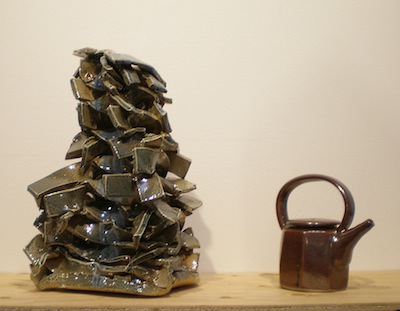
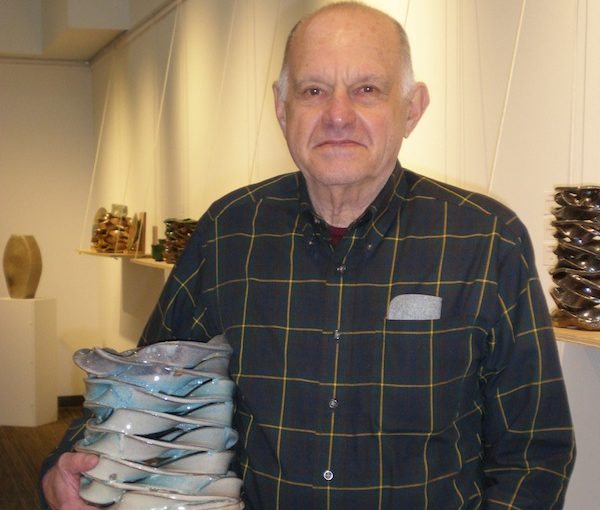
Larry Cohen’s new ceramic exhibition at the Zack Gallery runs until Jan. 25. (photo by Olga Livshin)

Larry Cohen’s new ceramic exhibition at the Zack Gallery is called This and That. The name is symbolic for the artist. His show consists of two entirely different types of pottery: whimsical woven sculptures and functional crockery. “I wanted to explore the relationship between pure art, like my sculptures, and functional things, like my bowls, vases and cups,” said Cohen in an interview with the Independent.

“There is a continuum that stretches from pure functional to pure art, and every object fits somewhere along that continuum,” he explained. “The closer to the artistic end, the less functionality the object has, except for people to look at it and think about it. On the other end, there is pure functionality: you can use a bowl for fruits or a mug for your coffee, but it also has a shape and a colour; something to look at, too.”

In his long artistic life, Cohen has worked in many different mediums, creating sculptures from metal and wood, but clay is his material of choice. “Clay is a wonderful thing to work with. It feels good in my hands,” he said. “And it could be found anywhere in the world. Here, in British Columbia, in Europe, in China, in Japan, in Latin America.”

In the past decade, Cohen has won a couple of month-long residencies as a clay master, one in China, another in Japan. “The clay is different everywhere. Its chemically different compositions provide different visual and textile effects in the objects made of it,” he said. “It could be the same colour when unfired and painted with the same glaze, but, if made from different types of clay, after firing, the resulting pottery would look and feel different.”

Cohen travels a lot and, everywhere he goes, he searches for the local potters and their art, trying to absorb as much as he can from the various traditions. “As clay is different everywhere, so the traditions are different, but, in most of the places I have visited, the history of pottery goes back thousands of years,” he said. “People made things of clay in ancient China and ancient Mexico. Not so much in Europe – it had to import the technique from China, but it is still very old. The only place in the world I know that didn’t have pottery is here, in British Columbia. The local clay is wonderful, but the indigenous people here didn’t use it. They made everything out of wood. Only in the past 200 years, since the Europeans settled in B.C., pottery has been on the rise.”

To a degree, Cohen is a local clay pioneer, like other local potters. It is important to him that everything he creates is unique, that no object repeats another. He is as much a craftsman as an artist, which makes even his utilitarian bowls and vases works of art. His woven sculptures are really one of a kind; they are akin to wicker baskets, but made of clay.

“Some of them look like vases, but there are holes,” he said with a smile. “You can’t pour water inside. No functionality except to look at and admire. It is a new technique for me. I always try something new, always think: what is another way to use clay?”

This particular technique looks like ceramic ribbons lying on top of one another, or interwoven. “Clay is forgiving,” Cohen said. “You can make all kinds of different shapes from it, but, even so, it took me awhile to develop this technique. I had to figure out how to overcome the softness of clay and how to combat gravity, so the upper layers wouldn’t squish the lower ones.”

photo - On display are works he has made using a technique that creates dynamic, ribbon-like clay structures
On display are works he has made using a technique that creates dynamic, ribbon-like clay structures. (photo by Olga Livshin)

He cuts clay in strips and then twists them in various ways to create the dynamic shapes. “Sometimes, I repeat the same shape multiple times, sometimes make them different,” he said. “I dry them before firing, so the whole sculpture doesn’t collapse under its own weight. Sometimes, I make two or three layers together. Other times, every layer is dried separately, and then they come together in the kiln, held to each other by the glaze. Once or twice, I made the full sculpture before firing, and you could see the lower layers sort of melting together.”

Unlike a painter, who sees the immediate result of his labours, a potter doesn’t see what he creates until it’s fired in the kiln. Cohen fires every piece twice, first without glaze, the second time with glaze.

“Once a piece goes into the kiln, you never know what will come out,” he said.

Cohen makes his pieces in bunches before firing them all together. “I have three large kilns in my studio on Cortes Island,” he said. “I fire them four or five times a year. One is electric, for lower temperatures. It is the first one I use. Whatever I’ve made by the time I fire the kilns goes in. Then everything has to cool down before I paint on the glaze and use the other two kilns – one for regular glaze, for the smooth surfaces, and another with salt for the special textures.”

This and That opened on Jan. 9 and continues until Jan 25.

Olga Livshin is a Vancouver freelance writer. She can be reached at [email protected].

Format ImagePosted on January 17, 2020January 15, 2020Author Olga LivshinCategories Visual ArtsTags art, clay, Larry Cohen, pottery, Zack Gallery
Victoria hosts Klondike

Victoria hosts Klondike

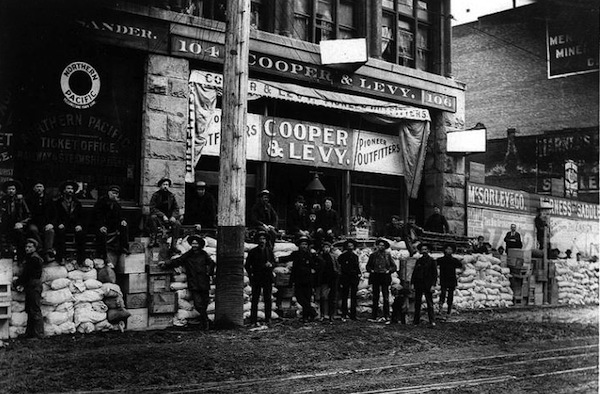
Cooper & Levy store, 104-106 1st Ave. S. near Yesler Way, Seattle, 1897. The store was one of the major outfitters of the Klondike Gold Rush. (photo from Asahel Curtis Collection, University of Washington UW 4770)

The archival images and newspaper headlines contained in the Gold Rush exhibit now on display at the Jewish Community Centre of Victoria (JCCV) evoke a sense of the hysteria that gripped the West Coast more than century ago, in spite of the risks involved in traveling to a severe and treacherous terrain. And Jews were not immune from the mania, as the three-panel display, entitled “The Jewish Presence During the Klondike Gold Rush 1897-1918,” distinctly demonstrates.

The exhibit will be at the JCCV through January. It brings with it a number of revisions from the one that toured Canada from 2016 to 2018 and included a stop in Vancouver.

“During its previous run, we received a lot of additional information from people who visited the exhibit, so much so that we couldn’t include it all in the current display. We are seriously thinking about doing a book starting later this year,” Rick Karp, president of the Jewish Cultural Society of Yukon (JCSY), told the Independent.

Once the previous display returned to Whitehorse, Karp followed up on the input he received and updated the three panels and the booklet accompanying the exhibit.

“As well, we revised the video that details the finding of the Jewish cemetery from the Gold Rush in Dawson, the cleaning and bringing it back to its original condition, and the rededication ceremony,” Karp said. “All the information about the cemetery in the accompanying booklet has been added, as well as the section entitled ‘The History of the Jews in the Klondike Gold Rush’ and the ‘Stories of the Gold Rush.’”

A significant addition to the Gold Rush stories is that of Joseph Barron, one of the first to open a mercantile store in Dawson. Barron came from Winnipeg and followed the stampede of 1898. He mushed into the Yukon via the White Pass route, bringing with him a stock of merchandise.

His beginnings in the north were not the most fortuitous. He lost his supplies on three occasions to fire between 1899 and 1901. Undeterred by adversity, he restocked and started over.

The Barrons would become a prominent Calgary family. Joseph’s son Abe founded the law firm Barron & Barron, which is still operated by the family today. His other son, Jacob (J.B.), was a leading businessman and theatre owner in the city, building Calgary’s first high-rise, the Barron Building, and breaking ground on its first Modern Orthodox synagogue, Shaarey Tzedec (which was demolished in 2013).

Joseph Barron’s wife and children did not come to Dawson until 1902. The younger Barrons only stayed for two years before they left to complete their education. The senior Barrons eventually left Dawson to join their children in Calgary in 1915.

Henry Isaacs was another entrepreneur who ventured north. He earned the moniker “the Butter King of the Klondike” upon learning about a technique using sea water to re-churn a shipment of what others had considered rancid butter into something edible.

Among the most enterprising adventurers was David Gross, a Russian immigrant and dropout trained as tailor, who, not yet 20 years of age when he made the journey north, found ways to make money selling groceries, stoves and other provisions, though his primary business was a clothing store. His ingenuity led him to see opportunities where others did not. For example, if butter had turned rancid and was unsalvageable for food purposes, he would sell it as axle grease for squeaky wheels. After learning that water can only penetrate an inch or two into flour, he would purchase large sacks of flour other merchants thought had been drenched and, therefore, ruined and then sell the flour that the water had not reached at a much higher price. Gross also became active in the nascent movie theatre business in Dawson City.

Yet the prize for the most daring Jewish seeker of fortune would have to go to Max Hirschberg. After losing his supplies en route and then finding, in 1890, that many of the good claims in Dawson had been staked, Hirschberg pushed on to Nome, where more gold was reported to be, on a bicycle!

Later in life, before his passing in 1964, he recounted the 11-week journey in which he made his way along a two-inch trail, confronting snow-blindness, exposure and exhaustion, nearly drowning in the Shaktoolik River and losing $1,500 in gold dust. When his bike chain broke, he made a sail from his coat and rigged it to his bicycle, then crossed the Norton Sound to Nome.

Interest in the Jewish community during the Gold Rush was ignited after the discovery of the aforementioned Jewish cemetery in Dawson City in 1995, and its ensuing restoration in 1997 and 1998. “The discovery of lives lost inevitably leads to questions about lives lived,” the exhibit booklet reads.

“The Jewish Community Centre of Victoria is excited to host the mobile exhibit. We would like to thank Rick for making it possible,” said Larry Gontovnick, president of the JCCV.

After it completes its current tour around Canada, the exhibit will be on permanent display at the Dawson City Museum in the Yukon. A duplicate copy will tour various communities in the United States.

Sam Margolis has written for the Globe and Mail, the National Post, UPI and MSNBC.

Format ImagePosted on January 17, 2020January 15, 2020Author Sam MargolisCategories LocalTags Gold Rush, history, JCSY, Jewish Cultural Society of Yukon, Klondike, Rick Karp, Victoria, VJCC, Yukon
Artistic responses

Artistic responses

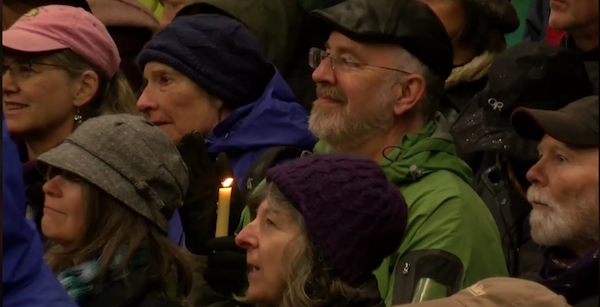
Gabriolans held a candlelight vigil after antisemitic graffiti was found at Camp Miriam. An arts festival will take place Feb. 7-9. (photo from You’ve Got a Friend)

Since Camp Miriam on Gabriola Island was defaced with antisemitic graffiti in December, Gabriolans have shown support for the Jewish community, including a candlelight vigil on Jan. 2. Next month, island artists, musicians and writers will gather together to present You’ve Got a Friend: A Festival of Jewish and Gabriolish Art, Words and Music. The Feb. 7-9 festival will feature Jewish-themed visual art, music and writing, all created by residents of Gabriola, among them Juno nominees and literary prizewinners.

“When people heard about the vandalism at Camp Miriam,” said Sima Elizabeth Shefrin, one of the festival’s organizers, “many said, ‘What can I do to help? How can I show my support?’ The festival is a chance to celebrate our friendship and solidarity with each other and to move things on in a positive way. We took the title, You’ve Got a Friend, from Carole King’s old song.”

The festival program includes visual art by Shefrin, Heather Cameron and others at the Gabriola Arts and Heritage Centre. The opening reception will take place Feb. 7, 6-9 p.m., and the gallery will be open Feb. 8, 10 a.m. to 4 p.m., and Feb. 9, 10 a.m. to 1 p.m.

The concert Oy! will feature Bob Bossin, Paul Gellman, Dinah D, the Today Only Klezmer Band and others. It will take place Feb. 8, 7:30 p.m., at the Roxy Lounge and Cultural Club, with tickets available at North Road Sports. Admission is a suggested donation of $15.

Earlier on the Saturday, at 3 p.m., Amy Block will lead a celebration for Tu b’Shevat, the Jewish new year of the trees, at the arts and heritage centre.

Finally, Nu? – poetry and memoir by Janet Vickers, Naomi Wakan, Lisa Webster, Shayna Lindfield, Gloria Levi, Lawrence Feuchtwanger, George Szanto and Bossin – will be held at the arts and heritage centre Feb. 9, 1-3 p.m.

You’ve Got a Friend is supported by Camp Miriam, the Gabriola Arts Council and Anne Landry. For more information, contact Cameron at [email protected].

Format ImagePosted on January 17, 2020January 15, 2020Author You’ve Got a Friend organizersCategories Music, Visual ArtsTags antisemitism, art, Camp Miriam, Gabriola Island, Shefrin, solidarity
Making hydrogen from sunlight

Making hydrogen from sunlight

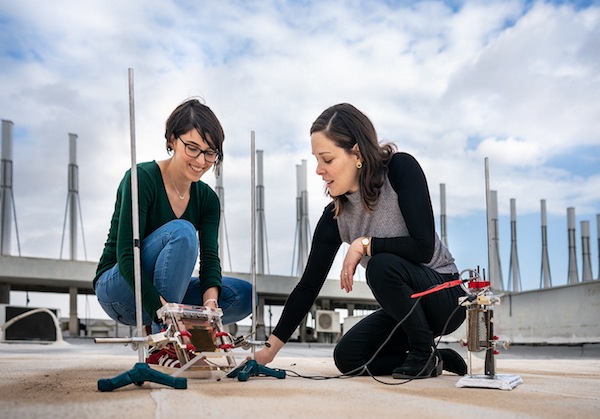
Avigail Landman, right, and Rawan Halabi with an experimental prototype device. (photo from Ashernet)

Researchers at the Technion-Israel Institute of Technology have developed a prototype system for efficient and safe production of hydrogen using only solar energy. Published in the journal Joule, the study was led by Avigail Landman, a doctoral student in the Grand Technion Energy Program, together with Rawan Halabi, a master’s student from the faculty of materials science and engineering, under the joint guidance of Technion and University of Porto (Portugal) professors. The system contains a tandem cell solar device. Some of the sun’s radiation is absorbed in the upper layer, which is made of semi-transparent iron oxide. The radiation that is not absorbed in this layer passes through it and is subsequently absorbed by a photovoltaic cell. Together, the two layers provide the energy needed to decompose the water into hydrogen and oxygen. The innovation is a continuation of the theoretical breakthrough by the Technion research team presented in a March 2017 article in Nature Materials. Hydrogen is a highly sought-after material in many areas of our lives and, today, most of the world’s hydrogen is produced from natural gas, but this process emits carbon dioxide, whose environmental damage is well known.

Format ImagePosted on January 17, 2020January 15, 2020Author Edgar AsherCategories IsraelTags high-tech, Israel, science, Technion, University of Porto
Tips for inclusivity

Tips for inclusivity

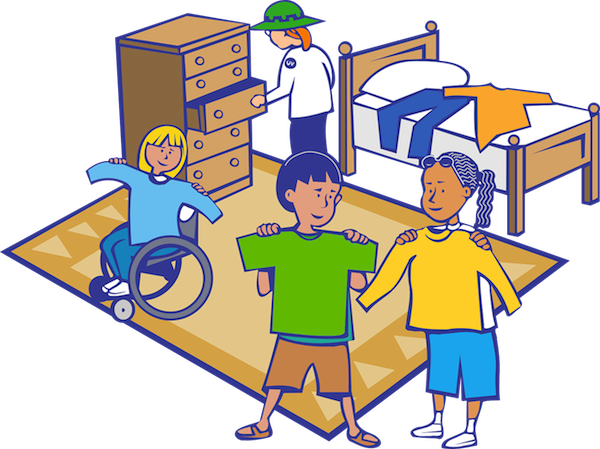
If you’ve got a kid with special needs, it can be hard to find the right learning experiences and it can require extra work to make them accessible. (image from clker-free-vector-images (pixabay.com))

All Jewish kids deserve to have access to wonderful summer camp experiences. However, if you’ve got a kid with special needs, it can be hard to find the right learning experiences and it can require extra work to make them accessible. Every kid is different, so these tips are only a start, and from just one parent. Here’s to hoping your child has a great experience with Jewish camping, and that you do, too.

Start early. Finding the right situation takes research. For us, the best advice came from the parents of other special needs kids. Every special needs parent I’ve met wants to help others, as well. Taking care of a kid with challenges can be a struggle.

Even if your child isn’t ready for camp now, listen carefully, as advice may make it easier when the time comes. Starting early might mean gathering information years in advance or just signing up early in the new year to get into the summer program that is the best fit for your kid.

Ask for more information. Many camps say they work to meet every kid’s needs, but their program descriptions may not offer details. Contact the camp office to ask how they can meet your specific child’s needs. Be polite and detailed. The camp director should demonstrate professional competence that shows they can rise to any challenges that may occur.

Ask for a tour. If a child has physical disabilities or sensory challenges, for example, the physical environment can make or break the kid’s experience. Some places give lip-service to accessibility but haven’t tested it. Maybe a kid using a wheelchair can’t use the bathroom, or the hiking trails are too rugged for the wheelchair to manage. If a child uses an iPad assistive communication device that requires charging, check that the camp’s got adequate plugs to recharge it.

Walk through the grounds. Imagine your child on a camp day. If your child is open to it, bring the kid along. How will this environment work physically for him or her? Is it truly accessible?

Ask about professional supports. Many camps are staffed with eager but inexperienced young adults. These counselors are often full of energy and great ideas but many have never encountered special needs situations. Does this camp have a professional on staff who works with kids with challenges? Does this person have any training or experience?

In some school environments, even the teachers aren’t expected to have special education training. If it isn’t required at school, it may not be available at camp.

While professionals are essential, sometimes the best support can be an older student or even another parent who has experience with a sibling, child or friend with special needs. If the camp looks like a possibility, see if your child can be paired with an assistant who really knows what she or he is doing. Sometimes, you need to pay extra to get this help.

Good communication is key. A camp that doesn’t respond to questions isn’t likely to work out well. This is particularly true if your child isn’t verbal or can’t advocate for themself. You should feel reassured that, from start to finish, the camp is willing and able to connect with you, let you know about the successes and difficulties each day, and even ask you for advice about your kid.

It doesn’t have to be formal, it can be a few words at pick up and drop off, but communication needs to be good to keep your kid safe.

Ask if you can observe or drop in. If you can see camp in session, with or without your camper present, you may have a much better idea of whether it will work. For instance, a kid who is sensitive to noise may need accommodation to cope with common camp experiences like bunk cheers or song sessions, as these frequently offer an opportunity for over-the-top yelling. You cannot hear that noise unless you are there when the campers and counselors are, too.

Compromise. The best Jewish environment for your child may not be the one you planned on. If your family is traditional but the Reform day camp has the most accessible campus, you might choose that camp. Or, if your local Chabad provides the most supportive environment in terms of counselor/camper ratio, but you’re raising an egalitarian Conservative family, you may need to decide which values are most important. For many, there are the things that their special needs camper must have, and then there are many other compromises along the way. Do what is best for your child. Sort out the theological discrepancies later.

Trust your gut. Sometimes, we don’t have all the information in advance, but we know the people involved and their good relationship with our children. If you feel confident and trust those in charge, that’s a great start. On the other hand, if you get a bad feeling from an interaction, pay attention! Your child is dependent on the adults in charge at camp. If you doubt their ability to meet your kid’s needs, don’t sign up, or take your kid out of the camp.

Your kid (and every kid) is precious. Do your homework. A good camp is more than daycare. It’s powerful enrichment that boosts Jewish identity and enthusiasm for the whole year.

Joanne Seiff has written regularly for CBC Manitoba and various Jewish publications. She is the author of three books, including From the Outside In: Jewish Post Columns 2015-2016, a collection of essays available for digital download or as a paperback from Amazon. Check her out on Instagram @yrnspinner or at joanneseiff.blogspot.com.

Format ImagePosted on January 17, 2020January 15, 2020Author Joanne SeiffCategories Op-EdTags accessibility, camp, disabilities, inclusion, kids, parenting
A time to learn who we are

A time to learn who we are

For many kids, camp is the only time they find themselves in a less structured environment. (photo from pixabay.com)

I remember the days when going to camp was the annual ritual, part of the summer holiday agenda. In our Winnipeg Jewish community, camps were standard practice. It seemed to me that all of my friends were going to be there, but there were always new faces. Some of them would prove to be the companions of my growing up.

Camp was there to free us from the constraints of everyday life, school and parental supervision. For some of us, being out there, in a natural setting, was the only time we ever found ourselves in a less structured environment, as most of us were city-dwellers. And there were always elements of Jewish culture to be shared.

But what I remember most of all was the consciousness that I was alone in a way different from the ordinary. I was in a cabin or a tent where most of my companions were strangers, at least at the start of the summer. Parents were far away. There was a counselor, but he or she was more like a referee than a parent. Whatever issues might arise between my companions and me, resolution would require direct negotiation without intervenors.

Here was an opportunity to test out our interpersonal skills and discover whether we would be leaders or followers, and in what areas did we have knowledge we could share. Here we could discover what issues might be important to us in person-to-person relationships. It had a different feel than our relations with siblings but with the intimacy of living together. We might even have to get into a physical fight if a conflict were grave enough. Would we allow someone to bully us? I certainly had to develop my capacities in these areas in my home environment.

In my case, I went the whole route: camper, counselor, program director. I can honestly say that the camping experience was my personal proving ground for skills I would hone and embellish throughout my life. In retrospect, I realize how important these occasions were for me.

I had the good fortune to attend a camp in my teen years that included subsisting for a few days in a wilderness environment. We hiked. We canoed. We even spent some time in a lake waiting for rescue when our canoe foundered in a sudden storm. I actually have started a fire by rubbing two sticks together. I have slept several nights in a forest with my companions listening to all the mysterious night sounds. We never saw a wolf or a bear, but we got to use copious amounts of mosquito repellent. I have lugged in the groceries and I have cooked food over an open fire. Potatoes are easy, but eggs are more difficult. The experiences were unforgettable.

Max Roytenberg is a Vancouver-based poet, writer and blogger. His book Hero in My Own Eyes: Tripping a Life Fantastic is available from Amazon and other online booksellers.

Format ImagePosted on January 17, 2020January 15, 2020Author Max RoytenbergCategories Op-EdTags camp, culture, education, kids, memoir
אזהרת מסע

אזהרת מסע

באזהרה נאמר כי יש להימנע לחלוטין מלהגיע לרצועת עזה. (David Berkowitz) 

הממשלה הקנדית פירסמה אזהרת מסע לישראל, עזה והשטחים – לאור הגברת המתיחות במזרח התיכון, והפעילות של האמריקנים מול האיראנים והפוך. אזהרת המסע שפורסמה בראשית החודש עדיין תקפה.

לגבי ביקור בישראל נאמר באזהרת המסע שיש לנקוט באמצעי זהירות מירביים. עוד נאמר כי מצב הביטחון בישראל עשוי להשתנות בצורה משמעותית ולכן יש לעקוב מקרוב אחר הנעשה.

באזהרה נאמר עוד כי יש להימנע לחלוטין מלהגיע לרצועת עזה, בזמן שהסיכון גבוה לפעילות טרור ופעילות צבאית עויינת באזור. לגבי השטחים נאמר שיש להימנע מלהגיע אליהם אם אין צורך בכך, לאור הסכנה הביטחונית הרבה. זאת למעט רמאללה, יריחו ובית להם שנחשבות לערים בטוחות יחסית. עוד נמסר כי אם אין צורך בכך יש להימנע מלהגיע לגבול של ישראל ורצועת עזה, לאור הסכנה של משלוח טילים מעזה לישראל.

באזהרת המסע נאמר שיש להימנע לחלוטין מהלגיע לרמת הגולן בגבול של ישראל וסוריה, בעיקר לאור הגברת הפעילות הצבאית של ישראל באזור. זאת למעט הכפרים הדרוזים באזור.

כן יש להימנע לחלוטין למהגיע לגבול של ישראל ומצרים, עד למרחק של חמישה קילומטר ממנו. זאת למעט העיר אילת.

עוד נאמר כי יש להימנע לחלוטין מלהגיע מלהגיע לגבול של ישראל ולבנון, עד למרחק של חצי קילומטר ממנו. זאת לאור פעילות צבאית באזור.

לא בדיוני: בית המשפט העליון בקנדה העניק אזרחות לבנים להורים מרגלים רוסים

בית המשפט העליון של קנדה החליט לפני מספר שבועות להעניק אזרחות קנדית לשני בנים של הורים שהיו מרגלים רוסים.

אלכנסדר וויבילוב (כיום: בן עשרים וחמש) נולד בקנדה למרגלים רוסים שחיו בסתר, בקנדה ובארה”ב. המשטרה הפדרלית האמרוקנית (האף.בי.איי) חשפה את שני ההורים שהשתייכו לרשת ריגול גדולה בשנת אלפיים ועשר. במסגרת חילופי מרגלים בין ארה”ב ורוסיה ההורים ושני ילדיהם חזרו בחזרה לרוסיה.

סיפור החיים של ההורים היווה בסיס לסדרת הטלוויזיה האמריקנית הבדיונית “האמריקנים”. לאחר שהוריו נעצרו החליטו במשרד הפנים הקנדי להפקיע את האזרחות של אלכסנדר וויבילוב, בטענה שהוא לא זכאי להיות קנדי. נשמעו אף טענות שהוא היה מודע לפעילות הריגול של הוריו למען רוסיה. עתה כאמור בית המשפט העליון הפך את ההחלטה ודחה את כל הטענות נגד הבן. גם אחיו הגדול של אלכנסדר ווילוב – טימופיי וויבילוב (כיום: בן עשרים ותשע) “יהנה” אף הוא מהחלטת בית המשפט ויקבל אזרחות קנדית קבועה. תשעת שופטי בית המשפט העליון ציינו בפסק הדין כי במשרד הפנים הבינו את חוק האזרחות הקנדי בצורה לא נכונה, ומנעו שלא בצדק את האזרחות הקנדית של אזרח קנדי.

זוג ההורים המרגלים הגיעו לטורונו בשנות השמונים וקראו לעצמם דולנד הית’פילד וטרייסי אן פולי. כאן נולדו שני בניהם טימוטי ואלכנסדר. לאחר מכן ההורים עברו לאירופה ובסופו של דבר הגיעו לקמבריג’ בארה”ב (בשנת אלף תשע מאות תשעים ותשע). כאמור ההורים נעצרו על ידי השלטונות האמריקניים לפני כתשע שנים לאחר שהתרברר שהם מרגלים רוסים. אלכסנדר וויבילוב אמר לתקשורת במספר הזדמנויות כי הוא לא ידע שהוריו היו מרגלים ונדהם לכן ממעצרם. לדבריו אם הוריו החליטו להיות מרגלים אולי הם לא היו צריכים להביא בכלל ילדים לעולם. וויבילוב שהגיע בחודש דצמבר לביקור בטורונטו לאחר (שפורסמה החלטת בית המשפט העליון להעניק לו בחזרה את האזרחות), לא יודע עדיין היכן יתגורר באופן קבוע מעתה ואילך. גם עתידו של אחיו טיפופיי וויבילוב לא ברור בשלב זה.

Format ImagePosted on January 15, 2020June 30, 2020Author Roni RachmaniCategories UncategorizedTags Canada, citizenship, Iran, Israel, Russian spies, Supreme Court, travel warning, United States, Vavilov brothers, אזהרת מסע, אזרחות, איראנ, ארה"ב, בית המשפט העליון, וויבילוב, ישראל, מרגלים רוסים, קנדה
BRCAinBC’s inaugural event

BRCAinBC’s inaugural event

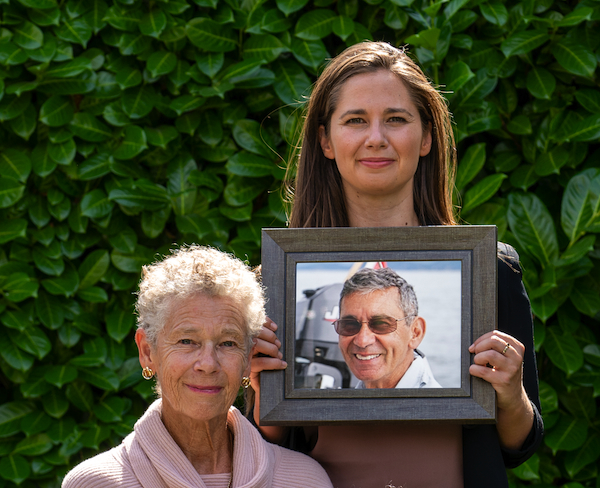
Jane Remocker and her daughter, Catriona, holding a photo of Geoff Remocker, who passed away in 2016 from pancreatic cancer. (photo from BRCAinBC Committee)

Education is a key goal of the upcoming One in 40: From Awareness to Empowerment event being held at Congregation Beth Israel on Jan. 8.

“BRCA 1 and 2 is the code for variant mutations of two genes known to increase the lifetime risk of several serious cancers, including breast and ovarian cancers and other cancers linked to reproduction in women and prostate cancers in men, as well as pancreatic cancers and melanoma in all genders,” explains the BRCAinBC Committee’s project primer. One in 40 is the probability of carrying the genes among Ashkenazi Jews – compared to a risk of 1/500 to 1/1000 in the general population.

The BRCAinBC Committee, organizer of the One in 40 event, describes itself as “a group of concerned members of the Jewish community in British Columbia, many of whom have been affected personally or in our families by the BRCA 1 or BRCA 2 genes and genetically linked cancers.”

The committee’s work is supported by Beth Israel, which is its home, as well as many other community members, organizations and institutions, including the B.C. Cancer Agency, the Centre for Israel and Jewish Affairs, the Jewish Federation of Greater Vancouver and the Diamond Family Philanthropic Fund.

“There are currently no efforts being made in British Columbia to create awareness or cover general genetic testing for people of Ashkenazi Jewish heritage – in the past, this was due to the prohibitive expense of testing,” notes the primer.

“There have been significant recent gains in the medical community around improving the affordability of testing for genetic mutations,” it continues, “however, awareness of risk is still low amongst members of the Jewish community and, currently, holding a risk profile of being of Ashkenazi Jewish descent is not sufficient to be covered for genetic testing under B.C.’s Medical Services Plan (MSP).”

The impetus for the committee and the One in 40 event was the death of Geoff Remocker of aggressive prostate cancer in 2016. After he died, his wife, Jane Remocker, and the family met with Beth Israel’s Rabbi Jonathan Infeld. She explained to the Jewish Independent in a phone interview that, as members of the congregation, there were donations being made to the synagogue in her husband’s honour, and the rabbi wanted to know where the family wanted to direct the funds. The couple’s youngest daughter, Catriona, who works in the healthcare field, suggested they do something with respect to BRCA genes. Since they weren’t quite sure what they wanted to do on the topic, the donations were held in a discretionary fund until Jane Remocker scheduled a meeting with the rabbi and her daughter two years later, in June 2018.

“By then, she and I had ideas and came up with our three basic goals,” Jane Remocker told the Independent. The three short-term goals of the committee were education and awareness within the Jewish community, and easier access to information about the BRCA genes; advocacy, which involves providing information about and access to screening options, both private and public; and fundraising to cover what has become the One in 40 community-wide education event and the BRCAinBC.ca website, which will be launched in January.

Since Geoff Remocker didn’t meet the criteria for B.C. Cancer Agency’s Hereditary Cancer Program, which offers genetic counseling and testing for “residents who may have inherited an increased risk for specific types of cancer,” he signed up for a B.C. Cancer study of drugs that treat prostate cancer, which included gene testing.

Remocker said he signed up for the study because, “as he said to me, ‘I don’t think the drugs will help me, I think it’s too late. But, if there’s a gene that’s driving this cancer to be aggressive and resistant to treatment needed, that knowledge will help other people.’” It was discovered that he was indeed a BRCA carrier.

Part of the issue, said Remocker about why her husband wasn’t eligible for the Hereditary Cancer Program, was that, while they knew some of her mother-in-law’s medical history, they knew nothing about her father-in-law’s side of the family, who came from Poland and Russia.

“And this is not uncommon,” she said. In addition to this generation not talking about health issues, in general, there wasn’t so much knowledge about health back then.

While a lack of family medical history can be one obstacle in getting genetic testing, she said, another is that many people don’t realize that men can be carriers of the BRCA mutant genes.

“They thought it was only a gene that affected women as breast cancer,” said Remocker. It is important, therefore, and a goal of the committee’s educational program, to make sure that Jewish men – especially if they have roots in Europe – know that they are possible carriers and, therefore, consider getting screening.

photo - Libby Znaimer, national spokesperson for Pancreatic Cancer Canada, will be the keynote speaker at One in 40: From Awareness to Empowerment, which takes place Jan. 8 at Congregation Beth Israel
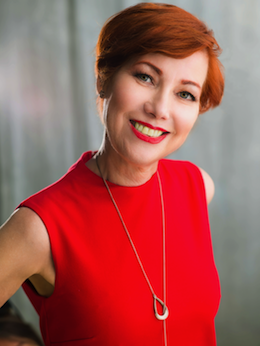
Libby Znaimer, national spokesperson for Pancreatic Cancer Canada, will be the keynote speaker at One in 40: From Awareness to Empowerment, which takes place Jan. 8 at Congregation Beth Israel. (photo from BRCAinBC Committee)

Confirmed panelists for the One in 40 event are Dr. Rona Cheifetz, medical lead of the Hereditary High Risk Clinic, B.C. Cancer Agency; and Dr. Intan Shrader, who, along with Dr. Sophie Sun, is co-medical director of the B.C. Cancer Hereditary Cancer Program. The panel will also feature medical oncologist Dr. Daniel Khalaf of the B.C. Cancer Agency and Jewish community member Tovah Carr, a BRCA carrier. There will be a chance for audience members to ask questions.

Keynote speaker Libby Znaimer of Zoom Media is national spokesperson for Pancreatic Cancer Canada; she is a cancer survivor and a BRCA gene carrier. Her personal fight against breast and pancreatic cancer is the subject of the 60-minute documentary Cancer Saved My Life, which discusses “the BRCA 1 and BRCA 2 gene mutations that predispose people to pancreatic cancer, and the connection between BRCA and breast and ovarian cancer,” as well as the “groundbreaking research going on in Canada and Israel, where there is a BRCA-rich population.”

The BRCAinBC.ca website will be “a one-stop place for people to go to get information about the genes and the mutations that indicate the cancer risk and where they can go for private screening if they don’t meet Hereditary Cancer’s criteria or they don’t want to wait,” said Remocker.

Hereditary Cancer has a long wait list, she said, so the website will have some options for private screening. “We’ve researched and found a number of accredited medical genetic labs that do specific inherited Jewish genes screening and we know that, [for] at least two of them, the results are accept[ed] by the Hereditary Cancer Program.”

Currently, the cost for private testing is about $250 US, said Remocker. This alternative means that, “instead of waiting six to 12 months to get your first interview with the Hereditary Cancer Program, you get a saliva test, you apply. They send the package to you, you send it back and you get your results anywhere from two to six weeks.”

A person can then take those results to their family doctor, she said, as a referral is needed for the HCP.

The website will also feature personal stories of those who have been affected by the BRCA 1 and BRCA 2 genes, as well as links to current research and resources.

Michelle Capobianco, the executive director of Pancreatic Cancer Canada, will be in attendance at One in 40, Catriona Remocker told the Independent. “[T]hey are considering working with us to roll out similar events to Jewish communities across Canada to improve awareness,” she said.

To register for the event, which runs 7-9 p.m., visit bethisraelvan.ca/ event/one-in-forty.

Format ImagePosted on December 20, 2019December 18, 2019Author Cynthia RamsayCategories LocalTags Ashkenazi, Beth Israel, BRCA, cancer, education, health, Remocker

Posts pagination

Previous page Page 1 … Page 268 Page 269 Page 270 … Page 649 Next page
Proudly powered by WordPress