Skip to content
  • Home
  • Subscribe / donate
  • Events calendar
  • News
    • Local
    • National
    • Israel
    • World
    • עניין בחדשות
      A roundup of news in Canada and further afield, in Hebrew.
  • Opinion
    • From the JI
    • Op-Ed
  • Arts & Culture
    • Performing Arts
    • Music
    • Books
    • Visual Arts
    • TV & Film
  • Life
    • Celebrating the Holidays
    • Travel
    • The Daily Snooze
      Cartoons by Jacob Samuel
    • Mystery Photo
      Help the JI and JMABC fill in the gaps in our archives.
  • Community Links
    • Organizations, Etc.
    • Other News Sources & Blogs
    • Business Directory
  • FAQ
  • JI Chai Celebration
  • JI@88! video

Recent Posts

  • Story of Israel’s north
  • Sheltering in train stations
  • Teach critical thinking
  • Learning to bridge divides
  • Supporting Iranian community
  • Art dismantles systems
  • Beth Tikvah celebrates 50th
  • What is Jewish music?
  • Celebrate joy of music
  • Women share experiences 
  • Raising funds for Survivors
  • Call for digital literacy
  • The hidden hand of hate
  • Tarot as spiritual ritual
  • Students create fancy meal
  • Encouraging young voices
  • Rose’s Angels delivers
  • Living life to its fullest
  • Drawing on his roots
  • Panama City welcoming
  • Pesach cleaning
  • On the wings of griffon vultures
  • Vast recipe & story collection
  • A word, please …
  • מארק קרני לא ממתין לטראמפ
  • On war and antisemitism
  • Jews shine in Canucks colours
  • Moment of opportunity
  • Shooting response
  • BC budget fails seniors
  • Ritual is what makes life holy
  • Dogs help war veterans live again
  • Remain vital and outspoken
  • An urgent play to see
  • Pop-up exhibit popular
  • An invite to join JWest

Archives

Follow @JewishIndie
image - The CJN - Visit Us Banner - 300x600 - 101625

Month: October 2025

When approaches differ

News of a possible breakthrough that could lead to the end of the war between Israel and Hamas is encouraging, but there is effectively no happy ending to this situation. Nothing can return the lives lost or undo the horrors of the past two years. Even if it ends tomorrow, the tragedy of this war will go down as one of the saddest, most protracted chapters in a heartbreaking history.

The international repercussions have been less lethal but will have permanent implications for, among other things, the stability and well-being of Jewish communities in the diaspora. Global antisemitism has reached unimagined heights. And, globally, Jewish people and organizations are at odds over how to proceed.

For many months, voices in Israel, among Jews worldwide and in our own local community have been divided over, among other things, whether Israel should unilaterally end the war, pursue it to the stated end of eliminating Hamas or, depending on the perspective, something on a spectrum between these views. Some are calling for an Israeli or international occupation of Gaza. 

Here in British Columbia, weekly solidarity rallies at Vancouver City Hall have continued, sometimes with small numbers, and featuring a diversity of voices. Other rallies, including marches across the Burrard Street Bridge and, this week, a community commemoration of the second anniversary of 10/7, have brought together overlapping and different participants.

It is sometimes hard for human beings, especially those deeply determined to do the right thing, to accept that there can be legitimate but differing opinions on the best way forward. We should be able to agree on this: no one can predict the future or know for certain what is best for the people of that region (or for Jews worldwide). We may disagree on fundamentals, such as whether a two-state solution remains a viable possibility or whether, at the other end of opinion, the West Bank and Gaza should be absorbed into an enlarged state of Israel (a perspective still generally viewed as extremist), or whether some kind of federated one-state system might integrate both peoples’ needs and futures. If we disagree on the end goal, we will almost certainly find fault with the other side’s means of reaching it.

Stuck as we may be in what seems an ideological, moral, political, strategic and theological disagreement, it is easy to view others, even those in our own community, as adversaries – this certainly is reflected in some of the messages we have received in recent days. On the one hand, we received an open letter to community rabbis ostensibly reminding them what Jewish morality entails, and, on a different hand, we received messages declaiming those in our community who call for a ceasefire as being in cahoots with nefarious groups, including one proscribed by the federal government as a terrorist entity. Both missives encourage community members to call out those who do not agree with their approach.

The passions ignited around this topic are understandable. These are existential issues faced by our people and our homeland. With no universally agreed-upon ends or means, division is inevitable. We should, though, keep in mind that, while it is our obligation to pursue justice, that pursuit includes minimizing harm in our own community. We should be guided by the understanding that our actions will have greater impacts on our people’s well-being here at home than on events halfway around the world. 

While it may be difficult in the moment of discord to see the sincerity and humanity of those we see as our opponents, there is a commonality at play. Believe it or not, the people in our community most vehemently hostile toward your outlook are convinced, as you are, that they are acting in the best interests of the Jewish people, and, in most circumstances, the best interests of our homeland.

Human affairs are an art, not a science. There are – surprise! – no right answers, only opinions and presumptions. As convinced as we may be otherwise, not one of us can conclusively know for certain the best avenue to pursue to bring about the future we dream of. 

At a minimum, let us presume we are all committed to a future of peace, justice and security. What that looks like, and how we get there, will differ.

Let us further presume the best intentions in others and celebrate our shared desire for positive outcomes and the impassioned commitment even of those with whom we disagree. 
Posted on October 10, 2025October 8, 2025Author The Editorial BoardCategories From the JITags community, diversity, hostages, Israel, Israel-Hamas war, peace, politics

New leadership at the JCCV

Following 12 years as president of the Jewish Community Centre of Victoria (JCCV), with many accomplishments to his credit, Larry Gontovnick will hand over the reins of the organization to Deborah Bricks at the JCCV’s annual general meeting in December.

A charitable nonprofit, the JCCV houses a deli, gift shop and library. It is also home to the Jewish Federation of Victoria and Vancouver Island, PJ Library, Jewish Family Services and Kolot Mayim Reform Temple. Additionally, it provides a location for Bema Productions, the Victoria Jewish theatre, to hold its auditions and rehearsals, and it hosts other Jewish organizations, such as Hadassah-WIZO and Camp Miriam, for meetings and events. Among the activities the JCCV organizes are webinars with guest speakers, a virtual Jewish conversation café, drop-in mahjong, a book club and Israeli dance.

photo - After 12 years at the helm of the Victoria Jewish Community Centre, Larry Gontovnick is handing over the reins to Deborah Bricks
After 12 years at the helm of the Victoria Jewish Community Centre, Larry Gontovnick is handing over the reins to Deborah Bricks. (photo from Larry Gontovnick)

Gontovnick, by far the longest-serving president of the JCCV since its founding in 1989, oversaw the raising of grant monies to renovate the centre’s kitchen, revitalize the interior and exterior of the building, enhance its security system and improve its audio-visual system.

The technical side of operations witnessed the redesign of the JCCV website, which now offers an online calendar and a PayPal option for donations and membership dues. A newsletter was implemented for communications with members and friends, and a payment device was installed at the centre for purchases.

“I am most proud of maintaining the warm, friendly and welcoming environment of the deli and centre, and maintaining this important facility for the Jewish community in Victoria,” Gontovnick told the Independent about his time running the JCCV. “I am very thankful for the wonderful staff and volunteers at the centre and the board members, who have all been a great pleasure to work with.

“I will now turn my attention to three beautiful grandchildren and being the best zayde I can be. My wife and I will continue our travels, as well as thoroughly enjoy living in one of the most beautiful places on earth.”

A notable and ongoing program started under Gontovnick’s leadership is the Victoria International Jewish Film Festival (VIJFF), now in its 11th year.  Bricks is the current director of the VIJFF.

“I am so pleased that Deborah, a current board member and director of the VIJFF, will be standing for president at the upcoming AGM,” said Gontovnick, who believes the energy and enthusiasm he brought to the centre will be furthered by his successor.  

An event planner with deep roots in Jewish culture and community, Bricks has been designing and orchestrating arts and culture events – music, cinema and literature – through Deborah B Event Management, both in Toronto and, for the past 10 years, in Victoria. She holds a bachelor’s degree from the University of Toronto in religious and cinema studies and a master’s in media and communications from the New School for Social Research in New York.

“The JCCV president role – a combination of strategic direction, community building and operational oversight – is especially important now,” Bricks said. “JCCV provides a home, a makom [place], for programs, services and events important to communities of Canadian Jews and our culture, such as the Lox, Stock & Bagel Deli, loved by community.

“And there are untapped directions for new, meaningful programs, services and events that build community among Jews in Victoria, seniors and families alike, and with our neighbours in Canada.”

As part of her community-building goals, Bricks is already engaging younger Victoria-area Jews from her own network to join the JCCV and its board, as well as older community members, who may enjoy the experience of Jewish community via the JCCV.

Part of her vision as president, Bricks said, is to direct a new strategic plan for the JCCV that eventually transforms it (i.e., its constitution) into a Jewish community arts and culture centre. As a formal arts organization, the centre could access more local, provincial, federal and other grants.

photo - Deborah Bricks will be both president of the JCCV and director of the Victoria International Jewish Film Festival
Deborah Bricks will be both president of the JCCV and director of the Victoria International Jewish Film Festival. (photo from Deborah Bricks)

Bricks told the Independent that she sees the JCCV “serving up something Jewish-ish for everyone.”

While president, Bricks will continue as director of VIJFF, leading its planning, film curation and event strategy.

“As Victoria’s only Jewish cultural festival, we try to spotlight Canadian-Jewish filmmaking and filmmakers,” Bricks said. “This year, we have three films by Canadians, ranging from stories about a Franco-Moroccan mother and son, about Yiddish in Sweden, and about the early Jewish immigrant experience in Montreal.” 

Also playing will be Sabbath Queen, which follows the story of Rabbi Amichai Lau-Lavie, the heir of 38 generations of Orthodox rabbis who became a drag queen and the founder of Lab/Shul, an experimental “God-optional” congregation based in New York. It will be followed by a discussion with filmmaker Sandi DuBowski (via Zoom) and Victoria drag king Dublin Tendre.

This year’s festival runs Oct. 18-23 and features seven film events at the Vic Theatre. For more information, visit vijff.ca. 

Sam Margolis has written for the Globe and Mail, the National Post, UPI and MSNBC.

Posted on October 10, 2025October 8, 2025Author Sam MargolisCategories LocalTags arts, community, culture, Deborah Bricks, JCCV, Larry Gontovnick, movies, Victoria, Victoria International Jewish Film Festival, VIJFF

Find the funny in you

In Irwin Levin’s upcoming Jewish Humour Playshop, participants will discover and/or build upon their own creativity and sense of humour through improv games, written and spoken exercises.

With a background in stand-up comedy and improvisation, Levin is a man with a message: “Everyone is funny!” He encourages community members (18+) to join in his three-hour “playshop” at the Jewish Community Centre of Greater Vancouver on Oct. 19, starting at 10:15 a.m.

“Come as you are, ready to play and have some laughs!” he told the Independent, adding, “I’m looking forward to teaching fellow members of the tribe at this unique event, where we can let loose and be the funny people we know we are.”

Featured exercises will include Wisdom from Chelm, Mensch on the Bench, and Jokes from Jewish Entertainers.

photo - Irwin Levin encourages community members to join his Oct. 19 improv playshop at the Jewish Community Centre of Greater Vancouver
Irwin Levin encourages community members to join his Oct. 19 improv playshop at the Jewish Community Centre of Greater Vancouver. “Come as you are, ready to play and have some laughs!” he said. (photo from Irwin Levin)

Levin has had what he calls “a wicked sense of humour” since childhood.

“Being funny is very important to me,” he said. ”I hated school because of problems with focus, and I didn’t bond well with other kids. My solace was making kids, teachers and others laugh, but, most importantly, I made myself laugh – like when I was 17 and accidentally reversed my dad’s car instead of going forwards, thus making a hole in the side of the garage and then crashing through the back onto our back lawn. After being very upset, I had the thought that we have the only three-door garage on the block – that made me laugh and helped me a lot. 

“The point is, sometimes it helps to look at the funny side of life. Laughter is very healthy and sometimes necessary, especially in a stressful world. That doesn’t mean you shouldn’t take life seriously, but it’s always nice to find someone to laugh with or on your own.”

Over the last five years, Levin has taken improv classes from David C. Jones, stand-up comedy classes with David Granirer and sketch comedy classes at Blind Tiger Comedy. He has performed at China Cloud Studios in Vancouver and is currently teaching a three-month improv series at Carousel Theatre with his wife, Cass Freeman.

“I started taking stand-up courses before improv, to see if that was something I wanted to do for a living. Around that time, I started dating Cass and she was into improv and got me interested. This was in the mid-’90s,” Levin said.

“Improv can relieve stress, reduce stage fright and improve self-esteem,” Freeman told the Independent in an interview a few years ago about the theatrical form. (See jewishindependent.ca/many-reasons-to-learn-improv.)  “Improv games encourage creativity, quick thinking and communication skills, and are a great tool for breaking the ice, having fun and building team spirit,” she said.

“When taking classes, improv is mostly playing games and doing short scenes,” Levin explained about what people can expect at his upcoming playshop. “There are no mistakes in improv! In improv, you aren’t trying to say funny things – you say things funny. The comedy just comes organically in a scene.

“The games in my playshop will be low pressure, because a lot of the exercises will be written, so that participants can take their time with coming up with answers and read out in a circle. Also, they don’t have to participate in any game that they won’t be comfortable playing.”

The cost to attend Levin’s Jewish Humour Playshop is $30 or pay what you can. People can register by texting Levin at 778-862-4638. 

Posted on October 10, 2025October 8, 2025Author Cynthia RamsayCategories UncategorizedTags humour, improv, Irwin Levin, Jewish Humour Playshop, workshops

Human rights in sports

The seventh annual Simces & Rabkin Family Dialogue on Human Rights, organized by the Canadian Museum for Human Rights, Vancouverites Zena Simces and Dr. Simon Rabkin, and Equitas-International Centre for Human Rights Education, takes place Oct. 23, at noon, via Zoom. It tackles the topic of The Match-up Between Human Rights and Sports: How Both Can Win Well in Today’s Landscape.

According to the Office of the High Commissioner for Human Rights, “sport is anchored in human rights values. It promotes fairness, non-discrimination, respect and equal opportunities for all. As it reaches billions, including young people, it is a conduit for societal change through empowerment and inclusion.” Despite being anchored in human rights values, sport also faces human rights-related challenges through various forms of discrimination be it sexism, racism, ableism, classism or others. The Oct. 23 dialogue will explore the benefits of sport as a force for good in upholding human rights, the challenges currently faced by the Canadian sport system, and pathways to strengthen the balance between sports and human rights so that both win by promoting well-being for all.

The expert panelists featured will be Bryan Heal, Jeff Adams and Armeen Kadwa. Attendees will have the opportunity to ask questions and share comments.

Heal is social impact research lead with Maple Leaf Sports & Entertainment (MLSE), heading such initiatives as the MLSE Foundation’s Change the Game research program for youth in Ontario. 

Adams, a labour, employment and human rights lawyer, is a Canada’s Sports Hall of Fame inductee. He won three gold medals in the Paralympics: twice in the 800-metre (1996 and 2000) and once in the 1,500-metre (2000) wheelchair racing events. 

Kadwa is founder and executive director of the nonprofit Hijabi Ballers, which is dedicated to creating positive sport experiences for Muslim girls and women. 

The panel will be moderated by Wendy MacGregor, a consultant, educator and lawyer, and founder and executive director of Athlete Zone. She has a master’s in law on abuse and maltreatment of athletes. Her published work focuses on the root causes of sport violence, maltreatment prevention, power imbalance and wellness in sport.

To register for the free public event, go to humanrights.ca/event/matchup-between-human-rights-and-sports. 

– Courtesy Simces & Rabkin Family Dialogue on Human Rights

Posted on October 10, 2025October 8, 2025Author Simces & Rabkin Family Dialogue on Human RightsCategories NationalTags Armeen Kadwa, Bryan Heal, education, human rights, Jeff Adams, sports, webinars, Wendy MacGregor

Granirer returns to Carnegie

From Oct.31 to Nov. 8, the Heart of the City Festival features more than 100 events – music, stories, poetry, theatre, ceremony, film, dance, readings, workshops, discussions, art talks, history walks and more – all rooted in Vancouver’s Downtown Eastside (DTES). Among the performers is award-winning counselor and stand-up comic David Granirer, founder of Stand Up for Mental Health, which teaches stand-up comedy to people with mental illness as a way of building confidence and fighting stigma. 

photo - Counselor and stand-up comic David Granirer will perform, with other comedians from Stand Up for Mental Health, on Nov. 5, as part of the Dowtown Eastside Heart of the City Festival
Counselor and stand-up comic David Granirer will perform, with other comedians from Stand Up for Mental Health, on Nov. 5, as part of the Dowtown Eastside Heart of the City Festival. (photo from Heart of the City Festival)

On Nov. 5, 4 p.m., at Carnegie Community Centre’s theatre, Granirer, with comedians from Stand Up for Mental Health, will look at the lighter side of taking meds, seeing counselors, getting diagnosed and surviving the mental health system.

The festival kicks off on Oct. 31 at Carnegie’s theatre with a Halloween event. Dress in costume, walk the red carpet, enter the costume contest to win a prize, and gear up for disco-ball dancing with DJ Maxi and crew spinning tunes. Hosted by Lance Lim of the Pigeon Den Art Collective, there will be masquerade magic and community fun for friends and families alike, refreshments provided.

Some other highlights in the upcoming festival are:

• Gerardo Avila’s theatrical performance Spirit Encounters celebrates Día de Muertos and features shadow puppetry, comedy, flamenco and Mexican dancing and music.

• Indigenous Cultural Exhibition with dancing, drumming and community, featuring Two-Spirit grass dancer Larissa Healey and Powwow dancer Pavel Desjarlais.

• Finding My Own Voice, a new folk opera work-in-progress presentation by Beverly Dobrinsky.

• Theatre in the Raw presents staged readings of two award-winning plays from their Biennial One-Act Playwriting Contest.

For more about this year’s festival, visit heartofthecityfestival.com. 

– Courtesy Heart of the City Festival

Posted on October 10, 2025October 8, 2025Author Heart of the City FestivalCategories Performing ArtsTags comedy, David Granirer, festivals, Heart of the City, Stand Up for Mental Health, stand-up
A last solidarity cycle

A last solidarity cycle

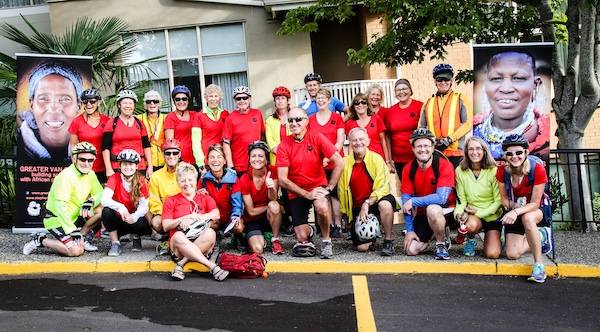
The inaugural Solidarity Cycle, in 2017. (photo by P. Simson)

We didn’t ride 100 kilometres, or even quite 50. It was a glorious symbolic ride in celebration of the many years of Solidarity Cycle, a much-beloved event that has seen dozens of cyclists and hundreds of supporters unite bike and heart to raise more than $400,000 for the Stephen Lewis Foundation Grandmothers to Grandmothers Campaign.

Even though Solidarity Cycle has pushed its last pedal – the event having been canceled this year – three members of Tikun Olam Gogos, who rode in the inaugural event back in 2017 and have served in numerous capacities every year since, just couldn’t let go.

Monday, Sept. 8 was a perfect day as Marie Henry, Darcy Billinkoff and I set out: not a drop of rain, not a wisp of smoke, just sunny skies with occasional clouds and a light breeze.

Nothing could keep us down, not Darcy’s fractured ribs, Marie’s stress injuries or my right hip, waitlisted for replacement. Could this “Wride of the Wrecked” be a clue to Solidarity Cycle’s demise?

There were more portents to come, but first it was time to ride.

Many features of our route to Westham Island came with joyful reminders of the previous cycles: cornfields reminiscent of the years of Chilliwack corn and chili celebration dinners, acres of sunflowers like those popping the Pemberton Valley ride the year of pandemic and big smoke, and kilometres of dike trails like those we traveled in Pitt Meadows. The one-lane, wood-deck river crossing onto the island was a refreshing antidote to that !@#$%!!! (oops, I mean challenging-but-fun) Golden Ears Bridge.

We reached our designated turn-around point, the Reifel Bird Sanctuary, to find the birds behind locked gates.

Even more dismaying, Emma Lea’s dairy bar was shut tight. NO ICE CREAM?! Clearly, the closed signs said it was time to wave a regretful goodbye to the ride that has fueled our summers and our love for the grannies these past eight years.

But, still, we weren’t quite done.

We topped off our ride with Heineken and lunch on the deck of the Riverhouse Restaurant and Pub, an indulgent reminder of many post-cycle beer and burger banquets. We always suspected we consumed more calories than we burned.

In the absence of a formal event this year, I did not solicit sponsorships. However, I set up a fundraising page to show my appreciation for the many people who have supported Solidarity Cycle over the years. Please do visit the page because there is a message there for you: slf.akaraisin.com/ui/grandmotherscampaign2025/p/BarbaraHalparin.

Without the yearly opportunity Solidarity Cycle has afforded you, I urge you not to forget the grandmothers and grand-others aiming to alleviate the scourge of HIV/AIDS that continues to significantly impact Africa. Here are some other ways you can continue your steadfast support for them, now that crucial international aid has been withdrawn. 

First, attend Tikun Olam Gogos’ other fundraising events. Second, be on the lookout for another in our fabulous concert series in the near future. Third, buy our merch! We sell our signature tote bags, pouches and other items, including our special edition O Canada line, at Fancy This Gifts (5044 48 Ave., in Ladner), by appointment at Joyce Cherry’s home boutique (604-261-5454) and on our website, tikunolamgogos.org.

You can also find our goods at several upcoming craft fairs: St. Thomas Aquinas Secondary School (Nov. 2); Dunbar Community Centre, St. Faith’s Church and St. Thomas More Collegiate (all Nov. 22); St. James Community Square (Nov. 30); and Kensington Community Centre (Nov. 30).

And, please – share your fundraising brainwaves with us because, of course, we are looking for a successor to Solidarity Cycle! 

Format ImagePosted on October 10, 2025October 8, 2025Author Barbara HalparinCategories LocalTags cycling, fundraising, Grandmothers to Grandmothers campaign, HIV/AIDS, philanthropy, Solidarity Cycle, Tikun Olam Gogos

Grammar insight on holidays

This year, I volunteered to help during High Holidays at my congregation. As a result, I became one of the “ticket ladies” on Rosh Hashanah. I used a cellphone that scanned bar codes on service tickets. When I first saw this being done on a holiday, I was surprised because of the technology use at a Conservative congregation on a day when some might not carry a phone. My family chose to print out our tickets, but times change. Even though everyone in my family had a printed ticket, we carried our cellphones anyway as we volunteered. It seemed safer to have our phones while walking to synagogue and while we were there. After all, that’s what the tickets are for, too. They indicate that the person belongs or has a spot and that the person is “safe.” 

The police and private security guards asked where they should position themselves. More than once, they indicated that being indoors in the lobby might be a good spot. Instead, they were asked to stand outside, in autumn’s sunny weather, guarding the doors and/or directing traffic. I heard only one incident of loud, angry shouts on the street, near the police officer there. That was enough for me. I was relieved police were there, and that there were master lists of everyone who might be in the building that day, just in case. 

While outsiders might think that this security is new, this is just the usual necessity at Jewish gatherings, though admittedly now more than ever. At odd moments between ticket scans, I thought of a dear family friend named Marge, who passed away in her 90s. Marge was a venerable and respected volunteer at the temple where I grew up. She was famous for her High Holiday ticket lady efforts. Marge was all business at the front door, a big smile for those she knew as they flashed their tickets. Yet, even if Marge knew you for 50 years, if you forgot your ticket, that grin vanished. A stern reprimand ensued. Marge kept us safe, and she wasn’t playing. She took that job seriously. 

The congregation where I grew up, Temple Rodef Shalom in Falls Church, Va., is right near Washington, DC. Rodef Shalom started out small in the 1960s, when my paternal grandparents were founding members. It grew rapidly, along with the Washington area. My mom started its preschool, ran the entire education program, and ended her career there as the administrator/executive director. As a Jewish professional’s kid, I knew where the emergency alarm buttons were and that synagogues near DC were frequent targets of hate. Congregation members who worked for the FBI or CIA formed part of the volunteer security patrol for the High Holidays, too. Everyone smiled as they said that “no-nonsense” Marge ran a tight ship. She was their best line of defence. 

Nobody knew this history in Winnipeg when I was given the ticket lady designation. I’d emailed with Marge right up until her passing. I tried to see her at every family visit. She loved to tell me about her Canadian grandfather, a fur trader whose family came from Sault Ste. Marie. The whole holiday, in between wishing everyone gut yontif, shana tova or sweet new year, I longed to tell Marge all about how I was a ticket lady now. I knew she’d love it. When I mentioned this to my mother, we both smiled over the phone. I’d never be as good at it as Marge was, but my mom also said, “Don’t worry, I’m sure Marge knows. She’s proud of you.” 

Being a ticket lady was an education. I’ve been in Winnipeg 16 years, so I recognized many names on the tickets, but definitely not all the faces. As people rolled in, I also recognized how diverse we are as a people. Some of us are early, others right on time – and then, there are the rest. 

This experience let me greet new people and hold on to lifelong connections. It made me think about a grammar term that’s fallen out of use. I wondered at how, as individuals, we are also dependent clauses. For years, we have seen news, books and other sources where the editing allows a sentence to start with “and” or “but” in a way that’s clearly dependent on the prior sentence. When I see this, I want to chastise, just as Marge might have. To me, that editorial choice still grates, but the volunteer experience made me see how the Jewish community works together. At the best of times, we are an enormous team, dependent on one another to function at our best.

Volunteering is an important part of Canadian identity. It was a required topic to study for my Canadian citizenship test, and I wondered why more congregants hadn’t volunteered. It was a vital part of my holiday this year. It reminded me how reliant we are on one another, as well as on our allies, our laws and law enforcement. Dependent clauses aren’t full sentences on their own. We, too, must remain connected to maintain meaning as Jews in Canada. 

In the Babylonian Talmud’s tractate of Zevachim, which I’m now studying, there’s a lot of time spent on what happens when a Temple (animal) sacrifice goes wrong. If the priests in the Temple had the wrong intention or person in mind when performing a sacrifice, it could mean the person’s sacrifice wasn’t valid. We don’t sacrifice at the Temple in Jerusalem anymore, but our intentions, towards ourselves, the community and the world, still matter. Volunteering wasn’t a sacrifice for me. It felt like I was fulfilling my role with the best intentions while I depended on others to keep me safe at that open door. Instead of any kind of sacrifice, it was a High Holy Day bonus. 

Joanne Seiff has written regularly for the Winnipeg Free Press and various Jewish publications. She is the author of three books, including From the Outside In: Jewish Post Columns 2015-2016, a collection of essays available for digital download or as a paperback from Amazon. Check her out on Instagram @yrnspinner or at joanneseiff.blogspot.com.

Posted on October 10, 2025October 8, 2025Author Joanne SeiffCategories Op-EdTags High Holidays, Judaism, lifestyle, security, Talmud, technology, volunteering

Deciphering “oy”

image - Guide to Jewish Sighs cartoon by Beverley Kort

Format ImagePosted on October 10, 2025October 8, 2025Author Beverley KortCategories LifeTags cartoons, Free Times Cafe, Jewish life
From the archives … social life

From the archives … social life

Oct. 10, 1935: This week, 90 years ago, community members were coming and going from the city. There was a Folk Song and Dance Festival and Arts and Crafts Exhibition coming up. Beth Israel, Young Judaea, AZA, BB Junior Auxiliary, Junior Council and Sub-Junior Council all had meetings and other events. China Seas and Page Miss Glory were screening at the Capitol Orpheum and Heart’s Desire was playing at the Strand.

The Jewish Western Bulletin / Jewish Independent has always covered the arts and culture scene. Amid the harder-hitting news, there have been society and social notes columns, social and club news sections, synagogue calendars, event listings, notices and advertisements, as well as articles promoting, reviewing or otherwise profiling various creatives (including community organizers) or their creations/events.

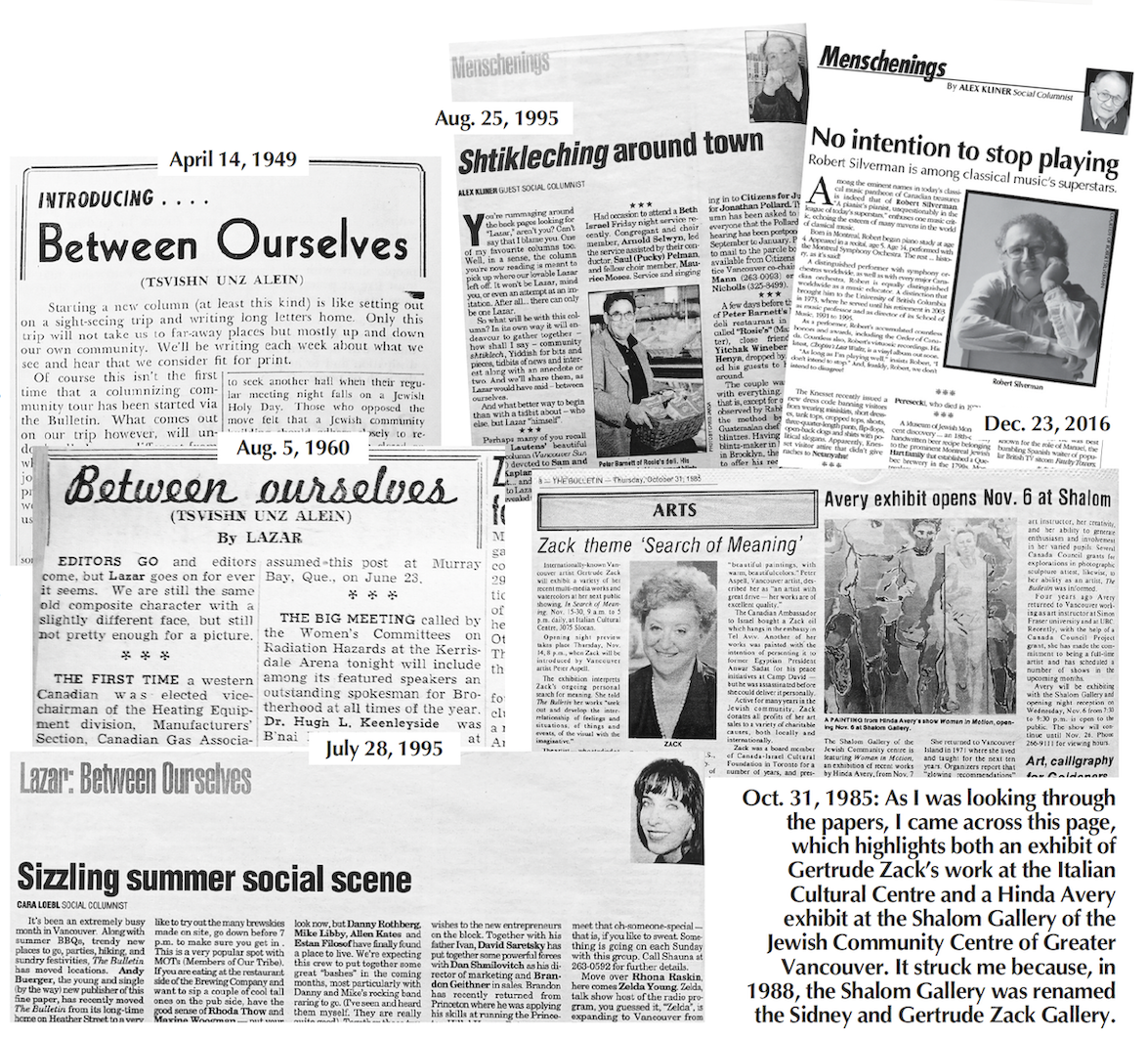
One of the longest-lasting social columns is Between Ourselves (Tsvishn Unz Alein) by Lazar, which started on April 14, 1949, when the JWB was run by the Vancouver Jewish Administrative Organization (akin to our Jewish Federation of Greater Vancouver) and Abraham Arnold was managing editor. When Sam and Mona Kaplan took over the paper in 1960, Mona Kaplan penned her first Between Ourselves (Tsvishn Unz Alein) by Lazar columns, in the Aug. 5 issue of that year, and she continued to be “Lazar” until the paper again sort of changed hands in mid-1995. While the Kaplans still owned the JWB, it came under new management, as they were beginning their retirement journey. At first, the new publisher, Andrew Buerger, kept the Lazar column – minus its Yiddish flavour – but editor Ariela Friedmann bid “Farewell to Lazar” (then written by Cara Loebl) a couple of months’ later, on Aug. 18, 1995.

Its replacement was Menschenings, which, Friedmann noted, would “give voice to all ages and aspects of the community, from social news, to what’s new, who’s new, some schmoozing, a bit of this and that.” 

Initially, the column was alternately written by two different writers, Jacqui Roitman and Alex Kliner, both of whom had experience in theatre and film. As many readers will know, Alex became the sole face of Menschenings, continuing through the Kaplans’ sale of the paper in mid-1999 to Kyle Berger, Pat Johnson and me. From his first column to his last, in 2016, when he retired, Alex’s writing was infused with Yiddish, having a heimishe (homey and familiar) quality like Lazar’s, meaning that Between Ourselves/Menschenings lasted some 67 years. 

image - Between Ourselves/Menschenings history in newspaper clippings

Format ImagePosted on October 10, 2025October 8, 2025Author Cynthia RamsayCategories From the JITags Abraham Arnold, Alex Kliner, Cara Loebl, history, Jacqui Roitman, Lazar, lifestyle, Mona Kaplan

Posts pagination

Previous page Page 1 Page 2 Page 3
Proudly powered by WordPress